
By Daniel Clark, 17th February 2025
Remote hearings, commenced during the COVID-19 lockdowns, have made it possible for more people to observe (and write about) cases in the Court of Protection. In fact, the majority of the blogs on the Open Justice Court of Protection Project website are written about remote hearings.
At the risk of stating the obvious, the Court of Protection does continue to sit in person. That is to say, all of the lawyers, the judge, and (sometimes) all the parties are in a physical courtroom.
We have a fairly good idea of how easy (or otherwise) it is to observe a hearing remotely. Sometimes we have to chase the links by phone and email; sometimes we hear nothing back at all. Other times, we receive the link well ahead of time.
What we don’t know so well is what access is like to the physical courtroom. Of course, we have plenty of blogs from in-person hearings[i], and these can give us a fairly good idea. These blogs often focus on the hearing itself, and detail issues like audibility and “private” signs on a court door.
When I started a research project with the Open Justice Court of Protection Project, we thought it would be good to look at how accessible the court buildings are: that is, before a hearing has even started.
This research project
The project (a Researcher Employability Project, or REP) is a requirement of my PhD funder, the White Rose College of the Arts and Humanities (WRoCAH). I had to undertake research with an external organisation, and I decided to make this offer to the Open Justice Court of Protection Project.
The first part of this research was compiling all of the rules, practice directions, statute, and case law that explains how judges should make decisions about transparency and open justice. The results of that research are here: “A review of transparency and open justice in the Court of Protection“.
WRoCAH offer some funding for travel and accommodation, so I asked them for the funds to stay in London for a couple of days. London could be described as the “home” of the Court of Protection, where its most senior judges regularly hear cases.
WRoCAH approved my application and, at the start of October 2024 (2nd-4th October), I stayed in London in order to get an idea of what access was like at the Royal Courts of Justice and First Avenue House. In my experience, it is a much smoother process to get a link for a remote hearing at either one of these courts compared to some of the regional courts, and I was interested to see how the in-person experience compared.
Of course, this is by no means a rigorous academic study. The only way to do that would be to visit each court that hears Court of Protection cases, assess access and transparency there, and then compare it to the experience of accessing a remote hearing. While WRoCAH have been extremely generous with the funding that they have provided for this project, I think it’s fair to say that this would be a step too far.
It’s also worth emphasising that this is a London-centric blog. It’s my hope in 2025 to visit some regional courts, and report back on how the experience compares.
I will first (1) discuss my first impression of both courts, as well as the process of getting through security. Then I will compare the process of finding the courtroom at (2) First Avenue House and then (3) the Royal Courts of Justice. I’ll then (4) raise a concern about the small font size of the signs at both courts, and (5) consider issues for all-day hearings, like toilets and the options for lunch. I then (6) make some tentative recommendations based on my own experience before ending with (7) a brief overview of access, reasonable adjustments and the Equality Act.
1. Entering the court: Security and first impressions
While in London, I decided to walk to both courts. It was a lovely, warm, October week, and my hotel wasn’t too far away. It is however possible to catch the tube: Chancery Lane is the closest to First Avenue House and Temple is closest to the Royal Courts of Justice.
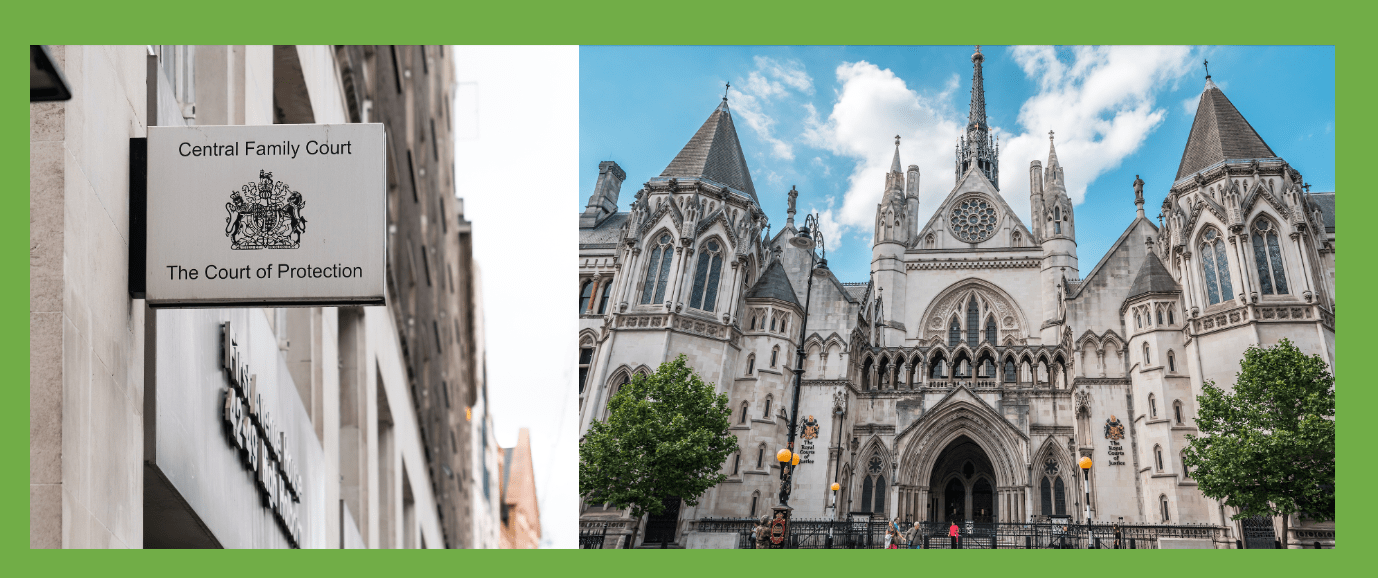
The Royal Courts of Justice is a large and imposing building. From the outside, it looks like it could be a church – a fairly beautiful church at that. I could admire its exterior as I walked down Bell Yard (adjacent to the court) and then on to the Strand (which is where you can find the main entrance).
By contrast, my first impression of First Avenue House was that it looked like it could be a building that contains council offices. As I walked down Browlow Street (adjacent to the court) I didn’t know what I was looking at until I turned left into High Holborn. There I immediately spotted a sign above the entrance, that reads, “Central Family Court” and “Court of Protection”.
There’s a small entranceway that contains a very large noticeboard. On the noticeboard is the daily cause list for each courtroom so you can check before entering the building that you’re in the right place and have got the right time
At the Royal Courts of Justice, the daily cause lists are affixed to a noticeboard inside the court. To check those, you need to go through the security process first.
When the Open Justice Court of Protection Project tells you to expect airport-style security at a courtroom, you must believe it. You need to empty your pockets, place your belongings (including hats and coats) through a scanner, and then you walk through a scanner. You also need to be prepared for the fact that you might be further scanned by a wand-type metal detector. You will be asked to take a sip of any drink that you have with you.
My visit to First Avenue House was exemplary. There were lots of security staff but each one of them was polite, explaining what I needed to do and when. This would surely be reassuring to those who had no idea what they needed to, especially family members and friends experiencing high levels of stress.
As it happened, it took me about two minutes to get through security – there was only person in front of me. I suspect that this was because I was attending just after lunch, and so there were fewer people entering the building.
When I attended the Royal Courts of Justice, I decided to use the main entrance (though there are other, more discrete, side entrances). I did this because that’s where most people would aim to enter from.
I arrived at 9:05 to a short queue that was mainly comprised of people in suits – lawyers, I assumed. It took me 15 minutes to get through security and, to my surprise given the size of the building, there were fewer security guards here than at First Avenue House.
They were however very friendly, and (when I explained I’d never been before) pointed me in the direction of the enquiry desk just past the security line.
2. Finding the courtroom: The experience at First Avenue House
It was fairly easy to find the courtroom in First Avenue House because there are signs everywhere. There is also an enquiry desk almost as soon as you enter, staffed (when I visited at least) by two people.
I knew from the signs that I needed to head to the fifth floor, which is where the Court of Protection sits. Once I arrived there (by lift, though there are stairs) I couldn’t see any signs telling me what to do next.
It turned out that I needed to “present” myself to the Court of Protection enquiry desk, so that I could sign in and receive a copy of the Transparency Order for the case that I was planning to observe. I only discovered that I needed to do this because I was asking where the courtroom was. A simple sign (preferably in large print – I’ll discuss this later) would be helpful.
However, of all the people I spoke to during my visit to London courts, the staff at the Court of Protection desk were the most friendly and helpful. They were as kind, patient, and courteous in person as they are in their email correspondence.
I had to sign an attendance sheet, which I understand is common practice at in-person hearings. The form directs you to sign your name and address but, when I asked, it turned out that I could provide my email address in lieu of my home address. This will be reassuring for many people who (for whatever reason) don’t feel comfortable providing their home address. I do however wonder whether the form should include a reference to this option. I was there to ask questions but somebody who is visiting the court for the first time, without any idea of what to expect, might write their address even if they don’t want to.
I was also provided with a copy of the Transparency Order, and told that I could ask the court staff about it if I had any concerns or questions.
3. Finding the courtroom: The (less positive) experience at the Royal Courts of Justice
It’s perhaps more accurate to describe the Royal Courts of Justice as an estate. In fact, I think I was a little underprepared for just how big it is.
Lots of walking doesn’t even begin to cover it, and the signs tend to intermittently appear and disappear. There are also a lot of steps. I’d guess that you wouldn’t be walking for further than half a minute before you come across at least a small flight of stairs.
I was told by staff at the enquiry desk that the building is wheelchair accessible. The website advertising tours of the RCJ also states that, while noting that it’s “only just” accessible – though that’s partly because the tour goes ‘behind the scenes’ to places most court users would not normally need to access if they were simply attending for a court hearing.
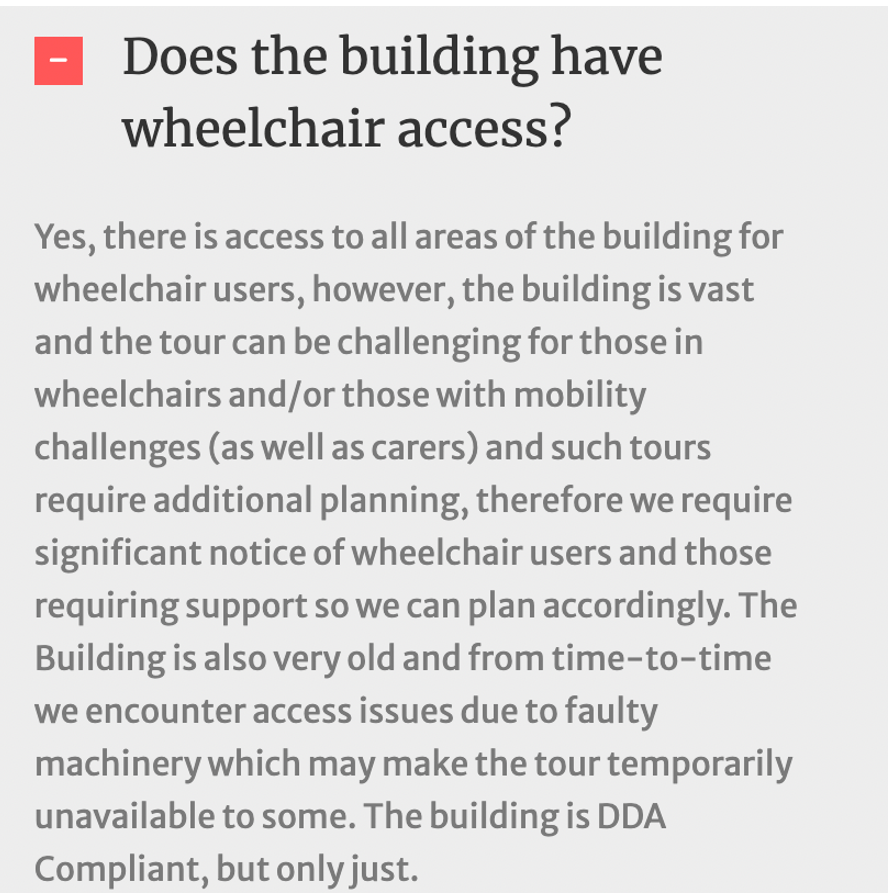
I think the “only just” description is accurate. I saw one lift not working, and the website does state that sometimes the building becomes inaccessible due to technical issues. But this isn’t really good enough, is it? We can’t meaningfully speak of an open justice system that accepts, as a matter of course, that sometimes wheelchair users will not be able to access the building.
I decided to first head for Court 39, which is where Mr Justice Poole was sitting as a judge of the Court of Protection. I also recognised this courtroom from the lists, and therefore knew that other Court of Protection cases are heard in there.
However, I struggled to make sense of the map and had asked at the enquiry desk where Court 39 is. They explained it’s in the Queen’s Building, and gave me pretty good directions. Neither the online list nor the printed lists include this extra information, so members of the public are left with a choice between deciphering a large map or asking for help at the desk – not great if you’re in a rush.
Once I finally arrived at Court 39 (signs for which only start to appear as you get closer), I noted an immediate problem. The court entrance is located on a long corridor with multiple other courtrooms: this is also where Family Court cases are heard (almost always in private). Fixed to the wall next to each courtroom entrance was this message: “NO ENTRY TO THE PUBLIC SAVE FOR ACCREDITED PRESS/MEDIA REPRESENTATIVES”.
I can well imagine that a member of the public could be put off from entering a courtroom with this sign next to the entrance, and court staff shouldn’t be surprised by this. It’s like me having a “NO POST” sign on my letterbox, and then being surprised when the Royal Mail doesn’t deliver to me.
On the door of courtrooms where Family Court cases were being considered, there was an additional “In Private. No Admittance” sign. But a member of the public who doesn’t know whether they should be allowed in anyway won’t necessarily notice this (and certainly won’t know how to interpret this disparity).
Luckily, there was a very friendly (and very busy) court usher who noticed me sitting at a table, and enquired who I was (she thought I might be a party who was late to a hearing). She confirmed that the cases were being heard in open court in Court 39, and that I was very welcome.
Once I’d decided which hearing to observe, I waited for quite a while – a hearing beforehand ran over by quite a lot. However, I wasn’t asked to sign an attendance form, which I understood was common practice. I also wasn’t given a copy of the Transparency Order until, at the start of the hearing I’d chosen to observe, the judge instructed the parties to give it to me. I wrote about that case here: “Treatment for Anorexia Nervosa: A brief directions hearing (with a new postscript on transparency)“.
4. Text size of signs
There was a stark similarity between the Royal Courts of Justice and First Avenue House: the text on notices is not very big.
The court lists, pinned on the foyer wall and inside the court building, were in the same font size as when they are posted online to CourtServe or the Royal Courts of Justice Daily Cause List. That isn’t a problem online because you can make them bigger but, at the risk of stating the obvious, you can’t do that when looking at a piece of paper.
In theory you could take a photo of the list, and enlarge it on your phone – but in practice you can’,t because (for reasons of security and privacy) it isn’t permitted to take photographs inside court buildings.
You could also try to look at the list by searching for it on Google on your phone. That isn’t wholly practical because the reception in both courts is quite poor, and the instructions on how to join the HMCTS WiFi network aren’t near the daily cause lists.
It isn’t just the daily cause lists that are in small print. In the waiting room at First Avenue House, I had to squint (admittedly I do use reading glasses) to read a sign that told me a water cooler was located on the sixth floor.
To its credit, First Avenue House does have multiple signs that all information could be asked for in an alternative format: for example, large print and braille. Perhaps ironically, this was not in a size of text that I would expect somebody who needs large print documents to be able to read. It goes without saying that it wasn’t in braille, either.
This was a similar problem in the Royal Courts of Justice: all of the signs were in a small font and the daily cause lists in the entrance were tiny. A copy of the standard Transparency Order was on a noticeboard outside Court 39 (where Mr Justice Poole was sitting as a judge of the Court of Protection). There were no other Court of Protection cases before other judges that day so I do not know whether this is standard practice or done at the direction of Mr Justice Poole.I thought that this was a good idea, notwithstanding the fact that it wouldn’t apply in every case. However, once again, the text was in the same size as it would be in a digital copy. This is an unnecessary, and easily corrected, barrier to access for those with poor eyesight.
5. What if I wanted to stay all day?
It’s not uncommon for a hearing to be listed for a full day (and even if not observing the same case all day, the public could observe multiple hearings in one day). I therefore wanted to check how practical that was.
One important element for this is the toilets. It would be difficult to stay without them. In both courts, these are easy to find (if you can read the signs) and there are plenty of them (though the toilets at the Royal Courts of Justice don’t quite match the grandeur of the rest of the building – they reminded me of railway station toilets, especially in the Queen’s Building).
There were toilets in both courts that were clearly marked as “accessible” and also operational. Those (male) toilets not identified as “accessible” were still well lit with wide doorways. Of course, I can’t vouch for the female toilets!
First Avenue House doesn’t have a café (at least not one I could find). However, I found the security process to be quick, and I don’t think it would be an undue burden if members of the public left the courtroom in order to get some lunch.While this does come with the disclaimer of the fact that the restaurants and cafes nearby are a little expensive (this is central London after all), there is also a nearby Tesco and Sainsbury’s where somebody could buy a meal deal. Alternatively, of course, somebody could bring their own lunch.
Just down the road is the Royal Courts of Justice, and (as detailed above) I found the security process to be a lot slower there – most probably because of the sheer volume of people going into the building. It therefore wouldn’t be ideal if somebody needed to “pop out” to get some lunch. It does however have a café, and I spent some time there before the hearing I’d chosen to observe.
The coffee was fairly cheap. I paid £2.55 for a black coffee, which wasn’t the nicest I’ve ever had but that’s hardly a barrier to open justice! The pre-packaged sandwiches were a bit more expensive at about £3-4 though this isn’t too far from the cost of a meal deal. I didn’t notice any halal or kosher choices but I did notice a vegan sandwich. That doesn’t mean halal or kosher choices aren’t available – regrettably I didn’t look in too much detail because, after quite a disappointing breakfast, lunch was far from my mind! Again, somebody would be able to bring their own lunch.
6. Some tentative recommendations
All in all, I enjoyed this visit to London. I’ve never been in a court before and, if I’m honest, I did enjoy my first experience of observing in-person hearings. There were some problems with audibility of the hearing itself at First Avenue House but I’m going to discuss that in another blog about the case itself (to be published in the next month or so).
I do think that there are some ways that the court buildings themselves could be made more accessible, both to those who need adjustments and members of the public more generally.
First, HMCTS need to consider how the Royal Courts of Justice can improve the physical accessibility of the court building. It really isn’t acceptable that a wheelchair user could arrive at court only to find that a lift has broken, and not be able to access it. I appreciate it’s an old building but does that really mean the technology can’t be updated? Of course, this isn’t just a problem for HMCTS, and nor is it unique to the Royal Courts of Justice – the government needs to invest in our court buildings.
Second, staff at the Royal Courts of Justice need to review the “PRIVATE” signs that seem to be a permanent fixture outside some of the courtrooms. I expected them to be there, and knew what they said wasn’t accurate. Other members of the public, perhaps observing a court hearing for the first time, may not.
Finally, both the Royal Courts of Justice and First Avenue House need to review the font size of their signs. It’s all well and good to have helpful messages about water coolers and where to ask for information in Braille but, if somebody can’t read it, that’s no help at all.
7. Accessing court and reasonable adjustments
The Equality Act 2010 is a piece of UK wide legislation that provides legal protection from discrimination for people with protected characteristics.
§4 of the Act identifies the following protected characteristics: age; disability; gender reassignment; marriage and civil partnership; pregnancy and maternity; race; religion or belief; sex; sexual orientation. Note that this list is in alphabetical order, and does not imply a ‘hierarchy’ of protected characteristics.
§20 of the Act then imposes a duty to make reasonable adjustments to avoid a disadvantage that may arise from certain features of an environment. One example given is ‘a feature of an approach to, exit from or access to a building’ §20(10(b). In practice, this means that buildings with steps leading to its entrance ought to provide a ramp or lift so that wheelchair users and those of reduced mobility can access the building in question.
For a more in-depth look at reasonable adjustments, I recommend reading this blog by Daniel Holt (whose website says that he is a barrister and Disability Activist): Reasonable Adjustments Explained
The Equal Treatment Bench Book guides judges in how they can make adjustments for those with disabilities in order to ensure that they can fully participate in the court process. For example, §177 gives examples of adjustments that had been made in criminal trials, such as, “requesting that all witnesses be asked “very simply phrased questions” and “to express their answers in short sentences”, to make it easier for a defendant (who had complex needs but no intermediary) to follow proceedings”.
These reasonable adjustments should also be made to court buildings. By making court buildings accessible, they are become both welcoming to all people as well as further the judicial aspiration for open and equal access to justice. As Helen Richardson, a Policy and Research Officer at the Magistrates’ Association, put it: “without accessible court buildings, an inclusive court estate that guarantees equal access to justice for all cannot be achieved.”
The Royal Courts of Justice have acknowledged problems with making this a reality because its listed status means there are restrictions on adjustments that they can make. However, at the end of 2023, they relaunched their “Disability Contact Officer network”, which is a team that devotes time to supporting people with disabilities. They run workshops for their colleagues, and help them with using accessible language.
This court also aims to provide large print forms, ensuring that “hearing enhancement systems are available and making sure ramps and lifts are available”. In my view, ensuring that lifts are available is a somewhat different goal to ensuring that lifts are functional.
Accessible courts don’t just ensure that all members of the public are welcome to participate in, and observe, court hearings. They are also important for lawyers and the judiciary, who may also need reasonable adjustments to assist their participation.
However, a 2023 report from the Magistrates’ Association describes the court estate as “insufficiently accessible”, which has an effect on the the recruitment of magistrates, as well as how frequently they can hear cases.
Inaccessible courts are bad for the public, bad for lawyers, and bad for the judiciary.
Daniel Clark is a member of the core team of the Open Justice Court of Protection Project. He is a PhD student in the Department of Politics & International Relations at the University of Sheffield. His research considers Iris Marion Young’s claim that older people are an oppressed social group. It is funded by WRoCAH. He is on LinkedIn, X @DanielClark132 and Bluesky @clarkdaniel.bsky.social.
Note: This blog reports on research conducted as part of a Researcher Employability Project (REP), which is funded by the White Rose College of the Arts & Humanities (WRoCAH). Notwithstanding this funding, which only Daniel is in receipt of, the Open Justice Court of Protection Project retains editorial control over this blog. Furthermore, the views expressed in this blog are those of Daniel, and not those of WRoCAH. Further information about the REP can be requested by sending an email to openjustice@yahoo.com.
[i] For example: An in-person hearing on anorexia (Re CC): Observer’s rollercoaster and the role of “hope” by Sydney White; My first in-person observation at the Royal Courts of Justice by Amanda Hill; Exemplary open justice: An in-person hearing at Teesside Combined Court by Claire Martin; Inaudible in-person proceedings: A practical barrier to transparency and open justice by Tim Sugden; A committal hearing to send P’s relative to prison – and the challenges of an in-person hearing by Claire Martin
 Promoting Open Justice in the Court of Protection