
By Celia Kitzinger, 24th February 2026
The judgment is now published (click on the title to read it)
Lesley Barnor Townsend -v- Epsom and St Helier University Hospitals NHS Trust [2026] EWCA Civ 195
UPDATE 27th February 2026
The Court of Appeal decision: Permission to appeal was granted on Ground 3 and the appeal has been allowed. Ground 3 is this: “The learned Judge erred in holding that a ‘clinical decision’ to withhold life sustaining medical treatment is not subject to best interests considerations and hence is not subject to the supervision of the Courts.” The case was remitted to the COP and a hearing listed at 10.30am before Morgan J on Friday 27 February, but sadly P had died during the night. I extend my condolences to his family.
Over the last couple of years, judges have been talking a lot about the importance of open justice and transparency.
But when I watched a Court of Appeal case yesterday (Monday 23rd February 2026), I found – yet again – that it’s not working very well in practice.
The theory of open justice
In a speech called “Justice must be seen to be done”, Mr Justice Cobb said: “It is a general principle of our constitutional law, and in the upholding of the Rule of Law, that justice is administered by the courts in public, and is therefore open to public scrutiny”. He quotes from a recent judgment: “In a democracy, where the exercise of public authority depends on the consent of the people governed, the answer must lie in the openness of the courts to public scrutiny”.[1]
In 2024, the Lady Chief Justice, set up a “Transparency and Open Justice Board”. In her speech announcing this, she says that “open justice is, first and foremost, a constitutional principle grounded in common law: one that over centuries the judiciary have defined, applied and defended”[2]. In her view,
“The greatest threat comes not from direct attack on the principle, but rather from careless – sometimes inadvertent – failures to protect its ideals. I intend the judiciary to step up, continuing to play our important constitutional role of protecting and promoting open justice as an essential element of the rule of law.”
The judge she appointed as Chair of the new “Transparency and Open Justice Board”, Mr Justice Nicklin, says that “over centuries, it has been the judiciary that has steadfastly recognised the importance of open justice and judges who have worked consistently to articulate its principles and promote its objectives”. In his speech he said:
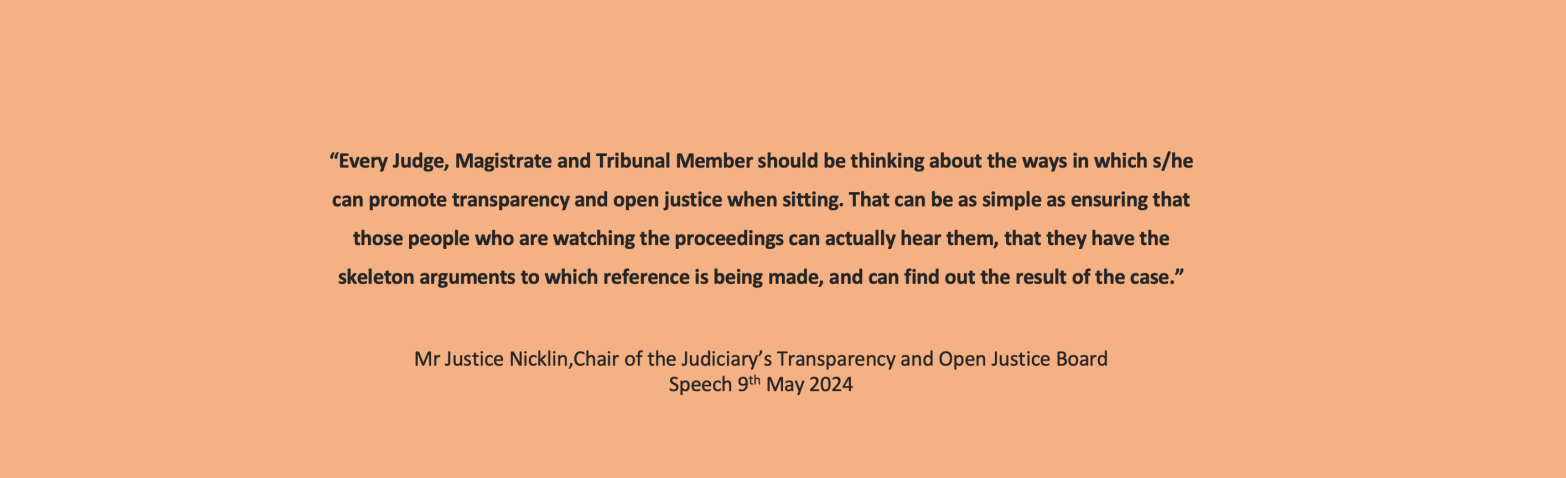
“… every Judge, Magistrate and Tribunal Member should be thinking about the ways in which s/he can promote transparency and open justice when sitting. That can be as simple as ensuring that those people who are watching the proceedings can actually hear them, that they have the skeleton arguments to which reference is being made, and can find out the result of the case.”[3]
Open justice in practice
The hearing in the Court of Appeal was listed like this:

So far, so good. Live streaming started in 2019 and is intended “to improve public access to, and understanding of, the work of the courts”.[4]
I’d been looking out for this case because the week before, I’d watched the Court of Protection case that was being appealed. I heard Mrs Justice Theis deliver her oral judgment around 5pm after a full-day hearing. I’d seen the lawyer representing the family ask for permission to appeal and heard Theis J refuse it – on the grounds that it stood no realistic likelihood of being successful. But here it was. Clearly, the Court of Appeal judges had thought it worth hearing the case.
I am prevented by a Transparency Order from saying very much at all about what the case is about – and I am a little surprised by the descriptor produced by the court in the public listing: “The case concerns serious medical treatment and best interests”. My description would be a bit different. It certainly concerns serious (life-sustaining) medical treatment – but the question of whether the decision about continuing or withdrawing it is a ‘best interests’ decision lies at the heart of the case. The Trust says it is not a ‘best interests’ decision, but a ‘clinical’ decision.
Usually, the serious medical treatment cases heard in the Court of Protection concern which of the available treatment options is in P’s best interests. Because P can’t consent to medical treatment, the court “stands in P’s shoes” and gives or refuses consent to whatever treatment the doctors are offering as clinically appropriate. In effect, that places P in the same position as a capacitous person, with a court’s decision based on best interests criteria substituting for capacitous consent.
But when a particular treatment is not available as an option because doctors do not consider it to be clinically appropriate, then the court cannot make a decision on P’s behalf that overrules the doctors.
In this case, the doctors were saying that a particular treatment was not available to P because it wasn’t clinically the right thing to do. I watched in the Court of Protection hearing as the lawyer for the family asked the judge to order the doctors to give the treatment, and to attach a penal notice if necessary.
The judge said this was outside her jurisdiction – not something the Court of Protection can do. She declined to hear the case – and she refused permission to appeal.
But now it was before the Court of Appeal…. on what grounds I wondered?
Based on my previous experience of Court of Appeal hearings, I was sceptical about how transparent it would be. Yes, I would be able to watch what was happening on their YouTube channel, but would I be able to make any sense of it?
For one thing, I didn’t have (and still don’t have) a copy of the judgment being appealed. I’d heard the judge in the lower court give an oral judgment, and I knew it was being transcribed and she would formally approve a transcript so that the lawyers for the family and the other parties and the judges in the Court of Appeal would have a proper record of the reasons for her decision. The lawyers and judges in the hearing would all have that judgment in front of them and probably refer to numbered paragraphs within it. Would I be able to follow it?
Secondly, I didn’t have any of the skeleton arguments for the Court of Appeal. The most important document, from my perspective, is the written submission from the family supporting the application to appeal and the grounds of appeal. Without knowing the grounds of appeal, how would I follow the case? I also wanted to understand the opposing arguments of the Trust and the Official Solicitor. (I do now have the skeleton argument for the Trust which arrived some hours after the end of the hearing – but not that of the OS or the family.)
Third, I was still bound by the Transparency Order from the Court of Protection and can say virtually nothing about the case, despite the fact (or more accurately because of the fact) that there is information about it in the public domain, both in the national and international press and on social media. I assumed the Court of Appeal would need to address this in some way, but until they do, I am effectively unable to report on the substantive matters. (As it turned out, they left the earlier TO in place in its current form and it still applies as I write this.)
I emailed the Court of Appeal (time stamped 08:58 on 23rd February 2026) raising these concerns, setting out some arguments for transparency, and asking for three things:
- Variation of the reporting restrictions to permit reporting of the names of P and the family (in addition to the name of the Trust) so that there can be meaningful reporting of this case. (The names of P and family members are already in the public domain in a press release and national and international media in connection with this case – and they want to be named.)
- Publication of the judgment by Theis J in advance of the hearing to appeal it (or failing that, a copy of the judgment that I can make public).
- Making the skeleton arguments accessible to the public.
These seem to me modest requests. They were matters that should properly have been considered in advance of the hearing, or at the very beginning, by any judge “thinking about the ways in which s/he can promote transparency and open justice when sitting”. [5]
The matter of reporting restrictions was raised by the barrister for the family – because the family want to be able to speak about the case, in their own names, and to name P. They object to the interference with their right to free speech. They had said the same thing in the Court of Protection hearing too. It seemed to me that the three Court of Appeal judges treated this as an administrative matter rather than a principled issue of Article 10 right to free speech. The judges did not engage in a balancing exercise of Article 8 and Article 10 then, or later. They deferred the discussion until the end of the hearing (so everyone was referred to with an alphabet soup of initials), and then deferred it again at the end of the hearing until the following day. I have not received a revised Transparency Order.
The judges simply ignored the obvious fact that members of the public observing the hearing did not have either the judgment that was being appealed, or the skeleton arguments. I think they didn’t receive my email until the hearing was well underway – I have no evidence that they read it until my requests were raised after the lunch hour. It seems there was a large volume of correspondence in the office that day. But shouldn’t the need for public release of the judgment from the lower court, and the skeletons, have been predicted? It seemed that the judgment had not been redacted in accordance with the Transparency Order (why not?) so the suggestion was to ask Mrs Justice Theis for it (which obviously meant I didn’t have it in time to follow this hearing).
To repeat:
“… every Judge, Magistrate and Tribunal Member should be thinking about the ways in which s/he can promote transparency and open justice when sitting. That can be as simple as ensuring that those people who are watching the proceedings can actually hear them, that they have the skeleton arguments to which reference is being made, and can find out the result of the case.”[6]
And this, again from Mr Justice Nicklin:
28. To my mind, open justice has four fundamental components:
a) open courts: that the public (including representatives of the media) can access court hearings – this includes physical access to court buildings and (where the facilities are available) remote access to hearings;
b) open reporting: that the public and media can freely report on proceedings held in open court, and that any restrictions imposed by the court preventing (or postponing) reports of proceedings (including anonymity orders) must (1) have a statutory basis; and (2) fulfil a legitimate aim, be necessary, proportionate, and convincingly established by clear and cogent evidence:
c) open judgments: that the court’s decision (and the reasons for it) should be publicly available; – on this point the interesting issue of ‘courts of record’ may well need to be considered; and
d) open documents: that the evidence and submissions communicated to the court is available to the public so that they can make sense of proceedings and the decision of the Court or Tribunal. The importance of this factor is greater in modern litigation because of the increased reliance, in many jurisdictions, upon written witness statements (often standing in place of a witness’s oral evidence) and written submissions. As I observed in a case in 2022: “The availability of skeleton arguments, and witness statements, deployed in open court hearings is essential to any meaningful concept of open justice”. (§28)
So, going through each of these “four fundamental components” in turn as they applied to this hearing.
- the court was ‘open’ in the sense that I was able to watch it, and so did around 50 other people on line contemporanously and it was recorded for posterity and is available on line (https://www.youtube.com/channel/UCdqOblYsySX4cj0nGV6RNSA) where it’s so far had around 600 views. Plus there were 3 or 4 journalists in the press box in the physical courtroom. But for remote observers, there were difficulties in hearing what was going on especially at the beginning because lots of people had their microphones on and someone was typing very loudly into theirs. At least one observer left in frustration at being unable to hear what was said as a result.
- I can’t openly report on the proceedings and (although all counsel made submissions about the reporting restrictions), the judges continued to impose existing reporting restrictions without disclosing the legitimate aim of so doing.
- The judges said that their decision on the substantive matter under appeal would be handed down the following morning by email to the parties. If that’s what’s happened, that means that a decision has been made but it’s not public. They did not give any indication as to whether or not, or how, or when, their decision would be made public.
- No skeleton arguments were provided for ordinary members of the public (I don’t know if journalists got them) until after the judges received my request during the lunch break. Nor did we have access to the judgment that was being appealed. I struggled to understand what was going on, despite having attended the hearing in the lower court. I can’t imagine how difficult it must have been for those who hadn’t even attended the previous hearing. I’ve repeatedly raised concerns about the failure to provide skeleton arguments in the Court of Appeal (see Transparency requires free and timely public access to skeleton arguments in the Court of Appeal and How not to do open justice in the Court of Appeal). I hoped things might have improved. They have not.
So, no, it doesn’t seem to me as though the judiciary in this case “applied and defended” open justice principles. What I see instead is what Lady Carr has described as “careless – sometimes inadvertent – failures to protect its ideals”.
In my experience, there is an unbridgeable gulf between the fine words and noble theory of open justice and the on-the-ground reality. And what that means, in the end, is a lack of confidence in the judiciary and in the justice system. The Court of Appeal on this occasion was not really open to public scrutiny – and that corrodes public confidence in the rule of law.
Celia Kitzinger is co-director of the Open Justice Court of Protection Project. She is on LinkedIn (here), and also on X (@KitzingerCelia) and Bluesky (@kitzingercelia.bsky.social)
[1] A v British Broadcasting Corporation [2014] UKSC 25; [2015] AC 588 at [23] https://www.judiciary.uk/speech-by-mr-justice-cobb-justice-must-be-seen-to-be-done/#_edn14
[2] https://www.judiciary.uk/speech-by-mr-justice-nicklin-transparency-open-justice-opportunities-and-challenges/
[3] (§33 https://www.judiciary.uk/speech-by-mr-justice-nicklin-transparency-open-justice-opportunities-and-challenges/#_ftnref27
[4] https://www.judiciary.uk/the-court-of-appeal-civil-division-live-streaming-of-court-hearings/#:~:text=Most%20cases%20from%20the%20Court,the%20work%20of%20the%20courts.
[5] (§33 https://www.judiciary.uk/speech-by-mr-justice-nicklin-transparency-open-justice-opportunities-and-challenges/#_ftnref27
[6] (§33 https://www.judiciary.uk/speech-by-mr-justice-nicklin-transparency-open-justice-opportunities-and-challenges/#_ftnref27
[7] §28 https://www.judiciary.uk/speech-by-mr-justice-nicklin-transparency-open-justice-opportunities-and-challenges/
 Promoting Open Justice in the Court of Protection
One thought on “The gulf between theory and practice: Open justice in the Court of Appeal”