

By Celia Kitzinger, 8th November 2023
Fortunately it seems to have been a one-off, but I was very surprised to be asked to pay £5 for a copy of an approved Order made by a judge at a public hearing.
We’re entitled to receive these Orders under Court of Protection rule 5.9, which concerns “Supply of documents to a non-party from court records”. It says:
5.9.—(1) Subject to rules 5.12 and 4.3(2), a person who is not a party to proceedings may inspect or obtain from the court records a copy of any judgment or order given or made in public.
Court of Protection rule 5.9,
In practice, it’s common for judges to make clear oral judgments or orders in court, and I often don’t ask for a written version. But when I’m unclear about what a judge has decided, or when – on the basis of what is said in court – I might want to express concern about or criticism of a judicial decision, it’s important for me to be able to obtain the written version and make sure that I understand correctly what the judge has done.
In this case (COP 13960342 before District Judge OmoRegie, sitting at Dartford County and Family Court on 11th October 2023) I was concerned by what seemed – in the hearing – to be an inadequate response to parental concern about possibly unauthorised restraint of their son. Both parents were in court and expressed dismay about an incident in which (they said) their son had been restrained by untrained personnel, leaving him “traumatised”. What I gathered from the hearing was that the judge’s response was point out that there was provision for a Round Table Meeting at which the parents could raise their worries about this incident. I asked for the Order because I was concerned about the apparent lack of judicial oversight of restraint in this case. And when I got the Order, I found that in fact the issue of restraint had been (in my view) properly addressed – as I report in an earlier blog post (“Judge concerned about “restraint regime” for learning-disabled man prohibits naming public body).
In response to my request for a copy of the approved Order, I received an email from an administration officer with His Majesty’s Courts and Tribunal Service (HMCTS) saying, “In order to receive the order you will need to pay a £5 fee, this can be done via cheque or if you provide us with a phone number to contact you on we can take the payment over the phone“. She helpfully provided me with a link to a pdf explaining the fees payable (here: https://assets.publishing.service.gov.uk/media/61547ac5e90e0719827b8ebe/COP44_0921.pdf)

And I paid up. I did so because I was really concerned about this case and wanted to find out what the judge had ordered (and because I can afford £5 without hardship – something that isn’t true of all members of the public observing hearing). The Open Justice Court of Protection Project is unfunded, so we won’t often be asking for Orders if we have to pay for them, since the fees would come out of our own pockets.
It took about an hour to sort out payment because I couldn’t get through the automated system to a real person able to take my credit card details and spent ages getting cross listening to muzak. When I emailed complaining, they kindly called me back very promptly. I paid and I got the Order.
But I also asked journalists whether they had to pay for Orders and discovered they did not. Press Association journalist Brian Farmer told me that although the press does sometimes have to pay for some documents, Orders from public hearings are not amongst them. Freelance journalist Louise Tickle tweeted publicly:
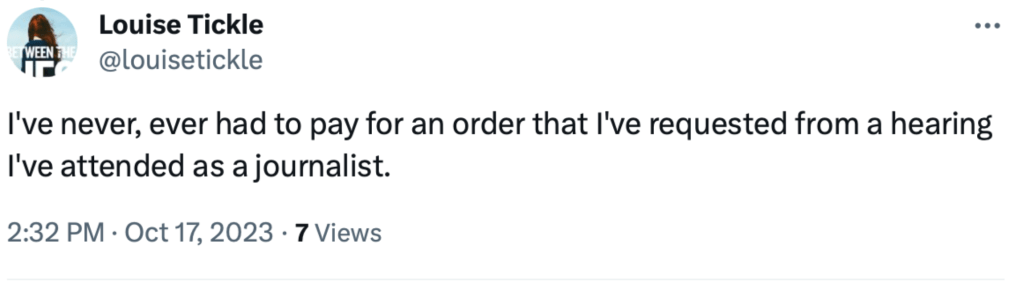
So I wrote to HMCTS as follows:
I’m concerned that you may be operating a policy whereby members of the public are charged for court orders but journalists are not. Is this so? Is it a formal policy and if so please can you send me a link to somewhere it exists in writing? Can you explain the justification for this policy (if it exists) please. If there is no such policy (formal or informal) please can you explain how it came about on this occasion please that I was charged for a court order. I’m concerned because my request was motivated solely by my wish to report accurately on what I had observed in court and the judicial decision, and it has a chilling effect on open justice to charge us for checking our facts.
Email from Celia Kitzinger to Deputy Service Manager, HMCTS (14:50, 17 October 2023)
The response was to send me a copy of the “fees leaflet for COP” (COP44 – Court of Protection – fees (publishing.service.gov.uk) and the comment that journalists shouldn’t be getting the Orders for free “as I understand the fees apply to all, the fee has been in place for a long time now and isn’t dependant on who is requesting a copy“.
But it seems, in fact, that the fee is, in practice, dependent on who is requesting a copy. Journalists tell me they receive them without having to pay and a former member of the HMCTS staff told me privately that it was routine to ask members of the public to pay, while supplying documents to journalists for free.
Meanwhile, lawyers started to debate whether or not an Order is “a document filed” as per the wording of the “fees leaflet”. It seems it all depends what you mean by “filed”: an Order is not filed by the parties for attention of the judge (like applications or witness statements) but, in principle, emanates from the judge for the attention of the parties; on the other hand the draft Order – whether agreed or contested – could be considered to be “filed” by the parties for the judge to consider, since it is regularly part of the court bundle submitted by the applicant. Last I heard, legal opinion was divided on this matter.
But leaving aside legal arguments about the meaning of the word “filed”, it’s inevitable that charging for Orders would have a chilling effect on open justice – whether charges apply only to members of the public or to journalists as well.
I’ve since made a Freedom of Information Request (no response yet) asking about policy and practice of charging journalists for Orders.
And I’ve asked for eight more Orders from a range of judges, including High Court, circuit and district judges across different hubs (including the Reading hub which charged me on this occasion). The good news is, the subsequent eight Orders have all been sent for free. Nobody has asked for any more £5 fees!
I’m now aware, however, that HMCTS could, in principle, charge me (and journalists) for Orders, and that the “fees leaflet for COP” provides for that – so it’s at someone’s discretion when the fee is not levied.
I’m not sure that requiring a fee for an approved Order from a public hearing can really be justified.
Of course other court documents can cost a great deal more. There has been a lot of publicity recently about the high costs of court transcripts, e.g. one rape survivor said she was quoted £7,500 for the transcript of her trial (“Court transcript costs are exploitative – victims“).
The outrageously high cost of transcripts doesn’t negate my concern with having to pay £5 for an Order. Unlike transcribing potentially weeks of a video-recorded hearing, and then getting a judge to check it for accuracy, an Order already exists as a document approved by the judge and sent to the parties. It doesn’t have to be created from scratch – whether at public expense or charged to a party. The only extra work required when I ask for an Order is to send it to me. And it comes as a pdf attached to an email The days are long gone when someone had to photocopy and distribute a paper copy of the Order by snail mail or fax (remember fax machines?) which I can see would increase the costs – although given that Orders are rarely more than five or six pages, £5 still seems exorbitant.
I’m grateful to Daniel Cloake (aka @MouseInTheCourt) for drawing my attention to Lord Wolfson’s argument that “enhanced fees, meaning they are set above the cost of the service” are appropriate and that it’s “considered correct for those who can pay more than the actual cost of the process to do so” as “fees are the main source of direct income for courts“. Obviously, I don’t agree that enhanced fees are appropriate from the perspective of open justice. And in any case, if it’s “those who can pay more than the actual cost of the process” who are being targeted to subsidise the crumbling justice system, then it’s surely professional journalists (via their employers) and not ordinary members of the public who should be paying!
I’m pleased this seems to have been a one-off. I hope it remains so.
Celia Kitzinger is co-director of the Open Justice Court of Protection Project. She has observed more than 490 hearings since May 2020 and written more than 100 blog posts. She is on LinkedIn (here), and tweets @KitzingerCelia
 Promoting Open Justice in the Court of Protection
One thought on “Judge’s order sold for £5: Monetising open justice”