

By Celia Kitzinger, 25th March 2024
It was listed as a committal hearing – an application by Barnsley Metropolitan Borough Council to send “DB” to prison.
It caught my eye because it wasn’t listed the way committal hearings are normally supposed to be.
The Practice Direction for Committal for Contempt of Court specifies that the name of the person alleged to be in contempt of court should be given in full. But it referred to this person only by the initials “DB”. And it says that, although the hearing is “public” there are “reporting restrictions”.
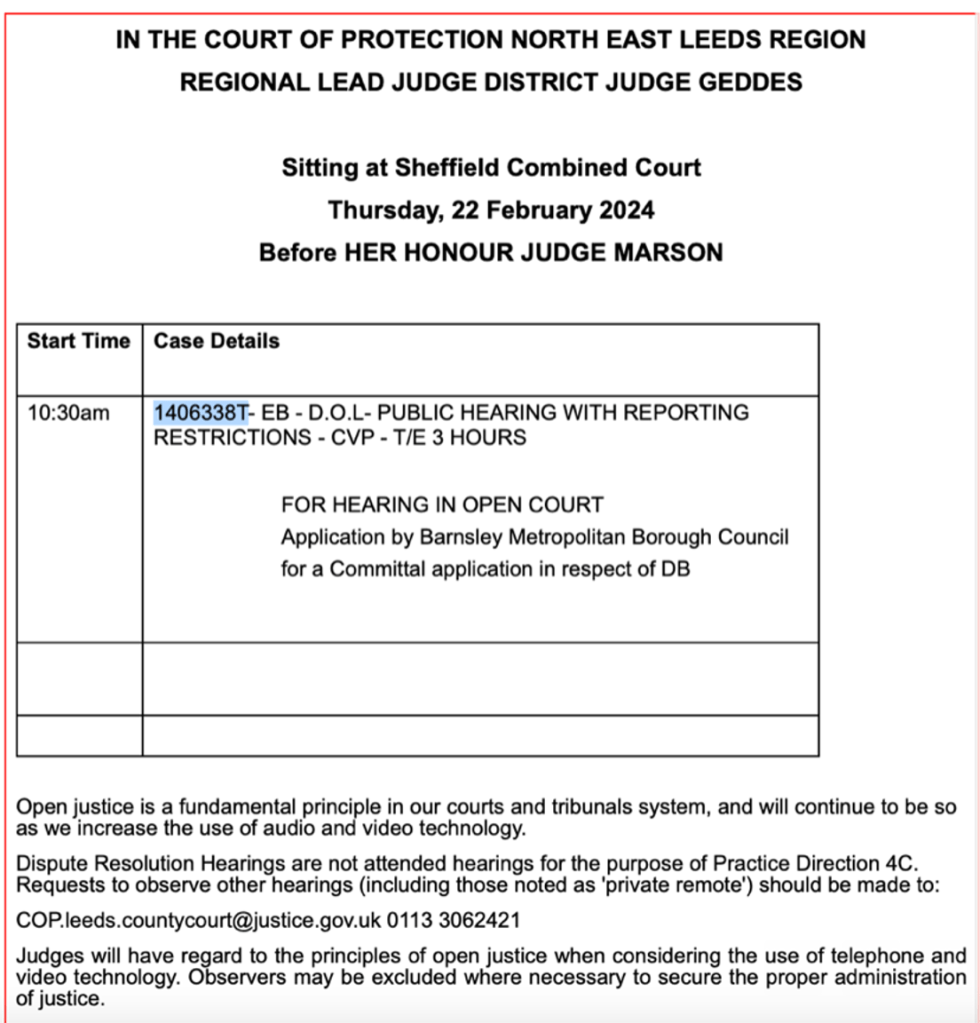
Who is “DB”? What has he done that the local authority is applying to send him to prison? And why is he at risk of being sent to prison effectively in secret, without the public knowing – or being allowed to tell anyone – who he is?
I was sufficiently alarmed by this listing that I wrote to the judge (care of the Leeds Court of Protection hub) in advance of the hearing, raising my concern about the discrepancies between this listing and the guidance in the Practice Direction (albeit that it permits of exceptions). I also asked for the link to observe the hearing.
The hearing
It was apparent from the outset that this case (COP 1406388T) has run into problems.
Counsel for the local authority, Rebecca Titus Cobb (St John’s Buildings) introduced herself and counsel for the protected party (Richard Borrett, Kings Chambers). She said that DB, the alleged contemnor, was not present, and was not represented.
At this point, I wondered if the court would actually proceed with the committal hearing and risk sending DB to prison in his absence.
The judge, Her Honour Judge Marson, didn’t seem surprised that DB wasn’t in court. I subsequently learnt that he had a track record of not attending hearings.
She did address at the first opportunity “the way this case is listed on Courtel” – i.e. my concern about the fact that DB had not been named in the listing. My understanding is that, initially, the intention had been to name him, but the judge had: “… become aware that the defendant can apply to court for non-disclosure of their name and I’m not able to identify that opportunity to have been communicated to DB […] I don’t know if he would wish to make such an application. That I hope explains why the entry on Courtel was changed to initials, in the event that such an application was going to be made and needed to be determined. Otherwise, it would be otiose, because the information would already be out there”. The judge then checked with Rebecca Titus-Cobb, “Am I right that he hasn’t been notified?”. “I suspect that is right”, she replied. “I don’t know”.
It seems that DB has breached the transparency order designed to protect the privacy of the vulnerable person at the centre of this case EB, whose deprivation of liberty is before the court. For reasons that weren’t clear to me, DB is parking his car near EB’s previous placement with Court of Protection documents visible through its windows. He’s been doing this since mid-September 2023: one court order that he must remove this material had been apparently complied with (in October) but by November 2023 he had resumed displaying the material – and the local authority filed an application to commit DB for contempt of court.
There was then a hearing on 13th December 2023, which DB was aware of but chose not to attend. That hearing was adjourned until 9th January 2024 to allow time for him to apply for legal aid and get legal representation. Again, though he chose not to attend. This hearing, on 22nd February 2024 was yet another attempt to hold an effective committal hearing.
It failed – due to multiple procedural defects identified by the judge – defects which, she said, “have troubled me a great deal”.
The following is taken from the oral judgment
“Firstly, Rule 21.8(5) states that the defendant’s name will appear on the court list unless the court makes a rule that their name should not appear. I have for the first time this morning had the opportunity to read Esper (Esper v NHS NW London ICB (Appeal : Anonymity in Committal Proceedings)[2023] EWCOP 29). The defendant has never been informed of his right to have rule 21.8(5) considered, or to make any representations about that. It may be that if an application were made, there would be no merit to it, but I have not considered the merits of it. The procedural irregularity is that he’s not had that opportunity.”
Secondly, the form that purports to be the application for the committal is wrong. The local authority has not lodged a COP 9. They have borrowed a form, M600 from another jurisdiction. It is the wrong form.
Thirdly, this court directed the defendant should be personally served with a notice of contempt by 19th January 2023, setting out the evidence relied on by the local authority, with a separate list of allegations numbered and identified separately to make it clear what it was being said he’d done, and when, and why it breached the order. This was not done by 19th January, and no application to extend the time was ever made. It was filed and served on Tuesday this week, less than 24 hours ago. The notice of contempt filed on Tuesday has information presented in a manner which I consider to be confusing, using an “and/or” format which is insufficient to enable someone to identify which order they breached and when.
Finally DB has not participated in the proceedings but at no point has there been any consideration of a summons.
I have considered all of those defects and have had regard to Rule 20 of the Court of Protection Rules on appeals which states “The appeal judge shall allow an appeal where the decision of the first instance judge was […] unjust, because of a serious procedural or other irregularity in the proceedings before the first instance judge” (§20.14(3)(b)). I am satisfied there are procedural irregularities and any decision I may made is likely to be successful on appeal, so I am going to strike out and dismiss this application for its procedural defects. I am aware I can waive defects if I am satisfied this would cause no injustice, but I am not so satisfied. I therefore dismiss the application that is before me today.
I do not criticise parties for those defects in a context where there is, in my view, a need – an urgent need – for committal templates in the Court of Protection. Without them, the parties and the court are challenged by everyone’s best endeavour to comply with the rules. Clear templates are need to assist everyone.
I assume that if DB continues to display confidential material relating to the case in public, the local authority is likely to make a new application, and so we may see the committal case back in the listings in future.
Celia Kitzinger is co-director of the Open Justice Court of Protection Project. She has observed more than 500 hearings since May 2020 and written more than 100 blog posts. She is on LinkedIn (here), and tweets @KitzingerCelia
 Promoting Open Justice in the Court of Protection
When I read this I think of an overworked local authority solicitor swamped with work. It does seem like there’s an inequality of arms sometimes in the CoP. I hope they manage to put in a new properly prepared application and stop any harm to P.
LikeLike