

By Jenny Kitzinger, 20th August 2025
A couple of weeks ago I observed a hearing about ‘YD’, a 60-year-old man in a Prolonged Disorder of Consciousness at the lower end of the spectrum (a vegetative state). The Trust had made an application that it was in YD’s best interests to withdraw life-sustaining treatment, specifically clinically assisted nutrition and hydration. This was opposed by YD’s family and friends as well as (by the end of the hearing) the Official Solicitor acting as YD’s litigation friend.
At this contested hearing, the Trust’s witness (YD’s treating consultant) and the independent expert (Dr Andrew Hanrahan) gave evidence that continuing life-sustaining treatment was not in YD’s best interests. The witnesses for the family, YD’s two partners and a close friend, all thought that clinically assisted nutrition and hydration should continue and that it is what YD would want for himself. I blogged about the hearing and what the witnesses had to say here: “A patient with “unusual” spiritual beliefs: Is withdrawing a feeding tube in his best interests?”.
The judgment has now been published: The Hillingdon Hospitals NHS Foundation Trust v YD & Ors (Refusal of Withdrawal of Treatment) [2025] EWCOP 31 (T3) (12 August 2025). The judge, Mrs Justice Theis, Vice President of the Court of Protection, decided that it is in YD’s best interests to continue to receive clinically assisted nutrition and hydration to keep him alive.
The judge acknowledged that the best interests test must “consider matters from the patient’s point of view”, though this is not “determinative” (§80) and she thought that she “now has a rounded picture of the values and beliefs that would be likely to influence YD’s decision if he had capacity” (§82). His values include “long held beliefs about the healing power of the mind, body and soul” and beliefs “regarding the spiritual world and healing” (§83). The judge said: “Having looked at the wider evidential picture I do not accept the narrow view taken by Dr Hanrahan [who thought it was not in YD’s best interests to continue with CANH] as it did not pay sufficient regard to the evidence of YD’s beliefs and values and wishes and feelings” (§87). The strong presumption in favour of life is not, she said, displaced in this case (§87).
I was pleased to see that, after making the decision for YD, the published judgment goes on to discuss the need for the ICB to play an active role in cases like this, and comments on the need for appropriate funding and placement for patients in YD’s situation (§88-§92). The firm representing the NHS Trust which made the application emphasised this:
“A significant aspect of the evidence was the spotlight it placed on the challenges faced by acute Trusts in managing patients in prolonged disorders of consciousness, and the question of who should initiate applications of this nature. […] Mrs Justice Theis highlighted the need for clearer guidance on when and how ICBs should be involved in Court of Protection applications. […] Importantly, the judgment reinforced that ICBs cannot remain passive. Mrs Justice Theis stated that ICBs must take a proactive role, avoiding delays, ensuring all relevant parties are represented, and seeking urgent directions from the court where necessary.” (“Law and Belief: Navigating clinical certainty and spiritual conviction in the withdrawal of CANH”)
The role of ICBs (and previously CCGs) has been an issue in several cases I’ve observed going back to 2016 (whether or not the concern raised during the hearing made it into the published judgment), so I hope Mrs Justice Theis’s foregrounding of such issues in the published judgment will help to focus minds on resolving problems.[1]
In this commentary, however, my focus is on the decision in Re YD, which I explore in relation to:
(1) its legal context, particular how ‘best interests’ decision-making plays out when the protected party holds strong religious or spiritual beliefs;
(2) the broader context of best interests decision making beyond the courtroom, drawing on my experience of similar cases that never reach the court;
(3) new media and social media coverage of the judgment and wider discussion it prompts – including the question of the cost of ongoing life-sustaining treatment for patients in these cases.
1. The legal context of the decision in Re YD
Some commentators were surprised by the judgment that it was in YD’s best interests to continue to receive clinically assisted nutrition and hydration. I was not. It is regularly the case that judges take very seriously the patient’s religious and spiritual values. Having watched the proceedings, I did not find the judgment entirely unexpected – especially given the final position taken by the Official Solicitor representing YD, who argued that it was in his best interests for clinically assisted nutrition and hydration to continue. Judges typically pay particularly close attention to the arguments raised by the Official Solicitor.
In my view, this was a ‘finely balanced’ case. On the one hand, the medical evidence advanced in favour of withdrawing treatment (i.e. that YD would never recover consciousness) was compelling. On the other hand, those who knew YD well provided strong and consistent evidence that he would want to be kept alive even without what medical science understands by ‘consciousness’. The question of whether or not the available treatment is in YD’s best interests really depends on the weight given to his values and beliefs as they apply to this situation – especially as there is not much evidence that he currently feels pain or is suffering particularly, which might have weighed in the balance against continuing treatment.
Although the evidence was that YD would want a ‘chance to heal’, the medical consensus was that continuing to provide him with clinically assisted nutrition and hydration would not actually provide this opportunity. From that perspective it was not in his best interests for this treatment to continue. But I recognise that the “chance to heal” (or the wish to “die trying to live”, as Sudiksha Thirumalesh put it in a related context) can be a very important value, and that where continued treatment is on offer (as it was here), capacitous patients do frequently chose it, even when doctors may doubt that it is in their best interests to do so (although in those cases perhaps the treatment or outcomes are rather different).
Regardless of the outcome, I felt that best interests principles were carefully explored both in the hearing and in the judgment – as is the hallmark of almost all CoP hearings I’ve observed. I certainly agree with many others who’ve published commentary on the judgment that great care was taken to ascertain, and to respect, the patient’s own perspective. As one commentator wrote (responding to Joshua Rosenberg’s summary of the judgment):
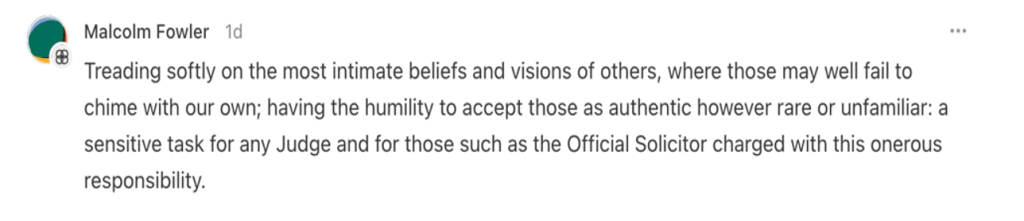
So, I do not share the view expressed by Rosalind English (in her blog post for the UK Human Rights Blog) that the judgment in this case was “a surprising and unusual decision”. She contrasts it with the outcome in Airdale v Bland [1993] 1 All ER 821 – the landmark case about Tony Bland, the young football fan left in a permanent vegetative state after the Hillsborough disaster. The decision in Bland was to withdraw clinically assisted nutrition and hydration. But these sorts of decisions are very fact-specific. In Bland, there was no evidence at all about what the young man at the centre of the case would have wanted for himself. As that judgment records: “At no time before the disaster did Mr Bland give any indication of his wishes should he find himself in such a condition. It is not a topic most adolescents address”.
What the House of Lords (now the Supreme Court) considers, at length, in the Bland judgment is how to balance “sanctity of life” against treatment withdrawal when both family and clinicians believe that discontinuing life-sustaining treatment is in the patient’s best interests, and when the patient’s wishes are not known. What the Re YD judgment considers is how to balance “sanctity of life” against treatment withdrawal when clinicians believe that discontinuing life-sustaining is in the patient’s best interests, but his family and friends do not, and when (unlike Bland) there is consistent and strong evidence of the patient’s own wishes, which are that he would want life-sustaining treatment to be continued. And of course, there is also more than three decades of case law between Bland and Re YD – and some of those cases have resulted in judicial decisions to continue treatment. It’s not obvious to me why Rosalind English would conclude that the decision about YD raises challenges which would require “a root and branch review of the “best interests” test”. The Court of Protection frequently makes decisions which give great weight to the patient’s own values, wishes, feelings and beliefs: it is making decisions on behalf of patients who cannot decide for themselves, and the court chooses between available options paying particular attention to what the person themselves would choose if they had capacity so to do.
Of course, the Court of Protection cannot compel doctors to provide treatment contrary to their clinical judgment – any more than a capacitous patient can compel a doctor to provide clinically inappropriate treatment. Nor can it compel health or social services to provide any other service that is simply not on offer for any reason, including cost considerations – that takes a judicial review. But in this case the continuation of treatment was an available option. There was no suggestion that doctors (or other health care professionals) would refuse to provide formula for the feed or decline to replace the feeding tube if it became detached. This is different from some other cases where doctors are clear that a particular treatment is not being offered to the patient – like the tracheostomy, which was not an available option for the ventilated patient in a different case (Balancing patient welfare and procedural fairness: Withdrawal of ventilation before Hayden J)
The role of the CoP is quite properly to make decisions between available options (whether that is life-sustaining treatment or anything else, e.g. where P should live). Given that clinically assisted nutrition and hydration was an available option in this case, the question before the judge was whether or not it was in P’s best interests to receive it – and given the particular facts of this case (including that he would have wanted it, and his partners’ devotion to him, and that he probably isn’t in pain) she decided that it was.
The fact that his wish to receive continued treatment was based on unusual spiritual beliefs (rather than, say, an established religion) does not change the seriousness with which he himself held them,or the weight that the court should attribute to them in considering his best interests – a point eloquently made by Katie Gollop KC representing YD via the Official Solicitor.
Strong spiritual beliefs have been seriously considered in multiple Court of Protection hearings about life-sustaining treatment and given significant weight alongside other factors such as the burdens of treatment for the individual in their particular circumstances. Cases are always fact-specific – and there seems also to be a diversity of judicial approaches to balancing the various factors involved.
Sometimes judges make the decision to withdraw life-sustaining treatment in the patients’ best interests, even when there is strong evidence that they would have wanted it continued. For example, the published judgment by Hayden J in Northern Care Alliance NHS Foundation Trust v KT & Ors [2023] EWCOP 46 concerns a Pentacostalist Christian pastor whose family were firmly of the view that “his faith was such that he would want his life to be sustained for as long as possible, in whatever circumstances and whatever the challenges” (§3). Having heard from family and friends Hayden J was clear that KT was “a man who lived his life by the Pentecostal sword and most likely would have wanted to die by that same sword i.e., in accordance with his Pentecostal beliefs.” (§31) and stated “I have found that KT would have wanted continued life-sustaining treatment, even in the face of a coma with a terminal diagnosis of chronic kidney disease stage 5.” (§32). Nevertheless, Hayden ruled that life-sustaining treatment should be stopped.
On the other hand, there are cases where judges have found continuing life-sustaining treatment to be in a person’s best interests[2], due to the strength of their religious conviction. McKendrick J recently found it was in the best interests of a devout Muslim man whose “Islamic beliefs would be likely (highly likely) to influence his own decision whether or not to continue with the NG tube if he had capacity”. Taking into account the patient’s view (as reported by the family) that “PK would view it as wrong and contrary to Islam for me to authorise the removal of his NG tube”, the judge authorised continued treatment (University College London Hospitals NHS Foundation Trust v PK & Anor [2025] EWCOP 17 (T3))
In sum, patients’ values, wishes, feelings and beliefs (including any religious/spiritual beliefs) are factored into best interests decision-making, alongside factors such as their current experience (if any), the nature of medical interventions they are subject to, and the patient’s specific diagnosis and prognosis. Given the array of factors considered in best interests decision making the judgment in this case (with such strong evidence about the strength and relevance of P’s spiritual beliefs) it is not an entirely surprising outcome.
2. Beyond the courtroom
Decisions to continue clinically assisted nutrition and hydration (and many other life-sustaining interventions) are being made outside the court all the time. Many people are maintained indefinitely in prolonged disorders of consciousness, long past the time at which clinicians (or indeed family) believe they will ever recover full consciousness. Nobody knows how many such patients there are in the community (nursing/care homes and homes) across England and Wales (it’s not properly audited) but it is estimated to be tens of thousands (4,000–16,000 patients in vegetative states, with three times as many in minimally conscious states).
In the vast majority of these cases, the clinical decision to continue life-sustaining treatment has never been considered by a judge. Sometimes treatment is continued by default simply because nobody has considered doing otherwise (irrespective of the patient’s own values and beliefs) (see Kitzinger J & Kitzinger C. (2017) Why futile and unwanted treatment continues for some PVS patients (and what to do about it) International Journal of Mental Health and Capacity Law. pp129-143).
But sometimes there are positive best interests decisions to continue treatment. In many settings where I do training and/or support families of patients in prolonged disorders of consciousness, I am aware of decisions made following best interests meetings to continue clinically assisted nutrition and hydration for patients with diagnoses/prognoses similar to YD’s. The patient’s religious or spiritual beliefs often play a part in these decisions and usually carry more weight – and results in more consensus decision-making – than do other common reports from family members which sound superficially very similar, such as ‘he’s a fighter’, ‘he’d want a chance’, ‘he needs more time to heal’. This is because religious/spiritual views often meet the Grainger criteria[3].
As a society, we do give significant importance to spiritual and religious belief, and to people’s freedom to practice their religion. So, it seems right that this is supported (where possible) once a person loses the capacity to act in accordance with their own religious/spiritual views and/or to make their own religious/spiritual choices. (Although in my experience, statements from family and friends about the patient’s religious beliefs, and about the inferences that can be drawn from this, are not necessarily interrogated in the typical healthcare setting with the same rigour as in a court hearing) [4]
So, although some commentators have identified the outcome in the YD case as “unusual” in continuing life-support for a vegetative patient, in fact it is typical of many decisions currently made outside the courtroom in similar circumstances, in care homes and nursing homes across the UK.
3. News media and social media coverage of the judgment
What was unusual about this case was the amount of public discussion it generated.
Unlike most Court of Protection hearings, which – although open to journalists and to the general public – conclude without any public discussion of the decisions made (this includes life-sustaining treatment cases), this case has attracted quite a lot of media attention and social media comment.
Public discussion was supported by the publication of the judgment (not all judgments are published) and by reporting of it by the eminent legal commentator, Joshua Rosenberg (“Patient must be kept alive: Hospital refused permission to withdraw nutrition and hydration).
It also seems that its ‘news value’ was heightened by the use of evidence from a spiritual medium and by the opportunity, from some media, for a rather prurient focus on the fact that YD has two partners.
There were significant differences between the judgment and the public discussion that ensued in relation to three issues, as I discuss below:
- 3.1 spiritual beliefs,
- 3.2 the fact that YD has two partners (previously unaware of each other’s existence),
- 3.3 the cost of maintaining people in permanent vegetative states.
3.1 Spiritual belief
The court treated YD’s spiritual beliefs with the same respect as it would have accorded to more formal or conventional religious beliefs. The Official Solicitor presented a strong and coherent argument (in relation to the Grainger criteria, see endnote 3) about why this should be the case, and her approach is mirrored in the published judgment. The evidential status of statements from the medium was carefully discussed in court (see footnote 4 of my original blog about the hearing: “A patient with “unusual” spiritual beliefs: Is withdrawing a feeding tube in his best interests?”.).
Public commentary – especially on social media -sometimes supports this approach

But social media also includes incredulous comments that YD’s beliefs (described as ‘hocus pocus’) were taken seriously in court. ‘Please tell me this is a joke!” wrote one commentator. Another thought the court was being guided from “beyond the veil”.
“It appears the legal and medical decision-making in the Court of Protection is now being guided by someone from “the other side”, via a medium!. […] In effect, the decision to continue life-sustaining treatment seems to have come via counsel from beyond the veil” [Zain de Ville, response to Joshua Rozenberg] [5]
3.2 Two partners
The court treated both YD’s partners (he was married to neither) as key witnesses and also heard at length from a close friend of YD. The words “family” and “next of kin” are not used in the Mental Capacity Act 2005: rather the court must consult (in addition to deputies, attorneys and anyone else named by the patient as someone to be consulted) “anyone engaged in caring for the person or interested in his welfare” (§7 (b)).
There’s no hierarchy about who should be consulted or the a priori weight to be given to their evidence. I’ve been personally involved in supporting best interests decision-making processes where valuable information about the protected parties’ values and beliefs has come from a neighbour and a hairdresser for example; and another where the patient’s ex-wife turned out to have more relevant and compelling information than his current wife. My experience is that decision-makers (at least in the context of a court case) examine evidence about the patient’s prior values without making any prior assumptions based on the evidence-providers ‘next of kin’ status. This case has been identified by Alex Ruck Keene as offering “a case study in the navigation of complex relationships going beyond ‘next of kin’ to identify those who were expert in the person”.
The fact that the two women did not know of each other’s existence prior to YD’s injury was highlighted in the legal proceedings only in so far as it was valuable as independent triangulation of evidence. The judgment notes that it was “striking” that even though the two partners were completely unaware of each other’s existence until YD’s injury “they were each able to independently confirm many common features about YD’s wishes and beliefs.” (§83).
There was no discussion of the situation in terms of deceit or secrecy in the court or in the judgment. The only hint of this by the women themselves during the hearing was when one of the partners said YD never wanted her to visit him at times when parking charges where operational outside his house: in retrospect she recognises that this meant it was a safe time for him to see his other partner: “I think me and [the other partner] took it in turns to be there”. In the judgment the judge simply records that his family and friends recognise that YD’s relationships were “compartmentalised” (§74).
Public commentary, however, put a rather different spin on this. Multiple newspaper headlines referred to “secret lovers” to describe the two partners e.g. “Comatose man’s secret lovers join forces to keep him alive” (Daily Telegraph 13/8/25) and “Comatose man’s secret lovers join forces to keep him alive – after only finding out about each other when he suffered a brain bleed (Mailonline 14/8/25). The story was picked up by outlets such as the Daily Star (which describes itself as “News with a Wink”): “Comatose man’s secret lovers try to keep him alive despite finding out his cheating ways” (14th August 2025, Daily Star online).
These headlines (and text referring to his “double life” and describing the patient as an “unfaithful lover”) led to salacious comments on social media and ‘below the line’ including speculation about the two women’s relationship and ’jokes’ about sexual prowess, infidelity and women spurned (e.g., see comments below Daily Mailonline).
The treatment of this case chimes with another genre of stories where sudden critical illness exposes illicit relationships -see stories (in the last couple of months) such as: “I uncovered my husband’s dirty secret while he was in a coma” (Metro, 26/7/25)) https://metro.co.uk/2025/07/26/uncovered-husbands-dirty-secret-a-coma-2-23714693/ and “Don’t Tell the Bride: Star […] recalls how she uncovered her husband’s affair while he was in a COMA (MailonLine, 19th Aug 2025, https://www.dailymail.co.uk/femail/article-10476687/Dont-Tell-Bride-star-uncovered-husbands-affair-COMA.html).
3.3 The cost of caring for patients in a permanent vegetative state
The third striking difference between the judgment and public discussion of it was the attention given to the resources needed to care for these patients.
The published judgment considers operational factors relating to treatment decisions for patients in prolonged disorders of consciousness (such as the role of the ICB and when patients should move from specialist neuro-rehabilitation units to care homes) (§88-92) and this was highlighted as significant by the legal firm representing the Trust. It raises crucial issues for those involved in designing and delivering care – but seemed to be of little wider public interest: neither the mass media, not general social media discussions picked up on this point.
By contrast, the issue of cost per se of keeping people alive in long term vegetative states DID feature in public discussion –in spite of the fact that this was NOT mentioned in the judgment. In comments below the Mailonline article, for example, readers suggested that if the two women want YD kept alive then they should pay for it, and commented on the “pointless waste” of “taxpayers’” money at huge cost to an over-stretched NHS.
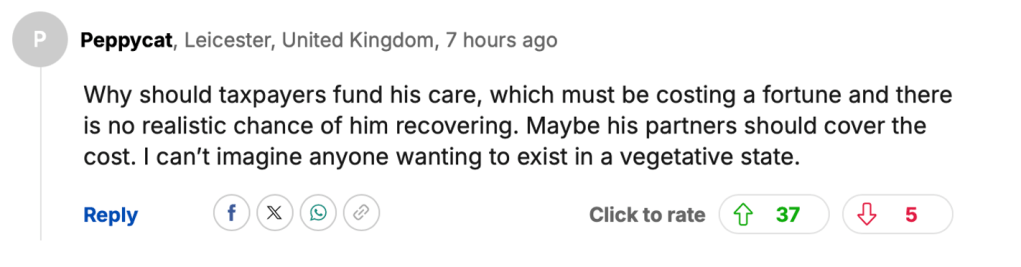


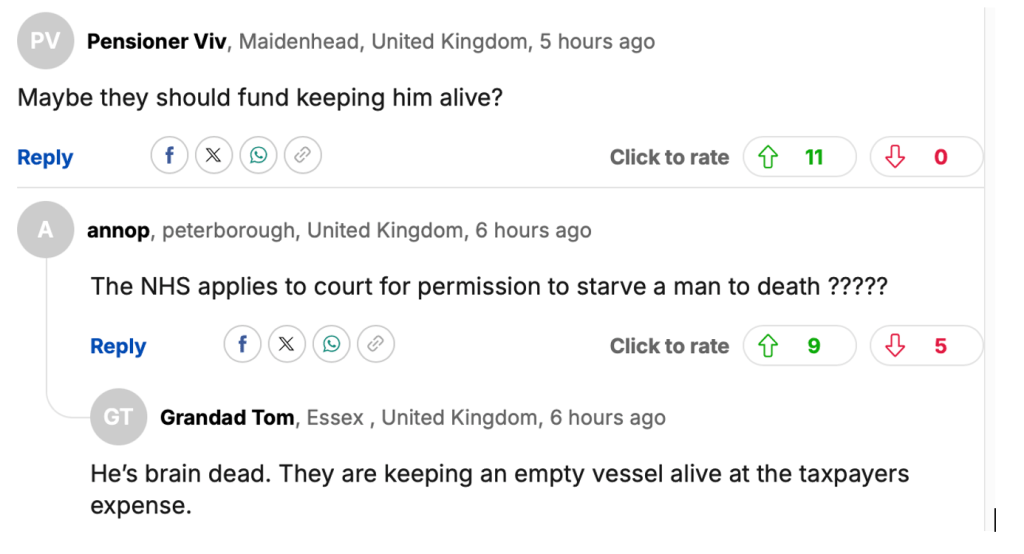
On a different platform, in response to Joshua Rozenberg’s blog, another commentator wrote very critically about YD’s (and his partners’) wishes and the person-centered approach of the court. This commentator sharply reframed the case in terms of being self-centered and highlighted inequalities:
“I wonder if the two partners are doing the heavy nursing care or are simply sitting by the bed chanting?! And who is paying the bill? As a full-time carer, working full time, of my elderly bed bound father and unable to get help, I find the selfishness in this case difficult to take. This man receives care whilst others do without.” (David Holroyd response to Joshua Rozenberg blog)
This issue was also brought to the fore by Rosalind English who points to “the profound and continuing financial burden on the public purse for prolonging unconscious life at all costs” and says:
“…one day it will occur to cancer patients being denied treatment or sufferers from severe cardiac conditions on never ending waiting lists for surgery that perhaps public money should be spent on them, rather than keeping PVS patients alive for years if not decades.” https://ukhumanrightsblog.com/2025/08/13/patient-in-permanent-vegetative-state-to-be-kept-alive-court-of-protection/]
Alex Ruck Keene picked up on this point, suggesting that this issue needs to be faced head on: “Just as in the case of admission and treatment in ICU, we tend to seek to avoid hard discussions about cost-benefit analysis of the sort that are now familiar in the context, say, of cancer drugs. For my part, I would suggest that there is an increasing need for work to be done to establish a framework within discussions about such costs can be considered in a transparent fashion and in a way which resolves the uncertainty justly.” He argues that, without this, there is the risk of concerns about costs leading “no doubt inadvertently” to distortion of the clinical framing of the person’s condition and of the treatment; or “distortion of best interests decision making (for instance, by asking whether the person would wish to be continue to be kept alive at the cost of “diverting” resources from others).”
The financial cost of keeping patients alive in prolonged disorders of consciousness is virtually never raised in court judgments. That’s because the court is focused narrowly on what is in the best interests of the particular patient at the centre of the case. If clinicians are willing to offer a range of treatments – including clinically assisted nutrition and hydration and all the skilled nursing and allied healthcare input that’s needed to keep these patients alive – then the court’s role is limited to making a decision as to whether or not taking up the treatment on offer is in the protected party’s best interests. (Conversely, if clinicians decline to offer a particular treatment, there’s nothing the court can do). But despite the absence of any consideration of cost in the judgment itself, this case, more than any other I’ve watched, seems to have focussed minds on this question of cost in sustaining patients in prolonged disorders of consciousness. This may perhaps be because of the unusual nature of YD’s beliefs, and the fact they were not part of a traditional religion, but I think the points raised are important, in this and similar cases. It’s right, in my view that the cost of treatment was NOT raised in the judgment: this should not be part of any best interests discussion for individuals. But there is clearly some legitimate public interest in what treatments should be on offer to patients, and in questions of resources and equity.
Jenny Kitzinger is co-director of the Coma & Disorders of Consciousness Research Centre, and Emeritus Professor at Cardiff University. She has developed an online training course on law and ethics around PDoC and is on X and BlueSky as @JennyKitzinger
Footnotes
[1] It’s very useful when judgments highlight operational issues that have been revealed during the course of the hearing – even if this has not been fully investigated as part of the hearing and no specific conclusion can be drawn or recommendations made. For the last ten years or so I’ve repeatedly heard discussion in court hearings of the key role that should be (and sometimes is not) played by the organisations that commission care (now ICBs and before that Clinical Commissioning Groups [CCGs]). Concerns have particularly been raised in relation to delays in best interests decision-making – which was not the issue in this case. However, concerns aired in the courtroom do not always make it into the published judgment. For example, we know, from observing the hearing, that there were clear operational issues in addressing the best interests of ‘PC’ (a woman in her early 30s who had catastrophic brain injuries from a cardiac arrest) which prompted the Official Solicitor to call for a review of both the hospital’s and the ICB’s procedures and protocols. Along with Celia Kitzinger, who also observed the hearing, we recorded part of this discussion in our blog: “Family tragedy and institutional delay in best interests decisions about life-prolonging treatment”. But in the judgment the judge, Mr Justice Cusworth, included only one sentence which acknowledged that these concerns had been raised and evidence filed, but simply stated that this “had not been the subject of dedicated submissions before me. My focus in this judgment is solely an assessment of PC’s best interests”, NHS North Central London Integrated Care Board v PC & Ors [2024] EWCOP 31 (T3). By contrast, in a case I observed back in 2016 (and in which we’d supported the family), the judge, Mr Justice Hayden, highlighted the issue of delay in the judgment (with its own sub-heading) and commented that although he had “not been required to investigate” the problem “It needs to be stated that the avoidance of delay in medical treatment cases is an important imperative…” and he then went on to make a very strong statement about this principle (§13) (Cumbria NHS Clinical Commissioning Group v Miss S and Ors [2016] EWCOP 32). This part of the written judgment was very important for the patient’s family– (who felt their loved one’s dignity had been compromised and that they themselves had been put through years of distress and frustration). It was also helpful when other families came to us for assistance in trying to urge other CCGs at the time to take responsibility for helping progress cases about life-sustaining treatment in a timely manner. We described the role of the CCG, the operational challenges and delays in this case in detail here: Causes and consequences of delays in treatment-withdrawal from PVS patients: a case study of Cumbria NHS Clinical Commissioning Group v Miss S and Ors [2016] EWCOP 32
[2] In some cases, judges considered ongoing life-sustaining treatment to be in a patient’s best interests even though the family provided evidence that the person wouldn’t want this, e.g. W v M [2011] EWHC 2443 (COP)
[3] This is a reference to the case of Grainger plc v Nicholson [2010] IRLR 4 (EAT) To meet these criteria a belief (1) must be genuinely held; (2) It must be a belief and not an opinion or viewpoint based on the present state of information available (3) It must be a belief as to a weighty and substantial aspect of human life and behaviour. (4) It must attain a certain level of cogency, seriousness, cohesion and importance and (5) It must be worthy of respect in a democratic society, be not incompatible with human dignity and not conflict with the fundamental rights of others. Beliefs in veganism, Scottish independence, gender critical beliefs and more have all been held to be philosophical beliefs protected under the Equality Act 2010, on the principles set out in the Grainger case.
[4] In one hearing I observed, the patient’s diagnosis was very similar to YD’s and evidence from the family echoed that in the YD case in many respects – P was “a Muslim who believed only God could choose a time of dying”; he was reported to have said “when your time is up, your time is up, until then you don’t give up, no matter what’”; and his family characterised him as “a man who can and would want, to fight on”. (“He deserves a chance”? Continuities and shifts in decision-making about life-sustaining treatment). However, the OS took the position that clinically assisted nutrition and hydration was NOT in this patient’s best interests and argued that “[t]he whole basis of which the family would want him to continue [to receive this treatment] is based on the possibility of a miraculous event going against all the medical evidence, that he might improve or recover”. The judge (Arbuthnot J) acknowledged this man’s religious faith but taking all factors into account, ruled nonetheless that in was in his best interests for clinically assisted nutrition and hydration to be discontinued. (The judgment was subsequently published as Mid Yorkshire Hospitals NHS Trust v NB [2022] EWHC 3682 (Fam). In another case, this time before Theis J (the judge in the case I’m reporting on in this blog), the judge found that withdrawal of ventilation and CANH was in the best interests of a 27-year-old patient who was in a PVS following a car accident, in ICU and ventilator-dependent, despite withdrawal of treatment being contrary to the Christian beliefs he had been brought up with (Kings College Hospital NHS Foundation Trust v X [2023] EWCOP 34). In neither of these cases did the judges conclude that P’s religious faith would have meant they’d definitely have wanted life-sustaining treatment continued. Court of Protection hearings pay attention to spiritual/religious faith but involve interrogation of it – and how any such beliefs might apply to their current situation.
[5] I wonder if, in spite of the court’s careful approach here (the messages were NOT treated as evidence from YD), the use of messages from this medium in court may be misunderstood in future, or even used to promote the idea that spiritual mediums can provide a direct line to comatose patients and that this has somehow been endorsed by a judge. Some mediums already promote their services to families of patients in prolonged disorders of consciousness, or other conditions such as dementia. (eg. https://www.lightbloomhealing.com/coma-communication; https://www.grief2growth.com/can-mediums-reach-people-with-dementia-with-stephanie-banks/)
 Promoting Open Justice in the Court of Protection