

By Celia Kitzinger, 30 October 2025
I was intrigued when I saw this hearing (COP 13853773) listed before the Senior Judge in the Court of Protection, sitting at First Avenue House in London on 20th October 2025.
It concerns “non-compliance issues” in a case called JS v South Tyneside Council – and I guessed (correctly) that the non-compliance related to the behaviour of South Tyneside Council rather than to JS, the protected party in the case.
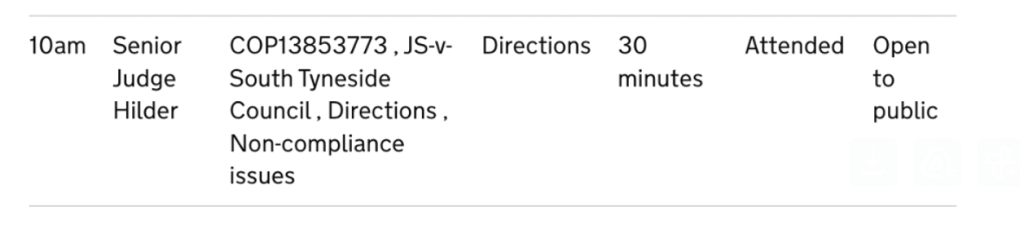
It turns out, as HHJ Hilder (who kindly made time to talk to me after the hearing) explained, that public bodies (local authorities, Trusts, ICBs etc) are regularly held accountable for non-compliance with court orders by being summoned before her to explain themselves. If they then comply not less than seven days before the date of the listed non-compliance hearing, it’s vacated (and apparently that’s usually what happens). I discovered that HHJ Hilder sets aside time for these hearings one day every month. A few days after the hearing, I was sent a list of the dates for “non-compliance issues” cases in 2026. I will be looking out for them and hope to attend as many as I can.
Over the past five years of observing Court of Protection cases, I’ve never actually watched a “non-compliance” hearing before. I’ve never even noticed them in the public lists. Apparently this is because the effect of listing them is rapid compliance, meaning that case never appears in the public listings.
I am not sure what sanctions, if any, are available to the judge if a public body simply continues its non-compliance. But the weight of the judge’s displeasure was fully evident in this case against South Tyneside Council.
What order had South Tyneside Council failed to comply with?
At the beginning of the hearing HHJ Hilder outlined what she called “the sorry history” of this case.[1]
Back in 2021, the Council had applied for authorisation of JS’s deprivation of liberty, using the streamlined (Re X) procedure.[2] They wanted the court’s permission to enter into a tenancy agreement on behalf of JS at a new placement, because his previous placement was closing down. Everyone considered that the new placement (a residential facility for people with learning disabilities) was in his best interests – but no Rule 1.2 representative[3] had been identified. So the application was stayed.
In March 2023, there was still no Rule 1.2 representative in place. The court lifted the stay and directed that the Applicant file updated evidence concerning the application and a signed COP3 capacity assessment. A direction was made for a General Visitor to complete a section 49 report.
Two years later, in March 2025, South Tyneside Council applied for a 12 week period of time to comply with the direction in the court order of March 2023, which was granted. But they didn’t meet the new deadline. So the case was listed for a non-compliance hearing on 20th October 2025.
Ten days before the listed non-compliance hearing, the Local Authority applied to vacate the non-compliance hearing, and to re-list the matter 10 weeks later to allow time for a Rule 1.2 representative to be appointed. That application was refused by the court. (Another non-compliance hearing, listed publicly for the same day – one I’d also hoped to attend – concerning the City of Wolverhampton Council in relation to COP 13795915 had been vacated, sadly for me.)
And so it was that, while most Court of Protection observers were headed for the Supreme Court in Parliament Square (or logging on to its website) to watch the reference from the Attorney General of Northern Ireland concerning Cheshire West, I was walking through Holborn in the rain on my way to First Avenue House.
The hearing
Although it was listed as ‘in person’, I was told – too late, at 09.31, while walking to First Avenue House – that it was to be remote. I asked for and was granted a “consultation room” (where lawyers normally consult with their clients) to watch the hearing on my laptop just down the corridor from the courtroom where HHJ Hilder was conducting the hearing. Court staff were helpful in finding an empty room and helping me to log on (though I ended up using my phone hotspot).
On behalf of South Tyneside Council, Nancy Williams of Doughty Street Chambers accepted that its conduct in this matter had been unsatisfactory, and apologised to the court for its non-compliance with the court direction and for the delay in making progress with this matter. According to their position statement, “During the time that the application has been before the court, the Local Authority has been experiencing ongoing staff difficulties and resource constraints”: she further referred to “mistaken” beliefs and “confusion” among the staff.
South Tyneside Council had done their best (albeit belatedly) to put things right, and had now (said Nancy Williams) appointed an IMCA on behalf of JS to act as a Rule 1.2 representative. The IMCA will need 4 weeks to prepare a statement for filing at court. Meanwhile, the local authority was continuing to seek authority to enter into the tenancy at JS’s placement on his behalf.
HHJ Hilder referred to the “very serious delay” in this case but focused on the positive fact that “we are going to make some progress now”.
She then identified some procedural errors and failings.
First, “despite recital F” she said, “the Council can’t appoint a Rule 1.2 representative: only the court can do that. So I am going to insert into the order that the court does that.”
Second, she asked what had been happening with JS’s tenancy to date, given that the local authority was continuing to seek the court’s authority to enter into a tenancy. On behalf of South Tyneside Council, Nancy Williams said that “the tenancy was allowed to progress”.
Judge: Are you telling me that somebody has purported to enter into a tenancy agreement without the appropriate authority?
Williams: Your Honour, that is the position. And the local authority seeks to remedy the position today by seeking the authority of the court.
The judge visibly exercised restraint in response to this news. She explored how it had come about that “someone without any lawful authority to do so” had entered into a tenancy agreement. It appeared that someone somewhere had believed that, as the application for authorisation was before the court, that would be sufficient. “Please take back to the local authority,” said HHJ Hilder sternly, “the message that simply applying for authorisation is not the same as being granted it”.
The approved order requires (by 1st December 2025) a COP 24 statement setting out/exhibiting six items:
a. the circumstances in which a tenancy agreement was purportedly signed on behalf of JS without any authorisation to do so;
b. an explanation as to why the Local Authority considered that it was appropriate to enter into the purported tenancy agreement without lawful authority;
c. a copy of the purported tenancy agreement;
d. an updated care and support plan which includes details of the level of staffing support when JS attends the day centre;
e. a COP 3 assessment of JS’s capacity to enter into tenancy; and
f. a draft final order.
There are a further three items relating to the Rule 1.2 representative:
a. confirmation that she is willing and suitable to act as Rule 1.2 repreesentative;
b. confirmation that she understands the role of Rule 1.2 representative, including monitoring the implementation of the care plan and consultation with JS; and
c. her views on whether the care arrangements are in JS’s best interests, including JS’s identifiable wishes and feelings.
The judge will deal with the matter on the papers on 3rd December 2025 – unless, I suppose, there is further non-compliance. The first date in 2026 set aside for non-compliance hearings is Monday 12th January, so I will be looking out for them then.
Reflections
It was very useful to know that there is some system in place for trying to ensure that public bodies comply with court orders. There’s a lot of non-compliance from public bodies evident in Court of Protection hearings every day. It’s routine to hear apologies tendered to the judge for not having submitted reports in time or complied with other directions and orders – pleading staff sickness, failures to respond to an enquiry further down the line, and administrative errors. Mostly judges seem resigned to it. It’s no secret that health and social services (like HMCTS) is underfunded, under-resourced and struggling to deliver basic services. I imagine that it’s only when a delay in something that should be straightforward (like appointing a Rule 1.2 representative) extends this long (two years or more) that the court draw the line. At least it seems, finally, to get compliance!
Celia Kitzinger is co-director of the Open Justice Court of Protection Project. She has observed more than 600 hearings since May 2020 and written more than 100 blog posts. She is on LinkedIn (here), and also on X (@KitzingerCelia) and Bluesky @kitzingercelia.bsky.social)
[1] There’s also a more detailed account in the Position Statement shared with me by the local authority.
[2] Failed Re X’: Deprivation of liberty and Re X (the streamlined process) – a social work perspective by Eleanor Tallon
[3] What is a Rule 1.2 Representative (by Voiceability)
 Promoting Open Justice in the Court of Protection