

By Claire Martin, 27th September 2026
Editorial note: Shortly after this blog was published, the Mental Capacity Law and Policy blog has said, in reviewing his latest judgment, that “HHJ Burrows is undoubtedly taking the lead as regards the development of a body of judicial consideration of the world after AGNI” (MCLP blog 10th October 2026) hat makes it particularly frustrating not to be able to gain access to hearings before this judge.
It goes without saying that hearings listed as ‘public’ should be accessible for members of the public to observe. Especially when they relate – as so many Court of Protection hearings do – to deprivation of liberty for vulnerable people. I was especially interested in this hearing before HHJ Burrows, who has something of a reputation as a judge making important decisions in this area. Another blog post covers HHJ Burrows’ ex tempore decision-making (there’s no published judgment) back in June 2026 in relation to a woman with profound disabilities living in an annex to her family home (“Considering ‘deprivation of liberty’ in a family home setting after AGNI“), and since the events described in this blog post, HHJ Burrows has published one of the first reported judgments to apply the new multi-factorial AGNI test (Re AR (Whether restrictions amount to a deprivation of liberty) [2026] EWCOP 45 (T2)).
So, I was frustrated and disappointed not to have been able to observe a remote hearing listed before HHJ Burrows in Preston on Monday 3 August 2026. I couldn’t observe it because I was never sent a link. Despite chasing repeatedly, I never received any reply at all. This was a fully remote hearing – so without the link, there was no way of observing it. Without the link, it wasn’t, in reality, “public” at all.
Background
There are two parts to the ‘background’ of what happened in relation to this hearing. I’ll deal first with the rules about remote observation and then the legitimate public interest in ‘deprivation of liberty’ hearings post-AGNI, which motivated my request to observe this (fully remote) hearing.
Remote observation of fully remote hearings
Those of us involved in the Open Justice Court of Protection Project have observed many remote hearings. Most of our blog posts concern hearings attended not in person but remotely – including hearings that took place in person (with a remote link provided for observers), as well as “hybrid” hearings (an in person hearing with one or more parties or their representatives attending remotely). But in most cases, the hearings we observe remotely are fully remote. That means there is nobody – except perhaps the judge – sitting in a physical courtroom: the only way of observing is via the link.[1]
Remote access to a public hearing is not a “right”[2]. Before making a direction to send a link to an observer, the court must be satisfied that (a) it would be in the interests of justice to make that direction; and (b) there is capacity and technological capability to enable transmission and giving effect to the direction would not create an unreasonable administrative burden. A list of mandatory considerations includes the need for open justice, the timing of any access request and its impact on the business of the court; the extent to which the resources necessary for effective remote observation are or can be made available; and any impact which the making or withholding of such a direction, or its terms, might have upon (i) the content and quality of the evidence; (ii) public understanding; (iii) the ability of the media and public to observe and scrutinise; and (iv) the safety and right to privacy of any person involved with the proceedings.[3]
The rules do not seem to differentiate between public hearings which are taking place “in person” (so that, at least in principle, an observer could go along to a physical courtroom), and those that are fully “remote” – meaning that everyone is online. Counsel and judges in fully remote hearings are usually in their place of work, but sometimes at home or in another location, and the judge may or may not be in a physical courtroom – and if they are, it may not be the court in which they are formally sitting. Especially during the COVID-19 lockdowns, but also subsequently, we’ve seen judges ‘sitting’ in the Court of Protection from home, in hotels, and even while on holiday. The transparency problem with wholly remote hearings is that if a link is not sent, then there’s – usually – no physical location to which we can go to observe the hearing, in which case it’s hard to see how they can be understood to be “public”.
Public interest: the Supreme Court decision in AGNI
On 2 June 2026, the UK Supreme Court handed down judgment in the case now often referred to as AGNI (formally known by the distinctly un-catchy title “A Reference by the Attorney General for Northern Ireland of a devolution issue under paragraph 34 of Schedule 10 to the Northern Ireland Act 1998 UKSC/0042). In that judgment, the Supreme Court overturned Cheshire West, thereby upending over a decade of practice in this area. We have published multiple blogs about the hearing and judgment here: Commentary on the UK Supreme Court case about deprivation of liberty, and also blogs about subsequent cases where judges have considered the AGNI ruling in relation to deprivation of liberty cases in the Court of Protection (Deprivation of Liberty in the CoP post-AGNI).
Deprivation of liberty cases are a large part of the work of the Court of Protection. The Family Court Statistics Quarterly (Jan-March 2025) reports that there were 2,127 applications relating to deprivation of liberty in January – March 2025, amounting to 23% of the application made under the Mental Capacity Act in that quarter. But there are very few published judgments concerning deprivation of liberty, post-AGNI. To date, there have been two from the Court of Protection (here and here ) and one from the Family Division of the High Court (here).
Deprivation of the liberty of citizens in England and Wales is of considerable legitimate public interest. The core team of the OJCOP Project and other public observers have been endeavouring to observe hearings concerning deprivation of liberty, post-AGNI, to understand how the Supreme Court ruling is being interpreted and implemented in case law.
My request for the link was ignored
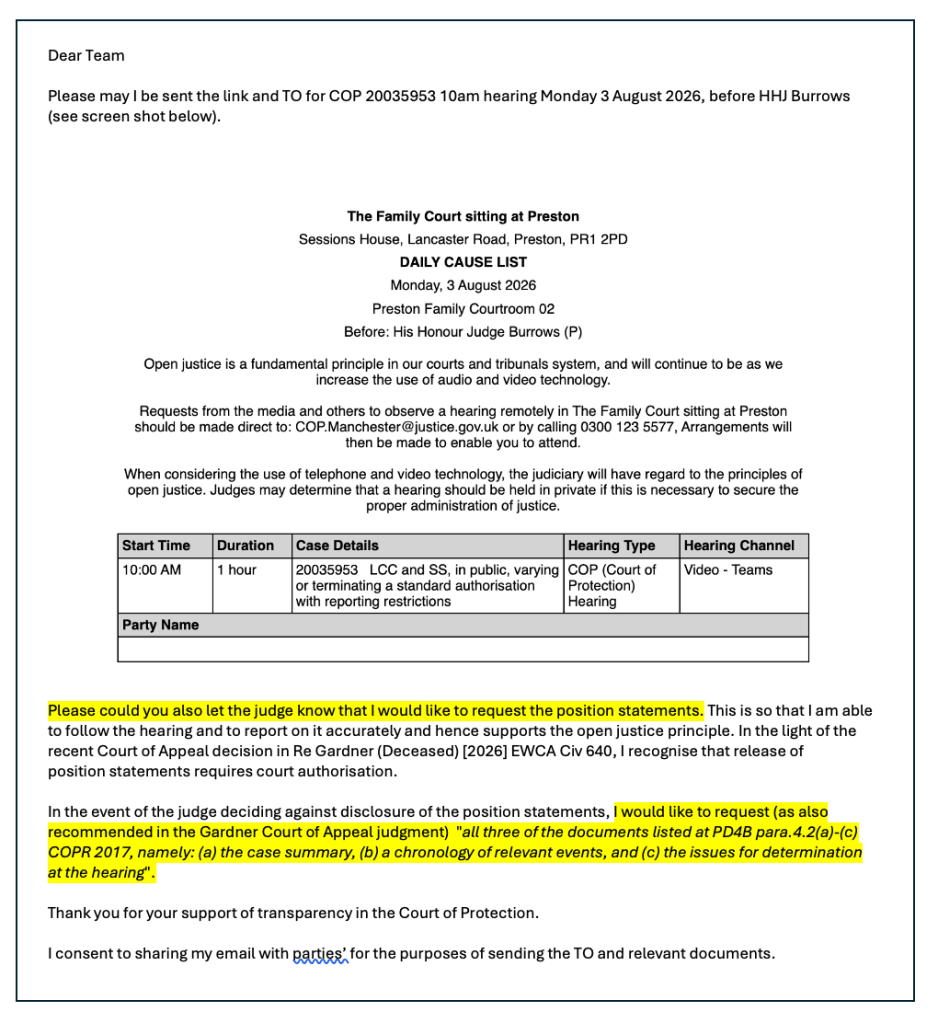
The hearing of Case 20035953 was listed as “public”. I emailed the evening before requesting link, Transparency Order and Position Statements (or Gardner Documents). I couldn’t email any earlier than this because the listings are not published until around 4.30pm the day before a hearing. This is often not understood by judges, who can, consequently, feel frustrated to receive a request from a public observer quite close to the start time of a hearing. It’s an issue we have raised many times but is intractable because of the dynamic nature of cases coming to court. Balancing open justice with other administrative pressures can be difficult and is one of the reasons why access to links is within the judge’s discretion according to the “Practice Guidance on Remote Observation of Hearings”. I don’t dispute the administrative pressures on the court – they are everywhere apparent – but I am concerned about their consequences.
This is the email I sent to the Manchester hub (whose email is provided in the listing):
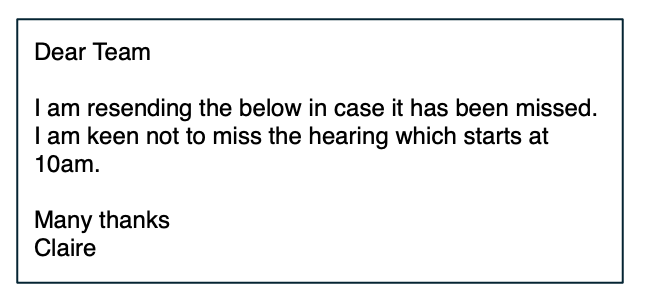
The hearing was listed to start at 10am. As it approached 9.30am, having received no acknowledgment of my email and no link to observe, I decided to resend my email with the note as below, which was sent time-stamped at 9:24am.
At 9.48am, I had still not heard from the court hub in Manchester so I telephoned the generic 0300 number provided in the listing above. There were what felt like endless recorded voice messages, which were not relevant to the matter I was dealing with and frustrating to listen to, as I was aware that the hearing started in 12 minutes.
I have been reprimanded in public, several times, by judges annoyed that I have asked for the link ‘late’ or joined the link ‘late’ (e.g. see this blog: Why members of the public don’t ask earlier to observe hearings (and what to do about it)). This is always outside of my control and it feels particularly unpleasant and unfair to be treated this way when a hearing is listed as ‘public’ and we observers cannot request links any sooner than the evening before (i.e. at a time when court staff have usually gone home, meaning they will need to respond first thing in the morning). Of course, this is difficult for court staff too, but that’s the system we are all faced with currently and it is very rarely the fault of the observer for asking or arriving ‘late’. This was all on my mind when I was faced with silence from the Manchester Court of Protection hub.
The recorded messages were mostly about travelling to court. I couldn’t bypass them and had to sit through them all to reach the number options to take me to another portal.
I finally got to an option saying: ‘if your query is about a hearing in the next 24 hours’ – I ‘held’ (as advised, to enable me to speak to someone) and it told me I was in a queue. The messages are long and not always understandable – e.g. if I want to complete a survey about my experience press 1, if not please hold and we will forward your call to a member of our team. Does that mean I can’t both ‘complete a survey about my experience’ and ‘speak to a member of [the] team’?
I was still on hold at 9:52am. There was annoying floaty music. The hearing was now due to start in 8 minutes.
‘One of our call agents will be with you shortly. Thank you for your patience’. I wasn’t feeling particularly patient at this point.
‘Did you know you can find further information on our processes on www.gov.uk’.
Floaty music.
9:55 ‘One of our call agents will be with you shortly’
Then the phone call was cut off at 10:02am.
The hearing was likely to have started two minutes earlier.
In one last attempt to gain access to this purportedly public hearing, I emailed Preston Family Court directly at 10:04am. I know we’re not supposed to contact the local court but we’ve discovered sometimes that’s the only thing that works – though it didn’t work this time.
I have never received an acknowledgement or reply to any of my emails.
The obvious questions are ‘what went wrong?” and ‘what should be done about it?’. I’ve told the story from my perspective and don’t feel able to say much else about this situation really – except to add that it’s not uncommon for public observers to find themselves in this situation. That’s why I’ve taken the step of writing about it. Most people don’t because they feel – reasonably enough – that they’ve already wasted enough time trying to get access to a purportedly “public” hearing and writing about it is likely to be more wasted time. I’m sure if I contacted the court I’d be told (as observers have before) that it was a particularly difficult morning, staff were very stretched, or someone was off sick, or a new member of staff was in need of further training. I don’t doubt that those things are often true. But the consequence is that ‘public’ hearings are actually heard in private and the judicial aspiration for transparency is thwarted.
Maybe the open justice champions heralded by Mr Justice Nicklin in June 2025 (reported by the Law Gazette here) could start to address this. In his speech in June 2025, Mr Justice Nicklin (referring to the Transparency & Open Justice Board), said: ‘The board and HMCTS are aware that there can be issues with people gaining timely access to remote hearings’, Nicklin said. ‘HMCTS are working to provide “open justice champions”. They will be regionally based, and it is intended that they will provide a single point of contact to assist in resolving open justice issues.’ We will see, once they are in place, whether open justice champions can make a difference.
A fully remote hearing is not “public” if the public cannot obtain links. Despite claiming otherwise, this hearing simply wasn’t, in reality, a public hearing. If the resources are not available to provide a link for observers for a fully remote hearing then the hearing is effectively “private” and would be better listed as such. Listing these effectively private hearings as “public” creates a misleading impression of transparency in the Court of Protection. And it’s particularly disappointing when the issue before the court is such an important matter of legitimate public interest (deprivation of liberty) and it’s being heard by an influential judge.
Claire Martin is Lead Consultant Clinical Psychologist, Cumbria, Northumberland, Tyne and Wear NHS Foundation Trust, Older People’s Clinical Psychology Department, Newcastle-upon-Tyne. She is a member of the core team of the Open Justice Court of Protection Project and has published dozens of blog posts for the Project about hearings she’s observed (e.g. here and here). She is on X as @DocCMartin, on LinkedIn and on BlueSky as @doccmartin.bsky.social
Endnotes
[1] This has posed a problem for transparency when cases listed as “in person” are changed at the last minute to remote hearings. See ‘Observing a remote hearing in court with the judge” which describes a situation in which only the observer and the judge were in the physical courtroom, with everyone else on line for what had been “rejigged as an MS Teams hearing” late in the day. In another case (also before HHJ Hilder) where two observers turned up at First Avenue House what was listed as an “in person” hearing, they was seated in a consultation room with a laptop and supported to observe the hearing (taking place just down the corridor) remotely.
[2] The statutory power to admit members of the public to observe remote hearings lies with section 85A of the Courts Act 2003 as inserted by section 198 of the Police, Crime, Sentencing and Courts Act 2022. The regime is implemented by the Remote Observation and Recording (Courts and Tribunals) Regulations 2022.


It would surely be possible for the CoP to routinely publish the listings in a more timely manner (as a small number of them do), perhaps in line with the 7 day notice period for requests to vacate?
LikeLike
Reply from Celia: I don’t know what the constraints are. It would be worth raising this question with HMCTS and/or with the MOJ Transparency and Open Justice Board (chaired by Nicklin J). One problem I have already found is that the further in advance the hearings are publicly listed on CourtServe (e.g. a few days instead of the evening before), the more likely they are in practice to be vacated/adjourned (well over 50% if I ask 3 days before a publicly listed hearing). So the on-the-ground practical consequence of listing in CourtServe “in a more timely manner” is more time spent (a) preparing public listings for hearings that don’t take place (b) my time wasted by requesting access to hearings that don’t take place; and (c) HMCTS staff time wasted by reading and responding to my emails requesting acess to hearings that don’t take place. It seems like an intractable problem but it would be good to get people thinking about how it could be addressed.
LikeLike