

By Celia Kitzinger, 15 September 2023
Introduction: On 21st October 2022, I submitted (at the request of counsel and with the permission of the court) a witness statement to Mrs Justice Lieven, concerning Case no. COP 13180943). I was asked to supply evidence as to how, according to my observations, Transparency Orders are actually working in practice. This came in the wake of Mr Justice Mostyn’s expressed concerns about Transparency Orders in Re EM [2022] EWCOP 31. I’ve reproduced the bulk of that evidence below because I want it be publicly accessible now that I’ve also recently (a) sent it to the ad hoc working group of the Court of Protection Rules Committee working on on Transparency Orders and (b) referred to it in my evidence to the Ministry of Justice on “Open Justice – the Way Forward”. It starts with §6 because I’ve left the numbering as per the witness statement as submitted (and omitted the first 5 paragraphs about me, setting out my personal academic background and experience). The statement is substantially based on an analysis of Transparency Orders at what were then the most recent 50 hearings I’d observed. I have no evidence of any significant change since then. I look forward to developments following the Rules Committee work on how to do transparency better. [Celia Kitzinger]
*****
IN THE COURT OF PROTECTION CASE NO: 13180943
AND IN THE MATTER OF THE MENTAL CAPACITY ACT 2005
AND IN THE MATTER OF COP Rule 4.2
B E T W E E N:
PM
Applicant
-and-
(1) B CITY COUNCIL
-and-
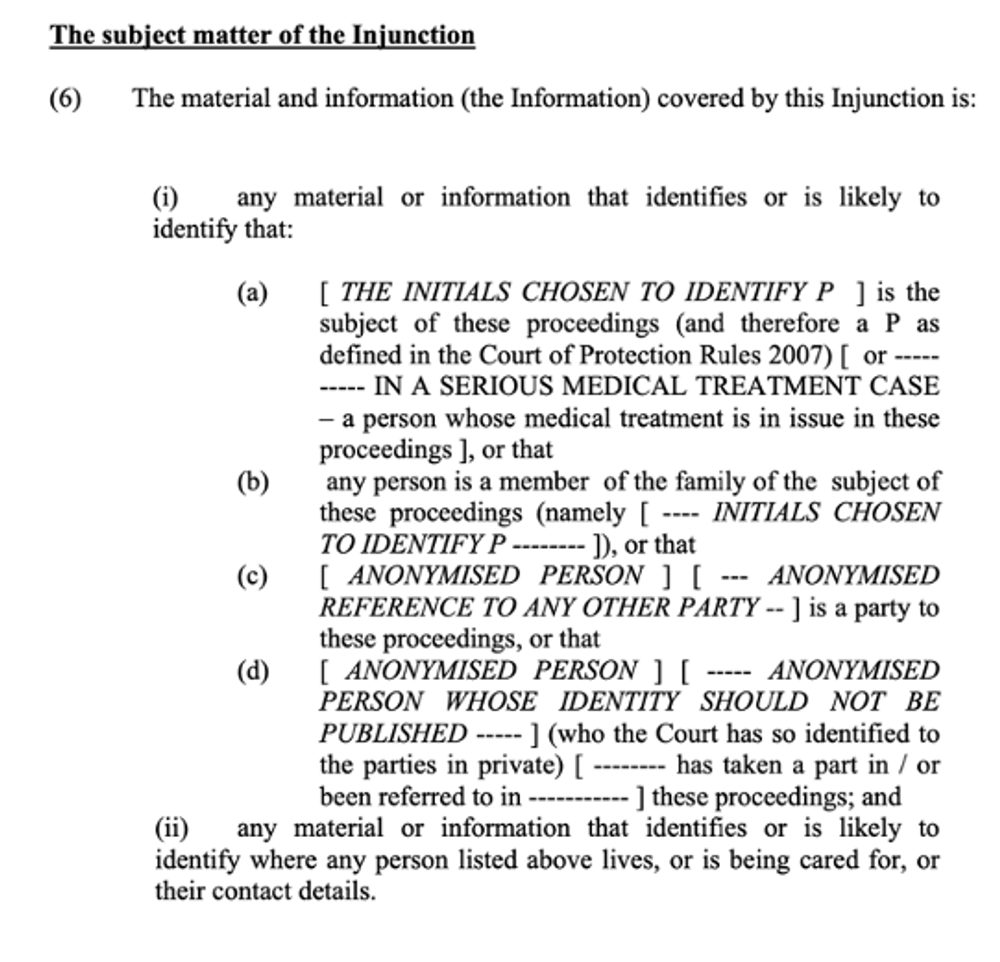
(2) B INTEGRATED CARE BOARD
-and-
(3) HM
(by his litigation friend, the Official Solicitor)
Respondents
| FIRST WITNESS STATEMENT OF CELIA KITZINGER |
[Paragraphs 1-5 omitted – they outline my academic qualifications and publications, and the history of the Open Justice Court of Protection Project]
6. I have been asked to provide a statement drawing on my experience, in practice, about:
(i) the extent to which reporting restrictions in the Court of Protection are the outcome of a balancing exercise weighing the protected party’s Article 8 right to privacy against the public’s Article 10 right to freedom of information; and
(ii) the extent to which those against whom injunctions are made have the opportunity to ask for reporting restrictions to be varied, making a case for the exercise of our Convention right to freedom of expression.
In summary (each of these points is subsequently evidenced)….
(i) There is rarely evidence of any balancing exercise
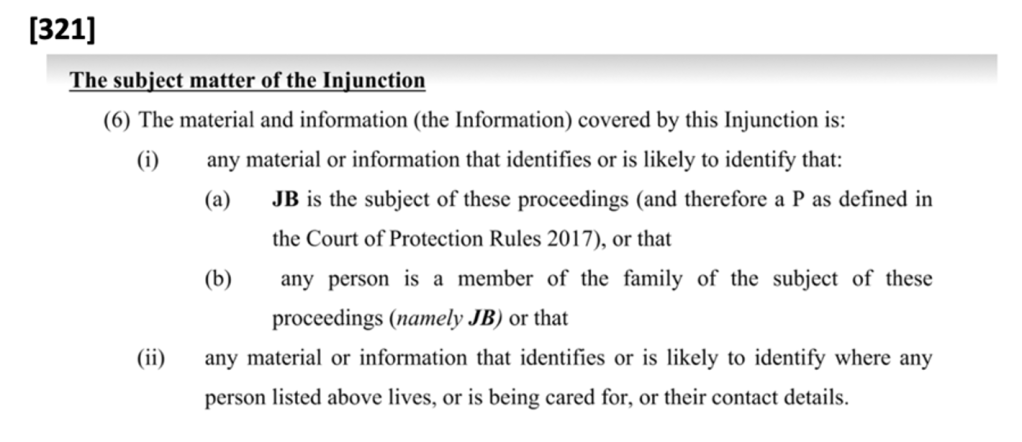
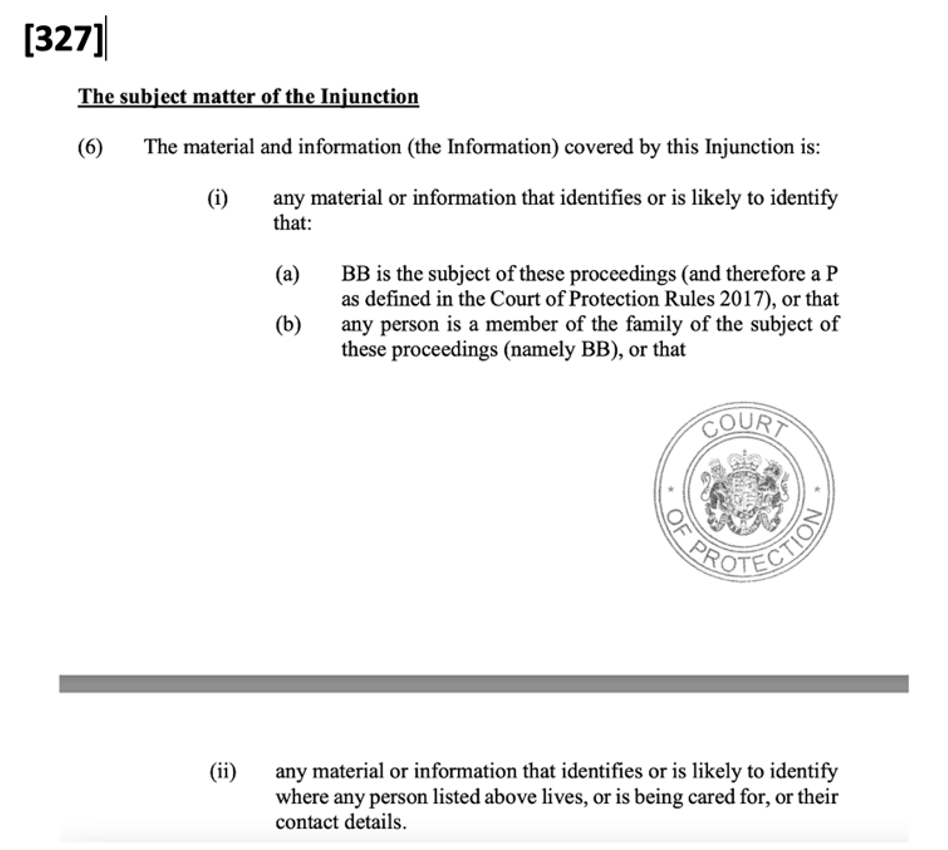
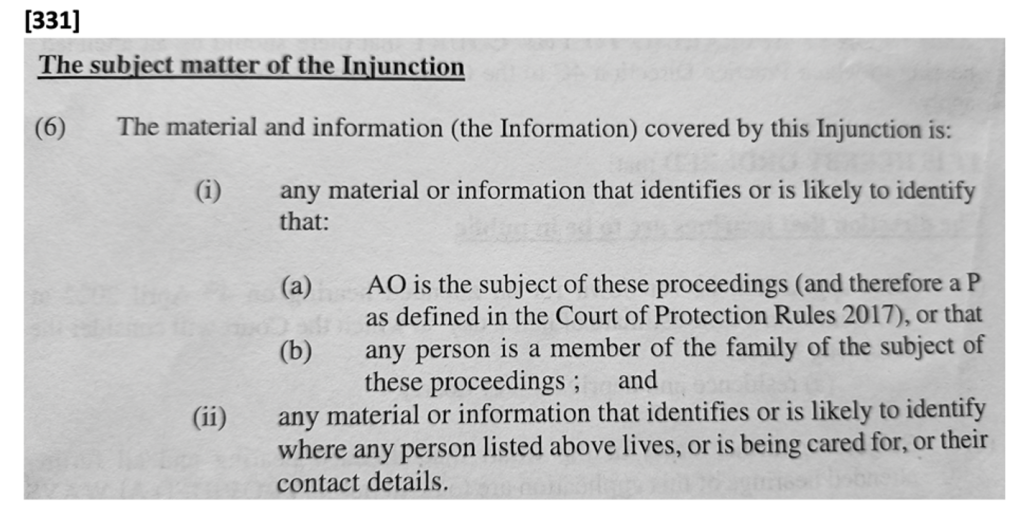
7. In the vast majority of hearings I observe, I do not see any evidence that the court has engaged in anxious scrutiny of competing convention rights in drawing up a Transparency Order (TO) or Reporting Restriction Order (RRO).
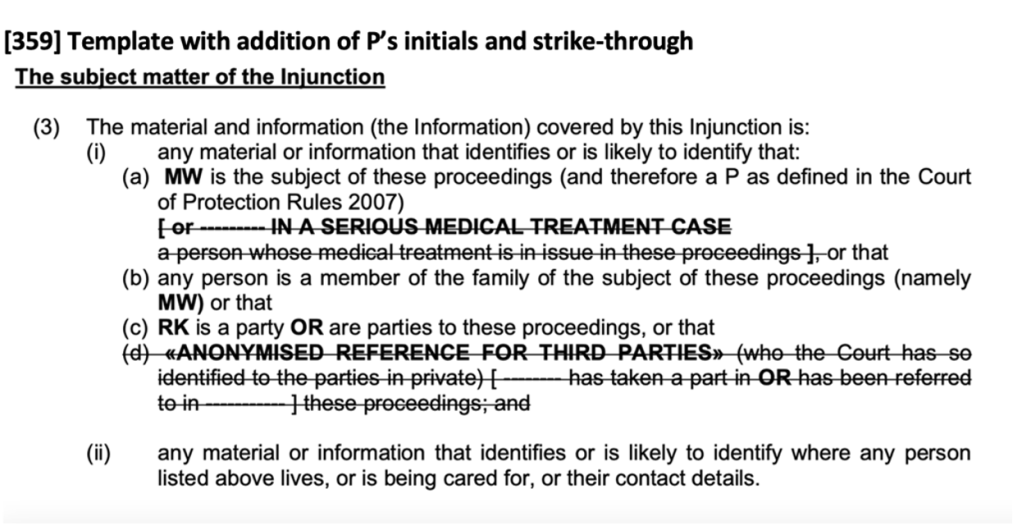
8. I often see evidence that TOs are treated as taken-for-granted, standardised “boilerplate” documents that do not require any balancing exercise from the court. They are sometimes authorised without the judge appearing to know what reporting restrictions they are thereby imposing, since they ask counsel if there is a TO and then re-use (without amendment) one they’re told is in the bundle (often made by a different judge) without appearing to have read it. Judicial summaries of reporting restrictions in the TO are frequently inaccurate (I would say, more often than not).
(ii) There is rarely any opportunity for assertion of Article 10 rights from the public (or journalists)
9. Members of the public are very rarely in a position to engage with the reporting restrictions imposed upon us. Reporting restrictions are usually (with rare and significant exceptions) presented as a fait accompli which we are expected to accept unquestioningly as a condition of entry into the court. I have noticed that there is a little more latitude for intervention from journalists – but even for journalists there is rarely much opportunity provided for them to question the reporting restrictions.
10. I do not take a position here on whether such a balancing exercise is required by law, or whether it would be a necessary and proportionate use of court time in every case. I am certain however that the current system for determining and implementing reporting restrictions is not working and needs to be thoroughly overhauled.
Two additional points:
(iii) Injunctions with reporting restrictions are very often not served on observers, so cannot serve their intended function
11. Members of the public very often do not receive any written version of the reporting restrictions: around half of the blog posts published by the Open Justice Court of Protection Project are published without sight of a TO or RRO. Since it is rarely suggested that we have breached reporting restrictions, one implication could be that an injunction against us is not needed. However, the absence of TOs (after their existence has been raised in court) has a chilling effect on transparency because we have no written record of what we are and are not allowed to report, and under those circumstances many members of the public are frightened to say anything at all, and it may be the case that we are over-cautious about what we publish in the blogs – for example there is often anxiety about naming public bodies and expert witnesses.
(iv) The language of the ‘standard’ Transparency Order is incomprehensible to most members of the public
12. Very few observers (except those with legal qualifications) are able to understand the TO and what it does and does not permit them to say. For example, there is a recurrent problem with the standard wording that prevents publication likely to identify that “AB is the subject of these proceedings (and therefore a P as defined in the Court of Protection Rules 2007)” – where AB are the initials a judge has assigned as those to be used in publishing information about P. A typical response: “If I have to refer to him as AB, and then I can’t say he was in this Court of Protection case, because it says I’m not allowed to say AB is the subject of the proceedings, that means I can’t say anything.” (I could give many more examples of the confusion and resultant chilling effect on transparency occasioned by the ‘standard’ wording).
EVIDENCE BASE
13. I write this statement as a member of the public and as co-director of the Open Justice Court of Protection Project and editor of its blogs[1]. I am not a lawyer or a journalist. I am not a “legal blogger”[2].
14. In preparing this statement, I draw upon:
- my experience over the course of the last decade with supporting family members involved in serious medical treatment cases – voluntary work carried out as an offshoot of my work with the Coma and Disorders of Consciousness Research Centre at Cardiff University;
- my experience over the last two and a half years, with the Open Justice Court of Protection Project, supporting other members of the public to observe hearings and myself observing more than 360 Court of Protection hearings;
- a systematic analysis (prepared specifically for this statement) of reporting restrictions issues as they arose in the 50 most recent hearings I’ve observed (as of 10th October 2022, listed in Appendix 1), held between 29th April 2022 and 10th October 2022.
THE ‘STANDARD ORDER’
15. The ‘Standard Order’ template for making reporting restrictions in the Court of Protection (the “Transparency Order”) has been used since 29 January 2016 with the introduction of the Transparency Pilot. It was cemented into the practice of the court in 2017 via Practice Direction 4C, which states:
§ 2.1 The court will ordinarily (and so without any application being made)—
(a) make an order under rule 4.3(1)(a) that any attended hearing shall be in public; and
(b) in the same order, impose restrictions under rule 4.3(2) in relation to the publication of information about the proceedings
§2.3 An order pursuant to paragraph 2.1 will ordinarily be in the terms of the standard order approved by the President of the Court of Protection and published on the judicial website at https://www.judiciary.gov.uk/publication-court/court-of-protection/.[4]
Court of Protection Practice Direction 4C
16. The most salient paragraph of the ‘Standard Order’ for public observers is the list of “material and information (the Information)” covered by the Injunction. As observers, we understand that we are “persons bound by the injunction” (#5) and what it prevents us from doing (#7), and the matter of duration (§8) is rarely at issue. It is to #6 (or its equivalent in any actual TO) that we turn to check what we are or are not allowed to report.
Remote hearings
17. Until the public health restrictions imposed by the government due to the coronavirus pandemic in March 2020, it was usual for the Court of Protection to sit in public for most “attended hearings” (i.e. those “where one or more of the parties have been invited to attend the court for the determination of the application” §2.2 Practice Direction 4C). The Vice President notes that “Attended hearings can be remote hearings for these purposes.” (§55 Remote Access to the Court of Protection Guidance, 31 March 2020[5]).
18. The situation was reversed in the Vice President’s 31st March 2020 Guidance. It states that PD 4C should be disapplied for remote hearings, and any TOs already in place for established proceedings discharged (§57). In view of the court’s commitment to transparency, however: “In each case active consideration must be given as to whether any part of any remote hearing can facilitate the attendance of the public, if so Practice Direction 4C may be applied and the transparency order reissued.” (§59). This is now the usual practice in the Court of Protection for remote hearings (other than hearings in the Royal Court of Justice, which are usually listed as “in open court” whether they are in person, remote or hybrid)[6].
19. An alternative practice for remote hearings has been adopted by some judges whereby PD 4C is disapplied and the hearing remains a private one, to which an observer is admitted, subject to a Reporting Restrictions Order (RRO). In my experience this is a minority practice.
EMPIRICAL FINDINGS
Boilerplate or “anxious scrutiny”?
20. There is a small minority of hearings partly, or wholly, devoted to the reporting restrictions themselves in which it is absolutely clear that there is anxious scrutiny of reporting restrictions. These include (successful) applications from the press to name P (as Laura Wareham [351][7] and Robert Bourn [360]) and a case where the judge invited submissions about an interim RRO he’d imposed at the beginning of the hearing preventing reporting that P was being covertly medicated [362]. These are exceptional cases.
21. In the majority of hearings, the language used by the judiciary and by advocates in court conveys the impression that reporting restrictions are effectively boilerplate text used from a template and deployed over and over again without making significant changes – that they are routinised and predictable, rather than the outcome of anxious scrutiny of competing convention rights in the individual case in question.
22. Drawing on contemporaneous notes from the last 50 hearings I’ve observed, there are references to: “the usual Transparency Order” (DJ Glassbrook [240]); “the Transparency Order is in the usual terms” (Arbuthnot, J [345]); “in the usual terms” (HHJ Hildyard KC [327]). Advocates also talk this way: “it’s the standard order in the standard terms” [357]; “the Transparency Order is in the standard terms” [320]; “Usual transparency orders apply as you know (do not identify family, P, clinicians etc)” [330].
23. Judges and advocates who know that I regularly observe court hearings sometimes display the assumption that I will know – without being told – what is in these “standard” orders: “Professor Kitzinger probably knows the terms of the injunction better than most practitioners” [342]; “Professor Kitzinger is here and understands the reporting restrictions”[338]; “I make the usual order that publication is permitted except that you can publish nothing to disclose P’s name, or the names of P’s family members, or of P’s current placement. I have been over that many times with Professor Kitzinger” [356].
24. Most of the TOs I am sent are virtually identical except for the initials used for P.
For example:
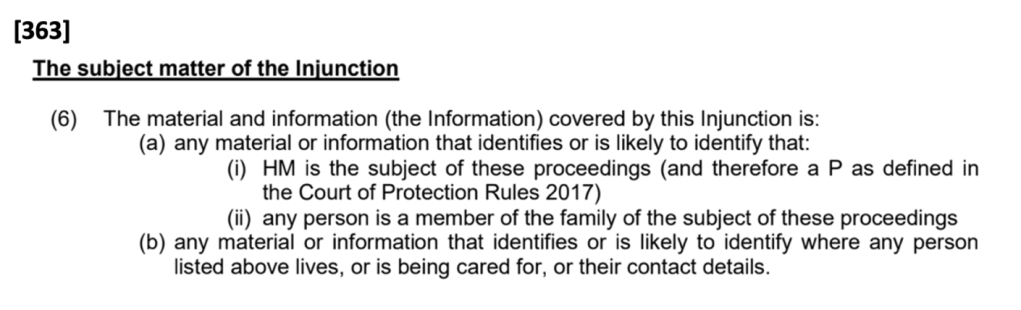
25. It’s quite common to receive (sealed) TOs that bear clear evidence of a ‘cut and paste’ approach and are insufficiently ‘personalised’ for the particular case (e.g. no initials for P, or the wrong initials, or a template that hasn’t been completed). I don’t see this level of inattention to detail in other documents before the court: position statements and substantive orders are usually impressively free of typos etc. and the latter are subject to careful attention by judges. This contrast between the quality of TOs and other court documents suggests a degree of inattention to the details of TOs
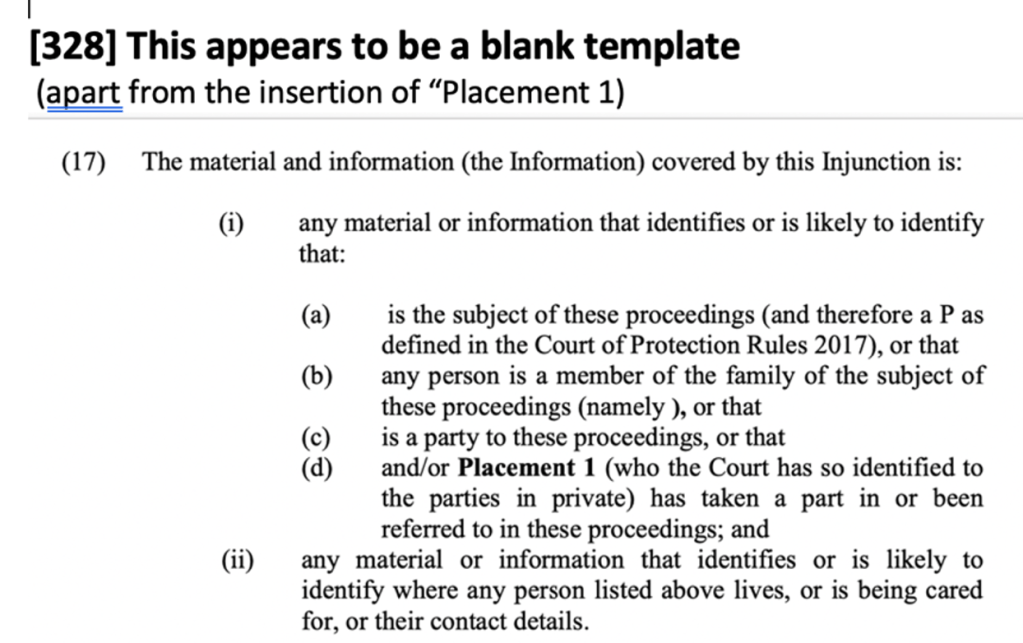
26. The TO from which the first of the extracts above is taken [328] was sent by court staff in advance of the hearing, attached to an email in which the judge was quoted as having said, “requestor is welcome to attend subject ONLY to confirmation that she has received copy of TPO”. I confirmed receipt at the beginning of the hearing – but that didn’t seem the right time to raise the deficiencies of the order I’d been sent. It seems unlikely that the judge can actually have read it. (Another member of the public, Bridget Penhale, Co-editor Journal of Adult Protection, and an elder abuse and adult safeguarding specialist, tells me she also has received a blank template TO for a different hearing.)
27. The same inattention to detail in TOs extends beyond the paragraph concerned with “The subject matter of the Injunction” and is sometimes apparent across the whole document. For example, one TO gives P’s initials as MH and those initials [MH] are used sometimes in the TO, including in the “subject matter of the Injunction” section, but there are also places where they should have been entered and have not and it instead reads “[the initials chosen to identify P]” [355]. Another TO uses “P” rather than “LD” (the nominated initials) for the person at the centre of this case and there are omissions throughout, e.g. “1) This application be set down for an attended hearing on [missing date] at [missing time] with a time estimate of [missing time estimate] at which the Court will consider the following issues:…”. (3) The attended hearing is to be listed as follows: [but nothing follows) [357]
28. Transparency orders are not supposed to have a Confidential Annex – but both [314] and [322] have these, with full postal addresses for P and P’s family in [332]. They do this despite also including a paragraph that instructs them not to add this confidential information and to keep the list of names “separately from other parts of the Information”.
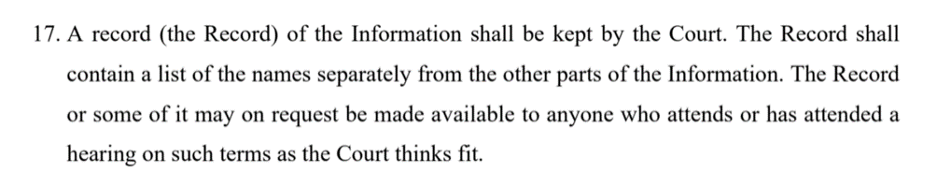
29. Another member of the public, Ruby Reed-Berendt (academic lawyer) tells me she was also sent a TO with a Confidential Annex. This concerns me because it means that confidential information (often beyond the information revealed in the hearing) is sent in written form to members of the public and hence renders people’s identities vulnerable to exposure (e.g. via a lost laptop, an overseen printed version).
OPPORTUNITIES TO ASSERT RIGHTS TO FREEDOM OF EXPRESSION + ASK FOR THE TRANSPARENCY ORDER TO BE VARIED
Family members of P
30. Family members and other lay persons involved in COP proceedings as parties, witnesses, observers, or in other roles (e.g. attorneys, deputies) are also bound by the TO – and it impacts upon their freedom of expression more severely than it does observers , because in speaking about (for example) “my son” or “my mother”, under their own name, in connection with a COP hearing, they are “likely to identify” that person as a P in the Court of Protection.
31. In many cases, family members seem content with these restrictions. In a significant proportion of cases, they are not. In hearings I’ve observed, the TO has led to restrictions on family members that they hadn’t understood in advance and do not want. These restrictions have included: use of fundraising platforms; talking to friends and relatives in search of evidence about P’s former values, wishes, feelings and beliefs; sharing updates about what’s happening with P on closed Facebook pages or their own publicly accessible blog posts; seeking out expert opinions of their own for P; and media, public education and campaigning activities. Often – even when they are parties to the case – family members do not realise that they are bound by the TO, and that it restricts their freedom of speech. It seems there is rarely any attempt to explain this to them (until after a breach is seen to have occurred).
32. Many of the families I’ve supported through serious medical treatment cases find themselves angry about being “silenced” or “gagged”. They have come to believe that the TO protects clinicians, not P. Some of the family members who’ve contacted me through the Open Justice Court of Protection Project say similarly that the court is attempting to silence them because of their criticisms of the healthcare or legal systems. Reporting restrictions are viewed as damaging P, not protecting them. Most have not, in fact, been willing to challenge reporting restrictions – believing it will be another expensive court battle, or that they are bound to lose anyway, or simply because they are too stressed and exhausted by the situation that has led to the court hearing in the first place. Some fear ‘reprisals’ against P if they are seen as ‘difficult’ family members.
33. I am currently supporting two members of the public seeking variations of the TO – neither of whom recalls any discussion at all, at the outset of their relative’s COP case, about the restrictions it would impose upon their Art.10 rights. What they remember is being “reassured” by lawyers that their names (and that of their relative) would not be made public, and that the family’s privacy would be protected – but not that they would lose the right to speak out.
34. It seems that there is no proper explanation or ‘anxious scrutiny’ of reporting restriction orders with family members. When supporting family members with cases that have not yet reached court, I explain the TO to them, and help them to engage in a balancing exercise, both in relation to their own rights to privacy and freedom of expression, and in relation to P’s. In a couple of cases, I have recommended publicising as much as possible in advance of the application to the court, such that “the cat is already out of the bag”, in terms of what is publicly available and a TO restrictive of their Art 10 rights is then less likely.
Public Observers
35. Most public observers (who are not journalists) have no idea that they can ask for a variation in the TO (or feel confident to do so, given that they have a very hazy idea of what the TO actually means anyway). I’m not aware of anyone except me who has done so.
36. It is exceptionally rare for me to be treated by judges, in the course of a hearing, as someone with Article 10 rights who might wish to vary the TO. This is not provided for in the Transparency Pilot rules (I’m not sure whether it was even considered?). I am regularly asked whether I have received the TO and sometimes whether I have understood it, but not whether I have concerns about it. Since I only receive the TO around 50% of the time (often after the hearing), it’s difficult for me to make any sensible interventions on behalf of my Article 10 rights anyway. The only journalist who regularly attends COP hearings (albeit almost exclusively those in the Royal Courts of Justice and not in the county courts) is Brian Farmer of the Press Association and I’ve noticed that he also finds it very difficult to intervene: I often observe him switching on his camera, or standing up in court towards the end of a hearing to say: “I’m sorry to interrupt the proceedings but…” Some judges are more open to inviting a contribution from journalists than others (Hayden J, Theis, J, Francis J, Poole J and Keehan J in particular, Brian Farmer tells me) – and Hayden J, Poole J, Roberts J and a handful of other judges (including District Judges and Circuit Judges in the county courts) have supported contributions from me about transparency matters when I have been able to indicate that I wish to make them.
37. I do sometimes have Article 10 concerns which I’ve been unable to address. For example, I’ve sometimes been told that a “standard” TO is in place, only subsequently to receive something like [316] below, which prevents me from identifying a public body (the Local Authority). But by then the hearing was over and there was no opportunity to ask why, or to ask for it to be varied.
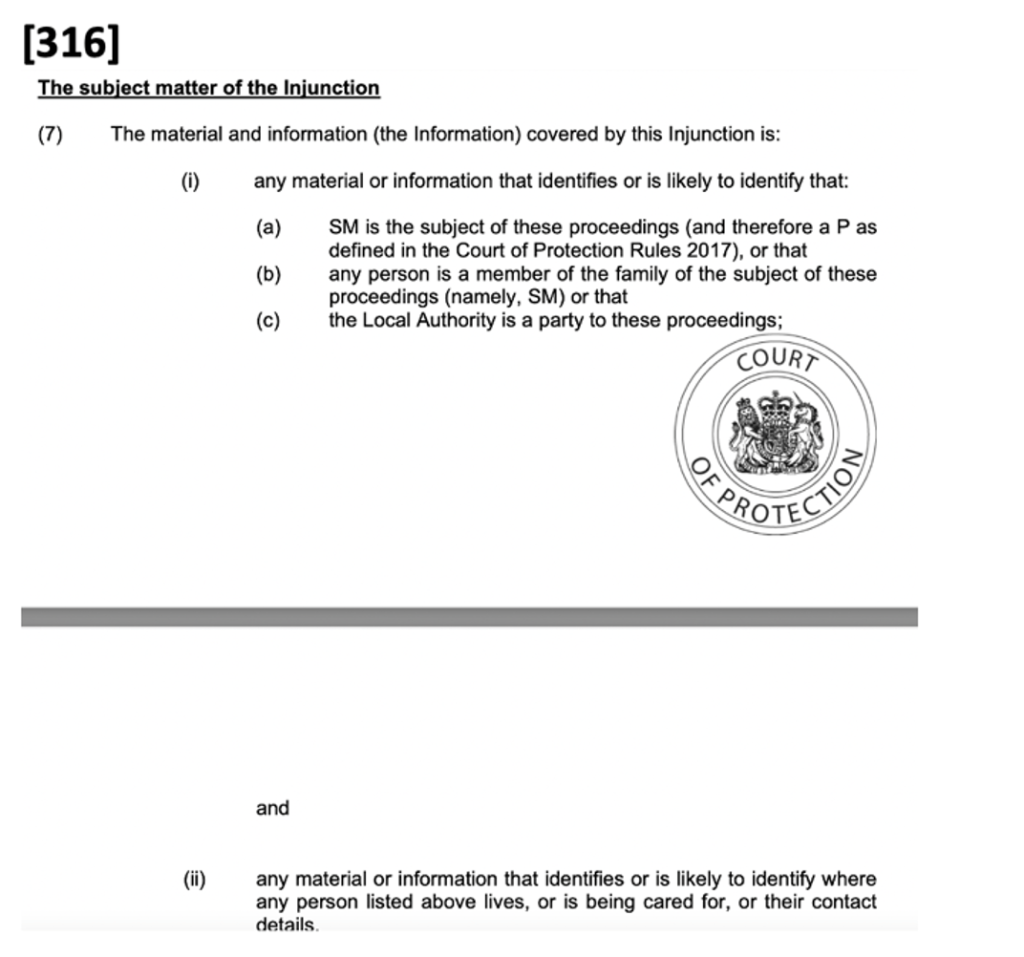
I was told in court that the TO was “the standard order in the standard terms” but when I received it, it prevented identification of the Local Authority. Since the hearing was over by then, I was not able to clarify this. [357]
38. When I have Article 10 concerns about a TO and have received it before the end of the hearing, I have usually found it most efficient (in remote hearings) to write an email to the judge and send it via whoever I have an address for who can pass it on (the judge’s clerk; counsel; whoever sent me the video link). In person, I have simply raised my hand and asked for permission to address the court. I have written blogs about some of these concerns: they have all been carefully considered by judges and resulted in variations to the TO in every case. This suggests that a member of the public (who is not a journalist) can play a part in ensuring the transparency of the court when given the opportunity to do so.
- He’s Polish: Challenging reporting restrictions (before Cohen J – varied to enable reporting of P’s nationality)
- Prader-Willi Syndrome and Transparency (before Theis J – varied to enable reporting of P’s diagnosis)
- Predatory marriage and coercive control (before Roberts J – challenged a retrospective reporting order, see §108-§110 of her judgment which deals with this)
- Naming a putative ‘expert’ in a Covid vaccination case: A letter to the judge (before Deputy Circuit Judge Rogers – asked and was granted permission to name the ‘expert’)
- Reflections on open justice and transparency in the light of Re A (Covert Medication: Closed Proceedings) [2022] EWCOP 44 (before Poole J – addressed concerns relating to an interim RRO prohibiting reporting of covert medication)
TRANSPARENCY ORDERS ARE OFTEN NOT SENT TO MEMBERS OF THE PUBLIC – RENDERING ‘ANXIOUS SCRUTINY’ OTIOSE
39. I only ever receive TOs (or written RROs) for about 50% of hearings. Of the last 50, I have no record of having received a written reporting restrictions order for the following (public) hearings: [317] [318] [319] [320] [322] [323] [325][329] [330] 336] [337] [340] [342] [344] [346] [349] [353] [354] [355] [358][8]
40. In one of these hearings [319], my contemporaneous notes record that the judge asked about TO at the beginning of the hearing, saying there was “added complexity because of concurrent care proceedings and other young people whose confidentiality needs to be respected.” But I have no record of having received the TO.
41. At some of these hearings (e.g. [320] [349]) the judge made explicit requests for TOs to be sent to observers, but we have no record of receiving them. For example, neither I, nor another observer (Paige Taylor, a Bar course student) who blogged about this hearing, ever received a TO for [320]. She describes what happened in her blog post:
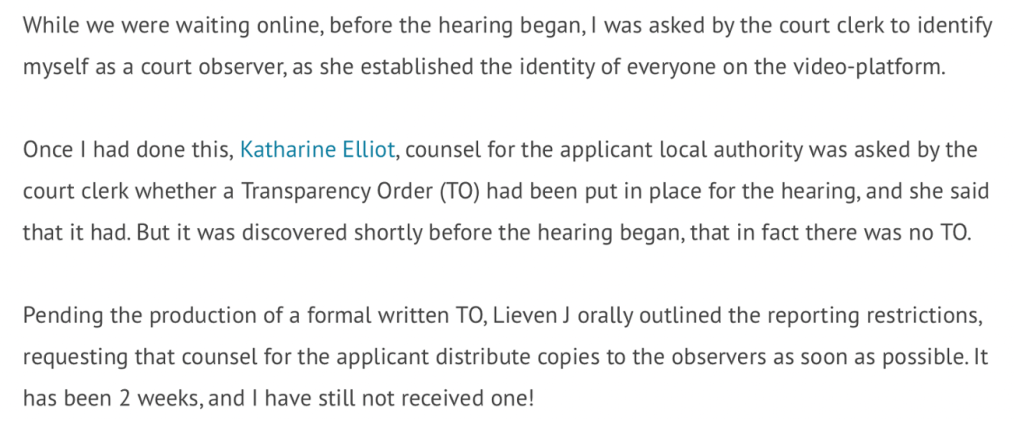
42. Some other examples:
- Three observers from the charity “Compassion in Dying” attended an in-person hearing – on different days – in the Royal Courts of Justice (and blogged about it: “She is religious and she is a fighter”: Three perspectives on best interests decision-making in the Court of Protection from ‘Compassion in Dying’). I was also in court for one of these days. None of us received a TO.
- I hadn’t received a TO for [318] and checked with another observer, Mollie Heywood who observed a subsequent hearing in the same case She says: “I’ve never had a TO for anything I’ve observed sent to me! They read out instructions but that’s it…. I’ve seen about five [hearings] or so” (Mollie Hayward, social worker + law student).
- One observer has watched 9 hearings and received only 3 TOs (and one of those came via me) – see Upeka de Silva, Policy Officer or Compassion in Dying, Appendix 2A.
- Another observer, Georgina Baidoun, former lay COP Deputy, tells me she has observed 10 hearings but received only 4 TOs.
- A member of the core Open Justice Court of Protection Project group has gone systematically through the 38 hearings (across 32 cases) that she’s observed. She has 14 TOs (=38%) – see Claire Martin Appendix 2B.
43. It does not seem to be anyone’s (agreed) job to send TOs to observers. When I’ve asked about this, I’ve generally been told that court staff should send them (e.g. ““It is not Counsel’s role to provide orders. This is an HMCTS role.”, HHJ Hilder, Item 8 Minutes of COP User Group meeting, 20 April 2022), but when I’ve asked court staff, I rarely get them (either there’s no response, or I’m advised to ask the judge). In practice, I mostly receive TOs from counsel.
44. Judges sometimes seem content to provide simply verbal summaries of reporting restrictions, followed by the request to “contact the court if you need a copy of the order” (Theis, J [337]) or “if you want a copy you can ask” [Theis, J [347]). One judge ran through the TO – she said it was “in the usual terms, nothing to identify [P], her family or where she lives – that would be contempt of court” and seemed surprised – when she offered me the opportunity to address her – by my request for a TO (‘You are keeping me on my toes’) [327]. Mostly I don’t get an opportunity to address the judge, so cannot make this request.
45. The problem with relying on oral summaries from the judge about what the TO says is that these summaries are often incorrect. For example:
On discovering that no TO had been prepared, the judge said: “you’re welcome to observe but the identity of the parties to the proceedings must remain confidential”. She checked with the advocates whether they were content to go ahead on that basis. Francis Hoar (counsel) provided a slightly different version of the TO: “You cannot report anything that may risk identifying any of their parties, or where they live, or who they associate with”. (The addition of “who they associate with” was new to me.) The judge asked the observers if we understood, so I was at that point able to ask whether we could identify public bodies, since they were also ‘parties’ to the proceedings. The judge said: “Yes, I meant the family. Not the public bodies. I think I need a pro-forma I can read out in these situations”. When I eventually received the TO, it prohibited identification of the CCG. I am unclear whether or not what the judge said in court means that she varied the pre-existing TO (made by HHJ Owens on 23rd April 2021). I’m not sure she meant to. [364]
46. Most members of the public who receive only oral summaries relating to reporting restrictions (whether these are framed as TOs or RROs, the latter of which are overwhelmingly oral only) do not feel confident to write blog posts about the hearing because they are not sure what the judge said they could and couldn’t report (or – wrongly – believe that there is nothing at all they are allowed to report). Not sending out TOs has a chilling effect on transparency.
47. In my experience, written versions of TOs (and RROs) are not sent to observers for the following reasons:
- there is still some confusion between TOs and “Remote Hearings Order” (even though more recently they are sometimes combined). I was sent RHOs for [317] and [353]. These did not include anything equivalent to “the subject matter of the injunction”.
- nobody knows how to separate out the TO from the rest of the electronic bundle
- counsel have the TO, but not the observers’ email addresses
- court staff have the observers’ email addresses, but not the TO
- it’s not clear whose job it is (if anyone’s) to send out TOs – sometimes I’m asked to circulate to other observers
48. Repeated requests for TOs are sometimes unsuccessful. For example:
“What sounded like a standard ‘warning’ was read out at the beginning of the hearing, informing me that publishing “the Information” prohibited by the TO could lead to me being sent to prison or having my assets seized etc. Nothing at all was said at any point during this hearing about what “the Information” was. Nor had I been sent a TO nor was there any attempt to send me a TO during the course of the hearing. I pursued the TO after the hearing, including via the court staff (on 21/8/22) and then via one of the barristers in the hearing (on 27/8/22) and finally by emailing the court address with an email for the attention of HHJ Howells herself. On 8/9/22, I receive an email from a Court of Protection Clerk at Cardiff COP saying “Please see attached 2x transparency orders for the hearings that you observed on 19th August”. Two documents were attached. One was a TO for the 9am hearing (which I had already received). The other was a Remote Hearings Order (not a TO) for the 11am hearing (COP 13802410). It contains NO REFERENCE to “the Information” I am not allowed to publish (i.e. it is not a combined RRO and TO). I still do not have a Transparency Order for this hearing.” [353]
49. My impression is that I am less likely to receive a TO if the judge requires amendments to the draft order (or to the order approved by the previous judge).
50. For example:
I never received a TO for the case before Lieven J on 27 January 2021 (COP 13703893). My contemporaneous notes from that hearing record that the judge referred at the beginning of the hearing to the draft TO and said she could see no reason for anonymising the hospital or the treating clinicians – and in fact she then referred to the clinicians by name in the published judgment. It subsequently transpired that the amendments had never been made – leading to considerable confusion for the BBC (and the court) in their application to name P a year and a half later, since there was a discrepancy between the still-extant TO (which said the treating clinicians could not be named) and the published judgment, which named them. The judge (Francis J) hearing the case brought by the BBC ruled that they could not now be named and ordered that Lieven J’s judgment should be taken down and redacted to remove the names of the treating clinicians (see BAILII (The Newcastle Upon Tyne Hospitals NHS Foundation Trust v Bourn (Rev1) [2021] EWCOP 11). For reasons not discussed in court, the name of the independent expert was also redacted. A temporary restriction on publishing anything about the case was imposed until the redacted judgment was in place. This whole process of seeking a variation to the TO was messier and more complicated than it need have been had the judicially approved version of the TO been available in the first place. (I blogged about the hearing: Medical treatment for people with learning disabilities: Telling Robert Bourn’s story and the challenges of ‘transparency’.)
51. I have emails from counsel in other cases saying that they will send me the revised TO once they have made the revisions and the judge has approved them – but then there is no record that I’ve ever received these revised TOs.
REPORTING RESTRICTION PROCEDURES ARE NOT WORKING WELL
52. In sum, there is strong evidence that the current procedures in place with the aim of protecting P’s privacy while at the same time protecting the public’s right to freedom of information and freedom of expression are not working well. I understand that, following the concerns expressed by Mostyn in Re EM [2022] EWCOP 31, aspects of TOs are being reviewed by the Rules Committee. Pragmatically, requiring a full-scale Re S analysis and notification of the press before any Transparency Order is made would cause a level of delay and complexity that would be impossible to manage – but it would be worth exploring how to address the current problems created by reporting restrictions and to build in mechanisms to allow the court more effectively to address the concerns participants (including family members) and observers often have about the way things are working (and failing to work) at present.
STATEMENT OF TRUTH
I believe that the facts stated in this witness statement are true. I understand that proceedings for contempt of Court may be brought against anyone who makes, or causes to be made a false statement in a document verified by a statement of truth without an honest belief in its truth
Celia Kitzinger
Dated 21st October 2022
Appendix 1. List of hearings 50 most recently observed hearings (on 10 October 2022)
by Celia Kitzinger in date order.
Ref. CASE NO. DATE JUDGE TO?
[314] COP 13755775 (29.04.22) Cobb J RCJ Y
[315] COP 13744224 (03.05.22) DJ Beckley FAH N (Private)
[316] COP 13801482 (04.05.22) DJ Woodburn Bristol Y
[317] COP 13053463 (17.05.22) DJ Porter-Bryant Cardiff N
[318] COP 13861341 (08.05.22) Francis J RCJ N
[319] COP 13630800 (20.05.22) HHJ Edwards Cardiff N
[320] COP 13585739 (23.05.22) Lieven, J N
[321] COP 1388671T (23.05.22) DJ Birk Y
[322] COP 1378613T (24.05.22) Moor J RCJ N
[323] COP 13930317 (25.05.22) MacDonald J RCJ N
[324] COP 1393210T (07.05.22) DJ Charnock-Neal Newcastle Y
[325] COP 13776756 (13.05.22) DJ Keller Cardiff N
[326] COP 13744224 (30.05.22) DJ Beckley FAH N (Private)
[327] COP 13899903 (07.06.22) HHJ Hildyard Reading Y
[328] COP 13719647 (09.06.22) DJ Searl Newcastle Y
[329] COP 13861341 (13.06.22) Francis J RCJ N
[330] COP 13933678 (15.06.22) Hayden J RCJ N
[331] COP 13662687 (17.06.22) HHJ Hilder FAH Y
[332] COP 13862920 (20.06.22) Cobb J RCJ Y
[333] COP 13861341 (27.06.22) Francis J RCJ Y
[334] COP 1393108T (01.07.22) HHJ Cove (Medway) N (Private – RRO)
[335] COP 13452747 (06.07.22) DJ Beckley FAH Y
[336] COP 13667357 (05.07.22) Hayden J RCJ N
[337] COP 133883671 (06.07.22) Theis J RCJ N
[338] COP 13744224 (07.07.22) DJ Beckley FAH N (Private)
[339] COP 13955023 (06.07.22) Arbuthnot J RCJ Y
[340] COP 13627568 (08.07.22) DJ Glassbrook Birmingham N
[341] COP 13796227 (13.07.22) DJ Beckley FAH N (Private)
[342] COP 13890570 (13.07.22) Poole J RCJ N
[343] COP 13609965 (09.07.22) Hayden J RCJ Y
[344] COP 13710982 (18.07.22) Lieven J RCJ N
[345] COP 139622855 (19.07-22) Arbuthnot J RCJ Y
[346] COP 13961662 (22.07.22) Arbuthnot J RCJ N
[347] COP 1394451 [22.07.22] Theis J RCJ Y
[348] COP 13755775 (25.07.22) Cobb J RCJ N
[349] COP 13969520 (02.08.22) Lieven J, RCJ N
[350] COP 13627568 (03.08.22) DJ Glassbrook Birmingham N
[351] COP 13977747T (18.08.22) Cobb J RCJ Y
[352] COP 13710521 (19.08.22) HHJ Howells Cardiff Y
[353] COP 13802410 (19.08.22) HHJ Howells Cardiff N
[354] COP 13407956 (19.08.22) Keehan J RCJ N
[355] COP 13488785 (30.08.22) HHJ Mitchell Bristol Y
[356] COP 13887142 (30.08.22) DJ Beckley FAH N (Private)
[357] COP 13971098 (31.08.22) DDJ Morrill (Huddersfield) Y
[358] COP 13777736 (02.09.22) DJ Foster Leeds N
[359] COP 13936808 (15.09.22) DJ Matharu Manchester Y
[360] COP 13703893 (16.09.22) Francis J RCJ N
[361] COP 12174660 (20.09.22) DJ Ellington FAH Y
[362] COP 13236134 (20.09.22) Poole J RCJ Y (also RRO)
[363] COP 13180943 (05.10.22) Lieven, J (Northampton) Y
[364] COP 12219141 (6-10-22) HHJ Brown Reading Y
Appendix 2 Other observers don’t get TOs either
A. Upeka de Silva (Policy Officer for the charity Compassion in Dying)
TOs for 3/9 = 33% (Note: one came from me)
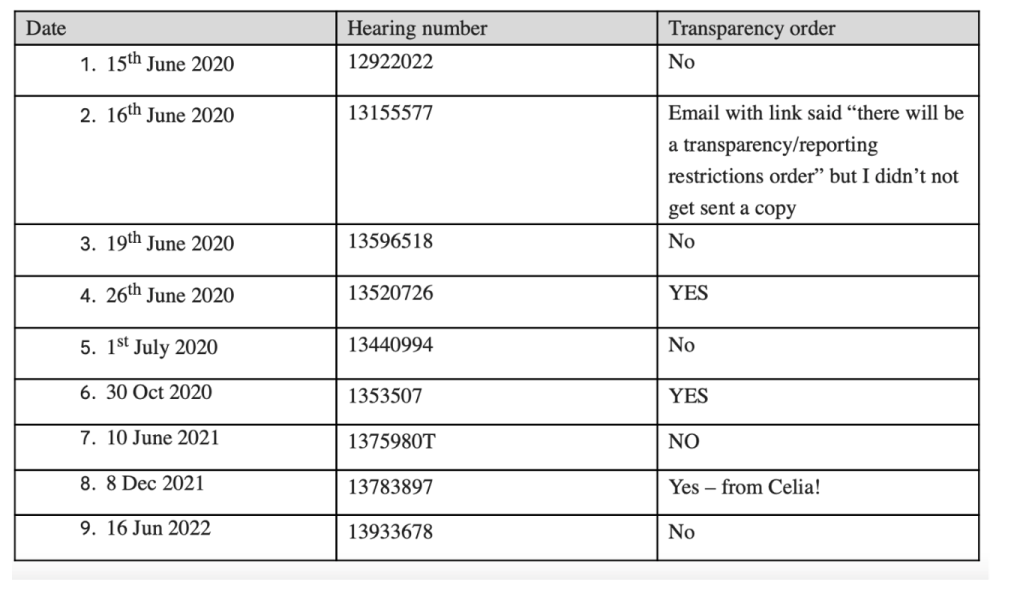
B. Dr Claire Martin, Consultant Clinical Psychologist, leads Older People’s Psychology Team, Gateshead
TOs for 14/38 cases = 37% (Note: one came via me; and she watched 2 hearings in 6 cases so second opportunities were missed to send TOs in some cases)
| Case | Date | COP number | TO yes/no | Who sent? | Topic/Blog |
| 1 | 29 June 2020 | 13330649 | No | First blog – 2 hearings | |
| 2 | July 2020 | 13392405 | No | Capacity/residence | |
| 3 | 6 July 2020 | 13375644 | No | Covert meds | |
| 4 | 30 July 2020 | 13620235 | Yes | Court staff – Judge’s clerk& Barrister Bridget Dolan & Solicitor Peter Merchant | Phone hearing – no blog |
| 5 | 26 Oct 202020 Jan 2021 | 13551368 | Yes | Court staff – Judge’s clerk | When Expert Evidence Fails |
| 6 | 11 Feb 20216-7 May 202114 July 2021 | 13575520 | Yes | Court staff – Judge’s clerk | Video Monitoring |
| 7 | 22 March 2021[1] | 13712176 | No | Life sustaining Rx following attempted suicide. Blog by Brown & Power. | |
| 8 | 29 March 2021 | 11919290 | Yes | Barrister – Sophia Roper | Bringing Lucy Home blog |
| 9 | 29 March 2021 | 13585866 | Yes | DJ Searl emailed me to inform that the TO would be being sent. Sent by court staff – Judge’s clerk | BI and contact with Mother. No blog |
| 10 | 13 April 2021 | 13416239 | No | S21A challenge. No blog | |
| 11 | 23 April 202130 April 2021 | 13718293 | No – notes from Celia say not received either | Celia/Claire blog – Court Enforced Amputation or Patient Autonomy? | |
| 12 | 16 May 2021 | 13655419 | No | Capacity for sex. No blog | |
| 13 | 7 June 2021[2] | 13751629 | No | You Can’t Ask I High Court Judge to Turn a Blind Eye to Illegal Detention, blog | |
| 14 | 14 June 2021 | 13751175 | No | No blog | |
| 15 | 5 July 2021 | 13418695 | Yes | Emma Sutton | Dental Clearance blog with Eloise Crang and Meg Aitken |
| 16 | 8 July 2021 | 13503831 | No | Predatory Marriage & Coercive Control – Celia blog | |
| 17 | 9 August 2021 | 13773522 | No | DoLs | |
| 18 | 12 August 2021 | 1324896T | Yes | Court staff – Listing Team | Should P Go to Live with Her Family in her Country of Birth? |
| 19 | 17-19 Aug 2021 | 13783897 | Yes | Celia (sent to her from Katie Gollop) | BI in a Contested End of Life Case blog |
| 20 | 13 Sept 2021[3] | 13787443 | No | No blog | |
| 21 | 21 Sept 2021 | 13339015 | Yes | Court staff – COP Admin Officer | Eight Litigants in Person |
| 22 | 19 Oct 2021 | 13364813 | No | Covid Vax – aspiring med student blog | |
| 23 | 29 Nov 2021 | 13816452 | No | 3 politics of the pandemic blogs | |
| 24 | 17 Jan 2022 | 13860597 | No | Cross-examining a GP – Celia Covid blog | |
| 25 | 27 Jan 2022[4] | 13607901 | No | Why members of the public don’t ask earlier to observe hearings. | |
| 26 | 31 Jan 2022 | 13817461 | No | No blog | |
| 27 | 7 Feb 2022 | 1354439T | No | Blogs by Gaby Parker, Jen O’Neill, Celia/Gaby, Celia, Eleanor Tallon, & ‘Four Commentaries’ |
| 28 | 14 Feb 202211 May 2022 | 13866679 | Yes | Barrister – Ulele Burnham | Prader-Willi case.2 Blogs Celia and B FarmerBamber |
| 29 | 24 Feb 2022 | 13883671 | Yes | Barrister – Ulele Burnham | 3 blogs – Mr MCelia – 11 FebClaire – 24 FebCelia -19 July |
| 30 | 25 April 202225 July 2022 (removed from listing)22 Sept 2022 | 13236134 | Yes | Court staff on two occasions (April & Sept) | A Baffling Case |
| 31 | 13 June 2022 | 12611795 | Yes | Solicitor – Kirsty Stuartand Court Staff | Micro-management blog |
| 32 | 18 July 2022 | 1396281T | Yes | Barrister – Conrad Hallin | Court Authorised C-section blog |
Total number of hearings = 38
Total cases observed = 32
[1] 13712176 – from my notes:
Reference made to TO, but not sent to me (not sure I requested). Mungo Wenban-Smith mentioned the ‘previous draft order on 9 March included a TO regarding anonymity. Said the aim was to ‘preserve the anonymity of CD’. The judge (Williams J) reinforced that P would be referred to by name during the hearing and that ‘others’ must adhere to the TO, and added that in the TO it also says family members’ names also not to be disclosed.
[2] Lieven J said ‘TO will be sent. Nobody is to publish information that could lead to the identification of the claimant or P’. Did not receive TO.
[3] From my notes: HHJ Hilder – I had to confirm that I understood the hearing was in private and I could not identify anything about P etc.
[4] From my notes: Judge mentioned observers – “welcome of course, but may I say … the court office is only open from 9-5 and communications received outside of those hours … a lot for staff to do… so Dr M if you wd be kind enough the earlier you can give notice the easier it will be.” Asked if I had received the TO [No] – asked for ‘someone’ to send it to me. Never rec’d. No summary. Don’t know who respondents are …..
[1] https://openjusticecourtofprotection.org/about/
[2] The Family Procedure Rule 27.11 (which applies only to private proceedings in the Family courts, and not to the Court of Protection) permits observation and blogging from “legal bloggers”, defined as “duly authorised lawyers” who meet the criteria specified in Practice Direction 27B.
[4] I couldn’t find it on that website, but it is available as a downloadable pdf from this page, where Charles J (then VP of the COP) explains the new approach: https://www.judiciary.uk/guidance-and-resources/the-transparency-pilot-a-note-from-the-vice-president-of-the-court-of-protection/
[5] https://www.judiciary.uk/wp-content/uploads/2020/04/20200331-Court-of-Protection-Remote-Hearings.pdf
[6] For a full account of the changing situation vs. observer access to Court of Protection hearings, see my Transparency Project blog post: “Why are so many Court of Protection hearings labelled ‘private’?”
[7] Numbers in square brackets refer to the number I’ve given the 50 court hearings I’ve observed, listed in Appendix 1.
[8] In preparing this witness statement, I have searched through my emails for the TOs missing from my files using (a) the case number; (b) the date of the hearing; (c) the names of counsel. It is just possible that I have in fact been sent TOs for one or more of these hearings but, if so, I have been unable to locate them.
 Promoting Open Justice in the Court of Protection
We contend that in our experience privacy sought by the imposition of a TO is for the healthcare provider (hospital, local authority or nursing home) rather than P. In fact we recall a judge stating that staff should be “protected” by not being exposed to potential criticism. Whilst not commenting directly on this opinion, it seems that if there is any balancing act it’s on the right to privacy of the public authority or their agents against the public interest for transparency and potentially accountability. Particularly when P is denied professional registration details (despite the professional body’s assertion that these remain their legal right, it makes it difficult to see how the public authority can support a TO whilst fulfilling their Public Sector Equality Duty.
LikeLike