

By Georgina Baidoun, 6th September 2024
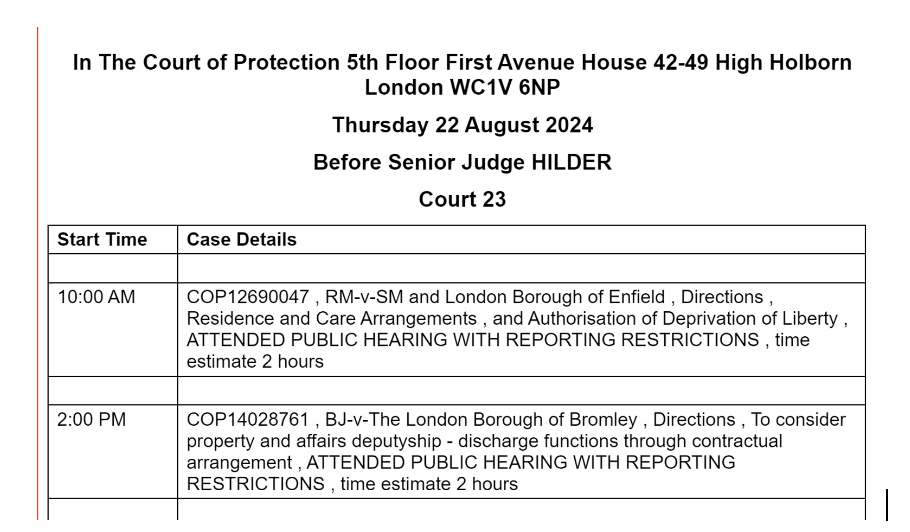
At 2pm on 2nd August 2024 I watched a hearing before HHJ Hilder, the Senior Judge of the Court of Protection. Here’s how it was listed: COP 140287761, BJ v London Borough of Bromley “To consider property and affairs deputyship – discharge functions through contractual arrangement”.
Noting that this was an attended (i.e. in person) hearing, I emailed the previous evening asking for a video link if it was possible to provide one. I received a link and attached transparency order (normal practice in my experience when observing hearings at First Avenue House) at 12.20pm, in plenty of time to get myself prepared. When I entered into the court room, I was happy to see that things were set up in such a way that I could clearly see the judge and the two lawyers who were in attendance. The sound too was very good, except that one of the lawyers did tend to lean back from his microphone; I imagine that the intimacy of only three people being in such close proximity made the microphone seem redundant. In fact, at some point in the hearing, the judge had to chastise the participants for beginning to turn it into something more resembling a conversation!
I am afraid I didn’t hear the names of the two lawyers, one representing the Local Authority and one representing the Office of the Public Guardian
The hearing
I have always found HHJ Hilder very supportive of open justice. She started by checking that I had received and agreed to the transparency order and then gave a brief summary of the case so far.
As was clear from the transparency order, the case had not started off as a property and affairs application but was originally listed as “Varying or terminating an urgent or standard authorisation under the Deprivation of Liberty Safeguards”. I guessed that the property and affairs matter had arisen during the course of that application as this was the second time I had encountered such a change of direction and was aware that, when a case changes direction, it keeps the same COP number throughout.
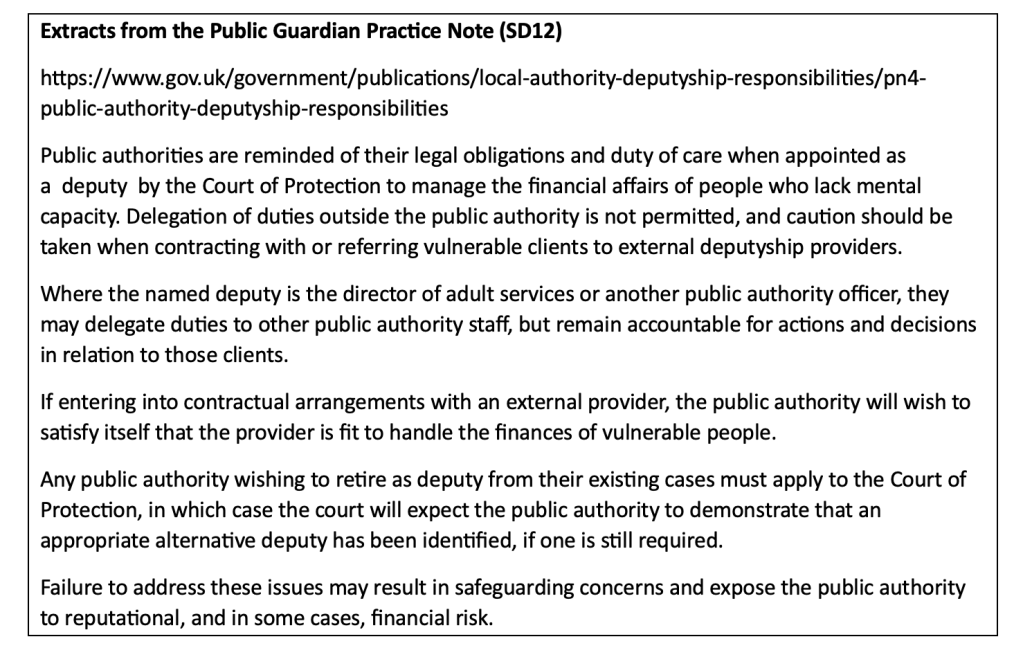
HHJ Hilder confirmed that, during a challenge relating to deprivation of liberty, issues had arisen as to how the Local Authority handled deputy appointments, particularly the contractual arrangements it had made with a commercial provider. She said that it was well established that deputy functions should not be delegated and that the only body that could give directions in such matters was the court. The fundamental principles of “empower and protect” that underpinned the Mental Capacity Act 2005 were essential here.
The Public Guardian had, of course, not been part of the deprivation of liberty application but had now been joined as a party by the court in order to represent P, who must have previously been judged to lack mental capacity to deal with such matters. However, the case had now been widened to include all those Ps for whom the LA had been given authority by the court to act as deputy. It seemed that the documents the judge had in front of her were confusing as to number and details. She said 46 cases had now been joined to these proceedings but that 5 deputyship orders were missing and some repeated. Considerable corrections would be needed before the next hearing.
The judge then asked what the Public Guardian’s position was, hoping it was not neutral. The Public Guardian representative replied that it was indeed neutral and as they were not aware of any irregularities. The judge said this was missing the point, as the concern was whether the scheme was even lawful. She was “pretty convinced” it wasn’t. The upshot was that the Public Guardian representative then agreed that he would take a position. (I thought it was interesting that he didn’t need to take instruction before making such a major change of direction.) The judge then said she would record this (leaving no room for afterthought!).
The rest of the hearing was taken up by arrangements necessary for the next and, the judge hoped, final hearing. This was a little hard to follow because it was about the paperwork in front of the court to which, of course, I had no access. However, it seemed that there was as yet no information available as to the nature of the contract between the LA and the company to which they had outsourced the deputyship work. The judge said that she needed to see a copy of a signed and dated contract. An important part of her concern was that of accountability. There was a guarantee bond in place (an insurance required for all deputyships) but it wasn’t clear whether it applied to the LA or the company.
For the next, and hopefully final, hearing the judge wanted:
- A narrative of when and how the contract had come into effect
- A narrative of how the private company was involved in these arrangements i.e. the terms of engagement and other documents such as any ‘code of expectations’ applying to the implementation of these arrangements
- A narrative explaining the route of accountability with details of the insurance bond and how it would apply.
There was then detailed discussion of timetabling, during which another issue arose. The Public Guardian representative said that he would want to give a narrative of his own as to how the current contractual arrangements were experienced by P. The judge agreed to this suggesting that one thing that might be explored was whether P ever saw anyone. (A deputyship normally requires that P should be visited at least once a year and this goes into the annual report.) The LA representative seemed unhappy about this as it raised issues beyond the contractual.
The judge suggested the parties should have a round table meeting before the next hearing so that dates could be changed if the issues became wider. The date for the next and, still hopefully, last hearing was fixed for Monday 25 November. I hope I shall be able to observe it.
After the hearing I made some interesting discoveries with some internet searches which I’ve added below as an “Afterword”.
Georgina Baidoun was the lay Court of Protection Deputy for her mother’s Property and Financial Affairs until her mother died in 2021. Because of the difficulties she experienced with several applications to the Court, and with the Office of the Public Guardian in connection with her annual report, she has retained an interest in these areas, including attending Court of Protection Users Group meetings. She is keen to share her experiences in the hope that she can help others who have to engage with these institutions with very little help or guidance. She tweets as @GeorgeMKeynes
Afterword
Internet searches produced the following.
Press statement
Bromley Council has announced its intention to award its Exchequer Services Contract to Liberata. The new contract will see Liberata continue to deliver a range of services including Revenues & Benefits, Customer Services, Administrative Social Care Services, Financial Transaction services, HR, Payroll and Pensions services on behalf of the Council. The initial contract is for eight years starting in April 2020, with the option to extend it for a further four years, and is potentially worth up to £120 million.
Councillor Graham Arthur, Portfolio Holder for Resources at Bromley Council, said: “The new contract helps deliver financial savings to the Council with real service improvements through the greater use of technology. We welcome the innovation planned and future working in partnership with Liberata which provides ultimate benefits to our residents and council tax payers.”
Bromley Council has commissioned Liberata to deliver the following services:
The collection of Council Tax and Business Rates
The administration of Housing Benefit (including overpayments ) and Council Tax Support
Assessments and awards for discretionary housing payments
Multi-channel Customer Services supporting all Revenues, Benefits and Corporate Services
Payroll and Pensions Services for the Council and its schools
IT services – administration of the Council’s Revenues, Benefits and Payroll systems.
Accounts Payable and Sundry Debtors administration (including temporary accommodation charges, adult social care charges and trade waste)
Financial Assessments for residents in receipt of adult social care
Appointeeship and Deputyship administration and payments
Cashiering services
Bromley Adult Services Procedures, Practice Guidance and Tools – extracts
https://www.proceduresonline.com/bromley/adults/chapters/default_chapters/p_deputyship.html
A Deputy has a legal requirement to act on matters they have been given the authority to act upon unless the Court of Protection has given them permission to delegate this to someone else, or where there are 2 Deputies able to make the decision and authorised to do so severally (independently of each other).
Remember: An application for the Local Authority to act should be the last resort after all other options have been ruled out.
Note: An application can also only be made if an individual is in receipt of commissioned services or a direct payment from Bromley Council with an authorised person acting on their behalf.
For queries regarding the Bromley Property and Affairs Deputyship Application process you can contact your line manager.
For queries on specific applications you can contact Chris Loft from the Appointee and Deputyship Team (A&D Team) within Liberata: Christopher.Loft@liberata.com, or the general A&D team inbox: bromleyAD@liberata.com.
Liberata will monitor the outcome of the application and will inform the social worker once known.
(I believe Christopher Loft is a Court and Tribunal Officer, in Colne, Lancashire)
 Promoting Open Justice in the Court of Protection
I encountered a variation of this where a firm of solicitors instructed by the Official Solicitor appeared to have in place some sort of arrangement with another firm of solicitors whereby if it became apparent that P required a financial deputy then they would pick up the telephone and invite that other firm of solicitors to apply to the COP to become the financial deputy of P. Clearly the firm of solicitors that was acting on the referral was deriving a financial benefit from it.
LikeLike
I am following this with interest. Some Local Authorities ‘outsource’ some of the Deputyships and they do some themselves. This means there is no contract as such in place but I wonder if the outcome of this case will have a wider impact on this issue
Regards
Wendy Jones
Tel: +447774345269
LikeLike