

By Amanda Hill, 23rd March 2025
I was excited to be travelling to London to observe an in-person hearing at the Royal Courts of Justice (RCJ) as part of my research with Cardiff University.
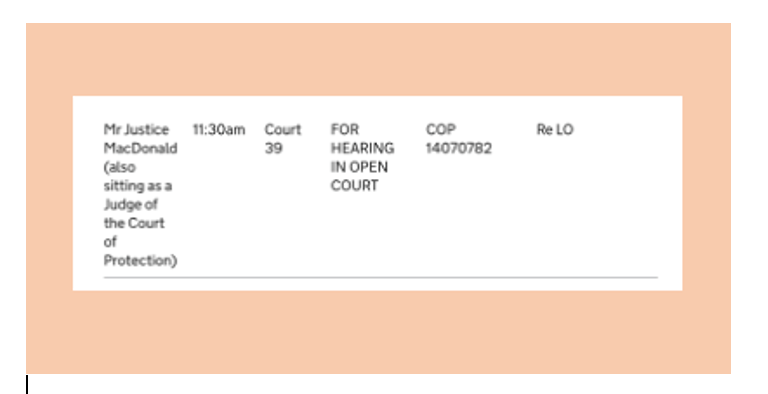
This would be my third time observing in person at the RCJ and I was beginning to feel as though I knew what I was doing and how things worked. The evening before, when the listings were published, I’d identified an 11.30am hearing (COP 14070782 on 8 October 2024) before Mr Justice MacDonald in Court 39, which I knew was in the Queen’s Building, the newer construction behind the Gothic splendour of the old building that always appears in photographs of the RCJ.
I arrived in good time at 9.50am. It was just as well, because I ended up queueing behind a school party going through security just ahead of me. The security staff didn’t seem as ‘fierce’ as they had done the day before when I was there, and were waving people through saying “Morning” and “Have a good day” as they checked them in.
I double-checked the Daily Cause List printed out and pinned up in the glass cabinets in the middle of the impressive Grand Hall. I could see that the listing for the hearing I wanted to observe was still the same – it was in fact the printed internet page from the evening before, timed at 19.01:
I approached the enquiries desk and said that I wanted to observe the hearing in Court 39. Straight away, the member of staff helpfully gave me the map to show me where the courtroom was. There was no suggestion that it would be in private or that it wouldn’t be happening as listed.
After a leisurely coffee in the on-site café, taking in my surroundings, I walked over to the Queen’s Building.
At around 11am, there were a few people around. I looked at the Daily Cause List in front of the court room door to triple-check the hearing was going ahead in that room, but the only list on display was for hearings before Mr Justice Poole from the week before.
The lights were on in Court 39 and I could see somebody tapping away on a computer in front of the judge’s bench, so I assumed that that was the judge’s clerk. I could also see one man in a consultation room next to Court 39, with the door open. My plan was to wait and see what happened around 11.30 (when the hearing was due to start), and follow other people into the courtroom when people started to move in. There also were a couple of people just in front of the court room who I assumed were waiting for the same hearing that I wanted to observe – but they left shortly afterwards so obviously not – and as time went on there were fewer people in the lobby area in front of the court rooms.
I sat and waited.
When 11.30 came and went I assumed that the previous hearing before the same judge was running late. The list told me that there was a 10.30 “urgent” hearing (not a Court of Protection one) by MS teams. It’s not unusual for hearings to run over their allotted hour and for subsequent hearings to begin late, so I just kept an eye on what was going on inside the court room. There were no signs of an in-person hearing going ahead.
At 11.38 I checked the listing using my phone to see if the listing had changed but it hadn’t. The 11.30am hearing was still there and it still said it would be heard in open court in Court 39.

Nobody went into courtroom 39 and nobody came out of the courtroom to say what was happening with the hearing.
At 11.43 I saw the judge in there, along with the staff member. The judge was sitting at the bench looking at his computer.
By 11.46 the judge had gone ,but the staff member was still at her computer. I felt very uncertain as to what I should do. I kept looking through the glass panel window on the door. Should I go in and ask what the situation was? But I was worried that the urgent hearing from 10.30am (a private family one) might still be going on, and that the staff member would be involved with that.
At 11.50 the judge sat back down at the bench but again did not stay long.
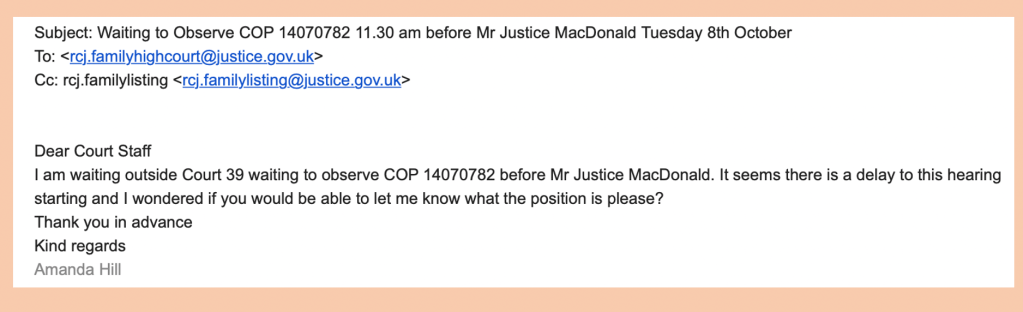
At 12pm I decided to email the RCJ staff to tell them I was waiting to observe the Court of Protection hearing in person and asking what the situation was:
By 12.10 there was still no news or signs of movement. Nobody was around apart from the people in the consultation room nearby behind the (now) closed door. I was feeling very frustrated and a bit stupid. I wondered again whether I should go into the courtroom and ask the staff member at the desk what was happening. I knew the hearing was not likely to continue past 1pm (when the court usually breaks for lunch) and time was ticking on.
By 12.19 I hadn’t had a reply to my email, so I rang the RCJ number published on the Open Justice Court of Protection “Featured Hearings” page. The phone was answered quite quickly and I spoke to a staff member and gave her the hearing details. She checked and said ‘they should be in court’. I told her that I was sitting in front of the court room and that I couldn’t see anyone in the court apart from a member of staff sitting at her computer. She put me on hold for a few minutes and then she came back, apologizing for keeping me waiting. She said that she had contacted the court associate who had told her that the hearing had been held remotely by MS Teams that morning. I’d spent 7 minutes on the call:
So, I had missed the hearing
Having gone specifically to London to watch COP hearings, spending the whole morning at the RCJ and having sat outside the court room for an hour, I couldn’t believe it that this had happened. I felt so foolish: it was such a waste of my time and a missed opportunity for open justice.
At 12.30 I left the building without having watched a hearing, feeling very dispirited about the whole experience.
What could have been done to support transparency?
As co-director of the Open Justice Court of Protection Project, Celia Kitzinger wrote to the court afterwards to find out what had gone wrong and received the following reply:
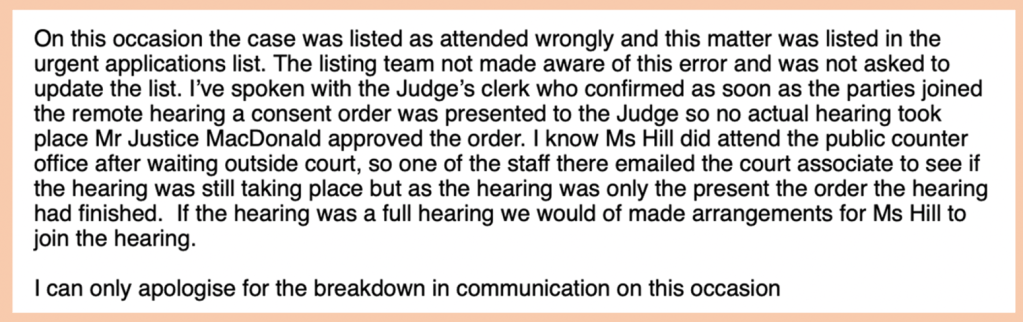
Note: I did not (as the email says) “attend the public counter” about my concern – I’d phoned; and I think on the account given, a hearing did take place briefly to approve the agreed order (agreed orders are often approved “on the papers” and the hearing is vacated but that doesn’t seem to have been the case here). But these are issues in passing, and not the key point.
A number of things could have been done in this situation.
- The online listing could have been corrected promptly, but only if someone – the judge or judge’s clerk – had checked the list, seen it was wrong, and told the listing team that it was wrong and asked them to correct it.
- The paper daily cause list outside the courtroom could have been updated. By coincidence, I had booked a tour of the RCJ that same afternoon and the guide said that the printed paper notices (at least outside other courtrooms) were frequently annotated in pen so that the public were kept up-to-date. This would have required the court staff to look at the list and realise that it was wrong – which they would have known, obviously, since they were managing a remote hearing and the list said it was an in-person hearing – so court staff were in a position to do this.
- A member of staff could have checked the corridor outside the court to see if anyone was waiting to observe as a consequence of the case having been wrongly listed and invited me into the courtroom, notwithstanding the fact that it was now a remote hearing (and a very brief one). This is what happened in another case we’ve blogged about: a hearing was changed from being in-person to remote and an observer who had travelled to observe the hearing in person was invited into the courtroom to observe the judge conducting the remote hearing (see Observing a remote hearing in court with the judge). In that case, it seems that the hearing had also been wrongly listed as “public” when in fact it had been intended to hear it in private. Displaying a firm commitment to transparency, the judge (HHJ Hilder) said: “Since Professor Kitzinger has taken the trouble to come to court, I made a Transparency Order and we are sitting in public” – and, “just to clarify,” she added (addressing the observer) “you would have been welcome to attend if it had been a private hearing”.
Transparency is in peril when it’s made so challenging for would-be observers to access court hearings. If errors and last-minute changes are inevitable (and perhaps some are), then at least steps should be taken to facilitate observers, either by provision of remote links to in-person hearings, or by admitting observers to otherwise empty courtrooms where judges are conducting remote hearings.
The judiciary, lawyers and HMCTS staff need to work together to avoid errors and to improve procedures to ensure that we’re not excluded and left feeling so dispirited and disempowered about open justice.
What was the hearing about?
The point of my going along to the Royal Courts of Justice that day was to observe justice being done, in person, and report back to the public on what I saw. I can’t report on the process, but I do know a bit about what happened because I asked the judge for the approved order from the hearing and eventually (two months later) received it. This means I can provide an update on what’s been happening in this case.
Another observer (Celia Kitzinger[1]) had watched – but not blogged about – a remote hearing in this same case back on 10th July 2023, also in the Royal Courts of Justice, but before a different judge (Mr Dias KC).
At that point (July 2023), the protected person, LO – described as “a 17-year-old with significant impairments” – needed psychological support but there were difficulties in obtaining this and the parents’ lawyer (Ben McCormack) sounded very frustrated: “Why are we sitting here time and time again to ask for directions: the psychologist left employment and it’s taken us six months to find another psychologist and get the authorities to agree to pay for one!”. He said – rehearsing a familiar refrain in the Court of Protection – “this litigation is characterised by agreement, but also by delay”.
The parents were also trying to get the authorities to plan ahead for when LO turned 18 in the course of the coming year, at which point he would transfer to adult services. Would LO qualify for Continuing Health Care? Where would LO live?
Counsel for LO’s parents said: “The agreement is that LO will live at [X Placement] in [City] and it’s likely everyone agrees he should live there after he turns 18 – but it is absolutely mission-critical that [X Placement] starts that intensive hefty process to become registered with CQC”.
So, what’s happened with the “mission-critical” CQC registration?
The approved order from the hearing I failed to observe (so three months later) says that LO’s support provider “remains unregistered with OFSTED” and that LO’s placement has “informed [the local authority] that they will not be pursuing CQC registration” and it “is therefore also unregistered with the CQC”. The landlord has also served notice. The public bodies[2] were looking for a new place for LO to live long-term.[3] This situation has serious implications for LO (and his family) and is a legitimate matter of public interest. This is exactly the kind of thing we need to be reporting from the Court of Protection.
At the hearing, the judge authorised the continuing deprivation of LO’s liberty as being in his best interests, reallocated the matter to another judge (Mr Justice Poole), and ordered the local authority to come up with a list of options for – and best interests analysis of – different care providers and placements, plus if relevant a transition plan and a care and support plan. There were also other issues relating to internet use and contact, plus the local authority was required to address “whether, and to what extent, external support may be required from a behavioural specialist and/or psychologist”.
The matter was listed to come back to court on the first available date after 16th December 2024 before Mr Justice Poole.
The next time we spotted it in the listings was 12th February 2025, so that probably was the first available date. It appeared as “in Court as in Chambers” which is a fancy legal way of saying “in private”.
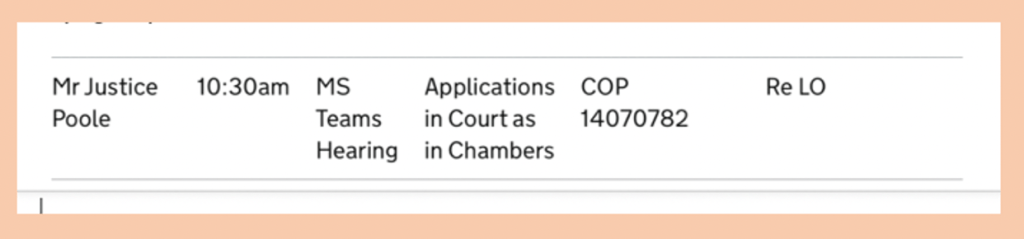
We were puzzled about why this hearing had been listed as private, given that both the hearing Celia had attended remotely, and the one I’d tried to attend in person, had been listed as “public”. When we asked about this, we were simply told this hearing had been “vacated” (i.e. it wasn’t happening), so we are none the wiser about whether (and if so why) the case is now being heard in private. It might be another mistake – or it might not.
We also don’t know why the hearing listed for February 2025 didn’t take place. It might be because everything has been done in accordance with the judge’s directions and LO is settled in his new home with the support of a psychologist, and all of the parties have agreed that a hearing isn’t needed. Or it might be because the case isn’t ready to be heard again – because (for example) the local authority hasn’t yet assembled a list of options for places where LO could live, or has not worked out agreement to funding them, in which case there would be no options for the judge to consider and make decisions about in LO’s best interests. We just don’t know. We’ll be keeping an eye out for this case coming back to court in the future.
This blog illustrates the difficulty of tracking hearings of cases we’re interested in across the months and years that they’re before the court and, in particular, the challenges we face when hearings are wrongly listed as “in person” and no steps are taken to correct this.
Transparency requires the judiciary, lawyers, and court staff to be alert to the possibility of would-be observers at their hearings and proactively to facilitate our attendance.
Amanda Hill is a PhD student at the School of Journalism, Media and Culture at Cardiff University. Her research focuses on the Court of Protection, exploring family experiences, media representations and social media activism. She’s a family member of a protected party in a Court of Protection case and acted as a Litigant in Person. Amanda is on LinkedIn (here), and also on X as (@AmandaAPHill) and on Bluesky (@AmandaAPHill.bsky.social)
[1] Thank you to Celia Kitzinger who wrote the paragraphs about what happened in the July 2024 hearing and to Daniel Clark who raised concerns about the “private” listing of this case in February this year.
[2] Celia Kitzinger has no record of having received a Transparency Order for the hearing she observed on 10th July 2023 (despite emails asking for one). I was sent the approved order – which includes lots of names of both public bodies and individuals involved in this case – but no Transparency Order. So this blog post has been written without any injunction concerning reporting restrictions having been served on us at any point. In accordance with the standard restrictions imposed by these Orders, we have not published P’s name, the name of his family members, anyone’s contact details, or anything likely to identify any of these people or where they live. We have also – to be on the safe side – chosen not to name the applicant local authority or the respondent integrated care board – those these should be (and normally are) in the public domain. We have asked for a Transparency Order and will amend this blog post as necessary if or when we receive it.
[3] The blog post cited earlier (Observing a remote hearing in court with the judge) is also about lack of progress in finding an adult placement for a young person transitioning to adult care and – coincidently – raises remarkably similar concerns.
 Promoting Open Justice in the Court of Protection