

By the Core Team of the Open Justice COP Project (Celia Kitzinger, Gill Loomes-Quinn, Daniel Clark, Amanda Hill and Claire Martin), 15th June 2025
It was launched – with no funding and no clear plan about what we were going to do beyond observing a few hearings and writing some blog posts – on 15th June 2020, by Celia Kitzinger (retired academic psychologist) and Gill Loomes-Quinn (disability scholar-activist).
It was the beginning of the pandemic. Court of Protection hearings had almost all moved from physical courtrooms where – at least in theory – the public could observe them, to ‘remote’ hearings via telephone and video-platforms, where they’d become pretty much inaccessible and were mostly marked “PRIVATE” in the lists.
By chance, Celia had been involved in the first all-remote hearing of the pandemic: a contested hearing about life-support treatment. She was supporting the patient’s daughter through what turned out to be a terrible experience in the new virtual court, as Celia describes here: Two years on: A postscript to remote justice. That’s what initially spurred us to create the Open Justice COP Project to monitor what was happening in these new “remote” hearings.
We had no idea, back then, just how difficult this would turn out to be, or how enthusiastically others would join us, or how big and influential this Project would become, or that five years later the eminent barrister Alex Ruck Keene KC (Hon) would describe it as “an amazing achievement – one of the few silver linings of the pandemic”.
Who we are and what we do
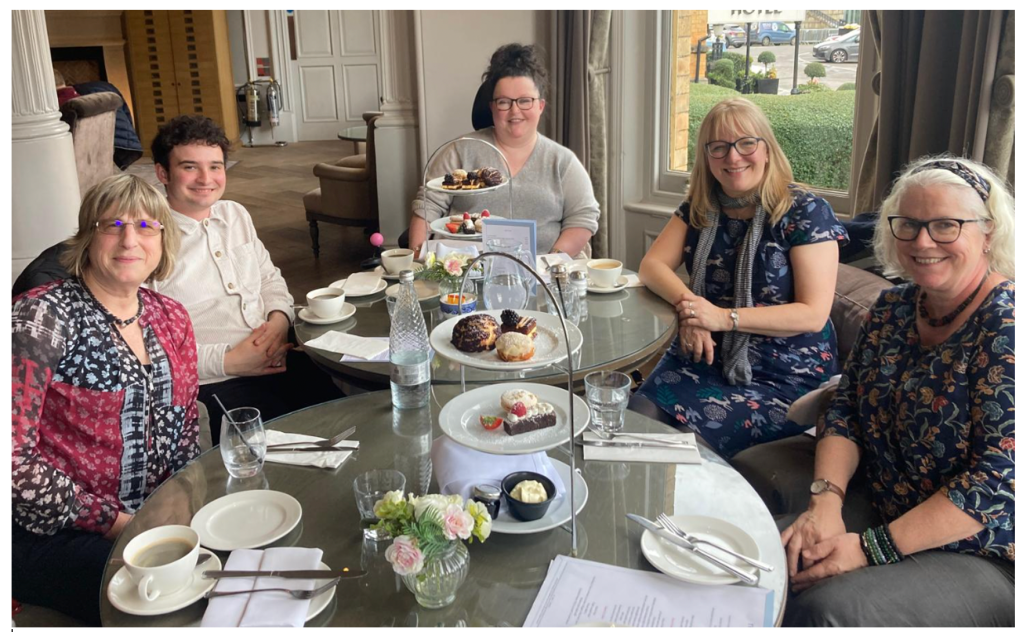
Born of our passionate belief that “publicity is the very soul of justice” and our strong desire to support the judicial aspiration for transparency, the Project has developed as a core team of five volunteers who do the day-to-day management of the Project and make its practice and policy decisions: Celia Kitzinger, Gill Loomes-Quinn, Daniel Clark, Amanda Hill, and Claire Martin.
Anyone who’s been watching closely will have realised that a core team member called “Anna” disappeared from the group (with no fond farewells) earlier this year, and was replaced with Amanda Hill. They are one and the same: “Anna” was a pseudonym. After a great deal of hard work, and many delays, Amanda finally succeeded in March 2025 – with the pro bono help of a legal team from Irwin Mitchell (thank you!) – in getting the Transparency Order for her Mum’s case varied, so that she can identify herself as the daughter of a protected party in the Court of Protection. Last time we published a photo of the core team, we had to obscure Amanda’s face so that she couldn’t be publicly identified. We’re thrilled that Amanda can now reveal herself and we can say “Welcome Amanda” (two years later). (You can read more about Amanda’s experience as a litigant in person in the Court of Protection here: “Our ordinary story ….and how it became an unbelievable family experience of the Court of Protection“.)
We’ve also supported other family members (sometimes with pro bono legal help) to seek discharge or variation of the Transparency Orders affecting them so that they too can publish information about court proceedings in their own names (e.g. see “A mother now free to tell her Court of Protection story” and “Bureaucracy blots out the sun”: Telling Ella Lung’s story”).
We’re grateful to Tor Butler Cole KC for her help in particular in the protracted struggle to discharge the Transparency Order preventing Jill Stansfield, daughter of the protected party in the first-ever all-remote Court of Protection hearing of the pandemic, from speaking out in her own name. Then pseudonymised as “Sarah”, it was her story, and the brutal nature of her COP hearing, that motivated Celia and Gill to launch the Project back in 2020. Today, Jill Stansfield draws on her experience to promote Advance Decisions to Refuse Treatment: following her father’s sudden collapse, he was given medical treatment (for years) that she is sure he would have refused if he could (“Why is it important to start advance care planning conversations early and before crisis”).
It is striking to us how people seek to use the distressing and sometimes unfair experiences they’ve suffered in health and social care (and/or in the justice system) to try to make the world a better place by sharing information with others and offering support. Discharging or varying reporting restrictions so that people can speak out about their experience is often essential for that to be effective. We’d like to be able to help more families who want to speak publicly about their Court of Protection experience in their own names, and we’ve developed some expertise in challenging Transparency Orders over the years. Please get in touch with us if you’d like support with this.
“OJCOP have been amazing to me personally. As a parent and ‘litigant in person’, they have helped me to get my Transparency Order varied so I can speak about my experience of going through the court, and most importantly be able to share the experience with other bewildered parents with disabled children who are going through the same often overwhelming process. Happy birthday OJCOP! May you have many more birthdays and continue helping others like me to understand the mysteries of the Court of Protection!” (Heather Walton, parent and litigant in person in the Court of Protection)
In addition to the core group of five, there’s a shifting group of around 100 people in a WhatsApp Observers’ Group. We are in contact most days, exchanging information about hearings we’re hoping to observe, and the challenges we’re confronting.
We also have an Advisory group of three lawyers (see “Meet the Team”) and we’re enormously grateful to them for the work they do – often at short notice – to provide us with information and support especially in relation to getting the law right when writing and editing blog posts.
We run “webinars” (hosted by Claire and Amanda) to offer support on how to observe hearings, and we offer to “buddy up” with people who would like someone to attend their first hearings with them (usually virtually). Thousands of people – health and social care professionals, disabled people and their families, and those with experience of the Court of Protection as protected parties, litigants in person and expert witnesses – have developed the confidence from our website and/or our webinars to watch Court hearings.
Although we still have no regular funding, we were lucky enough in the last year to receive money from two different university sources (the White Rose University Consortium and Cardiff University) to support PhD students Daniel Clark and Amanda Hill (separately) to carry out paid research on transparency issues in the COP. As a result, we now have a health and safety policy and employees’ insurance – even though we don’t employ anyone! If you’re interested in doing something similar on placement with us, do get in touch![1]
Blogging about hearings remains a key part of what we do to publicise the work of the Court of Protection. We’ve published 580 blog posts over the last five years (91 in the last year), including (on request, for a judicial training event) “Fifteen Top Transparency Tips for Judges”. We’ve seen some indications that our “tips” have been effective in changing judicial behaviour, which is encouraging.
With the appointment of Nicklin J as Chair of the Ministry of Justice’s new Transparency and Open Justice Board, it may be that the landscape for court observers is changing. We have contributed to the Board’s consultation exercise with “stakeholders” (Response to the Transparency and Open Justice Board proposed “key objectives”) and we know that the Board is aware of the problems we frequently face: unhelpful court lists (though they have significantly improved lately); difficulties with access (no response to emails; links that don’t work); and problems with hearing and seeing the court (both in person and remotely). Perhaps the Board’s proposed new “Open Justice Champions” within HMCTS will come up with solutions? We’ll report back on that next year.
We know that there are ongoing challenges – possibly specific to us in the Court of Protection – as regards both committal hearings for contempt of court (Contempt of court proceedings: Are they transparent?) and with the listing and holding of closed hearings (those from which a judge directs that one party and their legal representatives should be excluded). We expect to work on these issues over the coming year.
Open justice can sometimes feel like an uphill struggle – not (by and large) because anyone is actively opposed to it, but because the overriding objective of the court is to do justice – and letting us see it being done sometimes falls by the wayside. The judges’ lists are full, the lawyers are busy with last minute conferences with their clients and navigating unwieldy bundles, HMCTS is understaffed and under-resourced. Even if everyone felt as strongly as we do about transparency, it would still be hard to accomplish given the constraints on the ground. So we have tried – and we think on the whole HMCTS staff, the lawyers and the judiciary have tried – to treat open justice as a collaborative endeavour: we are all pulling together in the same direction, and sometimes we fail nonetheless. Figuring out where things are going wrong and how best to put them right is more productive than blame and suspicion.
So a big thank you to all the ushers, clerks, office staff and administrators in HMCTS who have dealt with our recurrent complaints about listings and access over the last year; to the solicitors and barristers who’ve negotiated our requests for position statements and opening summaries; and to the judges who’ve engaged with the needs of observers in court, including (importantly) not just handing down orders about reporting restrictions but making time for us to make oral applications to vary them there and then thereby averting lengthy COP 9 applications and the need for further hearings before open justice can be accomplished. We increasingly realise from talking with court observers in other jurisdictions (as members of the Courts and Tribunals Observers’ Network) that the Court of Protection may well be more committed to transparency and open justice than other courts.
Feedback
Finally, we’re delighted with the positive feedback we’ve received about the Project, from judges and lawyers, from health and social care professionals and from members of the public. Of course, we do also value critical feedback, corrections to our blog posts and challenges to our approach – and we do receive those frequently – but just for one day, on our birthday, we’d like to focus on praise and congratulations for what we’ve achieved.
The Project featured in a previous High Court judgment by Mr Justice Poole as “an important project that makes a significant contribution to transparency and public understanding of the workings of the Court of Protection” (§68 Re A (Covert medication; closed proceedings) [2022] EWCOP 44. This year, a judgment by Mrs Justice Arbuthnot (involving an application by Celia to vary a Transparency Order) referred to the Project as having “an important role in supporting public understanding of the Court of Protection which was, and arguably still is, a little-known court” (§17, Norfolk County Council v CA & Ors [2025] EWCOP 16 (T3).
Solicitor Heledd Wynn values the Project for the way it helps her “to understand the things that we as lawyers take for granted as we are trained to do so – language, protocol, procedures”, thereby alerting her to the need to “translate” for non-lawyers.
Law students tell us that it’s shown them that “the publishing of judgments is not sufficient for open justice. The opportunity to observe hearings has provided greater insight into the COP than I could ever have achieved through reading books and judgments” (Rebecca Pritchard, final year LLB law student, University of South Wales). “The OJCOP has enabled me to engage with an area of law that was previously unfamiliar to me- an area I had only seen listed among the services offered by barristers’ chambers, without fully understanding what it involved”, says Brittany Murphy, LLM student at Cardiff University, adding: “Were it not for the project, I would not have known how to observe Court of Protection (COP) cases, nor felt empowered to do so. Thanks to the guidance it provides, I have not only been able to observe such cases but have also developed a strong academic interest in the field, and will be writing my LLM dissertation on COP proceedings”.
Another law student, Sarah Shee, says the Project has taught her “so much about the workings of the court and its functions and the different organisations and people represented.”
“It’s shown me how relevant statute and case law work when applied to practice in different situations: e g capacity for sexual relationships, moving placement and housing, advance directives, whether or not to feed an unconscious anorexic patient, whether to put a long-term ventilated patient with irreversible brain damage on a palliative pathway, parental contact with P…. All so varied and interesting. The judgments really show the analytical way in which law is used and synthesised to make a decision. I’ve been impressed by how empathic a lot of the judges are and how they can understand and analyse complicated medical issues despite having had no medical training. It just brings law alive and also gets you really thinking about ethical issues. As a student of mental health law, it has been a brilliant insight into the COP and the sort of cases they have. It’s brought my academic studies alive seeing the different cases and judgements. I have honestly learnt so much. It’s like doing a module in COP (but without exams/essays thankfully) I can’t wait to have time to get more involved.” (Sarah Shee, studying for LLM in Mental Health Law)
The Project is also valued by health and social care professionals:
The OJCOP Project has deepened my understanding of the legal issues surrounding CoP proceedings, the ethical complexities they present, and the raw human emotion often absent in published judgments. I have also had the privilege of connecting with inspiring colleagues and mentors who have influenced my progression as an Expert Witness in the CoP and my journey into socio-legal research. (Eleanor Tallon, Independent Social Worker)
“I feel incredibly grateful… I’ve grown, learned, and been inspired by the passion and knowledge shared by everyone. It’s a privilege to be part of something so meaningful, and I’m excited for all that lies ahead.” (Laura Natale, social worker)
As a psychiatrist with a special interest in complex anorexia, the OJCOP Project is a rare gem. Hearings have deepened my understanding of the workings of the CoP and significantly improved my practice – especially through observing cross-questioning of clinical teams and independent experts. Observing hearings in the Court of Protection is a must for every medic working with anyone who lacks (or may lack) capacity. The Project is a fantastic support and resource. (Adaeze Bradshaw, Consultant Psychiatrist)
The Open Justice Court of Protection Project provides valuable insight into these proceedings. As a Mental Capacity Act Lead in the NHS I find reading about the experiences of those with an interest in the person’s welfare, and others with a link to ‘P’, particularly insightful and valuable food for thought in my day to day practice. (Edd Bartlett, Mental Capacity Lead Professional, Berkshire Healthcare NHS Foundation Trust)
In case management I think what you’re doing is making the COP processes much more accessible and providing learning opportunities to those in the field. In particular I think it helps those on the ground working with challenging aspects of capacity and best interest decision-making to understand what needs to go to court, whilst also being more confident about what does not, how to make good decisions and how important their documentation is around all of these aspects. It is something I’d encourage all those in complex case management to follow and to get involved in. (Vicki Gilman, Executive Director at Social Return Case Management Ltd and past chair of BABICM)
There’s no substitute for watching the decision-making process of the judges and the care and attention they take to get the judgment right for the person at the very heart of the hearing…. The OJCOP team provide their expertise to navigate you through the practicalities of attending the hearings and how to maintain safe behaviour (accidentally being in contempt of court was one of my worries!). (Emma Heron, Lead NHS Research Nurse)
It’s not just professionals of course. There are members of the public who observe hearings and read our blogs because they hold Lasting Powers of Attorney, court appointed Deputyships, or act as Relevant Person’s Representative – or simply because someone they care for (or they themselves) may lack – capacity in some domains and/or because they’ve become caught up in COP proceedings already. Unpaid carer, Maggie Bruce-Konuah, has described how “observing COP hearings has brought the MCA to life for me — seeing the principles enacted in real time has been truly eye-opening and I’m grateful to all who’ve made this access possible”. All of us, MCA professionals as much as the rest of us, could potentially be involved in Court of Protection proceedings and that’s an important reason why transparency really matters in this of all jurisdictions. Former litigant in person, Kim Dodd, makes this point powerfully in her appreciation of the Project’s role
“I’m in awe of the OJCOP Project team’s energy, approachability, knowledge and dedication, and am grateful for the hours you’ve sacrificed, individually and collectively, over the last five years to help the judiciary and legal professionals creep steadily towards their stated aspirations of open justice. The concept of open justice in the CoP is especially critical because as citizens (unlike with the criminal and civil courts) we cannot conduct our lives in a way which puts us out of the court’s reach by not committing criminal or tortious acts. Becoming a P, or a family member of a P is something that can happen to anyone. Happy Birthday OJCOP! Amazing individuals. Amazing progress. Thank you.” (Kim Dodd – member of the public and previous Litigant in Person in CoP proceedings)
Finally, a special thank you to everyone who’s blogged for the Project over the course of the last 12 months (in alphabetical order): Georgina Baidoun, Daniel Clark, Kim Dodd, Laura Eccleston, Ty Glover, Keir Harding, Amanda Hill, Ruth Hughes KC, Hita Jadeja, Celia Kitzinger, Jenny Kitzinger, Gill Loomes-Quinn, Richard Lung, Claire Martin, Ruth Meyer, Sophie Monaghan, Elissa Novak, Rebecca Pritchard, Lucy Series, Tim Sugden, Eleanor Tallon, Heather Walton, Sydney White, Meg Niven Withers, Jess Wright
We’d also like to thank each other for being such a great team! Happy Birthday to us!
[1] Blog posts reporting on Daniel’s research: “A review of transparency and open justice in the Court of Protection”; “Access to the Court of Protection in London: Do court buildings support transparency and open justice?”.
 Promoting Open Justice in the Court of Protection
Happy birthday ya’ll and thanks for a great resource Steve Khan
Sent from my iPad
>
LikeLike
Happy 5th birthday to the Open Justice Court of Protection Project!Thank you to the core team, volunteer observers, and bloggers for all you do. Your work is not only important but profoundly helpful in making this complex area more understandable—not just for professionals, but for regular people trying to make sense of it all. Deeply appreciated, and long may it continue.
LikeLike
Happy birthday!!! Thank you for all your hard work.
LikeLike