
By Daniel Clark, 31st July 2025
In a speech at the start of June 2025, the Chair of the Transparency and Open Justice Board, Mr Justice Nicklin, remarked that, “we must also recognise that open justice is not self-executing. The principles of open justice must be upheld, on occasions nurtured, and — critically — seen to be upheld.”
This blog provides an excellent example of the fact that open justice isn’t self-executing. If it weren’t for my presence at two hearings, it would have been all-but forgotten.
The case (COP 12999111) is a challenge to the deprivation of liberty of NF, an autistic man who has resided in a care home that, for the last 7 years, has been widely considered unsuitable for him. The applicant, NF, is represented by his litigation friend, the Official Solicitor. The respondent public bodies are Leicestershire County Council and NHS Leicester, Leicestershire and Rutland Integrated Care Board. NF’s mother, LF, is the third respondent, and a litigant in person.
I’ve blogged about the case before here: A judge without a bundle adjourns the case and I knew from prior observation that the judge had listed a next hearing for Thursday 12th June 2025 at 3pm.
The details of the substantive issues in this case will follow in a future blog. Here, I’m concerned only with the transparency failings of the case: in relation to listing, and in relation to the shambolic handling of the Transparency Order that erroneously prohibited the identification of Leicestershire County Council.
In his book The Rule of Law, Lord Bingham, a former Law Lord who was instrumental in the creation of the Supreme Court, comments that, “belief in the rule of law does not import unqualified admiration of the law, or the legal profession, or the courts, or the judges” (p9).
I have no doubt that some people reading this blog will think it is unfair of me to be critical – that court staff, members of the judiciary, and lawyers are all working very hard under serious time and resource pressures. That’s true, and I don’t dispute it.
But when failings occur, and they clearly have done here, it’s fair that we highlight them, and ask “why?” That’s exactly what this blog does – though unfortunately I don’t have an answer to that question. That’s not for lack of trying. As I go on to say below, no explanation has been forthcoming.
First, I discuss the fact that this hearing never appeared in any public listing. If I hadn’t observed the case a week before, I would have had no way of knowing that it was back in court.
Second, I show that the judge remade the Transparency Order so as to ban identification of Leicestershire County Council – despite a successful application 6 months earlier to lift that ban. This was done without notice to me or to Celia Kitzinger (who had made the initial application to lift the ban). It was an outrageous derogation from the principle of open justice, and resulted in me having to make a new application to vary the Transparency Order so as to be able to name Leicestershire County Council.
1. This hearing never appeared in any public listing
The only reason I knew about the hearing on 12th June 2025 was because I had happened to be present in court on 3rd June when the judge set that date for a hearing in Derby County Court.
The hearing on 12th June wasn’t included (at all) anywhere on CourtServe. It wasn’t in the Court of Protection list. Nor was it on the Derby Daily Cause List. Of course, I can’t show something that wasn’t there – but I can show where the case should have been.
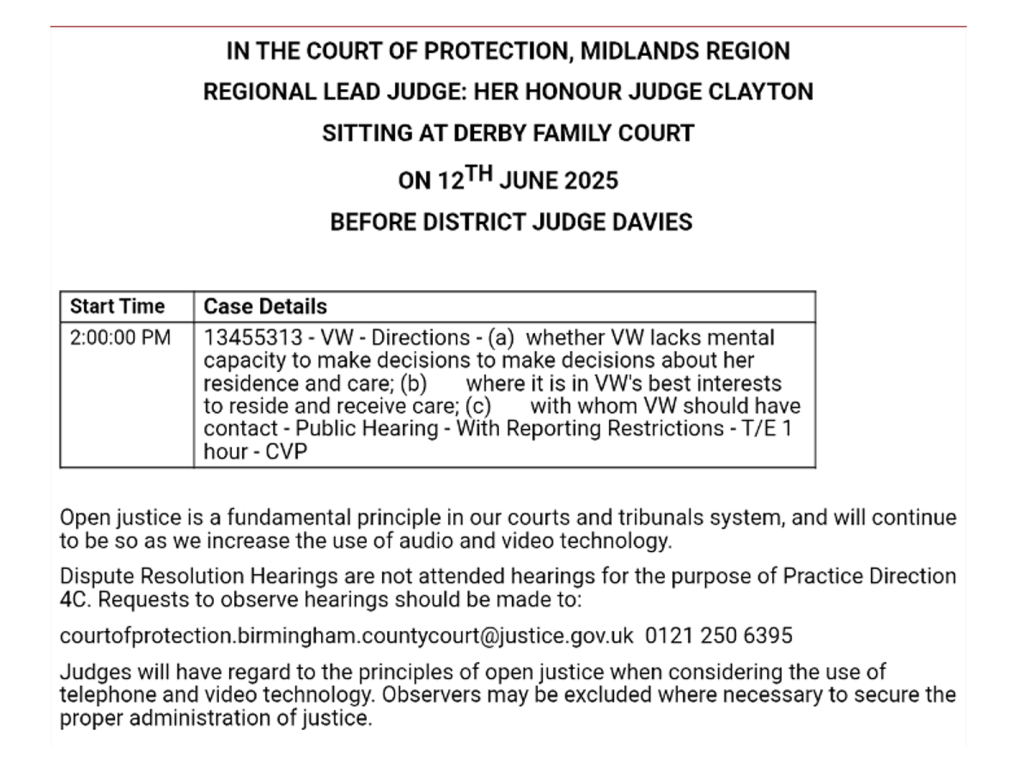
First, the Court of Protection list. There was only one case listed for hearing in the Derby Court of Protection list – you can see that here because Derby only has one entry.
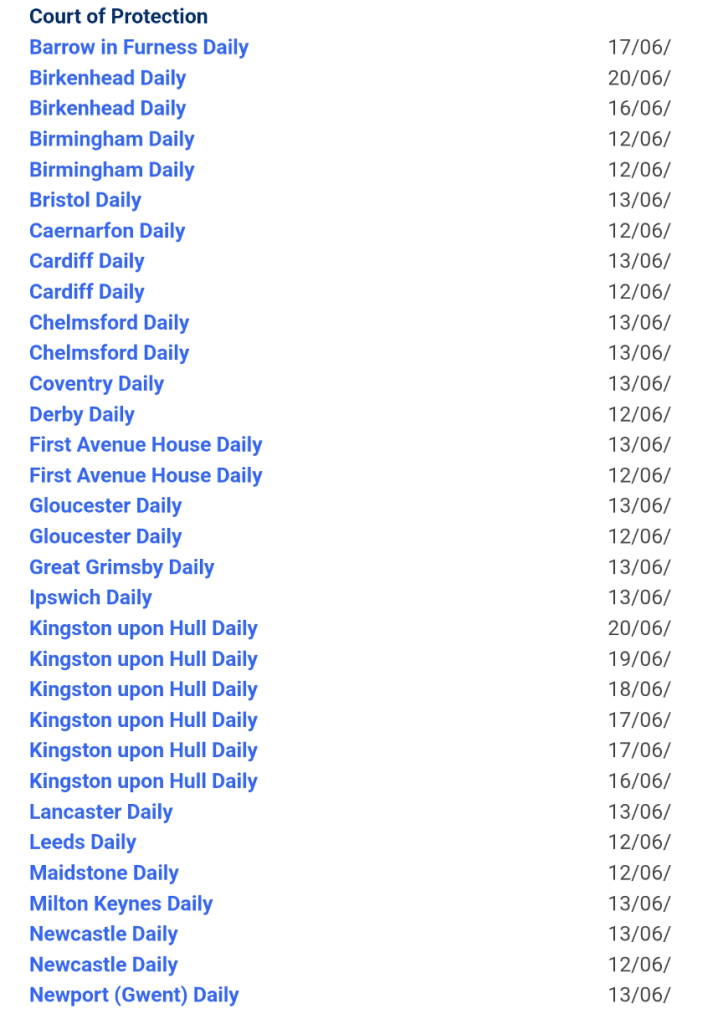
For the avoidance of doubt, here’s the only case publicly listed for hearing in Derby on 12th June 2025 – and it’s not the hearing I was looking for ( COP 12999111).
Sometimes, Court of Protection cases are in the local court’s Daily Cause List as well as, or instead of, appearing in the Court of Protection list. So, I looked there too, and could see that HHJ Williscroft was predominantly presiding over family court cases on the 12th June 2025. Here’s her published list for that date:
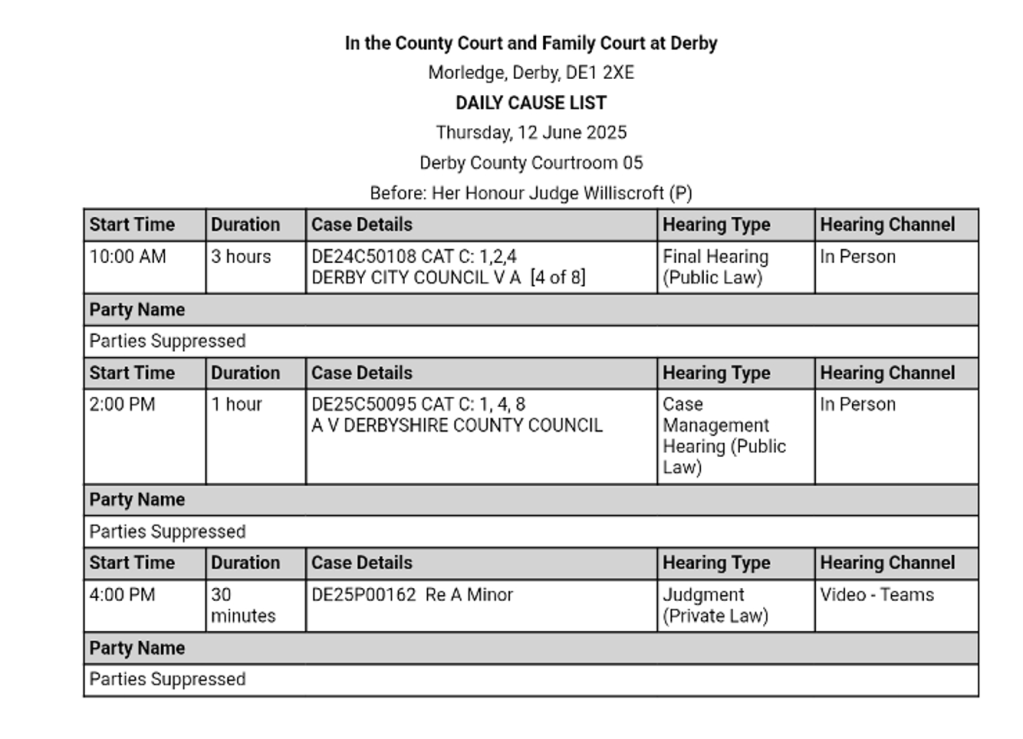
Note the absence of any Court of Protection hearings, let alone the one I was hoping to observe.
Given that 10 days had gone by since the judge first set down the case for hearing, giving what I assume to be plenty of time for it to be included in the list, I find it inexplicable that it wasn’t listed.
I emailed the court asking if it was still going ahead. I didn’t receive a direct reply to my email but instead received the remote Teams link.
I asked again if it was definitely taking place. given that it hadn’t been listed. By way of confirmation, I was then forwarded an email sent on 2nd June 2025, which made quite clear that the case had been adjourned on that date for relisting on 12th June 2025. That’s how court staff at Derby knew to send me a link.
What on earth went so wrong? Was this some sort of conspiracy to exclude observers or was it an administrative cock-up that nobody wanted to acknowledge?
In an attempt to find out, I sent an email to the Birmingham hub on Monday 16th June 2025. Here’s what I said:
Good morning,
I am writing with regards to the above case which was heard before HHJ Williscroft on Thursday 12th June 2025 at 3pm.
I knew that this case was being heard on this date because I had observed a hearing/meeting on 2nd June 2025. However, the case was not listed in either the CourtServe Court of Protection list or the Derby Daily Cause List. This means that, but for my prior knowledge, the case would have essentially been heard in private.
I am going to write a blog about this case, and I will discuss the listing issue in that blog. However, I am keen to offer a balanced view. As such, please could somebody let me know why this case was not in the public lists? I am intending to publish a blog soon so I would appreciate it if somebody could please get back to me by midday on Friday 20th June 2025.
Thank you for your support of open justice.
Kind regards,
Daniel Clark
I did not receive a response but, wanting to give a fair opportunity to reply, I chased it again at 1pm on Friday 20th June. I have still not received a response, which has done nothing to allay my fears that this is not an isolated event.
2. The judge remade the Transparency Order so as to ban identification of Leicestershire County Council – despite a successful application 6 months earlier to lift that ban
Transparency Orders are injunctions made by the court intended to protect the identity of the protected party (P) from becoming widely known. They balance two articles of the Human Rights Act: a right to privacy (Article 8) and a right to free expression (Article 10). You can see the ‘standard’ Transparency Order template here: https://www.judiciary.uk/wp-content/uploads/2017/11/cop-transparency-template-order-for-2017-rules.pdf
Transparency Orders rarely anonymise public bodies because they are funded by taxpayers, and therefore accountable to the public. They cannot truly be held accountable if they act in secret.
Sometimes P will be well-known in her or his local area, and there is a real risk that identifying the public body will lead somebody to be able to identify P. This is incredibly rare and, in my experience, agreeing not to report certain salient facts about P means that judges are content for us to report the name of the relevant public bodies.
I have written about this at greater length in this blog: Prohibitive Transparency Orders: Honest mistakes or weaponised incompetence? (see the first section: “What are Transparency Orders?”)
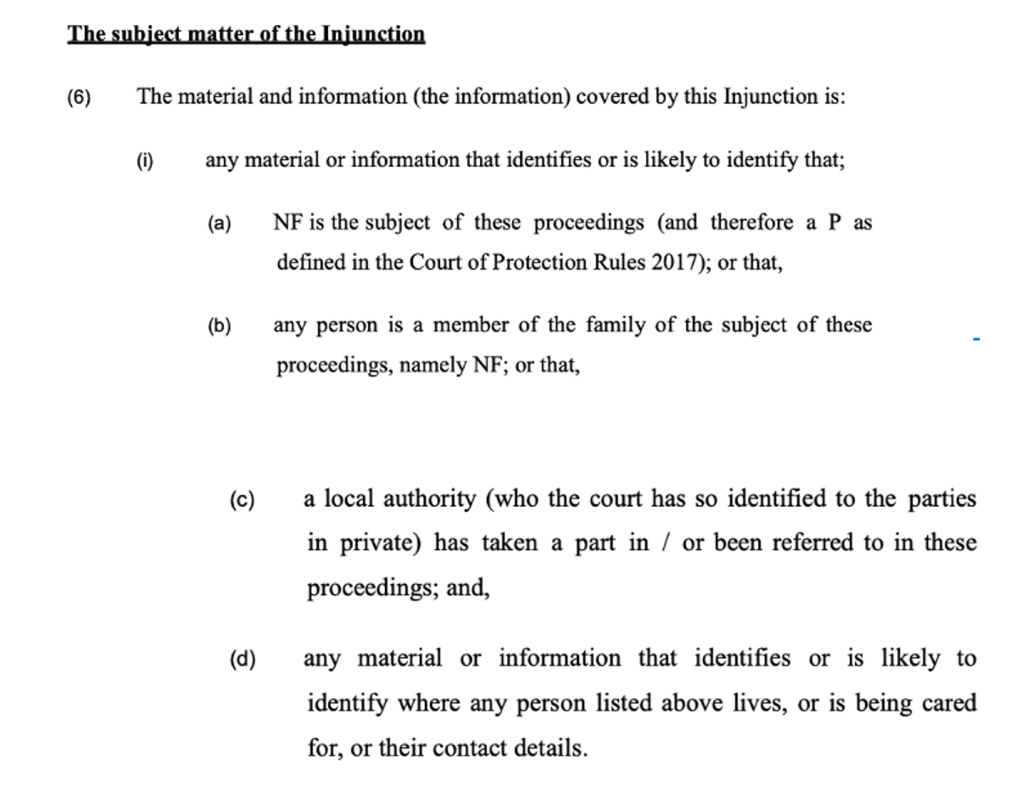
The OJCOP Project already had some experience of the Transparency Order in this case after Celia Kitzinger attempted to observe an earlier hearing on 26th June 2024. She missed the opportunity to observe it because the time of that hearing was brought forward (from 3pm to 11am) and nobody told her until after the hearing had taken place (another derogation from transparency in this case). She was, however, sent a copy of the Transparency Order (issued by DJ Revitt on 1st March 2024) and noted that it prohibited the identification of the local authority (see §6(i)(c) below).
Subsequent to Celia’s application, the Transparency Order was amended (though nobody had apparently thought to tell Celia). I know this because at the hearing on 2nd June 2025, I received a new TO issued by HHJ Chatterjee some six months after Celia’s application (on 10th December 2024) and it omitted the prohibition on naming the local authority that had previously featured as §6(i) (c) (see below).
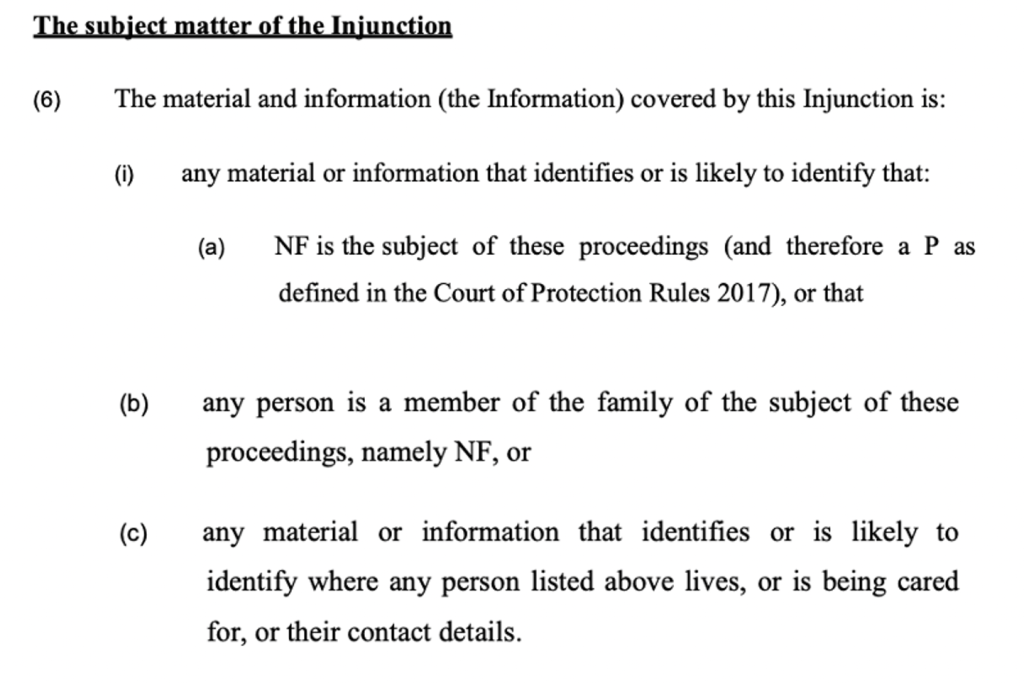
So far, so good.
But then, on the date of the next hearing a week later, 12th June 2025, when I was sent the Transparency Order again, I noticed that the file name included the date it had been issued (9th June 2025). I took this to mean that the judge – HHJ Williscroft – had amended it. She had. She had REINSERTED §6(I)(C) – THE BAN ON NAMING THE LOCAL AUTHORITY. Here’s how it now read:
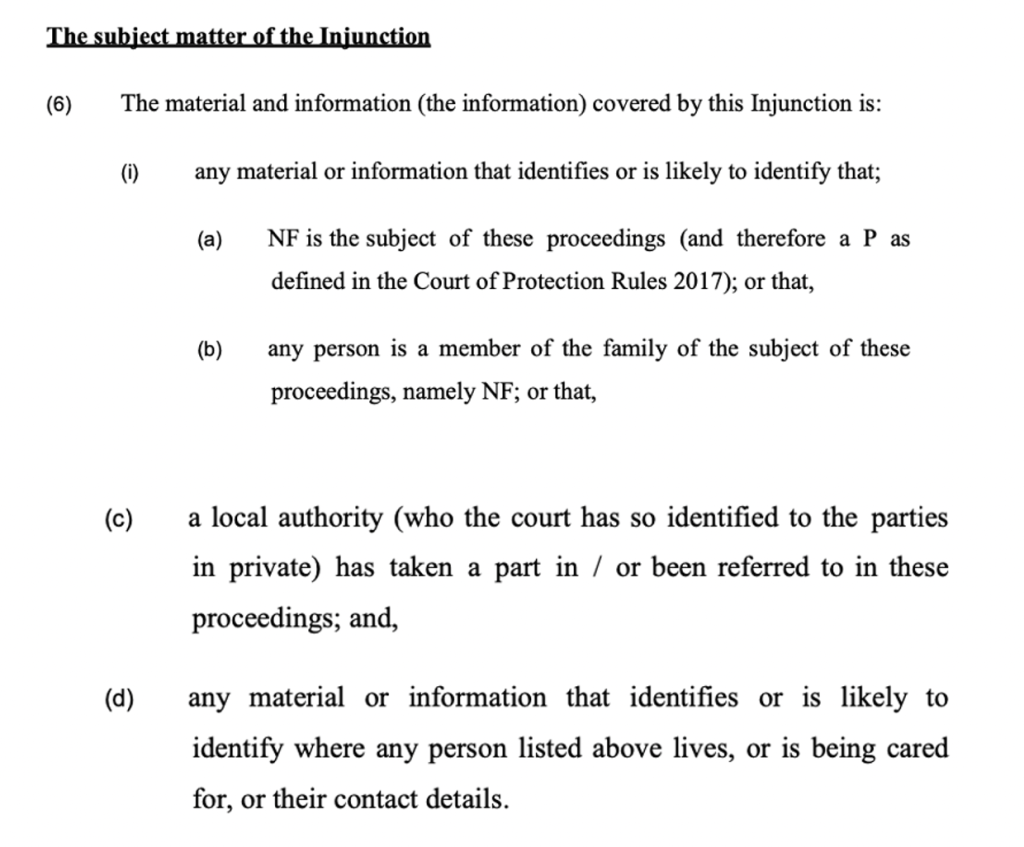
For the avoidance of doubt, I haven’t accidentally repeated the image from the initial Transparency Order. What had happened was that the judge had reverted the Transparency Order back to its original format.
This seems extraordinary. It means that after a successful COP 9 application to vary the TO so as to support transparency, the court had quietly –without notifying Celia whose successful application it was – varied it back again to prohibit naming a public body. Celia was not informed, or given any opportunity to state (or restate) her arguments to the court. If I had not attended this hearing, and been sent the revised (more prohibitive) TO, we would never have known.
I was outraged at this derogation from the principles of open justice. There may well have been a good argument for why Leicestershire County Council should not now be named – but these arguments should have been set out in open court, and not done in secret.
What exacerbated the problem was that I had already published a blog about this case. It had been written in accordance with the earlier Transparency Order, amended in the way that Celia had successful applied for. As a result, I had named Leicestershire County Council as a respondent.
Here’s what I said in my email to the judge:
Dear Judge,
I am writing with regards to the Transparency Order in COP 12999111, which I understand to be before you at 3pm today.
§(10)(i) states that “any person affected by this order may apply to the court for an order….that…varies…this order or any part or parts of it”. I would like to request a variation to this Order such that §6(i)(c) “a local authority (who the court has so identified to the parties in private) has taken a part in / or been referred to in these proceedings” is removed from the list of prohibited information.
This Transparency Order was dated and issued on 9th June 2025. Prior to the hearing on 2nd June 2025, I was sent a Transparency Order that was issued on 10th December 2024 by Her Honour Judge Chatterjee. That Order, which is attached to this email, did not prohibit identification of the local authority. It is my understanding that the Transparency Order dated 10th December 2024 was a result of a request to vary an earlier version that had prohibited the identification of the local authority involved in the case. My colleague, Celia Kitzinger, had requested the Order be varied so that the local authority could be identified, and this request was granted by the judge (resulting in the Order issued 10th December 2024).
As a result of the fact that the Transparency Order dated 10th December 2024 contained no prohibition on the identification of the public bodies, I included the name of both the local authority and ICB in a public blog: A judge without a bundle adjourns the case.
In Re BU [2021] EWCOP 54, the Honourable Mrs Justice Roberts commented that, “the court cannot and should not make reporting restriction orders which are retrospective in their effect” (§109). I am concerned that the Transparency Order dated 9th June 2025, which I was only sent today, is retrospective in its effect.
I understand that, after careful balancing of the relevant Article 8 and Article 10 rights, the court may decide that it is proportionate to prohibit the identification of a public body in order to safeguard the Article 8 rights of the protected party. However, I did not hear any argument to this effect on 2nd June 2025. If that argument had been raised, I would have requested permission to raise this during the hearing.
If a party has raised concerns that the identification of the local authority may lead to the identification of the protected party in this case, I would like to please make submissions on this point.
Kind regards,
Daniel Clark
Expecting to have a fight on my hands, I also put together a chronology of events since June 2024. Here are the transparency failings laid bare:
26th June 2024 – Celia Kitzinger is sent the Transparency Order (TO) for a hearing before District Judge Revitt. The TO prohibits identification of the local authority (LA) at §6(i)(c) – “a local authority (who the court has so identified to the parties in private) has taken a part in / or been referred to in these proceedings”. It clearly refers to a hearing set down for 26th June 2024. The public bodies are anonymised on the face of the Order. Celia requests that it is varied. Celia wasn’t told until 14:42 that the hearing time had changed from 15:00 to 11:00. This means she was unable to observe.
11th July 2024 – Celia receives an email from the court. DJ Revitt has said, “I propose to amend the order, but subject to any specific objections from the parties within 7 days”.
We don’t know what happened between July and December.
10th December 2024 – Her Honour Judge Chatterjee issues a TO that does not prohibit the identification of the LA.
2nd June 2025 – I request to observe a hearing at 10am. I am sent the TO issued by HHJ Chatterjee.
9th June 2025 – Her Honour Judge Williscroft issues a new TO that prohibits the identification of the LA at §6(i)(c) – “a local authority (who the court has so identified to the parties in private) has taken a part in / or been referred to in these proceedings”. It clearly refers to a hearing set down for 12th June 2025. The public bodies are not anonymised on the face of the Order.
11th June 2025 – A blog is published about the events of 2nd June 2025. This names the LA. I am unaware of the new TO issued by HHJ Williscroft. Neither the Court of Protection nor Derby Daily Cause list include the case for 12th June.
12th June 2025 – The case still has not appeared in the Court of Protection or Derby Daily Cause list but it is confirmed, via email, that it is taking place. I receive the TO issued 9th June 2025, and request that it is varied.
Just as I was about to send this chronology for the urgent attention of the judge, I was sent the Transparency Order issued by HHJ Chatterjee – the one that didn’t prohibit identification of Leicestershire County Council. The email said, “HHJ Williscroft has asked the attached order be sent to the attendees of today’s hearing.”
My hopes that an explanation would be forthcoming were quickly dashed. HHJ Williscroft apologised at the start of the hearing, saying that she was new to the case, “trying her best”, and had been told (I think – it was quite hard to follow what she was saying) that anonymity needed to “lifted”. I assume the judge misspoke: if she’d been told that, the Order wouldn’t have been amended so as to re-introduce a prohibition on identifying the local authority.
The judge didn’t seem even to entertain the possibility that the local authority shouldn’t be identified. After a brief discussion of whether she should revoke her Order of 9th June 2025 or write a new one, she said she would deal with this after the hearing – time was short, and she needed to focus on the substantive matters of the case.
But that means that what had happened on the transparency front remains entirely unexplained.
Why had the judge remade the Transparency Order so as – effectively – to revert to the earlier version that Celia had successfully challenged?
As I see it, there are two possible explanations. The first is that this is a simple clerical error; somebody sent a “revised Transparency Order” to the judge, not realising that the offending section was still there, and the judge approved it without checking.
The second is that this was no mistake. Instead, this was a purposeful attempt, by somebody acting for one of the parties, to set aside open justice principles without having that argument in open court.
This second version of events assumes a hypothetical person who assumed that the judge wouldn’t notice that she was re-inserting into the Transparency Order a prohibition on naming Leicestershire County Council. That wouldn’t be an unreasonable assumption because the judge didn’t realise the mistake until I pointed it out.
In a recent blog about failures of transparency in another case, Celia Kitzinger wrote: “the problem is that there are just so very many transparency failures. Adherence to the view that the Court of Protection is basically striving for transparency requires us to believe in cock-ups on an industrial scale.” When I first read those words, my thoughts immediately went to the case that this blog has been about.
I try not to think of mistakes like this as part of a wider conspiracy to maintain a secretive court. But when there are two serious issues with transparency – the Transparency Order and the listings issues – in the same case (three if you count the change of time that meant Celia missed observing the earlier hearing) and nobody seems willing to offer a proper explanation for how they happened, what else am I to think?
Whatever the explanation, I am deeply concerned that this is not an isolated incident. It now seems that there’s a possibility in other cases that variations to Transparency Orders we thought settled have been reversed either by accident or design.
Celia Kitzinger also shares my concerns. She told me: “This account raises the spectre of my hard work in making the successful application for varying the TO simply being undone a few months later, at a subsequent hearing. And it’s all-too-believable that this might be happening because (in my experience) judges pay very little attention to TOs and don’t know what they’re (metaphorically) signing off on. It’s part of the general (albeit understandable) focus on substantively doing justice rather than facilitating the watching of justice being done. I am particularly outraged that a TO which I’ve made a successful application to vary can just be switched back to how it was before BEHIND MY BACK as it were, without notification to me that it’s being done, and without the opportunity to challenge it. It does make me think “what’s the point?”. If you hadn’t been there, I’d never have known. “
In his June 2025 speech, quoted at the start of this blog, Mr Justice Nicklin began with a simple question: “If justice is done, but no one sees it, can we truly say it has been done?”
But for my prior knowledge of this case, justice would not have been seen to be done. With regards to the Transparency Order, it would not have been done at all.
Daniel Clark is a member of the core team of the Open Justice Court of Protection Project. He is a PhD student in the Department of Politics & International Relations at the University of Sheffield. His research considers Iris Marion Young’s claim that older people are an oppressed social group. It is funded by WRoCAH. He is on LinkedIn, X @DanielClark132 and Bluesky @clarkdaniel.bsky.social.
 Promoting Open Justice in the Court of Protection
One thought on “Open justice isn’t self-executing and here’s the proof: A case that never appeared on the public list and backtracking on a Transparency Order”