“The fact that my living arrangements are comfortable, and indeed make my life as enjoyable as it could possibly be, should make no difference. A gilded cage is still a cage.”
These were the words of Lady Hale, who gave the Supreme Court’s majority judgment in a 2014 case that is now commonly referred to as Cheshire West.
The last line in particular will be familiar to anybody who (like me) has worked as a carer in the health and social care sector. It is drilled into us during our training because it expresses a very simple principle: the meaning of “deprivation of liberty” must apply equally to everyone. If I live in a penthouse with 24/7 butler service, but I cannot leave without asking the butler’s permission, I am deprived of my liberty.
On 20 and 21 October 2025, in an application brought by the Attorney General for Northern Ireland, the UK Supreme Court will be asked to re-consider its judgment in Cheshire West. Unlike Cheshire West, there is no protected party at the centre of this case, and so the appeal is a question of legal principle. In particular, the court is to be asked whether a person’s wishes and feelings can be taken as consent to their care arrangements.
In essence, if they seem to be happy and are not objecting to the “supervision” and “control” that make their life as comfortable as possible, is it really right to treat them as if they’re “deprived of their liberty”? Or, to put it another way, is this even a cage at all?
This is an issue that has been rumbling on for some time. The (then) government’s consultation on replacing the Human Rights Act specifically cites the Cheshire West case (at para 159-160) as an example of how social policy is “distorted” by human rights law. In response, two lawyers at Irwin Mitchell published a blog that defended Cheshire West, using Lady Hale’s words to reiterate that ‘a gilded cage is still a cage’.
If successful, the case now before the Supreme Court may see a reduction in the number of people considered to be deprived of their liberty for the purposes of Article 5 of the European Convention on Human Rights. Some charities are concerned that a successful appeal will be dangerous for disabled people.
This blog is intended to give background to the Supreme Court case by explaining how “deprivation of liberty” is defined in law, what the Supreme Court decided in the Cheshire West case, and what the implications of that judgment were.
I have an academic interest in this area. A chapter of my PhD thesis considers deprivations of liberty, meaning that I’ve spent a lot of time (perhaps more than I’d like to admit) thinking about the Cheshire West judgment. I’ll draw on some of that research in this blog.
First, I will explain Article 5 of the European Convention on Human Rights, and the case of HL v UK. Next, I will explain how that case led to the creation of the DoLS system. Then, I will set out the Supreme Court’s reasoning in Cheshire West.
Following the Cheshire West judgment, there was an almost immediate reaction from the Court of Protection. The next two parts of the blog will therefore detail the introduction of the Re X procedure (for deprivations of liberty of those living in a community setting) as well as Mr Justice Mostyn’s view that the Supreme Court reached the wrong conclusion.
One criticism that Mostyn J had of Cheshire West was that it had significant resource implications. I conclude this blog by demonstrating that this was accurate, and also that one result of this is that a significant number of people are now unlawfully deprived of their liberty – by which I mean not just that many are without the requisite authorisation but also – in an unknown number of cases, that people with capacity to make their own decisions about where to live and receive care, and people living in accommodation that is not in their best interests, are likely to have been overlooked.
1. Article 5 of the European Convention
§64(5) of the Mental Capacity Act 2005 states that any reference to a deprivation of liberty has ‘the same meaning as in Article 5(1) of the Human Rights Convention’.
Article 5 of the Convention relates to the right to liberty and security. As with most human rights, this is a qualified right. For the purposes of understanding deprivations of liberty authorised pursuant to the Mental Capacity Act, the relevant qualification is set out as such in subsection (e):
Article 5 – Right to liberty and security
1 Everyone has the right to liberty and security of person. No one shall be deprived of his [sic] liberty save in the following cases and in accordance with a procedure prescribed by law:
[…]
(e) the lawful detention of persons for the prevention of the spreading of infectious diseases, of persons of unsound mind, alcoholics or drug addicts or vagrants;
Prior to Cheshire West, one of the most significant cases for English and Welsh domestic policy surrounding deprivation of liberty and mental capacity was HL v UK.
HL was an autistic man who, following an episode of “agitation” at his day service, was moved to a hospital following sedation. He did not object to his residence in the hospital, and he was therefore not detained pursuant to the Mental Health Act 1983. However, HL could not consent to his inpatient stay.
Bournewood Community and Mental Health NHS Trust (his treating Trust) did not consider him to be deprived of his liberty because he was not restrained. The European Court of Human Rights found that this was irrelevant, and that he had been deprived of his liberty. As HL had no recourse to the courts, because he was not formally detained, that deprivation was found to be unlawful. This is because 5(4) of the European Convention makes clear that there must be a mechanism for challenging the detention – “everyone who is deprived of his liberty by arrest or detention shall be entitled to take proceedings by which the lawfulness of his detention shall be decided speedily by a court and his release ordered if the detention is not lawful”.
This was recognised in the Mental Capacity Act by the insertion of §21a, which makes provision for such a detention to be challenged in the courts. These challenges tend to focus on either whether P can be said to lack capacity to make decisions about their residences and care or whether P’s current care and living arrangements are in P’s best interests[i].
2. The creation of the DoLS system
In response to the ruling in HL v UK, the DoLS (Deprivation of Liberty Safeguards) system was introduced in 2007. This came into force in 2009.
According to the Essex Autonomy Project, ‘Five and a half thousand DoLS assessments were conducted in the first nine months of implementation. There were 125 cases where a person had been found to be deprived of their liberty but the assessors had not recommended an authorisation because it would not have been in the ‘best interest’ of the concerned individual’ (see p1).
The DoLS system created two methods of authorisation – a standard and urgent authorisation. An urgent authorisation is granted by the managing authority (the place the person resides), and lasts for seven days. This can be extended, with the agreement of the supervisory body (the local authority), for a further seven days.
The purpose of the urgent authorisation is to legally authorise a deprivation of liberty ‘before the supervisory body can respond to a request for a standard authorisation’. A standard authorisation is granted after assessment by a Mental Health Assessor (a section 12 doctor) and a Best Interests Assessor (BIA). The standard authorisation must be granted within 21 days of the application being made but, as I will discuss later in this blog, that is simply not the reality on the ground.
The standard authorisation can be of varying lengths (though no more than a year).
While repeated assessments can be a person’s lifeline to greater freedom, they can also be inimical to the person’s welfare if the person is relatively settled and finds the questioning distressing. As Sandra and Joe Preston have explained, Joe’s mother was ‘subject to at least 9 short-term standard authorisations since May 2021” […] [but had] shown “no signs by word or action of objections” to where she is living’.
3. Cheshire West
In 2014, the Supreme Court handed down judgment in three cases (joined together on appeal) that concerned whether three individual people (anonymised as MIG, MEG, and P) were deprived of their liberty.
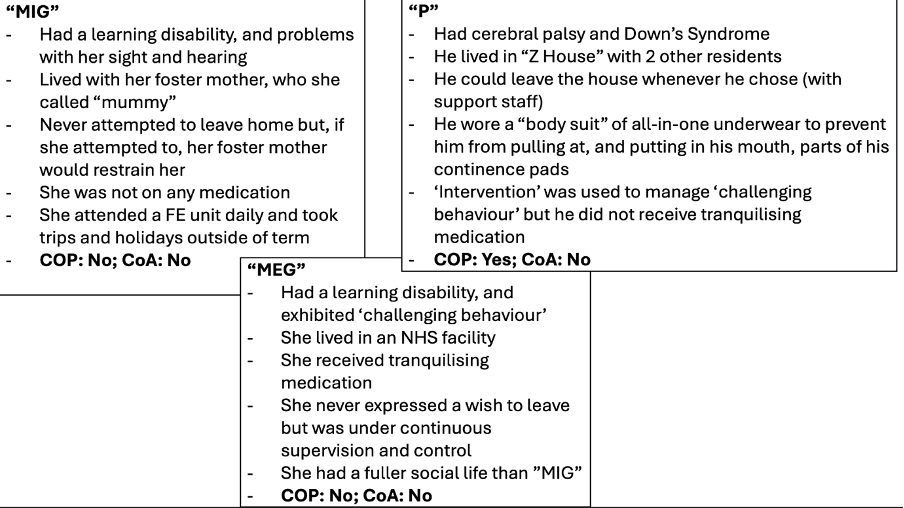
MIG and MEG were sisters, though they lived separately. P had no connection to either sister, and was older than them. In April 2025, I gave a talk about DoLS at the Socio-Legal Studies Association Annual Conference. Here’s my slide that set out the differences between the three protected parties.
As you can see, P, MIG, and MEG all lived in different places. They also had different care arrangements. Judges in the Court of Protection had found that MIG and MEG were not deprived of their liberty, but that P was. The Court of Appeal found that none of them were deprived of their liberty.
The Supreme Court took a contrary view. They unanimously agreed that P was deprived of his liberty and (by a margin of 4 to 3) found that MIG and MEG were also deprived of their liberty.
Giving the majority judgment, Lady Hale considered what a “concrete situation” of a deprivation of liberty might look like: ‘The answer, as it seems to me, lies in those features which have consistently been regarded as “key” in the jurisprudence which started with HL v United Kingdom 40 EHRR 761: that the person concerned “was under continuous supervision and control and was not free to leave”’ (§49).
This is commonly referred to as the “acid test”. Crucially, a deprivation of liberty does not just occur in care homes or hospitals. These arrangements can occur in any place, not just a place of residence.
It is important to stress that “continuous” does not necessarily mean that somebody is being constantly watched. Arrangements such as locked doors that a person cannot leave through without supervision, or can leave but must return within a specified amount of time, also amount to continuous supervision and control.
Alternatively, a person may be free to walk around the entirety of their care home and its grounds. However, if a carer checks on them every hour or two, and should they be discovered as missing they would be found and returned to the care home, and the person lacks the capacity to consent to that arrangement, this also qualifies as continuous supervision and control.
In its consideration of the Strasbourg case law, the Supreme Court identified three elements of a deprivation of liberty. All three must be satisfied if a deprivation of liberty to be understood through reference to Article 5.
The objective element – P has been confined in a certain place for a non-negligible period of time.
The objective element is something that any person in the same situation would recognise as being a deprivation of liberty. Here’s how Lady Hale explained it:
The subjective element – P does not consent or cannot consent. In the context that the Supreme Court was concerned with, an inability to consent arises because P lacks the mental capacity to do so.
Even when P says they’re happy with their residence, and that they do not want to leave, and welcome the fact that the doors are kept locked, this still amounts to a deprivation of liberty. It is this element of deprivation of liberty that the Supreme Court will be considering in October 2025. The key question is whether a person can, in effect, “consent” to living arrangements that would otherwise constitute a “deprivation of liberty” through the expression of their wishes and feelings, irrespective of whether or not they have the mental capacity to consent to those arrangements.
On the one hand, it seems that this would bring the approach more closely in line with Article 12 of the Convention of the Rights of Persons with Disabilities, which protects equal recognition before the law, because everyone would have the ability to “consent” (or not) to their living arrangements – and this would not be something taken away from people on grounds of mental incapacity.
On the other hand, Mencap, Mind, and the National Autistic Society have concerns that “changing the interpretation of deprivation of liberty will create confusion and will breach the human rights of people with mental health problems, learning disabilities and/or autism and will result in procedural safeguards being removed from people who need them to ensure that their care arrangements are not overly restrictive”, as Mathieu Culverhouse told Community Care.
It is imputable to the state – The state knows, or should know, about the deprivation of liberty.
In the conclusion of her judgment, Lady Hale comments on the need for there to be regular checks once a deprivation of liberty has been identified and authorised. I quote it here in full because it’s very relevant to what happened after the judgment –
4. The aftermath – the Court of Protection tries to impose order
In the Court of Protection Sir James Munby, the-then President of the Family Division, set to work in finding a way that would “simplify and extend” the framework. In a case that became known as Re X, he combined multiple cases that all involved an authorisation of the deprivation of liberty of a P who was living in the community (i.e. not traditionally institutional places). He created what became known as the Re X streamlined procedure, which is a somewhat ironic name given that it requires more paperwork than DoLS and the authorisation process can take months.
In a blog for the Open Justice Court of Protection Project, Eleanor Tallon explained this procedure as such: “essentially the streamlined process distinguishes between DoL cases to be dealt with out of the courtroom (i.e., ‘on the papers’), whilst allowing the court to give proportionate attention to cases where P may be objecting, or where there are other controversial issues which require more in-depth scrutiny by way of an oral hearing”.
If P appears to be objecting to their living arrangements, or if there are other complexities in the application, the judge who has been asked to make decisions on the papers can instead make directions for an oral hearing. This is now known as the “Failed Re X” procedure.
This is separate to the DoLS process. Commonly referred to as a COPDOL (Court of Protection Deprivation of Liberty), a BIA is not required to assess the arrangements – any appropriately trained professional (like a social worker with no further qualifications) can undertake this assessment. The acid test nevertheless remains the same.
5.Did the Supreme Court get it wrong? Mostyn J and the case of Katherine
While some judges in the Court of Protection tried to impose order on the increasing number of applications, another judge took the view that the Supreme Court had simply got it wrong. In Rochdale Metropolitan Borough Council v KW, Mr Justice Mostyn considered the case of Katherine. He described her as “just ambulant with the use of a wheeled Zimmer frame. Mentally, she is trapped in the past. She believes it is 1996 and that she is living at her old home with her three small children” (§6).
Mostyn J found that “in Katherine’s case the second part of the acid test [being not free to leave] is not satisfied. She is not in any realistic way being constrained from exercising the freedom to leave, in the required sense, for the essential reason that she does not have the physical or mental ability to exercise that freedom” (§25).
Knowing full well that this flew in the face of the Supreme Court’s judgment in Cheshire West, Mostyn J said that the Supreme Court ought to revisit the issue. He was willing to grant a leapfrog certificate, meaning that an appeal would be directly transferred to the Supreme Court. The local authority did not consent and so Katherine’s litigation friend applied to the Court of Appeal.
[I]n the absence of a reasoned judgment from the Court of Appeal explaining why I was wrong I maintain firmly the correctness of my jurisprudential analysis in my principal decision as augmented in my Tower Hamlets decision. In this difficult and sensitive area, where people are being looked after in their own homes at the state’s expense, the law is now in a state of serious confusion.
[T]o characterise those measures as state detention is to my mind unreal […] [Article 5] was aimed at the midnight knock on the door; the sudden disappearance; the prolonged detention. Article 5 was not aimed at Katherine, seriously physically and mentally disabled, who is living in her own home and cared for round the clock by carers paid for by an organ of the state.
§58
He concludes with a note of concern about the streamlined procedure: “The streamlined procedure itself requires the deployment of much man and womanpower in order to identify, monitor and process the cases. Plainly all this will cost huge sums, sums which I would respectfully suggest are better spent on the front line rather than on lawyers” (§60).
Be that as it may, in its second judgment the Court of Appeal observed that Mostyn J was also responsible for the expenditure of a significant amount of money:
The judge has twice made decisions which have been the subject of an appeal to this court. On both occasions, the parties have agreed that the appeal must be allowed. This has led to considerable unnecessary costs to the public purse and unnecessary use of court time. We regret to say that it is the judge’s tenacious adherence to his jurisprudential analysis leading to his conclusion that Cheshire West was wrongly decided that has been at the root of this. He says at para 26 of the second judgment that “the law is now in a state of serious confusion”. Even if Cheshire West is wrong, there is nothing confusing about it.
§32
In Bournemouth Borough Council v PS & DS, Mostyn J again declined to authorise a deprivation of liberty on the grounds that one did not exist. He again expressed his view that ‘the matter needs to be urgently reconsidered by the Supreme Court’ (§40)[ii]. Ten years later, that’s exactly what the Supreme Court is going to do, albeit without a protected party at the centre of the case.
6. Resource implications
Regardless of whether he was correct to describe the law as confused, Mostyn J was correct to be worried about the resource implications of the Cheshire West judgment.
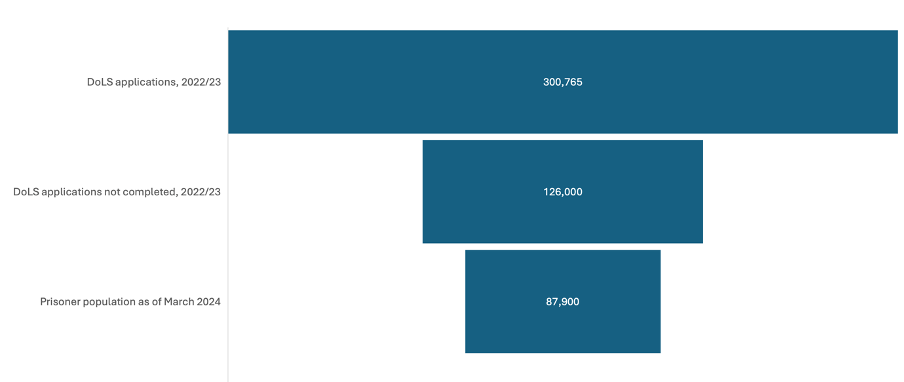
A report published by Age UK has analysed the current DoLS system. In 2022/23, there were 300,765 DoLS applications. The average wait time for an assessment was 156 days. Of those applications, 126,000 were not completed. By contrast, the prisoner population of England and Wales in 2024 was 87,900. To illustrate that point, here’s a graphic I created for the talk I gave in April 2025.
The same report emphasises that the number of uncompleted applications does not just represent a growing administrative backlog. The report notes that the purpose of the safeguards ‘is to protect human rights by ensuring that a set of external checks’ (p11). Such a significant number of applications waiting to be completed has two implications.
First, because the urgent authorisation will lapse after (at most) 14 days, people are being unlawfully deprived of their liberty for a very long time indeed. Second, ‘there is inevitably a risk of injustice for some individuals, whose lawful right to liberty will have been inappropriately denied’ (p4).
The Cheshire West judgment is not the only factor in the growth of applications. Another reason is because every move requires a new authorisation. This is best illustrated by way of a hypothetical example.
Sarah has dementia and has been living at Sunny Hill Care Home for two years. She lacks the capacity to decide whether to be accommodated at the care home for the purpose of her care and (for the sake of argument) has been subject to a standard authorisation that has been reviewed every year. However, her Lasting Power of Attorney has concerns about the standard of care, and decides it’s in her best interests to move to Sunny Bank Care Home.
When Sarah moves to Sunny Bank Care Home, the DoLS application process will start again – the standard authorisation does not move with her. In the same way, let’s imagine that Sarah falls while at Sunny Hill. She’s then admitted to hospital, where she stays for about a month. While at the hospital, another DoLS authorisation needs applying for. Regardless of where her LPA decides it’s in her best interests to move, the care home will need to apply for yet another authorisation.
Now let’s change the example slightly. This time, Sarah is living at home with her wife. The local authority reviews her care needs, and she is assessed as lacking capacity to make decisions about her residence and care arrangements. Objectively the acid test is met, and the court has authorised her deprivation of liberty under the Re X procedure. If Sarah moves house and the acid test continues to be met, a fresh application will need to be made.
This is a resource intensive exercise, and the government has not been wholly unresponsive to these issues.
In 2021, the government proposed Liberty Protection Safeguards (LPS) as a potential solution. Amongst other amendments, these would mean that, after an initial assessment, a person would not need to be re-assessed every year if they have a progressive degenerative disease such as dementia.
The idea is that this would free up blockages in the system, and make time for more people to be assessed – people who may have been kept waiting under the DoLS framework. However, the (then) Prime Minister Rishi Sunak tabled the plans for the duration of that parliament, and the now Care Minster, Stephen Kinnock MP, has expressed scepticism that they would be effective.
Far from just freeing up resources, the ability to dispense with yearly assessments may also be of benefit to the person deprived of their liberty who is content with their arrangements.
By focusing on the Court and the making and un-making of a “dol”, Emma and other people in her position are made to feel peripheral to the whole process. Many of them conclude that “getting off the dol” is essential before they can be part of the process. Many feel that when on a “dol” they are filed away and forgotten only to be taken out for scrutiny when someone else makes a fuss.
A few sections earlier, he described the authorisation of a deprivation of liberty as ‘permissive rather than mandatory […] it enables the carer to use restrictions that amount to a deprivation of liberty, it does not require them to do so’ (§50).
Anslem Eldergill, who until recently was a Court of Protection judge, has written on LinkedIn about his reason for disagreeing with this approach. He writes that, “the idea that under the DOLS Scheme it is the care plan that authorises the detention, and that it is not necessary to rescind a DOLs order (one can just not exercise the authority to detain), are also incorrect […] No one wants an order authorising their detention hanging over them for the remainder of the original 6 or 12 month period’.
I am not sure who Anselm Eldergill has in mind when he writes about somebody claiming that it is not necessary to rescind a DoLS order. That’s not my reading of HHJ Burrows’ judgment, and I suspect (though I’m not sure) that he is referring to commentary on the judgment. In fact, the comments of HHJ Burrows align with section 8.8 of the DoLS Code of Practice:
Deprivation of liberty can be ended before a formal review. An authorisation only permits deprivation of liberty: it does not mean that a person must be deprived of liberty where circumstances no longer necessitate it. If a care home or hospital decides that deprivation of liberty is no longer necessary then they must end it immediately, by adjusting the care regime or implementing whatever other change is appropriate. The managing authority should then apply to the supervisory body to review and, if appropriate, formally terminate the authorisation.
It is clear that the judgment in Cheshire West has had significant implications. The fact of the matter is, however, that the Supreme Court cannot make policy decisions. The primary question for the court is whether they got it wrong in 2014.
With thanks to two individuals who gave up their time to fact-check this blog. Any remaining errors are entirely my own.
Editorial Note, 9th October 2025 – This blog has been lightly edited for clarity and brevity. It has also been updated to reflect the fact that the Supreme Court will now hear the case on 20 and 21 October.
Daniel Clark is a member of the core team of the Open Justice Court of Protection Project. He is a PhD student in the Department of Politics & International Relations at the University of Sheffield. His research considers Iris Marion Young’s claim that older people are an oppressed social group. It is funded by WRoCAH. He is on LinkedIn, X @DanielClark132 and Bluesky @clarkdaniel.bsky.social.
Footnotes
[i] For examples of blogs about applications under §21a, see:
[ii] More recently, Mrs Justice Lieven has offered sharp criticism of the Cheshire West judgment. In Re SM, she found it was not necessary to authorise the deprivation of liberty of “a severely disabled child” because her liberty was not so deprived. Lieven J found that SM was unable to leave, not prevented from leaving. Alex Ruck-Keene described this as putting the Cheshire West cat amongst the pigeons, saying that it is ‘more serious than the challenges launched by Mostyn J […] because [Lieven J] engages with the [Cheshire West] judgment in a more sustained and detailed fashion”.

 Promoting Open Justice in the Court of Protection