

By Jenny Kitzinger, 11th January 2026
Caring for aging parents who have declining physical and mental capacity can lead to family conflict. There may be different understandings of what the parent wants or needs (and how to balance independence and risk) and different views on likely future deterioration. This can be compounded by disputes about how finances are managed, who is doing the caring (or doing it best), and what sacrifices different offspring would have to, or are prepared to, make in order to provide support. These tensions can trigger pre-existing family fault-lines and can often be exacerbated by different personalities, roles, expectations and by people’s location – for example when one family member provides everyday care and another, who lives further away, has less regular hands-on involvement.
Mostly these tensions are muddled through for better or for worse, without the involvement of a judge. But where the situation involves an unresolved conflict about a person’s best interests – and a crucial decision needs to be made – then it may end up in the Court of Protection.
This is what had happened in the case I went to watch in person in Cardiff: COP 20015780 before District Judge Hussell on 5th December 2025. This is the third in a series of hearings I’ve observed (the last two were on 1st and 26th September 2025).
The protected party in this case (Mrs P) is a woman in her late 80s who lives on her own in the family home. She is a proud, independent woman – who enjoyed long walks in the mountains with her husband until two and half years ago, when he died under very traumatic circumstances. Mrs P was overcome with grief – but resisted the offer of professional help, apparently telling one of her daughters: “unless you can bring my husband back, I don’t want to see anyone”.
Since then, Mrs P’s health has deteriorated with a combination of physical issues and mixed dementia. She has also been diagnosed with anxiety. She eats and drinks very little. She lacks capacity to litigate or to make decisions about key areas of her life.
She is currently supported to live at home by carers coming in three times a day, and regular visits from her family. Her youngest daughter, who lives close by, visits three times a week and provides aspects of daily care (including, for example, being the one to bathe her mother as she dislikes ‘strangers’ doing this). Her eldest daughter, who lives several hours drive away, comes to stay about once a month. Mrs P also has visits from her grandchildren.
Mrs P has family who clearly care about her. She is also someone who had planned in advance, anticipating possible loss of capacity and acknowledging her own mortality.
- Some ten years ago, she and her husband made a deed of transfer giving the family home (in which she still lives) to their daughters
- Both daughters (jointly and severally) have LPA for Mrs P in relation to her finances
- In addition, in 2023 Mrs P made her eldest daughter, her LPA for Health and Welfare.
Sadly, despite having a caring family, and trying to prepare in advance in this way, there is now a stalemate between her two daughters about what is in Mrs P’s best interests going forward.
The elder daughter, M, believes she should move to live nearer to Mrs P, and wants to use her mother’s funds to help facilitate this. She originally applied to the Court of Protection (back in May 2025) to authorise the use of Mrs P’s money (less than half her assets) to buy a house she’d identified right across the road from her mother. Indeed, she’d already had an offer accepted on the property. The plan was for M to move there, along with her household consisting of her husband, dog, and horses. She argues this would allow her to provide support in the way Mrs P would accept (she believes that her mother would not want anyone living with her); and that buying this house would be a reasonable financial investment for Mrs P. She promised that she would vacate the property if her mother needed residential care or when she died. (M did not intend to sell the home she currently lived in – so it would be available immediately if she needed to move back in).
The younger daughter (H) opposes this application. She does not think the proposed use of funds is in her mother’s best interests – nor, in her view, is it based on an accurate understanding of her mother’s needs. She anticipates that their mother will soon require 24/7 live-in care and wants her mother’s funds preserved to pay for professional full-time care.
In the previous hearings I observed, the focus was on the decision about the proposed house purchase (Attorneys disagree about a house purchase for their mother) – but the situation has evolved since then.
The specific house purchase planned by M has fallen through – due to the lack of agreement between M & H and/or a court order. The decision now before the judge was about how to care for Mrs P while her younger daughter was away on holiday for 5 weeks. M was asking the judge to authorise that £3,000 of their mother’s money be used to rent a bungalow close by Mrs P while her sister was abroad, so that she could use that as a base during her sister’s absence.
The hearing on 5th December 2025
Mrs P’s daughters were both Litigants in Person. The judge took care to make them feel as comfortable as possible – offering guidance about procedure, paying attention to physical comfort in the court room, and trying to ensure the litigants had the support people they might need with them.
He was also clear about boundaries (e.g. when the sisters were tempted to interrupt) and throughout the proceedings he reiterated the importance of keeping Mrs P’s best interests at the heart of the decision and of avoiding this being derailed by the ‘seam of animosity’ between the sisters. At different points in the hearing he also expressed his disappointment:
“I was hoping this was something that could be decided by you as a family…you can’t keep coming back to the Court of Protection – technically you can – but as I’ve said throughout this case, the most important person in this case isn’t here in the room – your mother.”
“I am sure if your mother knew about this application she would be incredibly upset and disappointed that her daughters have not been able to work collaboratively.”
Position of the applicant, M
M, as the applicant, spoke first. She emphasised why her mother needed her close by, rather than having extra paid-for care. She highlighted the problems with the carers (lack of continuity and not always arriving at the best time) and described her mother’s resistance – “mum shuts down when they come in, she won’t engage with them. They can’t get her to eat and drink.” She contrasted this with how her mother perks up when M is around.
She also emphasised the reversibility of some of her mother’s mental and physical decline. She said her mother’s appetite had improved since her anti-anxiety drug had been stopped – “it made her too sleepy to eat and drink” – and pointed to the success of a recent cataract surgery – “she is more mobile and confident because she can see what she’s doing. Having the gift of sight back she is making food again – making her breakfast…The blindness was impacting her dementia massively”.
M had recently arranged a longer visit than usual to spend time with her mother and said she’d seen her mother change for the better already. Mrs P was now enjoying listening to choir music and, according to M: “Over 10 days she’s transformed” and “I’ve turned it round – she’s walking up the mountain two miles.” (She’d sent the court a video of this.)
M emphasised that by moving close to her mother while H was on holiday, she could provide important family support to supplement the professional carers – including not just practical assistance but also such things as accompanying her mother on a walk, or joining her in the evening for “a game of scrabble and a little glass of Baileys”. This is what her mother wants, and is in her best interests:
“She is adamant she doesn’t want full time carers. “I can’t breathe’’. She shows up every day fighting to have her own spade. … She is a warrior, a force to be reckoned with, she won’t put up with something if she doesn’t want it…My mother trusted me as her eldest daughter … her health LPA. I’m asking for the court’s support to fulfil my obligation.”
The judge did not question the value of M’s input into her mother’s life, or the need for extra arrangements to be put in place while her sister was on holiday. His questions focussed on why M would need £3000 to fund this. He explored her reasons for not simply staying in the house with Mrs P (M explained that her mother might become agitated and ask M to leave); whether she could draw on some of her own savings, and why there was a need to accommodate her whole household for a 5-week visit, including ensuring a field for her horses.M spelt out some of the rationale for her request and explained that putting her horses in livery would cost much more. She also emphasised that she was facing major upheaval, would be losing out on paid work, and that she believed the need to accommodate her whole household was appropriate: “why do I need my horses and husband with me? Because they are my life”.
Position of the respondent, H
H said she was ‘perplexed’ by what her sister was currently asking for and concerned about changing goal posts. She emphasised that she was the family member who saw her mother most frequently, organised her care packages and accompanied her to most of her appointments (“with limited support from my sister”). It was she who had most intimate weekly contact with their mother: “I shop for my mother. I bathe my mother – I can see how fragile she is when I am showering her, the rest of the family don’t see that”. She did not think it was reasonable (while she was on holiday) for M to take £3000 to cover housing expenses for the type of care provided “for free” by H the rest of the year. Although she hadn’t been able to view the video of her mother walking that had been submitted to the court – “I know how well or not well she was”. She added that the video would only show “a snapshot”, and questioned the appropriateness of her mother walking up mountains, stating that any walking “should be on the flat”.
H did not feel that her sister understood her mother’s needs: My mother needs supervision during the day for my mother to stay safe. …My fragile mother now needs much more support than my sister is offering…I have concerns about the horses coming with my sister – my question is: when my sister is riding horses who is looking after my mother? I can’t understand why she can’t be in the house with our mother. …I strongly believe my mother wants company. And she could fall at any stage. Constant company might give her more opportunities to eat and drink…I think my mother’s funds should be used for my mother and not for the lifestyle of my sister, of three horses”.
She clearly did not trust her sister – neither in relation to how M became her mother’s LPA for Health and Welfare, nor in relation to how she was managing her mother’s money. Nor did she think her sister’s current plan took into account her mother’s future needs: “My mother has mixed dementia – it’s only going one way… After the 5 weeks what’s going to happen then? It will remain that my mother will be frail and vulnerable on her own. She may say she doesn’t want carers, and then she says she wants them. My mother needs supervision at all stages now. I’ve watched my mother over two years now…I’ve watched her slowly deteriorate.”
Judgment
After hearing from both litigants, the judge ordered a break and said he would return with a judgment – and an hour later we were called back into the court room.
The judge outlined the legal foundation for the decision in relation to best interests and also the court’s authority under the Mental Capacity Act – section 23 2(a)
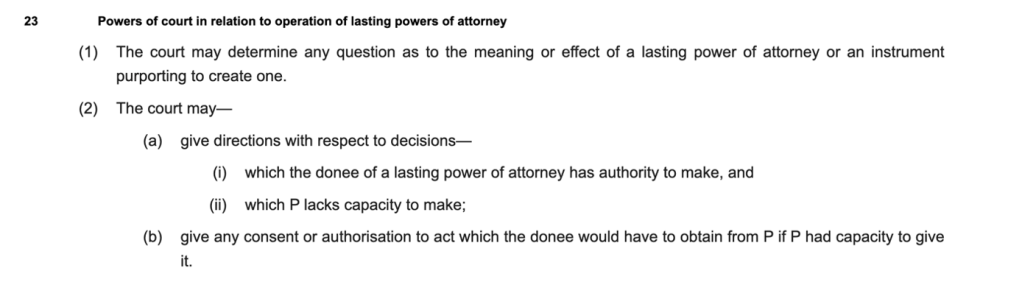
The judge ruled that he was not persuaded that it was in Mrs P’s best interests for £3000 to be spent on enabling M to step in to support her mother while her sister was away, but that he was prepared to authorise half that amount: £1,500
This was a very sad situation for Mrs P and the difficult decisions that had to be made had evidently placed a strain on family relationships. The debacle that led to the house purchase falling through had caused deep frustration. In each of the three hearings I’ve observed (two entirely online, and one in person), it has been obvious that each sister firmly believes she is right – and that the other is being unreasonable. In such circumstances, the idea of compromising with a position that is just wrong may feel unjust (and not in anyone’s ‘best interests’). The family schism ran deep – in the court room for this last hearing (the only one that happened in person), some other family members were present: they were all there to support M (the eldest daughter) and sat on ‘her side’ of the room.
Hearings like the three I observed in this case are not designed to delve into family history or to establish all the rights and wrongs of a situation. They are focussed on ensuring that evidence is available to the court to enable it to make a particular decision in a pragmatic way. Judges are then able to cut through a stalemate to try to make the best possible ‘best interests’ decision in the circumstances. This often seems to be some sort of compromise.
I thought the judge was very skilled and humane in the way he managed the hearing. Alongside his focus on making the decision about the £3000, he was obviously trying to support the sisters to put strategies in place that might stop the case coming back before him. He advised them to seek independent clinical assessment of their mother’s needs and prognosis to help them to plan ahead about how to use her money in her best interests – and said he was pleased to hear that a family conference with the professionals involved in Mrs P’s care had been planned for the following week.
He hoped the sort of best interests decision he’d made in this case was the sort of thing the two sisters might work out between themselves in future. He concluded with a plea to the two litigants: “The grievances are linked, possibly (I am not determining it) to a longer-term dispute. They must solve this for the sake of their mother. That is my plea to them. Otherwise, the concept of ‘best interests’ (except where the State is needed) should be, and remain, invested in the family.”
Jenny Kitzinger is co-director of the Coma & Disorders of Consciousness Research Centre and Emeritus Professor at Cardiff University. She has developed an online training course on law and ethics around PDoC and is on both X and BlueSky as @JennyKitzinger
 Promoting Open Justice in the Court of Protection
Thanks for this really interesting post, Jenny. How sad that despite P having done what she could to plan ahead for potential loss of capacity, her daughters are still in disagreement. To me, it shows the importance of not only putting in place the formal legal mechanisms of ADRT, LPA etc but also having actual conversations with our loved ones about the values and principles that we’d want to underpin best interests decisions made on our behalf. Not to imply that P in this case HADN’T had those conversations with her daughters (I don’t know if she did or not), and obviously it’s impossible to preempt every best interests decision that might come up if/when we lose capacity, but this post made me consider the WHAT as well as the HOW of best interests decision-making.
LikeLike