

By Celia Kitzinger, 12th October 2026
In recent months, we’ve observed dozens of hearings at which judges have ruled as to whether or not the residence and care arrangements of a protected party amount to a deprivation of liberty. I’ve observed some of these hearings myself; others have been reported by fellow observers.[1] Taken together, they offer an emerging picture of how the Supreme Court’s decision in A Reference by the Attorney General for Northern Ireland [2026] UKSC 16 (AGNI) is changing the way deprivation of liberty is understood and determined in practice.
As expected, many people previously considered to be “deprived of their liberty” under the Cheshire West interpretation of Article 5 of the European Convention on Human Rights are now being found not to be deprived of their liberty under the new AGNI approach. The consequence of this is that the “deprivation of liberty safeguards” [DOLS] – safeguards like independent assessments, a Relevant Person’s Representative (RPR), the right to review and challenge – are removed from them. This is a significant and controversial legal development. National charities have warned that it strips essential human rights protections from potentially hundreds of thousands of disabled people and is “the biggest rollback of disability rights in a generation”.
Against that background, how courts determine whether someone is deprived of their liberty after AGNI is a matter of legitimate public interest. The question is not simply how the new legal test is to be understood in the abstract. It is how judges apply it to the circumstances of individual people, what weight they give to the different factors, and how they explain decisions that may determine whether a person continues to receive important legal protections.
The answer to these questions is often not transparent for public observers watching these hearings. In many cases, all the parties agree[2] that the AGNI interpretation means there is no deprivation of liberty and the matter is not explored in any detail. These cases are in court for other reasons: e.g., contact arrangements, breached orders, P’s capacity and best interests in relation to decisions in other domains. Deprivation of liberty can appear almost in passing, as an administrative matter to be signed off along the way. The reasoning may be brief, with little explanation of how the legal test applies to the particular facts or why the parties’ shared position has been accepted.
The result is a troubling gap in public understanding. Observers may watch decisions being made that remove deprivation of liberty safeguards without learning much about P’s living arrangements, the restrictions to which P is subject, or the features of their circumstances that now place them outside the legal definition of deprivation of liberty. We can see the outcome, but not necessarily how the court got there.
That gap would matter less if the application of AGNI appeared straightforward and consistent across cases. But my experience of contested hearings has left me with questions. I have observed 18 cases in which the parties disagreed about whether P was deprived of their liberty after AGNI. None has resulted in a published judgment. In these hearings, I have sometimes been surprised by the arguments advanced by the parties, by the way judges have engaged with those arguments, and by the conclusions they have reached.
This causes me some concern about the bases upon which deprivation of liberty decisions are made in non-contested cases. The fact that everyone agrees a person is not deprived of their liberty doesn’t in and of itself make that the correct decision. It’s inevitable that AGNI’s “multi-factorial” test leads to a wider range of factors being considered in arriving at a decision as to whether or not P’s circumstances are such as to constitute a deprivation of liberty. It’s often said that decisions are now more “nuanced”, so maybe what looks to me like inconsistency across cases is simply exquisite judicial sensitivity to the unique particulars of each case. And the implications of AGNI are still being worked out in practice and have evolved over the four-month period since AGNI, as successive judgments have been published.[3] Nonetheless, it’s fair to say that judicial decisions about whether or not P is deprived of liberty are turning out to be problematic for a court that is said to aspire to transparency with regard to the way in which judges are arriving at their decisions. (Check out the Postscript to this blog post for the way in which listing practices add to the transparency problem.)
Where a decision determines whether a person retains important safeguards, it matters that we can understand the basis on which it is made. That is not an argument for treating every agreed position as suspect, or for expecting a lengthy judgment in every case. It is an argument for taking seriously the judicial responsibility to explain decisions sufficiently for them to be understood, particularly where the legal framework is new, its practical implications are still emerging, and the consequences for the person concerned are substantial.
It is against that background that I welcomed the opportunity to observe this hearing (COP 13851951) before District Judge Callaghan sitting in Chelmsford County Court on Friday 2nd October 2026, at which there was a dispute between the parties as to whether or not P’s residence and care arrangements constitute a deprivation of liberty. The different positions advanced by the parties were presented in oral submissions, and decided in an oral (ex tempore) judgment[4] over a hearing that lasted most of the day.
The hearing therefore offered something that is missing from many of the cases I have observed: an opportunity to hear the arguments on both sides, to see how the judge approached them, and to understand the reasons for the decision. I doubt the judgment will be published, so this blog post is likely to be the only public record of the court’s decision and of the process by which it was reached. Regrettably, this is the case for most court decisions about deprivation of liberty.
Background to this case
The young man at the centre of this case (P) is in his early 20s and has “severe autism and a learning disability”. He also has gastro eosinophilic duodenitis which requires him to follow a restricted diet. His mother says he has a diagnosis of PICA. but this is contested or “downplayed” by the ICB and the care providers -who acknowledge that P likes to put non-edible objects in his mouth but state that he rarely eats them.
He lived with his mother until he was 18 and moved to his current placement in 2021. He receives 24-hour care, funded through NHS Continuing Healthcare (CHC). He lives in supported living accommodation, with care-agency staff supporting him on a 1:1 basis at home, and 2:1 (in most circumstances) when he is out in the community. He has a Positive Behaviour Support (PBS) plan which permits staff to use physical restraint (a one arm release variation technique) as a last resort.
His parents are separated but he maintains a relationship with both of them and with his extended family. Each parent visits him weekly and also has contact by FaceTime. All parties except P’s mother consider it to be in his best interests to remain in his current placement with his existing care package. In any event, it has been determined during these proceedings that there is no available alternative placement on offer.
The dispute between P’s mother and the care providers
The current proceedings began with an application by the ICB on 5th November 2024 (pre-AGNI) seeking authorisation of P’s deprivation of liberty at H House.[5] The proceedings have also involved a protracted dispute about P’s mother’s contact with him and with the staff responsible for his care
At a hearing on 30th June 2025, HHJ Capon granted an interim injunction, endorsed with a penal notice, against P’s mother. The ICB had applied for the injunction on an urgent basis, arguing that her behaviour threatened the stability of the placement, which was said to be “on the brink of giving formal notice”. The evidence relied upon concerned her conduct, which she disputes. A few months later, at a hearing on 31st October 2025, the injunction was replaced by an agreed “Schedule of Agreement” (also described as a “Contract of Expectations”). This largely reproduces the terms of the injunction.
The Schedule, which remained in place at the time of the hearing I observed, regulates Ps mother’s contact both with her son and with the staff caring for him. The ICB says it was necessary because of incidents in which she was allegedly rude to staff, removed items belonging to P, and visited without appointments or at inappropriate times, sometimes arriving early or late. The ICB also says – more recently, I think – that she sometimes fails to attend scheduled Sunday visits, upsetting P who is disappointed not to receive the expected visit. There have also been disagreements about P’s medical care. Under the Schedule, P’s mother has agreed not to initiate conversations or raise questions about his medical care.
From the ICB’s and care provider’s perspective, the Schedule is working well. P’s mother takes a very different view. She considers the restrictions unnecessary and disputes the account of her behaviour that led to them being imposed. She says that some of the difficulties arose because she was legitimately questioning the care her son was receiving, or because the placement had failed to provide her with information she needed, including information at handover about his medication and what he had eaten.
She feels that she has been “maligned” and “victimised” by the care provider after raising concerns about the quality of his care. As she put it to the court: “because I raised concerns, it led to an injunction being created against me to deflect those concerns. This is a pattern of behaviour from [the care provider]. When I raise concerns about any matters, I am met with contact restrictions”[6].
These are sharply contrasting accounts of the same relationship. The ICB and care provider consider the restrictions necessary to sustain the placement and manage contact; P’s mother considers them unjustified and connected to her attempts to raise concerns about her son’s care. The history matters because the dispute about P’s residence and care arrangements cannot readily be separated from the wider disagreement about the quality of his care, his mother’s role in his life, and the extent to which her concerns are being heard.
Why the case came back to court
After the last hearing, on 31st October 2025, everyone except P’s mother agreed that proceedings should now conclude. However, the parties could not agree on the terms of a final order.
P’s mother wanted to be released from the Schedule of Agreement. She also wanted the search for alternative placements to remain open, since she had continuing concerns about the care P was receiving at H House. She also believes that he is deprived of his liberty there.
The final hearing was initially listed for 4th March 2026, but the proceedings did not conclude then. Further evidence was directed, and the final hearing eventually took place on 2nd October 2026, seven months later.[7] It was listed as a contested, full-day hearing.
During the hearing I observed, P’s mother agreed to remain bound by the Schedule of Agreement, as it became apparent that the ICB would otherwise apply for an injunction. She continued to argue that these proceedings should not conclude. However, there were still no available alternative placements for P, and the judge considered that her other concerns (about his healthcare and visiting arrangements) could be addressed outside the proceedings.
The hearing therefore focused primarily on whether P’s current residence and care arrangements amount to a deprivation of liberty under the law as clarified by AGNI. This is the issue I focus on in this blog post. But the wider context is important: the court was considering P’s liberty against a background of disagreement about his care, restrictions on his mother’s contact and involvement, and a prolonged dispute that had not resolved to her satisfaction.
The hearing
The applicant was NHS Mid and South Essex ICB, which is responsible for arranging P’s care, represented by Susanna Rickard of Serjeants’ Inn Chambers as counsel, and Beth Farrow of Mills & Reeve as the instructing solicitor.
There were three respondents:
- P (by his litigation friend the Official Solicitor), represented by Felicity Williams of Garden Court Chambers as counsel and Cerise White of Miles and Partners as the instructing solicitor. (Interestingly, Cerise White also acted for the protected party in the case of Oxfordshire County Council v P and G [2026] EWCOP 33 (T2), one of the (now) five published judgments in this area.)
- P’s mother (as a litigant in person on this occasion – she’d been represented by Anna Bicarregui of 39 Essex Chambers at the previous hearing); at this hearing the mother was supported by a McKenzie Friend.
- P’s father (also as a litigant in person, as he had been at the previous hearing).
At the outset, the judge made clear that “this case has been before the court long enough and there needs to be resolution”. Two versions of the draft order had been filed for her consideration. As she observed, “the only real difference is the deprivation of liberty point”.
Those opening remarks framed the task before the court: to bring protracted proceedings to a conclusion, primarily by resolving the question of whether P’s current arrangements amount to a deprivation of liberty.
Submissions concerning P’s deprivation of liberty
I’ll report on each party’s position in turn, in the order in which they made submissions.
The ICB’s position: P is not deprived of his liberty
Counsel for the applicant ICB pointed out that “the AGNI case has obviously changed the territory significantly”. The question of whether P’s residence and care arrangements now amount to a deprivation of liberty is one that the ICB “says candidly that it’s a lawyer’s question, and that must be correct”.
The ICB Position Statement sets out (counsel said) “that it’s possible to fudge this and to make an order that used to be commonplace before Cheshire West to the effect that ‘to the extent that he’s deprived of his liberty, it’s authorised’. But (she said) that’s not appropriate here, “because there’s sufficient evidence for the matter to be determined. It is the submission for the ICB, having examined P’s care and his reaction to it, that this does not fall into a ‘deprivation of liberty’ and might be quite far away from it”.
I do not have the ICB’s Position Statement, so the account that follows is based on the oral submissions only. I have not been able to verify every passage against the written document.
Counsel summarised the ‘objective’ and ‘subjective’ elements of the multi-factorial’ assessment required by AGNI. The objective element concerns confinement to a particular restricted space for a material period of time (the paradigm case being the prison cell) – and relevant factors include the possibility of leaving, the degree of supervision and control over their movements, the extent of their social isolation, and restriction of social contacts.
Counsel argued that AGNI “elaborated beyond domestic case law on the way in which an individual’s response to their living situation is actually part of the multi-factorial assessment of whether the objective element of confinement is met … Valid consent is an autonomous concept within Article 5, not to be equated with capacity”. Counsel referred to §3 of her Position Statement (which I don’t have) where she quoted from AGNI – and I think it was this extract she was quoting:
“…. an individual without legal capacity under domestic law, but who is conscious of their environment and has a basic understanding of their living circumstances so that they can express their view about their situation, who manifests their acceptance of the situation they are in, should have their opinion respected when an assessment is made of whether they are deprived of liberty under article 5.” (§53(2) AGNI).
She submitted that this was relevant to P in this case because “he is ‘manifesting his acceptance of the situation he is in’ – to use the Supreme Court’s words. In fact, it is more than acceptance. He enjoys living where he is and he is thriving and happy there.” She added that the word his father had used was ‘flourishing’”.
Counsel described P as clearly aware of his living arrangements: “He’s an active and animated young man. He’s engaged with his carers and recognises them. He loves his home.” The significance of P’s positive response, she argued, is that “ultimately AGNI makes clear that the court has to ask whether P’s living arrangements amount to a detention that’s against his wishes, or does it constitute a supportive home environment”.
Counsel accepted that P’s Personal Behaviour Support Plan provides for restraint as a last-resort intervention, but said it was seldom used. “Overwhelmingly, P is happy in his own environment”.
In §6 of counsel’s Position Statement, ounsel had apparently set out the kinds of behaviours that might indicate objection to a person’s living arrangements. I don’t have that document and I don’t know the source of the list she gave. I didn’t succeed in capturing all of the objections she cited but they included, conflict, arguments, attempts to leave, and physical restraint. “In my submission,” she said, “that description is far from fitting P”.
She argued that P “can’t be described as merely acquiescing in his care. He is happy” – and that “the so-called restrictions that form part of P’s care are imposed solely for the purpose of enhancing his quality of life: (not for punishment or coercion, but for his protection (see §130 AGNI).
Counsel concluded with a strongly positive account of P’s life at the placement. “It is the opposite end of the spectrum to a prison cell. P is happy. P shares his home with another service user and they have a positive relationship – it is more akin to friendship than housemate. He has a very varied program of activities. He has rewarding family relationships. He goes out into the community. He is not isolated. There is no element of coercion. His care is facilitative of his well-being and happiness and quality of life, and his experience is positive.”
She also relied on P’s father’s description of P as “happy and content”. His father considers that P receives “outstanding care” and has “a very special bond with both staff and his housemate”.
Counsel’s conclusion was that, in these circumstances, “the court is very far from being able to find that the objective element of confinement is met in those circumstances”.
The Official Solicitor’s Position: P is deprived of his liberty
The Official Solicitor advanced a different position to that of the ICB: “Contrary to the position of Ms Rickard, the position of the Official Solicitor is that we are not at one extreme. A more nuanced approach is needed.”
Counsel emphasised that P is subject to several care plans: the NHS CHC statutory care plan, the placement care plan and the Personal Behaviour Support plan, which provides for restraint as a last resort. In addition, the Schedule governs how contact between P and his mother operates. The Official Solicitor submitted that these arrangements need to be considered together, rather than the placement being characterised simply as a supportive home environment.
Counsel read out some paragraphs from the Department of Health and Social Care’s {DHSC] preliminary Guidance published on 15th June 2026, which addresses the relevance of objection to the assessment of deprivation of liberty: “It should be noted that the issue of whether a person is objecting to the confinement is relevant to the question of objective deprivation of liberty. Where a person is objecting, then it follows that valid consent is unlikely to be present. If there is an absence of objection when the person is capable of objecting, then it is more likely that the person is not being confined.”
The guidance goes on to say that objection may take different forms, including attempts to leave, refusal of care or treatment, physical resistance to care, restraint or one-to-one support to manage behaviour, and the use of covert or sedating medication in circumstances where a person objects.
Counsel then identified what she considered to be the relevant indicators of confinement and control in P’s own circumstances. These included locked entry and exit doors; one-to-one support during the day and hourly observations at night; supervision during personal care; and the arrangements governing visits and contact.
She submitted that P is not free to leave. He can only access the community with carers, and when he does, carers are on hand at all times. One example was given: “if he goes the swimming pool, he is not permitted to go down the flumes because of the risk to him”. More generally, “he isn’t able to come and go at will – that depends on the availability of carers”.
Counsel also drew attention to the difficulty of ascertaining P’s preferences. He “can’t express his preferences easily”, she said, referring to a recent visit by his solicitor at which he had not been able to engage with her. The quoted the Supreme Court’s warning in AGNI that the views of people with impaired understanding may not always be easy to ascertain: “[I]t may sometimes be difficult to ascertain the true feelings or preferences of vulnerable individuals who do not have mental capacity to decide on their living arrangements. The approach should be practical and realistic. Where there is serious doubt, no inference of valid consent should be drawn” (§53(v), AGNI, my emphasis).
The Official Solicitor’s argument therefore placed emphasis not only on the restrictions in P’s daily life, but also on the difficulty of establishing his wishes and preferences with confidence. Against the ICB’s account of a young man who is happy and flourishing, the Official Solicitor invited the court to consider the extent of P’s dependence on others, the limits on his freedom to come and go, and the uncertainty surrounding his ability to communicate his views.
The central difference between the two submissions was not whether P enjoyed important aspects of his life at the placement. It was what that evidence, alongside the restrictions on his movements and the difficulty of ascertaining his wishes, meant for the legal assessment of deprivation of liberty.
P’s mother’s position: P is deprived of his liberty
At the previous hearing (when she was represented)[8], P’s mother had raised concerns about whether the care and support that P is receiving is in his best interests. She thought he was not being offered activities that would motivate him to leave the placement. She expressed concern that, due to staff shortages, P is usually unable to leave the placement after 8pm. She said his bedtime routine can start as early as 5pm and that he’s often had a bath and dinner by 6.30pm, which leaves him unstimulated. This theme continued in today’s hearing.
For P’s mother, it was important that the judge consider an incident recorded in the hearing bundle, which she described as having occurred “when he wasn’t allowed to go out that night”.
It took some time to locate the relevant entry. The mother described an occasion when P asked a member of staff whether he could go out sometime after 6.30pm. The worker said no because the shops were shut. P then became “very, very distressed” and bit the service user with whom he lived.
The mother was concerned about the consequences of restricting P’s activities, both for him and for the other people living at the placement: “My concern with this in general is that he’s a risk to the other service users that he lives with, because his behaviour escalates when he’s subject to restrictions”.
She contrasted this with the arrangements when she cared for P at home: “When I looked after him at home, he led and I followed. That isn’t the case at H Home”. On the night in question, an on-call worker had been available to take P out for a drive, although not out into the community for an activity. Without that intervention, she said, it was impossible to know how his behaviour might have escalated. In her view, restrictions on going out increased the risk of P harming other residents and being restrained.
She also drew attention to the physical environment. Although the residence was “homely”, and in a pleasant area, she described the communal space as very small, given that P and his co-resident are each supported by their own staff.
The relevant entry was eventually located[9] and the judge read it aloud. It was a staff record dated 4th July 2026 and it was broadly consistent with the mother’s account: when told he could not leave the home, P had bitten his co-resident and been “head-locked” (according to the records).
The mother said that this was not an isolated example. She believed other entries showed that staff themselves were recording P’s distress when he was prevented from going out.placed the incident in the context of a longer-running disagreement about P’s evening activities. She told the court that, when proceedings began in 2023, she had asked for evening activities to be provided. Various promises had been made, she said, and she had agreed to drop her application to become P’s deputy. In her view, those promises had not been kept.
She described P as being detained at the placement after 8pm, contrary to his wishes and feelings: “He was used to going out at home. He’s finding it very difficult to be confined to H premises after 8pm. That’s one of the reasons I think he is deprived of liberty”.
Her concern was not simply that P had fewer opportunities to go out. She argued that the restrictions could lead to distress, which in turn could result in behaviour that harmed others and made restraint more likely.
She also described what she saw as a lack of meaningful evening activity. From 8pm until he fell asleep, she said, P has little stimulation and is confined to a small bedroom using his iPad. Staff put him into his pyjamas from 8pm in preparation for the overnight staff. By contrast, she said, she tries to take him out after 8pm when she can: “Recently we’ve been to the theatre. And on short breaks, when I take him out, we have evening activities. That’s when I say he thrives. He’s treated like a 25-year-old and not a 5-year-old who can’t go out after 8pm”.
Her account presented the evening curfew not merely as limits on P’s movements, but as restrictions she believed were inconsistent with his established way of life and had adverse consequences for his wellbeing and behaviour – sufficient to constitute a deprivation of liberty.
Finally – the contact restrictions. The contact restrictions in the Schedule of Agreement arose in a different context from the question of deprivation of liberty: the discussion concerned whether P’s mother would continue to agree to the Schedule. Their impact on P’s mother is relevant context, but it’s not necessarily the case that restrictions on her contact with P automatically establish that P is deprived of his liberty. Nonetheless, since the Official Solicitor had just identified the Schedule as one element of the overall arrangements the court should consider in making a determination as to whether or not P is deprived of his liberty, I listened to the mother’s submissions with that in mind.
P’s mother said that she was “banned from his home” and therefore had to take P out whenever she wants to spend time with him. This means spending the whole day with him in the community on Wednesdays and half a day on Sundays – arrangements she described as exhausting.
She explained that she had chosen supported living for P because she had become “burnt out” caring for him herself. She now feels that the ICB and care providers have placed her in an “unsustainable situation”, without flexibility over when she can see her son.
Alongside a full-time job and her own health issues, the arrangements have become difficult to maintain. Because she spends Wednesdays with P, she has to work on Saturdays, and she is also struggling to visit him every Sunday. She wants greater flexibility and the freedom to visit him in his own home.[10]
Her account illustrated how the Schedule affected not only the practical arrangements for family contact, but also her ability to sustain her relationship with P. The significance of those restrictions for the legal question of deprivation of liberty was a matter for the court to assess as part of the overall circumstances.
Position of P’s father: P is not deprived of his liberty
P’s father, representing himself, initially said that he agreed with both the ICB and the Official Solicitor. When the judge pointed out that they had taken opposing positions, he said that he would leave the lawyers to address the legal question of deprivation of liberty.
He did, however, offer his perspective on the restrictions imposed on P: “a lot of the restrictions that are being defined as deprivation of liberty are there for his safety. It doesn’t mean they are holding him prisoner. They are there for a reason”.
His submission emphasised the protective purpose of the restrictions. Whether that purpose answered the legal question was for the court to determine.
Judgment
After a recess for lunch, the judge returned to deliver her judgment. She set out the factual background to the case and summarised, in neutral terms, the opposing arguments made by the ICB and the Official Solicitor with respect to whether or not P is deprived of his liberty. She continued:“I go back to the evidence given by P’s mother today before me. I found that evidence to be compelling. She was not involved in the incident on 4th July and didn’t know about it until she read about it in the notes. It rang a chord with her because she knows her son is frustrated by not going out at night. I have heard that he is put in pyjamas at 8pm. On that date he was told he couldn’t go out, and he became agitated. That is clear evidence of a deprivation of liberty.”
The judge then considered the restrictions on P’s daily life more broadly. “When the court looks at the Guidance from the DHSC, […] find externally imposed restrictions […] there are locked doors, 1:1 or 2:1 supervision – which is essential for his needs, even when he’s with his mother – no independent community access, and supervision for medication and personal care. There’s also restraint – as a last resort, but it is there – and there are restrictions on his contact with his mother via the Schedule of Agreement. Finally, his finances are managed by his mother and not by himself[11]. The building is always locked externally. He lives behind locked doors. The premises are small, and become smaller still by the presence of carers. He is confined […]. So, the court decides that P is currently subject to a deprivation of liberty. There is a clear absence of valid consent.”
The judge therefore found that P’s arrangements amounted to a deprivation of liberty and that there was no valid consent. She went on to approve the deprivation of liberty as necessary, proportionate and in P’s best interests.
Reflections
One interpretation of the Supreme Court’s judgment in AGNI was expressed by DJ Glassbrook at another hearing in a different case: “The Supreme Court said that if there are objections then, on the face of it, we’ve got deprivation of liberty”.[12]
This is an interpretation we’re seeing quite frequently. The judgment in P’s case might be read as supporting it. P’s distress on 4th July 2026, expressed through agitation and biting another resident when he was not allowed to go out was described by the judge as “compelling” evidence for a deprivation of liberty. The locked doors, continuous supervision, restrictions on independent access to the community, and restraint formed part of the wider picture.
The judge’s reasoning, as recorded in the judgment, does not expressly explain how she weighed the incident of 4th July against the evidence advanced by the ICB that P “enjoys living where he is and he is thriving and happy there” — a view also supported by his father. The ICB relied on this evidence in arguing that P accepted his living arrangements and that there was valid consent.
The judge clearly attached considerable weight to the evidence highlighted by P’s mother: an occasion when P was prevented from going out, became distressed and was restrained. Her conclusion was that this was evidence of deprivation of liberty and that there was no valid consent. But I was left wondering how she reconciled that conclusion with the evidence of P’s general happiness at the placement. Did she regard the incident as revealing something fundamental about P’s experience of the restrictions, notwithstanding his otherwise positive response to his home? Or did she give it particular weight because it was a concrete example of what happened when P’s wishes appeared to conflict with the care arrangements? The judgment does not expressly resolve those questions.
Neither of the represented parties referred in their oral submissions to case law other than AGNI. I was nevertheless struck by some similarities between this case and Re AR (Whether restrictions amount to a deprivation of liberty) [2026] EWCOP 45 (T2), heard by HHJ Burrows about a month earlier. HHJ Burrows judgment is worth a read in conjunction with thinking about this case, since he’s a Tier 2 judge with considerable COP experience (and also appeared in Cheshire West), and was recently described by 39 Essex Chambers as “…undoubtedly taking the lead as regards the development of a body of judicial consideration of the world after AGNI“.
Like P, AR is also a young man in his 20s with autism and a severe learning disability. He too had lived in the family home until moving, as a young adult, into his current placement. Both cases also involve restrictions on contact with family members. In Re AR, as in the case reported in this blog post, staff had expressed concern about visits that were late or cancelled at short notice, which they described as “unsettling” for AR.
But HHJ Burrows concluded that AR was NOT deprived of his liberty and he listed the following matters as decisive:
(a) AR suffers from a condition that will always require a significant level of supervision. There is a need in his case to ensure a good level of routine and predictability so as to ensure his relative happiness.
(b) AR will always require restrictions on his movement. He will never be “free to leave” wherever he safely resides, and significant control has to be placed on his movements in and out of his residence.
(c) Management of his behaviour will always require a high level of supervision and control, including when necessary, restraint.
(d) Although he is not at his family home, he is at a place which he is able to treat as his own and to personalise his environment. He is able to make friends, and engage in activities in and out of the placement.
(e) These restrictions are in place for his own good, and are intended to ensure the best outcome for him.
(f) Although his residence at the placement involves restrictions, they are far away from the paradigm of the prisoner in his cell, or, for that matter the mental patient in his secure unit.
(g) These arrangements are relatively normal.
I am struck by how many of these observations could be made equally about P. Like AR, P requires substantial supervision; his movements will always need to be restricted for his safety; managing his behaviour will also need a high degree of supervision – with restraint available as a last resort; he has relationships with others at the placement and takes part in activities (swimming and trampolining were both mentioned); and the restrictions are to protect his wellbeing. Yet DJ Callaghan reached the opposite conclusion: P is deprived of his liberty.
The comparison raises a question about the significance attached to P’s distressed response to the evening restriction, and the resulting restraint. On the material I have described, this appears to be one of the most significant points of difference between the reasoning in the two cases. But it is difficult to assess precisely how much it explains the different outcomes without a fuller account of the reasoning in each judgment (particularly DJ Callaghan’s).
Contact restrictions provide another point of comparison. In Re AR, the parents were permitted supervised contact (only), with their son at his placement on the second and last Wednesday of each month — a more restrictive arrangement than the contact schedule described in P’s case.
HHJ Burrows recognised that contact could be a “significant” factor in determining whether a person was deprived of liberty. He observed that: “There may be situations where restrictions on contact with friends and family may be such as to change the character of the placement away from a home and closer to a place of detention”. But he concluded of AR’s circumstances: “This is, in my judgment, not one of them” (§67, Re AR).
The two judgments therefore leave me with a question. If the restrictions on movement, the need for supervision and the restrictions on family contact can be consistent with a finding of no deprivation of liberty in one case, but amount to a deprivation of liberty in another, what is it about the person’s experience of those arrangements that tips the balance?
The only explanation I can come up with is the weight attached to P’s response to being prevented from going out in the evening. DJ Callaghan treated the incident as “compelling” evidence of deprivation of liberty. But the precise role played by that evidence in the overall assessment is not fully explained in the reasoning available to me from the ex tempore judgment.
This matters beyond these two cases. AGNI requires a multi-factorial assessment that (where possible) takes seriously the individual’s own experience of their circumstances. But where the balance between the factors is decisive, transparency about how the court weighs them becomes especially important. Without that explanation, it is difficult for observers to understand whether different outcomes reflect meaningful differences in the evidence and the individual’s experience, or different approaches to applying the same legal test.
Celia Kitzinger is co-director of the Open Justice Court of Protection Project. She is on LinkedIn (here), and also on X (@KitzingerCelia) and Bluesky (@kitzingercelia.bsky.social)
Postscript: A transparency concern that listings never include “Is P deprived of liberty following AGNI” as a matter before the court
The public listing of this case appeared in CourtServe (the only way we normally get to learn about court hearings) as below. The public listing said the hearing was about “WHERE P SHOULD LIVE & HEALTHCARE”.
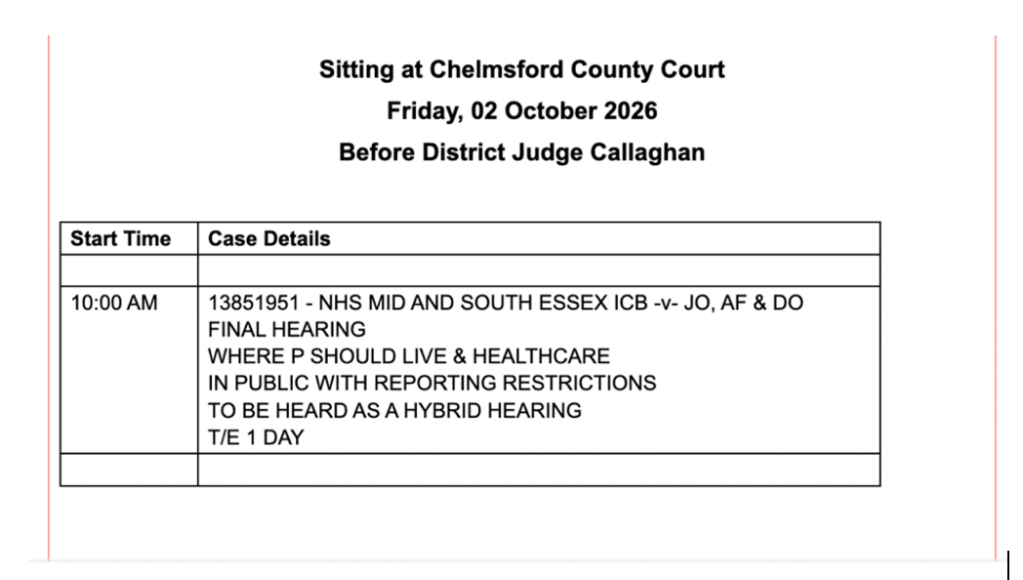
In fact, the matters before the court for this hearing were:
- whether P is deprived of his liberty following AGNI;
- whether to make a final best interests decision in respect of P’s residence (in the context of there being no available options) or whether, as P’s mother wanted, to keep proceedings live and direct the ICB to file evidence about potential alternatives
- whether or not the “Schedule of Agreement” (contract of expectations) to which P’s mother had earlier agreed (meaning that an injunction with a penal notice against her had been discharged) should also now be discharged, since she objected to it (in which case the ICB intended to make a new application for an injunction)
We knew in advance, from observing an earlier hearing in this case (on 31st October 2025), that the listing did not accurately reflect the issues the judge would be asked to address today. The question of “WHERE P SHOULD LIVE & HEALTHCARE” relates to matters from much earlier in the proceedings (which commenced on 5th November 2025) and does not reflect more recent developments. Although the question of whether or not P was deprived of his liberty was the matter that occupied most of the court’s time, the phrase “deprivation of liberty” does not appear in the listing, and no member of the public for whom this was a compelling concern could have known from the public listing that this would be an interesting hearing to watch.
Conversely, I have selected and asked to observe hearings listed as being concerned with “deprivation of liberty” only to find, when I enter the courtroom, that in fact that is not an issue the court is concerned with that day.
Given the extent of legitimate public interest about the implications of the Supreme Court decision in AGNI for vulnerable people, and the way in which AGNI is being implemented in the Court of Protection, it is a significant problem for transparency that court listings prevent us from accurately identifying those hearings at which the relevant issues will be aired in court.
Endnotes
[1] We’ve not blogged most of these cases (for reasons explained in the next paragraph of the main text), but links to those we have published about are available here: https://openjusticecourtofprotection.org/dol-in-the-cop-post-agni/
[2] In most cases, the person’s deprivation of liberty safeguards are removed without a court application in advance of, or immediately following, the next scheduled annual review process, as described by Joe and Sandra Preston in relation to their mother(-in-law) here: The irony and the AGNI. No court application is required. My own family is expecting the same to happen to our sister Polly: Polly and AGNI.
[3] I’m aware of only five published Court of Protection judgments, three of them by HHJ Burrows. They are: Oxfordshire County Council v P & G [2026] EWCOP 33 (T2); Re AR (Whether restrictions amount to a deprivation of liberty) [2026] EWCOP 45 (T2); Derby City Council v SM [2026] EWCOP 46 (T2); Re BM (Deprivation of Liberty) [2026] EWCOP 48 (T2) and Re PK & MK (Article 8 protections) [2026] EWCOP 52 (T2) – the last of these published subsequent to the date of this hearing. Additionally, two post-AGNI decisions about deprivation of liberty have been published by the Family Division: Re Mustafa (A Child) [2026] EWHC 2159 (Fam) and Essex County Council v MH, GH and ST [2026] EWHC 2328 (Fam). (There’s a helpful blog post about the two Family Division decisions here: “What do recent cases tell us about AGNI and deprivation of liberty for children and young people?”)
[4] I am grateful to the ICB’s legal team for preparing very helpful ‘Gardner documents’ (a case summary, list of issues and chronology) which have assisted in the accurate presentation of this case. I did ask for the Position Statements too, but they were not provided which means that I rely on the oral arguments alone in presenting the parties’ positions on how P’s care and residence arrangements do or do not constitute a deprivation of liberty. In presenting these arguments I have drawn on my contemporaneous touch-typed notes and they are as accurate as I can make them, but unlikely to be verbatim. (The same applies to the ex tempore judgment of course.)
[5] There is a longer history to the proceedings, going back to January 2023 when the ICB initially sought authorisation of P’s care and support arrangements as a deprivation of liberty (approved in mid-October 2023) and made an order providing that annual renew of future deprivation of liberty authorisations would be via the streamlined Re X procedure. Given what the ICB describes as ongoing “strained” relationships and “difficulties and differences of opinion” between P’s mother on the one hand, and the ICB and care providers on the other, the Re X streamlined procedure was not appropriate in 2024. In particular, P’s mother was disputing that P’s continued deprivation of liberty at H House was in his best interests.
[6] The specific incident P’s mother referred to was an occasion when P, visiting her at home was clearly in abdominal pain and “passed a stool with blue and white material in it”. She said she contacted the Deputy Manager and asked if they knew if P had swallowed something blue. They said not, but in her role as financial appointee she is given P’s receipts and found that he had been bought blue balls – and then later informed that he had a ball that he’d broken into small pieces but that staff had hoovered it all up. She referred the judge to a photo in the bundle – I think it was a sample of P’s stool which she had passed to the carers, who had assured her they would get it tested, but did not.
[7] The final hearing was initially listed for 4th March 2026. Rather than conclude the proceedings, the court directed the ICB to provide further evidence, which I understand concerned possible alternative placements. The seven-month delay before the final hearing in October appears to have had several contributing factors, including the need for further or better evidence about capacity, the parties’ inability to agree an order, the father’s unavailability on one of the dates initially listed for a final hearing, and a lack of confirmation from the court about subsequent hearing dates.
[8] Thank you to Claire Martin and Kim Dodd who both observed the hearing on 31st October 2025 and contributed to this blog post by checking my understanding of events before the hearing which I’m reporting on here.
[9] It seems there was a 1500-page bundle which the judge had only received around 8.30pm the night before the hearing, plus two supplementary bundles, each of 34 pages. This was, as the judge said, “unsatisfactory” for a final hearing. It was not, as I understand it, the fault of the parties: “I lay it squarely on the administration of the Court of Protection” (said the judge), saying that there was “only one admin officer actually doing any work in the building” when she called to ask for the bundle the day before.
[10] The judge did not make a ruling about this in her judgment – she simply encouraged “dialogue” about the arrangements but made clear that “what is important is that this placement is never undermined”. When subsequently asked by P’s mother about this – she expressed the view that flexibility would be desirable and made some suggestions about how that could work, saying: “this is a discussion I hope you’ll have with the ICB and the service provider”.
[11] The mother is P’s DWP and personal health budget appointee. In my view this is not, on its own, an obvious indicator of confinement, but it had been raised as such by the Official Solicitor.
[12] There is no published judgment. This quotation comes from a blog post: ” Objections (and breached conditions) after AGNI

