Since the COVID-19 pandemic, there have been dramatic changes affecting our daily lives. Virtual justice is now a norm. With the digital transformation, not so many buildings will be needed, less travel will be required, saving us more time. Surely, conducting hearings in the virtual world can only be a bonus?
Virtual hearings are not a novelty. Telephone hearings in civil courts were introduced in 1999 as part of the Civil Justice Reforms following Lord Woolf’s Review in England and Wales[1] – and more recently, through the reform justice programme run by HMCTS[2] – with some courts being better equipped for virtual hearings than others. And there have been several studies of virtual hearings (including studies conducted by HMCTS (2017& 2018)[3], the Public Law Project Judicial Review in the Administrative Court during COVID-19 Pandemic[4] and the research by Dr Natalie Byrom (Director of Research at the Legal Education Foundation) published by The Civil Justice Council[5].
Some of the emerging concerns have been:
Some lawyers have been unable to access relevant documents/files from the court due to a lack of access to appropriate technology/systems.
Participants in (telephone) court hearings are unable to read non-verbal clues and body- or facial reactions (e.g. being unable to see if someone gets upset during the hearing).
Participants may find it difficult to engage during the hearing, especially litigants in person may be more apprehensive about speaking.
Technical difficulties – having access to the right equipment and stable wifi.
Having access to a private area where the participants can be uninterrupted during the hearing.
The remote hearings take longer.
It can be problematic to follow, especially when more parties are involved.
There may be a feeling of disconnection due to difficulties in communication during the hearing.
Participants can be distracted by other websites or online activities.
It is more difficult for participants to show empathy.
Given my current circumstances – since my final project submission for my Graduate Diploma in Law (hoping to start the Legal Practice Course in September 2020) – I have been looking for opportunities to advance my legal knowledge and experience. Also, given my professional background in adult social care, NHS, and DoLS (the Deprivation of Liberty Safeguards), I was curious about witnessing professional engagement with capacity, best interests and the Deprivation of Liberty Safeguards from another perspective. I have attended court hearings previously, but wanted to find out what the virtual hearing is like from first-hand experience.
The virtual world of post-COVID-19 took me all the way from Kent up to the North of England. The hearing I observed (COP 13612598) was before District Judge Temple sitting (remotely) at the Newcastle Civil and Family Courts and Tribunals Centre.
I was initially unsure whether trying to gain access to a hearing on the same day that it was scheduled would be successful, but everything went very smoothly. Despite my scepticism with the court hearing start-time in less than two hours, I had a response from the court administrator within half an hour. I received a copy of the Transparency Order – which I must admit I found a little confusing, as to what information about the case I would be able to share (but see Celia Kitzinger’s blog which explains everything you need to know about Transparency Orders). I was also informed that I was going to receive a call nearer the time. I was unsure whether the whole hearing was going to be over the phone or perhaps whether it was just an introduction over the phone followed by a video. There was no mention of a test call.
Unfortunately, I did not manage to access documents about the case prior to the hearing.
Whilst I was getting ready for the call, I received another email stating that there may be a delay. In anticipation of the call, I made sure that I sat in the area of the home with a minimal chance of disruption and that my phone was charged and working fine.
I was wondering what sort of experience it was going to be. One of the horror hearings you hear about? Will the judge be sympathetic? Will there be unpredictable technical faults? Will the call get cut off? Will there be background noises? Will I hear and understand what people are saying?
The phone rang. It was the judge herself: ‘Are you Miss Maresova?’ The judge gave me a comprehensive introduction to the case, introduced parties, and explained how the hearing was going to proceed.
After the introduction, one of the lawyers provided a background to the case. It felt somewhat strange to be ‘in court’ without any travel or with my poor sense of orientation finding my way around a ‘strange’ building. As a speaker of English as a second language, I was a little apprehensive about relying on audio-only. To my relief, the voices were clear with no disruptions in the background or technical faults. There was no confusion about who was speaking. The judge made it clear who was talking at each point.
The hearing concerned where P should live – so it was about “varying or terminating a standard authorisation pursuant to the Deprivation of Liberty Safeguards” (as it said in the listings)
P was currently living in a specialised placement with some possibly excessive restrictions in place. He had a rare condition that required fluid restrictions. There was a discussion about how the restrictions could be loosened. But new restrictions were also proposed – monitoring of blood and urine. However, before deciding whether the current restrictions are necessary, further information from the GP on appropriate medical care and from the placement would be required.
After discussion about potential dates for the next hearing, the judge offered me access to the documents. Although I declined the opportunity at the hearing, later I emailed the court administrator requesting access. I had a response back almost immediately.
Despite the current restrictions, it is imperative that justice continues to be served and is open. Although the virtual justice system brings some benefits, it compounds some of the barriers that are already in the system. However, it is evident that that virtual courts will continue in some form beyond the pandemic.
Based on my experience as a public observer what would I improve?
Having access to the documents relating to the case, a test call and the use of a video rather than audio would be the preferred option. However, on the whole, it was a positive experience. I was grateful for the introduction to virtual justice.
Veronika Maresova aspires to become a solicitor. She tweets @VeronikaMareso1
[1] Lord Woolf’s review exposed the justice system in crisis. He made recommendations for improving the speed, accessibility and cost efficiency of the Civil Justice System.
Update: The judgment from this hearing is published on BAILII: University Hospital Coventry & Warwickshire NHS Trust v K & OrsEWCOP 31
On 22 June 2020 I attended (via Microsoft Teams) my first hearing in the Court of Protection. It was before Mr Justice Hayden (listed as Case number 13614472). There was no information about what the issues were before I attended, but it turned out to be very interesting and important given my background and experience.
I have a background in the adult learning disability field, with a BA (Hons) in learning disability. I worked in the health, social care and charity sectors until I became a full-time carer for my son in 2012. I was trained as a community advocate in one of the first advocacy schemes which was set up in a local long stay hospital in the 1990s
The case involved a woman in her 30s with a learning disability who had just been given a cervical cancer diagnosis. She was present at the hearing (in a room at the hospital) along with her mother. We also saw clinicians in another hospital room, and also a lawyer for the Official Solicitor who represented her, and one for the NHS trust.
The recommended treatments for her cancer involved 5 weeks of radiotherapy, plus chemotherapy and some internal treatments that would mean staying in hospital overnight. The treatment would trigger an early menopause and leave her infertile. Both she and her mother were keen for the treatment to go ahead but clinicians were concerned about her capacity to consent to the treatment – and indeed how to handle a possible future situation in which she might express the wish not to continue with treatment. The doctor explained that the treatment was very tiring and has unpleasant side effects.
The Trust had brought the case to court because they were concerned that the patient was not able to give consent to treatment because she did not understand what was wrong with her (beyond ‘something bad’), and did not understand what the treatment would involve, the serious side effects, and the life altering consequences of it.
There was also the issue of whether she understood that she would die – they said within a year – if treatment isn’t given.
Mr Justice Hayden agreed that due to the highly invasive nature of the treatment, the case should have the scrutiny of the court. He pointed out that the need for treatment was strikingly clear, so – given the possibility that the patient might say she didn’t want to receive it at some future point in the process – it was indeed good practice for the court to make a pre-emptive plan.
The consultant clinical oncologist described at length how he and another doctor and other medical professionals had tried to support the patient’s understanding and decision-making about treatment. I was encouraged to hear of the use of accessible ‘easy read’ literature and to hear that her mother and step-father were present when information was conveyed to her. They had informed her that the treatment would mean that she ‘can’t have babies’ and that she would start the menopause. The consultant clinical oncologist said he thought that overall she understood something ‘bad’ might happen to her if she did not have the medical treatments, but after a question from Mr Justice Hayden, admitted that he had not used the word ‘death’ when talking to her. He’d been concerned about upsetting her – but not using the word “death” would have made it hard for her to understand. The Trust lawyer had used the word “demise” in introducing the case – which as Mr Justice Hayden pointed out seems to “shy away” from the word “death” and is harder to grasp. The judge suggested that it “may be necessary to be blunt” or “candid” and to say “if you don’t have this treatment you may die”.
At this point I was wondering how on earth someone with a learning disability is supposed to navigate the decision-making process if they’re not actually given the information that they might die without treatment. Like anyone else, they should have the right to that information. I also wondered whether a learning disability liaison nurse, available in a number of acute Trusts, could have been there to support in this process. It turned out that the patient’s mother had been more blunt with her. She explained eloquently that she had told her daughter ‘if you don’t do this you will die’. Her daughter had replied: ‘I don’t want to die I will do the treatment’. The mother also said she would take time off work during the treatment process to support her daughter: ‘I’ll be with her all the way’. I thought that most parents aren’t the person to have to break that news to an adult child and how it shouldn’t have been that way. I was impressed how brave this family was.
People with learning disabilities experience multiple health inequalities. In this case, it seems that the patient’s team provided the best possible care and carefully considered the complexity of her case, but in failing to raise the fact of her likely death, they caused problems of inaccessibility. Doctors should feel more confident in talking about death and dying to patients with learning disabilities.
In his judgment, Mr Justice Hayden concluded that the patient does not have capacity to make her own decisions about her cancer treatment, but that treatment would be in her best interests so long as she chooses to engage with it. If she does not, after all possible support and encouragement are provided for her to do so, the emphasis should shift to palliative care – with the option of coming back to court at any point if necessary.
In this virtual courtroom with Mr Justice Hayden the law enabled a person with a learning disability to access the same rights and healthcare as any other citizen. This give me a huge sense of relief that my family member will be safe and listened to with these structures in place, and free to live the life he chooses.
Members of the public who observe a hearing in the Court of Protection are supposed to be sent a Transparency Order. This is a document (an injunction) forbidding us from making certain information public. Its main purpose is to protect the identity of the person at the centre of the case and the identities of their family members.
In a physical courtroom, we can be handed a Transparency Order. If we’re observing a remote hearing, it should be emailed in advance – or if that’s not possible – the restrictions it imposes should be outlined at the beginning of the hearing, and the document itself sent at the earliest possible opportunity.
I’ve been receiving texts and emails from people who’ve been inspired by the Open Justice Court of Protection Project to observe court hearings. They want to write blogs about their experience but are daunted by the Transparency Orders they’ve been sent and don’t fully understand – and are fearful of writing anything in case they inadvertently breach the Order. This is not surprising, as it promises penalties such as prison, fines and having your assets seized.
In her blog about attending in-person hearings in 2017, Gill Loomes-Quinn describes the Transparency Order as “intimidating” and found it very off-putting to have to “sign to agree to be bound by a document that is written in complex legal language”. She wondered whether the wording could be “simplified and made more accessible to members of the public”. Three years later, it remains just as inaccessible!
So, this blog is an attempt to demystify Transparency Orders, help people understand them, and explain the underlying principles about reporting cases.
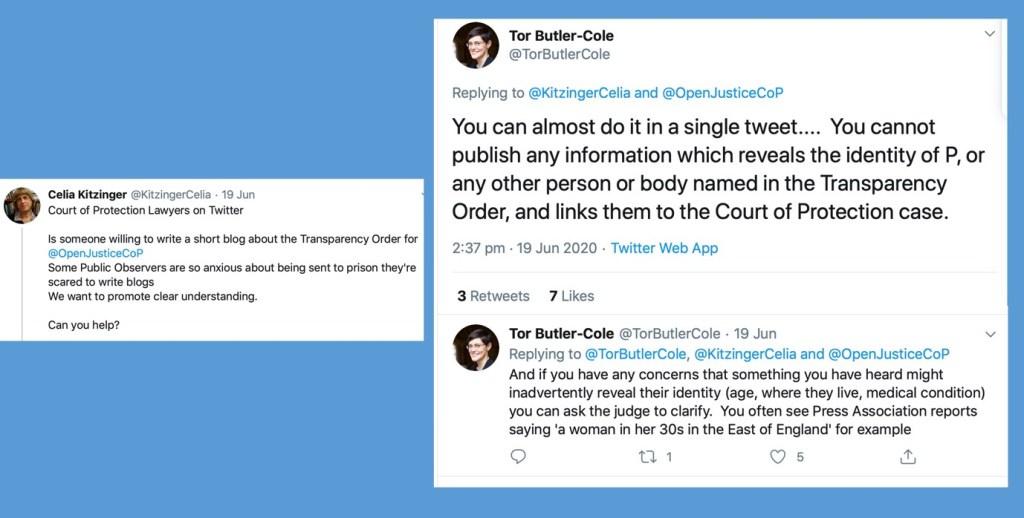
I started by trying to find a lawyer familiar with Court of Protection Transparency Orders to write a short blog on the topic. Here’s my request, on Twitter, and the response from Victoria Butler Cole QC
If that’s sufficient information, you can stop reading now!
Transparency Orders in Practice
I thought it would be useful to provide a bit more background and to report something of my own experience. I’ve observed 36 remote hearings in the Court of Protection between 1 May 2020 and 22 June, and my experience with Transparency Orders has been quite varied.
You should be sent a Transparency Order for every case you attend as a member of the public. In practice, though, I’m often not sent a Transparency Order in advance – and when I ask for one after the hearing, sometimes I still don’t receive it (even after chasing). Transparency Orders are in place for the vast majority of hearings you might observe. And it’s important to know what they mean so you can make sure you abide by them. It also helps to be familiar with what they look like in advance.
You can see what a typical Transparency Order looks like by downloading a template, with blanks to be completed relating to each individual case. The Transparency Order that has been used since 29 January 2016, with the introduction of the Transparency Pilot – now cemented into the practice of the court (since 2017) via Practice Direction 4C – is available here. It’s worth checking out the unofficial annotated version of the pre-2017 template Transparency Order available here, created by Victoria Butler Cole QC and designed to help non-lawyers understand the Order. The language hasn’t changed much over the years, and this is still a useful read.
Transparency Orders and COVID-19
With the public health emergency, and the move from physical courtrooms to audio- and video-platforms, this Transparency Order was disapplied (i.e. no longer applies to cases that have been ongoing in the court) because it presumes a physical court with a public gallery. This means that fewer cases have been listed as “public”. However, the Transparency Order can be re-applied if any member of the public (or journalist) requests access – so ‘private’ doesn’t really signal an intention to exclude us. Indeed, this document was written by a Vice President who is “messianic” (his word!) about transparency[1]! So far I’ve been successful in gaining access to every hearing listed as “private” that I’ve applied to.
You can see the new template (which lists hearings as ‘private’ by default) as an appendix (p. 18 onwards) to the 31 March 2020 Guidance here. Notice that it specifically allows for “ongoing consideration” being given to “the means by which any remote hearing … can be accessible to the public”. So if you request access to a remote hearing listed as “private”, the judge should consider how to make the hearing accessible to you. It additionally forbids anyone from making a recording of a court hearing (e.g. video-recording or photographing the screen) and forbids the presence of any unauthorised person able to listen to the hearing while it is happening. Judges sometimes also raise these points at the beginning of hearings.
As I mentioned above, despite what the rules say, you may not actually be sent a Transparency Order but you should act as though a Transparency Order does apply unless you are formally told otherwise.
What to expect in court
In my experience, when members of the public (or journalists) are present in court, issues relating to protecting the identities of P and P’s family are regularly raised orally at the beginning of hearings. If I’ve been sent a Transparency Order in advance, the judge usually asks, at the beginning of the hearing, if I’ve received it and understood it. On one occasion only I was asked to print off the Transparency Order, sign it, scan it, and email it back before the hearing[2]. If I haven’t been sent it in advance, the Judge has usually explained verbally (after the recording for the hearing has been started) what I’m not allowed to report, and I’ve been asked to verbally confirm, for the official recording, that I have understood. Be prepared for this, and be ready to confirm your understanding. It’s okay to ask a question at this point if you are not sure (e.g. I was unclear once from what the judge had said whether or not I could name the public bodies involved in the case so I clarified that with her).
The Transparency Order is not intended to prevent you from writing about the hearing.
It’s designed to protect the identities of the person at the centre of the case (“P”) and P’s family. It may also extend to cover the identities of other people who are involved in the case, and sometimes also those referred to in court, and even statutory bodies and professionals – especially where identifying them would risk “jigsaw identification” (For more about ‘jigsaw identification”, take a look at this blog on the Transparency Project website.) I attended one hearing where the Transparency Order forbade revealing the identities of the treating clinicians for this reason.
The principles behind Transparency Orders
Any one of us could become the subject of a Court of Protection hearing. Most of us would not want details of our lives – our personal habits, relationships with family and friends, character foibles and personality issues – laid bare for the public to pore over. It can be painful for P and P’s family to experience this kind of exposure in Court, and worse still to have it reported outside the courtroom. There is rarely any valid reason why the public should have access to P’s name or the names of their family members. However, some such reasons do exist. Here are two examples:
When there has already been publicity about a particular case. In the case of Steven Neary, for example, this included media coverage on the BBC and the magazine Private Eye and a petition, launched by his father Mark Neary, with around 8000 signatures demanding his return home. The judge concluded it was ‘frankly unreal’, given the extent of information already available, for the proceedings to be conducted and reported as if the identities of Steven and Mark Neary were unknown (London Borough of Hillingdon v Neary [2011] EWHC 413 (COP)
When P herself wants her voice heard in this way. One of my favourite Court of Protection judgments with a named “P”, is District Judge Eldergill’s judgment concerning Manuela Sykes. Ms Sykes was a life-long feminist and campaigner for women’s rights, a committed Christian, a political activist who stood for parliament, the editor for 40 years of a trades union newspaper, and a campaigner for people with dementia – the condition with which she was now diagnosed. “Ever a fighter”, now deprived of her liberty in a care home, this was her last fight. In deciding to “lift the cloak of anonymity” the judge observed that she had lived a very public life, never shied away from public controversy, and “she would wish her life to end with a bang rather than a whimper”.
The importance of P’s personal details in court hearings
Court hearings can reveal intensely personal – and sometimes unflattering – information and even criminal allegations. In recent hearings I’ve learned that the person at the centre of the case allegedly sexually harasses people, or engages in racist behaviour or that they are assaulting care staff. I’ve learnt that P’s family members are “delusional”, ‘uncooperative” or incapable of understanding or engaging with the kind of care P needs. I’ve heard about a boyfriend who was believed to be “abusive” and a mother who reportedly supplies her learning-disabled son with illegal drugs from her own dealer.
These details can be relevant to the best interests decisions that need to be made – for example, whether it’s in P’s best interests to be at home with family or in a residential placement, and if the latter, what kind of residential accommodation would be most suitable. So these can be appropriate matters for the Court to consider and it may be important to include these details in a judgment, and in any report by journalists or bloggers, because they are necessary for understanding why the judge made the decision they did.
The Mental Capacity Act 2005 takes a very broad and person-centred approach to best interests decision-making. In arriving at a decision the judge must consider (amongst other things) P’s past and present wishes and feelings, the beliefs and values that would be likely to influence their decision if they had capacity, and other factors they would take into account if they had capacity to do so (s.4(6) of the Act). This can mean a thorough-going exploration of the way a person lived their life and the kinds of goals they embodied in their everyday actions.
Transparency vs.P’s right to privacy
When the court is required to make a ruling as to someone’s capacity to make their own decisions, a similar exploration of their past values and beliefs is sometimes required. A case heard in 2015 before Mr Justice MacDonald (Kings College Hospital NHS Foundation Trust v C v V [2015] EWCOP 80) concerned a woman in her 50s (“C”) who wanted to refuse renal dialysis, after having damaged her kidneys in an attempted suicide. If she did so, she would die. If she consented to treatment she would likely live for many years. The question before the court was whether or not she had the mental capacity to make the decision to consent to or to refuse medical treatment herself (and if not, whether dialysis would be in her best interests). The Judge heard evidence from one of C’s adult daughters about C’s lifestyle and values, and from three psychiatrists. He concluded, on the balance of probabilities, that C did have capacity to make her own decision about renal dialysis. In setting out his reasons in the published judgment, he described C like this:
“C is a person to whom the epithet ‘conventional’ will never be applied. By her own account, the accounts of her eldest daughters and the account of her father, C has led a life characterised by impulsive and self-centred decision making without guilt or regret. C has had four marriages and a number of affairs and has, it is said, spent the money of her husbands and lovers recklessly before moving on when things got difficult or the money ran out. She has, by their account, been an entirely reluctant and at times completely indifferent mother to her three caring daughters. Her consumption of alcohol has been excessive and, at times, out of control. C is, as all who know her and C herself appear to agree, a person who seeks to live life entirely, and unapologetically on her own terms; that life revolving largely around her looks, men, material possessions and ‘living the high life’. In particular, it is clear that during her life C has placed a significant premium on youth and beauty and on living a life that, in C’s words, ‘sparkles’.” (Kings College Hospital NHS Foundation Trust v C v V [2015] EWCOP 80 para. 8)
This case was widely covered in the media, with lots of details about C’s life: check out this BBC report (which includes details of C’s suicide attempt), this Guardian article, which quotes most of paragraph 8 from the judgment, and the Daily Mail which also draws on additional information revealed in court.
Although some media reporting was characterised as “prurient” by Mr Justice Charles, it was entirely within the terms and conditions of the Transparency Order for it to be reported. Some people questioned whether it was really necessary for all this information to be included in the judgment – but that was a matter for the judge. Once it had been so included, it could be reported under the terms of the Transparency Order.
But, despite intense media interest in the case, nobody revealed C’s name, or the names of her family members.
Once the Court had ruled that C had the capacity to make her own decision, she decided to refuse dialysis, moved to a hospice, and died on 28 November 2015, fifteen days after the hearing. In view of the subsequent media interest in this story, Mr Justice Charles ordered that reporting restrictions should extend beyond C’s death to protect the private and family life of C’s daughters, including the youngest, a teenager for whom the circumstances of her mother’s death had wrought “an appalling impact on [her] emotional and psychological wellbeing” (para. 20(3)), exacerbated by the extraordinarily intrusive and insensitive behaviour of journalists, as detailed in that judgment (paras. 21-24). The judgment is an interesting read for anyone wanting to consider the relationship between transparency and the right to privacy, and the underlying legal principles that govern the making of reporting restrictions orders.
As this story illustrates, it’s important when writing about hearings observed in the Court of Protection to bear in mind not only the legal requirements of the Transparency Order, but also the likely impact of what is written on the people centrally involved in the case.
Summing up – key points
A Transparency Order does not prevent us from writing about the hearings we’ve observed.
It does prevent us from publishing (orally, in writing, via social media or in any other way) “any material or information that identifies or is likely to identify” a list of people which (almost always) includes P and their family members and sometimes other people too (like doctors or other health care professionals treating the person). Sometimes organisations are also included in this list.
It also prevents us from publishing “any material or information that identifies or is likely to identify where any person listed above lives, or is being cared for, or their contact details.” This means not publishing names of hospitals or residential placements, and thinking carefully before publishing local details that might identify a specific geographical area with the potential to lead to such identification.
It is rare for Transparency Orders to prevent us from naming public bodies (e.g. the local authority or county council) – but that does sometimes happen. It’s concerning when we’re told we can’t name public bodies because they are ‘public’ and funded by our taxes and should be accountable. It is possible to ask for the Transparency Order to be changed (“varied”) if you consider it overly restrictive, and the journalist Brian Farmer very often does so.
We can always name the Judge and the barristers involved in the case.
If you’re interested in following up on debates about reporting restrictions and open justice, I’d recommend reading Mr Justice Peter Jackson’s judgment balancing the right to respect for private life with the right of freedom of expression (in relation to the Steven Neary case) Mr Justice Charles’ judgment and the excellent Court of Protection Handbook and its accompanying website which covers Transparency Orders among many other aspects of the life of an application through the Court of Protection.
Celia Kitzinger is co-founder (with Gill Loomes-Quinn) of the Open Justice Court of Protection Project. More information about Celia and her work is available here.
[1] Quoted in a tweet from @TorButlerCole 6.01pm 25 June 2019 live-tweeting Mr Justice Hayden’s lecture at the inaugural event at the Court of Protection Bar Association. It’s an interesting thread.
[2] This was not a good idea. The email saying that I could have access to the hearing if I signed and returned the Transparency Order before the hearing started stated that the Transparency Order was attached to the email. It was not. By the time I had emailed the judicial staff to point this out and requested a copy of the Transparency Order, the hearing had started without me. I subsequently raised this problem with the judge concerned who told me she believed that a signed Order was required and that she could not admit me without it. This is the only occasions (in 36 hearings) where this was requested.
Last week I had the opportunity to attend a Court of Protection remote hearing before the honourable Mr Justice Hayden (listed as case number COP 13596518 Re ‘D’ in the Royal Courts of Justice list on 19 June 2020).
It was the first COP hearing I had been to and due to COVID-19, it was being held online via Microsoft Teams. This enabled me to request access to the hearing and join it with ease.
The hearing related to a young woman with a cognitive impairment, a complex mental health background and a number of vulnerabilities. The court was considering issues relating to where she should live, medical decisions (including contraception), and concerns relating to her capacity to engage with public health messages and social distancing during the pandemic.
The first thing that struck me was the rigid formality when addressing the judge. Was I going to understand what was happening?
Then what came next was the most surprising – but obvious and appropriate – request by the Judge: “Is D joining us? It would be lovely to meet her and talk directly to her.”
As a nurse my main focus is that the person remains at the centre of everything. It was so reassuring to see that this also was the primary focus within a formal court hearing for Mr Justice Hayden. The person-centred approach to this hearing epitomises and reflects exactly what I believe the Mental Capacity Act is all about. Mr Justice Hayden reinforced this focus on the person at the centre of the case throughout the hearing – especially when the lawyers were drifting away from being decision- or time-specific.
I felt very reassured that person-centred decision making triumphed in this case.
As stated by Mr Justice Hayden “This is not a paternalistic Act. It is an autonomous Act”. My role within my organisation enables me to echo those words.
For me, patient autonomy is a fundamental principle within healthcare and the MCA requires us to appreciate the importance of the principle of autonomy and individualised decision-making in everything we do, with every person we care for.
I will be aiming to attend many more of the court hearings and hope to give feedback information about how the court works and the way it makes decisions, both through this blog and to my organisation.
Sara Shorten is the Mental Capacity Act Lead and Matron at Norfolk and Norwich University NHS Trust. She is an RGN and has been nursing for 29 years. She tweets @ipswichgrove
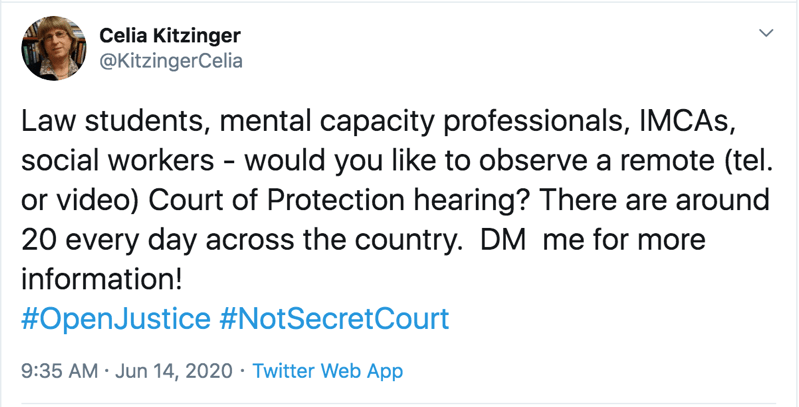
Late last Sunday night I happened upon a tweet from Celia Kitzinger:
The tweet garnered an enthusiastic response and an unexpectedly large uptake. Accordingly, and thanks to their resourcefulness and commitment to open justice, Celia Kitzinger and Gill Loomes-Quinn have since launched the Open Justice Court of Protection Project. This blog post is an account of my experience of taking up the gauntlet and observing a hearing in the Court of Protection for the first time. I offer it in the furtherance of the goal of transparency, and to encourage others to give observing a go themselves.
Why I was interested
The original tweet sparked my interest for a few reasons:
I have no legal education or professional background, but I have for the last year and a half been investigating a career change to the Bar. I’d been hoping to use these past few months to pursue mini-pupillages. Circumstances having intervened somewhat, I’m doing my best to seek out all the practical legal opportunities I can from the comfort of my kitchen table. After spending many hours on the Supreme Court video archive, or struggling with the audio on the Court of Appeal live streams, the idea of branching out into the Court of Protection was appealing.
It was especially so because one of the catalysts for my interest in the law has been acting as executor in an estate subject to a probate dispute centred on the issue of the testator’s capacity. Reading around that case, from Banks v Goodfellow, through some Law Commission reports, to the Mental Capacity Act, I’ve developed a fledgling academic interest in the area to match my personal one.
Finally, like many, I’ve been troubled by the potential effects of the current crisis on vulnerable people, including those who lack capacity. All the more reason, then, to support the goals of open justice and bear witness to the profound decisions now being made remotely in the Court of Protection.
Securing access
Helpfully guided by Celia and her blogging (especially here), I braved the listings and chose to seek access to this case:
Before MR JUSTICE HAYDEN
Also sitting as a Judge in the Court of Protection
Monday, 15 June, 2020
At 10:30 AM
FOR HEARING IN OPEN COURT
COP 12922022 Re A
Remote Hearing
This case seemed ideal for my purposes. It had been listed for open hearing, so there hopefully wouldn’t be too much trouble in gaining access; it was to be held over video link, which would hopefully make it more engaging, and easier to follow for a novice like me; and it was being heard by a senior judge (the Vice President of the Court of Protection, no less) so it would hopefully be dealing with an important or juicy point of law. Celia told me that such a case might only come along once every couple of weeks, so I felt lucky that this one had fallen into my lap. By this point, Sunday night had become Monday morning, so I wrote an email to the Royal Courts of Justice asking to be given information about how to access the hearing, scheduled it to be sent by Gmail at a more civilised hour, and went to bed.
The next morning, around two hours before the hearing was scheduled to begin, I received an email from the judge’s clerk providing an access link via Microsoft Teams. For the first time that I had seen, there was also an indication of how long the hearing was expected to take: two days. I had a commitment that afternoon, and several the next day, but I decided to join for as much as I could. In the end, the hearing finished late on Monday afternoon, so I ‘only’ missed about two hours around the lunch break.
Following the advice in Celia’s blog, I replied to the email, asking for a transparency order and position statements or draft orders to help me follow the hearing. (The advice was also to ask if the judge’s attention might be brought to this letter, with its suggestion of “a short opening helping to place the identified issues in some context” as a way of improving access when observers were present. Given that the author of the letter was one Mr Justice Hayden, that step seemed a little superfluous in this case!) As the clerk had instructed in her email, I sent my request to the RCJ mailbox. Doubtless due to the short notice and the high workload of the court and its staff, I didn’t receive a reply. Inevitably, the absence of background information, including documents mentioned in court, made the hearing harder to follow.
The hearing begins
When the time came for me to access the Microsoft Teams meeting, a few minutes before the hearing was due to start, I was asked politely by the clerk to show my face on video and confirm that I understood I was not allowed to record any of the proceedings. (For what it’s worth, there was no problem when another observer joined but was unable to activate a camera on her computer.) Including participants and observers, the total number of people in ‘attendance’ at the hearing was around ten throughout, though numbers did dwindle slightly as the day progressed.
The judge joined the meeting at 10:30 promptly, having been notified by the clerk that all the barristers and solicitors had logged on. The clerk announced his arrival, stated the name of the case and informed everyone that she was starting the recording.
In another indication of the court’s high caseload, the Judge expressed his regret at not having had reading time. He had managed over the weekend to read the “lengthy but helpful” statement from the Office of the Public Guardian (OPG) and the skeleton arguments, but not all the facts of the cases. It was generally agreed – as he had suspected – that this was not really necessary.
Following the recommendations in his own aforementioned letter, the judge asked the barrister who was due to speak first to set the case in its context. A very brief background was sketched: the applicant was a professional deputy who had applied to take over responsibility for the financial affairs of eighteen people. So far, eleven of the applications had been granted, and this case was to deal with the other seven.
This was the first indication any of the observers had received as to the subject matter of the hearing. I know that some were disappointed to hear the case concerned an area they knew nothing about and in which they had no particular interest. At least two observers discreetly left the meeting for those reasons (having emailed the clerk to explain they were doing so). It certainly seems that it would be helpful to include in the case listing a few keywords to indicate the themes or issues involved (as is done on the lists from First Avenue House). Neither would it seem overly burdensome to do so — though of course that’s easy for me to say.
As the hearing progressed, it became clear that the application had first been made about two years ago, but had been delayed for a variety of reasons. The judge at first instance, Judge Hilder, had referred the case upward because she had numerous reservations about granting the application, and thought there were important points involved that would be best heard by a tier 3 judge.
The applicant himself was not represented by a barrister at this hearing, though his solicitor was present. His desires were aligned with those of the County Council, which was currently the Ps’ deputy, but no longer wished to be. The council had its own solicitor, and was represented by one of the two barristers present. The other appeared for the OPG, which was opposing the application. The OPG also had a solicitor in attendance.
The cameras of the solicitors, the barristers and the judge remained on throughout, joined sometimes by the judge’s clerk or, on one occasion, an errant observer.
As the judge stressed repeatedly, proceedings in the Court of Protection were concerned with what is in P’s best interests. He described it as “the most highly fact sensitive area of the law”, with no scope for generalisation.
The main event
(It’s worth repeating that this is an account of the hearing as it seemed to me, bearing in mind I have no formal legal education and no previous experience with the court.)
Throughout the hearing there was debate and some confusion as to what exactly the judge was being asked to decide. The judge had found the barristers’ pre-agreed account of the issues at hand too vague, and soon after the hearing began he gave them a break of around ten minutes to decide on something more specific. During the break, the judge left the meeting, the recording was stopped, and the barristers were able to mute their microphones and telephone each other to discuss the issues. They duly came back with an agreement (which was described by reference to paperwork I couldn’t see). However, this debate recurred not infrequently over the course of the hearing.
Money emerged as a major driver on both sides of the case: the council was at least partly motivated by a desire to save money from a tight budget and to manage the competing demands on its limited resources. This was acknowledged as a legitimate consideration. Those opposing the application were concerned that the charging rates of the private deputy were considerably higher than the amount the ‘P’s were currently paying the council. They argued that it could not be in the ‘P’s best interests to pay more for a service that was effectively the same.
The central question seemed to be whether the court could compel a deputy (in this case, the council) to remain in that role against their wishes.
The barrister for the council argued that a deputy’s decision to withdraw could not be impugned as long as it was lawful. Further, the question of lawfulness was not one for the Court of Protection to decide. (It might instead be determined by judicial review.) The Court of Protection should concern itself with what is in P’s best interests. While making that calculation, he argued, the court should not regard as an option the continuation of the status quo, with the council as deputy. The council’s unwillingness to continue as deputy had taken that option off the table.
The judge was clearly sceptical of this argument, pointing out that the key decision here lay not in the hands of the council as existing deputy, but in the hands of the court. Any decision by the council that it no longer wished to act as deputy was without effect unless the court decided to grant the application. Moreover, given that the application at hand in this case was to discharge the council as deputy, there was some question as to whether the applicant in this case should be the council, rather than the private deputy who was hoping to step in.
The judge drew a comparison with family law: where a local authority may wish to have a care order discharged because of the burden of the obligations that order imposes on it. (He recalled appearing once before Mrs Justice Hale, as she was then, for such a local authority, and failing to convince her that the court should allow his client’s application for discharge.) It is settled law, he said, that a local authority will not be permitted to discharge a care order if it is found to be in the child’s best interests that the order should continue. The parallel with the case at hand was clear.
The council’s barrister argued robustly against this, maintaining the council had withdrawn consent to act as deputy and, as such, the best interests calculation in this case could not include its continuation as deputy as an option.
He warned that if the court decided it could compel the council to remain as deputy, it would mean that private bodies or individuals could also be compelled to remain as deputies against their wishes. This could have serious consequences in terms of people being less willing to become deputies.
While he conceded that policy considerations should only feature peripherally in the court’s deliberations, he maintained that there could be grave implications here as to the personal liberty of private individuals acting as deputies. He submitted that Parliament had not explicitly given the Court of Protection the power to infringe on that liberty: the Mental Capacity Act 2005, which created the Court of Protection, contained no such explicit provision. It was, rather, a matter of construction regarding section 19.3 of the Act. According to legislation.gov.uk, that section states that “[a] person may not be appointed as a deputy without his consent”.
In reply, the judge indicated he did not consider that compelling the council to remain as deputy would be equivalent to appointing them as such. In reference to potential policy implications, he said the question under discussion was what the court could do, rather than what it should.
The second major question the court considered was the relationship between the Court of Protection and judicial review. It was even remarked at the outset that the judgment in this case could be “a magnum opus” on the subject — that was, “if your Lordship had it in him”.
The barrister for the OPG argued that section 149 of the Equality Act applied to this case, due to the presence of a protected characteristic: the Ps’ disabilities. As such, the council, being a public authority, must have “due regard” to the need “to remove or minimise disadvantages suffered by persons who share a relevant protected characteristic, that are connected to that characteristic”.
Here, the disadvantages to the Ps by the proposed new arrangement would be financial, and the judge seemed to doubt whether money counted as being “connected to” the relevant protected characteristic. [I wondered, perhaps naïvely, whether the statistics on the correlation between disability and poverty might bolster an argument in the other direction.]
Opposing counsel argued that while section 149 might well apply, the proper way of testing that and challenging the proposed new arrangement would be through judicial review.
The judge pointed out that the relevant decision for judicial review in this case would be a decision of the Court of Protection to allow the discharge. At least as yet, no such decision had been made.
Counsel for the OPG insisted that there was “something special” about section 149 of the Equality Act that meant the Court of Protection could properly consider it. It was “purely procedural”, in that it asked for “due regard”. Determining whether due regard had been given did not require conducting a merits-based review or diving deep into the substance of the criteria by which a decision was made. It was not, he argued, a matter of pure public law. There was no challenge to the merits of any criteria on rationality, for example, which he conceded would be the domain of judicial review.
It was, he went on to argue, effectively a matter of case management for the court to decide what factors to take into account in the exercise of its discretion. For one, the court could ask what was motivating the council’s lack of willingness to continue as deputy. The judge agreed on the last point, but said the council was hardly hiding that money was a major factor. What was more, they were allowed to take money into account.
Finally, the judge alighted on the question of what factors should go into the decision as to whether a deputy should be discharged.
The barrister for the OPG identified the following:
Complexity (in general, the more complex P’s needs or financial situation, the more likely a private deputy is to be involved. In this case, the council had advanced complexity as an additional reason for wanting to transfer the deputyships to the private deputy.)
Cost
Personal dynamic
P’s wishes and feelings (if not already included under personal dynamic)
The judge thanked him for his submission, signalled that this was an area on which he would be reflecting further, and invited both counsel to contact him after the conclusion of the hearing with any additional thoughts on the matter. The barrister for the council had been reluctant to engage with the question for fear of prejudicing his submission that it concerned a decision the court should not be making, but he indicated that he might contact the judge with a reply “in the alternative”.
He closed by saying that it would be helpful for the judge to give an indication in his judgment of how to proceed with an application of this kind in future. The process in this case had been unnecessarily difficult and inefficient in terms of time and cost; some of the Ps concerned had died in the two years since the application had first been made. He indicated that a swift judgment would be helpful and appreciated.
The judge confirmed that he would make his judgment available as soon as possible after the end of this week. (A link to the judgment will be posted at the end of this blog when it becomes available.)
My impressions
In terms of the technology, everything was pretty seamless. I had no previous experience with Microsoft Teams but the software was easy to download (though downloading it might not actually have been necessary), worked well and was intuitive to use. The picture quality was excellent throughout, with six or seven cameras on at all times. Microphones were muted as much as possible in order to preserve audio and video quality, especially during the afternoon, when collective experience seemed to be that the internet, perhaps because of increased traffic, was more likely to play up. I noticed almost no glitches or interference, though I was absent for a portion of the afternoon session. Infrequently, participants overlapped in their speech, perhaps due to a slight delay in the feed, but any impact was negligible. Counsel and solicitors were able when necessary to turn off their microphones and make other telephone calls. It undoubtedly made matters easier that no witnesses had to be questioned in this hearing.
One thing worth noting was that, notwithstanding the involvement of the OPG, there was no direct representation for the Ps and no real sense of them in proceedings. As far as I know, none of the observers knew any of them personally. I don’t recall any mention of any humanising details about them as individuals in the time I was observing, though of course this may have happened while I was absent. I imagine the fact that the case involved seven Ps might be of some importance in this regard, and the lack of reading time might also have been a factor. Perhaps most significantly, it just may not have been necessary in dealing with the issues before the court. Certainly proceedings were conducted with an appropriate sense of gravity throughout. All in all, concerns that have been voiced elsewhere about the nature of a remote hearing being desensitising or reducing compassion didn’t appear particularly relevant in this case. This seemed exactly the kind of hearing that could be conducted well remotely.
As someone uninitiated in the ways of the Court of Protection, I was struck by the fluidity of proceedings: how easily the judge intervened and thrashed out points with the barristers, or invited opposing counsel to comment. Terms of address were formal, with an abundance of ‘lordships’ and ‘learned friends’, but no robes or wigs were worn. At times the form of the hearing felt almost like a business meeting or a university tutorial.
I would definitely encourage others to observe a hearing in the Court of Protection. Even in a case like this one, where the subject matter at first seemed completely arcane, issues were raised that were wide-ranging and significant enough to interest a (relatively!) broad array of people. The close-up camera shots of the participants provided a remarkably intimate window into aspects of the hearing, like style of advocacy, that would be of especial interest to anyone studying (or thinking of studying) the law.
The experience was enhanced because the judge was clearly committed to open justice, the clerk was polite and helpful, the technology worked well and the hearing was conducted by video link rather than over the phone.
Finally, I understand that arrangements for the management of remote hearings are under review. There are some minor changes that would do a lot to facilitate the access of observers. One is an earlier indication of time estimates and the topics involved; another, the supply of position statements and draft orders to make proceedings easier to follow. A comprehensive, consolidated listing system would make a major difference.
Patrick McBridestudied languages at university, before training as an actor and going on to work internationally in film, television and theatre. Alongside acting, he has pursued his interest in legal issues by other work and volunteering, including with the Southwark Pensioners Centre, the Belarus Free Theatre and the United Nations Relief and Works Agency in Syria. He is planning to start the GDL next year, with a view to eventually practising at the Bar. He would be delighted to hear of any and all opportunities for gaining further legal insight or experience, especially in these challenging times.
I was keen to observe a Court of Protection hearing because I’ve just finished the GDL (Graduate Diploma in Law) and am starting on the BTC (Barrister Training Course) after the Summer, so I thought this would be really good experience for me. I’m interested in medical ethics and clinical negligence for my future career and I can see the overlap with the work the Court of Protection does.
I sent two emails requesting access to the hearing using the email address displayed on the First Avenue House website – but they both bounced back. Celia Kitzinger, from the Open Justice Court of Protection Project, checked for me and discovered they’d posted an email address with a typo in it, and gave me the correct email address, so I tried again. Third time lucky! I thought I wasn’t going to get a reply because nothing came through until 10.30, which was the time the hearing was due to start – but then I was sent a number at exactly 10.30 to dial in on. I also received a Transparency Order attached to the email which set out conditions and restrictions regarding identification of the parties to the hearing and explaining contempt of court issues.
The hearing was conducted by phone. When I called in, I found I was speaking directly to District Judge Eldergill and he explained what the hearing was about. It concerned a young man who had “severe autism” and the hearing was about his relocating from one area of the country to another. There had been various complications around costs and dates. The family was not happy with the lack of attention being given to the care plan by the residential home he was in, so they were very keen that he should move. I think this plan to move him had been decided at a previous hearing in March, and then everything had stalled because of COVID-19. It was very helpful to get a brief summary like this from the Judge at the beginning of the hearing.
It was the first Court of Protection hearing I had listened to and it was hard for me to know exactly what all the terminology meant and what was being referred to and also to understand exactly what stage things were at in this whole series of hearings that had been held about this young gentleman. But I definitely felt I got the general gist.
There were lots of people at the hearing. There was someone representing the young gentleman in question. Then his parents were there, and his sister and her partner. There were representatives from Norfolk County Council where he was currently living, and from the Council he was moving to. There was also someone from the care home he was in and someone representing the accommodation he was moving to. And the young gentleman’s psychologist. So that was quite a few people for a phone call but luckily they had quite a few different accents which made it easier to follow who was speaking – and they did tend to re-announce who they were when they started speaking again – “It’s Mr [Name] again”, that sort of thing – which I was very glad of. But there were lots of occasions where people talked over each other to the extent that the Judge had to keep intervening to keep order. Especially when things were contentious! It was very different to video where you’ve got that body language – that sort of “run up” to someone wanting to say their bit.
The young gentleman’s sister in particular was very frustrated at what had been happening and she went off on a tangent a bit, saying things directed against the care home, and the Judge tried to restrain her. But she kept saying, “I want to be heard. Nobody’s listening to me”. And I thought that the telephone conference, compared with a physical courtroom, gave her more control and freedom to speak. She came across very powerfully. There must have been about four occasions when matters were somewhat heated and there were more than two people speaking over each other. And Judge Eldergill really had to state firmly, “One person at a time!” But then in other ways people were very respectful and asked for permission and said, “Can I speak next?”.
The barrister for the young gentleman was very clear and very specific about what he expected out of the hearing. He was very business-like and made it clear what answers he was looking for from the hearing – including confirmed dates for the move. Because the people from the County Council were being incredibly vague saying things like “ooh, I haven’t had an email back about that yet” and he was trying to tie them down and get them to commit. He was saying “That’s not acceptable – we’re not having another hearing unnecessarily”. And they did agree a week in July when the move would take place.
One of the issues discussed at the hearing was the problem caused by the fact that the young gentleman’s visits had been restricted. They’d put in place 30-minute visits for the family to come to the care home, but the fact that he couldn’t go out with carers and have interaction in the community had had quite an impact on his mental health. His sister had asked if she could take the place of the carers and there was a lot of discussion about how that would work without putting other residents at risk regarding COVID-19. The Judge agreed that she would take a test, and only on a negative result would she be allowed to take the young gentleman out for two to three hours, and she’d have to wear PPE. And the care home agreed to that and it was going to be put in the Order from the hearing.
Overall, I was surprised by how little the Judge spoke. The hearing was mostly everybody else conversing with each other, asking each other questions, and the Judge let them get on with it. It felt more like mediation in some ways. It felt to me as if he was trying to get everyone to where they needed to be, in some kind of consensus, without dictating to them. And I thought that was good.
This hearing demonstrated to me the way in which the Court of Protection can work very effectively to enable people’s voices to be heard. In a complex multi-agency situation, with a range of people all with their own particular involvements in the issues what’s important, and what I saw happen in this case, was a serious focus on getting things right for the individual person at the heart of it all.
Meriel Scott is a future barrister looking to practice in the area of clinical negligence. Meriel is an older student en route to the Bar and brings experience from working in the charity, local government and higher education sectors. She tweets @Mezbop
Today is Autistic Pride Day. It is the fifteenth time June 18th has marked the celebration since it was inaugurated by the campaign and solidarity group Aspies for Freedom in 2005, and subsequently taken up and developed both on- and offline by the autistic rights movement globally. As an autistic person, and a socio-legal researcher whose work focuses on the practical implications of the Mental Capacity Act 2005 – particularly the work of the Court of Protection, I reflect in this blog on why I see transparency in the Court of Protection as an issue of concern for the autistic rights movement, and why I think those who care about the values of Neurodiversity and justice for autistic people should engage with the work of a court that is a significant location of social and legal power in the lives of many autistic people.
Mental Capacity and Autism
While by no means all autistic people are deemed to lack the capacity to make key decisions for themselves throughout the course of their lives, and while it is of course not exclusively autistic people who find themselves subject to the legal framework of the Mental Capacity Act 2005; there is certainly a considerable overlap between the autistic community and people deemed to lack mental capacity in relation to at least some decisions. It has been my experience since I began my career as a specialist autism advocate in 2007 (coincidentally, just one month after the Mental Capacity Act 2005 came into force fully, on 1st April 2007) that the “worlds” of autism and mental capacity law and practice operate in rather distinct “bubbles”, with each appearing at times to be rather hazy about the dispositions, needs, and requirements of the other. A welcome exception to this general picture is found in the work of Dr Yo Dunn who can be heard here, talking about the impact of mental capacity law on autistic people (though note that parts of Yo’s interview are now outdated, and should be read in conjunction with the Government Response to the Law Commission’s Review of Deprivation of Liberty Safeguards and Mental Capacity).
My own experience resonates clearly with Yo’s description of engaging with social care, and mental capacity law, and realising the frequency with which the mental capacity law I encounter (the published judgment I read, or the commentary I see) centres on the life of an autistic adult. We know that autistic people have been at the heart of many of the cases that have driven forward the development of mental capacity law – not least in the landmark Bournewood Case (HL v UK 45508/99 [2004] ECHR 71) that triggered the development of the Deprivation of Liberty Safeguards. It is my view that given the number of autistic people whose lives are impacted (often profoundly) by practices shaped by the Mental Capacity Act 2005, including the work of the Court of Protection, autistic culture should form a significant part of socio-legal discourse surrounding the MCA 2005 in practice, and the Act should be a focus of concern and scrutiny for members of the autistic community and our allies.
Witnessing Law in Action for Autistic People – An Opportunity for Activism
As an autistic community, we areused to seeing devastating wrongs perpetrated against members of our community – the most outrageous scandals where we are left shouting for something to be done, for laws to be changed, for more scrutiny (e.g. the Winterbourne View scandal; Justice for LB; the abuse at Mendip House). So often it seems we are powerless against the risks posed to those of us who are most vulnerable in a society not designed by us, or for us, and in which we are so used to being devalued that our very humanity often appears to be in question. “Behind Closed Doors” is a frightening place if your human rights are a subject for debate.
But the Court of Protection is not “Behind Closed Doors”. Since the introduction of the “Transparency Pilot” in 2016 the majority of hearings that take place in the court (up to 30 in a day, across the country) are open to the public. This means that they are available for us to observe – to see how decisions are made that affect the lives of members of our community; to understand how the law works in practice; and to inform our political discourse with knowledge of what actually happens to those of us whose lives are impacted by the Court of Protection. This is not something we need to fight for. It is something we can do – right now.
At the Open Justice Court of Protection Project, we are supporting people every day to access hearings, and we are publishing their observations on our blog. I would very much like it if some of those were autistic people and our allies.
Gill Loomes-Quinn is an a socio-legal scholar and disability rights activist, with a background in specialist autism advocacy, and academic Autism Studies. She is passionate about promoting the role of social research in the pursuit of social change for autistic people. She held a teaching fellowship at ACER – the Autism Centre for Education and Research – University of Birmingham for several years, and has experience as a research consultant: Including the the Autism Education Trust, the International Disability Rights Monitor, and Inclusion London. Alongside her current PhD research, Gill works for Leeds Autism AIM – as a peer support and development worker, and is a convener of PARC (the Participatory Autism Research Collective).
Gill is co-founder of the Open Justice Court of Protection Project – she tweets as @GillLoomesQuinn
As a speech and language therapist I am well aware of the disproportionate number of people with ‘hidden disabilities’ who come before the courts charged with an offence. Despite the right to a fair trial enshrined in law too often those navigating the justice system find the language and processes complex and inaccessible precluding ‘effective participation’. Courts have the capacity to make the necessary adjustments and enact special measures to facilitate effective communication for all parties but this is not yet commonplace.
Having worked as a paediatric speech therapist for many years I side-stepped into registered intermediary work in 2015. I assist preschool and primary aged children who have witnessed crimes to give their most ‘complete, coherent and accurate’ evidence to the police and then later at court should the case come to trial.
Whether it’s because of working with children for such a long time…….or more likely because I’m not quite as smart as I’d like to think I am……my initial response was that of cold-blooded fear when Celia suggested that I might like to make gainful use of my lockdown free time to observe a hearing within the Court of Protection.
Members of the public can observe public hearings in the Court of Protection but the system doesn’t make this terribly easy. The daily court lists get published late in the afternoon the day before the hearings and even with that short notice those lists can still change. For instance, Celia identified a potential hearing that might interest me and texted me about it but by the time I received the text and sat down to email the court to request permission that hearing had disappeared! Finding Court of Protection hearings can also be tricky – they pop up in the dedicated Court of Protection list which covers hearings at First Avenue House in London, but some are listed under the Family Division list and most appear in a very user-unfriendly form (for users who are members of the public) at CourtServe. You need to be pretty obdurate.
But I persevered. I had set aside a Tuesday morning to observe a hearing so that was what I was determined to do. On Tuesday morning there were two potential hearings listed but with precious little information available about the nature of the hearings and the potential issues to be resolved I wasn’t really sure which hearing to select. In the end the decision was made for me. Having consulted Celia’s detailed advice about how to request access to the Court of Protection hearing I emailed the court clerk about my first-choice hearing but was promptly informed that this hearing had been rescheduled to mid-afternoon (when I was not available) and in any event was more than likely going to be vacated. So, with only 15 minutes to spare, I emailed again about my second choice hearing.
Success! Permission was granted for me to attend this other hearing and after a quick scramble to download Microsoft Teams, I holed up in my dining room to try and view the remote hearing undisturbed……and I achieved this for 35 minutes but my viewing of the hearing was then interrupted by my 13 year old son. Being disturbed by a request from a hungry son for morning toast may sound trivial but it’s a breach of confidentiality. Even though you’re in a virtual courtroom you are still in your own home – and I know that the issues of family life spilling over into professional lives are being experienced by many remote court participants – judges, barristers and witnesses alike – up and down the country.
The Court of Protection has measures in place for guarding the privacy of the applicants. Celia advised me that I should expect to be requested to complete a transparency order prior to my admission to the remote hearing – in my case this didn’t happen but the judge did give a verbal direction pertaining to privacy before the hearing commenced. On the screen I could see the various parties, their names and the clerk did give a run-through of the ‘who’s who’ but this was brisk.
I’d heard terrible stories of remote hearings – tech drop outs and parties having to rely on phones being held up to screens so I was pleasantly surprised by how smooth this experience was from the technological perspective. At all times I could hear everyone. At all times I could see everyone. Participants were very accommodating to one another, the judge inviting each participant to contribute in turn and there weren’t any interruptions or people talking over one another.
However, even though I could hear and see the hearing perfectly I still found the hearing hard to comprehend. I think the best way of me explaining my experience of the hearing is by way of analogy. When I was a teenager I fell ill with some sort of wretched bug and I missed 10 days of school. Upon return to chemistry class I found that I’d missed the whole week covering the basics of titrations and I sat in the class trying to apply context and my existing knowledge to quickly get to grips with this new topic.
It was clear to me from what participants were saying that the young man being discussed had a fairly unique set of issues: references were made to damage in childhood, trauma even indoctrination and that he required a ‘tailor-made solution’. However, had the advocates been invited to give a short summary of the case and issues to be resolved, as recommended by Mr Justice Hayden, Vice-President of the Court of Protection, this would have considerably helped my understanding.
I think I was left with more questions after the hearing had concluded than before it had begun. I could see justice being done. I could hear justice being done. But, hand on heart, I can’t say I fully understood the justice being done. The steps being made towards transparency in justice are very positive but there’s still some way to go.
Olwen Cockell is a dual-qualified speech and language therapist and primary school teacher. Olwen is based in Kent and has supported children with language and learning for over 20 years. Since 2015 Olwen has worked as a Registered Intermediary and assists children with speech, language and communication needs when communicating evidence to police and to the courts.
The opportunity to observe Court of Protection hearings from the comfort of my own home and learn how the courts are adapting to this new normal is truly exciting.
On 12th June 2020 I requested access to a Court of Protection hearing scheduled for 15th June 2002 which was very efficiently granted together with a Microsoft Teams link. The Clerk to The Honourable Mr Justice Hayden was fabulously organised by welcoming guests and explaining the importance of muting and switching off our devices. Unfortunately, the issues to be addressed in the hearing were not known to me until the hearing had started and as it turned out to be about financial deputyships which I found hard to follow I chose to leave the hearing when they briefly adjourned. In order not to waste the Clerk’s time, I would strongly recommend that a very brief indication of the issues be included against each listing for COP hearings in the Family Division (as they are on the First Avenue House listings).
I persevered and on 16th of June 2020 was pleased to be given access to a different hearing, this time before Mr Justice Williams, also listed without any indication of the issues. The case was heard again via Microsoft Teams. There wasn’t a welcome or introductory summary of the case to be discussed, but I knew what I had to do as a Public Observer, and the parties introduced themselves and their roles which was helpful. There was an issue with papers not having been appropriately circulated (the judge had not received the bundle) and I was impressed with the Clerk being able to share her screen so that an order from a previous hearing before a different judge was made visible to all.
The case (listed as Case 13155577 Re: M), created a rollercoaster of emotions. It related to a contact order between a mother (the applicant), a brother (litigation friend) and a local authority care home in which P was currently residing. While there were Covid-19 related concerns in relation to visiting, the primary tension seemed to be about a breakdown in trust and cooperation between the mother who wanted to bring and share lunch with her autistic son and the care home who had refused her admittance for a period. It was heart-breaking to think this had to come to court. On the other hand, Mr Justice Williams maintained unwavering focus on what is right for P and preventing him being exposed to a toxic atmosphere. The hearing lasted an hour, an order requiring both flexibility and stability was granted, and I left feeling reassured that person-centred decision-making, an issue I feel strongly about, prevailed.
I look forward to observing at least a couple more hearings and am grateful for all the tips provided by the Open Justice Court of Protection Project – http://www.openjusticecourtofprotection.org
Upeka de Silva studied law with a focus on human rights and medical ethics. She spent thirteen years working on promoting international sexual and reproductive rights and now works to support people to plan ahead in line with the Mental Capacity Act 2005 at Compassion in Dying. Upeka is passionate about supporting people to make their own decisions about their bodies and their lives and about ensuring that their stories are heard. Observing CoP hearings helps her to see these principles in practice. She tweets @de_upeka
We are delighted to welcome you to the blog for the Open Justice Court of Protection Project.
A key aim of the project is to raise awareness of the work of the Court, and its social impact. Blog posts covering observations by Public Observers, analyses of published judgments, and other social and legal commentary will be at the heart of how we go about achieving this aim.
We look forward to sharing blogs with you as the project develops – go ahead and follow us to keep up to date with everything we share!









 Promoting Open Justice in the Court of Protection