

By Celia Kitzinger, 11 August 2023
Kent County Council was criticised in court for misunderstanding the law and creating lengthy delays for a care home patient who wants to move to a different care home closer to his family[1].
Mrs Justice Theis, Vice President of the Court of Protection, said in the course of a hearing on 5 July 2023 that the delay had been “shocking” and that she felt “despair” about the way the case had been handled.
Mr N, who has schizoaffective disorder, has been in the care home for nearly three years, since being discharged from hospital. He issued an application (via his litigation friend the Official Solicitor) challenging his deprivation of liberty in November 2022.
Article 5(4) of the Human Rights Act states that: “Everyone who is deprived of his liberty by arrest or detention shall be entitled to take proceedings by which the lawfulness of his detention shall be decided speedily by a court and his release ordered if the detention is not lawful”.
But nothing has been happening “speedily” in this case.
The judge said: “It’s shocking, frankly. Here we are 8 months later, effectively having the first hearing”.
What did Kent County Council do to contribute to delay?
Until shortly before the hearing, Kent County Council (KCC) said – wrongly – that the Court of Protection couldn’t make any decisions about Mr N because the court had no jurisdiction.
The KCC said that because Mr N is a ‘restricted’ patient (under s.37 and s.41 Mental Health Act), the application should have been made instead to a Mental Health Tribunal.
The lawyer for Mr N (Bridget Dolan) said: “KCC’s position on jurisdiction is quite simply untenable, with no basis in law”. She also said that KCC had “misunderstood” some of the facts of the case and that, as a result, the application had gone “horribly awry”.
Kent County Council seems to have recognised, at the eleventh hour, that they had got this wrong. Shortly before the hearing they accepted that the Court of Protection does have jurisdiction and can make a decision about where it is in Mr N’s best interests to live.
Bridget Dolan (for Mr N) explained that “At the pre-hearing Round Table Meeting, we put to KCC that we considered [their application] misplaced. It has now been withdrawn. KCC accepts that the court does have jurisdiction… The issue of the jurisdiction of the court has now fallen away completely.”
When Ms Dolan explained this to the judge in court, that was the closest I’ve ever got to seeing a judge roll her eyes, displaying apparent exasperation.
The judge identified other causes of delay in this case. A hearing listed for March 2023 never happened – the judge later said “there are lessons to be learnt about vacating hearings in such a vague and incoherent way”. There was a delay in transferring the case up to a Tier 3 judge because there was no fixed date for a hearing (only “first open date after …”). And because Mr N says that he has capacity to make his own decisions about residence, an expert witness was needed in addition to the s.49 report – an expert had been identified, but the capacity assessment had not been progressed, since it might not have been needed if KCC was right about the jurisdictional issue – and the expert was now unavailable for a month). Overall, “the effect of KCC’s application to dismiss proceedings was everything was put on hold” (Official Solicitor).
According to the Official Solicitor (acting for Mr N), progress was “delayed for many months by KCC’s application for dismissal”. Her position is that the delay is “a breach of Mr N’s procedural right under Article 5(4) to a speedy determination of the lawfulness of his continued detention. That delay may well now sound in damages once KCC’s application is dismissed”[2].
The judge will hear this case again in October 2023, after an expert report on Mr N’s capacity has been obtained. Mrs Justice Theis has decided to reserve it to herself “so that I can understand how this delay has come about. It is not a good reflection on the system that a challenge was made in November 2022 and here we are in July 2023 without a determination and with a three-month delay”.
Naming Kent County Council
It’s in the public interest to know that a public body has acted in this way. People who pay their council tax to fund Kent County Council have a right to know when it is subject to criticism in a public courtroom. Generally, there is no prohibition on naming public bodies when we report on Court of Protection hearings.
But in this case, it turned out that publishing information about the identity of the County Council was prohibited under the terms of the Transparency Order.
I didn’t know this when I was watching the hearing, and I wasn’t sent the Transparency Order until after the hearing had finished.
What is a Transparency Order?
The Transparency Order is an Injunction (a court order) telling us what we are not allowed to tell anyone about a case in the Court of Protection.
If we disobey, we may – as it says in bold on the face of the order – be found guilty of contempt of court and may be sent to prison, fined, or have our assets seized.
There is a standard template for Transparency Orders in the Court of Protection and §6 covers the “subject matter of the injunction” i.e. the things that cannot be publicly reported. The main restriction relates to the identity of P (the person at the centre of the case) and their family. Paragraph 6 of the template forbids us from revealing:
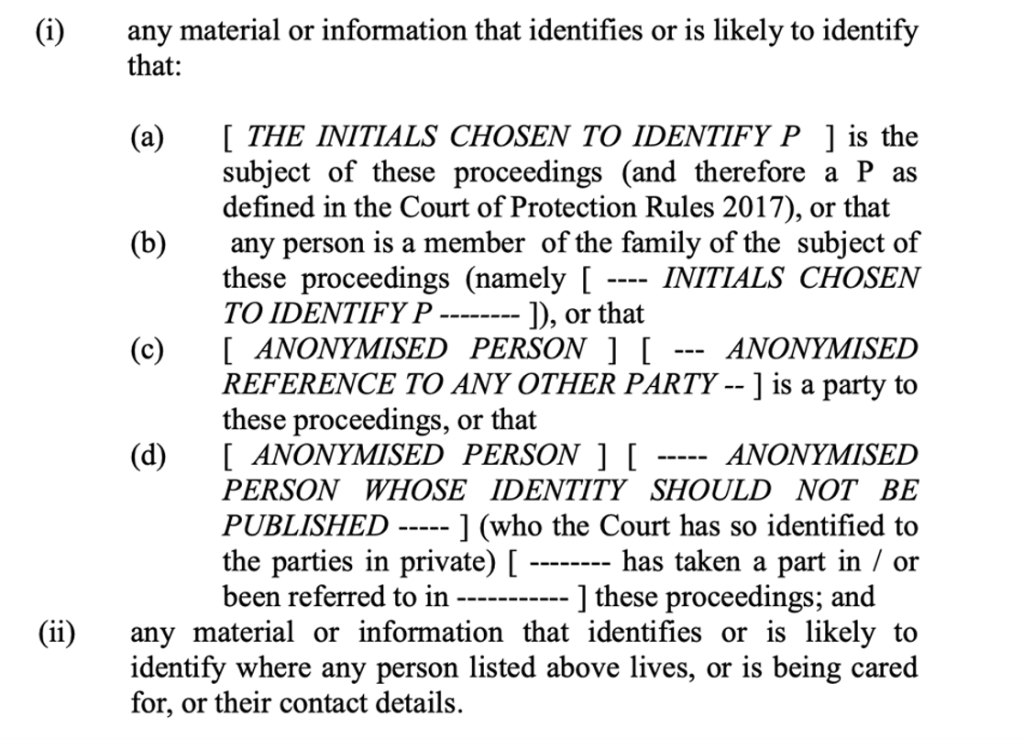
The form of the standard order in this case reads as follows:
(i) any material or information that identifies or is likely to identify that:
(a) JN is the subject of these proceedings and thereby a P as defined in the Court of Protection Rules 2017), or that
(b) any person is a member of the family of the subject of these proceedings (namely JN) or that
(c ) KCC are parties to these proceedings, or that
(d) JN (who the Court has so identified to the parties in private) or any person that is a member of the family of or has taken a part in/ or been referred to in these proceedings; and
(ii) any material or information that identifies or is likely to identify where any person listed above lives, or is being cared for, or their contact details.
So, KCC (Kent County Council) could not be publicly named. This didn’t seem right.
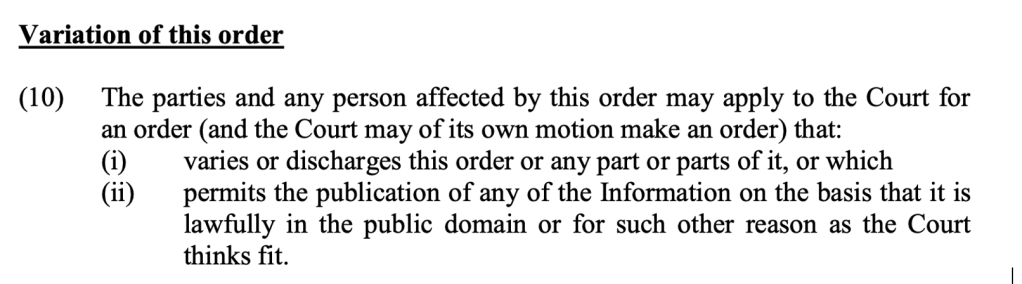
The standard template also says (at §10) that anyone affected by the order (which includes observers) can ask for the order to be varied or discharged.
Asking to vary a Transparency Order (in court)
The most straightforward and time-efficient way for observers to raise concerns about the reporting restrictions imposed upon us in Court of Protection hearings is when we are in court during the hearing.
I’ve done this dozens of times and it’s usually been resolved within two or three minutes.
It generally runs off something like this:
Judge: Have you seen and understood the Transparency Order?
Celia: Yes, but I’d like to ask for it to be varied. It’s not clear to me why the (Local Authority/Trust/ICB/Health Board) is included in paragraph (6) in the list of information that we’re not allowed to make public. This is a public body, paid for with our taxes, and should be publicly accountable for its actions. In terms of the Article 8 (privacy) and Article 10 (right to freedom of information) balance, is there an argument that revealing the name of the public body makes it likely that P could be identified?
Judge: (after short faff while everyone locates the Transparency Order and the relevant paragraph) Can I have counsels’ views on this.
Counsel for P, public body and other counsel: (all looking at Transparency Order as if they’ve never seen it before) There’s no reason to protect the identity of the public body. Publication of the identity of the public body will not realistically lead to identification of P.
Judge: In that case I will vary the Transparency Order.
That didn’t happen in this case because I didn’t have the Transparency Order until after the hearing was finished, so I didn’t know that there was a reporting restriction covering Kent County Council.
I had asked counsel for the Transparency Order (and their Position Statements) via email while we were all on the video-platform waiting for the hearing to begin. It was due to start at 10.30am but was delayed (until 11.14am) due to “technical difficulties” with an earlier hearing. Before the hearing started, I emailed my requests to the barristers I could see on screen – at 10.51am (Bridget Dolan), 11.02 (Steven Broach) and 11.05 (Michael Paget).
Virtually the first thing the judge said on joining the platform was that there was a Transparency Order in place which “prevents anybody from naming or identifying the person who is the subject of the proceedings, directly or indirectly”. She did not mention any prohibition on naming Kent County Council, nor did she direct that the Transparency Order should be sent to observers. Instead, she said, “if anybody who has joined the hearing would like to see the Transparency Order, they can ask the court for it”. The hearing ended at 12.25pm and the Transparency Order was sent to me more than three hours later (at 3.43pm).
So, it was only much later that day, after the hearing was finished, that I realised I was prohibited from naming Kent County Council.
Asking to vary the Transparency Order after the hearing is finished
The delay in sending me the Transparency Order meant a much more cumbersome and time-consuming process both for me and for the lawyers and judges when I decided it was necessary to ask for the Transparency Order to be varied.
Here’s what happened next.
Wednesday 5th July 2023 (the day of the hearing)
I sent an email to Mrs Justice Theis (via her clerk) at 8.17pm.
Dear Mrs Justice Theis
I have just opened and read the Transparency Order for this morning’s hearing, as sent to me by the OS’s instructing solicitor, Scott Storey, at 15.43 today. It is a sealed order dated 4 November 2022. I attach it for your convenience.
It says on the face of the order that “any person” has “the right to ask the court to vary or discharge the order“, and I would like to make a request for the order to be varied.
The variation I am asking for relates to §6 “The subject matter of the injunction” which provides a list of information covered by the reporting restriction.
As usual, we are prohibited from publishing information identifying or likely to identify that JN is the subject of these proceedings and any member of JN’s family (NB this seems to have been stated first in §6(i)(a) and (b) and then again in 6(i)(d) such that the latter is redundant).
What is not usual is that we are prohibited from identifying the public body involved in these proceedings: See §6(i)(c) “KCC are parties to these proceedings“.
If I’d received the TO, or had been made aware of this prohibition at the beginning of the hearing, I would have queried at that point (had I been permitted to do so) why it prohibits publication of the fact that KCC are involved in these proceedings.
In your summary of the TO for the benefit of those of us observing the hearing, I did not hear any mention of the fact that identification of this public body is prohibited. My contemporaneous notes record only the judicial comment that the TO “prevents anybody from naming or identifying the person who is the subject of the proceedings, directly or indirectly“. This is of course standard.
Is there an argument to the effect that identifying KCC would enable identification of JN – thus breaching his Art. 8 privacy rights? It’s not obvious to me (on the basis of what I understood of the hearing, or from the PS I have read from the OS) how JN could be publicly identified simply from the information that KCC is involved.
Does naming KCC constitute so high a risk to JN’s Art 8 rights that the balance tips in favour of this restriction of the public’s Art 10 rights to know that KCC is the public body implicated in raising the jurisdictional concern (now withdrawn) that purportedly contributed to delays in this case being progressed?
The KCC is a public body, funded by our taxes and accountable to the public, so it is of some concern to me that we are precluded from reporting that they are the body involved in a case that caused a High Court judge to say, in public court, “All I can do is express my despair. There’s delay building on delay“. It seemed to me as an observer that KCC bears some responsibility for that delay, and I would like to be able to say so because I believe that is a matter of legitimate public interest.
I recognise that the delay is likely also caused by other factors other than KCC’s (initial) jurisdictional claim, including the challenge to capacity, and intend to report accurately and fairly what I observed in that regard.
Not to be able to name the public body involved in this case. strikes me as an unjustified interference with the public right to know about what is going on, and to assess for themselves why (as Ms Dolan put it) “this application has gone so horribly awry“.
In sum, I am asking for the TO to be varied so as to lift the prohibition on naming KCC.
Please let me know if you need more information from me in relation to this.
Thank you.
Celia Kitzinger
Thursday, 6 July 2023
8.16am: Mrs Justice Theis (via her clerk) asked for representations from counsel. The judge’s clerk copied me into an email asking the Official Solicitor and Kent County Council to provide written responses to my request for the Transparency Order to be varied by 11am that day.
10.09am: The Official Solicitor said she supports the principle of transparency in respect of these proceedings and perceives no realistic risk of jigsaw identification of Mr N should the local authority be identified in this case. The OS therefore raised no objection to my application to identify Kent County Council as the relevant local authority.
11.57am: Kent County Council has not responded and the matter is passed to a different judge. We were sent an email from Mr Justice Poole’s clerk explaining that Mrs Justice Theis was no longer available to deal with this matter so Poole J would deal with it instead.
Friday 7 July 2023
10.20am: The solicitor acting for Kent County Council says she is urgently seeking instruction and says she’ll provide a response by the end of the day. (She doesn’t.)
Monday 10 July 2023
2.14pm I email the judge’s clerk to request a decision from Poole J
I have not received any submissions from the local authority regarding my request to vary the TO to enable me to name them.
If a submission has been made, may I see it please.
If not, is Poole J in a position to make a decision on my request in any case, since the local authority has had an extended deadline to make a submission already, and it may be that they do not intend to do so?
It’s a pity that I wasn’t sent the TO, or correctly informed as to the prohibition on naming the LA, before or during the time of the hearing – this could have been sorted out rather more quickly, and without involving so much court time, if that had been done. The court also risked the possibility that I might have put information about the LA on social media in advance of receiving the TO, since the judge had purported to explain to me what it said, but didn’t say that the name of the public body was included in ‘the Information’ not to be published. If she had, I’d have asked for the TO to be varied during the hearing.
2.26pm: The solicitor acting for KCC emails to say that KCC do not raise any objections to being identified as the relevant local authority.
2.44pm: I email Poole J’s clerk: “Further to the email […] saying that KCC do not raise any objections to being identified as the relevant local authority, I assume that Poole J will now make an order to vary the TO to permit this?”
Tuesday 11 July 2023
11.10am An email from Poole J’s clerk informs me that an order is now being drawn up to permit the naming of Kent County Council as respondent to the proceedings.
12.33pm: I receives an order which says:
“UPON receiving an application by Professor Celia Kitzinger of the Open Justice Project [sic] to be permitted to name Kent County Council as Respondent to the proceedings
AND UPON the Court determining that there should be no restriction on reporting the name of Kent County Council as Respondent to the proceedings
By consent of the parties
IT IS ORDERED THAT
1. The Transparency Order dated 4 November 2022 shall be varies (sic) as follows:
(i) Paragraph 6(c ) shall be deleted.
(ii) There shall be added as paragraph 9(1)(f), “naming Kent County Council as Respondent”
So, the deleted paragraph is the paragraph that says I’m not allowed to identify Kent County Council as a party to the proceedings. And the new paragraph that has been added is under a heading that reads: “What the Injunction does not prevent people from doing and does not apply to”. So it means that the injunction now does NOT prevent me from naming Kent County Council.
Reflections and outcome
This was all quite a palaver – especially compared to the straightforward way in which this issue can be dealt with in court if the Transparency Order is made available to observers in a timely manner.
If I’d had the Transparency Order during the hearing on the morning of 5th July, I’d have been able to request the variation at that point, and would have been able to write a blog post or tweet or any other kind of public report naming Kent County Council in connection with this case on the same day. Instead, I had to wait nearly a week – until the afternoon of Tuesday 11 July 2023.
Because I wasn’t able to ask for a variation in the order until after the hearing was finished, my request involved a fair number of busy people in a lot of extra work, as well as causing a delay in the implementation of open justice.
It is testimony to the commitment of lawyers and judges in the Court of Protection that at no point did anyone say – or even hint – that I was being a nuisance or that my request was unwelcome.
And at a subsequent hearing before Mrs Justice Theis a few weeks later (COP 14081834, 1 August 2023), I was pleased to hear her say: “If anybody needs a copy of the Transparency Order, they should contact the court immediately, or if there are any queries once they have seen it”. Of course, most people don’t know how to “contact the court” (emails to the RCJ court staff or to video-hearing administrators rarely work for obtaining Transparency Orders). I emailed one of the barristers, Leonie Hirst, and received the Transparency Order at 11.07am, i.e. around half an hour into the hearing. At 11.12am, I emailed counsel and the judge’s clerk:
“Please could it be brought to the attention of the judge that I would like to propose a variation to the TO which currently protects the identity of the Newcastle upon Tyne Hospitals Foundation Trust, which is a public body. It’s unusual for us to be required to conceal the identity of public bodies – paid for by our taxes and publicly accountable for their actions. I note the TO does not explicitly cover Newcastle City Council. Is there any real likelihood that identifying the Trust will lead to identification of P? If not (and on my understanding of the case it seems unlikely) then I would like to request this variation please.”
The judge dealt with my request at 11.44am, during a pause in the substantive proceedings during which one of the witnesses, P’s lead support worker, had been asked to log off to read an attendance note which (it seems) should have been sent to him and had not. The judge asked counsel whether there were any “compelling reasons” for preventing me from naming the Trust (or the City Council) and was told there were none. She then immediately asked for a revised version of the Transparency Order to be sent to her to reflect that. That felt much more proportionate!
The question remains, of course, as to how it is that these Transparency Orders are being drafted, and signed off by judges, in such a way as to ban the naming of public bodies – when in my experience there is rarely any good reason for this, and requests for variations are regularly granted unproblematically.
By including the names of public bodies as the subject matter of an injunction against us, the Court of Protection limits transparency – often, it seems, for no good reason. It’s frustrating for me to receive blog posts from people who’ve observed hearings I haven’t attended and to see, when I ask for their Transparency Orders, that they prevent publication of the names of public bodies in quite “routine” cases. In many (most) cases, I strongly suspect that if I’d been in that hearing and asked for that Transparency Order to be varied, it would have been. But, of course, it’s not fair to expect people (often students) observing their first COP hearings, to know that this is something to raise with the judge – or indeed to expect them to know how to go about doing that. Few observers (even journalists!) have the confidence and skills to raise questions about Transparency Orders.
I would like to see the lawyers who draft Transparency Orders and the judges who sign them take responsibility for checking that they’re compliant with the court’s Article 8 and Article 10 obligations, i.e. that they represent a considered balance between respect for P’s privacy and the right of the public to freedom of information.
It’s very rarely the case that knowing the name of a public body will lead to identification of P, or P’s family.
There’s an important general principle that we should be able to hold public bodies to account – especially in cases like the one reported here.
The presence of public observers in the courtroom is not enough, in and of itself, to deliver on the judicial commitment to transparency if we’re banned from reporting the names of public bodies for no discernible reason.
Postscript
For an update on this case, and the judge’s decision in the substantive matter of Mr N’s deprivation of liberty, see the blog post about the October hearing of this case (“Another case of s.21A delay (with a happy ending)“which I also observed. Regarding the Transparency Order, in their Position Statement for the October hearing, the Official Solicitor records as follows (at §5):
“The order of Poole J made on 11 July 2023 varied the transparency order of 4 November 2022 to remove the prohibition on naming KCC as respondent (following an application by Professor Celia Kitzinger) [D80-81]. Regrettably, on review of the file by Mr N’s solicitors, it has come to light that this was an error on the template of the order filed with the initial application, and anonymisation of KCC should not therefore have been included in the order. This was not picked up by the parties until this was pointed out to the court. Mr N’s solicitors will ensure this is not repeated in any further cases.”
Celia Kitzinger is co-director of the Open Justice Court of Protection Project. She has observed more than 460 hearings since May 2020 and written more than 100 blog posts. She is on LinkedIn (here), and tweets @KitzingerCelia
[1] For another blog post about this same hearing, dealing with the substantive matter of the application, see A s.21A challenge for a ‘restricted’ patient: A “shocking” delay.
[2] Taken from the Official Solicitor’s Position Statement (4th July 2023). The case law cited on this point is R (KB and Others) v Mental Health Review Tribunal and Secretary of State [2004] QB 936.
 Promoting Open Justice in the Court of Protection
10 thoughts on “Varying reporting restrictions to name Kent County Council in “shocking” delay case”