
By Celia Kitzinger, with Brian Farmer, 24 September 2023
On 9th July 2023, Andy Casey – then a healthy young man – was on a night out when he was assaulted in a pub garden. He was punched on the right side of his head and fell to the ground, with catastrophic injury to his brain. An ambulance took him to St George’s Hospital where, from the point of admission, he was found to be in the deepest form of coma, and four days later his treating clinicians suspected that his brain stem had died. This was subsequently confirmed by formal brain stem testing. This meant he met the legal definition for death in England.
Normally, withdrawal of organ support follows within 24-48 hours of the clinical diagnosis of brain stem death. In this case, though, the family did not accept the results of the tests and reported seeing Andy move in ways that they considered indicated that he was not brain stem dead. An attempt at mediation failed, and the Trust made an application to the Family Court for a declaration that Andy Casey was dead, and that therefore organ support could be lawfully withdrawn.
The judge heard evidence from the family and from clinicians and concluded that “Mr Casey died on 16 July 2023 at 11.51pm” (i.e., when brain stem testing confirmed his death). He further declared that: “in the circumstances, it is lawful for a consultant or other medical professional at the hospital part of the St George’s University Hospitals NHS Foundation Trust to (a) cease to mechanically ventilate and/or to support the respiration of Andrew Casey, (b) to extubate Andrew Casey, (c) cease the administration of medication to Andrew Casey and (d) not attempt any cardio or pulmonary resuscitation upon Andrew Casey when respiration and cardiac output ceases” (§79 and §81(ii) St George’s University Hospitals NHS Foundation Trust v Casey [2023] EWHC 2244 (Fam)).
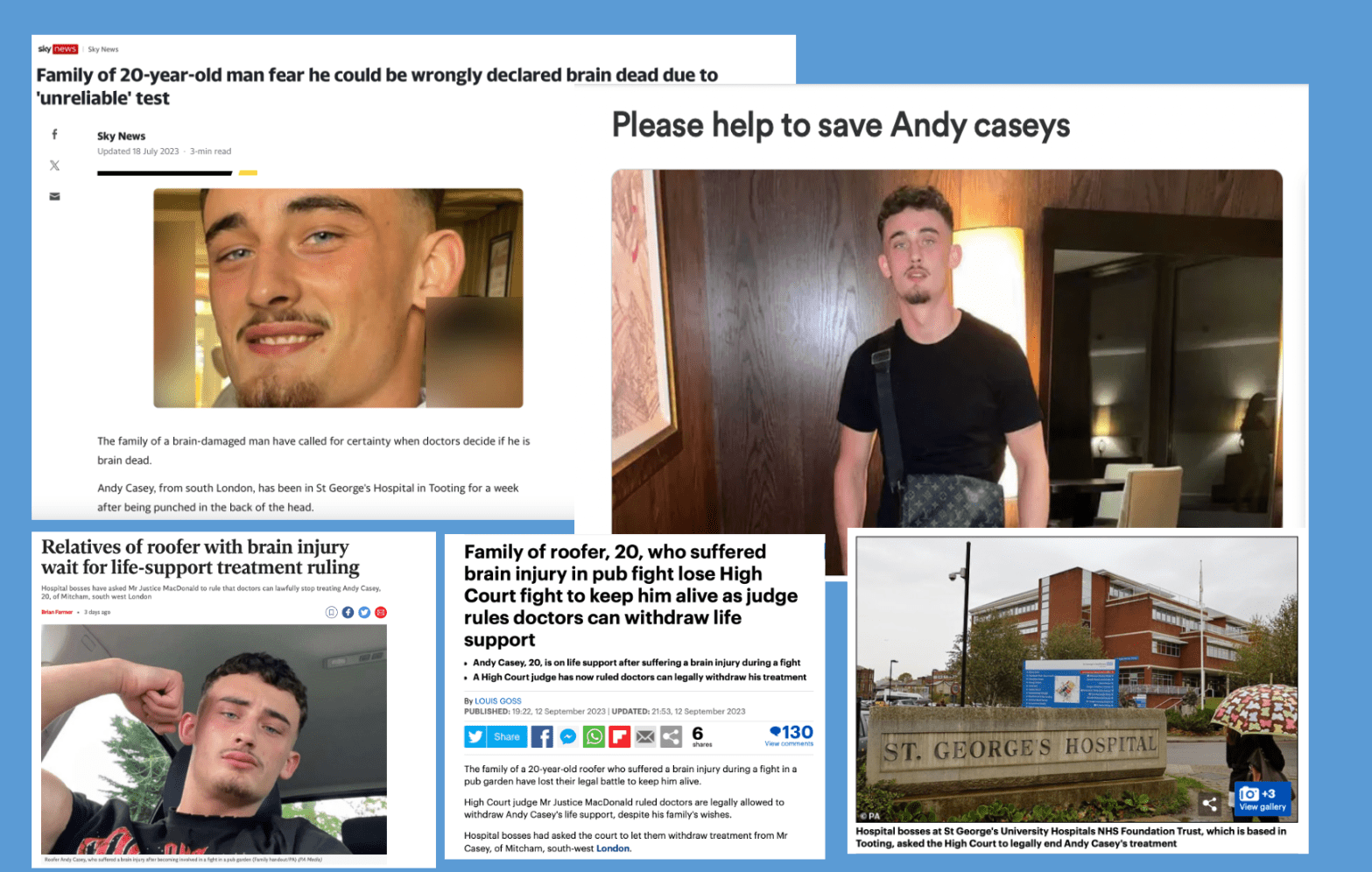
This sad story has been widely reported in the media as the case has unfolded – and Andy Casey’s name, and those of his family members, as well as the name of the hospital where he was being treated, have been included in these reports from the outset. Here’s an example from Sky News.
The family of a brain-damaged man have called for certainty when doctors decide if he is brain dead.
Andy Casey, from south London, has been in St George’s Hospital in Tooting for a week after being punched in the back of the head.
The 20-year-old’s family say doctors treating him at the hospital want to do a brain stem test to assess whether he is brain dead before removing life support.
The family oppose the test, citing questions over its reliability after two recent cases where the test was used to wrongly declare living people as dead.
Mr Casey’s mother Samantha Johnson told Sky News the test is “not 100% accurate”.
She said: “If they do this test and it comes back zero activity, they can turn off the machine … it’s not a 100% accurate test so there could be a chance that my son could pull through this.
“I believe my son is fighting. He needs this chance and I’m going to fight no matter what.”
Family of 20-year-old man fear he could be wrongly declared brain dead due to ‘unreliable’ test, Sky News, July 2023
The names of the family, and the Trust and the hospital are used throughout reporting of this case and are also used in the final judgment.
This is unusual – both in the Family Court and in the Court of Protection – and this blog post describes how this came about.
It’s an interesting case to consider for families who don’t want reporting restrictions in relation to their own cases in the Family Court or the Court of Protection.
It’s sometimes claimed that the Family Court and the Court of Protection are operating in secret, imposing “draconian” reporting restrictions which prevent families from speaking out about court cases in which they are involved.
Of course, many – perhaps most – families involved in these court hearings do not want their stories in the Daily Mail. But some do, especially when they believe that injustice is being done, or that the life of their relative is at stake. There may be lessons here for families who want to speak out.
Reporting Restrictions Order: 23 August 2023
Initially, there were reporting restrictions in place preventing identification of the Trust, Andy himself and Andy’s mother. Observers were sent the Order approved by Mr Justice Moor on 23rd August 2023.
3. For the purposes of these proceedings:
a. The Claimant shall be referred to as “A Hospital Trust”;
b. The Person the case relates to shall be referred to as “A”;
c. The Defendant (A’s mother) shall be referred to as “B”.
Publishing Restrictions
4. This Order prohibits the publishing or broadcasting in any newspaper, magazine, public computer network, internet site, social network or media including Twitter or Facebook, sound or television broadcast or cable or satellite programme service of any information (including any photograph, name and/or address) that is likely to lead to the identification of any of the following;
a. A, who is the subject of these proceedings; or
b. Any member of A’s family, including B; or
c. The name of the Applicant NHS Trust;
d. Any of A’s treating clinicians (clinical and non-clinical), including those who have taken a part in or been referred to in these proceedings.
IF, BUT ONLY IF, such publication is likely to lead to the identification of A as being the person receiving treatment or as a party to these proceedings, whether such identification be to the public at large or to those who know A, or have encountered A as a fellow patient or being a party to these proceedings.
Reporting Restriction Order, 23 August 2023
The problem with this Order was that by the time it was issued (in August 2023) there had already been media reports (and a fund-raising page) naming Andy, his family members, and the hospital (though not his treating clinicians) in ways that make it easy to connect them with these legal proceedings. They include the Sky News report quoted above, which was published in July 2023.
Varying the Reporting Restriction Order: 8 September 2023
Both the Official Solicitor (Emma Sutton KC, acting as Advocate to the Court) and Brian Farmer – as the journalist covering the hearing – drew the judge’s attention to the fact that the information prohibited by the reporting restriction order (RRO) was already in the public domain.
The Official Solicitor said, that “reconsideration of the terms of the RRO is likely to be needed at the outset of the hearing” – comparing it to an earlier case in the Court of Protection concerning William Verden (Manchester University NHS Foundation Trust v William Verden (by his litigation friend, the Official Solicitor) & Ors [2022] EWCOP 4 (see §§9-11 in particular), where there had also been lots of media publicity before the case reached court.
Brian Farmer (journalist with the Press Association) wrote to the judge as follows:
Dear Judge
1: I can see from the Alerts Service explanatory note that this case is a little unusual because Mr Casey’s mother appears to have disengaged.
2: However, the problem from the media’s point of view is a familiar one.
3: There has been publicity about Mr Casey’s case (names have been named) and the publicity has indicated that litigation is likely if not underway.
4: We’d want to be able to report developments and finish the story. Those developments (and probably the end of the story) will be outlined to you in court.
5: This is the jigsaw identification problem with which everyone in the Family Division is so familiar: names have already been named, how do we end the story if we can’t name Mr Casey or the Trust in court reports?
6: Anonymous reporting won’t work: outlining the facts without names will create the simplest identification jigsaw.
7: There are obvious public interest issues:
i) We ought to be able to report court hearings, even private hearings.
ii) We ought to be able tell people about the consequences of violence (and here I’d make the well-known, “what’s in a name… a lot press would say” (1) point).
iii) We ought to be able to report the issues that arise, and the difficulties doctors, families, and judges face, in these kinds of cases.
8: You’ll obviously have to balance [Articles] 10 and 8 but I’m not sure whose 8 rights you are protecting. Realistically, ending the story isn’t going to undermine Mr Casey’s 8 rights; they’ve already been undermined by reporting. I would make a similar argument in relation to Mr Casey’s mother and family.
9: We’d say you shouldn’t impose a blanket ban on reporting. (We’d then ask if we could report the ban and make “secret justice” arguments.)
10: These problems have been solved many times before in a series of treatment cases (Gard, Evans, Battersbee etc). We’d say you should let us name the names which have been already named – just as judges did in Gard, Evans, Battersbee etc.
Email from Brian Farmer sent to Mr Justice MacDonald
The parties’ positions
The position of the Trust – represented by Abid Mahmood – was that the reporting restrictions should continue, despite publication of some of the case details.
“It is not necessarily the position that persons will be able to link the previous reports in the media to this case when it appears on Bailii or the like”, he argued.
The Trust’s motive for retaining the reporting restrictions was clearly to protect staff.
Counsel referred to a message sent by Christine Casey via Facebook on 14 July 2023 inviting the public to attend the hospital to protest: “…if it says 0% then there turning his machines off so now we need as many people as possible to come up after the test to protest to make sure his machine don’t get turned off please share this status”. And since then (he said), a covert recording device was found in P’s room – designed to look like an air freshener with a device for recording at the back.
In their skeleton argument, the Trust acknowledged that “the family deny any connection to it [the covert recording device]” but added “it is obvious that the Hospital staff are employees who need to be able to get on with their work. Hospitals are always stressful and difficult places even without complications with protests and covert recording devices. The Trust owes duty to its staff.”
The Trust quoted the judgment in a Court of Appeal case (which also concerned a case of “brain death”):
“The manner in which social media may now be deployed to name and pillory an individual is well established and the experience of the clinicians treating child patients in cases which achieve publicity, such as those of Charlie Gard and Alfie Evans, demonstrate the highly adverse impact becoming the focus of a media storm may have on treating clinicians. The need for openness and transparency in these difficult, important and, often, controversial cases is critical but can, in the judgment of the court, be more than adequately met through the court’s judgments without the need for identifying those who have cared for Midrar…” (§102, Re M (Declaration of Death of Child) [2020] EWCA Civ)
Judge: I’m sorry to interrupt, but none of those actions would be restricted by a reporting restriction on the name of the Trust. Family already know it. Friends know it. And members of public know it. An Order preventing reporting of the name of the Trust wouldn’t prevent that mischief.
Counsel for Trust: If members of public want to, it would really be only a simple step to put into search engine the name of the Trust and locate the names of the treating clinicians. We propose that the Trust be referred to as “a London Hospital Trust”
Judge: The horse has bolted, Mr Mahmood. The name of the Trust is already out there. […] I really struggle with the idea that in circumstances where the name of Trust is already in the public domain, I should artificially restrict it. Ms Sutton – […] do you have any submission?
Official Solicitor: Yes, it’s straightforward. The family want to speak out. The only issue is that the clinicians are appropriately anonymised….
The judge checked that the family’s legal representatives (James Bogle and Paul Diamond) also supported relaxing the reporting restrictions. They did.
Decision on reporting restrictions
The judge said he was “entirely satisfied” that the Order should be varied to allow “naming of Andy and identification of the Trust”.
The Official Solicitor checked that the intention was that the Order would also permit naming Andy’s mother, the first respondent – albeit that she was not in court today – Samantha Johnson; and his siblings, seeking to join as third and fourth respondents, Christine Casey and Joe Casey. “Yes”, said the judge.
In his judgment, Mr Justice MacDonald names all of these people – and more (Joe Casey’s partner, Macy Jo Phelan, who gave oral evidence in court), as well as naming the Trust and the hospital. He refers briefly to the reporting restrictions in §5 of his judgment:
“… the court determined that it was appropriate to relax the terms of the Reporting Restriction Order (RRO) to permit the naming of Mr Casey and the identification of members of the family and to permit the naming of the Trust and the hospital. Both these steps were taken in circumstances where those details were already in the public domain as the result of coverage in the press. I was not prepared to relax the current restrictions on publishing the names of the treating clinicians involved in this case.”
§5 St George’s University Hospitals NHS Foundation Trust v Casey [2023] EWHC 2244 (Fam)).
Reflections
“Reporting Restriction Orders” (RROs, in the Family Court) and “Transparency Orders” (TOs, in the Court of Protection) raise difficulties for family members who want to speak out about their court case. They’re often made without the family really understanding what they mean, or knowing how to ask for them to be changed.
As I’ve said previously, these reporting restrictions, “[impact] upon their [families’] freedom of expression more severely than it does observers , because in speaking about (for example) “my son” or “my mother”, under their own name, in connection with a COP hearing, they are “likely to identify” that person as a P in the Court of Protection”.
In a witness statement submitted to Mrs Justice Lieven last year, I described my concerns:
32. Many of the families I’ve supported through serious medical treatment cases find themselves angry about being “silenced” or “gagged”. They have come to believe that the TO protects clinicians, not P. Some of the family members who’ve contacted me through the Open Justice Court of Protection Project say similarly that the court is attempting to silence them because of their criticisms of the healthcare or legal systems. Reporting restrictions are viewed as damaging P, not protecting them. Most have not, in fact, been willing to challenge reporting restrictions – believing it will be another expensive court battle, or that they are bound to lose anyway, or simply because they are too stressed and exhausted by the situation that has led to the court hearing in the first place. Some fear ‘reprisals’ against P if they are seen as ‘difficult’ family members.
33. I am currently supporting two members of the public seeking variations of the TO – neither of whom recalls any discussion at all, at the outset of their relative’s COP case, about the restrictions it would impose upon their Art.10 rights. What they remember is being “reassured” by lawyers that their names (and that of their relative) would not be made public, and that the family’s privacy would be protected – but not that they would lose the right to speak out.
34. It seems that there is no proper explanation or ‘anxious scrutiny’ of reporting restriction orders with family members. When supporting family members with cases that have not yet reached court, I explain the TO to them, and help them to engage in a balancing exercise, both in relation to their own rights to privacy and freedom of expression, and in relation to P’s. In a couple of cases, I have recommended publicising as much as possible in advance of the application to the court, such that “the cat is already out of the bag”, in terms of what is publicly available and a TO restrictive of their Art 10 rights is then less likely. For
Celia Kitzinger, Anxious scrutiny or boilerplate? Evidence on Transparency Orders
For families like the Caseys, ensuring that “the horse has already bolted,” or “the cat is out of the bag” can be a very effective strategy for preventing the “draconian” reporting restrictions which sometimes earn the courts a reputation for “gagging” families and for conducting proceedings in “secrecy”. Letting a journalist or public observer know about the hearing in advance is also likely to be of assistance in that they, too, might have arguments to present in court for varying or discharging reporting restrictions.
Celia Kitzinger is co-director of the Open Justice Court of Protection Project. She has observed more than 470 hearings since May 2020 and written more than 100 blog posts. She is on LinkedIn (here), and tweets @KitzingerCelia
(1) This is a reference to the well-known observation by Lord Rodger at §63 In re Guardian News and Media Ltd and others [2010] UKSC 1: “What’s in a name? ‘A lot’, the press would answer. This is because stories about particular individuals are simply much more attractive to readers than stories about unidentified people. It is just human nature. […] A requirement to report it in some austere, abstract form, devoid of much of its human interest, could well mean that the report would not be read and the information would not be passed on. Ultimately, such an approach could threaten the viability of newspapers and magazines, which can only inform the public if they attract enough readers and make enough money to survive.”


Fantastic reporting which outlines some of struggles of reporting from the COP and also the family courts. Open justice is important, it is vital the courts and actions of the parties can be properly scrutinised.
LikeLike