

By Georgina Baidoun, 24th June 2024
As often happens now, especially with cases involving attorneys and deputies, this one was listed as ‘attended’, which I took to mean “in person”.
This means that the parties (or their representatives) are attending in person, but it’s possible that there’s a link set up for others involved in the hearing (e.g. witnesses). Even if that’s not the case, the law permits a link for observers if it’s practicable to do so (e.g. if the court receives a request in plenty of time, and if the courtroom has video facilities and staff to set them up).
I decided I would nevertheless ask to observe remotely. I wrote as follows: “Good morning. I see that this public hearing is ‘attended’ but would be very grateful to receive a link to observe it on-line if a link is being set up.”
As always, I attached a screenshot of the court listing.
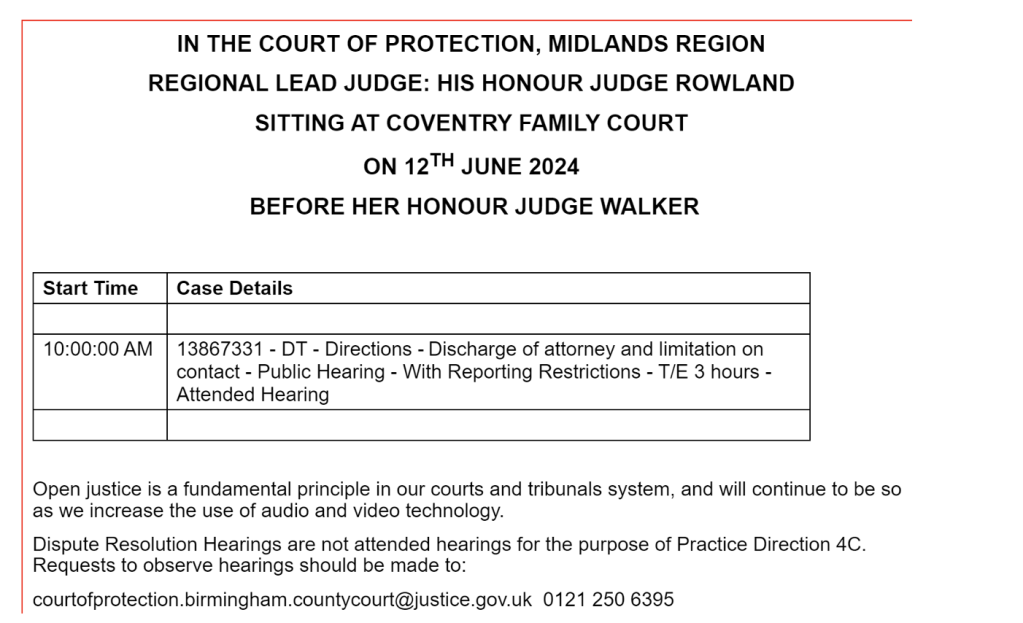
Entry into the court
I’m afraid I wasn’t optimistic and soon found myself wandering off into the garden, since it wasn’t raining for once.
Then at 10.38 I received an email from the court in Coventry including a Microsoft Teams link. I washed my hands and entered the court as quickly as I could.
Ten minutes later, when the hearing was well underway, I got an email from the Birmingham office saying: “Unfortunately, as the hearing is fully attended, there has been no link set up…” So I am left to imagine what had gone on behind the scenes but some trouble must have been taken because, when I entered the court, the judge said that making arrangements for me had delayed them. I duly expressed my heartfelt gratitude.
I hadn’t received a Transparency Order and this was addressed by the judge and, very helpfully, by the applicant’s barrister (see below) who rightly supposed that I was familiar with their general terms, to which I assented. I then turned off my camera and microphone, as I usually do.
The courtroom
My view of the courtroom must have been similar to the judge’s because I couldn’t see her but did get a very good view of all the other participants. They were introduced by Mr Ben Harrison from Serjeants’ Inn, who represented the applicant Local Authority
The first respondent had originally been P’s attorney for both property and finance and health and welfare and was representing herself – I will call her R.
The second respondent, was P’s ‘litigation friend, the Official Solicitor’, represented by Ms Rosie Scott.
Others in attendance were two people from the Local Authority, one of whom was a social worker, and R’s McKenzie friend, a term I hadn’t heard before (see Afterthoughts below).
The case before the court
Mr Harrison helpfully made a brief introduction to the case, which I was able to elaborate on as the hearing progressed.
It transpired that it had begun 3 years ago and that there had been several previous hearings. HHJ Walker had taken over from a previous judge and presided over at least two hearings since then. She had not met R before because R had been unable to attend these earlier hearings due to ill-health.
In 2021, Lasting Powers of Attorney had been registered for R to have powers of attorney for both P’s property and financial affairs and health and welfare. These powers had been revoked in 2022 when an interim, professional, deputy had been appointed. The reason was that the Local Authority were concerned that P had been subject to ‘coercion and control’ by R when agreeing to nominate her as her attorney and that this ‘coercion and control’ was continuing. They also believed that P had not had mental capacity when she signed the LPA documentation.
The Local Authority had also originally sought to restrict contact between P and R but had now agreed to withdraw this part of their application. They remained concerned but now believed that the risks could be managed by appointing a permanent professional deputy and R, in her turn, had agreed to the revoking of her powers of attorney so this could happen. R made clear that her agreement did not reflect her satisfaction with this outcome but the costs of the case had become disproportionate and it was distressing to P. She insisted that she had always acted in P’s best interests but P was now content to have a professional deputy appointed.
The LA responded that they were not seeking findings against R. They were also not rebutting that P still had capacity to make decisions about her own day-to-day spending.
Issues connected with the court process
At this point it turned out that the previous judge in this case had made an order that some of the information before the court should not be disclosed to R (i.e. it is “closed material”, see Guidance). If the case were to proceed to a contested hearing, the need to release this information would have to be considered. The Official Solicitor was of the opinion that it should remain redacted for ever unless the case was reopened and R agreed to this.
The judge expressed her sympathy for the pressure R had experienced throughout the long court process. R said it had taken up a large amount of her time over the last 3 years. She had always responded in a timely manner to the orders of the court but she could not say the same for the other parties. There had been ‘fearful accusations’ made against her and ‘dreadful adjectives’ used which were entirely out of keeping with her previously unblemished reputation. She wanted these removed from the record.
The judge said she could not do that; she could only say that there was ‘no determination’ in relation to these accusations, which was one of the benefits of settling the case now. R clearly felt that she had not had the opportunity to defend herself (guilty until proved innocent as I have noted in a previous post, The Public Guardian, Gifts and Attorneys. She talked about P having achieved her ‘life’s dream of living independently’ and that it had been R’s solicitor who had advised about putting LPAs in place.
The judge said that, if the case were to be pursued, the LA would take the opposite view but, as there was now agreement, their side of the story needed no further hearing.
The Official Solicitor said that her job was a balancing act and that the agreement reached would resolve matters as well as possible.
Questioning the need for an LPA for Health and Welfare
R expressed surprise that, although the issues before the court related to property and finance, her power of attorney for health and welfare was also to be removed. (This is the second case I have observed recently where attorneys have been surprised that the removal of their property and financial affairs powers seems inevitably to lead to the removal of their health and welfare powers too. I am beginning to sense that this is the norm and clearly people find it particularly upsetting.)
R wanted to know what would happen if P needed medical treatment. The judge said that an LPA was not necessary for this as the LA would be able to manage these matters, unless there was significant disagreement about treatment or where P should live, in which case it would come to court anyway. I think this only served to raise further doubts in R’s mind as she then referred to how happy P was in her current home and how anxious she would be if this was brought into question. The judge reassured her that this was not in question at the moment and that no restrictions were being placed on where P should live or with whom she could have contact.
The LA reinforced the lack of necessity for a health and welfare attorney; medical decisions would be taken by doctors. The Official Solicitor said there was no reason at present to think that P could not make her own decisions about her health, which she was doing very competently at present.
Summary and agreed determination
After an adjournment, the judge summarized the case and the agreements that had been reached.
P suffered from ‘complex disorders’ which had remained unchanged. She lacked capacity to engage in these proceedings and there was no reason to think that her capacity had been any different when the LPAs were written. The agreements outlined above were reiterated and the judge reassured R that the court recognized that she had always been a ‘significant person’ in P’s life and there was no reason why their relationship should change. The records would remain redacted because of the harm that they might otherwise cause to P.
Transparency Order
I had emailed Mr Harrison during the hearing asking him for the Transparency Order in case I didn’t receive it from the court. Just before the hearing ended, he asked me if I was still there and, when I turned on my camera and sound, assured me that he would be sending the TO. I took this opportunity to thank him for his help and also to thank HHJ Walker again. It had been a very positive experience.
After the hearing
After the hearing I also emailed the clerks and thanked them. Then I did some research.
I had not heard of a McKenzie friend before and discovered this https://mckenzie-friend.org.uk/
“A McKenzie Friend can best be described as anyone who accompanies you to court to help you as a Litigant in Person – those who are unrepresented by a Solicitor or engage a barrister. Your McKenzie Friend is able to sit with you in the court and offer advice and support as well as taking notes to help you.
There are some things that a McKenzie Friend cannot do on your behalf, such as conduct litigation, file court documents and Statements etc. There is a Practice Direction issued by the Family Courts which explains this in more detail.
Our team of McKenzie Friends support children and their families to help resolve family conflict. “
It must be unusual to find a McKenzie friend in the Court of Protection since they seem to be concerned with children and the Family Courts; I can’t think of an explanation.
I also wondered about the terminology ‘coercion and control’ and discovered its use in Section 76 of the Serious Crime Act 2015 which ‘introduced the criminal offence of controlling or coercive behaviour in an intimate or family relationship’. Luckily, I had the opportunity to check this with Mr Harrison after the hearing and was assured that that was not how the terminology was being used in this case. (A little knowledge can be a dangerous thing!)
Georgina Baidoun was the lay Court of Protection Deputy for her mother’s Property and Financial Affairs until her mother died in 2021. Because of the difficulties she experienced with several applications to the Court, and with the Office of the Public Guardian in connection with her annual report, she has retained an interest in these areas, including attending Court of Protection Users Group meetings. She is keen to share her experiences in the hope that she can help others who have to engage with these institutions with very little help or guidance. She tweets as @GeorgeMKeynes
 Promoting Open Justice in the Court of Protection