

By Georgina Baidoun, 4th July 2024
This case caught my attention because it was listed (see below) as concerning “authorising a gift or settlement of property” – and it turned out to be a substantial gift (a house).
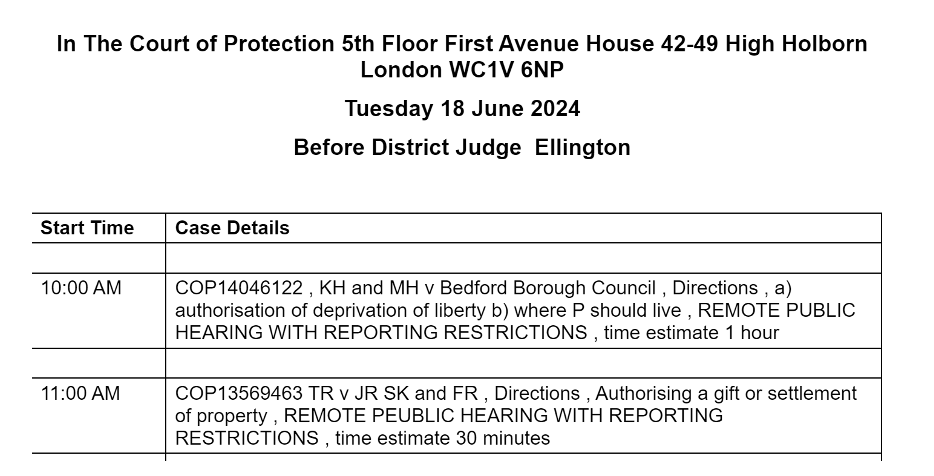
My request to observe the 11.00am hearing (COP 13569463) before DJ Ellington was answered with a link and Transparency Order received well in time for me to prepare myself.
When the hearing started, the applicant questioned my presence and I replied that I was simply a member of the public, but that I was also connected to the Open Justice COP Project. The judge asked me if I had received the Transparency Order and I confirmed that I had and agreed to abide by it.
The parties
The only party in attendance was the applicant, who was the professional Court of Protection deputy for P’s property and financial affairs.
The respondent was P himself, who the judge said was not yet joined as a party, which I think is unusual. I assume the reason was that there was no-one to represent him, the Official Solicitor having refused without giving reasons.
P’s daughter had been expected to join the hearing but she was not a party and, after attempts to contact her failed, the judge started without her. When she did join, she said that the Official Solicitor had refused to act for P because of costs, P having very little in the way of assets. The judge wondered whether there was an alternative to the Official Solicitor and later suggested maybe ‘just someone independent’ if it turned out there was no opposition to the application.
Application to make a gift
The gift for which the Court’s approval was sought was half of a home currently lived in by P’s daughter. It had been jointly owned by her parents and lived in by her and her mother until her mother died, her father having left many years before. She was her mother’s sole beneficiary but joint ownership of the house meant that it had passed in entirety to her father. He lacked mental capacity to deal with his property and financial affairs and was living in a care home, with his care was being funded by the Local Authority under Section 117 of the Mental Health Act – see note below.
Before a substantial gift can be made by a deputy (or an attorney) everyone likely to be affected must be officially informed, including any public sector organisation which might have an interest in ‘deprivation of assets’ needed for care costs. (The judge later referenced Practice Direction 9E in this respect – see note below). The applicant believed that the Local Authority had provided sufficient assurance that they would not oppose a gift on these grounds but the judge said she needed more evidence.
Another issue was the ‘family tree’ and who else in the family might have an interest. P’s mother was still alive but in poor health and living in a care home and there were two other relatives who had said they had no objection, although they had not done this by means of the official COP5 form. The judge said she needed more assurance that there was no-one else who should have been informed. The applicant believed that, according to intestacy law, the daughter would be the sole beneficiary when her father and his mother died.
At this point, the daughter belatedly joined, having possibly had technical issues because she later dropped out again for a while. She was clearly very distressed by the whole court process which she said had been going on for 4 years; she said she’d had only 24 hours’ notice of the current hearing. The judge explained that this hearing had been called as a matter of urgency because the mortgage on the home was coming to an end and she wanted, if possible, to avoid the threat of repossession. Other issues were not being considered at this point.
The daughter said that her father had written a statement saying he wanted to give her the home and that these problems could have been solved several years previously. (It later transpired that she had applied to be the deputy for P so maybe she thought she could then have made the gift herself without involving the court.) The applicant said that, if there were to be a change of ownership to include the daughter, a new mortgage would depend on her earnings, which she had confirmed were uncertain.
There seemed to be some confusion here and the judge intervened to check whether the gift applied for was for the whole or half of the home. The applicant replied that it was for half only, to get the daughter into the position intended by her mother’s will. She would jointly own the home with her father who had sufficient income to pay his share of the mortgage. The applicant suggested that P might have a statutory will made according to intestacy rules, which would confirm that the daughter would inherit the home after he died.
P’s daughter, on the other hand, believed that she should be gifted not half but the whole of the home. Without full ownership she would not be able to sell it. The judge said this would have to be the subject of a separate application.
The deputyship
It seemed that much of the daughter’s frustration arose from an on-going issue about the deputyship for P that was not being considered at this particular hearing. I think that she had originally applied to be deputy but her application had been contested and an interim deputy had been appointed while the case progressed. A major problem with not being a deputy was that she had no legal standing with the mortgage provider and any negotiations about the future had to be undertaken through the applicant.
Next steps
The judge agreed that the applicant should have the court’s authority to negotiate with the building society to see if a new mortgage could be arranged. This would require details of the daughter’s income, which she was ordered to supply to the applicant.
For the rest, the judge determined that, before she could make progress, she would need:
- Forms from the relatives (COP5) acknowledging service
- Form COP20B from the LA confirming they would make no future claim on P’s assets
- A genealogist to confirm that there were no other potentially interested relatives
- Relevant details relating to the future of the mortgage
- If possible, any thoughts the Official Solicitor might have as to P’s interests and the reason why they had declined to represent him
- If possible, someone independent to represent P.
At the daughter’s request, she agreed to add her as a party to future proceedings.
The judge suggested an early date for the next hearing but P’s daughter asked for a delay. It was arranged for 24 September 2024.
My thoughts
With increasing numbers of young people living with their parents for much longer, this case is likely to represent a problem that others will face in future. It underlines the need for parents to think carefully about what happens when they die or if they lose mental capacity. Here the problems were compounded by neither the mother nor her daughter seeming to have understood the difference between joint ownership of the home and tenants in common. Perhaps the father would have been prepared to alter the ownership arrangements if the potential consequences had been considered before he lost capacity.
Georgina Baidoun was the lay Court of Protection Deputy for her mother’s Property and Financial Affairs until her mother died in 2021. Because of the difficulties she experienced with several applications to the Court, and with the Office of the Public Guardian in connection with her annual report, she has retained an interest in these areas, including attending Court of Protection Users Group meetings. She is keen to share her experiences in the hope that she can help others who have to engage with these institutions with very little help or guidance. She tweets as @GeorgeMKeynes
Notes
Some people who have been kept in hospital under the Mental Health Act can get free help and support after they leave hospital. The law that gives this right is section 117 of the Mental Health Act, and it is often referred to as ‘section 117 aftercare’.
https://www.mind.org.uk/information-support/legal-rights/leaving-hospital/section-117-aftercare/
Practice Direction 9E – Applications relating to statutory wills, codicils, settlement and other dealings with P’s property
https://www.judiciary.uk/wp-content/uploads/2017/12/pd-9e-applications-relating-to-statutory-wills.pdf
 Promoting Open Justice in the Court of Protection
In the notes section there is reference to Section 117 aftercare is someone is detained in hospital. Does that apply if someone is detained in hospital under a DOLS ?
LikeLike
Hello – we’re not lawyers and can’t give legal advice but my understanding is that S117 aftercare is a reference to s117 MHA 1983 (https://www.legislation.gov.uk/ukpga/1983/20/section/117). It provides that some people who have been detained under the MHA get free aftercare (with the aim of avoiding readmission to hospital). The main groups of people it applies to are people detained for treatment under s.3 (not for assessment under s.2).
It doesn’t apply to people who are deprived of their liberty in care homes or hospitals, including psychiatric hospitals.
Celia
LikeLike