

By Amanda Hill, with contribution from Tim Sugden and Celia Kitzinger, 26th March 2025
The protected party in this case, “P”, is a woman in her early twenties, with diagnoses of autism, ADHD, behavioural difficulties and limited communication skills.
Her mother took her to Jamaica in February 2023 “seemingly to evade the involvement of social care professionals”, according to the Official Solicitor, representing P, as reported in an earlier blog about this case (Removing P to another country to evade the orders of the Court). I shall call P ‘Miranda’, the same as that blog.
Over two years later, in March 2025, Miranda is still missing.
There have been attempts to locate her, including via the involvement of the British High Commission in Kingston, the Foreign & Commonwealth Office, UK Border Force, the UK Police and British Airways. Nobody admits to knowing where she is – except for two family members, both believed to be with her: her mother, also a party to this case, and one of Miranda’s sisters. (Another of Miranda’s sisters remains in the UK.) Her father says that he has had no contact with his wife or with Miranda and the sister who is with her since the summer of 2023, and he does not know where they are. Emails bounce back and texts are unanswered.
Now the Local Authority, Essex County Council, has applied to conclude proceedings because, they argue “continuing proceedings would be futile and a disproportionate use of public funds”. The police would be notified if Miranda and her mother returned to the UK, because Essex Police are treating Miranda as a missing person.
In November 2024, there was a meeting between the Local Authority and Miranda’s legal representatives, and subsequent agreement to conclude proceedings. An application was made to the court dated 20th February 2025[1]. Counsel for the Local Authority also stated in his opening summary that P’s father supported the conclusion of proceedings.
A draft order was sent in the expectation that the decision would be made “on the papers” i.e. without a hearing. But this was refused by the court and a hearing in this case (COP 14027239) was listed for one hour at 10.30am on 19 March 2025, before Mr Justice McKendrick, sitting at the Royal Courts of Justice.
Two of us observed the hearing in the morning (myself and Tim Sugden) but the morning hearing was adjourned after an hour or so, until 3pm in the afternoon, and I wasn’t then available to observe it. Tim Sugden was able to do so and emailed a Hearing Feedback Form to the Open Justice Court of Protection Project which I’ve used, with his permission, to report on what happened in the afternoon.[2]. After the hearing, Celia Kitzinger requested and obtained the approved order (to which we’re entitled under Civil Procedure Rule 5.9 (“Supply of documents to a non-party from court records”, which reads: 5.9.—(1) Subject to rules 5.12 and 4.3(2), a person who is not a party to proceedings may inspect or obtain from the court records a copy of any judgment or order given or made in public.
The morning: Injunctions, penalties for contempt of court and next steps
In this remote hearing, conducted by MS Teams, the Local Authority was represented by Jim Hirschmann, Miranda’s father by Rose Harvey-Sullivan and Miranda by Keri Taylor (via the Official Solicitor). The father also attended the hearing and was on camera but he did not speak. The mother was not in court and the judge asked if she was aware of proceedings: that’s when it became obvious that nobody knew where she was or how to contact her.
The main deliberations of the morning were whether the judge would grant the application to conclude proceedings. It was clear to me from early on that he would not. Counsel for the LA made submissions in favour of concluding proceedings. During the submissions, the judge asked, to my mind, a key question: “Is it the LA’s position that it is in Miranda’s best interests to remain in Jamaica?” to which the LA replied that it was not, In the LA’s view, it is in Miranda’s best interests to return to the UK, to have a capacity assessment and for the public bodies to gather information to enable them to fill in gaps in the evidence. The judge then asked, “So, it is the LA position that Miranda should return?” – to which the answer was “yes”.
Counsel for Miranda’s father then submitted that he didn’t know where his wife and daughters were and he was unable to contact them. The judge asked counsel “what does he think Miranda’s best interests are?” to which the reply was that “he thinks that her mum will look after her…..he doesn’t agree with going against the court but he believes that Miranda is safe and cared for by her mum.”
In response to this, the judge stated that someone (meaning, the mother) has decided that Miranda should have no contact with her father and “this causes me concern”. Counsel for the father replied that it was “unusual” and the judge retorted “that’s an understatement”.
The judge wanted more information about emails and text messages that Miranda’s father had sent to his wife. This is when I started to get the impression that the judge thought the father knew more than he was letting on about where Miranda was. He asked for information about the house the father was living in and the split of ownership with his wife. The reason for these questions became apparent later on.
Counsel for Miranda via the OS submitted that the OS was in an “invidious position”. She had been appointed as Miranda’s Litigation Friend in December 2022 but had never been able to meet her. She referred to “closed material”[3] relating to Miranda’s return but “that horse has bolted”. It seems that documents had been served but the father’s counsel had been alerted despite the intention to exclude him from knowing about this. The OS was “neutral” as to whether the case should be concluded, but mainly because she couldn’t advance a positive case.
Counsel for the Official Solicitor did suggest further enquiries that could be made, including whether P had in fact returned to the UK unbeknown to the authorities. These included seeking information about whether Miranda’s mother was claiming benefits in the UK, whether she had a bank account, whether Miranda was registered with a GP, and whether estate agents had been contacted about the sale of the house Miranda’s father was living in (which he co-owned with his wife). The position statement also suggested that Miranda’s father could be directed to “file further evidence” about what he knows about their whereabouts.
The judge then set out his decision. He stated that he had only received the bundle of 700 pages at 7.30am that morning and a one-hour hearing was not enough to go through all the evidence. He raised potential safeguarding issues. Back in 2022, Miranda was found to have bruises on her body and as she is non-verbal she could not explain how she had come to have them. The judge described the family as “not co-operative” and her mother had taken her to Jamaica before an assessment as to her capacity to make decisions could be carried out.
Mr Justice McKendrick continued by saying that Miranda was a British citizen and “remains extremely vulnerable”. He was satisfied that the court retained jurisdiction. He found it “curious” that Miranda’s own Litigation Friend “does not know where she is or what steps have been taken to locate her”. He said: “I have little information regarding the up-to-date circumstances of Miranda”, including access to health care and medication and where she is living. He found that it was “inconsistent” with Miranda’s best interests to conclude the hearing today.
He directed that Miranda’s father must file a “very detailed” witness statement about the removal in January 2023 of Miranda from the court’s jurisdiction and what has happened since. He ordered that the witness statement must include a chronology of contact with Miranda’s mother, including emails and texts sent. He directed Essex County Council to make urgent further enquiries to try to locate Miranda. He would not close the proceedings when there were “clear avenues to pursue”.
Contempt of Court
Another judge at a previous hearing in this case on 15th September 2023, Mr Justice Williams, had issued an order saying that Miranda’s mother must return Miranda to the family home. He attached a penal notice meaning that if Miranda’s mother disobeys, and is found as a result to be in contempt of court, she could be imprisoned, fined, or have her assets seized.
One issue for the judge at this hearing was to establish what has happened in relation to this (and other) orders already issued in the case so far. He wants to try to establish if Miranda’s mother has been served with the order of Mr Justice Williams – and if so, and if she is in contempt of court, one possible penalty is a sequestration order against the 50% share of the property that she co-owns with Miranda’s father (the house he’s currently living in, worth several hundred thousand pounds). If the mother is found to be in contempt of court, she could lose her share of the property she owns. He stated that it is open to the court not only to send her to prison, but also that her assets could be sequestered. He said he was “not making a threat” but it was his “obligation” to point out the possible consequences of non-compliance with court orders.[4]
The judge’s view was that if Miranda’s mother was aware of the court proceedings, she should also be made aware that there were “repercussions” of not complying with judicial orders emanating from them. He was not going to say there would necessarily be an order for her to return Miranda to the UK, but the court wants to know where Miranda is and how she is living.
Next steps
The judge listed an in-person hearing at 12pm, Friday 28th March. He stated that Miranda’s father “must” attend in person as the judge may need to hear evidence from him. He asked Miranda’s father to take steps to contact Miranda’s mother because “I want [Miranda’s mother] to know that the OS must have communication with Miranda”. He wants all the parties to take steps to locate her.
The afternoon: Important transparency issues
After just about an hour, Mr Justice McKendrick adjourned the hearing until 3pm so that a draft order could be drawn up. Tim Sugden reported back on what happened when the hearing reconvened:
“When [the hearing] resumed, counsel for the applicant ran through the draft order that had been drawn up in the break, and the judge added / rephrased some sections in terms of what he expects the parties to do / write before then. That includes full details of whether (and if so, exactly how) the previous Return Orders were served on P’s mother; and the views of all parties as to whether (1) a further Return Order should be issued; (2) whether P’s mother is in contempt; and (3) whether the court has “continuing jurisdiction” in the matter, i.e. has P, by virtue of presumably residing in Jamaica for two years, become “habitually resident” there?
Then OS counsel requested that the hearing become a private one from which observers would be excluded, to discuss a particularly sensitive matter that “lay outside the terms of the TO” and which the other counsel were all aware of. The judge asked for submissions on this request – but I’m afraid I was a bit flummoxed at this sudden turn of events and didn’t know quite what to say in response, and so he went ahead and asked me (the only observer still standing by that stage, as it were) to leave, which I did. I was told that if the ‘public’ hearing resumed after the ‘private’ bit, the court staff would let me know so I could rejoin, so I hung around for a while … but heard nothing further after a half-hour or so, so disconnected and went off to do other things!”
I really don’t understand what happened here. In my opinion, if the Transparency Order was not drafted in a way to protect Miranda’s privacy, due to these “sensitive issues”, then it should have been changed. Neither Tim nor I were issued with a TO before the hearing started.
When the hearing started, there seemed to be some confusion about whether there even was a TO. But one was then located in the court “bundle” and emailed to both of us during the hearing. It was the sealed TO made by HHJ Hodges sitting in Chelmsford Justice Centre on 11th January 2023, and it’s in the standard form. The “Information” we are prohibited from reporting is set out in §6:
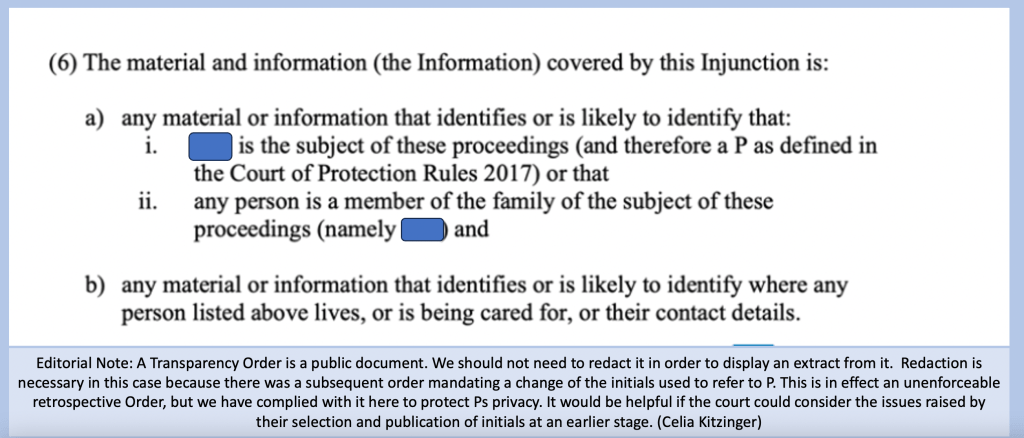
Tim and I are both experienced observers. We know that we could be found in contempt of court if we report matters which we are forbidden to do by the TO and we both have experience of the court going out of its way to permit us to observe hearings about sensitive matters by drawing up careful reporting restrictions to protect Miranda’s privacy and any risks of harm.[5]
In my opinion, if there are sensitive matters which should not be reported, then they should be considered in advance and the TO changed accordingly. It should not automatically mean a hearing is made private. That is not open justice. Also, Tim, like me, is not a lawyer. We are just ordinary members of the public. It is very hard for us to make “submissions”. I think this should be recognised by the court. I now know that I should be prepared more for this, for example to ask that public bodies be allowed to be named. But like Tim, I would have been “flummoxed” if I had been there too.
I don’t know whether the hearing on 28th March 2025 will be in public or not – or whether a video link for observers will be available if it is heard in public. I hope so, as I would like to observe to see what happens and be able to report on it.
Mr Justice McKendrick was clearly frustrated that more had not been done since 2023 to locate Miranda. I wonder if things will change before the next hearing.
The approved Order by Celia Kitzinger
The approved order (dated 19th March 2025) says that the mother “must attend the next hearing at 12pm on 28th March 2025” before McKendrick J (either remotely or in person) and that if she doesn’t, she may be held in contempt of court and may be imprisoned, fined, or have her assets seized.
The father, must also attend the next hearing, in person, and must serve in advance a signed witness statement providing a clear chronology of his contact with his wife – including texts, WhatsApp messages, social media, emails, written correspondence, and phone calls, and any contact details he has used, and details of any means he believes the other parties could use to contact her. He must also provide information about the ownership of the property he jointly owns with his wife (and the equity in it) and his belief as to where his daughter is currently living.
Essex County Council must also serve a witness statement setting out its belief as to where P is living, why it is in her best interests to return to the UK, and the steps it has taken to ensure that the mother has received (in such a form as to “effect service” upon her) the previous injunctive orders, the order concerning today’s hearing and the approved order resulting from it. The parties are also asked to agree a note in respect of the law relating to (i) the legal test for withdrawal of proceedings and (ii) the Court of Protection’s jurisdiction when there has been a wrongful removal of P from the jurisdiction.
The order does not record that part of today’s hearing was held in private and that a public observer had been excluded by the court. A note on the face of the order simply records “THESE PROCEEDINGS ARE IN PUBLIC BUT SUBJECT TO A TRANSPARENCY ORDER…” (capitals in original) and one of the recitals records that the parties had been given “… permission to share their position statements with observers who attended this public hearing”. This implies the whole hearing was public – but according to Tim Sugden it wasn’t. This does not seem accurate, and I’ve asked for information to whether or not there is a separate order relating to the private part of the hearing. There is no indication in the order that the next hearing will be other than public in its entirety.
Amanda Hill is a PhD student at the School of Journalism, Media and Culture at Cardiff University. Her research focuses on the Court of Protection, exploring family experiences, media representations and social media activism. She is also a daughter of a P in a Court of Protection case and has been a Litigant in Person. She is on LinkedIn (here), and also on X as (@AmandaAPHill) and on Bluesky (@AmandaAPHill.bsky.social)
Tim Sugden retired in 2022, after a career in children’s services, to devote his time to providing accommodation and support to refugees from Ukraine.
Celia Kitzinger is co-director of the Open Justice Court of Protection Project. She has observed more than 600 hearings since May 2020 and written more than 100 blog posts. She is on LinkedIn (here), and also on X (@KitzingerCelia) and Bluesky @kitzingercelia.bsky.social)
This blog was edited on 31st March 2025 to correctly state that the meeting in November 2024 was between the LA and P’s representatives. It was further edited on 24th July 2025 to comply with (retrospectively) with a transparency order varying the initials to be used in reference to P and her parents.
Footnotes
[1] This information is taken from the Local Authority’s position statement. I asked the judge to grant permission to counsel to share their position statements with me, which he did after the hearing, and all three counsel shared them with me. I am grateful to both the judge and counsel for responding positively and quickly to my request.
[2] We encourage other observers, especially those who don’t want to write blogs, to complete these Hearing Observation questions too – they are massively helpful to us, as this blog post demonstrates. You can find the form on our “Observer Resources page.
[3] “Closed material” means material which is put before the judge but (unusually) one of the parties is deliberately (by judge’s orders) excluded from access to it. This is lawful, under certain circumstances, and there is guidance as to how this should be done here: https://www.judiciary.uk/guidance-and-resources/guidance-for-the-court-of-protection-closed-hearings-and-closed-material/#:~:text=%E2%80%9CClosed%20material%E2%80%9D%20is%20material%20which,of%20a%20without%20notice%20application.
[4] We have blogged about many different contempt of court hearings, including: “A committal hearing to send P’s mother to prison”; “Committal hearing struck out and dismissed for procedural defects”. It’s relatively rare for financial penalties to be imposed on people found to be in contempt of court: a recent example is the unpublished judgment in Norfolk County Council v Caroline Grady [2025] in which Arbuthnot J imposed a fine. We hope to be able to blog about this shortly.
[5] For example, I am bound by a very detailed TO forbidding the reporting of certain information about the protected party in another hearing I observed, (The patient with no friends or family: A challenge for best interests assessment) and Tim observed and participated in a hearing wholly devoted to working out reporting restrictions such as to permit public observation or and reporting on a case before HHJ Hilder, which also involves a committal hearing (ongoing – blog to follow).
 Promoting Open Justice in the Court of Protection