
By Kim Dodd, 15th April 2025
I was a Litigant in Person in my dad’s Court of Protection case from February 2024 until his death in August 2024. He died in the care home it was deemed to be in his best interests to be forcibly removed to, from his own home – despite his wishes and feelings to the contrary. In those five months, Dad had contact with his family only to the extent allowed by what we considered an unnecessary, disproportionate and draconian contact plan. Our experience of the Court of Protection (CoP) proceedings and the gagging effect of the Transparency Order (TO) – for Dad, and me and my sister as respondents – piqued my interest in the court and the Mental Capacity Act 2005. During the last fourteen months I have observed CoP hearings regularly.
On Monday 17th March 2025, I started a 20 day ‘study’ of CoP hearings at the Cardiff Civil and Family Justice Centre. I felt much more confident than when I’d nervously observed my first few CoP hearings (which I blogged – under the pseudonym “Jean Louise” – about A newly addicted observer’s reflections.)
I realise that despite how much I have learned, through the approximately sixty hearings I have observed, I still feel a sense of trepidation when preparing to observe, and observing, a hearing. I set out equipped with enthusiasm, preparedness (including, like a kid on the first day of term, new pens and notepad). I even made a spreadsheet.
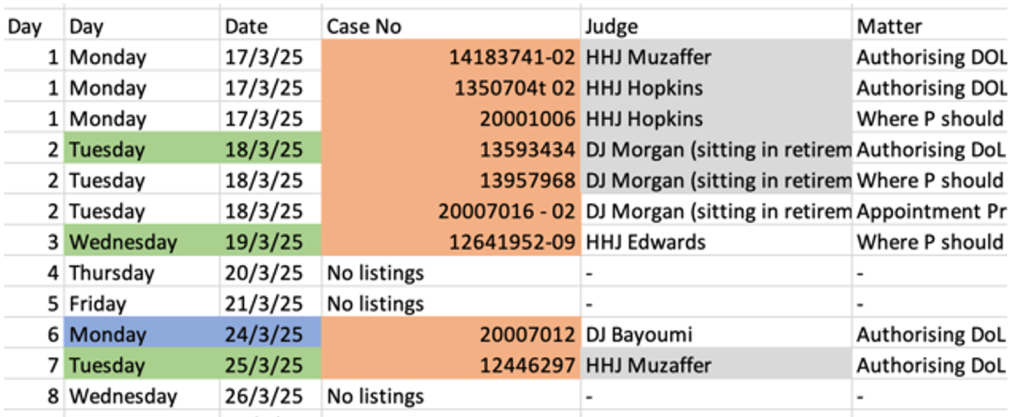
I do find that observing hearings can be quite a dizzying affair: there are so many courts to choose from when scanning listings the evening before, and often several choices on the ‘menu’ of each. Then there’s all the hearings that get vacated on the day, or those that you don’t get to observe despite your timely request, which means you end up selecting a different hearing from your ‘back up’ list and joining a hearing you know absolutely nothing about.
My decision to focus on a single court for twenty days helped me feel more grounded, able to concentrate on the rhythm and flow of the court. Here is a factual summary of what I observed during the four weeks, and some reflections.
Health warning: unless you’re interested in the details of how transparency does and doesn’t work, this isn’t a particularly interesting blog. Teaser: it gets a bit more interesting at the end, with my account of the final, 12-minute-long hearing I observed.
Week 1
Monday 17th March 2025
Three hearings were listed. I emailed the Cardiff address provided on the listings, requesting to observe one or more of them (two were listed for the same time), and pointing out that the listing didn’t name the public bodies represented in the hearings. On the matter of public bodies in the listing I was told that the matter is: ‘with our development team, and we are awaiting their directions’. In response to my observer request I was told: ‘The 3 hearings that were listed today have now been vacated’. I asked whether, and if so when, the hearings were re-listed, and whether it would be possible for them to share information about the public bodies involved, and if possible let me have the Transparency Orders. They didn’t reply.
Tuesday 18th March 2025
Again, three hearings were listed, albeit with two of them starting at the same time before the same judge (who was ‘sitting in retirement’). None of them gave the name of the public bodies involved in the hearings. I asked Cardiff staff who the applicant/respondent public bodies were, and which of the three I would be able to observe. I was sent a link and Transparency Order (which included P’s double-barreled surname in the file name) for the 11am hearing and was informed that one of the other two hearings had been vacated, and the other was ‘in person’. The TO used the initials “JJW” for the applicant protected party (confirming for me that it was indeed his name that had been used in the file name) and named the respondent as Swindon CC. At 10.13am I received notification from Cardiff that, ‘Judge has vacated the above matter from his list this morning’. So, two days into my study and still no observable hearing – but some concerns about transparency. First that P’s Article 8 privacy rights had been breached by including his name (entirely unnecessarily) in the file name of the Transparency Order, and second that, although the judge had not prohibited naming the public body, the name of the public body had not been included in the public listing.

Wednesday 19th March 2025
Only one hearing was listed; COP 12641952-09 at 10.30am before HHJ Edwards. I received the link and TO (again with P’s surname in the file name) at 7.48am. I noted again, that as with the hearing described the previous day, there was no prohibition in the TO on naming the applicant public body (Ceredigion County Council) but it had not in fact been named in the list.
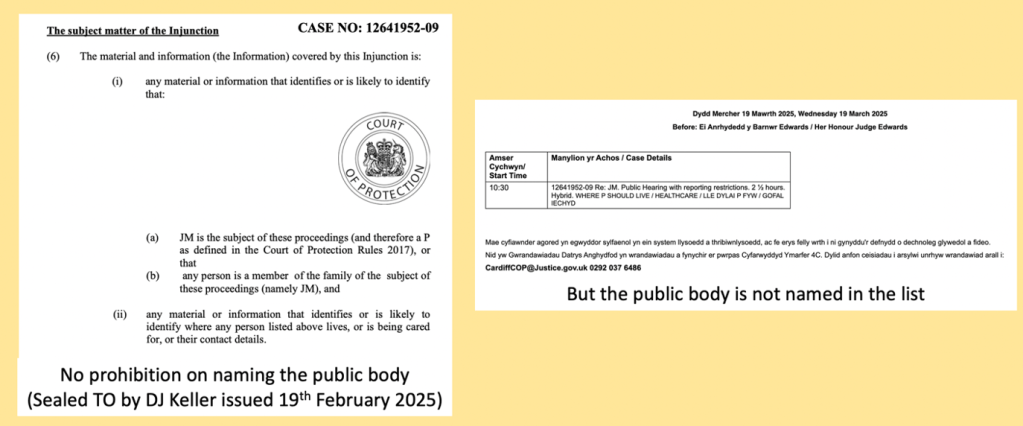
I joined the link and was looking forward to the opportunity to observe the hearing. But then, before the judge joined, I was grilled about why I was observing by a fairly assertive woman, who said, ‘these are supposed to be closed hearings. This has been an issue before’. I introduced myself, briefly explaining why I was there (I had a right to be at a hearing listed as “public”), and asked whether she was objecting to my presence in her role as a legal representative or as a family member of P. She said she was P’s mum.
Had she been a legal representative, I would undoubtedly have stood firm and argued my position before the judge (the right to stay and observe, unless they really were ‘closed proceedings’ in the legal sense, rather than layperson’s sense, as I suspect P’s mum may have used the term), but I had a moral dilemma in the moment. I said I would remove myself from the hearing to avoid the judge’s investment of hearing time on the matter which perhaps may come at the expense of more important issues for P and his mum. I reiterated that I was leaving out of respect for the requested privacy of P and his family, not because I saw any further reason for me not to observe. I suggested it would be very helpful if in future hearings they could clarify the issue of whether or not the hearings were actually ‘closed’ – or at least “private” – as P’s mum contended.
I was torn in the moment about what to do, and I know some people would have stayed in the hearing unless or until they were asked to leave by the judge (quite rightly in my opinion, as the concept of open justice demands it), but my compassion for P’s family led me to make what I felt was the right choice. As with all of the moral dilemmas I’ve encountered in my life, I’ve later wondered how much more interesting, and fun, life may have been had I made a different choice. I know from my own experience as a Litigant in Person in Dad’s CoP proceedings that the Article 8 (right to privacy) v Article 10 (right to freedom of expression) dilemma exists not just for the court to grapple with, but often for the family members who become involved in what are usually unwelcome and extremely emotional proceedings. As I left the hearing before the judge arrived, this doesn’t count as an observation on my spreadsheet.
Thursday 20th March 2025
There were no listings for Cardiff. I had the day off.
Friday 21st March 2025
Again, no listings for Cardiff. A week into the study and I still hadn’t observed a hearing. I did some gardening and went to the pub, suspecting this ‘job’ was going to be much easier than I’d assumed.
Week 2
Monday 24th March 2025
Only one hearing was listed (COP 20007012), at 3pm before DJ Bayouni. It concerned authorizing a DoLS in relation to care and residence. I received the link and Transparency Order, which again anonymised P with initials on the face of the TO and prohibited identification of P in the body of the Order, but included P’s surname in the file name. Unusually, the public bodies were anonymised on the face of the TO too. The hearing, which I’m not going to detail here, concerned an 80-year-old P who wants to go home but her son & granddaughter live there. There was also a discussion on the need for a deputy to be appointed. I emailed the court after the short hearing: ‘I notice the two public bodies were anonymised in the listing and in the header of the transparency order, but that there is no prohibition on naming them in the body of the order (in para 6). Please could you let me know which Health Board and Local Authority are the respondents in this case.’ I didn’t receive a reply. Another hearing has been scheduled for 22nd May 2025 which I hope I’ll be able to observe and at that hearing I will expect to be able to report back on the case, including the names of the public bodies. On the bright side, a week into my Cardiff study and I had finally observed a hearing!

Tuesday 25th March 2025
Again, only one hearing was listed: COP 12446297. I requested a link the evening before, but received an email at 8.13am on the morning, ‘HHJ Muzaffer has approved an order this morning that vacates today’s hearing, so it will not be going ahead’.
Wednesday 26th March 2025
There were no listings for Cardiff. I had the day off.
Thursday 27th March 2025
There were no listings for Cardiff. I had another day off.
Friday 28th March 2025
There were no listings for Cardiff. I had yet another day off.
Week 3
Over the weekend my attention had been alerted, by the Open Justice Court of Protection Project, to the fact that there is sometimes a mistake in sending listings to Courtel/Courtserve, so that CoP hearings appear in the Daily Cause List (DCL) of a court, and not in the CoP list. It turned out this had happened with three cases listed for Monday 31st March 2025 at Cardiff. (For the remaining two weeks of my study I checked the DCL as well as the CoP list, and this didn’t happen again.)
Monday 31st March 2025
The three listings on the DCL list, all before HHJ Porter-Bryant at 10am, 2pm and 3pm were shown as ‘restricted’. They gave no information about the parties involved in the hearing – so no information about the applicant/respondent public bodies – and no information about the issues before the court. I had plans for the afternoon, so I was only able to request a link to the first one: COP 13290314. I received the TO and found that, yet again, there was no prohibition on naming the public body (Swansea Bay University Health Board) – but it hadn’t been named in the lists.

This was an interesting case concerning a young person, which I observed along with a member of the Open Justice Court of Protection Project. I won’t describe the hearing here, partly because it may well be the subject of a future blog.
Tuesday 1st April 2025
There were no listings for Cardiff (either on CoP list or DCL). I had the day off.
Wednesday 2nd April 2025
There were no listings for Cardiff (either on CoP list or DCL). I had another day off.
Thursday 3rd April 2025
There were no listings for Cardiff (either on CoP list or DCL). I had yet another day off.
Friday 4th April 2025
Finally, after three days with nothing, a listing! Just one, for an 11am hearing before His Honour Porter-Bryant: COP 20012119. As usual, the list didn’t name the applicant/respondent public body. I received the link along with TO (which anonymised P with initials on the face of it and in the file name – progress! – though there was no judge’s name on the order). The TO showed the applicant as JD (by his proposed Litigation Friend) and the respondent as Neath Port Talbot County Borough Council and there was no prohibition on naming the public body, which again causes me to wonder why the name of the public body hadn’t been published in the list.

Then, at 11am I received an email: ‘Please be advised that the below hearing has now been VACATED’. Another one bites the dust.
Week 4
The final week of the study! With still with only two observations under my belt, I hoped for a busy week.
Monday 7th April 2025
There were no listings for Cardiff (either on CoP list or DCL). I had the day off.
Tuesday 8th April 2025
There were no listings for Cardiff (either on CoP list or DCL). I had another day off.
Wednesday 9th April 2025
There were no listings for Cardiff (either on CoP list or DCL). I had yet another day off.
Thursday 10th April 2025
Finally, another hearing, again the day’s only hearing, at 3pm before District Judge Bayoumi. COP 1214515t[1].
I received the TO, again with P’s surname used in the file name. Again I noted that the TO does not prohibit naming the public body, but the public body is not named in the list.
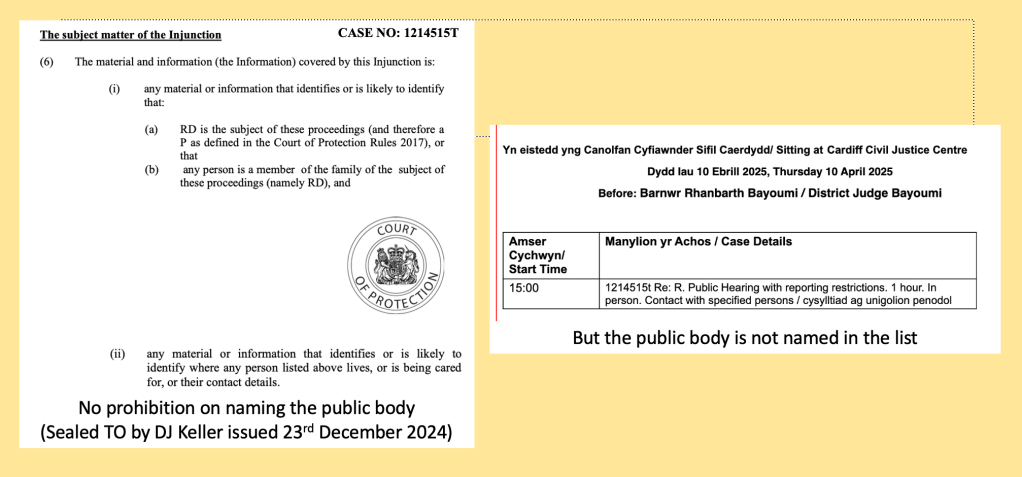
The was the shortest, rarest and potentially most interesting hearing I’ve observed. I have no idea who the LA in this case was – the TO only showed the initials of the applicant party, and it may not even have been a LA, though I assumed it was because it was about contact. Below is a close summary of the exchange (not to be taken as verbatim). It started at 3.04pm.
Judge: Good afternoon Miss Minton and Miss Newport. I have read the 61-page hearing bundle and your Position Statements. Is my understanding correct that all parties agree with the conclusions drawn by Miss Lock, that (P) has the capacity to decide to see Mr D, his father?
Counsel for the LA (hard to hear, it seemed partly due to court acoustics, and partly due to her muffled, almost sheepish replies): ….he’s a vulnerable young man
Judge: If he has capacity, I have no jurisdiction. I’m satisfied reading the reports of Miss Lock that it’s abundantly clear (P) has capacity to make these decisions. Therefore, your application is simply dismissed.
Counsel for the LA (inaudible):…..home….
Judge: These are not Children Act proceedings. We’re nowhere near that territory.
Counsel for the LA: No Maam.
Judge: As difficult as it may be for you to accept Miss Minton. Miss Newport?
Counsel for P (again hard to hear, due to court acoustics rather than any sense of sheepishness): .. The application should be dismissed…. we are nowhere near SA (probably a reference to In the Matter of SA [2005] EWHC 2942 (Fam))…. There’s no suggestion of influence…. what’s been achieved… it should be dismissed.…(P) has capacity… he has autonomy.
Judge: Did the applicant see the previous assessment?
Counsel for the LA: No
P’s Dad: I want to see him. It’s been prevented by (P’s ?) mother.
Judge: There’s no evidence. Even if ED (P’s father or mother?) influenced P, unless the threshold is met for a Section 9 judge that’s the end of the matter. P has capacity to decide on contact with his father. The court is satisfied it has no jurisdiction. The application is dismissed. (To Counsel for P) You’re not seeking an order for costs?
Counsel for P: No, but it would be a shot across the bow if they came back again with another application. A recital should be added to the order about P having autonomy and clear wishes and feelings which are to be respected.
Counsel for the LA: …. just who he spends time with….
Judge (to Counsel for the LA): Do you object to the inclusion of such a recital?
Counsel for the LA: There’s no need to include it.
Judge: It may provide (P and his father) some reassurance. Why shouldn’t it be included?
Counsel for the LA: The content is implied from the previous recital and doesn’t need it.
Judge: It’s a neutral position. It will be reflected in a recital. Please file a new order with me by the weekend. Good afternoon.
It was 3.16pm, the hearing had lasted only 12 minutes but had been eye-opening. I began to wonder how many such evidently problematic applications are generated in the context of ongoing Court of Protection proceedings.
Friday 11th April 2025
The last day of the study. Again, only one hearing was listed, yet again with public body / bodies not in the listing: COP 14234112 at 10am before DJ Morgan. I didn’t receive a TO but received an email at 8.56am to say that the hearing had been vacated. I subsequently requested the TO, but didn’t receive a reply. This ended the four-week study on a bit of a damp-squib, as it had started.
Reflections: The challenges of transparency
There were 15 hearings listed for Cardiff over the course of these 20 days. Of these, 8 were vacated (I have no way of knowing whether the one in person on Day 2, or the two hearings on the afternoon of Day 11, were vacated or not). The vacation rate is therefore a figure between 53% and 73%. There is an excellent blog (here) which explores the various reasons for hearings being vacated (and of course no one would want to add the cost of an unnecessary hearing), but the high percentage of on-the-day vacations in this study did surprise and concern me.
Despite my best efforts, I only managed to observe 3 hearings, and I received 6 Transparency Orders.
Not one of the 15 hearings listed for Cardiff over these 20 days gave the names of the applicant/respondent public bodies, yet not one of the Transparency Orders I received prohibited publication of the name of a public body. It has been difficult or impossible to get information about the names of the public bodies involved – staff haven’t replied to my emails requesting this information. (Also one of the 6 TOs does not give the name of the judge who made it!)
While protecting the names of public bodies (and a judge) from public scrutiny, the privacy of the protected party was jeopardized repeatedly. All six of the Transparency Orders I was sent prohibited publication of P’s name, but four of the six used P’s surname as part of the file name for the Order itself (including one that P’s mother claimed – probably wrongly – was a “closed” hearing!).
I had hoped that after four weeks of cajoling, I would be able to report that ‘Cardiff is now routinely including the names of the public bodies on their listings’, but sadly, despite my request to several members of staff during these four weeks, Cardiff are still not including the public bodies in the listing.
As the general public, and as taxpayers who are funding much of the Court of Protection’s costs, we have a legitimate expectation that these public bodies (who, unlike P, should be open to the scrutiny of the public) should be named in all but the most exceptional of cases.
Kim Dodd has previously blogged for the Open Justice Court of Protection Project (“A newly addicted observer’s reflections“) under the pseudonym of “Jean Louise” as she was at the time a respondent in her dad’s CoP proceedings and subject to a Transparency Order preventing her from identifying herself as a family member of a protected party. That TO has only recently been discharged as a result of her dad’s death (the order had effect “until further order of the court OR the death of P“). Having retired early from her own corporate career and studied for a Master’s of Law, Kim has developed her interest in law generally and particularly in the area of the law on coercive control. She is on LinkedIn (here).
[1] On a sidenote, I have long been intrigued by the ‘t’ that (sometimes, though not often) replaces the 8th digit in CoP case reference numbers. I observed a few hearings to try and work it out (which it transpired I couldn’t – though I was able to eliminate some of my theories, such that it may indicate a ‘translator’ was required). I asked the court after this hearing and was told the following: ‘The case numbers with a t were generated by our old case numbering system. As far as we know there is no significance to this change and they were just generated at random.’. If anyone can confirm or deny this account it would be much appreciated.
 Promoting Open Justice in the Court of Protection