Following an adjourned committal hearing back in December 2024, we were concerned that the defendant (referred to only by his initials, “MW”), who is facing a prison sentence for contempt of court, had been anonymised in the public court lists – and the observer considered it likely that there would be a prohibition (for reasons she didn’t know) on publishing his name.
As it turned out, the December hearing was adjourned because MW didn’t have legal representation. The next hearing was arranged for a couple of months later, and I was able to observe. This is an update on what’s happened since. The good news is that transparency has prevailed and we can name him as Melvin Wright.
In this blog I will address:
Open justice in a committal hearing – how the judge managed the transparency issues prior to the hearing with forethought and how she managed the hearing itself
What happened at the hearing. Part 1: Our application to vary the Transparency Order and to allow the naming of the defendant and Part 2: the committal hearing – the substance of the hearing
Reflections
Open Justice in a Committal Hearing
The Practice Direction Committal for Contempt of Court – Open Court says that open justice is “a fundamental principle” and that “the general rule is that hearings are carried out in, and judgments and orders are made in, public” (§3). The alleged contemnor should normally be named and committal applications listed as specified in §5(2):
FOR HEARING IN OPEN COURT
Application by [full names of applicant]
for the committal to prison of
[full names of the person alleged to be in contempt]
Any derogations from the principle of open justice “can only be justified in exceptional circumstances, when they are strictly necessary as measures to secure the proper administration of justice…” (§4).
On 29th January 2025 we (in the OJCOP project) were alerted, by a Court of Protection administrative officer, to a court order for the committal hearing on 3rd February 2025. This was the email:
“Dear Mr P [PA journalist]/Ms Kitzinger,
Please find attached a copy of the order made by HHJ Hilder on 29 January 2025, which provides at paragraph 9 service to the Press Association and The Open Justice Project.
Yours Faithfully,
[name removed]”
HHJ Hilder had issued a court order stating:
“Service
9. The court staff shall issue this order to all parties and also provide a copy to the Press Association and to The Open Justice Project.”
This meant that we knew in advance of HHJ Hilder’s decision not to publish the defendant’s name in the court listing (i.e. prior to the hearing) and we were able to decide whether to request to make representations regarding this departure from the usual practice of naming contemnors in court listings.
The order said:
Reporting restrictions
4. Pursuant to Rule 21.8(5) the names of the Defendant (MW), the First Respondent (initials removed) and the Second Respondent (initials removed) shall not appear in the public listing of the hearing, and the involvement of any of them in committal proceedings shall not be published by any other means. The Court will consider at the hearing whether this prohibition should be continued or terminated, and will hear submissions on that issue from the parties and/or media organisations.
Rule 21.8(5) says: “The court must order that the identity of any party or witness shall not be disclosed if, and only if, it considers non-disclosure necessary to secure the proper administration of justice and in order to protect the interests of that party or witness.”
Hooray! We could give some forethought, as HHJ Hilder had done, to whether we wished to apply to name the defendant in this case, as court rules and Esper stipulate is the default position in committal hearings.
It didn’t leave much time (we received the court order on the Wednesday and the committal hearing was the following Monday). Celia Kitzinger had observed the previous hearing but was away on holiday. The rest of us in the Project liaised and produced a Position Statement to apply for permission to identify the defendant. I was available to attend and so the application was in my name, supported by the Open Justice Court of Protection Project.
We public observers rarely see any journalists in the Court of Protection and when they have attended, they have typically not addressed the court. On this occasion a Press Association journalist did attend (in person) and it was reassuring to be able to contact him privately and garner his support for the Position Statement we submitted. I am very grateful for that. As it turned out, the Press Association has decided (so far) not to report on this case.
I have not written a Position Statement before. It was quite a nerve-wracking process. We (in the OJCOP project) have all applied to ‘vary’ (change) Transparency Orders before, for example when a public body is included in the reporting restrictions. There are very rarely times when publishing the name of a public body acting as applicant or respondant in legal proceedings should be banned, and we have almost always been successful in overturning the restriction. Preparing a Position Statement such as this was a different matter and required some knowledge of the law regarding disclosure of people’s names in the context of committal proceedings.
We also noticed, though, that the current Transparency Order for this case did also prevent naming of the public bodies, including banning publication of the names of the Local Authority, ICB, and NHS Trust. So we also included in our Position Statement an application to vary that restriction, to enable the naming of public bodies involved in the case.
HHJ Hilder had helpfully pointed to the relevant case law (the Esper judgment) in her court order. I had also, coincidentally, observed in person a committal hearing at the Royal Courts of Justice the week before, which had been an open justice disaster – see “Draconian reporting restrictions in a contempt of court case”). So I knew about the Esper judgment and that I would need to read it with a ‘fine toothcomb’ (HHJ Hilder’s words in the previous hearing for this case).
Here’s the substance of our Position Statement below:
This is an application to vary the Court Order for the second committal application (“the Order”) [in this case]made by Her Honour Judge Hilder, at First Avenue House, 42-49 High Holborn, London WC1V 6NP, on 29th January 2025, issued on 29th January 2025, in order to permit identification of the defendant ‘MW’, or otherwise for the court to give a reasoned explanation for non-disclosure of the contemnor’s identity.
The Order sets out at §11: “Reconsideration. 11. This order was made without a hearing. Any person affected by it may apply to the Court, by filing a COP9 application within 21 days of the order being served, for its reconsideration pursuant to Rule 13.4 of the Court of Protection Rules 2017.” Mr [S – court administration staff] emailed Celia Kitzinger with the Order and redirected it to the OJCOP project on 29th January 2025. We have only just had time to prepare this statement and respectfully request that the court considers the application.
On 29th January 2025 HHJ Hilder ordered the following at §4: “Reporting restrictions: Pursuant to Rule 21.8(5) the names of the Defendant (MW), the First Respondent (initials removed) and the Second Respondent (initials removed) shall not appear in the public listing of the hearing, and the involvement of any of them in committal proceedings shall not be published by any other means. The Court will consider at the hearing whether this prohibition should be continued or terminated, and will hear submissions on that issue from the parties and/or media organisations.”
The Practice Direction Committal for Contempt of Court – Open Court[1] says that open justice is “a fundamental principle” and that “the general rule is that hearings are carried out in, and judgments and orders are made in, public” (§3). The alleged contemnor should normally be named and committal applications listed….”
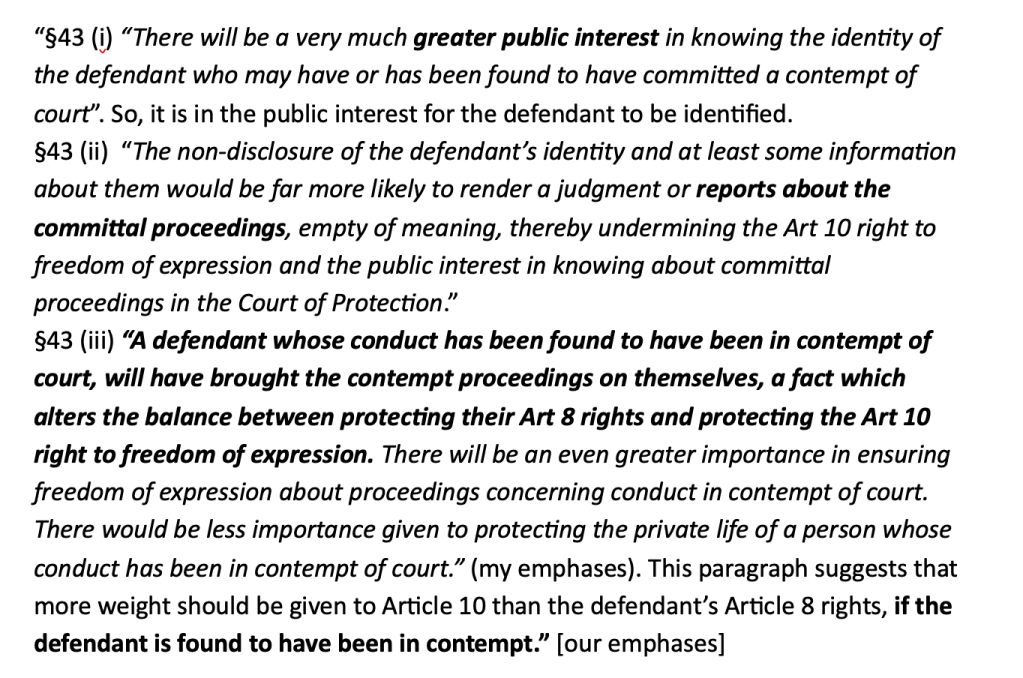
The Esper Judgment[2] at §54 (i) states: “Open justice is a fundamental principle and the general rule is that hearings should be carried out and judgments and orders made in public. Derogations from the general principle can only be justified in exceptional circumstances when strictly necessary as measures to secure the proper administration of justice.” And at §36: “It is expected that these conditions will both be met rarely for a defendant and extremely rarely for a defendant found to have committed contempt.” [my emphases]
Court of Protection Rules: According to Esper §15, Rule 21.8(5) of the Court of Protection Rules (COPR) prevails over any practice directions where they are “incompatible”. Rule 21.8(5) requires non-disclosure of a defendant in a committal hearing when two conditions are met (and both must be met): (i) To protect the interests of the party or witness (i.e. the defendant); (ii) to ensure the proper administration of justice.
Taking Point b (above) first: “To ensure the proper administration of justice”. This is covered by §37 and §39 in Esper. A number of circumstances are set out in §39 when this condition would be met. Point §39 (v) states that one would be when: “In some other way the proper administration of justice would be undermined”. This criterion at §39(v) is exceptionally vague (‘some other way’) and difficult to pre-empt when challenging reporting restrictions. We are not in possession of all of the facts about this case and are therefore not aware of reasons that would weigh the balance (of disclosure vs non-disclosure) in favour of non-disclosure. We appreciate that the reasons might be magnetic. We would submit that, should the decision for non-disclosure stand, in order to prevent the undermining of the ‘proper administration of justice’, as a minimum, the judge should record in the written public judgment (which we understand is required for all committal hearing judgments) her reasons for ordering the non-disclosure of a contemnor’s name.
Focusing on Point a (above): To protect the interests of the party or witness (i.e. the defendant), Esper states:
9. It is difficult to make an argument for disclosure of a contemnor’s name without knowledge of why the contemnor (MW in this case) is said to meet criteria for non-disclosure. As far as we are aware, there is no public order or judgment explaining the reasoning for ordering non-disclosure. In Esper §54 (ix): regarding not naming the defendant in order to protect P: “COPR r21.8(5) is not triggered to prevent the disclosure of the identity of the defendant if the sole purpose is to protect the interests of P. It must be the interests of the defendant that need protecting.” [my emphasis]. We submit that, given that the Esper judgment stresses that this should occur only ‘extremely rarely’, and particularly if the defendant is found to have committed contempt, HHJ Hilder should justify with her reasons why the defendant’s identity should not be disclosed in order to ‘protect the interests of the party or witness’.
10. Why might identifying MW be risky? In the Open Justice Court of Protection blog[3] dated 3rd January 2025, Celia Kitzinger wrote: “The only other reason I can guess at as to why it would be “necessary to secure the proper administration of justice and in order to protect the interests of that party…”that MW’s identity should be protected (and presumably [the second respondent’s] too) is that publication of their identities risks public identification of the protected party, via jigsaw identification (that would be the “proper administration of justice” bit) and (it’s “and” not “or”) MW’s own ill-health, which is referred to in the order (“The Court is mindful that MW has health limitations”). And: “… in relation to the risk of identification of P, most of the defendants in contempt of court cases in the Court of Protection are family members or close friends of the protected party, which means it can always be argued that knowing who they are might risk the public becoming aware of P’s identity. In practice, both in the Court of Protection (e.g. Re Dahlia Griffith [2020] EWCOP 46) and in the Family Courts (e.g. Manchester City Council v Maryan Yuse, Farad Abdi & the children [2023] EWHC 1248 (Fam)) family members have been named in judgments and there is no evidence at all that members of the public (or journalists) have subsequently tracked down the protected parties or children concerned or harmed them in any way.”
11. The Open Justice Court of Protection blog dated 3rd January 2025 does not report any details of the nature of the family relationships, in order to minimise the likelihood of jigsaw identification in future, if disclosure of the identification of the contemnor is considered by the judge in future.
12. We have heard the argument from counsel (at another hearing) that disclosure of the contemnor’s name, even in the unlikely event that it led to jigsaw identification of P, was not likely to cause any ‘harm’, and that the balance is always in favour of open justice and continuity of judicial reporting (via judgments) to enable public scrutiny and accurate recording of judicial process. We do not know, in this particular case, whether ‘harm’ is likely to be caused to P or to the defendant, and would not wish that to happen, were this the case.
13. Our submission is that jigsaw identification is unlikely and might be mitigated by changing the initials of P in a judgment or preventing specific details of the case being reported, and unless there are very real risks of harm to [the young woman at the centre of the case], MW and [second respondent], should the defendant’s name be disclosed, the balance is in favour of Art 10 rights and disclosure of the defendant’s name. The OJCOP project might still decide, should disclosure be permitted, NOT to publish the name of the defendant, but the right to do so should be preserved.
14. Finally, it is not standard practice to anonymise public bodies in Transparency Orders. The court recognises that local authorities are public bodies, funded by taxpayers, and therefore accountable to members of the public. A local authority/ICB/NHS Trust/other public body cannot be accountable if it acts in secret. The only (rare) circumstance under which the identification of public bodies is banned is when knowing the name of the public body is likely to lead to identification of the protected party.
15. In the event of concern that jigsaw identification is a real risk in this case and non-disclosure of the defendant’s name stands, the project will consider applying to the court to vary the Transparency Order and consider ways of protecting P’s identity other than the current draconian prohibition on naming the public bodies involved (i.e. prohibiting the publication of other potential pieces of the ‘jigsaw’ e.g. the initials used, or precise age).
Claire Martin, Open Justice Court of Protection Project
I sent our Position Statement to the court the night before the hearing, on 2nd February 2025.
What happened at the hearing: Part I – the application to vary the court order preventing naming of the defendant
I was observing remotely. I made sure that I logged on in plenty of time for the 11.30am start. The court associate was very helpful and communicative, joining me in good time on the link, checking that I could hear and advising me that he would turn on the court cameras when the hearing started. This sort of competent administration is exceptionally helpful for public observers – and I imagine for anyone remotely attending a court hearing who isn’t part of the inner world of legal procedures, including, in particular, family members. It communicates that the court is expecting and welcoming us to the hearing, and that we are considered a part of justice. I labour this point a little because not all hearings are the same.
All three counsel were in attendance at court. Another person was at the front of the court, alongside the barristers. I think this is the other family member who is a party to proceedings. She spoke only once in the hearing. The defendant was on remote link with a person who was supporting him (who I think was a legal representative).
I really wasn’t sure what to expect regarding the order of proceedings, in terms of hearing the allegations, findings, sentencing (if allegations were proved) and the issues regarding transparency and reporting restrictions.
I needn’t have worried. HHJ Hilder was exemplary regarding both providing an opening summary of the case and the transparency of the proceedings:
Housekeeping matters – I will give a succinct explanation for the benefit of observers why we are here. Then I will address the TO issues.
Explanation to observers – these are substantive proceedings in the matter of a 25 year-old woman in respect of whom declarations were made by DJ Mullins on 15th January 2024. She lacks capacity to conduct proceedings, [decide on her] care, contact, use of internet and social media, manage her property and affairs including entering into a tenancy. […] Orders were made by DJ Mullins restricting contact [with the defendant] on 25th October last year. [I] discharged [these] earlier injunctions and reframed them in an order material to today’s hearing. It is alleged by the Local Authority [my link cut out for a short moment at this point but the point must have been made that the LA have alleged breach of the injunctions] …. the earlier hearing was adjourned [that would be the hearing reported in our previous blog post, which was adjourned to enable the defendant to get legal representation]. The Local Authority filed a second application in respect of further alleged breaches and today’s hearing was listed to consider both committal applications.Right – the first of the Transparency Order issues – I would like to address, I hope it’s not contentious. Ms Martin has set out a Position Statement requesting the TO regarding substantive proceedings – so that the public bodies’ names can be made public. That DJ Mullins’ paragraph 6 of the order doesn’t apply – doesn’t apply to today. Anybody object?Para 6 of that order includes within the bodies/persons anonymised the LA, ICB/NHS Trust/LD service – Ms Martin.”
I spoke at the invitation of the judge at this point, confirming that we were applying for permission for the public bodies to be named.
Counsel for P (Victoria Butler-Cole) explained the background to why it had been requested that the public bodies should not be named, but she said she did not have instructions yet. The judge asked me if I objected to Counsel for P getting instructions in time for the next hearing, so that she could make submissions then, at which point the judge would decide whether or not to vary the TO and allow the public bodies’ names to be reported. I said that I didn’t object.
HHJ Hilder then turned her attention to the other part of our application: to vary the court order allowing identification of the defendant: “I need to deal now with applying to this hearing […] on 6 Dec […] the order which I made was that names of P, [the second respondent], and MW would not be made public in the listing of this hearing, or elsewhere, but that I would hear submissions at today’s hearing whether they should be disclosed. The first question to consider is: does anybody object [to waiting] until I have decided the substantive matter?
The judge asked me directly if I agreed with her approach to dealing with the substantive matter (the allegations) first. I said that it seemed a very sensible approach. I will report the allegations and committal aspects of the hearing in the next section.
At the end of the committal proceedings HHJ Hilder returned to our application. She asked me if I wished to add anything to our written application, and I said that I did not.The judge then asked counsel for P and for the defendant for their submissions:
Counsel for P: There is a slightly higher risk [of jigsaw identification, if MW is named) just because it is another piece of the jigsaw. We anticipate she [P] will want what [the defendant] wants.
Counsel for the defendant: MW is concerned about his name being made public – but I have a duty to the court not to make inarguable submissions. In light of the judgment in Esper, admissions have been made, I find it difficult to put forward what MW wants me to.
Judge: That is helpful
So, counsel for the defendant was saying that, even though the defendant did not want to be named, he (counsel) could not make that submission because it is ‘inarguable’. This will be because of the very clear judicial rules and case law on the naming of defendants in committal hearings, except in very rare circumstances, which clearly counsel for the defendant did not think were met in this case.
HHJ Hilder then made her ruling in respect of our application (which I reproduce in full – based on my contemporaneous typing of notes, which I attempt to make as accurate as possible (bearing in mind that we cannot record proceedings): “I am going to determine now the application made by Claire Martin of OJCOP in a written Position Statement dated 2nd February 2025, to vary the order which restricts identification of the defendant or alternatively her application was for the court to give a reasoned explanation of non-disclosure [of his name]. The application as it stands now, extends only as far as the defendant. I start by reminding myself of the order which is the substance of this application. Para 4 of the order, made on 6th December [2024]. I provided […] that MW’s name should not appear in the public listings, or other means. I went on to say that the court would consider at this hearing whether that prohibition should continue or be terminated. I included the Open Justice Court of Protection Project – an equivalent provision was made in the order of 29th January [2025], the second committal application. For the avoidance of doubt, the purpose of those provisions was so that I can ensure that court can be clear regarding the nature of proceedings, and on the other hand to preserve the opportunity for hearing any argument as to the naming of the individuals involved.Paragraphs 1-53 in the Esper judgment – in reality it would not be possible to have a sensible argument on identification of …. if names had already been put in the public domain. I reiterate, the reason for the provisions was to preserve the opportunity for argument – in my judgment [that is] the proper administration of justice in communicating the proceedings. At the point of both orders, the defendant had not admitted or been found to have been in breach. This hearing is in public. ANY member of the public could have observed. What is not public is the names of these three people. I acknowledge that the naming of a defendant is an important aspect of telling the story of proceedings. I am fully aware of the discussions of the Rules Committee, regarding changing the rules. At the moment, it is the current rules which apply. 21.85 specifically: the court MUST order the identification. The identity shall NOT be disclosed if and only if it considers non-disclosure necessary to secure the proper administration of justice AND protect the party or witness. It is very complicated. Both must be met. It is the interests of the person whose identity is under consideration.I have given MW’s counsel [permission] to argue the point. I am grateful to Mr Harrison for pointing out to me that the defendant has concerns: to be absolutely clear that in telling me that, he has done his duty to his client. I am also grateful to Mr Harrison for acknowledging that he cannot make improper submissions. He has not asked me to restrict publishing of the defendant’s name any further. ….[missed] None of the other parties has raised any objection to naming the defendant. He has now admitted breaches of the court order; that’s a serious matter which he has put HIMSELF in the position of being in. To that extent, looking at his interests … court has limited [options]…. In short that I am not satisfied that either of the thresholds in 21.8(5) are met and therefore I MUST lift the prohibition on naming the defendant – Mr Wright. [judge’s emphases]
Another public observer, Kim Dodd, raised her ‘virtual’ hand and asked about naming of the Local Authority, to which the judge replied: For this committal hearing – there is no restriction on the naming of the London Borough of Camden in respect of today’s hearing.
What happened at the hearing: Part II – the committal hearing
There are injunctions (with a penal notice attached) against MW, forbidding him from:
having face-to-face contact with P, except as organised and supervised by the local authority;
sending her any communication between 6pm and 9am;
sending her any communication that refers to sexual activities, her health, members of her family, these proceedings, her work or study, or that threaten violence against her;
complaining about P to the police.
Tony Harrop-Griffiths was representing the applicant Local Authority (the London Borough of Camden). He explained the current situation regarding allegations and admissions from the defendant (I couldn’t see him on screen unlike the two other counsel, and the sound from his microphone was poor, so it was harder to catch all of what he said, and my notes have some gaps):
“A number of admissions are made; some don’t go to the allegations… are there sufficient admissions to the allegations… for it to not need to proceed? [… ] remaining allegations: the most egregious is the one at the end, on 18th December, when P was found in his flat, shortly before midnight by two police officers. The seriousness of that is that there had been a hearing on 17th December and MW had attended unrepresented at the time. He suggested that he understood the nature [of the restrictions] and yet he appears that evening … [to have] kept her there for two nights without contacting anybody. The Local Authority is not minded to proceed to prove the other allegations. ….My instructions … as far as the Local Authority is concerned … are to adjourn the hearing for 6 months, in the hope that MW will be able to stick to the terms of the injunction. But it’s important, in P’s best interests, that he does that. It would serve as a reminder if he needed, to not do what he has been doing, which is not in her best interests. The Local Authority must take into account his age and frailty. That’s where we stand generally.”
Counsel for the Local Authority then submitted two changes to the injunction, which were seemingly designed to enable slightly more, and a more realistic approach to, contact between P and MW:
Preventing MW sending text messages to P between 9pm- 9am (currently the injunction is 6pm-9am)
In response to the query ‘Well what happens if P turns up on his doorstep, who is he to contact?’ it was proposed that this did not to be included in an injunction (which is what NOT to do), but that an arrangement should be agreed which is that MW should contact Social Services straight away (on a daytime or out-of-hours number). Apparently, it is quite common for P to turn up unannounced at MW’s flat. It was acknowledged that Social Service was very unlikely to respond ‘immediately’ (especially out-of-hours), and that MW should be allowed to let P into his flat until they arrived.
The judge turned to MW’s counsel and asked what breaches the defendant admitted. MW was represented this time, by Ben Harrison, who explained that MW admitted some breaches, but could not recall exact dates. He admitted:
Allowing P into his flat on ‘various dates’ in December 2024.
Paying for P to stay in a hotel for two nights, and on his floor on a mattress for 2 nights, and not calling Social Services as he had agreed to do (and subsequently she was found there by police officers).
Ben Harrison said ‘they are the extent of the admissions’. The judge asked how MW accounted for the other allegations:
Counsel for MW: The allegations … that he messaged in breach – he’s unable to recall the dates but he admits he has responded to P’s messages. He says, for context, that P herself continues to contact him and he responds to her messages. In respect of the allegation that he corresponds with P about these proceedings … he admits that he DID ask P to tell the truth about her communication with him, that he communicates with her about these proceedings, insofar he asked her to tell truth.[…] . He denies accusing P of being in a sexual relationship but admits … responding to information P gives to him about sexual relationships.
The judge clarified the allegation numbers that were admitted and said that she would ‘turn my mind to whether court needs to proceed in respect of further allegations now admissions have been made‘.
I could see that that judge was trying carefully to manage the committal hearing alongside the ongoing, and what seemed quite precarious (for the teams caring for P) welfare issues. MW’s admissions, the judge said, ‘suggests some positive gain with the opportunity that he now understands the situation.’ Victoria Butler-Cole (for P) pointed out that there had been further breaches but that, now, the ‘one thing that is different is that Mr W has legal advice’.
Cases like this rarely seem straightforward to me – yet the allegations have to be set out as clear, standalone events, decontextualised almost. I thought that HHJ Hilder made a very sensitive decision, that took account of P’s and MW’s situations in the round. She said: have considered carefully the full range of the allegations made in both applications. I take note of fact that Ms Butler-Cole has informed the court that there have been further breaches, but I have set those aside in the context of the current hearing. Looking at the admissions he has today made, I am satisfied that there is some … injunctive orders to be achieved on the basis of those admissions alone. Given that there is that potential, I am satisfied both that it is reasonable, fair and proportionate for the defendant, and in the best interests of the subject of these proceedings, that that potential should be given an opportunity. If it transpires that the potential does not bear fruit, there is always of course the prospect of further application. I am sure Mr Harrison will explain [to Mr W]. To be clear, I accept the admissions that have been made, I do not require evidence in respect of the other allegations, and they may be recorded as withdrawn.Now I think the next step is what the court wants to do in response.”
Counsel for MW advocated for adjournment of sentencing and suggested this was not opposed by the Local Authority. HHJ Hilder then, very helpfully, summarised the proposals: I am conscious of observers … I want to make sure they follow. Having made admissions, on his behalf, Ben Harrison says the court should not proceed to sentence today, but should adjourn sentencing, on the basis that the purpose of proceedings is the substantive proceedings, and to protect [those]. And the purpose of adjourning is to see how things go in the next however long, rather than make a decision today. The Local Authority supports that and Ms Butler-Cole does not oppose it. It seems to me that there is again some potential in that … I am content to take that approach. I will explain to him now.
After some refinements to be made to the injunctive order (the details of exactly how MW can tell P he is unable to respond by text during certain hours, when exactly he must call Social Services) the judge explained her decision to MW: Right MW I am going to address you directly. Can you hear me? [nodded] I would direct you to stand but in view of your medical condition it’s not necessary. What I say is significant and you should listen carefully. Today you have admitted breaching an order of the court. That is a serious matter, for which court has the powers to sentence you to prison for up to two years, seize your assets, or fine you. I am going to adjourn sentencing. The reason I am doing that is because I bear in mind that you have now constructively engaged with the court and legal representatives and have taken steps of acknowledging breaching the order. I take account of the fact you have apologised and accept that apology. I bear in mind your own difficulties in respect of your health and the practical complications that lie at the heart of proceedings. I acknowledge the need for proper arrangements between yourself and P. They are not easy to achieve. Efforts have been and will continue to be made – there is further provision to come back to court if they are not up and running. It is very important that I take you at your word when you say you want to support the Local Authority with care for P. The purpose of the adjournment is to demonstrate to me that you support that care, and by [complying] with orders that the court has made to support that care. You do not know all of the circumstances; you are required to abide by my orders to support P’s care provision. If you do that between now and sentencing, then there is every likelihood that no penalty will be imposed. If you do not, then the possibility of penalties still exist. I hope you bear that in mind.
MW: Thank you
Discussions followed about the precarious nature of P’s care and living arrangements, that she was no longer living in the local area (meaning it’s harder to arrange supervised contact) and that her only real contact is with MW. Victoria Butler-Cole (for P) said: “Welfare proceedings are at a very delicate stage … it is critical she needs to engage with the Social Worker and find a place to live.”
The judge empathised with the potential concern for MW in not responding to P, saying that she had ‘some sympathy with Mr W’s concern for her to not feel abandoned. It is mitigated by the fact that she now has professional carers with her to make sure she doesn’t feel abandoned.’
The court order stipulated that, if P contacted MW during prohibited hours of contact, he may reply once with a message saying, ‘I am not allowed to communicate with you until 9am tomorrow morning’.
HHJ Hilder received submissions regarding how to manage the next welfare hearing and the adjourned sentencing. She decided to hold the next hearing on the 29th April 2025 at 2pm, and for the welfare part of the hearing to precede the sentencing hearing. This will mean that, as long as MW has abided by the court’s injunctions, the ordering of the parts of the hearing will ‘give the possibility of concluding at that time’. The judge’s earlier remarks suggest that – as long as MW does comply – then she is unlikely to impose any sanction on him for breach of the court orders. So, the court needs to know, first, what has been happening since this hearing, in order that, second, an informed sentencing decision can then be made.
This seemed like a very neat way of knitting together the welfare best interests aspect of the case and the contempt proceedings, whilst delivering a compassionate court order that recognised the complexities of the situation, both for P and for MW.
Reflections
I was very pleased to have been able to make the case for transparency in this hearing and HHJ Hilder took what I thought was an extremely clear, systematic and transparent approach to this committal case.
She had ordered that the defendant’s name was not to be published in the public listing for the hearing (contrary to the Practice Direction Committal for Contempt of Court – Open Court); however, she planned this, so that (in her words) “the court would consider at this hearing whether that prohibition should continue or be terminated. … For the avoidance of doubt, the purpose of those provisions was so that I can ensure that court can be clear regarding the nature of proceedings, and on the other hand to preserve the opportunity for hearing any argument as to the naming of the individuals involved”.
Whilst this represented a departure from the court rules, HHJ Hilder, I thought, applied forethought and consideration of the competing aspects of this case – the primary aim of protecting P and acting in her best interests, whilst also taking the principle of transparency very seriously and coming up with a workable solution. There was a careful balancing – in open court – of Article 8 rights to privacy with Article 10 rights to freedom of expression.
Having written the Position Statement (with the support and feedback of the OJCOP Project team), despite feeling nervous (and a bit of an imposter!), my experience of the court process was that it was handled in an exemplary fashion by this judge. I would do it again, as long as I was aware of the relevant legislation and case law.
HHJ Hilder also, in my view, ensured that the court process was understood by observers. This does not always happen. I was not the only observer and – as the Court of Protection sits (generally) in open court – this surely should be a default, to build public understanding of how our laws are applied and to instil our trust in those who deliver justice. HHJ Hilder’s explanations did not take up a lot of court time, and she flagged what she was saying for observers, so we knew to pay particular attention: “I will give a succinct explanation for the benefit of observers why we are here” and “I am conscious of observers … I want to make sure they follow”. Acknowledging the relevance of public observers – and, implicitly, our role in supporting the judicial aspiration of transparency – was very welcome at this hearing.
Finally, in relation to the substance of the hearing itself – and very conscious that I know little about the welfare aspects of this case, including the reasons why MW is subject to contact restrictions with P – I thought that HHJ Hilder took an ‘in the round’ approach.
She seemed to understand the imperfections, tangles and pulls of people’s (messy) relationships – that the young woman at the centre of this case will seek out contact with MW even though he is said (in ways I don’t know) to have harmed her and to be a risk now to her. Despite this hearing being a committal hearing for breaches of court injunctions, I observed the judge show understanding for the unpredictable position that MW might find himself in (“Well what happens if P turns up on his doorstep, who is he to contact?”) and, again, find a workable solution. I have observed other cases where defendants are said to pose a risk of harm to P, and have been subject (in my view) to unrealistic and unworkable orders (such as ‘not to upset’ them, for example). HHJ Hilder’s approach was firmly rooted in what was going to be achievable in the real world outside of the courtroom.
The next hearing in this case (for sentencing) is on 22nd April 2025 at 2pm.
Claire Martin is a Consultant Clinical Psychologist, Cumbria, Northumberland, Tyne and Wear NHS Foundation Trust, Older People’s Clinical Psychology Department, Gateshead. She is a member of the core team of the Open Justice Court of Protection Project and has published dozens of blog posts for the Project about hearings she’s observed (e.g. here and here). She is on X as @DocCMartin, on LinkedIn and on BlueSky as @doccmartin.bsky.social


 Promoting Open Justice in the Court of Protection