

By Claire Martin, 8th February 2006
‘Non-compliance’ hearings aren’t listed very often – and when they are, they tend to be vacated at the last minute. They are hearings to which public bodies (local authorities, Trusts, ICBs etc) are summoned to hold them accountable for failing to comply with court orders. If they then comply not less than seven days before the date of the listed non-compliance hearing, it’s vacated – and apparently that’s usually what happens (“Non-compliance: What happens when public bodies don’t obey court orders?”).
But this non-compliance hearing (COP 13682383) went ahead.
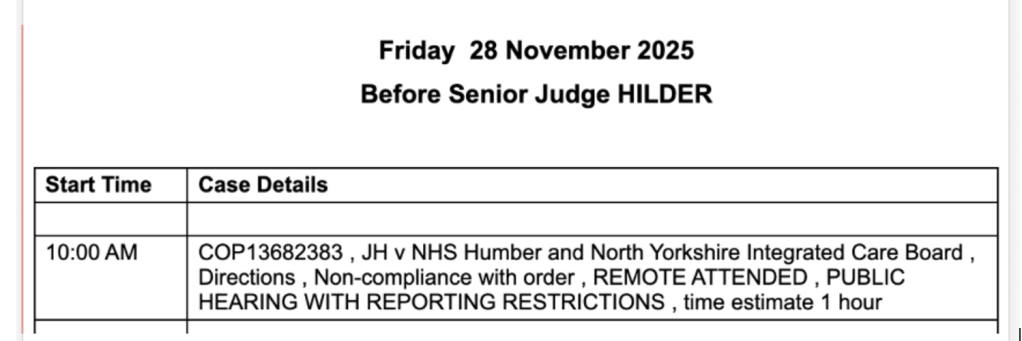
It concerns (in the words of the Official Solicitor) a case that “… became beset with delay, in the main brought about by the actions of the applicant ICB”. That ICB is NHS Humber and North Yorkshire Integrated Care Board. In this blog I will outline what happened at the hearing, and then end with some reflections.
The hearing
The hearing started at 10.04am. There were a lot of people on the link – I counted 11, plus myself and the judge. They included solicitors for each party and staff from the ICBs.
Counsel were: Rebecca Miller for NHS Humber and North Yorkshire ICB (the applicant); Ben McCormack for JH (the protected party) via the Official Solicitor (OS, the first respondent); and Natalia Levine for NHS West Yorkshire ICB (the second respondent)
Having already directed that I should receive anonymised Position Statements, Senior Judge Hilder gave only a “brief introduction”.
Judge: I am concerned with the best interests of [JH] who is 27. He has lived in his current placement since March 2023, funded by continuing care. He has diagnoses of learning disability, haemophilia, autism and ADHD. Proceedings started some time ago now. The issue seems to be, subject to submissions, HOW what is necessary to make a long-term suitable placement for P [can be achieved], given that the place he is in at the moment has issues in terms of the standard of the property. [judge’s emphasis]
The judge did not specify exactly which order the ICB was non-compliant with – but fortunately the position statements assisted with this. According to the OS position statement, the ICB was directed (in §6 of an order I haven’t seen, made at a hearing in September 2025 that I didn’t observe) to “set out the range of alternative accommodation and care packages potentially available for JH” in order to ensure that the court would be “aware how easily JH’s current home could be adapted to better meet his needs and to provide for some preparatory steps that would assist in any future property search for him“. That hasn’t happened. The ICB has clearly not provided information to the court about either matter and still didn’t have that information at the hearing I observed. (And I think the second respondent ICB was basically saying ‘we can help and they haven’t worked with us on this’.) So, for whatever reason, the ICB has not complied with HHJ Hilder’s order – and neither have they applied to appeal or vary the order, which is why the non-compliance hearing is taking place. According to the OS, there had been “a disagreement between the parties” about whether or not the court ought to make that order in the first place (the ICB wanted instead to focus only on whether and how improvements could be made to JH’s current home) – so it rather looks as though the ICB has simply failed to comply with an order they don’t like.
Returning to what the judge said in her introductory summary (quoted above), what became clear during the hearing was that the ‘HOW’, that the judge was referring to, was astonishingly slow and labyrinthine, and needed, it seemed, to be micro-managed by the judge to achieve any progress.
Counsel for the ICB explained the current situation: “… the current accommodation where [JH] is living in is not meeting his needs. It requires renovations and other works to make it suitable. One difficulty with that is the funding to enable those renovations to happen. The other matter is whether, even with those renovations, it will be suitable. The ICB has been liaising with Wakefield [I think this refers to the Local Authority] to see if they are able to fund in whole or part the works required. An urgent assessment was undertaken but we at the ICB have not been provided with an update on that position. An application was made for a disability grant. It’s not known whether that was successful and if it is, how much that will be for. Or how long it would take to be completed. As a result, the ICB fully accepts we have reached the stage where we need to be reaching for alternatives either for short-term respite or long-term placement. The ICB has committed to undertaking searches and providing update evidence by January. Humber ICB has also acknowledged that the West Yorkshire ICB has indicated they have some knowledge and expertise in placements for people in similar circumstances. They wish to work together with Humber ICB so that the professionals involved can share expertise and look to find options for [JH]. In the draft order is that a meeting will take place between professionals and ICBs within next two weeks. I don’t have a date. That information can be shared and form part of ongoing searches the ICB have committed to undertake.”
The judge then went through the draft order that she had received from the parties – with a fine-toothed comb. The issues in the draft order included:
- Funding and the suitability of JH’s current home (even with renovations)
- The status of an application for a DFG (Disability Facilities Grant)
- Which Learning Disability Team is responsible for providing care to JH
- The ICB’s current actions to secure appropriate accommodation for JH
- Detailed plans for next meeting of parties
I will detail each in turn.
A. Funding and the suitability of JH’s current home (even with renovations)
SJ Hilder addressed whether or not the landlord of JH’s current property might be willing to contribute to funding the costs for the works on the house (if court decides that he stays in the current property), and the potential funding agreement for contributions from the ICBs involved (whether he stays where he is or moves).
NHS West Yorkshire ICB (the second respondent) queried “whether the applicant can maintain that JH’s accommodation is capable of meeting his needs” . They were seriously questioning whether JH’s current property (even if adapted) could meet JH’s needs at all. This was based on Occupational Therapy recommendations for a suitable property, including facilities for carers and soundproofing, and, (says the second respondent) the funding from the Disabled Facilities Grant does not cover facilities for carers, noting that “the adaptations team have confirmed that sound proofing is not viable in a domestic property”.
The judge asked whether or not the Local Authority had completed a survey of the current property to this end and, if so, whether (or not) that survey had been put forward to the LA panel for financial estimates and funding consideration. Counsel for the applicant ICB said: “Yes they have undertaken a survey and they need to consider it within their own Local Authority processes. They’ve undertaken a survey but I don’t know if it’s been put forward to the panel”.
This current position of not knowing whether the suitability survey of JH’s current home has been tabled before the Local Authority panel, and if it has, what is the outcome of that, remains (at least) a year since the application to the Court of Protection was made by this applicant ICB.
B. The status of an application for a DFG (Disability Facilities Grant)
It was quite difficult for the judge to establish whether an application for a disabled facilities grant [DFG] on behalf of JH had, in fact, been made. She had to probe the ICB for clarity to ascertain the facts of the matter:
Judge: But the application on behalf of [JH] has been made?
Applicant ICB counsel: Can I confirm with my instructing solicitor?
Judge: Can they speak to me directly?
Applicant ICB solicitor [consulting with solicitor]: I believe so, unless I am corrected otherwise.
Judge: Well, we need to get to the person who has SIGNED this application who is that?
Applicant ICB officer – XX: I made the referral to West Yorkshire council for a disabled facilities grant [DFG]. They are in the process of drawing up their plans. Until they have had that approved by a funding panel ….
Judge: You called it a referral – you have made an application on behalf of [JH]?
Applicant ICB officer – XX: I made a referral but the [?department/team] will put in the application.
Judge: No – can I be clear – unless you have made an application …..
Applicant ICB officer – XX: I have made an application to the [? – council]
Judge: What was the date of the application you made for [JH]?
Applicant ICB officer – XX: [looking] 7th October [2025]
Judge: OK can we have a recital saying: ‘On the 7 October an application was made to Wakefield Local Authority by XX from the CHC (continuing healthcare) ICB. Wakefield HAS made a survey, we have no outcome [yet]’ …. NOW Ms XX what are you going to do about following this up?
Applicant ICB officer – XX: I have contacted the OT [occupational therapist] regarding materials they are recommending, and I have asked for an update, and they haven’t been able to do that.
Judge: Have you asked for a timescale?
Applicant ICB officer – XX: I have and they [?haven’t come back to me]
Judge: We need to be more prescriptive – I can see there’s a meeting within the next 14 days …. Mr McCormack can you help me.
This exchange illustrates how hard it is for the court to demand timescales from public bodies – they have their processes and the wheels of those processes often grind very slowly.
The judge directed that the order should include a sentence saying: “that court considers it very important that the outcome of the application for a disability grant is known by the next hearing date. Provide that the applicant ICB is required to provide a copy of this order to Wakefield and at this stage leave it to XX to do the chasing up BUT if there is no progress, this shouldn’t be left to drift and somebody needs to consider whether to refer back to court.” [judge’s emphasis]
This highlights how important it is that one person, with authority, is in charge! It made me think about all the people whose lives are managed by public bodies without a Senior Judge Hilder in charge.
C. Which Learning Disability Team is responsible for providing care to JH?
Which learning disability community team has the skills and is responsible for providing care to JH? Astonishingly, this wasn’t clear.
The draft order included a statement, read out by the judge, saying that, the ‘Local Authority Learning Disability Team’s professional opinion is that a safe, effective, viable service for [JH] living in the current property is beyond the remit of that team”. What does ‘beyond the remit’ mean? It’s almost as if the LA Learning Disability Team is saying that the property is making it impossible for them to provide a service to JH.
Judge: Who do they say should be taking on that responsibility? […] If the Learning Disability team says ‘this is too hard for us’ , where do we go next? What team WOULD be responsible for providing that support?
Applicant ICB counsel: Your Honour, I know the ICB is asking for support and assistance and that’s not been forthcoming from local services. The ICB is aware of this and the care provider is looking at whether training is needed to support [JH]. That liaison hasn’t been satisfactory at present.
Judge: That’s an understatement! The Learning Disability team is saying ‘not us’. At the very least you need to follow up, nail your colours to the mast, identify what team IS responsible and go to them. Are you in a position to do that now?
Applicant ICB counsel: No, Your Honour.
Judge: OK. Mr McCormack how about we add in a paragraph requiring the ICB to identify and set out its position as to which body, or team within a public body, is to provide a ‘safe effective and viable service’, as its worded.
If the Learning Disability Team is saying that they can’t provide a service to JH if he is ‘living in the current property’, I was confused as to how “training” would resolve that apparent impasse.
D. The ICB’s current actions to secure appropriate accommodation for JH
Judge Hilder was keen to establish whether the ICB is actively and simultaneously engaged with considering two options for JH’s accommodation: renovating his current property and investigating other options for him to live.
Counsel for JH: We had helpful discussions over the past week. Everybody IS now agreed that … shoring up and improving [JH’s] current home AND looking for elsewhere for him [is to be done].
Judge: OK can we replace with – ‘the court is concerned there has been a degree of lack of cooperation to date, and …. [?parties will look at] improving the current placement and secondly [considering] an alternative placement with a degree of urgency’.
The judge directed that, in relation to potential accommodation options, the order should include: “rather than an ‘update’, can we say ‘the applicant ICB’s position as to the specification for adaptation works we have agreed, the likely costs, how the costs will be met, how long the work will take and when it could start’. That gives us an idea of how long [JH] would need to be somewhere else and then we can go back to B and split it into two parts: the ICB needs to identify somewhere for NOW, while the works are done; and secondly somewhere instead if he’s just moving somewhere else.”
And shortly after: “Then we get to ‘no concrete option identified’. What is the ICB planning to do next? This cannot be allowed to carry on. They have to commit to what is going to be done next.” [judge’s emphasis]
Gosh! Such a level of detail directed by the judge. It all seems like common sense though to me: is the current property suitable with renovations, yes or no? are there other, permanent, options for JH that might be better anyway? what are the temporary options for JH if his current property is suitable with renovations?
E. Detailed plans for next meeting of parties
This concerned when the parties will meet, and who will be at those meetings. Judge Hilder gave very clear directions to include in the order, and where:
Judge: Then paragraph 5 – a meeting no later than 12 December. Minutes of that meeting and filed at court by 19 December. Any need for me to wade in with who is chairing and hosting?
Counsel for JH: Ms Miller is content something will be sorted.
I thought that the judge’s reference to ‘wading in’ was illuminating. I imagine that if a judge is feeling that they need to ‘wade in’ on micro-operational and administrative matters, it means that the public bod(ies) are not properly, with a sense of timeliness, discharging their duties. The judge made reference at one point to a GANNT chart: “Have we got a GANNT chart already?” Counsel for JH said that there was one, but that there were some “outstanding jobs to do. It’s dependent on lots of other helpers”. Judge Hilder replied: “the purpose of GANNT chart is it should be updated and should be up to date. Attach it to this statement.”
It became clear as the hearing progressed that the case has become bogged down by multiple people’s involvement, leading to delays in arranging meetings and then having no ‘updates’ for the court. The judge was clear (again), about the wording in the order in relation to getting people together to progress the case:
Counsel for JH: […] I think we proposed either or [a round table meeting or an advocates’ meeting]; or if I can be frank, [there is] some difficulty getting it arranged because of the number of people involved. Perhaps [what’s] best is a round table meeting OR an advocates’ meeting. In this case we have met – 12 people’s diaries is hard …
Judge: Yes but it’s a requirement, not permission. Let’s be clear who is expected to attend and they are required. Are there any [other] individuals – we might want to consider inviting the landlord of the property.
Counsel for JH: Yes we can certainly do that. What I wonder is if it’s possible that by the point of this meeting there isn’t a need for the landlord to come.
Judge: I think it would help if I specifically say it MAY be necessary to invite the landlord. Then, if he’s not required, he doesn’t need to come but you are still going to have the meeting. Leave in the sentence expecting the applicant ICB should be able to confirm the landlord’s position if he’s not going to be there.
After ensuring that she had gone through the minutiae of the draft order in relation to the substantive issues, and the serial failure of the public body to progress the case, the judge outlined exactly what documented information she wanted to be reported to court by 6th January 2026:
- JH’s current presentation
- An update on the progress of the DFG (Disability Facilities Grant)
- The applicant ICB’s position on which Learning Disability team or which public body is responsible for JH’s care
- A statement setting out potential (permanent and temporary) alternative accommodation for JH
- A statement setting out care arrangements for JH whilst away from his current home (should the renovations be decided upon). In relation to this, the judge was clear: “Can I insert in advance of that, a narrative of what steps have been taken to identify that, otherwise it’s impossible for the court to know whether [it’s been] one circular email or other steps have been taken”.
By the end of this hearing, I could appreciate why it was vital for the judge to know the how as well as the what in relation to JH’s care.
Reflections
This hearing was a lesson for me in being clear, specific, measurable and precise (within the court’s remit and powers). Senior Judge Hilder left nothing to vagueness, maybes, ifs and buts, mights or obfuscation. It was startlingly impressive.
But is this a good use of a judge’s (limited and very expensive) time? We often observe hearings where public bodies have failed to act on court orders (e.g. Renal Failure Case Returns: Dialysis problems and Barnet’s non-compliance with a court order). Why don’t the internal systems of public bodies ensure that court orders are acted upon when they should be? Isn’t there a governance system that means one person in the public body has the job of ensuring that everyone has done what they are meant to, before the next hearing?
I have observed many, many hearings where public bodies have endeavoured to comply with court orders, and sometimes matters are out of their hands.
The second respondent ICB (North Yorkshire) presented themselves as having the skills and reach to access other potential accommodation for JH, but it seemed that – in the time since 2024 when the case first came to court – the two ICBs have not been working together effectively. Why not?
I have sympathy for public bodies trying to secure adequate, let alone good, accommodation for people with learning disabilities and specific needs. This blog by The Resonance Supported Homes Property Fund describes the parlous state that we are in in the UK in terms of adequate accommodation for people with learning disabilities:
“People with learning disability are in desperate need of appropriate housing. Of the 1.5 million people in the UK with a learning disability 38% live with family and friends, 22% in a registered care home and only 16% in supported accommodation.
And 10,000 people with learning disability are currently on social housing waiting lists – in fact Mencap reported (April 2016) that 82% of local authorities say they have a shortage of suitable housing for adults with a learning disability and 67% say that it has become more difficult for adults with a learning disability to have their housing needs met.
This means that thousands of individuals have few suitable housing choices available to them, and where they do, they remain on long waiting lists. Large numbers are being housed in local authority areas miles away from their families and friends and a high number of people are stuck living in unsuitable long-term hospital inpatient facilities (assessment and treatment units) – where personal, health and societal outcomes are very poor and individuals can become ‘institutionalised’, facing multiple barriers to discharge.
2,045 people with learning disabilities in the UK are still residing in these inpatient facilities and 1,240 (61%) have had a total length of stay of over 2 years. Many if not most, would not be living in these facilities if enough of the right supported housing was available.
This severe lack of appropriate housing has a detrimental impact on people with learning disability and means that they are disproportionately affected in terms of social outcomes. They are much more likely to experience low incomes, poverty, unemployment, social isolation and loneliness, discrimination, bullying and abuse. This in turn can negatively impact their overall health and wellbeing, leading to an increased risk of stress, ill-health, poor mental health and behaviour problems.”
However, just pitching up in front of a judge without having done your utmost to secure the information ordered by the court (and without volunteering that information to avert being questioned by the judge about each step of this process – the HOW) isn’t good enough, really. There seemed to be an inertia “I have asked for an update, and they haven’t been able to do that.” As if this was sufficient for a court hearing where you and your organisation should have followed court orders. It felt like buck-passing. Or it might be burnout, or something else more systemic, I don’t know. Whatever it is, Senior Judge Hilder had to hand-hold (“Have you asked for a timescale?”) and microscopically manage the operational functioning of NHS Humber and North Yorkshire ICB. That can’t be a good use of public funds.
Meanwhile JH (like many other people with a learning disability) is left in wholly unsuitable accommodation to meet his needs.
The case is due back in court on 2nd March 2026 at 2pm for one hour.
Claire Martin is a Consultant Clinical Psychologist, Cumbria, Northumberland, Tyne and Wear NHS Foundation Trust, Older People’s Clinical Psychology Department, Gateshead. She is a member of the core team of the Open Justice Court of Protection Project and has published dozens of blog posts for the Project about hearings she’s observed (e.g. here and here). She is on X as @DocCMartin, on LinkedIn and on BlueSky as @doccmartin.bsky.social
 Promoting Open Justice in the Court of Protection