

by Lorraine Currie, 11th June 2026 The image accompanying this blog has been provided by Lorraine’s daughter: the Magic Artist, Grace. To see her artwork (and for details about how to purchase it), you can visit her website: https://gracecurrie.art Editorial Note: this is the first of a series of ‘commentary’ blog posts we plan to publishContinue reading “The Supreme Court’s judgment is an opportunity returning us to common sense”
Author Archives: openjusticecourtofprotection
A statement on the Court of Appeal’s judgment in Re Gardner (Deceased) (Court of Protection: Disclosure of Position Statements)

By the core team of the Open Justice Court of Protection Project, 9th June 2026 On 21 May 2026, the Court of Appeal handed down judgment in Re Gardner (Deceased) (Court of Protection: Disclosure of Position Statements [2026] EWCA Civ 640. This was an appeal against the decision of Poole J in Re AB (Disclosure of Position Statements) [2025]Continue reading “A statement on the Court of Appeal’s judgment in Re Gardner (Deceased) (Court of Protection: Disclosure of Position Statements)”
Five Practical Tips For Observing Your First Court of Protection Hearing

By Maria Maier, 13th May 2026 I attended my first ever Court of Protection hearing (Case 20033278) on Monday 11th of May 2026. Listed for 10:30am before Mrs Justice Judd, sitting in the Royal Courts of Justice, this was a Serious Medical Treatment case concerning a young woman with anorexia. The hearing focused on aContinue reading “Five Practical Tips For Observing Your First Court of Protection Hearing”
Anorexia, declaratory protection and the Mental Health Act: Ventilating a jurisdictional question following Townsend

Given the likelihood of an upcoming Supreme Court hearing, it may be that Townsend provides a very slender thread on which to base the Trust’s argument – or indeed, on which to delay determination of P’s best interests by first detouring down what might turn out to be a jurisdictional cul-de-sac over the next six weeks.
Fit for discharge and still in hospital five months later due to delay with eating and drinking plan – updated after 12th May 2026 hearing

There’ s a deceptively simple solution to enable P to leave hospital – the development of an eating and drinking plan – but a complex web of responsibilities for making that happen, involving multiple public bodies, multiple teams, and multiple people
Judge refuses to make Civil Restraint Order against P’s father

By Celia Kitzinger, 30th March 2026 A Court of Protection judge has refused an application from South Tyneside Council to make a Civil Restraint Order (CRO) against the father of a young autistic man living in supported accommodation. I observed the hearing (COP 14075351) before Mr Justice Poole sitting in person in the Royal CourtsContinue reading “Judge refuses to make Civil Restraint Order against P’s father”
“Open Justice is not open sesame” Court of Appeal told in court document disclosure case
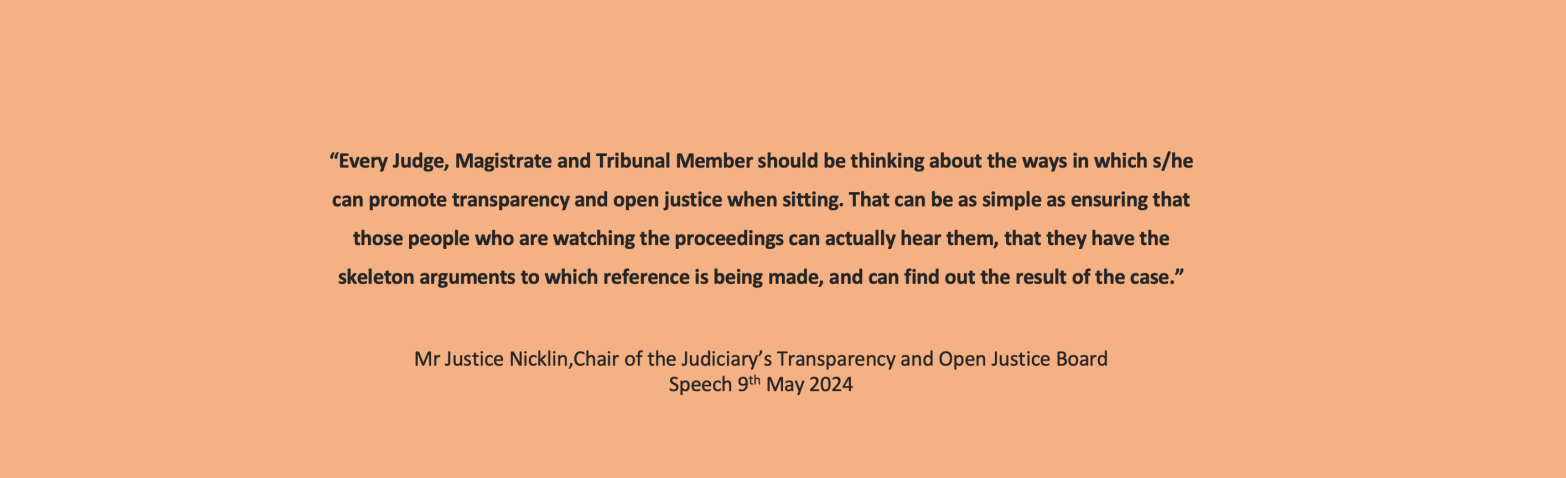
According to the appellant, an “urban myth” had developed about the application of the ‘open justice’ principle to Court of Protection hearings. Flowing from that urban myth, and exemplified by this case, was the proposition that non-parties have rights to access hearings (and materials relevant to hearings) before the Court of Protection, exercisable upon request, and for their benefit (Written submissions of Alex Ruck Keene KC (Hon))
Court of Appeal to decide whether open justice applies to the Court of Protection: Briefing for CA-2025-001953 Re Gardner (Deceased)

In this ‘advance briefing’, I will set out the relevant background and a short summary of the arguments of the appellant and the intervenors. I hope this will assist observers to follow the hearing – either in real-time (in person in the Royal Courts of Justice or via the live-stream) or subsequently via the recording likely to be available after the hearing on the court’s YouTube channel.
The gulf between theory and practice: Open justice in the Court of Appeal
By Celia Kitzinger, 24th February 2026 The judgment is now published (click on the title to read it) Lesley Barnor Townsend -v- Epsom and St Helier University Hospitals NHS Trust [2026] EWCA Civ 195 UPDATE 27th February 2026 The Court of Appeal decision: Permission to appeal was granted on Ground 3 and the appeal hasContinue reading “The gulf between theory and practice: Open justice in the Court of Appeal”
Permission to appeal refused: A procedural dead end

By Elissa Novak (with an introduction by Celia Kitzinger), 22nd February 2026 This is effectively the third tranche of litigation in the long-running case concerning Luba Macpherson and her daughter, “FP”. First came the welfare proceedings for FP which were concluded in 2023[1]. Then came committal proceedings which concluded in 2025 with Luba serving aContinue reading “Permission to appeal refused: A procedural dead end”

