Waiving anonymity to promote care home visiting rights: Michelle Davies Part 1

By Celia Kitzinger, Wednesday 9th December 2020

Editorial Note: An interim ‘judgment’ on this case has since been published here: https://www.bailii.org/ew/cases/EWCOP/2020/60.html

I’ve watched 114 hearings in the Court of Protection since 1 May 2020 and this one, concerning Michelle Davies before Mr Justice Hayden (Case No: 13677469, 23rd November 2020), is the first time I’ve been permitted to share the name of the person at the centre of the case.  

Michelle Davies, her husband Dr John Davies, and their son Kane Davies, were all named in oral submissions in court and in the documents included in the bundle.  That is not unusual.  

What is unusual is that no transparency order was made.  There is no reporting restriction.  Public observers and journalists can name Michelle when we write about the case.

The legal firm, Irwin Mitchell, who represent Michelle via her litigation friend (her husband), has put out a press release naming Michelle (as well as her husband and son). Michelle Davies has been named in numerous newspaper articles, and in radio and TV programmes (for example, herehere, and here).  The media reports are accompanied by photographs of Michelle supplied to Irwin Mitchell press office by her husband.  In one, Michelle and John Davies are dancing together at their silver wedding anniversary in 2008; another shows them celebrating John’s 50th birthday party in 2010.  In the photograph accompanying this post, Michelle Davies is pictured in Muir woods near Sausalito in California in September 2018, when the couple were on holiday together just a couple of months before she became ill.

It’s very unusual to be able to report a person’s name, or publish their photograph, in connection with a Court of Protection hearing. This is because the standard transparency order prevents publication of “any material or information that identifies or is likely to identify where any person listed above [i.e. P and their family and sometimes care staff] lives, or is being cared for, or their contact details”.  The order reminds us that “If any person disobeys the order made by paragraphs (5) to (9) (the Injunction) they may be found guilty of contempt of court and may be sent to prison, fined or have their assets seized.”

The intention of the transparency order is to protect the person’s privacy and this is what many people who become “P”s in the Court of Protection want (or would have wanted).   For others, though, their Article 8 right to privacy may be outweighed by the competing interest of their Article 10 to right to freedom of speech and open scrutiny of the circumstances in which they have been placed.

Background

On 14 December 2018, when she was only 56, Michelle Davies suddenly and without warning suffered a subarachnoid haemorrhage secondary to an aneurysm in her brain.  A week later, this was followed by a stroke.  She has extensive brain damage and since then has been cared for in hospital (for the first 11 months), then in a specialist brain injury neurorehabilitation centre, and now in a care home, pending suitable adaptations to the family home and a care package to enable her to return there.

From the moment of her injury, John Davies spent at least 3 hours a day at his wife’s side, and up to 6 hours some days.  “I didn’t miss a day for 15 months”, he told me.   

That all changed on 17th March 2020 due to the public health crisis. 

In addition to watching the court hearing as it unfolded, I was also privileged to spend two and a half hours with John Davies (via Zoom), listening to his account of what’s happened.  

He described the time he had spent with his wife before Covid-19 – taking her out, helping her physical recovery with passive movement of her limbs, talking to her, and watching television with her – all of which he sees as an essential part of Michelle’s neurorehabilitation and psychological health.  Then, between 17th March 2020 and 6th July 2020, the placement permitted no visits at all, and very few video calls.  In July 2020, when pubs, shops and restaurants started opening up again, there were three weeks when visits were allowed twice a week for 30 minutes each time.  Her husband described how Michelle was wheeled outside onto a patio to be with her husband and son (“she was absolutely beaming”).  But then on 31 July 2020, Manchester moved to higher restrictions and all visits were ceased.  No window contact was permitted and contact reverted to video calls (4 times a week for 30 minutes) for the next 15 weeks.  This, her husband believes, was hugely detrimental to Michelle’s rehabilitation, and to her mental health.  

John recognises that visiting restrictions have the legitimate aim of protecting public health but he believes that it is wrong to impose a blanket policy on everyone.  Instead, individualised care plans, including visiting arrangements, should be drawn up for each resident.  Michelle Davies is “a darn sight younger” than most care home residents and (apart from her brain injury) she is in generally good health.  She’s also already had Covid and the evidence suggests she was likely to have had immunity from reinfection for some months after recovering.  He considers the visiting restrictions “hugely disproportionate” . He wrote first to his MP,  who wrote back to say he’d passed it on to the Department of Health and Social Security – but there was nothing subsequently from either the MP or the DHSS to improve the situation. He then discovered  the public letter from Mr Justice Hayden about permitted contact in care homes.  “I thought, ‘ooh, that makes it sound as though we should be able to visit, and that didn’t tally with my reality”, so he wrote to the judge himself.  The court signposted him to the potential to seek legal advice, which in turn led to the application before the court.

A week before this hearing, Michelle had been moved from her previous placement to a new care home (closer to her husband and son), and her room is on the ground floor, permitting window visits.  Because of the move, Michelle is in quarantine for two weeks.  John described the window visits as “simultaneously delightful and frustrating” because Michelle doesn’t understand why her family can’t be in the same room with her: “when you’re on a video call you understand that you can’t be physically close, but when you’re a couple of metres apart with a window in between it’s more frustrating”.  Later, when I spoke to him, he said “Michelle’s not had a hug off her husband for 9 months. It’s diabolical.”

The window visits from family and friends had also revealed some problems in the care that Michelle is receiving in the new care home.  On one occasion friends had looked through the window only to find Michelle on the floor, having fallen out of her chair – apparently the fact that she needs to be belted into her chair had not been communicated to the new care home (“I was distraught” said John).  On another occasion, John discovered that his wife had been left alone in her room with the door closed to eat her lunch – but she is at high risk of choking and needs to be monitored while eating: he immediately ensured that someone came in to be with her.  His visits are more than simply social occasions: they are (as counsel for Michelle said) “a check, a balance, a monitor, an opportunity to communicate Michelle’s needs as this new home gets to know her, from the wealth of information that her son and husband have about her”.  Her husband is, said Mr Justice Hayden, “the conduit by which institutional learning is conveyed from one institution to another” – and that makes his visits important for Michelle’s wellbeing.

At the hearing, Lorraine Cavanagh QC, as counsel representing Michelle Davies (via John, as her litigation friend) asked the judge to order that it is unlawful for Michelle to be prevented from having daily face-to-face contact with her husband and son, and that from the end of her quarantine period she would be permitted face-to-face contact with John and Kane Davies for no less than 1.5 hours per day.   She asked him to order a risk assessment for contact between Michelle and her family members, a contact plan, statements about the various options for face-to-face contact, and all documentation concerning Michelle’s Deprivation of Liberty (some periods of which seem to have been unlawful, since it appears that no urgent or standard authorisation was in place). She said in particular that Michelle Davies’ Article 8 rights (respect for private and family life) were engaged in respect of her marriage of 37 years, and her relationship with her son and her parents.

On behalf of the local authority and clinical commissioning group Victoria Butler Cole QC suggested a way forward that joins the care home as a respondent, since the decisions being challenged are those made by the care home and not by the statutory bodies.  They will be notified of the proceedings, and joined as a party and required to file evidence and a position statement setting out (among other things) the arrangements they propose to put in place for visits between Michelle and her family, the basis of their decisions about contact, and their reasons for asserting that their policies and arrangements for contact do not violate the Article 8 rights of Michelle and her family.

Michelle Davies’ case will be back in court again on 11 December 2020. 

Waiving anonymity

The court case brought on behalf of Michelle Davies has the potential to change visiting rights for many people in care homes across England and Wales.  It’s for that reason that John and Michelle Davies want their names to be public.  

Many people in care homes, and their families are affected by restrictions on visiting similar to those endured by Michelle Davies and her family.  The submission on behalf of Michelle Davies described her case as “a paradigm example of the personal desolation caused by the application of blanket visiting policies”.

John Davies referred me to two campaigns concerned with this issue: Rights for Residents (“a campaign to end the current inhumane restrictions to visiting loved ones in care homes”) and John’s Campaign (supporting “the right of people with dementia to be supported by their family carers”). 

Although Michelle Davies was, her husband says, “a person who valued her privacy”, she is also “a very caring person and had a very strong sense of doing the right thing, especially where it would improve someone’s lot”.  He said that he “believes strongly that Michelle would want for something positive to come out of this dreadful situation that she finds herself in and this case presents an opportunity for that to happen”.

Twenty-three paragraphs (10 pages of the submission by Lorraine Cavanagh on behalf of the applicant) are devoted to arguing the case for ‘transparency’ and for allowing Michelle Davies’ name to be publicly reported.  She submits that the public has a right to know what is being done in its name in the Court of Protection and that this is strongly in play at a time when the public health crisis has imposed on the general population considerable restrictions on their rights and freedoms, along with growing campaigns to overhaul the ‘chaotic’ and ‘stringent’ arrangements for visiting loved ones in care homes.  And she argues that Michelle Davies herself has an Article 10 right to “… freedom of speech and open scrutiny of her circumstances, particularly important where, as here, her marriage and private relationships are being profoundly deprived by the operation of policy.  This is specific to Michelle Davies’ right to have her cause made public in order to attempt to avail herself of the power of ‘forensic sunlight’ to assist her cause but also, to assist the cause of others to bring about change and public pressure on theGovernment.”

The use of Michelle Davies’ name (as opposed to anonymising initials) is an important part of publicising her story, because “stories about particular individuals are simply much more attractive to readers than stories about unidentified people, It is just human nature” (Lord Rogers in Re Guardian and Media Limited. [2010] 2 AC 697)

The question of whether or not Michelle Davies could be named occupied around half an hour of court time.  Mr Justice Hayden asked to speak to John Davies directly about the issue.  He said: 

A named individual rather than someone referred to with just their initials attracts a much greater degree of public interest – it makes an issue become real to the public.  But being the focus of public attention can bring its own stresses and be very wearing and burdensome.  Ms Cavanagh tells me you’ve thought about this, but I want to hear from you.”

John Davies explained how he’d assessed Michelle’s past and present wishes over the course of two video conversations with her.  Michelle has a communication impairment due to her brain injury: it’s not clear to the professionals how much she understands – though John thinks she understands everything – and certainly her ability to respond is limited mostly to single words.

 “My starting point was my long-term understanding of Michelle as a person.  She is a quiet person, never one to put herself in the public eye.  But she is a very caring person and has strong feelings about helping others and when I said to her there were potentially thousands of people up and down the country like us, not able to see their relatives, she said “aww, aww” in a tone that showed sympathy and her facial expression was very upset.  I said ‘has that upset you?’ and she said ‘yes’.  I said there was the possibility of legal action on this and as soon as I said ‘legal action’ she went, ‘oooh!’, her way of expressing that something has caught her attention. And I said, ‘but we need to think carefully about using your name – I don’t want to cause any distress to you. I said we might be able to assist people by using her name and photo to publicise our case and she said “yes”.  I repeated the same process the following day and I got the same responses.  So, I had a discussion with our son, and we were both of the same opinion.  Michelle has had an absolutely awful thing happen to her and her nature is such that she would want something positive to come out of it if that were at all possible, and this seemed like an avenue through which that could happen.”

Mr Justice Hayden pointed out that the press, social media, and bloggers can sometimes be “irresponsible” in reporting on a case, and there was a discussion about how John and Kane might manage negative comments on Facebook and Twitter.  John’s view was that “we’ve got the resilience to deal with that. A few comments from some ill-informed individuals won’t slay me”.  Journalist Brian Farmer, who was in court, was consulted and agreed that “a story about someone who is named will attract more attention”.  Counsel for the Trust and CCG did not oppose it, and so Mr Justice Hayden indicated that he would not seek a reporting restriction concerning Michelle’s (or her family’s) name. 

Most persuasive was the fact that she had worked so hard to improve the lot of others during the course of her working life, and outside it. She would want to do the maximum to help those like herself during these difficult circumstances, and her husband considered she would recognise that she would be most likely to achieve that by being ‘Michelle Davies’ rather than by being anonymous”. 

This has been borne out by the subsequent media publicity, which has included BBC, ITV and press interviews.   One of the quotations from John Davies that has been used on several occasions in the press is this: 

There has been a failure to treat Michelle as an individual over the last eight months. Instead, she has been dealt with as one member of a huge amorphous group of people living in care homes. These people have names, families and lives. This one is called Michelle Davies.”

What’s ‘going public’ been like?

When I spoke to John Davies, he told me he’s “not had a single negative comment” from journalists or from the public – and he’s had positive feedback from strangers who’ve messaged him on Facebook to say they’re in similar situations and they’re “so glad someone was brave enough to challenge things”.  

If we’d said we wanted to stay anonymous, everyone would have said, ‘of course, yes’, but I did a cost/benefit analysis and I could see that there would be a massive benefit from the extra publicity if we let our names be used.  People can’t relate to ‘Mrs X’. But people become emotionally engaged if you’ve got a real name, and a photo. … If something good can come out of this horrible experience, we will take the risk of not having anonymity.”

He is clear about what he won’t do for the media.  He won’t share any photographs of Michelle since her brain injury “because that’s not respecting her personal dignity, and that’s not how I want people to think of her”.  He’s had “a few attempts from journalists to try to identify the care home” and has tried to prevent the media knowing where Michelle now lives. He’s declined requests to be filmed standing outside the window of her care home and has become “slightly paranoid” that journalists might follow him when he goes to the care home: in our zoom conversation he mimicked anxious glances over his shoulder as though checking whether he was being tailed.  “I’ve never been in this situation before, so I don’t know what to expect”. 

When I asked him if there was anything the media hasn’t reported that he wishes they would, he told me about his quadruple heart bypass.  He’d been “fit as a butcher’s dog”, played rugby for thirty odd years, was doing high intensity gym classes every week and was “the picture of health” when he found he couldn’t breathe in as deeply as normal and went to the GP about it.  After a series of tests, he was told he needed major heart surgery, and was off work afterwards for five months. 

 “Michelle nursed me through recovery. She demonstrated absolutely how much she cared for me. That’s when you find out – when you’re in adversity.  It’s part of my motivation for wanting to do everything I can for Michelle.  And once I’d recovered, I thought our challenge was done. Then just a few months later, Michelle had the aneurysm.”

One of the things the couple had planned to do, after John’s heart bypass, was to take out Lasting Power of Attorney, so that if either of them were to lose capacity to make their own decisions in future, the other would be able to make decisions on their behalf.  (‘Next of kin’ do not have decision-making rights over incapacitated adults.)

 “It was one my list of things to do after what happened to me, but we hadn’t got round to it. I wish we had. It would have made life so much easier for us.  And although I got to be Michelle’s RPR [Relevant Person’s Representative] and then her litigation friend in court, I still don’t have the Deputyship in place – either for health and welfare or for finance – though I started that process back in May.”  

He’d recommend to everyone reading this blog post that they should appoint Attorneys for both Health and Welfare and for Property and Finance, as soon as possible, and (obviously) before they are needed.  You can’t create them after you’ve lost capacity for making these decisions – these instruments have to be set up in advance.  (Information about how to do this is available on the government website here.) 

So far, ‘going public’ about what’s happened to Michelle has been less stressful that he expected. He explained that it helps that he’s a (recently retired) academic professor with a raft of skills in public speaking and analysis developed during his work.  He’s even been in court before, in Employment Tribunals, and found the Court of Protection a much better experience, and “far less intimidating”.  He had anticipated a more “adversarial” courtroom experience but found in fact that “everyone was working together to figure out what was best for Michelle”.  In a context where ‘remote’ courts (conducted via video-platforms) are sometimes criticised, it’s worth reporting that John Davies valued that experience: “sitting in my office at home, being able to nip out to get a glass of water or a lunch time bowl of soup in my own kitchen – it’s all a bit more chilled than a physical courtroom”.  

Anonymity, Freedom of Expression, and the Court

Many people who become “P”s in the Court of Protection would not want the kind of publicity that John Davies is certain Michelle would have wanted – and does want – for herself.  But others do – and for many of the same reasons that John and Michelle do.  Very often a case is in court because something has gone wrong – and it may well be something that has gone wrong not just for “P” but for others in P’s situation.  P and their family may hope that making it public they can help to improve other people’s lives.  

Yet often it feels as though the standard ‘transparency order’ is applied without really considering whether P would want their identity concealed in this way.  

The person’s name is almost always used in public court hearings,.  But the documents in the bundle  – the position statements and skeleton arguments – mostly use initials only.  And when we write about the hearings, we cannot use the person’s real name (or the names of their family members) even though we usually know those names.

So, as you can see from other blog posts for the Open Justice Court of Protection project, we have to find another way of referring to the person at the centre of the case.   Sometimes we simply use “P” (e.g. “When P is in prison”), which is how such people are referred to in the Mental Capacity Act 2005, in the Court of Protection Rules and in legal analysis  (such as this article by Alex Ruck Keene and colleagues).  Sometimes we use initials assigned by the court (which may or may not be the person’s real initials): AL,  KBF, or AB. Other times, we invent pseudonyms (like “Michael”,  “Andrew” , or “Barbara” in recent blog posts) to try to foreground the person as a unique individual.  

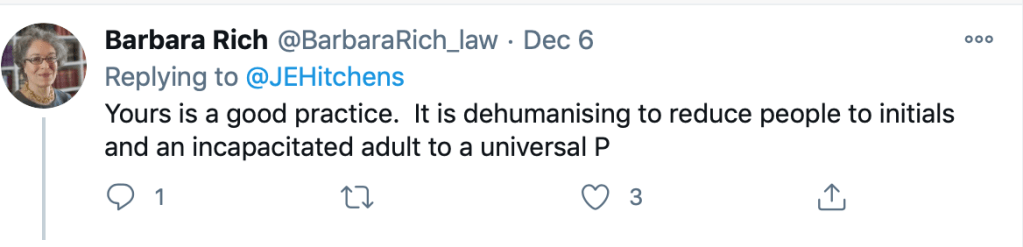
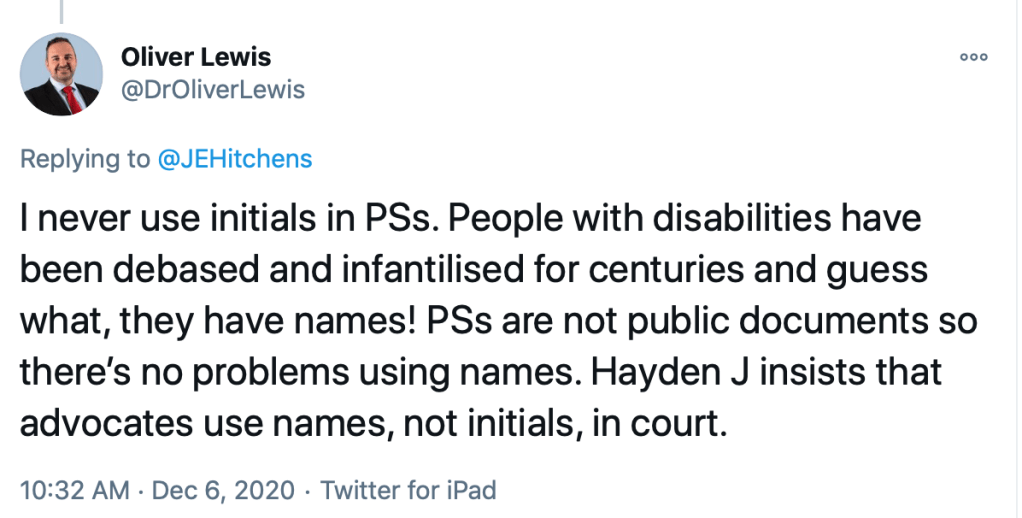
Some lawyers are concerned about the “dehumanising” effect of referring to someone as “P” or by their initials.

In my experience it is now relatively unusual for the lawyers and judge to do other than refer to the person by the name they – or, if they’re not able to participate, their family – prefer: sometimes a first name, sometimes a title and surname, sometimes a nickname or – for a trans person – a new chosen name (only his mother, giving evidence, repeatedly tripped up with name and pronouns).  My experience, like Oliver Lewis’s, is that Mr Justice Hayden normally insists on the use of real names:  just once when a person objected to the public use of her name, did he and the barristers refer to and address her throughout as “Ms P”, as was her preference.  

Many of the position statements I have been sent have not been anonymised, so they, too, contain the person’s real name: the logic of not anonymising them is that I know the names anyway (from having been in court) and I am bound in any case by the Transparency Order, so cannot reveal the person’s identity to anyone else. 

There is relatively little concern, however, about what feels to me, as an observer, like a routine (even ‘default’) acceptance that P herself should not be identified in any reports of the case. The exceptions stand out,  One was  Paul Briggs, whose real name can be used largely because his wife Lindsey Briggs talked extensively to the media about her husband (catastrophically brain injured by a dangerous driver) well before the case ever reached the Court of Protection – so he was already publicly identifiable: for families who believe their loved one would want publicity, making sure to launch publicity in advance of an application to the court might be a sensible strategy.  Another was Manuela Sykes a campaigner with a history of social activism, now with dementia and prevented from returning to her own home, who strongly wished for her situation to be reported in her own name.  In an insightful judgment, which authorised use of her name, District Judge Eldergill wrote:  

“She has always wished to be heard. She would wish her life to end with a bang not a whimper. This is her last chance to exert a political influence which is recognisable as her influence. Her last contribution to the country’s political scene and the workings and deliberations of the council and social services committee which she sat on.”

These are the exceptions – departures from the fact that “ordinarily” there’s a standard order that P will not be named publicly. As I watched this hearing before Mr Justice Hayden, I was dismayed to see how much work was needed (those 23 paragraphs of submission and half an hour of court time) to enable Michelle’s name to be used.

For myself, I hope very much that I am never a “P” in the Court of Protection.  I have done everything possible to make this unlikely.  I have an Advance Decision, an Advance Statement and have appointed both a Health and Welfare Attorney and a Property and Finance Attorney. (Check out the charity, Compassion in Dying, for more information about all these options.)  So, if I am ever a “P” in the Court of Protection, something will have gone dreadfully wrong.   I would want it to be made public, and I would want to be publicly named. I have said so in my Advance Statement – and would advise anyone who feels likewise to do the same.  

Of course, many people value the ‘transparency order’ that protects their identity from being publicly reported.  For others, though, it is an impediment to having our voices heard.  As Jeremy Bentham once famously said, “publicity is the very soul of justice”.  The use of P’s real name is still one aspect of “publicity” that individuals and families caught up in the Court of Protection may need to advocate for – as John Davies has for his wife Michelle, in recognition of her commitment to helping others who, like her, have been deprived of visits from family and friends during the pandemic.

Acknowledgement: Thank you to Dr John Davies for talking to me about the challenges his family is confronting, and for sharing the lovely picture of Michelle Davies that illustrates this article.  I am grateful to Mathieu Culverhouse and David York of Irwin Mitchell for alerting me to this case and for putting me in touch with John Davies.  I am also grateful to Lorraine Cavanagh QC (Counsel for Michelle Davies) and Victoria Butler Cole QC (Counsel for Wigan Council and NHS Wigan CCG) for making their position statements available to me.

Disability, Social (In)visibility, and the Importance of Open Justice

By Gill Loomes-Quinn – 7th December 2020

Editorial Note: This article was first published on Gill’s blog on her own website (voicespaces.co.uk) for International Day of Persons with Disabilities on Thursday 3rd December 2020

Today – 3rd December 2020 – is designated by the UN as International Day of Persons with Disabilities (#IDPWD2020) and this year, we as a global society are asked to focus on ‘invisible disabilities’.

Invisible to whom?

‘Invisibility’ is a facet of disability, and of disabled experience, that is all too familiar to those of us within disabled communities, as we are aware of the challenges experienced by those of us whose impairments do not cause the physical deformities, scars, or other outward signs that the general public seems to expect of ‘disability’. Indeed it seems too that the rest of society is slowly catching up to the existence of such impairments – with many accessible toilets in shopping centres, supermarkets, and coffee shops having signs on their doors reminding customers that ‘Not All Disabilities Are Visible’. This certainly seems to be a concern of the moment.

Such growing awareness of the existence of ‘invisible disabilities’ is to be applauded, if it prevents seemingly ambulatory disabled people with Blue Badges (parking permits entitling the holder to use accessible parking spaces) from being harassed or abused in car parks, or enables people to access facilities and adjustments to make life easier, without the anxiety that requesting or using such measures will be met with disbelief or hostility by self-appointed gatekeepers. But, as with so much of how the non-disabled world views ‘Disability’, the concept of the ‘Invisible Disability’ seems to have been constructed as an individual issue, located within a disabled person’s body-mind, and in a socio-political vacuum. The issue rests with the subject, not the viewer.

However, when I think of ‘Invisible Disability’ I consider another aspect of ‘invisibility’. I think about how much of my life as a disabled person, and how many of my experiences relating directly to my multiple impairments, seem to exist in a parallel world that is invisible to – or hidden from – non-disabled society. As an autistic woman who is also a wheelchair-user, I straddle the boundaries between ‘invisible’ and the ‘ultra-visible’ impairments, and I am acutely sensitive to the ways in which the ‘Able Gaze’ can shape one’s experience of disability (I have written about it – here ). But I am also mindful of a different aspect of the ‘invisibility’ of disability.

Social Invisibility

I remember discussing a trip to London with an acquaintance. I complained about unreliable transport, and about how complicated I found it trying to establish whether specific train or Tube stations were accessible. She replied with surprise – ‘Doesn’t everywhere have to be accessible now?’. I have similarly been met with shock when I tell friends I am charged on average 2.5 times the standard rate for a taxi journey. Conversely, members of the public engage me in conversation and make it clear that they assume I live in Local Authority funded accommodation, I am not in employment, and that the benefits and social care support I receive are considerably more extensive than those I do in fact receive. Disabled existence is a mystery to large swathes of non-disabled society, and the challenges and limitations that inaccessibility places on life with impairments are invisible to the mainstream majority. For some disabled activists, such as myself, sharing our experiences (such as via blogs or social media) is a key aspect of our activism – precisely as an attempt to make the invisible visible – but this comes at a cost, and it is always incomplete. I am relatively open about my impairments and their impact on my life, but when it comes to the most challenging impacts – the moments of despair, of disgust, of hopeless, defeated sobbing: the moments when existing in a world that is not designed for me, that views my presence in it as an unfortunate encumbrance, seems like too much, like too high a mountain to climb – those moments remain hidden. They are invisible. And while they remain invisible, I am on my own with them. They are my challenges alone.

Open Justice – A step towards liberation

It is my view that society should be made aware of how it treats its disabled members – and that ‘social invisibility’ is a form of willful ignorance, and an unjust privilege. Oppression thrives in darkness, and it is most efficient and effective in silence and in isolation. It is for this reason that I am passionate about the importance of transparency in terms of the legal and political policies, procedures, and bureaucracies that shape disabled existence in our society – because shedding light on such structures is one way in which they can be held to account, and injustices embedded within them can be dismantled.

This is why I am proud to be a co-founder and co-director (with Celia Kitzinger) of the Open Justice Court of Protection Project (openjusticecourtofprotection.org) – We promote transparency in the Court of Protection: a court that can impact significantly on the lives of disabled people who lack the mental capacity to make key decisions in their lives. The public has for some years had the right to observe hearings in the court, but this can be a challenge for people without relevant legal understanding or knowledge of court procedures, and public and press attendance at Court of Protection hearings has been minimal. We therefore support people to access and observe proceedings – e.g. by highlighting the details of hearings people may wish to observe on our website (our ‘Featured Hearings’), by providing information (our ‘Observer Resources’) and by publishing observations, along with posts on topics of interest, on our blog (we have posted over 70 blogs from more than 65 contributors since 15th June). In this way, members of the public – including health and social care workers, lawyers, educators, family members and advocates for disabled people, and ‘interested individuals’ – have been supported to observe the ‘law in action’, and to write about, thereby highlighting, the details of court proceedings, and of the social and political issues affecting the disabled people at the heart of them.

These have included:

  • A young man called ‘Michael‘ with complex needs, for whom no suitable accommodation had been identified.
  • The failure of expert evidence as to whether ‘Barbara‘ had the mental capacity to decide where she lives, the care she receives, and with whom she has sex.
  • Whether a person with Dementia should be medicated covertly.
  • Whether ‘AB‘ (who has Anorexia) had the capacity to decide whether or not to be tube-fed.
  • Questions of accountability for the rape of a woman with ‘significant learning disabilities’ (‘KB‘)

Many decisions of significant impact in the lives of disabled people are taken away from society’s sight. Decisions about my own life – my education, my employment, my access to healthcare, and to benefits – have taken place in hospitals, or local government offices, without public access, and often without me being present. Where we have the chance to shed light on, and to scrutinise decisions that shape the lives of disabled people, I suggest we have a strong moral imperative to take this chance. It is by doing so that we challenge the social invisibility of disabled people, and of the experiences that shape our lives.

And social visibility is a powerful step towards liberation.

Gill Loomes-Quinn is co-director, with Celia Kitzinger, of the Open Justice Court of Protection Project. She tweets @GillLoomesQuinn

Photo by Melanie Wasser on Unsplash

A parent’s reflection on “Michael” – a young man with complex needs and no suitable placement

NB, 3rd December 2020

The hearing I observed (COP 13677686) was before Mr Justice Peel on 18th November 2020.  I chose to observe this hearing because I’d read the blog by Caroline Hanman describing an earlier hearing about “Michael” – a young man with autism, learning difficulties and ADHD.  At that last hearing, the judge authorised continuing deprivation of his liberty in an unsuitable placement, pending this hearing, at which it was hoped that a suitable placement would have been found. 

Sadly, at this hearing it was reported that no suitable placement had been found and the judge approved Michael’s move to another temporary placement which was already known to have risks for Michael, because there were no other options available.  See Caroline Hanman’s follow-up blog for a description of what happened, and how an unsuitable placement was approved by the court.

I want to reflect on what I observed in the hearing of 18th November 2000 from my distinctive professional and personal perspective.

I have a career background of working in services for adults with learning disabilities, in particular those who are considered ‘difficult to reach’ because of their behaviour or isolation. Around 10 years ago I became a full-time carer for my son (about the same age as Michael) who has a complex mental health condition and we’ve experienced periods of full-time care services.  Many of the problems faced by Michael and his family resonate with my own experience.

Up until August it seemed that Michael had been living in a property with a staff team and had been managing well. At some point in July the manager left and it was after that Michael’s behaviour started to deteriorate. This raised a big red flag for me, as surely it would be helpful for Michael if someone found out exactly why his behaviour had changed so dramatically.  I imagine listening to his parents might provide some of the required details. 

Michael is experiencing a lot of disruption.  By the time I’d stopped huffing and shaking my head at the screen, I realised he would have been in five different settings within just one month: (1) his original property until 2nd November, (2) a hospital, (3) a place of safety, and then (4) the psychiatric unit where he is currently held.  On the day of the hearing, he was being moved to (5) another interim placement.  The plan is that this too is only temporary until he turns 18, so next year he will be moved again.  

I wondered how on earth my child would have coped with this situation (he wouldn’t) and how stomach churningly awful this must be for his amazing parents.  At some point a comment was made that ‘his parents visit openly and freely’. He’s not a prisoner –  I felt the stigmatising language like a sting!  

When counsel acting for Michael via the Official Solicitor (Mr Patel QC) sought a contingency plan if the interim placement broke down, the representative for the local authority (Mr Mahmood) said they would simply replace the care team! Without commissioner/social worker planning, oversight and staff training, it seems that the same mistakes could well happen over again.  I wondered how Michael might respond to that sudden shift in a whole staff team. Could the risk level increase because of the lack of planning? 

Apart from the direct staff team, I wondered, who is coordinating his care, understanding his needs (someone qualified in his diagnoses), training staff in his needs and ensuring that his needs are met? Where have CAMHS (the Child and Adolescent Mental Health Services) been? This young person should have been allocated a multi agency team to start planning his care. Where were they? Given that P has a diagnosis of autism, I wonder what support is available to him in the Autism Strategy, where he lives, as per the Autism Act 2009, and to what extent this has been explored.  He surely also meets the criteria of Care and Treatment Reviews (CTR) as part of ‘Transforming Care’ as he’s obviously at risk of ending up in a hospital setting or Acute Treatment Unit. An independent panel of experts in a CTR, including experts by experience, may have created a turning point for Michael earlier on Unfortunately there hasn’t been a lot of ‘transforming care’.

I did wonder why the CCG doesn’t seem to have been involved with Michael’s care (or any forward planning for him).  Considering Michael‘s multiple diagnoses and complexity of needs it would have meant that health services must have been involved at some point, to diagnose, so what happened? Was it a case of ‘signing him off’ and what I call ‘service ping-pong’ where no agency wants responsibility so keeps refusing access, all the while needs deteriorate?

At no point during this hearing was a transition phase from children’s to adults’ services discussed. Once Michael turns 18, CAMHS will no longer be involved nor will the children’s social services team. He will still be funded by the same LA, just a different pot of money. There was no mention at all of an EHCP (an Education Health and Care Plan can go up to the age of 25). What does Michael’s day consist of? Is he receiving an education? Has he received any input from psychologists or other therapists? Could such practitioners have helped with planning services and training staff to support his needs? 

I have been my son’s care coordinator for many years. In our experience there is little or no communication between agencies. Even though I worked in health and social care services for years, I found that the system is like a maze and sourcing every provision has been a battle. Young people fall through the net. I hope adult services offer Michael the chance of stability and safety in his life and suggest that the next care coordinator ensures that his voice is heard and his family are involved. 

NB wishes to remain anonymous to protect the identity of her son. She tweets @nb87120292

Photo by Michael Dziedzic on Unsplash

An unsuitable placement approved by the Court

Caroline Hanman, 2nd December 2020

This hearing (COP 13677686, before Mr Justice Peel, 18th November 2020) was to decide where “Michael” should live.  

He’s currently living in manifestly unsuitable accommodation to which he was moved after a crisis when he absconded from his usual living accommodation, was aggressive towards carers and caused damage to a neighbouring property. It took seven police officers to restrain him. They conveyed him to hospital, from which he was subsequently removed to a “place of safety” and then to a psychiatric unit for teenagers with severe mental health problems, which is where he was on the date of this hearing.

Michael has autism, learning difficulties, ADHD and is described as having “very challenging behaviour”.  This latest placement isn’t appropriate for him.  He’s been there since 6th November 2020 (so 12 days by the date of the hearing).  The decision of the court was to move him, that afternoon, to yet another placement which – counsel had acknowledged from the outset – is not really suitable for him. It was a disappointing outcome.  As the judge said in his oral judgment: “None of this seems to me to be entirely satisfactory”.

This was the third Court of Protection hearing about Michael in 11 days.  The first one was an urgent hearing (via email) that resulted in an emergency order at 00.23 on 7th November 2020, authorising Michael’s deprivation of liberty in the psychiatric unit.  The second hearing (which I blogged about here) was an urgent directions hearing before Mr Justice Cohen on Tuesday 10th November 2020.  At that hearing it was decided that Michael should stay in his totally inappropriate placement – because nowhere else could be found – pending today’s hearing.

Today’s hearing, the third in the series, was to approve an order for Michael to move to another – as it turns out interim – placement, pending a fourth hearing in mid-December. 

I’ve found it useful to follow up on this case across two hearings.  It’s given me the opportunity to see how the parties involved have responded to previous Court of Protection directions, and to see how things may have changed for the individual at the centre of the proceedings, and what, if any, lessons have been learned by those involved.

“The only option available”

As is usual, the hearing began with an introduction on behalf of the applicant – in this case, Mr Anderson, representing the current care provider.  He made it absolutely clear that Michael could not stay where he is and that his place is needed for another person for whom it is more appropriate.  He pointed out, too, that it was only due to unusual circumstances (described in my last blog post) that his client had ended up as the applicant, and really it was the responsibility of the Local Authority to take this forward.  (This was generally accepted and the current care provider was discharged as a party at the end of the hearing.)

The representative for the Local Authority, Mr Mahmood, said that, immediately after the last hearing, “extensive efforts were made to ensure compliance” and that “work was done evenings and weekends and so on”.  He emphasised that “every conceivable option has been considered” but in the end there was only one option: it’s a holiday let – a residential home that Michael has stayed in before, with 5:1 staffing from the same care providers.  The plan was to move him today, “in an unmarked ambulance, in daylight hours so that when he arrives he can see the property he’s going to be living in”.  Michael’s parents were part of the transition plan: his mother “will wave off Michael and follow the ambulance in her own auto vehicle and will then meet Michael at the [new property]”.

There were serious concerns raised about the LA’s proposal to return Michael to a community setting when it was clear that the previous arrangements had broken down to such an extent that s136 of the Mental Health Act had been used to remove him to a place of safety.  On behalf of Michael (via the Official Solicitor), Mr Patel QC explained that Ms Webber (previously Michael’s Accredited Legal Representative and now his solicitor) is unable to agree to the order proposed by the Local Authority because it effectively maintains the same care arrangements that were in place when the serious incident took place on 2nd November.  Moreover, Michael stayed at this same holiday let earlier this year when work was being done on his usual accommodation and during those few weeks, there were two incidents of harm to others and one destruction of property: “so in that context the Official Solicitor is concerned we’re putting in place for Michael what was in place before, which wasn’t sufficient to avoid incidents”.  Mr Patel QC said, succinctly: “The local authority is proposing to send Michael back to a property where he cannot be safe. But we can’t object to the proposed course of action because he can’t stay where he is and there is no alternative placement”.  The Official Solicitor is pressing the local authority to come up with a contingency plan if things go wrong for Michael before his case is next back in court – but this has yet to be agreed.  

Parental Concern

Michael’s parents were both present in court and his mother has become a party since the last hearing.  Although she was unrepresented, she was supported by her husband.  He made it clear that as parents they felt they had been “pushed into a corner”.

We accept that Michael can’t stay where he is, and we have no options.  We understand the pressures they are experiencing with Michael there, but we feel options should have been explored sooner, given the concerns we raised back in August about the change in care plan.  This should have been followed up a long time ago.  It’s just all come to a head today.”

Michael’s parents had raised various concerns about the holiday let placement in their Position Statement – including the fact that it is a relatively small property with limited garden space, as well as the incidents that had previously occurred when Michael had temporarily stayed there. The parents also expanded on some unresolved concerns regarding the efficiency and management of the agency involved in Michael’s care. 

I found it staggering that the concerns raised by Michael’s parents in August 2020 were still unresolved three months later and the Local Authority, despite having described Michael’s parents’ input as “invaluable” in Court had apparently failed to address their longstanding concerns about Michael’s care arrangements. 

Oral Judgment

In an oral judgment, Mr Justice Peel said he wanted to “pay tribute to the extraordinary devotion and care” of Michael’s parents.  He was less complimentary about the local authority.  

Why is it that prior to November 2020 no applications in relation to Deprivation of Liberty were made?  The local authority has provided the explanation that the parents were consenting to arrangements in relation to Michael, who is not Gillick-competent, and therefore no application was thought to be required. But it’s accepted that applications should have been made at least from September 2019 onwards. There has been an appropriate acknowledgement of past failings.  Planning for when Michael reaches the age of 18 should have been undertaken for some considerable time.  I’m not sure from my reading of the documents that planning was taking place – and it is now taking place vigorously because of this application.  It should have been addressed by the local authority some time ago.  That is one of the reasons why we are in the position today where all parties recognise that there is only one option available.  I suspect that with greater planning in advance, other options might have been located or developed.[1]

The judge was satisfied (on a s. 48 basis) that Michael lacks capacity to make his own decisions about the conduct of the proceedings, where he should live and his care and support package and on that basis he approved the order for the interim placement – although he also asked the LA to sort out a contingency plan to cover what will happen if the interim placement breaks down. He directed that the case should return in mid-December (preferably before him), because the court needs to scrutinise the LA’s plans (“which it seems to me are to an extent in their infancy”) for what should happen once Michael turns 18.  He concluded his judgment by saying, “Above all, I would encourage the LA to continue the work that is now taking place and to focus on Michael’s needs going forward.”

A sad and uncomfortable experience

Although I was impressed with how Mr Justice Peel managed this hearing, observing it was a sad and uncomfortable experience.  There are so many things that sit uncomfortably at a professional level. Michael is a young person with evidenced care and support needs, yet the LA failed to make a Court of Protection application to deprive him of his liberty, incorrectly seeking parental consent for a decision that properly needed legal authorisation. Mr Mahmood’s explanation that, as Michael was aged under 18, the LA had (incorrectly) determined that his parents could consent on his behalf sounded very shallow, given the quite obvious necessity for professionals to work within the law and the need for social workers to practise in ways that actively uphold and promote human rights.  In my opinion, this fundamental breach of legal duty raises serious concerns about possible wider malpractice that may exist, and I have been reflecting on this matter since the hearing. 

For example, Michael is under the age of 18 so there is still a legal requirement for him to participate in some form of education or training, yet no reference was made to Michael accessing any form of education or training at any point in either of the two hearings I observed.  I am left wondering if (as I would expect) Michael was supported through an education, health, and care plan (EHCP). If so, what was in it, how was it being informed at a specialist level, and what (other) agencies and professionals were involved. I found it quite perverse that the LA fleetingly mentioned that the CCG (NHS Clinical Commissioning Group) was likely to become involved once Michael is aged 18 and I could not help wondering how Michael’s care plan was being commissioned and why the CCG had not had any previous input.  

The judge seemed less than impressed when it became clear that the legitimate concerns raised by Michael’s parents three months previously had still not been seriously addressed by the LA despite this being the third Court of Protection hearing that had taken place on an urgent basis. If a judge can quickly grasp the nettle and respond appropriately, it seriously begs the question why the professionals involved with Michael are seemingly not demonstrating the same level of concern and why the only care ‘option’ available to Michael is one that obviously carries identified risk and is heavily dependent on the ongoing goodwill and support of his parents.

I felt quite sad for Michael and his parents because it is obvious that he has struggled during his young life but nobody outside the family seems to understand him and there seems little will to improve things. Although reference was made to Michael being supported by a different mental health team once he is 18, there was no evidence of how Michael is currently being supported in what should be a carefully planned transitional period. Michael’s voice was again, not being heard during this hearing, even though his views and wishes should be paramount and the judge was (I believe) at pains to ensure that this happens by the time of the next hearing.

It’s incredibly sad and humbling to observe these Court of Protection hearings. I really hope things work out for Michael and his family soon. I will try to attend the next Court of Protection hearing and write another follow up blog if I can. 

Caroline Hanman is in the process of returning to Social Work following a career break, and will shortly be taking up a post in a local authority Adult Social Care team. She tweets @CarolineRTSW

Photo by Cindy Tang on Unsplash


[1] Quotations are as close as possible to what was actually said in court but since observers are not allowed to audio-record hearings they are unlikely to be verbatim.  Thank you to Celia Kitzinger who also observed this hearing and helped with making the quoted material as accurate as possible.

Challenging Reporting Restrictions in the Court of Protection

Brian Farmer, Tuesday 1 December 2020

Editorial Note:  We recently published a blog post about a case concerning a learning-disabled woman who had been raped and become pregnant.  The hearing was about whether a caesarean section was in her best interests.  As is usual in Court of Protection hearings, the Transparency Order required her identity to be kept confidential: she is referred to only as “KB” and nothing can be communicated that might reveal her identity, or that of her family, or where they live.  Unusually, though, the name of the NHS Trust and Local Authority responsible for KB’s care, as well as the name of the police force investigating her rape, were also covered by the Transparency Order.  This was because of the risk of “jigsaw identification” – whereby people are able to piece together information from different sources, including the published judgment, media reports of the court hearing, and possibly future reports in the criminal courts if the rapist is apprehended – and so identify a protected person in that way,  It is relatively unusual for the Court to forbid identification of public bodies such as NHS Trusts and Local Authorities – not least because there is an obvious public interest in knowing what public bodies (funded by tax payers) are up to.  In this case, journalist Brian Farmer wrote to the judge to ask that the media should be allowed to identify the police force, the Local Authority and the NHS Trust involved. In an earlier case in the Family Courts this year, Brian Farmer and Louise Tickle were successful in persuading the judge to change his mind, but in this case the judge authorised only the naming of the police force and not identification of the Trust or Local Authority.  The key arguments applied to the facts specific to each case concern the likelihood of identification of the protected parties, and the balance between their right to privacy (Article 8) and the right of the media (and public observers) to freedom of expression (Article 10).  We have reproduced Brian Farmer’s letter here (with his permission) because any of us may in future want to challenge reporting restrictions in the Court of Protection and his arguments are ones we can all learn from. 

Dear Judge,

Re KB/CoP Case No: 13673754

Thank you very much for letting me address you at last week’s hearing and for giving me the opportunity to apply to vary Transparency Order.

 (I’m assuming that, in making this application, PA Media will not be at risk of a costs order. I make that assumption on the basis of paragraph 16 of the President’s 2019 guidance on reporting family courts — https://www.judiciary.uk/wp-content/uploads/2019/10/Presidents-Guidance-reporting-restrictions-Final-Oct-2019-1.pdf — If we are risk of a costs order I would withdraw our application).

I would respectfully argue that the order is too wide. I think that the media should be allowed to identify the police force, local authority and NHS trust involved.

1: One preliminary, probably moot point: I don’t believe a Transparency Order is needed in this case. I think KB is automatically protected by the provisions of Sexual Offences (Amendment) Act 1992, which prevents victims of sexual assault, and people who say they have been a victim of a sexual assault, from being identified in media reports — https://www.legislation.gov.uk/ukpga/1992/34/contents.

2: I would argue that naming the police force, local authority and NHS trust involved will not create an information jigsaw which will lead to KB being publicly identified. There are jigsaws and jigsaws: if we were to report KB’s address, or name her sister, a child could piece together the jigsaw; if we were to name the day centre she attends, many people could piece together the jigsaw; but how could the man or woman on the Clapham Omnibus realistically identify KB by knowing the names of the Metropolitan Police, a large London local authority and a London NHS trust. I’m not aware that there’s any information already in the public domain which would provide a key piece. I would suggest that here you’re dealing an information jigsaw comparable to a 1,000-piece jigsaw of the Sahara sky at noon. In the real world, who would even think of trying to piece together KB’s identity, let alone be able to?

3: Journalists regularly have to abide by the provisions of two pieces of legislation which protect the identity of vulnerable people, when reporting crime and courts: the, above mentioned, Sexual Offences (Amendment) Act 1992, who protects victims of sexual assault, and Section 45 of Youth Justice and Criminal Evidence Act 1999, — https://www.legislation.gov.uk/ukpga/1999/23/section/45 —  which gives judges and magistrates the power to make order protecting child defendants, victims and witnesses. Neither piece of legislation suggests that naming a police force, local authority or NHS trust can be an identifying factor, let alone police forces, authorities and trusts in London. Section 45 of the Youth Justice and Criminal Evidence Act gives journalists a guide to pieces of information which might create an identity risk. The section specifies: name, address, school or educational establishment, place of work and image. You can be sure that the PA will not name KB, give her address, name the day centre she attends or print a photograph, nor will we name a street, or even an area of the borough.

4: It may be argued that neighbours might identify her, but the reality is that friends, relatives, carers and possibly neighbours, must know her identity. The man who raped her may well know her identity. I would argue that, when balancing KB’s Article 8 rights against the Article 10 rights of the public and media, it’s not reasonable to make an order which effectively bars journalists from telling a small group of people something they probably already know. In any event, KB’s unlikely to be at risk from any of those categories of people. She must now, surely, be subject to 24-hour supervision.

5. Likewise, it may be argued that other patients in the hospital where she gives birth may identity her. I would have thought the risk of that is very small, but if you think there is a risk, impose an embargo. Prevent reporting of the names of the police force, local authority and NHS trust until the baby has been born and KB is back at home.

6: Something has plainly gone wrong in this case. The public, particularly the taxpayers who fund the local authority with responsibility for KB’s welfare, have a right to know the name of the local authority. In the real world, people won’t try to work out KB’s identity, they’ll moan about the council: and they should be able to do that. If the local authority isn’t named, residents can’t tweet their concerns; people can’t tell newspapers that they’ve also had issues; the local MP can’t ask questions; even the councillors on the local authority may not know that the local authority involved is their local authority: they certainly can’t debate the issue at a public meeting. I would refer you to Mr Justice Hayden’s recent judgment https://www.judiciary.uk/wp-content/uploads/2020/05/2020-EWHC-1282-Fam.pdf  That case raised a similar issue where we successfully argued that a local authority should be named. In that case it transpired that the leader of the local authority did not know that the local authority was his local authority, until he read the Daily Beast. How can you be sure that lessons will be learned if debate is stifled? And, isn’t that the most important thing, that lessons are learned. Of course, the local authority will have something to say in their defence, and, of course, we’ll include that defence in any report. 

7: Likewise, the public have a right to ask questions of the police force they fund: they can’t do if the police force isn’t named. The public might wonder why the culprit hasn’t been arrested, and they have a right to ask. Will the police investigation be hampered if names are named? Have the police presented any evidence of that? Issues have been aired in open court, the police force has been named in open court. Was there an application for the case the be heard in private because of the sensitivity of the police investigation? The culprit either has the mental capacity to understand what he has done, or he doesn’t. If he does, he must surely know that the police will be investigating. The case has already been reported: how many men can there be in southern England who have raped a woman with significant learning difficulties in the last nine months? Hopefully very few. If the culprit lacks the mental capacity to understand what he’s done, is it likely that a report in the Daily Beast will put him on the alert?

8. People also have a right to ask questions about the NHS trust they fund because the Official Solicitor has raised a concern about the issue of sterilisation in open court. They may be lots of people in the trust’s area with concerns about the same issue.

9.   I don’t know the names of the local authority or the NHS trust. It may be that similar concerns have been raised about them before. It may be that lessons which should have been learned still haven’t been learned. I don’t know. If I can be given the names, simply for the purposes of the argument, I’ll happily do some research and see if I can add anything to our case.

10. I think in this case, when you balance KB’s Article 8 rights against the Article 10 rights of the media and public, the balance tips on the Article 10 side. I would respectfully argue that with should be allowed to name the local authority, police force and NHS trust.

If I can be of any more help, just ask.

Brian Farmer

Brian Farmer is a journalist with PA Media. He often reports on Court of Protection cases heard in the Royal Courts of Justice. 

Photo by Luis Cortés on Unsplash

Inviting family into the decision-making process

By Caroline Barry, 25th November 2020

Having watched the Open Justice Court of Protection Project with admiration from afar, I finally got my first opportunity to participate in the Project as a public observer.  

At around 9.30am on 19 November 2020, I saw that a hearing was coming up before Mr Justice Hayden (COP 13544390).  I sent an email at 9.38am requesting access, not really expecting a response at such short notice.  By 10am I had a response and by 10.28am I was observing the proceedings.  

Like many other people, I have participated in endless Teams calls over the past few months but my first observation was of how intimate it felt.  I was expecting a sort of “bird’s eye” view from the back of a courtroom – perhaps reflecting my instinct and desire to be loitering at the back, inconspicuous and with a clear line of exit if need be.

Instead, we were asked to keep our cameras as we were checked in to the court, and the frame filling headshots left no doubt as to our presence in the proceedings.   As I am sure many have felt, there was a fleeting moment where I felt exposed and intrusive, questioning my own motives as voyeur of a highly sensitive personal situation.  

It was not a feeling I ever had when reading countless judgments from the Court of Protection.  Those judgments, as indeed this hearing, have – I am sure – made me a better doctor and a better advocate for those living with serious illness and it is for that reason that I felt able to remain on the call.

The case concerned a person we’re asked to refer to as PH. He is not yet 40 years old.  He has a complicated medical history and a range of injuries caused by drinking a highly corrosive substance about five years ago – whether in a suicide bid or a ‘cry for help’ was uncertain.  He now has a tracheostomy and a feeding tube.   He also suffers from seizures and a severe seizure triggered a diffuse hypoxic brain injury which has affected his cognitive function.  He’s currently in hospital, but ready for discharge, so a placement needs to be identified.  

Previous placements have broken down. He was described as showing “challenging and highly disruptive” behaviour – including violence during periods of agitation and distress.  The latest expert evidence has come up with a new diagnosis: “emotionally unstable personality disorder of the impulsive type”.  


Andrew has recently been found by an expert assessor to lack capacity across a whole range of areas, including residence, care, medical treatment, and more.  The expert report was received just a few days earlier.  

No decisions were made at this hearing because Andrew was unrepresented.  Mr Justice Hayden recommended that this should be sorted out “expeditiously” (by asking the Official Solicitor to act on Andrew’s behalf) because “we cannot do anything without Andrew being able to give his instructions, capacitously or otherwise”.  There will be another hearing on 19 January 2021.

Although it was a complex case, I felt on fairly solid ground as the background facts were outlined.  Assistance with complex decision-making is a routine part of palliative care.  The ability to synthesise a lifetime of medical problems into a coherent whole, and to pull together the threads of the physical, psychological and social challenges a person faces into a holistic formulation are skills that develop naturally over years of practice.

I automatically found myself thinking about how I would be documenting the problem list and management plan if I was the attending consultant, and perhaps the questions that I would be asking of PH or his clinicians, if I were involved in his care. 

This train of thought was interrupted by the participation of PH’s partner into the proceedings.   There was a noticeable shift in tone and body language of all the participants visible on the camera.  Mr Justice Hayden lent into the camera, his voice lowered and softened, head to one side. He asked her: “What’s the weather like there?  It’s a very beautiful place when the sun shines!”.  

The previous formality melted away and I watched as, with just a few words, a very real connection was made between the highly technical medical information and the person at the centre of proceedings, his life and values. 

I think perhaps only 4 or 5 questions were asked over the course of around 10 minutes.   I was left with the impression that more was gained in this short exchange than could have been obtained from several hours of ‘expert’ testimony. 

Palliative care, as indeed the Court of Protection, is often characterised by decisions that can appear binary; CPR or “DNACPR”, feeding tube or not, come into hospital or stay at home, capacity or no capacity.  At times, the burden of decision making can be hard to manage both for professionals and for the person affected.   

PH’s partner reminded us that those decisions are medical constructs. When asked what PH wanted, her answer was clear: “he wants to be normal. He wants his life back”. 

These few words had a powerful impact on me.  I was reminded of the way in which we are content in medicine to discuss the complexities of a case within the safe confines of a sphere of professionals.  Whilst the views of patients and their relatives are always sought, they are rarely “invited in” to the mechanism of discursive decision making. 

Often, we throw up a cloud of dust, and persuade ourselves that relatives and patients may lack the required technical knowledge to fully participate in decision making, whilst failing to recognise that it is us who are deficient in our ability to ask the right questions. 

I could see so clearly in this case how a meeting confined to professionals alone could develop tunnel thinking about medical decision making, without contextualising those decisions within a wider narrative arc of a person’s life story and essential values. 

I watched as Mr Justice Hayden, with calmness, clarity and compassion deconstructed this fallacy, with the simple but sensitive prompt of “making the decision for him, not for you”.   I flatter myself that I have effective communication skills but admit to being unexpectedly moved by watching the judge in action.

From an observer’s standpoint, the interaction appeared therapeutic, in the sense that a relationship was established, common ground found, reassurance given and a plan taken forward for the future.  

PH’s partner supported the view that PH would benefit from the right kind of neurorehabilitation – even if he could not see the potential benefits, and even if that meant that she wouldn’t be able to see him as often.

When you read a published judgment, I can’t be the only person who reads a few paragraphs then jumps to the concluding comments.  I realised today that when you think about Court of Protection cases simply in terms of the outcome of the case, you overlook the journey taken to get there.  

Of course, I am sure for many individuals and families a court hearing can be a highly distressing and detrimental process.  Today, I formed the impression that for others, it might be an opportunity to restore dignity and choice to someone who has been unwittingly dehumanised by many years of medical treatment. 

David Sackett, pioneer of evidence-based medicine, notably said the most powerful therapeutic tool you’ll ever have is your personality”.  I hope that, in this case, the interaction I observed was indeed therapeutic for those involved.  If so, it will be thanks in no small part to Mr Justice Hayden’s sensitive manner and to the remarkable Lydia, who, within moments of speaking, established herself with quiet authority as one best placed to guide decision-making.  This latter point was also clear to Mr Justice Hayden, who recommended that she should be fully incorporated into discussions of Andrew’s care.

For my part, I left with a resolution to examine my own practice, and to consider deeply the motivations for the clinical decision-making forums (e.g. Multidisciplinary Team Meetings) I am part of that do not physically place the person or their family at their centre. 

Caroline Barry is a Consultant in Palliative Care with interests in mental capacity and human rights towards the end of life.  She tweets @drcarolinebarry

Photo by Anastasiya Romanova on Unsplash

Refusing kidney dialysis – a daughter’s reflections

Julie Morton, 23rd November 2020

When I asked for access to observe a hearing in the Court of Protection, I had no idea how close to home the key issue would turn out to be.  

The case I heard (COP 13673437) was in court for the first time and was listed for 2pm on 12 November 2020 before Mrs Justice Theis sitting as a Tier 3 judge of the Court of Protection in the Royal Courts of Justice, and held remotely via MS Teams. It actually started at 14.40 because the lawyers were reading documents that had been submitted late.

The person at the centre of the case, AL, has end stage kidney disease.  He needs haemodialysis three times a week to keep him alive. At the moment, he’s in hospital and accepting regular dialysis (at a “sub-optimal” level of twice a week), and is fit for discharge.

When he’s discharged from hospital and goes back home, he’ll probably refuse to come back in for dialysis.  This could mean that he dies.

My father died just over a year ago (in his mid 70s) because he, too, refused dialysis.  His situation was different because he didn’t have kidney disease and there weren’t any problems with his kidneys until he was admitted to hospital after a fall due to a small bleed on his brain and he died six days later.  Before the fall he was pretty healthy.  After the fall his kidneys just didn’t work and his body filled with fluid – he visibly looked like he’d been pumped up with fluid the last time I saw him. 

My father had full capacity throughout his stay in hospital.  A nurse discussed dialysis with him the night he died, and we were told after his death that my father had said he didn’t want any treatment or dialysis for his kidney disease as he didn’t want to be “strapped to a machine”.  This was his choice but, unfortunately, I and other family members weren’t part of that discussion and couldn’t give our views or reassurance regarding this. My father passed away that night on the ward on his own.

It was his right to make that decision but I wish I’d had a conversation with him about it.  I look back now at all the missed opportunities and kick myself for all the times I could have talked with him about his wishes about treatment and didn’t. 

There was a lovely time about six months before his fall, when he came round to spend time with me and my brother and brought a whole lot of photographs of us as children and letters we’d written to him 30 or 40 years ago.  That was a time for sharing feelings and memories and I wish I’d seized the opportunity to talk with him about the future then.  

And the day he went into hospital after the fall, I went to visit and it was just the two of us, and a conversation about his wishes is one of the things I wish I’d done, and didn’t.  I think I didn’t want to frighten him – and although I knew in my heart it wasn’t looking good, I never thought it would come to him passing away. The last thing he said to me was, when I said, “I’ll come and see you soon Dad”, he said, “Don’t forget!” – and I never saw him again.  And now I’m driving around with his ashes in the car and I don’t know what he would want doing with them – and I could have asked him but I didn’t take the opportunity to ask about that  either.   I just look back and think, “why didn’t we have those conversations?”.  Of course,  it’s easy to say that in hindsight.

I wonder what AL understands about his kidney problems and the way the treatment makes him feel? I’m not sure what actually happens but “wired up to a machine” doesn’t sound pleasant at all.

I hope AL’s family have some understanding of why AL is refusing treatment when he’s living in the community.  I was surprised to hear that his family would not be attending the hearing and that they asked to be informed of the judge’s decisions afterwards and that their interest in this had “tapered off”.  Maybe they find the court process daunting? Maybe there will be more information at the next hearing to establish what the family think is best for AL – and I hope we will hear from AI himself.

The applicant Hospital Foundation Trust (represented by Rhys Hadden) was applying for a declaration that it was in AL’s best interests to be discharged from hospital and to be treated reactively in the community and not under any compulsion or constraint.  It seems that this would mean an ambulance turning up at AL’s supported living accommodation three times a week to take him to his dialysis appointments but, as Rhys Hadden put it: “Nobody would restrain him, or coerce him into the ambulance. He’d be invited to attend for dialysis and it would, in effect, be up to him”.  The Trust was hoping for a final order at this hearing, and had an expert witness (a consultant nephrologist) in court, as well as two people involved in AL’s residential care.  AL was represented by Sarah Simcock via the Official Solicitor.  

AL lives in supported living accommodation where he is supported to manage his paranoid schizophrenia and recurrent depression. His capacity to consent to (and to refuse) haemodialysis has been assessed and he’s been deemed to lack capacity “due to fixed and delusional beliefs”.  This means that a best interests decision needs to be made about whether he should be compelled to receive dialysis against his wishes by means of physical, mechanical or chemical restraint.  There have been many occasions on which he’s failed to attend appointments and he’s become ill as a consequence and it’s led to a number of hospital admissions.  

The proposal to make a final order was resisted by AL’s counsel.  She asked for more time to get a better sense of AL’s wishes and feelings.  A previous (remote) interview with AL had not gone well, and it was hoped to have a face-to-face meeting with him to try to understand why he was refusing treatment when back in the community setting.   She said:

The Official Solicitor has no understanding why AL is passively accepting dialysis in hospital but refuses to attend hospital when he’s back in the community.   He’s compliant with his treatment (albeit at a suboptimal level of two times a week) – he doesn’t resist. But when in the community that compliance falls away.  In order to understand that, we consider that a face-to-face meeting should be arranged – given that the consequences of his continued refusal to accept dialysis once he is back in the community could be his death.”

She had also only just received the discharge and transition plan and hadn’t had an opportunity to discuss it with her instructing solicitor. And she wondered whether, if AL were to live in a place where nursing care was available (as it is not in his current placement),  he might be willing to accept dialysis – since he would not be required to travel to receive it.  She said:

We do note AL is medically fit for discharge and it’s not in his best interests to remain indefinitely on the hospital ward where he currently is, but we simply want to make sure that all available options have been explored fully, given the serious consequences likely to result if the Trust’s proposed plan is implemented.”

She also made the point that, since he is likely to become unwell and die if allowed to choose for himself whether or not to have dialysis, a care plan needs to be developed to cover that eventuality (i.e., his death in the residential care facility).

The judge decided not to make a final order at this hearing. I was relieved that the decision was delayed to obtain a better understanding of AL’s wishes and feelings.  Especially as nobody seems to have a clear idea about why he is compliant with the treatment when he’s an inpatient but then refuses to leave his supported living home and go into hospital for treatment when he’s back in the community.

In regards to finding a care facility that would be able to give the treatments on site, I have never heard of this in my social work career of 12 years either, although I haven’t had first-hand professional experience of people needing dialysis as there is a specific social work team within the hospital in Sheffield where I work for people with kidney problems. 

I fully understand the implications of AL being detained in hospital when he is fit for discharge but fully agree with the decision to delay this slightly until further information is gathered regarding his wishes and feelings. AL is only a young man in his 40’s and has had really debilitating health issues by the sound of it. It would be a real shame if he is left to die in the supported living home without fully exploring what other options could be available for him.

Since Dad’s death I’ve felt really anxious about death and dying and really worry about it.  I’m in my fifties and since what happened to Dad, I have decided to get my Lasting Powers of Attorney sorted.  I have all the documents for both Health and Welfare Power of Attorney and for Finance and Property Power of Attorney.  Both forms are filled in and ready to sign, with my son and daughter (in their twenties) as my decision-makers.  But for the last eight months they’ve been sitting in a box in my living room and I can’t bring myself to sign them and get the witness signature and everything.  It just makes me feel too anxious – as though I am going to die.  I can’t seem to handle it, even though it’s a process I initiated and I know I would have some peace from knowing that I’d sorted it out.

I do believe it’s important to talk with family and friends about what you would want if you ever couldn’t make your own decisions about medical treatments and other aspects of your health and social care – because you never know when something might happen.  And if you would like your family to have a decision-making role, appointing them as Power of Attorney is essential – because “next of kin” do not have any decision-making rights for adults who lack capacity.  You could also make an advance decision and advance statement. Check out the charity Compassion in Dying webpage which explains all the options for preparing for loss of capacity, and they also have an information line to provide support. 

I hope to attend the next hearing to find out what decision the court will make for AL.  It’s listed for one-hour at 2pm on Monday 23rd November 2020.

Julie Morton is has worked as a Social Worker for 12 years and as a best interests assessor for 4 years. She frequently works with people lacking capacity and living in either supported living or residential care. Her main case work is supporting adults with complex social care and health needs, with learning disabilities, autism and mental health issues. Julie has just started a Twitter account and would love some interesting people to follow her: @JulieMo09409624

Photo by Jari Hytönen on Unsplash

Accountability for the rape of a vulnerable woman

By Adam Tanner, 20th November 2020

Editorial note: The judgment from this hearing has since been published and is available here.

On November 12th 2020, I observed a hearing before Mr Justice Poole which concerned KB, a woman in her 30s, who was said to have suffered an hypoxic brain injury at birth which led to “significant learning difficulties”. This woman, KB, was living with family and receiving care, iincluding constant supervision, by way of a direct payment from the local authority (represented in the hearing by Victoria Butler Cole QC). Despite this, KB was the victim of rape, and subsequently became pregnant. The NHS Foundation Trust (represented by Nageena Khalique QC) had applied to the court to carry out a Caesarean section – and an order was granted to permit this. 

KB was said to have no ability to understand the reality of pregnancy.  Counsel for KB via the Official Solicitor (Bridget Dolan QC)  said that KB could not comprehend that a baby was growing inside of her. As a result of her learning difficulties, she was unable to verbalise beyond an occasional yes/no and it was deemed that she would not be able to undergo a vaginal birth. In his judgment, Mr Justice Poole said that the evidence shows that KB’s lack of understanding is “profound” and that she would “not at all understand the reasons for the medical interventions” involved in a vaginal delivery. It was said by counsel for the Trust on a number of occasions that KB would not be able to follow “professional instruction” during a vaginal birth. As such, the Trust believed that a vaginal delivery could be potentially traumatising for her. 

It was also stated during oral judgment that it would be lawful to use “reasonable and proportionate measures” including physical or medical restraints to enable the transfer of KB from her home to the hospital. However, all evidence was that KB would be cooperative and that she has never demonstrated any serious non-compliance. 

The NHS Foundation Trust had initially planned to seek an application for a non-therapeutic sterilisation procedure for KB, to avoid this kind of situation happening again. Sterilisation was quite rightly (in my view) called “draconian” by Ms Dolan QC. KB is a person with profound learning difficulties, who has never expressed any sexual desires or wishes. She was the victim of rape; she did not want to get into the position in which she now finds herself. Ms Dolan noted that sterilisation has only been authorised by the Court twice in the past 30 years on women who lacked capacity, and each of those times it was because the person was demonstrating the desire to engage in a sexual relationship. The Trust said that they would conduct a further roundtable meeting and move the decision about sterilisation to a later date. The judge noted that there is a “global and complex picture” which needs to be considered before any such decision can be made.  I hope they will decide not to allow any form of sterilisation of a woman who did not ask for, wish for, or desire any of this to happen to her. 

Throughout the hearing, there was criticism levelled not at any particular person but at the failure of the system in allowing such a lengthy delay before this case came before the Court. Further to this, concerns were raised when KB was 22 weeks pregnant about whether or not termination should be sought; however, repeated delays meant that, by the time KB saw a specialist consultant (when she was 24 weeks pregnant) that was no longer a viable option. Counsel for the Trust did, however, note that KB’s mother would have been against termination of pregnancy in any event. The judge remarked that KB might well have been so far along that the termination may have required the induction of labour, which would have been traumatic for KB.

Towards the end of the hearing, a representative of the Press Association, Mr Brian Farmer, raised an issue with the fact that all those who are present in court are prohibited (by the Transparency Order) from naming the local authority, the police force and the NHS Trust. Brian Farmer made the point that it was a matter of public interest which public bodies are involved, so that they can be held to account. 

Counsel for KB via the Official Solicitor said that, although it is normal to name public bodies in Court of Protection hearings, in a case of this nature – where KB had been a victim of a sexual offence – there is a risk that naming them might identify KB and she is entitled to her anonymity. Mr Farmer, therefore, stated his intention to launch an application to vary the terms of the Transparency Order, stating that Mr Justice Hayden has been very clear that the Court of Protection should not be a secretive court.

Mr Farmer also noted, and the judge said he would pass it on to the Vice-President, that the new ‘transparency order’ regime is less transparent than the old regime. He argued that the old regime of reporting restriction applications meant that the orders named the parties and provided a case summary. Now, he said, it is essentially a guessing game what COP hearings (in the Royal Courts of Justice) are about until the case is being heard.

I believe Mr Farmer is entirely correct in his wish to vary the terms of the Transparency Order. There were a number of other restrictions placed on reporting this case which limit an array of matters concerning KB from being discussed, most of which are not, in my view, of public interest. It is, however, of public interest to know which local authorities may be responsible for rather serious breaches of safeguarding. There is a risk that the scope of the Transparency Order – which prevents naming the public bodies involved – will mean that the Court continues to attract the stigmatising label of the ‘secretive court’ which has so often appeared in the press. The Court allows journalists and members of the public into hearings, but if we cannot then hold the responsible bodies to account, there is little point to us being there in the first place. 

This is an extremely serious case, with consequences that will go far beyond KB, as much investigation is yet to be done into how, in my opinion, the system managed to fail her in so many ways.

Adam Tanner is a PhD researcher in mental capacity law and has contributed previous blogs to this Project (e.g. here). He tweets @AdamrTanner

Editorial note:  An earlier version of this post was published at 8.00am on Monday 16 November 2020.  We removed it from our site at 8.22am the same day in response to a message from Victoria Butler Cole QC (counsel for the local authority) advising us that there were factual errors. The post has been corrected to address these – and the author also took the opportunity to fact-check and rephrase some sentences that may have been ambiguous or unclear in the first version. We were advised as follows:
1. The blog states that the woman whom the proceedings concern had a ‘supportive package with professional carers’ and that she was ‘under the constant care of her local authority’. KB was living with family and receiving care by way of a direct payment.
2. The blog says there was ‘serious criticism levelled not at any particular person but at the system which allowed a vulnerable woman to be raped while in the care of the local authority’. Again, there was no criticism made on this issue within the court hearing. The only opinion the judge expressed was that he felt the application by the Trust should have been made sooner.
” (Email from Victoria Butler Cole, 18.24pm on Monday 16th November 2020)
We are grateful for the opportunity to make these corrections.

Photo by Markus Winkler on Unsplash

What does the Court of Protection need to know about “borderline personality disorder”?

By Keir Harding, 18 November 2020

Editorial note:  In a blog post about a Court of Protection hearing (here), Celia Kitzinger reported that the person at the centre of the case had been diagnosed as having an “emotionally unstable personality disorder” (also known as a “borderline” personality disorder) and that this constitutes “an impairment of, or a disturbance in, the functioning of the mind or brain” under s. 2(1)of the Mental Capacity Act 2005. The contested nature of the diagnosis was not mentioned or engaged with in the Court of Protection hearing (nor was it addressed by Celia in her commentary on the case) – and so we asked Keir Harding to write a piece about the diagnostic category and the way it is used by way of raising awareness, both in the legal field and more broadly in health and social care, of some of the issues involved.

“Borderline Personality Disorder” and “Emotionally Unstable Personality Disorder” are interchangeable terms for a mental health diagnosis typically given to someone who has difficulty managing their emotions, copes in ways that can cause problems for them, and has difficulties with relationships. In theory, it is a diagnosis given by a qualified mental health professional. It is classed as a mental disorder which means that a person with the diagnosis could be detained under the Mental Health Act (1983). There is a NHS webpage about it here, and a Mind page here

For the diagnosis to be given appropriately according to the psychiatric criteria,  people’s symptoms should meet the 3 Ps. Their difficulties should be: 

  • Persistent – Not waxing and waning, not relapsing and remitting but relatively constant. 
  • Pervasive – In every area of life. They shouldn’t function brilliantly in one area and not in another. 
  • Problematic – It has to cause distress to them. 

All of the above is theory. But these diagnoses are in reality very contested, and in my experience and the experience of many people who have these diagnoses, the diagnosis can be arrived at after a very brief consultation and without a thorough assessment. I argue that this means, in respect of the Court of Protection, that in proceedings where P has one of these diagnoses, it is important to establish how the diagnosis has been arrived at – and to confirm that it is the result of a rigorous assessment, rather than the ‘gut feeling’ of a clinician. The Royal College of Psychiatrists recommends that “diagnosis should only be made by those qualified to make it and only following a thorough assessment”. 

A Contested Diagnosis

There are 10 different types of personality disorder listed in the Diagnostic and Statistical Manual of Mental Disorders (the ‘DSM 5’) – which is published by the American Psychiatric Association, and used to diagnose mental disabilities in the United States and some other countries. These are: paranoid, schizoid, schizotypal, antisocial, borderline, narcissistic, histrionic, avoidant, obsessive-compulsive, and dependent. It’s also possible to be diagnosed with a “mixed personality disorder” or with a personality disorder that doesn’t quite meet the criteria for any of these diagnostic categories (“a personality disorder not otherwise specified”).

I’ve worked in a variety of mental health settings for the past 20 years and I have met fewer than 10 people with a personality disorder diagnosis that isn’t  either “borderline” or “antisocial”.  So, while in theory there are 10 types of personality disorder, only 2 of them seem to be regularly diagnosed.   

In my experience, if you are a woman who self-harms, you will get a Borderline Personality Disorder (BPD) diagnosis regardless of whatever else is going on.  Something in this system is definitely wrong. 

Research suggests that if you can be diagnosed with one personality disorder, it’s highly likely you’ll meet the criteria for another two.  So that’s 3 personality disorders in all.  In a system that aims to put people into a neat tidy box so that we know a care pathway, it becomes messy because they’re actually in 3 boxes (and they probably display some traits from a few of the other diagnostic categories too).  

Let’s take borderline personality disorder in the DSM 5 diagnostic manual as an example:  To be given the diagnosis you need to match 5 of the 9 relevant criteria.  Let’s say my friend Ian and I are on the same hospital ward.  He meets criteria 1-5 and I meet criteria 5-9.  So, we have the same diagnosis, the same treatment plan, and yet we share only one characteristic.   

Borderline Personality Disorder could certainly be argued to be the most stigmatised diagnosis out there. As long ago as 1988, an article in the British Journal of Psychiatry (“Personality Disorder: The patients psychiatrists dislike”) reported research showing that psychiatrists treated patients with this diagnosis as more difficult and less deserving of care compared with other patients.  The authors wrote:

“The PD cases [sic] were regarded as manipulative, attention-seeking, annoying, and in control of their suicidal urges and debts. PD therefore appears to be an enduring pejorative judgement rather than a clinical diagnosis. It is proposed that the concept be abandoned.”

A story of two mental health staff talking goes like this: 

“I’m having problems with my patient with Personality Disorder” 

“How do you know they have personality disorder?” 

“Because I’m having problems with them.” 

This is why I feel it’s very important that when the court accepts that someone has the diagnosis of BPD they ensure that this is based on a thorough psychiatric examination from an expert in the field, using a trusted rating scale and finding the person to have met the diagnostic criteria.  A person does not “have BPD” simply because their care team find them challenging.   I frequently meet people with this diagnosis who do not meet the criteria but have this label written all over their notes.  

Even when people are shown to have met the criteria, the court should be aware of the subjective nature of assessment for this diagnosis.  Those deciding that anger is “inappropriate” (Criterion 8) or that attempts to avoid abandonment are “frantic” (Criterion 1) may well have difficulty appreciating the unique set of circumstances those they assess are living through. 

There is a language around people with this diagnosis that invites people to treat them badly or even cruelly. They are often described as attention seeking, manipulative and in many ways not truly deserving of care. They take up places in the healthcare system that could be used for people who are “really ill”. They are ascribed mythical powers to be able to tear apart previously high functioning teams and, despite a suicide rate of 1 in 10, are rarely taken seriously when describing being suicidal. It is very hard to be helpful to people when you label them as disordered and see them as holding all the characteristics above. This isn’t something I’d expect caring people to do.

Perhaps a more useful way of thinking about this is through the lens of trauma. Up to 80% of people who receive this diagnosis will have experienced some form of abuse. I’ve very rarely worked with anyone where the difficulties they have now don’t make sense in terms of previous experiences of neglect, abandonment and abuse. If we can remember what has happened to people, we tend to be empathic. When we label that person as disordered, we tend to locate the problems in them rather than the people or circumstances that hurt them, or the circumstances of their trauma. I would bet money that this label is disproportionately applied to the girls who survived the child sexual abuse scandal in Rotherham – but the people we sympathise with now will be the people who are blamed for their problems in the future. 

Jay Watts writes of testimonial injustice once this label is applied. The words of those given the diagnosis are seen as meaningless because an expression of pain is viewed as just seeking attention, and a legitimate complaint is ‘typical PD’. “Inappropriate anger” is one of the criteria for BPD and what greater power imbalance can there be for someone whose reactions to injustice are labelled by others as “inappropriate”?

Many would argue the diagnosis can be useful and I sometimes find it helpful for those I work with, if only because it comes with ‘NICE’ (National Institute for Health and Care Excellence) guidelines (see here and here) that recommend specific ways of helping people with this diagnosis. I help a lot of people leave compulsory treatment because the care they are receiving bears no relation to what is recommended in the guidelines.  In the face of risk, teams move from “being with” people and start “doing to” people.  Collaboration ceases and as people respond badly to the restrictions (whose potential for harm is spelled out in the guidelines), this is only seen as evidence to restrict more.  Recommended therapies are not provided or are provided by those who are untrained – and despite a recommendation not to prescribe medication for BPD, polypharmacy (the prescription of multiple medications to one person daily) is rife. 

Another common theme I see in legal reports is for someone’s current presentation to be generalised to their entire life.  It can be forgotten how an inpatient environment is often perceived as harmful and not recommended for people with this diagnosis, with the ‘NICE’ guidelines telling us admission should only be used during a crisis.  When people are compelled to reside in a harmful environment, it would make sense that their behaviour changes substantially.  With that in mind I would always want the court to think about whether behaviour used as evidence for anything in one environment can reliably be applied to different environments where often that behaviour has never occurred.  

The Consensus Statement for People with Complex Mental Health Difficulties who are diagnosed with a Personality Disorder was published in 2018. In this statement  many people with lived experience and some professional bodies including the British Psychological Society stated “We would like to abandon the term ‘personality disorder’ entirely” .  That won’t happen any time soon though, and with the new edition of the diagnostic manual used in the UK (the World Health Organisation International Classification of Diseases – version 11) being published next year, it is possible that more people will qualify for a disordered personality with all the implications already outlined.  This is a scary prospect and while seeing that someone has a diagnosis of BPD will tell you much about their relationship with those who should care about them, it will tell you nothing about the value of their personality. 

I very much hope that the contested and controversial nature of personality disorder diagnoses that I’ve described here is understood and borne in mind by the Court of Protection whenever it makes decisions concerning people with one of these diagnoses.  

Two very readable lived experience pieces describing the impact of being given this label can be read (here) and (here).

Keir Harding is an Occupational Therapist and Dialectical Behavioural Therapist with 20 years’ experience in mental health and an MSc in ‘personality disorder’.  He has been a lead therapist NHS services and is now Clinical Lead for Beam Consultancy.   Keir works closely with people with lived experience to provide training, expertise and therapy to help avoid long term hospitalisation. He serves on the executive board of the British and Irish Group for the Study of Personality Disorder.  He tweets @Keirwales

Photo by Priscilla Du Preez on Unsplash

Deprivation of Liberty at an Urgent Hearing

By Caroline Hanman[1] – 17th November 2020

The person at the centre of this hearing (pseudonymised as “Michael” in this post) is a young man under the age of 18. He’s autistic and he has learning difficulties and ADHD (“attention deficit hyperactivity disorder”).  He sometimes exhibits challenging behaviour which on occasion has resulted in physical injury to other people and destruction of property. The key question before the court is where he should live – and this needs to be decided urgently because his current (temporary) placement is entirely unsuitable.  This was a directions hearing. Substantive decisions about where Michael will live will be made at the next hearing on Wednesday 18th November 2020.

Background

Until recently, the local authority (LA) provided Michael with a package of care consisting of 3:1 (and at times 5:1) staff support and he was under constant supervision. However, no application to authorise his deprivation of liberty has ever been made to the Court of Protection.  (For a useful explainer about deprivation of liberty for 16 and 17 year olds under the Mental Capacity Act 2005, see this Guidance Note from 39 Essex Chambers).  It is unclear why no such application was made.  When a person is unlawfully deprived of their liberty, a claim for damages can be brought under the Human Rights Act 1998.

This court application had been precipitated by events on 2nd November 2020.  Michael was then living in his usual placement.  He became upset and caused quite severe property damage and injured at least three people.  Police officers were called and Michael was restrained and taken to hospital where he was detained under s. 136 of the Mental Health Act 1983 and then removed to a “place of safety” (in this case, a residential care home).

The following day (3rd November 2020) it had become clear that Michael was not detainable under the Mental Health Act 1983 and a couple of days later a second opinion (requested by the Local Authority) confirmed this.  So, Michael could not remain in the “place of safety” to which he’d been taken. 

The Local Authority was unable to source a suitable placement for Michael and so he was admitted to an unsuitable placement as a temporary measure. He was admitted to psychiatric unit for teenagers with severe mental health problems on 6th November 2020.  Again, though, the LA did not make an application to the court to authorise this deprivation of liberty.

As the LA had not applied for authorisation to deprive Michael of his liberty, the organisation running the unit at which Michael had been placed sought to do so. They made contact with a barrister (Ian Brownhill of 39 Essex Chambers) who tried and failed to get hold of the LA by phone and then moved rapidly and efficiently to get the case before the court.  His actions demonstrate what can be done by lawyers who understand the system and are willing to work at unsocial hours to ensure that vulnerable people get the protection they are entitled to.  Mr Brownhill found a solicitor (Katie Webber) willing to act as Michael’s accredited legal representative (ALR) and made an out of hours application on behalf of the current placement organisation to regularise Michael’s care arrangement.   The out of hours judge, Mr Justice Poole, heard the case via email and in the early hours of Saturday morning he appointed the ALR and authorised Michael’s deprivation of liberty until the date of this court hearing.

Listening to the background to this hearing was a useful reminder of how rapidly it is possible to get cases before the court, and of the fact that the Court of Protection works (as Ian Brownhill has tweeted) 24 hours a day, 365 days a year. 

The hearing

The matter is listed before Your Lordship today”, said Ian Brownhill, “to consider Mr Justice Poole’s order and to determine if Michael’s deprivation of liberty should continue”. 

This case was listed – without a case number – as an “Urgent Hearing” before Mr Justice Cohen at 10.30am on 10 November 2020. (The case number eventually provided was COP 13677686).  So, we were observing developments in a case that had been launched only late on Friday 6th November and was here in court four days later for a directions hearing i.e., a hearing for the judge to review the case and consider what further information, evidence or action taken by the parties was needed before he could make decisions about the substantive matters before the court – here, where Michael should live).

 Michael is in a setting where he ought not to be – a setting for people who are having acute episodes under the Mental Health Act.  This is negative in terms of his best interests and also for the wider community in [this geographical area] because one of the places of safety cannot be utilised because Michael is there inappropriately.

Ian Brownhill

As the case unfolded it became clear that the LA was actively seeking an alternative placement but was having great difficulty finding somewhere that might be suitable.  I was pleased that the judge made the point that, geographically, some placements would be unsuitable because of the importance of Michael’s family being able to retain regular contact.

The LA (represented by Abid Mahmood of No5 Chambers) clearly was in a difficult situation, and no doubt was on the defensive, but at times his contributions appeared evasive and not terribly helpful (for example: “If any delay has been caused by the LA then there is an unreserved apology for this...” – when it was abundantly clear that they had caused delay).

I was pleased that Mr Justice Cohen took the time to speak directly to Michael’s parents, present in court throughout.  He ensured they had received, read and understood the draft Order (they confirmed it had arrived that morning) and he checked that Michael’s mother wanted to become a party to the proceedings, saying “You’ve obviously been a constant in Michael’s life and very much part of his ‘care package’ if I can put it that way, and I’ll happily join you as third respondent”. 

Mr Justice Cohen went through the draft order carefully, allowing for comment and adding further detail where he considered this to be appropriate.  Observers do not have a copy of the order but from what we heard in court it seems to say that Michael should stay in his current placement, which “clearly” (said the judge) has restrictions in place which amount to a ‘deprivation of liberty’ – but that these restrictions should be as limited as possible and only as necessary “for him continue to reside there”.  He paused at this point and said: “Does one not need to add in:and to prevent him causing harm to himself and to others?’”

The judge also asked Michael’s mother whether there was anything in the order that “causes you anxiety” – to which she replied “Nothing I’ve seen looks untoward. It looks absolutely fine to me, thank you.”

This exchange[2] also brought a touch of humanity to the proceedings:

This was an interesting case to observe and I feel I have learned a lot.  My professional social work experience is with adults, and although I knew, for example, that the Deprivation of Liberty Safeguards do not apply to people aged under 18, I had not fully appreciated that the court can approve a deprivation of liberty application for younger people if they lack capacity (see the guidance note here).  This admission will be stating the obvious to many people but this point had gone over my head even though I know that when the new Liberty Protection Safeguards (LPS) are introduced they will apply to people aged 16 and over.

Attending these hearings is still very new to me and I am on a steep learning curve. I had not realised that you should have your camera off (in part to preserve bandwidth) unless asked to turn it on.  And I was surprised to discover at the end of the hearing that a journalist, Brian Farmer, invited the judge to provide more detail about the restrictions imposed in the Transparency Order. I did not know that observers could (possibly) ask questions and I found it slightly odd that a journalist seemed to be making it harder to secure transparency within the Court of Protection by suggesting additional restrictions on what can be reported.  I appreciate not everyone would share this view though – and he was clearly concerned to report responsibly and not to provide the media with information that could upset the parents or risk leading to Michael being identified.

I would personally recommend that all social workers take the opportunity to observe Court of Protection hearings, whatever your specialism. They provide useful insight into how the law operates in practice and how decisions taken by professionals can impact on human rights. I feel humbled by the experience.  Remote attendance has opened things up and really helped me reflect on my practice and what I want to achieve when I (soon) return to work.

Social Work has a solid value base which demonstrates a real commitment to ethical practice and to promoting the rights of individuals.  Yet in the two COP hearings I have attended so far, I have had cause to query if this has happened and if so, where the evidence is. In this hearing it is apparently the case that Michael lacks capacity to make his own decision about where to live.  Michael’s parents were in attendance to speak on his behalf (as was his ALR and a representative from the Official Solicitor who will take over from her as his litigation friend).  But it was unclear to me if Michael had been asked if he would like to attend court or what he felt about what was happening. I cannot in all honesty say I heard Michael’s voice at any stage. He may be autistic, he may have learning difficulties, and he may lack capacity, but I would have liked to know more about him and to feel confident that his voice (the most important of all) was really being heard in the court where decisions were being made about him.

I hope to attend the next hearing and to learn how things have progressed with this case, and how Michael’s wishes and feelings are accessed and factored into the decision-making process.

Caroline Hanman is in the process of returning to Social Work following a career break, and will shortly be taking up a post in a local authority Adult Social Care team. She tweets @CarolineRTSW


[1] I am grateful to Celia Kitzinger who also observed this hearing and was sent (as I was not) the Position Statements by both Ian Brownhill and Abid Mahmood.  This enabled her to cross-check what I had written against the facts as provided in those documents and so to improve the accuracy of this report. (Celia also contributed some of the as-close-as-possible-to-verbatim quotations, including the exchange between the judge and Michael’s mother.)

[2] Observers are not permitted to audio-record hearings so all quotations in this blog post are as accurate as possible but based on written notes scribbled down during the hearing and unlikely to be verbatim.  In addition, a request was made – following a question from the Press Association journalist Brian Farmer – not to mention Michael’s specific age, but to use the term “late teens” which (according to the judge) “is one more blanket of anonymity for him”.  In the exchange above, Michael’s age was indexed twice – once by his mother and once by the judge (i.e. “a xx-year-old lad”) and the extract has been adapted to remove these references.

Photo by Phil Desforges on Unsplash