

By Peter C Bell, 6th July 2023
I am a (mature!) law student at the Open University, studying part-time for an LLB Law (Hons), and have just completed my second year (results of last End of Module Assessment eagerly awaited).
I have a long-standing interest in Open Justice, having observed or participated in hearings in courts and tribunals, including magistrates court, crown court, county court, High Court (Bankruptcy division), property tribunal, employment tribunal, tax tribunal, social security tribunal and Court of Protection. In some cases, I was the litigant in person (LIP). In others, I was a McKenzie friend assisting a litigant in person. I have also observed several Fitness to Practice hearings at the Nursing and Midwifery Council’s hearing rooms in Stratford and made an (unsuccessful) application there under the Open Justice principle for access to documents that were before the panel. I have also served a 3-year term as a public governor of an NHS Trust in a county in the south of England, which provided mental health care, both in the community, and also in closed units – as well as acting an Independent Monitoring Board member at a London category B prison.
So, over the years I have accumulated a certain amount of practical experience from a range of institutional settings where people are subject to being deprived of their liberty to a greater or lesser degree.
Having appeared as a litigant in person (LIP) at the Court of Protection in London when I applied to be a deputy for a person I had befriended, I have a particular interest in the operation of the Court of Protection. This person was living with dementia and was moved by the local authority from her rented flat to a care home in another London borough.
I am currently in Dorset visiting my elderly parents for a couple of weeks, helping my dad with their garden, and also doing some cooking for them both. After a very hard day in the garden yesterday, fighting to get a hedge under control, I decided to take a day of rest and try my first remote observation of a Court of Protection hearing. I had seen the regular posts from the Open Justice Court of Protection Project and wanted to observe a hearing to see for myself how easy it was to gain access to a hearing, and how open and transparent the hearings were. I was hoping to learn some more about the law that the Court of Protection applies and the sorts of cases that are routinely brought before it.
Preparation for my day at the Court of Protection
Actually my preparation started the evening before, when the Open Justice Court of Protection Project published details of upcoming Court of Protection hearings on their twitter account.
I looked through the details of cases to be heard on Tuesday 27 June 2023. Using the guidance on the project’s website and the template email request that they publish, I submitted a request to the Family Division of the Royal Courts of Justice asking to observe a case listed for hearing before Mrs Justice Theis at 10:30 a.m. (This was the daily “featured” hearing on the Open Justice COP Project’s home page.)
I sent the email request in just after 6:30 p.m. quoting the case number, the published parties’ names or identifiers (in this case re: HW) and providing my contact details – name, telephone number and email – together with confirmation that the court could pass on my email address to the representatives of the parties so that I could be sent a copy of the Transparency Order and any position statements.
Oh no – broadband down – panic!
I checked my laptop email account the morning of the hearing at around 8:30 a.m. only to find that my parents’ broadband was down, so I had to switch to using the Personal Hotspot on my mobile which fortunately got me connected again. I was wondering whether I would be able to observe a hearing using this method.
However, the broadband came back around 10 minutes later – but now it was a blistering 40M down and 10M up (having been around 7M down and 0.3M (!!) up before). The upgrade was supposed to have happened last week, but had been delayed by OpenReach. Trust it to be on the day that I most needed it to work! I should not have worried though – everything was fine, and the increased speed was fantastic.
Search for a hearing that had not been “vacated”
At 09:39 a.m. I heard back from the Video Hearings Administrator at the High Court Family Division that the hearing that I had planned to observe had been vacated: the phrase used was “the matter has been vacated”. Fortunately I know that this has nothing to do with going on holiday, but simply means that the hearing will not now take place, and it’s very common for COP hearings to be vacated So, what to do?
Looking again through the list of today’s hearings on the Open Justice COP Project twitter feed, I picked out a hearing in Middlesborough at 12 noon before Judge Brown and fired off an email request to the Newcastle regional centre asking to observe that hearing. The hearing was listed as “MON v STBC where P should live, healthcare, varying or terminating an urgent or standard authorisation under the deprivation of liberty safeguards” with time estimate of 1 hour, held remotely using BTMM, whatever that is!? (It was later explained to me that it was BT Meet Me).
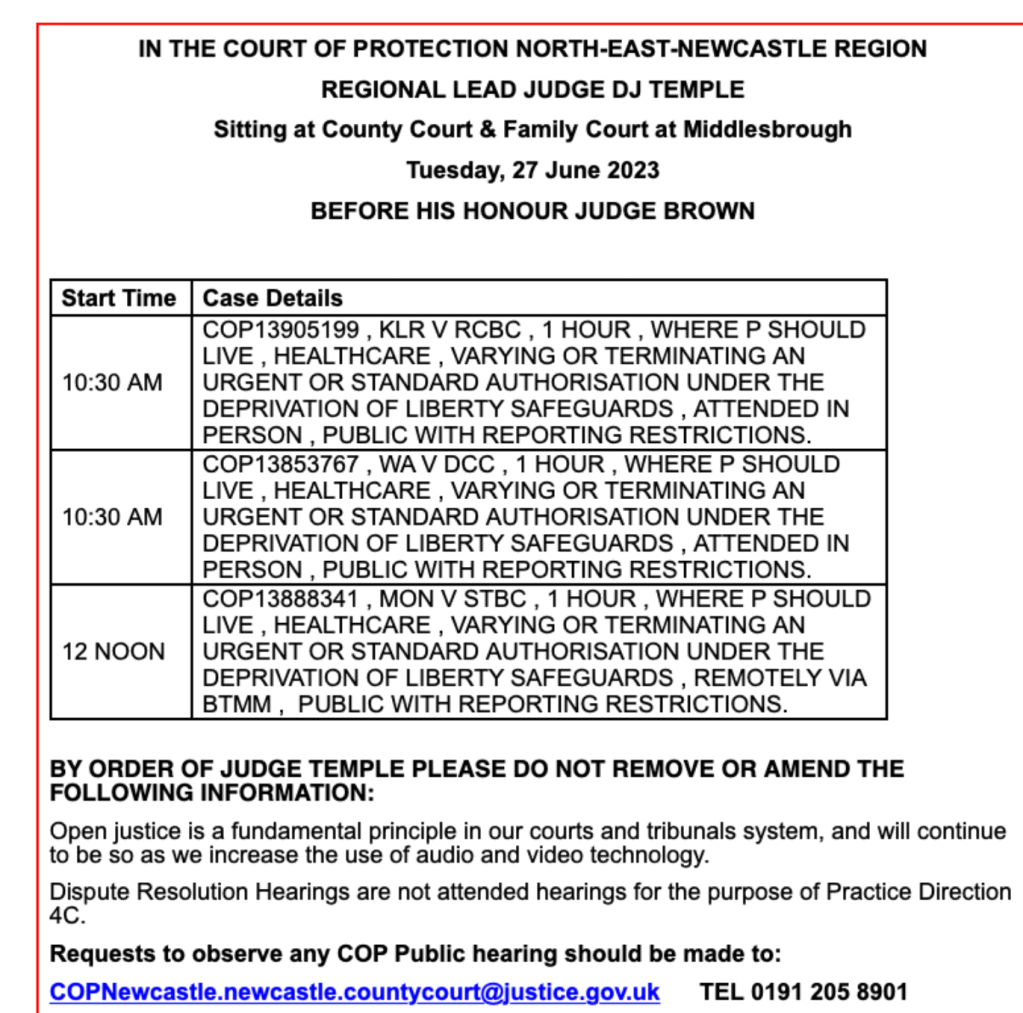
At 10:07 I got an email from the Newcastle Family Court advising that the hearing scheduled for 12 noon had been vacated. So, off again to find another potential hearing …
This time I found an 11:00 a.m. hearing at Luton County Court before Her Honour Judge Hildyard listed as ICB v CL Case Management Hearing – authorising a deprivation of liberty (in relation to e.g. care and residence arrangements) with a time estimate of 1 hour held remotely via CVP – which I now know is Cloud Video Platform – one of the online video systems used by the courts.

Now I know that ICB stands for Integrated Care Board, which is the successor organisation to the NHS CCG or Clinical Commissioning Group. For those unfamiliar with the organisation of the NHS, a CCG was a group of General Practitioners and employed CCG staff who decided how resources were allocated to provide NHS services in the geographical area that the CCG covered. But I wonder how many members of the public recognise the abbreviation ICB, never mind knowing what an ICB does?
Another request to observe email fired off at 10:28 a.m. – as I sent it, I wondered whether the HMCTS (Her Majesty’s Courts and Tribunal Services) processes and procedures would be able to respond in time for an 11:00 a.m. hearing? Could they arrange access to a public hearing via CVP in just 32 minutes?
Starting to despair about actually getting to observe a hearing, I looked once again at the listings and picked out a 12-noon hearing as well. This one was a hearing at Reading County Court before Her Honour Judge O’Neill and listed like this:
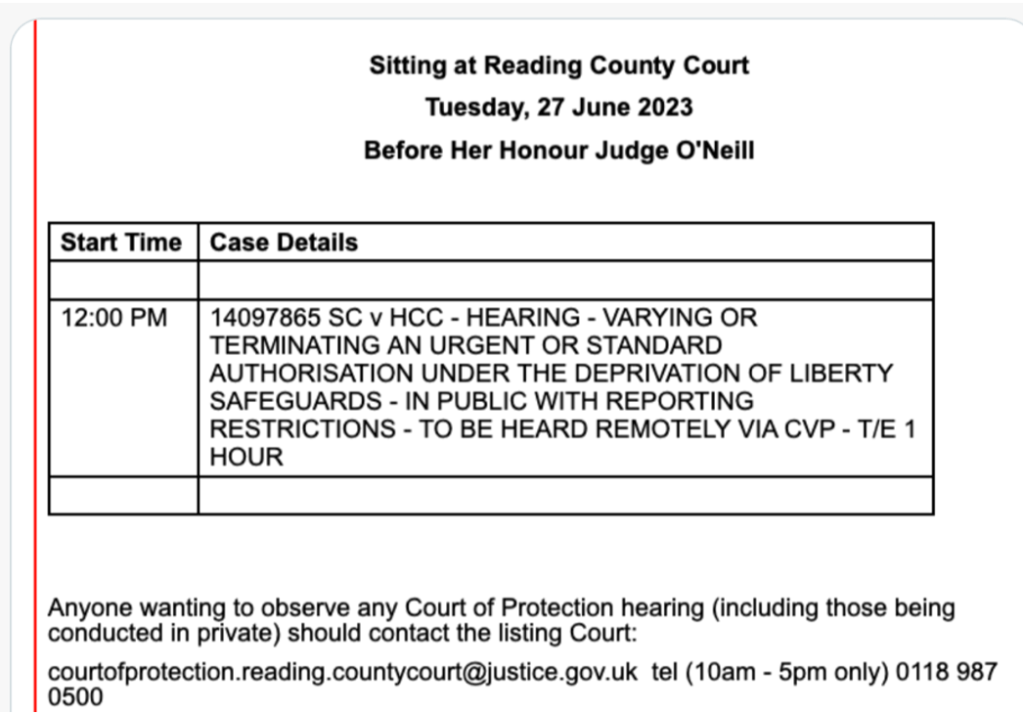
So, I dashed off another request email at 10:37 a.m.
At 10:44 a.m. with just 16 minutes to go before the scheduled start time for the 11:00 a.m. Luton County Court hearing before Her Honour Judge Hildyard, I called the phone number for the Reading regional centre on the listing and after a short, recorded message was transferred automatically to the HMCTS National Business Centre. Another recorded message told me that delays might be longer than usual because staff were being trained and then, of course, the music on hold … and on hold… and on hold …
At 11:12 a.m. I sent a copy of my original email request (made at 10:28 a.m.) to the alternate email address that I had found for the Reading regional centre, although I was not particularly hopeful that this would do any good.
I was still waiting patiently on hold but after 30 minutes on hold, and at 11:13 a.m., I decided to give up and accept that I would not be joining the Luton hearing.
Happily, in my unread emails was one from the Listings Section at Reading County Court, received at 11:05 a.m., with a link to the CVP hearing at 12 noon. (So only 28 minutes after I sent in the request and sent to me 55 minutes before the hearing starts). This email advised me that I would receive a further email to tell me when the judge was ready to start the hearing and not to join the hearing until I had received that further email.
Finally! I might get to observe a hearing. Now all I needed was to try and get hold of the Transparency Order, so that I would know what order (if any) had been made and what I would need to abide by. Difficult to know what you can or cannot do when you have not seen the order.
Then, would you believe it, at 11:24 a.m. I received a Microsoft Teams meeting link from Luton County Court. No identification of which hearing it applied to or who had sent the email. Just a meeting link with no further instructions.
Dilemma! What should I do? Should I just join the hearing (which I presumed was HHJ Hildyard’s 11:00 a.m. hearing)? Had the hearing started at 11:00 a.m. which would mean that I was joining some 24 minutes late, or had the hearing only just started? Rather than risk joining so late, and with so little information to go on, I decided not to use the link but to concentrate on the 12-noon hearing at the Reading County Court where I had received the link in good time and was just awaiting the second email which would tell me when to join that hearing.
I emailed back to the Luton County Court sender at 11:36 a.m. thanking them for the link but asking them to advise the Judge that I would not be joining the hearing at this late stage.
I then immediately (at 11:38 a.m.) emailed the Listings Section at Reading County Court asking for a copy of the Transparency Order for the 12-noon hearing before Her Honour Judge O’Neill, as I really wanted to read any Transparency Order prior to joining the hearing.
Luton County Court emailed at 11:42 a.m. to advise that the hearing before Judge Hildyard had concluded but had started late because an earlier hearing had overrun. My request to observe had not been received by them (from the regional centre, I presume) until they were about to start the hearing.
The Listing Section at Reading County Court also emailed at 11:45 a.m. to say that they did not know whether a Transparency Order or other Reporting Restriction was in place, but my request for a copy of any Order had been passed on to the COP section. This was followed very swiftly at 11:48 a.m. by an email from the COP section attaching a copy of a Transparency Order dated 14 June 2023.
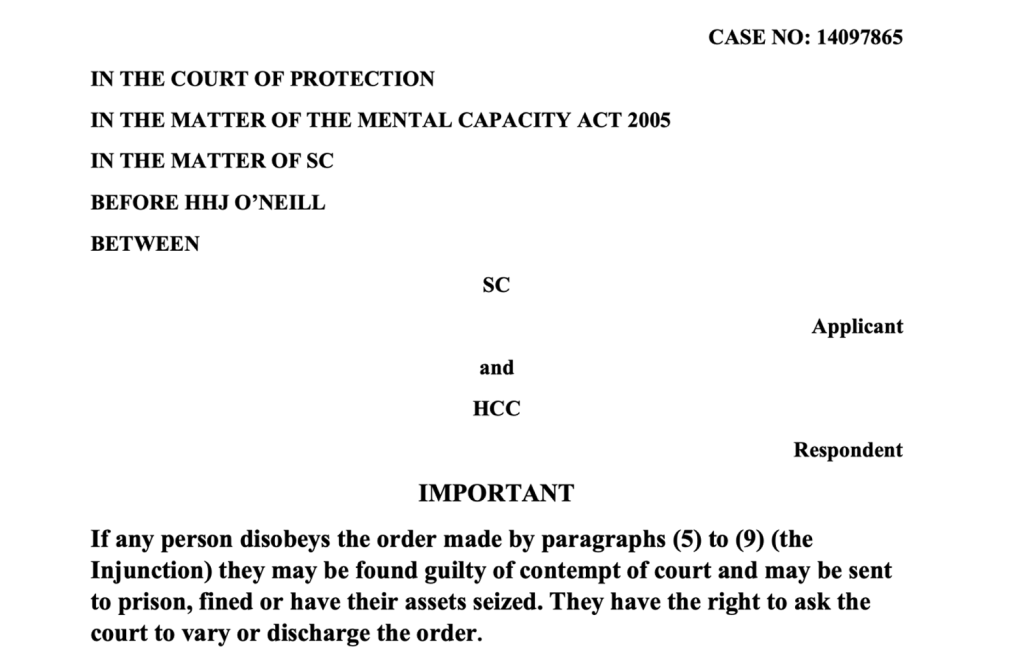
At last! Something to do with the law and the cases, and not just administration. I opened up the attachment and started reading …
At 11:55 a.m. I received the second email asking me to join the hearing and so, at last, we were off!
Joining the hearing
I took a deep breath, opened up the first email with the hearing link in it and clicked on the link. Microsoft Edge opened up a window (I use google chrome all the time, so had hardly ever used Edge but there is always a first time).
On the screen was a Welcome to HMCTS@meet.video.justice.gov.uk and a stern warning about not recording or transmitting any part of the meeting.
Below that was another box which read “Join from Skype for Business” and a button marked CLICK TO JOIN. I clicked on the “Click to Join” button. WRONG!
After a minute or two spent closing down a couple of windows and starting over again with the link in the email, I realised that I needed to scroll down past the Skype for Business box to the “Join from your web browser” box (hidden below) and then click on the button “www Click to Join”.
Finally, I had to enable my web camera and allow Norton to allow Edge to access the camera and microphone and I seemed to be joining a video meeting with 5 or 6 people already present. By default, both my camera and microphone were on as I joined. I quickly jotted down the names of the people shown on the screen and started to try and work out who they might be. When I realised that not everybody had their camera switched on, I decided to switch off my camera and also to mute my microphone as well.
The hearing
When I joined (at 11:56 a.m.) there appeared to be a discussion taking place between Thomas Metcalfe and Felicity Williams, who turned out to be the advocates for the applicant (“SC”, the protected party) and the local authority respectively. There were 4 other people present as I joined. One turned out to be the son of the applicant. I do not know who the other 3 people were, and the judge did not (as I understand is usual), ask for the people on the platform to be introduced and there was no introductory summary, despite the recommendation by the (former) Vice President that short introductory summaries should be provided.
Thomas Metcalfe is a solicitor from Simpson Millar. Felicity Williams is a barrister from Garden Court Chambers. Both specialise in Court of Protection matters, according to their respective firm’s websites.
At 12:02 pm Her Honour Judge O’Neill joined the hearing and introduced herself as Louise O’Neill. She advised those present that there was an observer, Mr Bell, present and that I was aware that a Transparency Order was in place. She then proceeded with the hearing.
At this stage I had no idea what exactly the hearing was about, so was picking up clues as the hearing progressed. I also did not at first realise who the parties present were and who the advocates were representing, so it was rather confusing to start with. An introductory summary would have really helped! Things became a little clearer as the hearing progressed.
The judge said something about the importance of SC (the applicant, with initials anonymised) being able to go home and asked the advocates what the position was.
Thomas Metcalfe said that there had been a pre-hearing conference and that a draft case management order had been agreed. There was also a mention of relevant works.
This turned out to refer to adaptions to the applicant’s property that were needed before she could return to her home.
Felicity Williams for the local authority, mentioned that an Occupational Therapist assessment was needed (and possibly other assessments as well – this was not too clear) and that an 11-week period was required for the assessments and the works to the property to be carried out. Adaptions were needed and there were issues with costs and how this was to be resolved.
So, it appeared that the issue was that SC was ready to go home but that the Local authority wanted more time for an assessment of what adaptions to SC’s home were required before agreeing to her transfer home? Whether SC was in hospital or in a care home was not clear.
The Judge asked if the whole family were supportive of the proposals. Thomas Metcalfe said that the family were all of the same mind and that they were a close family.
The Judge agreed that the ICB needed to be joined as a party to the proceedings and asked Thomas Metcalfe to arrange that. There was mention of “when the ICB come on board”.
The Judge asked for a position statement and said that she would need it at least 2 days before (presumably before the next hearing) in order to allow time to reflect.
At 12:09 the Judge said that the draft order looked fine.
Thomas Metcalfe said that attempts to make contact with the ICB had so far failed but he was trying to make contact. And that 11 weeks would be needed to have all the information ready regarding works and costs.
The Judge stated that she did not want the court process to contribute to any delays. If Thomas Metcalfe wanted an earlier hearing, then he should contact the court and file a COP9. The Judge formally gave Thomas Metcalfe liberty to request a hearing marked for the attention of the same judge and for an urgent or expedited hearing.
A date for the next hearing was discussed and agreed to be held in 15 weeks’ time. The Judge set the hearing for 16 October 2023 at 2pm via CVP with a time estimate of 1 hour.
Having spoken with the two advocates, the Judge then asked SC’s son, who was present (and apparently was represented [but I could not work out who was representing him]), if he wanted to add anything. The son said that it would be helpful to get the ICB involved as the people who had been involved from the CCG and who knew his mother’s situation were no longer there.
The Judge said to the son that there was nothing that she could do about the changes at the ICB but that, at least he would have the same judge involved.
The Judge then closed the hearing saying, “See you on 16 October, if not before”.
The hearing ended at 12:20 pm.
After the hearing
After the hearing finished, I reread the Transparency Order which basically protects the identity of the applicant, the local authority, and any family members.
I have to wonder whether it is necessary and proportionate to hide the name of the local authority and the name of any NHS organisation involved in the case. Clearly the identity of the applicant and the family should be protected, but would naming the local authority and the NHS organisations involve risk of identification of the applicant or the family?
I wonder whether I should consider making an application to have the Transparency Order varied, so that only SC and the family are protected from identification?
I then looked up the names of the two advocates and identified which barristers’ chambers or solicitors’ firm were involved. In one case I found an email address for the clerks at chambers. In the other case there was a form on the solicitors’ website and I left a message to be passed on to the solicitor.
Felicity Williams responded promptly and advised me that she had passed my request for a position statement and sight of the draft proposed order on to her instructing solicitors. I thanked her for her assistance.
I also sent an email to the Listing Clerk at Reading County Court thanking him for his assistance and letting him know that, by referring me to the COP section as he had done today, his action had produced the Transparency Order that I had requested.
I have yet to hear back from Thomas Metcalfe’s firm.
Reflections
First, I realised how much time and effort is expended both by someone requesting to observe a remote hearing, and also by the many court administration staff involved in trying to arrange public access remotely to any hearing that actually goes ahead. I was also surprised by how many hearings were cancelled at the last minute – given the scarcity of resources, both court staff and judiciary. I wonder what the reasons are that hearings are cancelled so late? I understand it’s often because the parties agree the order “on the steps of the court” (see Last-minute vacated hearings in the Court of Protection).
It was also clear that the process of submitting a request to observe and the way in which HMCTS staff deal with those requests is not exactly streamlined. An email request to a regional centre, passed on to a local court listing clerk, then to the COP section, probably then to a clerk to the judge, referred to the judge, then back from the local court to the requester. And this for a request where the default response ought to be (for a public hearing not requiring judicial permission for attendence) simply responding with an email link to the hearing and notifying the Judge.
Second, I was most impressed by the atmosphere in the courtroom and by the attitude of Her Honour Judge O’Neill. The Judge showed real concern for the welfare of the applicant (who was not present at the hearing) and was clearly very keen to ensure that the situation was resolved as quickly as possible so that SC could return to her home.
Third, the proceedings were less formal than I have witnessed in other court settings (such as magistrates, crown and county courts) and more closely resembled a structured discussion between interested parties about how best to assist the applicant to return to her home. The Judge was quite clearly directing the proceedings and, from time to time, issued a formal statement or ruling. But for the most part the atmosphere was relatively relaxed, although the Judge made it clear at times that she was very keen that the applicant was able to return home just as soon as practicable. I am pretty sure that the parties got that message.
Fourth, It was quite difficult joining a hearing where the other parties had substantially more information about the situation than I initially had. Sight of a position statement or a quick verbal summary of the current position by either the Judge or one of the advocates, together with a list of the issues that were before the court would have helped me to understand the proceedings much better. It would also have helped to have known at the start of the hearing (after receiving the Transparency Order) just who the parties in the hearing were. Ideally, I would have liked to have been provided with a copy of the draft case management order that was being discussed. Because the parties had basically agreed the majority of the points prior to the hearing, there was little discussion of the actual contents of the draft order during the hearing.
Fifth, I want to comment on the language used and the initialisation and abbreviations. One of the complaints I always had of NHS meetings was the impenetrable deluge of abbreviations which only serve to reinforce the “us” and “them”: the professionals who had grown used to the abbreviations and knew some or all of them on the one hand, and the public who were baffled by the NHS-speak.
Things are not quite as bad in the Justice field (as far as abbreviations are concerned, at least), but there are still times when a different choice of words, or a few added words, could make meaning so much clearer to a member of the public who does not necessarily have a legal background. There is no real problem in saying “the matter is vacated” if you also add “which means that there will be no hearing today”. If you must use a technical term, then perhaps it is worth remembering that the “public” may not have the vocabulary needed (particularly the legal vocabulary) to understand and to follow, and it can make all the difference if some time is taken to ensure that communication happens.
But, overall, I would say it was a useful and enjoyable experience. There was certainly no intimation at all that this was a “secret court”. On the contrary, the welcome from the Judge to an observer and the openness was quite refreshing. I will be making more time in the future to try and observe some more hearings in the Court of Protection.
Many thanks to the Open Justice Court of Protection Project without whose sterling work (including collecting and publishing daily details of COP hearings) and encouragement, I would not have been tempted back in to the Court of Protection.
Peter C. Bell is a law student at the Open University. He tweets @dolphinpcb


A wonderful read of your first foray into the world of observing proceedings – thanks for sharing!
On Thu, Jul 6, 2023 at 8:07 AM Promoting Open Justice in the Court of Protecti
LikeLike