

By Clare Fuller, 17th April 2025
In the following blog, I’m going to combine two experiences of the same event written contemporaneously and originally as separate pieces. The event is a hearing in the Court of Protection and both experiences are mine.
In Part 1 I describe abortive attempts to obtain a hearing link.
In Part 2, I focus on a public rebuke from the judge and the impact this had on me.
As in all events, there are multiple lenses these experiences can be viewed through and unseen reasons behind actions. I have no doubt there were human factors at play in both scenarios.
Neither experience supported transparency or open justice in the Court of Protection.
Part 1 Open Justice Denied: A Frustrating Attempt to Attend the Court of Protection
This morning, I had what I can only describe as a non-experience with the Court of Protection. It was to have been my eighth opportunity[i] to observe a hearing through the Open Justice Court of Protection Project — a valuable part of my professional development as a Lasting Power of Attorney (LPA) consultant and Advance Care Planning Educator. But despite my best efforts, I never made it into the virtual courtroom.
Observing Court of Protection hearings helps me to understand where Lasting Power of Attorney arrangements can go wrong, where they are challenged, and how I can best advise my clients to avoid distressing disputes later on.
Each hearing I’ve attended has offered rich learning: insight into legal reasoning, the lived experience of ‘P’ (the person at the centre of the case), and the ways families and professionals can work either in harmony—or, sadly, in conflict. Which is why today was so disappointing.
I was alerted by a direct message that there was to be a hearing involving an application to revoke Lasting Powers of Attorney. This felt pertinent to my roleand I was keen to learn more. I rearranged my diary commitments and plans, freeing the potential three hours to be present, and requested the hearing link.
This is the email I sent at 09.07am that morning.
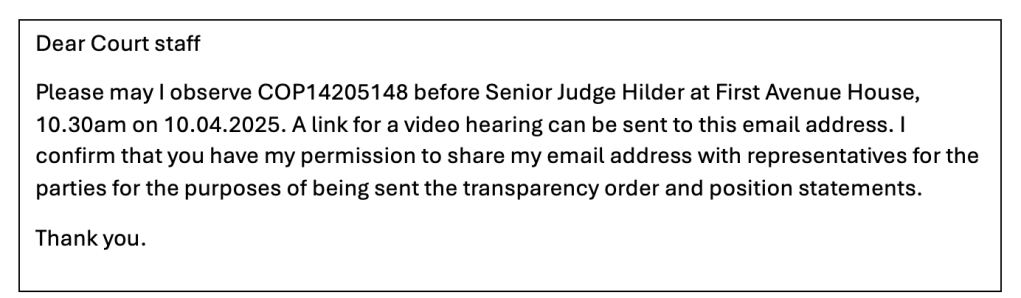
I also started work to blog about the hearing using the Open Justice Court of Protection Project Hearing Feedback template. From previous experience, I know how valuable it is to join a hearing up and ready to go.
In the lead-up to the hearing, I also joined the WhatsApp group for observers. WhatsApp Group support is an initiative that I have not accessed the previous times I attended a hearing and I found it tremendously valuable. I understand the concept of using WhatsApp groups developed recently as a way of providing support for the people observing Court of Protection hearings. Reading the WhatsApp messages made me aware that one observer had been sent the link but two others hadn’t.
As the listed start-time of 10.30am approached, time I became worried that I still did not have a link. I checked in with the WhatsApp group to make sure I had sent my request to the correct email (I had) and I re sent my request.
I sent a further request, this time marked as urgent.
Timeline of a morning that went nowhere
| Time | Comment |
| 08:33 | I received an X direct message alerting me to a hearing. I replied immediately to confirm I was available. |
| 09:07 | I sent my official request to observe the hearing via email, using the Open Justice Court of Protection template. |
| 09:53 | I sent a second request via email, this time also asking for A Transparency order. |
| 10:15 | Still no email link. I waited, hopeful. |
| 10:24 | I re-sent my observation request. |
| 10:37 | I marked a third request as urgent. |
| Meanwhile | Within the WhatsApp group, it became clear that only one of the four of us had successfully received a link. |
| 10:46 | No link received. I gave up hope of attending the hearing. |
I had been actively trying to observe this hearing for over 90 minutes. I didn’t want to log in late, potentially disrupt the process, or feel like an intruder. But I was deeply disappointed. I’d set aside time, prepared myself mentally and professionally, and was eager to witness justice in action.
Instead, I was left in limbo.
The whole aim of the Open Justice Court of Protection Project is to make the court’s vital work visible; to shed light on the complex, sensitive decisions being made about some of the most vulnerable members of our society.
But openness isn’t just about permissions—it’s about access.
Today, I was willing, prepared, and enthusiastic—but still not admitted. It doesn’t feel like open justice when observers are left behind because of administrative delays or communication breakdowns.
I understand the complexities. I appreciate the pressures. But I hope the system can be improved, because attending hearings really does help professionals like me to support families better, to understand the law more deeply, and to advocate more effectively for those whose voices are often least heard.
This morning, justice was happening somewhere—I just wasn’t allowed to see it.
I thought my story and blog would end here. But there is a sequel.
Part 2 A Troubling Experience with the Court of Protection
I originally wrote the piece that now forms Part 1 of this blog when I believed I had lost the opportunity to attend a hearing. You’ll see from the timeline of emails that I first requested access approximately two hours before the hearing was due to start—a detail that’s important in understanding what followed.
What happened next was not just frustrating—it was uncomfortable and unsettling, and left me with a poor impression of the Court of Protection. Here’s what happened, and how it made me feel.
At 11:03, I was informed by the WhatsApp Observer support that the court clerk was aware of my request and that a link would be sent. Although I knew proceedings had already started, I felt it would be discourteous not to join after time had been spent arranging the link. Other observers from the Open Justice Court of Protection Project had already been admitted by this time. I don’t know what time they made their requests, but it would be interesting to reflect on what difference, if any, that may have made.
This is the email I received at 11:06:
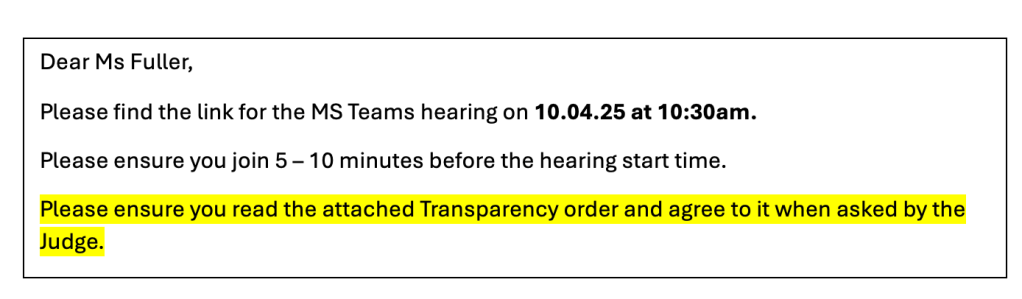
When the email arrived, I read the attached Transparency Order immediately, so I could confirm I had done so if asked. I joined the hearing at 11:07, with my camera off and sound muted, as I knew was appropriate. I was prepared to confirm that I had read the order.
What I was not prepared for was what happened next.
The hearing began as expected, with Judge Hilder asking me to switch on my camera and microphone. I complied, confirming I was alone and had read the Transparency Order.
Then, things shifted quickly. Within moments, Judge Hilder addressed me sharply, describing late access requests as disruptive and advising me to “consider that, in the future.” This was done in front of all present in the court. I was stunned, embarrassed, and humiliated. It felt like I was being publicly told off for something outside of my control.
I had requested to join at 09:07, more than 90 minutes before the hearing began. Yet I didn’t say this. I didn’t explain that previous hearings had started late, which had shaped my expectations. I can’t even remember whether I said sorry—I simply acquiesced.
In the space where I had planned to take notes on the hearing, I instead wrote: “I feel discombobulated, anxious and humiliated. Joining late also means I have missed the introduction and any summary – I feel on the back foot, anxious and without full understanding through no fault of my own.”
Reflections
I am grateful that I have had six positive experiences as an observer in the Court of Protection and acknowledge that if this had been my first experience it may well have been my last.
I still don’t understand:
- Why I wasn’t sent a link in a timely manner
- Why, once I did join, I was made to feel so unwelcome and uncomfortable
The impact on me was deeply unpleasant. I had to accept a public rebuke for something I felt was not my fault. Even more concerning, I missed crucial early parts of the hearing and struggled to focus due to the emotional impact of the experience. My fight-or-flight response kicked in, crowding out the calm, attentive state needed for observation and reflection.
I want to be clear: this is not the norm in my experience of the Court of Protection. I share this not to put others off from attending, but in the hope that it might help prevent a similar situation in the future.
Conclusion: Key Learning Points
- Timely access is critical: Requests to observe hearings should be acknowledged and acted upon promptly to ensure meaningful participation.
- Respectful communication matters: Public rebukes, especially for issues beyond an observer’s control, can have lasting emotional impact and undermine trust in the process.
- First impressions are powerful: For those new to observing, an unwelcoming experience could discourage future engagement with the justice system.
- Transparency requires support: Open justice must be paired with effective administrative processes and respect to be truly effective.
Clare Fuller RGN MSc is a Registered Nurse with 30 years’ experience in End-of-Life Care (EoLC). She has worked in hospices, the community, and acute sectors as a Clinical Nurse Specialist, and at a national level as a Consultant Nurse for the Gold Standards Framework. Clare is a CQC Specialist Advisor for EoLC and a Lasting Power of Attorney Consultant. Clare is also currently advising as a Commissioner for the Parliamentary Commission on Palliative and End of Life Care. Clare is the owner and director of Speak for Me which helps organisations to improve EoLC and provides professional and public education about Palliative and End of Life Care and Advance Care Planning. Clare campaigns for proactive Advance Care Planning and hosts the podcast Conversations about Advance Care Planning
Footnote – previous hearings I’ve blogged about
[i] Bearing Witness: Anorexia Nervosa and NG Feeding;
Lasting Power of Attorney: Across Borders
Capacity to make a Lasting Power of Attorney
Reflecting on Re MW and Advance Planning: Legal frameworks and why they matter
What happens when Lasting Power of Attorney goes wrong?
Decision-making with clarity and compassion: Validity of LPAs and appointment of Deputy
The logic, law and language of Lasting Power of Attorney: A case before Hayden J
.
 Promoting Open Justice in the Court of Protection
Please do not take this the wrong way and I understand why you felt you could not respond to what the Judge had said. However had you corrected him then it would probably led to him apologising and backing down. You could always try to now rectify the position by sending an e mail for the attention of the Clerk to Judge Hilder and ask that they pass it on to the Judge and in it explain all your prior attempts to get a link to the hearing
LikeLike
There should be a feedback process for the judiciary and associated processes, not about questioning their decisions but dealing with their conduct when fulfilling their role. I have seen solicitors reduced to tears over the years I’ve been in Tribunals, patients belittled and silenced, blatant bias towards particular witnesses, and some seriously rude behaviour at times too. Among MHA administrators there’s a quiet culture of knowing who the “difficult ” judges (and other panel members too, not just judges) are but I have rarely seen anyone do anything about it, because of fear I suppose? MHTs are now recorded, so there would be objective evidence to check, that ought to apply across the board.
LikeLike
Judges are mostly welcoming to observers and these are exceptions. Without condoning them in any way, it’s important to understand why they happen.
In my experience, when things go wrong it’s often because of delays or errors from HMCTS staff (who have rapid turnover and training needs), which have knock-on effects for observers – and then judges assume (wrongly) it’s our fault. So Clare Fuller was sent the link late, after the hearing started, and chastised by a judge who misattributed responsibility to Clare for a late request.
Similarly, back in November 2024, a novice observer asked for the link to a hearing listed for 11am before HHJ Beckley (who, like HHJ Hilder, is usually very good at promoting transparency and open justice). She received the link in a timely fashion, but with a message saying the hearing would begin at 12 noon. Someone more experienced might have thought to double-check this (“can I confirm the start time of the hearing, because you tell me noon, but the listing says 11am), but this novice observer assumed she had the most up-to-date information and waited until shortly before 12 noon before logging on – only to find the hearing was finished. She then received a message: “HHJ Beckley is sorry that you were unable to attend this morning’s hearing as an observer. There may be various reasons why you could not attend, and he doesn’t need to know them. He would like to point out that an observer request creates work for very hard-pressed court staff and for either an advocate or judge to prepare an introduction to the case for the observer’s benefit”.
The would-be observer was devastated – both to have missed the hearing and by the implied rebuke in the judicial response. HHJ Beckley absolutely did need to know why this observer could not attend, and I made sure he became aware of it.
I absolutely appreciate that observer requests create work for HMCTS staff, for lawyers and for judges. They also require an input of time and energy and commitment from members of the public – including those of us who volunteer for the Open Justice Court of Protection Project as well as the would-be observers who contact us. The effort put into court observations, from all parties, makes it particularly disappointing for all of us when things go wrong.
Given the constraints on funding and staffing of the justice system, I think it probable that there will continue to be errors and delays in communication. When judges hold public observers responsible for errors and delays, and respond to observers in ways that are experienced as humiliating and upsetting that is undoubtedly an indication of the levels of stress and time-pressures that judges are experiencing. It is nevertheless unhelpful and serves only to sabotage our shared commitment to transparency in the Court of Protection. I hope judges – as the people with most power in this situation – can set the standards of civility for all of us.
LikeLike
I was the Whatsapp observer who notified Clare that she was going to be admitted to the hearing late. I knew because I too had been sent the link and was admitted late, despite having requested the link the evening before, as soon as the listing for the hearing came out. I’d received a message from the Clerk apologising for being sent the link late, saying that there had been technical difficulties sending links. I then replied thanking him, but pointing out that I knew about another observer who had also requested the link but who hadn’t received it. I honestly didn’t think he would act on that, I was pointing it out so he could try to get to the bottom of why she hadn’t been sent the link.
But as I was observing, I saw the clerk interrupt the hearing to tell the judge there was somebody else who wanted to observe. I knew this was Clare. The judge expressed her frustration at people sending in late requests but said she would allow her to join. I then saw the dressing down the judge gave Clare when she joined. I was mortified watching it all unfold.
I understand that it makes life harder for court staff to manage requests to observe and I know he was genuinely doing his best. I’ve observed Senior Judge Hilder before too, and usually she is welcoming to observers. I think it’s a shame that this time she jumped to the conclusion it was the observer’s fault and not due to technical problems.
Observers don’t want to become distractions. I’ve been to hearings in person and people do enter and leave the court room during hearings. I’ve also observed hearings remotely where people join and leave as the hearing is progressing, particularly for hearings that are whole-day hearings. I don’t think observers should be discouraged from doing that, within reason.
Senior Judge Hilder always asks observers individually if they are alone and have read and understood the transparency order. Not all judges do that, they use other methods.
I think judges and clerks should agree in advance what processes should be in place for admitting people to a hearing that has already started. Although I fully support open justice, maybe in this instance it would have been better for Clare not to have been admitted than to be embarrassed in public as she was.
LikeLike
LikeLike
Clare I am so sorry this happened to you – and not through any fault of your own. I have had several similar experiences, one very recently. This also happened to a trainee of mine who I was supporting to observe. She never did observe another hearing.
I wrote a blog about this very thing several years ago and, sadly, not a lot seems to have changed in terms of assumptions being made when access goes wrong – the observer gets the blame!
Having said that, it is the exception not the norm in my experience. It always seems to me to be in response to stress and frustration at the administrative processes which, at times, might feel a burden to court staff, advocates and judges alike. Resourcing and stability of court staff is a huge issue I know. Open justice and transparency aren’t just lofty ideals though are they? They must be met with active engagement on all sides to make them a reality. It’s a shame that judges – with a tremendous amount of power – at times, make assumptions about why an observer is arriving late or asking for information in a way that they think is not timely. I would hope that judges – of all people – would pause to be sure of the evidence before accusing someone of wrongdoing. HHJ Hilder, in my experience, can be quite stern as well as fair and she has always been very supportive of open justice, explaining at length the proceedings for the benefit of public observers. Something went seriously wrong in your hearing and needs to be addressed behind the scenes. As commenters above have said, civility and conduct in public office are vital. This goes for judges as well as public observers.
My own recent experience was with HHJ McCabe in March. As well as requesting the link to observe, I had (as we in the Project always do) requested the TO and for the judge to give permission for the parties to share their Position Statements with me. I had emailed in plenty of time for the 11am hearing (given that hearing listings are only released between 4-5pm the night before – a fact that I think some judges, including this one, are completely unaware about). When I was admitted to the hearing (in good time) the following happened:
counsel for the Local Authority told the judge that he had no objection to me observing and that I had asked to receive Position Statements
The judge quickly and irritably interjected, saying: “I don’t know when you asked Ms Martin … these requests need to be raised far in advance … it’s a pretty unfortunate way to go about it … [telling off tone – v unpleasant] we are well into the hearing and we have important matters to discuss …..” [the hearing has just started] {These were my contemporaneous notes}
Like you I felt told off and humiliated. I was the only public observer at that hearing, with a small number of others on the call (5, plus the judge). I also said nothing, despite the fact that the judge addressed me by name and was (in my view) unfairly accusing me of being tardy in my requests to the court and essentially hampering the “important matters” of the court. Of course, I understand that the hearing for P is very much the most important aspect of proceedings – which is why I had emailed in plenty of time within what’s possible for an observer. If the court wants observers to request to observe, or request documents, “far in advance” then those involved in managing proceedings need to work out a way for observers to do so. Open justice and transparency are a stated ‘fundamental’ judicial aspiration – it is their responsibility to ensure that their own systems facilitate this aspiration.
I do hope that this doesn’t happen to you again Clare, and would definitely say that it is an exception. We as public observers do not ‘own’ this problem, and it is never acceptable to be unfairly admonished in public in this way.
LikeLike