

By Amanda Hill, 5th December 2025
“It’s his own home”. That’s what the mum of the protected party (I’ll call him “JC”) told the court. JC has been living in his current home for about 10 years, but listening to what was said in this hearing, it didn’t seem much like a “home” to me.
JC has been diagnosed with severe learning difficulties, autism and PTSD, and has significant care needs. He is currently being cared for by a care provider that I can’t name, with care commissioned by a Local Authority (LA) and an Integrated Care Board (ICB) that I can’t name either, due to the reporting restrictions in this case.
And after this hearing he will continue to be cared for by the same provider, because there is no other option. The judge, District Judge Matharu, made it clear to the family that she has no authority to order the LA and ICB to commission a different care provider for JC. And the LA and ICB position is that there is no other available option.
What is particularly shocking about this case is that there is CCTV from August to November 2024 that (according to the LA and ICB) “raised concerns”[1] about JC’s care. These include employment of staff without the relevant expertise, who failed to offer JC appropriate occupation and stimulation, and “the timeliness of interventions when JC soiled himself/the floor, staff sleeping, or inappropriate use of their phones and other matters”. The public bodies say that this has now been investigated, safeguarding referrals completed and changes have been made. The Position Statement for the LA and ICB states “Some staff have been removed from his care package. Others have received final warnings and further training”. These “others” are still caring for JC.
The family, who first raised the concerns on viewing the CCTV, are appalled by what happened and there is a “near breakdown of relations between the care provider and family members”. Both JC’s brother and his mum referred to what they had seen as “abuse”: they wanted a change of care provider.
JC’s brother and his mum wanted the judge to view some of the footage. In trying to persuade the judge to look at it, JC’s brother said, “A picture paints a thousand words and there are thousands of words in the bundle.” His mum added that the “CCTV makes JC human, not just words on a page”. But Adam Fullwood, of 39 Essex Chambers, representing the ICB and LA, argued that the judge didn’t need to look at the footage, because Mark Caulfield, the court appointed Independent Social Worker (ISW), had. He’d had “unfettered access.” The judge initially said that she would look at “a couple of incidents …. with nobody else in the courtroom” because the family had asked her to. In the event, the way the hearing panned out, I don’t think she did. She did, however, acknowledge the gravity of what the CCTV contained.
In an unusual move that I haven’t seen before, the judge, DJ Matharu, arranged for the sealed order to be drawn up immediately, at the end of the hearing, and it was printed out (by the judge herself) for the family. Afterwards, the judge made what she called “final observations”. She said (as best I could capture it):
“That concludes the hearing except for the following …I don’t want comments or responses. ..For the benefit of everyone, this isn’t a win or lose for anyone…. The position the court was in was that there was no alternative option (to staying with the current providers)…. To the credit of those involved in (JC’s) care, after video footage … steps have been established to provide a better environment .. .. As much as (mum and brother) look to the future ..I want the carers to collaborate and make them feel heard (the judge stressed these words). (Mum and brother) have demonstrated throughout …..and Mr Caulfield confirmed ….what loving people they are …(JC) has had a lot of trauma and, it may not be appropriate for me to say, but so have (mum and brother) …. Hopefully the Working Together Agreement and CCTV protocol, by doing what it says on the tin, may restore hopes for (mum and brother)… There can be no doubt that (Mum and brother) are not going away (the judge said loudly and firmly, looking at the public body staff sitting at the back of the courtroom) …. Mediation is a fresh platform …. I’m grateful to you both.” (looking at mum and brother).
But the care provider that I can’t name will remain responsible for JC’s care for the foreseeable future. There is no other current option. Many people would find this shocking, I imagine. Nobody has been held accountable for the abuse, apart from the carers who are no longer caring for JC because they have been suspended or dismissed. And JC’s mum and brother haven’t received an apology for what happened, either from the public bodies or the care providers, as many fair-minded people might think would be the decent thing to do given the circumstances. I saw a family fighting to ensure the best care and environment for their son and brother going forward and a family making compromises to ensure that “trust” – a word used, according to my notes, at least 22 times in this hearing – can be re-established.
I observed this hearing, COP 12683557, in person in Manchester. It was listed to last for three days, from 10th – 12th November 2025, but in the event, for reasons that will become clear, and to the family’s dismay, the hearing was over by 1pm on the second day. On the first day, I sat at the back of the courtroom with a journalist who is interested in this case. She has got to know JC’s mum and brother very well. I learnt that she had observed an earlier hearing that I tried to observe remotely but couldn’t, because the court didn’t provide a link.
It was at that previous hearing, in July 2025, that the Transparency Order (TO) was amended to include restrictions on naming the LA and ICB. This new restriction also means that I can’t cross-reference two previous published judgments in the case or make any explicit connection between those previous judgments and the way the case has evolved over the years. The Position Statement from JC’s Litigation Friend, the Official Solicitor, refers to “…a long and complex history; there are historic and seminal judgments…about JC’s mistreatment and unlawful behaviour of statutory bodies……To a degree, and by way of an observation, the severity of those historic concerns may have caused the family members to continue to mistrust the statutory bodies and care providers”. To provide context to the issues of trust, the LA now is the same LA as in those historic court proceedings (proceedings which are already in the public domain).
The court’s decision to ban me from referring to the previously published judgments poses a very significant obstacle to transparency: it’s a serious infringement on my Article 10 rights to report, and the public’s right to understand, this case in the context of what has previously been reported about this family in Court of Protection proceedings. The effect of the TO is to sever this hearing from the previous proceedings.
I was going to write a fairly short blog post, briefly outlining the hearing. But as I started to write it, I realised that in order to do justice to the hearing, the process and the outcome, I need to describe in detail what happened. This has therefore turned into a very long blog post. I’ve tried to report what people said, typing as quickly as I could. But my notes won’t be entirely accurate as I don’t touch type or use shorthand. I believe the value of approaching the blog in this forensic way is that it shows not only how a Court of Protection judge tried to deal with a situation where her hands are tied, legally, by the absence of options, but also to try to give a flavour of what it was like for the family involved, who had no legal representation and took part as litigants in person. I don’t know whether the journalist will find a way to report on the hearing; the press often want to use names in their reporting and the reporting restrictions in this case are extensive. I think it’s important that there is a record of what happened, and the issues it highlights – that’s why this blog is so long.
I asked Gill Loomes-Quinn[2] to read a draft copy of this blog, to get her perspective. She believes that this hearing is an archetypal case raising two fundamental issues with which the COP is routinely faced: (1) Limitation to “what’s on the table” and the relative impotence of the judge in the formulation of ‘best interests’ decisions where resource implications are engaged (the key authority is N v ACCG & Ors [2017] UKSC 22); and (2) The ‘David and Goliath’ character of the position of litigants in person – especially when these are family members versus public bodies.
After reporting the hearing, I’ll reflect on six aspects: what makes where we live a “home”; establishing a standard of care; the value of an experienced Independent Social Worker; the courtroom environment; judicial review and finally, power.
The Hearing 10th – 11th November 2025
Day 1 – Monday 10th November
The start of the hearing
This was a final hearing, originally listed for three days, so that the judge could hear evidence and make a decision as to what residence and care would be in JC’s best interests. Very early on, though, it became clear that there was going to be a change to that plan.
The listing for the first day, 10th November 2025, appeared like this:
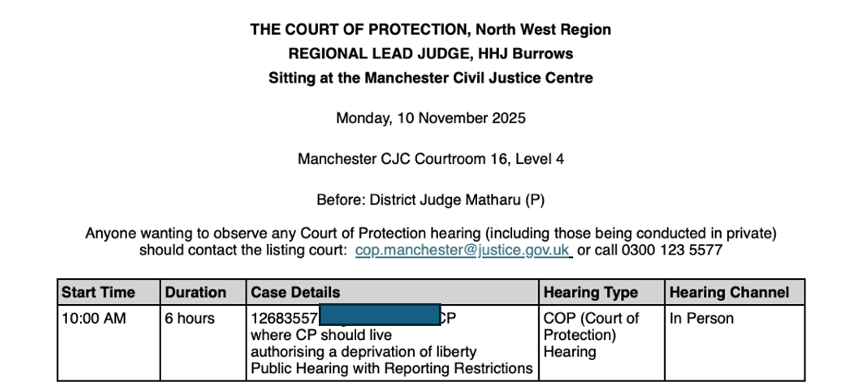
You’ll notice that I’ve had to redact the public listing. That’s because the publicly available listing included the name of the LA, which I’m not allowed to name. It states that the hearing was about where JC should live and authorising his deprivation of liberty. But any possibility of JC moving from his home was only very briefly touched on. The hearing ended up being about a final order authorising JC’s Deprivation of Liberty, a CCTV protocol and a Working Together Agreement. A primary focus for the judge became the issue of re-establishing trust between the family, the public bodies and the care provider.
Those of us who were waiting in the waiting room, including JC’s mum and brother, were shown into the courtroom at 10.40, some 40 minutes after the scheduled start. The judge was already sitting at her bench. But there was a problem as some of the legal team weren’t there, due to a massive queue to enter the building and go through security, because of enhanced security checks (I’d had to wait 30 minutes myself and even had to open my laptop at security). As we waited, the preliminary discussion was whether the judge was going to view the CCTV footage. She eventually agreed to view two incidents during her lunchbreak and the hearing then turned to the substantive issues. By this time, everyone who was due to be in court had arrived. I noticed four females enter and sit on the backrow of the courtroom, alongside the journalist and me. I realised later that these women were from the ICB and LA. Somebody else pulled up a chair from the benches and sat on the far right – this was Mark Caulfield, the ISW. The courtroom was small; apart from the judge’s bench and a clerk’s bench in front of her (which was unoccupied) there were two wooden benches where the legal teams sat and a row of chairs at the back.
There was no opening summary or introductions so I had to figure out quickly who was who and what was going on, as best I could. Adam Fullwood was representing the ICB and LA (so he was wearing two hats) and behind him were two instructing solicitors. Sam Karim KC, of Kings Chambers, was representing JC via his Litigation Friend, the Official Solicitor. (For simplicity, I will refer to him as Counsel for JC). A representative from his instructing solicitor was seated behind him. JC’s mum and brother were on the right of the front bench. The judge, as is common for District Judges, had no court staff to support her in the courtroom. She rang staff outside the courtroom during the hearing, when she needed something, such as asking for water for JC’s brother.
No available options
Attention immediately turned to available options for JC’s care. The only option for commissioning by the LA and ICB was from the care providers already providing JC’s care. Counsel for the applicants put it this way: “You’ve got to grasp the nettle of what you’ve got”. JC’s mum and brother struggled to understand this. They’d thought that, after hearing evidence, the judge would make a decision about whether JC’s care should be transferred to another provider, but as the judge said: “I can only work within those confines”. The judge can’t order public bodies to commission an alternative provider if it isn’t an option on the table. The question arose as to whether the hearing needed to last for three days, and whether all the witnesses should be called, if there was only one outcome possible.
Mum stated that the family wanted the current care provider removed and an Individual Service Fund (ISF)[3] arrangement put in place, with new care providers, rather than being commissioned by the LA, who she said she had “battled with” for 20 years. The LA was committing only to a review of whether an ISF was possible, with a decision by February 2026. The judge said she was “sorry to butt in” and that she was “clear of your position but it is a matter of law and I can’t change….. do you both understand it’s not an option?..…I can only as a matter of law deal with what’s available”. I thought her tone was like the firm tone I used to use as a teacher, when a class discussion needed to move on.
A very short while later, her tone changed dramatically. The judge said to JC’s brother “I’m going to take my judge hat off and ask you personally – are you ok?” The courtroom was exceedingly hot and it became apparent that JC’s brother was feeling ill. The hearing was clearly taking its toll on both JC’s mum and brother. Mum became tearful. She mentioned “abuse” and JC’s brother said, “We know what decent care is and we know what abuse is …sorry judge”. The judge then said “I can see how you are looking and it is a useful reminder for me how this is affecting the family, but my focus is solely on JC.” Mum replied: “We see a paucity of care; it’s not care, it’s provision”. The judge referred to her case management powers and said she was deviating from the court timetable. She said she was worried about a three-day probing process on the family, and the impact on them of this, if the outcome was effectively pre-determined and nothing was going to change. She did say that “people have been suspended and people have been dismissed” but also that “this is only option and is in JC’s best interests that everybody works together.”
She continued, speaking to JC’s mum: “You are a fierce advocate …. I cannot change (the care provider)…I can only change where we go from here ….if I can help today (she stressed) I’m going to be very straight with you; I can’t change mindsets. But the trauma it’s causing you….…three days of court time…..I’ve probed and I’ve considered …that’s what’s going to happen.” She then reflected on whether she should “rise” for a few minutes, to see what could be done with the judge’s “input” – she said she was exercising creative case management. Mediation was mentioned.[4] The judge did add that there was no pressure on the family to agree to the suggestion of a shortened hearing, as there were three days of court time allocated. It was clear to me, though, that the judge really didn’t envisage a three-day hearing anymore.
At that point Counsel for the applicants stood up. He suggested “one further go” at a way forward to see “if any good can come out of this for JC”. He proposed a ‘Working Together Agreement”, later referred to simply as a WTA. The family being “encouraged” (some might say, including me, “pressured”) to move forward from the past was a key feature of this hearing, for the public bodies and the judge.
As there were not going to be decisions about care, remaining issues for the court were the proposed CCTV protocol, the Working Together Agreement and mediation.
The CCTV Protocol: involvement of family
The judge left the courtroom at 11.25, so about 45 minutes after the hearing had started. I noticed Counsel for JC going up to the family and letting them know that they could leave their belongings in the courtroom. We were called back in at 12pm and the judge was already sitting at her bench. I saw her smile at the family as they came in.
Counsel for the applicants addressed the court first. He referred to the working together agreement and raised the “utility” of a fact-finding hearing[5] to establish what had happened in the past – but he argued that wouldn’t be in JC’s best interests: “there is no utility in doing that” and suggested setting out a framework going forward.
Counsel representing JC then made his submissions. He said that he had had a conversation with the ISW and their view was that it would be good to have a conversation with JC’s mum and brother to discuss the benefits of mediation …”regarding care and residence, it is in JC’s best interests to remain there, there is no other option ….even if we have three days of hearings.” He stated that a working together agreement “seems to be agreed” (as a way forward) which would outline the roles and responsibilities of family, carers and the LA. There would also be a CCTV protocol which would cover who was going to be the data controller, who would have the key to the cupboard (where the CCTV is stored, I gathered) and who should be present when the CCTV is viewed every quarter. It was the suggestion of the ISW that there should be confirmation of who has logged on to view the CCTV due to the family’s concerns.
The judge stated that the current proposal with regards to the CCTV footage going forwards was that the family would be excluded from viewing it and they would only get an outline of its contents from the people who viewed it (so from the LA I think). Those people would bring concerns to the family’s attention. This became a point of contention, however. The judge continued: the family “may say that ‘if we hadn’t seen what we have seen …’. I’m saying this for the Official Solicitor ….these are JC’s safeguards. ” The judge seemed to be suggesting that the family would not trust what they were told about the CCTV footage if they hadn’t seen it themselves.
Counsel for JC replied that “The LA have heard what you have said.”
The judge then stated “There is some force in what they (the family) say, that’s why we’ve got here. We are trying to move forward without upset and heartache. I’m trying to deal with what I think they are going to say.” Counsel for JC proposed that “the family can be there when it is viewed” subject to a protocol and the judge replied “That’s what I’m suggesting, to move forward…”
Counsel for the applicants stood up and submitted that a report would be sent to the family unless there were concerns about the standard of care, in which case the family would be told and then brought in to view the footage, so they would not be excluded. He said that mum was visiting regularly (the court had earlier been told that JC’s brother was not visiting regularly due to the distress it caused him). Counsel for the applicants argued that it was not a case of the family being excluded. He then suggested that things “…cannot proceed on the basis that (it is suggested) the care provider and public bodies are going to tamper (with the CCTV footage).” He used the word “micromanage” in terms of the court’s role. He also stated that the ISW was in court, so the court could hear directly from him.
I saw the judge rub her forehead. Addressing the family, she said “I’m trying to find a managed way here …I adjourned for 30 minutes so you could get some fresh air and understand what is happening. You’ve heard about ISF, that’s now going to be looked at, for a realistic update by February so that’s …”. JC’s brother said “progress” and the judge agreed. She then said “We have to have something in place for the CCTV protocol”.
A Working Together Agreement
Mum then spoke. She said it was “a step forward. With regards to the Working Together Agreement, she said “We’ve always tried to work together. We have viewed horrendous, despicable footage” and some staff are still there (caring for JC).
The judge then asked mum how she thought a working together agreement would work. Mum said that she would try and work together. But she was worried. She told the court she has taken “an audio recording in to try and protect myself.” She explained: “I’m an older woman…..there are three six-foot-tall guys…it shouldn’t be like that …it’s JC’s home ….it shouldn’t be like that ….”. She indicated she felt intimidated. Mum is in her late sixties.
JC’s mum continued, saying that there is a female carer (whom I will give the pseudonym Mary) that she trusts and who was due to give evidence. She is a “whistle-blower” and should be protected, according to JC’s mum. Mum was concerned Mary would be laid off by the care providers for being a “whistle-blower”. About the proposal to exclude family from viewing future CCTV footage, she said “Our concern is that they will determine what is abuse ….I don’t trust the social worker to identify what is abuse.”
The judge summarised: “So, to break it down, you are going to work with…” (the carers) and mum replied: “I’ve always been polite.”
The judge then gave her views on the CCTV protocol, taking into account the two reports written by the ISW. She thought it was important the family were involved. She said, “I can’t build trust on your behalf” and “I can’t give you the gift of trust.”
She continued: “I’m trying to be neutral but ……….the CCTV is going to remain in place, it is part of JC’s life to protect him …and if things happen, you are going to be told and will see it …and for your worries and concerns that it will be tampered with or removed, I will speak further to (counsel for the applicants) and I’m satisfied that there is a safe mechanism. That’s the best I can do, isn’t it?”
Mum replied that it was about safeguarding JC.
At this point, Counsel for the applicant made a new proposal. He suggested that an independent IMCA[6] be appointed by the LA, who would be present at the CCTV viewing, and who would be “really independent.” The judge found that “helpful” and added that “the IMCA will be there on behalf of JC on a long-term basis.” JC’s brother said that it was a way forward.
The judge then moved to the subject of “Mary”. She addressed Counsel for the applicants:
“….Mr Fullwood, it may be out with my jurisdiction …I was (told about Mary) …I’m treading carefully but being open ….she (Mary) has a great attachment to JC, because she was going to come to court …she might feel some sort of employment risk or intimidation…I’m choosing my words carefully …out with my jurisdiction …..”.
Counsel for the applicants replied that “She is an employee of (care provider)… I have no evidence she’s been threatened in any way …judge can check …she would have come to court …but we don’t understand there is any impediment to her coming to court …it is a serious allegation to make ..she is not an employee of the LA.”
Dogs
The judge then brought up the subject of dogs. “I know I shouldn’t micro manage, but I may have to be practical in my role today…mum has two dogs and I have read in the witness statements that JC likes dogs …I’ve read that some staff don’t feel comfortable with dogs ….I’m not interested in their comfort ….If JC likes dogs …..”
Counsel for the applicants stated that these were “large dogs potentially running amok in a property” and making a mess. “We are hearing from the care provider that this is a problem, and the dogs are not being controlled as they should be” and that wasn’t to the benefit of JC. The judge replied, “I am not making findings….the dogs are retrievers (mum confirms they are two labradors, so hardly XL Bullies, I think to myself) and if JC wants to see those dogs he should be allowed to.”
Counsel for the applicant responded, “I take the court’s point ..as much as can be done, should be.” And the judge replied, “That’s all I’m asking for.”
There is case law about dogs and people who lack capacity. According to Ian Brownhill, the most famous dog in the Court of Protection is “Bobby the Dog”: (Mrs P v Rochdale Borough Council & Others, [2016] EWCOP B1). Ian says in a webinar[7] that the judge in that case was “clearly an animal lover” and she recognised the importance of pets to people who lack capacity. Paragraph 29 from the judgment reads as follows: “It may seem to those not well rehearsed in the needs of a person who owns a pet, in this case a person who no longer has capacity to make decisions about various matters, what the importance of a pet is in their life. The deputy only has to read any single reference in reports, assessments or statements of Mrs P of how important Bobby is to her. Her Social Worker says in her witness statement to the court that:- “I would recommend that of single most importance in her life is her dog and having some form of contact with her dog in the future if possible.” The judge in that case? It was DJ Matharu!
Mediation[8]
The judge continued. She said “The IMCA is a useful tool” which she was sure the Official Solicitor would support. “Mr Karim, there has been progress on the Working Together report, the CCTV protocol will be refined….have I overlooked anything on behalf of JC?”
Counsel for JC outlined some issues to be clarified and then moved to mediation: “It seems on behalf of the Official Solicitor that the recommendation made by the ISW is a good one ..JC has complex needs ….and (has been) looked at by the court for 15 years ….perhaps (we can) find a way in which the public bodies and family can work together on behalf of JC’s best interests.”
The judge asked more about mediation, whether it would be now or in the future and Counsel for JC replied something about depending on a “change of commission and provider…. ..mediation ..if there have been mistakes…” at which the judge cut in and said:
“You are being polite – there have been mistakes.” (Judge’s emphasis).
The judge then summarised the position, addressing the family:
“I don’t want you to think that I don’t want the three days (for the hearing)…I don’t have the jurisdiction to (give you what you want ) ….I’m not removing responsibility for either of you but somebody independent (the IMCA would become involved) …you heard what I said about Mary, and the dogs …..I can ask you, but I can’t compel you,…. but mediation would be something …I think it can be a very good thing …looking again at the notes I took…this is not a criticism or berating you, but when you’ve been through everything….. when you are saying what you feel…”
My reading was that the judge didn’t want to put the family through what she saw as a demanding process for them if there would be no change of care provider, and she was trying to work through what could be achieved.
Mum replied. She said that friendships are so important for JC, the care is rigid…it does not allow for flexibility and friendship: “He’s living in his own home, it’s got to be a home …(they, the care provider) are trying to treat JC’s home like another supported living place ..it’s his own home …he has human rights, to develop a friendship ..there is no creativity (re care)”.
The judge had her hand resting on her jaw as she looked at JC’s mum and brother, listening intently.
JC’s brother said the carers were systematically removing…..and encroaching….removing things he loves …the care providers had goalposts but (they) have moved back, to restrict his life.
Hearing the views of the Independent Social Worker
The judge then made a proposal. She suggested asking the ISW to give his views, to comment and “tell me what this judge should do.” About the CCTV protocol, for example.
Counsel for the applicants said he agreed with the judge’s proposal to hear from the ISW but that family wanting to view the CCTV footage “……has come back to a lack of trust.”
I heard mum sigh loudly.
The judge said to the family “I need to hear from somebody independent, to you, to (the LA)…. I want to try to future-proof JC’s care. That applies to everybody, the two of you, the two of me (by which I think she means the OS and her) and the LA” (raising her voice).
The ISW went to the witness box and was sworn in by the judge, as she had no clerk.
The judge stated that it had been “a curious route” for him to be in the witness box. She continued: “You have heard heartfelt views (from the family about JC’s care) ….the hurt they feel on JC’s behalf …you’ve viewed the footage, met the family …the reason I have put you in the witness box is to understand why a new approach from everybody is required and how that can be workable ….I’ve been involved with the family for a number of years …”.
The ISW said he will do his best to assist the court. The judge asked him about the appointment of an IMCA and he thought that was an excellent idea which will enable a “greater degree of accountability and transparency.” The judge stated that it takes “transparency to build trust” and asked “How does one build trust in this sort of situation?”
The ISW said that the family hadn’t been invited to meetings and that “happens with the Court of Protection….I have no vested interest.. the family are the most dedicated I’ve ever come across …I have met professionals who want the same …I worry ..not worry …I’m trying to choose my words carefully …the difference between professionals and the family …they have different views about how to achieve goals but all want the same goal …I didn’t get a sense that nobody didn’t want that”. That’s why he suggested mediation and talked about “some slack in the system”. He thought the situation was more rigid but “solutions have been found …sorry judge, I don’t want to ramble…but I think they had a degree of faith in my independence and, I might be wrong, but in your independence.”
The judge then said that she may be “putting a label on it but – are we at make or break?”
The ISW replied “Regardless of what happens today, things are going to change in JC’s care, but when people (are in the same room) and can compromise, things can change.”
It was then Counsel for the applicants’ turn to ask the ISW questions. He started by saying that he was going to ask about what can be done to improve trust. He asked if it is the ISW’s professional view that a Working Together Agreement can improve relationships and the ISW replied yes, if it’s adhered to. Counsel then turned to the issue of the CCTV protocol and the appointment of an IMCA. The ISW replied yes (to the suggestion of the IMCA) because of their independence, and that the suggestion has been put forward by the public body to increase accountability and transparency.
Counsel for the applicants then turned to mediation: “Can you say why, and be clear to the court, why it would be a benefit for (mum and brother)?”
The ISW replied that the family “have a long history of not being listened to” and that he understood their position. “But you never know what is going to happen until you get in that room…impartial person in the room…and mum and brother would say they want a social worker they can have trust in, that would be their ultimate goal..”
Counsel for the applicants then stated that the LA is “inviting the court to make an order that JC will receive care provided by (current care provider)” and what the ISW’s view was on whether they can meet JC’s needs. The ISW replied that there is a “disparity in terms of evidence and degree of certainty” but he “is satisfied the care plans will meet JC’s needs for the next 12 months.”
Counsel for JC via the OS asked the ISW about the CCTV protocol, and the advantages and disadvantages of the family being present when the CCTV footage is viewed. The ISW replied that there was the advantage of the family not being there in that there would be no “interference”. But there would be a disadvantage too. The family know JC particularly well, including his “…idiosyncrasies”. JC shows distress that the family can identify that the professionals wouldn’t spot (even if there was lack of agreement about what is abuse or not). Counsel for JC then stated that a disadvantage of them being present would be exacerbating a lack of trust. The ISW responded by saying that there was a possibility of increasing conflict when viewing (together) but it may be a way of developing relationships. “I did not specifically explore that with the LA (viewing with family present) ..but I support family being present…if It’s a regular review I don’t anticipate it being a challenge”. Counsel for JC asked if a quarterly review would be ok and the ISW replied “yes, if concerns are dealt with judiciously”. He mentioned “activities”, “faeces” and “urine”.
Counsel for JC then asked the ISW: “Are JC’s needs being met in current placement?” and the reply from the ISW was “yes”. “And in the future, if there were to be a change of provider, what would you recommend regarding better relationships between family and professionals?” The ISW mentioned co-working and involvement of the family, hence the suggestion of ISF. “Mum and brother don’t feel listened to……there are polarised views on care and I see that continuing (without a change of provider)”. But he said that he has seen some improvements. He said “Concerns were raised in 2023, 2024…difficult to make argument that care needs are being met ..but to provide balance, I am satisfied…. finely balanced on the basis of probabilities, that JC’s needs are being met …..the family have greater control and the ICB and LA can ensure that JC’s needs are being met.”
There was a brief exchange about how contact between JC and his brother could be facilitated and the discussion turned back to mediation as a way of improving relationships. The ISW said “When people have concerns about care …especially as a social worker, I have seen improvements even with the same providers.”
The judge then asked mum if she had anything to say.
Mum asked the judge if she could stay sitting down. The ISW and mum smiled at each other and she called him Mark. She started talking; talking about trauma and how she feels the need for a new start ..that’s why talk of ISF gave her hope……..
The judge asked her to ask the ISW a question.
Mum asked him, “How do you justify his needs are being met when he can’t go out in his car?” The ISW asked for guidance from the judge, as he was being challenged to answer something anecdotal in court. The judge replied, saying that both Counsel had asked him if the “package was meeting JC’s care needs, and mum is saying that they don’t; she doesn’t understand how you could say that, in the round, if he doesn’t have access to a car.”
The ISW replied by saying that there are always occasions when there are absences (of a driver)…mum and brother are saying that it is endemic and if that is the case, then that is a significant part of his care …”and when I spoke to the care provider, they said a car was a part of his routine and P used (going out in the car) for self-regulating …P can’t access the community any other way, so a driver is a significant part of his care plan…but the absence (of a driver) would need to be systematic.”
Mum mentioned about looking at the car through the “lens of P’s care” and the judge said she would deal with it.
Mum carried on. She said that ISF would be a fresh start. But I could see that she was finding it hard to speak. “..I want to clarify ..sorry judge, I had so many questions …trying to put a question .. Catalyst provider ..I want it clarified who Skills for Care really is … I’m sorry judge, I’m not phrasing properly “. The judge asked mum to pause and addressed the ISW: “The LA have said they are going to look into it. So, if they have “got the wrong end of the stick”, if I can put it like that … that would come out in the wash, wouldn’t it?
The ISW replied “Yes.”
The judge continued, saying that the LA say they will come back by Feb…as an interim stage, they will do their homework (about the possibility of ISF).
Mum then said: “I’m not a lawyer, I’m just a mum …care isn’t about being perfect, it’s about being good.”
The judge summarised her position. “What I’m trying to do is provide some progress with the only tools I am given …I asked the ISW to provide evidence about building trust up …Mr Fullwood, you are going to have to take instructions on this…I am minded to direct, so far as I am able, mediation …it is not an arbitrary, nebulous concept …I’m going to be prescriptive ….about who should be there, otherwise it is not going to work, and perhaps an agenda of sorts , using what Mr Caulfield has had to say …to next mediation meetings and achievable targets ….first item is P’s car…difficulties with agency workers … I’m not asking the ISW to deal with (all the issues in his report …(my aim) is to try and see how we can work together going forward.”
A leap of faith
The judge accepted that the morning had not proceeded in the way the plan for the hearing had been put together but she said she was trying to work towards “a new start and provide the engagement of everybody”.
She then addressed the family. She said I have to (express myself) myself in legal language even though you aren’t represented …..”mediation requires a leap of faith …the LA are going to provide (the means) but it also requires the two of you …what does “leap of faith” mean? It means going in with an open mind … I can only direct it, if you two will give it a go.”
The judge was asking the family to agree to mediation and to consider it over lunch. The judge reiterated the view of the ISW, after a comment by mum about hearing more evidence (I think): “He has said this is not the best (care provider) but it’s all we have … at this moment in time, these are the only care staff available …so I can probe, but it is the only care team available.”(judge’s emphasis)
The judge also wanted mum to understand that, by offering the appointment of an IMCA, the LA were also making a compromise, after mum stated that the family have compromised, and are willing to compromise in the future.
At that point, at 1.30pm, the court rose for an hour.
Discussions between the parties took place before everyone came back into court. The Local Authority proposed one organisation to act as mediators and the judge wanted to find out what the family thought. She said again: “I can’t compel mediation …are you prepared …to explore (mediation) …to take a “leap of faith?” JC ‘s brother replied yes, although “it’s going to be hard for us, (this) has taken its toll on us.”
The judge replied, “We aren’t going to leapfrog into …(there are) certain tweaks I want to make …but the fact that you are prepared to give it a go is a great thing for me.”
Making a decision about who views future CCTV footage
The judge then suggested to Counsel for the applicants that there was something he might want to seek instruction on; the ISW has said that he doesn’t see why the family can’t be at the CCTV footage reviews.
Counsel for the applicants said that he didn’t have a chance to question the ISW on that, but the purpose was safeguarding and that’s the LA’s responsibility and not the family; “Mum says she just wants to be a mum ….there are practicalities …..it could make relationships worse …but can I say this? If you decide this is what should happen or give an indication…..”
The judge replied: “I have to tread carefully …if I give indications….”. Counsel for the applicants suggested that she could ask the OS what her view was. The judge replied “I’m trying to do this collaboratively …do you want to ask the ISW?”
To this suggestion, Counsel for the applicant said that the ISW (looking at him) “would say the responsibility is the public body and he is nodding …..but if the OS has a clear recommendation, I will take that into account.”
As Counsel for the OS doesn’t have instructions on that particular point, his solicitor leaves the court to find out what the instructions would be.
The Judge then made a decision. “I haven’t made findings because of the possibility of making a rift bigger” and she doesn’t want to set things up to fail … “when I look at the expectations… it might it be advisable not to have the manager (who was named[9]), but a client manager trying to manage the new relationship…”.
Counsel for the applicants said: “We can make enquiries …(the named manager) would be the obvious choice.” He said the concern was that the LA could come up with somebody else who would be opposed (by the family).
The judge said, “If we could do that today, that would be very helpful”. She then talked to the family and asked them if they could suggest anybody ….the family suggested a compliance officer who they have some faith in.
The judge recognised that she was micromanaging, “which people say isn’t the role of the court, but some cases demand it, and this is one of them”.
Counsel for the applicants referred to the “WTA” and the judge stated that she was trying to find somebody the family could trust to be a client manager. Counsel for the applicant asserted that the “key is communication …the mediation process starts with building blocks, so the focus could be how to improve communication with everybody …to avoid “misunderstandings” and the judge responded by saying she agreed with “incremental improvement.”
The judge said, “ I hate this expression but a “meet and greet of the IMCA”, part of WTA, Working Together Agreement, such as a rota of activities, because that is such a big thing. And part of that is JC and his car” so there would be …”achievable markers”.
Counsel for the applicants stated that the “…background needs to be disclosed (to the IMCA) but not enough to colour the chances of success.” The judge agreed that everyone needed to be concerned about JC’s privacy.” She asked the family if they understood what was happening at the moment. Mum started speaking ….. “I think an apology is in order ..but enough is enough, I want to move forward, it is sad where it has got to, but we are ready to move on.”
The judge thanked the ISW: “Your input has been very useful; you have seen the fruits (of your work).”
The ISW replied: “For me, what would assist, as an addition to the formal mediation, are friends and family in the community being part of JC’s life, managers coming together with family ….greater (care provider) presence …having a JC day, training days, using expertise about the best ways to work with JC – that seems to have been lost in this conflict …a training day, with an independent facilitator to input into a PBS[10] process, an undertaking from mum and brother….part of mediation.. if I’m allowed to say this, the local authority won’t fund mediation indefinitely and there are meetings that mum and brother should be a central part of …I realise this is disputed but with (previous carers), there was a relationship, and the best care packages (have good relationships) as long as they are within boundaries and professional guidance.”
Counsel for the applicant responded, “I don’t think anybody would disagree with what you’ve said.” He asked the ISW to confirm that mediation would give greater reassurance that the package of care was in JC’s best interests. The ISW confirmed his view that it would.
Counsel for the applicants continued, asking about the family sitting in on future CCTV viewings: “Would you agree that (viewing CCTV) is to review the quality of care and that is the responsibility of the LA …and there are consequences if the family sit in?”
The ISW responded that it was a challenge “…and I don’t think I said this as a disadvantage …but there has to be a framework …for example, if mum raises a concern and it is not reviewed…it would need to be triangulated (evidence) …(it’s about) building trust and transparency, as long as it does not interfere……”
Counsel for the applicants responded by saying that one of the difficulties was about building trust, and is it an indication that the family don’t trust (the process) if they are there …what if an independent IMCA is there?
The ISW replied that it “is a compromise ….and subject to review”. I notice that the judge isn’t writing notes at this point but is looking at the ISW as he’s speaking.
Counsel for the applicants stated that the court was still awaiting instructions from the OS, but was it his view that an IMCA would satisfy regarding the fairness of the system? The ISW replied “Yes”.
Counsel for JC then questioned the ISW. He asked the ISW “Is it still your view that the gold standard is family involvement and, in their absence, an IMCA is an acceptable option”, which the ISW confirmed was his view.
Counsel for JC then asked the ISW about mediation and the family viewing CCTV. He took his time to answer. His reply was “I don’t think it is a prerequisite to mediation, but it would be helpful (to provide trust) – I think – CCTV being available.”
The judge then asked the ISW: “I think there is a risk of a degree of separation if the family aren’t involved (in viewing CCTV)?”
The ISW replied yes, but it depended on the challenges of family being present …”.it is difficult to say, judge …everyone on an equal footing ..steps should be made to allow family input”
The judge continued. And the independent IMCA, it is going to take some time for that trust to be established between the family and the IMCA? The ISW agreed.
The judge went further: If they never get to see what their son and brother (is doing) ….“How do you think that fits in with this degree of trust we are trying to build?”. The ISW replied, stating that a different contact for them within the care provider, somebody they had more trust in, would help negate them not being there to view the CCTV footage.
The judge observed: “So some creative thinking…….but that would still be your preferred option?”
The ISW replied “Mum goes in every single day; no professional has that degree of contact …and sometimes what she observes doesn’t tally with what she hears, so it is difficult to square the circle, and I would be the same ….so for example, concerns have arisen because mum has seen faeces and urine, and she doesn’t trust the staff, because they haven’t always been accurate …..and that’s why my preferred option is 1) family and 2) IMCA.”
The judge turned to the family and asked if there was anything that arose from the questions she’d asked the ISW, or that they thought she hadn’t asked. JC’s brother replied no and said that the questions had been “poignant.” Mum added that there was a duty of candour, that she wanted openness and transparency and that she wanted to move forward.
Counsel for the applicants then spoke, saying “In the spirit of being candid, and on behalf of my client, people being there is not to find fault”, and he raises “practical arrangements”. (He refers to practical difficulties which arose to do with the ISW viewing the previous CCTV footage). He suggested that the data controller gave everybody 4 weeks’ notice of the review of the CCTV footage.
The judge asked “And you are proposing that this meeting is everybody?”
Counsel for the applicants replied: “I’ve made my submissions on behalf of my two clients …I’m trying to anticipate difficulties …it’s a small point but can be an important point”. He mentioned …”4 weeks’ notice” and that it doesn’t have to be both family members, for example JC’s brother has work commitments.
At this point, Counsel for JC informed the court that the OS supported, for transparency and good working relationships, that either JC’s brother or mum should be there (to review the CCTV) in JC’s best interests.
The judge then turned to the family, and said: “You’ve heard, one or other of you must be able to attend and if perhaps if one or other of you couldn’t make it”….(the IMCA could be there). The family agreed. Counsel for the applicants then stated that perhaps the IMCA should be there for every meeting and there was a discussion as to who should be there for the care provider, and the judge stated that the detail needed to be pulled together and used the term “least worst option”. She brought the discussion to a close, saying “that deals with the CCTV protocol and the WTA client manager”.
Agreeing the Court Order
The judge’s attention moved to the court order. She suggested a 6 month for a review of the Deprivation of Liberty authorisation “and to see how it’s going. You’re going to say the court doesn’t have the authority……but a review earlier than 12 months might be better.” The judge was giving a clear indication that she wanted a review after 6 months. After the instructing solicitor looked at the people from the public bodies, Counsel for the applicants agreed on 6 months. The judge explained to the family that judges can’t “hang onto cases” if a final order is issued and she suggested a 6-month review was possible and if all is going well, she thought that they could have a hearing “on the papers”, that is, without anybody attending.
The judge then goes through the detail of the order, the family are asked to look at the website of the organisation the LA will fund for mediation, to make sure they don’t have any objections. After the judge went through the detail of the order, at a little before 4pm, the judge rose. Counsel for the applicant had to draft the agreed order. The plan was that the order would be approved the same day.
But mum was still thinking about the process. After about half an hour, we went back into the courtroom. Mum had spoken to Counsel for JC during the break. She still wants Mary to give evidence. Mum asked the judge: “What’s your advice? I’m not a lawyer.”
The judge replied: “I can’t give advice ….a 3 day final hearing was listed, so that I could explore and probe what care JC was receiving …and to explore that, you were going to call witnesses and I was going to spend 3 days exploring …and Mr Fullwood said, to help people who weren’t represented, he said that you can explore but there is no other option …the evidence is in the bundle ….but there won’t be cross examination ….there are things that need improvement …I aired worries about Mary in open court …but as to what happens to her evidence, I don’t hear from them, but I have read their evidence …3 days of challenges to you and the care company, when the outcome is going to be exactly the same. We are trying to have a different way ahead …would that have been the same after 3 days of acrimony and resentment on both sides? …I have no jurisdiction to change the care team …I could have said that I’ve looked at the video and Mr Caulfield has looked at the videos …..and they accept that there does need to be a different approach, a different programme of care, and of you not being made to feel welcome and treading on egg shells …what is that going to achieve when I can’t change anything? …What I’m hoping for, with this collaborative approach …I’ve never seen JC’s brother look so ill….I’m weighing up, and that’s not my role, what is the best outcome for JC, because I can’t remove the care company …..we move two steps forward and fifteen steps backwards ..We have a document that works for everything …I just want what’s best for JC …..what would (witnesses) have achieved? I’m looking for a period of time when, in 6 months’ time ….so for people who aren’t represented, does that provide any clarity?”
JC’s brother confirmed that it had. JC’s mum said that they needed to read the order. The judge said that she would print the order when it was ready so they could read it. We left the courtroom again. My impression is that the court’s preference was for the family to agree to the order and accompanying documents (the CCTV Protocol and the WTA) before the end of the day, so nobody would have to return the next day.
The lawyers spent time drafting the order in a consultation room as the rest of us, including JC’s mum and brother, waited in the waiting area. We were called back in at 5pm. Counsel for the applicants had emailed the order to the judge, and she left the courtroom to print it out.
My notes at this point record: I wonder why the barristers can’t explain it to the family as we are waiting ….we are all sitting in silence now. It feels like a very long day.
The judge came back with the printed papers, and we all left the courtroom again. JC’s mum and brother went into a consultation room to read them. Counsel for JC joined them. At 5.30pm we headed back into the courtroom. JC’s mum and brother look very tired.
JC’s brother told the judge that “Sam (Karim) has politely talked us through the order”. But the family were not happy with the wording of the Working Together Agreement. They felt that the wording was slanted against the family, and the judge said she also had some concerns. She added “It’s been a long day and I’m sorry”. JC’s brother said that if they are moving forward and building trust, the way the document is phrased (raises issues). The judge said that it was “not based on any findings….but there are a couple of tweaks I want to make (too).” It was agreed that the parties would arrive for further discussions at 9.30am the next day, with the second day of the hearing due to start at 10.30am.
The judge thanked the family, and the hearing was finished for the day. It was approaching 6pm and Manchester Civil Justice Centre was virtually empty as we all left.
Day 2 Tuesday 11th November
Initial discussions
The next day, we were called into the courtroom at 10.45 and the judge was already sitting at her bench. Counsel for the applicants had his two instructing solicitors again and today there are three rather than four ladies from the public bodies sitting in the back row. Counsel for JC is accompanied by his instructing solicitor. JC’s mum and brother are on the front row. I sit on the back row behind them. Today neither the ISW nor the journalist are there. The journalist had told me the previous day that she couldn’t be there as she had other commitments.
Counsel for the applicants told the judge that the parties “have been busy”. The draft order was agreed but there were issues with the Working Together Agreement. He thought, being optimistic, that they needed 20 minutes more. The judge asked the family if they wanted her to deal with the CCTV protocol then, but JC’s brother says they wanted everything to be dealt with in one go.
Counsel for JC told the court that the Official Solicitor was neutral on the WTA and that it was not drafted in a way that was implying that a party had “done something”. The judge wanted “everyone treated the same way.” She suggested that in the preamble to the WTA, it was written that the recorded provisions “are not based on findings or culpability on any findings” because I haven’t made any comments …I don’t want to use word appease…”. JC’s brother suggested the word “alleviate” and the judge thanked him. Counsel for the applicants then suggested a form of words but was speaking so quickly I couldn’t note them. The judge liked the wording and said it was “clearer and more precise”.
The judge then stated “for openness, the journalist approached me yesterday to ask for the approved order…….she’s not here today”
Counsel for the applicants then said something about “yesterday’s news” and smiling, he looked at the public bodies staff sitting behind him on the back row. The judge smiled too.
JC’s mum asked if some evidence from JC’s two GPs could be considered (they had sent her an email overnight). Counsel for the applicants said he thought they had looked at all the evidence and were “looking forward to the future.” Mum replied that it was looking forward. The GPs wanted to put forward to the court how important it is for JC to have the family as advocates in his life. The GPs have known JC since he was 4. The judge asked whether the GPs are supporting family involvement and mum replied that it’s about the best model of care that JC should be receiving from a clinical, emotional and social level, and she is confused about why they (the GPs) have not been brought in and their advice not sought. The judge asked if it is a medical issue and mum replies that it is a holistic issue…they are writing it in the best interests of JC. They sent it in an email to her as “he doesn’t know how to submit (it), I just got it last night, it is not supporting the family, it’s to give a view of the medics of what’s best for JC.”
Counsel for JC stated that it “might be best to see it” and the judge agreed. Counsel for the applicants said that he couldn’t say anything until he has seen it. The judge commented that she didn’t know what impact it would have on the Working Together Agreement.
We left the courtroom again at 10.55, so that the parties could have further discussions. We are called back in at 11.45.
Working Together Agreement – Back to the dogs, and “items”
Counsel for the applicants told the court that there is “good news and bad news.” The parties had agreed the order and the CCTV protocol. They had agreed everything in the WTA except one substantive issue (the dogs having access to the paddling pool in the garden) and one clarification (about bringing items into the property).
Counsel for JC stated that the paddling pool issue was a difficult one. The family say JC enjoys seeing the dogs and “My learned friend says he doesn’t enjoy it”: the Official Solicitor had “no strong view”.
The nub of the issue was that the care provider say the dogs shouldn’t go in the paddling pool because it isn’t hygenic. JC’s brother explained what happens. The dogs go into the kitchen as their main area, and they are let off their leads. They then play in the garden and will inevitably go in the paddling pool, not in the spa which is in the house. JC sometimes gets in the pool after running around without shoes on, and has played in the pool with the dogs. Mum adds that since he was a small child, his dad created a pool and he has always gone in a pool with the dogs. He has always had dogs in his life, he has been brought up with them. The family don’t want restrictions on the dogs. If the dogs aren’t allowed into the garden, they will only be allowed in the kitchen.
The judge asked about the type of pool, and JC’s mum explained that they are blow up paddling pools, he stands in them, and only his feet are in them. Counsel for the applicants said that he has heard the evidence, it is JC’s paddling pool, it is not the dogs’ paddling pool, it is not the family’s paddling pool…the staff have to make it clean and hygienic for JC…this is all focussed around JC’s needs, JC won’t go into the pool if he sees the dogs have gone in there ….we don’t understand why the emphasis is being put on the dogs when its JC’s to use; it is in the care plan.
The judge asked how burdensome it is to clean a plastic paddling pool for the care staff and Counsel for the applicants replied that it “is another job that can be avoided”. The judge added “And when you said that the evidence is that JC doesn’t enjoy the dogs as his mum and brother say …where is the evidence? Counsel for the applicants replied that it is “what I’m told. I can call the social worker …?” The judge says, “And mum will say….”. Counsel for the Applicants said that he was reporting back what the carers on the ground say. After a discussion about the nature of the pool, and a suggestion from Counsel for JC that maybe the family could clean the pool, the judge asked mum “May I ask one more question….is it onerous for you to pick up a hose pipe and clean the paddling pool?” and mum replied “Not at all.”
The judge made a decision. She was not supporting the position of the care provider: “Much of yesterday has been about working collaboratively …mum and brother need to be involved …that’s what yesterday’s hearing was about …JC will indicate if he isn’t happy ….mum and brother have been involved in JC’s life …I am not endorsing an unmanageable provision …mum needs to feel relaxed when she goes to see JC with the dogs …could make her feel tense or unhappy …and JC could sense that …..and when I’m told that it is another job can be avoided …Mr Karim suggested a compromise …mum is happy to clean it”. They all agree on the wording for the WTA about the dogs.
Counsel for the applicants then raised the issue of notice being given to replace items. He said it is “forwards looking” and is in JC’s best interests. Counsel for JC supported the amendment and agreed that not everything needed to go through a formal best interests decision. The judge asked the family what their issue was with the wording. JC’s brother explained that the wording doesn’t say furnishing and fittings, it says “’items’ ….that could be a KitKat. What if the trampoline busts or breaks, we would expect to replace that, not go through a best interests process.” The judge clarified: “You are talking about a like for like; that goes without saying.” JC’s brother replied: “I don’t think it does, judge.” The judge asked Counsel for the Applicants about the “like for like” wording and that was agreed. The judge also suggested that if new people come in, like for like applies to equipment such as sofas, bird tables or similar. The family thanked her for the clarification. The judge added that where there is disagreement, there will be a best interests decision involving the IMCA, and the family are happy about working collaboratively with the IMCA.
There is then a discussion about tidying up the agreed version of the Working Together Agreement. JC’s brother asked for a punctuation change relating to potential future carers, if an ISF model of funding is agreed after review from the Local Authority. He apologised to the judge: “Sorry, it’s a small point” to which the judge replied: “it’s not a small point.” The family confirmed that they are happy with the organisation proposed by the Local Authority for mediation.
Counsel for the Applicants then stated that proceedings were concluded even if it is a 6-month order and a COP9 would be completed if a hearing was needed. The judge said that she wanted to pick up on that: “I had my own note…I need to explain the meaning of that to brother and mum…all that I think needs to go in, Mr Fullwood, and I will explain what concluding means.”
The judge addressed the family: “Brother and mum, what that means is that as a consequence of how things have panned out yesterday and today….looking forward, for all the reasons I gave yesterday, the issues have been resolved by the court order, the WTA and the CCTV protocol …I’m trying to use words that won’t upset you…. so ‘wrapped up’; but you are concerned with ISF …that’s the only bit that is really live at the moment – home and the care provider is finished. If the ISF model is not commissioned, that is something you will have to follow up …by judicial review ..that’s an admin court.”
Ending the hearing
Counsel for the Applicants proposed that the family had approved court documents printed that they could take away with them. The judge had to arrange this herself, phoning the Court of Protection office to let them know they would be receiving some documents that they had to seal immediately, because she had unrepresented parties. She told them she would deal with printing them in her “retiring room”. The judge explained to the family that she wanted them to have the documents when they left.
As the court was waiting, Counsel for JC brought up the issue of the email from the GP. Counsel for the applicants said that he hadn’t had a chance to read it and he didn’t know what the purpose of the email was. The judge said that she would read it so that she could say she’d read “everything”. She read it. Then she addressed JC’s mum and brother: “You can relay to the GPs that I’ve read their medical overview …there is nothing new to what is in the ISW’s report …stability…family relationships are a fundamental aspect …(of JC’s) social and emotional needs …the email has been provided to the LA and it can also be provided to the care provider as part of the WTA. There is nothing there that criticises anyone.” Mum mentioned an addendum, and the use of agency staff, and “that is the concern of the GPs.”
The judge replied (after dealing with a confidentiality schedule for the order, as the order is being sent to the press): “You are putting me in a difficult position in this way – I cannot dictate or compel the care team to use certain staff or do certain tasks …however JC needs consistency …so anybody with an ounce of common sense can see that he needs stable staff …but if there are shifts, or staff are not available….would you rather nobody was there?” Mum replied “no”.
The judge continued: “Mr Caufield, his work is a very important piece of work …the GP reports don’t contradict (that) ….. it reaffirms (what’s in the ISW report)”. JC’s brother used the word “ratify”. The judge then indicated that she would be making some observations once the order had been printed.
The judge then left the courtroom to do her administration tasks and print the order. The rest of us stayed in the courtroom, waiting. At first there was silence, except for the noise of computer keyboards. It was very hot. JC’s brother drank some water and Counsel for JC suggested he step out of the room to get some fresh air. JC’s brother asked if he iwas allowed to. Counsel for JC said yes, and JC’s brother left.
At 12.40, Counsel for the applicants said to the public body staff that they could step outside to stretch their legs as he had just sent something to the judge, but they stayed in the courtroom. Counsel for the applicant started talking to his legal team, discussing hotels I think ……he said something about coming back in 6 months. At 12.43 JC’s brother came back in, and he wasn’t wearing his tie. Counsel for the applicants started talking to his solicitor about high taxpayers moving to Malta and reasons why …and talking about his children. I’m not sure he realised, but his voice carried in the small, otherwise silent courtroom. I remember thinking of the family, sitting and listening.
At 12.50 the judge came back in, gave the printed, sealed order to JC’s mum and brother (Counsel having confirmed they didn’t need hard copies) and made her closing observations, which I have already included at the start of this blog. And with those final words from the judge, the hearing ended.
Reflections
I will focus on a few key points: the meaning of “home”; establishing a standard of care; the ISW; the courtroom; the idea of judicial review; and the concept of power.
Home as a place to do as you please
For many of us “home’[11] is a space where we make personal choices about what we do and how we live. A place to be free to express our identity. To decide for ourselves about all the small and important details of our lives. This includes pets.
To anyone who doesn’t like dogs or who has never been brought up with dogs, it can be hard to understand the focus on dogs in this case. But anyone who has been brought up with dogs will understand how important they are to family life – and to providing a home rather than just a house. I’ve got two labradors myself, so I perfectly understand why JC’s mum and brother were not prepared to concede to the demands of the LA. I was pleased that the judge recognised how important allowing the dogs to access the garden was for this family. Having later learned about the Bobby the dog case, her decision is not surprising to me.
Establishing a standard of care
Highlighted in bold in §5 of the LA and ICB Position Statement are the following words, about case law they have used: “Here, the court’s task was to select the best practical outcome that was realistically available, even though all the options were, to say the least, imperfect. It was beyond the powers to eliminate risk or make A’s many problems go away.”
Mum isn’t looking for gold-plated, perfect care. She said during the hearing “Care isn’t about being perfect, it’s about being good.”
Observing this hearing does make me wonder what counts as “good care”.
The Independent Social Worker
It was clear that both the family and the public bodies recognised Mark Caulfield as an independent voice in this case. And the judge certainly valued his input, both his reports and his contribution during the hearing. It is an excellent example of what an important role Independent Social Workers can have in Court of Protection proceedings. He came up with what seemed to me to be important suggestions and ideas for the future, such as having a JC day and training days. I hope his ideas are taken forward.
The Courtroom
The courtroom is a space that is very familiar to legal teams. I’m sure they feel at home in that space. But I think it’s important to recognise that it can be an alien space for families and especially Litigants in Person. Apart from me (and the journalist and ISW on the first day), everybody in the courtroom was associated with the parties to the case, other than JC’s mum and brother. There were seven people associated with the public bodies and two associated with the legal team for JC. Plus the judge. I imagine it can feel lonely for a family representing themselves in that sort of situation.
The oppressive nature was added to in this hearing by the very hot temperature inside the courtroom. At one point JC’s brother asked if he could take his tie off and the judge replied that he could even take his jacket off (he didn’t) and that “the courtroom has no temperature regulator, it is either freezing cold or boiling hot”. I was pleased that the judge noticed how JC’s brother was not on tip top form and reacted to that. Legal teams need to be conscious that families don’t know what they can and can’t do, even asking for water. And in a small courtroom like this was, being conscious of how sound carries is important too. Even small things can help alleviate the trauma of going through a Court of Protection process.
Judicial Review
The judge told the family that if they weren’t happy with a future LA commissioning decision about care, their only recourse was “judicial review”, which she described as an “admin court”. I haven’t been able to find anything that simply explains to Litigants in Person what a judicial review is, and how to go about asking for one. And I don’t know how much they cost. I’ve found an Introduction to Judicial Review by the Public Law Project, and the relevant forms for the court are here: https://www.gov.uk/government/publications/form-n461-judicial-review-claim-form-administrative-court.
Judicial appeal came up in the recent Assisted Dying debate, with ex-judge Nicolas Mostyn suggesting that it is an easy process for Litigants in Person to do (speaking to Illora Finlay). I wonder how true this is, an opinion reflected by a reaction on X:
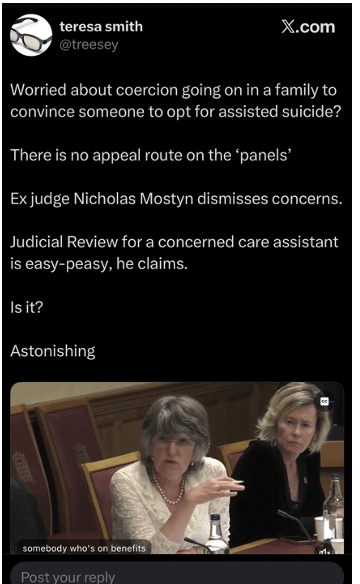
Gill Loomes -Quinn explained to me that there are practical barriers in going to judicial review for lay people, that legal professionals may not be aware of, or give due consideration. Not least that there’s usually a requirement to exhaust other options such as internal complaints procedures, which require that a) You are able to access the complaints procedure (this isn’t typically covered by the scope of Care Act advocacy, even if you qualify for one of those.) b) The Local Authority responds to a complaint. The problem is that if they don’t, the next step would be complaining to the Ombudsman – but they require a copy of the outcome of the internal complaint. Which if the LA hasn’t done anything with your complaint, you don’t have. A catch 22 situation.
Power
According to Gill Loomes-Quinn, power imbalances abound in this case. She writes: “Most constrained seem to be the family members/LiPs, who are at a disadvantage in the unfamiliar, formal legal setting of the court room and who rely on the public bodies and care providers to meet the needs of their loved one (and who risk being characterised as ‘difficult’ if they fail to ‘toe the line’). The judge is constrained by the limits of her jurisdiction and is required to accept the scope of the options presented to her. It seems like (in this sort of case) things are weighted in favour of the public body – access to funding for legal teams, power to decide what options are ‘on the table’, as well as the bottom line that P needs care, and alternatives available are limited (Direct Payments / ISFs present an illusion of ‘choice’ based on market principles, but this relies on there being options to choose from and in lots of areas this isn’t the case).”
Gill believes that this case highlights well the limited scope of the MCA 2005: “The Act provides a statutory framework for decision-making on behalf of those deemed to lack capacity but to talk of it ‘protecting’ P seems erroneous. To ‘protect’ someone in this P’s position would be to take steps to keep him safe and provide him with care that meets his needs – and it would be to ensure that he and his family are not expected to engage with care providers they don’t trust who have failed him in the past. Likewise, these things would be in his ‘best interests’. What the Act seems to protect and reinforce are existing power imbalances and social (dis)orders – all the ‘sweeping under the carpet’ of “moving forwards” and “looking to the future” in this case. Along with the failure of ‘professionals’ to realise that no matter how it is worded, the very enforcement of a WTA is suggestive of a finding of fault on the part of the family – otherwise why create one? They’re not enforced ‘as standard’. And it’s not much of an ‘agreement’ when it’s compelled?[12] But what other options does P’s family have? What happens if they refuse to agree? Or to participate in mediation?”
Gill continues: “It also strikes me that there is typically a failure on the part of ‘professionals’ to recognise the cumulative nature of the trauma experienced by disabled people or family members – or anyone who is a ‘service user’. So often, suggestions are made glibly – “Go to Judicial Review” – and (notwithstanding the inaccessibility and impenetrability of such mechanisms) these are made to sound so simple. There may be some recognition of the difficulties of inaccessibility for those unfamiliar with ‘the system’, but what I don’t really see is acknowledgement of the ‘burn out’ that occurs with years of such ‘battles’. Each failure of ‘the system’ to deliver results in a kind of fatigue (“Here we go again”) – along with an erosion of trust and a loss of hope – making even the genuinely simplest of administrative tasks feel insurmountable. I don’t think ‘professionals’ like to acknowledge how intensely adversarial and damaging the systems of which they are a part can seem to those they profess to help.
This case alludes to one of the phenomena that I think contributes to such ‘burn out’ – the ‘Tightrope’ that ‘service users’ (or family members etc) are required to negotiate: The need to advocate robustly for oneself (or loved one) while at the same time keeping the ‘professionals’ onside and avoiding being characterised as ‘difficult’ in a way that can impact the treatment received. The egos of service providers and public bodies can be very fragile.”
Moving Forwards
All in all, I left this hearing reflecting on many things. About the power imbalance between the carers, the care provider, the public bodies, the court and the family. About the focus on moving forwards, as if what had happened in the past could be swept away. About the onus on JC’s mum and brother to have “trust” in the organisation responsible for the care of their son and brother, an organisation that everyone agreed had made mistakes in the past. Mistakes that the family uncovered. About the fact that there was no accountability from the public bodies responsible for commissioning such poor care, public bodies that the court has decided can’t even be named. I left this hearing thinking about how much the court was really protecting P, despite all the Deprivation of Liberty Safeguards in place. I really hope that JC’s house can become a proper home for him, and that he does receive good care moving forwards. It’s what he deserves and what his mother and brother dearly want.
Amanda Hill is a PhD student at the School of Journalism, Media and Culture at Cardiff University. Her research focuses on the Court of Protection, exploring family experiences, media representations and social media activism. She is a core team member of OJCOP. She is also a daughter of a P in a Court of Protection case and has been a Litigant in Person. She is on LinkedIn (here), and also on X as (@AmandaAPHill) and on Bluesky (@AmandaAPHill.bsky.social).
[1] I have received two anonymised position statements, from the LA and ICB jointly, and the OS, as well as the approved court order. I have used information in those to write this blog post, as well as my own observations.
[2] Gill is a disabled scholar-activist and ‘service user’. Her PhD focused on the ‘Voice’ of disabled people in practices relating to the Mental Capacity Act 2005 (particularly in the Court of Protection). Gill co-directs the Open Justice Court of Protection Project.
[3] From here: An Individual Service Fund (ISF) is an arrangement where the budget for a person’s care and support arrangements is transferred from a Local Authority, directly to a support provider of the person’s choice. This enables the person to be in control of how their support is designed and delivered.
[4] The OS PS states that mum and brother were being asked to “ reconsider their rejection to engage in mediation; independent mediation between the family, the public bodies and the care provider can only be considered to be in JC’s best interests.
[5] This recent judgment from October 2025 provides useful information about fact finding hearings: [2025] EWCOP 37 (T3)
[6] An IMCA is an Independent Mental Capacity Advocate
[7] Ian Brownhill presented a webinar entitled “Pet Owners, Protected Parties and Patients” on 2nd May 2024. With thanks to Celia Kitzinger, blog editor, for bringing this to my attention
[8] Gill Loomes-Quinn and Jaime Lindsey wrote a report on mediation in the COP: Evaluation of mediation in the Court of Protection
[9] The person the LA named who would be responsible for reviewing the CCTV footage was not somebody the family trust
[10] PBS is Positive Behaviour Support
[11] Daniel Clark has published a blog reflecting on the nature of “home”: The well-recognised wish to go home 25th November 2025
[12] This blog from Daniel Clarke writes about a hearing where a WTA was central but Counsel argued was part of an unfair process for a family member: “It is a process that isn’t fair”: Structural injustice in the Court of Protection
 Promoting Open Justice in the Court of Protection