

By Amanda Hill, 12th February 2026
I am the daughter of a protected party in the Court of Protection.
I can say that because at a hearing in March 2025, HHJ Murch approved my application to vary the Transparency Order covering my mum’s case, so that I could be identified as a family member of a protected party (“I’m finally free to say I’m a family member of a P: Does it have to be so hard to change a Transparency Order?”) – but the Transparency Order remains in place- it’s just been “varied”, not “discharged”. So, I am still restricted in what I can say publicly. It includes a ban on publishing my mums’ name, and my siblings being able to say that they have been involved in a Court of Protection case.
As well as asking the judge to let me identify myself as the daughter or a protected party, I also asked him to change the duration of the Transparency Order so that it automatically discharged (ended) when my mum died. And then I would not worry about saying my mum’s name, in connection with Court of Protection proceedings.
The judge did not, however, “accede” (to use the language of the court) to my application to alter the duration of the Transparency Order (TO) from “until further order of the court” to “until the death of P”. He said I’d have to apply to the court again to get the TO discharged after mum died – with the expectation, discussed during the hearing, that this would be decided “on the papers”, that is without a hearing.
So Paragraph 5, dealing with the duration of the Transparency Order was varied to read like this:
‘This Injunction shall have effect until further order save that any party or interested person may apply to vary it upon the death of BB; and that any such application shall be considered in the first instance on paper by HH Judge Murch or his nominee if available, or by any other judge’
After that hearing, I was just relieved to be able to speak openly about my experience as a family member of a P in the Court of Protection. But as time went on, the thought of having to go back to court after mum died began to weigh heavily, especially as she is getting frailer and frailer.
But then, at the end of September 2025, a new judgment from Mr Justice Poole (In the matter of Re Gardner (Deceased)(Duration of Transparency Order) ( [2025] EWCOP 34 (T3),) led me to decide that there was an opportunity to make another application. The judgment ruled that “in the great majority of cases a TO made in Court of Protection proceedings ought to be discharged upon P’s death or within a short period after their death. The appellate courts might say that that should be the rule in all such cases” (§42). This, says Poole J, is because “The purpose of the TO to protect the anonymity of P during the proceedings, or during their life, will have been served.” (§42). As Poole J is a Tier 3 judge of the Court of Protection, the highest level, this case sets precedent that Tier 1 and Tier 2 judges (HHJ Murch is Tier 2) must follow.
With the pro bono help of Victoria Butler-Cole KC, of 39 Essex Chambers, I made a new application to the court on 20th November 2025. And on 3rd January 2026 (much to my surprise as it was a Saturday!), I heard from the court that HHJ Murch had approved my application, and the duration of the Transparency Order has been changed to “until the death of BB”, my mum.
I cried when I got the email, such was the relief. I’d more or less given up hope of hearing back before mum died, knowing how long things can take and not hearing back at all after I submitted the application. The impact of knowing that we don’t have to go through the process of making an application to the court again is immense.
In this blog I’ll explain how I made the application, in the hope that other family members who have a TO with a duration of “until further order of the court”, and who want to ask the court to change it to “until the death of P”, will understand how to do that.
I’ll end with my thoughts on why I believe the system surrounding Transparency Orders is dysfunctional. And has moved beyond the original intentions of the court.
Back in 2014 Mr Justice Munby[1], then President of the Court of Protection, expressed concern that the court was “saddled … with the charge that we are a system of secret and unaccountable justice” (Practice Guidance issued on 16th January 2014). Munby J recognised that existing terms designed to “protect the anonymity of the person who is subject of the proceedings and members of their family” (§9) may not always be appropriate, “for example, where family members wish to discuss their experiences in public, identifying themselves and making use of the judgment” (§11).”
This seems to me to have been forgotten. If you don’t want to know the details about how to make an application to change a TO, I encourage you to skip to my ‘Reflections’. And then maybe you will start to understand what it feels like to be subject to a TO and why I believe change is needed.
A successful application to vary the duration of the Transparency Order
I got off to a bad start. When I started the process, I did it without a lawyer to represent me. I contacted the Local Authority (Central Bedfordshire) legal team to ask whether they would support my new application – and I thought that they would support me (or at least not oppose me) because they’d supported my previous application back in March 2025, including that part of the application concerning varying the duration. I emailed the legal representatives on 14th October 2025 explaining that I wanted to make a new application for the wording in paragraph 8 to be changed to “until the death of BB” to comply with the new case law of Re Gardner (Deceased)(Duration of Transparency Order) ([2025] EWCOP 34 (T3). Unfortunately I got an immediate reply (on the same day) saying that the local authority “is in agreement with the Judge and the Final Order made on 20 March 2025”. So they were opposing a new application to change the duration.
My heart sank. Once again. I thought to myself “Why does it have to be so hard?”. Shortly afterwards, I instructed the wonderful and ever-helpful Victoria Butler Cole KC of 39 Essex Chambers (on a direct access basis). I want to describe the steps she took to get the duration of the TO changed for me because they were not very difficult and anyone should be able to follow her example.
There are two stages: (A) ask the other parties in your case not to oppose (or to support) the change you want; and (B) make a formal application to the court, setting out the grounds for the change you are asking for.
A: Contact the other parties and ask them not to oppose (or even to support) the application
I’d already done it myself – but it turned out to make a difference when a lawyer did it for me (admittedly with more legal language in it). Victoria Butler-Cole KC sent an email on my behalf to the same Local Authority legal representative that I’d contacted previously. Her email offers, in effect, a template that anyone can use, adapting individual details as necessary. I have highlighted each step of the letter, and then quoted from it:
- Put case name and initials in subject header of email and send the email to the other parties involved: The subject header for this email for me was: “COP Case 13899903 Re BB“. The email was sent to the solicitor for the local authority. At that stage they were the only other party in our case, but you would have to send to all parties if there is more than one.
- Begin your email by quoting what the TO currently says about “Duration” (usually §8 of the ‘standard’ order), and saying what you want it to read instead. Here’s what Victoria Butler-Cole wrote for me. First, she said very clearly what she wanted to apply to the court to do, giving the precise reference (§8) of the Order and the date it was made: “I am applying to the court to vary paragraph 8 of the transparency order that was made on 29 March 2022 and amended in March of this year.” Then she quoted the part I wanted to change, “Paragraph 8 (as amended) presently reads: “This Injunction shall have effect until further order save that any party or interested person may apply to vary it upon the death of BB; and that any such application shall be considered in the first instance on paper by HH Judge Murch or his nominee if available, or by any other judge”. (For many TOs, this paragraph is likely to read just “until further order of the court”.)
- Then say what you want it changed to (“the proposed amendment”): In my letter, this sentence said: “The proposed amendment is that paragraph 8 will read: “This Injunction shall have effect until the death of BB”.”
- Quote from Poole J’s judgment. The letter then spelled out the reason for asking the judge to make that change – the new case law: Anyone could use this same paragraph (I guess without the word “recent” if you’re reading this much later than 2026). It reads like this: “You may be aware of the recent judgment of Mr Justice Poole in Re Gardner (Deceased)(Duration of Transparency Order) [2025] EWCOP 34 (T3), in which the judge held that “In the great majority of cases a TO made in Court of Protection proceedings ought to be discharged upon P’s death or within a short period after their death. The appellate courts might say that that should be the rule in all such cases. The purpose of the TO to protect the anonymity of P during the proceedings, or during their life, will have been served.” ”
- Say this judgment is binding on the judge: My lawyer pointed out that the judgment was “binding”. This means that Poole J’s is a precedent – new case law that other judges (at least lower-ranking judges) must follow. There are three classes of judge. The lowest tier is T1 (often a District Judge), the middle tier is T2 (a circuit judge whose title is His/Her Honour Judge X – or HHJ) and the highest tier, T3, are High Court Judges. So, depending what tier your judge is, you can adapt this paragraph accordingly. “That judgment, which has not been appealed, is binding on HHJ Murch [insert the name of your judge here] or any other Tier 2 [or “Tier 1”] judge of the Court of Protection. It follows the Supreme Court judgment in the case of Abbasi, which is similarly binding on lower courts, and which makes very clear that transparency orders cannot extend beyond the lifetime of the protected party unless other parties make fresh applications.” Note – you don’t need to know anything about the judgment in Abbasi to write this letter – the lawyers will all recognise the name. But if you are interested, it’s a Supreme Court ruling about publishing the names of individuals in court reporting. You can read more about it here: https://www.bevanbrittan.com/insights/articles/2025/abbasi-and-haastrup-to-name-or-not-to-name/
- Say why you want the duration changed now rather than having to wait to make an application after the death of P. The reason Victoria Butler-Cole KC gave for me wanting to change the duration now rather than waiting until after mum died is that it would be an additional burden on me at a time when I would be grieving for my mother. This is probably true for most people. But you may have additional reasons, and these should also be spelt out. Here’s what the letter said: “In BB’s case, there is no reason for any continued anonymity after her death, which will already be a very long time after the CoP proceedings concluded. The effect of the current paragraph 8 is that at a time when Ms Hill is mourning the death of her mother, and dealing with the administrative matters that require attention when someone dies, she would have to also make an application to the Court of Protection. She would understandably rather not add that to the burden of tasks that she will face at that difficult time, and in light of the clarity now provided by the courts, there is no proper basis for paragraph 8 to remain in its present form in any event.”
- Add a final line asking for their reasons if the party says they oppose the request. Victoria Butler-Cole KC attached a consent order to her email. (“A consent order is an order that all the parties agree with. If you can agree what should be written in a consent order, then you may not need to have a hearing to ask the judge what to do.” From https://courtofprotectionhandbook.com/wp-content/uploads/2020/07/basic-guide-glossary.pdf.) This became the draft order which was sent as part of the application (see below). She also asked for confirmation that no hearing would be needed and that the judge could approve the new order based on the documents in the application, that is “on the papers”(without a hearing): She said: “I would therefore be very grateful if you could take instructions on the attached consent order, so that, it can be submitted to the court with a COP9 and confirmation that it can be made on the papers. Given the clarity that the courts’ recent judgments have provided, it would be very unfortunate if more costs had to be incurred on this issue. If the local authority opposes the proposed change, please could you explain the reasons for that position, including with reference to the relevant caselaw.”
The email ended with the customary sign-off and was sent on 7th November 2025.
In our case, two days after sending her email, Victoria Butler-Cole KC received a reply from the local authority, which she forwarded to me. It said the Council “does not have a position on the matter”. So instead of their previous position (supporting the judge’s earlier decision that I’d have to reapply after mum died) they backed down to having no position. They would no longer oppose my application. I so welcomed the change of heart -the letter from a lawyer had made all the difference. I was immensely happy but also frustrated that it had taken the intervention of a KC, who had effectively made the same arguments as me (albeit much more eloquently) to change the position of the Local Authority. The strength of an argument really shouldn’t depend upon who makes it.
I don’t know whether it would still have been worth it to make an application if the public body had opposed my application. Obviously, that would have been a riskier process and would probably have involved a hearing, and I would have needed to think about it carefully.
B. Make a formal application with a statement of grounds supporting it
Once I had confirmation that the Local Authority would not oppose my application, I could go ahead and make the application. Victoria Butler-Cole then told me which documents I needed to make my application to the court and what I needed to send to the court.
This consisted of a COP 9 form, which I completed myself, a copy of the draft order I was asking the court to approve (which was the same as the consent order sent to the Local Authority), the grounds for my application (essentially the same as the content of the email sent to the Local Authority but drafted in a different format and with some background information) and a copy of Victoria Butler-Cole’s email to the Local Authority and the reply (as proof that they were not opposing the application).
This is a copy of the email I sent to the relevant Court of Protection hub, which for Luton is the SE hub at Reading. You would have to locate the relevant hub for your court. Email addresses for Court of Protection hubs can be found here: https://www.gov.uk/courts-tribunals/court-of-protection.
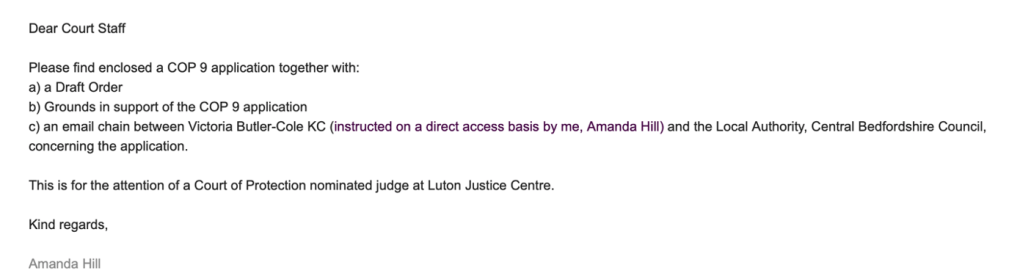
Make sure that you put the COP number and name of the protected party in the subject heading of the email as I initially forgot this and had to re-send when I realised. I did not have to pay to submit the application.
I attached three documents: the COP 9 form (downloadable here); the evidence for box 2.3 of the form, which was the email from Victoria Butler-Cole and the reply from the local authority confirming their neutral position; and the draft order I was asking the court to approve. This is the draft order I was asking the court to approve (attached document for box 2.1 of the Cop 9 form):
CASE NUMBER: 13899903
IN THE COURT OF PROTECTION
IN THE MATTER OF THE MENTAL CAPACITY ACT 2005 IN THE MATTER OF BB
BETWEEN:
BB Applicant
-and-
CENTRAL BEDFORDSHIRE COUNCIL
-and-
AH
Respondents
ORDER
Before … sitting as a nominated Judge of the Court of Protection
At Luton Justice Centre, 4th Floor, Arndale House, Luton Point, LU1 2EN
On ….
ISSUED …
UPON AH having issued a COP9 seeking variation of paragraph 8 of the transparency order made on 29 March 2022 and varied by order made on 20 March 2025
AND UPON the court noting the judgment of Poole J sitting as a Tier 3 judge of the Court of Protection in the matter of Re Gardner (Deceased)(Duration of Transparency Order) [2025] EWCOP 34 (T3), in which the court held that transparency orders ought to be discharged upon P’s death or within a short period of P’s death
AND UPON the local authority confirming by email dated 20 November 2025 that they do not have a position in respect of AH’s COP9 application, do not wish to make submissions and are content that the application is dealt with on the papers
AND UPON the court noting that the Official Solicitor did not play any role in the previous application by AH to vary the transparency order, the Official Solicitor having no ongoing role and no public funding for her costs as litigation friend, and that it is not necessary for BB to be represented in order for the present application to be determined
AND UPON the court determining on the papers that it is appropriate to make this order in light of the applicable guidance from the higher courts as to the appropriate duration of transparency orders in the Court of Protection
IT IS ORDERED THAT:
- Paragraph (8) of the Transparency Order dated 29 March 2022 as varied on 20 March 2025 is further varied to provide that “This Injunction shall have effect until the death of BB”.
- No order as to costs.
**********
The statement of grounds for the application (the attached document for box 2.2 of the Cop 9 form) was based on the email my lawyer sent to the Local Authority, but formatted differently and with some added background information (attached as a Word document). Here’s how it read.
Grounds in support of the application
- This is a COP9 Application brought in relation to a s21A application (COP13899903) which were issued on 9 March 2022 and concluded on 5 December 2022. A Transparency Order (‘TO’) was made in standard terms on 29 March 2022 and issued on 5 April 2022. On 22 March 2025, the TO was varied to permit the second respondent, BB’s daughter Ms Amanda Hill (‘AH’) to be named. AH now seeks a further variation of the TO so that it expires on BB’s death.
- Paragraph 8 of the TO (as amended) presently reads: “This Injunction shall have effect until further order save that any party or interested person may apply to vary it upon the death of BB; and that any such application shall be considered in the first instance on paper by HH Judge Murch or his nominee if available, or by any other judge”
- The proposed amendment is that paragraph 8 will read: “This Injunction shall have effect until the death of BB”.
- This change is in line with the decision of the Supreme Court in Abbasi v Newcastle [2005] UKSC 15, which was recently applied by Poole J sitting as a Tier 3 judge in Re Gardner (Deceased)(Duration of Transparency Order) [2025] EWCOP 34 (T3). Poole J held at para 42 that: “In the great majority of cases a TO made in Court of Protection proceedings ought to be discharged upon P’s death or within a short period after their death. The appellate courts might say that that should be the rule in all such cases. The purpose of the TO to protect the anonymity of P during the proceedings, or during their life, will have been served.”
- That judgment, which has not been appealed, is binding on HHJ Murch or any other Tier 2 judge of the Court of Protection. It follows the Supreme Court decision in Abbasi, which is similarly binding on lower courts, and which makes very clear that transparency orders cannot extend beyond the lifetime of the protected party unless other parties make fresh applications for such orders, based on their own privacy rights.
- In BB’s case, there is no reason for any continued anonymity after her death, which will already be a very long time after the CoP proceedings concluded. The effect of the current TO at paragraph 8 is that at a time when AH is mourning the death of her mother, and dealing with the many administrative matters that require attention when someone dies, she would have to also make an application to the Court of Protection. She would understandably rather not add that to the burden of tasks that she will face at that difficult time, and in light of the clarity now provided by the courts, there is no proper basis for paragraph 8 to remain in its present form in any event.
- The local authority has confirmed that it has no position on the application and does not wish to make submissions.
- There is no need for BB to be joined as a party and her private funds to be used to pay a litigation friend, given the clear guidance from the higher courts as to the appropriate form of TOs, and the fact that on her death, she will not have any continuing interest in preserving the order. AH therefore requests the court make the proposed order submitted with this COP9 without a hearing.
I must admit, I’ve observed many hearings where the judge has said “submit a COP9”. But this was the first time I’d submitted one myself. I felt really nervous, but it wasn’t as difficult as I’d expected.
I sent the email to the Reading hub with the four document attachments on 20th November 2025. Apart from receiving the automatic acknowledgment of the email from the Reading hub (which meant I knew the court had received it) I didn’t hear anything. I waited. Christmas came and went. And then on 3rd January 2026 I received the unexpected email from the Reading hub with a new approved order attached.
Success! The approved order
The order was identical to the draft order I sent with the application, apart from the Judge’s name being inserted and the dates. Plus the addition of a new paragraph 3, which I discuss further below.
CASE NUMBER: 13899903
IN THE COURT OF PROTECTION
IN THE MATTER OF THE MENTAL CAPACITY ACT 2005
IN THE MATTER OF BB
BETWEEN:
BB Applicant
-and-
CENTRAL BEDFORDSHIRE COUNCIL
-and-
AH. Respondents
ORDER
Before HH Judge Murch, sitting as a nominated Judge of the Court of Protection
At Luton Justice Centre, 4th Floor, Arndale House, Luton Point, LU1 2EN
On 04 December 2025
Issued 03 January 2026
UPON AH having issued a COP9 seeking variation of paragraph 8 of the transparency order
made on 29 March 2022 and varied by order made on 20 March 2025
AND UPON the court noting the judgment of Poole J sitting as a Tier 3 judge of the Court of Protection in the matter of Re Gardner (Deceased) (Duration of Transparency Order) [2025] EWCOP 34 (T3), in which the court held that transparency orders ought to be discharged upon P’s death or within a short period of P’s death
AND UPON the local authority confirming by email dated 20 November 2025 that they do not have a position in respect of AH’s COP9 application, do not wish to make submissions and are content that the application is dealt with on the papers
AND UPON the court noting that the Official Solicitor did not play any role in the previous application by AH to vary the transparency order, the Official Solicitor having no ongoing role and no public funding for her costs as litigation friend, and that it is not necessary for BB to be represented in order for the present application to be determined
AND UPON the court determining on the papers that it is appropriate to make this order in light of the applicable guidance from the higher courts as to the appropriate duration of transparency orders in the Court of Protection
IT IS ORDERED THAT:
1. Paragraph (8) of the Transparency Order dated 29 March 2022 as varied on 20 March 2025 is further varied to provide that “This Injunction shall have effect until the death of BB”.
2. No order as to costs.
3. This order was made without a hearing and without notice. Any person affected by this order may apply within 21 days of the date on which the order was served to have the order set aside or varied pursuant to Rule 13.4 of the Court of Protection Rules 2017 (“the Rules”). Such application must be made on Form COP9 and in accordance with Part 10 of the Rules.
*******
The judge had approved the variation on the papers (based on the application documents and without a hearing) on the 4th December 2025, a couple of weeks after I had submitted the application. And the Court issued the order on 3rd January 2026, a month afterwards, and the day I received the email. I was so relieved. Our TO burden seemed to be nearly over.
But this experience leaves me with some concerns based both on my own experience and in relation to TOs more generally.
Reflections
One aspect of the approved order puzzled me: paragraph 3. Any person affected by the order has 21 days to apply to the court to have it set aside. But 21 days from when: the 4th December 2025 or the 3rd January 2026? I double checked with Victoria Butler-Cole and she told me that it was 21 calendar days from the date people were sent the order.
But how would “anyone affected” know about the order? I kept my siblings informed, who are the most directly affected apart from me and my mum. I could have told my mum, but she would have absolutely no understanding of what it meant. What about the people who observed my hearing? They are “affected” because they may want to publish a blog after my mum has died. Also, the carers and care home manager. I’ll be able to name them in relation to court proceedings when the TO expires. In any case, the court hasn’t ordered me to inform anyone affected. The email reply from the Reading hub, with the new approved order, said: “All parties are blind copied into this email”. I can’t see who was on blind copy, but I assume it was the Local Authority, since they were the only party (the Official Solicitor being no longer involved). It seems to me that it is difficult for paragraph 3 to achieve its objectives.
This contrasts with the situation Celia Kitzinger faced when she applied to publicise her sister Polly’s statutory will case. Celia had to fill out two Court of Protection documents, a COP 20A and COP 20B, and send them to everyone “affected”, including all the people originally involved in the statutory will application two years previously. She also had to ensure that Polly (the protected party) was informed about the application, even though she, like mum, had little chance of understanding. Celia wrote about it in this blog: Successful application to disapply Section 12(1) of the Administration of Justice Act: Making Polly’s statutory will application public.
The application process for Celia was different from mine because there was no Transparency Order in the proceedings she was applying to publish about (it was entirely “private”), but it’s not obvious why the procedure regarding notification of others was so different. Maybe it’s just that a different judge decided on a different process. If you ask for an order to be varied or discharged, it’s worth knowing that you may be required to do this additional step of notifying everyone affected. If you are, check out Celia’s blog for some help with how to do that – she describes it as tedious but not difficult.
Thinking about transparency orders more broadly, I have concerns about how and why the court selects the duration it does. The pro-forma standard Transparency Order offers three options.

So the options are: (i) Until further order of the court (ii) Until the death of P; or (iii) Until a period of time after the death of P. It concerns me that a duration of “until further order of the court” seems to have become the default duration. In research I conducted for Cardiff University from October 2024 – December 2024, I found that of 32 Transparency Orders, 29 had a duration of “until further order of the court”. I understand that it is common for this to be the duration on the first order that is ever made, as applications are considered by the judge on the papers and people might want to argue about whether it is amended at a subsequent hearing. I can also understand the logic of deciding on an expiry date when it is clearer what is involved in the proceedings. But it’s not clear that it was ever the intention of the judiciary in setting up the Transparency Pilot and standard TO for “until further order of the court” to remain the duration of the TO once the proceedings are ended. It means the court is issuing orders restricting what people can say indefinitely. This is certainly not in line with case law today (Poole J, Re Gardner). I urge paralegals drafting TOs, lawyers checking them and judges approving them to actively consider the duration in future, as proceedings are coming to an end, rather than routinely leaving them as “until further order of the court”. Following Poole J (re Gardner), “until the death of P” should surely become the norm once there has been a final hearing. Since many older TOs are routinely recycled across successive hearings in the same case, legal teams will need to pay attention to updating them.
It seems to me that this has been largely ignored by the court. It is very rare that family members are able, under the terms of the TO, to publicly share information about their Court of Protection experience. Those of us who can, have had to jump through multiple hoops in order to be able to do so, as this blog (and my earlier blogs[2]) have shown.
The more I think about Transparency Orders, the more they frustrate me. In my opinion, legal professionals have no idea of the far reaching and long-lasting impact of a TO. How they can lead to families feeling silenced, creating distrust and a feeling that the system is unjust.
A brighter future?
There are positive signs that change might be on the way – and perhaps surprisingly, it comes from the Family Division. A very recent judgment by Poole J ([2026] EWCOP 1 (T3)) approves an application to vary a TO so that both the protected party, Ruby Parr, and her mum, Alison Parr, can be publicly named in connection with court proceedings. He says:
§43: I foresee no detriment to Ruby from her name being published as the subject of the application. Her understanding is at such a low level that she will not be aware. She has an Article 8 right to respect of her private and family life and I must weigh that in the balance alongside the Art 10 rights of others, including her mother and in the context that the starting point of any such consideration about transparency is the open justice principle (my emphasis). Ms Parr fully supports the application to lift the prohibition on naming Ruby and members of her family in the context of these proceedings. She was supported at the hearing by Ruby’s father and adult brother. There was no opposition from the Local Authority (in its written position) nor from the ICB.
I found this judgment refreshing. Refreshing because the judge doesn’t foresee any harm to Ruby from her name being published. Refreshing because the LA and the ICB did not oppose the application.[3] Refreshing because Poole J clearly trusts Alison, Ruby’s mum to act in her best interests.
Of course, every case is different, and judges have to make decisions based on the facts of each particular case. But I hope that the tide is starting to turn. Our transparency order has been an incredible burden. I don’t think the judges, lawyers or public bodies involved have any idea of the impact it has had, and is still having.
Finally – why did I do it? I understand the view that the TO is in place to protect my mum’s privacy – but I believe that her privacy was compromised the moment an application was made to the court by somebody that mum didn’t know and who didn’t know my mum. I know that mum, if she was able to understand and had capacity, would never have wanted a court to be involved in deciding where she lives. In the very little that she understood in the run up to the CoP hearing, she saw the court as the enemy of the family, including her – telling me and my sister “they are out to get you“. She would have been horrified, if she had understood, that it was being insinuated that my sister was stealing her money, because of something she herself had said. And she would have wanted my sister to have been able to put the record straight publicly. And now my sister will be able to, should she choose to, once mum dies.
Mum would also have been horrified that the Official Solicitor was (supposedly) representing her wishes and feelings, and did so in court with legal standing that put the OS version of her wishes above the version of her family. At the time of the first hearing, nobody from the OS had even visited my mum to ascertain her wishes and feelings (to the extent that she would have been able to articulate them). I remember being shocked at that. The OS PS included mostly information the family gave the solicitor, and erroneous information about mum that they had obtained from unspecified sources. A comment about mum enjoying flower arranging (we knew all she’d done was one week’s evening course) while failing to mention so much more that reflects who my mum is, like her love of birds, and putting tea bags on roses to help them grow, jars to this day.
My mum wouldn’t have wanted observers in court – but much more than that, she wouldn’t have wanted her life to be discussed in court at all. That’s when her privacy was invaded by strangers – the barristers and solicitors and the Official Solicitor and the judge. If that was going to happen, as it did, then ensuring these strangers didn’t make decisions about her in secret, and changing the reporting restrictions so that I could explain to people what had been done, would have gone at least some way to alleviating her distress and anger about having to be a party to proceedings in the first place. She always absolutely trusted me to do the right thing. And that spurs me on.
I want to thank all of those who have been involved in both applications to vary the TO in our case – especially my direct access lawyer, Victoria Butler-Cole KC. And I hope that more transparency and fewer restrictions for family members becomes the norm. What a legacy for Munby J that would be.
Amanda Hill is a PhD student at the School of Journalism, Media and Culture at Cardiff University. Her research focuses on the Court of Protection, exploring family experiences, media representations and social media activism. She is a core team member of OJCOP. She is also a daughter of a P in a Court of Protection case and has been a Litigant in Person. She is mainly on LinkedIn (here), but also sometimes on X (@AmandaAPHill) and Bluesky (@AmandaAPHill.bsky.social).
Footnotes
[1] James Munby died on 1st January 2026. You can read one of the many obituaries here: https://pinktape.co.uk/uncategorized/r-i-p-sir-james/
[2] ‘Deprived of her liberty’: My experience of the court procedure for my mum (17th March 2023); Gagged – in whose best interests? (7th July 2023); Our ordinary story ….and how it became an unbelievable family experience of the Court of Protection (9th April 2025); I’m finally free to say I’m a family member of a P: Does it have to be so hard to change a Transparency Order? (22nd July 2025)
[3] I still don’t really understand why the Official Solicitor sent an email the day before the March hearing suggesting that mum might need to be represented. Mum, although special to us, is just an ordinary person, not in the public eye. Nor why the LA did not support my application to get the duration changed when they had supported this change in the March hearing. Is it just due to an inherent suspicion of families? To me it’s a shame after the positive relations that I developed with the legal teams during the original court process. It has left a bitter taste in my mouth.
 Promoting Open Justice in the Court of Protection
I found this blog extremely informative, and hope it will encourage many families caught up in CoP proceedings to challenge draconian orders about the TO’s duration (which I consider ‘until further of orders of the court’ to be) early in proceedings. I wonder if there is a role for us as observers to challenge such an order at the start of a hearing?
I learned of the Open Justice CoP Project, and started observing CoP hearings, in early 2024 when Flintshire County Council confirmed that (rather than do what they had initially threatened: forcibly remove my dad from his own bungalow into a care home against his will, and that of his family, using their s5 MCA powers), they were initiating CoP proceedings to achieve that goal. The TO was among the hundreds of pages the Local Authority sent to the court (and us). In Dad’s case the TO said the duration was ‘until the death of RD’. I didn’t take much notice of the TO’s duration at the time as there were much more concerning documents within the bundle, and the TO itself protected the anonymity of the Local Authority – which was my main issue with it. I do know now, from observing almost a hundred CoP hearings, that the wording of ‘until the death of….’ Is extremely rare. I believe Dad’s TO was the only one I’ve seen that said that (until I saw Amanda’s revised TO in this blog – well done Amanda). This was fortuitous as Dad, having been dragged out of his own home by the Local Authority in March (to a substandard care home where draconian contact restrictions were imposed on us) died within a few months of his incarceration. I know for sure that after his death I would not have found the strength to revert to the court to vary the duration of the Transparency Order.
The process Amanda shares here does strike me as arduous and resource-intensive for the individual and the court, and I do wonder (no, I doubt) whether people without access to legal assistance would be successful if they tried to replicate it without a KC’s (or any legal representative’s) support. I also know that Amanda’s proceedings in the CoP were not particularly contentious and there was no relationship breakdown between the LA and the family. In Dad’s case (and in many others) it was very different, the LA and us were effectively at war. If I had needed to request variation to the duration of the TO, I’m certain they would have objected.
Finally, I share Amanda’s concern about the potential effect on observers of hearings in cases where a TO is later changed. I was an observer at the hearing where Amanda was granted permission to identify herself. Without reading this blog I may have missed an opportunity to publish information about MM’s case when she passes, but of greater concern is when (as I assume can happen) the TO is changed to be more restrictive than I was aware of, which means I could publish something and go to prison. Surely any updates to TOs should be circulated by the court to the earlier recipients of them?
LikeLike
I can fully understand why Amanda wanted to vary the TO now rather than later, having been in a very similar position and fortunate enough to enlist Celia’s support in having our TO varied at the same time as our case was heard at the Court of Protection.
The issue of when a TO expires may appear to be an insignificant matter for those working for Local Authorities and the Court of Protection, but for those of us affected by a TO who have a family relationship with a Protected Party, the wording and time frame really do matter.
As Amanda says, it’s unfortunate to add the burden of making another COP application to all the other burdens that inevitably accompany the death of P.
Where is the harm in making expiry ‘on the death of P’ the norm, with variations to this wording only in exceptional cases rather than vice versa?
LikeLike