

By Celia Kitzinger, 23rd October 2026
There were five hearings concerning ‘non-compliance with court orders’ listed, for 15 minutes each, before DJ Ellington sitting remotely at First Avenue House on Monday 19th October 2026. I watched two of them, at 11am and 12.30pm.[1]
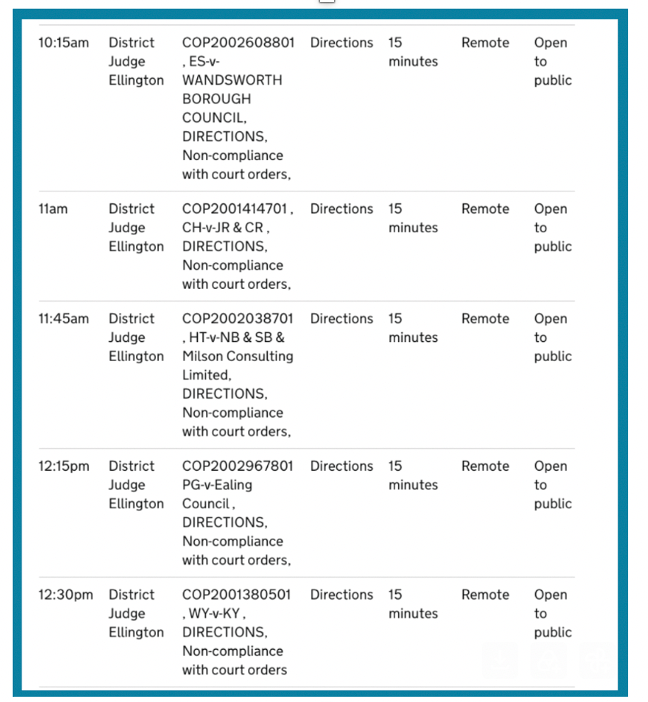
Both hearings concerned family members who’d made applications to become Deputies for Property and Financial Affairs[2] for their relative with dementia. Progress on both applications had stalled due to the applicants’ adverse financial histories.
These two cases involving family members were very different from “non-compliance” hearings we’ve blogged about before where it was public bodies who had failed to obey court orders (see: “This cannot be allowed to carry on”: A non-compliance hearing with NHS Humber and North Yorkshire ICB” and “Non-compliance: What happens when public bodies don’t obey court orders?”). In both of these earlier non-compliance hearings, there was some “stern talking” from the judge. to the lawyers representing the public bodies.
In these two cases, by contrast, it was immediately apparent that the judge’s aim was not to rebuke the applicants, but to discover what had gone wrong – with a clear awareness that this may have been something completely outside the control of the family members – and then find the best way forward. In both cases, this turned out to be appointing the applicants as Deputies.
My main take-away from watching these two hearings was an understanding about why there are such long delays in dealing with some applications for Finance Deputyships and how this judge tried to put right the court delays and inefficiencies that had beset these two applications.
1. Application stalled by non-compliance with an order made in error
The first of the two hearings I watched lasted a little over 10 minutes.
The judge, reading from the court papers, said that her understanding was that there was a problem with the application for Deputyship from P’s daughter (D) and granddaughter (G), because there were “issues relating to historical insolvency”. Another judge had apparently ordered them both to submit evidence about this. The court had received this evidence from D, but not from G.
G said immediately that she’d “never been bankrupt or anything like that”. Her mother added: “G was 6 years old when we went bankrupt”.
“So, you think it’s an error in the order,” said the judge, looking through the files. “Okay, sometimes there is some misunderstanding”.
After a short pause while the judge looked through the documentation, she said, “Oh yes, they’ve put applicants in the plural, and that’s how it’s gone down this route”.
It seems that the delay in processing this application – I think a delay of about 18 months – was occasioned by a mistaken plural reference form in an order. It meant that the court was waiting for evidence about insolvency from G, who has never been insolvent and on whom such an order should never have served.
The judge then checked the rest of the application. She verified that P had been notified of the application: the correct form (an application notification and acknowledgement form (COP14PADep) had been completed by a social worker on 30th March 2025. She also checked that other relatives had been notified of the application.
She then checked the details of P’s estate – at which point it became apparent that she had no income apart from state benefits, and that D and G had not applied to become DWP appointees (see: https://www.gov.uk/become-appointee-for-someone-claiming-benefits) This was a concern.
Judge: Part of the Mental Capacity Act is we have to make the least restrictive decision. The general view is appointeeship through DWP is a less restrictive system than deputyship. Also, if you obtain deputyship, you have additional duties. You have to obtain a security bond which will cost money and you have to do an annual report to the OPG. And they prefer it online so you have to be tech-savvy too. Why have you applied for Deputyship rather than appointeeship?
Granddaughter: We were advised by the Social Worker to get Deputyship. Also not having Deputyship is something I know is causing problems for other people I know who can’t access the bank with only an appointeeship.
Judge: That’s a problem with the bank, not the legal system. But this has been waiting long enough.
Granddaughter: Yes!
Daughter: We agree!
Judge: So, I will give you deputyship – but you may wish to apply for discharge after that. I need you to be aware of the added burdens this is going to give you above appointeeship. But you won’t have difficulty opening a bank account. Because there’s not much money, I’m going to put the bond at £10,000. That means you need to buy insurance cover and take the cost of that from her estate. The court will help you with that. I will make the order today and the court will write to you.
Daughter/Granddaughter: Thank you! Thank you for your help.
2. Application stalled for lack of alternative family member willing to act as Deputy
The second hearing lasted around 25 minutes.
In this case, an applicant for Deputyship for Property and Finance, P’s niece (I think), had previously suffered some “financial difficulties” of her own that had resulted in court involvement. When this had come to light, “the court had some concerns and asked if there was anyone else who would be suitable” and (according to the files the judge was looking at) someone else’s name had been “put forward”. But the court had never received a “Deputyship declaration” from that person, so there was still no Deputy in place for P.[3]
The applicant confirmed that this is what had happened and said that the person whose name had been mentioned was her father, and “he doesn’t feel comfortable about doing it – he’s 77 and lives in [another country]”. She added, “We did speak to P’s Social Worker and tell her”. But clearly the message had not got back to the court.
“Is there anyone else?” asked the judge. After a discussion of the different family members, it appeared not.
A discussion of the applicant’s past financial difficulties ensued, and it became clear that – although she’s still paying off the debts in accordance with court orders – the context in which the debts were incurred are historical, relating to events from around a decade ago, in association with someone who is now deceased. She is in stable employment and has been for a long time. She is now in the difficult position of using her own savings to subsidise P and the family member he lives with (I think it was two brothers, her uncles) in their own home and she’s is moving money around between that other family member’s account (for which she has third-party authorisation)[4] in complicated transactions to cover the bills. The sum of £6,000 to cover roof repairs was mentioned, plus a recent unspecified amount for carpet cleaning. Although the applicant said that her savings could bear this, the judge saw it as a problem: “this is not money you should be spending […] Obviously we can’t have the current situation carry on – it’s not fair on you”.
The judge then considered the possibility of appointing a panel deputy. The disadvantage of this is that since P part-owns his own home, the charges would be “set at solicitor’s normal costs, so quite a drain on his estate”.
Judge: There is a difficulty with your history, but […] what I’m going to do I think is uhm give you the chance to put in a Witness Statement saying why things are different now from 2006/2007 because I don’t think the previous judge went through that.
Applicant: They did ask me to come back and say where the statements originated from and what payments I was making on them
Judge: In August last year?
Applicant: I don’t know – it’s been going on for such a long time.
Judge: I know it must be very frustrating.
[…] (Judge locates witness statement in bundle)
Judge: You say in your Witness Statement you ran in to problems following a redundancy. You did not go into insolvency, did you?
Applicant: No.
Judge: What I’m going to do is not give you the ability to sell the house ((“that doesn’t matter, they’re living in it”), but I will appoint you as a deputy.
Applicant: Oh! Thank you very much!
Judge: This is a best interests decision under s.4 of the Act that it’s in P’s best interests to have you as Deputy and that, in the circumstances, you are an appropriate person in this situation.
The judge then went on to “just check everything else”.
The assessment of capacity (completed by a social worker) was “in order”.
The notification to P of the application for Deputyship (“the one I had to sign and P had to sign as well to tell him I was making the application?”) was out of time: the judge said: “it’s supposed to have been within 3 months of when the application was made. That’s not fatal. […] It has the date of 5th June 2025 – though not in the right box – and is signed by you as a statement of truth. That’s enough for me”.
But there were missing declarations about P’s investments: “it says ‘details not known’” – and details of P’s occupational pension had not been completed. “I need you to fully complete this form”, said the judge.
The applicant said she would visit P and see if she could locate what was needed – the problem being that P tends to “throw his paperwork away”. She undertook to complete the form within the next four weeks, and then to file it and “obtain an insurance product to cover the estate in case you are unable to account for any of it”, and to mark her application as for the attention of DJ Ellington.
The hearing ended on a positive note:
Judge: The court, on the information supplied, is willing to appoint you as Deputy – with no power of sale – subject to the form being filled in appropriately.
Applicant: Brilliant thank you. Thank you very much for your time.
Reflections
It was useful to see the judicial approach to these ‘non-compliance’ hearings. It was entirely helpful to the applicants. So these ‘non-compliance’ hearings are clearly not just about penalising non-compliance and adverse costs orders against the non-complying party. Court of Protection judges seem to have quite wide discretion as to how they manage cases like these, which I think derive from their general case management powers under Part 3 of the Court of Protection Rules 2017. This permits a judge to “take any step or give any direction for the purpose of managing the case and furthering the overriding objective”.
Finally, I don’t know if Financial Deputyship applications are particularly likely to cause problems (or whether it’s just that there are so many of them that they are common but proportionately represented among ‘stalled’ cases in the COP) but the only previous case we’ve reported on concerning a ‘non-compliance’ hearing for a family member of P also concerned a Deputyship application – and in that case the application had, it seems, simply been ”lost” in the court process after a judge “went off sick” (see “A deputyship application gone astray”).
Celia Kitzinger is co-director of the Open Justice Court of Protection Project.. She is on LinkedIn (here), and also on X (@KitzingerCelia) and Bluesky (@kitzingercelia.bsky.social)
Endnotes
[1] I’d asked to observe all five – because non-compliance with court orders is a serious matter. Not only is it disrespectful to the court and tends to undermine the rule of law, it causes delay in judicial decision-making, extends proceedings, and has a cost to the public purse. It’s important for the public to know how judges deal with it. As it turned out, the court did not respond to my request for the links (sent at 8pm the evening before and again on the morning of the hearing) until after the first of the five had started, so I missed that one. I watched the second hearing. The third was vacated. No parties turned up for the fourth. I observed the fifth and final hearing. As usual, material quoted from the oral hearing is based on my contemporaneous touch-typed notes and is as accurate as I can make it, but is unlikely to be verbatim.
[2] For what these applications involve see: https://www.gov.uk/become-deputy/apply-property-financial-affairs-deputy
[3] The quote marks are phrases used by the judge. I’m not sure exactly what had preceded this hearing that qualified as P’s brother having been “put forward” as a deputy, but I think whatever it was (maybe no more than a suggestion from the niece that if she couldn’t be deputy, then he might be a suitable alternative), it led to an expectation on the part of the court that a “Deputy’s declaration” would be submitted by P’s brother – and I take it that this means the COP4 form which is headed “Deputy’s declaration” and is a formal application to be appointed as deputy. So, in effect, the niece’s application having failed, her father would have been making a new application to become P’s deputy in his own right.
[4] Applicant: “I’ve got 3rd party authorisation from [the relative P lives with] but P uhm-ed and ah-ed about it and then his dementia got so bad he couldn’t do it.”

