

By Daniel Clark, Amanda Hill and Celia Kitzinger, 8th November 2026
The final hearing in this long-running case lasted 16 minutes.
The case began with an application from Norfolk County Council on 18th December 2023 and came to an end nearly three years later, after 10 hearings and three published judgments[1], on 8th October 2026.
The case concerned safeguarding an elderly woman (“CA”) against what the local authority alleged was coercive control and assault from her daughter, who also holds Lasting Power of Attorney (LPA). At a fact-finding hearing back in October 2024, the judge declared Caroline Grady had undue influence over her mother, and invoked the inherent jurisdiction to limit Caroline and her mother (CA) to supervised contact only, and also made court orders to restrain Caroline’s use of the LPA.
Now the case has ended with all contact restrictions between mother and daughter removed and with the daughter’s Power of Attorney in place and unrestrained by court orders. From the family point of view, the situation is returned – as much as is now possible – to how it was before the proceedings began.
Several of us involved in the Open Justice Court of Protection Project have observed this case across the years and this is the seventh blog post[2]. Celia has previously published an interview with the daughter (see “Safeguarding Mum”); Amanda (who has watched most of the hearings) has also interviewed and corresponded with both the daughter and her McKenzie friend as part of her PhD research and draws on that information in this blog post.
In this post, we:
(1) outline the background to the case (Daniel Clark)
(2) report on the final hearing of 8th October 2026 (Daniel Clark)
(3) reflect on the difference of perspective between the court, with regard to “protecting” a vulnerable person, and the family view of “totalitarian state” intervention (Amanda Hill)
(4) consider this case in relation to the theoretical framework of juridogenic harm (Celia Kitzinger)
1. Background – by Daniel Clark
There has been substantial continuity of bar and bench throughout the nearly three years of these proceedings. All the most recent (High Court) hearings have been before Mrs Justice Arbuthnot.
- The applicant local authority (Norfolk County Council) has been consistently represented by Dr Oliver Lewis of Doughty Street Chambers, until this final hearing at which he was replaced by Lee Parkhill of Cornerstones.
- The protected party (referred to as “CA” in recent judgments, and in this blog post) has been represented throughout (with the exception of the committal hearing) by Malcolm Chisholm of ICG, instructed by her litigation friend the Official Solicitor.
- The daughter of the protected party has (again with the exception of the committal hearing) represented herself as a litigant in person (usually with the help of her McKenzie Friend). Following the committal hearing and a subsequent application for transparency, the daughter can be named as Caroline Grady, and her McKenzie Friend as Arthur Stokes.
Since this case has a very long history which is covered in detail in an earlier blog post, what follows is a brief summary[3]:
In early 2023, Caroline Grady’s mother (CA) was admitted to hospital with a chest infection. While there, hospital staff became concerned about their relationship, and made a safeguarding referral to Norfolk County Council. Following an alleged lasagne-throwing incident after CA returned home, 24-hour care was put in place (from October 2023). Caroline was arrested on suspicion of causing actual bodily harm and banned from seeing her mother for 3 months. She has consistently denied throwing lasagne at her mother. She was never charged, and the police prohibition on contact had lapsed by the time the case was first heard.
At a directions hearing, on 17th January 2024, HHJ Beckley declared there was reason to believe that Caroline Grady’s mother lacked capacity to conduct proceedings, invited Caroline to make a series of undertakings that placed limits on her contact and communication with her mother (which she did), and attached restrictions to the LPA for Health and Welfare that Caroline holds for her mother. This was in advance of a projected fact-finding hearing. HHJ Beckley then remitted the case for hearing before a more senior judge, Mrs Justice Arbuthnot, as the local authority considered it might seek to invoke the inherent jurisdiction (which would require a Tier 3 judge).
In preparation for the the fact-finding hearing in October 2024, , Norfolk County Council submitted a lengthy schedule of allegations against Caroline Grady. They considered her mother to be a vulnerable adult and argued that Caroline has coercively controlled aspects of her mother’s life and assaulted her. At that hearing, Mrs Justice Arbuthnot declared that Caroline’s mother (who has a dementia diagnosis, though that may not be correct) lacks capacity to conduct proceedings, to make decisions about her care, and to manage her property and affairs. But she does have capacity to decide about contact. Arbuthnot J also found, on the balance of probabilities, that all the allegations against Caroline[4] were “proved” or “found” – including the lasagne incident. She declared Caroline had undue influence over her mother, and invoked the inherent jurisdiction to maintain supervised contact only (by court order rather than undertaking).
Both in court, and in a subsequent interview with Celia Kitzinger (see section 5 of “Safeguarding Mum” blog), Caroline Grady rejected the judge’s characterisation of her relationship with her mother reiterating that the lasagne incident never happened: ‘I feel like an innocent man hanged. I’ll go to my grave knowing that I never poured lasagne over my mother. But I’ve been caught on the “balance of probabilities”.’
In December 2024, the family applied for twelve hours of unsupervised contact on Christmas Day. Arbuthnot J granted six hours of unsupervised contact, on condition that Caroline Grady’s partner was present at all times.
In January 2025, Arbuthnot J found Caroline Grady to be in contempt of court for a breach of the undertakings given to the court in January 2024. She was fined £500, having admitted four breaches but having denied a fifth that the judge nevertheless concluded did happen.
In February 2025, Arbuthnot J heard (and approved) an application by Celia Kitzinger to vary the Transparency Order so that Caroline Grady (who opposed the application) could be identified by name in connection with both the committal and welfare proceedings.
By October 2025, the local authority concluded that 24-hour live in care was no longer required. Contact restrictions were lifted.
On 23rd March 2026 the court was asked whether the injunctions attached to the LPA for Health and Welfare could be lifted. The judge declined to do so, and listed a final hearing for October 2026.
2. Final hearing of 8th October 2026 – by Daniel Clark
Prior to the hearing, a series of agreements had been reached by the parties and were reflected in the agreed draft order before the court.
- All injunctive orders, including the restrictions on the LPA, could now be lifted.
- CCTV with audio enabled could be installed in CA’s house. The local authority was content to accept Caroline Grady’s promise to the social worker that the audio would only be used in emergencies.
- The Transparency Order should be amended so as to be discharged upon the death of CA, removing the need for Caroline Grady (or indeed anybody else) to apply to the court after CA had died if they want to publish or communicate the names of people (other than Caroline) involved in this case.
All that remained was for Mrs Justice Arbuthnot to approve the order, which is exactly what she did in the 16-minute hearing.
This was quite a development from the fact-finding judgment (and indeed contempt application) just two years before – a fact that did not go unacknowledged. With more than a hint of understatement, Counsel for the local authority told the court that ‘despite that long and difficult road, the parties are in a good position and have a good working relationship…we hope that will continue’. The judge was keen to concur: ‘I’ve read the statements and it’s a very positive picture…[with regards to] the audio part of the machinery, I’m perfectly happy to accept Ms Grady’s personal promise to the social worker. And when there are emergencies such as a fall or something, Caroline can step in via the equipment. We’re in a much better position than we were’.
There were only two issues discussed at any length during the hearing. The first was in relation to observer access to position statements (no so-called ‘Gardner documents’ had been prepared). There was some concern on behalf of the local authority and the protected party that these contained sensitive personal information, quoted directly from source evidence, and were not wholly anonymised.
Having clarified who I was, and why I might want access to position statements, the judge concluded that all four observers could receive the position statements. She directed that the statements should be anonymised, and that source evidence should be removed and replaced with a “gist” so that we (i.e. the observers) had a general idea of the evidence relied on.
The second issue was amending the duration of the Transparency Order – as Caroline Grady had asked the court to do – changing it from “until further order of the court” to “until the death of CA”. There was some sensitivity about discussing this issue in court because, as with other hearings, CA was in court on the video link, sitting just behind Caroline. All of us who observed had nothing but praise for the careful way in which this was handled. CA’s representative, Malcolm Chisolm, explained the position of the Official Solicitor as being that “A time will come when different considerations apply – I don’t want to put it in any more detail than that”.
Having checked that this is what Caroline Grady wanted (“you’re content with that, are you?”) the judge approved the variation. None of the observers has been sent the revised Order so I can’t report on the exact phrasing.
With these remaining issues resolved, the judge wrapped up the proceedings by characterising the current situation as “a very positive picture”. It was agreed that it was “great news to be concluding this case on agreement” and the Official Solicitor wanted to “wish the family all the best”, saying it had been “a pleasure to represent [CA]”.
The judge acknowledged that, going forward, Caroline did have some concerns about her mother’s current care arrangements (for example, “someone came in for 8 minutes and not the full hour”). Caroline commented that the previous care company (which provided daily visits after 24-hour care stopped, but which withdrew when they closed their local branch) was “amazing” and that the new one “hasn’t worked out”, adding that the local authority recognises the problems and “we’re all working together in mum’s best interests to try to get this working a bit more efficiently”.
3. Reflections on ‘protection’ and a “totalitarian state’ – by Amanda Hill
This hearing ended with the judge and counsel reflecting positively on the outcome – as though they considered the last 34 months to have concluded as a job well done. There was no suggestion that the case had been anything other than a necessary, proportionate and helpful intervention into this family’s life.
But my own perspective is more in line with that of another observer who’s being following this case: she characterised the outcome as being effectively “as you were” – a phrase that perfectly captures the futility, exhaustion, and frustration of the situation. After almost three years of court proceedings, massive financial cost, and emotional pain, contact restrictions are over, and Caroline returns to her previous role as her mum’s primary (unpaid) carer as if the last three years never happened. “It’s quite extraordinary” she told me “how everything has come full circle”.
The tone of this short hearing was very different to others I’ve observed, particularly the previous one on 23rd March 2026, the subject of the most recent previous blog post. At that hearing, Caroline’s father made a strong claim: that the court was acting like a “totalitarian state”. Following this, the judge declined to remove the injunction terms attached to the Lasting Power of Attorney, saying that she remained concerned about the risk of Caroline reverting to “previous behaviour”.
But now, after just 16 minutes, it’s all over. The injunctions have gone and court involvement has ceased. Nobody seems worried about Caroline “reverting to previous behaviour”. It’s almost as though somebody somewhere has said “Enough. These proceedings have got to stop”.
And stop they have. But at what cost – financial and human?
As part of my PhD research, I submitted Freedom of Information requests to many public bodies, including this local authority, Norfolk County Council (NCC), to discover what external legal fees are spent on Court of Protection cases. This is the reply from NCC:
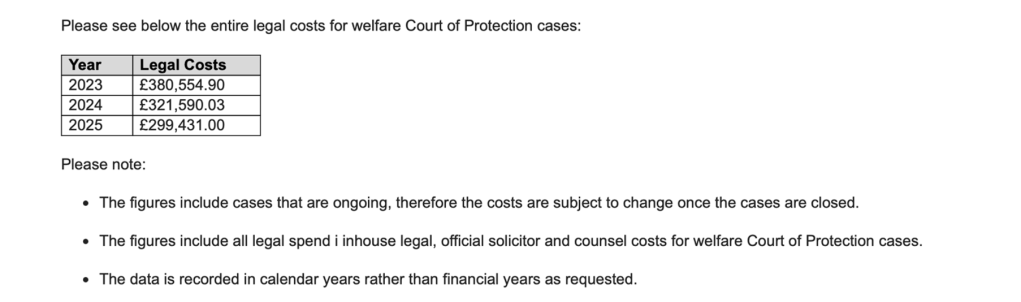
These costs are at the upper end of the range of replies I’ve received from public bodies across the board. I can’t get information for specific cases, but I do wonder how much of NCC’s costs in 2024 and 2025 relate to this case (and legal fees for hearings in 2026 have not been included). This case must have cost the taxpayer a lot of money.
Of course, it’s not all about the money. What about the human cost? Caroline’s mother had 24-hour care in her own home for two years, apparently (according to the Council) to protect her from her daughter. Every one of their interactions was supervised. In 2024, Caroline had to beg the court to spend a few hours together, unsupervised, on Christmas Day. For my PhD research, I asked Caroline what she thought about the protection given to her mother by the court. She told me: “For me, one of the strongest points is that something described as “protection” can actually feel like punishment to the person living through it. It is also important that harm done to a close family member can become harm to P, because that family member may be one of the most important sources of love, security and support in their life.”
Part of the gulf between the family and the court is reflected in the way that particular words have been differentially used and understood by various parties.
“Guilty”: Caroline said in the March 2026 hearing that she “wasn’t guilty”. ‘Guilty’ is not a word used in the Court of Protection. Facts are found. But Caroline feels as though she’s been found guilty: she told me that she felt treated as guilty from the outset, and treated like a criminal. It’s now engraved forever on public record that Caroline coercively controlled and abused her mother. Not only Caroline, but her mother too (the protected party) has described herself as feeling “guilty”, as reported in the Official Solicitor’s position statement for the hearing in October 2025, when she was asked about the 24-hour care she was receiving: “I just don’t feel as though I have got a life anymore at the moment. I feel like I am the guilty one, like I am being punished. At my age, I don’t think it is right”.
“Enmeshed”: In the March 2026 hearing, Counsel for Norfolk County Council referred to the language Caroline herself had used in her oral statement to the court, which included use of the word “enmeshed” to describe her relationship with her mother, indicating that she accepted this description. I asked Caroline about this: “In answer to your question about the word “enmeshed”, it was not originally my word. I had heard the judge use it to describe Mum and me, and I repeated it in my statement. It was also written into the fact-finding judgement after the October 2024 hearing. I am not a psychologist, and I did not understand it as a clinical or negative term. I actually thought it might be positive but just looking it up, apparently not so! To me, it meant that Mum and I were exceptionally close and strongly bonded, probably more so than the average mother and daughter.” It seems as though Caroline thought “enmeshed” meant the same as “close knit”. It is, however, a term used in Court of Protection hearings to indicate a very unhealthy relationship (see “Tangled webs, ‘enmeshment’, and breakdown of trust”.)
“Undertaking”: In the March 2026 court hearing, after Caroline said that she found undertakings “scary”, Arbuthnot J described them as “just promises to the court”. Caroline had been found in contempt of court for breaching undertakings in January 2025. Undertakings have a penal notice attached. When I interviewed Caroline in November 2025, she described the effect of the undertakings on her family life: “….it ends up then we [Caroline and her father] can’t even just talk to mum about what’s supposedly going on, because remember that we had to sign these undertakings. I mean, we don’t know what an undertaking is. And to this day, we still really don’t. But we sign these undertakings, that we couldn’t use certain words; we were being controlled. They were so dictatorial to us, we couldn’t even talk naturally as a family”. The “certain words” that Caroline could not “mention” to her mother, because of the injunction, included the words “care home”. This led to Caroline’s parents adopting the code words “Big House”, as they talked to each other about neighbours and relatives who were moving into care.[5] Caroline told me she experienced the court as effectively telling her: “if you use that word Big House again, we’re going to have you!”. She continued “How dare they control what we say? I think that’s awful, isn’t it? Especially old people, they talk about death and care homes”.
“Totalitarian state”, “code words”, “dictatorial”, “control”. Some people might be surprised to hear citizens of part of the United Kingdom using vocabulary like this to describe a state institution in the 21st Century. But even a retired Court of Protection judge, Anselm Eldergill, associates elements of the Court of Protection with a totalitarian regime. He posted a slideshow on Linkedin[6] in June 2026, entitled “Reforming the Court of Protection & Mental Capacity Act”. Here’s one of his slides:
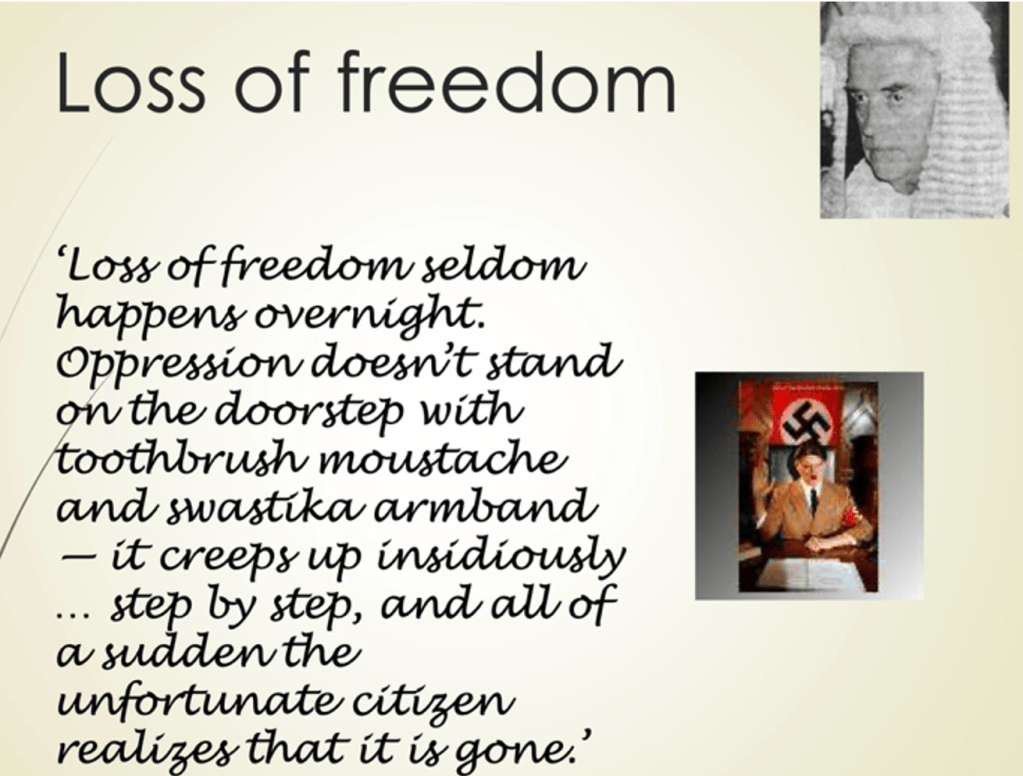
When I saw it, I thought of Caroline’s dad’s use of the words “totalitarian state” and I contacted Anselm Eldergill. I told him I was curious about the quote on his slide and the choice of images. He told me that it is a quote from Lord Chief Justice Lane and that “his point, of course, was that small encroachments on liberty added together eventually erode liberty. That is what we need to be vigilant about, and is likely how we will lose our liberty rather than by one dictator with a toothbrush moustache taking it in one go” (I have Eldergill’s permission to quote this.)
At the end of these proceedings, Caroline’s mum is in the position of a lot of people needing care – living at home with carers going in a number of times a day. And, as for many people in her situation, it seems that sourcing carers that fit in with her needs is a problem. Caroline as primary unpaid carer will no doubt be involved in trying to ensure her mother gets the care she needs.
Three years and 10 hearings later, Caroline Grady and her family no longer have the Court of Protection overseeing their lives. But the impact of these proceedings will last for the rest of their lives.
4. Juridogenic harms – by Celia Kitzinger
It is obvious to most family members and lay observers – and I think to many lawyers and judges too – that the legal processes of the Court of Protection, however well-intentioned and however positive their eventual outcome, can and do cause harm, both to the vulnerable person at the centre of the case and to their families.
The term “juridogenic harm” parallels “iatrogenic harm” in medicine. It denotes “the harm that law generates as a consequence of its operations.”[7] It describes “the intrinsic and often inescapable harms caused by the litigation process itself, even when the process is working exactly as it should”[8]
Some of these harms are familiar from litigation generally: the stress of legal proceedings, the demands of navigating a court governed by technical language and unfamiliar conventions, and the financial costs. The research literature[9] identifies patterns of emotional and psychological harms – trauma, stress, stigmatisation, and feelings of being “humiliated”, “bullied”, “afraid” and “overwhelmed” in court proceedings. In the Family Court, people often describe feeling feel blamed and pathologized[10]. In the Open Justice Court of Protection Project, we hear about the same sort of harms from family members involved in the Court of Protection: it’s “nerve-wracking’, “overwhelming” and “lonely” – leaving them feeling “helpless” and as if they are “foreign bodies in the hearing”.[11]
The same, unsurprisingly, is true for Caroline Grady and her family. She tells me she feels that her life was “taken over” by the Court, and that it’s been “the most exhausting and distressing chapter of our lives”. She’s left feeling “devastated” and “exhausted” by what she’s been put through. Harm caused to family members also harms the protected party, because it damages P’s familiar scaffolding and support network.[12]
It’s not just Caroline – we’ve also heard of her mother’s distress about the proceedings. In one hearing she expressed her sense of indignity at being found to lack capacity in certain areas of her life: “I do have capacity to make up my own mind. That makes me so angry, because I do have capacity. What I listen to, I take in. And I can respond coherently to other people”. In another, she expressed her dismay about the court requirement that she be constantly supervised by paid carers (to protect her from her daughter): “I want a proper and normal life. I do not want to be somebody who is monitored and watched all the time. It is hurtful and I am not happy with that, who would be? It is not like they are a relative. They are always there and it is horrible”.
This case inevitably raises some difficult questions. What was the psychological and emotional cost for the vulnerable elderly woman at the centre of this case of more than two years spent under constant supervision and prevented from unsupervised contact with the daughter she has a very close relationship with? What was the cost for this family as a whole?
Juridogenic harms need always to be weighed against the benefits of court intervention. In this case, as in some others[13] I’ve witnessed, I’m not at all convinced that on balance the proceedings have contributed a net improvement in the lives of the protected party or her family
Daniel Clark is a Research Fellow in Open Justice at the University of Sussex. His research concerns public access to, and understanding of, courts and tribunals in England and Wales. He has a specific focus on applications relating to contempt of court, and in particular those that arise in the Court of Protection. Daniel is also a core team member of the Open Justice Court of Protection Project. He can be contacted on LinkedIn.
Amanda Hill is a PhD student at the School of Journalism, Media and Culture at Cardiff University. Her research focuses on the Court of Protection, exploring family experiences, media representations and social media activism. She is a core team member of OJCOP. She is also a daughter of a P in a Court of Protection case and has been a Litigant in Person. She can be contacted on LinkedIn (here).
Celia Kitzinger is co-director of the Open Justice Court of Protection Project and an Honorary Professor in the School of Law and Politics at Cardiff University. She is on LinkedIn (here), and also on X (@KitzingerCelia) and Bluesky (@kitzingercelia.bsky.social)
End notes
[1] The three published judgments are: Norfolk County Council v CA & Ors [2024] EWCOP 64 (T3); Norfolk County Council v Caroline Grady [2025] EWCOP 15 (T3); Norfolk County Council v CA & Ors [2025] EWCOP 16 (T3)
[2] The blog posts (in reverse date order):
- A remarkable turnaround: Updating the “vile judgment” case
https://openjusticecourtofprotection.org/2026/08/13/a-remarkable-turnaround-updating-the-vile-judgment-case/ - Safeguarding Mum: The “vile” judgment and the daughter’s story: https://openjusticecourtofprotection.org/2025/09/05/safeguarding-mum-the-vile-judgment-and-the-daughters-story/
- Draconian reporting restrictions (now lifted) in a contempt of court case https://openjusticecourtofprotection.org/2025/04/07/draconian-reporting-restrictions-in-a-contempt-of-court-case-severing-continuity-between-judgments/
- “Let us be alone as a family again”: An application for unsupervised contact at Christmas https://openjusticecourtofprotection.org/2024/12/23/let-us-be-alone-as-a-family-again-an-application-for-unsupervised-contact-at-christmas/
- Complex issues for the court and plans for an ‘omnibus’ capacity hearing: https://openjusticecourtofprotection.org/2024/07/09/complex-issues-for-the-court-and-plans-for-an-omnibus-capacity-hearing/
- When two legal teams turn up in court to represent P: Disputed capacity to conduct proceedings: https://openjusticecourtofprotection.org/2024/03/18/when-two-legal-teams-turn-up-in-court-to-represent-p-disputed-capacity-to-conduct-proceedings/
[3] See “A remarkable turnaround: Updating the ‘vile judgment’ case”
[4] There were originally 36 allegations, but these were reduced by order of the judge to a list of 11 consolidated allegations.
[5] The injunction to the LPA only applied to Caroline and not her father, a fact that Counsel for the applicant brought up in the March 2026 hearing. This again illustrates how hard it is for lay people to fully understand court proceedings. It’s possible that this misunderstanding arose because of §140 of the “vile judgment” [2024] EWCOP 64 (T3) which states: “The risks of future harm to CA remain at present. CA needs to be protected from the harm particularly from DA [the cypher used for Caroline Grady in this judgment] but also from EA, CA’s ex-husband.” EA is Caroline’s father.
[6] https://www.linkedin.com/posts/anselm-eldergill-53146142_reform-eldergill-ugcPost-7471217629257646081–hwI/?utm_source=share&utm_medium=member_desktop&rcm=ACoAADuX1HQB0Q_m3mh7jvi_Q2gP0df5aT6lmoY
[7] Carol Smart, 1989 Feminism and the Power of Law, Routledge
[8] The quotation is from Thomas G Gutheil, Harold J Bursztajn, Archie Brodsky and Larry H Strasburger, ‘Preventing “Critogenic” Harms: Minimizing Emotional Injury from Civil Litigation’ (2000) 28(1) Journal of Psychiatry & Law 5, 6.. They capture the same concept in the term “critogenic harm” (derived from crites, Greek for “judge”)
[9] For example: Michaela Keet, Heather Heavin and Shawna Sparrow, ‘Anticipating and Managing the Psychological Cost of Civil Litigation’ (2017) 34(2) Windsor Yearbook of Access to Justice 83; Feikoab Parimah and others, ‘A Snapshot of Emotional Harms Caused by the Litigation Process – Qualitative Data from Ghana’ (2021) 2 Forensic Science International: Mind and Law 100050; Thomas G Gutheil, Harold J Bursztajn, Archie Brodsky and Larry H Strasburger, ‘Preventing “Critogenic” Harms: Minimizing Emotional Injury from Civil Litigation’ (2000) 28(1) Journal of Psychiatry & Law 5, 6 < https://www.forensic-psych.com/articles/artPreventingCritogenicHarms.php; Sheelagh McGuinness, ‘The Harms of Criminal and Coronial Investigation in the Context of Reproductive Loss’ [2025] Criminal Law Review 5; Noel Semple, ‘The Cost of Seeking Civil Justice in Canada’ (2016) 93(3) Canadian Bar Review 639, 666
[10] Luke Clements and Ana Laura Aiello, Understanding Parent Blame (Bristol University Press 2025); Michael Layton, ‘Iatrogenic Harm and the Court of Protection'<https://openjusticecourtofprotection.org/2026/06/12/iatrogenic-harm-and-the-court-of-protection/ >
[11] For example, the blog post by ‘Hope’, ‘Counselling and Support Needed for Family Members in the Court of Protection’ https://openjusticecourtofprotection.org/2023/12/13/counselling-and-support-needed-for-family-members-in-the-court-of-protection/
[12] Iatrogenic harm and the Court of Protection https://openjusticecourtofprotection.org/2026/06/12/iatrogenic-harm-and-the-court-of-protection/
[13] Two other cases are described in the forthcoming chapter (co-authored with Amanda Hill) that I’ve drawn on in writing these reflections: Kitzinger C and Hill A 2027 “Juridogenic harm in the Court of Protection”, in Hidden Law Making in the Court of Protection (Edited by Judy Laing and Sheelagh McGuinness, Bristol University Press). These same two cases are also covered in the following blog posts: Celia Kitzinger, ‘Systems-Generated Trauma and Closed Proceedings: Hywel Dda University Health Board v P & Anor[2024] EWCOP 70 (T3)’ (Open Justice Court of Protection Project, 14 December 2025) < https://openjusticecourtofprotection.org/2025/12/14/systems-generated-trauma-and-closed-proceedings-hywel-dda-university-health-board-v-p-anor-2024-ewcop-70-t3/ and Sandra Preston and Joe Preston, ‘A Court Hearing and 23 Visits from 16 Officials: Family Doubt that “Deprivation of Liberty” Is Working in the Public Interest’ (Open Justice Court of Protection Project < https://openjusticecourtofprotection.org/2025/08/07/a-court-hearing-and-23-visits-from-16-officials-is-deprivation-of-liberty-working-in-the-public-interest/

