Treatment escalation for a teenager in ICU

By Rhiannon Snaith, 16th March 2023

Editorial note 3: (added 30 April 2024) There is a Court of Appeal hearing on 1st and 2nd May 2024 – the parents (supported by Christian Concern) are challenging Mrs Justice Roberts’ finding that ST lacked capacity to litigate the case, and lacked capacity to make her own medical decisions. You can watch the hearing (live-streamed, no need to request the link, and you can drop in and out, like watching TV, here: https://www.youtube.com/channel/UCn_a8COiB_KbaEvXKFk7lng?view_as=subscriber). It will also be recorded and available on You tube afterwards.

Editorial note 2 (added 14 September 2023): Sadly, the Mail reported today that ST has now died.

*******

I am a PhD student at Cardiff University researching media representations of end-of-life decisions. I have previously observed a number of hearings in the Court of Protection (CoP) and have blogged about several cases (see bio). I was keen to watch this hearing as I’d learnt that it was about serious medical treatment, and as it turned out, it was different from other cases I had observed in the sense that P may have the capacity to make her own decisions, which I’d not seen in hearings that I’d previously observed. 

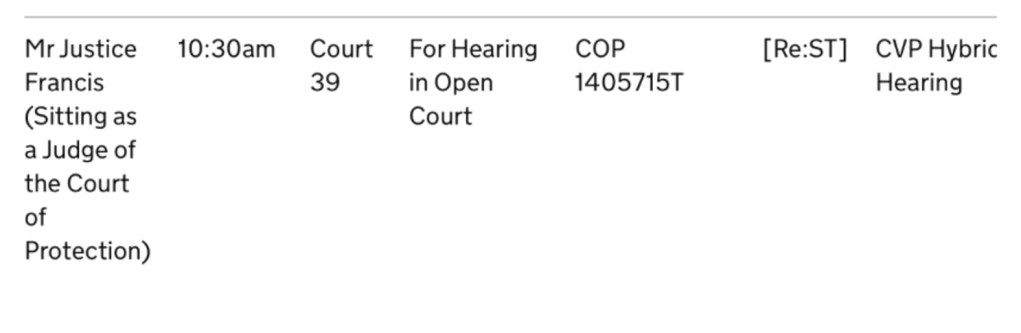
This case (COP 1405715T, before Mr Justice Francis) was heard in the Royal Courts of Justice, on the morning of Tuesday 14th March 2023. It was listed as a ‘hybrid’ hearing, which meant that some people would attend in the physical courtroom in London, while others would attend (as I did) remotely via Cloud Video Platform. 
At the heart of this case is ST, a young woman who has been in intensive care since August 2022 after contracting COVID-19. Prior to this, ST had numerous health problems due to a genetic mitochondrial disorder, though none that caused any neurological problems. It was only after contracting COVID-19 that ST became ill with pneumonia and was admitted to an intensive care unit and was placed on mechanical ventilation, and regular and frequent kidney dialysis. 

It seems that the primary goal of this hearing was not to determine whether treatment should be withdrawn/continued but to ascertain what should happen if ST’s condition deteriorates. Questions relating to ST’s capacity to make such decisions for herself was also raised, as well as the issues relating to her awareness of her condition and prognosis. It seems that ST’s parents had initially not wanted to distress ST by telling her about her condition, and that ST herself had expressed the view that she did not want to acknowledge it. However, it was important for all parties that ST’s wishes be taken into consideration.

The hearing

The applicant in this hearing was the Trust, represented by Victoria Butler-Cole KC. The parents were represented (pro bono, via Advocate) by Jake Thorold (they were not eligible for legal aid). Katie Gollop KC was also present as a potential advocate for ST via her litigation friend, the Official Solicitor, though she played only a minimal role in this hearing and it was decided during the hearing that she would not be taking an active role unless otherwise advised. 

Counsel for the Trust 

Victoria Butler-Cole KC, counsel for the Trust, gave a helpful introduction to the case for those attending the hearing. She explained that while ST had underlying health conditions, it was not simply her genetic disorder that had led to her current condition, but COVID-19. After contracting COVID-19, ST was placed in intensive care, has been put on mechanical ventilation and is in need of regular dialysis. Attempts to wean ST off mechanical ventilation had been unsuccessful: the doctors believe it will never be successful and that she will require mechanical ventilation for the rest of her life. Counsel also said that ST is not a candidate for a kidney transplant: “the very sad view of medical doctors that she’s now to be treated as someone who’s in the terminal phase of her underlying medical condition. A kidney transplant is not on offer. That is something the parents understand”.

The application made by the Trust was to address the question of what should happen if ST’s condition deteriorated. It was made clear that the hospital was not willing to offer certain treatments. They were not willing to offer a kidney transplant or CPR (in particular, chest compressions). These were not ‘best interests’ decisions but clinical decisions by the hospital. Counsel said they were made on the grounds of futility. For example, “If it got to the point that chest compressions were needed, there would be no prospect of her coming back to life, if I can put it in very lay terms –  or if she did, only for very short period”.

It seemed that the main issues between the hospital and ST’s parents were in determining what limits should be placed on treatments in future if there is deterioration, e.g., in relation to infection, or problem with organ function.  

Counsel for the Trust said there was a question about ST’s capacity and her ability to make decisions about her medical treatment for herself.  In order to have capacity to make a decision, a person needs to be able to understand, retain, and weigh information relevant to the decision they need to make (s. 3.1 Mental Capacity Act 2005) and then communicate their decision.  But at the time the application was made to court, ST’s parents did not want ST to be told about her condition or prognosis as it would be very distressing for her. There are also “certainly times when ST herself has expressed unwillingness to talk about very upsetting matters”. But the doctors need to know the basis on which they are providing medical treatment.  Is it because ST capacitously consents to it, or is it because it is in her best interests?  And capacitous consent can only be established if ST is given the information about her illness and her prognosis (and so is potentially able to understand, retain and weigh it).

An additional complication is that ST registered a Lasting Power of Attorney (LPA) in 2022. However, concerns were raised as to its validity as ST had just had major surgery and doctors thought she was not in a position to make such a decision at that time. Counsel added that ST was in a better condition now than she was at that time and she may now have capacity to make an LPA. 

It is important to note here that since the application was made, and since ST’s barrister was appointed (on Friday), ST’s parents no longer object to ST being provided with the relevant information. 

It was only at a meeting yesterday that ST has expressed her own views in any level of detail.  She says she doesn’t trust the doctors and believes they are making things worse. This is also the view of her parents. The doctors had told ST that she would have to be on a ventilator for the rest of her life.   Counsel said: “She was very upset by that, understandably.  She’d wanted to go home and thought she would come off the ventilator and be able to do so, and now she is looking at spending the rest of her life in hospital or possibly a nursing home if one could be found that could manage both dialysis and ventilation. This is devastating news for a [teenager] who until she got COVID was doing very well”.

According to Counsel, common ground had been reached following recent discussions between the hospital and family members trying to establish a practical way forward. It was agreed that if ST has capacity to make her own medical decisions, then everyone wants her to do that, but on the basis of informed discussions. It was also stressed that any information passed on to ST should be set out beforehand to ensure minimal distress and confusion. This was agreed upon by the hospital and the parents. As communicating with a tracheostomy is difficult, it was stated that ST would be able to communicate via writing (on an iPad), a method of communication which she had previously expressed a preference for.

It seemed imperative that the process of involving ST in discussions regarding her condition and prognosis be handled in a sensitive way, and that ST would be able to have discussions without her parents present in some cases. It may be that she has capacity to make her own decisions if she is given the information sensitively and supported to understand it. 

Counsel for the Trust concluded by putting forward three options in terms of the possible next steps:

Option 1: The hospital brings in an intensive care consultant from outside the Trust, who has no links to either ST or the hospital she is currently in and who can provide independent information to ST and her parents. In this instance, the Trust would be happy to facilitate (and pay for) this.

Option 2: Follows a similar process to option 1 but with the Official Solicitor (OS) involved. There is currently sufficient evidence (said counsel) for an interim order that ST is unable, at the moment, to make decisions as she is overwhelmed by her condition and does not have all the relevant information.

Option 3A ‘Harbin v Masterman’ order was the third option (See here). This allows the Official Solicitor to advise the court, rather than represent ST. 

“So, you are not asking me to make a decision about capacity today”, asked the judge.

It seemed not.  

Counsel stated that a discussion to discern what issues the court may need to deal with was needed.  

Counsel for ST

Katie Gollop KC spoke next. She was present as the potential advocate for ST via her litigation friend, the Official Solicitor [OS]. She acknowledged the very sensitive nature of the case and said she did not know much about it at present. She said her “instinct” at the moment was to take a step back for now, particularly when there is a possibility of a contested hearing. Additionally, she made the point that “it is not immediately obvious that ST lacks litigation capacity – especially having looked at the note of yesterday’s meeting”.

Counsel was also concerned that the way the application was originally framed was the OS giving ST information (about her illness and prognosis) that was going to be life-changing and very upsetting – purely for the purposes of giving her a capacity assessment.  This didn’t seem the best use of the time ST has left to her.  

She added that Issues regarding communication were very unclear as well. The Trust has said ST is blind while her parents said they didn’t believe this, and there was evidence in a note by ST’s nurse that says she facilitates communication by providing ST with a pen and paper. As a result, the OS is unsure of ST’s communicative ability. She suggested that an intermediary or a speech and language therapist could be involved, or that a speaking valve could be fitted to ST’s tracheostomy tube.

In summary, it may be more beneficial for the OS to not withdraw from the proceedings but to take a step back while ‘option one’ was explored. 

Counsel for Parents 

The court heard next from Jake Thorold as counsel for the parents, but there was an adjournment of around 45 minutes for him to consult with the parents before he made his submissions. This was because he had been so recently appointed and matters had been evolving so rapidly that he had not had time to take full instructions from them.  Also, ST’s mother is not fluent in English.  There was no interpreter in court for her today and her husband had taken on that role. 

When the hearing started again, the judge checked with counsel: “Are you satisfied you’ve had enough time with your clients, bearing in mind you’re dealing with them remotely and there are language issues?”  He said he was.

Counsel said that there was some upset from ST’s parents that the case had been brought to court. They had now discussed the issues with him, and subsequently with ST (during the adjournment), and they were happy for all the relevant information to be given to ST regarding her condition and prognosis. They were also happy with the proposal to bring in an independent expert, as long as agreements were made as to what the process would be in providing this information and what is told to ST. It was also stressed that ST’s parents were happy for some conversations to happen with just ST and the expert present (without their involvement) as long as nobody from the Trust was present at that time.

Counsel had also explained the Transparency Order (TO) to the parents (who had now discussed it with their daughter). Counsel informed the court that both ST and her parents “want these proceedings to take place in public and for all parties to be named”.  This clearly surprised the other parties, and the judge. Counsel for the Trust responded by stating that the names of the Trust, hospital and staff should not be made public because “inevitably there’s a risk that completely unacceptable behaviour by the press or members of the public will occur, as have occurred before in cases involving children”.

The judge was concerned and said, “once we unbolt the door, we can’t close it again”.  The judge’s view was that it would be best to keep the Transparency Order as it is and review it at the next hearing.

The last 5 or 10 minutes of the hearing were difficult to hear due to distorted sound – which was particularly unfortunate for ST’s parents: the judge reassured the parents and those attending online that discussions within this time frame were purely in relation to the transparency order.  

Reflections 

Three things struck me about this case. 

The first, and perhaps most obvious, was the fact that ST may have capacity to make her own medical decisions. This was striking as up until this point the cases I had previously observed did not involve Ps for whom there was any possibility of capacitous medical decision-making (because they were not conscious). The diversity of cases that come through to the CoP often stands out to me and as someone who is studying representations of end-of-life decisions, specifically for those without capacity, it is always interesting to see how the decision-making process is handled in court – including, in this case, the question of support for ST to enable her to make her own decision about treatment if she has capacity to do so.

The second thing that struck me, as has been clear to me previously, is the care and consideration taken by the judge and legal teams when it comes to P, and also their family. In this case, the judge made it clear throughout the hearing that a priority was to ensure that ST’s parents were given and understood all the relevant information, including the potential ramifications of making all information regarding the case public. It is something that I would want to be assured of for my family if I were ever in a similar position. 

The third thing that struck me was how young ST is to be facing such a challenging situation. Often, when I attend hearings, I am struck by the emotional aspects of these cases. In this case, ST is a young woman, younger than me, who not only is facing the very upsetting prospect of her condition and her prognosis, meaning she will not be able to return home, but may also have to make very difficult decisions in terms of her treatment. I can’t help but think about how I might feel in that situation. Would I want to be fully aware of my condition and prognosis? What limits, if any, would I put on my treatment if my condition worsened? They are difficult questions to consider for anyone, and perhaps especially for a teenager.

Attending hearings is always an eye-opening experience for me, not just in terms of developing an understanding of the court process and how decisions are made but also personally. In this case, it brings home to me the many devastating and, frankly, scary implications of ST’s condition, both emotionally and physically on her and her family. I wish both ST and her family well and hope that the plans developed help to ensure that she feels supported and cared for.    

Rhiannon Snaith is an ESRC funded PhD student at the School of Journalism, Media and Culture at Cardiff University. Her research focuses on media representations of decisions about life-sustaining treatment, specifically for those without the capacity to make such decisions for themselves. She has previously blogged for the Project here and here.  You can learn more about her work by checking out her academic profile. She tweets @Rhiannon_Snaith

When P objects to an expert

By Celia Kitzinger, 14th March 2023

Professor X has no expertise”, says Laura Wareham[1] – the protected party at the centre of this case.  She does not want him involved in drawing up her care plan.  

This is partly (she says) because of very negative things she’s heard about him from a friend and partly because Professor X “doesn’t believe in Hypermobile Ehlers-Danlos SyndromeHis job is to discount it” (click here for more information about hEDS).  She makes an accusation of criminal behaviour against him too, which seems to startle the judge. Her parents, who are parties to this case, also object: “Laura, don’t say that!”.  

Laura  – who has “a hugely complicated medical background”, including “autistic spectrum disorder”, “bipolar affective disorder” and “Bodily Distress Syndrome – has been in hospital  since April 2022 following an emergency admission.  She’s been intubated, ventilated and very seriously ill.  She’s now stable and is attending the remote hearing (COP 1397774T) from her hospital bed.

Everyone agrees that Laura doesn’t require care in an acute hospital setting and hasn’t done for some time. Everyone agrees she should be discharged.  An expert (Dr A) is currently developing a care plan for her and there is a view (from whom is not quite clear) that he needs to work jointly with an expert in infectious diseases.  The expert he chose, Professor X, is not someone Laura wants involved.

Background

This case has been in court at least three times before (since August 2022), and I blogged the February hearing at which the problem of the expert was first raised (“Standoff about the appropriate expert: A pragmatic judicial solution”).  

At the February hearing, the judge had come up with a pragmatic solution.  Since Professor X wasn’t acceptable to Laura, counsel should go back to Dr A and “explain that the confidence of Laura and her parents will be fatally undermined by Professor X’s involvement. Ask [Dr A] if there is someone else who can fulfil that role” – and then see if that person could be available to help with Laura’s care plan.  Laura’s parents recommended the name of someone they thought could help and the judge required that name to be put to Dr A as a candidate expert too (if in fact that expert was available).

I hoped to hear today that a suitable infectious diseases expert had been found to work with Dr A,  and that Laura’s care plan could be finalised so that she could be discharged soon.

Today’s hearing: 22nd February 2023

The case was heard by Mrs Justice Arbuthnot. At the beginning of the hearing, Scott Mathewson, counsel for the Health Board, briefly summarised the case to date and reported that the parents’ preferred expert was not able and willing to take instruction.  But there was “good news”: “There is another doctor, a colleague of Professor X, who is an infectious diseases expert, Dr N. He is also an international expert and he has accepted instruction and Dr A is happy for him to act as his second. My Lady, we regard this as a breakthrough.” (Counsel for the Health Board)

Laura wasn’t happy.  In response to the judge’s observation that “Laura has no confidence in Professor X”, Laura added “Or anyone contaminated by him.  Which includes a colleague.”  Later she said, “I don’t want to be condemned for the rest of my life by someone who isn’t educated or compassionate enough to….” (I don’t know where she was headed with that because her father intervened and spoke over her.)

The view of the Health Board is that “in an ideal world, only experts that Laura approved of would be instructed” but that given the need to find someone quickly (Dr A was to assess Laura in two days’ time and then submit a report with a proposal for discharge), “the balance falls in favour of making the order so that Laura may be discharged to a suitable placement as soon as possible”.

Laura’s father raised a question as to whether in fact an infectious diseases expert was needed: “We’d always been surprised at Dr A’s apparent request to have input from someone in infectious diseases…. Looking at the correspondence we got this morning from our ex-solicitor, it seems it was at the suggestion at the Health Board that an infectious diseases specialist was brought in.  And Dr A simply agreed – presumably in ignorance of the extreme distress that would bring to Laura.” (Laura’s father)

Ian Brownhill, counsel representing Laura (via her litigation friend the Official Solicitor) said it is “perfectly clear from Laura that she doesn’t want anything to do with Professor X” and suggested that when Dr A visits Laura in two days’ time to conduct his assessment, he should say what other expert input (if any) he needs, acknowledging that (as the judge put it) Professor X is “out of the question now”.  He said: “The Official Solicitor’s position remains the same – Laura ought not to be where she is.  Laura doesn’t want to, and ought not to be- I don’t want to say ‘stuck with’- but have something on her medical records that she feels is fundamentally flawed.  We are trying to find an even keel while progressing this case.  This is important, but there are are many other important issues to resolve – her capacity, her contact with her parents.” (Counsel for Laura)

Both counsel invited the judge to order that Dr A should be “in the driving seat… so if he deems it necessary to have input from Dr N he has permission to rely on that input, and also if the Warehams believe further input is required, there is no objection to them obtaining additional evidence”.

I haven’t seen the final order, but I think it’s to the effect that Dr A should decide if he needs any additional input or not, and if so what kind of additional input, and that he can ask anyone he wants except Professor X (including Dr N,  Professor X’s colleague).  The judge (apparently reluctantly) indicated that Dr N could be considered as an “expert desktop reviewer of Dr A’s work … if there is nobody else available and the discharge proposals can’t otherwise be done within the timescale.  But Dr A will realise there is a risk his work will be undermined by [the Wareham’s] strong views about Dr N – whatever the rights and wrongs of the case, and this is no reflection on either Dr N or Professor X by the way”.

An articulate and eloquent ‘P’

It’s unusual, in my experience, for a protected party to speak out as clearly and confidently as Laura does throughout this hearing.  

But Laura Wareham has spoken out publicly before – about her own medical treatment for Ehlers-Danlos Syndrome and the death of her sister Tania who suffered from the same condition and also had cancer (Nottinghamshire Post) and about her fundraising activity for an operation, not available to her on the NHS, to stabilise her neck (ITVDaily Star)

She’s been very ill and her parents accept that Laura lost capacity to make some or all of her own decisions for a while, but they believe that she has now regained it.  So does Laura.

When counsel for the Trust provided a helpful introductory summary for observers, he mentioned the finding from consultant psychiatrist Dr Claudia Camden-Smith that Laura lacks capacity to make her own medical decisions.  Laura intervened: “It’s been disputed”.  He  acknowledged this,  explaining that “the matter of capacity is to be determined at the final hearing”.  Laura’s intervention led to a rebuke from the judge. 

Judge: Don’t interrupt!

Laura: I had my hand up and you ignored me.

Judge: You will have your moment, but not now.

Laura: Fine! (My note: this was said as the kind of ‘fine!’ that means exactly the opposite.)

Later,  Laura’s mother raised concerns that Laura’s psychiatric diagnoses amount to a claim that “there’s nothing wrong with [Laura], it’s all in her head” and was going on to explain this when the judge interrupted her, saying “Let’s go back to-“.  

Laura:  No. I would rather you let her finish her sentence.

Judge: If you interrupt, I’m afraid I’m going to exclude you from the hearing.

I found this quite a challenging exchange: the judge ‘interrupted’ Erica Wareham (literally mid-sentence), but objected to Laura Wareham interjecting in just the same way, to call her out on that. What’s happening here (and in the judge’s earlier exchange with Laura on the matter of ‘interruption’) is a consequence of the judge taking for granted the specialised turn-taking system of the courtroom[2], of which Laura (like most lay participants) is unaware. 

Court of Protection hearings are supposed to put “P” (the protected party) at the centre of the case, and that’s clearly where Laura wants to be.   She’s asked for full access to both her own medical records and to the Court of Protection bundle. (It wasn’t clear to me that either was forthcoming.)

Laura also complained about the way the case had been listed on the Royal Courts of Justice Daily Cause List  (using just her initials, “LW”):

Laura: I’m offended that you’ve taken my name off the case.

Judge: I don’t know what you mean.

Laura:  It says ‘LW’.  I am me, and I will be referred to as me.

Judge:  Oh, right. That is to do with listings.

Laura also corrected the judge at one point when she heard the judge mis-speak the family name: “Our name is WareHAM, not WareING”.

This was an interesting hearing because – like other hearings in which articulate and determined protected parties participate fully – the role of the person’s own wishes and feelings, and their place in ‘best interests’ decision-making is thrown into sharp relief.  I have no doubt that Laura (and her parents) will oppose a court determination that Laura continues to lack capacity.  And whatever the court finding on capacity, Laura’s wishes are going to have to play a key role in any future ‘best interests’ decisions made about her[3].

The next hearing will be for a date after 17th April 2023 (we’ll update when we have a precise date), and I believe it will be concerned with Laura Wareham’s capacity to make her own decisions.  I will be interested to see if Laura’s name appears on the listing, as she has requested.  The Open Justice Court of Protection Project has many concerns about errors and omission in listings and regularly raises them with HMCTS, with mixed success!

Celia Kitzinger is co-director of the Open Justice Court of Protection Project.  She’s observed more than 400 hearings and is a frequent blogger.  You can find her on LinkedIn, and on Twitter @KitzingerCelia


[1] The court order enables me to name Laura Wareham (and her parents, Conrad Wareham and Erica Wareham) but not the hospital where she is being treated, or any of the professionals involved in her care.  All quotations are based on touch-typed contemporaneous notes and are as accurate as I can make them, given that we are not allowed to audio-record court hearings. They are unlikely to be 100% verbatim.

[2] See J Maxwell Atkinson & Paul Drew, Order in Court (1979) Palgrave Macmillan

[3] Compare Influencing ‘best interests’ decisions: An eloquent incapacitious P and Articulate, Eloquent and Passionate – but does P have the Mental Capacity to Make Decisions about Four Areas of her own Life

“This is a quagmire and it needs to be urgently done”: LPA objections, disputed capacity and an imperative need for a panel deputy

By Eleanor Tallon, 12th March 2023

Very little was revealed about the woman at the centre of this case – other than she has been living in a care home since the end of 2021, whilst her son remained living in her home. 

In June 2021, she had made a Power of Attorney for Property and Affairs appointing her son as her attorney. Then in March 2022 she instructed solicitors to revoke that LPA to appoint her daughter-in-law and grandson as joint LPAs instead. But then both she and her son objected to this change. This led to questions being raised about her capacity to make an LPA and to revoke the registered LPA. 

A Special Court Visitor was instructed to assess retrospective capacity for the LPA, and various other decisions, but her son disputes all the conclusions reached. Further complicating issues include concerns raised around her son’s conduct in managing her affairs, his occupational interest in her property and the fact that the woman does not want contact with the other family members.

No one is able to administrate her affairs and the Local Authority cannot proceed with financial assessments to secure payment for the care home placement, which leaves her in a tenuous position.

“This is a quagmire, and it needs to be urgently done. A panel deputy could resolve this, though there may be an issue about getting one on board quickly. The end result would be the court making full enquiries as to appointing a panel deputy, or her son, or indeed anybody else.” (Carol Davies, Counsel for the Applicant)

The woman isn’t party to the proceedings, but she is aware of them and wants to explain to the judge directly how she feels.

Access to the hearing

Having held a professional role within Court of Protection proceedings, I have a keen interest in the Open Justice Court of Protection Project to support my continuing development. I have observed several hearings before (and have blogged about three of them here, here, and here) so I felt somewhat prepared as to what to expect as a public observer. I knew it was best to email the court staff the evening before, and to choose 2 hearings in succession of each other (to provide a back-up plan in case my first choice was vacated). 

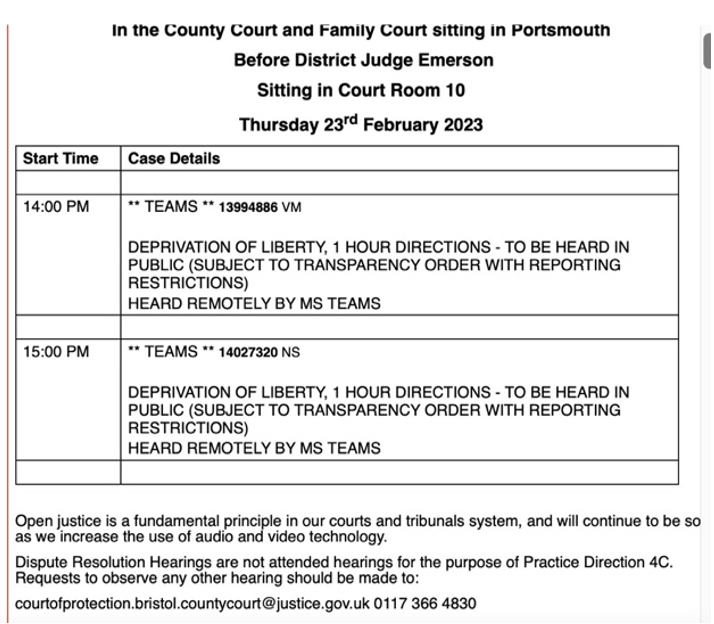
On the evening of 21st February 2023, I scrolled through the listings (which are helpfully provided on the Twitter feed for the Open Justice Court of Protection Project [OJCOP]) and I noticed two hearings related to DOL, one at 9.30am and another at 3pm. I emailed to request access for both hearings, feeling suitably organised.

However, the next morning, I chased up the access link for the 9.30am hearing, only to receive an email from the court enquiries officer (shortly before the hearing was about to start), advising that I had sent the request to the wrong place (I sent the request to the ‘enquiries’ address rather than the ‘hearings’ email address) and they had only just passed it on. How frustrating!

This was a regrettable faux pas, as it was clearly too late to gain access and I didn’t hear back. I did hear back about my second choice, but unfortunately that one had been vacated. 

I felt dismayed (mainly with myself) and was reminded of my first hapless attempts at gaining access to a COP hearing as a public observer. I decided to admit defeat for that day and re-strategise for the following day, as I had a meeting that had been cancelled in the afternoon. 

That evening I looked at the listings and the following case (at 2pm) – tweeted by OJCOP – stood out to me:

I was interested because a Local Authority Solicitor (Laura Wrixon) had publicly commented on the tweet explaining:

“The 2pm hearing is not as listed. It’s about capacity re finances, registration of an LPA/appointment of a deputy and P’s participation in the proceedings.”

This was appealing, particularly when considering some of my recent work (as an Independent Social Worker), where I have been involved more often in assessing decisions around finances and litigation capacity. It’s been interesting to explore related case law, after spending many years (as a Social Worker and Best Interest Assessor) mainly focusing on capacity decisions around welfare, support, residence, and DOL. I felt enthused to observe the hearing, as a further learning tool for assessing capacity on financial affairs and understanding the legal processes related to deputyship. 

That night I emailed the County Court, as well as requesting another hearing as a reserve. On the morning of 23rdFebruary, I chased up the request and by lunch time I received an email back with confirmation that the judge had approved my request, and a link to the hearing was provided.

Further to this, I noticed that the link had been passed on directly by a solicitor, named Laura Wrixon (presumably the same solicitor who had commented on the Tweet). It seemed that she was the instructing solicitor for Local Authority in the case, which gave me a perfect opportunity to request the transparency order and position statements, which I did. 

Shortly after I received the transparency order (and my request for position statements was being considered). It certainly felt like the obligations around open justice were being upheld, and maybe synchronicity was working in my favour?

I read through the transparency order, which highlighted the typical subject matters (which basically prevent attendees from sharing any personal details or sensitive information disclosed, which could identify those involved in the proceedings).

So, to protect confidentiality, I will use the pseudonyms; Mrs King, who is subject to the proceedings and her son will be referred to as Mr King (first respondent).

By reading the transparency order, I also gleaned that the original application was made in September 2022 by Hampshire County Council, with Mr King as first respondent and the Southern Health NHS Trust as second respondent. 

It was also apparent that an earlier hearing took place in November 2022 which considered issues of capacity around welfare and property and affairs. 

The hearing

Upon gaining access to the hearing (COP 13994886), Judge Emerson was already in the process of leading the introductions. I initially attempted to familiarise myself with who was who from the assortment of faces and names on screen, and I observed the following attendees:

  • Mr King, first respondent, who was represented by a Legal Executive, Clare English (CE) of Martin Searle Solicitors
  • Carol Davies (CD), Barrister of College Chambers and Counsel for the Applicant (Hampshire County Council).
  • Laura Wrixon (LW), Instructing Solicitor at Hampshire County Council (the Applicant).
  • Mr Christopher McGowan (CM), Solicitor at the Office of Public Guardian (OPG). 
  • Ms Y, Social Worker at County Council.

The judge then advised the court that that I (Eleanor Tallon) had requested to observe the hearing, 

Judge: I have been made aware and I have no issues with it, does anyone else? I take it from the resounding silence that everyone agrees to Ms Tallon observing the hearing.

Counsel for the Applicant: Ms Tallon has received the transparency order. She has also requested position statements which we have considered, but it may be that Ms Tallon hears enough today to not need the position statements.

The judge then discussed the papers he had before him, which included a draft order, an order for a section 49 report, the statement of the Special Court Visitor, and position statements for the County Council, Mr King, and for the OPG.

At this point I was wondering whether the NHS Trust was no longer a respondent and if the OPG had now been joined as a respondent? And if so, was that the reason that a section 49 order had required a Special Court Visitor to conduct the capacity assessments? (Position statements would certainly have been helpful to make more sense of it all!)

Having checked the government website I was informed of the following:

Section 49(2) of the act provides that the Court of Protection (‘the court’) may request a report to be made to itself, either by the Public Guardian or by a Court of Protection visitor, to help with decision-making.

Court of Protection visitors can visit anyone they are directed to by the court. They can be directed by the Public Guardian to visit people who have a deputy appointed by the court to make decisions for them, as well as donors and attorneys acting under registered enduring or lasting powers of attorney. (A ‘donor’ makes a power of attorney; an ‘attorney’ makes decisions for the donor.) They may in some circumstances visit someone before the registration of a lasting or enduring power of attorney.

The judge asked whether there were any disputes regarding the reports.

Counsel for the Respondent: There is a disagreement on capacity, Mr King has some key points to make.

The judge advised that although the disputes would be considered, today’s case management hearing was not to determine factual issues about capacity. There was then some discussion around Ms English (Counsel for the Respondent) having access to Judge Emerson’s email address. It was agreed that Ms Wrixon would arrange this, followed by the judge requesting that an overview of the case was provided to the court for the benefit of the observer.

Ms Davies, Counsel for the Applicant,  then proceeded to outline the events which had led to the current position, which appeared to be quite complex, contentious, and protracted. 

From what I could gather, it seems that Mrs King spent some time in hospital from September 2021, following which she was moved to a care home, but there was a dispute as to her capacity to decide on where to reside. This wasn’t resolved until January 2023, at which point it was concluded that she had capacity to decide on residence, and her decision was to remain living in the care home.

However, there remained an issue around Power of Attorney. Mrs King had apparently appointed her son Mr King as her Lasting Power of Attorney (LPA) in June 2021. However in March 2022 she instructed solicitors to revoke the LPA in favour of her son, and instead appoint her daughter-in-law and her grandson (who both live in overseas) as joint LPAs. The LPA paperwork was sent to the OPG to be registered.

Following this, objections were raised by Mr King and Mrs King via a letter, which stated that she did not want her daughter-in-law or grandson to be registered as LPAs.

The OPG then considered the aspect of the LPA (for Property and Affairs) being revoked. Mrs King’s capacity to decide on appointing an LPA was in question, along with other decisions. Dr B was instructed to assess her capacity, followed by another expert, Dr H being asked to give further opinions. 

The parties then agreed to Dr N, Special Court Visitor, being appointed to provide a further capacity report, which was due to be completed by the end of March 2023 but had already been submitted some weeks early. 

The Special Court Visitor identified that Mrs King had capacity when requesting to revoke the LPA in favour of her son and had capacity to appoint her daughter-in-law and grandson. The Special Court Visitor also concluded that Mrs King currently lacks capacity to manage her property and affairs, lacks capacity to make decisions on the proceedings, lacks capacity to make a will, and lacks capacity to decide on the occupation of her home (as well as a couple of other issues which I was unable to capture, as I couldn’t write them down quickly enough!)

Counsel for the Applicant then highlighted that there is now an agreement that an update report is required as to Mrs King’s cognitive impairment and capacity. It wasn’t specified as to which decision this would be for and without having seen the position statements for this case (and with so many sub-issues) it certainly wasn’t clear what exactly was being contested, but I assumed a further report was agreed on account of ongoing disputes. 

I felt quite sorry for Mrs King, who I knew so little about, other than the fact that she had been subject to various mental capacity assessments on a number of convoluted matters, which could be an arduous and emotive process for anyone, with or without a cognitive impairment.

Further to this, Counsel for the Applicant related that Mr King had made an application via a COP 9 form for a judicial visit to his mother, and that this was the main purpose of today’s hearing.

Judge: I need to understand the need for the visit and what the practicalities would entail, instead of simply agreeing to it.

Counsel for the Respondent: The position statement from Mr King explains his reasoning for the request.

Judge: I also have to consider the timing of the visit. I have some hesitation. If I was to visit, I need to consider when it should take place. From what I’ve seen, it struck me that we don’t have an update on capacity on a number of issues. If I was to visit it should be done after the assessment has been done and people have had a chance to consider the outcome. One of the issues is capacity to litigate, and that’s one of the concerns I have.

Counsel for the Respondent referred to Mr King’s position statement and highlighted a point around Mrs King’s ability to participate and have her voice heard in the proceedings.

Counsel for the Respondent: Mrs King is aware of the proceedings and wants to explain to you directly how she feels.

Judge: I understand that, but do you understand my point?

Counsel for the Respondent: Yes, though if she does lack capacity her wishes and feelings are still pertinent and her comments will inform the court.

(My BIA senses were tingling listening to this exchange).

Judge: Absolutely. The point I’m making is this. You are effectively asking a Special Court Visitor to review all capacity issues. I understand the point about participation but not knowing what the answers to the capacity questions are… If I don’t know what any difficulties are and how to approach her, I fear that I will be beating around in the dark not knowing the answer.

Counsel for the Respondent conceded that if Mrs King was found to have capacity overall then a visit might not be necessary.

Judge: I understand that practice directions mean there is a desire to enable participation and there is an indicated desirability for judicial visits, which I have sympathy with. But I don’t think at the moment, I should make a decision until I know what the mental capacity assessment says.

Counsel for the Respondent: If she has capacity to litigate then that makes a difference.

Judge: The purpose is not to gather information.  If she has capacity, the court has no jurisdiction in any event.

A recent blog from the Open Justice Court of Protection Project springs to mind here, which relates to situations in which a person may have capacity to litigate but not to make the decisions in question, though in practice this appears to be fairly unusual.

Judge: We will wait for the assessment, and we can make a decision at that point. It’s not helpful to make a decision today.

Counsel for the Applicant: That matter can be adjourned until the next hearing. I don’t know if a Special Court Visitor could complete the report within that period. We may need to think about vacating the hearing for the 25th April.

Judge: I suggest we keep that hearing for now. In terms of the directions for the report, how quickly can it be provided?

There was discussion about hearing dates and timescales for the report. The judge then went through recitals for a further draft order, and the issues that need to be covered going forward which included: the need for an updated mental capacity assessment;  a note of what experts did agree on; Mrs King’s views on contact with her daughter-in-law and grandson; and the reasons to believe that Mrs King may have lacked capacity on appointing a Power of Attorney (Property and Affairs). (I assumed that this latter issue was in reference to the subsequent application made for her daughter-in-law and grandson but it wasn’t entirely clear).

Mr McGowan, Solicitor for the OPG, discussed whether there was a pragmatic solution as an interim position which could be agreed between parties.

Counsel for the Applicant: Mr King does not agree for a panel deputy.

A panel deputy is a professional deputy appointed by the Office of Public Guardian. The Court of Protection will choose such deputies from a list when no one else is able to act for a person who lacks capacity on the relevant scope of decisions.

Counsel for the Respondent: Mr King refutes the statement that he’s unsuitable to act as deputy and is concerned that the costs for a panel deputy would impact on her estate.

Judge: I’m not going to make a determination as to a final appointment of a panel deputy, but we need to consider what should happen in the interim. What do you say Ms Davies?

Counsel for the Applicant: It’s a hornet’s nest, as to registering the previous LPA. The report from the OPG last year, raised concerns as to Mr King being responsible. We are not recommending a deputy, other than that an interim deputy would be appropriate. The County Council Charging Assessment Team are extremely busy and it wouldn’t be feasible for them to act, as they would not want to hold the deputyship whilst there is a dispute. The only option is for a panel deputy to ensure neutrality. There are ongoing difficulties to date as there is no control over Mrs King’s finances, which means the council can’t get going with the financial assessment to work out what she should contribute to the costs of her care. This is a quagmire, and it needs to be urgently done. A panel deputy could resolve this, though there may be an issue about getting one on board quickly. The end result would be the court making full enquiries as to appointing a panel deputy, or Mr King, or indeed anybody else.

Solicitor for the OPG: I just want to point out a further nuance when deciding whether Mrs King’s property should be considered into the financial assessment. If Mr King remains in the property that would raise issues.

I would just explain here for the reader that when a Local Authority arranges a permanent care placement, they complete a financial assessment in terms of the personal contribution the resident is able to make towards the costs. The LA takes the person’s property into account, possibly initiating a deferred payment agreement (DPA) until the property is sold. 

However, there are certain conditions in which a property owned solely by the individual can be disregarded, and this includes when a family member is still living in the property as their main or only home (and therefore has ownership rights). This is known as ‘the relative’s property disregard’ and guidance on how LA are to apply the disregard is provided by DoH in the light of the Walford v Worcestershire County Council judicial review [2015] EWCA Cov 22.

Mr King’s age wasn’t confirmed and the disregard can be applied regardless of age, but the property must be disregarded where the relative meets the qualifying conditions (i.e. is aged 60 or over or is incapacitated) and has occupied the property since before the resident entered the care home.

Judge: What you are suggesting is a potential conflict of interest between Mr King and Mrs King in respect of ownership of property, in that the management of her affairs could be compromised. Yet the property and affairs of Mrs King do need to be administrated. The council have concerns as to Mr King being suitable to exercise the deputyship and the OPG has also raised concerns to this effect. I’m only dealing here with the interim and to decide the best interests of Mrs King before we get to a final hearing. There is a need for her Property and Affairs to be dealt with urgently and an assessment of her care fees. There were concerns regarding the previous conduct of Mr King and Dr H reported issues. Within the position statements there is evidence of a conflict of interests. Mr King has an occupational interest in the property. I must consider the proportionality of a deputy being appointed, as well as the potential delays in a professional being appointed when there is a family member willing, but the concerns are reiterated. On balance, for an interim position, it seems an interim deputy is appropriate notwithstanding the costs and delays that may cause. I have not made this decision based on findings of fact against Mr King. It’s a holding position until that determination can be made.

However, the quagmire didn’t end there.

Respondent for the Applicant: I’m just flagging the point on the current LPA, we don’t have a registration of the LPA made in favour of the grandson and daughter-in-law and it is unclear whether a deed of revocation has been registered for the LPA made in June 2021. Maybe Mr McGowan can assist.

The judge queried whether any current LPAs were suspended.

Mr McGowan (Solicitor for the OPG) discussed the process of removing an LPA in order to appoint a deputy and highlighted that there stands an objection (I assumed he meant from Mr King?). Mr McGowan went on to say that the OPG could not be sure that Mrs King had capacity to revoke the LPA for her son and said that the LPA is still live but needs to be suspended. 

(I hadn’t heard of an LPA being suspended but it does seem to be ‘a thing’. Please see this commentary for further clarity).

Judge: I just about understood that.  Thank you for explaining. I will now move on to the next recital that needs to be determined.

The judge then made reference to the recitals asking the parties if they were happy with (a) to (g) (which I was not privy to, so I found this difficult to follow). However, it appeared that Mr King was not in agreement with some of the points.

Counsel for the Respondent: Mr King disputes that he moved into the home after his mother was hospitalised and he has evidence that he occupied the property for 7 years. He has concerns regarding (f) to (g).

Solicitor for the OPG: We need to determine Mrs King’s capacity to object to the LPA in March 2022. We need an opinion on her capacity to make that objection.

Counsel for the Applicant: In relation to the purported attorneys, Mrs King’s grandson and daughter- in-law, we are all clear that she doesn’t want contact with them. The question is around the position of these two people, should they challenge the revocation. They have not been notified of these proceedings or asked whether they want to be actively involved to push for their LPA. I am proposing whether to make a provision for them to be notified and if they seek to join, to file a COP 5. 

A discussion ensued around gaining permission to serve notice by email (given these relatives live overseas) and the limits of information that would be shared with them when notifying them of the proceedings. Dates were discussed for a further hearing in June and it was agreed that Mrs King would be offered an opportunity to attend the next hearing in April if she so wishes.

The judge then went through the requirements for a further section 49 order and systematically went through the recitals for directions, commenting that it can be ‘painstaking and difficult’ to go through the order but it’s helpful to clarify the directions and decisions needed. 

Finally, the judge asked whether there was anything further from the representatives, which they declined, and he thanked those involved and brought the hearing to a close.

Reflections

Counsel described this situation as a hornet’s nest and indicated that the legal ground they were covering was a quagmire. These metaphors seem entirely fitting. Though, what didn’t come across enough for me, was any real impression of Mrs King, or her views. 

I was concerned that Mrs King had indicated that she wanted to play a part, yet had she been offered the opportunity to attend the hearing? The social worker was present within this hearing: could Mrs King have attended alongside her social worker to support her participation?

I accept the point that the judge made in relation to not wishing to visit with Mrs King until a further mental capacity assessment had been completed, though I envisage from her point of view, that she might be tired of repeated assessments covering the same boggy issues, only to find that parties have remained in conflict as to the conclusions made, thus leaving her in a place of uncertainty and confusion. Could it be that she simply wants to be involved and retain a feeling of dignity and control within these proceedings?

In my professional experience, I have often seen families feud when it comes to decisions around finances and property, and not infrequently, this can be the subject of safeguarding concerns. Under the Care Act (2014), the person must remain at the heart of safeguarding enquiries and their wellbeing and what they want as an outcome should be ascertained and upheld as much as possible throughout the process. 

The principles of the Care Act (2014) and the Mental Capacity Act (2005) are clear and congruent to one another, and both advocate for participation. To that end, I hope that Mrs King gets the opportunity to have her say, in a way that is meaningful to her. I also hope that these complicated matters are resolved soon, to enable her to feel settled, rather than being stuck in the middle of crossfire.

Of course, I am mindful that the purpose of the proceedings is certainly not to disempower Mrs King. On the contrary, the objective of the Court of Protection is to uphold the rights of vulnerable individuals who are assessed as lacking capacity to make decisions, promoting their autonomy and happiness, whilst balancing this with an acceptable level of risk. 

At times, the complexities of a situation are such that the court will need to take meticulous steps to work towards achieving the best and most appropriate outcome for the individual concerned. This often means wading through a treacherous waste ground before that solution is reached.

In terms of determining that elusive balance between empowerment and protection,  I pose a few reflective questions:

  • How will the mental capacity assessment be re-approached to ensure the conclusions withstand further challenge?
  • Has the relevant information been broken down in a way which is accessible to Mrs King, to support her in making the requisite decisions?
  • Has Mrs King been made aware of the concerns raised around her son managing her finances, and what are her views on him continuing to live in the property? 
  • If Mrs King has capacity around contact with her family who live abroad (and is declining to share information with them), would it even be viable for them to seek to be her POA?
  • Does she have an advocate to support her (or an IMCA if there are statutory investigations around financial abuse)? 
  • Are there any suggestions as to further ways in which she could regain capacity on specific areas?

I was left with many unanswered queries, which may have been addressed by the professionals involved already. This might have been clearer had I been provided with position statements, which I have pursued and not received, though I recognise the workload pressures (which create ever-increasing to do lists!).

Further thoughts

Overall, what struck me about this case, was the importance of providing a clear record of a person’s decisions and reasoning, at the time when their capacity isn’t questioned. In contrast to appointing a deputy through the court (after the person has lost capacity to make decisions on managing their financial affairs), appointing a Power of Attorney (whilst the person has capacity to do so) is a relatively simple process. The court is rarely involved, the documentation can be completed online by the person (or their representative) fairly quickly and with minimal expense (here https://www.gov.uk/power-of-attorney/make-lasting-power).

But if the evidence that supports the LPA application is less than comprehensive, then this lends itself to controversy if the person’s capacity to appoint an LPA is later challenged.

When supporting a person to apply for an LPA, it would be prudent to record the discussions held with the person, which clearly evidence their ability to understand, retain, weigh and communicate the following (as set down by Mr Justice Poole in the following judgment, paragraph 16):

The Public Guardian v RI & Ors [2022] EWCOP 22

I proceed on the basis that the relevant information in relation to the execution of an LPA is: 

a. The effect of the LPA. 

b. Who the attorneys are. 

c. The scope of the attorneys’ powers and that the MCA 2005 restricts the exercise of their powers. 

d. When the attorneys can exercise those powers, including the need for the LPA to be executed before it is effective. 

e. The scope of the assets the attorneys can deal with under the LPA. 

f. The power of the donor to revoke the LPA when he has capacity to do so. 

g. The pros and cons of executing the particular LPA and of not doing so.

And when considering capacity to execute an LPA, it is emphasised that the bar for capacity should not be set too high and that explanations should be given in a way that is appropriate, for example by use of simple language. There should be a clear breakdown as to the relevant information which is shared with the person, using communication aids and other support as necessary. 

An independent report from a suitably trained professional may help to ensure that a POA application is rigorous, with accurate recording that stands up to future scrutiny. This might help to avoid a legal quagmire such as the one Mrs King has found herself in, and to ensure that the most empowering decision is made.

Yet, there is the potential for unforeseen circumstances, such as concerns arising from the conduct of a registered LPA, which may mean that an investigation needs to be carried out by the OPG (possibly alongside the Local Authority) and further steps may be required, to safeguard the person’s financial security and well-being. 

As noted within this case, appointing a professional deputy in such circumstances is not a decision that is made lightly. It follows a conscientious decision-making process with careful regard to the merits and disadvantages, when weighing up the options. But ultimately, this may be the only feasible option where a higher level of scrutiny, neutrality and professional accountability are warranted. 

From my observation of this hearing, I feel reassured that Mrs King’s case will be dealt with diligently, when a final determination is made on the appointment of a deputyship.

Eleanor Tallon is an Independent Social Worker and Best Interests Assessor. She can be contacted via her website mcaprofessional.co.uk and found on LinkedIn. She also Tweets @Eleanor_Tallon

Discharge from hospital: Light at the end of a very long tunnel

Daniel Clark, 10th March 2023 – with new update by Celia Kitzinger about the emergency hearing on 16th March 2023 (added at end of blog post)

This hearing (COP 14036761, before Mrs Justice Theis) was scheduled to begin at 10:30am on Monday 6th March, 2023. However, the Judge was engaged with an urgent matter and so the hearing actually began just before 11:45.

At the centre of this case is a young woman who has been detained under Section 2 of the Mental Health Act (1983). This case has been blogged about twice. In the first hearing, which I did not attend, the Trust where she was receiving her care (“the discharging Trust”) had decided that she was not eligible to be detained under Section 3 of the Mental Health Act (1983). Celia Kitzinger, who observed this hearing, reported that it seemed a safe discharge was on the horizon. 

At the second hearing, which I observed but could not blog about due to work pressures (the blog post is again by Celia Kitzinger), it was clear that the discharge plans had gone awry. The day before the hearing, the discharging Trust, and “the receiving Trust” found themselves in irreconcilable disagreement. The discharging Trust found that P did not meet the criteria for detention under Section 3 of the Mental Health Act, whereas the receiving Trust found that she did, and that discharge into the community would be likely to cause her harm. As no placement could be found at such short notice, the ICB were asking for the Court to authorise P’s deprivation of liberty in the hospital setting whilst a care package could be found. 

At the hearing on 6th March 20223, which was held via MS Teams, the people present were: 

  • Katie Scott, of 39 Essex Chambers, for the Applicant, the Integrated Care Board
  • Benjamin Harrison, of Serjeants’ Inn Chambers, representing P via the Official Solicitor
  • Avril Rushe, of No5 Barristers Chambers, representing the NHS Trust currently providing care for P (“the discharging Trust”)
  • Olivia Kirkbride, also of Serjeants’ Inn Chambers, representing the NHS Trust who will eventually take responsibility for P’s care (“the receiving Trust”)
  • P, with her solicitor
  • P’s current psychiatrist, and the psychiatrist’s registrar
  • P’s social worker            

It was a relief to hear that positive steps have been taken to ensure that P can soon be discharged from hospital. 

Open Justice

At the beginning of this hearing, Counsel for the ICB gave a brief but detailed opening case summary, including what had changed since the last hearing. Even though I had observed the previous hearing, and was the only observer, there was no way for Counsel to know this, and I was grateful for the summary. 

It’s a matter of open justice that hearings begin with a clear explanation of the situation both past and present, so that observers can follow what follows. Without it, observers could have so little information that they would not be able to accurately report the hearings. This, in turn, would make the Court of Protection more opaque than transparent. 

P’s presence at the hearing

P was present at this hearing but had not been at the previous hearing. Before going any further, Mrs Justice Theis took the time to ensure that Counsel for the Official Solicitor was in contact with P’s solicitor. This was so P could ask for a break, or indeed express any other needs that she may have.

The Judge also asked how P would prefer to be referred to: either by her first name, or as Miss X, or in any other way. I thought that this was a very positive touch, and that it demonstrated a keenness to ensure that P’s wishes and feelings were at the centre of the hearing. I will return to the way in which P’s wishes and feelings were clearly of central importance to the Judge, and it was nice to see the way in which the Court provided a platform for them.

The care package 

Counsel for the Integrated Care Board, in opening, explained that the issue before the Court is “future treatment and care within the options available”. The two options were either for P to remain in hospital or to go to accommodation in the community with a “significant” care package in place. What made this hearing initially easy to follow was that all the parties had agreed that a care package within the community is in P’s best interests. This accommodation has been found, and “the sensory lights have been installed, [the placement] has anti-ligature bedding, and [the placement] has the PBS [Positive Behavioural Support] plan”. 

The ICB have also commissioned a private company to provide care with 5 members of staff present, “albeit with only three staff engaging at any one time, with the other two available should there be a crisis or emergency”. This is consistent with P’s support in hospital, where she has been supported on a 3:1 basis. I must admit that I did wonder how the care company will be able to sustain this, given the well documented crisis in recruitment and retention in the care sector. I hope there is some type of contingency plan should these staffing levels be difficult to maintain. 

In the event of an emergency that cannot be safely managed at home, Counsel for the Receiving Trust explained that they will “provide a place of safety for P”. This could include facilitation of a Mental Health Act assessment or “steps [that are] taken under Section 136”. However, whilst in this current accommodation, the Discharging Trust (who currently care for her in hospital) will be providing her support under the previously identified specialist pathway. At the end of the initial 6 months of living in the community, it is expected that the Receiving Trust will accept the referral into their care.

Counsel for the Official Solicitor explained that, “[P] wants to give [the placement] a go and would like to go and see it, if at all possible, rather than just photographs”. The Judge clearly thought this was important, and returned to this at the end of the hearing, saying “that’s something that the Court really wants to happen”. She also expressed her gratitude that P could attend the hearing, because “it was useful to see what everyone is doing” to ensure she has the best possible care. Given the delays over the last month, I’m sure it was a relief to hear directly that things were moving along in a positive direction. 

An incident

I was very disturbed by one aspect of this hearing. It became clear quite early on that an incident had taken place at the start of this month which resulted in P being physically restrained. However, there was confusion about how many people were actually involved in this restraint. 

Counsel for the ICB said that “some reports say six people, some reports say four people”. It was clear that nobody was any the wiser. Only Counsel for the Discharging Trust seemed to have some sort of idea: she reported that her most recent understanding was that four people restrained P, and a further two people were in the room. Either way, a report about this incident is to be submitted to the Court by the end of the week. 

I find it unacceptable that there should be such confusion about how many people were involved in a restraint (to be clear, it seemed to me that this confusion was created by the ward staff rather than Counsel themselves). As I have written for this blog before, I have been involved in physical restraint. It’s a physically and emotionally demanding time for all involved, but especially demanding for the person who is being restrained. It is our duty to never lose sight of that. 

Part of that duty is ensuring that the details of the restraint are factually reported, in great detail. One of the reasons for this is so that another person reading the subsequent report can scrutinise what happened, and consider what could have been done differently. It also acts as a safeguard for the person, ensuring the cause of any harm (physical or psychological) can be identified. 

The information necessary is myriad but includes: the full names of those involved, the position of those involved (i.e. who held what arm in what way), what was said to the person, how long the restraint lasted, and what aftercare (including debriefs) was given to both the person and staff involved. You’d expect, as an absolute bare minimum, to know how many people were involved. 

I therefore cannot envisage a situation in which there would be so much confusion about how many people restrained somebody. At the time of the hearing, almost six days had passed since this incident. In my opinion, it should have been crystal clear (at the very least) how many people had been involved. Counsel for the ICB did explain that this has been identified as a potential Serious Incident, and is being investigated. 

Going Forward

There are some fine details to be sorted out before P can return to the community. First, there was some confusion about a section of the original Order which ‘gave’ the police the powers to return P to hospital. The Judge was confused by this, stating that it is not for the Court to grant the police powers. However, Counsel for the Official Solicitor stated that the police sometimes ask for this as “it isn’t covered by their usual powers” – their usual powers being detention under Section 136 of the Mental Health Act or to prevent criminal offences being committed. The Judge asked for Counsel to find out what the police want, and whether they still want this, ahead of the next hearing. 

Second, there was some discussion about how P might be transferred should she experience a crisis (short of an emergency). The care provider who will be supporting her in the community do not have a secure transport service, and so there is still a question of how P could go from her accommodation to a Centre that can provide support. This issue needs to be resolved by the next hearing.

Finally, it was acknowledged that the Official Solicitor is concerned the initial referral to the receiving Trust would never have been successful because P was “unstable”. The OS wants to know what the discharging Trust thinks about the receiving Trust’s policy. In response, the Judge stated that while “there is a difference between the two main professionals…there is nothing I can do about that”. However, the fact remains that “the Court was having to go from hearing to hearing without knowing what was going on. The focus of the Court is what is best for P” and any judgment will only be able to “recognise this situation and say it hopes it does not happen again”.

At the last hearing, the Judge had asked for a submission on how this situation had been reached, and how it can be avoided in the future. Such a statement had not been produced at the time of this hearing, and Counsel for the Trusts had some disagreement about who would be most appropriate to provide this. Naturally, this Judge wants this issue to be resolved. 

I believe that it is very important work is done to ensure a situation like this does not happen again, where competing opinions and policies prevent a young person receiving the next step of support in a timely manner. Hopefully, this situation can contribute to vital lessons to not only these two Trusts but all Trusts.

This case will return to Court on Monday, 20th March, at 09:30, at which point all finalised plans will have been submitted to the Court. In the meantime, P will remain in hospital under a deprivation of liberty.

Daniel Clark is a PhD student in the Department of Politics & International Relations at the University of Sheffield. His research takes seriously Iris Marion Young’s claim that older people are an oppressed social group, and is funded by WRoCAH. He also works as an healthcare assistant in the NHS. He tweets @DanielClark132.

UPDATE: HEARING ON 16 MARCH 2023

By Celia Kitzinger

There was an urgent hearing before Theis J at 9.30am on 16th March 2023 – the Thursday before the hoped-for hearing on the following Monday at which the parties would invite the judge to approve an order for P to move into her new flat.

What’s happened is she’s spent a lot of time in police custody”, said Katie Scott, counsel for the ICB.   “There was an ‘episode’, if I can describe it like that, when she assaulted a number of hospital staff, and police.  There were attempts to return her to [the Hospital] from custody, but she’s made it very clear that she doesn’t want to spend time in hospital. Within minutes of being returned she had assaulted staff – and then, when they were called, the police.  That happened again last night.  Matters have escalated today, and members of staff on the ward felt so strongly that it was not in P’s best interests  to spend any more time on the ward, even just until Monday, that it’s been considered whether she could be moved sooner.  The agreed position of the parties is that it would be in P’s best interests to move to the flat today.  She is currently in custody and the police could convey her to the flat and the Hospital will send her belonging on today.

Counsel for the Official Solicitor (Ben Harrison) reported P’s view that “she was very clear that she wanted to be in prison rather than go to the Hospital again.

After some (short) discussion about the staffing ration (5:1) at the new flat, the safeguards relating to restrain – in particular prone restraints, and the importance of locking away knives, the court approved P’s move to the new flat, with the hope that there would now be “some structured calm for P to have the best opportunity to make this placement work for her”.

The next hearing is listed for 2nd May 2023, and the judge reminded everyone that the court was available for an urgent application before then, if needed.

Celia Kitzinger is co-founder of the Open Justice Court of Protection Project and tweets @KitzingerCelia

Injunction against a mother: ‘Biting the bullet’

By Avaia Williams, 8th March 2023

The person at the centre of this case (DS), a man in his early thirties, has been living in an acute hospital ward for over 14 months. That’s not due to a difficult-to-treat medical condition, or to a detention considered necessary under the Mental Health Act 1983 or a deprivation of liberty under the Mental Capacity Act 2005, nor is it due to long term chronic illness. No, DS has been living in hospital because suitable alternatives have not been available.

DS was admitted to hospital with a fractured leg in early December 2021.  He has a profound learning disability,  spastic quadriplegic cerebral palsy and he does not communicate with words. The court has already made declarations that he lacks capacity to make decisions about his residence and care. His leg has healed and (although he’s had a few subsequent health issues), his doctor has declared him medically fit for discharge from the hospital.

DS cannot return to the placement he was at before he was admitted to hospital because they had already served notice on him, several months previously, citing the behaviour of DS’s mother (AW).  After attempts to find a domiciliary care provider to enable DS to return home to live with AW failed, another residential placement was located, but subsequently withdrew. A new residential placement has now been found, but they will only accept DS if there is a Working Together Agreement in place setting out expectations of conduct. (Working Together Agreements are quite common in the family courts: check out this template for an example of how they can look.)

So far, the situation has been (since mid-December last year) that AW does not agree to the plan for DS to live in this new placement.  She has not signed a Working Together Agreement and has been reluctant to enter into negotiations around this. An injunction against her, to require of her the behaviours to which she will not voluntarily agree, is now being considered by the court.

I was watching this hearing – the first one I’ve observed in the Court of Protection since the lockdown – due to my interest in practicing in this area as a barrister. I have a wide legal interest, but much of this concerns matters of mental capacity, mental health, and public law, matters which are all regularly present in the Court of Protection. I am currently in the process of applying and interviewing for such roles and felt that revisiting such hearings would be beneficial. 

I hoped to gain further insight into the procedural aspects and legal requirements of the Court of Protection, known as Rules and Practice Directions. This hearing was an exceptionally relevant one for such an insight as it concerned argument of a breach of these rules. Additionally, I hoped to gain a greater appreciation of advocacy within the Court of Protection.

The Hearing

The hearing (COP 13679387) before District Judge Brown sitting at Bristol Civil & Family Justice Centre was heard remotely on 2nd March 2023. 

The applicant – who was also in court – was AW, the mother of the man at the centre of the case and also his Relevant Person’s Representative (RPR). She was represented by Richard Alomo of No5 Chambers.

DS was the first respondent and was represented (via his litigation friend, the Official Solicitor) by Oliver Lewis of Doughty Street Chambers.

The relevant local authority (Devon County Council) was represented by Emma Marie Harrison, solicitor advocate within the Council.

The Integrated Care Board (NHS Devon ICB) was represented by Ellen Lloyd of Bevan Brittan LLP.

Counsel for DS

Counsel for DS (via the Official Solicitor [OS]) gave a useful introductory summary to the case, drawing attention to the fact that this would be beneficial to those observing the hearing.  

He expressed concern that DS was still in hospital and said that 14 months is “an enormous amount of time for anyone to remain in a medical setting when it’s not medically indicated”. He explained that a previous offer of a care placement had been withdrawn due to AW’s behaviour, with the placement commenting that “the potential reputational damage is too great”: “in effect, saying ‘we’d love to offer DS a place, but it’s just too risky for us because of the conduct of his mum’[1].

Following this, the ICB (with the support of the OS) had found a suitable placement (“the Home”). However, the Home will only provide DS with a place if AW signs a Working Together Agreement (“WTA”), i.e. a bespoke  agreement between the placement and AW to collaboratively work together in DS’s best interests, outlining specific expectations about conduct and what will happen if these expectations are not met. AW has not accepted any such agreement and, counsel submitted: “our impression is that she will not countenance signing or entering into any negotiation as to its content”.  It was, said counsel:

 “... a surprise, an hour ago, to receive a position statement [from counsel for the mother] saying there are procedural mistakes about today’s hearing, and she might be able to sign a Working Together Agreement. The OS position is that it would be much, much, much better to continue this hearing and focus on DS and his needs by working together, rather than the court making injunctions. But unless AW is able to sign the Working Together Agreement today, to enable DS to be discharged, then the court should make the injunctions sought.” (counsel for DS)

District Judge Brown, in response, made her own views very clear:

If there could be an agreement by way of the WTA then that would be preferable.  If the court seeks to make an injunction or requires an undertaking, that has the potential for undermining professional relationships and future care plans for DS. But everyone here recognises it’s not in DS’s best interests to remain as a patient in an acute setting where he is not having his social needs met or a home-style-type or normal type of setting.” (Judge)

DJ Brown offered the parties some time for further discussion outside of court if they felt that “compromise might be possible”, but added that she was “not willing to leave this open-ended today” since “there has already been considerable delay for DS”.  That offer was declined by the mother, whose counsel reported that “her primary position is that DS is not ready for discharge. Her second position is that if he is ready for discharge then he should return home” with her. 

Solicitor for the ICB

The ICB said they wanted AW to agree to the terms of the WTA and, given that “previous agreements had been implemented and breached soon thereafter, we would want her to give an undertaking to the court that she would abide by the agreement”.

The ICB was clear that “returning home is not an available option for the court. The ICB is not willing to offer such a package. It is not safe or sustainable for DS”. 

The Supreme Court has ruled (in N (Appellant) v ACCG and others (Respondents) [2017] UKSC 22) that the Court of Protection may only choose between available options, and that it does not have the power to order a CCG (now ICB) to fund a care plan proposed by parents or to order care providers to that which they are unwilling or unable to do.  

Counsel  for the Local Authority

The LA has (said counsel) “a very minor role in the proceedings” and is “not taking an active role”.

However, the LA did raise a single salient point at this stage, that being that if an injunction were to be granted as sought by the Official Solicitor, then AW’s position as DS’s RPR could not remain in place, because its conditions “would make it impossible for [her] to carry out her role as RPR”. If an injunction were therefore granted, the LA proposed that a paid representative is put in place to take over this role and AW discharged (and they would like a recital to that effect in the order).

Counsel for the applicant – DS’s mother

Counsel for the mother argued that there were significant procedural failings, specifically in relation to §10.10 of the COP Rules relating to interim injunctions such that no injunction could lawfully be served today.

In particular, the respondents had failed to set out their injunction application on the COP 9 form and “the only application here in the bundle is one which is asking AW to give an undertaking to the court”. He continued: 

My client is entitled to have properly set out – which we say we haven’t – the terms of the order being sought, and, more importantly, the evidence in support of that application so that she can respond accordingly. The only application here alludes to a requirement by the proposed placement for a Working Together Agreement and an order by the court to abide by that. That is not a proper evidential basis for an injunction order – with the consequences that are likely to befall my client if she is found to be in breach of that order.” (counsel for AW)

Additionally, counsel for AW argued that the previous placement being withdrawn was not solely due to AW’s actions – rather, there had been suggested amendments to the care plan. “It would be wrong to leave the court with the impression that all this fell apart because of the allegations made against AW”. (What became abundantly noticeable at this submission was Oliver Lewis’s eyebrows shooting up.)

It was submitted that a properly defined ‘stand-alone’ draft order should be before the court “so there’s no misunderstanding about what AW is being asked to do”.  Instead (he said) there was “a mishmash of the prohibitory and mandatory, along with what might be considered restrictions on contact”. In conclusion, it was submitted that “[t]he application is in a mess at the moment”.

Response from Counsel for DS

In respect of the injunction, counsel for DS submitted that all the elements of the injunction argument had been presented in the other documents served on AW, and there was no need to put these all into a single document:

Injunctive directions within a case management order are fairly standard in the Court of Protection.  There are two ways of doing it – either like that, or the other way is with injunctions in a separate documents. It can happen either way – even at Tier 3.  It often turns on judicial preference, and if the court would prefer two separate documents, that can be accommodated.” (counsel for DS)

In respect of the direction that it’s now in DS’s best interests to move to the Home, counsel acknowledged that the proposed placement may not be perfect (one problem is that it is 100 miles away from where his mother lives; another is that it was rated as ‘requires improvement’ by the CQC).

It may not be perfect, but like in many cases, perfection is the enemy of the good […] It is in DS’s best interests to be discharged somewhere, and we now have a somewhere. I urge the court to bite the bullet. The price tag is either a signed Working Together Agreement or the protective ring (if I can use that phrase) of injunctive relief so that the care home can provide for DS’s care in a sustainable and safe way.” (counsel for DS)

Judgment 

DJ Brown delivered a succinct and clear judgment. She pointed out that DS has spent 14 months in hospital and that although his mother has an issue about whether he is fit for discharge, the consultant who examined him on 17thFebruary 2023 considers that he is fit for discharge and that the few remaining physical concerns can be dealt with in the community. (The reactions from the parties, again, was very noticeable to me. AW was clearly shaking her head in apparent disagreement at this point). The Judge continued: 

On the evidence before me, he is fit for discharge and there is before me ONE option. AW’s primary position is that it’s not in his best interests to be discharged to the Home but when he is discharged he should be cared for at home.  But a home care package is not an option before me.  AW has said she will use an unspecified care provider and there is no care plan before me from AW and no information as to how 24-hour care will be provided...” (Judge)

At this point AW physically raised her hand on camera and, without approval to speak, she starkly stated “There is!”. The judge responded, “Mrs W, I am giving my judgment. If you have comments, make them to your representative please,” before continuing with her judgment:

The court cannot force a party to provide an option, so the only choice the court has is to either do nothing, or to discharge DS to the Home.  The Home will only offer a place to DS if AW were willing into enter into a Working Together Agreement, which sets out the framework for contact and the way in which care will be provided for DS at the Home. Up until today, that Working Together agreement was not being considered by AW and she wasn’t willing to consider the Home but only a family home placement. That led to the application being made by the ICB. The difficulty is that it’s unclear to me how a court could force a party to give an undertaking, so it seems to me that application is somewhat misconceived – albeit that the intention behind it is very clear: the potential provider requires certain reassurances to be able to provide care for DS.”

So, the first question is whether it is appropriate to make a decision for discharging DS to the Home. If yes, secondly, would an injunction be necessary to ensure this was effective?”

On the first question, the judge said it was clear that remaining in hospital was not in DS’s best interests, despite “observed reactions of Mrs W” which led the judge to believe that AW’s view seemed to be that it would be better for DS to remain in hospital rather than to go to the Home. The judge was clear that she did not agree with this and having read the transition plan and reports about his needs, she was satisfied that discharge to the Home was overwhelmingly in DS’s best interests.

As to the second question, DJ Brown ruled that since there is no legal authority to force AW to consent to a WTA, the only choice would be either an injunction, or no order for DS to go to the care home.  Although counsel for the mother had raised several procedural irregularities, including failure to complete a COP 9, DJ Brown was clear that the court has the power to dispense with these requirements where circumstances justify it – particularly in this case where all the substantive arguments and evidence that would have been on the COP 9 were present in other court documents that had been served. Effectively, DJ Brown was saying that to require this information to be extracted from documents already seen by the applicant, and pasted into a new document, would serve no useful purpose, would create unnecessary delay, and would be disproportionate considering the best interests of DS.

DJ Brown was satisfied that there was evidence of AW’s disruption to previous placements and that the court was obliged to protect the placement at the Home. The only way this could occur was to make an injunctive order, based on the terms set out in the Working Together Agreement. She asked for some rewording of this so as “to make it clear as to the exact behaviour that is prohibited”. She also asked for the contact arrangements to be treated separately, with the injunction saying that AW “is to abide by the contact arrangements as set out in the care plan”, so that if there’s a change in these arrangements agreed with the care home, then the injunction wouldn’t need to be amended.  “Its purpose is to give the Home reassurance that AW will behave in a reasonable manner with members of staff and will abide by the care plan, and it will limit other contact outside of the weekly update.”

This is an interim placement and parties will continue to work to find a better placement closer to AW. The next hearing is listed for 2:00pm on 25 May 2023.  At that hearing, both DS’s placement and the interim injunction against his mother will be reviewed.

The mother sought (and was refused) permission to appeal this decision – and although she retains the legal right to appeal directly to the High Court under Rule 20 of the COP rules it would have to be shown that there is a real prospect of success or there is some compelling reason to allow the appeal. 

Reflections

The hearing lasted no more than 90 minutes, but some very significant decisions were made in this short time. As somebody hoping to practice as a barrister in Court of Protection cases, this was extremely eye-opening and added a new dimension to my understanding of the Court of Protection.

My interest in mental capacity law has only been furthered by attending this hearing.  In particular, the arguments regarding procedural minutia, which are entirely mundane to many, were very interesting to see in practice. Often, these rules are in place to direct representatives as to what they must do and not do, adherence is largely agreed and they are rarely disputed other than in the appeal courts, and so being able to witness the submissions of Richard Alomo, representing the mother on this matter, added another layer of interest for me to this hearing.

Furthermore, CoP cases are very emotive, it is therefore not too surprising that AW made a small outburst challenging the judgment that DJ Brown was giving.  These outbursts happen all the way up to the Supreme Court, including this heart-rending example from the Charlie Gard case (at 09:06-10:06). It is always interesting to witness is how judges respond to these and, with credit to this judge, she handled this very empathetically but also firmly. This is typical of judges of the Family Division in my experience, too. As somebody who regularly attends cases before the criminal courts, I experienced a drastic difference between this judge’s reaction to an outburst and those of magistrates and judges of the Crown Court, who certainly do not take as kindly to any interruptions and somebody making an outburst like this would rapidly be remonstrated with or ejected from court.

My interest in working professionally in the Court of Protection has been fuelled by being able to observe this hearing and I look forward to the review hearing on the 25th May 2023.

Avaia Williams is a student on the Barrister Training Course at BPP Manchester and founder of the Nightingale Rights Initiative. He is hopeful of practicing professionally in the Court of Protection and has a wide interest in public law. He regularly tweets @AvaiaLaw


[1] Quotations are as accurate as possible, given that we are not allowed to audio-record hearings. I am grateful to Celia Kitzinger who also attended this hearing and helped with the quotations.

‘The baby has to come out’: Court-authorised caesarean when subject-matter and litigation capacity are disputed

By Ruby Reed-Berendt, 3rd March 2023

Editorial update: The woman in this case has more recently (in October 2023) been the applicant in a case before the Family Division of the High Court, concerning vaccination of her baby son, now 9-month-old, and in the care of the local authority under an interim care order. She asked the Court to make an injunction preventing the local authority from exercising its parental responsibility to arrange for the child to receive “routine childhood vaccinations” including diphtheria, tetanus, whooping cough, and polio. Her position was that it is not in the child’s best interests to be vaccinated and that to vaccinate him without her consent would violate her rights under Article 9 of the European Convention on Human Rights. She considers that it would be contrary to her Muslim faith for him to be vaccinated. The judge dismissed her application. You can read the judgment (about the vaccinations) here: Re WSP (A Child: Vaccination: religious objection) [2023] EWHC 2622 (Fam). At the moment there is no published judgment of the COP hearing described below, but it is possible that one will be published shortly (see the footnote to the Family Court judgment – which we have pursued with Mr Justice Moor).

The woman at the centre of this case (SEM) was 32 years old and pregnant with her first child. The Trusts responsible for her obstetric and psychiatric care had made an application that it would be lawful to carry out a caesarean section, notwithstanding that  – in the view of all the clinicians responsible for her care – she lacks the capacity to consent to it. The case (COP 14053355) was heard over two days ( 22 and 23 February 2023) before Mr Justice Moor.

According to the Trusts, SEM “began to exhibit psychotic symptoms” in July 2022. These were said to include delusional beliefs, a suspicion of her treating clinicians, and paranoia. She had refused to receive an Anti-D injection, required because she was rhesus negative, on the basis that she believed the baby would then no longer genetically be hers. A warrant was obtained to gain access to her home and she was admitted to hospital for assessment under section 2 of the Mental Health Act 1983 (MHA). This was later transferred into a section 3 detention. 

At the time of the hearing, SEM remained detained in hospital under the MHA. She had applied to the Mental Health Tribunal to challenge her detention, but on 15 February 2023 the tribunal concluded that the criteria for ongoing detention under section 3 MHA were still met.

Ms Nicola Kohn of 39 Essex Street Chambers acted as counsel for the two Trusts. SEM had instructed her own solicitor (who accepted she had litigation capacity) and Mr Martin Westgate KC of Doughty Street Chambers acted as her counsel. From what I could see of the virtual and physical rooms, she was present neither in the court room nor on the video platform. 

Everyone in Court agreed that a caesarean section was the safest mode of delivery for SEM and her baby. SEM had put on a large amount of weight during pregnancy, leading to concern that she had developed gestational diabetes, increasing the risk of complications for her and the baby should she have a vaginal birth. The matter had been discussed with SEM on various occasions but there the Trust did not consider that she had consented to this procedure or that she had the capacity to do so. So, the Trusts commenced proceedings in the Court of Protection, seeking a declaration that SEM lacked capacity to make decisions about her obstetric care, specifically the birth of this child, lacked litigation capacity, and that a caesarean section at 39 weeks with spinal epidural was in her best interests. 

Like many of the caesarean section cases which come to the Court of Protection, this was an emergency application, made by the Trust on 16th February 2023, four days before the planned procedure (which had to be postponed when the case could not be heard in time). By the time the case was heard on 22nd and 23rd February, SEM’s due date was less than a week away and it was clear that the parties were increasingly anxious of the possibility of her going into labour spontaneously.   

I became aware of this case on Monday 21st February 2023 via the Open Justice Court of Protection  twitter feed. I requested to observe on that day, but was informed that the case was no longer being heard then and would be relisted the following day. On the Tuesday, I received a link to join the hearing, however the sound on the video link was broken and I was unable to hear anything (you can read Celia Kitzinger’s blog about that hearing here). I re-joined the hearing on 23rd February and was able to listen to each counsel giving closing arguments and Moor J handing down judgment. 

During the course of 23rd February, it became clear to me that evidence had been heard the previous day from two doctors: Dr A, SEM’s treating consultant in the mental health unit, and Dr B, a consultant psychiatrist instructed by SEM’s solicitor. Both doctors had also given evidence at the Tribunal hearing, with Dr A’s evidence preferred on that occasion. As I understand that Moor J’s judgment will be published at some point (and a link will be added when it is), in this blog I focus on the closing arguments put before the court. 

At the outset of the second day, Moor J made clear that everyone wants the same outcome here, “a happy delivery of a healthy baby and mother”.[i] Nobody was suggesting that the caesarean section should not go ahead, and in the course of the hearing Ms Kohn advised that the Trust had made arrangements to allow the procedure to take place that afternoon (as it ultimately did). However two key issues were contested: first, whether SEM had capacity to consent and (if so) whether she had actually consented, and second, whether she had litigation capacity. 

  1. Did SEM have capacity to make medical decisions and was she consenting to the procedure? 

From what I gathered (having not been in court to hear the doctors give evidence), it seemed that there had been various conversations between SEM and her care providers over the proceeding months about the birth of her child. The necessity for a caesarean had been explained to SEM, as well as the relevant risks. During this period, she had become focused on and concerned about the (small) risk of that she could need a hysterectomy, expressing that she would not consent to it. Some discussion also took place regarding blood products. SEM expressed to Dr B on 19thFebruary that she would consent to the caesarean, but had said to Dr A later that day that she was on the verge of signing the consent papers. And so, we come to the arguments advanced.

Mr Westgate for SEM

On behalf of SEM, Mr Westgate submitted that she had capacity to consent to the caesarean section, and that she was consenting. He argued that SEM had understood the relevant information, and although she had concerns about them, she did accept that the administration of blood products, and possibly a hysterectomy, might be necessary. Mr Westgate emphasised that SEM’s behaviour in the run-up to the case “is what we would expect of someone who hears, retains, uses information,” and that when she is given space to make a decision, listened to, and respected, she is able to make a decision for herself. He suggested that the evidence of lack of capacity given by Dr A were “assertions” and “generalisations” which Dr A was unable to substantiate in detail. 

He first dealt with the Dr A’s evidence regarding SEM’s mistrust or paranoia of doctors. He suggested that her interactions had been variable and there appeared to be a spectrum of experience dependent on the practitioner she was interacting with: “who SEM is speaking to may be a factor when taking into account whether she can communicate effectively”. He noted that Dr B had a different experience of interactions with SEM, in that she reported “no lack of engagement or delusional thinking”. He noted that SEM had reached a decision with the advice of doctors and that the history of the case is “full of her accepting advice from Dr C [another doctor in her treating team] despite it going against what she wants”. He suggested this demonstrated SEM’s ability to discuss difficult topics and to agree to move on certain points. He added that any non-engagement with doctors does not fit within the “rubric of decision-making” and whilst a lack of cooperation from SEM might be unhelpful, it does not necessarily affect her ability to make decisions. 

In terms of the hysterectomy, Mr Westgate emphasised that SEM had not refused the hysterectomy or the c-section, indicating that the focus of the Trust’s evidence was on her reaction to the news that a hysterectomy was a potential complication. He suggested it was “unsurprising that she reacted the way she did” to what was a “shocking piece of information”. He continued that her response “shows exactly the thought processes that you would expect from a capacitous individual”. He submitted that Dr A’s claim she didn’t fully understand what is wrong with her was not relevant to this decision, since “the fact she lacks insight on something else doesn’t have a bearing”. He added that her desire to avoid a hysterectomy shouldn’t be construed as her lacking capacity as this “falls into the error of equating the quality of the decision with capacity”. He pointed to the fact that a warning about a hysterectomy is a routine part of the process of informed consent for caesarean section, suggesting that this indicates a recognition that it “might lead someone to say no”.  He concluded on this point: “nothing off about not wanting to lose an organ…especially where SEM is a young woman who has not completed her family and has previously lost a baby”. 

Mr Westgate then spoke of the Trust’s submission that SEM’s decision is changeable, and their reliance on the different discussions SEM had with Dr A and Dr B on the 19th February. On this point he stated: “difficult decisions are hard, you don’t lack capacity because you find them hard. Decision-making is a process and not a single event. Doubts don’t go even when you have made a decision, and you might refer to those doubts in later discussion. If SEM changes her mind that doesn’t mean she lacks capacity now”.  

Mr Westgate accepted that if SEM were considered to have capacity, this would mean that she could potentially refuse treatment while she was in the process of labour. He stated “That’s the consequence one looks at with brave concern. It can’t displace the finding of capacity in and of itself. It’s her choice. Although others may say it’s wrong and tragic and possibly irresponsible, it’s for her to decide.” This led him to deal with what he termed the ‘contingent’ option, where Moor J could potentially find that SEM had capacity now, but make a declaration that should she lose it during labour, then the professionals could proceed in her best interests. This so-called option was based on the case of Guys And St Thomas NHS Foundation Trust (GSTT) & Anor v R  where a woman with a diagnosis of Bipolar Affective Disorder was objecting to a caesarean section, and all parties agreed she had capacity to do so, but there was said to be a significant risk she would lose capacity during labour. An ‘anticipatory declaration’ was made that should she lose capacity during labour, a c-section could be undertaken as in her best interests. On this case, Mr Westgate noted the thorough review undertaken by Hayden J of the relevant cases (to which Moor J commented “thirty-nine authorities!”) and urged the judge to reject the making of a similar declaration. He suggested the power should be used sparingly, and pointed to the key factual differences, in that SEM was currently consenting but may withdraw her consent. He suggested a contingent declaration should not be used “as a backdoor way to say she lacks capacity” and that her capacitous decision should be respected. 

Ms Kohn for the Trusts

Ms Kohn began her submissions acknowledging that, if she is capacitous, SEM can choose whatever medical interventions she wishes. She went on to state: “It is not an academic point whether or not she agreed. Clinicians have to be certain what she is agreeing to and whether she does agree. On the evidence we have, there is no evidence of an agreement in fact or in law.” 

She continued 

Because [SEM] is going to remain conscious, she can say yes to the c-section but if the court determines she has capacity, at any point she can say no to blood products. It is not simply that we can accept a decision, we need to know what all the decisions are she is consenting to […] Clinicians need to know what her wishes are and what she consents to, and they don’t know this.

Ms Kohn reminded Moor J that:“decisions about birth are difficult but they are ones that half the population has to grapple with. This is not a situation where a medical procedure is suggested which SEM can choose to have or not to have. One way or another, the baby has to come out.  She submitted that “it’s a manifestation of SEM’s psychosis that she dwells on particular aspects of care offered to her and asks questions without ever being able to come to a conclusion”.  

She encouraged the judge to prefer the evidence of Dr A, who specialises in this area of mental health and had seen SEM repeatedly. She added that “the suggestion that there is personal animus by Dr A towards SEM or by SEM towards Dr A where she only manifests psychosis to them is not borne out in the evidence”.  She drew the judge’s attention to a table she had sent him, summarising SEM’s interactions with her healthcare workers. At this point the judge interrupted “I’m not going to consider this, it’s 13 pages”. So instead, Ms Kohn gave a summary of its contents, which provided an overview of the discussions that had taken placed with SEM over the last few months and the notes those interacting with her had made about her behaviour. She said:

 “By now you’ve probably got the gist of my submissions – that SEM’s failure to engage, paranoia and suspicion is not reserved for Dr A. It is manifesting throughout. It is discernible by a number of staff. There is a longstanding lack of trust and lack of engagement which puts SEM and her baby in danger. That goes to inability to understand and retain information relevant to the decisions she has to make. She can’t keep hold of a decision, circles back round the points made.”

Ms Kohn then went on to consider whether there was evidence that SEM had an ‘impairment of, or disturbance in the functioning of, the mind or brain” (per section 2 of the Mental Capacity Act 2005). She noted that Dr A’s evidence was that SEM had a diagnosis of psychosis. She mentioned the Trust were now in receipt of the Tribunal’s decision (adding that the other side already had a copy but had chosen not to share it because SEM did not want it to be shared). She noted this decision was “not binding but it is a persuasive judgment made by a competent court”.  She highlighted that Dr B argued in the Tribunal that SEM was not suffering from a disorder, and the Tribunal had preferred the evidence given by Dr A, that she was suffering from psychosis.  “So, we know she is suffering from a psychotic illness, and we argue that a causative nexus is thus made out.”

Her next submission was as follows: 

In post-legislative scrutiny of the Mental Capacity Act, the House of Lords said that the presumption of capacity can be used to support non-intervention because professionals struggle with how to apply principle or use it to avoid taking responsibility. It is regrettable that this application has been made so late. It would have been simpler for the Trust to say ‘go ahead with c-section and rely on section 5 [of the Mental Capacity Act] to save SEM’s life’. But where she has articulated she would not consent to hysterectomy/transfusion, it would not be proper for them to proceed. Nor would it be appropriate to declare she has capacity but at the point where her life were in jeopardy for the Trust to act contrary to her wishes. Those two scenarios cannot be married.” 

She, like Mr Westgate, urged Moor J to reject the option of an anticipatory declaration, stating “I would forcefully caution against pursuing that path”. 

Ultimately, as the judgment makes clear, Moor J found the evidence of Dr A more persuasive (he described Dr B as ‘not having the full picture’) and found that SEM had not given valid consent, and in any case lacked capacity to do so. It also interesting to see how the recent decision of the Mental Health Tribunal influenced this case; it was mentioned at various points in Moor J’s oral judgment. Whilst the decision of the Tribunal does not bind the Court of Protection, it was obviously persuasive as a “decision of another competent court” and it was notable that thing SEM had said in that hearing were then discussed in this hearing as evidence of her illness. The Tribunal’s preferring of Dr A’s evidence also appeared to influence the judge’s thinking. 

2. Did SEM have litigation capacity? 

The question of SEM’s litigation capacity was not the focus of the hearing but is important.  In all the cases I have previously observed in the Court of Protection, it is accepted that the person lacks capacity to conduct the proceedings, meaning they are unable to instruct their own legal representative and are represented via the Official Solicitor, acting as their litigation friend. Although SEM had instructed her own legal representative in this case, her litigation capacity was contested. 

Mr Westgate finished his submissions by speaking of SEM’s litigation capacity. He emphasised that SEM should be presumed to have litigation capacity until the reverse is demonstrated, and that no direct evidence had been put forward by the Trust to rebut that presumption. He pointed to the fact that SEM had instructed her solicitor throughout the case, which he argued demonstrated her capacity to do so:

 “As we stand, there is nothing to show she doesn’t understand the issues, and the issues aren’t complicated. So, there is no need for Official Solicitor to act on her behalf, and the conduct of the case by her doesn’t show a lack of understanding.”

A statement was also provided by SEM’s solicitor (who did not give oral evidence) which confirmed that she had never had difficulties getting instruction from SEM (except the day after the Tribunal) and considered her to have an understanding of the key issues, and thus litigation capacity, throughout. 

I did not hear any direct submissions made by Ms Kohn regarding SEM’s litigation capacity. However, the Trusts’ Position Statement (kindly provided by their solicitor) stated “the unanimous view of all those involved in [SEM]’s care is that she lacks capacity to conduct proceedings” as well as lacking capacity to make decisions about the caesarean.

It is considered very unusual for individuals to lack capacity to make decisions on the subject matter before the court while retaining capacity to litigate about this matter (as was emphasised in the Trusts’ Position Statement, citing Mostyn J’s judgment in Re P [2021] EWCOP 27 where he says that such a finding should be “virtually impossible” and “as rare as a white leopard” (see also “Capacity to litigate”).  Moor J ultimately concluded that SEM lacked capacity to litigate, almost as a matter of course. This left a very strange situation where SEM had conducted proceedings on her own behalf,  but should not have been allowed to do so due to a lack of capacity. 

Reflections

These cases are profoundly difficult and it is disturbing as an observer to see intimate decisions taken about an individual who isn’t present. 

I did wonder whether the case would have been different if a decision regarding SEM’s litigation capacity had been made sooner. Ms Kohn at one point suggested that the Official Solicitor might have helped maximise SEM’s participation, because their agent could have visited SEM and taken a statement from her. She was also critical of SEM’s solicitors for ‘refusing’ to accept that SEM lacked litigation capacity and taking instructions from her when she ‘clearly’ lacked capacity. However, it is very common for the Official Solicitor to take a position which is against the person’s expressed wishes[ii] so it may have been that SEM’s views would have been even less present, because there might not have been anyone making submissions which directly reflected her position.

I also wondered whether in this case it might have been possible to support SEM to make a decision for herself. Mr Westgate suggested that with the right support, SEM was able to come to an informed decision, and it did seem that, based on the timeline presented, she was close on a number of occasions to giving consent to a caesarean, albeit with some reservations. She had also expressed feeling rushed into making a decision (although Ms Kohn disputed whether this was the case and suggested an inability to make a settled decision was caused by SEM’s diagnosed psychiatric illness)She did not, as far as I know, relay to the judge whether, by that point, she would consent to the procedure. The emergency nature of the application perhaps overtook things, and it appeared that a key concern for the Trusts and for Moor J was that if the procedure went ahead on the basis of SEM’s consent, she might change her mind midway or refuse necessary ancillary care. This, it was said, would leave the healthcare professionals in an untenable position of either proceeding without consent or allowing SEM to die. With this in mind, as well as the clear views of her treating team, it is perhaps unsurprising that in the absence of clear consent from SEM, a lack of capacity was established to allow arrangements to be made. 

Ruby Reed-Berendt is a Research Associate and PhD Candidate at the School of Law, University of Edinburgh. Her research focuses on mental health and mental capacity law from a feminist perspective. You can check out her academic website to learn more about her work, and you can follow her tweets @rubyreedberendt


[i] All quotations are based on contemporaneous notes taken at the hearing, and may not be verbatim.

[ii] A further exploration of this situation can be found in Alex Ruck Keene, Peter Bartlett and Neil Allen, ‘Litigation Friends of Foes? Representation of ‘P’ before the Court of Protection’ (2016) 24(3) Medical Law Review 333-359, which is available open access here

A ‘closed materials’ hearing on forced marriage

By Celia Kitzinger, 1st March 2023 (revised 3rd March 2023)

This is the first time I’ve watched a hearing before Mrs Justice Theis since she became Vice President of the Court of Protection on 13th February 2023.

One of the last things the previous Vice President, Mr Justice Hayden, did before he stood down earlier this month was to publish the Guidance for the Court of Protection on “’closed hearings’ and ‘closed material’” (9th February 2023).  So, this must be one of the first Court of Protection hearings to deal with the matters covered in that Guidance since it was published.

This case (COP 13907545 on 28th February 2023) concerns a learning-disabled woman in her twenties (P) who has been subjected to an arranged marriage to which, as I understand it, she was unable to consent.   She is now living in a residential facility, and I gather that her parents would like her to return home.  They have agreed, following earlier court hearings, to take the necessary steps to end or annul the marriage – although that does not seem to have been progressed.

Her parents are parties to the case, and certain material has been redacted in their versions of the court bundle. They don’t have access to evidence that is available to the other parties. So there is ‘closed material’ at this hearing, defined as “material which the court has determined should not be seen by the party (and/or their representative)” (from the Guidance).

The hearing

It’s a hybrid hearing.

The judge, the two barristers, P’s father and his McKenzie Friend (who was also acting as the father’s interpreter) are all in Court 33 in the Royal Courts of Justice  – along with a couple of other people I take to be the instructing solicitors, and PA journalist Brian Farmer.

On the remote platform there are (the judge says) “at least three” public observers, and also people who have identified themselves to the court associate as P’s case manager, P’s social care support worker, and P’s social worker (amongst others).

Unfortunately, Cloud Video Platform (CVP) isn’t working well in Court 33.  Last week there was no sound at all audible over CVP from Court 43.   This time it seems to be a problem with two of the microphones – those used by the two barristers.  The judge herself comes across loud and clear.  The problem with the sound output from the barristers must be deeply frustrating for the people on the video-platform who are actually involved in the case, and trying to support P. 

Sally Gore of Fenners Chambers is counsel for Luton Borough Council, the applicant in this case.  The judge asks her to provide a summary for the benefit of observers, but I hear only snatches of what she says.  Despite trying two different head sets and turning my laptop volume up to maximum, her speech comes across as very faint, and – worse still – distorted, as though it’s coming from under water.  I can decipher odd phrases (“psychiatrist… capacity to marry… injuries to legs and feet ….paragraph 32 …. multidisciplinary team…”), but most of what she says is inaudible and she remains largely inaudible for the duration of the entire hearing.  The judge (whose mike is working beautifully) asks her at the outset for “a headline list of things I’m being asked to determine today” and I can’t hear any of her response – although I’m able later to reconstruct what the case was about from the short judgments made before lunch and at the end of the afternoon hearing. 

As the hearing progressed, counsel for the local authority remained barely audible.  Counsel for the Official Solicitor (Bethan Harris of Garden Court Chambers) was sometimes audible, but every cough in the courtroom, every rustle of paperwork, obliterated her voice.  Likewise, P’s father and his McKenzie Friend/interpreter were hard to hear, and making out what they were saying was further complicated by their accents as non-first-language English speakers. 

And so, for an overview of the case, I recommend reading the BBC article by Brian Farmer, who was in the physical courtroom: “Arranged marriage: Judge protects woman with learning disabilities”. 

Unusually, neither the journalist nor I were sent Position Statements for this case (I understand because they had not been anonymised) until three days after the hearing – which meant three days after publication of the press report and a couple of days after I published a first version of this blog post. Having now received the Official Solicitor’s Position Statement (sent at 11.56 on 3rd March 2023) I have updated accordingly.

My focus in this blog is (and was) on how the matter of  ‘closed materials’ was managed by the judge – because the judge was the one person I could hear perfectly. The most important change in this updated version of my blog relates to the application to redact. My initial impression, before I received assurances to the contrary from the two lawyers involved in the case, and then the Official Solicitor’s Position Statement, was that there had been no previous request from either the Official Solicitor or the local authority for permission to redact the documents shared with the parents. This is not correct. There had been a previous application and the court had already granted permission for the redacted documents to be filed, on an interim basis.

Closed materials

I was on the verge of giving up on this hearing due to the problems with the audio when I suddenly heard the judge raise the issue of “redaction”. She sounded a bit cross:

I’m unclear at the moment from the documents I’ve got what exactly has been seen by the parents.  I understand that certain parts of the information P has given has been redacted because of her concern about certain information being shared with her parents?  [Yes] I don’t know what has been redacted. It hasn’t been highlighted in the document and I think that is unsatisfactory…. I don’t think that was raised at the last hearing. I don’t know how much there has been discussion with the parents outside court so they know what all this means.”

The problem seemed to be that the lawyers had redacted the bundle sent to the parents but provided the judge with only a non-redacted version (and, I think, a list of the redactions). The judge sounded frustrated by the challenge before her of identifying just what material had been ‘blacked out’ from the parents’ documents.

I’ve got a 903-page bundle and I don’t think the redaction was brought to my attention. I need to be able to see clearly both what is being said in the open document and what’s being said that’s redacted.  […] I’m stating the obvious.  How on earth am I supposed to deal with this issue without seeing what these documents are. […] For me to understand it, I need to know what is being redacted and what isn’t.  All I’ve got is an unredacted version.  Maybe that ought to be a lesson learnt in relation to managing these proceedings, but let’s just get on with the hearing for now.”

A little later, the judge drew P’s father’s attention to the blacked-out lines and said “that’s called redaction”.  She explained that it had been done because P did not want her parents to know what she had said.  The father seemed to accept that in relation to his daughter’s statements, but was concerned that part of a doctor’s report had also been redacted.  

The judge said again “I can’t deal with the redaction issue until I’ve seen all the documents”, and then gave a short judgment dealing with other issues (appointment of an independent expert, continuation of the Forced Marriage Protection Order, and the date of the next hearing [9th June 2023)).  The court then adjourned for lunch.

After the lunch break (and I think after hearing another case between 2pm and 2.30pm), the judge returned – by which time another issue had also arisen: the Transparency Order (see below).  

On redaction, the judge  explained that she’d now looked through the documentation, and that the material that had been redacted in the doctor’s report was identical to the material that came directly from P herself.  It was the same information that P didn’t want her parents to know, either from her directly or conveyed “second-hand” via the doctor’s report.

The judge was obviously disturbed by what had happened. My impression was that it was not the redaction itself (since she had previously approved an application that material could be redacted) so much as as the manner in which the redaction had been done – without what she considered to be sufficient explanation of what had been redacted or why.  She said that normally:

 “… there should be complete disclosure, for very obvious reasons, but that has to be balanced with P’s best interests if there were disclosure and the impact that might have on her participation in proceedings.  I’m minded to permit these redactions at the moment, but make it clear there is going to need to be some very rigorous thought and scrutiny of that before the next hearing.  […] If anyone wants the redaction to continue beyond the next hearing, there needs to be an actual application.

At the end of the hearing, she gave a short judgment concerning the closed materials.  

“There has been an application from the local authority and the Official Solicitor for certain information to be redacted from the document provided to the parents who are respondents in these proceedings.  The court has had the opportunity to view the material that’s been redacted. In considering whether the court should permit those redactions, it has taken into account the following matters.

  1.  It is an obligation of open justice that all parties should see the material all the other parties have seen
  2. I need to satisfy myself that a request to withhold information from a party is validly made.  What is said here is that it accords with P’s wishes that certain information is not shared with her parents. That reflects the level of anxiety she has if that information were to be shared with them, which could impact on her ability to participate in these proceedings – namely to speak frankly with her solicitor and those who care for her.
  3. I need to consider the best interests of P, and the greater the risk of harm by disclosing this material, then the stronger the imperative that this information should be withheld at this stage.
  4. If this material were not redacted then the parties would be on an equal footing and this is relevant to their Article 6 rights to a fair trial.
  5. I can take into account ‘necessity’.
  6. Both Article 6 and Article 8 rights are engaged and the court needs to consider the least invasive and least disproportionate measures.

Bearing in mind the stage this case is at, and where P is now, and the information the court has – and takes at face value – that not disclosing accords with her wishes, and that it would cause her anxiety if it was disclosed and impact on her ability to participate in these proceedings – and given that it’s understood and accepted by the parents that this is the reason this information is not being disclosed, I am persuaded at this stage that it is necessary and in P’s best interests that this information is not disclosed at this stage.  

But, as I’ve said, this issue requires proper and effective scrutiny, because it may become important information that may have an impact on the decisions the court is being asked to make.  So it may be that the pendulum will tip the other way in future.

If either the Official Solicitor or the local authority continue to want this information to be redacted and not disclosed to the parents, I shall want a proper application, and one that’s clear about the basis on which this information is redacted and also whether future hearings should be open to the public. I’m not suggesting they should not be but I want this addressed. And there’s going to need to be a direction that the court needs to be provided in advance with a bundle with the redacted material in it.  And it needs to be done in a way where the court doesn’t have to wade through an electronic bundle of 903 pages to work out what has and hasn’t been redacted.”

And that was the end of the hearing.

Reflections

I was concerned about two substantive matters in this hearing (in addition to the CVP failure already mentioned): the issue of ‘closed materials’ and the way in which the Transparency Order was addressed. I’ll discuss each in turn.

  1.  Closed materials

It was clear that the judge was having difficulty with a large electronic bundle and was struggling to make sense of what material was being withheld from two of the parties, or why that material in particular.

I have now read the Position Statement from the Official Solicitor and I can see that it covers the legal framework applicable to redacting court documents in some detail – with reference to the Court of Protection Rules 2017, to previous case law, and to the Vice President’s Guidance (included in full as an appendix).

The Guidance is clear.

 “The starting point is that, in principle, all parties (and, if not joined as a party, P) to proceedings before the Court of Protection should be able to participate in all hearings, and have sight of all materials upon which the court will reach its conclusions.” 

 A key reason for this (says the Guidance) is the principle of open justice, which “normally requires that a judge cannot read or hear evidence, or receive argument which is not before all the parties to the proceedings”.   

Derogation from the basic principles of open justice requires – as the judge made clear – proper and effective scrutiny.

23. In any case where the basis for withholding disclosure is identified as being necessary to secure the rights of P, the following staged approach applies to the court’s consideration (and hence to the matters which must be set out in any application for material to be closed):

  1. When deciding whether to direct that a party should not be able to inspect the part in question, the court should first consider whether disclosure of the material would involve a real possibility of significant harm to P;
  2. If it would, the court should next consider whether the overall interests of P would benefit from non-disclosure, weighing on the one hand the interest of P in having the material properly tested, and on the other both the magnitude of the risk that harm will occur and the gravity of the harm if it does occur;
  3. If the court is satisfied that the interests of P point towards non-disclosure, the next and final step is for the court to weigh that consideration, and its strength in the circumstances of the case, against the interest of the other party in having an opportunity to see and respond to the material.  In the latter regard the court should take into account the importance of the material to the issues in the case;
  4. In all cases, the test for non-disclosure is whether it is strictly necessary to meet the risk identified by the court.

The problem here seems to have been with displaying the redactions (and the reasons for them) in a readily accessible form for the judge – and not any failure to engage with the fundamental principles of open justice. I’m not sure what deficits Theis J intended to reference when she refers to the need for “a proper application” for ongoing redaction (was there something ‘improper’ about the previous application?), but perhaps, in future, lawyers making applications to redact might find it worth their while to enquire of the judge how they would like information about the redactions to be formatted: as a list? as a set of paired documents, one redacted and one not? or some other way? As it was, it seems the judge was overwhelmed by the task of locating the information she needed – hence “it needs to be done in a way where the court doesn’t have to wade through an electronic bundle of 903 pages to work out what has and hasn’t been redacted“.

It is helpful to have a judgment about closed materials that is both principled and pragmatic to add to the existing case law and to the guidance. I have asked Theis J whether she will consider publishing it.

2. Transparency matters

At the outset of the hearing the judge announced: “Nothing is to be reported that in any way identifies the young person who is the subject of this hearing, and if anyone needs a copy of the Transparency Order they should contact the court”.

This is slightly odd – since my understanding is that it is the responsibility of the court to ensure that an injunction is served on us to protect P’s Article 8 rights, not up to us to decide whether or not we “need” to have an injunction served on us.  

Moreover, I doubt that most people would know how to “contact the court” to obtain the Transparency Order.  Writing to the Royal Courts of Justice email address, or to the Video Hearings Administrators who send out the links, is unlikely to result in a Transparency Order being sent, and few members of the public know how to contact the lawyers directly, or would feel ‘entitled’ to do so.

Journalist Brian Farmer, who was in the physical courtroom, obtained a copy of the Transparency Order during the lunch hour, and reported back to the court subsequently that there was a view from the lawyers that the ‘standard’ wording meant, or might mean, that we were prevented from publishing the name of  the local authority, Luton Borough Council.    

This was (to me) a surprising argument, since there was no prohibition in the Transparency Order, which was in the standard form, on naming Luton Borough Council.  

The Transparency Order says that we cannot publish “any information that identifies or is likely to identify where any person listed above lives, or is being cared for, or their contact details” (6(ii)).  (The “persons listed above” are P and her family members.) Naming the local authority does not  identify where these people live or reveal their contact details. As Brian Farmer put it, “if I’m stopped by the police and asked where I live and say ‘I live in the New Forest District Council’, that isn’t going to enable anyone to identify my address!”.

If there’s any risk that naming a public body would permit identification of P and her family, via jigsaw identification (i.e. in conjunction with other salient facts about the person, some of which may already be in the public domain, others of which are revealed in the course of a hearing), then someone needs to make an application to the court explaining how that is so (and undoubtedly it sometimes is so, albeit not as often as parties claim).  If the judge accepts that naming a public body runs a real risk of identifying P, then she weighs up P’s Article 8 right to privacy against the public’s Article 10 right to freedom of information and makes a decision about whether or not to ‘vary’ the Transparency Order so as explicitly to include the public body in the prohibited information.  I have been in court for scores of such determinations before dozens of different judges.

But in this case the lawyers didn’t seem to be making an application to vary the Transparency Order.  In fact, counsel for the local authority said they were “neutral” on the matter, and counsel for the Official Solicitor was “just being cautious”.  But both seemed to be suggesting that the wording of the standard Transparency Order might already imply a prohibition on naming the local authority.  If that were so, we’d never be able to name public bodies – since that is the standard wording!  As Brian Farmer said in court “I have never before come across an order like this interpreted in that way”.   

As it turned out, the judge did not accept the argument that naming the local authority was already prohibited by the Transparency Order, nor did she encourage an application to prohibit the naming of the local authority, and so we can name Luton Borough Council. 

It is also curious that when I received the (unsealed) Transparency Order (dated 9 June 2023), I found that it has the name of P and both her parents on the front cover (as first, second and third respondents) and P’s name in the body of the document (1(a)). This is very unusual. My understanding is that Transparency Orders are public documents and for that reason they are almost always anonymised – the main exception being when the order is not intended to prohibit reporting of P’s name. I’d been told that the reason that I wasn’t sent the Position Statements was because they had not been redacted to remove P’s names and the names of her family members – but I was sent this document which included all three names, which seems inconsistent.

Conclusion

This was the first time since the Guidance was published earlier this month that I’ve witnessed a ‘closed material’ hearing.  

I’ve been very concerned about the ethics of closed hearings, as I articulated in my submission to the COP Rules Committee (Closed Hearings: Submission to the Rules Committee). The experience of watching this hearing has left me heartened by the robust response of the judge. She was right, I believe, to say that there should be “a lesson learnt” about managing closed material in COP proceedings (i.e. that judges should give some thought to how they want redacted material displayed and presented to them) and that “rigorous thought and scrutiny” is needed before the next hearing to review whether and why ongoing redaction is ‘necessary’, and its likely implications for the future conduct of this case. I’m pleased that there is now Guidance in place and glad to see that it formed part of the Official Solicitor’s submission to the court.

Three final points:

  1. If there is to be a restriction on sending out Position Statements unless they are anonymised (a restriction not normally observed in the past), then please can lawyers prepare anonymised versions in advance of the hearing so that there is no delay in getting them to observers. As is evidenced by the difference between my first and my revised version of this blog post, Position Statements are crucial for understanding the proceedings.
  2. Transparency Orders (TOs) should always be anonymised – not least so that when (as happens in practice quite frequently) they are not sent out to all the observers, it’s possible for one observer to forward them to other observers who haven’t received them without breaching the order itself. As blog editor for this Project I quite frequently find myself needing to forward a TO that I’ve received but other observers have not, so that they can write blog posts with an understanding of the reporting restrictions; and, conversely, in relation to hearings I’ve not personally observed, I need to ask prospective authors for the TO from their hearings to assure myself that the draft blog submitted doesn’t breach the reporting restrictions.
  3. The ongoing problems with Cloud Video Platform in this (as in other) hearings will be addressed in my letter of concern to His Majesty’s Courts and Tribunal Service. It’s particularly unfortunate that there were difficulties with sound quality in this hearing since the court associate did check with us in advance that we could hear – and we could hear perfectly on whatever mike she was using at the time. I suppose the barristers’ mikes need checking in future as well. And perhaps when the applicant barrister begins to embark on her opening summary of the case, there needs to be a check then that everyone on the video platform can hear. I appreciate how enormously frustrating the difficulties with CVP are for everyone concerned (especially when MS Teams served us so well over the course of the pandemic).

In the end, this hearing reinforces my belief that open justice and transparency is a basic principle in the Court of Protection, shared by bar and bench alike. It’s ironic that it’s when things go wrong (with sound systems, anonymisation, and clarity in redaction) that commitment to this principle becomes most apparent to me. The challenge, as always, is to translate aspiration into practical reality.

Celia Kitzinger is co-director of the Open Justice Court of Protection Project, and has personally observed more than 400 hearings since 1st May 2020.  She tweets @KitzingerCelia

Note: Quotations are as accurate as I can make them given that we are not allowed to audio-record hearings. They are drawn from touch-typed contemporaneous notes.

Capacity to litigate: A young woman with anorexia nervosa

By Celia Kitzinger, 28th February 2023

UPDATE: There are three published judgments here: Z NHS Foundation Trust & Anor v Patricia & OrsIn the Matter of PatriciaRe Patricia

The white leopard – also known as the ‘snow leopard’ – is rare and elusive. There are no more than six or seven thousand left in the wild and their numbers are declining due to habitat loss, poaching and the impact of climate change (WWF)

But what does a white leopard have to do with the Court of Protection?

The hearing

The  hearing before Mr Justice Moor (COP 14028041, 24 February 2023) concerned a young woman with severe and enduring Anorexia Nervosa.  We’re not allowed to report her name.  She’s asked to be referred to as “Patricia” in any publicity about this case. Reporting restrictions also prevent us from naming the Trusts involved in her care[1].

This was a ‘directions’ hearing to deal with issues that need to be sorted out before the final hearing in a few months’ time.  

The court is being asked to decide whether Patricia has capacity to make her own decisions about treatment for her Anorexia Nervosa and –  if she doesn’t – then what treatment is in her best interests.

Patricia has also made a (purported) Advance Decision to refuse treatment (ss. 24-26 Mental Capacity Act 2005) specifying that she is refusing some treatments if she’s not able to make her own medical treatment decisions in the future.  The applicant NHS Trusts have asked for a declaration as to whether Patricia has (or had) capacity to make an advance refusal of treatment.  If she has capacity at the time that she made it, then it is binding on her doctors and she cannot lawfully be given the treatment she has refused.

But the key issue dealt with at the hearing I observed was not directly related to her views about medical treatment.  Instead, it was about whether or not Patricia has capacity to conduct this litigation, i.e., is she able to understand, retain and weigh information relevant to the court hearing, including deciding whether or not to appoint her own legal team, to take legal advice, to understand and make decisions based upon that advice, and to instruct lawyers during the final hearing.

In my experience of watching court hearings, it’s extremely rare for the person at the centre of a Court of Protection hearing to be deemed to have litigation capacity.  I’ve observed more than 400 hearings, and I’ve seen this only three or four times.

On the rare occasions when someone is found to have litigation capacity, it’s common for them to be found to have subject matter capacity too. For example, in Re SB [2013] EWCOP 1417 Holman J found that a woman with bipolar disorder had both litigation capacity and the capacity to make the subject matter decision (to terminate her pregnancy); and in Lancashire and South Cumbria NHS Foundation Trust v Q [2022] EWCOP 6 Hayden J found that a woman with bulimia had both capacity to litigate and also  subject-matter capacity (to make her own medical decisions).

But it’s not automatic that people with litigation capacity also have subject matter capacity (or the other way around).   Capacity to conduct the legal proceedings and capacity for subject matter decision-making are two different things – and capacity assessors are required to assess them separately.   In principle it’s possible to have both litigation and subject-matter capacity, or neither, or just one and not the other.  

So, a person can have capacity to conduct the legal proceedings without having subject matter capacity, but in practice it’s rare.

As rare as a white leopard.

P’s capacity to conduct these proceedings

In deciding whether someone has capacity to conduct the proceedings (often referred to as “litigation capacity”), the court applies the same test as for any other capacity determination, i.e. s.2 and s.3 of the Mental Capacity Act [MCA] 2005.  Capacity should be presumed and a lack of capacity to litigate cannot be established merely by reference to a person’s age, or appearance, on the basis of their ‘condition’ (e.g. diagnosis).  

A person can be deemed to lack capacity to litigate only if it is established (on the balance of probabilities, and after attempts to help them have failed) that they are not able to understand, retain and weigh the relevant information for the particular application before the court (i.e it’s specific to this litigation in particular, not to litigation in the abstract – which is why ‘capacity to conduct these proceedings’ is a better formulation than the often-used ‘litigation capacity’).  This inability must be caused by “an impairment of, or a disturbance in the functioning of, the mind or brain” (2(1) MCA 2005).  A summary of the ‘relevant information’ that a person needs to be able to understand, retain and weigh (derived from previous case law) is helpfully provided by the 39 Essex Chambers Guidance Note “Relevant Information for Different Categories of Decisions” (September 2022)

In this case, the initial position of the treating Trust (represented by Sophia Roper KC) was that Patricia lacks capacity to conduct the proceedings.

But the Official Solicitor (represented by Michael Horne KC) accepted the findings of an expert assessment which found that Patricia does have capacity to conduct this litigation.  This means that Patricia should be free to appoint a legal team of her own choice (or to act as a litigant in person) and to conduct the litigation based on her own views, rather than having the Official Solicitor conduct them for her (based on their assessment of her ‘best interests’).  

In view of the expert opinion and the position taken by the Official Solicitor, the Trust said – pretty much right at the beginning of the hearing – that they “concede the issue of litigation capacity[2].  

So, there was nobody before the judge arguing that P lacks capacity to conduct these proceedings. 

The judge said “I am entirely satisfied that I should make a declaration that P has capacity to conduct litigation in this case in relation to her medical treatment.”  He added quickly, “That does not mean that she has capacity in relation to her medical treatment”.[3]

I was surprised that he then added” “Mostyn made a judgment recently that this is as rare as a white leopard, but my experience is that this is not uncommon”. 

It may be, as Moor J says, that capacity to conduct the proceedings without capacity to make subject matter decisions is  “not uncommon”, but in that case the reality on the ground is not reflected in the published judgments (nor in my own observational experience). 

White leopards in case law

The judgment Moor J was referring to is Mostyn J’s decision in Re P [2021] EWCOP 27

Mostyn J disagreed with a psychiatrist, who reported that the P in that case (with paranoid schizophrenia) had ‘litigation capacity’ but lacked ‘subject matter capacity’ (whether or not to take antiretroviral medication to treat her HIV).  He said that “the correct decision by Dr Kemp [psychiatrist] about subject-matter incapacity should have led, almost inevitably, to an equivalent decision being made by her about P’s capacity to conduct litigation about that very subject matter…  I am not saying that differential decisions are impossible, but I am saying…. that such a case should be as rare as a white leopard.” (§39, Re P [2021] EWCOP 27, Mostyn J)

Mr Justice Mostyn outlined the capacity required in conducting proceedings.  It is, he said,  “a dynamic transactional exercise requiring continuous, shifting, reactive value judgments and strategic forensic decisions”.  The litigant “has to be mentally equipped not only to be able to follow what is going on, but also to be able figuratively to tug counsel’s gown and to pass her a stream of yellow post-it notes…”   – i.e. to be able to respond to what is happening in court by issuing ongoing instructions to her lawyer as events unfold (§31 Re P [2021] EWCOP 27, Mostyn J)

He concluded: 

…. it is virtually impossible to conceive of circumstances where someone lacks capacity to make a decision about medical treatment, but yet has capacity to make decisions about the manifold steps or stances needed to be addressed in litigation about that very same subject matter. It seems to me to be completely illogical to say that someone is incapable of making a decision about medical treatment, but is capable of making a decision about what to submit to a judge who is making that very determination (§33 Re P [2021] EWCOP 27, Mostyn J)

Mr Justice Hayden has robustly defended the ‘in principle’ potential for litigation capacity without subject matter capacity (in Lancashire and South Cumbria NHS Foundation Trust v Q [2022] EWCOP 6). 

But there are very few cases (at least, cases I’ve been able to track down) in which P has been deemed to have capacity to litigate the proceedings but does not have capacity to make the subject-matter decision(s) before the court. 

Here are those I was able to locate – with help from people on Twitter who responded to my call for such cases (thank you Sophy Miles, Nuala Kane, and others who communicated with me privately):

  • Re QR [2014] EWCOP 26 (DJ Batten) A 62-year-old woman with a diagnosis of paranoid schizophrenia has capacity to litigate – but not to decide where she should live 

And possibly this one:

  • NHS Surrey Heartlands Integrated Care Board v JH [2023] EWCOP2 (Hayden J) A man in his 40s with “Autistic Spectrum Disorder” had capacity to conduct these proceedings (as a litigant in person).  The subject matter before the court was the validity of JH’s Advance Decision to Refuse Treatment [ADRT] made five years earlier.  The need to establish the validity of the ADRT implies (though I don’t think the judge explicitly declared) that JH now lacks capacity to refuse treatment.  (We blogged this case: “‘Vindicated!’ The experience of P in the Court of Protection”.) 

If there are other cases readers are aware of, please let me know.

This case will be back in court on 19th April 2023. It will be interesting to see if Patricia is found to have subject matter capacity – to decide about her own medical treatments for anorexia nervosa.  If she does not, then this case will join those above as another white leopard case.

Celia Kitzinger is co-director of the Open Justice Court of Protection Project. She has observed more than 400 hearings since 1st May 2023. She tweets @KitzingerCelia


[1] Reporting restrictions were dealt with appropriately both during and subsequent to the hearing.  The judge raised the matter of reporting restrictions and provided a brief summary of them within a few minutes of the start of the hearing.  He alerted observers (as far as I’m aware I was the only member of the public observing) to the fact that the Transparency Order protects the identity of the protected party, her family members, anyone with medical responsibility for Patricia, and (because of the risk of jigsaw identification) it also prohibits naming a country.  This verbal account accurately reflected the “subject matter of the Injunction” in the Transparency Order of 20 January 2023, which was sent to me by counsel for the Official Solicitor during the course of the hearing (with an alert that it may be amended). The judge added that it may also “possibly” cover the names of the three Trusts involved as well. Counsel for the applicant Trust made the case for adding their identities to the injunction (again, this was a concern with jigsaw identification) and the judge said he was minded to do so, but asked whether PA journalist, Brian Farmer (also present) and I, had anything to say on the matter.  We both did.  Brian’s view was that since he did not intend to write anything about this directions hearing, he was content with the order for now and would make submissions at the final hearing.  My view was that, since I was planning to write something about the directions hearing, I would like to name the applicant Trust (but not the other two).  The judge decided we should not be able to name any of the three Trusts, pending Patricia having the opportunity to appoint a lawyer to represent her own views on the matter.  Counsel for the applicant Trust then sent me the amended Transparency Order later the same day. In my view, this was all efficient and timely behaviour from everyone involved. Subsequent events which I cannot report here mean that I do have additional concerns about the current (and previous) Transparency Order, and Brian Farmer  and I will raise these concerns in advance of the next hearing.  I spell this out in detail since I tweeted, shortly after this hearing finished, about a different hearing, earlier in the same week, attended by two members of the public, expressing my concern about the way the reporting restrictions were managed in, and subsequent to, that hearing. That tweet was interpreted as referring to the hearing described in this blog post. I did not intend, in that tweet, to refer to this hearing. I apologise for creating a situation in which that misunderstanding occurred.

[2] We are not allowed to audio-record court hearings, so quotations in this blog post are based on contemporaneous touch-typed notes. They are as accurate as I could make them, but are unlikely to be 100% verbatim.

[3] The lawyer representing Patricia via the Official Solicitor up to that point then turned off his video and symbolically left the proceedings – reappearing only to make contributions to a discussion about  “transitional arrangements” for transferring information between the Official Solicitor and Patricia’s future legal team.

The silent courtroom: A hearing without sound – and why transparency matters

By Celia Kitzinger, 26th February 2023

On Wednesday 22 February 2023, I watched two and a half hours of a hearing before Mr Justice Moor in the Royal Courts of Justice  – without any sound, because Cloud Video Platform was malfunctioning. 

Cloud Video Platform (CVP) often malfunctions.  I’ve heard lots of judges complain about it during court hearings, as court staff have struggled to ensure that people attending or observing online can see and hear, or be seen and heard.

 A survey of 1,500 judges asked to express an opinion on video conferencing technology in use across Britain’s courts and tribunals found that most prefer using Microsoft Teams for remote hearings rather than the made-to-order video platform bought as part of a £1.2bn Ministry of Justice digitisation initiative.  

Usually, when there’s a problem with CVP, judges wait 10, 15, 20 minutes while clerks or IT people (if they’re lucky enough to have any) try to fix it.  If that doesn’t work, I’ve seen judges (in all-remote hearings) switch to Microsoft Teams instead, or in hybrid hearings they’ve moved everyone to a different courtroom where CVP is functional.  It’s deeply frustrating for judges and a massive waste of court time.  HMCTS (His Majesty’s Courts and Tribunal Service) should be hugely embarrassed about this IT purchase.

Until this hearing, though, I’d never had the experience of a judge and two counsel simply deciding they were “content” to proceed despite the fact that the CVP audio system was entirely non-functional and nobody on the remote platform could hear anything from the court.  I’m not sure who everyone was on the CVP system, but they included at least three members of the public as observers, and someone identified as a Legal Director for an NHS Trust. (I hope they didn’t include P.)

Several of us explained, in the ‘messages’ box on CVP, that we couldn’t hear anything.  We were told that the judge knew that, but that he’d decided to go ahead with the hearing anyway.  I asked if there would be some attempt to fix the audio at some point and was told yes, so I remained on the platform in the hope of restored functionality. (One of the other observers left within an hour, another held on for nearly two hours).  But the CVP audio was never fixed, so I ended up observing about two and a half hours of silent court.  (I gather the judge assumed that I must be able to hear, since I remained on the platform – but his clerk most certainly knew otherwise!)

This blog is about what it’s like to watch (but not hear) the court in action.   What can you say about a hearing when you actually couldn’t hear a single thing?

Watching 

The hearing (COP 14053355) was before Mr Justice Moor in Court 43 at the Royal Courts of Justice.  It was listed as “hybrid CVP” and  For Hearing in Open Court”. 

To attend via Cloud Video Platform, all I needed to do is click on the link, once I eventually got it, and then answer questions about whether it can use my audio and video [yes] and type my name in a box. There’s helpful information for those who’ve never used it before on how to join Cloud Video Platform for a hearing here.   

After listening for a bit to “Waiting for the Conference Host to join” in a virtual waiting room, the screen springs to life and I can see the courtroom.

The courtroom

The Royal Courts of Justice (RCJ) is an amazing Gothic Revival building opened by Queen Victoria on December 4th 1882.  

When I’ve attended in person, I’ve first gone through airport style security – on a bad day that takes about half an hour –  and then walked through the stunning Great Hall, which is like a cathedral with a marble floor, majestic arches and stained-glass windows.  You walk the length of the Hall, turn left, along a corridor through several heavy wooden swing doors, out into a courtyard and turn right – and that’s where all the in-person COP hearings I’ve attended have been held, in the Queen’s Building, a disappointingly modern and rather undistinguished building at the back.  And that’s where today’s hearing is, in Court 43.

I don’t think I’ve been in Court 43 in person, but it looks very much like all the courts in the Queen’s Building (and county courts across England and Wales) that I have been in. The closest comparison I can think of is a slightly shabby, utilitarian, small university lecture theatre in an ‘old’ university, devoid of charm or gravitas. It has dark wood-panelled walls and paler wooden lecture-style seating – fold-down seats for the front two rows and bench-style seating behind that.   It would seat maybe 40 people at most when completely full (outside of covid restrictions).

Cables (for laptops, I think) snake across the floor.  There are five little bottles of mineral water on a table at the front (though several people have brought their own reusable flasks) and a pump dispenser bottle that looks like hand sanitiser to one side.  Paperwork is strewn over the available surfaces. The people in both the front and second rows all have laptops (or maybe one is an i-pad) and those I take to be solicitors are typing away during most of the hearing.

People who’ve not attended court hearings in the RCJ before sometimes imagine that observers sit in a raised public gallery like the Visitor’s Gallery in the House of Commons or the Public Gallery at the Old Bailey, where criminal trials are held – something like the dress circle in a theatre.  But no, in the RCJ observers just sit in the back row of a pretty flat room – though it looks from the video-screen as though the seating at the back in this court room is very slightly raised, with one small step up. 

The camera is angled from the front of the court – I would guess about level with and to the left of the judge. What’s on screen seems to me pretty close to a ‘judge’s eye view’ of the court.  The judge isn’t on camera (and I never see him). I can’t see anything of the judge’s bench (the raised desk at the front) or the front of the court.

This view on the video-platform is very different from the view I get in physical courtrooms, where I sit at the back of the court. My view is usually the back of everyone else’s heads, and across them (or through the gaps between them) to a distant judge.  The camera in this hearing is as if I walked to the front of the court next to the judge and turned around.  I can see everyone’s faces!

The people

There are seven people visible on screen: two in the front row, three in the second row and two in the third row.

It’s immediately obvious which ones are the barristers.  They’re the two in the front row – both wear wigs and gowns, and the male barrister (I can’t see the female one properly) is wearing a jabot – otherwise known as a ‘court bib’ or ‘neck doily’ – two rectangles of white linen, designed (in 1640) to conceal the collar of their shirt. 

These pieces of linen were thought to be an essential component of upper class, male fashion in the baroque period, and were originally very wide and flamboyant.  By the 1860s, they had become two simple rectangles, which are still worn by barristers today; the two rectangles are even said to represent the tablets of Moses in the Old Testament.” (Scott Haley in Lawyer Monthly).  

Usually, the barristers introduce themselves and their ‘teams’ at the beginning of the hearing.  I don’t know if that happens today, since I can’t hear anything, but I think I recognise the female barrister anyway. She’s on the very far right of my screen with (mostly) only her right shoulder and right hand visible to me (when she gesticulates, which she does a lot). But on occasions when she’s still standing up but stops talking and gazes up (I assume at the judge) her face swings into view: small and fuzzy on the screen – but I think it’s Nicola Kohn (her last name is pronounced to rhyme with “John”, as I’ve heard her tell several judges in previous hearings).  I don’t recognise the male barrister.   

I email the court clerk and she helpfully provides the names of both barristers and the parties they’re representing:  Nicola Kohn of 39 Essex Chambers  is counsel for the NHS Foundation Trusts and Martin Westgate KC of Doughty Street Chambers is representing the person at the centre of the case (P).  

I don’t know (because I couldn’t hear the introductions and the court clerk doesn’t tell me) whether Martin Westgate is acting for P directly (i.e. in accordance with her instructions) or whether he is acting in her ’best interests’ as determined by a third party – most likely the Official Solicitor.  The latter is much more common, because (with rare and significant exceptions) P is almost always deemed not to have ‘litigation capacity’. 

It’s conventional for solicitors to sit behind the barristers they instruct – so I look at the second row.  There’s one young woman with long dark hair directly behind Martin Westgate (on the left of my screen)  so I take it she’s his instructing solicitor. And behind Nicola Kohn (on the right of my screen) there are two young women sitting next to each other  – also with black jackets and laptops – who I take to be solicitors instructing her (though I don’t know why there are two of them). 

In the third row there’s a man in a grey suit making notes in a black notebook (on the Nicola Kohn side of the courtroom) and then a couple of seats away from him, pretty much in the centre of the row, there’s an older woman in a black top with a white necklace, surrounded by a mass of paperwork.  Neither of them looks like ‘family’.

I look around the court, and on the video-platform, to see if there’s someone I can readily identify as P or P’s family members.  This is sometimes obvious online – for example,  when a couple attend on a single screen with a domestic backdrop (maybe parents of P?) or when someone is present from a hospital bed (P?)). Looking at people in a physical courtroom, I wonder about anyone clearly not ‘attached’ to the barristers and solicitors, or not dressed in traditional dark clothing, or people who appear anxious and distressed.  Are they observers?  Family members?  P themselves?   But everyone here looks as though they have a professional involvement in this case, rather than a personal one.  I get the impression that this hearing is happening in the absence of the person at the centre of the case (and their family) – and I wonder why. 

I don’t think anyone is observing the hearing in person as a member of the public.  I know that journalist Brian Farmer is not in court today.

The action

Watching this court hearing unfold in silence is a bit like watching an old-fashioned black and white movie. Everyone is wearing black, white or grey: the only colour is the sepia-toning of the lighter wooden seating.

I can see the barristers speaking – first one, then the other – and I try lip-reading, but am entirely unsuccessful.  

With nothing to hear, I pay attention instead to the small movements of the courtroom.

Counsel for P moves between his laptop and paperwork, on his left, and the wooden boxy laptop stand on his right, which he often uses to lean on when he’s standing up. He gesticulates quite a lot as he speaks: once he holds both hands in front of him at shoulder height, palms outwards (it looks like a ‘surrender’ gesture); on several occasions he chops the air with his right hand – maybe in beat with his speech, maybe enumerating his points?  Occasionally he does what lawyers call “turn my back on the court” (for which they ask permission of the judge): i.e. turn around to consult with, or receive information from, his solicitor seated behind him.  (Once she leans forwards and taps his back to indicate her wish to convey something.)

Counsel for the Trust is only half-visible (vertically) on screen for most of the hearing: she slides in and out of shot depending on where she’s looking. But I can see her repeatedly taking her glasses off (presumably when she needs distance vision to see in the direction of the judge) and then putting them back on again when she looks down at her laptop and the paperwork.  She gestures with her right hand (often holding her glasses). She hikes up her gown over her shoulders several times.  She connects her laptop to a power source.  She sips from a glass of water.  

Other people in the room have characteristic fidgets that I come to recognise.  One keeps pushing his glasses back up against his nose with a fingertip.  One repeatedly flicks back her long hair behind her right ear.  People get things out of their bags: a sweet, a tissue, lip salve, a mobile phone (briefly consulted and returned).  

It’s hard to concentrate, and not very rewarding to watch.  I intermittently move to my emails, or wander off to get a cup of coffee, or check out my social media accounts – still waiting, increasingly more in hope than expectation, for the restoration of sound.

Then, at around 15:40, something happens.  There’s a restlessness in court. Neither barrister is standing or speaking, and people are moving around.  The older woman in the third row back gets up and moves off-screen – but she’s not left the building (I assume) since her paperwork is still strewn over the surface near where she was sitting.  I think she’ll be back soon (maybe a toilet visit?).  Hands reach for the water bottles at the front, but I can’t tell whose hands they are: two of the five bottles are removed.  And now somebody new is in the frame. A young woman, dark suited like everyone else, but someone I’ve not seen before enters from the left of my screen and scoots down the row towards the man in the grey suit, past the place vacated by the older woman. She sits down next to the man and she seems to be engaged (briefly) in conversation with him.  Who is she?  So, there are actually eight people in court, not seven, as I’d thought (plus, of course, the judge and the court staff or clerk, who must be there too, though I can’t see them).

Five minutes later the court has settled, and the barristers are alternately speaking and typing again –  but the older woman doesn’t return.  

Then it dawns on me.  She must be a witness and she’s still in court but I can’t see her because she’s up at the front somewhere, and she’s giving evidence.   And that’s probably what the younger woman who’s suddenly appeared in frame was doing earlier.  So, what I’ve been watching hasn’t been submissions, and lawyers dealing with questions and interventions from the judge, as I’d assumed, but witnesses being sworn in, giving evidence and cross-questioned. Why wasn’t the camera on the witnesses?

It’s not that common to have the opportunity to observe witnesses giving oral evidence in the Court of Protection.  That’s what I should have been seeing (if anyone had thought to rotate the camera so I could see the witnesses on the stand) and hearing (if the audio had functioned as it should).

It all ends at about 16.30. The barristers whip their wigs off immediately. Then everyone is gathering up their bags and putting away their laptops and paperwork.  

Cloud Video Platform continues to run in the empty courtroom.  

After 10 minutes I exit the platform.  

What did I miss?

At 18.03, after the hearing was over, I was sent a Reporting Restriction Order (RRO) along with the Position Statement on behalf of the applicant Trusts – one Trust responsible for P’s obstetric care, the other for her mental health. 

The RRO tells me that the Court was asked to consider:

“(a) [P’s] capacity around her obstetric care and treatment; and 

(b) If [P] is deemed to lack capacity, whether it is in [P’s] best interests to have a planned caesarean section, to be undertaken under spinal anaesthetic.”

The RRO includes a schedule with P’s name, the names of three people with responsibility for P’s care, and the names of the responsible solicitors acting for the parties.  I google them – find photographs, match faces to names. 

The Position Statement tells me that P is 39 weeks pregnant and “suffering from first episode psychotic illness; requires a caesarean section to ensure the safest possible outcome for her and her baby and, in the view of all the clinicians responsible for her care, lacks capacity to conduct these proceedings and to make decisions regarding her obstetric care and support”. 

There is a disagreement about whether or not P has capacity to conduct proceedings and to make decisions regarding her obstetric care. The Trusts think she doesn’t; P’s own legal team think she does.  “As a result, live evidence will be taken in court and the two positions tested”.  That’s what was happening during the silent hearing.

I’m told that the hearing will continue on the following day – with submissions and an oral judgment. Unfortunately, I’m not able to attend, but I let other potential observers know – and both the journalist Brian Farmer and the medical law and ethics researcher Ruby Reed-Berendt were there on 23rd February 2023 (the latter having also sat through nearly two hours of today’s silent hearing).  Brian’s report is here (“Woman with mental health difficulties gives birth after judge approves C-section”)  and Ruby’s will follow shortly as a blog post for the Open Justice Court of Protection Project.

Transparency matters 

Three members of the public attempted to access this hearing on Wednesday 22nd February 2023: me and two academics working on medical law and ethics. It had been listed on the Royal Courts of Justice Daily Cause List as “For Hearing in Open Court”.  

It ran over three days – and for two of those days there were in fact observers present who could both see and hear the proceedings.  I understand that the hearing was moved to another court to enable remote access on the third day.

But on Wednesday 22nd February, when witnesses gave evidence and the court addressed the crucial question as to whether P did or did not have capacity to instruct her own legal team, and to make her own decisions about her obstetric care – on that date, Cloud Video Platform was malfunctioning, and the court did not delay the hearing to try to get it fixed or to move to another courtroom.

I understand that the court (and the lawyers) were desperate to get on with this hearing: it was obviously urgent given that P was 39 weeks pregnant.  I don’t think there was a conspiracy to exclude us.  But some people will think that.  The email inbox for the Open Justice Court of Protection Project is full of desperate correspondence from people who tell us they’ve suffered harm from this Court – including deception, exclusion, unfair treatment, and manifest injustice.  I am not immune to those communications – especially in the aftermath of the debacle concerning closed hearings and the new Guidance from the Vice President authorising the court to “cross the line from silence to active deception” as “a last resort” (§27(2)).

Here’s what I wrote to Counsel for the Trusts (and I gather it was shared with the judge):


I can see from the PS (which says that P is 39 weeks pregnant) why you would be desperate to proceed.  But I would have hoped (given the very serious decision being made, and the presence of at least 3 observers and the Legal Director of the NHS Trust on the link) that maybe 10-15 minutes could have been given over to trying to fix the problem with CVP, or move to another court.  That’s what’s happened in other cases, including urgent serious medical treatment cases. (For example, I’m personally aware of  three hearings before Hayden J and one before Poole J where judges have moved to a different courtroom because of CVP problems.)

Our experience as observers today was, of course, enormously frustrating.  A couple of people had rearranged their schedules to observe this case. We’re told that the judiciary is deeply committed to transparency and that it’s “a fundamental principle” in the Court of Protection – but it was abandoned very quickly today.  It didn’t feel as though our presence as observers was valued at all. Given a technical hitch, we were quickly dispensed with.  There was no formal attempt from the judge to explain or apologise: it was left to the poor member of staff who corresponded with us about what was going on. This episode has created some scepticism about the court’s commitment to transparency – not least because it relates to an area of the court’s work (court-ordered caesareans) which as you must of course know is already a source of some disquiet amongst members of the public, including childbirth professionals. 

We acknowledge, of course, that making the right decision in a timely fashion for P is the most important consideration for the court – but the ideals and principles of transparency in a democratic society are part of, and integral to, “making the right decision” for P. The presence of observers is supposed to protect P against the arbitrary use of state power and to keep the judge while judging under trial. Excluding observers without taking the time to fix or manage a technical hitch, so that a judge can get on speedily with ordering invasive surgery in our absence, is deeply concerning.  

I will be raising my concerns about the (very frequent) malfunctioning of CVP with His Majesty’s Courts and Tribunal Service, whose responsibility it is.  But in my view, a judiciary committed to transparency as a ‘fundamental principle’ needs to accept more responsibility for ensuring public access, despite the challenging conditions created by an embarrassingly expensive non-functional court video platform.  Two days later, I observed a (fully remote) hearing before this same judge conducted via MicroSoft Teams: it worked perfectly.

Open justice is an important protection and safeguard for the vulnerable person at the centre of the case. Decisions to impose draconian measures (deprivation of liberty, invasive medical treatment) should not be made in secret.

Celia Kitzinger is co-director of the Open Justice Court of Protection Project.  She has observed more than 400 hearings since 1st May 2020.  She tweets @KitzingerCelia

Man lives for months in care home bathroom: “An egregious situation”

By Celia Kitzinger, 22nd February 2023

The man at the centre of this case is in his mid-50s and lives in a care home – or more specifically, in a communal bathroom of a care home. He “retreated” to the bathroom more than six months ago in July 2022  “where he has essentially remained and emerged on only limited occasions”.  

He has learning disabilities, autism with “unusually acute sensory needs”, and he “exhibits challenging behaviours”.  My understanding is that the bathroom is the only place he feels safe.

There was agreement in court that this is an unacceptable living arrangement for him: it’s a “horrible situation” (Sophia Roper KC, counsel for the man via his litigation friend, the Official Solicitor), “hugely regrettable” (Toby Kippax, for the local authority) and “an egregious situation” (HHJ Melissa Barlow).  

The hearing

The hearing (COP 14000147) was before Her Honour Judge Barlow sitting (remotely) at Bristol Civil Justice Centre on 9th February 2023. 

I was surprised to learn that it was not the local authority who made this application (back in late September 2022) but the man’s representatives who took the initiative and asked the court to do something about the situation. 

It was a very short hearing, basically because there was nothing for the judge to do at this stage. 

Counsel for P

Summarising the situation at the start of the hearing, counsel for “Brian” (my pseudonym for the man at the centre of the case) said that the position was that “after several months of first somewhat abortive attempts to consider alternative care homes, some delays in bringing the matter to court, and some going around the houses in the usual way” there is still no draft order before the court authorising a move for Brian to somewhere more suitable to live. 

This is, she said, “a very grim situation for him, and the Official Solicitor has been extraordinarily anxious about his position”.

A report from Independent Social Worker [ISW], Eleanor Tallon, has been “very helpful” and led the local authority and Integrated Care Board to search for “a much more targeted placement”.  One has been found which the ISW says is able to meet Brian’s needs.  

There’s a lot of work to be done, and there’s an optimistic, positive and energetic team ready to start very soon on the adaptations required at the property – in particular installation of a bathroom.  There are some potential headaches, including asbestos, some of which can be safely left alone and some of which can’t. There’s a cautious estimate of 10-12 weeks for it to be ready for him to move into. Nobody is suggesting that this further wait is good, but nobody’s suggesting it’s other than the least worst option. A question that might occur to the observer is why hasn’t anyone thought about an interim move, and the answer is, we have, but that’s likely to make things worse and would precipitate a further decline.  We did briefly consider whether he could be moved before the building work is completed but that’s likely to cause disruption to the start of the placement.” (Counsel for P)

She added that the Official Solicitor’s view was that “lessons should be learnt from what has happened in the past”.

Counsel for the LA

The LA’s position is that we absolutely recognise [Brian’s] situation is hugely regrettable but in terms of context, he’s lived here for 30 years, and he struggles with any change, even the smallest degree of change. The local authority was undertaking regular reviews and prior to his retreat to the bathroom there was no indication that it would be appropriate to change his placement.  Unfortunately, his retreat to the bathroom in July 2022 was unforeseen in terms of its duration.  He had retreated to the bathroom before, but it would be for a short period, and he’d come out after the unsettled period. The significant precipitating factor here is that he’s not come out – but before changing his placement it had to be something dramatic, given this is his home of 30 years and he finds change difficult.  Finding a placement where his sensory needs could be met and with a high quality of care was difficult.  However, we have now found somewhere for his single occupation. It’s unfortunate that it’s taken as long as it has, but it’s a complex process, and it’s certainly not for want of trying on the part of the commissioners.” (Counsel for the LA)

Judicial comment

The judge said that it wasn’t “what the local authority has done since it became involved” but rather the way the situation was allowed to continue beforehand that concerned the court and the Official Solicitor.  “It’s how when P retreated to the bathroom, and stayed there, it took such a length of time for any positive action to be taken… Everyone appreciates the difficulty of finding a new home, but whether those difficulties have been exacerbated by what has been allowed to come to pass….”.  

She ended the hearing on a slightly more up-beat note: “It’s not for me to investigate what went wrong. I’m not apportioning blame.  We are where we are.  This is an egregious situation and I’m glad something has been done about it”.

The next hearing is listed for 4th April 2023.

Reflections

I was told that counsel had not prepared position statements, so I was totally reliant on what I heard in court in reporting on this case. I did ask counsel for Brian for a previous position statement from one of the earlier hearings (there have been about ten) to enable me to get a better sense of the background to this case, but did not receive one. I am left wondering about how Brian and the care home have been coping all these months. For example, is he sleeping on the bare floor or have they moved a bed into the bathroom?  Does he come out for meals or eat his meals in the bathroom? Does the bathroom ever get cleaned? How is this working out for other residents who might want to use the communal bathroom?

This was a disturbing hearing to watch because it was abundantly clear that something had indeed gone badly wrong and – as ever in the Court of Protection – the focus is on putting things right, rather than interrogating the past. I often feel, as an observer,  that there are a lot of lessons that should be learnt from past failings (frequently involving delays) apparent in the management of many cases that come before the court. But in fact, I see little evidence that anyone does draw out such lessons, or that what has happened is analysed sufficiently to permit systemic change.  Perhaps there’s simply no slack in the system to allow for that.

I’m also disturbed by the way transparency was managed in this case. It was listed as a public hearing, and I was told at the outset that there was a transparency order “in conventional terms” (counsel for Brian) and was sent one with the usual restrictions.  A week later – after I’d asked whether an earlier position statement might be available to help me understand the background to this case –  I received subsequent correspondence suggesting that additional reporting restrictions might be sought, that go beyond those in the ‘standard’ reporting order I’d been sent. I requested further information – which I’ve not received a week later.

Obviously, I don’t want anything in the way I’ve reported this case to cause Brian harm (e.g. because people who don’t already know him and his situation might recognise him from this description, breaching his right to privacy).   

Equally obviously, I’m alarmed at the harm that has already been caused to Brian by the circumstances he’s been living in, and I want people who read our blog posts (who are predominantly professionals working with the Mental Capacity Act 2005) to know about what’s happened, and to be alert to the risk of such situations in future. That’s one of the few ways in which there’s at least some chance that  “lessons” can be learnt. 

I’ve written previously about both delayed and ‘retrospective’ transparency orders (e.g. here and here), pointing out their chilling effect on transparency in the Court of Protection. 

Celia Kitzinger is co-director of the Open Justice Court of Protection Project and has observed more than 400 hearings since 1st May 2020.  She tweets @kitzingercelia