Editorial note: The judgment has been published here.
When I logged into this hearing (COP 13712297, before Mr Justice Hayden) on the afternoon of Wednesday 10thFebruary 2021, I discovered it had been listed as an urgent matter relating to medical decisions about TW, a 50-year-old man with a catastrophic brain injury.
TW was admitted to hospital in mid-December 2020 following a severe stroke leading to a brain stem infarct. He then had another severe stroke in late December 2020, since when he has been in a coma. He is maintained by mechanical ventilation via a tracheostomy tube. There is no question for any of the parties but that TW lacks capacity to make his own treatment decisions. The question before the court was whether it was in TW’s best interests to continue to receive life-sustaining treatment.
Although the fundamental starting point in English law is a strong presumption that it is in a person’s best interests to stay alive, the principle is not absolute. “Important as the sanctity of life is, it may have to take second place to human dignity” (Munby J in R (Burke) v GMC (OS intervening) [2005] QB 424 at [213(o)].
The key case law on this issue is Aintree University Hospital NHS Foundation Trust v James [2013] UKSC 67 at [22]:
“ … the focus is on whether it is in the patient’s best interests to give the treatment, rather than on whether it is in his best interests to withhold or withdraw it. If the treatment is not in his best interests, the court will not be able to give its consent on his behalf and it will follow that it will be lawful to withhold or withdraw it. Indeed, it will follow that it will not be lawful to give it. It also follows that (provided of course that they have acted reasonably and without negligence) the clinical team will not be in breach of any duty towards the patient if they withhold or withdraw it.”
The applicant Trust (Sandwell and West Birmingham Hospitals NHS Trust) was represented by Nageena Khalique QC of Serjeants’ Inn Chambers. The view of the clinical team and the independent experts was that TW is extremely unlikely to make any significant recovery from his neurological injury and that life-sustaining treatment (in particular the ventilator, and CPR should it be needed) was not in TW’s best interests and should be withdrawn (or withheld). The Trust’s proposal was that palliative care should begin immediately and withdrawal from ventilatory support follow shortly thereafter.
Family members, with TW’s brother as the family spokesperson, opposed withdrawal of life-sustaining treatment. Counsel for TW’s brother was Ian Brownhill of 39 Essex Chambers.
Counsel for TW, via the Official Solicitor, was Bridget Dolan QC, also of Serjeants’ Inn Chambers
The hearing was listed as a directions hearing, i.e. to determine what else needed to be done (and by whom, and to what schedule) in order to make a final determination as to whether or not continuing treatment was in TW’s best interests. In fact, the hearing – split over two days – resulted in a decision from Mr Justice Hayden:
“I am clear that the continuation of ventilatory support and likely invasive treatment can no longer be reconciled with TW’s best interests. In those circumstances I must grant the declaration sought by the Trust.” (From published judgment, here)
The hearing
On Wednesday, it was determined that TW’s wife, and also his daughters from a previous marriage, wanted to provide evidence. As they were in another country (Canada) it was agreed as appropriate to adjourn the hearing, part-heard, for continuation on the Friday. This postponement would also allow for the experts involved to watch video-clips that the family had made of TW in hospital so that they could comment on the family’s claims that TW was responsive to them, despite having been diagnosed as comatose.
Once the hearing restarted on Friday, it soon became obvious that it was going to take the whole day. In total the hearing took more than seven hours, and I managed to re-arrange some afternoon appointments so I could hear the whole thing. Even though the hearing was exhausting for all concerned (more later), I am pleased that I did so.
Medical evidence
The hearing began with evidence from medical experts about TW’s condition. We were provided with a detailed chronology from TW’s first attendance at the hospital Emergency Dept on 12th December 2020, with a severe headache, blurred vision and non-specific malaise, following which he was discharged. He was re-admitted to the Emergency Department five days later on 17th December 2020, with signs of his first stroke – some loss of consciousness, slight left-sided weakness and agitation. A detailed MRI scan some 6 days later revealed multiple infarcts (severe damage and cell death) in the area known as the hindbrain, indicating that TW had had a major stroke. A further very severe stroke, described as a ‘catastrophic brain injury’, occurred on 29th December 2020 and since that time TW has been ‘profoundly unconscious’ in a deep coma and is being cared for, on full life-support, in the Intensive Care unit of the hospital.
Although the way that the experts provided their evidence was entirely professional, it was clear that they were emotionally affected by the situation. One of the treating consultants choked up during his evidence, when talking about the current situation created by the pandemic, which means that family members are not able to visit relatives (particularly those in intensive care).
“If this was at a normal time, I would be in the coffee room with the relatives saying, ‘I’m very sorry, but that is the way it is’. This is tragic for the family. It’s happening at a cruel and tragic time that is no-one’s fault.[1]
TW’s family had filmed some video clips on their phones which they thought showed that he was responsive to their voices as his body had moved when they spoke to him. These clips had been shown to the doctors who were asked to comment on what they could see on the videos. All the medical experts said that TW’s movements were completely involuntary and not due to any conscious response on his part.
‘The video shows movement but in an involuntary way and not due to any particular stimulus or command. I can understand that the movement appears to be in response to the family…. I can understand the pain of the family and understand why they feel hope where none exists.
It’s just not biologically possible for him to recover given the severity of the insult to his brain stem. […] Sadly, the die was cast on 29th December. We were set on an inevitable path. He’s not recovered and would appear to have deteriorated.”
Counsel for the Trust asked the independent expert, a Professor of Intensive Care Medicine, about TW’s movements, clearly visible on the video made available to him the previous day, when TW’s brother was speaking to him: “Does that change your view?”, he was asked. “It reinforces my view”, he said. “Those were spinal reflexes, not conscious movements. Not at all. They were not in response to his brother’s voice. They were automatic reflex movements that indicate how severe the brain injury is.”
The detailed evidence about TW’s serious and enduring medical condition was difficult for observers to hear, so I can only imagine how hard it must have been for family members to listen to and process.
Family evidence
Mr Justice Hayden asked for TW’s wife to be called as first witness, in advance of hearing from TW’s brother who was second respondent in the case.
TW’s wife, who had previously emailed her view that treatment should not be withdrawn, was first asked whether anything she’d heard from the doctors in court so far had changed her view. “No”, she replied. She said, TW had told her: “if anything like this happened to him, there’s no which way that anyone’s going to take me off a ventilator”. In response to a question about whether she would still hold that view if he never recovered enough to express love for his family, she said, “I think that he can and he will.” Her fixed view was, “we are going to fight this to the end”.
TW’s brother’s views were also unchanged by the medical evidence presented to the court. He was convinced that in the autumn of 2020 (when covid infection and death rates were high), TW had known that something bad was about to happen to him:
“I think my brother knew something was going on – it was a bit weird, but I think he knew something was wrong with him, but he didn’t know what. He was scared this would happen. He said, ‘if anything ever happens to me, you guys fight for me, because I’d fight for you’. With Covid we knew people going into hospital and not coming out. I am representing his voice. He wanted us to fight to the end for him.”
To me, it appeared likely that the conversations reported by the brother were more related to TW’s fears relating to Covid-19 as the brother had said that they (he and TW) had had many discussions about Covid; indeed, there was no evidence that TW had ever specifically addressed the question of what he wanted to happen if he was catastrophically brain damaged and unconscious (although his brother believed that the ‘fight for me’ comment was intended to extend to this scenario too).
Both TW’s wife and his brother painted a picture of him as a home-loving family man, who enjoyed cooking, Chinese and Indian food, football (a Manchester United fan like the judge!) and watching films. His wife described him as “my best friend and my soulmate”. But somehow their comments did not seem to fully convey TW as a fully rounded individual at a more personal level. The judge later stated that he was of a view that neither had been “entirely candid” in their answers to his questions (for example, despite the evidence of the medical records, his wife denied that TW had drunk alcohol to excess), but he acknowledged that it was understandable that they would wish to present TW in the best possible light.
After a much-needed lunch break, we heard evidence from TW’s daughters. These 3 young women were in the same room, together with their mother (who was offering support from the side), and their evidence was both compelling and electrifying. The emotional nature of what they had to say and the emotional toll that this had on them was instantly apparent to everyone – and the impact of this on those involved in the hearing was immediate. I was glad that I wept behind a computer screen rather than in open court.
The daughters took a different view from the family members who had spoken before lunch. They understood the science and what that meant for their father and did not ultimately oppose treatment withdrawal. But they wanted to be able to see him, to say ‘Goodbye’ – to hold his hand and hug him before he died.
“This is an excruciatingly painful time for me and my family”, said the eldest of the three, reading out a prepared statement. She described trying to make arrangements to come to England from Canada, and how she was stymied by flight (non-)availability and quarantine restrictions.
“My heart has been shattered in ways unimaginable. All I’m asking is for you to let me see my Dad in person once more. Please allow my dad to stay on the ventilator until we can get to him. I’m begging you from the bottom of my heart. I’ve never wanted anything more in my life.”
The hearing of course was not about them, or other family members and what they wanted to happen. It was about what was in TW’s best interests, as the judge reminded us at several points. However, another of the daughters said that her view was that her father would want his daughters to be able to see him before he died, and this had an immediate impact on the court. The question: ‘What would P want (or have wanted) for his daughters in this situation?’ was clearly relevant to the hearing and a factor to be considered in making a best interests decision. The daughters were asking for time to get to England and spend some final moments with their father before he died, in part because they believed that this is what he would have wanted, for himself, and for them. The judge switched tack straight-away, and started to explore the possibility of a 3-week delay in withdrawal of TW’s life-sustaining treatment in order to allow the daughters one last visit.
Sadly, it became clear that the precariousness and instability of TW’s medical condition was such that the clinicians considered TW was at significant risk of a further cardiac arrest/heart attack in the near future. He’d already had CPR twice since his collapse in December, and the clinicians made clear that they would not be willing to do CPR again if his heart stopped. Although it was possible that TW might survive for three weeks, with ongoing life-sustaining treatment, the survival of his body would come at the cost of his human dignity. He would need to be subject to ongoing medical interventions – not just ventilation but also suction of his trachea to remove secretions, administration of drugs, food and fluids, a urinary catheter, cleaning after faecal incontinence, and passive movement and repositioning to avoid or minimise the risk of pressure ulcers and contracture. He has had intermittent nosebleeds due to irritation from the nasogastric tube. He’s been constipated and regurgitating feed. During periods of involuntary movement and seizure activity, he has bitten his mouth and tongue causing bleeding. He’s had a lung infection and a urinary tract infection (both treated with antibiotics) and these could happen again – as could a cardiac arrest.
Judgment and its aftermath
After brief closing statements from counsel for all the parties, Hayden J delivered an ex tempore judgment approving the application (from the Trust) that life-sustaining treatment should be withdrawn, that TW be provided with palliative care and he be allowed to die. In relation to a three-week extension of treatment he said:
“Were I to sustain Mr TW’s present situation for a three-week period to enable his daughters to come over, I would be compromising his dignity at the end of life. My obligation in his best interests is to protect that.”
The oral judgment took 50 minutes to deliver, reflecting the evident difficulty and emotional nature (and consequences) of the decision. It was clear from Hayden J’s delivery that the case had a powerful impact on him; there were several points where he paused and appeared to be searching for the right words that would convey his understanding and compassion for family members. At a few points it seemed that he struggled with the undoubted impact that his words would have.
Following the final words of the ex tempore judgment, there was some further discussion about when the decision would take effect. The daughters requested that ventilatory support should not be withdrawn on Valentine’s Day:
“We appreciate the time you took to hear us out and to be a voice for us. But please, could it not happen on Valentine’s Day – any day except Sunday, please. To associate a day of love with a day of loss would be too much.” (Oldest daughter)
It was agreed by the Trust that withdrawal of ventilation would take place the day after Valentine’s Day.
There then followed a brief discussion about the possibility of an appeal of the decision to the Court of Appeal. Although TW’s brother indicated that he would not launch an appeal, TW’s wife said that she did want to, and the judge told her that she would need to apply as soon as possible (preferably later that day) to be joined as a party and seek leave to appeal the judgment. As far as I know there was not in fact any appeal. In closing, the judge acknowledged that everyone was “emotionally exhausted” and said that we would all remember this case for a long time.
As usual, I was very impressed with the way that Mr Justice Hayden managed the hearing. He was rigorous, perceptive and empathetic. He is able to relate to diverse individuals with humanity and compassion. His clear focus on TW and what was in his best interests, even in this most important and challenging of decisions was very clearly displayed. Despite the sad outcome, this hearing stands as an example of the Court of Protection at its best.
Bridget Penhale is Reader Emerita at the University of East Anglia, Norwich and also an independent consultant on elder abuse, adult safeguarding and adult social care. She has contributed to several previous blog posts for this Project including one reporting on another of Mr Justice Hayden’s judgments, under the title “Who is to blame if the COVID-19 vaccination causes harm to P”. She tweets @bpenhale
[1] Thank you to Celia Kitzinger for this and several other of the longer quotations from the hearing – of which she had many more than I was able to record. Since we are not allowed to audio-record hearings, these are unlikely to be word-perfect, but are as close to verbatim as Celia was able to make them.
I have attended court before, both in person pre-Covid, and remotely in 2020. I have attended Magistrate’s Court, Crown Courts, the Court of Protection and the High Court, as well as Fitness to Practice Hearings, but I have only ever attended as an Expert Witness, and once as a juror. I wouldn’t exactly say that I have enjoyed attending court as an Expert Witness, but I have felt privileged to be able to see a piece of work through to its completion and bear witness to a chapter in a person’s life at a point at which their very humanity and right to self-determination are under scrutiny. In those moments when the pressure has been at its greatest and I have questioned my own decision-making skills in agreeing to stand as an Expert Witness, I have been able to revert to the realisation that this isn’t about me, it’s about P. That any one of us could one day be P. And if I were P I would want someone to provide the necessary professional information to help the judge in coming to a decision. From what I have experienced, the Court of Protection process holds P right at the centre.
As hearings moved to remote platforms, this has allowed an opportunity to observe a wider range of cases and practices. I felt this could provide me with a different perspective; almost the way that attending a wedding as a guest is different from attending as a bride or groom. Life seems like a game of Tetris; with different elements appearing that seem to have no relationship to each other, and only by holding onto multiple pieces and turning them over in your mind do they eventually fall into place and those inter-relationships build a clear landscape. So, for example, I like to understand how the evolution of the brain impacts on its functioning, how the organicity of the brain relates to a person’s interpersonal relationships, the way they express themselves in the world, the way the world imposes limitations and disabilities, how culture plays out in our assumptions, and the way we construct a legal system around all of that. Because this is also the journey that my patients experience, so it seems helpful if I can share in that same journey.
The hearing
I attended a hearing (COP 13698546) on Thursday, 4 February, 2021 before Mrs Justice Judd, as a novice observer. I wasn’t too sure what to expect and unfortunately the case was not summarised at the start of the hearing. On entering the virtual hearing – with camera off and mic off – I was met with some surprise that I was there, as there had been some confusion about whether it was a private or a public hearing, and I was then asked who I was. My sense of having done the wrong thing kicked in. Having never attended a remote hearing as an observer only as an Expert Witness I panicked, so gave my full name and job role. They then clarified that they only wanted to know if I was attending as a member of the public.
There followed a significant amount of reflection about whether the hearing should remain as a public hearing, and there was clearly initially some preference in the room for it to be moved to a private hearing for the protection of P, as a young person “with autism spectrum disorder and complex developmental disorder” who (said the judge) “is very troubled and in need of considerable assistance”.
Steve Broach, applicant for the local authority was not at the previous hearing at which – it was reported – Mr Justice Keehan had listed the hearing as “private”. Nor was Hannah Taylor, representing the CCG, whose client had not even been a party at the previous hearing. But Peter Mant had been there and explained:
“We simply took the standard terms of Hayden’s guidance at the start of the pandemic. It’s a cut and paste from that rather than any considered thoughts. It would be consistent with general principles of transparency to allow attendance with appropriate reporting restrictions.”
There was then a discussion about whether the case should be heard in the Court of Protection, or whether – because it’s possible that P retains capacity – it should be heard under the inherent jurisdiction (and hence become a private hearing in the Family Division).
The judge said she was “concerned about the capacity test” provided by the consultant psychiatrist. Steve Broach agreed that more information was needed about capacity and that there wasn’t sufficient basis at this stage for any final declaration, but said that there was “ample reason to believe that P may lack capacity” and hence sufficient evidence for an interim direction under s.48. of the Mental Capacity Act.
“We say” (said Steve Broach), “that the expert report gives us enough reason to believe that this young person may lack capacity to make decisions as to care and residence. So it’s appropriate to remain within the statutory framework of the Mental Capacity Act until we find capacity.”
Peter Mant agreed that “on balance, the threshold is met” and said, “we would invite you to continue on the current path”.
Having heard these submissions, the Judge agreed that there is sufficient evidence to satisfy the s.48 test that there is reason to believe that P lacks capacity to make decisions about care and residence. It was agreed by all that an order authorising a deprivation of liberty was definitely in P’s best interests. The judge approved the order for instructing an Expert Witness, and asked for a new hearing to be reserved to her.
It was interesting to be able to see the steps that take place prior to the instruction of an Expert Witness, which is the point at which I would normally become involved in a case.
I was surprised that I felt bizarrely nervous about attending without having done any preparation. I wouldn’t normally dream of entering a court room without knowing the case and having read the court bundle, and being asked to introduce myself didn’t help!
On reflection I had a sense of slight disappointment at not hearing the human story within the brief hearing for this case. My usual role is to meet with P and many people that are important in P’s life, to really try to immerse myself into the macro and micro culture of P’s life and understand how the instructed questions relate to P and P to them. Observing this hearing didn’t provide any of that, it felt more like attending a business meeting. But what I did experience, which felt very familiar, was that thread of all parties holding in mind that P is vulnerable, the deep and overt reflecting, and all parties wanting to engage in a protective process – including, in this case, the request for P’s initials to be changed for the hearing if it was to remain as a public hearing.
The case is likely to be back in court in mid-March 2021.
Dr Rebecca Poz is a Consultant Clinical Psychologist and Clinical Neuropsychologist with the Norfolk and Suffolk NHS Foundation Trust, and in private practice, and an Honorary Senior Lecturer at the University of East Anglia. She specialises in the psychology of Older People and the sequelae of brain injuries. She tweets @rebeccapoz
I attended the hearing on C-19 vaccination (COP 13707957, 10th February 2021) without knowing what the content was beforehand but on the recommendation of another OJCOP observer. I have an academic and previous professional interest in the workings of the COP and the MCA 2005 and have found observation of hearings to be useful and instructive; this hearing was no different.
I was late to the hearing as the email response to my request was late arriving and I was already caught up in something else when it arrived, having thought that I had not got access to the hearing. When I eventually saw the message, I decided to try to attend and gained admission; as the issue was not terribly complex it was possible to catch up fairly easily. However, as I missed a good half of the hearing, I will mainly restrict my comments to views about the Judge and his handling of the hearing and the judgment that he reached.
The issue he had to address was whether it was in the best interests of Mrs P (the 70-year-old care home resident at the centre of the case) to receive a C-19 vaccination. The applicant, Mrs P’s daughter, said that her mother was vehemently opposed to vaccines because of the harm vaccination had caused to her (i.e. to the daughter) and as a consequence “she never wanted to receive any vaccines”. This harm was not described in court: the judge did ask about her medical situation, but quite delicately – saying that he did not want to embarrass her – and she said she would rather not get into that. Mrs P’s daughter also said that the vaccine has not undergone rigorous safety trials – in particular for people with pre-existing liver and/or brain damage – and is unsafe.
The daughter also said that there was an alternative drug that could be used to protect her mother from the virus. This is an anti-parasitic medication called Ivermectin, which is currently being actively considered for use against the Covid-19 virus. When I researched the evidence so far about its use against C-19 I found it somewhat equivocal. The drug is still subject to clinical trials as much of the previous evidence relates to use with animals. As with many such medicines, Ivermectin also has a number of side-effects (including nausea, vomiting, joint pain and swelling, fever, blistering or peeling skin and hives). Side effects which might result from any use as an anti-viral agent are not yet clear. (Check out this Medline Plus information here.)
So, it seemed to me that the daughter’s argument that her mother should not have the vaccine as it has not been proved to be totally safe, but that she should be given medication that has neither undergone full clinical trials for use against the virus nor been approved for such use by any regulatory authority was somewhat spurious. Mr Justice Hayden raised exactly this concern during the hearing, commenting to Mrs P’s daughter, “you’re going for the unknown, the unapproved, and that’s the highest risk of option of all”. She replied: “What I’m asking for is quite a maverick position, I understand that. I am fighting for this because that’s what my mother would do if the situation were reversed.”
Overall, I was impressed with the way that the Hon. Mr. Justice Hayden conducted the hearing – for his incisive questioning and points made, his empathy when questioning respondents and witnesses and his ability to relate to diverse individuals without losing sight of the overall purpose of the hearing and his role in this. Some of his observations about the effect of the pandemic on care home residents were quite moving. These showed his knowledge and understanding of the issues involved for both residents and their families, but also particularly for care staff – with their responsibility to act to both protect residents and also to maximise well-being (especially in relation to mental health). Although this centred on those for whom they have a duty of care, the Judge also acknowledged the tensions and challenges for care workers with their own personal and familial situations, describing Mrs P’s key worker as “heroic”. His humanity and clear focus on Mrs P and the issue of what was in her best interests came across very clearly. And the oral judgment was both thorough and well considered, even though presented in a comparatively short time (and in real time at the end of the hearing).
The court’s decision was counter to what the daughter was arguing for. The judge found C-19 vaccination to be in Mrs P’s best interests. But he acknowledged that the daughter had argued her case forcefully and eloquently. I felt that the fact that there was no apparent outburst or evident distress on the part of the daughter on hearing the decision indicated her sense that he had listened, heard and responded to her statements and there was a recognition of this on her part.
In response to her question following the judgment about who would be liable if anything happened to or went wrong for her mother as a consequence of having the C-19 vaccination, Hayden J’s simple and immediate response was “Me”. I saw this as evidence both of his humanity and his skill as a Judge. The daughter was surprised at this reply and said something like, “It was a serious question”, to which he said “I was being serious too: you would start with me.” This was refreshing in its honesty and perhaps exemplifies his position as a Senior Judge (Vice-President) of the Court.
Bridget Penhale is Reader Emerita at the University of East Anglia, Norwich and also an independent consultant on elder abuse, adult safeguarding and adult social care. She tweets @bpenhale
As an academic researching and teaching Medical Law, I easily find myself reducing the law to nothing more than paper. I’m constantly surrounded by an array of textbooks and piles of academic articles scattered across a desk. I spend countless hours over-analysing words and trying out counter-arguments. And somewhere amidst all of this, I tend to forget that there are human lives deeply embedded within the medico-legal world I’m engaged with. That’s why observing this case was so important for me.
Watching this hearing (COP 13707957, 10th February 2021) was humbling. It’s astounding how much one can learn not only about the inner working of the law but also about life more broadly from a few hours of observing a case.
Before I elaborate on my experience of the hearing, I should disclose that from the first minute of joining, I was awestruck to be attending a hearing before Mr Justice Hayden. My legal training took place in South Africa and my first exposure to his judicial reasoning was in the internationally reported case of Alfie Evans, a young child with a neurodegenerative disorder from whom he authorised withdrawal of life-sustaining treatment. I have great respect for how he handled the Evans case in the face of the additional burdens that widespread publicity and external pressures added to an already heart-breaking and complex matter. These included external influences from abroad, and overwhelming public outrage, that was to some extent fuelled by manipulation of the legal facts by some media (especially social media). (See the factual BBC report on the case following the child’s death here). Given what I knew of the Evans case, I expected to see the same sense of careful ethical consideration and humanity in Hayden J’s judicial reasoning in other cases and was reassured to find that this was so in the case I observed.
The hearing
The person at the centre of the case (“Mrs P”) is a 70-year-old woman living with alcohol-related dementia (Korsakoff syndrome) in a care home. Everyone agreed that she lacked capacity to make her own decision about whether or not to have a Covid-19 vaccine. The applicant, her daughter (as a litigant in person), took the position that it was not in her best interests to be vaccinated. The Trust, represented by Tony Harrop-Griffiths, contended that it was in her best interests to be vaccinated as soon as possible.
Throughout the hearing, Mr Justice Hayden showed sensitivity and true regard for all involved in the matter. He did this with a firm focus on Mrs P as the person at the centre of the case. So, after Mrs P’s daughter gave evidence on why she thought her mother should not receive the vaccination – at least not until there was more scientific evidence about its side-effects and efficacy – he said: ‘the question for me is how do I keep your mom safe now, today, tomorrow, next week, next month…if I go down the route you are asking me to go?’
Mr Justice Hayden outlined the gravity of the situation for Mrs P at a time when most people in her care home have now been vaccinated and it is likely that the very strict rules restricting visits to the care home, and excursions from it, will be relaxed. This is important because ‘many of those people [in the care home] have had no physical face to face contact, no touch with relatives. In many cases, that has led to a deterioration in their conditions and in their mental health…’ [Once everyone is protected] ‘mental health needs can be met and the touch – people can see their sons, they can kiss their daughters, they can hold their grandchildren and that well-being for those in care homes is immeasurably important’. When that happens, and there are more visitors to the care home, Mrs P will be at much greater risk than currently if she has not been vaccinated.
It is not only his sense of compassion and his ability to capture the consequences of the daughter’s request that is moving but also his ability to define the role of the court in ensuring that Mrs P’s best interests are protected.
But Mr Justice Hayden was not the only inspiring person in the room.
A lot can be said about the daughter’s determination to fight for what she believed was in her mother’s best interests. She was joining the hearing from her current home in America – and had got up at 4.30am to be able to do so. It was clear that endless hours of research (on PubMed) and rehashing of a difficult past, went into her preparation for the hearing. She obviously found it extremely challenging to have to present and defend her own position, and act as her mother’s voice, in court. Her presentation was impressive – Hayden J described her as “an articulate and well-read woman” – and her occasional tears as she talked about how she had ‘parented’ her own mother through difficult times bore testimony to her commitment and care for Mrs P. She believed her mother would have refused the vaccination if she could. Her mother, she said, would have made the decision jointly with her daughter. She was keen to find “an alternative solution” to the vaccine that would keep her mother safe.
Of course, it’s not possible to overlook Mrs P’s presence. She was not physically present in the hearing, but she was masterfully ‘brought to life’ not only through the statements of her daughter (“she’s very strong-willed and strong-minded”) but also her key worker. We heard from him about Mrs P’s sometimes ribald sense of humour, her kindness and desire to help with routine jobs around the home – and also that she has a “male friend” at the home: “they sit holding hands all day long in the lounge: I don’t know if she can remember his name but they find each other every day!”.
In the end, Hayden J decided that it was in Mrs P’s best interests to be vaccinated against Covid-19 right away. He based his decision on the fact that Mrs P does not currently seem to be objecting to being vaccinated (indeed indicated her preparedness for that) and that she is in a vulnerable category in a country that has one of the highest rates of infection in the world, and has ‘co-morbidities’ – including her dementia which means she cannot understand social distancing, which put her further at risk. Waiting for a year to see “how the science evolves” (as suggested by her daughter) would mean leaving Mrs P at much greater risk of Covid-19 infection during that period – which (he decided) is not in her best interests.
Reflections
When reflecting back on this case, there are three observations I would like to share.
1. Relationship dynamics
Two people who know Mrs P very well were in the courtroom. One has known her as a daughter and as a carer (as her alcohol-related issues progressed) for decades. The other, Mrs P’s key worker, has known her for eight years, since she’s been in the care home where he works six days a week – he knows the intimate detail of her day-to-day life and her current behaviour, wishes and feelings.
I thought the key worker (called unexpectedly into virtual court when Hayden J asked for him to attend the hearing) was in a difficult position. Mrs P’s key worker is essentially the link between mother and daughter – and it seems they have a generally good relationship. She described him as “a very remarkable man because, like me, he does have the ability to calm my mother down when her rage just explodes”. Appearing in a hoody, clearly just called from his work, he was (he said) “not prepared for this meeting today”. Hayden reassured him that “I can get far better evidence from people sitting there in hoodies than from people who’ve been preparing for three days and put a shirt and tie on!”.
During his statement, especially in response to questions directed at ascertaining P’s views on whether she would have accepted the COVID vaccine or not, I could not help but wonder how the relationship dynamic between Mrs P’s key worker and her daughter influenced what he felt able to say.
When he was asked to describe Mrs P, he did so vividly and with affection. As Hayden J said, “in this remote court room, he made Mrs P come alive”. She’s “a very funny lady”, he said, but when asked about her sense of humour he demurred: “I can’t say some of her jokes in court because of some of her language!” He was very clear that if Covid-19 were to enter the care home, Mrs P would be at great risk, however hard they tried to keep her safe.
The judge asked the key worker “Have you had a conversation with her about the vaccine?”. He spoke about the day when the vaccines were given at the care home:
‘She came into the room where the vaccinations were being done and we had to explain to her she could not have the vaccine that day. She was trying to get it done. She told me because everyone else was getting it done…’
He explained that they told Mrs P that she couldn’t be vaccinated because it was against her daughter’s wishes. Mrs P stood around for a while and then “within 20 minutes she forgot about it”. It seems that (as the judge pointed out) “Mrs P forgot that she didn’t like vaccinations”.
Observing this exchange highlighted for me the delicate balance between providing a reflection of Mrs P’s current wishes and feelings and keeping the relationship between those involved in Mr P’s life intact. Especially, since (as Hayden J pointed out) Mrs P’s daughter and her key worker will still have to work together productively after the hearing to protect Mrs P’s best interests.
2. Interpreting actions
For me, one of the most striking observations from this hearing is how the behaviour we exhibit during our lifetime is brought into the court and analysed through a legal lens as evidence for best interests decision-making.
It was clear from her daughter’s testimony that Mrs P subscribed to the notion of ‘doctor knows best’. Her daughter mentioned that Mrs P ‘…places a lot of emphasis and respect on people in positions of power – doctors, nurses, lawyers – they know best’.She gave the example that her mother – unfortunately – had her white fillings removed and replaced with inferior amalgam ones because ‘the dentist said it was the best thing to do’.
It was interesting to see how these reports of Mrs P’s actions earlier in her life were taken by Hayden J as evidence that she would have been likely to trust clinical judgment on the vaccines. In his judgment, he specifically emphasised:
“She [Mrs P’s daughter] told me that historically her mother had been too passive in relation to the establishment, generally, and to the medical profession in particular. I suspect that may be to some degree generational. Deference is no longer a part of public life in the United Kingdom and there is a healthy questioning of medical advice, greatly aided by access to the World Wide Web. That was not what Mrs P believed. She trusted her doctors. She did more or less as they advised. The doctor was always right; she came from a generation that did not like to trouble the doctor. [Mrs P’s daughter] told me how that extended in her view to her mother having her fillings replaced… […] That compliance was part of the way that the capacitous Mrs P lived her life. I have no reason to believe that that changed as she progressed through life.” (Mr Justice Hayden)
This shows how in the absence of documentary evidence about our wishes, our day-to-day conversations and actions can be reported to the court and inspected for what they might reveal about our beliefs, values, wishes and feelings now that we lack capacity to express them ourselves in the new situation we’re in.
It highlights, for me, how important it is to not allow your past comments and actions alone to speak for you but to make your own voice heard while you are able to do so.
3. The importance of advance decisions and advance statements
Anyone determined to refuse Covid-19 vaccination (or any other medical treatment) can lawfully do so if they have the mental capacity to make that refusal. They can also plan in advance for refusing vaccination (or any other medical treatment) after losing mental capacity in the future by making an Advance Decision to Refuse Treatment (ss. 24-26 MCA 2005). Unfortunately, for those of us who know that the possibility of making an advance decision exists, and know of treatments we might want to refuse under certain conditions, getting around to making one seems to be one of those things that is always on our to-do lists”. ‘I’ll get around to that later, I’ve got time – right?!’
After observing the hearing, I now have this gnawing feeling that these decisions are not something that should be left for later. If you feel strongly about refusing a particular treatment (completely, or under specific circumstances) whether it be vaccinations, or life-sustaining treatment if (say) you’re in a permanent coma or vegetative state, or organ donation, you must take the time and make your wishes known. Write it down and talk about it! By simply taking the time out to do this, we can save our loved ones from being involved in making extremely difficult decisions on our behalf – in best interests meetings with clinicians, and (if disagreement persists) in the courts. I would like to encourage everyone who would want to refuse treatment under some situations to set time aside to complete an advance decision form on the Compassion in Dying website. It is also possible to write an advance statement explaining what treatments you do want to receive and giving other information about what matters to you and the kind of social, or religious, or personal care you’d like to receive.
As a direct result of watching this hearing I have made my own advance decision. I found the Compassion in Dying website extremely informative, easy to navigate and helpful in setting out the most common end-of-life situations where an advance decision could be relevant.
My take-home message from having observed this court hearing is simply to always remember that there are delicate and real human lives woven into the letter of the law. The law teaches us to think in black and white, and this skill has its merits. Yet, it is often necessary to add a bit of colour and texture to that polarised black and white picture, and that’s what I got from observing the strong personalities and compassion, care and courage exemplified by all involved in this hearing. The reverberating effect on my own life – my decision to make an advance decision – has also been a positive outcome of understanding how human lives – and deaths – are deeply embedded in the medico-legal world.
Bonnie Venter is a PhD candidate and Senior Associate Teacher in Medical Law at the University of Bristol Law School. Her PhD research is based on a legal and regulatory evaluation of the living organ donation pathway, with a specific focus on the psychosocial assessment of the living organ and tissue donor. She tweets @TheOrganOgress
This hearing (case number: COP 13711789) before Ms Justice Russell on 9 February 2021 concerned an application to authorise up to five treatment procedures – likely to involve some degree of restraint amounting to deprivation of liberty – that P does not want to undergo.
This was a directions hearing to determine what additional evidence was required before a decision can be made. The final hearing is planned to take place at the end of February.
Background
P, who we will refer to as Mr Jones, is a man in his 50s with a diagnosis of schizophrenia and signs of vascular cerebral atrophy. He also has Type 1 diabetes.
Since February 2018, he has had a benign peptic oesophageal stricture (abnormal tightening or narrowing of the oesophagus) which has caused him to suffer from progressive dysphagia (difficulty swallowing food and fluids) and intermittent vomiting. This has had an impact on his ability to eat and drink, which consequently has an effect on his Type 1 diabetes and predisposes him to pre-renal failure.
The applicant, the NHS Foundation Trust, was seeking a declaration that it would be lawful to treat Mr Jones – against his wishes – with a series of endoscopic dilatations, to prevent his condition from worsening. (Check out the guidelines on endoscopic dilatations here). Mr Jones has repeatedly stated that he does not want to have any planned endoscopic dilatation.
Rhys Hadden acted as counsel for the NHS Foundation Trust during these proceedings, and provided a very useful opening introduction to the issues in the case. Mr Jones, the respondent, was represented via the Official Solicitor as his litigant friend: Richard Partridge acted on his behalf.
The Hearing
The NHS Foundation Trust sought an order that would enable Mr Jones to be treated. The proposed procedure is an endoscopic dilatation, without which his stricture will continue to narrow until completely obstructing his oesophagus and leaving him unable to swallow. Mr Jones would have to undergo up to five dilatations over a period of 3-6 months. These would prevent his condition from worsening and avoid further unplanned admissions to hospital related to this condition.
Though Mr Jones has repeatedly refused to consent to this procedure, his condition has been reviewed by three different consultants over the last four months, each finding that he lacks capacity to make this decision. Another capacity assessment has been scheduled to take place in mid-February. If Mr Jones is found, in a final determination, to have capacity to make his own decision about endoscopic dilatation, the court will lack jurisdiction. If he is found to lack capacity to make his own decision, then the court will make a decision in his best interests (in accordance with s. 1(5) MCA 2005).
At a next hearing, the court will need to decide:
Capacity: Whether a final declaration can be made that Mr Jones lacks the capacity to make a decision as to whether to undergo a series of endoscopic dilatations – and if so;
Best interests: Whether it is in Mr Jones’ best interests to proceed with a series of endoscopic dilatations (between two and five) over a period of 3-6 months, taking account of Mr Jones’ own wishes, feelings, values, and beliefs.
Deprivation of liberty: Whether the restrictions to Mr Jones’ liberty associated with the proposed treatment (e.g. sedation and possibly physical restraint) amount to a deprivation of liberty under Article 5 of the European Convention on Human Rights and should be authorised as lawful under s.4A(3) and 16(A) MCA 2005.
The view of the NHS Trust currently is that Mr Jones lacks capacity to make his own decision and that it is in his best interests for the endoscopic dilatations to be carried out. The Official Solicitor has reserved her position on capacity and on best interests, pending another capacity assessment and a meeting with Mr Jones to ascertain his wishes and feelings.
Before the next hearing an additional capacity assessment will be carried out and there will be a report of Mr Jones’ wishes and feelings. A care and treatment plan will also be prepared. At present, the extent to which Mr Jones would be deprived of his liberty should he undergo this procedure is unclear as the care and treatment plan was not presented before the court.
Though this was a very short hearing (lasting a total of ten minutes), the ground covered was extremely important and the decision will be consequential – whether Mr Jones will be deprived of his liberty up to five times and given treatment he does not want but which is considered to be in his ‘best interests’, or whether he has the capacity to refuse treatment, leaving his stricture to worsen.
I hope to be able to attend the next hearing and follow this case to its end.
Ravina Bahra is an aspiring barrister and is interested in politics, social welfare, migration matters, and access to justice. She has an undergraduate degree in Law from the University of Essex and recently completed a postgraduate degree in Human Rights at the London School of Economics. She tweets @RavinaBahra
Editorial Note: The judgment has just been published (5th February 2021) and is available here.
I had the opportunity to observe this hearing (COP 13588956) before Mr Justice Hayden at the Royal Courts of Justice (via MS Teams) on 28th January 2021, having requested access at 9:35am and received a link to the hearing within twenty minutes.
This hearing was about whether or not the person at the centre of the case (who I will refer to as Ms Doe), currently deprived of her liberty in a care home, can return to Poland, the country of her birth, to live with her sister and her niece who are keen to look after her themselves. Ms Doe hates her current placement and has been saying for more than a year that it’s a “horrid place” and that she wants to go back to Poland to be with her family.
The application before the court from Ms Doe (via her litigation friend the Offical Solicitor) was a challenge to the standard authorisation granted by the Local Authority pursuant to section 21A of the Mental Capacity Act 2005 as regards the best interests qualifying requirement.
Ms Doe was represented at the proceedings by Emma Sutton of Serjeants’ Inn Chambers, instructed by Lauren Crow (MJC Law). The two respondents were the commissioning bodies: the Local Authority, represented by Zoe Whittington of Cornerstone Barristers, and the Clinical Commission Group (CCG) represented by Samantha Paxman of Browne Jacobson LLP, instructed by Hannah Child of the same firm.
I have a background in law and human rights and have become increasingly interested in issues pertaining to access to the justice system and the general accessibility of the law to the public. I have also previously had the opportunity to sit in the public gallery of a Crown Court, but I do not have much experience with the Court of Protection or with remote hearings. I was aware that observing a hearing of such a personal nature, one tackling completely different issues to those I’d seen during hearings dealing with crime, would offer me a new perspective. I did not realise, however, just how limited my knowledge of the intricate details of Court of Protection hearings actually is – and I learnt a lot during this hearing.
Background
The applicant at the centre of the proceedings, is a woman in her sixties, born and brought up in Poland, who has been living in England for more than 40 years.
She has a diagnosis of persistent delusional disorder or somatoform pain disorder, and a comorbid depression. As a consequence, Ms Doe frequently refuses to eat, drink or walk, and she believes that she needs to have her legs amputated due to the perceived pain. Following earlier court hearings, it was ruled that it was in her best interests to be fitted with a PEG tube for administration of nutrition, hydration, and medication – to be delivered, if necessary, against her wishes and with reasonable and proportionate restraint if required.
The purpose of these proceedings was to determine whether it is in her best interests to remain at her current placement in a care home, or whether she should be allowed to move to Poland to live with her sister and niece, as she and they all wish.
At a previous hearing on 23rd July 2020, final declarations were made that Ms Doe lacks capacity to make decisions about her residence. The decision must therefore made by the court and must be made in Ms Doe’s best interests. Given her strong wish to return to Poland, enquiries had been made prior to this hearing about her benefit entitlement, her health and social care rights, her citizenship status, and other issues that might have a bearing on her position as a consequence of the UK leaving the European Union (e.g. her pension entitlement). Also, an independent social worker had been instructed to assess the practical viability of Ms Doe returning to Poland, both in terms of travel arrangements and in terms of checking out the ability of her family to provide her with the necessary support. All such enquiries had produced very positive reports.
Risk, Rights, and Happiness
Ms Doe was seeking a best interests decision that would allow her to move to Poland, in accordance with the wishes of herself and her family.
Under Schedule A1 of the Mental Capacity Act 2005, a person may not be detained in a care home in circumstances that amount to deprivation of their liberty unless certain conditions are met, one of which is that it is in their best interests to be detained in this way (s. 16(1)). The usual best interests criteria apply (s. 4 Mental Capacity Act 2005), including:
ascertaining the person’s own wishes and feelings (s4(6)(a)) and their beliefs and values (s4(6)(b)).
consultation with those engaged in caring for the person or interested in their welfare.
It is also a key principle underpinning the Act that any decision made on behalf of a person who lacks capacity should be the least restrictive of the person’s rights and freedom of action (s. 1(6)).
Ms Doe has been clear and consistent in her wish to return to Poland for a long time and repeated that to her solicitor in a telephone conversation on 22nd January 2021. She confirmed she would like to return as soon as possible, and would accept professional support. It is, said counsel, “a wish on which she has never wavered” and significant weight should be given to Ms Doe’s wishes. Ms Doe’s values and beliefs are also important – and they include caring for family members. She had cared for her father following her mother’s death and remained with him in Poland when he was unable to care for himself. Returning to Poland will mean that she can be with her family (she now has none in the UK), freely speak her first language, and will be able to consume food from her native land, which carers at her current residence have stated that she has frequently said she misses. Also, Ms Doe and her sister are Catholic and she will be able to engage in religious activity and properly practise Catholicism with support from her family.
Ms Doe’s family are keen to welcome her home. In judgment, Mr Justice Hayden said “what shines through is their unflinching, unhesitating commitment to her”.
In addition to Ms Doe and her family, many other people involved with Ms Doe were consulted and they unanimously expressed the view that moving to Poland would be in her best interests. They included the local authority social worker (who was in court as a witness), the CCG, the psychiatrist, and her GP.
Most importantly, returning to the care of her family in Poland would offer a less restrictive way of providing Ms Doe with the care that she needs. At present, she is in an institutionalised setting where many of the residents have dementia and this limits her ability to socialise, develop friendship, and engage in group activities. She has often simply refused to leave her own room.
The Official Solicitor was in no doubt that it is in Ms Doe’s best interests to return to Poland and that, although there are still some ‘unknowns’ about what her life would be like there and the extent to which her family will actually be able to provide her with the care she needs, as much as possible has been done to sort this out in advance, and the remaining issues fall into the bracket of sensible risk appraisal.
The emphasis must be on sensible risk appraisal, not striving to avoid all risk, whatever the price, but instead seeking a proper balance and being willing to tolerate manageable or acceptable risks as the price appropriately to be paid in order to achieve some other good – in particular to achieve the vital good of the elderly or vulnerable person’s happiness. What good is it making someone safer if it merely makes them miserable?
The consequences of the pandemic
One of the biggest and most pertinent concerns raised by Mr Justice Hayden in the proceedings was that of the current COVID-19 pandemic and national lockdown in the UK. The effects of the pandemic were discussed in particular in relation to vaccination and travel plans.
Very early on in the proceedings, the judge raised the question of the COVID-19 vaccination. Ms Doe has already been offered the vaccination owing to her vulnerabilities. However, she had refused the vaccine and was deemed to have the capacity to refuse it. It is not required that she has one in order to travel from the UK to Poland: all that is needed is a negative test result. “I wasn’t thinking in terms of the regulations,” said the judge, “but about Ms Doe’s best interests. There is a very significant body of evidence that it would be in her best interests to have the vaccine and I’m not confident she will be offered it expeditiously in Poland”.
At this point, Ms Doe’s social worker was called to give evidence. She stated that she had discussed the vaccine with Ms Doe on 25th January 2021, four days prior to the hearing. Ms Doe had said that her nephew had recently travelled between Germany and Poland without needing to be vaccinated so she didn’t feel it was required.
The witness went on to mention that they have previously discussed Ms Doe’s fear of needles. She has often been reluctant to have antipsychotic medication because she finds the injections to be painful, and this refusal that has led to hospitalisation. The witness did also say, under questioning, that it has sometimes been possible to persuade her to have injections in previous circumstances. Mr Justice Hayden asked: “Would you think it appropriate for you to persuade her of the benefits? I don’t mean force it on her”, to which the social worker replied, “My understanding is that the care home manager has been doing that”.
The judge came back to this issue towards the end of the hearing, saying “I don’t want to obsess about this but…”. He continued to express a hope that Ms Doe would be vaccinated, and that there would be sufficient time before her departure for her to receive both of the two injections required (now usually 12 weeks apart). He did also acknowledge, however, that if she has capacitously chosen not to be vaccinated, “that is her right”.
The other pandemic-related issue was whether Ms Doe, and the two nurses who would need to travel with her, were validly exempt from the lockdown requirements for the journey to Poland.
According to Schedule 3A(1) of the Health Protection (Coronavirus, Restrictions) (All Tiers) (England) Regulations 2020/1374, a person can only lawfully leave the place where they are living if they have a “reasonable excuse”. One of those reasonable excuses is “moving house” (s. 2(2)(f) (iv)) and there was some discussion as to whether that is what Ms Doe is doing, and the status of the two nursing staff supporting her. Commenting that “even the most enthusiastic defender of the regulations couldn’t contend they’re a model of pellucid clarity”, Mr Justice Hayden concluded that “even though this bespoke plan doesn’t fall comfortably within any of these listed excuses, it is not an exhaustive list, and in any case, I would hope that an order from the Court of Protection would assuage the concerns of even the most vigilant official at border control”.
Mr Justice Hayden delivered the ex tempore judgment after a short adjournment. He decided that it was in Ms Doe’s best interests to move from the care home to live with her family in Poland, in accordance with the order prepared by the Official Solicitor. He said he has “very little hesitation in coming to the conclusion that whilst the plan is not free from risk, it offers distinct and obvious advantages. It broadens [her] social horizons, it returns her to her family, it returns her to her homeland, and most importantly, it is consistent with her clearly and frequently stated wishes”.
He also commended the two nurses who were planning to travel with Ms Doe to her family’s home in Poland, and to stay there for some days to support her in settling in and helping her family get used to the care she needs. They would need to self-isolate on return and their willingness to support Ms Doe in this way was, he said, “incredibly impressive”:
“Five days of isolation in these difficult times is a challenge and to do it for someone else in the course of your employment is, I think, heroic. I don’t know that the public fully appreciates the sacrifices that some of our nurses make.“
I felt overwhelmingly that Mr Justice Hayden had made the correct decision and am convinced that that opinion was shared across the parties to the proceedings. It seems only right that Ms Doe should be allowed to move from a care home she says she hates to a family home with her sister and niece who are committed to caring for her.
It is often easy to underestimate the impact that court hearings have on people’s lives, and to forget that real people are affected by the decisions of the court, when reading a case summary or article. Even without Ms Doe’s presence – she had been invited to attend court but had declined – there was a definite unanticipated human dimension from watching a hearing that you simply don’t get from reading a judgment.
Moreover, having recently completed a degree in Human Rights, I benefited from contextualising my understanding of rights within the setting of the Court of Protection. Though national and international human rights mechanisms were not directly involved in this case, these proceedings did deal with deprivation of liberty (Article 5 of the European Convention on Human Rights) which underpins section 21A applications. It also touched on Ms Doe’s private and family life, and her personal beliefs and values.
Watching how this hearing emerged over time and took shape through the different arguments presented was powerful and made the proceedings feel very real.
When the proceedings ended, I felt that I had chosen a very pleasant hearing. It was relatively straightforward, without disagreement between parties, and the judgment was one that Ms Doe and her family would be happy with. The judge had a warm demeanour and even had a kind comment for the social worker about her stained-glass window, which was visible behind her as she gave evidence.
The judge praised everyone involved in the case: “I’ve been extremely impressed by the presentation of this case and by the implementation of the November order by all the professionals concerned. Good practice requires to be identified, and it’s a pleasure to do so.” In particular, he singled out the position statement prepared by Ms Doe’s counsel, Emma Sutton, as presenting “an extremely thorough consideration of competing issues”: she has “set out the factors that go into the best interests analysis and she has navigated her way through the relevant provisions of the Mental Capacity Act, looking at Ms Doe’s wishes and feelings, both past and present, and looking at her beliefs and values”. He described Emma Sutton’s position statement as “a model of its kind”. Elements of it are to be incorporated into the judgment.
I felt that I had been fortunate in observing a hearing that showcased an ideal standard for best practice and for written and oral submissions. This was informative for me as an aspiring advocate in gaining a first-hand understanding of effective advocacy.
Lastly, I gained a new and all-important understanding of the wide-ranging impact of the COVID-19 pandemic. Consideration of the pandemic and lockdown took up a significant amount of the proceedings, and it was clear to see how COVID-19 has infiltrated every aspect of life from the concerns surrounding Ms Doe and the vaccine, to whether it would be feasible for Ms Doe to return to Poland, and of course to the remote hearing itself.
Ravina Bahra is an aspiring barrister and is interested in politics, social welfare, migration matters, and access to justice. She has an undergraduate degree in Law from University of Essex and recently completed a postgraduate degree in Human Rights at the London School of Economics. She tweets @RavinaBahra
By Claire Martin and Celia Kitzinger, 22nd January 2021
Back in October 2020, a hearing before Mr Justice Poole (COP 13551368) was adjourned, part-heard, after inadequate reports from the expert witness, Dr Quinn. He reported that the person at the centre of the case (she’s “AG” in the judgment and we called her “Barbara” in our previous blog) lacked the mental capacity to make any of the decisions before the court – including the decision to engage in sex, and the decision to marry. His evidence collapsed under cross-examination. The parties agreed to instruct a new expert and listed a new hearing for 20th January 2021. This is a report of that hearing.
The most salient finding of this new hearing (also before Mr Justice Poole) was that Barbara, who had previously been found under s. 48 of the Mental Capacity Act 2005 to lack capacity in relation to both sex and marriage is now deemed to have capacity to engage in sex, but not to have capacity to marry.
The effect of the judgment is that the local authority must withdraw the Safeguarding Adults protection plan that has been in place to prevent Barbara from having an intimate relationship with her partner (another resident in her care home) ever since proceedings began in January 2020. This plan has meant that the couple has been subject to supervision and monitoring. She has been prevented from entering his room and from spending time with him other than in public places.
At the hearing in October 2020, counsel for Barbara’s partner described it as a “troubling feature” of the hearing that it was starting some ten months after the initial application to the court. By now, with the new court judgment of 20 January 2021, this – as it turns out unjustified – interference with the couple’s Article 8 rights to private and family life has been in place for more than a year.
For the judge, the moral of the case is spelled out in the opening sentence of the judgment:
“This case demonstrates how a thorough assessment and well-reasoned expert report on capacity can assist the resolution of difficult issues, saving time, resources, and anguish.” (para.1, A -v- AG and CI (No. 2))
As observers, we recognise the importance of good expert reports and the cost – both human and financial – of the delay caused by an inadequate report. But this is not the most salient ‘take home’ message for us.
We are both dismayed that Barbara has been actively prevented from engaging in an intimate relationship with her partner for more than a year and we are concerned to understand how this interference with her human rights was possible for such a protracted period.
At the hearings we observed, the applicant Local Authority was represented by Brett Davies; Barbara was represented by Joseph O’Brien (via her Accredited Legal Representative); Barbara’s partner (we call him “John” – he is CI in the judgment) was represented by Ben McCormack.
Background
The court had been asked to determine Barbara’s capacity to make decisions about the conduct of litigation, her place of residence, her care and support, her contact with other people, the management of her property, engagement in sexual relations, and marriage.
The Trust’s application to court was occasioned by safeguarding concerns, after Barbara – who has frontal lobe dementia – had formed an intimate relationship with a man she met in the care home. She’d moved from her bungalow into a care home in July 2019 after finding it increasingly difficult to cope at home. Shortly afterwards, she struck up a relationship with John, who had moved to the care home following a stroke. He is now a wheelchair user, and described as cognitively intact. Towards the end of 2019, the couple were seen kissing and holding hands in communal areas and were several times discovered lying down together in bed. Barbara said she wanted to marry John, and to leave the care home and live with him in the community.
If Barbara lacks capacity to consent to sex, then any sexual involvement she has with John is legally assault or rape: the police visited John and explained this to him. Barbara (and John) were supervised by staff in the care home because of the risk to John of prosecution under s.30 of the Sexual Offences Act 2003. At the first hearing (in January 2020), an interim declaration was made that Barbara lacked capacity for all the decisions before the court, including capacity to consent to sex, and the couple’s contact has been circumscribed ever since.
In a clear and helpful interim judgment, Mr Justice Poole lays out some key issues for experts to bear in mind in future in providing the Court of Protection with written reports about a person’s capacity (para. 28 of the interim judgment) – essential reading for expert witnesses.
New evidence in court
The new expert appointed, consultant psychiatrist Dr Laurence Mynors-Wallis, produced a report that is “detailed”, “clear” and “properly evidenced”: “a first-class report”. Brett Davis, counsel for John described it as “a very impressive and careful document”.
Like the previous expert, Dr Mynors-Wallis found that Barbara lacks capacity to conduct legal proceedings and to make decisions as to her residence, care, support, property and affairs, and marriage.
Unlike the previous expert, he concluded that she does have the capacity to decide with whom she has contact and to engage in sexual relations.
“The evidence from Dr Mynors-Wallis establishes quite clearly that, notwithstanding previous opinions given to the court on this issue, AG does have capacity to make decisions about sexual relations.” (para. 26, A -v- AG and CI (No. 2)
Dr Mynors-Wallis also found that Barbara lacks capacity to marry.
AG was not consistent in her account of her own marriage status (I am told that she remains married) but Dr Mynors-Wallis says that he was satisfied that she demonstrated a basic understanding of the marriage contract. What he considered was absent was any ability to understand, retain, weigh or use more complex information relevant to decisions about marriage and divorce, such as the financial implications. (para 18, A -v- AG and CI (No. 2)
Understanding the financial implications of marriage was first mentioned as part of the requisite understanding for having the capacity to marry in London Borough of Southwark v KA and Others [2016] EWCOP 20.
“P must understand the duties and responsibilities that normally attach to marriage, including that there may be financial consequences and that spouses have a particular status and connection with regard to each other.”
But the judge in that case (Mrs Justice Parker) considered that the understanding need only be rudimentary, and in a later judgment, Mr Justice Mostyn considered that:
“it would be inappropriate and, indeed, arguably dangerous to introduce into the test for capacity to marry a requirement that there should be anything more than a knowledge that divorce may bring about a financial claim.”(para 30, Mundell v (Name 1) [2019] EWCOP 50])
In considering Barbara’s case, Mr Justice Poole said that “In the light of this guidance, it is important not to apply too stringent a test for capacity to make decisions about marriage or divorce” (para 21) but finds that Barbara’s “view of her status as a married person is not at all grounded in reality.”
“she has fantastical beliefs that the act of getting married will result in her living independently in the community, free her of the need for care, and enable her to work. This is what married life was like for her in the past, and her impairments due to her frontal lobe dementia result in an inability to understand that marriage in the future will not return her to that same level of functioning and independence. AG is unable to retain information about her present married status – she does not consistently recall whether she is married, divorced or widowed. She cannot weigh or use relevant information to allow her to consider the advantages and disadvantages of marriage so as to make a decision about marriage” (para.23, A -v- AG and CI (No. 2)
The care home will now follow the Care Quality Commission’s guidance on “Relationships and Sexuality in Adult Social Care Services.” It emphasises that Providers need to understand the importance of enabling people to manage their sexuality needs” and to “recognise and support these needs, so that they do not risk discriminating against people or breaching their human rights.
At the next hearing (in April 2021) best interests decisions will be made about where Barbara might live. The Trust is reconsidering the options that might be available for her care and residence with a view to whether it might be possible for Barbara and John to live together in the community if they wish to do so (for example in an extra care supported housing scheme).
At the end of the judgment Mr Justice Poole says:
“It is regrettable that delay in resolving her case has prevented AG and CI from sharing intimacy when, as the court has now found, AG does have capacity to engage in sexual relations.” (para. 25)
Comment
There’s a human cost to this story which, for us, is not adequately captured by a simple expression of “regret” at the end of a judgment in which the court effectively congratulates itself on how it managed the problem of an inadequate expert witness report.
It’s taken more than a year – from 13 January 2020 when the case first came to court until 22 January 2021, when final orders were made – to establish that Barbara has the capacity to make her own decisions about who she spends time with and whether or not to have sexual relations. During that year, Barbara and John have been prevented from developing an intimate relationship.
At the end of the previous court hearing, back in October, one of us blogged:
“Since the end of 2019 Barbara has been (consistently) expressing, verbally and through her actions, wishes to live and have sexual relations with the companion she has met in the care home. She has been waiting almost a year now for these issues about her life to be determined. […] So, over all I felt very sad for Barbara, and for those caring for her who will need to walk the tightrope of her care before the case is heard again in January 2021. We must not forget that this is a woman in her 60s, whose dementia is becoming worse and time is of the essence for her to potentially be allowed to live a life she wants to live.” (Claire Martin)
The effect of this delay has been to rob Barbara – for a whole year – of her right to determine for herself whether she spends time with John, and whether or not she has a sexual relationship with him.
Celia
It’s hard to understand – as mere observers – how this situation was allowed to happen and (therefore) how it can be prevented in future. The care home acted quickly: after discovering that Barbara and John were sexually involved in December 2019, the application that she lacked capacity for contact and sex was granted in January as an interim declaration under s. 48 of the Mental Capacity Act (MCA) 2005 are made where “there is reason to believe that P lacks capacity in relation to the matter” and “it is in P’s best interests to make the order, or give the directions, without delay”. The expert instructed as a consequence of that hearing produced a report in February 2020. There were presumably some problems with this report as he was asked to report again, and produced a more detailed report in May 2020. This involved a three month delay that could perhaps have been avoided with clearer instructions or an expert more able to engage with Barbara: it may also be that the public health emergency posed some problems that led to delay in reassessing her. Then in June 2020 the test for capacity for sex changed (with the Court of Appeal decision in Re JB) necessitating a further assessment. It can’t have been easy to find a slot for a three day hearing, and the court summer vacation period must have intervened, meaning that the final hearing got pushed back to October 2020 – nine months after the original s. 48 decision about Barbara’s capacity had been made. This already seems too long a wait on a matter that touches so directly on fundamental human rights. The additional 3-month delay due to the inadequacy of the expert report compounded the problem.
From what I can see (and the participants in this story, who have much more information of course, may know differently) there are no obvious points at which someone could have said something to the effect of “we can’t let this situation continue – we need an urgent hearing NOW!” But with benefit of hindsight that’s what should surely have happened.
There is a presumption of capacity by law, but once this has been displaced (by a s. 49 decision) it may be difficult to reinstate it. The impression we were both left with from the October 2020 hearing was that Barbara almost certainly lacked capacity to make decisions about sex (and everything else), but that the court was being punctilious in ensuring that reliable evidence supported this conclusion. We expected (as, we suspect, did the lawyers) that when the hearing resumed in January 2021 we would find Barbara’s lack of capacity for sex properly evidenced – especially since she has a degenerative condition and had been seen as likely to lack capacity for almost a year.
It is only with the new compelling evidence about Barbara’s capacity over the last year to make her own decisions about contact and sex that it feels dreadful that her rights have been trampled over for so long. There is a strong message for all of us here not too readily to allow the diagnosis of dementia to override the presumption of capacity, even when there is “reason to believe (s. 48) that a person lacks the relevant capacity.
I also have some concerns about the finding that Barbara lacks capacity to decide to marry. This was the issue flagged up by the expert witness as the most difficult for him to resolve and the challenges it involved are laid out in the judgment (paras. 18-23). I can appreciate the problems. On the other hand, I bring to mind the very many conversations I have had with friends and colleagues – not deemed to lack capacity – on the matter about why they do (or do not) want to get married. For most of those who want to marry, it is – as for Barbara – simply “because they love each other” (para 22) – and my observations about the financial implications are treated as entirely irrelevant. Some of my feminist friends who decide against marriage have “fantastical” (para. 23) ideas that marriage requires a woman to promise to obey her husband, or that she will be automatically subjugated to her husband in a way that she would not in a different-sex civil partnership (which is legally structurally equivalent). Some who decide in favour of marriage do so in part because they believe that this will mean their spouse will be able to make health care decisions for them if they cannot – indeed, this false belief was frequently used to justify same-sex marriage campaigning in England. There’s a large body of sociological and psychological literature on ‘the meaning of marriage’ for people. If the court is to avoid setting a higher bar for people with impairments of mind or brain than for everyone else, this literature should perhaps inform the court in deciding what information a person needs to be able to understand, retain and weigh in displaying capacity to make decisions about marriage.
Claire
This judgment has stark lessons and wide ramifications for health, social and care professionals. Barbara was judged to lack capacity for conducting litigation, making decisions about residence, care and support needs, property and financial affairs and whether to marry or divorce. She was judged to have capacity to decide with whom she has contact and, most importantly, to make decisions to engage in sexual relations. At the same time, counsel for the LA intends that the care setting would ‘keep a record and review regularly’ any concerns e.g. emotional manipulation. Of course, Barbara has a degenerative condition (frontal lobe dementia), so her needs and abilities will change, and it did make me wonder where that intention will go if a best interests decision is made that she and John can move into their own accommodation, even if it is a sheltered living setting.
I think it is right that we as health and care professionals need to work with these most complex dilemmas and grey areas. Being clear about how and why we support P in the way we do is about being able to live with some amount of uncertainty and discomfort. The reward (for them, and us) is that people might live lives that feel fulfilling and vibrant. If we don’t do this, we keep people so ‘safe’ that they have no life at all.
In practice, in our experience as an older people’s psychology service , sex is not frequently facilitated in care settings for people with dementia in a robust and person-centred way, consistent with the Care Quality Commission’s guidance on “Relationships and Sexuality in Adult Social Care Services. It is a very difficult area for staff and health care professionals for many reasons, including the complex question of capacity to consent, and the subsequent possibility of sexual relations being deemed assault (as in this case with Barbara and John).
Speaking to two psychologist colleagues, both of whom specialise in and have extensive experience of, working in care homes and on wards with people with dementia, we reflected together that it is often the case that any sexual expression in dementia is typically seen as ‘disinhibition’ or ‘challenging behaviour’ and stopped or restricted immediately.
One colleague said that sexual intimacy in dementia care settings ‘just doesn’t happen’. Friendship is more often allowed (holding hands) but even this can arouse strong responses from staff in the care setting. One colleague described a recent case, reported to her, in a care home where two people formed a friendship and were holding hands. This was seen as risky by care staff and they were separated – one of them was moved to a different floor of the home. My colleague was told that the couple ‘lacked capacity’. The home had made this assumption because of their dementia.
It is important to understand what might underlie responses like these.
Fear of repercussions for the home can be an unspoken concern. ‘What would the family think?’ is very common response when residents move towards forming new friendships or relationships with other residents. Being faced with upset or angry relatives who would prefer their loved one not to form new (and especially sexual) relationships can be difficult to manage. It might feel a better solution to divert or quietly restrict such behaviour.
There might be an understandable lack of confidence for staff in care settings to deal with complexity in the area of dementia, capacity and sexual intimacy. Sometimes care settings are faced with making speedy decisions. The care home in this case seems to have acted really responsibly and quickly in asking for help to determine Barbara’s capacity – it was the judicial system that was slow to resolve this issue for the home, and for Barbara and John.
A less openly acknowledged (or owned up to) obstacle is people’s beliefs about older people and sex, revealing entrenched ageism and calcified social attitudes. One colleague said ‘people are often appalled at the idea of older people having sex in my experience – almost to the point of disgust’. This is likely to be amplified in relation to older people with dementia and willtranslate into care practice and often be hidden behind safeguarding (which of course, is also important).
Another, wider, issue is risk. Risk is inherent in everything that we as humans do. It is embedded in any fulfilling and vibrant life. However, we have become much, much more risk averse in services. Fear of blame is real, and often not unreasonable. Making ‘positively risky’ decisions in complex cases can be hard, especially if the unintended costs might be high (e.g. criminal prosecution for assault; investigation into a home’s safeguarding processes). At the same time, it is entirely consistent to argue that safeguarding might be evoked as a way of smothering and hiding our own discomfort and disgust.
One colleague reflected that gender can be a determinant of responses to expressions of sexuality in dementia care. Men might be dealt with more ‘robustly’ than women who show sexual desire – they might be seen as more sexually predatory (which of course statistically might be correct, and clearly is more common), though it can be a default response, rather than countenancing the possibility that the person is expressing a genuine need.
The need for attachment, relationship and intimacy is normal; though such expressions of sexuality and intimacy might not be understood as such, and can be interpreted as a function of the impairment of the brain, and therefore ‘disinhibition’ or ‘challenging behaviour’ to be stopped, rather than a genuine human need. So, all of these factors demonstrate how hard it must be for care settings, and for the wider health and social care system, to navigate complex issues of sexual intimacy in dementia.
It is common that sexual intimacy is restricted for people, often with the good intention of protecting them from harm when there is a question of whether they know what they are doing. However, this judgment makes it clear that we must live and work with our discomfort. We must look at ourselves and question whether it is our views and beliefs that are informing our decision to restrict a person’s right to have intimacy with another – one of the most fundamental attachment needs for us all.
I struggled a bit with this judgment on the issue of capacity to decide to marry and divorce. Counsel for Barbara very clearly and helpfully explained the reasoning of the expert witness for his assessment that Barbara lacks capacity for this decision. He noted that Barbara ‘has a good understanding of marriage [but]… struggled to weigh the advantages and disadvantages’. This is what led to the decision that she lacked capacity to decide to marry or divorce. The key issue, as proposed by counsel, was that we ‘cannot make silo decisions – the concept of marriage involves the concept of mutual obligation. [Barbara] doesn’t understand her financial or care needs but still understands the concept of marriage’. This made sense to me: Barbara understands what marriage is and told the expert witness it is about love, but she doesn’t understand that people’s finances become intertwined and the potential ramifications of that.
However, he went on to say that ‘context is everything’ and that ‘sex and marriage for {Barbara] are not as clear cut as the local authority says’. Barbara expressed a view to the expert witness that sex is only acceptable within marriage. Counsel said ‘The question of marriage might come to the forefront. It very well could do – if her views on sex linked to marriage are borne out then it could be an issue’. I think I am struggling with this because although the Mental Capacity Act 2005 does structurally invite a ‘silo’ approach to decisions, nuance was expertly applied to assessing whether Barbara understood that marriage also had implications for finances – and found that she did not. One decision therefore reasonably has a bearing on another. However, her understanding of marriage as far as it relates to sex is that the two are inextricably linked – so, not in separate silos.
If Barbara and John want to marry, and if Barbara’s failure to appreciate the financial implications of divorce and marriage is a significant barrier to her being deemed to have capacity in this area, then I wonder whether an arrangement could be made to separate out the financial ramifications? Since she lacks capacity to make her own decisions about property and finance, someone else is anyway now responsible for doing this on her behalf. Perhaps that person could also work on a pre-nuptial agreement in Barbara’s best interests?
I found Barbara’s case fascinating from a legal and ethical perspective and heart-breakingly sad for her and John, having lived the past year restricted from close contact with one another – especially in a pandemic when we have all felt scared and under threat, and have needed to feel loved.
Final reflections
This case does show, as Mr Justice Poole said, “how a thorough assessment and well-reasoned expert report on capacity can assist the resolution of difficult issues, saving time, resources, and anguish.” (para.1, A -v- AG and CI (No. 2)). But it also shows that the use of interim decisions about capacity – which can extend, as in this case, for over a year before a proper capacity assessment is before the court – can lead to the violation of a person’s basic human rights. In this case, Barbara, who has a degenerative condition – so that time is of the essence for decision-making – has lost a whole year (during pandemic lockdown) of intimacy of any kind with her chosen partner. A year that she can never get back. And there is, as far as we know, no kind of reparation for her – indeed, it’s hard to know what could begin adequately to compensate her loss. For us, it just feels that the “regret” expressed by the judge isn’t enough. We would have liked to see some more robust concern expressed about the length of time this process took and some consideration about how to avoid this in future. Perhaps the judiciary feels weary and resigned to the turgid pace of justice and the lack of sufficient resources, such that it feels pointless to address these issues? But we think it’s up to the judge to reflect on and speak to the fact that Barbara was in a judicial system that – albeit inadvertently – breached her right to intimacy with her partner for a very long time.
Note: There’s a report of this case in the Daily Mail, here.
Claire Martin is Consultant Clinical Psychologist. Cumbria, Northumberland, Tyne and Wear NHS Foundation Trust, Older People’s Clinical Psychology Department, Gateshead. She tweets @DocCMartin
Celia Kitzinger is co-director (with Gillian Loomes-Quinn) of the Open Justice Court of Protection Project. She tweets @KitzingerCelia
Acknowledgement:Claire would like to thank Dr Alan Howarth (Consultant Clinical Psychologist) and Dr Kate Andrews (Senior Counselling Psychologist) for helpful discussions that informed this post.
Although the majority of hearings in the Court of Protection have been open to the public since 2016, very few people actually watched them.
This changed when – due to the public health emergency – hearings moved out of physical courtrooms and onto video platforms or telephone conferencing systems, making it much easier for us to observe hearings from the comfort of our own homes. Public observers are now much more common.
“Before Covid, I’d never had a public observer in court,” one barrister told me, “but now I’ve learnt to expect it. There were 12 observers in one of my hearings in December.” A trainee solicitor, reflecting on her first experience of having an observer in a hearing, said: “Before COVID-19, I can safely say that I had never considered the real possibility of having a public observer at a first instance COP hearing.” Another solicitor said, “It’s all been a bit strange getting used to the idea of having members of the public watching us.”
The Open Justice Court of Protection Project, launched in June 2020 (by Celia Kitzinger and Gill Loomes-Quinn) has supported hundreds of people to attend remote hearings (and the occasional hearing in an actual courtroom). They’re mostly health and social care professionals, but also some law students and occasionally people who are themselves caught up in Court of Protection hearings as family members of a protected party. Most are attending to better understand how justice is done – often, specifically, how the Mental Capacity Act 2005 (which many observers use in their everyday work) is interpreted and implemented by the court.
The question “Does being watched change how justice is done?” arose out of discussions with colleagues involved in similar projects: Louise Tickle, a journalist involved in The Transparency Project, which reports on the family courts; the Transparency Project’s chair, barrister Lucy Reed; George Julian, who blogs about inquests (and live tweets from them); Emma Norton, of the Centre for Military Justice. We’re addressing this question in a panel discussion on Thursday 21 January 2021, as one of a series of four webinars organised by Louise Tickle under the title “Law, Justice & the Spaces Between”, with the support of Bath Publishing. More information about the panellists, the four seminars and how to get your (free) ticket here.
How can we know the impact of observation?
We can’t compare and contrast the hearings we didn’t watch with the hearings we did: we don’t know what happened in hearings when we weren’t there. But there’s often evidence from the hearings we do attend that the judge, lawyers, court staff and sometimes other participants, are aware of our presence and behave differently as a result.
Barristers sometimes explain that, “because observers are present,” they need to finalise a transparency order before the hearing progresses, or check with the judge whether they can read aloud from a skeleton argument (which the judge has already read) so that observers can follow an argument (or conversely, they may ask the judge to silently read a paragraph about P so as to preserve P’s privacy when observers are present).
Sometimes I’ve actively intervened into hearings I’ve observed by sending requests to the judge via the court clerk, or to emails to counsel. I’ve asked for position statements: sometimes I receive them without further ado; on other occasions counsel and the judge have discussed during the hearing whether or not they should be released and if so if they need to be anonymised or redacted first. I’ve made submissions about the transparency order: on one occasion the judge agreed to make a change I had requested. On another occasion I emailed counsel asking whether they would be willing to ask the judge to expand the published judgment to cover some points raised in the position statements but not directly addressed in the oral judgment. These interventions on my part change the process of justice, but not – of course – the substantive outcome of hearings.
But the ways in which justice changes when observers are present are likely to go well beyond explicit reference to observers by barristers and explicit interventions from observers into the court process. Simply knowing that we’re watching, and that we may write about what we see, may influence what goes on in court.
Many lawyers – and also some family members, litigants in person, other lay participants and expert witnesses – have the experience of hearings that have public observers and hearings that don’t. They are in a good position to describe the difference they think observers make.
So I tweeted the question, “Does being watched change how justice is done?” and received more than 40 responses – many of them direct messages (DMs) which developed into conversations, rather than (or in addition to) public tweets. I also received emails addressing the same question. Most were from barristers but I also heard from some solicitors, six family members (some of whom were litigants in person), and one expert witness. In quoting what they told me, I’ve given names where I have permission (or where I’m quoting from public tweets) or descriptions (e.g., “barrister”, “COP family member”, etc) where I don’t. I’d also welcome feedback on this blog post: use the “Leave a Reply” button at the bottom of the post.
How being watched changes how justice is done
From what we’ve been told so far, there seem to be five significant changes to Court of Protection hearings as a result of observers in court:
(1) Barristers are increasingly opening cases with introductory summaries for observers
(2) Lawyers (and sometimes judges) are having to explain to P and P’s family that observers may be present and may write about the case
(3) When observers are present lawyers clarify and highlight key legal concepts
(4) Blogs by observers create an opportunity for self-reflective learning
(5) Observation means lawyers are “on best behaviour”
1. Barristers are increasingly opening cases with introductory summaries for observers
In my experience, opening summaries are now common – and it is usually stated at the outset that they are “for the benefit of those observing this hearing”.
Around four-fifths of the hearings I’ve observed in recent months have begun with a basic introduction both to the people present in court (who is representing whom; who is applicant, who the respondents are) and to the key issues in the case (e.g. what the applicant is asking for). There’s also often a potted history of previous hearings in the same case. Introductions usually take around 3-5 minutes (I’ve very occasionally heard much longer ones – 15 mins in one case) and they are invaluable to observers in enabling us to understand what then unfolds in court. To the anonymous barrister who said: “I’m not sure how useful hearing an opening actually is for an observer as they would not have had the benefit of reading all the context within the bundle”, please be reassured that we find them extremely useful!
It’s my experience, and that of other observers, that there’s been a gradual increase in the frequency of opening summaries over the seven months that the Open Justice Court of Protection Project has been operating – from rarely encountering them at the outset, to mostly hearing them now:
“I think the only thing which I have noticed for sure from the start of the project up until now, is that there has definitely been an increase in the number of cases which start with an opening statement laying out the background to the case. Although that is by no means across the board still. It has definitely become more common place, especially when the case is before certain judges in the RCJ, who ensure it.” (Adam Tanner, Public Observer)
Opening summaries were the single most frequently mentioned change in response to observers’ presence (and sometimes the only change people mentioned):
“Only difference is the applicant barrister is supposed to “open” the case. That never happened before.” (Barrister)
“I hear more detailed case summary and intros now than previously.” (Kirsty-Louise Stuart, solicitor)
“We have been told that we need to properly open cases again for the benefit of those attending. I have found this to be good practice anyway and the process of condensing the case into a short opening is actually really useful for me.” (Barrister)
I’m not the only person who thinks an opening summary can help the judge. The Vice President of the Court of Protection, Mr Justice Hayden, who wants opening summaries to become “routine normal practice” has said in hearings that he finds them helpful in ‘orienting’ him to the case. A barrister agrees – and adds that they are also useful for non-lawyer participants – including P, P’s family and litigants in person:
“It’s good practice to have to think ‘how can I summarise this case in 2 minutes’ at the outset. I think it helps to do that in most cases anyway, but a public observer’s presence means we are more likely to have thought about it first. It aids the judge’s understanding and just as importantly the understanding of non-lawyer participants/litigants.” (Barrister)
Opening summaries do, however, need to be succinct, brief and to the point. Victoria Butler Cole QC expressed concern (across a series of public tweets) that oral opening summaries can “waste time” and that it would be more useful to provide us with written case summaries. From the observer’s perspective, written case summaries would provide the additional benefit (if they could be requested in advance) of enabling us to choose between hearings on the basis of our professional or personal interests (e.g. a DOLS assessor might choose a hearing related to deprivation of liberty issues; a psychologist working with older people could choose a case concerning a dementia patient rather than one about a young person with learning disabilities).
It would also be invaluable to receive, on request, the skeleton arguments, or position statements prepared in advance by the parties – since these usually underpin oral argument in court, even when they are not explicitly referenced. These are rarely offered. When I request them there is often no explicit refusal – they are simply not sent at least 50% of the time. This is something that appears to me not to have changed over the course of our project, despite a relevant Court of Appeal judgment nearly two decades ago:
Summaries are an excellent development in enabling observers to follow a case. Timely release of skeleton arguments to those observers who request them would support comprehension and avoid some of what happens at present where counsel read out sections of the argument (sometimes apparently irritating the judge) for the benefit of those of us who don’t have the documents.
2. Lawyers (and sometimes judges) are having to explain to P and P’s family that observers may be present and may write about them
The Article 10 right to freedom of information, which supports the presence of observers in court, is often in tension with the Article 8 right to private and family life – and this plays out in court as lawyers and judges wrestle with how to explain our presence to lay participants, and what information we are and are not allowed to have access to or report in blogs (see my post here).
Both barristers and solicitors sometimes express anxiety about how P (and P’s family) will react to the presence of observers – and this is a compelling reason to address the matter before the court hearing and to request a private hearing if it’s really necessary to do so.
When hearings are open to the public, as most are, solicitors should have explained in advance to P, P’s family and any other lay participants that there may be public observers. In practice, though, this seems often not to happen and I have personally witnessed these explanations being offered in court at the beginning of the hearing at the point at which the lay participants become aware of my presence. This seems to lead to hasty, defensive, and often inaccurate explanations.
One judge explained to P’s family that I was there “to see how remote hearings are working – so she’s only interested in whether the technology is working properly not in the substantive content of the case”. I was taken aback by this and emailed the judge’s clerk a few minutes later to correct this misapprehension. Another judge explained to P that the observer “won’t quote anything you say – she just writes general summaries of the case” (another email!).
It should also be self-evident that in explaining my role as a public observer, lawyers need to explain the transparency order – but this explanation is not always offered (and can be inaccurate when it is).
Barristers seem to be caught unawares by the need to explain the presence of observers – either because they perhaps hadn’t expected an observer, or because they thought a solicitor would have explained this to their client in advance of the hearing. But some solicitors, too, are clearly not prepared for the presence of a public observer in a public hearing:
“The first thing that surprised me about the presence of the observer was how sudden it was. At a telephone hearing a few weeks ago, the operator was announcing names, and the name after mine was one I didn’t recognise. I scrabbled through my papers to check attendees to see if I had missed anyone. When I concluded that I hadn’t, I emailed counsel asking “…any idea who this person is?!” It was only when the Clerk joined the call that she confirmed that we had a public observer present, that the judge had already confirmed he could be present and that he would need a copy of the Remote Hearing Order before matters proceeded any further. The observer was emailed this and matters proceeded as usual. He was permitted to introduce himself and explain why he wanted to observe the hearing, which I hadn’t anticipated either. I was a little taken aback because, although P was not present and did not want to participate in the court process, I hadn’t had the opportunity to speak to P about the reality of someone being present at this specific hearing.” (Trainee solicitor)
Other, perhaps more experienced, lawyers are increasingly familiar with these conversations, but can also manifest some anxiety about them, describing them as “difficult” and referring to clients who have (or would have) become distressed by having observers present:
“Having observers has, I would say, moved me to talk to Ps and family members more about this. Whereas it may only have been a mention before, the presence of observers is more of a reality now.” (Kirsty-Louise Stuart)
“Yes, we are definitely having to have more difficult conversations with Ps about the fact that strangers will be listening and may write about them.” (Victoria Butler Cole QC)
“I recently acted in one case where our client was a private woman. She was horrified that Court proceedings were ongoing (although they were necessary) and was acutely embarrassed when certain topics, such as sex, were discussed in court. This was necessary, handled in a delicate way by all parties (including the judge) and we supported her closely throughout, but I am aware that it would have been hard to explain to her that a further person was in court, who was there for experience rather than anything else. It may well have been that the judge did not permit observers if any had requested access, but even the conversation with her would have been very difficult and would no doubt have added to her distress.” (Trainee solicitor)
Some lay participants are delighted to have observers in court. One unexpected consequence of our work with the Open Justice Court of Protection Project is that we have been contacted by people with requests to attend their hearings – and have observed hearings as a response to such requests on seven different occasions now: that’s an average of one every month for the duration of the Project. What P’s family members (who in some cases are also litigants in person) tell us is that they believe that having an observer present will ensure that the judge “behaves himself” and “doesn’t do anything wrong – because you’ll be watching!”. Litigants in person have also reported feeling less isolated and alone if there’s just one other person in court who doesn’t feel to them as someone “on the other side”. In several other cases, family members have contacted me after a hearing (it’s easy to find me via google) to ask what I thought of it and whether the judge was “fair” – and seemed to have gained some comfort from having someone independent and impartial as a witness to their story.
Even though, in every case so far observed at the request of family members, the judicial decisions made have been contrary to what they wanted, family members report that they felt the hearing went better for them than had previous hearings, and that the judge was “fairer” to them because observers were there. One litigant in person wrote:
“ [Observer’s] presence was valuable – the judge was quite snappy and aggressive with me before he arrived; and was clearly in fast-forward mode. That changed.” (Litigant in Person)
We’ve several times been contacted by families who are angry and distressed about the transparency order (they speak of “censorship”, “secrecy”, “preventing us from telling the truth”) and they want to know how they can get it changed so that they can speak publicly about what’s happening to their family. I get the impression that lawyers representing the family, and/or P, have sometimes simply adopted the standard transparency order without discussing with the family whether they (or P) would have wanted some variation to it, especially in the direction of greater transparency. In one (very unusual) case where lawyers had worked with family to permit public identification of P, P’s son actively wanted us present in court in the hope of some additional publicity about the case – to bear witness to the injustice his family was suffering and to ensure others knew about it (blog post here).
In response to my tweet requesting comments on how being watched changes how justice is done, several people contacted me concerned that their hearings (not all of which were Court of Protection hearings) had not been observed, saying they wish they had been.
Another family member told me she desperately wanted observers present, and had tried (unsuccessfully) to interest the media in the hearing about her mother: “If only your Project had been around when my Mum’s case was in court, it would have made such a difference for us to have someone watching”.
The presence of observers in court hearings will be welcomed by some but problematic for others. What is needed is for lawyers to talk with their clients about the role of observers, and the transparency order, in a timely manner and to become confident in having “difficult” conversations about this – perhaps supported by the knowledge that sometimes their clients might welcome observers in a way that lawyers might not have anticipated.
3. When observers are present lawyers clarify and highlight key legal concepts
Lawyers – especially those most accustomed to having observers in court – report that they try to ensure that the key legal concepts underpinning the decisions that need to be made are fully explicated for the benefit of observers (any non-legal specialists involved in the case). This can include spelling out acronyms and initialisations, referring explicitly to sections of the Mental Capacity Act 2005 and sometimes reading them out, and drawing out the implications of case law more fully than they otherwise might:
“There’s a few bad habits that have been corrected: […] we’re thinking about how we communicate and tend to explain the ratio of authorities, or what obscure pieces of legislation mean….” (Ian Brownhill, barrister)
“That drive to ‘clarity’ goes for lawyers and (as I perceive it) judges too, who are more likely to explain what they are doing in straightforward terms.” (Barrister)
One barrister is especially positive about the effect of observers in ensuring that fundamental legal principles come to the fore and as a result are “more rigorously and consistently applied”:
“There has been real enthusiasm for public observers in the Court of Protection. It has been seen as a real opportunity to counter the perception of it as a secret court. As a result, we have been taking the time to expressly set out the first principles and legal principles which should govern everything the Court does. This exercise, which was prompted by a desire to make the proceedings accessible and easier to follow has actually meant that as the principles are pushed to the forefront of everybody’s mind, they are more rigorously and consistently applied.” (Josh Hitchens, barrister)
Overall, lawyers see this as a good development – especially when there are non-legal participants such as litigants in person or expert witnesses in court. But there is also some concern about the extra time (and therefore cost) of court hearings conducted in this way:
“My only difficulty with being observed is the expectation that practitioners will avoid using legal jargon. I find this difficult for two reasons: firstly, I find shorthand to be useful for speeding up hearings and to cut through complex concepts and secondly, maybe selfishly I have got used to referring to acronyms like DoL or MCA, I now find that I lose my flow if I have to shift into speaking in full sentences. It may appear that I’m being flippant but I do think that there is a place for commonly understood terms and concepts between practitioners. I have seen counsel recount the entire test for mental capacity for the benefit of observers. While I agree that ‘jargon busting’ is a good thing generally, I am troubled by the idea of drawing out hearings solely to explain that which the judge and the parties already understand. There are resources available if observers didn’t understand every term used.” (Barrister)
As a seasoned observer (I’ve watched nearly 130 COP hearings since May 2020), I’ve actually not noticed much change in the use of acronyms or explanations of ‘jargon’ – I’ve simply become more skilled at decoding them. I’ve spent a lot of time on google, typing in acronyms and case names to figure out what’s meant, and I usually have the Mental Capacity Act 2005 open in another window on my computer so I can rapidly check anything I’m unsure of. Observers often also write down what’s said verbatim and look it up after the hearing.
While observers are always grateful for any help we can get with understanding what’s going on in court, I think we all recognise that the point of the hearing is primarily to make decisions on behalf of a protected party, and not for our educational benefit. We can cope with not understanding every word! What I hadn’t appreciated until barristers told me, though, was the value for the court of being explicit about the underlying legal principles that guide its decision-making.
4. Blogs by observers create an opportunity for self-reflective learning
Lawyers often read blogs about the hearings in which they themselves feature:
“We reflect on our advocacy by reading the blogs!” (Ian Brownhill, barrister)
“I have actually found the blogs produced by observers to be really interesting and useful.” (Barrister)
“Reading the blogs is entertaining – a little bit like the review following opening night. It keeps everybody on their toes.” (John McKendrick QC)
We have of course also received occasional email correspondence from lawyers asking for corrections to blogs (e.g. here) and -as we say in our policy statement – we welcome this. Hard as we try, we are (mostly) non-lawyers, so it seems inevitable that we will sometimes make mistakes in reporting court hearings. Open justice imeans running the risk that non-specialist members of the public will get the wrong end of the stick and inadvertently misreport proceedings. That risk is of course reduced by careful introductory summaries at the opening of hearings, and by releasing position statements – at least to the blog editors who can then cross-check the author’s submitted post against court documentation. Moreover, our errors as public observers for the Project, seem to me to be considerably less egregious than those of other reporters and commentators across some media and social media outlets. There is generally a poor understanding of the CoP and its work among journalists as among the general public. Without a space such as that provided by our blog, the only place a court has to explain its work is in published judgments – obviously intended primarily to do a different job and speak to different audiences.
I get the impression that some lawyers (and judges) feel rather ‘exposed’ by blogs (and tweets) about their hearings – I would too in their position. There are also professionally-imposed constraints on their ‘right to reply’ – although we will publish relevant replies/corrections when we receive them, as stated in our policy (here).
My view is that, so long as we are as accurate as we can be in what we write, and appropriately courteous in our criticisms and disagreements, the discomfort borne by the professionals involved in court hearings we report on is one of their contributions to the price paid for open justice – a shared principle to which we, and they, are jointly committed.
5. Observation means lawyers are “on best behaviour”
Awareness of being watched and its impact on behaviour is something academic social scientists have agonised about. It’s sometimes referred to as the “Hawthorne Effect” after a study in 1920s Chicago investigating whether improved factory lighting increased productivity: it seemed initially that brighter lighting increased output until someone turned the lighting down to below baseline levels and found that productivity increased even more. The moral is that that people change their behaviour for the better when they think you are watching them (or at least, monitoring their behaviour). In linguistics, the effect of being observed is named the “observer’s paradox” (“to obtain the data most important for linguistic theory, we have to observe how people speak when they are not being observed”, Labov 1972, p. 113): the problem is that observing ordinary vernacular speech is difficult (or was in 1970s America) because a speaker who is aware that their speech is being simply displaying poster images of ‘watching eyes’ (like the image at the top of this post) has been shown to improve behaviour dramatically (e.g. reducing bicycle theft in this study).
So, are lawyers (and judges) likewise minding their Ps and Qs, and displaying themselves and their work to best advantage, when they know they are being watched?
Inevitably, yes. Reports from the front line strongly suggest that knowing you are being observed changes the way justice is done in the direction of improving everyone’s behaviour in court. As John McKendrick’s comment quoted earlier indicates, the possibility of a blog about your performance in court (like “the review following opening night”) has the effect of “keep[ing] everybody on their toes”. Most of the comments I received about this issue were from people who preferred to remain anonymous.
It absolutely changes things – practitioners and judges are less sloppy I think, and take the time to properly set out the facts, the law and judgments when they might otherwise refer to things in a more shorthand way. This, I think, is a good thing since it means that anyone participating or watching (often family or even P themselves) can actually follow what is going on far better. It means we are all on ‘best behaviour’ essentially! (Barrister)
Privately I think observers make the barristers try harder in a hearing – like in a driving test. u never drive like that normally. They are more aware of what they are supposed to do in court. (Solicitor)
“My opinion is that it is extremely good to have witnesses present, and by this, I mean anyone (including journalists) who is not directly involved. This is the case in medical situations. Just having a visitor from another unit completely alters (for the better) how processes occur, and also prompts self-reflection or, through questions asked or comments made, a more formal reflection. Groups who work together in isolation (e.g. locked nursing homes or wards) are at great risk of developing attitudes, values, and processes that are not good. So I think even having the possibility that an observer could be present, or could suddenly walk in/join in on video will make a difference.” (COP expert witness)
Eight barristers (independently of one another) told me that having observers present improves judicial behaviour – in particular via what was characterised by one of them as “improved civility in court”. They referred to “rudeness” from judges who were “hostile” to or “impatient” with their oral submissions in court, or “dismissive” of P and P’s family members. One barrister emphasised that that Court of Protection judges are “very good – from DJs up to HCJs. They are serious about the role they are performing and appear to enjoy the work” but added that being observed “acts as a brake on some of their more obstreperous characteristics”. One commented that judges behave better in front of observers, knowing that the public would be “horrified” at their customary level of disrespect (e.g. expressing the view that some hearings are “a waste of time”).
One barrister who often acts for the Official Solicitor said that “observers have moderated some of the lower-level Judges who are known for being hostile towards the Official Solicitor”. I quoted this to a different barrister who did not share the perspective that some judges are specifically hostile to the Official Solicitor but said: “I think perhaps the reality is that judges are less dismissive of ANY advocate, less ‘rude’ or apparently stroppy etc when there is an observer present – they are human after all and are aware they have an audience of usually professional, disinterested persons who want to observe them at work. Generally, I think that simple fact means people act in a more civilised manner.” (Barrister)
A couple of other barristers (both QCs) told me about bad behaviour from judges that they’d endured as junior advocates – behaviour that obviously still rankled years later – and hoped that our presence as observers might militate against that for others. I have certainly observed (what I consider to be) bad behaviour from professionals in court – but the worst case (which I wrote about here) was a hearing at which, although I was known to be present, I think the advocates and judge perceived me (correctly) as having a primary role as support-person for P’s daughter, rather than as an observer. Observers unconnected to parties in the case, present only to observe, may be oriented to very differently and are more likely to militate against bad behaviour from judges and counsel.
On the other hand, a couple of barristers did mention, with some concern, a “performative” element to some judges’ behaviour when they have observers in court. They were acutely uncomfortable with the idea that a judge might be “playing to the gallery”, displaying his or her knowledge, skills, intellectual acuity, beneficence, wisdom and humanity as a sort of ‘public relations’ job for the Court of Protection – and not actually getting on with the business in hand. This was only thought to be the case for one or two judges. It was also acknowledged that one or two judges really “don’t care” what the public think of them, and there was some concern about (what some lawyers consider to be) these judges’ disrespectful behaviour and bad practice – unmitigated in the presence of observers – having a negative effect on perceptions of how justice is done in the Court of Protection. I have to say that I personally recognise and resonate to both sets of concerns.
Final Reflections
The rapid increase in the numbers of observers in the Court of Protection coincided with the move to remote hearings. What observers see when watching how justice is done is different in remote hearings as compared with attended hearings in courtrooms. As John McKendrick QC, who was involved in the first post-pandemic COP remote hearing, says:
“As counsel we have been on a long journey since the first all Skype hearing in March 2020. The involvement of members of the public in a virtual hearing from home, is different to appearing in a public court. The layout of a physical courtroom draws the advocate’s attention to the judge and witness and little else. Virtual hearings have a different effect and expose counsel in a different way. Normally the public would only see my back but in a virtual hearing they can clearly see my facial reactions. That provides a sense of greater accountability.” (John McKendrick QC)
Nonetheless, the points made here – about the value of opening summaries, the need to explain the presence of observers to lay participants, the value of clarifying key legal concepts, the opportunity for self-reflective learning, and the likelihood that being observed means lawyers are “on best behaviour”, would seem to apply equally to hearings in courtrooms as to remote hearings.
Obviously, too, we can blog about hearings whether they are in courtrooms or on video-platforms – and have already published a report about “a covid-secure attended hearing” at First Avenue House during the pandemic. For us, as observers, there is of course a question mark about how we will be supported to observe hearings once they return to physical courtrooms, and hence the future for open justice in the Court of Protection.
For the avoidance of doubt, nobody has suggested that substantive judicial decisions are altered by the presence of observers. I’ve seen nothing to indicate that a judge who might, for example, have made an order that life-sustaining treatment is not in P’s best interests falters under the glare of public observation and instead orders that treatment should continue (or vice versa). What changes with observers present seems to be the process of justice, rather than its outcome.
The judiciary has a strong commitment to open justice: it is, for them, “a principle at the heart of our system of justice and vital to the rule of law” (Lord Justice Toulson R (Guardian News and Media Ltd) v City of Westminster Magistrates’ Court [2012] QB 618. This is notably so in the Court of Protection: “Transparency is central to the philosophy of the Court of Protection”, says Mr Justice Hayden, Vice President of the COP (in his 31 March Guidance). The problem for the judiciary is that if their stated commitment to transparency and open justice is to have any practical realisation, they have to ensure that journalists and public observers come into their (virtual or physical) courtrooms.
The Open Justice Court of Protection Project is committed to providing the judiciary with the support it needs to overcome the barriers to public attendance and to minimising and managing the practical difficulties the presence of observers can sometimes involve. It is a fundamental principle that justice should not only be done, but should be seen to be done. With nobody watching, ‘open justice’ is simply an abstract ideal.
Celia Kitzinger is co-director (with Gill Loomes-Quinn) of the Open Justice Court of Protection Project. She tweets @KitzingerCelia
As a follower of the Open Justice Court of Protection Project on Twitter I took advantage of their daily publication of upcoming Court of Protection hearings and e-mailed in my request to observe this case.
Before MR JUSTICE COHEN Sitting as a Judge of the Court of Protection Monday, 11 January, 2021 At 02:00 PM FOR HEARING IN OPEN COURT COP 13677853 Re ‘P’ MS Teams Hearing
A previous hearing in this matter, held some 11 days earlier, had been observed and blogged about by Kristy Regan, a Senior Lecturer in Social Work at the University of Sunderland. Her well-written report entitled “A mother abroad and a family dispute”provided some useful background to the case and for continuity I intend to use the same aliases as she did for the parties.
Ms Sarah Haren, the barrister representing applicant Louise, helpfully summed up the background to this dispute at the beginning of the hearing. She told the court that in September 2020 Louise’s mum, who I shall call Ms P, was taken “in a surreptitious way” and with “no prior notice” from England to a European country by Ms P’s other daughter ‘Kim’ where they still remain.
Ms Haren explained that “within weeks of arriving in [Country] Ms P’s property was placed on the market” by Kim, under power vested by a Lasting Power of Attorney over Ms P. This led to Louise feeling “deeply concerned”.
We were then told that in November 2020 Louise issued an application for the return of Ms P back to the UK as “plainly she was a vulnerable adult”. Ms Haren further submitted that whilst there was “some evidence” Ms P lacked capacity there “was no expert evidence” and requested this be ordered as part of today’s directions hearing.
The judge asked Ms Haren what she considered the effect was of a “curious document” which purported to be a “professional witness report” written by Dr A and supplied by Kim. Ms Haren replied that she had only received the document that morning and had concerns about the admissibility of it. She submitted that the document should “carry little to no weight” and in any event “doesn’t avoid the need for a court appointed assessment of capacity”. Citing provisions within Section 15 of the Court of Protection Rules 2007 Ms Haren detailed their objections as follows:
No record of a letter of instruction, No purpose of assessment
All information came solely from Kim
No record of what Dr A was told
Nothing to record the experts understanding that the report was for court, or knowledge of his duty to the court
No reference to medical or social services records
No statement or record of tests used to determine her capacity or the result of those tests
No record of questions asked or the form they took, eg open or closed
No record of when or how long the assessment lasted
No record of Ms P’s appearance during the assessment
No consideration of Ms P’s vulnerability from influence; nor her capacity to litigate, or capacity to grant or revoke Kim’s Power of Attorney or to manage property or affairs
Concern over Kim’s presence throughout the meeting
And no indication that Dr A understood the context of these proceedings, ie a contentious hearing between sisters over welfare.
Stating that the “comments made on Dr A’s report are plainly valid” the Judge said he needed a proper assessment of Ms P.
In response to a question from Mr Justice Cohen as to the proposed way forward, given that travel between England and Europe is heavily restricted due to Covid, Ms Haren suggested that the assessment may have to be remote. In dealing with the accompaniment of Ms P by Kim it was advocated that the conduct of the assessment could be determined by the expert.
The court then considered the question of contact between Louise and her mother as it is understood none has taken place since the mother moved abroad some 5 months prior. A summery by the judge that it was “extraordinary they weren’t having daily communications” led to the following exchange taking place:
Judge: the idea these two should be locked into what may be very expensive and prolonged litigation is unfortunate … We have to find a constructive way forward through this. I don’t want to go into who’s right or wrong about it. Is there any reason why Louise shouldn’t speak to her mum a couple times a week? Just like the way we’re communicating with you now?
Kim: Mum hasn’t wanted to
Judge: At the very least she should have the opportunity
Kim: She doesn’t want to until this is resolved
Judge: But your report says she doesn’t want to lose contact.
Kim: Louise lives 15 minutes from [an airport], they can come here
Judge: Well if you leave things until they are resolved, I’d be surprised if that’s what your mother wanted. I hope you can enter mediation. An awful lot of suspicion would be alleviated if Louise has the opportunity to speak to her mother. Having expensive and emotional litigation is not the best way to reach a constructive conclusion.
Kim: We agree, this is not the road
Judge: Do you agree you should appoint a mediator?
* A few moment hesitation
Kim: Yes
This was surprising as Ms Haren had already told the court that her client had requested mediation, but the offer had been rejected by Kim. After some discussion, the parties agreed that the mediator should be based in England, rather than trying to find an English-speaking mediator local to Ms P. The judge suggested to Ms Haren that her client should “pick two or three mediators who would be able to start work reasonable quickly and who can be provided with the minimum of documents. A brief and neutral summery can be prepared for them. I do not want a ‘he says she says’”
Turning back to the issue of contact the Judge told Kim that “I expect you to facilitate your mother speaking to your sister twice a week” with the court ruling that communications should take place at 5pm on Wednesdays and Sundays unless otherwise agreed.
Mr Justice Cohen directed that he wanted a report from Ms P’s social worker and her GP and these would be paid at joint expense of the parties. They should report on Ms P’s capacity to deal with various issues arising out of the litigation, her vulnerability, an opinion on where she should live and their recent dealings with her prior to departure.
The Judge also said “Consideration will have to be given at the next hearing for representation of the mother. In the event of the capacity assessment suggesting that Ms P either lacks capacity or is a vulnerable person the parties must liaise with the Official Solicitor as to her representation“.
Responding to a request the judge replied that he was “not prepared to order that medical reports should be provided to the daughters” adding it was “wholly inappropriate … before I know whether she has capacity”.
It was at this point Kim became emotional saying “I’m delivering care to mum, and I can see what’s happening to her. I’m going to have to tell her about this”. The judge replied: “you’ve got yourself into this situation with horns being locked”. Upon realising that with the choosing of experts and report preparation etc the matter might not come before a judge until March, Kim added “what about mum, it’s her house and her decision. Where are we?”. The judge replied:
“The answer is you’re nowhere at the moment. Two sisters are at daggers drawn as to which country she should be living in. How can I decide? She might be being taken advantage of. We need to get the evidence in … I’m not making a finding on evidence that doesn’t currently exists..”
To provide a glimpse into what I’m sure is a complicated back story Kim stated it was a “misconception that this is a fight between sisters, we have to look at facts and the criminal investigation into fraud with late father”… “we have seen the film, she was filmed, she was filmed!”.
Opinion
Well, do we have a daughter protecting her mother from the fraudulent activities of a sister or a daughter weaponizing her mother as ammunition to get revenge? Thankfully not a question I have to answer.
I am reminded of a section of text in barrister Sarah Langford’s excellent book “In your defence” discussing the unsatisfying conclusion of most divorce proceedings: “My job has taught me to understand the power of the judgment; how a compromise will not grant the vindication that drives some people to court… It is not over until they realise that no one – not me, nor the judge, nor the law – is able to give them the release they so long for.”
It is difficult to see how any one party could ever win in a case like this, sadly I fear that whatever happens only losers will remain, albeit losers with a lot less money. I hope that mediation works out and both daughters get to spend quality time with their mother, time after all is precious and irreplaceable.
Hopefully, the parties will have some positive news to report to the court, on the first available date after 22nd Feb.
Daniel Cloake is a blogger and news gatherer with a keen interest in law and the justice system. This blog post was originally published on his own site, “The Mouse in the Courtroom” (where you can read his many other blog posts) here. He tweets @MouseInTheCourt
Ahead of a seminar in which OJCOP is participating this Thursday 21st January (more info below – register here) I have been reflecting on the question at the centre of the seminar: “Does being watched change how justice is done?” and thinking about what I have learned from my experiences as a public observer in the physical Court of Protection (prior to the pandemic), and through the Open Justice Court of Protection project.
It was in February 2017 that I had my first experience as a public observer in the Court of Protection at First Avenue House, High Holborn, London. I was filled with excitement at the prospect of undertaking a core part of the empirical research for my PhD, but I was also full of trepidation. I knew that public observers were quite rare in the Court of Protection since the introduction of its Transparency Pilot in 2016, and I was aware that a degree of work was created for lawyers and court staff in ensuring that documents were anonymised and paperwork was available for members of the public to sign into public hearings and agree to be bound by the terms of the relevant Transparency Order. So, I was worried about how I would be received as a public observer in the court.
My concern was exacerbated by the fact that I was unsure about what would happen following my period of observation – I knew (or assumed or hoped) that at some point I was going to get a PhD following this work, and I knew that my intellectual curiosity was going to be stimulated and my legal knowledge improved. But these all seemed rather self-oriented objectives. It was also my hope that my presence as a (disabled) public observer in the Court of Protection and what I learned and wrote as a result would enable me to develop a political analysis of the role of the court in the lives of disabled people, and in disability rights politics. But that seemed a rather ‘grand’ aim, and I also worried that such aims and ambitions may seem “niche” – considering the world of oppressions facing disabled people and our communities; or that I may not be up to the task of communicating my observations to make the difference I sought.
I was fortunate to meet court staff and legal practitioners during my month in court who expressed genuine interest in my research and indicated that they saw its value. These included barristers who took the time to discuss with me how the court works, and a solicitor who asked me about my research during a break in a hearing I was observing and then told the applicant in the hearing that “this sort of research” was “very important for policy-making”: a welcome vote of confidence in the research.
Things have changed considerably between 2017 and now regarding the presence of observers in the Court of Protection. As we know, in response to the danger posed by the Coronavirus pandemic the majority of hearings before the court are now held remotely, which has transformed the scope of access to court proceedings for members of the public, addressing some of the challenges I experienced such as the risk of traveling considerable distance to hearings that turn out to have been vacated at short notice; but also creating some challenges such as that arising when emails requesting access to remote hearings are unanswered. During this period, as the Open Justice Court of Protection Project, we have been able to set up publicity and support around public observation in the Court of Protection and found that this has been met with considerable interest by members of the legal profession who see the value of having the work of the court observed and understood by members of the public, and by people keen to observe court hearings for professional or personal reasons.
The presence in court hearings of (sometimes) several observers at a time, and comments written in blogs for the project website have highlighted that members of the public involved in mental capacity law and practice gain much from seeing the court in action, and that these gains have a social justice impact beyond the walls of the courts. These insights have certainly addressed some of my earlier personal anxieties about the balancing of labour and benefit involved in transparency in the Court of Protection. I think I am seeing the growth of a ‘community of practice’ that didn’t exist and that therefore could not have an impact when I was a lone researcher at the back of a court room in 2017.
Now seems like an ideal time to reflect on what we have learned about the relationships between open justice and social justice and to discuss with those working across other courts and tribunals how our experiences intersect with theirs – what we might learn, and how we might maximise our impact.
The Open Justice Court of Protection Project is delighted to be participating in the seminar series, hosted by Bath Publishing, and coordinated by journalist, Louise Tickle – ‘Law, Justice, and the Spaces Between: An important series of free webinars investigating openness and press reporting in our courts and tribunals’.
The series consists of 4 seminars with participants including Sir James Munby (immediate past President of the Family Division of the High Court); Tor Butler-Cole QC (barrister specialising in inquests and Court of Protection cases, 39 Essex Chambers); Emma Norton (solicitor, and founder of the Centre for Military Justice) Lucy Reid and Julie Doughty (the Transparency Project); Dr George Julian (knowledge transfer consultant and live tweeter of inquests); Prof. Celia Kitzinger and Gill Loomes-Quinn (the Open Justice Court of Protection Project); and many more.
The 4 seminars are as follows:
Does being watched change how justice is done? The role and function of observers in trials, inquests, family courts, and tribunals 21 January 2021*
Silence in court: What is lost – and who gains – when the State bans family members from speaking out? 4 February 2021
In pursuit of social justice – Is a hearing held in public enough to hold the State to account? 18th February 2021
The observer’s dilemma: Does negotiating access with power and parties compromise independence? 4 March 2021*
This series engages issues close to the hearts and minds of anyone interested, and committed to, Open Justice in our legal system. It will bring together experts in legal practice, scholarship, and activism and promises to address intellectual, emotional, moral, and practical aspects of the pursuit of transparency across our courts and tribunals. It is a series not to be missed.
You can find out more about each event, and register here – we look forward to seeing you there!
*Seminars including The Open Justice Court of Protection Project
Gill Loomes-Quinn is co-director of the Open Justice Court of Protection Project. She tweets @GillLoomesQuinn









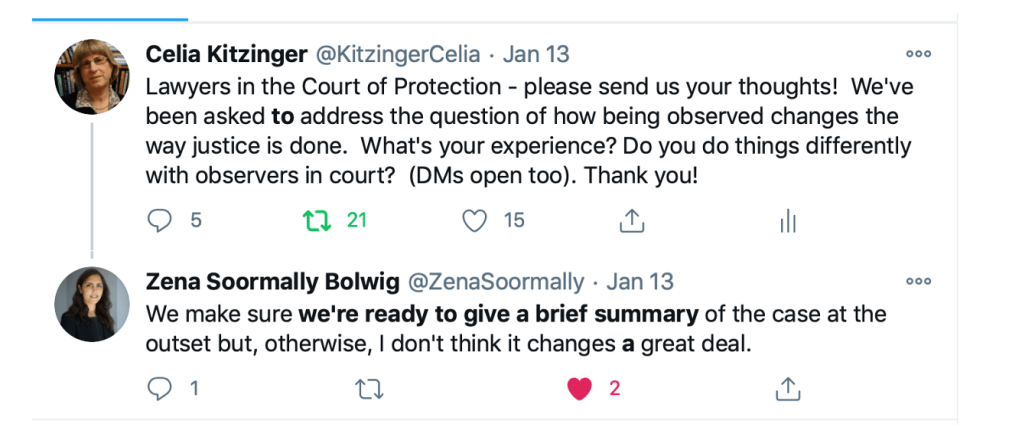

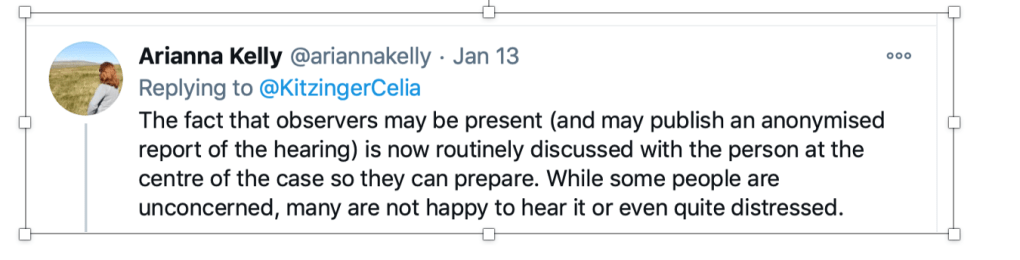
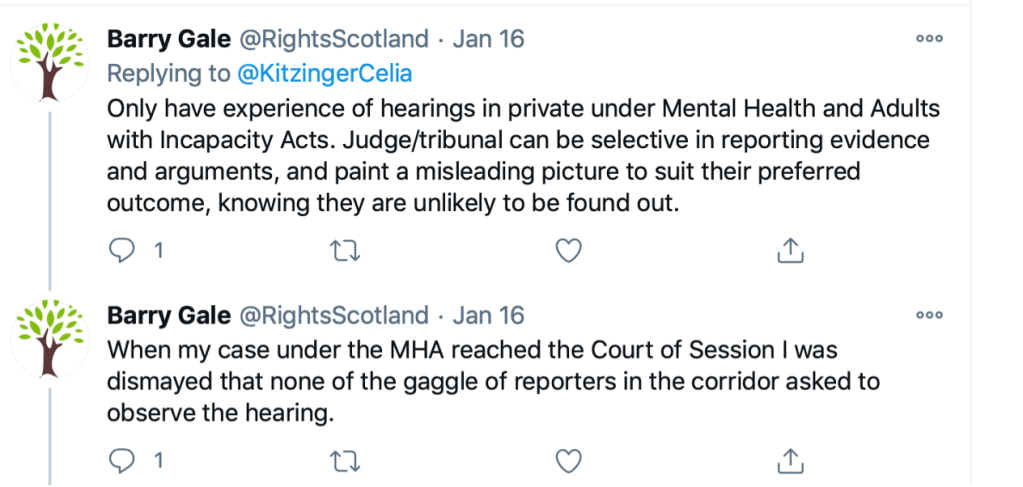
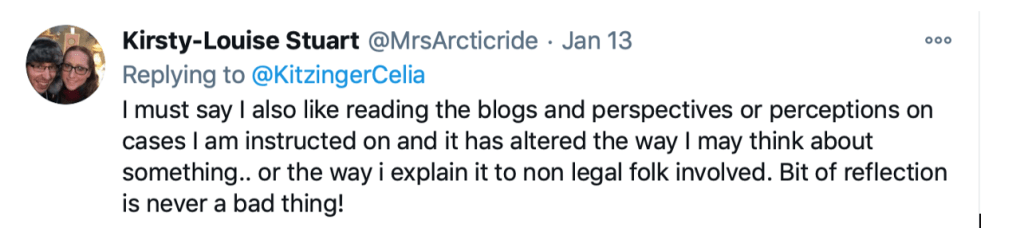


 Promoting Open Justice in the Court of Protection