Costs and benefits of acting as expert witness in the Court of Protection

By a Serious Brain Injury Case Manager, 13 October 2020

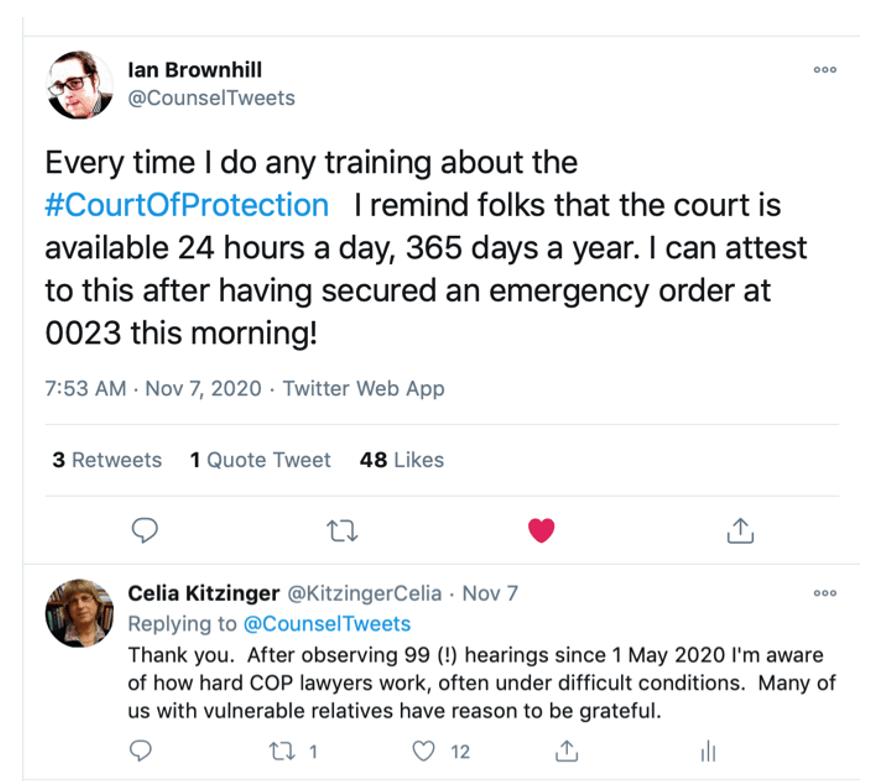
This tweet gave me reason to pause and reflect because it came on the back of a request by a lawyer to commission me, as a professional working in acquired brain injury, as an expert witness for the Court of Protection. 

The vast majority of my work as an expert witness is for the High Court as a Care Expert. It is my role to identify what services and support a person with a brain injury will need across their lifetime and provide costs for this. I have however also been commissioned to give expert opinions for the Court of Protection. Usually this relates to a question of what is in the best interests of a person with a brain injury who lacks capacity to take a specific decision, often related to where someone lives and how they are supported. The person’s lack of capacity has been decided before I am commissioned and is not contested. What is up for discussion is how the individual’s needs are best met, i.e. what is in their best interests? 

I am not part of an organisation that promotes my availability for expert work, it has simply developed over the last 20 years and is sustained by word of mouth. Whilst I am often commissioned by the same people (or their colleagues), I am also commissioned by legal firms and lawyers I have had no contact with too. So, not a closed loop but this is not a question of what economists would call “perfect competition”. 

Responses to Celia Kitzinger’s tweet revealed that this is a familiar problem in many areas of the Court of Protection’s work.  The barrister Katie Gollop (@katiegollop) responded that all 5 anorexia cases in the COP prior to a recent hearing in which she represented P had used the same person as an expert witness.  Maybe, she reflected, having a different expert would make no difference to the evidence or to the outcome of the case “but with no mix, we don’t know”. 

Several experienced COP lawyers raised the issue of payment:  “the limitations of legal aid rates don’t help, I suspect” (@WGAbroad); “It can be tricky to find someone who will work for legal aid rates and produces reports which don’t need clarifying and addendums on so many points that it ends up wasting a lot of time and money… always looking for new ones but actually not many about” (@MrsArcticride); “often the pool is restricted by legal aid rates, proximity to P, and the need for someone who understands the statutory framework of capacity assessment”.  

I have found from my own experience in High Court cases that fellow experts from different disciplines can become familiar faces, particularly in fields where there are very few appropriately qualified and experienced people. This is a real issue when considering the needs of people affected by acquired brain injury, most especially if the outcomes are less obvious and require greater experience to identify and assess. 

The most complex cases that I encounter concern people with “higher level” difficulties with executive skills, i.e. with social behaviour and social communication and with cognition, particularly if the affected person has reduced or no awareness of their difficulties and how this affects their functioning. Most complex of all are those with an intellectual awareness of their difficulties: such people can describe the difficulties they face, but only in the abstract and externally generated and sustained scenario of an assessment. When this intellectual awareness does not affect functioning or behaviour in the real world, this makes assessment a real challenge. There is an increasing body of research evidence regarding how poorly mainstream and generalist services pick up on the needs of the unfortunately named “walking wounded”, i.e. those who have generally made a good physical recovery from their brain injury but who have been left with life changing issues that can affect decision making, planning, problem solving and initiating activity (e.g. Flynn, 2016George and Gilbert 2018Moore et al, 2019).

It is hardly a surprise therefore that some individuals affected by brain injury come to the attention of the Family and Criminal Courts and the Court of Protection. Their Lordships review of the Mental Capacity Act noted the specific issues with assessment of Mental Capacity for people with an ABI and the evidence provided to the review was very critical, not of the perceived paternalism experienced by some other groups, but of the reverse (House of Lords, 2014). Evidence from across England and Wales, specifically naming acquired brain injury, reported a failure to conceptualise and adequately respond to invisible, complex and interrelated difficulties and a failure by non-specialists to know how to assess such matters (Norman, 2016Holloway, 2014;  Holloway et al, 2019)

In recent years I have been approached to undertake assessments and give expert opinion in the Coroner’s Court, the Family Court and the Court of Protection. Sometimes this work is jointly commissioned by multiple parties and sometimes it relies upon Legal Aid funding for that commission. From a financial perspective, it would make sense not to accept such referrals.  The State clearly does not pay the same rate as the commercial world of personal injury litigation. I am part of a small business that needs funding to survive, to support the pro-bono work we do and to fund time for research and writing. 

My personal decision to take on such referrals (occasionally) is informed in part by a sense of duty (if I know something and can help, then I ought to) and, perhaps in a less lofty and self-regarding/virtuous way, because such matters can be really interesting and can tax one’s mind and thinking. I have therefore agreed to work at 78% of the usual medico-legal hourly fee, at 57% and, once, at 42%. On each occasion I have been informed that this is the maximum fee structure permitted for the task. The hours allotted and agreed are never sufficient, so this creates another pro-bono element too. The fact that the fee seems to vary is not something I claim to understand. 

Recently I was approached to undertake an assessment and give expert opinion in a matter which sits firmly in my field of experience and expertise, it was a similar request to others that I have carried out. However, on this occasion, I was informed that the maximum hourly rate was 17.35% of the medico-legal rate (for clarity, not 17.35% less than the medico-legal rate, just 17.35% of it). A quick search of the internet informs me that the hourly rate insisted upon was the same as what was being offered for a “Customer Services Advisor”, where educational expectations of candidates was “GCSE’s preferred”. I turned down this referral. 

So, whilst not doubting at all the skills, integrity and ability of the experts whose names had become quickly familiar to an observer (and to other experts) at the Court, I suspect that funding may be one of the reasons why that familiarity has developed. When it is not “the market” that decides the appropriate rate, an element of self-selection/self-de-selection of who is commissioned becomes normal. Putting it more directly perhaps, who can afford to work for significantly reduced fees? Is “P” able to benefit from the very best of expertise when hourly rate is a driving force for choice of expert? If you have a choice, do you work for less than 20% of your usual hourly rate?

As it should be, giving expert opinion is an onerous task. Never more so than when the outcome could affect where someone lives, who they live with or even if they live at all. It would be a very foolish person to take these responsibilities lightly. Such cases invade my sleep and cause me self-doubt. The reputation of an expert can be lost in an instant. We are all only as good as our last case, as the careless, hubristic, unlucky or over-worked can find to their cost. Within my field there is a dearth of suitably qualified and experienced professionals in practice, let alone able to give expert opinion. I fear that financial considerations with publicly funded cases is exacerbating this situation and doing a potential disservice to both the Court and, more importantly, to “P”, the person who at the centre of the case. Bearing in mind that brain injury is somewhat of a Cinderella with statutory provision, it would be helpful if funding agreements recognised it as a speciality that is nuanced and complex and where achieving expertise is not straightforward. 

The author is an experienced Serious Brain Injury Case Manager who has often provided expert evidence in court.

Editors’ note: We also recommend  this report by Malvika Jaganmohan about the findings of the President’s Expert Witness Group Symposium (dealing with expert witnesses in the family courts). 

Photo by Francesco Ungaro on Unsplash

A Decision about Capacity

By Celia Kitzinger, 12 October 2020

Ruth (not her real name) lives in a care home.  She wants to move out, but not to the Extra Care Housing proposed by the local authority – in part because she has bad memories about the area, and in part because it is a long way from her husband and son.  She has strong views about where she wants to live, and she believes she has the right to make her own decision about this.

At this hearing (Case no 13391039, before District Judge Lusty), the key issue to be decided was whether in fact Ruth does have the right to make her own decisions about where she lives and the care she receives,  or whether others will make these decisions on her behalf because she lacks the requisite mental capacity.

Evidence on capacity

The starting point, by law, is that Ruth does have the mental capacity to make her own decisions.  There is a presumption of capacity built into the basic principles of the Mental Capacity Act: “A person must be assumed to have capacity unless it is established that he lacks capacity.” s. 1(2) Mental Capacity Act

There is no disagreement that Ruth has dementia – and, indeed, that she is deteriorating.  A diagnosis of dementia does not, however, in and of itself, mean that Ruth doesn’t have capacity to make her own decisions.  The Mental Capacity Act s.3 (1) states: “A lack of capacity cannot be established merely by reference to— (a) a person’s age or appearance, or (b) a condition of his, or an aspect of his behaviour, which might lead others to make unjustified assumptions about his capacity.” So the “condition” of dementia is not sufficient to establish lack of capacity.

The Act is clear that the presumption of capacity (s.1(2)) can be rebutted only if – after all practicable steps to help a person to make a decision for themselves have been taken (s. 1(3)) – the person is “unable to make a decision for himself in relation to the matter because of an impairment of, or a disturbance in the functioning of, the mind or brain” (s. 2(1)).

“… a person is unable to make a decision for himself if he is unable— (a) to understand the information relevant to the decision, (b) to retain that information, (c) to use or weigh that information as part of the process of making the decision, or (d)  to communicate his decision (whether by talking, using sign language or any other means).” s. 3(1) Mental Capacity Act 2005

There have been numerous assessments over time by different professionals, all of which find that Ruth lacks capacity to make decisions about residence and care. Reports of these assessments were in the bundle before the court.  

I did not see the assessments of Ruth’s capacity, but I have seen similar reports for other people.  They typically describe professionals’ efforts to explain the different options – often using simple language, visual aids, raising the options with them at the time of day when they are most alert and able to engage, giving people time to process information and checking their understanding.  Assessors typically support the person’s ability to remember information about different options with written or visual information (easy-read leaflets for example) and try to help the person weigh up the pros and cons of different options.  Assessing capacity is a routine part of health and social care: it’s important to ensure that the person is giving valid consent to whatever treatment or course of action is being proposed for them.

The General Medical Council has an interactive tool on “Decision-Making when Patients may Lack Capacity” here.  It’s aimed at doctors but it’s a very useful and straightforward read for everyone.  I particularly recommend the “Case Studies”:  Sally Jackson and Tracey Sarle who have Downs Syndrome are supported to make their own decisions about chemotherapy for breast cancer (Sally) and whether or not to have a smear test (Tracey), and Mr Lang who has dementia is supported to make his own decisions about antibotics for a lung infection and hospital investigation for a problem with his eye.

For Ruth, though, capacitous decision-making did not seem to be possible, however well supported she was.  Although she has strong feelings and wishes about where she lives (and is clearly able to communicate them), assessors have found her unable to understand, or to retain, or to weigh up the information relevant to the decision that needs to be made. 

An independent report from an expert doctor was recently authorised by the judge and this expert – like all the assessors before him – found that Ruth lacks capacity to make these decisions. 

Based on the findings of the numerous capacity assessments, counsel for the local authority accepts the finding that Ruth lacks capacity to make decisions about residence and care.  So do her husband and son, who were both in court and accepted the evidence of the independent report.

The only person who believes Ruth does have capacity to make her own decisions is Ruth herself.  

Ruth’s representative in court

Ruth was not in court.  She was represented in court by a barrister appointed and instructed via the Official Solicitor.  Her barrister reported that “Ruth is very clear in her own mind that she does not lack capacity to make these decisions”.  But he did not argue on her behalf that the court should accept that she has capacity.  

He said that as her litigation friend he was in a “delicate role”.  He could not, he said, agree with the Order before the court in respect of Ruth’s lack of capacity.  Repeating Ruth’s claim to have capacity to make her own decisions, he said, “I simply invite the court to consider that”.  He added that he does “not invite any more evidence on capacity”.  This means, as counsel for the local authority put it, that there is “no active objection to the court finding that Ruth lacks capacity in the relevant domains”.

That’s pretty much what anyone in this barrister’s position would have done – subject of course to the concrete particulars of the case.  Another experienced Court of Protection barrister I contacted, asking what she would do in this situation, said: “Tell the court P says she has capacity and set out any evidence you can find to support that or undermine the other evidence. Then leave it to the court to decide. Potentially let P speak to the judge if she wants to. And then go for P’s wishes being determinative in the inevitable best interests decision.”

The outcome of this hearing was that the judge made a final declaration (pursuant to s. 15 of the Mental Capacity Act) that Ruth lacks the mental capacity to make decisions for herself about where she should live and the care she should receive (and also lacks capacity to conduct legal proceedings).  This means that decisions about residence and care will now be made by the court on the basis of Ruth’s best interests: as the judge put it, “it’s now about looking at the various options for Ruth and deciding what’s best for her”.  

Best interests

In making a best interests decision about where she should live, Ruth’s views will be taken into account.  There was evidence of this already having been done. The local authority reported that the Extra Care Housing option she had objected to was now “off the table – and we’ve removed reference to it in the order”. He said: “We are now exploring Extra Care options in close proximity to Ruth’s family – and exploring both short term and longer-term options, because Ruth has said she doesn’t want to be ‘shifted around’ but to settle in one place”.

Ruth’s husband seemed relieved that the placements considered for Ruth would now be closer to home: he said he “much appreciated” it.  Ruth’s son agreed, but expressed some concern about any Extra Care possibilities as against continued residence in a care home.  He said his mother would “wander out the front door and get lost once she was a hundred meters away from the front door she doesn’t recognise anyway”.  The question of where Ruth will move next (if she does move) will be a key issue for the next hearing at the end of November. I hope to be able to be there.

Reflections

I was left wondering who will tell Ruth about what happened in court today, and what she’ll be told (and what she’ll understand) about the judge’s declaration that she lacks capacity to make crucial decisions about her life.

What must it feel like to believe that you are perfectly able to make your own decisions, and to have a judge rule that you are not?  What effect might this have on Ruth’s relationships with the people around her if she realises that they all (her family too) accepted the view that she lacks capacity to make her own decisions?  

The views and voices of those subject to decisions such as the one imposed on Ruth are rarely heard.  Some of these issues are explored by people involved in The Voices Project in which people with disabilities talk about how it feels to be told that they lack the capacity to make decisions about key aspects of their lives: sex, relationships, and medical treatment. 

Of course, I am reassured by the fact that everyone in court seems genuinely concerned to take Ruth’s wishes and feelings into account, and to ensure that she is happy – and safe – in whatever accommodation she lives in.  Ruth is cared for.  People want the best for her.

But she has been stripped, by law, of her right to decide for herself – and even if the decision that’s eventually made is the decision she would have made for herself, even if (in the words of the barrister quoted earlier)  her wishes turn out to be “determinative” of the decision made about her she may still feel angry and compromised by a ruling that she lacks capacity to make her own decisions.    

Any of us could become a future “Ruth”.  It might be dementia, or a stroke, or traumatic brain injury from a fall or a road traffic accident.  It could be a brain tumour or a disease in the brain like encephalitis.  We could lose some of the cognitive abilities we currently take for granted – and with that, the right to make our own decisions.

Some people are content that others will take over decisions about where they live, what care they receive, who they have contact with, and how their money is spent. They may trust professionals to make those decisions on their behalf. Or they may decide to appoint someone who knows them well – a spouse, an adult child, a friend – with Lasting Power of Attorney for Health and Welfare (and/or for Property and Finance) to make the relevant decisions for them when they are deemed no longer to have the capacity to do so. (Note: “Next of kin” have no right to make decisions on behalf of an incapacitated adult – if you want a family member of friend to be your decision-maker you need to formally appoint them as such on the government website here.)

It is helpful to those who find themselves with the responsibility of making decisions for others – or simply contributing to those decisions (as Ruth’s husband and son are doing) – to have some steer from the person themselves before they lost capacity. The court, and Ruth’s family, could have been helped in decision-making if Ruth had written an “advance statement” (in advance of losing capacity) about her wishes, her hopes, her values. Any “relevant written statement made by [a person] when [they] had capacity must be given particular consideration when arriving at best interests decisions about them (s.4(6)(a)). And if Ruth had wanted to refuse any particular medical treatments she could have done that too, via an Advance Decision (ss. 24-26 Mental Capacity Act).

Many of us will live for months, or years, or even decades with reduced and declining capacity to make our own decisions. Advance decisions, advance statements and Lasting Powers of Attorney are not really ‘end of life’ tools, but ‘end of capacity’ tools that give voice to our decisions and preferences about how we live with impairments of the mind or brain.  They are mechanisms for all of us who have capacity to make serious decisions at the moment to influence what happens to us if, in future, we are no longer able to decide for ourselves.  There are various practical (and philosophical) problems with all of these tools – but they are probably the best options available right now for those of us concerned about losing capacity.

Celia Kitzinger is co-director (with Gill Loomes-Quinn) of the Open Justice Court of Protection Project. She has supported many people with making advance decisions and advance statements and has (of course!) made her own. She recommends the charity Compassion in Dying for more information on these options. She tweets @kitzingercelia

Photo by SHTTEFAN on Unsplash


Dementia, Cats and Football

By Joe Lord, Thursday 8 October 2020

Orders from the Court of Protection can be momentous for ‘P’, the person at the centre of the case. Orders may (among other things) deprive P of their liberty, interfere with their bodily integrity or assume control of their property – all steps that could attract criminal sanction were they not implemented in P’s best interests. The underlying themes here – the impact of law on the individual, and the story of the individual themselves – have always interested me, and have no doubt fostered my desire to practise at the criminal bar. 

Touching heavily on these themes, the hearing I observed on 23rd September 2020 (Case number COP: 13573266) struck a chord. Before getting into the detail, I should note that only after chasing First Avenue House was my email request forwarded to the presiding judge, DJ Beckley. I then heard nothing until 2pm, when the judge phoned to admit me to the hearing. The moral here is: if you want to observe, always keep your phone ready for the scheduled hearing time. 

Gerald’s Tale

The Individual

I observed the second of what will be three hearings concerning Gerald (not his real name), an elderly man who had lived in a flat with his now-deceased parents since the 1970s. Gerald’s primary medical condition is vascular dementia, which is largely responsible for the accidents at home that have seen him in and out of hospital over a number of years. This saga culminated in April 2020 when Gerald was discharged to a local care home, with proceedings issued by the Local Authority (‘LA’) in June 2020 to determine next steps, namely where Gerald should live and receive care, and whether Gerald’s tenancy over the flat should be terminated if he remains in care. Gerald was represented by Ms Keri Tayler, with Mr Jon Holbrook acting on behalf of the applicant LA.; Gerald’s place at the centre of proceedings was constantly reiterated by counsel and DJ Beckley throughout the hearing.

The Law

As is routine, the LA applied for an order under s.21A Mental Capacity Act 2005 (‘MCA’) to determine whether Gerald meets one or more of the requirements for the deprivation of his liberty, and to challenge the purpose and conditions surrounding such a step. At first blush, the broad scope of this order seems to provide a worrying degree of power to a judge. Nonetheless, a ‘presumption of capacity’ is fundamental to the MCA (see s.1), a welcome safeguard that requires the state to work uphill when seeking such powerful orders.  

Another protective layer comes from s.21A MCA, which is focussed directly on whether it is necessary, proportionate and in the best interests of P to be detained, rather than on the circumstances which led up to the deprivation of liberty: Director of Legal Aid Casework & Ors v Briggs [2017] EWCA Civ 1169. This seems to ensure P’s current condition is adequately considered, preventing a decision being coloured wholly by past events. It also reflects P’s position as the protagonist of proceedings conducted in his best interest in that the enquiry is focussed on exploring the most up-to-date account of P’s wishes and feelings. 

Comment

I was reassured by the detailed exploration conducted by the court into Gerald’s position. At the previous hearing, Gerald had made clear (via Microsoft Teams) that he knew where he was and what he wanted – particularly access to newspapers and a return to his flat, the address and significance of which Gerald was well able to recall. 

Gerald is clearly a pragmatic and proud man. In this hearing, DJ Beckley ran through Gerald’s statements that he strongly believed he could manage at home with care visits, but preferred to stay in the current ‘so-so’ home if around-the-clock care was needed. If a care home was truly necessary, Gerald asked only that one capable of accommodating his cat could be found; although this could not be done, readers will take comfort from Mr Holbrook (for the applicant), who confirmed that the LA is looking after the cat. Gerald also wanted to see his local football team in action, accepting that COVID-19 – rather than the LA – might be the stumbling block to this. 

These details were significant to me for several reasons. Firstly, they reinforced the position of P as the person at the centre of the case and, secondly, illustrate the genuine care taken by the Court, the LA and social workers – despite the pandemic and wider budget constraints. Most importantly, such details brought to life the charming quirks of an individual: these are details which make legal cases both fascinating and heart-breaking. I could not help but feel compassion towards Gerald, something which no doubt coloured my ‘take-away’ from the hearing that he was strong enough – at least mentally – to have his liberty and dignity back. 

Of course, I could not truly comprehend Gerald’s position, a position which was patently vulnerable given his medical history. Indeed, there were further hints at vulnerability as legal arguments began: although the terms of the Order were largely agreed, Mr Holbrook stated that round-table meetings between the parties were at an impasse without a position statement from the Official Solicitor. Ms Taylor (acting on behalf of Gerald) disputed this, persuading DJ Beckley that, as the applicant, the LA bears responsibility for leading the case direction, and that it made perfect sense for the Official Solicitor to submit her stance last with the benefit of all the evidence. 

However challenging the predicaments of Gerald and those like him, we can take comfort in the knowledge that dedicated and diligent professionals, from social workers to court staff, are striving to ensure that the best decisions possible are made for those like Gerald in our society. 

Joe Lord is an aspiring barrister who recently graduated with a First-Class degree in Law from UCL. Currently a volunteer for Advocate, he is aiming to study the BPC in September 2021. He tweets @Joe_Lord7; his Linkedin is Joseph Lord

Photo by Alexander London on Unsplash

A law graduate’s first experience of a COP (telephone) hearing

By Emily Williscroft, 7 October 2020

My experience of observing a Court of Protection hearing was exciting and bewildering and a brilliant educational opportunity.  I feel inspired to observe more hearings because it’s such a fantastic way of learning more about the law in practice.

I finished my undergraduate degree (with first class honours from Edge Hill University) this summer and I don’t yet have a training contract – though I was proud of myself that I made it through to the Assessment Centre by the brilliant firm, Irwin Mitchell, that does a lot of Court of Protection work.  

I’ve kept in touch with people who work at Irwin Mitchell and on August 18th 2020 I saw this tweet from Kirsty Stuart of Irwin Mitchell. 

With a recommendation like that, of course I wanted to attend some hearings. 

It took me a while to make time to do this (I work full time), but on Friday 18th September I emailed the regional hub court in Newcastle asking to observe a hearing before DJ Charnock-Neal at 11am that day.  I received a response confirming that I could attend, and explaining the process for Judge Charnock-Neal to dial me into the telephone hearing.  I’d been reading tweets about people not getting responses to requests to observe, and about hearings being vacated or postponed, so I was prepared for difficulties –  but everything went really smoothly.

Upon receiving the phone call from the Judge, I was asked a number of formal questions. I had to confirm I was alone and that nobody else could hear the call, that I was not recording the hearing and that I understood I had to keep details that would risk anyone being able to identify P confidential. Once this was complete, everyone in attendance was introduced.  Other people on the call, in addition to the judge, were representatives for the Local Authority and for P (the person at the centre of the case).

As recommended (here) by the Vice President of the Court of Protection, Mr Justice Hayden, the applicant, the barrister for P, Ms Nicola Kohn,  provided a useful background summary of  the case for my benefit so that I could make better sense of the proceedings. I understood that 

P is a grandmother with both dementia and mental health issues. Family ability to provide care and support changed recently so she’s moved into a care home and one of the issues at the hearing was the need for a section 49 report.  I had to look up what that was: Section 49 of the Mental Capacity Act (here) gives the court power to require a Local Authority or NHS body to provide a report about P.  |There was also some discussion about the effect of the new Health Protection (Coronavirus, Restrictions) (North East of England) Regulations 2020. This would have a significant impact on P’s life and therefore needed to be brought to the attention for the hearing as the changes implemented related to care homes. Information about the new restrictions were posted on social media on the same day as the hearing – and in fact I saw a tweet from P’s barrister about this.  She’d learnt about the new restrictions from Twitter which is, she says, “not quite how they told us to research the law at lawschool”!

As it was my first hearing it was all rather overwhelming, I was exposed to a lot of information very rapidly and I didn’t manage to get everything that was said written down or fully understand what I was listening to.  The hearing only lasted for half an hour, so it felt like a bit of a whirlwind.  But I’m glad I did it.

I knew nothing about the Mental Capacity Act 2005, or about the Court of Protection from my undergraduate degree.  I have observed criminal court hearings as part of a module called “Lawyer Skills” but obviously the Court of Protection was very different. It was also completely opposite to the way I had learnt about the law as a student – for example, first learning about criminal offences and then going into court to observe criminal prosecutions.  Here I was having to figure out the Mental Capacity Act (and google it quickly) in order to understand what was going on in court. It threw me a bit! I’m going to research the Mental Capacity Act before observing my next hearing – and I’ll definitely use the new “Hearing Feedback Form” from Open Justice Court of Protection, which is designed to offer a framework for people new to this area of law to understand and record what is happening (and to help shape future blogs). 

I went into this experience with an absolute minimum of knowledge both about the Court of Protection and about the Mental Capacity Act, and am determined to learn more.  I’ve become alert to the importance of ‘capacity’ assessment in determining whether a person makes their own decision or whether it is made for them by others.  I also want to learn more about how ‘best interests’ decision-making works in practice. 

So, I will be back with another blog as soon as I feel confident enough and can make the time to try again!  And I’d recommend these observations to all aspiring solicitors and barristers.  It’s a way of engaging with legal issues when it’s not possible to go into court physically and it’s a great way of learning what actually happens in court. 

Emily Williscroft is an aspiring solicitor who recently graduated from Edge Hill University.  She tweets @emwilliscroft

Photo by Nick Morrison on Unsplash

Observing as a GDL student in the (virtual) Court of Protection

By: Ella Fornsworth, 7 October 2020

As a GDL student looking to gain legal experience in the middle of a global pandemic, things have not been easy recently, with the possibilities of attending court in person or completing mini pupillages significantly reduced. 

I was entirely unsure as to whether I was able to attend court remotely, and had struggled to find comprehensive information on doing so, until a fellow participant on an Inner Temple Virtual Open Day mentioned the Open Justice Court of Protection Project, and advised consulting their Twitter account for guidance on gaining access to remote hearings in the Court of Protection. 

I followed the Twitter account, and not long after doing so received a message from Celia Kitzinger, one of the Co-Directors of the project, detailing extensive information and instructions on how to request access to a remote hearing. 

Consulting their Twitter listings, I chose a hearing that I knew would fit into my schedule and contacted the email address included in the Tweet. 

I kept my email quite short, saying that I was an aspiring barrister currently studying on a GDL conversion course, and that I was looking to learn more specifically about the Court of Protection, the Mental Capacity Act 2005 and Deprivation of Liberty applications. I mentioned that I also wanted to gain experience observing court proceedings in general. 

I did not receive a response to my email until about an hour prior to the hearing itself, and the response simply stated that the judge had granted me permission to observe the hearing, and asked for a telephone number that could be used to contact me. From there, I just had to wait until I received a telephone call around 10 minutes after the scheduled start time of the hearing. 

The hearing I observed was: COP 1354496T KW before District Judge Ellington on Monday 28 September. 

When I picked up, I was speaking directly to the judge, which felt pretty daunting! She asked for confirmation of my name, and then asked that I understood that I could not share the name or details (such as location) of the people involved in the hearing. I replied that I understood, and she gave me a brief outline of the case, and explained that she was going to place me on mute for the duration of the hearing. She also explained that the start time had been slightly delayed as she had been expecting to receive some documents that she had not been provided with. Whilst I was speaking with her, there was some interference on the line, so I had to explain at one point that I had lost her, but she simply repeated her question for me. 

This connection problem seemed to occur multiple times throughout the hearing; sometimes the judge was quite inaudible and the barrister involved explained at one point that he too was struggling to hear. I understand, however, that this is a fairly unusual problem — at least in other hearings covered by observers in the Open Justice Court of Protection Project. 

The hearing was concerned with the transfer of a patient between care homes. The patient’s family was unhappy with the situation at the current one, although the patient said that they did not want to be moved. The main problem that arose was a delay obtaining a financial assessment from the Local Authority on whether one of the family members was able to become a financial deputy for the patient to ‘top up’ the fees of the new care home. The Local Authority barrister explained that the assessment may take another 14 days. 

The solicitor acting for the family put on record the frustration of the solicitors in terms of the ‘radio silence’ they had experienced from the Local Authority. They asked for confirmation that the placement at the care home would not be lost during these 14 days, and suggested that the court should direct that it must be done within 7 days instead, as it was in the best interests of the patient to be moved, especially due to the requirement of a Covid-19 transition plan involving an isolation period. 

The judge enquired as to whether any information had been provided on the staff experience in the new care home of dealing with agitated and aggressive behaviour, as this had been identified as key to the success of the move in a Section 49 report. The family, the Local Authority barrister and the social worker present all stated that they did not have sufficient information on the experience of the care home staff with this kind of behaviour. The family’s solicitor stated that it would be desirable to address reassurance on this fact before the move takes place. 

When asked what order he thought the judge should make, the family’s solicitor stated that the overwhelming case was for a move and that an order should be made, but that the order would be subject to an assessment and transition plan, as well as confirmation that the new care home would have the appropriate skill to deal with challenging behaviour, and the Local Authority would be required to file evidence of these three things, at which point the best interest decision would come into effect immediately. 

The judge stated that she needed to see evidence before she could say that the move was in the patient’s best interests, and this will be discussed at the next hearing, which I hope to be able to attend. 

I am extremely grateful to the Open Justice Court of Protection Project and Celia for providing me with the information and assistance I needed to be able to gain access to a hearing. Projects such as these are vital for not just law students such as myself to add to their experience, but also for the public in general to have the opportunity to learn more about the Court of Protection. 

Ella Fornsworth is an LLM Law and Legal Practice (GDL) student at BPP Law School Leeds, looking to pursue a career at the Bar. She tweets @EllaFornsworth

Photo by Steinar Engeland on Unsplash

Amputation: A best interests decision for the surgeon

By Carrie Hanman, 6 October 2020

Editor’s note: This is one of two blogs published today concerning the same hearing. You can read Adam Tanner’s perspective on the same hearing in the previous blog post.

To support my professional development as a “Return to Social Work” student, I attended (via telephone link because I had problems in joining the video-platform), a Court of Protection hearing before Mrs Justice Lieven on 2.10.20. It was listed on the Family Division of the Royal Court of Justice website like this:

Before MRS JUSTICE LIEVEN
Also sitting as a Judge of the Court of Protection
Friday, 2 October, 2020
At 11:30 AM
FOR HEARING IN OPEN COURT
COP 13659766 Re ‘PA’   MS Teams Hearing

I found the hearing interesting because it built on my previous experience as a hospital social worker and because I have a personal commitment to ensuring that human rights are upheld. 

As is usual for Court of Protection cases, the hearing was subject to a Transparency Order to protect the identity of the individual (P) at the centre of the case.  He was a 61-year-old male inpatient who was of Afro Caribbean origin and had been admitted to hospital with a serious foot infection.  He has a history of mental health problems (paranoid schizophrenia), although this has been sufficiently well controlled for the last 8 years to allow him to live in the community.  He is also a Type 2 diabetic and is asthmatic.  

 The initial application submitted to the court by the NHS Hospital Trust responsible for his medical care (represented by Fiona Patterson) was for a treatment order to allow a below-knee leg amputation but on the day of the hearing the application was amended to request a Court of Protection order that would allow a surgeon freedom to decide on the day whether it was in P’s best interests to proceed with the originally proposed partial leg amputation or, alternatively, to provide more conservative treatment. As counsel for the NHS Trust put it:

So what the Trust would like is to slightly amend the care plan and Order so that the surgical procedure goes ahead but if, in theatre, the surgeon thinks he can save the foot, then he’ll drain the wound and if necessary debride the infected bone tissue and sent P back to the ward with antibiotics.  But if his worst fears are confirmed, then he can proceed immediately to a below-the-knee amputation.

Since his admission, P has regularly refused to allow examination of his foot, and redressing of his foot wounds, and he sometimes refuses to take his antibiotics. A best interest medical treatment decision order was sought on the grounds that P lacked capacity to understand the severity of his medical condition and to consent to necessary medical treatment. It was submitted that P has an impairment of mind because he has schizophrenia, and is unable to understand his current condition or weigh information relevant to treatment decisions.  P was represented by the Official Solicitor (with Nicola Greaney as counsel)

Counsel for the applicant Trust explained that the original application had been for an order to approve surgical amputation of P’s lower leg because P was at serious risk of potentially fatal sepsis infection and necrosis – but on the morning of the hearing, the surgeon had observed unexpected signs of improvement which indicated a more conservative treatment approach might be possible. The application was amended to allow for the possibility that if under anesthetised examination the surgeon considered a more conservative approach was possible, the Court of Protection order should allow for the surgeon to exercise his autonomy­­­ in making a best interests decision for P.  The Trust wanted to proceed with giving P a general anaesthetic and then inspect the bone and establish the degree of infection.  If the surgeon’s professional judgment was that amputation was necessary, the Trust wanted him to be empowered to go ahead and do it at that point. If his professional judgment was that it could be avoided when P was properly examined in theatre, then he should be empowered to enact that decision too. This would also avoid the risk to P of having to undergo two separate procedures if amputation should turn out to be necessary.

I was pleased that the immediate response from Mrs Justice Lieven was to express her concern that an Order was being sought which would allow a surgeon to unilaterally decide, on the morning of a scheduled operation, whether amputation should proceed. I found her concern reassuring because the Court is charged with making evidence-based decisions and making an advance judgment about something that had yet to be evidenced inevitably carries risk and reinforces the perceptions of power imbalances that exist between individuals and professionals. 

The surgeon was called to give evidence. He explained that the infection in P’s foot was serious and that the risk of sepsis and necrosis was high and could prove fatal. Based on the surgeon’s inspection of the foot on Monday, he had believed surgery to be clinically necessary. However, his observation of P’s foot on the morning of the hearing had indicated there to be unexpected signs of improvement. The surgeon advised the judge that he could only undertake a thorough physical examination of P’s foot in theatre, and that depending on the viability of the tissue and bone he would be willing to consider a more conservative treatment approach to treatment (e.g. draining the infection, removing infected bone tissue and treatment with more antibiotics). Cross examination revealed that the surgeon considered the threshold for amputation to be high but that if the application to keep amputation as a surgical option was withdrawn and sepsis infection spread higher up his leg, then P’s demise was likely to be rapid. Despite my concerns about granting the surgeon the final say in making best interests about P’s leg, it was hard to see an alternative way forward given the evidence the surgeon presented.

During the surgeon’s evidence it became clear that no hospital discharge care plan existed. To me this was surprising because it was evident that the hospital would be seeking to discharge P as soon as possible because of COVID19 risk factors and because a surgical ward would not be a suitable environment to support his recovery. 

The reason given to the court for the lack of discharge care planning was that the uncertainty of whether amputation was to proceed meant it was impossible to plan his post-discharge care needs. Yet it was clear from the discussion that his needs were considered high enough to warrant intensive rehabilitation or even possible care within a suitable nursing home. This situation, whilst logical in theory, struck me as strange because in my previous experience as a hospital social worker, discharge planning always started shortly after the admission – particularly if someone was already known to services. It may be that many medics are unaware of what goes on within discharge planning at an operational level – but P’s evidenced need for an early discharge and his need for ongoing care and support were obvious to the judge during the hearing, so it is surprising that no reassurance of early care planning having begun was offered by the Trust’s legal representative. The judge asked for a discharge plan to be agreed by lunch-time on Tuesday so that it would be available for her at the next hearing, scheduled for the following week.

What also surprised and disappointed me during the hearing was that no reference was made to P’s wishes or to his social circumstances until the judge asked family members (P’s brother and son) to contribute. Obviously as an observer I did not have access to the legal bundle which presumably would have included a thorough best interests assessment, but – like me –  the judge was surprised to discover part way through the hearing that P has a wife. She asked whether all the correct papers had been served to P’s wife, and was assured that they had been, but I do feel that the hearing would have been better informed by verbal reference to P’s wishes and his social circumstances at the outset.  I didn’t really feel that P’s wishes and feelings were given as much weight as I expected them to receive in this hearing. I also wondered whether P (who was described as “pleasant and cooperative”) had been invited to attend the court hearing at which life-changing decisions were being made about him. However, I do feel the judge was sensitive to the situation the family was in and that, had they voiced explicit objections to the application, these would have been listened to. 

Although the application was made by a hospital Trust in respect of a best interest decision for a surgical procedure, the local mental health Trust had been named as a respondent. Their legal representative (Bridget Dolan) made the point that the Trust considered it inappropriate to have been named as a respondent because they were not opposing the application for a Court of Protection decision order on a physical condition: they had met their duty of care towards P and they would continue to do so through further assessment of P’s mental health once more is known about the treatment pathway to be followed. The judge’s response was somewhat impatient: she asked “where is this going?” and said that if it related to a cost application that could be dealt with later (it is in fact to be dealt with in the next hearing) and that if it arises from a sense of grievance then it should be dealt with in correspondence between the NHS bodies, since “in light of the importance of the underlying issues, I’m not terribly interested in dealing with that now”.  (The Clinical Commissioning Group was also represented in court, by Vikram Sachdeva.)

In her short oral judgment, the Mrs Justice Lieven said she was confident (on the basis of a report from a consultant psychiatrist) that P lacked capacity to understand and weigh up information about his condition and the treatment options available.  She declared that it was in P’s best interest to undergo further medical treatment and approved the amended application.  (My connection cut off a few minutes before the end of the hearing.)

A further hearing is set to take place in 7 days, after the surgery, and will address how P’s future care and support needs will be met in the least restrictive way once he is discharged from hospital. I hope to attend this and if so, I shall write a follow up blog. 

This was a thought-provoking hearing which will help my reflective practice when I return to social work.  It is important for professionals to remember that individuals with mental capacity, even those with a history of mental illness, have the right to refuse treatment against medical advice even if it could save their life. It was common ground amongst the parties (and family members) that P did not have the mental capacity to make this decision.  Nonetheless, his wishes and feelings – which were apparently not to have surgery should have weighed heavily in the best interests decision.   After all, an amputation has life changing consequences for individuals and families and it is essential for people to be involved as far as possible and have their voices heard. 

Having attended this hearing, I do feel that P’s human rights were sensitively observed but I still remain uncomfortable about the principle that the Court of Protection has the legal power to provide for advance autonomous best interest decision making to a single professional. I would also personally be interested to learn whether P had been offered the services of an Independent Mental Capacity Advocate or whether anyone from his family had felt able to undertake this role. From what was said in court it was apparent that P’s family members were anxious not to alienate P by appearing (as the judge put it) to be “siding against him”, and this seemed to make it difficult to speak freely. 

Carrie Hanman qualified as a social worker in 1994 and after taking a career break for family reasons she is in now in the process of renewing her registration as a Social Worker with @SocialWorkEng She tweets @CarolineRTSW

Photo by Nino Liverani on Unsplash

A Permissive Order For Amputation Contrary to P’s Wishes

By Adam Tanner, 6 October 2020

On October 2nd 2020, I observed a hearing on Microsoft Teams, before Mrs Justice Lieven in the Royal Courts of Justice (COP 13659766 Re PA).

Lieven LJ was, as she has been in previous cases, clear that an introduction to the case should be provided for the purpose of transparency for observers in the virtual Court. Counsel on behalf of the applicant Trust, Fiona Paterson, therefore, gave a brief history of the facts of the case.

PA is a 61-year-old man who has a history of serious mental health issues, including paranoid schizophrenia. He currently also has Type II diabetes and asthma. His mental health issues have rendered him unable to consent to treatment for a severe infection in his foot and he has difficulties in complying with clinical examinations and allowing his dressing to be changed, due to his mental health problems. He has already had an emergency partial amputation to his foot at the beginning of September. However, the infection has been getting worse, and PA has been refusing to allow doctors to assess the leg or give him any further treatment. 

The order submitted to the court in advance of this hearing, sought authorisation to amputate PA’s leg below the knee; however, during the week of the hearing, there seemed to be some improvement in PA’s condition. His doctor said that on Monday there was around 75% necrotic tissue and 25% healthy tissue; but having inspected PA’s foot that morning he believed there had been some small improvements on this. The Court was therefore now being asked to authorise a series of events:

  • To allow the doctor to administer a general anaesthetic to PA and, under general anaesthetic, conduct exploratory surgery to assess the true extent of the infection. He said he would debride the foot of any necrotic tissue, clean and sterilise the wound and apply a dressing.
  • However, if the infection is found to be worse than currently believed, then the Trust seeks permission to proceed right away to a below-knee amputation. 

Lieven J expressed her initial reluctance to grant such an order, because it was giving vast discretion to the surgeon in the operating theatre to decide whether the below-knee amputation is in PA’s best interests. She, therefore, wished to hear directly from the doctor who would be making the decision in theatre.

The doctor made it clear that he would favour ‘conservative treatment’ and that a below-knee amputation would be a ‘last resort’ and would have to meet an extremely ‘high threshold’. However, he also stated that should PA not have this surgery as soon as possible then PA is essentially a ‘sitting duck for rip-roaring infection which might take his life by systemic sepsis’. The doctor gave evidence that systemic sepsis could, in some circumstances, result in death within hours. 

The reluctance to have two separate hearings, and allow for two separate surgeries, was universally agreed by all parties – in part to ‘avoid distress’ to Mr PA by requiring him to undergo two separate procedures, and in part to avoid delaying appropriate treatment. Counsel for the Official Solicitor, Nicola Greaney, supported the plan put forward by the doctor and was happy for the surgeon to have discretion to make a best interests decision concerning amputation in theatre on the day. 

Mrs Justice Lieven, therefore, granted the order as proposed and that discretion should be given to the operating doctor with the understanding that there is a high threshold needed to undertake a below-knee amputation and that ‘conservative’ treatment options would be preferred. 

This case is by no means the first time in which the Court has had to decide whether it is in the best interests of a person who lacks capacity to have part of his lower extremities amputated. 

In the case of  Wye Valley v B [2015], a 73-year-old man who had a long-standing mental illness, as well as Type II diabetes, was refusing to allow medical intervention for an infected foot. Consequently, doctors believed that P required amputation of the foot, or he would succumb to the infection within days. In that case, Peter Jackson J (as he then was) decided that, although P lacked capacity, it would not be in his best interests to go against his express wishes and amputate his foot. Peter Jackson J emphasised that it is vital not to disregard the views of a person who lacks capacity. The judge stated that when making a best interests decision, “there is no theoretical limit to the weight or lack of weight that should be given to the person’s wishes and feelings, beliefs and values” (at para 10). It should also be noted that in this case, the judge went to meet Mr B in the hospital personally, to understand his views.

Similarly, Mrs Justice Lieven has, in a previous amputation case, East Lancashire Hospitals NHS Trust PW [2019], stated that she had spoken to the patient over the phone “in order to try to understand his wishes and feelings”. This case had similar facts to Re PA: P was a 60-year-old man with paranoid schizophrenia who developed sepsis relating to a diabetic foot infection and had a partial foot amputation. The clinical team similarly sought a below-knee amputation as one option of treatment. Lieven J had regard for Peter Jackson J’s previous ruling in deciding that, despite P not wanting an operation, it would be in his best interests to have it done. 

Unlike these two earlier cases, there was minimal information provided in court or in the oral judgement in Re PA about the wishes and feelings of Mr PA. As far as we know from what transpired in court, the judge had not spoken to PA, nor was PA in court (and it was not clear whether or not he had been invited to attend).  Counsel for PA (via the Official Solicitor) simply said that PA did not wish to have his leg amputated. He had become more ‘cooperative’ in recent days, in that he had permitted doctors to change his dressings and observe the foot, but would not allow the doctor to touch or closely inspect the wound. At the time of the hearing he had also not agreed to amputation. 

What should be noted, however, is that Mr PA’s brother and his son both spoke during the hearing.  The judge asked PA’s brother how he thought Mr PA would feel if he woke up and found he’d been given a below-knee amputation.  “I know for a fact he won’t be happy, whatsoever”, he said.  “He won’t be happy at all.  But as a family we’ve gone through it from every angle and we can’t see any other way forward.”  The judge asked how Mr PA had responded to the partial amputation of his foot that he’d already been given: “Not as bad as I expected it to be.  But I think maybe if it was below the knee, maybe he would have reacted different.”  Mr PA’s son asked to speak to the judge and said:

I just want to say that when we visited Dad on Sunday he was quite positive and cheerful and speaking about going home and life outside hospital.  I think if he understood the life-threatening situation he’s in, he would be on board with the surgery.  But he doesn’t seem to understand.

This wasn’t explored in any detail, but the fact that Mr PA does not understand his predicament may be the distinguishing factor between this case and Wye Valley, in which P was said to understand the risks of his refusal. In Lieven J’s 2019 case, however, P was unable to understand the risks attached to his refusal. In the current case, Lieven J said she was satisfied that Mr PA was not refusing treatment “due to any religious or other deeply held belief system”, but simply because “he has no insight into his condition”.  

In a short oral judgment, she authorised a ‘permissive’ order allowing the surgeon to proceed as proposed by the Trust, with “freedom of movement to go ahead and make a clinical decision” about whether or not to amputate the leg when Mr PA was under general anaesthetic (planned for Tuesday 6 October 2020).  She pointed out that this proposal from the Trust was supported by the Official Solicitor and also by Mr PA’s brother and son who “do not seek to argue with what is suggested”. 

There is an obvious need for speed in situations such as these, especially at a time when the justice system is incredibly backlogged with cases. It is therefore understandable that in urgent applications, not everything is addressed in granular detail. However, the views of the person at the centre of the case should not be given short shrift. Of course, as observers we are not privy to the court papers, and so do not know what was laid out in position statements which could well have provided more in-depth information about P’s wishes and feelings, but these were certainly not raised in Court.

This case may be heading back to the Court in the coming days to address the discharge plan for Mr PA, as at present there is currently no post-treatment plan in place whatsoever.   This was an issue of great concern to the judge – not least because, as Counsel for the Trust pointed out “with the Covid pandemic we need to make sure PA doesn’t languish in hospital any longer than is necessary”.

As a PhD researcher who researches and writes on the role of the courts under the MCA 2005, this case was extremely interesting to observe as there has been a series of cases which concern the amputation of patients’ limbs when those patients have been, predominantly, diagnosed with paranoid schizophrenia.  Lieven J’s handling of an emergency application and the way in which best interests was decided in this case are going to greatly inform my future research into the way in which the best interests test is applied by professionals in both medical and legal settings. Cases such as these illuminate when a patient’s voice should be heard and what a fine balance it is when trying to decide the weight, if any, which should be given to the views of an incapacitous person. 

Adam Tanner is a PhD researcher in mental capacity law and has contributed previous blogs to this Project (e.g. here). He tweets @AdamrTanner

Photo by Street Donkey on Unsplash

How to use CourtServe

By Celia Kitzinger – 5 October 2020

CourtServe is an invaluable resource for the public who want to know about Court of Protection hearings that we might be able to attend (and other hearings too).  It’s a listings service provided by Courtel Communications.  On its website it says it “delivers a comprehensive court list distribution service in electronic format to the legal community in England and Wales”.  You have to register (it’s a very simple process) but it’s free to use.

CourtServe covers hearings in crown courts, magistrates’ courts, and in the Royal Courts of Justice, and also employment tribunals.  For me, it’s an essential resource for locating Court of Protection (CoP) hearings taking place outside London.  

There are two other lists I use for locating hearings in London: the Family Division of the Royal Courts of Justice (RCJ) website (here) and the First Avenue House website (here).  The information posted on these other two lists is duplicated in CourtServe but under different tabs and I find the format less user-friendly (more below!).

It’s really useful to know how to use CourtServe if you want to be able to locate court hearings in the regional courts, and not be dependent on turning up in court and seeing what’s available on the day, or asking barristers or clerks for help in locating hearings.  It will take you less than 5 mins to get registered and become able to locate CoP hearings.

Using Courtserve

Go to CourtServe (here).  Once you’ve logged in and created a password, go to the left hand menu, and under “Services” click on “County Courts” (see Figure 1)

Then click on “Court of Protection lists” (see Figure 2) 

This will take you to a list of hearings, like the list displayed in Figure 3.  Notice that the First Avenue House hearings (which take place in Holborn in London) are also listed here – but the Royal Courts of Justice hearings are not, because you are looking at “county court” listings and RCJ hearings are under a different tab.

If you click on any of the towns and cities listed here, another screen opens up giving you information about the hearing or hearings (there is often more than one) on the list.  Take a look at Figure 4 for an example, based on clicking on “Bournemouth and Poole”. 

You can see that there are three hearings listed before His Honour Judge Simmonds sitting at the County Court and the Family Court at Bournemouth and Poole – at 10am, 3pm and 4pm.  They are all being held remotely (two by telephone and it doesn’t provide any information but simply says “remote” by the 3pm hearing).  There’s no information about the issues likely to be addressed at these hearings – unfortunately it’s unusual for any such information to be provided except for hearings at First Avenue House.

Contact information is provided at the bottom of the page for the hearings in Bournemouth and Poole, and the email address and phone number provided are correct.  Notice that you don’t contact the county court in Bournemouth and Poole, but the regional administrative hub for the Court of Protection South West Region, which is in Bristol.

What do I do if there’s no contact information (or if it’s wrong)?

Unfortunately, contact information is often not provided, or is incorrect.  In CourtServe today (Sunday 4 October 2020) I located 27 Court of Protection hearings for Monday 5 October 2020: 8 provide no contact information at all: 2 provide the correct email address but no phone number; for 3 the contact information provided is incorrect.  That’s half of all listings providing inadequate contact information!  This is fairly typical.

Missing or incorrect contact information is very frustrating for members of the public wanting to observe hearings.  

In today’s lists for Monday 5 October, three of the entries that are missing contact information are First Avenue House hearings – which is one reason why it is best to go direct to the First Avenue House website to locate these (here). 

The best way to locate the correct contact information for CoP hearings in county courts is to figure out which of the seven regional hubs that court might belong to.  There is a list of hubs with their correct addresses, and email and phone contact information here.  

For example, Teesside County Court (see Figure 5) provides no contact information at all for its CoP hearing on Monday 5 October 2020.  (It hasn’t provided any contact information in these listings for any of its CoP hearings for at least the last month.)

What the Teesside listing does say (at the top, look at the red arrow) is that it’s in the Court of Protection North East region.  If you check the list of administrative hubs you’ll find,  sadly, that there isn’t actually an administrative hub called “North East” – it’s a choice between the “North East-East Regional Hub” (which is in Leeds) or the “North East -North Regional Hub” (which is in Newcastle).  I think the correct hub is Newcastle!

Finding more COP hearings in addition to those listed under the “Court of Protection” tab

For Monday 5 October 2020, the 10 links provided under the Court of Protection tab (shown in Fig 3) yield a total of 19 hearings: in addition to 1 hearing in each of Bristol, Leeds, Maidstone, Hastings, Taunton and Teesside, there are 5 in Sheffield, 3 each in Bournemouth and Poole and in Reading, and 2 in First Avenue House.  

In addition to the 19 hearings listed under the Court of Protection tab, there are a further 8 scattered across the lists for the county courts.  There’s no way of finding these except by opening up each town or city name in the whole list of county courts and then each of the links that appear subsequently, checking them out one by one.  I regularly find that between a third and a half of all the Court of Protection hearings listed for any given day are NOT included under the Court of Protection tab, and can only be located (arduously) in this way. 

It can be very time-consuming to locate these hearings – you have to trawl through a lot of data to find them. They are sometimes not clearly labelled as “Court of Protection” hearings, and even if you recognise that’s what they are, there can be barriers to access.  For example, Figure 6 shows the CourtServe listing for a hearing before District Judge Charnock-Neal at 12pm on Monday 5 October 2020.  It says it’s “Public” but it’s under the “Newcastle” tab (not “Court of Protection” tab) and the email addresses provided are not correct for the COP hub.

And this hearing before District Judge Case is listed under “Blackburn” and then “Family; District Judge Case”.

It doesn’t provide any indication that this is a Court of Protection hearing (I only know that it is because I recognise the format of the case number) – nor does it provide any contact information (none at all!).

The way hearings are listed can make it highly unlikely that any member of the public will be able to attend.  For the 1 in 3 COP hearings not listed under the CoP tab, open justice is severely compromised: observing these hearings will require your determination and persistence.

Improving Open Justice via the listings

CourtServe is only as good as the data provided by Her Majesty’s Courts and Tribunal Service.  I’ve heard barristers describe it as a “data dump” – but I’ve yet to find anyone able to describe to me how information about hearings gets from a judge’s diary into Courtserve.  I’ve asked a couple of judges who have “no idea”.  In practice, judges often don’t know how their own hearings are listed in CourtServe.  Some solicitors and barristers have told me they’ve never used CourtServe.

Still, despite its deficiencies, it’s an essential resource for public observers.  Without it, I would have no idea of how to locate court hearings outside London and no chance of observing any of them.  It’s a crucial tool for open justice.

Improving the CourtServe listings so that all CoP hearings are correctly placed under the “Court of Protection” tab, and ensuring that hearings are tagged with issues to be addressed and accurate contact information, would be a substantial contribution to open justice and transparency in the Court of Protection.

Celia Kitzinger is Co-Director (with Gill Loomes-Quinn) of the Open Justice Court of Protection Project. She tweets @kitzingercelia

Photo by Karolina Kołodziejczak on Unsplash

Applying to be a deputy in place of the court-appointed deputy

Alice Ferguson – 1st October 2020

I observed a telephone hearing (COP 13534031) before Senior Judge Hilder at 10.30am on the 17th September 2020.

The Start of the Hearing

There were several people involved in the hearing: including the judge, the applicant ‘C’ (P’s cousin), C’s representative, P’s representative, counsel for the local authority (the ‘LA’), P’s social worker, and me as an observer. There were others present on the call, however their roles were not introduced and they spoke very little or not at all. The callers appeared familiar with one another before the hearing began.  In terms of my ability to understand who was present and what their role was, there was also the issue of people talking over one another when Judge Hilder began checking who was on the call, meaning I could not hear all of what was being said (others stated the same).

Throughout the call, the discussion about P’s welfare was primarily discussed between the Judge, and P’s cousin C, and her legal representative, and later with the local authority representative.

Before attending this hearing, I had heard and read much about the issues presented by telephone hearings, with one service user describing the process as inhumane. However, with the country still well within the grips of the current pandemic it is crucial that hearings can go ahead without needlessly bringing several parties together in a courtroom.

There were, indeed, problems with background noises of various callers interrupting Judge Hilder and causing some (albeit minor) confusion with those present on the call. Judge Hilder muted callers who were not required to speak and for the most part this was sufficient. There were, however, other issues at hand:  the applicant, P’s cousin, complained of previous telephone hearings cutting out and said she also struggled to understand some discussions due to partial deafness. She also reported difficulties in contacting P who currently resides in a care home.

These issues underline the struggle that is very real for many COP participants, especially for those who are not present as professionals: what is already so commonly a stressful and confusing process can be amplified by the complications of modern technology. Overall, though, the hearing went relatively smoothly. Judge Hilder ensured all parties were clear on what was being discussed and repeated or simplified anything that caused uncertainty.

The Case Before the Court

Due to not being present for previous hearings regarding P’s welfare, I had to pick up a sense of P’s current circumstances throughout the course of the hearing (there was no formal introduction). P is in her 80s and has been diagnosed with vascular dementia. This has left her unable to care for herself and she currently resides in a care home. She has some idea of her current circumstances, and frequently mentions her previous home (before care) and has a close relationship with her extended family. This includes C (the applicant), other cousins, and a goddaughter. The hearing also discussed plans for P’s care, her capacity and the finalisation of a care plan.

The deputyship application therefore had to be addressed first in the hearing because a change would impact the plans for P’s care.

P’s cousin, C, was applying to terminate court-appointed deputyship and instead take the place of deputy herself.  From the nature of the conversation, it appeared that the current deputy had been appointed by the court to handle both P’s financial and her personal affairs. C had made applications to take over each of these roles. Under Re M, N v O & P [2013] COPLR 91, Senior Judge Lush stated that the “order of preference” for deputies began with family members of P, and considered the emotional as well as economic benefit of this (professional deputies charge for their services). It was not discussed in this hearing why C was not initially made a deputy for P in either capacity. Judge Hilder was, however, mindful of costs. Rather than multiple hearings, she requested that those present at the current hearing email each other where possible to avoid such expenses and instead organised a singular, final hearing (the date of which is confirmed at the end of this article).

Under section 16(2)(b) of the Mental Capacity Act 2005, the court has the power to appoint a deputy on behalf of P where P lacks capacity to make decisions for matters concerning P’s personal welfare or P’s property and affairs. C wished to take the place of this deputy through a Court of Protection application – her argument being that she did not feel comfortable with a court-appointed stranger managing P’s personal and financial affairs.

The court first heard about a COP9 application made by C to take over the role of deputy in place of the court-appointed one to make decisions about P’s welfare. As stated on the government website, a deputy is  only appointed by the court if is believed to be in a person’s best interests to do so.

Summary

C explained that in their country of birth, elderly relatives rarely go into care homes (where P is currently residing). Instead, the elderly are cared for at home until death.  This is a tradition that C and the family wish to continue. In accordance with this wish, the control of property and decisions about P’s welfare should, they believe, be determined by family members.  C said:

“I want to help [P] live her life the way she wants to live it. I want to buy her the food she likes; I want to take her shopping; I want to keep her in touch with extended family outside of the UK. I believe this is my job.”

C (the applicant)

Judge Hilder accommodates C; she allows her to explain clearly and completely why she wishes to be appointed as both finance and welfare deputy in place of the professional. (C speaks for herself for most of the hearing although her representative occasionally joins in).

P’s social worker adds to C’s argument. C “does not feel that her voice is being heard … a deputyship is about accommodating a family feeling”; with the power of deputyship, C feels she can truly fulfil this role. C is also concerned that the locks have been changed by the deputy in a breach of what he is authorised to do. Finally, she mentioned that she had not felt involved enough in the process because the deputy was not frequently in contact with her; “we did not hear from him at all”.

In Re BM, JB, v AG [2014] EWCOPB20, Senior Judge Lush explained further on the point of familial deputies. He stated that although the ‘court has preferred to appoint a relative or friend as deputy’ because ‘a relative or friend is usually familiar with P’s affairs and aware of their wishes and feelings’, it must be in P’s “best interests” to do so.

When C has finished explaining her wishes, Judge Hilder politely but firmly reminds C about the point of the deputyship. The point is to support P; to protect and serve her best interests, and her best interests alone. The deputyship does not exist to do this for both P and C. The court has appointed the deputy because the deputy is, and continues to be, in the best position to ensure P’s welfare.

Judge Hilder frequently reminds C and her representative that P should remain the focus. There may have been an application to remove the court-appointed deputy, but it is crucial to remember why a deputy had been appointed in the first place – to serve P’s best interests. C may want to accommodate P’s personal preferences, and she may be in the best position out of those present for the hearing, but P’s needs extend beyond familiarity.

The judge then explains that the act of changing the locks is an authorised act. Finally, on this point, she states that the deputyship may be open to change or extension, but this is not being dealt with at this moment in time. C’s application was rejected.

C interjects. What is further concerning her is the deputy’s power to enter P’s household and remove her personal belongings. This appears to be a reference to the financial deputyship that the court has arranged for P. C explains her anxiety that sentimental or valuable items belonging to P and her family would be incorrectly disposed of. C wants her cousin to have a say in what is, or is not, kept.

What the appointed deputy doesn’t know is:

“what is special to P. A [court-appointed deputy] will not know whether this or that item is from her wedding, from a relative back home, from a special occasion [for example]”.

C (the applicant)

C is clearly distressed, understandably so; it is an uncomfortable notion for many people to envision a stranger deciding which of their possessions are and are not worth keeping. Belongings are, after all, often a reflection of our lived experiences.

“I accept your concerns and share them”, Judge Hilder responds. “We will deal with this issue as we progress through the draft order.”

It is confirmed that, pursuant to section 2 and section 3 of the Mental Capacity Act 2005, P lacks capacity to make decisions about her care and where she should live.

All parties agree with this; the doctor’s opinion (which was referenced from a prior meeting between P and the doctor) is that P will not regain capacity. C does express further concern:  just because P lacks capacity to make decisions about her care and accommodation, this should not mean her wishes about remaining in a care home should be ignored. C is demonstrably distressed and emotional throughout this process. Judge Hilder sometimes has to mute the telephone line of C during the hearing to direct the conversation into something orderly.

Although this may sound, upon reading, as though it could be an unfair advantage of a Judge (and arguably it could well be utilised as such), the muting was appropriate in some situations and no party objected. Judge Hilder would quickly unmute the telephone line of C and explain that she had just done so and why. This happened just a few times (about 2 or 3) and the issues C raised in the moments before muting were addressed as the parties discussed each section of the draft order. 

Judge Hilder explains the power of a deputy under the MCA 2005. Under section 16, court-appointed deputies have the power to make decisions about a person’s property. “A property is hardly ever cleared without direction from the service user or family”, she continues. C, and other approved family members, can help. “There is no issue with this.” The financial and welfare professional deputy, therefore, could remain without preventing C’s involvement.

C agrees that this is fair. However, P’s house is “very, very important to her [P]”. C suggests that P visits the house to personally direct what items should or should not be removed. P is “talking about [her] house all the time. All the time.”.

Judge Hilder acknowledges this. “There are certainly positives to accommodating [P] in this regard”, but what about the risks? She refers to counsel for the LA.

The counsel for the LA agrees there are positive aspects to P being involved in the process, but the idea also raises concerns. Firstly, she continues, is the very real risk of introducing stress for P. There are photographs of the property in its current state. The house would need to be cleared of items that are definitely not belongings (e.g. items that are clearly rubbish). P is also not fully mobile and may be confined to the ground floor due to accessibility issues.

This again underlines the difficult balancing act present in many COP cases. When a loved one loses capacity, it is instinctual to want to protect them and to feel empowered throughout the process. However, what family members want and what is best for the service user cannot always align.

The counsel for the LA and Judge Hilder discuss what can be done to accommodate P whilst avoiding potential problems. It is suggested that a list of items that P wants to keep may be a useful option if it is not possible to bring her to the house.  C is invited to make the list and to check with other relatives so as to ensure all valuable possessions are retained.

C states that there has been difficulty in contacting P via telephone during the pandemic; often she rings the care home and receives no response. It is accepted by both C and the Judge that the current pandemic has introduced further barriers to organisation, but this cannot be helped.

C’s legal representative then begins to talk; he wishes to remind the court of Articles 3 and 8 of the Human Rights Act 1998 (to be free from torture and inhuman or degrading treatment and a right to a private and family life respectively). The representative reiterates that the court must consider the familial role of the cousin and her wishes for P’s care (namely that C wishes to take P into the family home).

The mention of Article 3, in this context, could be suggesting that P should not have to endure care that does not accommodate her wishes, including her right to be with her family (Article 8). If so, C’s representative would likely have been referring to the prevention of inhuman or degrading treatment of P through care that would not fulfil her desire to be with her family. It is uncommon for Article 3 to be referenced in discussions of care proceedings, with Articles 6 (the right to liberty and security) and 8 being more frequently referenced.

I must mention here that Article 3 could also suggest the opposite. P has a right to care that is sufficient for all her needs. This includes 24-hour care, which may not be possible in the family home (at this point, arrangements for P’s care in the family home were not complete). To place a vulnerable person in a care setting that cannot serve their best interests is arguably more likely to lead to an Article 3 infringement than to deprive a person from a family’s care. There is also the question of whether P’s treatment would ever reach the level of severity that is required to qualify a discussion of Article 3 (one hopes this would never be relevant). Article 3 has been stated as requiring a minimum threshold of severity for treatment to be considered under its scope which is relative to each case (Ireland v United Kingdom (1978)). This assessment of Article 3 is speculative, however, as C’s representative did not explain his reference to it further.

Judge Hilder reminds the representative that what C wants for P, and what P wants for herself regarding aspects of her care may not be the same. “It is not compulsory for P to agree with her cousin on all matters of her care” and it is therefore important to consider P’s personal wishes for her care as far as it is possible to do so. Ultimately, P’s Article 8 rights may not completely align with C’s, and it is P’s rights that must be the focus in this hearing.

Details are agreed; a list must be drawn up by P and her family as to what their plans are for living arrangements (if, in future,  P moves from the care home and into a family home in line with the family’s wishes), what belongings should be kept and further discussion on how far P can be involved in the process. This involves C needing to provide a detailed plan on how P will be cared for and who will care for her when the family cannot be at home.

Further, C needs to confirm whether she would be willing to move to a different area in order to care for P as they currently live relatively far away from one another. Finally, the statement should include any properties C or the extended family have found that would be suitable for P to reside in should she move from the care home.

The local authority also needs to file a statement concerning a care package. This should include costs, type of accommodation needed, care services including the consideration of personal assistants (depending on whether P does indeed move to a private home or remains in a care home). The local authority should also state what accommodation it prefers, including a different type of care home if that is deemed suitable. 

All parties agreed on the next steps and a date for the next hearing (about where P should live and how best to care for her) was confirmed. This will be the 20th October 2020 at 10am in First Avenue House, London.  The current plan is that it will take place in person (not remotely) and it is scheduled to last the entire day.

Due to the next hearing taking place in person, I cannot observe it. However, I am confident that Judge Hilder will continue to strike a balance between P’s needs and the wishes of her family. COP hearings often centre around sensitive and emotional issues, and it was reassuring to witness a judge who acted with empathy for the family’s concerns whilst ensuring that P remained the primary focus. Judge Hilder skilfully found solutions to empower both P and her family throughout the process by suggesting ways to involve them as much as possible.

Alice Ferguson is a Bar Practice Course student with an interest in civil and social rights. She tweets @aliceferguson_

Photo by Raychan on Unsplash

References

https://www.injusticewatch.org/news/2020/challenges-arise-as-the-courtroom-goes-virtual/ (Comment on effect of remote hearings)

https://www.39essex.com/cop_cases/re-m-n-v-o-p/ (Reference to Re M, N v O & P)

https://www.legislation.gov.uk/ukpga/2005/9/section/16 (Reference to s16 MCA)

https://www.gov.uk/become-deputy (government deputy web-page)

https://www.bailii.org/ew/cases/EWCOP/2014/B20.html [Re BM [2014] EWCOP B20]

https://childprotectionresource.online/article-3-echr-and-care-proceedings/ (discussion of Article 3 and care proceedings)

http://hudoc.echr.coe.int/eng?i=001-181585 (Ireland v United Kingdom (1978))

https://www.legislation.gov.uk/ukpga/2005/9/section/2 (Section 2 MCA hyperlink)

https://www.legislation.gov.uk/ukpga/2005/9/section/3 (Section 3 MCA hyperlink)

A Litigant in Person returns to the virtual court – Navigating Approaches to Care when Family and Local Authority Disagree – Part 2, One Week On

By Hilary Paxton and Aalia Omar, 29th September 2020

Back in July, the two of us attended a hearing before DJ John Beckley sitting at Central Family Court: Thurrock Council vs JS (COP 11895778).  We wrote about our experience of this hearing as a blog post (by Hilary Paxton, here) and a reply to it (by Aalia Omar – scroll down to the bottom of the post) which reflects specifically on litigants in person.

At the July hearing, the council was seeking an injunction from the judge to ensure that the father of a young autistic man (JS) who was living at home would not refuse entry to the carers or speak aggressively to them.  The council believed that JS’s father (who was a litigant in person) had been preventing the carers from the autism specialist agency from entering the house and caring for JS – which meant he was in breach of an order previously made by the court. At the July hearing, DJ Beckley arranged for a one-week trial to see if JS’s father would comply with the order.  If he did not, then a penal notice could be attached to the order – and DJ Beckley explained that this meant that JS’s father could go to prison if at that point he did not comply with the injunctions.

We were left on the edge of our seat wondering whether JS’s father would comply with the requirements.  We both decided to try and observe the follow-up hearing to understand whether the proposed approach had worked in practice and agreed that we would do a joint follow-up blog.

There was a frustrating start to the subsequent hearing on Friday 31 July 2020 – also before DJ John Beckley sitting at Central Family Court.  We had received an email four hours before the hearing, confirming that we could join the hearing by MS Teams, but we were both left waiting for a link to be provided until after the start of the hearing.  It was an administrative hitch, but beyond our control as observers, and when we finally got the link we both joined as quickly as possible and hoped we did not disrupt the hearing.  Judge Beckley was, however, courteous and paused proceedings to introduce us as observers, and referred to the blog that had been published that morning about the previous hearing.  JS’s father was again in court as a litigant in person, and although the hearing was via MS Teams and other participants could see each other, JS’s father once again joined the hearing by phone, so could not see others or be seen.

We heard that broadly JS’s father had indeed complied with the requirements in the intervening week.  The Judge sought the views of those present to inform his decision on making the injunctive orders requested by the council and whether to attach a penal notice to the orders.  There was much discussion about an incident that had taken place between JS and one of his carers and whether JS’s father should be advising new carers on what responses work well when JS is agitated. The Council seemed keen to suggest that this could amount to obstruction, especially if the carer wants to take a different approach.  They suggested that JS’s father had in effect been telling the carers what to do.  This angered JS’s father, who felt the council was misrepresenting the facts and trying to make him look bad.  

There was also a debate about situations where there was one female and one male carer, and how the male carer could provide support, whilst not providing personal care, especially if JS became agitated and presented any risk to the female carer.  In the end the Judge decided that if a female carer gets hurt and is unable to provide care, the male carer could come to her aid, and should be on hand in case of this, but that it should be in the least restrictive way, and that the male carer could remain just outside of the room, or observing from a distance.

The council lobbied for the addition of a penal notice to the orders, believing this would increase the likelihood of compliance, and reduce the likelihood of having to come back to court. 

In the end the Judge decided on balance not to add a penal notice, deciding it was neither necessary nor expedient to do so. He did make it clear that if JS’s father does breach the orders, the council will be able to come back to court swiftly. The request can be sent through to the Judge directly, and he will ensure that if a hearing is necessary it is held as quickly as possible.  If this happens, there is still the option to attach a penal notice to the orders at that time.  The Judge reminded those present that the hearing in September must focus on JS, and on what is in his best interests, rather than on the behaviour of JS’s father.  It was therefore very important that the arrangements proceed as required, to enable this to happen.  This was accepted by all, and JS’s father assured the Judge he understood this.

Hilary

Whilst my learning about the content of the case and the approach of the Judge was largely the same as with the previous hearing in this case, there were a couple of points that were of note that are worth mentioning.  I have found the option of observing remotely a really helpful option.  It saves on travel expense and time.  This is particularly relevant when hearings are cancelled on the day, when costs of travel may have already been expended.

What I experienced in this particular remote hearing, however, made me realise that it is possible for people to be in court, but not “in court”.  That is, they may be on the call or the video conference, but not give it their full attention.  This is not really as likely when everybody is gathered in the same court room.  It became apparent at one point in this hearing that JS’s father was calling out to someone.  I thought he was shouting at the person who was speaking at the time.  In fact, when the Judge asked him to please not interrupt and to let the person continue speaking, JS’s father explained that he was just calling out to a friend who was “driving away”.  The Judge asked him to mute his telephone if he was speaking to someone else, but also suggested, ever so gently, that it was probably in his interests to listen to what other people in the hearing were saying.  I found it quite shocking that for something as important as a court case, JS’s father had been unable to find a quiet place where he could concentrate on what was being said. 

I realised that it is all too easy to start making judgements about a person for not behaving in the way that you think is the correct way to behave.  I also thought that when somebody is represented by a member of the legal profession, it means that they can advise on the usual way of conducting oneself in a court hearing. Being a litigant in person means that you are “on your own”, and no matter how many times you have been in court, a remote hearing is a different experience.  I think it may be helpful for the court or the Judge to be explicit about some ground rules so that individuals are supported in such situations.

I also recognise that I may hear things that I disagree with in the course of a hearing.  When something unexpected is said, I noted that the Judge needs to quickly form a view on whether it is relevant to the hearing or not, and if not, let it go.   This level of focus is important as it enables the Judge to ensure he or she is not distracted from the key matters on which they have to form a judgement, and the information they need to do so.

Aalia

 Remote hearings do not seem as official as they would in a physical courtroom. As Hilary has described, JS’s father explained that whilst he was ‘in court’ he was also in his car at Gatwick Airport. This could have in turn meant he was distracted and therefore taken away from any argument made in court. In a physical court room, one hundred percent of his attention would be on the matter at hand instead of being distracted by the surrounding environment. 

Problems are also caused when lay participants, like this litigant in person, do not have access to the same technology as everyone else.  As JS’s father was unable to join by video call and only by telephone, he could not see people’s faces, or monitor their facial expressions or body language.  This can be quite informative.  There were some moments where I thought I caught an eyeroll or judgmental expression from the representative for Thurrock Council when JS’s father was speaking. I found this quite insensitive and uncalled-for. It is difficult to know if she would have behaved in this way had JS’s father been able to join by video.  Perhaps she would, in which case it could have in turn provoked him or caused an issue – but it may have been that she was simply exploiting the inequality created by her access to the video-platform which was not available to JS’s father. 

Even though Thurrock Council made a very compelling argument for the judge to attach a penal notice, the judge ruled in favour of JS’s father by not ordering a penal notice at this point. It’s important to note even though JS’s father sometimes got a little emotional, spoke over people and sometimes struggled to explain his point of view, the judge was very understanding. This was a big takeaway for me as it displayed that it’s not always about who presents the stronger argument. DJ Beckley listened and understood what lay behind certain behaviour by JS’s father and rather focused the decision of the hearing on what was in the best interest of JS as the person at the centre of the case.

Hilary Paxton works for the Association of Directors of Adult Social Services in England. She also works part-time as an RPR and is training to be an IMCA. She tweets as @hilpax

Aalia Omar is a law student at the University of Essex.  She tweets as @_AALIAOMAR