
This blog contains brief summaries of the position of each party and intervener. In putting together this blog, I’ve tried to capture the essence of each position but not explain every step in the formulation of that position.
Tag Archives: Supreme Court
Place Your Bets: The Supreme Court vs The Spirit of Cheshire West

On Monday 20th to Wednesday 22nd October, the UK Supreme Court is gearing up to hear a case that could redraw the map of human rights protections for people deprived of their liberty, and I, for one, am terrified.
Reform, not rollback: Reflections from a social worker and former DOLS lead on the upcoming Supreme Court case about deprivation of liberty
This question strikes at the heart of the “subjective element” of deprivation of liberty. And it’s why charities like Mind, Mencap, and the National Autistic Society are sounding the alarm. As someone who has worked as a DoLS lead, Best Interests Assessor, and social worker, and now as a Practice Development Consultant at SCIE, I share those concerns.
Cheshire West Revisited
There are probably constitutional and legal questions about this route to reviewing an earlier Supreme Court decision, but that’s not what interests me today. want to write about valid consent, because it’s a topic I’ve been thinking and writing about a lot since Cheshire West
Reconsidering Cheshire West in the Supreme Court: Is a gilded cage still a cage?
Even when P says they’re happy with their residence, and that they do not want to leave, and welcome the fact that the doors are kept locked, this still amounts to a deprivation of liberty. It is this element of deprivation of liberty that the Supreme Court will be considering in October 2025. The key question is whether a person can, in effect, “consent” to living arrangements that would otherwise constitute a “deprivation of liberty” through the expression of their wishes and feelings, irrespective of whether or not they have the mental capacity to consent to those arrangements.
Reflections on the Supreme Court’s judgment in Abbasi on the duration of reporting restrictions

by Daniel Clark, 25th April 2025 On Wednesday 16th April 2025, the UK Supreme Court handed down judgment in two cases. One of them, For Women Scotland Ltd v The Scottish Ministers, has received a huge amount of attention in the press and in social media. The other has not. It is nevertheless a veryContinue reading “Reflections on the Supreme Court’s judgment in Abbasi on the duration of reporting restrictions”
Capacity to engage in sex: Nine responses to the Supreme Court Judgment in Re. JB

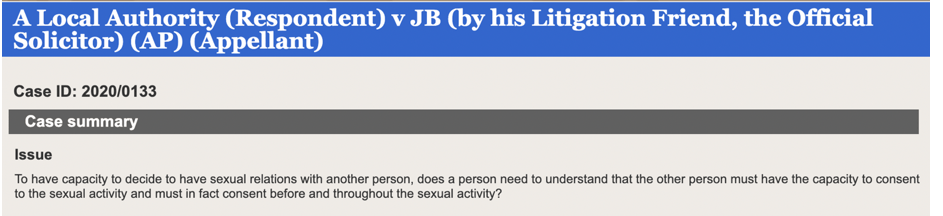
The Supreme Court considered the issue of whether to have capacity to decide to have sexual relations with another person, a person needs to understand that the other person must have the capacity to consent to the sexual activity, and must in fact consent before and throughout the sexual activity.
Capacity to Engage in Sexual Relations: A forthcoming Supreme Court hearing
By Charlotte Roscoe and Celia Kitzinger, 9th July 2021 Editorial Note: This blog post concerns a case in the Supreme Court. The Open Justice Court of Protection Project normally covers only cases in the Court of Protection. We have made an exception in this case (as we have before, for cases in the Court ofContinue reading “Capacity to Engage in Sexual Relations: A forthcoming Supreme Court hearing”

