

By Claire Martin, 16th November 2025
The protected party at the centre of this case (P) is a man who has significant hoarding difficulties. The Local Authority wants him to leave his home – either by agreement or by force – to enable them to clear the property and assess the amount of work that is required to make the place habitable. I think the plan is then for P to go back to live there, as he owns the house himself (it’s a home that he inherited).
I observed the 12-noon hearing below, in person, at First Avenue House in London (COP 14270384), before Tribunal Judge Kaufman.
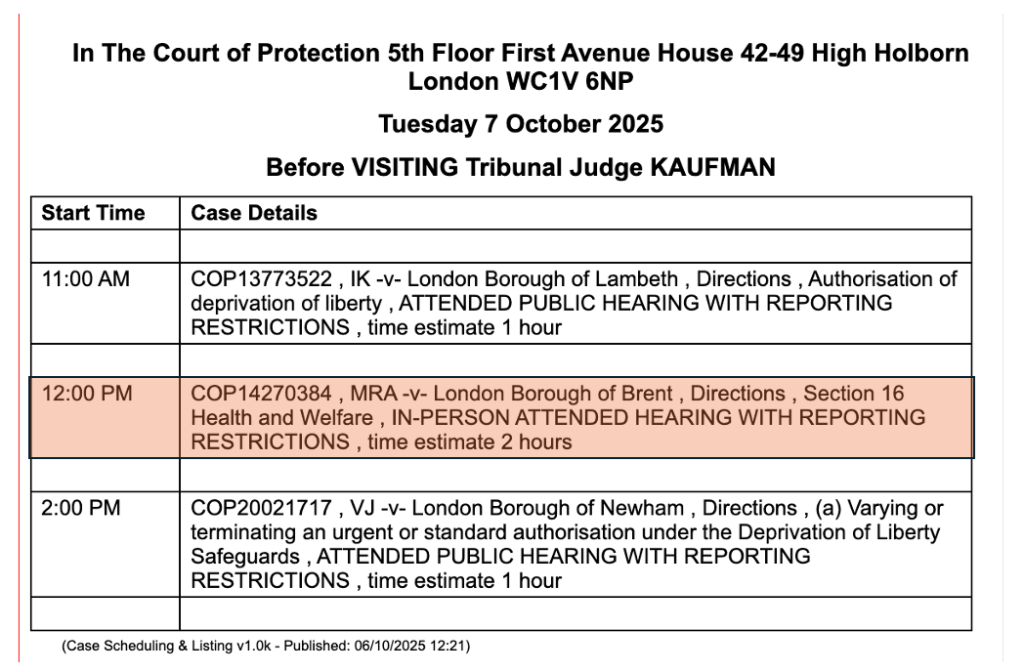
Background
P is a man with diagnoses of autism and hoarding disorder. He has a brother who supports him, including with managing his finances, but things are very difficult as his brother is said to have health difficulties of his own. Finances are not part of this application – however, more on this later.
The issue for P is that the Local Authority (Brent) has deemed his property in need of urgent clearance (the specific risks said to be posed by hoarding at the property were not described at the hearing). Previous attempts (in September 2025) at clearance with an agency were of limited success (according to the clearance agency) because P remained at the property and ‘progress was too slow to be meaningful. He resisted the removal of certain items and progress was extremely limited.’ (PS from MH Trust).
P has a new CMHN (Community Mental Health Nurse) with whom he is engaging (he didn’t form a good relationship with his previous CMHN). He also meets with his GP, and he does have a good relationship with the person from the clearance agency (I will call him Doug). The CMHN, GP and Doug are working together with P to try to find a way to help him to allow his house to be cleared, with as little distress as possible. An ‘autism informed communication plan’ is being drawn up. It sounds like it’s all quite difficult and P both wants things to change in theory and is distressed at the prospect of it and resistant to it in reality.
A referral to specialist tertiary clinic has been made by the Mental Health Trust, for assessment and possible treatment of P’s hoarding – but the ICB has refused funding for this, and the Mental Health Trust is appealing this decision.
An expert psychologist, Professor Paul Salkovskis, has been approached to see if he’s available to assess P and make a report to the court (I am not entirely sure what he’s being asked to report on).
The hearing we observed was to decide whether (and the extent to which) to authorise the LA to clear P’s property without him being there, and (if authorised) where P should go in the interim.
The Hearing
P wasn’t at the hearing, although he was aware that it was happening, and his counsel (Asma Nizami via the Official Solicitor) said that P “did get in contact with [his solicitor] yesterday, making it clear he had been intending to send an email with points he wishes to make”, but that “he’s not had the time or the mental clarity to put it together, but he wants to put it together and wants it to be conveyed verbatim to the court. He’s not in a position at the moment [to do that] and he would have wanted to come to court today to speak to us, but 10am would be impossible for him at the time”.
Other parties in this case are the Local Authority (represented by India Flanagan) and P’s Mental Health Trust (Central and North West London NHS Foundation Trust, represented by Emily Campbell).
The Local Authority wanted the judge to authorise a two-stage clearance plan: Stage 1 is that P is told that the court has ordered him to vacate the property, and he (hopefully) agrees to go elsewhere whilst his property is cleared. Failing that agreement being reached, Stage 2 is that P will be removed forcibly, using restraint if necessary (by a company called Secure 24).
The Mental Health Trust and the LA were asking the judge to authorise both steps at the hearing. The Official Solicitor, acting for P, expressed disquiet about the lack of a detailed plan from the LA, should Stage 2 be required:
Counsel for P: We would invite the court to take a staged, a cautious approach. [P] is likely to be very distressed with the prospect of removal – there is evidence already that he was distressed at the end of September when [Doug] attempted to remove things. To put it concisely: Stage 2 is not fully thought out. If Stage 2 is to be considered by the court, a proper restraint plan is needed.
It’s not clear what staged, incremental approach the court is being asked to approve. At the moment, the clearance plan refers to ‘prone restraint’ being authorised. There is the potential that when [P] would be lying down face down, it would be extremely restrictive [Judge: …. and dangerous]. Exactly, and there is guidance from the Department of Health which rules it out in most cases.
In brief the terms the OS is not in a position today to approve the restraint plan, or prone restraint. It also refers to mechanical restraint, which includes handcuffs. [P has] no history of violence, security is not an issue, he’s not at risk of harm to anyone else.
Taking all these points into account, we would say the position [that is] in [P’s] best interests is solely to authorise Stage 1 at this stage, and it to be made clear to [P] that he is being asked by the court to vacate his property so that clearance can take place because the court has determined it’s needed, and it’s hoped that because [P] is a law abiding person who respects the authority of the court, that he will act in line with that. [counsel’s emphasis]
Counsel for P also expressed some reservations about the proposed interim place for P to live:
Counsel for P: The Local Authority [LA] is referring to a placement called [XX] as a ‘BnB’. But we have received an email from the LA today that summarises that it is NOT a BnB. It’s not open to the public and does NOT operate as a BnB, it’s not online, it’s just a semi-detached property, it does not operate as a public facing venture.
Judge: What is it?
Official Solicitor: It’s an emergency housing provider – there are 3 flats, A B C. One is privately rented out, the other two it seems are used by different clients for emergency housing. So …. hospitals and LAs referring clients with nowhere else to go. So, it’s misleading to refer to it as a BnB. […] What we would ask court to do is to step back and review whether this is the best place for [P].
Counsel for the OS went on to say that P had previously (2017-2021) stayed in a hotel, and that same hotel has availability, but the LA says that it doesn’t fund ‘private hotels’. However, she observed, “Whilst the LA says it doesn’t fund private hotels, there’s a contradiction because it’s willing to fund the so-called BnB.”
The judge adjourned the hearing for lunch whilst the LA sought pictures of the proposed ‘BnB’ accommodation. Counsel for the OS specifically asked to see the floor plan, and photos “covering the communal area and bedroom he would occupy”.
Given the earlier report that P wanted to express his views to the court but had not had the ‘time or mental clarity’ to send an intended email to the court, I did wonder why the OS hadn’t sent a legal representative to meet with P and provide a report on his wishes and feelings, especially since the case was long-running. As a result, the court was grappling with how to allow for some flexibility in where P goes to stay, should he be willing to leave his home, but not want to go the ‘BnB’. Options seemed limited, but the possibility of him paying himself for the previous hotel he stayed in, or (less plausibly) stay with his brother, were mooted:
Counsel for P: The way you’d phrase it is that it’s in his best interests to vacate and reside elsewhere either at [XX] or another suitable placement chosen by him and agreed by the LA. For example, he may say he wants to go to stay with his brother. That’s unlikely but could be an option he’d want to go with. We wouldn’t want for him to be said to breach the order.
Judge: I think that would have to come back to court, on the papers. I would not want him to be forced to go somewhere he didn’t want to go, if he felt somewhere else was more palatable.
It was clear from early on in the hearing that the judge was ‘attracted’ (her word) to authorising Stage 1 only, it being the ‘less restrictive alternative’. That was the order that the judge made.
Finances
A side-issue cropped up during the hearing – how P’s finances are to be managed. Although this is not part of this application (which is a Health and Welfare application), it became clear that P’s finances are not being managed properly for him. His brother tries to help. He has a pension that he doesn’t seem to be accessing and, worryingly, the LA had made an application to court for a deputyship order back in November 2024. It turned out that the judge (who has overseen this case throughout) hadn’t received the application.
The judge said “I am surprised this has been going on for a year, maybe it’s got lost in the system. They need to be sent so I can look at them. … If you can send me them again I can have a look now.”
Counsel for P said that the previous deputyship application was ‘deficient’ and was ‘paused’.
P himself does not agree that he lacks capacity to manage his finances. I don’t know whether a capacity assessment for finance management has been done.
When the judge received the application (during the hearing) she made an interim deputyship order for a panel deputy to be appointed. She said that, although the previous documents were ‘incomplete’, P and those with an interest in the potential appointment (P’s brother, his Social Worker and the Official Solicitor) had been ‘made aware of the application and there are no objections that have been brought to my attention to oppose the appointment of a panel deputy’. The judge directed that the panel deputy should make enquiries about P’s finances to ‘regularise’ the situation, and that it might be the case that P’s brother takes over the role in future.
Next Steps
P wants to have his voice heard by the court – this was emphasised by his counsel throughout the hearing.
When making the interim deputyship order for finances, the judge said “I also note that he did not accept that he lacked capacity. Given he hasn’t attended this or previous hearings I am going to make an INTERIM deputyship order and he can attend at the next substantive directions hearing. I am more than happy to hear from him his position on deputyship.” [judge’s emphasis]
I was quite surprised, then, when counsel and the judge were setting a date for the next substantive hearing (which will deal with the surveyor’s report on the state of P’s property and the works required, as well as updates regarding P’s finances) P’s own limitations and needs were given little consideration.
Judge: 25th November at 10am 2hours
Counsel for P: Is there any way it could be afternoon to encourage P?
Judge: 11 o’clock ….
Counsel for P: Unfortunately, 11 is same as 10, the earliest he could attend is 2pm. We will encourage him, but the reality is that …..
Judge: 11 o’clock on the 25th November.
I know from attending Court of Protection hearings regularly that judges’ diaries are very stretched and there seems to be little wiggle-room. However, ‘P’ is meant to be the centre of a case, and the court wants to hear from P, so making reasonable adjustments for P’s identified needs to facilitate attendance would seem fair and equitable.
I am not sure why P would find it hard to attend court in the morning, and his counsel had earlier alluded to him struggling to engage with the court, despite wishing and intending to do so. For whatever reason, it sounded like an afternoon hearing was likely to accommodate his needs. That wasn’t what was offered, however, and we have seen that the case has been listed at an earlier date, and still for a morning hearing, on Monday 17th November 11am, via remote link. If you’d like the link to observe email: courtofprotectionhearings@justice.gov.uk with the case number COP 14270384.
The case might have been back in court sooner, depending upon what happens when P is asked to comply with the court’s order to move out whilst his house is cleared. I didn’t spot the case number coming up again in the listings. I hope, whatever happened, that P can be supported through what is likely to be a very difficult period of time for him.
Transparency Matters
First Avenue House in London – the home of the Court of Protection – is geared up for public observers. Staff are unfailingly helpful in my experience, they have printed Transparency Orders ready to hand to you when you tell them which hearing you are there to observe, and they seem on top of changes to listed hearings.
This hearing started a bit late (around 12.30).
In the waiting area, Asma Nizami (counsel for OS) came to speak to us (I was observing with Amanda Hill my colleague in OJCOP) to explain the standard OS position on disclosure of Position statements (following the guidance from Poole J in Re AB (Disclosure of Position Statements) [2025] EWCOP 25 (T3) ), and I was very grateful to Asma Nizami for raising it in court.
Official Solicitor: Another issue – a matter that arose outside of court. The two observers from the Transparency Project have requested PSs. I don’t have instructions from the OS …. I am aware from a recent hearing, the OS position has changed as result of the Poole judgment. The OS has not been agreeing to disclose PS without an order from the court. The reason for that is because we don’t have evidence that [P] would agree that his PS can be disclosed to an observer. That leaves us – you can direct if observers ask court to direct this.
Judge: I have got the draft order I don’t know if there are significant changes to the draft or amended draft in process?
Oddly, the judge didn’t address the issue raised by the OS at this point, and counsel raised it again (thank you!) at the end of the hearing: “Before you rise – can I ask for clarity on the Position Statements?” (Official Solicitor)
The judge asked us to confirm we had received the Transparency Order (we had been given this as a paper copy by the court staff at First Avenue House when we arrived). She then ordered disclosure of PSs to us as observers. And that was that.
I received the Position Statement for NHS Trust Central and North West London NHS Trust) the day after the hearing and the PSs for the two other parties two days later.
Thank you to Asma Nizami for raising the request for the judge to direct that Position Statements should be provided to observers, and to all counsel for providing Position Statements following the hearing. It makes an enormous difference to our understanding of the case.
Being able to read the PS for the Mental Health Trust has been very helpful. This case has been ongoing since the 20th June 2024 and the PS provides crucial background information that I would otherwise not know. It helps me fully to understand the judicial process, making it accessible to me as a member of the public.
Claire Martin is a Consultant Clinical Psychologist, Cumbria, Northumberland, Tyne and Wear NHS Foundation Trust, Older People’s Clinical Psychology Department, Gateshead. She is a member of the core team of the Open Justice Court of Protection Project and has published dozens of blog posts for the Project about hearings she’s observed (e.g. here and here). She is on X as @DocCMartin, on LinkedIn and on BlueSky as @doccmartin.bsky.social
 Promoting Open Justice in the Court of Protection