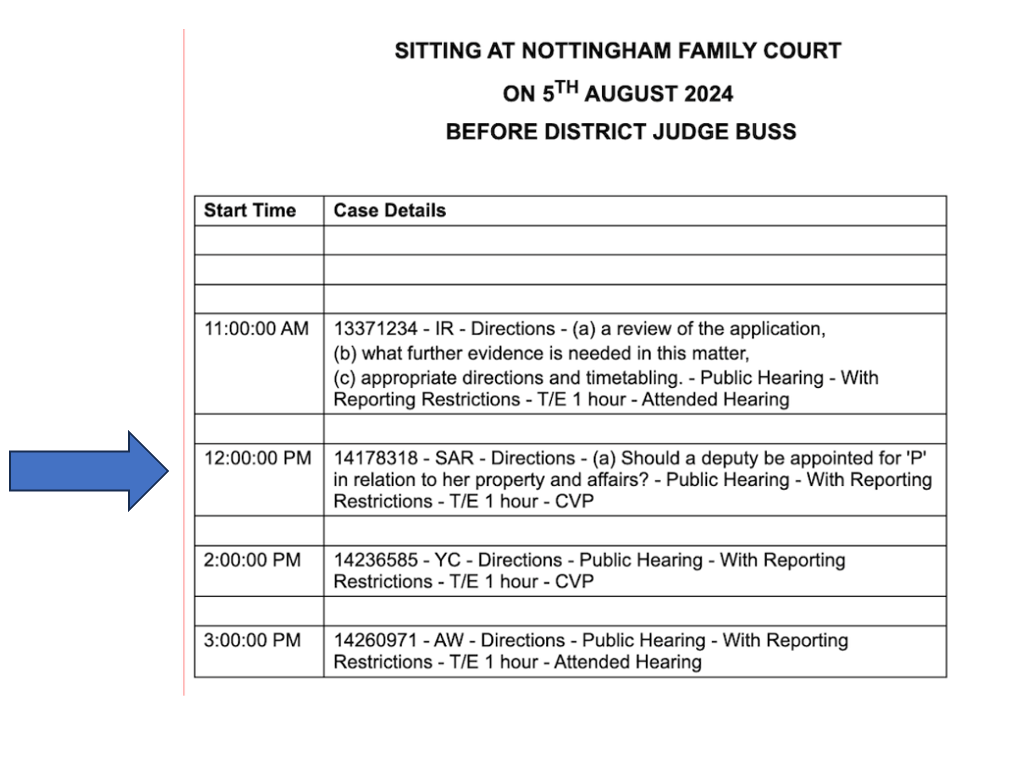
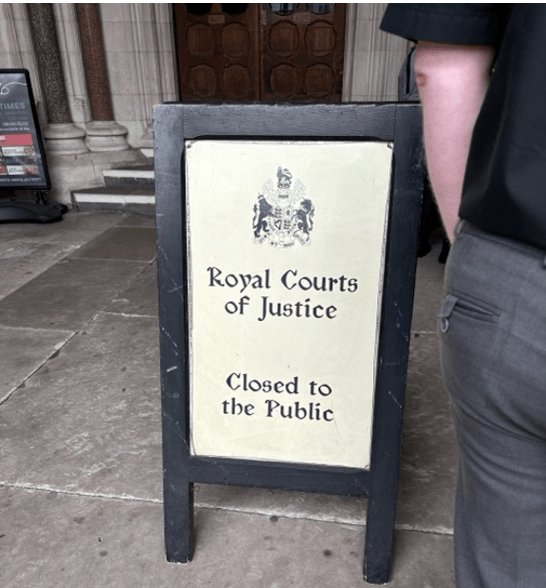
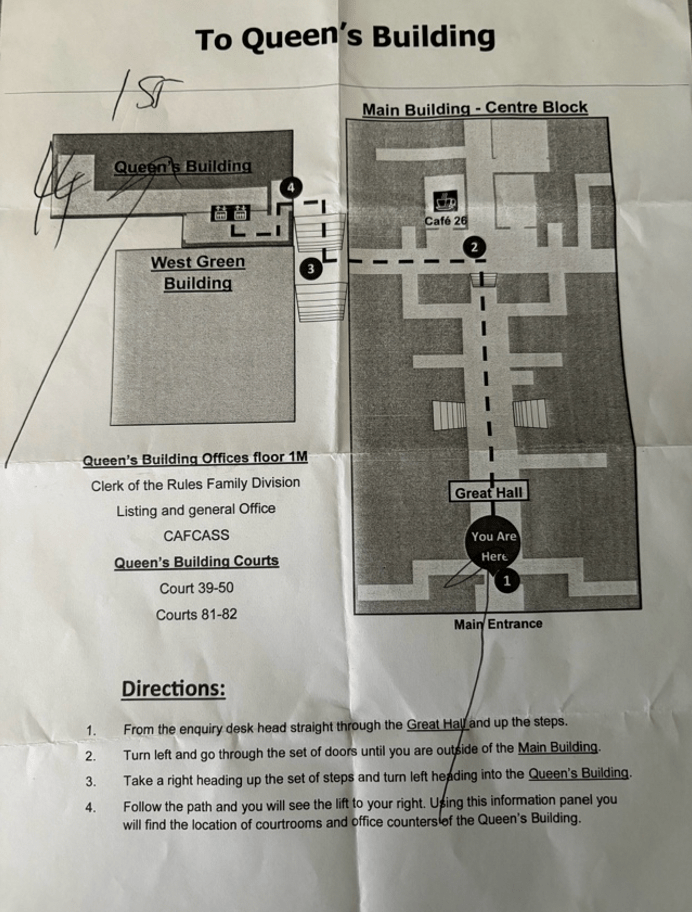
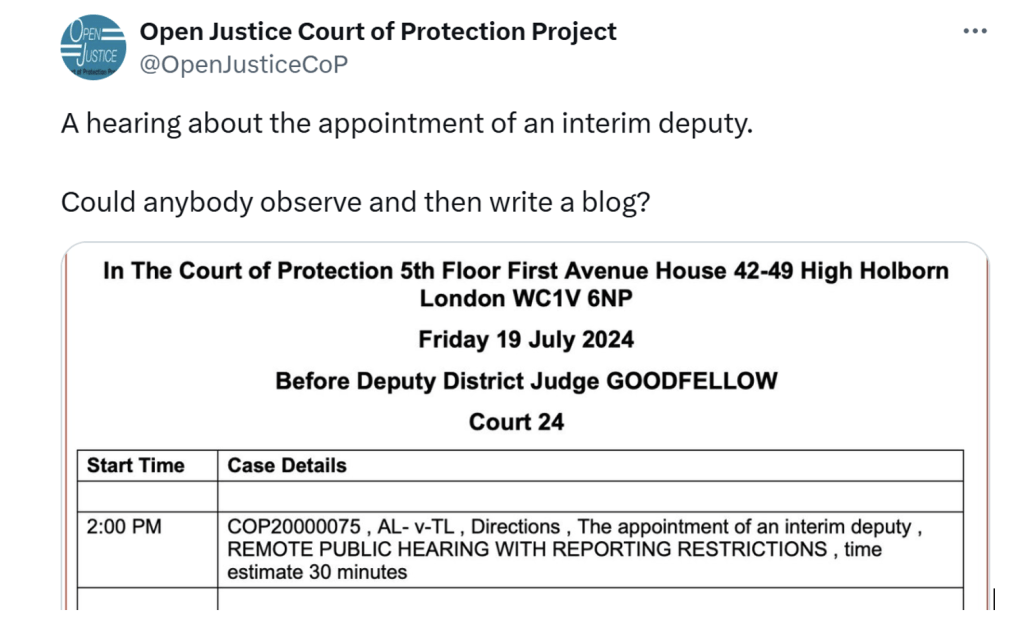
As often happens now, especially with cases involving attorneys and deputies, this one was listed as ‘attended’, which I took to mean “in person”.
This means that the parties (or their representatives) are attending in person, but it’s possible that there’s a link set up for others involved in the hearing (e.g. witnesses). Even if that’s not the case, the law permits a link for observers if it’s practicable to do so (e.g. if the court receives a request in plenty of time, and if the courtroom has video facilities and staff to set them up).
I decided I would nevertheless ask to observe remotely. I wrote as follows: “Good morning. I see that this public hearing is ‘attended’ but would be very grateful to receive a link to observe it on-line if a link is being set up.”
As always, I attached a screenshot of the court listing.
Entry into the court
I’m afraid I wasn’t optimistic and soon found myself wandering off into the garden, since it wasn’t raining for once.
Then at 10.38 I received an email from the court in Coventry including a Microsoft Teams link. I washed my hands and entered the court as quickly as I could.
Ten minutes later, when the hearing was well underway, I got an email from the Birmingham office saying: “Unfortunately, as the hearing is fully attended, there has been no link set up…” So I am left to imagine what had gone on behind the scenes but some trouble must have been taken because, when I entered the court, the judge said that making arrangements for me had delayed them. I duly expressed my heartfelt gratitude.
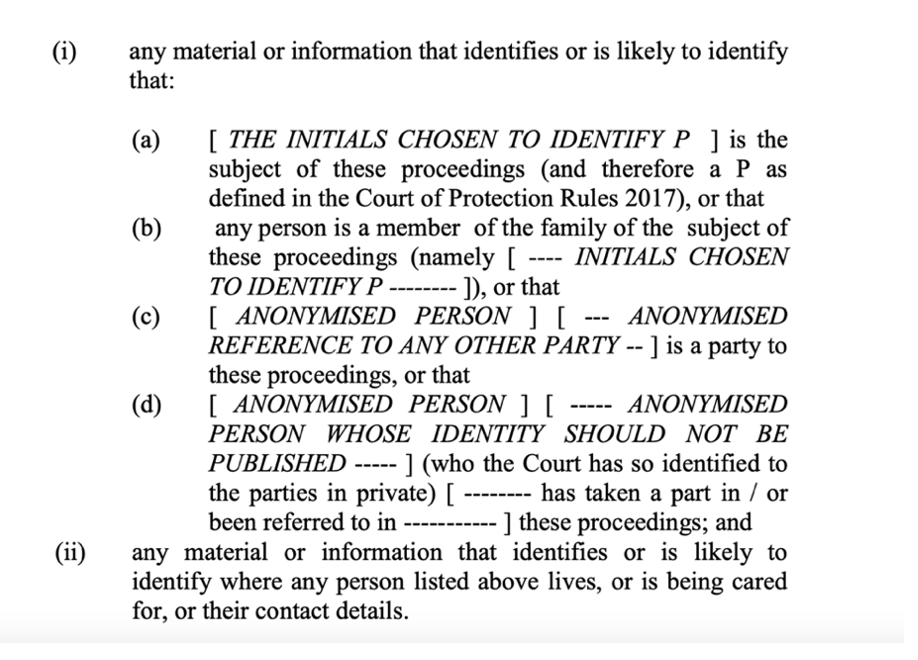
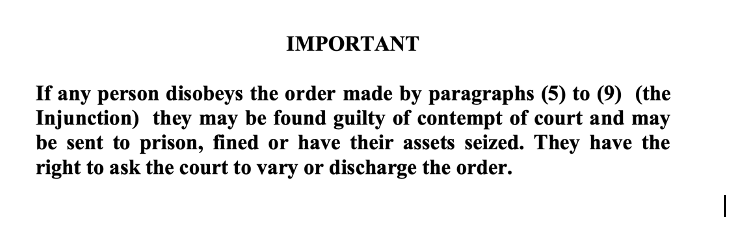
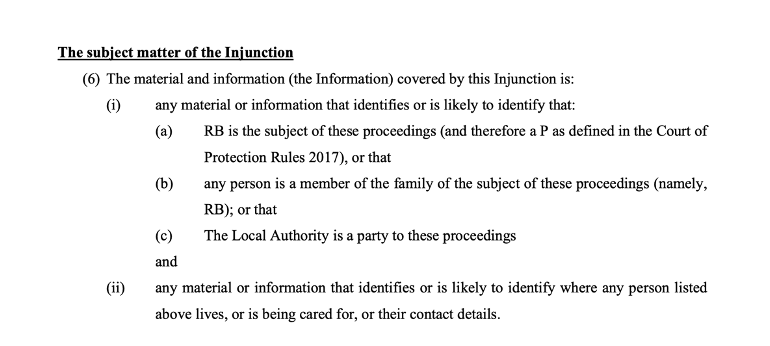
I hadn’t received a Transparency Order and this was addressed by the judge and, very helpfully, by the applicant’s barrister (see below) who rightly supposed that I was familiar with their general terms, to which I assented. I then turned off my camera and microphone, as I usually do.
The courtroom
My view of the courtroom must have been similar to the judge’s because I couldn’t see her but did get a very good view of all the other participants. They were introduced by Mr Ben Harrison from Serjeants’ Inn, who represented the applicant Local Authority
The first respondent had originally been P’s attorney for both property and finance and health and welfare and was representing herself – I will call her R.
The second respondent, was P’s ‘litigation friend, the Official Solicitor’, represented by Ms Rosie Scott.
Others in attendance were two people from the Local Authority, one of whom was a social worker, and R’s McKenzie friend, a term I hadn’t heard before (see Afterthoughts below).
The case before the court
Mr Harrison helpfully made a brief introduction to the case, which I was able to elaborate on as the hearing progressed.
It transpired that it had begun 3 years ago and that there had been several previous hearings. HHJ Walker had taken over from a previous judge and presided over at least two hearings since then. She had not met R before because R had been unable to attend these earlier hearings due to ill-health.
In 2021, Lasting Powers of Attorney had been registered for R to have powers of attorney for both P’s property and financial affairs and health and welfare. These powers had been revoked in 2022 when an interim, professional, deputy had been appointed. The reason was that the Local Authority were concerned that P had been subject to ‘coercion and control’ by R when agreeing to nominate her as her attorney and that this ‘coercion and control’ was continuing. They also believed that P had not had mental capacity when she signed the LPA documentation.
The Local Authority had also originally sought to restrict contact between P and R but had now agreed to withdraw this part of their application. They remained concerned but now believed that the risks could be managed by appointing a permanent professional deputy and R, in her turn, had agreed to the revoking of her powers of attorney so this could happen. R made clear that her agreement did not reflect her satisfaction with this outcome but the costs of the case had become disproportionate and it was distressing to P. She insisted that she had always acted in P’s best interests but P was now content to have a professional deputy appointed.
The LA responded that they were not seeking findings against R. They were also not rebutting that P still had capacity to make decisions about her own day-to-day spending.
Issues connected with the court process
At this point it turned out that the previous judge in this case had made an order that some of the information before the court should not be disclosed to R (i.e. it is “closed material”, see Guidance). If the case were to proceed to a contested hearing, the need to release this information would have to be considered. The Official Solicitor was of the opinion that it should remain redacted for ever unless the case was reopened and R agreed to this.
The judge expressed her sympathy for the pressure R had experienced throughout the long court process. R said it had taken up a large amount of her time over the last 3 years. She had always responded in a timely manner to the orders of the court but she could not say the same for the other parties. There had been ‘fearful accusations’ made against her and ‘dreadful adjectives’ used which were entirely out of keeping with her previously unblemished reputation. She wanted these removed from the record.
The judge said she could not do that; she could only say that there was ‘no determination’ in relation to these accusations, which was one of the benefits of settling the case now. R clearly felt that she had not had the opportunity to defend herself (guilty until proved innocent as I have noted in a previous post, The Public Guardian, Gifts and Attorneys. She talked about P having achieved her ‘life’s dream of living independently’ and that it had been R’s solicitor who had advised about putting LPAs in place.
The judge said that, if the case were to be pursued, the LA would take the opposite view but, as there was now agreement, their side of the story needed no further hearing.
The Official Solicitor said that her job was a balancing act and that the agreement reached would resolve matters as well as possible.
Questioning the need for an LPA for Health and Welfare
R expressed surprise that, although the issues before the court related to property and finance, her power of attorney for health and welfare was also to be removed. (This is the second case I have observed recently where attorneys have been surprised that the removal of their property and financial affairs powers seems inevitably to lead to the removal of their health and welfare powers too. I am beginning to sense that this is the norm and clearly people find it particularly upsetting.)
R wanted to know what would happen if P needed medical treatment. The judge said that an LPA was not necessary for this as the LA would be able to manage these matters, unless there was significant disagreement about treatment or where P should live, in which case it would come to court anyway. I think this only served to raise further doubts in R’s mind as she then referred to how happy P was in her current home and how anxious she would be if this was brought into question. The judge reassured her that this was not in question at the moment and that no restrictions were being placed on where P should live or with whom she could have contact.
The LA reinforced the lack of necessity for a health and welfare attorney; medical decisions would be taken by doctors. The Official Solicitor said there was no reason at present to think that P could not make her own decisions about her health, which she was doing very competently at present.
Summary and agreed determination
After an adjournment, the judge summarized the case and the agreements that had been reached.
P suffered from ‘complex disorders’ which had remained unchanged. She lacked capacity to engage in these proceedings and there was no reason to think that her capacity had been any different when the LPAs were written. The agreements outlined above were reiterated and the judge reassured R that the court recognized that she had always been a ‘significant person’ in P’s life and there was no reason why their relationship should change. The records would remain redacted because of the harm that they might otherwise cause to P.
Transparency Order
I had emailed Mr Harrison during the hearing asking him for the Transparency Order in case I didn’t receive it from the court. Just before the hearing ended, he asked me if I was still there and, when I turned on my camera and sound, assured me that he would be sending the TO. I took this opportunity to thank him for his help and also to thank HHJ Walker again. It had been a very positive experience.
After the hearing
After the hearing I also emailed the clerks and thanked them. Then I did some research.
“A McKenzie Friend can best be described as anyone who accompanies you to court to help you as a Litigant in Person – those who are unrepresented by a Solicitor or engage a barrister. Your McKenzie Friend is able to sit with you in the court and offer advice and support as well as taking notes to help you. There are some things that a McKenzie Friend cannot do on your behalf, such as conduct litigation, file court documents and Statements etc. There is a Practice Direction issued by the Family Courts which explains this in more detail. Our team of McKenzie Friends support children and their families to help resolve family conflict. “
It must be unusual to find a McKenzie friend in the Court of Protection since they seem to be concerned with children and the Family Courts; I can’t think of an explanation.
I also wondered about the terminology ‘coercion and control’ and discovered its use in Section 76 of the Serious Crime Act 2015 which ‘introduced the criminal offence of controlling or coercive behaviour in an intimate or family relationship’. Luckily, I had the opportunity to check this with Mr Harrison after the hearing and was assured that that was not how the terminology was being used in this case. (A little knowledge can be a dangerous thing!)
Georgina Baidoun was the lay Court of Protection Deputy for her mother’s Property and Financial Affairs until her mother died in 2021. Because of the difficulties she experienced with several applications to the Court, and with the Office of the Public Guardian in connection with her annual report, she has retained an interest in these areas, including attending Court of Protection Users Group meetings. She is keen to share her experiences in the hope that she can help others who have to engage with these institutions with very little help or guidance. She tweets as @GeorgeMKeynes
This is an update of a blog I wrote in November 2020. A few things have changed since then so while the bulk of the text is still intact, I’ve added a couple of developments and included what changes we might expect from the International Classification of Diseases [ICD]-11, the diagnostic manual in the UK that superseded the ICD-10 in January 2022.
“Borderline Personality Disorder” and “Emotionally Unstable Personality Disorder” are interchangeable terms for a mental health diagnosis typically given to someone who has difficulty managing their emotions, copes in ways that can cause problems for them, and has difficulties with relationships. In theory, it is a diagnosis given by a qualified mental health professional. It is classed as a mental disorder which means that a person with the diagnosis could be detained under the Mental Health Act (1983). There is a NHS webpage about it here, and a Mind page here.
For the diagnosis to be given appropriately according to the psychiatric criteria, people’s symptoms should meet the 3 Ps. Their difficulties should be: Persistent – Not waxing and waning, not relapsing and remitting but relatively constant. Pervasive – In every area of life. They shouldn’t function brilliantly in one area and not in another. Problematic – It has to cause distress to them.
All of the above is theory. But these diagnoses are in reality very contested, and in my experience and the experience of many people who have these diagnoses, the diagnosis can be arrived at after a very brief consultation and without a thorough assessment. I argue that this means, in respect of the Court of Protection, that in proceedings where P has one of these diagnoses, it is important to establish how the diagnosis has been arrived at – and to confirm that it is the result of a rigorous assessment, rather than the ‘gut feeling’ of a clinician. The Royal College of Psychiatrists recommends that“diagnosis should only be made by those qualified to make it and only following a thorough assessment”. That this has to be stated possibly reflects how little thought can go into the label being applied.
A Contested Diagnosis
There are 10 different types of personality disorder listed in the Diagnostic and Statistical Manual of Mental Disorders (the ‘DSM 5’) – which is published by the American Psychiatric Association, and used to diagnose mental disabilities in the United States and some other countries. These are: paranoid, schizoid, schizotypal, antisocial, borderline, narcissistic, histrionic, avoidant, obsessive-compulsive, and dependent. It’s also possible to be diagnosed with a “mixed personality disorder” or with a personality disorder that doesn’t quite meet the criteria for any of these diagnostic categories (“a personality disorder not otherwise specified”).
I’ve worked in a variety of mental health settings for the past 20 years and I have met fewer than 10 people with a personality disorder diagnosis that isn’t either “borderline” or “antisocial”. So, while in theory there are 10 types of personality disorder, only 2 of them seem to be regularly diagnosed.
In my experience, if you are a woman who self-harms, you will get a Borderline Personality Disorder (BPD) diagnosis regardless of whatever else is going on. Something in this system is definitely wrong.
The World Health Oorganisation [WHO] attempted to do something different when they revised the ICD-10. At first, they got rid of all of the different types of ‘personality disorder’ diagnoses meaning that people would simply be diagnosed with “Personality disorder” which could be graded as mild, moderate or severe. The former Chair of the WHO personality disorder group described Borderline Personality Disorder as “a spurious condition unsupported by science that should be abandoned” and it was abandoned until intense lobbying resulted in BPD making it into the ICD-11 as a descriptor. Now, your diagnosis can be “Personality Disorder: *rating of severity: Borderline Pattern”. In theory, borderline pattern is diagnosed if someone meets 5 of the 9 criteria for BPD. It has yet to be shown whether this change will make a huge difference but some have suggested that by including a BPD option, clinicians will default to what they have always done. This change means that EUPD should fade out of being used as a diagnosis as more trusts move to using the ICD-11
The ICD-11 does include the diagnosis of complex PTSD, which may well describe the repeated damaging life experiences so common in those given a Borderline Personality Disorder diagnosis. It is certainly indisputable that those who recieve a BPD diagnosis are predominantly those who have lived through trauma and abuse. Some studies suggest 80% of those with the diagnosis have lived through such experiences and it is recognised as the diagnosis most associated with childhood abuse. A CPTSD may well help everyone looking at the difficulties someone experiences as natural consequences of what they have lived through as opposed to some sort of disorder or defect that lies within them.
Table BPD criteria
1. Chronic feelings of emptiness
2. Emotional instability in reaction to day-to-day events (e.g., intense episodic sadness, irritability, or anxiety usually lasting a few hours and only rarely more than a few days)
3. Frantic efforts to avoid real or imagined abandonment
4. Identity disturbance with markedly or persistently unstable self-image or sense of self
5. Impulsive behavior in at least two areas that are potentially self-damaging (e.g., spending, sex, substance abuse, reckless driving, binge eating)
6. Inappropriate, intense anger or difficulty controlling anger (e.g., frequent displays of temper, constant anger, recurrent physical fights)
7. A pattern of unstable and intense interpersonal relationships characterized by extremes between idealizationand devaluation (also known as “splitting“)
Research suggests that if you can be diagnosed with one personality disorder, it’s highly likely you’ll meet the criteria for another two. So that’s 3 personality disorders in all. In a system that aims to put people into a neat tidy box so that we know a care pathway, it becomes messy because they’re actually in 3 boxes (and they probably display some traits from a few of the other diagnostic categories too).
To be given the diagnosis you need to match 5 of the 9 relevant criteria. Let’s say my friend Ian and I are on the same hospital ward. He meets criteria 1-5 and I meet criteria 5-9. So, we have the same diagnosis, the same treatment plan, and yet we share only one characteristic.
Borderline Personality Disorder could certainly be argued to be the most stigmatised diagnosis out there. As long ago as 1988, an article in the British Journal of Psychiatry (“Personality Disorder: The patients psychiatrists dislike”) reported research showing that psychiatrists treated patients with this diagnosis as more difficult and less deserving of care compared with other patients. The authors wrote: “The PD cases [sic] were regarded as manipulative, attention-seeking, annoying, and in control of their suicidal urges and debts. PD therefore appears to be an enduring pejorative judgement rather than a clinical diagnosis. It is proposed that the concept be abandoned.”
Dialectical Behaviour Therapy is the most researched therapy for Borderline Personality Disorder. Its creator, Marsha Linehan (quoted here: “Why you don’t want a diagnosis of Borderline Personality disorder”), advises people who are given the diagnosis “if you end up in the Emergency Room for a medical disorder for gods sakes do not tell them you meet criteria for Borderline Personality Disorder. Do not tell anybody. You’ll be treated differently and many, many mental health practitioners won’t see someone who meets criteria for Borderline Personality Disorder”.
The question can be asked “Are people with borderline personality disorder the patients psychiatrists dislike, or are the patients psychiatrists dislike told they have BPD?” The example below from Aaron Beck, the creator of CBT suggests the latter:
A story of two mental health staff talking goes like this: “I’m having problems with my patient with Personality Disorder” “How do you know they have personality disorder?” “Because I’m having problems with them.”
This is why I feel it’s very important that when the court accepts that someone has the diagnosis of BPD they ensure that this is based on a thorough psychiatric examination from an expert in the field, using a trusted rating scale and finding the person to have met the diagnostic criteria. A person does not “have BPD” simply because their care team find them challenging. I frequently meet people with this diagnosis who do not meet the criteria but have this label written all over their notes.
Even when people are shown to have met the criteria, the court should be aware of the subjective nature of assessment for this diagnosis. Those deciding that anger is “inappropriate” (Criterion 8) or that attempts to avoid abandonment are “frantic” (Criterion 1) may well have difficulty appreciating the unique set of circumstances those they assess are living through.
There is a language around people with this diagnosis that invites people to treat them badly or even cruelly. They are often described as attention seeking, manipulative and in many ways not truly deserving of care. They take up places in the healthcare system that could be used for people who are “really ill”. They are ascribed mythical powers to be able to tear apart previously high functioning teams and, despite a suicide rate of 1 in 10, are rarely taken seriously when describing being suicidal. It is very hard to be helpful to people when you label them as disordered and see them as holding all the characteristics above. This isn’t something society would expect caring people to do.
There are a range of therapies with an evidence based for helping those with this diagnosis, but these treatments are not always accessible. While DBT is the only one specifically mentioned in the NICE guidelines (specifically for women where self harm is a significant issue), the evidence base is similar for Metallisation Based Therapy (MBT), Cognitive Analytic Therapy (CAT) and many others. It is always worth checking what help has been offered and whether that help has an evidence based for the problems being described.
Perhaps a more useful way of thinking about this is through the lens of trauma. I’ve very rarely worked with anyone where the difficulties they have now don’t make sense in terms of previous experiences of neglect, abandonment and abuse. If we can remember what has happened to people, we tend to be empathic. When we label that person as disordered, we tend to locate the problems in them rather than the people or circumstances that hurt them, or the circumstances of their trauma. I would bet money that this label is disproportionately applied to the girls who survived the child sexual abuse scandal in Rotherham – but the people we sympathise with now will be the people who are blamed for their problems in the future. Again, it’s worth checking if any evidence-based help around trauma has been offered.
Jay Watts writes of testimonial injustice once this label is applied. The words of those given the diagnosis are seen as meaningless because an expression of pain is viewed as just seeking attention, and a legitimate complaint is ‘typical PD’. “Inappropriate anger” is one of the criteria for BPD and what greater power imbalance can there be for someone whose reactions to injustice are labelled by others as “inappropriate”?
Many would argue the diagnosis can be useful and I sometimes find it helpful for those I work with, if only because it comes with ‘NICE’ (National Institute for Health and Care Excellence) guidelines (see here and here) that recommend specific ways of helping people with this diagnosis. I help a lot of people leave compulsory treatment because the care they are receiving bears no relation to what is recommended in the guidelines. In the face of risk, teams move from “being with” people and start “doing to” people. Collaboration ceases and as people respond badly to the restrictions (whose potential for harm is spelled out in the guidelines), this is only seen as evidence to restrict more. Recommended therapies are not provided or are provided by those who are untrained – and despite a recommendation not to prescribe medication for BPD, polypharmacy (the prescription of multiple medications to one person daily) is rife.
Another common theme I see in legal reports is for someone’s current presentation to be generalised to their entire life. It can be forgotten how an inpatient environment is often perceived as harmful and not recommended for people with this diagnosis, with the ‘NICE’ guidelines telling us admission should only be used during a crisis. When people are compelled to reside in a harmful environment, it would make sense that their behaviour changes substantially. With that in mind I would always want the court to think about whether behaviour used as evidence for anything in one environment can reliably be applied to different environments where often that behaviour has never occurred.
The Consensus Statement for People with Complex Mental Health Difficulties who are diagnosed with a Personality Disorder was published in 2018. In this statement, many people with lived experience and some professional bodies including the British Psychological Society stated “We would like to abandon the term ‘personality disorder’ entirely”. That won’t happen any time soon though and its arguable that the ICD-11 category of “personality difficulties” will open the door for many more people being seen through the lens of personality disorder with the implications already outlined.” This is a scary prospect and while seeing that someone has a diagnosis of BPD will tell you much about their relationship with those who should care about them, it will tell you nothing about the value of their personality.
The ICD-11 allows the diagnosis of children from the age of 14 with personality disorder. The current RCPsych guidelines state “it is important that the diagnosis is made in this age group”. Over 1200 mental health professionals signed an open letter calling for children not to be diagnosed until it can be proven that the diagnosis does not harm them in May 2024.
I very much hope that the contested and controversial nature of personality disorder diagnoses that I’ve described here is understood and borne in mind by the Court of Protection whenever it makes decisions concerning people with one of these diagnoses.
Keir Harding is an Occupational Therapist and Dialectical Behavioural Therapist with 20 years’ experience in mental health and an MSc in ‘personality disorder’. He has been a lead therapist NHS services and is now Clinical Lead for Beam Consultancy. Keir works closely with people with lived experience to provide training, expertise and therapy to help avoid long term hospitalisation. He serves on the executive board of the British and Irish Group for the Study of Personality Disorder. He tweets @Keirwales and is Keir Harding on Linkedin, and Keir Harding OT on Facebook. He co-presents the podcast The Wrong Kind of Mad on the topic of “personality disorder” with Hollie Berrigan.
Postscript: Keir tried to get out of writing this, hoping that some of those who were critical of him writing the first blog would step up to improve upon it. In the absence of any other volunteers he revised the original piece and fully appreciates it could be better. Two very readable lived experience pieces describing the impact of being given this label can be read (here) and (here)
This was a 20-minute hearing (case number COP 14104740) before DJ Deborah Campbell, sitting in Bristol on 20th May 2024. It appeared in the Courtel/CourtServe listings as “Public with reporting restrictions, via Teams” concerning “(a) If RP has capacity to decide whether his home should be decluttered (b) Whether it is in RP’s best interests that his home should be decluttered“.
Open justice ran smoothly for this case. The listing was accurate and helpful. I received the link in a timely fashion. The Transparency Order (made by HHJ Cope on 22nd September 2023) was in the standard form and doesn’t prohibit identifying any public bodies. The judge welcomed observers and gave us a summary of the case. Oh, if only all hearings were like this!
In June 2023 (so nearly a year ago), the local authority (North Somerset Council, represented by in-house solicitor Will Cottrell) had applied to the court for permission to enter and declutter RP’s home. There was a risk that the Housing Association was going to evict him due to the state of the property – despite attempts made by the social worker to assist him with decluttering, attempts which had not, apparently led to much progress. Since then a specialist decluttering organisation had been appointed to work with RP and that had been much more successful. “His response has been very positive and – to the social worker’s surprise – he’s engaging with them“. Progress is said to be “slow but steady“.
The problem, said Will Cottrell (for the local authority) is that he’d expected to have a pre-hearing meeting with the housing association to hear from them whether RP’s decluttering progress has been sufficient – or at least in the right direction – to the extent that they would no longer wish to evict him. But no representative from the housing association had come to the pre-hearing meeting.
According to the local authority: “There appear to be two options. The most extreme is to do nothing, if that’s what RP wishes, and simply to respect his wishes which may commit him to eviction from the housing association. Or the other extreme would be to remove him from his house to a placement and conduct a complete clearance of the property. Neither option is attractive, and the social worker is steadfastly against the latter. You have already approved an 8-week course of 1-2 hour visits and we have made an application for that to become a permanent support provided to RP.”
There was some discussion about the funding stream. I gathered that a one-off request can be made for someone like RP who doesn’t receive any other services under the Care Act which has the objective of maintaining a habitable home environment.
The Official Solicitor has declined to support RP in the role of litigation friend on the basis of finances: “he’s not eligible for full legal aid but equally doesn’t have enough money to pay privately either“. The local authority has “put out feelers for Accredited Legal Representatives and they said if the Official Solicitor has declined to accept the invitation to act on the basis of financial aspects of the case, then it was highly unlikely that they’d accept it either, for the same reasons“.
The judge was quite concerned about this. She said: “[RP] is aware these proceedings are ongoing and he’s aware of the eviction risk – though his understanding of the eviction risk is- He doesn’t have capacity for that, because he says he’s just going to move to Greece. Are there any other options for ensuring that [RP] can take part in these proceedings?“
The local authority raised the possibility of whether the Council would be able to fund RP’s former advocate to represent RP in these proceedings – adding, “I don’t know if he’d then want a solicitor, leading to the same situation“.
“I think we have to try”, said the judge. “If there’s no joy on that basis, come back to me and we’ll have to think of something else. Can you update the draft Order to reflect that. Apart from that, I’m happy with what’s proposed“.
The next hearing was agreed for 3pm on 26th June 2024.
Celia Kitzinger is co-director of the Open Justice Court of Protection Project. She has observed more than 550 hearings since May 2020 and written more than 100 blog posts.She is on LinkedIn (here), and tweets @KitzingerCelia
By the core team of the Open Justice Court of Protection Project, 15 June 2024
Four years ago today, on 15th June 2020, at the beginning of the COVID-19 pandemic, Celia Kitzinger (retired academic psychologist) and Gill Loomes-Quinn (disability scholar-activist) launched the Open Justice Court of Protection Project.
It was born of our passionate belief that “publicity is the very soul of justice” at a time when it seemed that the public health emergency was closing down the opportunity for people to observe the court in action.
We had no funding and no clear plan about what we were going to do beyond observing a few hearings and writing some blog posts. The Project was the two of us, plus the website we set up in the hope that some other people might be interested.
It’s turned out to be wildly successful!
We now have a well-established and respected Project, with five core team members: joining Celia and Gill, “Anna” is someone with personal experience as a litigant in person in the COP for her mother; Daniel Clark is a former paid carer, now PhD student; and Claire Martin is an NHS consultant clinical psychologist working with older people. Last year we also appointed an Advisory group of three lawyers (see “Meet the Team”).
Over the last four years our website has attracted over 578,000 views from more than 299,000 unique visitors. Numbers are rising every year.
We’ve encouraged and supported thousands of people from a wide range of backgrounds to observe the court in action, and to share their experiences and their reflections via our blog and social media. Contributors include health and social care professionals, disabled people and their families, and those with experience of the Court of Protection as protected parties, litigants in person and expert witness.
We’ve published 489 blog posts in four years – that’s about one every three days! – and we have thriving social media outlets and run a WhatsApp group for court observers.
The Project has opened up public awareness of the Court of Protection as never before.
All this, still without any funding, and as a wholly voluntary organisation run in our spare time by members of the public.
We’ve been thrilled with the positive feedback we’ve received.
Recent remarks from the Chair of the Judiciary’s newly formed “Transparency and Open Justice Board” confirm that “open justice was never limited to journalists; every citizen is entitled to the same access to proceedings in open court”. Mr Justice Nicklin observes that “where journalists once sat in Courts, now sit a new breed of court reporters. Often representing or reflecting particular interests, they are providing welcome additional eyes and ears of the public in reporting what takes place in our Courts and Tribunals” (§41). We feel seen!
We have four years of experience as citizen-reporters in the Court of Protection. Our Project is in many ways a success story. We were always pushing at an open door – in theory if not always in practice, and we’ve significantly expanded transparency in the Court of Protection, once “Britain’s most secret court”.
Our Project is a showcase for what can be achieved by members of the public, seeking to work collaboratively with judges and lawyers in the Court of Protection, and with HMCTS staff, to overcome the barriers to open justice.
We want to thank everyone who’s supported us over the last year.
That includes all the judges, lawyers, and court staff, who’ve responded to our emails and phone calls, sent out links, dealt with audio and video problems, and addressed our concerns about listings. We recognise the time-commitment involved and very much value your obvious dedication to transparency and open justice.
We’re especially grateful to our advisory group members Kirsty Stuart, Victoria Butler-Cole KC, and Ian Brownhill who have helped us make sense of case law and statute – often at rather short notice – when we were struggling to understand cases, and concerned to report them accurately.
A special thank you to everyone who’s blogged for the Project over the course of the last 12 months (in alphabetical order)[I]: Deborah Airey, Pippa Arnold; Georgina Baidoun, Peter C Bell, Jordan Briggs, Nikki Bowsley, Ian Brownhill, Cliodhna Carroll, Beverley Clough, Chiara Cordone, Amy Dadarria, Kim Dodd, Brian Farmer, Claire Fuller, Ty Glover, Febienne Green, John Harper, Gail Heslop, Amanda Hill, “Hope”, Hita Jadeja, “Jean-Louise”, Ellen Lefley, Daisy Long, Tom McBride, George Palmer, Ruby Reed-Berendt, Nell Robson, “Rose”, Tess Saunders, Rhiannon Snaith, Hartej Singh Saund-Matharu, Tim Sugden, Eleanor Tallon, Jake Thorold, Isabella Treston, Avaia Williams, Ann Wilson, and Kei Yong.
Finally, we want to thank each other for being such fantastic and supportive colleagues and for making the experience of running this Project feel so rewarding.
We look forward to working together productively over the course of the next year.
HAPPY BIRTHDAY TO ALL OF US!
[i]As a matter of policy, and in line with our overall commitment to transparency, we do not usually publish anonymous blog posts (or anonymous commentary on them). Sometimes, however, we are forced to do so – as when there is a Transparency Order in place prohibiting an author from identifying themself as a protected party or as family of a protected party (“Rose”, “Anna”, “Hope” and “Jean-Louise”). We also made the exceptional decision this year to publish an anonymous account from a Court of Protection barrister about their own experience of anorexia (“A tribute to E: How anorexia and ‘Re E’ made me a Court of Protection lawyer”). Wevery much regret that one of the members of our core team, “Anna” is compelled to remain anonymous due to a Transparency Order: her efforts to get it varied have so far not been successful (see: Gagged – in whose best interests?).
At that point, just under a week before, Deputy High Court Judge Victoria Butler-Cole KC, asked for a full-day final hearing to deal with an application for a court-authorised caesarean for a woman who (probably) couldn’t give consent to it. She asked for oral witness evidence for the court. She also asked whether the protected party wanted to talk to the judge directly.
But it wasn’t DHCJ Butler-Cole KC who heard the case today (30th May 2024). It was Mr Justice Cusworth – and the hearing was over and done with in 14 minutes, with no cross-examination of witnesses (although they were in court) and no mention of whether or not the protected party had spoken with the judge. Cusworth J authorised the caesarean – with restraint if necessary.
This blog is split into three sections: [1] Transparency Matters; [2] The Decision of the Court; and [3] Reflections.
1. Transparency Matters
The Court of Protection (CoP) is committed to open justice. Sometimes this is hard to achieve in practice. It takes a lot of steps to get the ducks in a row.
Hearings have to be listed correctly for the public to know when a case is being heard, to enable them to decide which cases to observe. We observers then email the relevant court to request the link to observe. Someone at the other end needs to read the email and provide the link, in time. So far, so good. If the hearing is hybrid, like this one (meaning that people are in the physical courtroom as well as there being a remote link to attend and/or observe), ‘open justice’ also means being able to see and hear the court in action. This is more difficult than when the hearing is fully remote and everyone can be seen and heard more easily (because everyone is on screen in their ‘cell’ and each person is – usually – directly in front of their computer microphone).
Knowing who everyone is, is much easier in fully remote hearings too, because people’s names are normally attached to their image on the screen. Open justice means knowing who we are watching and what their roles are. We often rely on counsel to introduce themselves so we know which party they represent. Celia Kitzinger commented in her blog on the lack of transparency in the previous hearing for this same case: “I often recognise the lawyers – if not by sight (which can be hard when they’re be-wigged, though they weren’t in this case), by sound – but in this case I had no idea who the applicant lawyer was. I eventually figured it out when the lawyer for the Official Solicitor said, about half way through the hearing “Mr Rylatt and I have had some discussion…” – and bingo! I recognised him as Jake Rylatt, a lawyer I’ve watched before (albeit infrequently) in several hearings. I doubt those observers who hadn’t already come across Jake Rylatt would have picked this up.”
Observers should also be served the ‘Transparency Order’ which is the court injunction telling us who we cannot name in any reporting (almost always P, the protected party, and their family, but sometimes other information is included in the injunction).
Sometimes there are a few ducks not quite lined up, or totally out of the picture altogether.
Getting the link
When court listings are posted via Courtel or on the Royal Courts of Justice website (at around 4-5pm each weekday evening) the Open Justice Court of Protection project reposts all CoP hearings on our Twitter/X feed each evening and adds ‘featured hearings’ on the website and Facebook page.
So, we emailed the Royal Courts of Justice the night before to request the link and Transparency Order. Claire received an email at 08:27 (and Nell shortly after that time) the following morning, informing us that our request had been forwarded to ‘VHA and associate team who will be able to action your request’. That was very welcome. Sometimes responses are not received until very close to the start of a hearing, and we might then email again – bothering busy court staff – to chase up our original request in case it has gone astray.
The hearing was due to start at 10.30am and Claire received the link at 10:09am. So did Nell Robson.
But Ruth Fletcher (a legal academic working on reproductive rights at the Queen Mary School of Law in London) requested the link for this hearing before we did. She emailed on Tuesday 28th May. We emailed on Wednesday 29th May. Ruth received a reply from the court on Wednesday 29th May but she didn’t receive a link for the hearing, and ten minutes before it was due to start, she emailed again. She also telephoned the number for the Royal Courts of Justice and got no reply. She finally received the link at 11.19am (almost 50 minutes after the scheduled start of the hearing). This is not open justice. The system for collating and responding to observer requests seems to be fragmented and piecemeal, and it is down to pot luck, at times, whether you receive the link in time to enable you to observe. Fortunately for Ruth, the start time of this hearing was delayed until 11.25am, but the difficulty gaining access would put a lot of people off.
Joining the hearing
The hearing was on Cloud Video Platform (CVP). There are a few steps in joining a CVP hearing. You add in your name, then you have to click whether you are joining with ‘video+audio’, ‘audio only’, ‘presentation only’ or as an ‘observer’. I (Claire) have previously clicked ‘observer’, but this choice automatically joins you muted and with your camera off, and you cannot change it once you are ‘in’. In a previous hearing, the court clerk was speaking to me directly to check I could hear and see (which I could), and I couldn’t reply! On that occasion, I wrote in the chat box that I was unable to respond because I had joined as an ‘observer’. So, for this hearing I clicked to join with ‘video+audio’ so that I could respond if the clerk asked whether everyone could hear – which she did! (The fact that joining as an “observer” causes problems for court staff like this is evidence, presumably, of a lack of consultation with them about how the system works in practice.)
The downside of joining with ‘video and audio’ is that, unlike MS Teams, with CVP you cannot switch off your camera priorto being admitted to the virtual courtroom (there’s a small tick box for joining the link with microphone off). So, I always make a mental note to remember to locate the icon for it the moment I am admitted and switch the camera off. It is at the middle-bottom of the screen!
A further step before being admitted is needing to enter the PIN number for the hearing (which is in the email that the court staff send with the link to join). It’s so easy not to know how to get through all of this and to find it quite intimidating. And all of this is before you are in the ‘virtual’ courtroom observing proceedings.
The hearing was listed for 10.30am but as noted didn’t, in fact, start until 11.25am. It’s not uncommon for a hearing to be delayed for all sorts of understandable reasons. As an observer on the link with the periodic voiceover saying ‘Waiting for the conference host to join’ it can start to feel unsettling when time draws out. We were worried we might be on the wrong link (two different emails had been sent with a link), or that the link had changed.
Claire emailed the court staff at 11.10 to check we were connected to the right link (and also took that opportunity to ask again for the Transparency Order).
At 11.16 we were connected and there was the sound of people sorting out chairs and the court room. Court staff asked if everyone could hear, so Claire switched on her mic and confirmed that we could hear. The hearing got underway at 11.25am, almost an hour after it was listed to start. It’s worth ensuring you have some time around a hearing’s listed start time and length as often they start late, and we are (usually) not informed of delays or how long a delay may last.
Who’s who in court
In hybrid hearings – like this one – it is often difficult to know who is who in the courtroom. Others on the remote link are listed, so at least names are known, if not roles. We rely on the key people to make themselves and their roles known. In this hearing, counsel for the NHS Trust was invited by the judge to open proceedings. He might have said his name, but I didn’t hear it. I think it was Jake Rylatt, counsel for the applicant NHS Trust, as the week before.
Counsel for HW was another man, though in the previous week’s hearing it had been Katie Gollop. We don’t know who was representing HW today because he spoke for a very short time, just answering a query from the judge on one occasion, and we didn’t catch how the judge addressed him.
There were others in court – who Jake Rylatt said were the psychiatrist who had assessed HW’s capacity for making decisions about her obstetric care, and (we think) a consultant in midwifery. We think there were also instructing solicitors sitting behind counsel, as is usual.
The judge was not on any screen on the remote link. Celia Kitzinger commented on this experience, see here: “There was no camera on the judge. There’s something quite unsettling for those of us concerned with open justice for the judge to be nothing more than a disembodied voice in a video-hearing. Just on principle, judges shouldn’t be invisible!”. So, Mr Justice Cusworth’s disembodied voice was heard every now and then, speaking to counsel and asking for information. This surprised me for a court at the Royal Courts of Justice. I have observed other hearings there, where the judge, counsel and any witnesses giving evidence could be observed at the same time (via different cameras).
The Transparency Order
There was no Transparency Order attached to the emailed remote link to observe (recently, I have often had TOs sent with the hearing link) and Claire emailed back straight away, thanking the court staff for the link and re-requesting the TO. However, the TO wasn’t received it prior to or during the hearing. We still don’t have the TO though have requested it twice and have also requested the sealed court order to try to better understand the reasoning of the judgment. We believe that we are entitled to request these documents under COP Rule 5.9 :
The judge has agreed to our request for the order (via email with his clerk), but it has not yet been received nearly two weeks later.
The TO was mentioned, however, at the start of the hearing by Jake Rylatt. He said “For the benefit of observers, the TO material covered by the injunction is any material identifying that P is a subject or P’s family, any information identifying where any people live or are cared for or any contact details and identification likely to identify hospital staff and the prison – she was on a 14-day recall, she’s no longer on this….”
This is what I (Claire) have come to understand as the ‘standard’ injunctions in a TO – which are principally in place to protect the privacy of ‘P’, the person at the centre of the Court of Protection case, and anyone associated with them, such as their family members, where they live and so on. We have found that TOs are not always in their ‘standard’ form when (and if) we do receive them. Sometimes they include, as part of the subject matter of the injunction, a Local Authority, an NHS Trust or even the Office for the Public Guardian (see this recent blog).We might inadvertently identify these bodies if we do not receive the TO, and we are also unable to request that the TO is ‘varied’ (changed) at the time of the hearing, to enable identification of public bodies, if we don’t receive the TO in a timely fashion.
Opening summary
If cases have not been blogged about or observed before, we know nothing of the case or what the issues are for the court on that particular occasion.
At this hearing, there was an clear and helpful opening summary from Jake Rylatt, consistent with the guidance from the former Vice-President of the Court of Protection. The judge in this hearing stated explicitly that an opening summary would be helpful, not least because there were observers present. Such explicit support for open justice from the judiciary is very welcome.
2. The decision of the court
The previous blog post about this case ends with this: “The judge pointed out that “the legal framework isn’t going to be contentious”, and then listed the hearing for the whole day on Thursday 30th May 2024 (rather than the half-day requested by the Trust) “to give time for a remote visit [i.e. a conversation with HW] and for the judgment, which you’re going to need as soon as possible”.”
We didn’t find out, in the hearing, whether HW had spoken to the judge in a ‘remote visit’. HW was said, now, to be in agreement with the authorisations sought – a planned Caesarean section. She was, however, deemed to lack capacity to make this decision for herself and the Official Solicitor (OS) was in agreement with the NHS Trust that this was in her best interests. I don’t know whether the OS was previously opposed, or whether they sought more information. At the previous hearing, there was certainly a question about whether HW had, or would, regain capacity and thus make the decision for herself (which could well have been to have a Caesarean). An up-to-date capacity assessment had been completed:
Counsel for the Trust said: ” Further assessments by Dr A (consultant psychiatrist), with support of the MDT around [HW], last week and Tuesday [this week]. All three concluded that she lacks capacity regarding obstetric care. [It is] agreed by the OS that [HW] lacks capacity for proceedings and her obstetric care. The court is invited to make Section 15 declarations [about lack of capacity for these decisions].”
There were clinician witnesses in court, and the hearing had been allocated a whole day, but the hearing quickly moved to the (joint) current position of parties being submitted to the judge. The position, now supported by both parties (the applicant NHS Trust and the Official Solicitor for HW), was that it was in HW’s best interests to undergo a planned Caesarean section on the 3rd June 2024, with chemical and physical restraint if necessary. Jake Rylatt presented the proposed care plan to the court as follows:
“[The plan is] for a c-section on Monday 3rd June – this is consistent with her wishes and feelings expressed over the last week or so, supported by psychiatry and midwifery and based on psychological trauma and harm [that would occur] during an induced vaginal birth. Parties are satisfied that a c-section is in her best interests. The updated treatment plan: spinal anaesthetic then general anaesthetic under specific circumstances – one, if she requests it; two, if she’s insufficiently cooperative, or three, if there’s a clear clinical reason for general anaesthetic – that will be assessed on the day. C-section and anaesthesia is set out in detail in the obstetrics care plan. Restraint is set out in a stepwise manner … p179 of the bundle. The crux of the plan is contained in a stepwise plan for management. It essentially envisages that verbal de-escalation will be tried, then oral PRNas prescribed, Lorazepam; failing that, intra-muscular PRN will be administered, then there may be need for physical restraint. The safest manner, taking in to account NICE guidelines, is to use a safety pod and [?]. If that process is not successful at deescalating, then the plan is for review by an anaesthetist and further sedatives as required. It is only anticipated that restraint is required … [lost] if restraint beyond that in emergency … [lost] it’s very much hoped that won’t be necessary and indeed [HW] has been compliant with interventions to date [Jake Rylatt went on to express that this won’t necessarily be so during labour].”
There was brief mention of Deprivation of Liberty being taken out of the agreed draft order and then the judge invited Jake Rylatt to take the court to the draft orders, which confirmed the above declarations (that HW lacked capacity to make obstetric decisions) and authorised the care plan described.
The judge said:” I am quite content with the treatment order, subject to the spelling of the word foetal“.
And, after an agreement about how long the TO should last for (three months) and counsel for the OS [whose name I did not hear] confirming his agreement to the draft order, that was it. A 14-minute hearing.
3. Reflections
We’ve presented our reflections separately.
Nell Robson’s reflections
Having just completed an EPQ researching the making of best interests decisions for pregnant women and the common challenges that arise, this case seems to fit the trend exactly. Repeated challenges or issues in the cases I looked at included:
The evident lack of time in most cases, due to applications for pregnant women being brought to court late in the woman’s pregnancy – as is applicable to this case, as HW was 38 weeks pregnant at the time of the hearing.
The difficulty in ascertaining whether a patient lacks capacity – HW’s lack of capacity seemed (from the directions hearing that Celia Kitzinger blogged about) to be predicated on the fact she would not accept that she was pregnant. However, by the time of the hearing that I was observing, HW had accepted that she was pregnant – and yet it was not made clear (to observers) why she had been judged to continue to lack capacity to make birth decisions.
The position that tends to view pregnant women (especially women with severe mental illness [SMI]) as ‘risky’ rather than a person at risk or vulnerable themself.
The problem of when the woman’s voice being clearly missing from the hearing. Best interests decisions must consider the wishes, beliefs and values of the person concerned. At this hearing it was stated at the start of Jake Rylatt’s submissions that the proposed care plan “is consistent with her wishes and feelings expressed over the last week or so”. But HW was not at the hearing and therefore did not speak for herself, Counsel representing HW (via the Official Solicitor), who we don’t know, did not speak at all about HW’s expressed wishes and feelings and neither did the judge. Although of course, HW might have spoken to the judge at some point, it felt that her own views, and therefore her voice, was entirely missing from those who might have spoken to her said at the hearing. This seems common in cases I have read for pregnant women in the CoP.
In the very swift judgment, it was ruled that a general anaesthetic may be resorted to if a) HW states that she would like one, b) if she is ‘insufficiently cooperative’, or c) if there is a clear clinical reason for one. The choice of phrase of ‘insufficiently cooperative’ feels concerning to me. It creates the idea that, potentially due to her lack of capacity, she should have no say in her treatment if her views are contradictory to those of her medical team. Surely, her voice should be listened to and respected much more than it is appearing to be? It also seems to position HW as the issue, that her wishes are obstructing the path that the doctors wish to take, rather than her wishes being something that should be used to inform her care.
The largest concern that I felt when observing this case was that the voice of HW was entirely absent, both in that she was not present at the hearing, nor were her views towards her treatment explained adequately at any time. As I had not observed the previous hearing concerning this case, I understand that her wishes and feelings may have been expressed then, however I think that it is still important to restate her wishes when making the final judgment/declaration. It was only counsel for the applicant Trust who mentioned them at the hearing. There was no questioning of the submissions at any point (apart from a small point about whether the transparency order should be for 3 or 6 months) and numerous restrictive measures against HW were authorised without any detail (spoken about in the hearing at least) about when and how such physical and chemical restraint could be used. Alongside flattening the voice of HW by permitting so much restraint with such little (transparent) scrutiny, this also returns to the issue of perceiving the woman as ‘risky’ rather than a vulnerable person who needs to be cared for and worked alongside with rather than controlled.
Claire Martin’s reflections
I know that HW will have had her baby by now. I hope that the experience was manageable for her. The information that we as observers have is that she (for the majority of her pregnancy at least) did not believe that she was pregnant. I can understand why her clinical team was concerned about the potential impact on her mental health when she went into labour.
I searched for papers addressing pregnant women who do not believe they are pregnant – and specifically was looking for research about the psychological impact on such women who go into spontaneous labour. It won’t have been an exhaustive scholarly search, but interestingly nothing about the impact on women came up. This might be because I have not searched fully enough, or used the wrong search terms, or it could be that there is no research in this area – perhaps pregnant women with mental health issues who do not believe that they are pregnant are not giving birth spontaneously, and instead are always undergoing planned caesareans.
There is substantial literature on the phenomenon of what is called ‘pregnancy denial’. It has been thought to fall into two categories: psychotic and non-psychotic pregnancy denial. This paper (from 2000) explains the phenomenon below:
This fascinating paper (from 2023) discusses potential underlying mechanisms, possibly updating the understanding of the phenomenon described in to 2000 paper above, concluding:
This paper (again US, in 2011) addresses legal as well as treatment considerations for clinicians, though of course this is in relation to US case law.
There are several papers making clinical recommendations such as here and here, and this paper (from the USA, 2024) ends with these recommendations:
However, I couldn’t find papers explaining why a planned delivery is recommended, although intuitively I can understand that this would be thought best by those looking after pregnant women. As Nell mentions above, it appears that the Best Interests decision (for a planned Caesarean section, with restraint if deemed necessary) was based upon HW’s belief that she is not pregnant, and the MDT’s assessment that she would be distressed by giving birth naturally. Celia Kitzinger said in her blog, “I can imagine that going into labour would be very frightening if you didn’t believe you were pregnant” – but this was simply speculation from Celia about why a caesarean might be in HW’s best interests and not based on anything made explicit in court. So, I simply don’t know.
It would be interesting to know if this scenario (going into labour when you believe you are not pregnant) has been researched and reported and what this was like for the women, any subsequent impacts on their mental health, relationships with their babies or other consequences. My (albeit brief) literature search suggests that current practice is based on what others believe is the right way to help women in ‘pregnancy denial’ to give birth, rather than evidence-based practice. I would really like to know if there is research that I have not found about this interesting and very important area.
In this hearing, I was most struck by the decision of lack of capacity very swiftly being accepted by the judge, given that, only a week previously (at the directions hearing before DHCJ Butler-Cole) there was a possibility of HW regaining capacity, which would have enabled her to make her own decision about whether to have a Caesarean section. In this scenario, I was unsure why the judge didn’t scrutinise the capacity assessment more – especially given that the psychiatrist who did the assessment was in court ready to give evidence. Perhaps, since he and counsel all had the relevant paperwork (and I didn’t) it was all uncontroversial by now. However, to understand how the law operates and how decisions are made – especially very intrusive and draconian decisions such as these – a clear public record of how capacity and best interests decisions are reached should be (I would argue) mandatory. Otherwise, how do we know that this is not just the Trust wanting to do the easiest and clinically safest thing from their point of view? I don’t know if there will be a published judgment for this case, which would, of course, provide that public record.
Restraint plans were spoken about vaguely (presumably there are details in the approved order) but included chemical and physical restraint if HW was ‘insufficiently cooperative’ (with only a spinal anaesthetic for the Caesarean). It might be that the court order has the detail about the clear steps for chemical and physical restraint and when they are allowed, and I haven’t had the opportunity to read that yet. If it does, I will update this blog accordingly, to reflect accurately the judicial decision-making process.
I know that this is the stark reality of caring for people who might become upset, angry, potentially aggressive and violent. I think that the language used, however, is unfortunate and positions others in a powerful ‘doing to’ role with HW. For example, the phrase ‘insufficiently cooperative’ is probably how staff will see HW if this is the language used in the court order and care plan. I wonder how staff might feel about HW, and their own role(s) in relation to her, if, for example, the plan was phrased in terms such as: ‘If HW changes her mind at any point about her obstetric care, becomes distressed and is asking for a different birth plan’? ‘Changes her mind’ is different to ‘insufficiently cooperative’, gives HW some agency and respect for her own views and continues to afford her wishes and feelings some respect and weight during the process of giving birth. It would frame the entire process dialogically, rather than position HW as a subject who is either ‘cooperative’ or ‘uncooperative’ in relation to others’ plans and powers. Of course, when a best interests decision is made for someone, it is not their decision to ‘change their mind’ about. However, given that the birth plan and court order were determined in the context of HW agreeing with the decisions in them (her wishes and feelings were mentioned and were said to be the same as her clinical team’s), her views were therefore presented as a relevant part of the best interests determinations.
Sam Halliday’s recent paper on pregnancy and severe mental illness discusses the framing of women with mental health problems as ‘risky’ rather than ‘at risk’ and vulnerable themselves. I thought that HW was positioned this way. She was seen as a risk – of becoming uncooperative with the clinicians. I wondered whyand under what circumstances she might move into this position. There was no judicial scrutiny of the details of this scenario (at the public hearing). We didn’t learn any details of a stepwise plan, in terms of what HW would need to be doing to enable chemical and physical restraint to be applied. Jake Rylatt stated the following: “Restraint is set out in a stepwise manner … p179 of the bundle. The crux of the plan is contained in a stepwise plan for management. It essentially envisages that verbal de-escalation will be tried, then oral PRN as prescribed, Lorazepam; failing that, intra-muscular PRN will be administered, then there may be need for physical restraint. The safest manner, taking in to account NICE guidelines, is to use a safety pod and [?]. If that process is not successful at deescalating, then the plan is for review by an anaesthetist and further sedatives as required.”
What would count, for example, as ‘insufficiently cooperative’ to trigger this stepwise plan? What were the ‘verbal de-escalation’ methods? How would they be deployed and by whom, and how many people would be around HW? Would HW only need to be refusing the c-section care plan verbally to be considered ‘insufficiently cooperative’, or would she need to be posing a risk to others or herself physically? How long would this be tolerated before Lorazepam was administered, intra-muscularly if necessary? Was there included in the plan an order to spend time discussing HW’s thoughts with her, to better understand her concerns, once she was emotionally ‘de-escalated’? I have read about and have been in other hearings (see here, here and here, the final link describes the judge directing more detail about how P is to be restrained) where these sorts of details were nailed down by the judge, to ensure that P was protected from premature intrusion and force, and also to protect professionals by ensuring that they knew exactly what they were to do each step of the way.
The key point here is that, even if this was all already-known by counsel and the judge – because it was all spelt out in the paperwork – we, the public, didn’t know the answers to any of these questions. Why would you let the public into court to observe a hearing but restrict the information available to us in such a way as to leave us anxious and disturbed about the possibility that restraint was being improperly authorised? Observers in court are likely to be writing about the case. Compulsion during labour is a (realistic) fear of many women. I’m a very experienced Court of Protection observer, but I came away from the hearing not fully understanding the basis on which the caesarean was being ordered and the circumstances in which chemical and physical restraint would be used, and how they would be deployed. This is the opposite of what the court should be doing – it’s not transparent, and it raises our anxieties about coercion.
I echo Nell’s concerns about HW having no voice – counsel for HW, who is representing her via the Official Solicitor, said nothing about HW’s wishes and feelings, her ‘impairment of the mind or brain’ underlying her lack of capacity, or how she was currently doing. HW as a person was not brought to the court room. Doing so might have humanised her more for the court. The “court” (meaning the judge) may already know a lot about her – but he didn’t say so and he didn’t tell us anything much at all – again raising our anxieties rather than allaying them. I think – across the two hearings we have observed – we, the public, know very little about HW as a person.
Overall, I left the hearing thinking that there was insufficient judicial curiosity and scrutiny of very invasive requests regarding a woman’s body. I don’t know (did the judge?) when and how HW might be subject to highly distressing restraint procedures. It might be in HW’s best interests to have a caesarean with the aim of avoiding distress and emotional trauma. That seems like a compassionate and reasonable proposal. It is, however, also known that forced treatment in itself, including physical and chemical restraint is highly likely to be traumatising (see this recent blog about a woman with anorexia for her detailed description of what this was like for her; and this paper). Significant restraint of a pregnant woman was authorised in this hearing, including the administration of intra-muscular tranquilising medications. The stated objective of avoiding the distress of giving birth to a baby HW did not think she was having did not seem balanced by concern for the potential to cause distress by the methods authorised in the order.
What about the open justice aspects of this hearing? I would say that insufficient attention was paid to this. The hearing had been scheduled – at least initially – for a full day, and it was over and done with in 14 minutes. Other bloggers (here, here and here) have expressed grave disquiet about court-ordered caesareans. This hearing proceeded as if the legal system had no idea that members of the public might feel concerned about a court-authorised caesarean or might be critical of this decision.
Another 14 minutes or so could have covered the kinds of concerns that members of the public are likely to have about court-ordered caesarean with restraint. The court could have explained the decisions the court reached and the reasons for them in a way that might pre-empt the kinds of criticisms that are routinely and publicly raised about court-ordered caesarean. The hearing, originally listed for a full day, would still have come in at under half an hour – and that extra 14 minutes would have really made a difference for open justice.
Claire Martin is a Consultant Clinical Psychologist, Cumbria, Northumberland, Tyne and Wear NHS Foundation Trust, Older People’s Clinical Psychology Department, Gateshead. She is a member of the core team of the Open Justice Court of Protection Project and has published dozens of blog posts for the Project about hearings she’s observed (e.g. here and here). She tweets @DocCMartin
Nell Robson is a sixth-form student who has recently completed an Extended Personal Qualification entitled: “What are the challenges in making best interests decisions for pregnant/birthing women?”
Ordinarily, the Court of Protection is concerned with the personal welfare or property of people who are “habitually resident” (a term used in cases involving children and vulnerable adults) in England and Wales. On occasion, however, the Court is required to step outside of this comfort zone and consider issues relating to people who are “habitually resident” other than in England and Wales, notwithstanding that they may be physically located there.
This situation has arisen multiple times in recent years in respect of people from the Republic of Ireland. It is sometimes the case that Ireland lacks a suitable placement or appropriate medical treatment for a person’s particular needs (this appears to be particularly the case for those with serious eating disorders), resulting in the Irish High Court making orders for a placement or treatment in England and Wales, in circumstances which (to date) have always involved depriving them of their liberty in the relevant facility.
A recent example of this is the case of Re RO (Schedule 3 MCA 2005)[2023] EWCOP 55. In October 2023, the Irish High Court authorised the continued placement of a young Irish citizen at a specialist eating disorder facility in England and Wales. This was despite the young woman in question, who remained “habitually resident” in Ireland, making clear that she wished to return to Ireland even if that as to have a serious impact on her health. Proceedings were subsequently issued in the Court of Protection for the Irish High Court’s order to be recognised and declared enforceable in England and Wales.
How does the Court of Protection approach this situation? Can the Court of Protection second-guess the decisions of a foreign court?
Not a Best Interests Decision
The legal provisions governing the Court of Protection’s powers over people who are habitually resident other than in England and Wales are contained in Schedule 3 of the Mental Capacity Act 2005. In summary, this schedule provides a mechanism for the Court to make declarations that “protective measures” ordered by a foreign court be recognised and enforced in England and Wales. For these purposes, “foreign courts” include the courts of Scotland and Northern Ireland, as well as those of other countries.
A “protective measure” is defined in the Mental Capacity Act 2005 to include any measure directed to the protection of the person or property of an adult (which encompasses anyone over the age of 16 in this context) who, as a result of an impairment or insufficiency of his personal faculties, cannot protect their interests. Notably, a determination that a person lacks capacity constitutes a “protective measure” under the legislation.
These definitions come from the Hague Convention on the International Protection of Adults (2000). The UK has signed the Hague Convention, but not ratified it (it has only been ratified by Scotland), but these definitions are nonetheless incorporated into domestic law by Schedule 3 of the Mental Capacity Act.
In the Irish cases referenced above, the typical course is that – following an order of the Irish High Court (which, it should be noted, continues to review matters frequently even after a person moves to England / Wales) – the Health Service Executive of Ireland applies to the Court of Protection for the protective measure to be recognised and declared enforceable in England and Wales. The procedure for making such an application is contained in the Court of Protection Rules 2017 Practice Direction 23A, which details a range of evidence which will need to be provided.
Perhaps most strikingly, unlike in an ‘ordinary’ Court of Protection matter there is no direct requirement to provide capacity evidence concerning the person in respect of whom an order is sought (albeit if it was obvious that a person did not lack capacity, it is likely that the Court of Protection would refuse to enforce the Irish High Court order). This reflects the fact that the Court of Protection is performing a very different role to its standard fare. Rather than being the primary decisionmaker, the Court of Protection’s role is essentially limited to determining whether the foreign protective measure can be lawfully implemented by scrutinising whether the core procedural and substantive rights of P have been complied with. When such an application is made, the Court of Protection cannot, for example, conduct its own best interests analysis that it might wish to substitute for that of the Irish High Court.
In the important case of Re PA [2016] Fam. 47, the Court of Protection endorsed the position that a decision to recognise or enforce a foreign protective measure is “not a decision governed by the best interests of the individual… Thus it follows that the Court will be obliged to recognise and enforce a measure in a foreign court order even where applying a best interests test it would not be included in an order made under the domestic jurisdiction under the MCA”. This should be distinguished, however, from a decision of the Court of Protection regarding how to implement any such measure, as part of which the adult’s best interests must be considered.
What can the Court do?
It’s important to acknowledge, however, that the Court of Protection’s power is not entirely circumscribed to simply a rubber-stamping exercise, and in certain situations the Court can refuse to recognise a foreign protective measure. The Court has set out very detailed checklists for Deprivation of Liberty cases) in SV, Re [2022] EWCOP 52 (08 December 2022) which must be met for a foreign protective measure to be recognised, and indicated that an oral hearing is always required in such cases in The Health Service Executive of Ireland v A Hospital Provider [2023] EWCOP 55 (24 November 2023), so the Court is not merely making these decisions ‘on the papers’.
The Court’s discretion not to recognise a protective measure may apply where the measure taken was not urgent and yet the adult concerned was not given an opportunity to be heard in breach of the rules of natural justice. Secondly, the Court may choose not to recognise a protective measure where such recognition would be “manifestly contrary” to public policy, or the measure would be inconsistent with a mandatory provision of the law of England and Wales.
Examples of the Court of Protection refusing to recognise and enforce a foreign order are rare. Recently, however, in Aberdeenshire Council v SF (No.2) [2024] EWCOP 10, Mr Justice Poole did so in relation to a Scottish Guardianship Order which gave power to P’s mother to authorise arrangements amounting to a deprivation of liberty on her daughter’s behalf:
“In my judgment therefore, no opportunity was provided to SF to be heard in the case in which the protective measure was made. Furthermore, having regard to the wide powers granted to the guardians, including authorisation of the deprivation of SF’s liberty, and the application of those powers to any future community placement, and given the duration of the order (proposed to be indefinite and made for seven years), the failure to give SF an opportunity to be heard did amount to a breach of natural justice. I am sure that all those involved sought to protect SF’s best interests and that SF’s parents were properly assessed as being suitable guardians. I do not doubt that SF lacked capacity at that time to make decisions about her personal welfare. However, there was no opportunity for her wishes, feelings, and views to be communicated to the court and no provision made for her interests to be represented. There were no safeguards for the protection of her Art 5(1) rights. Natural justice required that in a case where SF’s liberty was being put into the hands of others for a period of seven years, she should have had an opportunity to be heard and/or an opportunity to be represented. SF’s access to the court should not have been dependent on her taking the initiative. Effective access should have been secured for her. As it is, there were no measures taken to ensure that her Art 5(1) rights were upheld.”
As such, the Court will in certain situations decline to recognise a foreign “protective measure”, in this situation because the adult in question had not been given an opportunity to be heard. It is perhaps somewhat of an irony, therefore, that the Court of Protection will often consider the question of whether to recognise and / or permit enforcement of a foreign protective measure without the relevant adult even being a party to the proceedings or having independent representation.
This is not without controversy, and – as Alex Ruck Keene and Chiara Cordone have argued (a walkthrough of this article is available here)– it gives rise to an uncomfortable tension that a person lacking capacity in England and Wales can have very different rights to another person in an almost entirely analogous situation save that the first person is “habitually resident” in a foreign country.
Conclusion
These cases are without question an oddity in the Court of Protection world. As put by Alex Ruck Keene, they require “the Court of Protection, and those appearing before it… mentally to undertake a very significant gear shift”. As ever, however, it is essential that the person at the heart of proceedings is not lost sight of in the midst of what is unquestionably a legally complicated area.
Jake Thorold and Chiara Cordone are both barristers at 39 Essex Chambers who specialise in Court of Protection work.
My interest in observing COP cases is limited to cases involving attorneys and deputies, and these are usually about property and financial affairs. There are few of them to observe and they are increasingly listed as being ‘in person’, which makes it hard for me to attend. I was therefore grateful to Celia when she alerted me to a hearing before DJ Ellington at 12.00pm on Thursday 6th June 2024 which was listed (as shown below) as a hearing concerning “decisions relating to property and affairs” with “The Public Guardian” as first respondent.
I emailed to request the link on 5 June at 16.23. I sent a reminder the next day, the day of the hearing, at 11.30. Getting no response, I then rang at 11.53 to be told that the hearing was ‘attended’ – the implication being that it was in person and no links would be provided. I pointed out that that was contrary to the CourtServe listing and the person to whom I spoke easily traced my email and agreed, since I had included a screenshot of the CourtServe entry in my email. She then assured me that she had at that moment sent my request to the court clerk. Exactly an hour later, when I had given up expecting anything, I received this email.
Please note the hearing was delayed and has just started. Please ensure you join 5–10 minutes before the hearing start time. Please read the attached Transparency order.
I hurriedly clicked the link and entered the court room, to be asked immediately by the judge whether I had received the Transparency Order. I had acted so quickly that I hadn’t read the bit about the TO being attached so had to go back to it and then assure the judge that I was happy to comply.
I think it was the most crowded hearing I have witnessed. There were ten people there, including myself and the judge, and only the judge was in the physical courtroom. So much for it being ‘attended’ or in-person.
The judge said that they had already gone through the preliminaries so I got no summary of what the hearing was about and found it very difficult to make sense of a lot of it. I couldn’t even make sense of all the people on screen. The only contributor of substance was the barrister representing P, Alexander Drapkin of 5 Stone Buildings. I am used to P being represented by the Official Solicitor but got no sense that this was the case here. I am guessing that he was employed by the ‘interim deputy’ who was referred to and was perhaps another of those in court I am still confused as to who the applicant was. The listing shows it to be P (MGW) and it tended to play out like that, but the Transparency Order says it was the Public Guardian.
This is the second case that I have observed recently where attorneys had already been replaced by an interim deputy and I imagine that this is to protect P’s interests while a case is progressing through the court. It does however, have the effect of making attorneys look guilty until proved innocent.
The Public Guardian was represented by Glenn Campbell and there were three respondents, all of whom were in attendance. The respondents were relatives of P and I think at least two had been his/her attorneys. I don’t know all the reasons why the OPG was challenging their continuation as attorneys but the one issue that came up in court was gifts made from P’s assets to two of them. So it might well be that the challenge originated from the third.
The gifts in question were substantial and well beyond what would normally be acceptable but, in this case, the OPG said that it was not in P’s interests to investigate further. This was because it was very clear that P intended the gifts to be made and it was estimated that, taking into account remaining assets and P’s life expectancy, there would be sufficient money remaining to pay for his/her care needs. I was rather surprised by this as P was in his/her mid-sixties and the sum of money would not last for many years if P was in a care home. There was no mention of the type of care or the state of P’s health, which might have made all the difference.
The judge said she could make no order on the gifts because there was no application in front of her and the matter was now complicated by the fact that P had moved to Scotland and would be subject to a different legal regime. However, it was now on record that the OPG did not have any concerns on the matter.
As to the substantive matter of the removal of the attorneys, I think the judge said that a discussion prior to the hearing had achieved resolution and the attorneys were prepared to relinquish their powers to a deputy or equivalent to be appointed in Scotland. If the attorneys were not prepared to formally relinquish their powers, they were given a date by which to make an application to restore them i.e. the onus was on them. They were assured by the Judge that at this stage there was no finding against them. The Judge asked if they understood and it was not at all clear that they did.
As to costs, the OPG was not seeking any but P’s barrister would be paid, as is usual, from P’s assets.
My thoughts
I was particularly interested in the decision about gifting and how the outcome relied on P having made his/her wishes very clear in advance of losing capacity. I have done the same thing in respect of my LPA, having left a letter with one of my attorneys (who is also a solicitor). The rules about gifts that can be made from P’s assets by attorneys and deputies are very limiting. Even with clear instructions, it will still be necessary for my attorneys to apply to the court to make the particular gift I want to make and to continue standing orders.
This was a pretty chaotic experience, only made worse by the fact that the judge appeared in a tiny part of the screen under the name of someone I later discovered was the court clerk! I assume there had been a problem with the judge’s camera or microphone and they had swapped places. Since the view of her was sideways in the courtroom and everyone else was facing their screens, it took a moment even to identify where her voice was coming from when she first addressed me.
Georgina Baidoun was the lay Court of Protection Deputy for her mother’s Property and Financial Affairs until her mother died in 2021. Because of the difficulties she experienced with several applications to the Court, and with the Office of the Public Guardian in connection with her annual report, she has retained an interest in these areas, including attending Court of Protection Users Group meetings. She is keen to share her experiences in the hope that she can help others who have to engage with these institutions with very little help or guidance. She tweets as @GeorgeMKeynes
We operate a “Watch List” at the Open Justice Court of Protection Project. We do this because the Court of Protection doesn’t always get things right first time around.
Sometimes we find repeated problems with how particular judges’ hearings are listed (e.g. they don’t have descriptors to tell us what they’re about, or they say “Private” when they’re almost certainly not). Or court staff at particular hubs or from particular courts recurrently fail to send us video-links in time to observe hearings. When this happens, we put the relevant courts, or regional hubs, or judges on our “Watch List”. This means we try to ensure that someone goes along to future hearings and raises concerns if the problems continue. We hope that by repeatedly alerting the relevant authorities to the fact that they don’t have it right first time around, they’ll do better in future. It seems to work. We review the “Watch List” each month – removing those who are performing better, and adding others who are cause for concern.
The South West hub (all of it!) has been on our “Watch List” for the last two months because it has a disproportionately high number of hearings listed as “Private” – and one particular judge in the South West hub, District Judge Eaton-Hart (who sits in Torquay) was on our “Watch List” for an additional reason – a history of listing problems (no descriptors, and no contact details).
So, I watched two of DJ Eaton-Hart’s hearings in May – and having done so I added DJ Smith (who sits in Plymouth) to the Watch List. That’s because at both of DJ Eaton-Hart’s hearings I was sent Transparency Orders made by DJ Smith, and both were problematic. I subsequently sought to observe two of DJ Smith’s hearings. Both were vacated – but I was sent the Transparency Orders for both. So, this blog draws on the four (sealed) Transparency Orders made by DJ Smith[1] that I was sent in connection with hearings during May 2024 to show how, as a member of the public, I was able to support the court’s learning about transparency.
As I’ll show, the first three Transparency Orders I was sent took up a fair amount of court time because they (erroneously) prohibited reporting of the identity of public bodies. On the first two occasions, I challenged the Transparency Orders via an email addressed to the judge, leading to what he described (several times) as a “learning experience”. On the third occasion, I challenged the Transparency Order via a formal COP 9 application. The fourth Transparency Order didn’t need challenging: it didn’t prohibit reporting the identity of any public bodies. So it looks as though the “learning experience” had worked.
Of course, I am pleased that DJ Smith (and DJ Eaton-Hart and probably quite a few other judges whose Transparency Orders we’ve challenged) are now more aware of the requirements of open justice and how Transparency Orders should work. But I’m also concerned, that this may not be the most efficient and cost-effective way of imparting this information.
I’m told that a message has now been sent (by the Senior Judge? by HMCTS?) around the South West hub (and maybe further afield?) telling judges not to routinely anonymise public bodies. It would of course be much better for everyone if these errors were not made in the first place – but where they have been made, I would hope that they might be spotted in advance by lawyers or by the judge and fixed before the Transparency Orders are sent out to us.
At the moment the court seems to rely on members of the public to spot the errors and to ask for changes. This does not seem an efficient or sensible use of public funds, and it places the burden of open justice on the shoulders of members of the public who are not trained in law, and do not necessarily have the knowledge or skills – or confidence – to carry out this task. Correcting erroneous Transparency Orders also involves quite a lot of court time and imposes an unnecessary burden on the public purse.
Here’s what transpired with some of DJ Smith’s Transparency Orders during May 2024.
DJ Smith’s Transparency Order No. 1: Received 15th May 2024
The first hearing I observed before DJ Eaton-Hart was on 15th May 2024 and he’d “inherited” a Transparency Order from another judge, DJ Smith. There’s nothing unusual about that. It’s often the case that Transparency Orders are simply “carried forward” from one hearing to the next, even when there’s a change of judge.
But the Transparency Order for this case (COP 14203764) prohibited us from identifying the Local Authority (Devon County Council) – and also named P on the face of the Order, in the file name, and in the body of the Order itself.
Then, two days later, the same thing happened again.
DJ Smith’s Transparency Order No. 2: Received 17th May 2024
On Friday 17th May 2024 at 8.17am, I asked to observe all three hearings listed before DJ Eaton-Hart that morning.
I heard back at 10.36am that the 10am had been vacated, and the 12noon was likely to be vacated too – but the 11am (COP 1424179T) would go ahead and the court staff sent me the link and attached the sealed Transparency Order.
I saw immediately on opening the Transparency Order that, just as before, there were problems. The protected party’s (P’s) name was on the face of the Order and in the file name – though not, on this occasion, in the body of the Order itself (where the initials “TA” were used). And the Order prevented reporting the identity of the local authority.
As before, the Order had been made by DJ Smith, sitting in Plymouth and not by DJ Eaton-Hart.
As I’d been sent the Order in plenty of time, I was able to write to the judge before the hearing started – which is much easier than trying to raise problems orally during the course of the hearing. Here’s what I wrote.
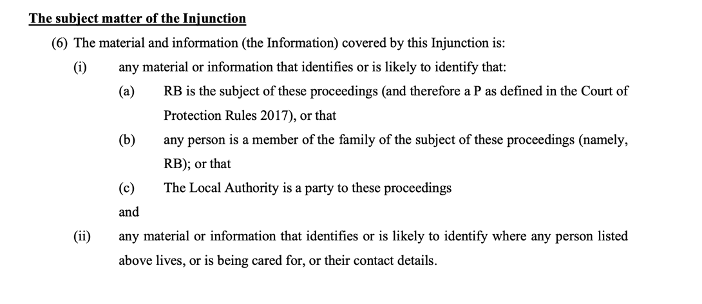
The judge was efficient and crisp in managing the problem.
At the beginning of the hearing, he referred counsel to “the Transparency Order on page 23 of your digital bundle” and pointed out that it named P: “it should clearly be anonymised”.
He continued: “Second, it injuncts those who are the subject of this order from identifying the local authority. This appears to be a boilerplate order that has come in with those two technical but important defects. It appears there has been no scrutiny of Article 8 and Article 10 rights nor is there any suggestion that this is one of those rare circumstances under which the local authority can be anonymised. Unless anyone seeks to persuade me otherwise, I require a new Transparency Order that doesn’t name P, and doesn’t injunct anyone from naming the local authority”.
The applicant lawyer said he didn’t believe he needed instruction from his client but would go ahead and make the required changes – which he did. (I was sent the amended and sealed Transparency Order – after chasing it – on 7th June 2024).
The judge took the opportunity to reinforce the point that Transparency Orders should be properly considered by those who represent the parties. “I understand how precedents are just used and reused, but it’s an important matter and it needs to be right for each individual case and not just boiler-plated out”.
He also referred (as he had two days earlier) to my concern about the Transparency Order as having provided a “learning experience” – and said, helpfully, that it’s “not a blame exercise – I’m just trying to get it right first time around”.
The substantive matter of the hearing was dealt with very quickly. It concerned whether or not P has capacity to make her own decisions about where she lives. It seems that where she lives now is so unsuitable, and causes her so much distress, that there’s reason to doubt that she has that capacity – but in a better environment it’s possible that she would regain it. Her current placement has served notice of termination on her, so it’s urgent to find somewhere else for her to live. At the next hearing (probably 17th or 18th June 2024) the issue of capacity will be considered again: “I’m not passing over the capacity issue, but a roof over this lady’s head is absolutely paramount.”
I’m very pleased with the way this judge deals with what are pretty clearly simply technical errors in Transparency Orders. These errors are, unfortunately, pervasive.
DJ Eaton-Hart’s practice compares very favourably with that of judges who ask for submissions, wait for counsel to take instruction, delay consideration until future hearings, or even require us to submit a formal application to vary the Order via a COP 9, resulting on a couple of occasions in pointless, expensive and time-consuming hearings devoted solely to fixing a technical error.
Transparency Order No 3 from DJ Smith: Received 20th May 2024
At both hearings I’ve watched before DJ Eaton-Hart, the Transparency Orders that needed fixing were made by DJ Smith. So, when I saw a hearing listed before DJ Smith, I immediately asked for the link.
As it happened, the hearing was vacated, but not before I’d been sent the Transparency Order – and, yes, it was made by DJ Smith, and yes, like the other two Transparency Orders I’ve seen from DJ Smith, it prohibits identification of a public body. Actually, two public bodies: the local authority (§6(i)(c)) and the Official Solicitor (§6(i)(d)). Here’s the relevant part of the approved and sealed Transparency Order as I was initially sent it for this case (COP 14100128).
I was alarmed by the recurrent pattern of technical errors in Transparency Orders from this judge, and especially concerned that, on this occasion, the Transparency Order also prohibits us from naming the Official Solicitor. Increasingly we are seeing recently-made Orders prohibiting us from naming not just local authorities, Trusts and ICBs but also the Public Guardian and/or the Official Solicitor (see, for example, my blog post: “Challenging a Transparency Order prohibiting identification of the Public Guardian as a party”). So, I wrote to both Mrs Justice Theis (Vice President of the Court of Protection) and Senior Judge Hilder – and also raised my concern at a COP User Group Meeting. (I think it is those actions on my part which led to a memo being sent out to the judiciary informing them that they shouldn’t be routinely anonymising public bodies.). And at the COP User Group Meeting, HHJ Hilder advised me to complete COP 9 applications to get these erroneous Transparency Orders amended.
So, that’s what I did next.
Here’s the relevant part of my COP 9 formal application to vary this Transparency Order.
I also wrote to the Official Solicitor:
The response from the Official Solicitor was interesting: “Please be advised we were not aware of the order referred to and we have checked our records and as far as we can see the Official Solicitor has had no involvement in these proceedings and we are therefore not in a position to assist”.
I remain baffled as to why DJ Smith made an Order that the Official Solicitor could not be identified as having taken part in the proceedings – which it seems she didn’t – or even as having been referred to in the proceedings.
Within six hours of submitting my COP 9, I received an amended (sealed) Transparency Order approved by DJ Smith as below. The local authority and the Official Solicitor have been removed. I can now name them. (The local authority was Plymouth City Council). But there was no explanation as to why they were ever included in “the subject matter of the Injunction” in the first place.
Here’s the amended Order – in the form it should have been in first time around.
Transparency Order No 4 from DJ Smith: Received 22nd May 2024
On 20th May 2024 I spotted two hearings, both listed for 10am, before DJ Smith sitting in Plymouth, and asked to observe both.
I received an email saying that one had been vacated, but attaching a Transparency Order for the other (COP 14186566). As it turned out, that one was also vacated, but I was delighted to note that the Transparency Order was (almost) correct. The judge had (almost) got it right first time around!
The remaining error (not visible above) was in the file name – which looked to be P’s surname. This is a frequent error and breach of P’s privacy in many of the Transparency Orders we are sent.
I also noted that the Transparency Order was freshly minted: it had been made just two days earlier, on 20thMay 2024.
Final reflections
So, the effect of all this intervention on my part seems to have been that DJ Smith will not in future be making Transparency Orders that routinely anonymise public bodies, and will (I presume) be amending those she has already made. I eagerly await the next opportunity to check one of DJ Smith’s Transparency Orders and hopefully to observe a hearing before her.
Transparency Orders are not new. They were introduced with the Transparency Pilot in 2016 and the “standard” template has remained virtually unchanged ever since. The 2017 version is publicly available as a downloadable pdf.
The part of the Order I’ve focussed on in this blog post is the paragraph called “The subject matter of the Injunction” and here’s how it looks in the template.
The problem seems to be that it permits (at 6(i) (c)) an anonymised reference to “any other party” – and this is being interpreted by some lawyers and judges as permitting the court routinely to prohibit identification of parties such as local authorities or even the Office of the Public Guardian or (oddly) the Official Solicitor.
This does not seem ever to have been intended. In February 2016, the Court of Protection Handbook published a guide to the “Transparency Order in Plain English” which stated explicitly that “Normally you will be allowed to name the local authority, CCG or NHS Trust who is involved in the case”. The exception to this normal practice is (rarely) when naming the public body risks identifying the protected party.
I’m not sure how it’s come about that some judges seem routinely to be anonymising public bodies. What is clear is that nobody has been challenging the practice.
Until very recently, it was common for observers not to be sent Transparency Orders and around half of our blog were posted without sight of them.
Since the beginning of 2024, that’s changed dramatically – possibly as a consequence of evidence I submitted to the court, to the working group of the COP Rules Committee focusing on Transparency Orders, and to the Ministry of Justice (see: “Anxious scrutiny or boilerplate? Evidence on Transparency Orders”). We do now almost always receive Transparency Orders – and so of course that mean we can see the errors in them. And observers are increasingly challenging those errors, and taking up court time in doing so.
The problem for us, and for the court, is that all these challenges are very labour-intensive and costly to the public purse. I accept that the court is committed to the principle of open justice, and that these are administrative and technical errors rather than deliberate attempts to prevent us from reporting on matters of public concern. Not all members of the public agree with me on that – for some observers, these errors are clearly creating a negative impression of the court’s commitment to transparency. But whether they are cock-up or conspiracy, they have the same effect of breaching our Article 10 rights for no good reason.
There must be a better way of providing lawyers (who draft the Transparency Orders) and judges (who approve them) with the “learning experience” they need so that Transparency Orders are right first time around.
Postscript, 11th June 2024
A few days after publishing this post I spotted another hearing before DJ Smith in Plymouth, listed for at 10am on 11th June 2024 (COP 1412356501). Unfortunately it was listed as “PRIVATE”. I checked with court staff that it really was private and was told it was.
Celia Kitzinger is co-director of the Open Justice Court of Protection Project. She has observed more than 500 hearings since May 2020 and written more than 100 blog posts.She is on LinkedIn (here), and tweets @KitzingerCelia
[1] Dates of TOs by DJ Smith: COP 14203764 made on 31st January 2024; COP 1424179T made on 24th April 2024; COP 14100128 made on 20th June 2023; COP 14186566 made on 20th May 2024.
It was one of those days where I had not really intended to do any Court watching. I was back in Weymouth to help the family to support my elderly father after the recent loss of both his wife (my mother) and then his elder sister and casually glancing through the Courtel/CourtServe listings for my local Court.
Weymouth is a combined court centre, with both magistrates and family and county courts located in the same building situated by the inner harbour in Weymouth. This is a short bus ride and then a 5-minute walk away from my parent’s house in Weymouth. My father used to appear regularly in these courts when he was a probation officer in Dorset, but that was some 50 years ago!
I’d never seen a Court of Protection hearing listed for Weymouth (you sometimes see them listed at Poole), but on Thursday 25 April 2024, buried amongst the Possession hearings to be heard that day in Courtroom 3 by District Judge Lacey was a Court of Protection (COP) hearing:
Start Time
Duration
Case Detail
Hearing Type
Hearing Channel
3:00 PM
1 hour
13784330 Restricted
COP (Court of Protection) Hearing
Video – Teams
Party Name
Parties Suppressed
I was intrigued to know what sort of COP hearing was happening in my local Court.
Access
Transparency was impeded by the failure to include the Weymouth COP hearing in the COP section on CourtServe. I double-checked, just in case I’d missed it, but no – it was only in the Daily County/Family Court list – and so, unsurprisingly, it had not been picked up by the Open Justice Court of Protection Project team. If I’d not been looking specifically at the Weymouth list, it would have been private by default. I notice also that the list does not say that it’s a public hearing (it uses the word “Restricted”) and it does not provide any descriptors indicating what issues are before the court. It also doesn’t provide the correct email address for would-be observers.
Knowing that COP is organised into regional “hubs” in England and Wales, I was aware that requests to observe in Weymouth Court, which falls within the South-West region, must be sent to Bristol. So, I submitted my usually-worded request to observe the hearing (and ask for the Transparency Order) by email to the COP regional hub in Bristol. My email was sent at 10:05 for a hearing scheduled for 15:00 the same day and I immediately followed it up with a phone call to the Hub to alert staff to the email.
At 11:26 I received from the South-West Regional Hub a Teams link to the hearing together with a copy of the Transparency Order made by DJ Lacey on 28 June 2023 and issued on 17 July 2023.
Transparency Order
As a law student I’ve received training on how to read legal documents and how to check them. So here are my thoughts on the Transparency Order I had been given:
The intention of the Transparency Order is to protect the identity of the person who is the subject of the Court of Protection proceedings, so anything that might identify them should not be in or attached to a Transparency Order. The name of the person is usually replaced by initials, which may, or may not, be their own initials or some other initials chosen to represent them. In this case the initials JJ have been used in place of their name. However, the Transparency Order has a filename, and the filename used for this Transparency Order has, as part of that filename, the surname of a person beginning with J – so, it is most likely that the filename of the Transparency Order has revealed to me (and anyone else who is sent the Transparency Order) the name of the protected person. I’m told this is not unusual.
At clause 6(i)(c) of the Order the name of the local authority who are the respondent in the case is also protected. It is prohibited to publish information that identifies or is likely to identify that XYZ Council is a party to the proceedings. The wording in this sub-clause uses the initials of the Council – ie XYZ Council is a party to these proceedings and it is fairly obvious that the identity of the Council can readily be identified by these initials. Moreover, on the face of the Order the name of the local authority is spelled out in full. The Transparency Order is a public document that ought to be available to every member of the public – but I cannot show you a copy as to do so would be a breach of the terms of the Order itself, owing to the way in which it has been drafted.
At clause 9(i)(e) of the Order, permission is given for “disclosing information for the purposes of caring for DOB” but it is not clear what connection DOB has with the case; most probably this is an error and “DOB” ought to read “JJ”.
So much for the drafting of the Transparency Order but what about the prohibition on naming the local authority involved in this case? Why is it that it is thought necessary to withhold from public view the name of the local authority?
There are, occasionally, good reasons for withholding the names of public bodies, but this is rarely the case. I can see no good reason why publishing the name of the local authority is likely to lead to the identification of the person who is the subject of these Court of Protection proceedings. And any local authority ought to be accountable for their actions – they are a public body after all. Of course, in the Family Courts it is usual that local authorities are not named, but the Court of Protection is a separate jurisdiction with its own rules and procedures and case law. Is it too much to expect the legal professionals working in the Court of Protection to know those rules and the norms of the Court of Protection and to ensure that the correct templates are offered to the Court for consideration?
My immediate response, on reading the Transparency Order, was to submit a written request to the Court to vary the Transparency Order and to omit the local authority from the list of those parties protected by the Transparency Order. At the same time, I suggested that the Court might consider amending the duration of the Order, so that the Order was only in place during the lifetime of the person protected by the Order.
My email to the Court requesting that the Court consider my request to vary the Transparency Order was sent at 11:44.
At 12:55 the Regional Hub sent me an email saying that the hearing at 3pm had been vacated (i.e. was not going to go ahead), but by this time I was on a bus on my way to the Court.
Why? You might ask. was I on a bus to the Court when the hearing I was interested in was one held on Teams? Well, just below the listing for the Court of Protection hearing on the Daily Cause list for Weymouth County Court was another hearing listed before the same Judge at the same time. This was a committal hearing with a Housing Association applying to commit a tenant to jail (or a fine) for contempt of Court. I will not give the name of the Housing Association or the name of the tenant for reasons which will become clear later on.
Listing problems are not unique to the Court of Protection
But apart from this case which I was interested to observe in person, there was yet another reason that I was on the bus. This was to do with the listing of cases in the Magistrates Court, which is in the same building – Weymouth is a combined court centre. The Magistrates were sitting in Court 1 and on Courtserve was a list of cases before the magistrates. However, again from previous experience, I noticed that it was only a very short list and all of the cases on the list were Libra cases.
Now the Courts are going through a transition to new technology for listing cases (at least in the Magistrates Courts). The old system Libra is being phased out and new cases are listed on something known as Common Platform or CP. Cases listed on Common Platform have a particular format for the case reference – which is usually 99AA9999999 whereas Libra case references are in the format which is wholly numeric.
Weymouth had loaded one file on to Courtserve which was clearly the Libra list. There was no sign of any Common Platform cases, which made me suspicious. You see, Libra listings are loaded automatically on to Courtserve – the Libra system sends them to Courtel who process them on to their system. But Common Platform lists have to be emailed by each individual court across to Courtel before they are loaded on to Courtserve. So my suspicion was that there WAS another list of cases – but this had not been emailed by staff at Weymouth Magistrates Court. The only way to find out, as the telephone lines at Weymouth Magistrates Court were not being answered, was to hack up, get through security and have a look at the physical notice board outside each Court. That is modern technology for you!
Arriving at Weymouth Combined Court Centre
Hence my arrival at Weymouth Combined Court centre at 13:55 (according to my trusty notebook). There was a new security officer on duty at the entrance, with the two security officers that I recognised and who recognise me and say, “Hello Mr Bell”, sitting and/or standing in the background. The new man was being very, very, very thorough!
I take with me a back pack with various things in it to sustain me throughout the many minutes (sometime hours) of waiting in Courts. And also some items for taking photographs of my journeys to and from Court (taking photographs without permission inside a Court or near the entrance to a Court can land you in a lot of trouble). I had to empty almost everything out of the back pack for examination. Battery packs, selfie stick, lots and lots and computer and phone leads, chargers, laptop, multiple notebooks, ID, you name it, if I might need it, it is usually with me …
The usual arms wide legs apart stance, show the wristwatch, turn around, show the belt buckle, hold still until wand has finished bleeping (never understand how they work out whether the bleeps are real or false?) AND relax. Then pack everything back in to back pack, take out trusty notebook and pen, and do the rounds of the three noticeboards.
Sure enough, on the noticeboard outside Court 1 – the active Magistrates Court – are TWO lists. The Libra list published on Courtserve and a much longer, two page list of Common Platform cases.
I have the Libra list on my laptop and on my mobile phone, but obviously do not have the much longer CP list.
I walk around the other noticeboards – nothing posted outside Court 2, and quite a long list posted outside Court 3 – but this is another list that I have downloaded from Courtserve. There, at the bottom of the Court 3 list, are the two hearings at 3pm that I am interested in.
I return back to security and ask how I can get a copy of the 2nd list for the Magistrates Court, and am directed through a door to the office.
This area is empty with a partition (wiggly, not straight!) along its length dividing the area in to two. At the end of the public side, there is a telephone handset with a notice saying, if you want to contact the County Court, lift the handset.
In the middle of the partition is a glass window through which you can see an empty office with desks for around 8 people. By the window is a buzzer, which I press.
Shortly thereafter two women enter from the far end and go to a computer screen where they sit and stand together discussing some procedure on the computer. After some minutes one of the women comes over to the window to ask what I want. I reply that there are two lists posted for the Magistrates Court but only the Libra list is available on Courtserve, could I have a copy of the other Common Platform list?
The response is – we have sent that to Courtserve – it should be there. I get out my mobile phone and navigate to the Weymouth Magistrates Court entry on Courtserve and show them that it is only the Libra list that is there. I advise them that Courtel have told me that Libra lists are sent automatically but CP lists have to be sent manually. I am told that they have been told that the CP lists are sent automatically, but there is obviously some confusion.
Could I have a copy of the CP list, please? Could it be emailed or could I have a printed copy? A printed copy of the double sided A4 page with the list of CP cases is provided to me.
At 14:09 I step in to the public gallery entrance to Court 1 where a case is in progress. In the public area on the back row there is a young woman in a black suit with a laptop typing away furiously (but silently).
In the Court are two female Magistrates on the bench, with a large male legal advisor (much taller and heavier than me!) sat in front of them looking at me. To the left in a box of his own sits someone I recognise as the Probation Officer, also with his laptop open in front of him.
At the front of the Court on the left is a woman from the Crown Prosecution Service with laptop up on a stand in front of her, and to the right is the solicitor for the Defendant.
On the right of the Court behind a glass screen (in the area known as “the dock”) can be seen the head only of the person who is the defendant.
Just in front of the public area and on the right rear of the Court is a cordoned off area where the Court Usher usually sits, but she is not in Court at the moment.
I take a seat on the public seats at the rear of the Court, open trusty notebook (a real, paper notebook not a digital one) and try to follow what is going on.
The Magistrates Court
I gather that the Defendant is a Miss Davies and the offence appears to be one of some disorder outside a property when drink had been consumed. Police were called. The Defendant’s solicitor offers some mitigation and advises the Court that his client is pregnant and expecting a baby within the next two weeks and asks for the offence to be dealt with by way of a financial penalty.
I am looking on my mobile phone to find the listing to try and locate the name of the Defendant and the case reference when the Legal Advisor barks across the well of the Court at me – is that a mobile phone? I hold it up and say, I am trying to look at the hearing list …
I am told that I must switch off any mobile phone when I come in to Court (see later for my comments on this). I do as I am told – he is much bigger than me! – and switch off my phone.
The Chair of the Magistrates asks Miss Davies to stand and then tells her that she has a conditional discharge for 12 months. There is a quick discussion with the defence solicitor about his client’s financial circumstances and the Magistrates order a surcharge of £26 and £40 costs totalling £66 which they agree can be deducted from benefit.
The Chairs closing remark to the Defendant was to thank her for her attitude in Court and to wish her good luck.
It is now 14:19 and the Court moves on to the case of Mr Jake Batty who is listed for a 10:00 hearing. It appears that Mr Batty is not at Court.
The Probation Officer explains to the Court that Mr Batty is not present because they (probation) had advised him to attend at Bournemouth Crown Court as he was due there today for sentencing in another matter. It seems that he did not, however, attend at Bournemouth and the Crown Court has issued a warrant for his arrest.
In the circumstances, the Probation Officer invites the Court to adjourn the current proceedings to a later date, as it would be inappropriate to ask the Court to issue a warrant, given that it was the Probation service who had advised him not to attend this Court but to go to Bournemouth Crown Court instead.
A date is found by the Legal Advisor and Mr Batty is ordered to attend at Weymouth Magistrates Court on 20 June 2024 @ 10:00 a.m.
At this point I took the opportunity to pop out from Court 1 in order to copy down in my notebook the Libra hearing list of 5 cases that were not on the CP list I had been given.
I was able to flick back through my notes and correct the names and add the case numbers to the two cases I had just observed.
Committal hearing
At 14:50 I moved to sit outside Court 3 waiting for the committal hearing to begin. By this time, I had been made aware by the Judge’s Clerk that the Court of Protection hearing listed for 3pm on Teams had been cancelled. I had enquired how the two cases were to be scheduled. My plan was to find a quiet room and set up my laptop for the Teams hearing using my mobile phone as a WiFi hotspot, and then to switch off the electronics and revert back to the trusty pen and paper notebook for the other hearing (or vice versa – depending on which hearing the Judge decided to deal with first).
The Judge’s Clerk told me that the committal hearing would be in Court 2 (because it was a committal) and I noticed in one of the meetings rooms a barrister in full wig and gown (as I now find is required for a committal hearing) with another woman who was either her instructing solicitor or a representative from the Housing Association that was bringing the proceedings.
At one stage a young woman accompanied by a young man were escorted by the Judge’s Clerk in to the meeting room where the barrister and the other woman were seated.
At 15:05 the Judge’s Clerk came up to me and informed me that I could not be admitted because “the Defendant says that she will not come in to Court if there is someone present”. I was told that she had suffered a recent trauma – and then the nature of that trauma was made plain to me.
I realise that the Court official was trying her best to convince me that I should not observe the hearing – but I do not think that she ought to have breached the Defendant’s right to confidentiality in the way that she had done.
I politely but firmly insisted that the decision as to whether I could observe should be made by the Judge. It was a public hearing and I had a right to be heard if there was consideration being given to holding the hearing in private.
The Judge’s Clerk repeated what she had said, but louder and more forcefully. And went to go back in to the Court room.
I repeated what I had said, and emphasised that this was a decision for the Judge and I asked explicitly to speak with the Judge before he made his decision.
I sat back down to wait with my heart thumping.
At 15:28 the Judge’s Clerk advised me that we would all go together in to the Court room (now Court 2) and the Judge would find out the Defendant’s reasons for not wanting the public present.
At 15:30 the Judge entered the Court room as we all stood, asked us to be seated and started by addressing the Defendant at some length.
The Judge first raised the point that the Defendant was not legally represented. He acknowledged how difficult it can be to obtain representation even though you are entitled to it.
He also said that there was the issue of members of the public being present today.
The Judge advised the Defendant that she was entitled to free criminal legal aid, and had various rights, including the right to answer any questions, the right not to self-incriminate (which he explained), right to remain silent and not to give evidence.
He explained that the possible consequences of the alleged breaches included fines or imprisonment.
This was the second time that this hearing had been listed but the Court was aware of the reason why the Defendant did not attend on the last occasion.
He explained that these were public proceedings and a fundamental part of our justice system was the principle of open justice. Anyone can sit at the back of the Court and listen, as Mr Bell was doing.
The Judge told the Defendant that Mr Bell attends various hearings, not just here but all over the country. There was nothing to suppose he had any particular interest in this case or the Defendant.
In exceptional circumstances and where it might otherwise be adverse to the administration of justice for a hearing to be in public, a hearing could be held in private.
The Judge told the Defendant that he would hear from Miss Patley (I think that was the name) on behalf of the claimants, then from you (the Defendant) and if necessary, from Mr Bell.
The Judge then again told the Defendant that she was entitled to legal representation today and that he was aware that she had contacted more than one firm without success. Technically this is the first time I have seen you to be able to tell you that. And that is my starting point, given this is the first time you have appeared before me.
The Judge then invited Miss Patley to address him.
At 15:38 Miss Patley advised the Judge that these proceedings were public and subject to Part 81. However, CPR rule 32.3(3)(g) allowed the proceedings to be in private in part or in whole. The Judge would be assisted by the White Book and the rules allowed him “for any other reason” to order that the hearing is not in public.
It was open to this Court based on the vulnerability of any party to so order.
So that was the route for the Court to that result.
Counsel told the Judge that the Defendant had been able to make various disclosures to her, but did not elaborate on what those were.
With respect to the substantive application, the Defendant had contacted numerous firms. It was not unusual for parties to go unrepresented in these sorts of proceedings. The purpose of today’s hearing is to establish to what extent the Defendant accepts the 8 breaches of the Order which are alleged.
The Defendant is accompanied today by a companion who is sitting at the back of the Court.
The Court can proceed to sentence her but sentencing would require the Court to hear her vulnerabilities.
Counsel for the Claimant then made reference to case law – but I did not catch the reference.
Counsel said that the Claimant would accept that this is a case were an adjournment is the right thing to do. The Defendant has demonstrated that she can comply with the order.
In order to get there the Defendant would have to admit the allegations. If the Defendant does not accept the allegations, then it would be necessary to list for a trial, with the result that the proceedings would be hanging over everybody’s head. However there remains the Defendant’s fundamental right to challenge the allegations.
The Judge then addressed the Defendant again.
Miss X (the Judge used the Defendant name but I am not going to publish it) – to make that order I would have to hear those vulnerabilities. The question I need to ask you initially is, would you like a chance to find representation? In terms of a further opportunity to get legal representation would you like a further chance. You should not feel in any way coerced or bullied in to going ahead.
The Defendant referred to her mental health and that she wanted to understand the proceedings better.
The Judge then addressed me. Mr Bell I WILL come to you and you will have an opportunity to speak if it is necessary to do so.
Counsel for the Claimant, Miss Patley, then gave the Court her client’s view on the question of adjournment. She stated that, ordinarily, they would strongly oppose any adjournment as these were serious matters that needed to be addressed. The Claimant would accept that on the last occasion the Defendant’s non-attendance was for a good reason that the Court is aware of.
They did not want to be in a position where a party was put to detriment. Both parties should be on an equal footing. Ordinarily, in this case, it would be fair to give the Defendant the opportunity to find representation. The Court accepts that the Defendant has shown compliance with the injunction. That would work to her advantage. However, they would expect to see compliance with the injunction.
The Judge addressed the Defendant and advised her that it is unusual that consent is given by a Claimant for an adjournment. However I am conscious that this is the 2nd hearing and you were not present at that hearing. On balance it simply would not be fair. You are aware that this injunction is in place. It falls upon me to remind you that that order is in place. I have to warn you. It is in force. Please make sure that you do not breach it. You could try more national firms. Before you go make sure you get a copy of the order that was made last time. Please do try Yeovil.
The Judge then discussed with Counsel the length of time for the adjournment – it was suggested 21 or 28 days.
The Defendant advised that she was doing a mental health course and asked if Tuesday mornings could be avoided. The Judge agreed and said he was not available on Tuesdays anyway. He advised the Defendant, when they did find legal advice, that she tell them of her vulnerability and also about her concern about having a member of public present.
The Defendant asked if a doctor’s note would help and the Judge said, yes, any documentation would be helpful.
The Judge then adjourned the hearing to the first available date after 28 days, He told the Defendant that it would probably be the same Judge on the next occasion.
He then told the parties that they could leave but asked me to remain behind. He assured the Defendant that he would not be talking about her case with me but wanted to talk to me about another matter.
The Defendant thanked the Judge for the way he had helped her and in return the Judge thanked the Defendant for the way she had conducted herself in Court.
As the Defendant’s companion was leaving I handed him one of my business cards with my phone number and whispered that I might be able to help the Defendant to find legal representation if she wanted to give me a call.
All the other people in the Court then left leaving just the Judge and myself.
Judicial comments on the Transparency Order
The Judge explained that he just wanted to say a few words about my request to vary the Transparency Order in the Court of Protection case. He assured me that it was being dealt with but that he had thought it only fair that he should send a copy to the local authority for their comments.
I thanked him and agreed this was quite appropriate. The Judge then asked me a little bit more about myself, my law studies and what I wanted to do once I had my law degree. The Judge said that he was aware of my engagement with the Court from conversations with his colleagues. We chatter very pleasantly for a few more minutes before I stood, thanked him and left the Court.
Afterwards, outside the Court, the Defendant and her companion and the Judge’s Clerk were waiting. The Defendant approached me and we shook hands. She seemed relaxed and was smiling. I assured her that I would not be revealing her identity in my blog posts and she was very grateful for that. I think she said something along the lines of “too many people know too much about me already – and it affects my mental health”.
I asked her to give me a call if she was still having difficulty finding representation and I would see if any of my contacts could help.
And so ended an interesting day at Weymouth Combined Court!
Mobile phones and laptops in court
As a follow-up to the “put that mobile phone away” matter, I have located that letter to the Observers Network by the Lady Chief Justice of England and Wales and sent a copy to the Weymouth Court asking them to bring it to the attention of HMCTS staff there. Let us see what happens next time I am in the Weymouth Magistrates Court and want to use my laptop to look something up!
Peter C. Bell is a law student at the Open University. He tweets @dolphinpcb
The purpose of a “directions” hearing is for the judge to narrow down the issues that are to be decided, and to give instructions (“directions”) on how the case will proceed. The point is to sort out procedural and practical matters. Directions hearings often cover actions that need to be taken (e.g., capacity assessments, disclosure of medical records, obtaining witness evidence and determining the availability of witnesses to come to court) and the dates by which those actions need to be done, so that everything is ready for a full hearing where a final decision can be made. They’re a kind of ‘advance planning’.
Directions hearings are very important in ensuring that the case proceeds smoothly and in a timely fashion. If the parties don’t ask for something that they later think is needed, or if the judge does not direct something that one of the parties says is necessary, that matter is sometimes raised again at the next hearing and this can lead to concerns about whether substantive decisions should be put ‘on hold’ and await whatever it is that hasn’t been done – or whether, even in the absence of that information, the judge can go ahead and make an important decision.
For example, I’ve seen lots of directions hearings where judges have declined a request to authorise an independent expert report – only to find at the next hearing that the s.49 report (from the NHS or social care staff caring for the protected party) has either not been submitted to the court, or that it displays insufficient expertise to form the basis for the decision that needs to be made.
One important cause of delay in the Court of Protection is (in my view) inadequate directions hearings. But I can entirely see the difficulty for parties and for the judge in determining exactly what is needed in advance, without squandering public funds by putting everything conceivable in place from the outset. It’s obvious too that new issues arise in the course of following the directions from a first hearing – a report turns up a previously unanticipated disagreement about capacity, or a family member raises something that hadn’t been considered, or a placement that had been thought suitable turns out not to be, or becomes no longer available. When this happens, then there’s another directions hearing, and (often) several more – sometimes called “case management hearings” – as everyone tries to get together the information and real-world options the judge needs to know to make substantive decisions. See for example “Covid vaccination and T-cell immunity: A renewed application for expert evidence”, where not appointing an expert at the earlier directions hearing seems to have caused – by my reckoning – a 9-month delay in resolving the case.
This very short (20 minute) directions hearing (COP 14257278) was a hybrid hearing before Deputy High Court judge, Ms Victoria Butler-Cole KC, sitting in the Royal Courts of Justice in Court 42 on 24th May 2024.
My aim in this blog post is to set out some of the information I gleaned from that hearing (and some of the gaps in that information) to assist people who might want to observe the final hearing which is listed for 10.30am on 30th May 2024.
Transparency Matters
Joining
I observed the hearing remotely via what looked like a new (modified) version of cloud video platform (CVP). I had no problems with it but one of the two observers planning to observe the hearing with me was unable to get sound and video working (so missed the hearing altogether, despite her name appearing in the sidebar as an observer). This is quite a common difficulty people experience with this platform. If you are planning to watch an upcoming CVP hearing you might find it helpful to read this information: “How to join Cloud Video Platform (CVP) for a video hearing”. That said, it wasn’t obvious to me from the link I was sent that this was cloud video platform: nothing in the email said so, and the link I was sent was hmcts2300@meet.video.justice.gov.uk. But a google search on “meet.video.justice.gov.uk” throws up information about cloud video platform, so I figure they are probably the same thing, or versions of the same thing. If someone with my experience of observing remote hearings (I’ve watched more than 500) is hazy on this point, it can be assumed that most other members of the public will struggle with this too.
Audio and video
I experienced issues with both audio and video in the course of this hearing.
On audio: the very helpful court usher (Audrey) did a brief sound-check before the judge came in: “Can everyone hear me?”. I confirmed that I could and nobody else on the platform said anything (I didn’t know at that point that one of the observers couldn’t hear anything from the court and obviously – as she couldn’t hear it – she couldn’t respond herself to the usher’s question). I did take the opportunity to point out that it wasn’t possible to know from the fact that the usher was coming through loud and clear on whichever mike she was using (probably the judge’s) whether or not we would be able to hear the lawyers. Sometimes the lawyers’ mikes aren’t switched on, or their mikes are too distant to pick up their voices. This later turned out to be a problem in relation to Katie Gollop, the lawyer representing P via the Official Solicitor. We missed several minutes at the beginning of her submission – though Audrey helpfully sorted it out (turning the mike on, then moving it closer) in response to my comments in the ‘chat box’.
On video: There was no camera on the judge. There’s something quite unsettling for those of us concerned with open justice for the judge to be nothing more than a disembodied voice in a video-hearing. Just on principle, judges shouldn’t be invisible! Also, I know from lawyers that they observe the judge closely during hearings to pick up cues about how the judge is responding to their submissions and where they can leave a point and move on, or where they might need to expand. I want to be able to see what that too. I’ve only observed one other hearing before Depty High Court Judge Butler-Cole KC in the RCJ but at that one, too, there was no camera on the judge – and these two have been the only (video-based) hearings with an invisible judge. Is this something to do with facilities in Courtroom 42 perhaps?
Who is in court?
As usual, the applicant lawyer provided an introduction – primarily for the judge but obviously really useful for observers – as to who was in court. He said he was representing the applicant Trust (along with his instructing solicitor); Ms Gollop was for the Official Solicitor, along with her instructing solicitor and – he was speaking quickly – some other people including, I think, a social worker. Also, as usual, the applicant lawyer did not introduce himself. I think there must be some court etiquette that means applicant lawyers never say “I am Mr/Ms Bloggs….” – the judge must be presumed already to know. But observers don’t know, and so we have to work out who they are from what happens later. Sometimes the judge helpfully responds “Thank you Mr/Ms Bloggs” (more of this please!) but often we have to wait until another lawyer says something along the lines of “as Mr/Ms Boggs said….” or for the judge to cue in Mr/Ms Bloggs to speak later in the proceedings.
I often recognise the lawyers – if not by sight (which can be hard when they’re be-wigged, though they weren’t in this case) by sound – but in this case I had no idea who the applicant lawyer was. I eventually figured it out when the lawyer for the Official Solicitor said, about half way through the hearing “Mr Rylatt and I have had some discussion…” – and bingo! I recognised him as Jake Rylatt, a lawyer I’ve watched before (albeit infrequently) in several hearings. I doubt those observers who hadn’t already come across Jake Rylatt would have picked this up.
Fortunately, “Gollop” and “Rylatt” are uncommon names and typing them into google along with “lawyer” quickly yields information about who these two lawyers are, even if you don’t know their first names, (see Katie Gollop KC and Jake Rylatt). I am often left floundering when trying to identify lawyers with names like “Smith” or “Watson”. Again, it’s clearly some antiquarian bit of court etiquette that unhelpfully dictates that first names aren’t used. A recent exception was when there were two “Mr O’Brien”s in court and the judge resorted to referring to them as “Mr Joseph O’Brien” and “Mr Michael O’Brien” (though actually you can only find the latter if you know he’s on his barristers chambers webpage as “Mike O’Brien”). Exceptionally, I also observed a hearing with two barristers both called “Francesca Gardener” see: Francesca Gardener and Francesca Gardener!
My point is that observers should be able to know the name of the applicant lawyer from the start of the hearing (because everyone else in court does!) so if they can’t bring themselves to breach court etiquette by saying their own name in court, please could the judge thank them by name immediately after their opening introductions so that we know who they are.
Transparency Order
The judge checked at the very beginning of the hearing that we knew the provisions of the Transparency Order, which she said had been previously made by another judge, Mrs Justice Theis (the Vice President of the Court of Protection).
We were told that we cannot publish anything likely to identify the protected party and her family members, or where they live or are cared for. We are also prohibited from publishing any material identifying the hospital, or the staff involved with her care and treatment.
There was one further prohibition which, if I heard it correctly, seemed unusual but which “is now moot”. I’m not quite sure what this was and don’t want to report it incorrectly (if I’m even allowed to report it, which it seemed to me I might not be). This prohibition does not (I believe) affect my freedom to report anything heard subsequently.
The reason why I’m somewhat unclear about what the Transparency Order actually says is because I’m relying on an oral version of it and I have not yet received any written version of the Transparency Order relating to this hearing. I assume this will be sent out to observers eventually – and I hope more promptly for the final hearing.
Opening summary
Applicant counsel (the lawyer who I later learnt was Jake Rylatt) provided – with the judge’s approval – a useful opening summary. I’ve reproduced it below.
What is the case about?
We learnt from the opening summary that the protected party (HW) is in her mid-thirties and she’s 37-weeks pregnant. She’s detained under the Mental Health Act and it had been agreed that she lacks capacity to conduct these legal proceedings (hence the appointment of the Official Solicitor on her behalf), and also lacks to make decisions about care and treatment related to her pregnancy and delivery of her baby. The Trust had made an application that it was lawful and in her best interests to carry out a Caesarean section – provisionally planned for 3rd June 2024. They’d hoped for final orders this morning, but there had been a change in HW’s presentation when she was assessed two days earlier and that had led the Official Solicitor to ask for a little more time to see whether it was possible that HW might regain capacity to make her own decision about a Caesarean in June. (Hoping to learn more about the background to this case, I asked for Position Statements but were told none had been prepared for this hearing.)
The applicant Trust
Counsel for the applicant Trust, Jake Rylatt explained that HW’s medication (olanzapine for her psychotic condition) has been “titrated upwards” (increased) with the result, it seems, that she is now acknowledging the views of other people that she is pregnant. From this observation, I gathered that she previously has not. He added that there is a clinical view that she may being doing this as a means of securing her discharge.
More recently still, she has accepted she’s pregnant to the extent that she’s saying, “if nine people are saying I’m pregnantand only one (myself) holds out, then I must be pregnant”. She’s also reported as having said that if she is indeed pregnant then she’s content to go ahead with a c-section and is in the hands of the clinicians in terms of what they think best for anaesthesia.
The implication, it seemed to me, from what counsel for the applicant Trust said, was that despite some improvement in her ability to understand information relevant to the decision that needs to be made (specifically, that she’s pregnant), HW lacks capacity to make that decision for herself and is unlikely to regain it by the time of the planned surgery. He invited the judge to convene a final half-day hearing for 2pm on 30th May 2024, saying that if all parties agreed by that point, then the hearing could be vacated.
The judge indicated a somewhat different approach: “Capacity is very definitely in question. The fundamental basis of the original application was that [HW] didn’t believe she was pregnant and that doesn’t now appear to be the case. One possibility is that the treatment has caused the change; another possibility is that it’s just taking her a bit of time to recognise the fact she’s pregnant and come to terms with it”.
The judge asked Jake Rylatt which witnesses he proposed to call. It was agreed that the anaesthetist would not be needed, but the obstetrician would. The consultant psychiatrist treating HW was, said counsel “away today, but it is hoped he’d be available to step into the fray in future if necessary”. It didn’t seem particularly helpful to characterise the court hearing as a “fray” (“an energetic and often not well-organised effort, activity, fight, or disagreement”, Cambridge English Dictionary). I noticed that the judge conspicuously avoided that that term in her response: “It’s not going to be helpful to have someone else step in if they’re not familiar with HW and her situation”. The judge asked for steps to be taken to find out when HW’s own psychiatrist would be available to give evidence to the court.
The Official Solicitor
I couldn’t hear the first few minutes of what Katie Gollop was saying. First her mike wasn’t switched on and she was completely inaudible. Then the usher responded immediately to my raising the matter in the chat by turning on the mike, but it was too far away to pick up more than the odd phrase. For some time, I could see Katie Gollop, but not hear her, and I could hear the judge, but not see her! The usher then did move the mike closer and the sound quality was then fine.
I heard the judge say that there was a midwife spending time with HW, that there had been mention of foetal movements (perhaps in relation to HW coming to believe that she is in fact pregnant?), and then a discussion about HW’s family, who I think haven’t been involved in this situation at all up to now. The Official Solicitor made clear that she was not pursuing family members (I think she mentioned a restraining order?) but that the local authority might be so doing.
The judge directed the Official Solicitor to get HW’s medical records for the past couple of weeks. I reflected at this point that I didn’t know (and still don’t know) why the Trust has taken the position that a Caesarean is in HW’s best interests. I don’t know, for example, if this is for a physical reason that makes vaginal delivery potentially risky (e.g. a breech presentation) or whether it’s solely related to HW’s mental health issues (I can imagine that going into labour would be very frightening if you didn’t believe you were pregnant). Katie Gollop did refer to “potential risks to the baby [sic]” but without spelling out what those were.
Together, counsel and the judge worked out the schedule up to the next hearing: another visit to assess HW’s capacity on Tuesday afternoon next week (the hearing is listed for the Thursday), followed by an advocates’ meeting early Wednesday afternoon and the Position Statements to be submitted to the court late on Wednesday.
The judge asked whether HW wanted to talk directly to the judge herself – concerned that she should have this opportunity and it should be included in the schedule. Nobody seemed to know the answer.
Listing the final hearing
The judge pointed out that “the legal framework isn’t going to be contentious”, and then listed the hearing for the whole day on Thursday 30th May 2024 (rather than the half-day requested by the Trust) “to give time for a remote visit [i.e. a conversation with HW] and for the judgment, which you’re going to need as soon as possible”.
I have requested a copy of the approved Order (to which members of the public are entitled under COP rule 5.9) which will doubtless enable me to correct this blog post and to fill in some gaps. When I receive it (I hope before the hearing on Thursday 30th May 2024), I’ll update this blog post accordingly.
Celia Kitzinger is co-director of the Open Justice Court of Protection Project. She has observed more than 500 hearings since May 2020 and written more than 100 blog posts.She is on LinkedIn (here), and tweets @KitzingerCelia