Can a Turkish Guardianship Order be recognised in England and Wales? 

By Daniel Clark, 29 September 2024

This case began as an urgent application to the Court of Protection in August 2023. It wasn’t until May 2024 that it came before a judge. 

In August 2023, XY (who resides in Turkey) was visiting the UK with her brother, CD. She has done this many times but, on this occasion, became unwell and was admitted to hospital. 

When in hospital, CD found it very difficult “to be taken seriously as [XY’s] representative” (in the words of his Counsel) by members of hospital staff, despite the fact that he is recognised as XY’s guardian in Turkey. He therefore made an urgent application to the Court of Protection, asking for recognition and enforcement of the Turkish Guardianship Order.

The case never went to court. The Office of the Public Guardian had to confirm that the Turkish Guardianship Order was valid and, after a 7-day admission, XY was discharged and returned to Turkey.

After an almost 9-month delay (it’s not clear to me why there was such a long delay) the application was listed for hearing before the Vice-President of the Court of Protection, Mrs Justice Theis, on 2nd May 2024. 

Despite the delay, CD expressed his wish for the application to proceed so that XY can still visit England with him regularly. At the moment, he does not feel comfortable doing so given the possibility that XY may experience the need for another hospital admission. 

The case (COP 14129463) was then transferred to Senior Judge Hilder, and it was finally listed before her on 17th July 2024. She was sitting remotely, via MS Teams, so that CD could participate in proceedings from Turkey. While XY was with her brother throughout the hearing, she was discharged as a party to proceedings in accordance with guidance in cases of this kind (which I discuss below). 

CD was represented by Victoria Butler-Cole KC of 39 Essex Chambers and  Rhys Hadden of Serjeants’ Inn Chambers,  acting pro-bono, having been instructed via the charity Advocate. Its front page explains that they ‘match members of the public who need free legal help with barristers who are willing to donate their time and expertise in deserving cases for those who are unable to obtain legal aid and cannot afford to pay.’

Cases that concern the recognition of orders made in a foreign jurisdiction are quite unusual, and I’ve only been able to find three blogs[i] on the Open Justice Court of Protection Project website that deals with the issue. All of them concern an application made by the Health Service Executive of Ireland and related to one-off decisions (whereas this was recognition of an Order). 

This case is novel for two reasons. First, the position statement states that ‘there are no reported decisions concerning the recognition and/or enforcement in this jurisdiction of foreign protective measures made in Turkey’. Second, the case is novel in that the XY was not currently in the jurisdiction of the court, and only visits England for limited periods of time. 

This therefore could have been a very difficult hearing to follow. However, my understanding was assisted by a very detailed opening summary, as well as the position statement of CD, which he was happy for the barristers to share with me. 

Transparency matters: “Doing a public service job”

As is usual for this judge, the hearing started with her asking me to confirm that I was in a private place, and that I had received (and understood) the Transparency Order. 

The judge was also alive to the fact that it may be odd for CD to find that a random member of the public was observing the hearing, particularly given that the court in Turkey is not as open as the Court of Protection.  She assured him that members of the public, ‘can watch what the court is up to. Really what they’re interested in is what I’m doing, they’re not here for some surveillance of you…They’re doing a public service job keeping an eye on the court and [the protected party’s] privacy is protected by the Transparency Order’.  

After observing the hearing and reading the position statement, it struck me that the specific details of the case could inadvertently reveal, to those who know them in the UK, the identities of XY and CD as a party to proceedings.

I have therefore taken the unusual step of giving them both random initials in this blog. There are also other identifying features that I have decided not to mention. By this I mean no disrespect; I simply wish to ensure that I make good on the judge’s assurance that the privacy of XY (and indeed that of CD) is protected. 

The situation in Turkey

When I saw the case was listed as concerning ‘Recognition and enforcement of Turkish Guardianship Order’, I was intrigued. In preparation for the hearing, I attempted to find out whatever I could about what a Turkish Guardianship Order actually is. Unfortunately, (an admittedly hurried) Google search was not as forthcoming as I would have liked, and a search of my university library also did not give me much. 

I was however able to find multiple references to guidance by Mr Justice Mostyn, published in Health Service Executive of Ireland v Florence Nightingale Hospitals Ltd. In this case, the judge was considering whether to declare that protective measures made in the High Court of the Republic of Ireland could be recognised in England. 


To assist his thinking, the judge constructed a “checklist” of 22 questions. These, in theory, could be used for all cases where a foreign court has made orders in respect of a person. They are concerned with confirming that the foreign made order will be compliant with law in the United Kingdom. It is in this judgment that Mostyn J confirms that a protected party can be discharged as a party, unless there is an overwhelming reason for them to be added as one.

It turned out that this also guided the discussion in court, though I do not go through it step-by-step in this blog. 

With that in hand, I felt like I was more ready than I initially was. 

During the hearing, it was explained that CD had helped to look after his sister for many years. In 2013 he was advised to apply to be appointed as XY’s legal guardian, pursuant to a Guardship order, and this resulted in CD making an application to the Court of Peace (the name for the civil court in Turkey). This application involved an independent medical assessment of XY, as well as several checks on CD for criminal convictions or a conflict of interest. 

In 2014, the Court of Peace made CD the legal guardian for his sister. It authorises him to make decisions about her ‘health (including medical treatment), her welfare and any financial decisions’. 

As Counsel remarked during the hearing, the powers are “a bit more like an LPA which doesn’t tell you what an attorney can or cannot do”. There are, however, some importance differences. CD is not allowed to move XY into a care home or authorise her receipt of a large sum of money – this would require the authorisation of the court. 

Furthermore, the guardianship is renewed every two years: it is not assumed that a person appointed a guardian in one year will still be suitable to act as such in two years’ time. 

Are the documents valid?

Counsel recognised CD as possessing expert knowledge, and included him in explaining various issues to the judge. This struck me as eminently sensible (after all, it is CD who lives in Turkey). I also thought that this must have been quite empowering for CD. After a bad experience last year, he was now being recognised as somebody who can assist in understanding his sister’s circumstances. 

The judge also took great pains to ensure that CD felt at ease: after all, the Court of Protection is not an adversarial court. For example, she joked that, “I’m afraid your English is much better than my Turkish, so I need some translation of your Turkish court documents”

The first issue that the judge dealt with was whether the Turkish documentation she had in front of her was valid. In particular, she was concerned that the person to whom an oath of translation (certifying the translations were accurate and complete) was not the same person who had translated other documents. 

It was clear that the judge did not want this case to become long and protracted but it was also necessary for her to understand how the documents were translated. As she put it, “it’s really important that if the court is going to recognise a document from a foreign court that I have a proper understanding of what the court says.”

Rather than put proceedings on hold, she decided to ask CD some questions following an affirmation that his evidence would be truthful. He confirmed that the translation was accurate, and he could see no errors in it. The judge was happy with this, and gave a mini-judgment that “notwithstanding that I don’t have an oath of translation, I am satisfied” that the translation is accurate. 

What about best interests?

The judge had seen evidence, and was satisfied, that XY lacks the capacity (under the meaning of English law) to make decisions about her care and treatment, as a result of what the Mental Capacity Act 2005 rather crudely describes as ‘an impairment of, or a disturbance in the functioning of, the mind or brain’. 

However, the judge was concerned that, “there’s nothing here that requires the guardian to make decisions in the best interests of the subject”. 

CD offered that, in actual fact, there is provision in Turkish law that, “I must act in her best interests, and because they are in the law I accept these conditions”.

This did not, however, resolve the problem for the judge, who remarked that “I very much doubt that a harassed doctor in an overcrowded ward would have any awareness of that”. 

The issue, therefore, needed some thinking through. In the view of the judge (and I agree), it is unreasonable to expect those in England and Wales providing care for XY to familiarise themselves with Turkish law. While she did not doubt the veracity of CD’s claim that he must (and in any event would) act in XY’s best interests, she also needed to take as many steps as possible to ensure that there would not be a repeat of the previous year’s experience.

As a result, she wrote into the order that CD can only exercise the Guardianship Order in compliance with the English law principles as set out in the Mental Capacity Act 2005. In order to ensure that this would be understood, the judge explained the principles of the Act, and how best interests decisions are reached. 

Furthermore, if it was the case that the Guardianship Order was revoked in Turkey, the Order recognising its legitimacy in England and Wales would be automatically revoked. In other words, CD could only exercise powers in England and Wales that he could also exercise in Turkey.

At the conclusion of the hearing, the judge declared that the Turkish Guardianship Order could be recognised in England and Wales, and so CD can make decisions on XY’s behalf (if needed) while in the country. She was however clear that “the ultimate decider is the court”, and this does not preclude further hearings if medical teams disagree with the decisions that CD is taking. 

Final thoughts

This hearing has made me wonder whether England can learn a thing or two from Turkey.

I can’t imagine that the Turkish system is under-burdened. Despite this, there is still a 2-year renewal period of a Guardianship Order. There are also much stricter limits on the decisions that a Guardian can make (such as whether a person can move to a care home) in comparison to the decisions an LPA or Deputy can in England and Wales, as well as strict limits on what a guardian can authorise. In particular, I wonder how many abuses of the LPA system could be avoided if it was a requirement that this is reviewed.

I think it’s worth emphasising again that the barristers acting in this case did so pro-bono, which is work undertaken on a voluntarily (and unpaid) basis. Each year the judiciary publishes a pro-bono recognition list, which “recognises barristers and solicitors who gave 25 hours or more pro bono legal assistance over the last year”. Both Victoria Butler-Cole KC and Rhys Hadden feature in this list. 

I was also impressed with the judge, who took every possible step (from explaining my presence in court to the principles of the Mental Capacity Act) to ensure that CD could participate fully in the court process. 

In a recent blog about a case concerning the authorisation of an Irish court order, Celia Kitzinger notes that these type of cases often, “seem, by comparison with the usual standards in the Court of Protection, terribly cursory and not very person-centered”.

This wasn’t the case here. 

XY was present throughout, and the judge recognised this. Towards the end of the hearing, she noticed that XY appeared to have fallen asleep, and she joked that, “I’m sure [XY] isn’t the only person attending my hearings who falls asleep but it’s lovely to see it”. 

There were also numerous references to what XY enjoys to do, and these were also referenced in the position statement. For example, XY enjoys socialising, shopping, and listening to music. Despite the fact that XY was not a party, the judge and barristers ensured that this hearing did not become coldly clinical or simply concerned with a point of law.

All in all, this hearing struck me as an example of some of the best elements of the Court of Protection: rigorous, committed to the law, and never losing sight of the real people at the centre of it.

Daniel Clark is a member of the core team of the Open Justice Court of Protection Project. He is a PhD student in the Department of Politics & International Relations at the University of Sheffield. His research considers Iris Marion Young’s claim that older people are an oppressed social group. It is funded by WRoCAH. He is on LinkedIn, X @DanielClark132   and Bluesky @clarkdaniel.bsky.social.


[i] ‘From Prison in Ireland to Care Home in England’ by Adam Tanner (14th August 2020) – https://openjusticecourtofprotection.org/2020/08/14/from-prison-in-ireland-to-care-home-in-england/

‘Irish cases in the Court of Protection’ by Jack Thorold & Chiara Cordone (11th June 2024) – https://openjusticecourtofprotection.org/2024/06/11/irish-cases-in-the-court-of-protection/

‘Another Irish Schedule 3 case: “An oddity in the Court of Protection”’ by Celia Kitzinger (11th September 2024) – https://openjusticecourtofprotection.org/2024/09/11/another-irish-schedule-3-case-an-oddity-in-the-court-of-protection/

Judgment: An update to “A Catch 22 situation for P or Hobson’s Choice?” (and how access to court documents helps transparency and open justice)

By Amanda Hill, 24th September 2024

I’ve now been sent the (as yet unpublished) judgment in the case of “London Borough of Lambeth v CT & North Central London ICB” (issued 21 August 2024, additions made on 4 September 2024).  This is the case I observed and blogged about last month: “A “Catch 22” situation for P or Hobson’s Choice?  Disagreement among professionals as to whether P has capacity and a finely balanced decision for the judge

The hearing I described in that blog post (COP 14251478, 20th August 2024) was about the finely balanced decision HHJ Beckley had to make as to whether P, to whom I shall now refer using the pseudonym ‘Georgio’, had the capacity to make decisions about his residence and care. Both Georgio’s Litigation Friend, the Official Solicitor, and the Local Authority argued that he did. The NHS Trust disagreed. The hearing ended without a judgment.  The judge said he would let the parties know his decision the next day.

At the end of the blog, I wrote that I’d asked for a copy of the approved order and that I hoped I would receive it as I was really interested in what HHJ Beckley decided. 

I have since received the approved order (sent to me on 10th September) and on top of that, unsolicited, on 4th September I also received a copy of the judgment (not yet published) from HHJ Beckley. I’ve also been sent a copy of the position statement from P’s litigation friend, the Official Solicitor, via her representative (received 6th September, after I requested it from the Official Solicitor). These documents have been enormously valuable as they enable me to make transparent what I’ve learnt from them, which is much more than from simply observing the hearing. The position statement in particular provides more information about Georgio. They show how important it is to have court documents in making sense of what happens in court.

Most importantly, the judgment reveals that HHJ Beckley decided that Georgio did not have the capacity to make decisions about his care and residence. 

The judgment made reference to a possible appeal against that decision and the approved order included a listing for another hearing on 17th September 2024 – but this hearing did not take place, and I’m not sure whether or not an appeal has been made. In this update I will explain what I learned about Georgio from the position statement, in order to provide more context for the reasons the judge gave for his decision. I will then outline other aspects of the judgment that I found interesting, as well as confirming who the parties were and which  counsel represented them, as was clarified by both the judgment and the approved order. I will then outline the process of the judgment being issued, as I think it gives an insight into what can happen ‘behind the scenes’.

More about Georgio 

The judge referred to Georgio by his real name throughout the judgment, saying that “the use of initials can be de-personalising”. I am still bound by the Transparency Order of course, which forbids me from identifying P. But I will take a leaf out of the judge’s book and so I am using a pseudonym here (rather than initials or the generic “P”) to refer to him. The following information was provided in the position statement I received.  

In the original blog, I wrote that Georgio was “a man who looks to be in his late 60s or early 70s.” I read in the position statement that he was in fact much younger – 55 years old. He was born in London and has lived there his whole life. He suffered a head injury when he was 12 and has had epilepsy ever since. Following the death of his mother, he started drinking alcohol and using drugs, lost his business and eventually lost his home as well. The position statement makes no reference to any other family members. He now suffers from ill health, recently acutely. His physical illnesses and health problems include Chronic Obstructive Pulmonary Disease (COPD), Polysubstance and opioid dependency, epilepsy, chronic back pain, arthritis, and osteoporosis. He is partially sighted due to vitamin B12 deficiency, and has a “mixed type” cognitive impairment. The position statement reports that Georgio uses a wheelchair but is unable to use his arms to move, due to pain. He only has the use of one leg and uses that to move himself backwards in the chair. He has said that he would not use a wheelchair if he moved back onto the streets. He also says that he is in constant pain. Psychiatrically, he has suffered from Post-Traumatic Stress Disorder, has suspected antisocial personality disorder or emotionally unstable personality disorder, a history of psychotic depression and Dysexecutive Syndrome and polysubstance use, with alcohol and opiate dependence, for which he has been intermittently prescribed methadone. Learning this about Georgio laid bare in very stark terms the poor state of his health. 

The judge’s principle reasons for deciding that Georgio did not have capacity to make decisions about his residence and care 

The judgment goes into a lot of detail about the judge’s reasoning. But the key points that I took from it related to the relevant information. Everyone has to agree on what the information is that Georgio needs to be able to understand, retain and weigh, and then they have to determine if he does in fact understand, retain and weigh it, in order to determine his capacity.  In this case the judge says that one thing that hadn’t been included in the “information”, which he thinks should have been, is that Georgio has mental impairments that create care needs and affect his decision-making ability.  He then goes on to say that this in particular is something P can’t currently weigh. Paragraph 24 of the judgment spells this out:

“Ms Bicarregui (Counsel for the OS, representing Georgio) submitted that a pretty good list of the relevant information that [Georgio] needs to understand, retain, use or weigh and communicate is set out (in the) completed DOLS Form 3. I agree, but I consider it misses an important piece of relevant information, namely that [Georgio] has a number of mental impairments (which are listed in the judgment) and that those impairments lead to specific care needs and affect [Georgio’s] decision making ability in relation to physical care needs and residence.”

The relevant information that the judge doesn’t consider Georgio is able to use or weigh is set out in paragraphs 33 and 34 of the judgment. Specifically, he doesn’t consider that Georgio “is able to use or weigh the fact that he has mental impairments and that these lead to specific care needs and impact on his wider decision-making ability.” Further, he considers that Georgio’s “lack of awareness of his mental impairments means that he is unable to weigh his own impulsivity, lack of planning ability and lack of foresight when he is making decisions about his care needs. If he had such awareness, he could make further attempts to consider the likely outcome of a decision or seek the assistance of another to look at what the likely outcome might be.”

The judge also made clear the fact that capacity is time-specific and that with greater support Georgio could recover capacity and the judge feels that work “should be prioritized”. He also wants a less restrictive placement to be sought. 

Other interesting aspects of the judgment 

Reading the judgment, although much of it is standard legal explanation, I felt that HHJ Beckley made quite an effort to take Georgio as a person into consideration. From the start, at paragraph 2, some of the contents seem to be specifically aimed at Georgio. This started with the judge stating that he would refer to ‘Georgio’ by name. In paragraph 3 the judge confirmed that he wanted to issue a judgment as soon as possible because it would be “unfair to [Georgio] to have to wait longer for his decision”. 

The rest of the judgment follows a more typical format, explaining the legal basis for the decision, including “Formulation of the matter”, “The relevant information”, “Using or weighing the relevant information”, “Relevant information that I don’t consider [Georgio] is able to use or weigh”, and “Next steps”. There was a specific discussion about “The fire setting” (Georgio had set fire to a previous placement).

I find that grasping the importance of the ‘relevant information’ when making capacity assessments and decisions is a concept that is hard to understand for lay people such as myself. Despite the judge’s best efforts to make the judgment accessible to Georgio, I imagine that his legal team will have to work hard to try and explain it to him. 

Information to supplement the original blog

During the initial hearing, I couldn’t identify who counsel were ,but the judgment and approved order clarifies that. Tony Harrop-Griffiths was counsel acting on behalf of the applicant, the London Borough of Lambeth.  Anna Bicarregui was counsel acting on behalf of Georgio, instructed by the Official Solicitor and Mungo Wenban-Smith was acting for the South London and Maudsley NHS Foundation Trust (a non-party). 

The documents also clarified the situation with regards to who the parties were and were not. The Transparency Order I had been sent was issued on 14th May 2024 and listed King’s College Hospital NHS Foundation Trust as the applicant and ‘Georgio’ as the respondent. But the judgment listed the parties as London Borough of Lambeth (applicant),  Georgio as 1st respondent and North Central London ICB as 2nd respondent. Paragraphs 7 and 8 of the judgment shed light on the situation: 

The approved order clarified that the attendance of North Central London ICB had been “excused by order of the Court” which was why there was no legal representation for them. 

Once again, having access to the court documents greatly enhanced my understanding of the hearing and shows the value of them being made available to observers and helping proceedings to be transparent. This was also illustrated by the judgment making clear how the final document came to be issued. 

The process of the judgment being finalised and issued                  

The judgment makes clear the process by which it was finalized. The judge emailed his decision to the parties the day after the hearing of 20th August 2024, as he said he would. When the judgment was emailed to the parties, the judge asked the parties to let him know if there was “anything that doesn’t make sense or needs greater explanation”. Following that, the Applicant and Official Solicitor filed a joint ‘request for further detail following the note or judgment”. Subsequently, the judgment included additional information which was distinguished from the original judgment by the use of italics. The additions were made on 4th September 2024 (as noted on the judgment) and the revised judgment was then sent to the parties. I received a copy on 4th September, the same day. With this process highlighted in the final judgment, I was able to follow what was in the original judgment and what had been added as a result of the further information which had been requested by the legal teams. This gave added insight into what can happen in finalizing judgments. I haven’t seen anything like this before, as usually I only see published judgments on Bailli. This is the first time I have received an unpublished judgment. I hope that the judgment is published eventually, so that everyone can see the process of decision making in action. 

This hearing has opened my eyes even further as to the difficult decisions that the Court of Protection faces. I feel that HHJ Beckley placed Georgio at the forefront of the case, something that was possibly helped by the fact that Georgio was fully present and engaged in this hearing. The dearth of suitable supported care placements, as well as the basic principles of capacity, including the possibility of making unwise decisions, were also highlighted. 

I will keep an eye on the listings for any future hearings in this case.

Amanda Hill is a PhD student at the School of Journalism, Media and Culture at Cardiff University. Her research focuses on the Court of Protection, exploring family experiences, media representations and social media activism. She is on LinkedIn (here), and also on X as (@AmandaAPHill) and Bluesky (@AmandaAPHill.bsky.social)

Another Irish Schedule 3 case: “An oddity in the Court of Protection”

By Celia Kitzinger, 11th September 2024

She’s an Irish citizen in her early twenties, with schizophrenia and a “mild intellectual disability”, currently detained in an acute unit at an Irish psychiatric hospital under an order of the Irish Court.  It’s not an appropriate placement for her.  

Everyone agrees she needs a homely environment where she can practice and improve her living skills, but there’s nowhere in Ireland that can provide this with the level of security that’s also needed (she’s absconded from previous placements and been sexually exploited).

The President of the Irish High Court, Mr Justice Barniville, has made an order for her to move from Ireland, where she is ‘habitually resident’, to a placement in England that’s been identified as suitable.

The relevant legal framework is Section 63 and Schedule 3 of the Mental Capacity Act 2005 which give effect to the central provisions of the 2000 Hague Convention on the International Protection of Adults as a matter of English law.  

Two lawyers have written an ‘explainer’ blog which outlines the relevant law here: “Irish cases in the Court of Protection”; and we’ve also published a blog post reporting on another Irish Schedule 3 case we observed: “From Prison in Ireland to Care Home in England” a few years ago.

In cases like these, there is no requirement to provide capacity evidence – although  it was in fact made clear in this hearing that the evidence before the Irish High Court was that the young woman is a person who ‘as a result of impairment or insufficiency of [her] personal faculties, cannot protect [her] interests’  – which is how Schedule 3 defines what we’re used to thinking of in terms of s.2(1) Mental Capacity Act 2005 as someone who lacks capacity to make particular decisions due to an impairment of the mind or brain.  

Additionally, the Court of Protection is not free to conduct its own best interests assessment.  This is not a hearing about best interests.

Instead of making assessment of either capacity or best interests in the usual way, the court is restricted to checking that procedural requirements and basic rights have been complied with by the Irish (or other foreign) court. The ability of the Court of Protection to refuse to recognise and declare enforceable foreign protective measures is very limited.

These cases are ‘an oddity in the Court of Protection’ and require “a very significant gear shift” for the Court. This was apparent in the hearing I attended.

The hearing

The case (COP 20001355) was heard before Mrs Justice Theis  on 12th August 2024, sitting in the Royal Courts of Justice.  The judge and the lawyers were robed – i.e. wore their gowns and wigs.  The hearing lasted only 40 minutes and I got the impression that it would have been dealt with more quickly if I’d not been observing, since some of the explanation of the case and the relevant law seemed to be provided for my benefit as an observer. 

I was given a clear and helpful summary of the case by Henry Setwright KC, who (with Lucy Logan Green – both of 4PB Family Law Barristers) was representing the Health Service Executive (HSE) of Ireland in this case.  

I’ve watched this barrister before in similar hearings: he’s been described as “a go-to silk on international cases”.  He’s methodical, articulate and unhurried in his submissions, and lays out the law with admirable clarity – and I’m also grateful for the HSE’s Position Statement, which I have used to check the accuracy of this post. Having introduced the case with some care, he said: “That is a general outline of the process as is well-understood by My Lady, but it doesn’t happen so often that members of the public might understand”. 

The gist of the introductory material was an explanation of the role of the Health Service Executive of Ireland and assurances that the Irish legal framework “contains safeguards and deference to human rights which we say is really the equal of this jurisdiction and ensures – and did so in this case – that P is properly and fully represented and their voice is fully heard”.  This latter comment was significant because there was nobody to represent P in this hearing.

According to Henry Setwright KC, Schedule 3 allows the English court to recognise the Irish court’s order for compulsory detention “on strict conditions”.  Those conditions “have become synthesised to a high degree of sophistication in a checklist by Mr Justice Mostyn, which is made available to Irish judges and which they do consider, and that contains the points which English judges have been concerned to ensure are properly made up”.  This checklist is appended to a judgment which can be found here: Re SV [2022] EWCOP 52

The judge in this case went through the checklist and identified compliance of each point (e.g. P was an adult, P has an impairment in her mental faculties and cannot protect her own interests, P had a proper opportunity to be heard in Ireland, P would be at risk without protective measures in place, and so on).  If there is compliance with the checklist then, in effect, that’s all that’s needed or (I think) permissible under Schedule 3, and the Court of Protection should normally go ahead and implement the Order.  

Once the Order is implemented, the Irish court will continue to “maintain a very close continuing watch” on P, and the English Order lasts for as long as the Irish Order lasts.  Counsel added that “when P is based in England there is no charge on the NHS for English tax-payers.  The Irish pay.”

In her judgment, Theis J gave a little more background: “P has had a history of mental health difficulties, having moved between her parents’ home, various residential placements, and supported living.  She’s engaged in risk-taking behaviour and substance misuse.  She has been exposed to chaotic childhood experiences….”  The judge then went through the “Mostyn checklist”, in the course of which she relayed P’s own views about moving to a care home in England: “she’s understandably anxious but is keen to know more and interested to ask questions about when she will move and times of flights.  She has had  a very proper and effective opportunity to be heard before the High Court of Ireland, so there is no necessity for this court to consider whether she should be joined or heard in this court”.    The judge made the order as drafted. And that was that.

Reflections

It’s an odd experience to watch these hearings – I think this was the third I’ve observed.  They seem, by comparison with the usual standards in the Court of Protection, terribly cursory and not very person-centered.  I understand the reasoning that this is because the more usual process (or the Irish version of it) has already been done in the Irish court and this is simply about getting arrangements authorised cross-nationally.  On that basis, it would be terribly wasteful of everyone’s time, and create unacceptable delay, to go through the whole process all over again in a second (English rather than Irish) court – hence a relatively straightforward checklist rather than a full hearing. And the English court can decline, and has done previously, if the checklist isn’t complied with (as described here: “Irish cases in the Court of Protection”). But from the point of view of observers, it does require us to trust that the Irish hearing (which of course we haven’t seen) was just and fair.  I have no reason to think that it wasn’t – in this case or any other – but the whole point about the Open Justice Court of Protection Project, of course, is that we don’t take the justice system (any justice system) on trust alone: that’s why we’re observing.  So, these are frustrating hearings to observe from that perspective: they’re at one remove from where the actual decisions about what’s best for P – the decisions we really want to observe – are being made.

Those interested in learning more about these cases might like to read the article by Alex Ruck Keene KC (Hon) and Chiara Cordone (“Distributed rights protection”) published in the International Journal of Law and Psychiatry, which engages with some of the challenges and opportunities they present.

Celia Kitzinger is co-director of the Open Justice Court of Protection Project. She has observed more than 560 hearings since May 2020 and written more than 100 blog posts. She is on LinkedIn (here), and also on X (@KitzingerCelia) and Bluesky (@kitzingercelia.bsky.social)

Bromley is outsourcing property and affairs deputyships: Is it lawful?

By Georgina Baidoun, 6th September 2024

At 2pm on 2nd August 2024 I watched a hearing before HHJ Hilder, the Senior Judge of the Court of Protection.  Here’s how it was listed: COP 140287761, BJ v London Borough of Bromley “To consider property and affairs deputyship – discharge functions through contractual arrangement”.

Noting that this was an attended (i.e. in person) hearing, I emailed the previous evening asking for a video link if it was possible to provide one. I received a link and attached transparency order (normal practice in my experience when observing hearings at First Avenue House) at 12.20pm, in plenty of time to get myself prepared. When I entered into the court room, I was happy to see that things were set up in such a way that I could clearly see the judge and the two lawyers who were in attendance. The sound too was very good, except that one of the lawyers did tend to lean back from his microphone; I imagine that the intimacy of only three people being in such close proximity made the microphone seem redundant. In fact, at some point in the hearing, the judge had to chastise the participants for beginning to turn it into something more resembling a conversation!
I am afraid I didn’t hear the names of the two lawyers, one representing the Local Authority and one representing the Office of the Public Guardian

The hearing

I have always found HHJ Hilder very supportive of open justice. She started by checking that I had received and agreed to the transparency order and then gave a brief summary of the case so far. 
As was clear from the transparency order, the case had not started off as a property and affairs application but was originally listed as “Varying or terminating an urgent or standard authorisation under the Deprivation of Liberty Safeguards”. I guessed that the property and affairs matter had arisen during the course of that application as this was the second time I had encountered such a change of direction and was aware that, when a case changes direction, it keeps the same COP number throughout.
HHJ Hilder confirmed that, during a challenge relating to deprivation of liberty, issues had arisen as to how the Local Authority handled deputy appointments, particularly the contractual arrangements it had made with a commercial provider. She said that it was well established that deputy functions should not be delegated and that the only body that could give directions in such matters was the court. The fundamental principles of  “empower and protect” that underpinned the Mental Capacity Act 2005 were essential here.

The Public Guardian had, of course, not been part of the deprivation of liberty application but had now been joined as a party by the court in order to represent P, who must have previously been judged to lack mental capacity to deal with such matters. However, the case had now been widened to include all those Ps for whom the LA had been given authority by the court to act as deputy. It seemed that the documents the judge had in front of her were confusing as to number and details. She said 46 cases had now been joined to these proceedings but that 5 deputyship orders were missing and some repeated. Considerable corrections would be needed before the next hearing.

The judge then asked what the Public Guardian’s position was, hoping it was not neutral. The Public Guardian representative replied that it was indeed neutral and as they were not aware of any irregularities. The judge said this was missing the point, as the concern was whether the scheme was even lawful. She was “pretty convinced” it wasn’t. The upshot was that the Public Guardian representative then agreed that he would take a position. (I thought it was interesting that he didn’t need to take instruction before making such a major change of direction.) The judge then said she would record this (leaving no room for afterthought!).

The rest of the hearing was taken up by arrangements necessary for the next and, the judge hoped, final hearing. This was a little hard to follow because it was about the paperwork in front of the court to which, of course, I had no access. However, it seemed that there was as yet no information available as to the nature of the contract between the LA and the company to which they had outsourced the deputyship work. The judge said that she needed to see a copy of a signed and dated contract. An important part of her concern was that of accountability. There was a guarantee bond in place (an insurance required for all deputyships) but it wasn’t clear whether it applied to the LA or the company. 

For the next, and hopefully final, hearing the judge wanted:

  • A narrative of when and how the contract had come into effect
  • A narrative of how the private company was involved in these arrangements i.e. the terms of engagement and other documents such as any ‘code of expectations’ applying to the implementation of these arrangements
  • A narrative explaining the route of accountability with details of the insurance bond and how it would apply.

There was then detailed discussion of timetabling, during which another issue arose. The Public Guardian representative said that he would want to give a narrative of his own as to how the current contractual arrangements were experienced by P. The judge agreed to this suggesting that one thing that might be explored was whether P ever saw anyone. (A deputyship normally requires that P should be visited at least once a year and this  goes into the annual report.) The LA representative seemed unhappy about this as it raised issues beyond the contractual. 

The judge suggested the parties should have a round table meeting before the next hearing so that dates could be changed if the issues became wider. The date for the next and, still hopefully, last hearing was fixed for Monday 25 November. I hope I shall be able to observe it.

After the hearing I made some interesting discoveries with some internet searches which I’ve added below as an “Afterword”.

Georgina Baidoun was the lay Court of Protection Deputy for her mother’s Property and Financial Affairs until her mother died in 2021. Because of the difficulties she experienced with several applications to the Court, and with the Office of the Public Guardian in connection with her annual report, she has retained an interest in these areas, including attending Court of Protection Users Group meetings. She is keen to share her experiences in the hope that she can help others who have to engage with these institutions with very little help or guidance. She tweets as @GeorgeMKeynes

Afterword

Internet searches produced the following.

Balancing open justice and P’s right to privacy: A protected party says NO to a public observer “and her voice shall be heard”

By Eleanor Tallon, 3rd September 2024

I was not able to observe this hearing because the protected party, N, said she did not want an observer as “she doesn’t know who they are or what their ethics and values are”, and the judge ruled that a public hearing was not in N’s best interests.

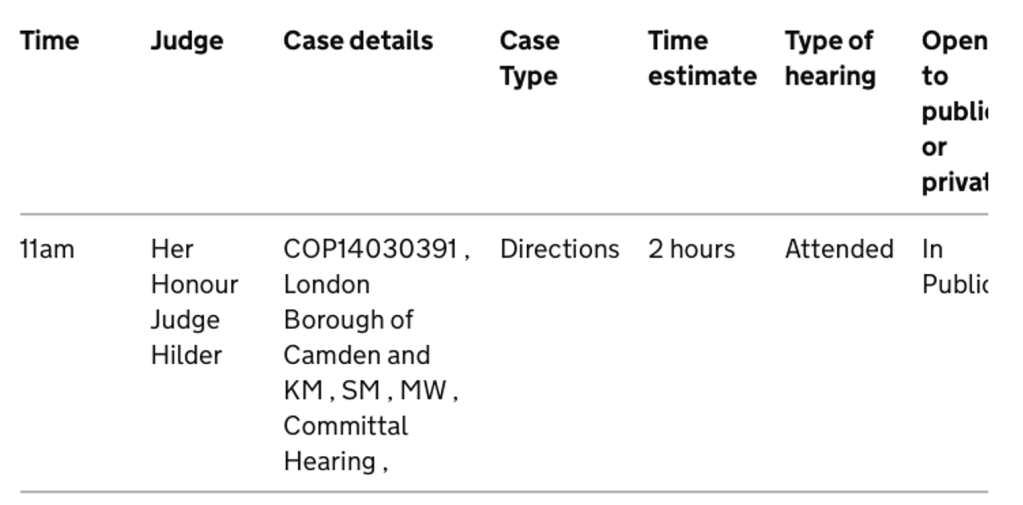
The case (COP 1030276T) was listed as a public hearing (see screenshot below). I gained access via the link sent by court staff at precisely 10am on 22 August 2024.

My observation was limited to hearing submissions about restricting public access to the hearing and an ex-tempore (oral) judgment. The judge’s decision was based on a report of N’s distress at having an observer attend, and the fact that the Official Solicitor acting on behalf of N, did not agree to my attendance. I was asked my position on the matter, before the judge ruled that it was not in N’s best interests to continue the hearing in public, so it became a private hearing, and I had to leave.

This blog will go through the judgment (on public access to the hearing), with a reflection on the challenges of balancing P’s privacy with the values of open justice. I will also discuss the court rules in relation to public and private hearings, which differ between the Civil Courts and the Court of Protection. It seems that even judges can sometimes misapply the rules. Finally, I will consider why advance planning is important when deciding whether proceedings should be made private – not only for the benefit of the protected party, but also to avoid a false impression of transparency being given to the public.

The hearing

I requested access to the hearing by email at 7.52pm on 21st August 2024. I then followed this up with a further request marked ‘urgent’ at 9.08am on 22nd August, as I hadn’t received the link or a transparency order. By 10.00am I still hadn’t received anything, so I telephoned the court, but while waiting for the phone to be answered, I saw the link to the hearing pop up in my emails. I quickly gained access to find 12 attendees waiting for DJ Matharu to join, including the following:

  • Barrister Varsha Jagadesham (who I later learnt was counsel for N via the Official Solicitor)
  • Barrister Mungo Wenban-Smith (who I learnt was acting for the first and second respondents, and I assumed from the email addresses that the respondents were the local authority and the ICB, and this was later confirmed)
  • Legal professionals from Hampsons and Bindmans (presumably the instructing solicitors)
  • Various professionals from the local authority, one from health and one from a care home organisation

The protected party, N, was not present, and I was the only member of the public attending.

At 10.10am, DJ Matharu came on screen. She explained that she had just spent some time communicating with Ms Jagadesham (counsel for N) about an observer wanting to join. She elaborated: “I have had conduct of this case for a number of years, through which N has been actively involved in her own case. It was important for counsel to inform her that an observer request had been received. Ms Jagadesham you have informed N, what is your view?” Before counsel responded, the judge emphasised that the starting point was that this was a public hearing. 

Counsel for N replied: “I have spoken to N and she said no, she does not want a public observer attending as she doesn’t know who they are or what their ethics and values are. There is the potential for distress and the Official Solicitor does not consent to an observer. This is an unusual position. The Official Solicitor is concerned that public attendance would not be in N’s best interests, given it could cause real distress. N is already fairly heightened. The social worker assisted her to speak with me and she needed support to calm her down. It took a few attempts to close the call. Given that N would be very unhappy with a public observer, and she’s already upset that the court has been invited to conclude the matter today, having a public observer could be more upsetting. We are not opposed but the Official Solicitor does not consent, and it must be considered whether it would be in her best interests under section 4 of the Mental Capacity Act.

The judge then turned to Mungo Wenban-Smith (counsel for the respondents), pointing out that he had been involved in the case long-term and she asked what his position was. He said:  We wouldn’t oppose an application to exclude observers, and listening to the submissions on behalf of N, distress is likely. I refer to your consideration, but we wouldn’t oppose a private hearing, should this support a smooth hearing and N’s best interests.

The judge then addressed me: We have an observer, Ms Tallon. We have discussed the paramount considerations: what do you say? I wanted to say that I was observing as a volunteer with the Open Justice Court of Protection Project, and that my ethics and values are aligned with the focus of the Project – to ensure people are being treated fairly by the court. However, I wasn’t expecting this to happen, and I had not anticipated the need to champion open justice under such circumstances. I also didn’t want to distress N or delay the hearing further and I was acutely aware of the discomfort I would have felt, if the judge had allowed me to observe against N’s wishes. I responded: “Good morning judge. I don’t wish to cause any distress, and, on that basis, I am happy not to observe the hearing“.

The judge then continued: “I have to give a judgment as to the rules and I will be brief because I’m conscious of the agitation of N if there is delay. The case is concerning N, and it’s been before me many times, supporting judicial continuity. A public observer request was made late last night. This is a public hearing and it’s important to notify the legal teams of such requests. This is in the knowledge of N being actively involved in the case with regular and frequent participation. Counsel for N and the Official Solicitor feel that distress will be heightened. She does not want an observer in this case, and this would displace the presumption of a public hearing.  I need to take the court rules into account, and I must have regard to N’s best interests. Her best interests would not be served by an observer attending the hearing. N is a private lady, she’s treated with dignity, and her voice shall be heard and is often heard. There are finely balanced outcomes. N was going to participate, but this caused her anxiety. Ms Tallon has been gracious. Having heard that, she is willing to withdraw. Yet I have to give my judgment. The facts are that the court welcomes observers, but on the facts of this case, it is not in N’s best interests. The Civil Court rules are imported into the MCA and the hearing must be public unless one or more of matters at CPR 39.2 paragraph (3) apply. At subsection (c) it involves confidential information and personal matters, and at subsection (d) it would not be in the best interests of the protected party, if anyone was to observe. The observer is not opposed. Do you have anything to add Ms Tallon?

I responded: “No, thank you, judge. I will remove myself from the link now“.

I left the hearing at 10:24.

Balancing the right to freedom of information (Article 10) and the right to privacy (Article 8)

As an Independent Social Worker, I am regularly instructed to provide expert opinions on mental capacity and best interests. My approach to this always centres around enabling decision-making capacity, and failing that, supporting the person’s participation in decision-making and aligning decisions with their wishes and feelings as far as possible. Yet there are times when there are competing values. Often this is in the context of protecting a person from risks of harm versus protecting their autonomy, but here the situation was different. 

The balance was between, on the one hand, the ECHR Article 10 right to freedom of information and the value of open justice (which also offers a further level of quality assurance that the courts are operating fairly) and, on the other, N’s ECHR Article 8 right to privacy, and her sense of dignity and participation in the proceedings. It was a natural response to willingly concede to the hearing being made private, as it went against the grain for me to be the very reason N did not participate in her own hearing, regardless of how well intentioned my reasons were for wanting to observe.

A similar case before Hayden J

Having the discussed the course of events with Celia Kitzinger, co-director of the Open Justice Court of Protection Project, she drew my attention to a previous blog, which reports a hearing before Hayden J,  in which the protected party ‘Ms P’ “strongly objects to members of the public being present” (“Privacy, capacity and the judge’s communication skills”). That case was different, in that counsel (including Ms P’s counsel), were content for the hearing to be in public, and  Mr Justice Hayden refused Ms P’s request for the hearing to be held in private. He explained the Transparency Order to her, and said that her name and identity could not be revealed, and highlighted the importance of open justice. The judge said: “Like many cases that come to the Court of Protection, the applicant Trust is asking the court to declare legal a course of treatment that is highly invasive concerning an adult whose capacity is in issue.  This sort of case is of human importance in a mature, civilized, democratic society and it manifestly engages issues of civil liberties.  In society at the present time, every day, a whole gamut of civil liberty issues are raised and I cannot think of any period when it’s been more important for the court to be vigilant to maintain civil liberties.”  (Mr Justice Hayden, as reported in the blog post)

Although Hayden J communicated sensitively and reassured Ms P in an exemplary manner (and she did in fact participate fully in the hearing), the public observers still felt a tangible level of unease and guilt whilst attending a hearing against the wishes of the protected party where the person felt her private affairs were laid bare.

I reflected on what I experienced in the small part of N’s hearing I attended, and I completely empathise with N. On a personal note, if I was subject to decisions being made about my life by professionals within a court arena, it would fill me with an intense feeling of anxiety and powerlessness, which would only be increased by having unknown public observers watching from a virtual gallery. 

Yet, from a professional perspective, I’m also mindful that there can be errors made, closed cultures and a (sometimes devastating) misapplication of the MCA within all professional domains. 

The Court of Protection is the responsible body for setting the legal precedent and providing rulings which direct wider practice under the MCA. Open justice is therefore vital to safeguarding the rights of individuals, exposing abuse of power, and allowing for public scrutiny over decisions made.

Court rules and practice directions

I was puzzled by the judge’s use of the Civil Procedure Rules (CPR 39.2) in the Court of Protection. This perplexity was based on my understanding that the Court of Protection Rules and Practice Directions would apply.

With Celia’s help, I researched this (thank you Legal Twitter/X), and it was confirmed by lawyers that the Court of Protection Rules 2017 are the primary procedural rules of the Court of Protection. 

The Civil Procedure Rules are incorporated into the Court of Protection to fill in any ‘gaps’ in the COP rules, as necessary (see Rule 2.5 of the Court of Protection Rules, copied below).

So, it seems that the Civil Procedure Rules can be applied in the Court of Protection but only in situations where the Court of Protection Rules don’t provide for the issue.

But the Court of Protection Rules do cover decisions about making hearings public or private (at part 4.3).  

This is what  Practice Direction 4C says:

2.1. The court will ordinarily (and so without any application being made)—

(a) make an order under rule 4.3(1)(a) that any attended hearing shall be in public; 

and

(b) in the same order, impose restrictions under rule 4.3(2) in relation to the publication of information about the proceedings.

2.5. (1) In deciding whether there is good reason not to make an order pursuant to 

paragraph 2.1 and whether to make an order pursuant to paragraph 2.4 instead, the court 

will have regard in particular to—

(a) the need to protect P or another person involved in the proceedings;

(b) the nature of the evidence in the proceedings;

(c) whether earlier hearings in the proceedings have taken place in private; 

(d) whether the court location where the hearing will be held has facilities 

appropriate to allowing general public access to the hearing, and whether it would be 

practicable or proportionate to move to another location or hearing room;

(e) whether there is any risk of disruption to the hearing if there is general public 

access to it;

(f) whether, if there is good reason for not allowing general public access, there also 

exists good reason to deny access to duly accredited representatives of news 

gathering and reporting organisations.

It appears that the judge made an error in applying the Civil Procedure Rules where the Court of Protection Rules should have been applied instead.  

It’s quite possible that the outcome would have been the same regardless of which set of rules were applied, but the court should, nonetheless, be clear and accurate about the basis on which decisions are made.  

Of course, not all judges are Court of Protection specialists, and I imagine that it isn’t easy to move between different courts, with a myriad of applicable laws, rules and regulations depending on the type of case. 

This apparent legal error also points to the value of having an observer in court who can detect a potential misapplication of the law, research the matter with guidance from experts, and report on it, thereby (hopefully) improving the justice system. 

It is also a credit to open justice that there are lawyers who are supportive and instrumental in helping public observers and bloggers to understand the law and who are willing to contribute directly in a very pragmatic way, to enhance public knowledge and advance the judicial aspiration for transparency. 

Further reflections

I admired that DJ Matharu held N’s privacy and dignity in high regard, and she was clearly committed to N’s participation. 

Yet with reflection on the court rules, it may have been less stressful for N if the court had thought ahead and made the hearing private in advance, rather than this being triggered at the point of an observer request being received – particularly as observer requests can usually only be made after about 5pm on the evening before the hearing at the earliest (please see this blog post which explains why: Why members of the public don’t ask earlier to observe hearings (and what to do about it)).

Given that N had been such an active participant in the hearings over some years, discussions about whether or not there should be public observers and the principle of open justice as it applied to this case could have been held much earlier in the proceedings. Then if N objected to observers, her counsel could have prepared a formal application to make the hearing private. It felt to me that this hearing was, under the circumstances, inappropriately designated as public. Forward planning would have also allowed for clarity as to which rules to apply and made for a ‘smoother’ hearing for all concerned.    

In PBM v TGT & Anor [2019] EWCOP 6,  Francis J made the hearing private because “(f)rom the outset, PBM expressed considerable concern about the possibility of members of the public being present at this hearing”’ – so it seems that in that case, someone raised the matter of public observers with the protected party early on (“from the outset”), meaning that the hearing was listed as private and the situation that arose in this case was avoided entirely. The Court of Protection Handbook also remarks that there are some situations in which insufficient focus has been paid to the impact upon P of (in effect) broadcasting – or at least, narrowcasting – a hearing (my emphasis). It seems in this case that ‘insufficient focus’ was given until I asked to observe, which really was too late.* 

To conclude, when a judge makes a decision to change the status of a hearing from public to private, there has to be a significant rationale and a careful balancing exercise between ECHR article 8 (right to privacy) and article 10 (freedom of expression). It is not solely a ‘best interests’ decision, as seems to have been implied in the course of this hearing. Ultimately, I believe in this case the right decision was made based on N’s strongly expressed wishes – but advance planning and preparation could have avoided the distress to N, the discomfort I felt having been admitted to a hearing that N didn’t want me to observe, and the hasty misapplication of court rules to the matter. Finally, whether or not a final judgment was made to authorise a deprivation of N’s liberty, I hope that N can find some peace with the outcome, and that her voice continues to be heard.

Eleanor Tallon is an Independent Social Worker, Expert Witness and Best Interests Assessor. Eleanor can be contacted via email eleanor@mcaprofessional.co.uk or through her website mcaprofessional.co.uk and found on LinkedIn or X(Twitter) @Eleanor_Tallon


* I am grateful to Daniel Clark for drawing my attention to this case law and to the Handbook commentary.

A “Catch 22” situation for P or Hobson’s Choice?  Disagreement among professionals as to whether P has capacity and a finely balanced decision for the judge  

By Amanda Hill, 30th August 2024

“I want to get on with my life”.

At the heart of this hearing (COP 14251478 on 20th August 2024) is P, a man who looks to be in his late 60s or early 70s.  He attended remotely by video link from a psychiatric hospital and was present for most of the all-day hearing. He wants to leave the hospital but there is disagreement about whether he has capacity to make decisions about his care and residence. 

The Local Authority, London Borough of Lambeth, and P’s litigation friend the Official Solicitor (OS), argue that he does have capacity to make his own decisions about care and residence. Counsel for an NHS Trust argued that he does not. (I must admit that I’m not entirely sure which Trust was being represented in court. The Transparency Order lists King’s College Hospital NHS Trust as the Applicant. But I heard references to counsel in the hearing representing South London and Maudsley NHS Trust but them not being a ‘party’).

One issue which came to the fore in this hearing was that if P does have capacity, the options open to him in terms of care and residence were limited. Apart from the periods when he was in hospital, he had lived on the streets. If the judge were to decide that he has capacity, there was a distinct possibility that he could make the potentially ‘unwise decision’, given his physical and mental vulnerabilities, to return to the streets. As counsel for the Local Authority put it, although there are “advantages and considerable disadvantages…(it) would be his choice”. 

The part of the hearing I watched (the second day of a two-day hearing), consisted largely of cross-examination of two witnesses with different points of view. Firstly, a social worker who had recently performed a capacity assessment of P and considered that P does have capacity to make decisions about his care and residence. Secondly, a medical professional, a psychiatrist, who believed that P does not have that capacity. The different position adopted by these sets of professionals, social workers and medical clinicians, was an interesting feature of this hearing, as was the issue of P’s trust (or otherwise) in them and how that impacted their assessments.

In this blog I will set out the background to this case, followed by the different arguments put forward by the witnesses. I will consider P’s ‘voice’ and engagement with the hearing and outline the ‘Catch 22’ that P risked according to counsel for the OS. I will finally reflect on the lack of options available to P.

Underpinning the submissions by counsel were arguments about getting back to the basics of the MCA 2005 and how capacity should be determined – even if it means unwise decisions could be made. 

Background to the hearing

I became aware of this hearing through another member of the public who participates in the Open Justice Court of Protection Project’s  (OJCOP) WhatsApp observer group, Tim Sugden. He’’d attended the previous day and completed an observer feedback form, through the OJCOP website here.

There were three advocates, representing the NHS Trust, the Local Authority and P through the Official Solicitor but I wasn’t able to ask for their position statements as I didn’t catch their names. I wish that time could be taken to clearly identify counsel for public observers so that we could ask for position statements, which greatly enhance understanding of hearings. 

This was a hybrid hearing and I attended remotely, as did P and the medical witness. The judge, HHJ Beckley, and the lawyers were in the physical courtroom at First Avenue House. As is often the case with hybrid hearings, the sound was sometimes poor.  There was no opening summary for observers at the start of this hearing, which is disappointing and not in line with the recommendation from the (former) Vice President of the Court of Protection (here). So I have pieced together the background from Tim Sugden’s feedback form, and my own observation. 

P seems to have spent a lot of his life “street homeless” and from what I observed had been content with this lifestyle, as he had expressed a desire to return to it. However, since around 2022 he seems also to have spent a lot of time in hospital and his physical capabilities have diminished. He now uses a wheelchair,  and during the hearing it became apparent that he finds sitting for long periods uncomfortable. He takes medication for pain. He has indicated that he accepts he needs a certain degree of care now. 

P is currently in a psychiatric hospital – but over the past couple of years, he seems to have been in and out of hospital for physical rather than psychiatric problems.  Nonetheless, discussions had been ongoing regarding his future care and residence. The Court of Protection (COP) had become involved at some point (the Transparency Order I was sent was issued by District Judge Mullins and dated 14/5/24 so the court was certainly involved by then). 

It appears that P doesn’t understand why the COP is involved. The social worker stated during cross examination: “I couldn’t sway him from the criminal element of what the court was… he said ‘I haven’t done anything wrong’…I explained the Court was about doing the best for him”.[1]

The social worker also referred to discussions with P about moving to a care home from hospital. P has an issue with trusting medical professionals which impacted on how he felt about moving into a care home. For example, the social worker reported that P “felt that medical were out to get him… to trap him… not listen to him”. P did however say he was willing to move to a care home on a short-term basis, as a precursor to finding a longer-term solution, which could be some form of supported living. The social worker assessed that P had the capacity to make this decision when he met him in June 2024. 

P subsequently moved to a care home in July 2024. However, within four hours the move had failed as P had set fire to his bedding. He was taken to A&E at the local hospital with a wound to his hand and then detained under section 2 of the Mental Health Act that same day and admitted to an acute psychiatric unit. On 2nd August 2024 a tribunal ruled that P should not be detained in the Psychiatric unit under Section 2 and should be discharged. But P was still detained in the Psychiatric hospital until a decision could be made about his capacity to decide for himself about his care and residence (and if he lacks capacity, his best interests in that regard).  It had already been agreed that he did not have capacity to make decisions about litigation – hence the appointment of the Official Solicitor.

This hearing was held over two days, to enable the judge to make a decision about capacity and, if necessary, best interests, as well as authorization of a short- and long-term Deprivation of Liberty. 

One striking feature outlined on the feedback form completed by Tim Sugden at the previous day’s hearing was that P asserted in court that the reason he had set fire to the bedding was that it was effectively a reaction to what he had seen and how he had been treated at the care home. From the observer feedback form, I read that P had held up his hand to intervene in the hearing because “He wanted to say that the fire he had started at the nursing home had “not been intentional”, that he had only done it as he had “been stripped and locked in a room for hours”, “beaten up” and “held by the throat” by staff, and refused any access to talk to someone in charge.” In the hearing I observed, there was reference to a Section 42 safeguarding enquiry against the care home staff, which I assume was as a result of P’s allegations. 

The previous day the court had heard evidence from the Interim Team Leader from Lambeth who co-ordinated completion of the Capacity Assessment. She suggested that P did have capacity to make decisions about his care and residence. Now the court was to hear from the Social Worker who had also assessed P as having capacity and a senior Psychiatrist who had treated P in hospital. 

Does P has capacity to make decisions about his care and residence?

The social worker, (W), was cross-examined extensively by the three counsel and I will outline the main points he put across to support his assessment that P had capacity to make decisions about his care and residence.

He explained that he was a qualified DOLS (Deprivation of Liberty Safeguards) assessor and had conducted capacity assessments since 2007. He had met P for nearly three hours in June 2024 and described P as ‘receptive’ to him. He contrasted what he found to what he had expected, in terms of how P engaged with him. He’d written in his report that “P appears to engage differently with psychiatrists to social workers”. He was asked by Counsel for the OS whether in terms of “using, weighing and retaining information, are you happy that P is showing some insights…are you confident that it was proper evidence to use and weigh rather than him saying what you wanted to hear?” W replied that P did understand his care needs. For example, he was not accepting of male personal carers and would prefer females. “In my opinion he accepted that his life had moved on and he was aware of his limitations”. He accepted he was now in a wheelchair and he understood that taking drugs and consuming alcohol over a long period had impacted his health. It did seem, however, that P was more accepting of his physical limitations than his mental limitations. 

When questioned by counsel for the Trust, it was put to W that P agreeing to go into the care home one day and then setting fire to it so soon after arriving was evidence that he suffered from impulsive behaviour that was incompatible with making capacitious decisions. W replied that he felt it was down to how P was supported to make decisions. It was about “his involvement in decisions and how much he is listened to”. W implied that social workers approached P differently: “my colleagues all have different (views) ….a social worker looks at (the situation) holistically….psychiatrists view things differently and focus on mental issues.” He reiterated: “I’m not trying to put my opinions above other colleagues but social work is about helping people to understand how to make decisions …it depends on how things are explained to him”.  

Counsel for the OS asked W to reflect on why P distrusted medical professionals. “Do you think that P’s experience of being let down by professionals going back to his mother’s death, is … a factor?” W replied “I will answer that question how I want to, based on my conversation with him. I got the feeling that P is very distrustful of medical staff, I went with an open mind and I was surprised how I was received by him, we were in a small room, as a social worker we showed we could listen and could help him and I got the impression he sees the professions very differently…that’s my feeling about that, we didn’t openly discuss it.” 

W remained convinced that P had capacity and believed that how P reacted depended on how he was supported to make decisions. He asserted that although P had agreed that he should go to a care home for a short while, he was already anticipating that he might not like it. He didn’t waver from his assessment that P had capacity to make decisions about his care and residence, at least when he had assessed him in June. 

Dr A (as I will call him) was cross examined next. He is an experienced psychiatrist and was part of P’s clinician and liaison team when he was in the previous hospital. He had seen P informally when he was in hospital (during ward rounds) and formally (to assess and treat him), for a number of months before his discharge to the care home. He accepted that the team viewed “this as a complex case”.  He still firmly believed that P did not have capacity to make decisions for his residence and care, although he accepted that he “had not seen him recently”. He outlined some of the multiple diagnoses that P had, including personality disorders resulting in behavioural issues. P had sustained a brain injury in childhood and had abused substances over many years. A recent cognitive impairment was indicative of dysexecutive syndrome. However, the nub of Dr A’s evidence was that testing had indicated that P had a progressive, deteriorating condition: “We have two different tests that indicate he has a high probability of dementia”. Dr A believes that “there is an underlying condition that affects his ability to weigh up information”. He stated that P “doesn’t accept he needs help” and that his lack of ability to plan for the consequences of his actions indicated that he could not process information in a way that indicated capacity. He used the example of P being asked what he would do if he was discharged. P stated that he would get a taxi to Liverpool Street but Dr A believed it extremely unlikely that a taxi driver would take him, an indication of a lack of adequate planning. 

He questioned why P would set fire to the bedding at the care home when it would not lead him to better accommodation. This led to an interesting exchange between Dr A and counsel for the OS, which I will paraphrase. It was revealed that P had taken two lighters with him to the care home and only handed one over when he was admitted. He then used the other to set fire to the bedding. 

Counsel asked Dr A if this indicated an ability to plan actions. “…P kept the other one (lighter) in case he needed it…..does that indicate executive functioning?”. 

Dr A referred to a “frontal load deficit” and gave an example of making a cup of tea: multiple steps are involved, one could put the kettle on a cooker but forget to take it off. “I can’t say how capacitious he was to set fire to the place, but the planning component was falling apart ….in terms of planning, what was the pathway, what did he think he would get out of it?” 

Counsel for OS: Couldn’t the logic be “I set fire and therefore I will get out of the care home?

Dr A: Did he get out?

Counsel for OS: Well, yes he did……and he says he saw some things there and has made allegations.

Dr A: But he took the lighters with a plan to set fire to the place before he saw it? 

Counsel for OS: Maybe he took the lighters just in case …..and then had a distressing experience, saw people treated badly and was shut in a room for four hours. 

Counsel suggested this course of events indicated planning. Dr A believed it indicated impulsive behaviour.  

Dr A stated that he believed that P lacks insight into the challenges facing him in the immediate future, because of a choice between going into a care home or back onto the streets. Counsel for the OS suggested that maybe he would think differently if there was a different option, with more supported independent living, giving him more freedom to come and go. Dr A replied that the first question in the capacity assessment was the impairment of the brain and that is still there… “the dysexecutive syndrome is not likely to reverse”. Although still believing that P lacked capacity to make decisions about his care and residence, he accepted that multiple people had differing views on this, and he was not going to pretend that it was a straightforward case. 

The voice of P and a Catch 22 situation

Unlike many of the hearings I have observed, P was present and engaged throughout this hearing. He joined the hearing from the psychiatric unit, from a room that looked like a large cupboard but included a fridge – so I guess it was a sort of small kitchen. A member of staff helped him to use the computer, muting and unmuting the link as necessary, as well as giving him the occasional ice lolly, which he seemed to appreciate. He was sitting in a wheelchair. Throughout the hearing, HHJ Beckley took the time to engage with P and explain what was happening. Each time P replied, and actively participated in the conversations. For example, when P joined the link a little later than everyone else, the judge greeted him and explained that the court was hearing evidence from the social worker who had conducted the capacity assessment. “We will wait for him (to finish) and then I’ll listen to you. Is that OK?” P replied that it was. 

P seemed to be listening intently as the social worker gave evidence. When he had finished, it was P’s turn to address the court. The judge started the exchange by saying “P, I realise how weird it must be for you to be sitting in that room listening to people talking about you in this room”. He invited P to tell the court what he wanted to say. P firstly apologized for how he had acted when the judge had visited him in hospital. He wanted to tell him that he was very sorry for the way he had acted and that the judge had needed to leave. 

He then expressed his desire to leave the hospital: “I want to get on with my life, I’m not interested in drugs anymore, I will take my medication…I’ve been in here a while now, Your Honour…the pain I’m in now, I’m not receiving the right medication…It’s distressing for me…all I’m trying to say to you guys if you can see in your hearts to see where I’m coming from …I just want to get out.. to go somewhere where I have a carer, to help me take my medication on a more regular basis, to be as independent as possible ….I can see I need some help from carers…That’s all I’ve got to say”

The judge accepted his apologies and told P that Dr A would now be giving evidence. P replied by saying ““I look forward to it, Your Honour”.

I haven’t observed many hearings where a P has been present and participated, not least as eloquently as this P did. I noted the way he spoke to the judge, referring to him as “Your Lordship” and “Your Honour”. He certainly seemed able to express his views politely but firmly. P stated clearly in this exchange that he recognised that he needed some sort of care, but wanted to live as least a restrictive life as possible. 

However, I realise that being able to express a view is not an indicator of having capacity. Previously blogged cases concerning eloquent P’s who were determined not to have capacity include: “Articulate, Eloquent and Passionate – but does P have the Mental Capacity to Make Decisions about Four Areas of her own Life?”;  “Influencing ‘best interests’ decisions: An eloquent incapacitious P” and “Improving P’s quality of life pending a s.21A change in residence”.

In this case, as counsel for the OS submitted later in the hearing, P seemed to be in a Catch 22 situation. In the past he had said he did not need care, and that was evidence that he was in denial and did not have capacity to make decisions about his care and residence. However, now that he was saying he recognised that he did need care, the court was being asked to consider whether what he was saying should be taken at face value and that it was what he did rather than what he said which indicated capacity. For example, Dr A stated during his cross-examination that P had self-discharged from “multiple hospitals and nursing homes” which he considered showed a lack of ability to plan for the long-term. Counsel reminded Dr A that capacity is time and decision specific and that P was currently saying that he understands that he’s physically frail, that his body wouldn’t take him using drugs anymore. Was Dr A suggesting that his actions in the past are relevant to the capacity assessment now? Dr A replied that “My slight concern is that we are accepting he has capacity because he is agreeing with what we are suggesting”. He added “I don’t know how it squares up in my head…he says ‘give me my freedom and I’ll accept help’ but he is not accepting help now”. Dr A also stated, with regards to the fact that the social worker said he didn’t feel listened to that he would take that at “face value”. 

As I set out below, the judge seemed to suggest that past actions were in fact relevant to the current decision he would have to make. 

How the judge will decide

There were two aspects to closing submissions. Firstly, what the judge should consider when deciding on capacity and secondly, what options were available to P. Counsel for the OS and for the Local Authority both submitted that going back to basics was the basis. Counsel for the Local Authority stated that according to the MCA 2005 there should be an assumption of capacity and the burden was to prove that there was not capacity. There was also a principle that “capacity is not on the wisdom of the decision…P has the capacity to make an unwise decision and to suffer the consequences if things go wrong”. He argued that the bar should not be set too high to let somebody decide for himself. 

Counsel for the OS reminded the judge that there should be a functional and then a diagnostic case – is P able to weigh, use and understand the relevant information to make a decision and if not, what is the cognitive impairment that is preventing him from doing so? She implied that the social work approach was different from the medical approach in this case, that Dr A believed that as P had a progressive, deteriorating impairment he should be assessed as not having capacity, which is the opposite way round to the way outlined in case law. I heard ‘JB’ and I think that is referring to Heart of England NHS Foundation Trust v JB [2014] EWHC 342.

I was struck by something the judge said about how he would make his decision – he said “although capacity is time-specific, I can take into account the history”. I had understood that capacity was only time and decision specific, so I learned something from this statement. 

In terms of options if P were found to have capacity, they seemed to be stark. No mention was made during the hearing of any family and clearly P had no home to be discharged to. He had indicated that he wanted to be discharged to some form of supported living that enabled him to receive care but be free to come and go. However, this did not seem to be a viable option before the court at this hearing. Counsel for the OS summed it up as follows: “if you find today that P has capacity, I think you must proceed on the basis that P is free to make his own decisions. So, what is the question? The question is that there is not amazing supported accommodation so the question today is that whether he will stay where he is or go to the street, homeless.” And one can imagine that if P ended up on the streets again, he would soon find himself back in hospital. 

Putting the cart before the horse?

Witnesses were asked not to speculate during this hearing but I did find myself wondering whether the decision on capacity about care and residence would be different if P had somewhere safer to be discharged to than the streets. The judge seemed to be partly considering this during an exchange between him and counsel for the Local Authority towards the end of the hearing. As much as I could understand it, counsel for the LA was pondering about the only options being between hospital or the streets “because there is no other option”. The judge reflected on the fact that P was likely to be discharged if the Court found that he had capacity. This was because the tribunal had decided he should not be detained under section 2 of the MHA. Therefore, if the COP decided that P did have the capacity to make decisions about care and residence, it was unlikely that he would be stopped from leaving the psychiatric hospital. The judge then said that he couldn’t “assess the outcome, as that’s putting the cart before the horse”.

This again seems to be referring to a point made in the ‘JB’ case. Paragraph 7 of that judgment states: 

The temptation to base a judgement of a person’s capacity upon whether they seem to have made a good or bad decision, and in particular upon whether they have accepted or rejected medical advice, is absolutely to be avoided. That would be to put the cart before the horse or, expressed another way, to allow the tail of welfare to wag the dog of capacity. Any tendency in this direction risks infringing the rights of that group of persons who, though vulnerable, are capable of making their own decisions. Many who suffer from mental illness are well able to make decisions about their medical treatment, and it is important not to make unjustified assumptions to the contrary.’ (Heart of England NHS Foundation Trust v JB [2014] EWHC 342)

The judge concluded the hearing by saying that it was a finely balanced decision. He was going to let the parties, including P, know the next day by email, so I don’t know what decision he came to. It is unusual for judgments to be published so I have asked for a copy of the approved order. I hope I receive that as I’m really interested in what HHJ Beckley decided. 

Update: a blog outlining the judge’s decision has been published:

24th September 2024 Judgment: An update to “A Catch 22 situation for P or Hobson’s Choice?” (and how access to court documents helps transparency and open justice) by Amanda Hill

Amanda Hill is a PhD student at the School of Journalism, Media and Culture at Cardiff University. Her research focuses on the Court of Protection, exploring family experiences, media representations and social media activism. She is on LinkedIn (here), and also on X as (@AmandaAPHill) and Bluesky (@AmandaAPHill.bsky.social)

Note: Where I’ve quoted from the hearing, this is based on my notes, as observers are not allowed to record hearings. I’ve tried to capture these as accurately as possible to the best of my ability, but I don’t touch type so they will not be 100% accurate. P was referred to by his name throughout but because of the Transparency Order in place, as is standard I cannot name him.) 


Capacity, Relaxing of Restrictions, and a Happy P!

By Hita Jadeja, 28th August 2024

I observed a hearing on 24th July 2024 (COP 13879770) before His Honour Judge Whybrow who was sitting remotely (via Cloud Video Platform [CVP]) as a nominated Court of Protection judge at the County Court and Family Court at Kingston upon Hull.

The protected party (P) in this case is a young lady in her twenties. The case has a long history dating back to 2022.  This hearing related to her capacity to engage in sexual relations, reviewing some of the restrictions in her care plan, and considering next steps in relation to commencing college.

P’s barrister (instructed via her litigation friend) was Mr Tom Hughes and the relevant Local Authority (LA) was represented by Mr Simon Batt, in-house solicitor.

Before I write about the hearing itself, I will share my experience in terms of access to the hearing, and provide some background to the case.

Joining and position statements

The hearing was listed for 11.00am and I received the link and transparency order (TO) in good time. 

There was a short delay before the hearing started. HHJ Whybrow apologised and explained that it was due to a judicial visit.  P was present alongside her support worker. Others in attendance included P’s solicitor, social worker and her litigation friend.  

The judge asked if I could switch on the camera, introduce myself, say why I was observing – adding that he knows that I don’t have to explain why I was observing. He also asked me to confirm whether I had received the TO.  I was fine with explaining why I was observing – although I was a little surprised to have been asked to do so as I’ve never before been asked.  

There was a problem though, because when joining the remote CVP hearing, I selected the ‘observer’ option. I’ve always done this, since ‘observer’ is an accurate description of my role, but selecting this option means (I now realise) that it’s not possible to switch on your camera or mike.   So, unlike when joining the MS Teams platform, I could not see the option to switch on the camera and so I started speaking until the judge said, “are you there”: I replied “yes”, and I was asked again, so it became clear that they could not hear me.  

As I was about to use the chat box, the judge asked me to switch on my camera again, I quickly typed, “I can’t” and was typing the next line to explain when he questioned, with a confused expression, “you can’t or you won’t.  Someone who I now know was Mr Batt, responded by explaining that it might be the settings and it would be better if I left and re-joined.  I typed “I will rejoin” and the judge said “okay”.

Conscious that I was holding up the hearing, I re-joined in a hurry and soon discovered that I had joined with the video option only, instead of video and audio.  I switched on my camera and began speaking, when the judge said ‘we cannot hear you’, I typed that I was observing in a public capacity, and that I was a member of the Observers’ Group with the Open Justice Court of Protection Project. I said I was interested in the area, and confirmed that I had understood the TO.  That was fine, the hearing started and I switched off my camera.

At the end of the hearing, Mr Hughes pointed out that a summary had not been provided to me (as per the recommendation issued by Mr Justice Hayden, former Vice President of the Court of Protection).  I had, however, indicated that I would like the position statements and these, he said, would provide the necessary background, although he was mindful of confidentiality.  

HHJ Whybrow asked me if I still wanted the position statements, so I switched on the camera and used the chat box to say that I did, and it would be helpful.  He informed both counsel that I had come on camera, had introduced myself and had confirmed my understanding of the TO and on that basis, he gave his permission to release the position statements.   

Mr Batt asked if I could email him my request.  As he is an in-house solicitor, I asked for his email address as it would be difficult to get, unlike Mr Hughes, who could easily be contacted via his chamber’s website.  Mr Batt sent me both the LA’s and P’s position statements.  

I’m grateful to Mr Hughes for addressing my request for the PSs and to Mr Batt for sending them.  I now have both context and an enhanced understanding of the case. I would also like to express my gratitude to HHJ Whybrow for his patience in enabling open justice.

Summary of case background

P has diagnoses of cognitive impairment and diabetes, although there is a lack of clarity surrounding her diagnosis.  A clinical psychologist has concluded that overall P’s support needs are likely as a result of development trauma and attachment difficulties due to adverse childhood experiences rather than a global learning difficulty.  

P had absconded from her previous residential placement and was found in vulnerable and dangerous situations with men she had contacted using the internet/social media.  Safeguarding concerns were raised and the court became involved in 2022. 

The court determined in the interim, in accordance with s.48 of the Mental Capacity Act 2005 (MCA), that there is reason to believe that P lacks capacity to conduct these proceedings; make decisions about her residence; make decisions about her contact with others; manage her property and affairs; access the internet/social media; engage in sexual relations; and enter into a tenancy agreement. 

Both position statements acknowledge the opinion provided in the expert report obtained, that with the right support, on the balance of probabilities, P is likely to gain capacity in all areas except for managing large sums of money. 

P has moved to a supported living placement and is well-settled.  She has the benefit of one-to-one care and support 24 hours a day, seven days a week.  She has built good relationships with the staff and other residents at the placement.  She accesses the community with her support staff.  She enjoys shopping, eating out, attending rugby matches and going to a local disco.

P now has a boyfriend who also resides at the placement.  She has been engaging in therapeutic and education work to develop her understanding of sexual relations and relationships in general – although, her litigation friend expressed concern that this work has been delayed.  It was recommended in the expert report dating back to 2022 but work began some time in 2024 – prompted by P having sexual intercourse with her boyfriend when this should not have been permitted to happen, given the interim capacity position at the time.  

Following the therapeutic work, an assessment undertaken by P’s social worker determined that P had acquired capacity to engage in sexual relations.  P was elated to hear this.

She has also enrolled on a college course which is due to start in September 2024. 

P’s wishes and feelings surrounding the restrictions in place have been ascertained by her solicitor.  P expressed that she would like to lose the waking night staff, go to the cinema with her boyfriend, and have an hour alone with him.  When attending college, she is happy for her support workers to meet her after lessons but not join her in the classrooms.  In relation to a laptop being purchased for college work, she agreed to restrictions in respect to social media/internet access. 

As P is still deemed to lack capacity in respect of contact, P’s barrister has highlighted the need for a ‘TZ style care plan’ to be prepared by the LA if the court accepts that P has gained capacity to engage in sexual relations.  There’s an explanation of a TZ care plan in this blog:   “Grave concerns”: Funding arrangements, capacity for sex, and a TZ-style care plan.

The LA, in its position statement, recognises the importance of preparing a TZ-style care plan as soon as possible. In practical terms, this will include for example, having provision for P to spend time alone with her boyfriend while also including having access to appropriate staff, who can assist her if there is an inappropriate level of risk.  Other ways of managing risk include a suggestion by her social worker that staff can walk her and her boyfriend to the cinema and be present for when they come out.  The LA will undertake necessary risk assessments and work with relevant professionals involved with P, including staff at her current placement, and representatives of the organisations that have been providing therapeutic and educational work.

The Hearing

The judge (who had also spoken to P before the hearing) confirmed that he was satisfied with the assessment undertaken by P’s social worker. P had understood, retained and was able to communicate what she had learnt about safe sex during her therapy sessions and from her social worker.  He made a declaration under s.15 MCA that P has capacity to engage in sexual relations.  There was a big smile on P’s face, to which the judge responded “I know you wanted me to say that”.

Mr Batt informed the court that the LA were working on a TZ style care plan. This then led to a discussion around graduated reductions on her current restrictions.  Whilst the ground rules were to be worked out, the LA was considering introducing an hour of unsupervised time with her boyfriend on alternate days, and if that goes well, it could move to every day, and include review periods.

The judge asked that P is provided with easy read documents so she knows what is happening and why.

Mr Batt was pleased that P is starting college soon and wished her well.  He informed the court that the LA will purchase a laptop and have suitable controls placed, as there are concerns about rushing things with regards to P’s access to the internet and social media.  

P’s barrister stressed that as P is going to college, having access to the internet/social media will be part of her world. Educational work around internet/social media and re-assessing P’s capacity in this area should be prioritised.  Furthermore, it is important that the LA have a plan available for the next hearing which can be endorsed by the court.

In terms of relaxing other restrictions, the LA agreed that P’s waking night staff could be removed.  P’s social worker clarified that the cameras at the placement are not monitored constantly so there is need for more detail around that.  P’s barrister also raised the matter of P not having access to the remote control for the television in her room requiring quick resolution.  (Currently, P has to find staff every time she wants to change channels, as it is a smart TV which gives access to social media sites.) 

For now, P’s capacity in all other areas remain as previously determined by the court.  The parties agreed that the general way forward – considering the expert report – is that, with support, P is likely to gain capacity in all areas except managing large sums of money.  

P had not yet received her college timetable so the judge suggested a review hearing towards the end of September.  A hearing has been fixed (at which capacity building and P’s progress in college will be considered) at 2pm on 26th September 2024. 

Hita Jadeja is a solicitor with a background in commercial dispute resolution and inhouse advisory work who has an interest in health and social care law, Court of Protection work and mental health law.

What to do if the Transparency Order prevents you from naming a public body

By Celia Kitzinger, 27th August 2024

It’s probably safe to assume – unless you’re told otherwise – that if a Transparency Order prevents you from naming a public body, it’s a mistake. That’s been true of the vast majority of cases we’ve encountered.

But even when it’s a mistake, if it’s in a court Order, the prohibition stands.  You can’t just go ahead and name the public body and say, “oh I assumed it was a mistake in the Order”.  If the Order says you can’t name a public body, then you can’t name the public body, and our Project won’t publish a blog post that names the public body if the Transparency Order forbids it – however unlikely it is that the judge actually intended to stop us from doing so. 

So, you’ll want to get it changed (technically, “varied”) and that means asking the judge.

The simplest way to do this is to send an email to the judge (use the email address of whoever sent the Order), pointing out that the Transparency Order prevents you from naming the public body and asking for this prohibition to be removed.  Anyone affected by the Transparency Order has the right to ask for it to be varied.  You should quote the wording of the Order and the paragraph number.

Here’s an example of a letter I wrote after receiving the Transparency Order and before the hearing was due to start.  

Usually, if the judge gets a letter like this before the hearing starts, he or she will say something to counsel along the lines of: “I have received a letter from X which points out that the Transparency Order prohibits identification of [the local authority/the Trust/the Public Guardian etc].  Unless any of you wants to make a case to me as to why that body should have its identity protected, I propose to vary the Order to remove that restriction”. 

My experience is that when this happens lawyers are quite surprised that the Order does protect the identity of a public body, and nobody seeks to argue that it should.  The judge then changes the Order.   

In this case, though,  it turned out that the hearing was then vacated – i.e. it didn’t happen.  So the judge didn’t have the opportunity to raise it with the lawyers.  

So, I sent a follow-up email pointing out that, even though this hearing wasn’t going ahead,  I was still concerned about the Transparency Order since “it will presumably apply to future hearings in this case”.  (The same Order is used over and over again, often for years, apparently without anyone ever looking at it again.)

I wasn’t wholly confident that anyone would deal with that email, so I also made a formal application for the Order to be varied (as Senior Judge Hilder advised me in a Court of Protection User Group recently) by completing the standard form (I’ve done dozens now!) called a COP 9.  (You can download the blank forms here: https://assets.publishing.service.gov.uk/media/602a3d8bd3bf7f03208c2b40/cop9-eng.pdf)

It asks for the case number and the name of the protected party (I wrote “I don’t know. The initials used by the court are VA”) and then my own name and address and contact details.  In response to “what is your role in the proceedings” I wrote “public observer”.  Asked what order I was seeking from the court, I wrote: “Variation of Transparency Order (made by DJ Hennessy on 3rd April 2024) to permit identification of local authority.”  And these were my grounds: 

I sent the form to the Manchester address from which I’d received the Transparency Order. 

Just over two weeks later, I was sent this (see below) .  All sorted!

As you can see, the Local Authority I’d been forbidden to name was Wirral Council, but I don’t think anybody intended to prevent me from naming them – and nobody has notified me of any subsequent application as per [2] in in Order above. So that’s done.

How to identify a problem with the Transparency Order

Obviously, it would be best if the court got the Order right in the first place, but when it doesn’t, it’s good to see a judge being responsive and supporting open justice like this. It was exemplary behaviour – and rather a contrast with what happened in another case I wrote about here: “Prohibition on identifying public guardian is ‘mistake not conspiracy’, says judge”. 

Judges do make mistakes, and it would support open justice in the Court of Protection if everyone who is sent a Transparency Order could rapidly identify if there’s a problem (e.g. because it prohibits identification of a public body) and if there is, raised the matter with the court.

It helps to be able to identify, quickly, what the Transparency Order prevents you from doing. 

Here’s how.

When you get a Transparency Order, it’s almost always in the ‘standard’ form, i.e. following the 2017 template which you can see, in advance, here: https://www.judiciary.uk/wp-content/uploads/2017/11/cop-transparency-template-order-for-2017-rules.pdf

The relevant paragraph is called “The subject matter of the Injunction”.  In the template it’s §6, and you could start by going straight to §6 of the actual Transparency Order you’ve been sent, but sometimes the numbering is different so if §6 doesn’t say “The subject matter of the Injunction” look at the paragraph before and after.  It’s essentially a list of the persons (and organisations) you’re not allowed to identify.

Generally, §6(i)(a) says you’re not allowed to identify the person at the centre of the case (“P”).  Then §6(i) (b) says you’re not allowed to identify any member of their family.  It’s after those two prohibitions  – as §6(i) (c) and (d) etc. that you may sometimes find a prohibition on identifying other people (e.g. a treating clinician, or the manager of a care home) and then a prohibition on identifying a public body.  And that’s the prohibition you should ask the court to vary.  This is what the one I was asking about looked like – and the problem was (6)(i)(c)

If you get a Transparently Order that has a clause in it like (6)(i)(c) – it might say “A Local Authority” (as above) or it might say the Trust or Health Board or the ICB, or th Public Guardian, or the Official Solicitor – you should ask the judge whether this is really what is intended.

Sometimes (very rarely) there’s a good reason for requiring us to keep secret the name of a public body. For example, if P is being treated for a rare condition in a small Trust which has only one hospital at which she could plausibly be treated – so identifying the Trust risks identifying P.  If that’s the case, the court can explain it to you.  But in my experience, that’s really unusual.  It’s much more likely to be a mistake.  

The Court of Protection judiciary has repeatedly stated its aspiration to transparency.  These mistakes prevent the judiciary from achieving that aspiration.  That’s why it’s so important that we all assist the court by pointing out their mistakes – and in doing so we make small but significant strides towards an open and accountable system of justice.

Celia Kitzinger is co-director of the Open Justice Court of Protection Project. She has observed more than 560 hearings since May 2020 and written more than 100 blog posts. She is on LinkedIn (here), and also on X (@KitzingerCelia) and Bluesky (@kitzingercelia.bsky.social)

Prohibition on identifying Public Guardian is “mistake not conspiracy”, says Judge

By Celia Kitzinger and Georgina Baidoun, 21st August 2024 (Updated 9th November after receiving response from HMCTS)

On 1st February 2024 a member of the public, Georgina Baidoun, observed a hearing concerning an application by the Public Guardian to discharge an attorney.  She was sent a Transparency Order prohibiting her from identifying “the OPG” (the Office of the Public Guardian) – represented in the hearing by Mark Calway.

No such Transparency Order should ever have been made.  It was, as the judge who made it said later, “mistake, not conspiracy”. 

But this “mistake” was not fixed for four months, despite the best efforts of both Georgina Baidoun and Celia Kitzinger, the latter of whom picked this up in her role with the Open Justice Court of Protection Project.

The mistake with the Transparency Order meant that we couldn’t publish Georgina’s blog post about the hearing – because it was simply impossible to write about it if she couldn’t say that the Public Guardian was the applicant and they were seeking discharge of an attorney.

We detail what happened below.  We still don’t have an adequate explanation of how things went so badly wrong (despite delaying this blog post in the hope that HMCTS would investigate and report back, but after several chases this hasn’t happened) (See Update added at the end of this blog post, 9th November 2024).

As far as we can determine, someone – we think the judge must be the person to bear responsibility for it since it was her order –  simply made an error by including the OPG in the Transparency Order.  That error should have been fixed as soon as it was pointed out (on 1st February 2024). Instead, we were forced into a long drawn-out process involving unanswered correspondence, a formal COP 9 application, and the stress and time (for Celia) of preparing a Position Statement and then appearing as an applicant in court, seeking a variation to the judge’s order.  This delayed open justice, and it cannot possibly be a good use of the court’s time or the public’s money.

Open justice and transparency are not served by this protracted and unnecessary procedure.  Open justice delayed is open justice denied.

In the first section (“The court’s ‘mistake’”) we describe what happened in relation to the Transparency Order. The second section is Georgina’s (delayed) description of the hearing to which the Transparency Order was erroneously applied. 

The court’s “mistake”

February: The hearing and Georgina’s request to the judge to amend the Order

Immediately after the hearing (COP 14123571 on 1st February 2024, the experienced public observer, Georgina Baidoun, sent an email to the judge (via the court email) asking the judge (HHJ Sullivan) to amend the Order.  She said: “it currently says that the OPG cannot be named. This doesn’t make sense because the OPG was named in the court listing […].  The way the transparency order reads at present prevents reporting … It is an opaque enough institution without this extra hindrance”.  

In response, on 6th February, she was told her email had been sent to the Office of the Public Guardian for comment. Then, despite subsequently chasing it, she heard nothing more.

March/April: Celia’s request to the judge to amend the Order – followed by a formal COP 9 application

So, on 27th March, Celia Kitzinger wrote to the judge responsible for the Transparency Order (HHJ Sullivan) copying in the lead judge for the regional hub (HHJ Eleanor Owens) saying: “I cannot envisage any circumstances under which it would be in accordance with the principle of open justice to prevent the public from knowing that the Office of the Public Guardian (OPG) was involved as a party in the Court of Protection” and pointing out that the prohibition has the effect of banning Georgina Baidoun “from writing anything reporting on the case, and it prevents the Project from publishing a blog about it too”.  The email asked the judge to vary the TO so we could report on the case. 

Three weeks later Celia got an acknowledgment of her request saying that the judge hoped to respond by 22ndApril 2024.  She didn’t.  

After chasing on 23rd April, Celia got a response on 25th April saying: “Please advise Professor Kitzinger that I will require a formal application to amend the order from the observer who has raised this issue”.  Celia cut and pasted the information from her original email of 24th March on to a “formal” COP 9 form and sent it back the same day. (There is no reason why it had to be the observer who made the application, since Celia (as blog editor) was affected by the order and hence was entitled to ask for a variation.)

May: A hearing to amend the Order

We expected the application to be dealt with on the papers.  But no. The judge then listed a one-hour (remote) hearing for 30th May 2024 solely to deal with the matter of the Transparency Order. 

We hoped that the Public Guardian would indicate in the interim that they did not oppose Celia’s application to name them. If they did, said the judge, the hearing could be vacated.  But neither Georgina nor (we understand) the judge heard anything from them.

So, Celia (who is not a lawyer) consulted with some busy lawyers who were willing to help her think what she needed to say, wrote her Position Statement, and chose to publish it in advance of the hearing in a blog post:  Challenging a Transparency Order prohibiting identification of the Public Guardian as a party.  

No Position Statement was received in advance of the hearing from the Public Guardian.

So, on 30th May 2024, Celia was in court (remotely) in Maidstone as the applicant in COP 14123571 before HHJ Sullivan. Georgina came too as an observer. 

Once we were both on the video-platform and before the judge appeared, a member of the court staff asked whether we were expecting anyone from the OPG and Celia said “I hope so – they’re the first respondent”.  We all waited five minutes in the hope that the PG would turn up. They didn’t. 

The judge appeared and said: “Good morning. I’m afraid we don’t have anybody from the Office of the Public Guardian. They were made aware of this hearing at the same time as yourselves, and I think, Professor Kitzinger,  you will recall the email that came out from the hub, 2nd May, saying that if they didn’t object then I’d be very happy to have a consent order so I could vacate the hearing. So, as far as I’m aware, they’re not objecting to the proposed amendment. […] I’ve looked at the proposed amendment. It seems perfectly fine to me. The reason I did want to have a hearing was I did want to hear from the OPG if they had any points they wanted to raise.  … I didn’t think there was going to be an issue, but I thought it was appropriate for them just to have 5 minutes to tell me if there was.  So I’ll make that amendment and get that through the hub today.”

She added that the protected party has since died, and made some polite and interested enquiries of us both as to how many hearings we managed to get to and our geographical scope.  

Celia was so cross by the length of time this had all taken, and the amount of work it had involved her in that she didn’t trust herself to say very much by this point.  Having imagined (reasonably enough) that there would only be a hearing because of some kind of objection or difficulty raised by the OPG, she had researched a range of possible concerns and arguments relating to them and consulted several helpful senior barristers about ways of managing what she imagined might be a complex situation.  But it had all disappeared in a puff of smoke.

Fortunately, Georgina was able to be warm and friendly and to engage with the judge. She explained her own interest in observing:  “I do appreciate it when I can watch cases involving the OPG because there are so many people now involved with Lasting Powers of Attorney in this country. Either holding them and not realising what they’re going to entail, or finding themselves acting as attorney and not really knowing what the constraints are… For me it’s the issues that get raised through the LPA or sometimes the Deputyship, which it’s very hard for a layperson to imagine.  I’ve been a Deputy myself and when I’m writing a blog it’s with the purpose of alerting people really to issues they might not otherwise think about.”  Georgina and the judge then had a conversation about some of the problems that arise with Lasting Powers of Attorney and the judge made reference to “the one that David Hodge did, the Chanel handbag, the watches”. We looked it up afterwards and it was this one: “Judge names and shames women who spent £230,000 of elderly relative’s savings on cars, designer handbags and jewellery” (it was Mulberry and Vivienne Westwood handbags). 

The judge’s only explanation for why the OPG had been included in the transparency order in the first place was: “it can be a bit pressured and perhaps that can be attributed to what’s happened with this. But in any event, I’ll get that amendment done. And I’ll look at them perhaps a bit more carefully in future, even when we’re a bit pressed.” It was, she said, “mistake not conspiracy”.

And a sting in the tail: after the hearing, the Order revising the Transparency Order was sent promptly to Celia and to the Public Guardian – who responded the very next day (31st May) to say that the Public Guardian “does not object to the order made but requires an amendment to the recitals”.  They submitted a  COP 9 formal application  (more admin, more work, more cost to the public purse).

The Office of the Public Guardian says they were not issued with the notice of hearing that took place on 30thMay and so were unable to attend.  They say furthermore that they had not made an application to be anonymised in this case, and in any event, that as far as they were aware proceedings had concluded back in April (we think this will have been when P died) and at that point there was no order to anonymise the Public Guardian.

We don’t know if these amendments to the Order were ever made. Celia has never received a revised version of the Order, so maybe not.  

We honestly don’t know how it’s possible that the Office of the Public Guardian were not issued with the notice of the hearing.  We asked HMCTS to investigate whether or not there’s any evidence that the COP sent the notice that the OPG says it didn’t receive – but we’ve not received a substantive response.  Given that the OPG didn’t respond to either of us attempting to assess their position in advance of the hearing, we are willing to consider the possibility that notice was sent to them, and ignored or mislaid.  Georgina has noticed that the OPG often say (in hearings that she’s observed) that they haven’t received documents which family members say they’ve sent.

In our view, this whole episode is a shameful waste of public money. It’s depressing that the mistake (anonymising the OPG) should have been made in the first place – but the solution should simply have been to fix it as soon as Georgina pointed it out, back in the first week of February. All those emails from both of us, the COP 9, the formal Position Statement, the hearing itself – none of those should have been necessary.  We note, further, that the judge is a Tier 2 judge (so not the most ‘junior’ of judges) and that correspondence was copied to HHJ Owens, the Lead Judge for the South East Region, who might have been expected to provide any necessary support in sorting out this problem.  It shouldn’t be necessary for members of the public to jump through all these hoops in order to support the judicial aspiration for transparency in the Court of Protection.

The hearing on 1st February 2024, by Georgina Baidoun

This is my belated account of what happened in the hearing I was banned from reporting on for so long.

The protected party had given Lasting Power of Attorney (LPA) for both ‘property and financial affairs’ and ‘health and welfare’ to Mrs A, her daughter (and, I think, also to Mrs A’s husband given the way he was mentioned later). 

The Office of the Public Guardian sought to permanently remove Mrs A’s power of attorney because they were concerned that an equity release had been arranged on P’s home and it seemed that not all of the money had been accounted for. 

There was no hint as to who had raised this issue with the OPG but I assume someone did because people with power of attorney do not normally have to report to the OPG. A good guess would be someone concerned to recuperate care costs. The power of attorney had already been temporarily suspended and someone was acting as a professional deputy pending the outcome of this hearing.

Mrs A’s position was that the equity release on P’s home had been arranged when P still had capacity and before the LPA took effect. The OPG said they had yet to see evidence of this, despite Mrs A saying that she had already sent it through her solicitor, when she had one; she was now representing herself due to cost. (This wasn’t the first time I had heard a respondent claim she had sent information to the OPG which they said they didn’t have.)

The big issue arising from this state of affairs concerned the selling of P’s house, the money from which was needed to pay debts – probably care home fees, although no details were given. Mrs A had instructed two estate agents and the house had had some viewings. The Judge made it clear that she did not have the authority to do this, given that an interim deputy was now acting for P. The Judge pointed out that even the interim deputy would not be able to sell the house without making an application to the court. Mrs A said that she had acted on the advice of her solicitor at the time and produced an email confirming this. The Judge seemed surprised by this advice but I thought it was probably sensible. The solicitor would know that there could be no contract until there was proper authority, but selling houses takes time and he or she probably thought (over optimistically no doubt) that the authority would be obtained by the time it was needed. 

At this point, there was a dramatic turn of events. I can’t remember exactly what was said but Mrs A realized for the first time that the application was not only to discharge the power of attorney for property and financial affairs but also the one for health and welfare. She was clearly very upset by this. It was indeed hard to see the logic.

The Judge suggested that the way forward would be for an order to be issued to the effect that Mrs A should respond to the issues raised by the OPG by way of a witness statement to which she should attach any receipts she had for contested expenditure and also documentary evidence of when the equity release had been agreed.

I was disconnected from the hearing at this point (there had been technical difficulties both for me and for Mrs A) but I think it was more or less over anyway. I did not try to reconnect. 

Immediately after the hearing I wrote to the court asking for the Transparency Order to be varied.  I’m dismayed that it took four months before this could be achieved.

Update: 9th November 2024

At a meeting on 17th June 2024 I made a verbal request to two senior HMCTS staff to investigate what went wrong in this case leading up to the hearing a little more than a couple of weeks before, on 30th May 2024

I followed up on 26th June with a reminder: “When we spoke I asked you to find out, if you could, whether the COP had followed the correct procedure and informed the OPG about this hearing before HHJ Sullivan. It concerned my application to vary the TO to permit identification of the PG as a party in the case.  The OPG did not turn up to the hearing and subsequently said they’d not been informed about it. I would like to know if in fact they were so informed.”

Having received no response, I wrote again on 19th August 2024.

Again I received no response.

On 21st August 2024, I published this blog post and sent a link to my two HMCTS contacts. No response.

On 29th October 2024 I chased again, in an email which was also raising a separate problem: “I also asked you to investigate (and have not heard back from you) why the Office of the Public Guardian said they had not received notice for the hearing at which I was applicant back in May (as blogged here ).  This resulted in a massive waste of everyone’s time since they did not oppose my application and if they had received notice would have said so and avoided the need for an attended hearing.

I finally got a response on 4th November 2024, i.e. 5 months since the court hearing about which I was expressing concern.

It seems that the Public Guardian may not have responded to mails about whether they objected to our request to vary the Transparency Order because the emails concerning this matter were sent to the wrong address: “the court hadn’t updated the email details at that time so the usual OPG email address was still being used rather than the counsel’s as instructed

As to why the Public Guardian didn’t turn up to the court hearing: “I can confirm that the OPG were served with the documentation in this matter to their usual email address, an email was sent to them at the same time it was sent to you about your application on 2nd May 2024 to notify them of the hearing on 30th May. That said as noted, an error has been made as the notification should have gone to the counsel on record instead of their usual email address which most likely led to the non attendance/no response at that time. […] Unfortunately an error is at fault in missing the update of the service email address in this matter and some process delays potentially that impacted the application you made“.

So it seems that at the root of the problem was likely an error in emailing the usual OPG address instead of counsel representing the OPG in this case.  And the cost was many months delay for transparency, and an actual attended hearing (with all the cost of that for the Court) for which I spent hours writing a Position Statement (and wasted time consulting legal friends about it).

I think the moral for me is that next time I hear nothing back I shall ask about the email address someone has used and query whether there is another or someone specific to which it should be sent.

I’m told that since July 2024 a new system has been in place which “enables us to record who acts for who on a case and shows those party links to make it clear on the digital file who is to be contacted“.

Uhm, well, that’s good. Why on earth wasn’t that in place before?

Celia Kitzinger is co-director of the Open Justice Court of Protection Project. She has observed more than 560 hearings since May 2020 and written more than 100 blog posts. She is on LinkedIn (here), and also on X  (@KitzingerCelia) and Bluesky (@kitzingercelia.bsky.social)

Georgina Baidoun was the lay Court of Protection Deputy for her mother’s Property and Financial Affairs until her mother died in 2021. Because of the difficulties she experienced with several applications to the Court, and with the Office of the Public Guardian in connection with her annual report, she has retained an interest in these areas, including attending Court of Protection Users Group meetings. She is keen to share her experiences in the hope that she can help others who have to engage with these institutions with very little help or guidance. She is on X (@GeorgeMKeynes) and Bluesky (@georgemkeynes.bsky.social)

Note: All quotations from the hearings are based on contemporaneous notes and are as accurate as we can make them, but given that we’re not allowed to audio record proceedings are unlikely to be 100% verbatim.

Tangled webs, ‘enmeshment’, and breakdown of trust: Re A: (Covert medication: Closed Proceedings) – an implementation hearing 

By Claire Martin, 18 August 2024

This case (COP 13236134) has been in the Court of Protection since 2018. 

The protected party (A) is a 25-year-old woman, who has been living in a care home under a Court of Protection order, for five years. If all goes according to plan, she will be back at home as she wants, living with her mother, by the time you read this blog.  It’s been a long journey.

Background

She was initially removed from her mother’s care and placed in a care home on 9th  April 2019 in the hope that, away from her mother’s influence, she would agree to take hormone therapy for Primary Ovarian Insufficiency. She did not.

Then, all contact with her mother was stopped in June 2020, after the court determined  that her mother’s influence was the reason for her refusal.  But still she continued to refuse to take the medication.  

What happened next was shocking for those of us following the case. The judge (HHJ Moir) heard the case at a closed hearing  – that is, a hearing from which the judge deliberately excluded A’s mother and her legal representatives.  A’s mother was not informed that the hearing was taking place.  At that hearing, HHJ Moir authorised covert medication for A, so that she would go through puberty,   The judgment from that hearing is publicly available here: A Local Authority v A & Ors [2020] EWCOP 76).  I don’t know whether there was any public listing of this hearing – quite possibly there was not.  Certainly, public observers were not aware it was happening and the judgment was only made public (by Poole J) years later at our request. 

In April 2022, A’s mother (B), believing that A had still not received the hormone medication (the reason she had been removed from her care) and, of course, not having seen her daughter since June 2020 –  if she had done so, and seen that her daughter had gone through puberty, she would likely have raised questions about that –  applied to the Court of Protection for her daughter to return home. 

I observed a hearing for the case on two days in April 2022, before HHJ Moir, and blogged about my confusion that A had apparently been in the care home for two years yet, the hearing led me to believe, had still not received the hormone medication. 

Then, in September 2022, a three day in-person hearing was held, this time before Mr Justice Poole (a Tier 3, High Court, judge) who had taken over the case on HHJ Moir’s retirement. Daniel Cloake contacted us during the hearing to let us know what was going on – and later wrote about it: ‘“I have to tell you something which may well come as a shock”, says Court of Protection judge.’ At this hearing, Poole J revealed to A’s mother and her legal team – and to us as observers – that A had been covertly medicated for two years and had now achieved puberty.  Nobody had yet informed A, and she was continuing, daily, to refuse the medication, and then, daily, to be covertly medicated. 

This case shook our faith in open justice in the Court of Protection. We felt we had been misled by the court (as had A’s mother and her legal team) about what had been going on. We had also published an inaccurate and misleading blog post because of this, which Poole J acknowledged in his published judgment, while recognising that we published in good faith based on the information provided in court (Re A (Covert medication: Closed proceedings)) 2022 EWCOP 44) . We expressed our own concern about the effect of this on open justice and transparency in a blog post here

In the wake of this case, and our public reporting of it, the COP set up a sub-committee of the Court of Protection Rules Committee to review the matter of Closed Hearings and to produce some Guidelines.

Celia Kitzinger made  a submission to this group on how closed hearings are conducted and the impact on transparency and public trust in the courts. (Closed Hearings: Submission to the Rules Committee).  New guidance was  published and although the situation with regard to closed hearings has improved somewhat, we are concerned that there are still unresolved problems which are not being addressed.

Following Mr Justice Poole’s laudable decision to stop the closed hearings, members of the public observed a series of subsequent hearings in 2023 and 2024 at which attempts were made, in effect, to unpick the mess this case had by now become, by sorting out an “exit plan”, which seems not to have been contemplated at all in the original decision to covertly medicate A.  The “exit plan” from covert medication would, the judge suggested (repeatedly), involve informing A that she had achieved puberty as a result of being given the hormone medication without her knowledge, and covert medication would then stop. It was hoped (perhaps unrealistically under the circumstances) that she would voluntarily take the ‘maintenance medication’ that continues to be prescribed.  Finally, there was also the matter of authorising A’s ‘exit’ from the care home.  The main reason she was there was for covert medication. Once this ended, that justification ceased – and since both she and her mother wanted a return home, there was a strong argument for her to be discharged into the care of her mother.  Our blog post covering these issues is here: “Still no exit plan and ‘we are some way from the ideal scenario’”  

Subsequently, following a hearing we didn’t observe in January 2024, Poole J made a decision that it was in A’s best interests to return home, whether or not she voluntarily agreed to take the hormone treatment: Re: A (Covert Medication: Residence) [2024] EWCOP 19.  He also said that covert medication should cease.

The hearing was in response to B’s renewed application for her daughter to return home – supported neither by the local authority (which instead suggested a change of residence for A from the care home to independent supported living, although without a concrete proposal in hand) nor by the Trust nor by the Official Solicitor.  In the judge’s view, although it might be possible for medication to continue to be administered covertly whilst A remained in the care home, or in independent supported living, she might discover that she’s being covertly medicated at any point.  The plan, he said, “is fraught with risk …  I doubt that it is sustainable for years ahead” (§ 52 Re A (Covert Medication: Residence) [2024] EWCOP 19). He also found her mother’s proposals to encourage A to take medication voluntarily to be “unrealistic” (§ 53).  The full judgment is worth reading for its careful and unflinching analysis of the issues in this case. Here are some key extracts: 

§58.  … it is a significant infringement of A’s human rights to medicate her against her wishes and without her knowledge. Presently, the provision of covert medication requires her to be deprived of her liberty, to live away from home, and for her contact with her mother to be regulated. Whilst she would no longer be deprived of her liberty if she were to return home and contact with her mother would no longer be regulated in the same way, continued covert medication in the community would still be a significant infringement of her autonomy and Art 8 rights. Hormone treatment is good for A’s health, but it comes at a heavy price in terms of infringements with A’s human rights.

§59. I have to consider the length of time over which these very serious interferences with A’s human rights may continue. Dr X’s evidence is that it is in A’s medical best interests to continue to receive hormone treatment for the rest of her life. Therefore, I have to contemplate the possibility of A being deprived of her liberty, covertly medicated, and separated from her mother whether in a care home or in SIL [Supported Independent Living], for the rest of her life. In nearly five years since A was removed from her mother’s home no-one has persuaded her to take HRT voluntarily. Even now, it is proposed that further strategies are deployed to try to persuade her. Whilst it is understandable that attempts should continue, in my judgement the time has come to acknowledge that such attempts are unlikely to succeed. A has been remarkably consistent and tenacious in refusing HRT. Nothing that has been attempted – removing her from home, suspending all contact with her mother, providing information and education, building her trust in her carers – has made any difference. It is more in hope than expectation that new strategies are now suggested

§66. I have not been provided with any plan for the transition of residence, the ending of covert medication, or the imparting of information to A about covert medication….

§70.  A return home to the care of her mother, will expose A to a substantial risk of harm flowing from the nature of the relationship between her and B. This enmeshed relationship previously resulted in A being deprived of medical attention and treatment that she required, reasonable medical advice regarding A being rejected, and significant social isolation. Under B’s care A was under-developed physically and mentally, and was ill-prepared for independent or even semi-independent living. There is nothing in the evidence I have seen or heard to lead me to believe that there will be a marked difference in B’s approach to her relationship with A were A to return home. B may have learned to say some things that she knows she ought to say to portray a more positive future for A at home, but I have no sense that she has any real desire to change. She gave no impression that she thinks she has ever done anything wrong.

§72. I have focused on the negative aspects of A and B’s enmeshed relationship but there are some positive aspects. There is a bond of love between them. A strongly wishes to live with B…..

§80. The relationship between A and B is deeply troubling and has caused significant harm to A, but her relationship with B and with her grandmother is the family life that A knows and to which she strongly wants to return. Some measures can be taken, in A’s best interests, to try to protect her from the most harmful aspects of her relationship with B, but it must be accepted that returning A home will remove a layer of protection that she has benefited from within the placement. However, if A’s enmeshed relationship with B prevents it being in her best interests now to reside at home, it is unlikely that it will ever be in her best interests to reside at home. It is difficult to see how their relationship will change. Hence, if A does not return home now, she may very well be accommodated away from home, separated from her mother, against her strong wishes, for the foreseeable future. The influence B has over A has apparently survived all attempts to dismantle it over the past few years. It is entrenched and cannot be wished away. Realistically, it is too late now to try to undo all the harmful effects of the relationship. The best that can be done is to try to mitigate them in the future.

Having made this decision, Poole J gave directions to the parties to provide evidence to the court as to the planning for A’s return home, the cessation of covert medication, and the provision of information to her

The judge fixed a one-day hearing for 18th April 2024 at which the detailed arrangements were to be determined, but everything then stalled because the judgment was appealed by the Trust and the Official Solicitor. 

It was heard in the Court of Appeal on 30th April 2024 and Poole J’s judgment was upheld.  You can watch the Court of Appeal case on YouTube here: Re: A (By Her Litigation Friend, The Official Solicitor) and the judgment is here: Re A (Covert Medication: Residence) [2024] EWCA Civ 572  Lord Peter Jackson, who wrote the Court of Appeal  judgment says that Poole J:.

“…  grasped the essence of this complex and concerning case and he appreciated that A’s situation cried out for a definitive decision. Wherever she lives she will suffer harm and gain some benefit, and a move home in the face of deep professional scepticism could only take place with a firm judicial lead. The judge might have followed the professional advice, but he explained why he did not. He might have approved a trial at home (though it seems in some respects the worst of all worlds) but he did not do that either. Instead, he reached his own conclusion, based on his considered assessment of A’s best interests, supported by coherent reasoning. For what it is worth, I find his analysis strongly persuasive.” (§110)

The hearing I am reporting on for this blog followed the Court of Appeal ruling that upheld Poole J’s decision. 

The hearing on 24th June 2024

The hearing on Monday June 24th 2024 was an ‘implementation hearing’ – for the court to decide how the court orders (upheld by the Court of Appeal) should be put into effect.

I observed it, along with a clinical psychology trainee, in-person in Middlesbrough.  I have  blogged about the observation experience separately because this was only the second hearing I have observed in person and the process was exemplary in terms of public access and transparency.

In this post I will outline the issues before the court at this hearing, describe in some detail Poole J’s directions and the micromanagement into which he was being invited to engage by the parties.  I’ll outline how the court handled differing positions from the parties on what to tell A about the ‘truth’ of what has happened. I will end with some reflections on the case. 

Issues Before the Court 

After a helpful brief summary from Katie Gollop KC (counsel for the Local Authority – LA) -as requested by Poole J who noted that there were ‘two observers in court and one online’ – counsel for the LA  outlined the ‘outstanding issues’ for the court[1]

  • Disclosure – “if she asks why, what should she be told?” [i.e. if A asks why she has been covertly medicated, what should she be told?] 
  • Timing of the return to her mother’s care – “how close to the provision of information [should this happen]? Should the provision of information be in stages (A has a short attention span) or should it be in one go?”
  • A’s access to the consultant treating endocrinologist – “A’s mother continues to object to being in the same room because of trauma around the Irish accent.”
  • Community access – “[this] is chicken and egg – the LA haven’t been able to recruit carers without a start date. A potential care provider has been identified, they want to do their own assessment, they are willing to come forward without a start date. It is a matter for you My Lord about how much oversight – how often she’s offered a trip and what to do”
  • Access to WiFi – “A spends a lot of time on her tablet – the placement says she spends most of waking hours watching videos on YouTube, not emailing or accessing social media, but watching YouTube channels. If she goes home tomorrow there is no WiFi at home, so there is an issue there as to that being sorted out.”

The parties seemed to be asking for extremely detailed directions from the judge about how to execute the ‘exit plan’.

The morning part of the hearing: “I am not going to descend into that kind of detail”  Poole J

The judge described his expectations for how the court orders should be implemented:

I thought Poole J was very clear in his directions for the exit plan. 

There was discussion about the fact that it is, now, going to be A’s choice whether she takes the HRT. Although it is more protective of her long-term health for her to continue to take the medication, the risks to her health (of not taking the maintenance HRT) are said to be less than had she not gone through puberty at all. There is further information on Primary Ovarian Insufficiency treatment  here

On balance, Poole J has decided that A’s best interests are not served by achieving treatment covertly, which would require her to live apart from her mother – a situation that, over the past five years, has caused A significant distress, and continues to do so, to the extent (it was said) that she rarely leaves, or engages in anything within, the care home. 

This is clearly not what was anticipated when HHJ Moir made her judgment in 2019. The situation that the court and the system around A had embroiled themselves in, and which Poole J was attempting to disentangle them from, reminded me of the quote from Munby J, in 2007, in this case (§120): “What good is it making someone safer if it merely makes them miserable?”

Joseph O’Brien (council for the NHS Trust) made – I thought, given the history of the case – a curious request regarding the judge’s letter to A: 

“The Trust is concerned about building up trust with A. We would encourage you to encourage A to trust the doctors. We would implore that the letter sets out she should listen to the doctors.

J: She may not listen to me, but I will draft letters and I am able to take on board suggestions.” 

Commentary on the morning: Trust and Attachment

A has spent the past five years, removed from her mother’s care (where she has consistently stated she wants to be), and has not been persuaded to trust doctors. She is now going to be told that doctors – authorised by the court – have been prescribing and secretly crushing up tablets in her sandwiches. And at the same time the judge is being asked to tell A to trust the doctors. It might be objectively true that continuing to take the HRT will be helpful for A. It is also objectively true that ‘doctors’ (in the form of the proxy care home) have been deceiving A for many years. A is offered the HRT every day – and every day she refuses – and as far she is aware, her decision has been respected. This adds another, daily, layer of deception. Now she is going to learn that she has been deceived, not only about taking HRT medication, but also that she has been led to believe that her decisions have been respected, when they have not. 

The original Local Authority plan in 2019, outlined by HHJ Moir in her judgment, states: 

In 2022, when the case came before Poole J, the judgment stated: 

I would be interested to know the nature of the ‘sensitive, tailored emotional support’ that was offered to A. It isn’t detailed in the evidence (that I can find) in subsequent documents (to the 2019 judgment) about the case, and by 2024 any improvement in ‘behaviour and socialisation’ seemed to have faltered. 

Attachment, separation and loss were the focus of Bowlby’s studies in the 20th century on the vital importance of human relationships for psychological health. He defined attachment as a “lasting psychological connectedness between human beings.” There is a huge body of research about attachment (and of course scholarly criticism too). This is a good primer, if you are interested. Having observed three of the hearings for A’s case, having the benefit of some of the parties’ Position Statements and reading the judgments in this case, I am persuaded that neither the strength of A’s attachment to her mother, nor the potential damage from suddenly removing A from that relationship, have been appreciated by the court until this year. 

paper on security and separation, by Stroebe, a well-respected loss and bereavement researcher, states – referring to attachment theory: 

“A basic fascination about the theory—one which also made it remarkable when first published—lies in the fact that it can explain health difficulties which are not originally caused by physical or medical conditions: simply being harshly separated from (or bereaved of) a close person can cause mental and physical health problems (even—though rarely—mortality from a broken heart).”

The Court of Appeal judgment includes a transcript (§33) of a conversation (this year, five years after she moved to the care home) between A and her solicitor (which vividly conveys A’s feelings for her mother and level of trust she has in doctors): 

“Sol. How many times are you having contact with mum?

A. Twice a week. (sobbing) I want more time.

Sol. Do you think your mum is encouraging you to take your

medication?

A. It’s my choice and she knows it so she doesn’t push it. I trust

my mother.

Sol. You say you trust your mother. She is working with the court

and she wants you to take it because she knows it’s safe and

you need it.

A. She won’t force me because it’s my body.

Sol. If you trust your mother why won’t you trust her and take the

medication.

A. I don’t know, I guess I’m just nuts, aren’t I?

Sol. I don’t think you trust your mother.

A. Hey hey HEY I do trust my mother, don’t say I don’t trust my

mother.

Sol. If you trust her you should trust that she wants the best for you.

A. No matter what, I will never believe or trust any of you.
Sol. We have sought you an independent expert to clarify your

diagnosis, but will you engage with them.

A. No because I will never trust one of you. Let me go home and

I will choose one myself out the phonebook when I am home

not someone connected to you.
A. (Sobbing) I’m in hell. It’s not that hard to see anyone working

with you. I know you will have paid [them] off to say what

you want.

Sol. This is not the case A. We are all working together to try and

find a conclusion to this.

A. Yeah, rubbing your hands together taking all the money.

A. I want someone I can trust.

Sol. If they give you the same diagnosis will you trust them then?

A. I don’t know do I, as long as [they’re] not connected to you.

Sol. So a Dr not connected to Dr X giving you the diagnosis

wouldn’t help?

A. No, I will only listen to someone I find myself from the phone

book when I am at home.

Sol. Ok, I will let the Judge know that.

A. I have had enough, shut up.

Sol. Is there anything else you would like to tell the court.

A. Just fucking cork it.

Sol. Ok [A] – as you know the hearing is at the end of this month

and I will let you know the outcome. Bye.

A. Just fuck off.”

My one comment on the tenor of that conversation is that I think the solicitor is rather provocative (“I don’t think you trust your mother”). If the aim was to develop trust in ‘the system’ around A, that approach is unlikely to be successful. 

Given this current stalemate, it also seems unlikely to me that A will respond to a letter from the judge saying ‘trust the doctors’ by simply acceding to this entreaty. Will she even believe that the covert medication is stopped, and that it is, really, her decision whether to continue HRT? I think there could be a risk that she doesn’t, given that she has been led to believe it has been her decision each day for the past five years, has believed she is making that choice, and will learn that she has been wrong in that belief. Might she think that somehow, some way, the medication is still being secreted into something else she is eating or drinking?  Part of me wonders why the court didn’t simply authorise covert medication –  arguably, appearing to give a choice has the potential for later reducing trust, compared to never having had a choice at all. Learning what has happened could cement (rather than diminish) her lack of trust in the health and care system. I am not suggesting that she should not be told, but that the system has potentially created future risk, which could possibly have been foreseen and better managed with some credible work on ‘exit plans’ far earlier in the process.

During the lunch break the parties worked on the draft order to bring to the court in the afternoon session. When the court reconvened, it became clear that the parties’ positions were still some distance apart. 

The afternoon part of the hearing: What is the the ‘truth’? 

Michael O’Brien (counsel for ‘B’) started by taking the judge through the implementation order, which included telling A about what had happened.  But he pointed to “a matter of contention” between the mother and other parties as to the truth about what, in fact had happened. The order stated that A should be told that HHJ Moir said that her mother “discouraged” her from taking HRT and now regrets that. But Michael O’Brien wanted the order to be amended to say that HHJ Moir found that her mother “did not encourage” A to take HRT and her mother now regrets that.  Poole J was firm:”But you just said that it should be what the court found. HHJ Moir found that it was active discouragement. That is what was found. […] Please don’t meddle with the words. You cannot pick and choose the words. That was the finding of the court. I am not sure why we are having this debate.” [judge’s emphasis]

A ‘fact’ found in a Court of Protection case cannot be altered and must be treated as a ‘fact’ in subsequent hearings and court orders (unless the Court of Appeal or Supreme Court overturn it) – regardless of the views of those who might think those ‘facts’ are incorrect. 

This particular tension was about whether A’s mother actively discouraged A, rather than simply failed to encourage her, to take the HRT medication. HHJ Moir (the original judge in this case) had found, as fact, ‘active discouragement’. 

Poole J referred to the original judgment (18th June 2019) and clarified that HHJ Moir had judged:

The judge also addressed the suggestion that his letter would be the sole information imparted to A: “and I‘ve said my letter may assist but it’s not a substitute for the information”. [judge’s emphasis] 

I made a note to myself during this part of the hearing to the effect that counsel for B appeared mightily fed up with the LA and NHS – this impression was based on his exasperated tone of voice and overall demeanour. (I imagine that feeling, if I am correct, was reciprocated). Somehow the parties in this case have become so dug into their trenches that it seems almost impossible to come up for air. There is very little trust between them, it seems. 

This exchange illustrates the situation.  Counsel for B is explaining that, whilst on the one hand, the mother was being charged with a caring responsibility for A, the LA was declining to provide her with information about their plans for taking A out into the community:

Counsel for B:  As far as community access is concerned, with LA Support Workers. There is an issue here. To date we have been unable to get anything from the LA about what would happen when support workers take A out into community. At the advocates meeting [we were] told that’s not a matter for [A’s mother] to know. That it’s a matter between A and the support workers. Well, [A’s mother] does need to know, she needs to support A to go out, so she needs to know what A is going to be doing when she goes out. The difficulty here is that there is, as My Lord is well aware, there is every attempt [….] every attempt she has tried to engage, she has been rebuffed.  So, it is clear from the first day that she is supposed to go out with support workers. A’s mother wants to do that. As far as [her mother] is concerned, what is important is that she knows what is going on so she can encourage her to go out. [She] agrees that there should be a session every week to go out, [she’s] content to encourage more than that. She can’t find out what is planned, [there is] no clear plan from LA. There is reason to be sceptical…

The LA position (as presented by Michael O’Brien, the mother’s counsel) was that going out and about was a matter for A and her carers, and nothing to do with A’s mother. I thought this seemed unrealistic – especially given that (it was said) A has not been ‘out in the community’ for the five years she has resided at the care home. I also wondered whether A wants to go out with support workers. The conversation transcript with her solicitor (above) makes me think she’d rather have nothing to do with anyone from the state system at all! There might be lots of contributory reasons for this – including what the court is describing as an ‘enmeshed’ relationship with her mother – but the reality of A’s sense of the world and her relationships is what it is. 

As Poole J previously stated “[t]here is no perfect solution in this case and whichever way one turns there is a balance of benefits and harms.”

Nevertheless, the judge  instructed “I said that it should be for A and the support workers, precisely to enhance A’s autonomy. In the context of the sometimes-harmful relationship which crushes A’s autonomy. However, the support workers should communicate with her mother about plans for outings so she knows what’s happening.” 

Counsel for B said “I am grateful. That is very clear.” He went on to say (later) “The reason I am being so pedantic is because I know that with the LA, unless it’s clear, the LA will ask for more and this will cause negativity”. 

Poole J: … the whole discussion rather speaks to a breakdown of trust”. 

It did indeed appear that way. 

Counsel for the mother was painting a picture of a Local Authority taking every possible opportunity to shut A’s mother out of her life – under the guise of enabling A’s ‘autonomy’. Counsel for the LA did not comment further, though had clearly stated at the start that they did not trust A’s mother to be as good as her word.

There was a final discussion about the draft order, agreements between the parties and the level of input from Poole J into this process. It was interesting to observe the parties and the judge involved in something of a dance about who was to take most responsibility:

Counsel for the LA: […] the LA plans are best interests informed documents, [A’s mother] has been very frequently consulted, but in the end …. unless your lordship wants to be the arbiter…. 

Judge: You can tell I don’t, but I will see the final order.

Poole J asked for a review hearing to be listed for October 2024. The LA had ‘pencilled in’ a review hearing for December 2024, explaining: “[The] only problem is [it’s] going to take time to commission Support Workers”. I was a bit confused by this, because A’s return home was planned for the next week or so, at which point (I thought) the Care Plan was meant to be implemented. 

Nevertheless, Poole J suggested: “Let’s be optimistic […] in time for a hearing in October,  December is too far off.”

Final Reflections

My overwhelming feeling at the end of this hearing was one of sadness. I fully understand why the NHS Trust and the LA, both charged with a duty of care for looking after A, took the action that they did, back in 2018, of applying to the Court of Protection to establish whether A had capacity to decide her medical care, and if not to determine her best interests. 

As the Court of Appeal said: 

The psychological concept of ‘enmeshment’ originated in structural family therapy theory. This website asks: What is enmeshment trauma? and provides this answer: “Family enmeshment occurs when a family lacks clearly defined roles and boundaries. Salvador Minuchin first described the concept in his structural family therapy theory, which emphasizes the role of family relationships in an individual’s ability to function. According to Minuchin, enmeshed family members struggle to define themselves outside the family. They have high levels of communication and little physical and emotional distance.

In an article (2004) called ‘Family Systems Theory, Attachment Theory, and Culture’, the authors take a cross-cultural approach:  “Family systems theory and attachment theory have important similarities and complementarities. Here we consider two areas in which the theories converge: (a) in family system theorists’ description of an overly close, or “enmeshed,” mother-child dyad, which attachment theorists conceptualize as the interaction of children’s ambivalent attachment and mothers’ preoccupied attachment …..We also review cross-cultural research, which leads us to conclude that the dynamics described in both theories reflect, in part, Western ways of thinking and Western patterns of relatedness. Evidence from Japan suggests that extremely close ties between mother and child are perceived as adaptive, and are more common, and that children experience less adverse effects from such relationships than do children in the West”.

It might be accurate to describe A and B’s relationship as ‘enmeshed’ for our culture, though a psychological diagnosis such as this is not helpful without a full exploration and understanding of the reasons for, and the likely success or impact of, any actions subsequently taken to try to undo the ‘enmeshment’. 

A has spent five years separated from her primary ‘attachment figure’ and the information I have read would suggest that she had, previously, developed very few other relationships, excepting her grandmother and a friend she describes as the daughter of her mother’s friend. Reading the Court of Appeal judgment, it is hard not to form the view that A seems to be more psychologically disturbed now and is consistently expressing distress at the lack of contact with her mother. The one thing that has been achieved has been (covert) HRT to induce puberty. 

Throughout the hearing, A’s mother was looking down at and fiddling with her hands  quite a lot. She looked very nervous. She was on her own at first, sitting in the dock until Poole J entered the court and said to her: “You are sitting in the dock! Is there somewhere else you can sit?” She was sitting at the back behind counsel and their solicitors, behind a glass panel, all on her own. She laughed nervously and moved to sit next to people I think were solicitors at the side of the court. 

She did not visibly respond when people mentioned her ‘enmeshed’ relationship with A, or the risk of ‘harm’ to A from her maternal relationship. It must have been hard to listen to. I kept thinking – perhaps it is a relationship that has meant that A is unable to separate emotionally from her mother – that might not be the ‘best’ thing for her (or anyone, especially in our culture), but there are many relationships that mirror this co-dependence. Telling A that it is ‘rational’ to take the medication, go out with support workers, or (as counsel for the NHS Trust suggested) for the judge to tell her, in his letter, that she must ‘trust the doctors’, is simply not going to work for a person who has spent most of her life living in a bubble with her mother. 

The past five years of forced separation have not affected her willingness to ‘enhance her autonomy’, go out with support workers, or indeed, voluntarily take the prescribed medication. It seems to me to be unrealistic and reveals a lack of psychological understanding to expect A to achieve autonomy at home, when the system itself has completely failed to make any headway in this respect when she has been away from home – for a five-year period. It is almost as if she is being expected to develop MORE autonomy at home than she has done at the care home, and A’s mother is being expected to create a willingness in A (to be autonomous), that her mother – probably for her own personal, historical reasons – does not want to happen. No one (it seems) at the care home or in the wider system of support for A has managed to do this. 

Is the system setting up yet another situation that is likely to be unattainable? 

We are all of us formed and influenced by our upbringing, main caregivers and culture. Jehovah’s Witness children, as a result of their upbringing, grow up with a belief that receiving blood products is wrong, and we all form beliefs and views that lead us to act in ways that others might deem unwise and against our ‘best interests’. And as long as our capacity is not in question, we are allowed to make these decisions. 

I do not have direct first hand knowledge of whether A lacks capacity for the decisions before the court. Given that the witnesses at the first hearings had differing views about A’s capacity for medical and care decisions, this could be considered a ‘close to borderline capacity’ case, although the court has since found, after very careful scrutiny, that she lacks that capacity. In hearings we’ve watched as part of the OJCOP Project we’ve often heard judges say that the closer someone is to retaining capacity for a decision, the less likely they feel they should make a decision that runs counter to what the person says she wants. In this case, a decision was made counter to her wishes – principally due to the (understandable) medical concern that A was pre-pubertal and the significant health risks that carries for an adult woman. 

I think my feeling of sadness about the case comes from stepping back and looking at what the outcomes of the early closed hearings before HHJ Moir have achieved.  They have brought about a positive outcome (A has achieved puberty) but  also created harm, for the people involved:  A’s distrust of doctors and carers has been massively reinforced; staff have been ‘enmeshed’ in lies and deceptions; lawyers are frustrated with the situation and apparently with each other; parties are asking the judge to micromanage a case they feel is out of control following a judicial decision they don’t like and tried to appeal. Relationships are strained).

If judges are going to interfere with people’s lives – separate them from the people they love, order them to be given secret medications they have refused – they need to be sure that the positive outcomes outweigh the negative ones.  Hand on heart, can we say that of this case?  

I hope that A and her mother can re-establish a life together, and that A can develop a sense of what she wants over time and be compassionately supported to live her life happily – even if it’s not in a way that other people think is ‘normal’. 

Claire Martin is a Consultant Clinical Psychologist, Cumbria, Northumberland, Tyne and Wear NHS Foundation Trust, Older People’s Clinical Psychology Department, Gateshead. She is a member of the core team of the Open Justice Court of Protection Project and has published dozens of blog posts for the Project about hearings she’s observed (e.g. here and here). She is on X as @DocCMartin and on BlueSky as @doccmartin.bsky.social

Appendix 

Previous blog posts about and published judgments from this case 

In reverse chronological order – start with the blog at the bottom to read ‘from the beginning’

The published judgments are:


[1] All quotes are as accurate as possible – we are not allowed to record hearings, so this report is based on typing as quickly as possible to capture what is said in the course of the hearing.