Exemplary open justice: An in-person hearing at Teesside Combined Court 

By Claire Martin, 2nd July 2024

I have observed more than sixty Court of Protection remote hearings (via MS Teams or Cloud Video Platform) but only one hearing in person, at a regional court (Newcastle). There were real challenges with that one – such as no listing of the hearing on the noticeboards at the court and no court staff to assist. So, I was excited and also a little bit nervous to be going to Teesside Combined Court in Middlesbrough to watch a whole day hearing. 

I am delighted to be able to report what a positive experience it was, as a public observer, and would highly recommend in-person observations if they could all be like this one. 

In this blog I won’t be reporting on the substantive issues of the hearing  but on the process and experience of accessing the court in Middlesbrough as a public observer in the Court of Protection. 

Background

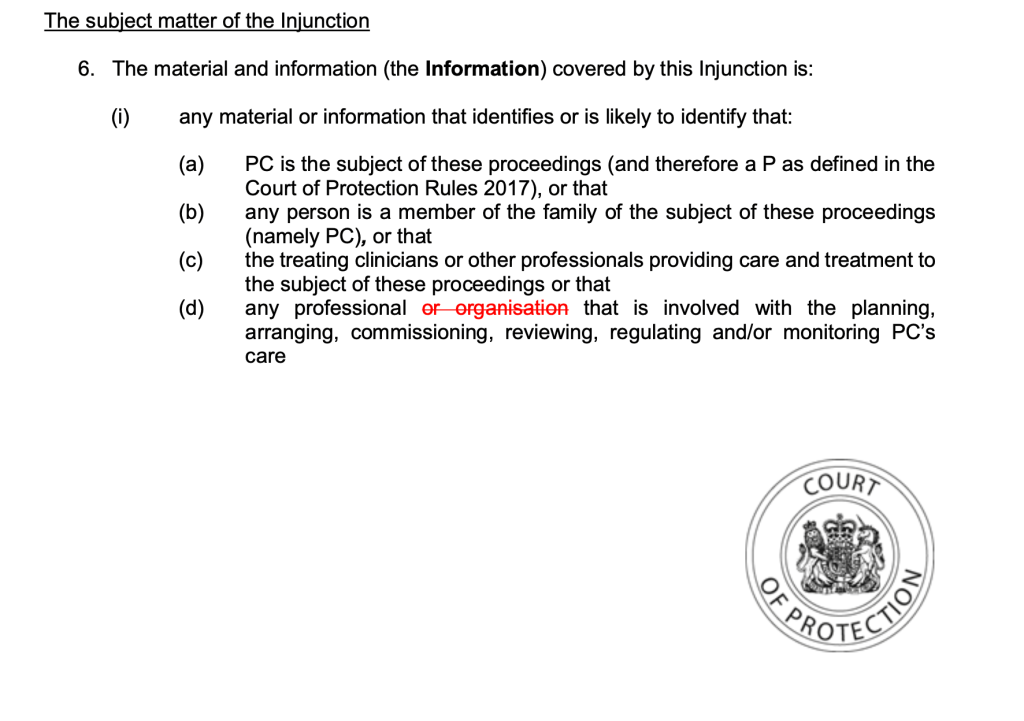
A case we’ve been following for a long time before Mr Justice Poole (COP 13236134) was  listed for 11.30am, Monday 24th June 2024, in person at Teesside.  Here’s how it was listed – as “ATTENDED” (i.e. in-person) – when the lists were published on the Friday before.

I hoped to observe remotely, so I emailed the court to ask whether it might be possible to set up a link, but by this time it was Friday evening and I was concerned that the court staff might not read my email in time and I might miss the hearing. I was observing with a clinical psychology trainee, Amy (who will be writing her own blog about the experience), and we liaised about what to do over the weekend.

Given a history of staff (across different courts) not sending out links in time, we decided, since we live in the North-East, to drive to the court together to observe in person. I emailed the court staff again on the Sunday night to let them know we would be coming along in person,  so as not to put them to the trouble of setting up a link if we were the only people who’d asked for one. 

As it happened, the court staff were very responsive, emailing back at 10.10am on the Monday morning, informing me that a remote link could be set up (and indeed they had received another request for a remote link, which they set up for that person). They sent the Transparency Order at the same time (the injunction which informs us what we cannot report about the hearing – usually the identity of P, the protected party, anyone connected to them such as family members, or any information that is likely to enable their identification). It’s important we receive this document in writing before a hearing so that we understand and do not breach the court’s reporting restrictions. 

I was pleased that we had decided to go along in person: if a link hadn’t been available, we wouldn’t have had time to make that decision, and get there in time for the start of the hearing.

It was a very, very hot day. We made sure we left in plenty of time to get to Middlesbrough, find somewhere to park, walk to the court and get through security. We built in a lot of contingency time in case of delays. 

Finding the court

We were a little bit flummoxed working out which court we were visiting. The listing said: ‘County Court and Family Court in Middlesbrough’ but didn’t give an address.  When we put the court name into Google Maps, what came up is ‘Teesside Combined Court Centre, Russell St, Middlesbrough TS1 2AE’. As the court listing does not have a full address or postcode, we wondered whether there were two courts and whether we would be walking to the correct one. Newcastle has two courts – Newcastle Quayside Law Courts and Civil Family and Tribunal Courts – at opposite ends of the city a long walk from each other. 

The Court of Protection sits under the Family Court, so I thought that the ‘Combined Court Centre’ might not be the correct place. There were two other courts in Middlesbrough – Teesside Magistrates court (I knew it wouldn’t be that one), and Teesside Justice Centre, which (on Google Maps) is listed as ‘Family Court’. What to do? We decided to go with Teesside Combined Court Centre because that’s what came up when we put the words  from the listing (County Court and Family Court, Middlesbrough) into Google Maps. Luckily we had made the right call. 

It can be confusing knowing where to go when you are not part of the court system – I wonder whether people who need to attend courts for their own hearings experience  the same uncertainty we did. 

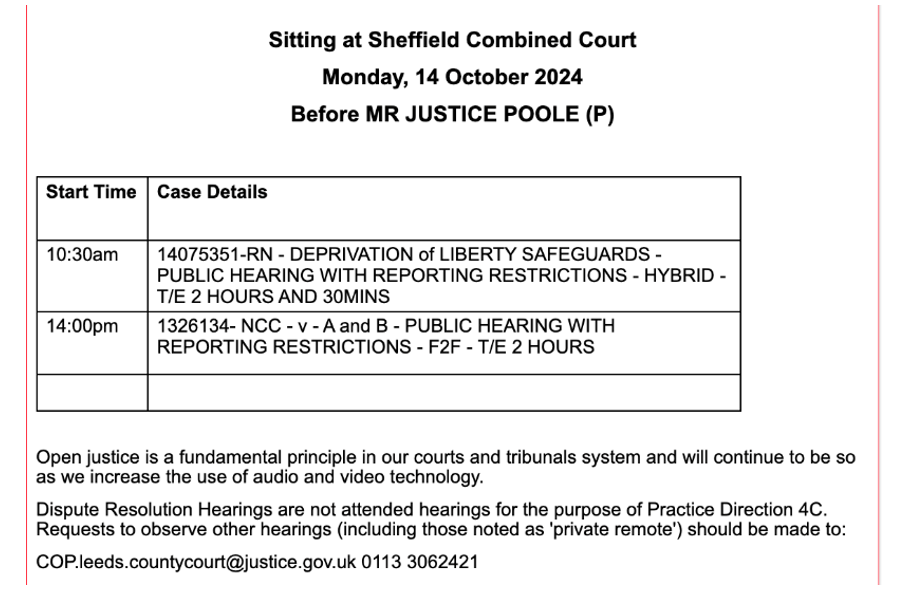
A simple solution would be to list the full address and postcode of the court. Some listings do this (such as Court of Protection hearings at First Avenue House in London), see for example the listing below for a hearing on 1st July. 

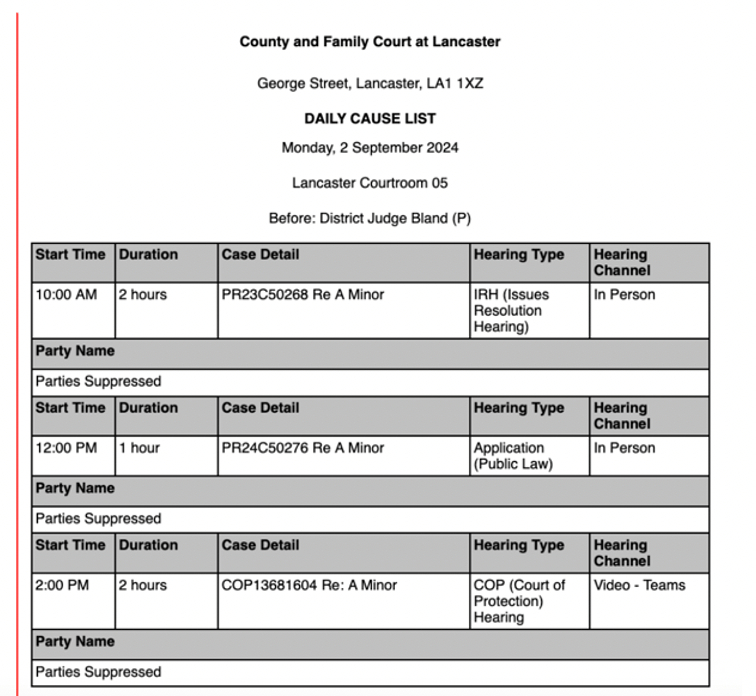
I had a quick look at all Court of Protection hearings on CourtServe for July 1st 2024 and found that there are several listing inconsistencies: some have place name only, some court name only (the most common) and some have full address including postcode.  

Table 1: CourtServe Listings for the Court of Protection for July 1st 2024

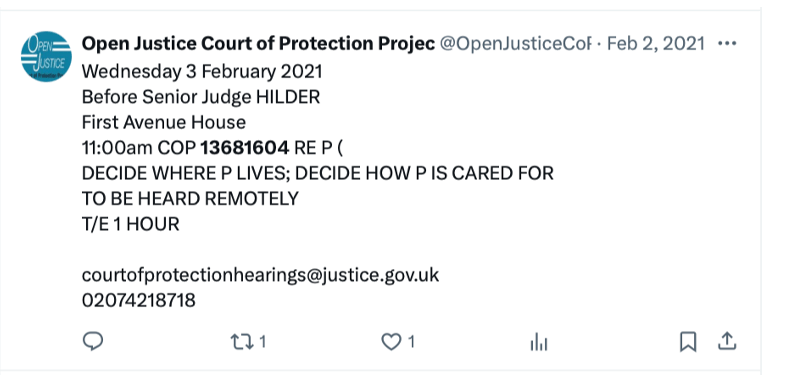
Middlesbrough now had the full address and postcode for 1st July! Very helpful when there are three courts in the city and Google Maps comes up with confusing instructions. 

I’ve learnt subsequently that I could have used “Court Finder” to get this information – but I didn’t know about that at the time, and I’m guessing lots of other people don’t either.

A really good experience of open justice in person

Here are the ingredients that made this such a good experience.

Efficient and polite security

When we arrived at the court there was a table to place bags on for searching. The security guards were very respectful and polite, asking us to remove items rather than rooting around in our bags. We needed to show the keyboards of our laptops and then pass through the security scanner ourselves. The guards used a scanning wand to ‘frisk’ us and this was done efficiently and comfortably. Any ‘offending’ items had to be handed in and collected after the hearing. I still had my brush with mirror (glass) and tweezers and perfume (glass) which I should have remembered to leave at home after the last in-person hearing I went to! It didn’t matter as the staff were very personable, popped them in a bag, gave me a ticket and it was all dealt with speedily and professionally. 

This is in stark contrast to some recent reports of over-zealous court security and inappropriate, sexualised language and touching as part of entry searches in different courts (see here and here).

Accurate listing

As soon as we were through security, we saw on the left-hand side there was a noticeboard with the court’s hearings for that day.  One of the security guards asked which hearing we wanted, and we mentioned Mr Justice Poole. The hearing was there on the board, with the courtroom number.  the guard said he wasn’t sure it was public, and we showed him the listing on the board which said ‘public’. Then he told us which floor the courtroom was on and we made our way there. 

This contrasts with the other in-person I have attended in Newcastle (and blogged about here) when the noticeboard did not have the hearing displayed and we couldn’t find court staff to help us to find out where the case was being heard. 

Helpdesk

The hearing we were observing was on the second floor of the building. There was a helpdesk as we went into the main court room circular corridor, with two people ready to assist. They were very helpful. Again, they said that Court 4 was ‘usually for the Family Court’ and wasn’t likely to be public. I explained that it was a Court of Protection hearing and was listed as public, and that I had observed this same case before, remotely. She was very happy to take us along to the court and, given that we didn’t know the etiquette and how to alert the court usher that we were there, the person from the helpdesk went into Court 4 for us to find the court usher, Olivia, and tell her we were there. She made it seamless, which was much appreciated because we didn’t want to walk into the courtroom when we were not meant to, but equally didn’t want to miss the hearing. Olivia came out of the court and took our names and told us when to come back, and that all parties would be waiting outside, and we could enter with them. 

Again, this contrasts with my experience on the day in Newcastle where there were no staff to ask for help – that could have just been that day, or perhaps they were elsewhere dealing with other matters, but I didn’t notice a helpdesk in the style that Middlesbrough had one. It’s a very good idea – I saw the helpdesk staff assisting lots of people (who seemed to be looking for the court for their own hearings), not only to locate the right court, but also explaining to them what to expect in terms of when things started and where to sit and wait. 

Courtroom Seating which meant we could see and hear proceedings

On entering the court room, we saw Olivia sitting in front of (and lower than) the judge’s bench, at her own ‘bench’ ready to administrate proceedings. We entered to the side of the courtroom and, given that we had met her already, and she knew who we were, I asked her where to sit and she indicated the side benches. This turned out to be a very good perspective because  we could see the faces of counsel and the judge (unlike in Newcastle where you sit at the back and can’t see – or often hear – counsel, because they face the judge). Being able to see everyone’s face also meant we were better able to hear what everyone was saying.

Another public observer, Tim Sugden, blogged about his experience, noting that, when sitting at the back of a court, “what counsel in the front row said was difficult to hear”.  He made the important point: “It’s not open justice if you can’t hear what is being said in the courtroom.  My experience is that this is a recurrent problem in magistrates’ courts – and now I’ve found the same problem in the Court of Protection as well.”  I have also observed remote hearings which were very difficult to follow because the sound quality was so poor. Celia Kitzinger has blogged about a remote hearing that had no sound at all – and even though there were several people (not all observers, she didn’t think) on the remote link, and she alerted the court staff to the problem, the hearing went ahead regardless! 

Hybrid hearings (that are part in-person and part remote) can be particularly challenging, depending upon how sophisticated the court sound system is. Even when there are microphones for each person who is going to be addressing the judge (and for the judge themself) people do not sit still (understandably!) and when they move about, and especially stand up, the microphone does not go with them. At a hybrid hearing at the Royal Courts of Justice, Gill Loomes-Quinn commented in her blog contribution (here) that “the sound quality via the remote link was suboptimal”. Gill struggled to hear witness evidence from a nurse in the case, and this was at the Royal Courts of Justice, where I would expect the sound technology to be good.  Sometimes it’s not only public observers who cannot hear, as Tom McBride described, in this evocative piece describing the Royal Courts of Justice hearing in the same blog

The screen, split up into three different video feeds (showing the witness box, the judge’s chair, and the remainder of the courtroom), gradually becomes busier as barristers, witnesses, observers and staff enter through a door in the corner of my screen. I hear bits and pieces of hushed audio through microphones set up in the courtroom, though nothing is clearly audible. Initially, I assume this is because the remainder of the microphones are yet to be turned on; later, I learn that it is in fact only this microphone which works, which becomes apparent to me when a barrister asks a witness to speak more loudly so that her audio can be picked up.

I teach at a university from time to time – they have small, attachable microphones with a clip-on control box, that we are asked to wear so that when we move about the sound quality is not diminished for the audience. They are rechargeable and sit in docking stations. This would be a good solution.

No inaccurate prohibitions on electronic devices

There was no problem taking in our laptops and mobile phones (although mobile phones, understandably, had to be switched off or on silent). And there were plug sockets to plug our laptops in. There was someone sitting in front of us, also typing notes on a laptop – I think she was a junior lawyer, because one of the barristers came up to speak to her at the lunch break. 

This positive experience contrasts with the confusing and incorrect advice in a report by HMCTS recently published (and later updated in May 2024) about public access to the courts, stipulating that laptops and other text-based electronic devices could not be used in courts. This letter, from the Courts and Tribunals Observers’ Network, challenged the report as follows: 

The Network reported that the Lady Chief Justice responded to the letter,  acknowledging “that the HMCTS advice wrongly suggested that laptops could not be used in court and noted that the service had taken steps to make the necessary correction”. 

However, despite the correction, some courts continue to prevent people from using their electronic devices – see Peter Bell’s recent experience in a Magistrates’ Court in Weymouth:  “I am looking on my mobile phone to find the listing to try and locate the name of the Defendant and the case reference when the Legal Advisor barks across the well of the Court at me – is that a mobile phone? I hold it up and say, I am trying to look at the hearing list …I am told that I must switch off any mobile phone when I come in to Court (see later for my comments on this). I do as I am told – he is much bigger than me! – and switch off my phone.” 

Observers were treated as a routine in court proceedings

When proceedings were underway, the judge noted at the start that observers were present and checked with counsel that we had been sent the Transparency Order. We did not have a sense that we were unwelcome aliens, a threat to the court, or a risk-management issue. These sorts of unsettling experiences have been described by some other observers

In this blog about a hearing before HHJ Burrows, Celia Kitzinger describes how she and another observer tried, and failed, to attend the hearing because the decision not to provide a link (why not?) was made too late.

Had we known earlier that the hearing could only be observed in person, one of us might have made the 1-2 hour journey to Preston to observe it.  But the judicial decision not to provide links to this hearing was conveyed to us way too late to make this possible – and this must surely have been evident to the judge if he’d given it a moment’s thought. […] Of course, sometimes it’s simply not possible, especially in regional courts, to provide video-access to fully in-person hearings because courtrooms aren’t supplied with the appropriate equipment or there are no staff available to set it up.  Requests for remote access can impose intolerable burdens on the court or its staff.  But in this case, the non-availability of a video-link was attributed not to resource problems but to a judicial decision simply not to provide it.”

On another occasion, Amanda Hill received no response from the court, either by email by telephone, and when she did get to speak to someone, the hearing had finished. She was simply told “sorry for any inconvenience caused”. And in this blog, George Palmer, a law student, was refused entry despite having sent requests in plenty of time (and another observer being admitted to the remote hearing): “Disappointed, I was left unable to join the hearing, without a sufficient explanation by the court as to why my emails were not passed across to the judge.”

So, all in all, given the variety of experiences of observers of different courts and judges, we’re impressed by our experience in Middlesbrough. We were admitted without fuss, and sat silently observing, without feeling unwelcome or in the way. 

Good ongoing communication

We were kept informed (again by Olivia) when the break after the morning session turned into a full lunch break (which was not the initial plan). We were sitting in the corridor waiting for the hearing to resume but a decision had been made to have a lunch break and she came to let us know. She must have had lots of other jobs to do but she kept us in mind. 

An on-site café

There is an on-site café at Middlesbrough court, which made things much easier. If you leave the court building for any reason you must go through security again. We did, in fact, opt to do that after eating lunch because it was hot in the building – and getting back in through security was as efficient as the first time. But the cafe meant that if time had been tight, we could have stayed on site. Many courts don’t have this – the answer is to take a packed lunch and some snacks (and a bottle of water).

Final Observations 

Observing in person means not being able to wear your slippers and change your clothes if you are too hot or too cold. It was an exceptionally hot day, and the court building had no air conditioning, or fans in the courtroom. I had dressed for the weather but I will always make sure to have layers in future in case the room is air conditioned (do UK courts have this facility?) or in case it gets too hot. As observers on this occasion, we were actually closest to the open windows in the courtroom, with a gentle breeze wafting in. They had to be closed at one point due to building noise outside, and I immediately started to feel hot and sticky. I very much felt for counsel who were wearing their wigs and weren’t seated near the windows. The swelteringness of it! 

Being an in-person observer, watching how a remote observer is admitted and responded to, meant that we could see how the court usher made sure the remote observer had true access to the hearing. I don’t know what the experience was on the other end, but before the hearing was underway, the usher checked that the observer could see the court and hear. At first there was a glitch in joining and the usher patiently dealt with this. I have had several experiences as a remote observer checking I could hear – when the usher is speaking, often sitting in front of a microphone. What then happens in the hearing is that counsel (in particular, although judges do this too when they are shifting their attention between screens and witnesses for example) stand up to address the judge. This means that they move away from their microphone and often become inaudible. This must have happened on this occasion because at one point the usher asked Katie Gollop KC to reposition her desktop microphone because the remote observer could not hear her. I assume the observer emailed the usher and was responded to straight away. Another exemplary aspect of this hearing, for open justice. I have recently observed a different (remote) hearing in Norwich, however, where there was one microphone shared between all counsel – the usher had to scurry about the courtroom switching it between people as they addressed the judge. 

A final observation is about the compassion I witnessed the judge show to the mother of P (the protected party). She was in court for the hearing (which was about plans to return her adult daughter to live with her – after five unhappy years in a residential care home). At the start of the hearing P’s mother sat alone behind all counsel (who are on the front bench facing the judge) and their solicitors and junior counsel who sit on the row behind them. She was behind a pane of glass and in what turned out to be the dock. I thought that quite ironic, because the way she has been characterised by the Local Authority and NHS Trust certainly positions her as the culprit in these very sad proceedings. I don’t know whether she knew she was in the dock, and her own legal team had not directed her elsewhere. However, when Poole J entered the court room he said, kindly: “You are sitting in the dock! Is there somewhere else you can sit?” 

P’s mother laughed diffidently and moved to the side of the court, directed by (I think) her legal team, sitting beside them for the remainder of the hearing. Whatever her role in her daughter’s life, it must have been very hard for her on her own in this intimidating courtroom, hearing counsel unanimously blame her for what has happened. I hope she could hold in mind the small gesture that Poole J showed to her at the start of the hearing. 

We will blog about what happened in the hearing soon. 

Claire Martin is a Consultant Clinical Psychologist, Cumbria, Northumberland, Tyne and Wear NHS Foundation Trust, Older People’s Clinical Psychology Department, Gateshead. She is a member of the core group of the Open Justice Court of Protection Project and has published several blog posts for the Project about hearings she’s observed (e.g. here and here). She tweets @DocCMartin

Photo credit: The copyright on this image is owned by Oliver Dixon and is licensed for reuse under the Creative Commons Attribution-ShareAlike 2.0 license. It’s been slightly cropped for the display here.

Prohibitive Transparency Orders: Honest mistakes or weaponised incompetence? 

by Daniel Clark, 28th June 2024

I try not to see conspiracy behind the multiple transparency failures of the Court of Protection. The judicial system is busy and overstretched, and mistakes are (unfortunately) inevitable: links won’t be sent in time, listings won’t be always accurate, video links won’t always be set up.

However, I must admit that I’m struggling when it comes to Transparency Orders. Time and again, we’re being sent Transparency Orders that stop us identifying public bodies. In 2024 alone, we’ve been told that we can’t identify Councils, the Public Guardian, and even the Official Solicitor. 

This is more than an administrative error: somebody has drafted the Order, the parties have (presumably) agreed to it, and then the judge has ‘ordered’ it. That’s a lot of people who have seen its prohibitions so, it’s fair to assume, they must have been agreed upon for good reason. 

Or is fair to assume that at all? 

In this blog I’m going to write about two cases where I’ve asked for a Transparency Order to be varied. What I describe isn’t unique but it will hopefully show that Transparency Orders seem to be written on auto-pilot. That isn’t good for open justice, and it isn’t good for court time.

First I’ll explain what a Transparency Order is. For those of you who are familiar with how the Court of Protection works, you might like to skip to the next section, where I’ll explain the first of two cases. Finally, I’ll ask: is this all an honest mistake, weaponised incompetence, or something altogether different? 

What are Transparency Orders? 

Transparency Orders are injunctions made by the court intended to protect the identity of the protected party (P) from becoming widely known. They engage in a delicate balancing act between two articles of the Human Rights Convention: a right to privacy (Article 8 rights) and a right to free expression (Article 10 rights). You can see the Transparency Order template here: https://www.judiciary.uk/wp-content/uploads/2017/11/cop-transparency-template-order-for-2017-rules.pdf

When authorising Transparency Orders, judges consider the balance between P’s right to privacy and the rights of others (family members, the public,  the media and indeed P themself) to talk about court proceedings. This means that Transparency Orders will usually only prohibit the publication of information that identifies, or is likely to identify, P, or her family, or where any of these people live, or are cared for, or their contact details. Unfortunately, this has the effect that P’s family members are unable to talk about the case if they’re using their real names, as “Anna”, a member of our core team, has described (“Gagged – in whose best interests?“).

Victoria Butler-Cole KC has produced an annotated draft Transparency Order that also makes reference to what Transparency Orders don’t usually prohibit. She notes that “normally you will be allowed to name the local authority, CCG or NHS Trust who is involved in the case”. This isn’t something new: this draft was published in 2016. 

It’s important that we can talk about the involvement of public bodies in Court of Protection cases. After all, they’re funded by taxpayers and therefore accountable to the public. If they act in secret, their actions cannot properly be said to be open to scrutiny.  

Sometimes, P will be very well known in her local area. In these instances, a case might be made that a local authority should not be identified because to do so would increase the risk that P may be identified. This is, however, a very rare situation, and it’s usually the case that we can agree not to publish other pieces of information about P in order to safeguard P’s Article 8 rights while also ensuring our Article 10 rights.

One of the standard provisions in a Transparency Order (usually §10) is that “any person affected by this order may apply to the Court for an order…that: (i) varies or discharges this order or any part or parts of it”. I am affected by each Transparency Order that I receive because it restricts my Article 10 rights in some way.

I am therefore in a position to ask a judge to vary a Transparency Order, as I did in the two cases that I will now discuss. 

Case 1: The London Borough of Lambeth steps into the light

This case (COP 14116349) concerns a young woman who was removed from the care of her mother, and put into a care home. We’ve blogged about it before (“Two law students’ first observation of a COP hearing“).

There has been such a significant interference in P’s family life that it is clearly in the public interest to know which local authority is acting in this case. 

There is also some “closed material”  in this case, i.e. P’s mother (who is a party) is not being told something relevant to the case, and the Metropolitan Police have asked the court to keep it that way (for now). 

On Wednesday 22nd May 2024, this case was listed before Mr Justice Keehan, who was sitting remotely (via MS Teams) at the Royal Courts of Justice. I received the link and, after chasing it, I also received the Transparency Order. 

I was disappointed by what I saw. The Order was sealed by DJ Eldergill in July 2023, and prohibited identification of ‘any party to these proceedings’ (see 6(i)(c).  This is what it looks like:

This means that I am prohibited from  identifying the local authority in this case. I also believed it meant that I could not identify the Official Solicitor, who represented P as her litigation friend. This is because I have seen the Official Solicitor being described as added as a party to proceedings, though I understand that technically P is a party and the Official Solicitor is P’s litigation friend.  In any event, neither the judge nor the barristers corrected me, which I take as implicit acknowledgment that my understanding was correct. 

I immediately sent an email, marked as “URGENT”,  for the attention of the judge, with permission for it to be shared with the parties. After making the judge aware that I’m familiar with the need to balance Article 8 and Article 10 rights, I wrote:

Counsel for the local authorityIn respect of naming the local authority, we’re adopting a neutral position. It’s a matter for the court.

Judge: [Counsel for P], do you have any observations?

Counsel for PThere are no observations on behalf of the Official Solicitor. 

Judge: [Counsel for P’s mother], I don’t suppose you do?

Counsel for P’s mother: No observations.

Judge: I’m content to vary the Transparency Order. Thank you very much for raising it. 

With that, I had permission to name the London Borough of Lambeth as the applicant in this case, and also to identify that the Official Solicitor represented P. 

Case 2: The long fight to name Wolverhampton City Council

This case (COP 14158444) concerns an older woman (JG) who lives in a care home. She was challenging her deprivation of liberty under s21a of the Mental Capacity Act 2005, and wants to return home. JG was represented by her Accredited Legal Representative (ALR). 

On Wednesday 10th April 2024, I asked to observe this hearing, which was listed before HHJ McCabe, sitting remotely (via MS Teams) at Wolverhampton Family Court. I received the link and Transparency Order, which was approved by HHJ McCabe in February 2024. 

Upon opening the Transparency Order, I saw (to my dismay) that it prevented me from identifying the local authority. As I’ve done before and since, in this situation, I sent an email for the (urgent) attention of the judge.

In my email, I also acknowledged that the Transparency Order prohibited me from identifying the care home at which P resides. However, the Order specifically named the care home, meaning that it told me P’s address.

This troubled me because I would be furious if I found out my personal address was being publicised in this way, and so I felt that the Court should have its attention drawn to it. 

Between my email and the hearing beginning, something went wrong. The judge only received my email as the hearing was starting (she was reading it as she joined the link) and the parties had not received it. She did not feel happy addressing it at this hearing but did give me permission to file a position statement by 4pm on 21st May 2024. 

With guidance and feedback from this Project’s core team, I set to work. I was also asked by the parties to send me the original email so that they could begin to take instructions, and I did so. When I heard nothing further from them, I assumed that there must be a concern P could be identified from reporting of the name of the local authority. 

In my position statement, I rehearsed the arguments about finely balancing P’s Article 8 rights alongside my Article 10 rights.  I then developed this further:

Holding my breath, and assuming I’d be facing some stiff opposition at the hearing, I waited for the parties to file their position statements in response. 

First came the position statement of the Accredited Legal Representative, on behalf of JG, who expressed “no objection…The ALR notes the contents of Mr Clark’s position statement and in particular the authority of A Local Authority v A Mother [2020] EWHC 1162 (Fam)”. In some cases the identification of a local authority may risk the identification of P, but this was seen by the ALR as only “a minimal risk” here. 

On the morning of the hearing came the position statement of the local authority. This also recognised the authority of Mr Justice Hayden’s judgment in A Local Authority v A Mother. Wolverhampton City Council “respectfully agrees with the view of the ALR”, and therefore did not oppose my application so long as neither JG nor her social worker were identified. 

At the next hearing on 4th June 2024, proceedings were concluded. The court found it was in JG’s best interests to remain in her current care home, alongside continuing work to meet her cultural and spiritual needs. The court also agreed that the Transparency Order ought to be varied.  

And that was that. After almost 2 months of waiting, I could finally say that Wolverhampton City Council was the respondent local authority in this case.

Honest mistakes or weaponised incompetence?

I found these two experiences extraordinary.

Not one of the parties in either case had anything to say about these highly prohibitive Transparency Orders. They offered neither an explanation nor justification. In fact, in the second case, the parties explicitly acknowledged that the risk of identifying P was so minimal that such a prohibition couldn’t be justified.

And yet, these prohibitions didn’t appear in the Order by magic, did they? Somebody put them there. A judge approved them. So, the question becomes, why put them in if there’s no need for them? 

Is it just an honest mistake? Well, it could be. Many Court of Protection lawyers and judges also practice in the family courts, which tend to prohibit identification of public bodies. If a Transparency Order is being filed in a rush, perhaps they’re being written and approved on auto pilot.

But that would mean an awful lot of mistakes.

Having seen so many of the types of Transparency Orders such as those described above, it’s hard not to think that some public bodies are paying lip service to transparency and open justice. The onus for making sure that open justice actually materialises in practice is left with members of the public.

The problem with that is that it can be very intimidating to make the types of application I’ve described. I’m not legally trained – but in both of these cases, I was essentially telling the court, “I think you, and the lawyers in this case, are wrong”. That can be an intimidating thought (and it was when I first started challenging these Transparency Orders but I soon moved past that). 

It also takes up time: time that isn’t freely available to members of the public who are trying to promote transparency in the Court of Protection but who also have other responsibilities. It took a while to write a position statement, and edit (and re-edit) it. And for what? For the parties to say they had no objections. 

So, is this weaponised incompetence? According to Psychology Today, weaponised incompetence ‘is when someone knowingly or unknowingly demonstrates an inability to perform or master certain tasks, thereby leading others to take on more work’. 

This does seem to fit the bill. Somebody somewhere has performed a task that flies against the standard Transparency Order: they are unable to master this task. As a result, others (in the cases above, me) have to take on more work to address the task not being done as it should. 

Regardless of how we understand these prohibitive Transparency Orders, there’s one thing that’s certain. In the words of DJ Geddes, lawyers need to “just stop” routinely anonymising public bodies: “the more [Transparency Orders] that are right, the less time we have to spend on them when there’s much more important things to be thinking about including the actual facts of this case.”

Daniel Clark is a member of the core team of the Open Justice Court of Protection Project. He is a PhD student in the Department of Politics & International Relations at the University of Sheffield. His research considers Iris Marion Young’s claim that older people are an oppressed social group. It is funded by WRoCAH. He tweets @DanielClark132.


[i] https://www.ons.gov.uk/visualisations/censuspopulationchange/E08000031/ [13th May 2024]

[ii] https://www.carehome.co.uk/care_search_results.cfm/searchtown/Wolverhampton [13th May 2024]

What does a Deputy for finances do?

By Ruth Meyer, 26th June 2024

I am quite often asked by people what I do in my job.  The role of Deputy for finances appointed by the Court of Protection does not really mean much to many and probably sounds a bit scary!

I’ve been a Deputy for about 11 years although I have been involved in deputyship work for the last 22 years when I was the deputy’s assistant. The great thing about that was the fact that I’ve ‘grown’ with my clients and have known them since they were very young. My move to become a Deputy was a natural one and I stepped into the shoes of the previous deputy who retired. However, I was very excited to take on the role but also felt the weight of responsibility as the buck now stopped with me!

My own background is very modest. I grew up in the 70’s in South London and went to the local comprehensive school. I am one of four children and the daughter of an immigrant. My mother is English and my father is Asian. He was born in Burma but spent his childhood in Singapore during the Second World War. I was therefore raised to be careful with money and never ever took it for granted. I think this background has helped me understand how hard it can be for families.

I did well at school. People in our local neighbourhood helped tutor me. My dad was very keen that I had the educational opportunities that he unfortunately was not able to have. I obtained a law degree at Southampton University and did my legal training at a small firm in Winchester before qualifying as a Solicitor.

I was able to spend six years practising Wills, Probate and Tax and this gave me an excellent great base of knowledge to have as a Deputy.

This was followed by a six-year career break when I had two children. I was fortunate to have the opportunity to live in the USA on a non-working visa – my husband was working there. However, I sat and passed the New York Bar and worked in a legal clinic to provide free legal advice for those that need it. I certainly learnt to turn my hand to what was thrown at me!

Finally, on returning to the UK I took a job dealing with Court of Protection matters, gradually building up my own team.

Much of my day is spent meeting and talking to my clients and making “best interest” decisions on financial matters that they cannot make themselves. Many of my clients have been damaged at birth due to clinical negligence although I also act for those that have acquired a brain injury, perhaps through a road traffic accident. 

Many of my clients can make everyday decisions i.e. they can manage a small bank account but they would struggle manage larger sums and most of my clients have a compensation award that needs management. Many of my clients are under the age of 30 and so I also work closely with their parents or another relative. Quite often I will take a client on who is still a very young child and I have to be really mindful that not only has the child been impacted by the negligence but also their parents have been through a lot.

Decisions can cover buying a house, paying for care and therapy, purchasing specialist equipment and investing money.  Absolute care must be taken as this money has to last my client for the rest of their lives and for many this is all they have.  They cannot work, have no other income and are vulnerable individuals.

So, how do I make these decisions?  The Mental Capacity Act 2005 states what must be considered as far as possible as well as who to consult.  It gives you a good steer. I can only make a financial decision if my client is unable to make it themselves and when I do make such a decision it must be in their best interests. For instance, I will look at what benefit they will obtain, the cost of it and the joy it may bring them. I’ve recently agreed to fund a weekend at a music festival for my client and her carer. She is in her 20’s and is desperate to go! It’s a sizable expense but I think she will gain enormous benefit in attending. Due to a brain injury her opportunities for social interaction are limited and I want her to have this opportunity.

For every decision I will try and consult the client as far as possible and usually parents or a carer. These are the people who know my client well and I’m sure they know them better than me!

Many decisions are of extremely high value.  However, what is important is how that decision impacts my client and what is best for them.  Sometimes it is the low value decisions that can have the biggest impact and it is those decisions that make me realise why I love what I do.

Recently, I agreed to fund a weekend away for a teenager and his grandmother and I have thrown in a food allowance so that they can really enjoy their time away without financial worry. 

This is a rare break that my client can have with his grandmother who dotes on him but financially would struggle to fund this.  She will be going as his carer and it means my client has an opportunity to spend some quality time with his grandmother.

With these sorts of decisions, of course, a Deputy needs to consider the finances but equally, they need to consider the benefits from other angles.  My client has had a tough life.  His parents divorced and his mother is unable to look after him and lives in long term care.  His father has struggled with being a sole parent.  So, this is the perfect opportunity for my client to spend some time with his grandmother.  Family is important.

The day after I made the decision, very unexpectedly I received a telephone call from the grandmother to thank me for this “act of kindness”.  I told her to enjoy the time with her grandson and just bring back some happy memories.

Sometimes, a financial decision is not just about the money.

I recall one decision for a young brain injured adult. He didn’t want a deputy but he was stuck with me! He wanted to spend his compensation from a road traffic accident on exactly what he wanted. The problem was that he was vulnerable and he didn’t really have sufficient insight on what could possibly go wrong. He desperately wanted a job but could get one.

Eventually he asked me to give him some of his money so that he could set up a vodka tasting business. I must admit that I prejudged the situation and had grave doubts that this would be a success. Despite this, I asked him to put together a basic business plan and then come back to me – and he did! I looked through the plan and knew instantly that it would only be a matter of time before the money would be lost.

I thought carefully about this. Even though it was significant sum of money, it wasn’t absolutely huge and I figured he would learn a lot from setting up his own business and this would give him the dignity he craved in having a job. Three months in and the money was gone and the business ceased. However, my client did learn a lot and really enjoyed working out the challenges. I’m really pleased I supported him in this. Sometimes an unwise decision may be the correct one.

A year later he had regained sufficient capacity to no longer be a protected person in the Court of Protection and has since gone on to set up businesses in America and Australia.

Strangely, I have never looked back and felt I have made the wrong decision. Every decision, no matter how small is carefully considered. 

I rarely get into a disagreement with a client or family as to a decision but I do warn them at the outset that we may not agree on everything and if that happens we need to have a discussion. If there really is an unresolvable disagreement, I can ask the Court of Protection to make a direction but that is costly to my client and time consuming. Usually, I will try and get some tangible evidence as to why I can’t agree a particular request for funding something. An example was when a client wanted to build a sensory garden for their son but we really didn’t have sufficient funds. So, I obtained a report as to how long the funds would last if we spent that money and we decided to delay it until we had saved enough. That garden is stunning and my client loves being in it but at the time I just couldn’t justify the cost.

On another matter I decided it would be beneficial for me to pay for the education and therapy of my client who had moved to the USA. The monthly amounts were high and I had forgotten to obtain a Court Order allowing me to send money out of the jurisdiction. This meant I was put before the Senior Judge to explain why I had made that decision. The judge was extremely thorough and went through all the financial entries with a fine toothcomb. I was terrified that I had done something wrong (and I had) but it was a genuine error which the Judge was able to rectify by putting an Order in place. It was a lesson learnt and a very stressful experience!

As you can see the work of a financial deputy can be very varied but also it is an absolute privilege in being able to work, support and help those that are extremely vulnerable. I’m very fortunate to have a job I love.

Ruth Meyer is a Partner and Head of the Court of Protection Team at Boyes Turner in Reading and can be contacted on rmeyer@boyesturner.com.

Revoking Lasting Powers of Attorney and an object lesson in Open Justice best practice

By Georgina Baidoun, 24th June 2024

As often happens now, especially with cases involving attorneys and deputies, this one was listed as ‘attended’, which I took to mean “in person”. 

This means that the parties (or their representatives) are attending in person, but it’s possible that there’s a link set up for others involved in the hearing (e.g. witnesses).  Even if that’s not the case, the law permits a link for observers if it’s practicable to do so (e.g. if the court receives a request in plenty of time, and if the courtroom has video facilities and staff to set them up).

I decided I would nevertheless ask to observe remotely. I wrote as follows:  “Good morning. I see that this public hearing is ‘attended’ but would be very grateful to receive a link to observe it on-line if a link is being set up.”

As always,  I attached a screenshot of the court listing.

Entry into the court

I’m afraid I wasn’t optimistic and soon found myself wandering off into the garden, since it wasn’t raining for once. 

Then at 10.38 I received an email from the court in Coventry including a Microsoft Teams link. I washed my hands and entered the court as quickly as I could.

 Ten minutes later, when the hearing was well underway, I got an email from the Birmingham office saying: “Unfortunately, as the hearing is fully attended, there has been no link set up…” So I am left to imagine what had gone on behind the scenes but some trouble must have been taken because, when I entered the court, the judge said that making arrangements for me had delayed them. I duly expressed my heartfelt gratitude.

I hadn’t received a Transparency Order and this was addressed by the judge and, very helpfully, by the applicant’s barrister (see below) who rightly supposed that I was familiar with their general terms, to which I assented. I then turned off my camera and microphone, as I usually do.

The courtroom

My view of the courtroom must have been similar to the judge’s because I couldn’t see her but did get a very good view of all the other participants. They were introduced by Mr Ben Harrison from Serjeants’ Inn, who represented the applicant Local Authority

The first respondent had originally been P’s attorney for both property and finance and health and welfare and was representing herself – I will call her R.

The second respondent, was P’s ‘litigation friend, the Official Solicitor’, represented by Ms Rosie Scott.

Others in attendance were two people from the Local Authority, one of whom was a social worker, and R’s McKenzie friend, a term I hadn’t heard before (see  Afterthoughts below). 

The case before the court

Mr Harrison helpfully made a brief introduction to the case, which I was able to elaborate on as the hearing progressed. 

It transpired that it had begun 3 years ago and that there had been several previous hearings. HHJ Walker had taken over from a previous judge and presided over at least two hearings since then. She had not met R before because R had been unable to attend these earlier hearings due to ill-health. 

In 2021, Lasting Powers of Attorney had been registered for R to have powers of attorney for both P’s property and financial affairs and health and welfare. These powers had been revoked in 2022 when an interim, professional, deputy had been appointed. The reason was that the Local Authority were concerned that P had been subject to ‘coercion and control’ by R when agreeing to nominate her as her attorney and that this ‘coercion and control’ was continuing. They also believed that P had not had mental capacity when she signed the LPA documentation.

The Local Authority had also originally sought to restrict contact between P and R but had now agreed to withdraw this part of their application. They remained concerned but now believed that the risks could be managed by appointing a permanent professional deputy and R, in her turn, had agreed to the revoking of her powers of attorney so this could happen. R made clear that her agreement did not reflect her satisfaction with this outcome but the costs of the case had become disproportionate and it was distressing to P. She insisted that she had always acted in P’s best interests but P was now content to have a professional deputy appointed. 

The LA responded that they were not seeking findings against R. They were also not rebutting that P still had capacity to make decisions about her own day-to-day spending. 

Issues connected with the court process

At this point it turned out that the previous judge in this case had made an order that some of the information before the court should not be disclosed to R (i.e. it is “closed material”, see Guidance). If the case were to proceed to a contested hearing, the need to release this information would have to be considered. The Official Solicitor was of the opinion that it should remain redacted for ever unless the case was reopened and R agreed to this.

The judge expressed her sympathy for the pressure R had experienced throughout the long court process. R said it had taken up a large amount of her time over the last 3 years. She had always responded in a timely manner to the orders of the court but she could not say the same for the other parties. There had been ‘fearful accusations’ made against her and ‘dreadful adjectives’ used which were entirely out of keeping with her previously unblemished reputation. She wanted these removed from the record.

The judge said she could not do that; she could only say that there was ‘no determination’ in relation to these accusations, which was one of the benefits of settling the case now. R clearly felt that she had not had the opportunity to defend herself (guilty until proved innocent as I have noted in a previous post, The Public Guardian, Gifts and Attorneys. She talked about P having achieved her ‘life’s dream of living independently’ and that it had been R’s solicitor who had advised about putting LPAs in place.

The judge said that, if the case were to be pursued, the LA would take the opposite view but, as there was now agreement, their side of the story needed no further hearing.

The Official Solicitor said that her job was a balancing act and that the agreement reached would resolve matters as well as possible.

Questioning the need for an LPA for Health and Welfare

R expressed surprise that, although the issues before the court related to property and finance, her power of attorney for health and welfare was also to be removed. (This is the second case I have observed recently where attorneys have been surprised that the removal of their property and financial affairs powers seems inevitably to lead to the removal of their health and welfare powers too. I am beginning to sense that this is the norm and clearly people find it particularly upsetting.)

R wanted to know what would happen if P needed medical treatment. The judge said that an LPA was not necessary for this as the LA would be able to manage these matters, unless there was significant disagreement about treatment or where P should live, in which case it would come to court anyway. I think this only served to raise further doubts in R’s mind as she then referred to how happy P was in her current home and how anxious she would be if this was brought into question. The judge reassured her that this was not in question at the moment and that no restrictions were being placed on where P should live or with whom she could have contact.

The LA reinforced the lack of necessity for a health and welfare attorney; medical decisions would be taken by doctors. The Official Solicitor said there was no reason at present to think that P could not make her own decisions about her health, which she was doing very competently at present.

Summary and agreed determination

After an adjournment, the judge summarized the case and the agreements that had been reached.

P suffered from ‘complex disorders’ which had remained unchanged. She lacked capacity to engage in these proceedings and there was no reason to think that her capacity had been any different when the LPAs were written. The agreements outlined above were reiterated and the judge reassured R that the court recognized that she had always been a ‘significant person’ in P’s life and there was no reason why their relationship should change. The records would remain redacted because of the harm that they might otherwise cause to P.

Transparency Order

I had emailed Mr Harrison during the hearing asking him for the Transparency Order in case I didn’t receive it from the court. Just before the hearing ended, he asked me if I was still there and, when I turned on my camera and sound, assured me that he would be sending the TO. I took this opportunity to thank him for his help and also to thank HHJ Walker again. It had been a very positive experience. 

After the hearing

After the hearing I also emailed the clerks and thanked them. Then I did some research.

I had not heard of a McKenzie friend before and discovered this https://mckenzie-friend.org.uk/

A McKenzie Friend can best be described as anyone who accompanies you to court to help you as a Litigant in Person – those who are unrepresented by a Solicitor or engage a barrister. Your McKenzie Friend is able to sit with you in the court and offer advice and support as well as taking notes to help you.
There are some things that a McKenzie Friend cannot do on your behalf, such as conduct litigation, file court documents and Statements etc. There is a Practice Direction issued by the Family Courts which explains this in more detail.
Our team of McKenzie Friends support children and their families to help resolve family conflict
. “

It must be unusual to find a McKenzie friend in the Court of Protection since they seem to be concerned with children and the Family Courts; I can’t think of an explanation.

I also wondered about the terminology ‘coercion and control’ and discovered its use in Section 76 of the Serious Crime Act 2015 which ‘introduced the criminal offence of controlling or coercive behaviour in an intimate or family relationship’. Luckily, I had the opportunity to check this with Mr Harrison after the hearing and was assured that that was not how the terminology was being used in this case. (A little knowledge can be a dangerous thing!)

Georgina Baidoun was the lay Court of Protection Deputy for her mother’s Property and Financial Affairs until her mother died in 2021. Because of the difficulties she experienced with several applications to the Court, and with the Office of the Public Guardian in connection with her annual report, she has retained an interest in these areas, including attending Court of Protection Users Group meetings. She is keen to share her experiences in the hope that she can help others who have to engage with these institutions with very little help or guidance. She tweets as @GeorgeMKeynes

What does the Court of Protection need to know about “borderline personality disorder” or “emotionally unstable personality disorder”: An update 

By Keir Harding, 19 June 2024

This is an update of a blog I wrote in November 2020.  A few things have changed since then so while the bulk of the text is still intact, I’ve added a couple of developments and included what changes we might expect from the International Classification of Diseases [ICD]-11, the diagnostic manual in the UK that superseded the ICD-10 in January 2022.  
 
“Borderline Personality Disorder” and “Emotionally Unstable Personality Disorder” are interchangeable terms for a mental health diagnosis typically given to someone who has difficulty managing their emotions, copes in ways that can cause problems for them, and has difficulties with relationships. In theory, it is a diagnosis given by a qualified mental health professional. It is classed as a mental disorder which means that a person with the diagnosis could be detained under the Mental Health Act  (1983). There is a NHS webpage about it here, and a Mind page here.  

For the diagnosis to be given appropriately according to the psychiatric criteria,  people’s symptoms should meet the 3 Ps. Their difficulties should be:  
Persistent – Not waxing and waning, not relapsing and remitting but relatively constant.  
Pervasive – In every area of life. They shouldn’t function brilliantly in one area and not in another.  
Problematic – It has to cause distress to them.  
 
All of the above is theory. But these diagnoses are in reality very contested, and in my experience and the experience of many people who have these diagnoses, the diagnosis can be arrived at after a very brief consultation and without a thorough assessment. I argue that this means, in respect of the Court of Protection, that in proceedings where P has one of these diagnoses, it is important to establish how the diagnosis has been arrived at – and to confirm that it is the result of a rigorous assessment, rather than the ‘gut feeling’ of a clinician. The Royal College of Psychiatrists recommends that“diagnosis should only be made by those qualified to make it and only following a thorough assessment”.  That this has to be stated possibly reflects how little thought can go into the label being applied.  
 
A Contested Diagnosis 
 
There are 10 different types of personality disorder listed in the Diagnostic and Statistical Manual of Mental Disorders (the ‘DSM 5’) – which is published by the American Psychiatric Association, and used to diagnose mental disabilities in the United States and some other countries. These are: paranoid, schizoid, schizotypal, antisocial, borderline, narcissistic, histrionic, avoidant, obsessive-compulsive, and dependent. It’s also possible to be diagnosed with a “mixed personality disorder” or with a personality disorder that doesn’t quite meet the criteria for any of these diagnostic categories (“a personality disorder not otherwise specified”). 
 
I’ve worked in a variety of mental health settings for the past 20 years and I have met fewer than 10 people with a personality disorder diagnosis that isn’t  either “borderline” or “antisocial”.  So, while in theory there are 10 types of personality disorder, only 2 of them seem to be regularly diagnosed.    
 
In my experience, if you are a woman who self-harms, you will get a Borderline Personality Disorder (BPD) diagnosis regardless of whatever else is going on.  Something in this system is definitely wrong.  
 
The World Health Oorganisation [WHO] attempted to do something different when they revised the ICD-10.  At first, they got rid of all of the different types of ‘personality disorder’ diagnoses meaning that people would simply be diagnosed with “Personality disorder” which could be graded as mild, moderate or severe.  The former Chair of the WHO personality disorder group described Borderline Personality Disorder as  “a spurious condition unsupported by science that should be abandoned” and it was abandoned until intense lobbying resulted in BPD making it into the ICD-11 as a descriptor.  Now, your diagnosis can be “Personality Disorder: *rating of severity: Borderline Pattern”.  In theory, borderline pattern is diagnosed if someone meets 5 of the 9 criteria for BPD.  It has yet to be shown whether this change will make a huge difference but some have suggested that by including a BPD option, clinicians will default to what they have always done.  This change means that EUPD should fade out of being used as a diagnosis as more trusts move to using the ICD-11 
 
The ICD-11 does include the diagnosis of complex PTSD, which may well describe the repeated damaging life experiences so common in those given a Borderline Personality Disorder diagnosis. It is certainly indisputable that those who recieve a BPD diagnosis are predominantly those who have lived through trauma and abuse.  Some studies suggest 80% of those with the diagnosis have lived through such experiences and it is recognised as the diagnosis most associated with childhood abuse.  A CPTSD may well help everyone looking at the difficulties someone experiences as natural consequences of what they have lived through as opposed to some sort of disorder or defect that lies within them.  
 
Table BPD criteria 
 
1. Chronic feelings of emptiness 

2. Emotional instability in reaction to day-to-day events (e.g., intense episodic sadness, irritability, or anxiety usually lasting a few hours and only rarely more than a few days) 

3. Frantic efforts to avoid real or imagined abandonment 

4. Identity disturbance with markedly or persistently unstable self-image or sense of self 

5. Impulsive behavior in at least two areas that are potentially self-damaging (e.g., spending, sex, substance abuse, reckless driving, binge eating) 

6. Inappropriate, intense anger or difficulty controlling anger (e.g., frequent displays of temper, constant anger, recurrent physical fights) 

7. A pattern of unstable and intense interpersonal relationships characterized by extremes between idealizationand devaluation (also known as “splitting“) 

8. Recurrent suicidal behavior, gestures, threats, or self-harming behavior 

9. Transient, stress-related paranoid ideation or severe dissociative symptoms1 
 
Research suggests that if you can be diagnosed with one personality disorder, it’s highly likely you’ll meet the criteria for another two.  So that’s 3 personality disorders in all.  In a system that aims to put people into a neat tidy box so that we know a care pathway, it becomes messy because they’re actually in 3 boxes (and they probably display some traits from a few of the other diagnostic categories too).   
 
To be given the diagnosis you need to match 5 of the 9 relevant criteria.  Let’s say my friend Ian and I are on the same hospital ward.  He meets criteria 1-5 and I meet criteria 5-9.  So, we have the same diagnosis, the same treatment plan, and yet we share only one characteristic.    
 
Borderline Personality Disorder could certainly be argued to be the most stigmatised diagnosis out there. As long ago as 1988, an article in the British Journal of Psychiatry (“Personality Disorder: The patients psychiatrists dislike”) reported research showing that psychiatrists treated patients with this diagnosis as more difficult and less deserving of care compared with other patients.  The authors wrote: “The PD cases [sic] were regarded as manipulative, attention-seeking, annoying, and in control of their suicidal urges and debts. PD therefore appears to be an enduring pejorative judgement rather than a clinical diagnosis. It is proposed that the concept be abandoned.” 
 
Dialectical Behaviour Therapy is the most researched therapy for Borderline Personality Disorder.  Its creator, Marsha Linehan (quoted here: “Why you don’t want a diagnosis of Borderline Personality disorder”), advises people who are given the diagnosis “if you end up in the Emergency Room for a medical disorder for gods sakes do not tell them you meet criteria for Borderline Personality Disorder.  Do not tell anybody.  You’ll be treated differently and many, many mental health practitioners won’t see someone who meets criteria for Borderline Personality Disorder”.
 
The question can be asked “Are people with borderline personality disorder the patients psychiatrists dislike, or are the patients psychiatrists dislike told they have BPD?”  The example below from Aaron Beck, the creator of CBT suggests the latter: 
 
A story of two mental health staff talking goes like this:  
“I’m having problems with my patient with Personality Disorder”  
“How do you know they have personality disorder?”  
“Because I’m having problems with them.”  
 
This is why I feel it’s very important that when the court accepts that someone has the diagnosis of BPD they ensure that this is based on a thorough psychiatric examination from an expert in the field, using a trusted rating scale and finding the person to have met the diagnostic criteria.  A person does not “have BPD” simply because their care team find them challenging.   I frequently meet people with this diagnosis who do not meet the criteria but have this label written all over their notes.   
 
Even when people are shown to have met the criteria, the court should be aware of the subjective nature of assessment for this diagnosis.  Those deciding that anger is “inappropriate” (Criterion 8) or that attempts to avoid abandonment are “frantic” (Criterion 1) may well have difficulty appreciating the unique set of circumstances those they assess are living through.  
 
There is a language around people with this diagnosis that invites people to treat them badly or even cruelly. They are often described as attention seeking, manipulative and in many ways not truly deserving of care. They take up places in the healthcare system that could be used for people who are “really ill”. They are ascribed mythical powers to be able to tear apart previously high functioning teams and, despite a suicide rate of 1 in 10, are rarely taken seriously when describing being suicidal. It is very hard to be helpful to people when you label them as disordered and see them as holding all the characteristics above. This isn’t something society would expect caring people to do. 
 
There are a range of therapies with an evidence based for helping those with this diagnosis, but these treatments are not always accessible.  While DBT is the only one specifically mentioned in the NICE guidelines (specifically for women where self harm is a significant issue), the evidence base is similar for Metallisation Based Therapy (MBT), Cognitive Analytic Therapy (CAT) and many others.  It is always worth checking what help has been offered and whether that help has an evidence based for the problems being described.   
 
Perhaps a more useful way of thinking about this is through the lens of trauma.  I’ve very rarely worked with anyone where the difficulties they have now don’t make sense in terms of previous experiences of neglect, abandonment and abuse. If we can remember what has happened to people, we tend to be empathic. When we label that person as disordered, we tend to locate the problems in them rather than the people or circumstances that hurt them, or the circumstances of their trauma. I would bet money that this label is disproportionately applied to the girls who survived the child sexual abuse scandal in Rotherham – but the people we sympathise with now will be the people who are blamed for their problems in the future.  Again, it’s worth checking if any evidence-based help around trauma has been offered.  
 
Jay Watts writes of testimonial injustice once this label is applied. The words of those given the diagnosis are seen as meaningless because an expression of pain is viewed as just seeking attention, and a legitimate complaint is ‘typical PD’. “Inappropriate anger” is one of the criteria for BPD and what greater power imbalance can there be for someone whose reactions to injustice are labelled by others as “inappropriate”? 
 
Many would argue the diagnosis can be useful and I sometimes find it helpful for those I work with, if only because it comes with ‘NICE’ (National Institute for Health and Care Excellence) guidelines (see here and here) that recommend specific ways of helping people with this diagnosis. I help a lot of people leave compulsory treatment because the care they are receiving bears no relation to what is recommended in the guidelines.  In the face of risk, teams move from “being with” people and start “doing to” people.  Collaboration ceases and as people respond badly to the restrictions (whose potential for harm is spelled out in the guidelines), this is only seen as evidence to restrict more.  Recommended therapies are not provided or are provided by those who are untrained – and despite a recommendation not to prescribe medication for BPD, polypharmacy (the prescription of multiple medications to one person daily) is rife.  
 
Another common theme I see in legal reports is for someone’s current presentation to be generalised to their entire life.  It can be forgotten how an inpatient environment is often perceived as harmful and not recommended for people with this diagnosis, with the ‘NICE’ guidelines telling us admission should only be used during a crisis.  When people are compelled to reside in a harmful environment, it would make sense that their behaviour changes substantially.  With that in mind I would always want the court to think about whether behaviour used as evidence for anything in one environment can reliably be applied to different environments where often that behaviour has never occurred. 
 
The Consensus Statement for People with Complex Mental Health Difficulties who are diagnosed with a Personality Disorder was published in 2018. In this statement,   many people with lived experience and some professional bodies including the British Psychological Society stated “We would like to abandon the term ‘personality disorder’ entirely”.  That won’t happen any time soon though and its arguable that the ICD-11 category of “personality difficulties” will open the door for many more people being seen through the lens of personality disorder with the implications already outlined.” This is a scary prospect and while seeing that someone has a diagnosis of BPD will tell you much about their relationship with those who should care about them, it will tell you nothing about the value of their personality.  
 
The ICD-11 allows the diagnosis of children from the age of 14 with personality disorder.  The current RCPsych guidelines state “it is important that the diagnosis is made in this age group”.  Over 1200 mental health professionals signed an open letter calling for children not to be diagnosed until it can be proven that the diagnosis does not harm them in May 2024.   
 
I very much hope that the contested and controversial nature of personality disorder diagnoses that I’ve described here is understood and borne in mind by the Court of Protection whenever it makes decisions concerning people with one of these diagnoses.   
 
Keir Harding is an Occupational Therapist and Dialectical Behavioural Therapist with 20 years’ experience in mental health and an MSc in ‘personality disorder’.  He has been a lead therapist NHS services and is now Clinical Lead for Beam Consultancy.   Keir works closely with people with lived experience to provide training, expertise and therapy to help avoid long term hospitalisation. He serves on the executive board of the British and Irish Group for the Study of Personality Disorder.  He tweets @Keirwales and is Keir Harding on Linkedin, and Keir Harding OT on Facebook.  He co-presents the podcast The Wrong Kind of Mad on the topic of “personality disorder” with Hollie Berrigan. 
 
 Postscript: Keir tried to get out of writing this, hoping that some of those who were critical of him writing the first blog would step up to improve upon it.  In the absence of any other volunteers he revised the original piece and fully appreciates it could be better. Two very readable lived experience pieces describing the impact of being given this label can be read (here) and (here) 

Decluttering P’s home: Who represents P?

By Celia Kitzinger, 17 June 2024

This was a 20-minute hearing (case number COP 14104740) before DJ Deborah Campbell, sitting in Bristol on 20th May 2024. It appeared in the Courtel/CourtServe listings as “Public with reporting restrictions, via Teams” concerning “(a) If RP has capacity to decide whether his home should be decluttered (b) Whether it is in RP’s best interests that his home should be decluttered“.

Open justice ran smoothly for this case. The listing was accurate and helpful. I received the link in a timely fashion. The Transparency Order (made by HHJ Cope on 22nd September 2023) was in the standard form and doesn’t prohibit identifying any public bodies. The judge welcomed observers and gave us a summary of the case. Oh, if only all hearings were like this!

In June 2023 (so nearly a year ago), the local authority (North Somerset Council, represented by in-house solicitor Will Cottrell) had applied to the court for permission to enter and declutter RP’s home. There was a risk that the Housing Association was going to evict him due to the state of the property – despite attempts made by the social worker to assist him with decluttering, attempts which had not, apparently led to much progress. Since then a specialist decluttering organisation had been appointed to work with RP and that had been much more successful. “His response has been very positive and – to the social worker’s surprise – he’s engaging with them“. Progress is said to be “slow but steady“.

The problem, said Will Cottrell (for the local authority) is that he’d expected to have a pre-hearing meeting with the housing association to hear from them whether RP’s decluttering progress has been sufficient – or at least in the right direction – to the extent that they would no longer wish to evict him. But no representative from the housing association had come to the pre-hearing meeting.

According to the local authority: “There appear to be two options. The most extreme is to do nothing, if that’s what RP wishes, and simply to respect his wishes which may commit him to eviction from the housing association. Or the other extreme would be to remove him from his house to a placement and conduct a complete clearance of the property. Neither option is attractive, and the social worker is steadfastly against the latter. You have already approved an 8-week course of 1-2 hour visits and we have made an application for that to become a permanent support provided to RP.”

There was some discussion about the funding stream. I gathered that a one-off request can be made for someone like RP who doesn’t receive any other services under the Care Act which has the objective of maintaining a habitable home environment.

The Official Solicitor has declined to support RP in the role of litigation friend on the basis of finances: “he’s not eligible for full legal aid but equally doesn’t have enough money to pay privately either“. The local authority has “put out feelers for Accredited Legal Representatives and they said if the Official Solicitor has declined to accept the invitation to act on the basis of financial aspects of the case, then it was highly unlikely that they’d accept it either, for the same reasons“.

The judge was quite concerned about this. She said: “[RP] is aware these proceedings are ongoing and he’s aware of the eviction risk – though his understanding of the eviction risk is- He doesn’t have capacity for that, because he says he’s just going to move to Greece. Are there any other options for ensuring that [RP] can take part in these proceedings?

The local authority raised the possibility of whether the Council would be able to fund RP’s former advocate to represent RP in these proceedings – adding, “I don’t know if he’d then want a solicitor, leading to the same situation“.

I think we have to try”, said the judge. “If there’s no joy on that basis, come back to me and we’ll have to think of something else. Can you update the draft Order to reflect that. Apart from that, I’m happy with what’s proposed“.

The next hearing was agreed for 3pm on 26th June 2024.

Celia Kitzinger is co-director of the Open Justice Court of Protection Project. She has observed more than 550 hearings since May 2020 and written more than 100 blog posts. She is on LinkedIn (here), and tweets @KitzingerCelia

Happy fourth birthday to the Open Justice Court of Protection Project

By the core team of the Open Justice Court of Protection Project, 15 June 2024

Four years ago today, on 15th June 2020, at the beginning of the COVID-19 pandemic, Celia Kitzinger (retired academic psychologist) and Gill Loomes-Quinn (disability scholar-activist) launched the Open Justice Court of Protection Project. 

It was born of our passionate belief that “publicity is the very soul of justice” at a time when it seemed that the public health emergency was closing down the opportunity for people to observe the court in action.

We had no funding and no clear plan about what we were going to do beyond observing a few hearings and writing some blog posts.  The Project was the two of us, plus the website we set up in the hope that some other people might be interested.

It’s turned out to be wildly successful!  

We now have a well-established and respected Project, with five core team members: joining Celia and Gill, “Anna” is someone with personal experience as a litigant in person in the COP for her mother; Daniel Clark is a former paid carer, now PhD student; and Claire Martin is an NHS consultant clinical psychologist working with older people. Last year we also appointed an Advisory group of three lawyers (see “Meet the Team”). 

Over the last four years our website has attracted over 578,000 views from more than 299,000 unique visitors. Numbers are rising every year.

We’ve encouraged and supported thousands of people from a wide range of backgrounds to observe the court in action, and to share their experiences and their reflections via our blog and social media. Contributors include health and social care professionals, disabled people and their families, and those with experience of the Court of Protection as protected parties, litigants in person and expert witness. 

 We’ve published 489 blog posts in four years – that’s about one every three days! – and we have thriving social media outlets and run a WhatsApp group for court observers.

The Project has opened up public awareness of the Court of Protection as never before. 

All this, still without any funding, and as a wholly voluntary organisation run in our spare time by members of the public.

We’ve been thrilled with the positive feedback we’ve received.

 available on the National archives here: https://caselaw.nationalarchives.gov.uk/ewcop/2022/44

(email from blogger, Hita Jadeja)

(from Twitter/X here: https://x.com/AspieDeLaZouch/status/1779485778361385047)

from Twitter/X here: https://x.com/langerslangers/status/1760990048638349339

(on Linked-In, here: https://www.linkedin.com/search/results/all/?keywords=David%20glasgow%20careful%20methodical%20and%20respectful&origin=GLOBAL_SEARCH_HEADER&sid=WE%3A)

Recent remarks from the Chair of the Judiciary’s newly formed “Transparency and Open Justice Board” confirm that “open justice was never limited to journalists; every citizen is entitled to the same access to proceedings in open court”.  Mr Justice Nicklin observes that “where journalists once sat in Courts, now sit a new breed of court reporters. Often representing or reflecting particular interests, they are providing welcome additional eyes and ears of the public in reporting what takes place in our Courts and Tribunals” (§41). We feel seen!

We have four years of experience as citizen-reporters in the Court of Protection. Our Project is in many ways a success story.  We were always pushing at an open door – in theory if not always in practice, and we’ve significantly expanded transparency in the Court of Protection, once “Britain’s most secret court”.  

Our Project is a showcase for what can be achieved by members of the public, seeking to work collaboratively with judges and lawyers in the Court of Protection, and with HMCTS staff, to overcome the barriers to open justice. 

We want to thank everyone who’s supported us over the last year. 

That includes all the judges, lawyers, and court staff, who’ve responded to our emails and phone calls, sent out links, dealt with audio and video problems, and addressed our concerns about listings. We recognise the time-commitment involved and very much value your obvious dedication to transparency and open justice. 

We’re especially grateful to our advisory group members Kirsty Stuart,  Victoria Butler-Cole KC, and Ian Brownhill who have helped us make sense of case law and statute – often at rather short notice – when we were struggling to understand cases, and concerned to report them accurately.

A special thank you to everyone who’s blogged for the Project over the course of the last 12 months (in alphabetical order)[I]: Deborah Airey, Pippa Arnold; Georgina Baidoun, Peter C Bell, Jordan Briggs, Nikki Bowsley, Ian Brownhill, Cliodhna Carroll, Beverley Clough, Chiara Cordone, Amy Dadarria, Kim Dodd, Brian Farmer, Claire Fuller, Ty Glover, Febienne Green, John Harper, Gail Heslop, Amanda Hill, “Hope”, Hita Jadeja, “Jean-Louise”, Ellen Lefley, Daisy Long, Tom McBride, George Palmer, Ruby Reed-Berendt, Nell Robson, “Rose”, Tess Saunders, Rhiannon Snaith, Hartej Singh Saund-Matharu, Tim Sugden, Eleanor Tallon, Jake Thorold, Isabella Treston, Avaia Williams, Ann Wilson, and Kei Yong.

Finally, we want to thank each other for being such fantastic and supportive colleagues and for making the experience of running this Project feel so rewarding. 

We look forward to working together productively over the course of the next year.

HAPPY BIRTHDAY TO ALL OF US!


[i] As a matter of policy, and in line with our overall commitment to transparency,  we do not usually publish anonymous blog posts (or anonymous commentary on them). Sometimes, however, we are forced to do so – as when there is a Transparency Order in place prohibiting an author from identifying themself as a protected party or as family of a protected party (“Rose”, “Anna”, “Hope” and “Jean-Louise”).  We also made the exceptional decision this year to publish an anonymous account from a Court of Protection barrister about their own experience of anorexia (“A tribute to E: How anorexia and ‘Re E’ made me a Court of Protection lawyer”). We very much regret that one of the members of our core team, “Anna” is compelled to remain anonymous due to a Transparency Order: her efforts to get it varied have so far not been successful (see: Gagged – in whose best interests?).

Court-authorised caesarean with chemical and physical restraint if required: A 14-minute final hearing

By Claire Martin and Nell Robson, 13th June 2024

This is a case we’ve blogged about before: “Caesarean: A directions hearing”.

At that point, just under a week before, Deputy High Court Judge Victoria Butler-Cole KC, asked for a full-day final hearing to deal with an application for a court-authorised caesarean for a woman who (probably) couldn’t give consent to it. She asked for oral witness evidence for the court.  She also asked whether the protected party wanted to talk to the judge directly.

But it wasn’t DHCJ Butler-Cole KC who heard the case today (30th May 2024).  It was Mr Justice Cusworth  – and the hearing was over and done with in 14 minutes, with no cross-examination of witnesses (although they were in court) and no mention of whether or not the protected party had spoken with the judge.  Cusworth J authorised the caesarean – with restraint if necessary.

This blog is split into three sections: [1] Transparency Matters; [2] The Decision of the Court; and [3] Reflections. 

1. Transparency Matters

The Court of Protection (CoP) is committed to open justice. Sometimes this is hard to achieve in practice. It takes a lot of steps to get the ducks in a row. 

Hearings have to be listed correctly for the public to know when a case is being heard, to enable them to decide which cases to observe. We observers then email the relevant court to request the link to observe. Someone at the other end needs to read the email and provide the link, in time. So far, so good. If the hearing is hybrid, like this one (meaning that people are in the physical courtroom as well as there being a remote link to attend and/or observe), ‘open justice’ also means being able to see and hear the court in action. This is more difficult than when the hearing is fully remote and everyone can be seen and heard more easily (because everyone is on screen in their ‘cell’ and each person is – usually – directly in front of their computer microphone). 

Knowing who everyone is, is much easier in fully remote hearings too, because people’s names are normally attached to their image on the screen. Open justice means knowing who we are watching and what their roles are. We often rely on counsel to introduce themselves so we know which party they represent. Celia Kitzinger commented in her blog on the lack of transparency in the previous hearing for this same case: “I often recognise the lawyers – if not by sight (which can be hard when they’re be-wigged, though they weren’t in this case), by sound – but in this case I had no idea who the applicant lawyer was.  I eventually figured it out when the lawyer for the Official Solicitor said, about half way through the hearing “Mr Rylatt and I have had some discussion…” – and bingo! I recognised him as Jake Rylatt, a lawyer I’ve watched before (albeit infrequently) in several hearings.  I doubt those observers who hadn’t already come across Jake Rylatt would have picked this up.”

Observers should also be served the ‘Transparency Order’ which is the court injunction telling us who we cannot name in any reporting (almost always P, the protected party, and their family, but sometimes other information is included in the injunction). 

Sometimes there are a few ducks not quite lined up, or totally out of the picture altogether. 

Getting the link

When court listings are posted via Courtel or on the Royal Courts of Justice website (at around 4-5pm each weekday evening) the Open Justice Court of Protection project reposts all CoP hearings on our Twitter/X feed each evening and adds ‘featured hearings’ on the website and Facebook page. 

So, we emailed the Royal Courts of Justice the night before to request the link and Transparency Order. Claire received an email at 08:27 (and Nell shortly after that time) the following morning, informing us that our request had been forwarded to ‘VHA and associate team who will be able to action your request’. That was very welcome. Sometimes responses are not received until very close to the start of a hearing, and we might then email again – bothering busy court staff – to chase up our original request in case it has gone astray.

The hearing was due to start at 10.30am and Claire received the link at 10:09am. So did Nell Robson. 

But Ruth Fletcher (a legal academic working on reproductive rights at the Queen Mary School of Law in London) requested the link for this hearing before we did. She emailed on Tuesday 28th May. We emailed on Wednesday 29th May. Ruth received a reply from the court on Wednesday 29th May but she didn’t receive a link for the hearing, and ten minutes before it was due to start, she emailed again. She also telephoned the number for the Royal Courts of Justice and got no reply. She finally received the link at 11.19am (almost 50 minutes after the scheduled start of the hearing). This is not open justice. The system for collating and responding to observer requests seems to be fragmented and piecemeal, and it is down to pot luck, at times, whether you receive the link in time to enable you to observe. Fortunately for Ruth, the start time of this hearing was delayed until 11.25am, but the difficulty gaining access would put a lot of people off.

Joining the hearing

The hearing was on Cloud Video Platform (CVP). There are a few steps in joining a CVP hearing. You add in your name, then you have to click whether you are joining with ‘video+audio’, ‘audio only’, ‘presentation only’ or as an ‘observer’. I (Claire) have previously clicked ‘observer’, but this choice automatically joins you muted and with your camera off, and you cannot change it once you are ‘in’. In a previous hearing, the court clerk was speaking to me directly to check I could hear and see (which I could), and I couldn’t reply! On that occasion, I wrote in the chat box that I was unable to respond because I had joined as an ‘observer’. So, for this hearing I clicked to join with ‘video+audio’ so that I could respond if the clerk asked whether everyone could hear – which she did!  (The fact that joining as an “observer” causes problems for court staff like this is evidence, presumably, of a lack of consultation with them about how the system works in practice.)

The downside of joining with ‘video and audio’ is that, unlike MS Teams, with CVP you cannot switch off your camera prior to being admitted to the virtual courtroom (there’s a small tick box for joining the link with microphone off). So, I always make a mental note to remember to locate the icon for it the moment I am admitted and switch the camera off. It is at the middle-bottom of the screen! 

A further step before being admitted is needing to enter the PIN number for the hearing (which is in the email that the court staff send with the link to join). It’s so easy not to know how to get through all of this and to find it quite intimidating. And all of this is before you are in the ‘virtual’ courtroom observing proceedings. 

For a helpful explainer on how to access CVP see here: How to join Cloud Video Platform (CVP) for a video hearing

Problems joining this hearing

The hearing was listed for 10.30am but as noted didn’t, in fact, start until 11.25am. It’s not uncommon for a hearing to be delayed for all sorts of understandable reasons. As an observer on the link with the periodic voiceover saying ‘Waiting for the conference host to join’ it can start to feel unsettling when time draws out. We were worried we might be on the wrong link (two different emails had been sent with a link), or that the link had changed.

Claire emailed the court staff at 11.10 to check we were connected to the right link (and also took that opportunity to ask again for the Transparency Order). 

At 11.16 we were connected and there was the sound of people sorting out chairs and the court room. Court staff asked if everyone could hear, so Claire switched on her mic and confirmed that we could hear. The hearing got underway at 11.25am, almost an hour after it was listed to start. It’s worth ensuring you have some time around a hearing’s listed start time and length as often they start late, and we are (usually) not informed of delays or how long a delay may last. 

Who’s who in court

In hybrid hearings – like this one – it is often difficult to know who is who in the courtroom. Others on the remote link are listed, so at least names are known, if not roles. We rely on the key people to make themselves and their roles known. In this hearing, counsel for the NHS Trust was invited by the judge to open proceedings. He might have said his name, but I didn’t hear it. I think it was Jake Rylatt, counsel for the applicant NHS Trust, as the week before. 

Counsel for HW was another man, though in the previous week’s hearing it had been Katie Gollop. We don’t know who was representing HW today because he spoke for a very short time, just answering a query from the judge on one occasion, and we didn’t catch how the judge addressed him. 

There were others in court – who Jake Rylatt said were the psychiatrist who had assessed HW’s capacity for making decisions about her obstetric care, and (we think) a consultant in midwifery. We think there were also instructing solicitors sitting behind counsel, as is usual. 

The judge was not on any screen on the remote link. Celia Kitzinger commented on this experience, see here: “There was no camera on the judge.  There’s something quite unsettling for those of us concerned with open justice for the judge to be nothing more than a disembodied voice in a video-hearing.  Just on principle, judges shouldn’t be invisible!”. So,  Mr Justice Cusworth’s disembodied voice was heard every now and then, speaking to counsel and asking for information. This surprised me for a court at the Royal Courts of Justice. I have observed other hearings there, where the judge, counsel and any witnesses giving evidence could be observed at the same time (via different cameras). 

The Transparency Order

There was no Transparency Order attached to the emailed remote link to observe (recently, I have often had TOs sent with the hearing link) and Claire emailed back straight away, thanking the court staff for the link and re-requesting the TO. However, the TO wasn’t received it prior to or during the hearing. We still don’t have the TO though have requested it twice and have also requested the sealed court order to try to better understand the reasoning of the judgment. We believe that we are entitled to request these documents under COP Rule 5.9 :

The judge has agreed to our request for the order (via email with his clerk), but it has not yet been received nearly two weeks later.

The TO was mentioned, however, at the start of the hearing by Jake Rylatt. He said “For the benefit of observers, the TO material covered by the injunction is any material identifying that P is a subject or P’s family, any information identifying where any people live or are cared for or any contact details and identification likely to identify hospital staff and the prison – she was on a 14-day recall, she’s no longer on this….”

This is what I (Claire) have come to understand as the ‘standard’ injunctions in a TO – which are principally in place to protect the privacy of ‘P’, the person at the centre of the Court of Protection case, and anyone associated with them, such as their family members, where they live and so on. We have found that TOs are not always in their ‘standard’ form when (and if) we do receive them. Sometimes they include, as part of the subject matter of the injunction, a Local Authority, an NHS Trust or even the Office for the Public Guardian (see this recent blog). We might inadvertently identify these bodies if we do not receive the TO, and we are also unable to request that the TO is ‘varied’ (changed) at the time of the hearing, to enable identification of public bodies, if we don’t receive the TO in a timely fashion. 

Opening summary

If cases have not been blogged about or observed before, we know nothing of the case or what the issues are for the court on that particular occasion. 

At this hearing, there was an clear and helpful opening summary from Jake Rylatt, consistent with the  guidance from the former Vice-President of the Court of Protection. The judge in this hearing stated explicitly that an opening summary would be helpful, not least because there were observers present. Such explicit support for open justice from the judiciary is very welcome. 

2. The decision of the court

The previous blog post about this case ends with this: “The judge pointed out that “the legal framework isn’t going to be contentious”, and then listed the hearing for the whole day on Thursday 30th May 2024 (rather than the half-day requested by the Trust) “to give time for a remote visit [i.e. a  conversation with HW] and for the judgment, which you’re going to need as soon as possible”.” 

We didn’t find out, in the hearing, whether HW had spoken to the judge in a ‘remote visit’. HW was said, now, to be in agreement with the authorisations sought – a planned Caesarean section. She was, however, deemed to lack capacity to make this decision for herself and the Official Solicitor (OS) was in agreement with the NHS Trust that this was in her best interests. I don’t know whether the OS was previously opposed, or whether they sought more information. At the previous hearing, there was certainly a question about whether HW had, or would, regain capacity and thus make the decision for herself (which could well have been to have a Caesarean). An up-to-date capacity assessment had been completed:

Counsel for the Trust said: ” Further assessments by Dr A (consultant psychiatrist), with support of the MDT around [HW], last week and Tuesday [this week]. All three concluded that she lacks capacity regarding obstetric care. [It is] agreed by the OS that [HW] lacks capacity for proceedings and her obstetric care. The court is invited to make Section 15 declarations [about lack of capacity for these decisions].”

There were clinician witnesses in court, and the hearing had been allocated a whole day, but the hearing quickly moved to the (joint) current position of parties being submitted to the judge. The position, now supported by both parties (the applicant NHS Trust and the Official Solicitor for HW), was that it was in HW’s best interests to undergo a planned Caesarean section on the 3rd June 2024, with chemical and physical restraint if necessary. Jake Rylatt presented the proposed care plan to the court as follows: 

[The plan is] for a c-section on Monday 3rd  June – this is consistent with her wishes and feelings expressed over the last week or so, supported by psychiatry and midwifery and based on psychological trauma and harm [that would occur] during an induced vaginal birth. Parties are satisfied that a c-section is in her best interests. The updated treatment plan: spinal anaesthetic then general anaesthetic under specific circumstances – one, if she requests it; two, if she’s insufficiently cooperative, or three, if there’s a clear clinical reason for general anaesthetic – that will be assessed on the day. C-section and anaesthesia is set out in detail in the obstetrics care plan. Restraint is set out in a stepwise manner … p179 of the bundle. The crux of the plan is contained in a stepwise plan for management. It essentially envisages that verbal de-escalation will be tried, then oral PRNas prescribed, Lorazepam; failing that, intra-muscular PRN will be administered, then there may be need for physical restraint. The safest manner, taking in to account NICE guidelines, is to use a safety pod and [?]. If that process is not successful at deescalating, then the plan is for review by an anaesthetist and further sedatives as required. It is only anticipated that restraint is required … [lost] if restraint beyond that in emergency … [lost] it’s very much hoped that won’t be necessary and indeed [HW] has been compliant with interventions to date [Jake Rylatt went on to express that this won’t necessarily be so during labour].”

There was brief mention of Deprivation of Liberty being taken out of the agreed draft order and then the judge invited Jake Rylatt to take the court to the draft orders, which confirmed the above declarations (that HW lacked capacity to make obstetric decisions) and authorised the care plan described. 

The judge said:” I am quite content with the treatment order, subject to the spelling of the word foetal“.

And, after an agreement about how long the TO should last for (three months) and counsel for the OS [whose name I did not hear] confirming his agreement to the draft order, that was it. A 14-minute hearing. 

3. Reflections

We’ve presented our reflections separately.

Nell Robson’s reflections

Having just completed an EPQ researching the making of best interests decisions for pregnant women and the common challenges that arise, this case seems to fit the trend exactly. Repeated challenges or issues in the cases I looked at included:  

  • The evident lack of time in most cases, due to applications for pregnant women being brought to court late in the woman’s pregnancy – as is applicable to this case, as HW was 38 weeks pregnant at the time of the hearing. 
  • The difficulty in ascertaining whether a patient lacks capacity – HW’s lack of capacity seemed (from the directions hearing that Celia Kitzinger blogged about) to be predicated on the fact she would not accept that she was pregnant. However, by the time of the hearing that I was observing, HW had accepted that she was pregnant – and yet it was not made clear (to observers) why she had been judged to continue to lack capacity to make birth decisions. 
  • The position that tends to view pregnant women (especially women with severe mental illness [SMI]) as ‘risky’ rather than a person at risk or vulnerable themself
  • The problem of when the woman’s voice being clearly missing from the hearing. Best interests decisions must consider the wishes, beliefs and values of the person concerned. At this hearing it was stated at the start of Jake Rylatt’s submissions that the proposed care plan “is consistent with her wishes and feelings expressed over the last week or so”. But HW was not at the hearing and therefore did not speak for herself, Counsel representing HW (via the Official Solicitor), who we don’t know, did not speak at all about HW’s expressed wishes and feelings and neither did the judge. Although of course, HW might have spoken to the judge at some point, it felt that her own views, and therefore her voice, was entirely missing from those who might have spoken to her said at the hearing. This seems common in cases I have read for pregnant women in the CoP.  

In the very swift judgment, it was ruled that a general anaesthetic may be resorted to if a) HW states that she would like one, b) if she is ‘insufficiently cooperative’, or c) if there is a clear clinical reason for one. The choice of phrase of ‘insufficiently cooperative’ feels concerning to me. It creates the idea that, potentially due to her lack of capacity, she should have no say in her treatment if her views are contradictory to those of her medical team. Surely, her voice should be listened to and respected much more than it is appearing to be? It also seems to position HW as the issue, that her wishes are obstructing the path that the doctors wish to take, rather than her wishes being something that should be used to inform her care.

The largest concern that I felt when observing this case was that the voice of HW was entirely absent, both in that she was not present at the hearing, nor were her views towards her treatment explained adequately at any time. As I had not observed the previous hearing concerning this case, I understand that her wishes and feelings may have been expressed then, however I think that it is still important to restate her wishes when making the final judgment/declaration. It was only counsel for the applicant Trust who mentioned them at the hearing. There was no questioning of the submissions at any point (apart from a small point about whether the transparency order should be for 3 or 6 months) and numerous restrictive measures against HW were authorised without any detail (spoken about in the hearing at least) about when and how  such physical and chemical restraint could be used. Alongside flattening the voice of HW by permitting so much restraint with such little (transparent) scrutiny, this also returns to the issue of perceiving the woman as ‘risky’ rather than a vulnerable person who needs to be cared for and worked alongside with rather than controlled.

Claire Martin’s reflections

I know that HW will have had her baby by now. I hope that the experience was manageable for her. The information that we as observers have is that she (for the majority of her pregnancy at least) did not believe that she was pregnant. I can understand why her clinical team was concerned about the potential impact on her mental health when she went into labour. 

I searched for papers addressing pregnant women who do not believe they are pregnant – and specifically was looking for research about the psychological impact on such women who go into spontaneous labour. It won’t have been an exhaustive scholarly search, but interestingly nothing about the impact on women came up. This might be because I have not searched fully enough, or used the wrong search terms, or it could be that there is no research in this area – perhaps pregnant women with mental health issues who do not believe that they are pregnant are not giving birth spontaneously, and instead are always undergoing planned caesareans.

There is substantial literature on the phenomenon of what is called ‘pregnancy denial’. It has been thought to fall into two categories: psychotic and non-psychotic pregnancy denial. This paper (from 2000) explains the phenomenon below:

This fascinating paper (from 2023) discusses potential underlying mechanisms, possibly updating the understanding of the phenomenon described in to 2000 paper above, concluding:

This paper (again US, in 2011) addresses legal as well as treatment considerations for clinicians, though of course this is in relation to US case law. 

There are several papers making clinical recommendations such as here and here, and  this paper (from the USA, 2024) ends with these recommendations:  

However, I couldn’t find papers explaining why a planned delivery is recommended, although intuitively I can understand that this would be thought best by those looking after pregnant women. As Nell mentions above, it appears that the Best Interests decision (for a planned Caesarean section, with restraint if deemed necessary) was based upon HW’s belief that she is not pregnant, and the MDT’s assessment that she would be distressed by giving birth naturally. Celia Kitzinger said in her blog, “I can imagine that going into labour would be very frightening if you didn’t believe you were pregnant” – but this was simply speculation from Celia about why a caesarean might be in HW’s best interests and not based on anything made explicit in court.  So, I simply don’t know.  

It would be interesting to know if this scenario (going into labour when you believe you are not pregnant) has been researched and reported and what this was like for the women, any subsequent impacts on their mental health, relationships with their babies or other consequences. My (albeit brief) literature search suggests that current practice is based on what others believe is the right way to help women in ‘pregnancy denial’ to give birth, rather than evidence-based practice. I would really like to know if there is research that I have not found about this interesting and very important area. 

In this hearing, I was most struck by the decision of lack of capacity very swiftly being accepted by the judge, given that, only a week previously (at the directions hearing before DHCJ Butler-Cole) there was a possibility of HW regaining capacity, which would have enabled her to make her own decision about whether to have a Caesarean section. In this scenario, I was unsure why the judge didn’t scrutinise the capacity assessment more – especially given that the psychiatrist who did the assessment was in court ready to give evidence. Perhaps, since he and counsel all had the relevant paperwork (and I didn’t) it was all uncontroversial by now. However, to understand how the law operates and how decisions are made – especially very intrusive and draconian decisions such as these – a clear public record of how capacity and best interests decisions are reached should be (I would argue) mandatory. Otherwise, how do we know that this is not just the Trust wanting to do the easiest and clinically safest thing from their point of view? I don’t know if there will be a published judgment for this case, which would, of course, provide that public record. 

Restraint plans were spoken about vaguely (presumably there are details in the approved order) but included chemical and physical restraint if HW was ‘insufficiently cooperative’ (with only a spinal anaesthetic for the Caesarean). It might be that the court order has the detail about the clear steps for chemical and physical restraint and when they are allowed, and I haven’t had the opportunity to read that yet. If it does, I will update this blog accordingly, to reflect accurately the judicial decision-making process.

I know that this is the stark reality of caring for people who might become upset, angry, potentially aggressive and violent. I think that the language used, however, is unfortunate and positions others in a powerful ‘doing to’ role with HW. For example, the phrase ‘insufficiently cooperative’ is probably how staff will see HW if this is the language used in the court order and care plan. I wonder how staff might feel about HW, and their own role(s) in relation to her, if, for example, the plan was phrased in terms such as: ‘If HW changes her mind at any point about her obstetric care, becomes distressed and is asking for a different birth plan’? ‘Changes her mind’ is different to ‘insufficiently cooperative’, gives HW some agency and respect for her own views and continues to afford her wishes and feelings some respect and weight during the process of giving birth. It would frame the entire process dialogically, rather than position HW as a subject who is either ‘cooperative’ or ‘uncooperative’ in relation to others’ plans and powers. Of course, when a best interests decision is made for someone, it is not their decision to ‘change their mind’ about. However, given that the birth plan and court order were determined in the context of HW agreeing with the decisions in them (her wishes and feelings were mentioned and were said to be the same as her clinical team’s), her views were therefore presented as a relevant part of the best interests determinations.

Sam Halliday’s recent paper on pregnancy and severe mental illness discusses the framing of women with mental health problems as ‘risky’ rather than ‘at risk’ and vulnerable themselves. I thought that HW was positioned this way. She was seen as a risk – of becoming uncooperative with the clinicians. I wondered whyand under what circumstances she might move into this position. There was no judicial scrutiny of the details of this scenario (at the public hearing). We didn’t learn any details of a stepwise plan, in terms of what HW would need to be doing to enable chemical and physical restraint to be applied. Jake Rylatt stated the following: “Restraint is set out in a stepwise manner … p179 of the bundle. The crux of the plan is contained in a stepwise plan for management. It essentially envisages that verbal de-escalation will be tried, then oral PRN as prescribed, Lorazepam; failing that, intra-muscular PRN will be administered, then there may be need for physical restraint. The safest manner, taking in to account NICE guidelines, is to use a safety pod and [?]. If that process is not successful at deescalating, then the plan is for review by an anaesthetist and further sedatives as required.

What would count, for example, as ‘insufficiently cooperative’ to trigger this stepwise plan? What were the ‘verbal de-escalation’ methods? How would they be deployed and by whom, and how many people would be around HW? Would HW only need to be refusing the c-section care plan verbally to be considered ‘insufficiently cooperative’, or would she need to be posing a risk to others or herself physically? How long would this be tolerated before Lorazepam was administered, intra-muscularly if necessary? Was there included in the plan an order to spend time discussing HW’s thoughts with her, to better understand her concerns, once she was emotionally ‘de-escalated’? I have read about and have been in other hearings (see herehere and here, the final link describes the judge directing more detail about how P is to be restrained) where these sorts of details were nailed down by the judge, to ensure that P was protected from premature intrusion and force, and also to protect  professionals by ensuring that they knew exactly what they were to do each step of the way.  

The key point here is that, even if this was all already-known by counsel and the judge – because it was all spelt out in the paperwork – we, the public, didn’t know the answers to any of these questions.  Why would you let the public into court to observe a hearing but restrict the information available to us in such a way as to leave us anxious and disturbed about the possibility that restraint was being improperly authorised?  Observers in court are likely to be writing about the case. Compulsion during labour is a (realistic) fear of many women. I’m a very experienced Court of Protection observer, but I came away from the hearing not fully understanding the basis on which the caesarean was being ordered and the circumstances in which chemical and physical restraint would be used, and how they would be deployed. This is the opposite of what the court should be doing – it’s not transparent, and it raises our anxieties about coercion.

I echo Nell’s concerns about HW having no voice – counsel for HW, who is representing her via the Official Solicitor, said nothing about HW’s wishes and feelings, her ‘impairment of the mind or brain’ underlying her lack of capacity, or how she was currently doing. HW as a person was not brought to the court room. Doing so might have humanised her more for the court.  The “court” (meaning the judge) may already know a lot about her – but he didn’t say so and he didn’t tell us anything much at all – again raising our anxieties rather than allaying them. I think – across the two hearings we have observed – we, the public, know very little about HW as a person. 

Overall, I left the hearing thinking that there was insufficient judicial curiosity and scrutiny of very invasive requests regarding a woman’s body. I don’t know (did the judge?) when and how HW might be subject to highly distressing restraint procedures. It might be in HW’s best interests to have a caesarean with the aim of avoiding distress and emotional trauma. That seems like a compassionate and reasonable proposal. It is, however, also known that forced treatment in itself, including physical and chemical restraint is highly likely to be traumatising (see this recent blog about a woman with anorexia for her detailed description of what this was like for her; and this paper). Significant restraint of a pregnant woman was authorised in this hearing, including the administration of intra-muscular tranquilising medications. The stated objective of avoiding the distress of giving birth to a baby HW did not think she was having did not seem balanced by concern for the potential to cause distress by the methods authorised in the order. 

What about the open justice aspects of this hearing? I would say that insufficient attention was paid to this. The hearing had been scheduled – at least initially – for a full day, and it was over and done with in 14 minutes.  Other bloggers (herehere and here) have expressed grave disquiet about court-ordered caesareans. This hearing proceeded as if the legal system had no idea that members of the public might feel concerned about a court-authorised caesarean or might be critical of this decision.

Another 14 minutes or so could have covered the kinds of concerns that members of the public are likely to have about court-ordered caesarean with restraint. The court could have explained the decisions the court reached and the reasons for them in a way that might pre-empt the kinds of criticisms that are routinely and publicly raised about court-ordered caesarean. The hearing, originally listed for a full day, would still have come in at under half an hour – and that extra 14 minutes would have really made a difference for open justice.

Claire Martin is a Consultant Clinical Psychologist, Cumbria, Northumberland, Tyne and Wear NHS Foundation Trust, Older People’s Clinical Psychology Department, Gateshead. She is a member of the core team of the Open Justice Court of Protection Project and has published dozens of blog posts for the Project about hearings she’s observed (e.g. here and here). She tweets @DocCMartin

Nell Robson is a sixth-form student who has recently completed an Extended Personal Qualification entitled: “What are the challenges in making best interests decisions for pregnant/birthing women?”

Irish cases in the Court of Protection

Jake Thorold & Chiara Cordone, 11th June 2024

Ordinarily, the Court of Protection is concerned with the personal welfare or property of people who are “habitually resident” (a term used in cases involving children and vulnerable adults) in England and Wales. On occasion, however, the Court is required to step outside of this comfort zone and consider issues relating to people who are “habitually resident” other than in England and Wales, notwithstanding that they may be physically located there.

This situation has arisen multiple times in recent years in respect of people from the Republic of Ireland. It is sometimes the case that Ireland lacks a suitable placement or appropriate medical treatment for a person’s particular needs (this appears to be particularly the case for those with serious eating disorders), resulting in the Irish High Court making orders for a placement or treatment in England and Wales, in circumstances which (to date) have always involved depriving them of their liberty in the relevant facility. 

A recent example of this is the case of Re RO (Schedule 3 MCA 2005) [2023] EWCOP 55. In October 2023, the Irish High Court authorised the continued placement of a young Irish citizen at a specialist eating disorder facility in England and Wales. This was despite the young woman in question, who remained “habitually resident” in Ireland, making clear that she wished to return to Ireland even if that as to have a serious impact on her health. Proceedings were subsequently issued in the Court of Protection for the Irish High Court’s order to be recognised and declared enforceable in England and Wales. 

How does the Court of Protection approach this situation? Can the Court of Protection second-guess the decisions of a foreign court?

Not a Best Interests Decision

The legal provisions governing the Court of Protection’s powers over people who are habitually resident other than in England and Wales are contained in Schedule 3 of the Mental Capacity Act 2005. In summary, this schedule provides a mechanism for the Court to make declarations that “protective measures” ordered by a foreign court be recognised and enforced in England and Wales. For these purposes, “foreign courts” include the courts of Scotland and Northern Ireland, as well as those of other countries.

A “protective measure” is defined in the Mental Capacity Act 2005 to include any measure directed to the protection of the person or property of an adult (which encompasses anyone over the age of 16 in this context) who, as a result of an impairment or insufficiency of his personal faculties, cannot protect their interests. Notably, a determination that a person lacks capacity constitutes a “protective measure” under the legislation. 

These definitions come from the Hague Convention on the International Protection of Adults (2000). The UK has signed the Hague Convention, but not ratified it (it has only been ratified by Scotland), but these definitions are nonetheless incorporated into domestic law by Schedule 3 of the Mental Capacity Act. 

In the Irish cases referenced above, the typical course is that – following an order of the Irish High Court (which, it should be noted, continues to review matters frequently even after a person moves to England / Wales) – the Health Service Executive of Ireland applies to the Court of Protection for the protective measure to be recognised and declared enforceable in England and Wales. The procedure for making such an application is contained in the Court of Protection Rules 2017 Practice Direction 23A, which details a range of evidence which will need to be provided. 

Perhaps most strikingly, unlike in an ‘ordinary’ Court of Protection matter there is no direct requirement to provide capacity evidence concerning the person in respect of whom an order is sought (albeit if it was obvious that a person did not lack capacity, it is likely that the Court of Protection would refuse to enforce the Irish High Court order). This reflects the fact that the Court of Protection is performing a very different role to its standard fare. Rather than being the primary decisionmaker, the Court of Protection’s role is essentially limited to determining whether the foreign protective measure can be lawfully implemented by scrutinising whether the core procedural and substantive rights of P have been complied with. When such an application is made, the Court of Protection cannot, for example, conduct its own best interests analysis that it might wish to substitute for that of the Irish High Court.

In the important case of Re PA [2016] Fam. 47, the Court of Protection endorsed the position that a decision to recognise or enforce a foreign protective measure is “not a decision governed by the best interests of the individual… Thus it follows that the Court will be obliged to recognise and enforce a measure in a foreign court order even where applying a best interests test it would not be included in an order made under the domestic jurisdiction under the MCA”. This should be distinguished, however, from a decision of the Court of Protection regarding how to implement any such measure, as part of which the adult’s best interests must be considered.  

What can the Court do?

It’s important to acknowledge, however, that the Court of Protection’s power is not entirely circumscribed to simply a rubber-stamping exercise, and in certain situations the Court can refuse to recognise a foreign protective measure. The Court has set out very detailed checklists for Deprivation of Liberty cases) in SV, Re [2022] EWCOP 52 (08 December 2022) which must be met for a foreign protective measure to be recognised, and indicated that an oral hearing is always required in such cases in The Health Service Executive of Ireland v A Hospital Provider [2023] EWCOP 55 (24 November 2023) so the Court is not merely making these decisions ‘on the papers’.

The Court’s discretion not to recognise a protective measure may apply where the measure taken was not urgent and yet the adult concerned was not given an opportunity to be heard in breach of the rules of natural justice. Secondly, the Court may choose not to recognise a protective measure where such recognition would be “manifestly contrary” to public policy, or the measure would be inconsistent with a mandatory provision of the law of England and Wales.

Examples of the Court of Protection refusing to recognise and enforce a foreign order are rare. Recently, however, in Aberdeenshire Council v SF (No.2) [2024] EWCOP 10, Mr Justice Poole did so in relation to a Scottish Guardianship Order which gave power to P’s mother to authorise arrangements amounting to a deprivation of liberty on her daughter’s behalf:

In my judgment therefore, no opportunity was provided to SF to be heard in the case in which the protective measure was made. Furthermore, having regard to the wide powers granted to the guardians, including authorisation of the deprivation of SF’s liberty, and the application of those powers to any future community placement, and given the duration of the order (proposed to be indefinite and made for seven years), the failure to give SF an opportunity to be heard did amount to a breach of natural justice. I am sure that all those involved sought to protect SF’s best interests and that SF’s parents were properly assessed as being suitable guardians. I do not doubt that SF lacked capacity at that time to make decisions about her personal welfare. However, there was no opportunity for her wishes, feelings, and views to be communicated to the court and no provision made for her interests to be represented. There were no safeguards for the protection of her Art 5(1) rights. Natural justice required that in a case where SF’s liberty was being put into the hands of others for a period of seven years, she should have had an opportunity to be heard and/or an opportunity to be represented. SF’s access to the court should not have been dependent on her taking the initiative. Effective access should have been secured for her. As it is, there were no measures taken to ensure that her Art 5(1) rights were upheld.”  

As such, the Court will in certain situations decline to recognise a foreign “protective measure”, in this situation because the adult in question had not been given an opportunity to be heard. It is perhaps somewhat of an irony, therefore, that the Court of Protection will often consider the question of whether to recognise and / or permit enforcement of a foreign protective measure without the relevant adult even being a party to the proceedings or having independent representation.

This is not without controversy, and – as Alex Ruck Keene and Chiara Cordone have argued (a walkthrough of this article is available here)– it gives rise to an uncomfortable tension that a person lacking capacity in England and Wales can have very different rights to another person in an almost entirely analogous situation save that the first person is “habitually resident” in a foreign country. 

Conclusion

These cases are without question an oddity in the Court of Protection world. As put by Alex Ruck Keene, they require “the Court of Protection, and those appearing before it… mentally to undertake a very significant gear shift”. As ever, however, it is essential that the person at the heart of proceedings is not lost sight of in the midst of what is unquestionably a legally complicated area.

Jake Thorold and Chiara Cordone are both barristers at 39 Essex Chambers who specialise in Court of Protection work.

The Public Guardian, Gifts and Attorneys

By Georgina Baidoun, 10 June 2024

My interest in observing COP cases is limited to cases involving attorneys and deputies, and these are usually about property and financial affairs. There are few of them to observe and they are increasingly listed as being ‘in person’, which makes it hard for me to attend.  I was therefore grateful to Celia when she alerted me to a hearing before DJ Ellington at 12.00pm on Thursday 6th June 2024 which was listed (as shown below) as a hearing concerning “decisions relating to property and affairs” with “The Public Guardian” as first respondent.

I emailed to request the link on 5 June at 16.23. I sent a reminder the next day, the day of the hearing, at 11.30. Getting no response, I then rang at 11.53 to be told that the hearing was ‘attended’ – the implication being that it was in person and no links would be provided. I pointed out that that was contrary to the CourtServe listing and the person to whom I spoke easily traced my email and agreed, since I had included a screenshot of the CourtServe entry in my email. She then assured me that she had at that moment sent my request to the court clerk. Exactly an hour later, when I had given up expecting anything, I received this email.

Please note the hearing was delayed and has just started.
Please ensure you join 5–10 minutes before the hearing start time.
Please read the attached Transparency order.

I hurriedly clicked the link and entered the court room, to be asked immediately by the judge whether I had received the Transparency Order. I had acted so quickly that I hadn’t read the bit about the TO being attached so had to go back to it and then assure the judge that I was happy to comply.

I think it was the most crowded hearing I have witnessed. There were ten people there, including myself and the judge, and only the judge was in the physical courtroom. So much for it being ‘attended’ or in-person.

The judge said that they had already gone through the preliminaries so I got no summary of what the hearing was about and found it very difficult to make sense of a lot of it. I couldn’t even make sense of all the people on screen. The only contributor of substance was the barrister representing P, Alexander Drapkin of 5 Stone Buildings. I am used to P being represented by the Official Solicitor but got no sense that this was the case here. I am guessing that he was employed by the ‘interim deputy’ who was referred to and was perhaps another of those in court I am still confused as to who the applicant was. The listing shows it to be P (MGW) and it tended to play out like that, but the Transparency Order says it was the Public Guardian.

This is the second case that I have observed recently where attorneys had already been replaced by an interim deputy and I imagine that this is to protect P’s interests while a case is progressing through the court. It does however, have the effect of making attorneys look guilty until proved innocent.

The Public Guardian was represented by Glenn Campbell and there were three respondents, all of whom were in attendance. The respondents were relatives of P and I think at least two had been his/her attorneys. I don’t know all the reasons why the OPG was challenging their continuation as attorneys but the one issue that came up in court was gifts made from P’s assets to two of them. So it might well be that the challenge originated from the third.

The gifts in question were substantial and well beyond what would normally be acceptable but, in this case, the OPG said that it was not in P’s interests to investigate further. This was because it was very clear that P intended the gifts to be made and it was estimated that, taking into account remaining assets and P’s life expectancy, there would be sufficient money remaining to pay for his/her care needs. I was rather surprised by this as P was in his/her mid-sixties and the sum of money would not last for many years if P was in a care home. There was no mention of the type of care or the state of P’s health, which might have made all the difference.

The judge said she could make no order on the gifts because there was no application in front of her and the matter was now complicated by the fact that P had moved to Scotland and would be subject to a different legal regime. However, it was now on record that the OPG did not have any concerns on the matter.

As to the substantive matter of the removal of the attorneys, I think the judge said that a discussion prior to the hearing had achieved resolution and the attorneys were prepared to relinquish their powers to a deputy or equivalent to be appointed in Scotland. If the attorneys were not prepared to formally relinquish their powers, they were given a date by which to make an application to restore them i.e. the onus was on them. They were assured by the Judge that at this stage there was no finding against them. The Judge asked if they understood and it was not at all clear that they did.

As to costs, the OPG was not seeking any but P’s barrister would be paid, as is usual, from P’s assets. 

My thoughts

I was particularly interested in the decision about gifting and how the outcome relied on P having made his/her wishes very clear in advance of losing capacity. I have done the same thing in respect of my LPA, having left a letter with one of my attorneys (who is also a solicitor). The rules about gifts that can be made from P’s assets by attorneys and deputies are very limiting. Even with clear instructions, it will still be necessary for my attorneys to apply to the court to make the particular gift I want to make and to continue standing orders.

The rules about gifts are set out in Public Guardian Practice Note PN7 (giving gifts).

Conclusion

This was a pretty chaotic experience, only made worse by the fact that the judge appeared in a tiny part of the screen under the name of someone I later discovered was the court clerk! I assume there had been a problem with the judge’s camera or microphone and they had swapped places. Since the view of her was sideways in the courtroom and everyone else was facing their screens, it took a moment even to identify where her voice was coming from when she first addressed me.

Georgina Baidoun was the lay Court of Protection Deputy for her mother’s Property and Financial Affairs until her mother died in 2021. Because of the difficulties she experienced with several applications to the Court, and with the Office of the Public Guardian in connection with her annual report, she has retained an interest in these areas, including attending Court of Protection Users Group meetings. She is keen to share her experiences in the hope that she can help others who have to engage with these institutions with very little help or guidance. She tweets as @GeorgeMKeynes