Happy Third Birthday to the Open Justice Court of Protection Project

By Celia Kitzinger, Gill Loomes-Quinn, Claire Martin and Kirsty Stuart, 15 June 2023

Three years ago today, on 15th June 2020, Celia and Gill launched the Open Justice Court of Protection Project, at the beginning of the COVID-19 pandemic. 

It was born of our passionate belief that “publicity is the very soul of justice” at a time when it seemed that the public health emergency was closing down the opportunity for people to observe the court in action.

When the COVID-19 public health emergency first began in March 2020, Court of Protection hearings moved from physical courtrooms to ‘remote’ hearings via telephone and video-platforms.  For months, Celia had been supporting “Sarah” through the decision-making process about whether life-sustaining treatment was in her father’s (P’s) best interests. It had just reached court – and it turned out to be the first all-remote hearing of the pandemic. It was a brutal experience for Sarah, as Celia describes here: Two years on: A postscript to remote justice.   Seriously concerned that all remote hearings would be equally alienating for P and their family, Celia decided to watch other remote hearings,  tweeted about her experience, and found others were interested.  Gill spotted the opportunity for a wider project and created the website, and we launched the project, on 15 June 2020.  We said:  A key aim of the project is to raise awareness of the work of the Court, and its social impact. Blog posts covering observations by Public Observers, analyses of published judgments, and other social and legal commentary will be at the heart of how we go about achieving this aim. (Welcome Page 15 June 2020)

We had no funding, and no institutional backing – then or now.  We were just two individuals who cared passionately about open justice in a court which makes draconian decisions in relation to the human rights of some of the most vulnerable people in society.  

It didn’t occur to us to “ask permission” of anyone to set up the Project (which we imagined would be something of a niche interest). If hearings were open to the public then we would go along, and encourage others to attend, and we’d write about them – subject to reporting restrictions.  

We couldn’t have anticipated the extent to which simply doing something that seemed to us quite basic and straightforward would have such a ripple effect throughout the Court of Protection and beyond.

Three years on, we have a much bigger project on our hands than we ever imagined. We simply didn’t predict the degree of interest and enthusiasm the project has stimulated, or the extent to which it has encouraged and supported people from a range of backgrounds (including health and social care professionals, and people who are themselves engaged in ongoing proceedings in the Court of Protection) to observe the court in action, and to share their experiences and their reflections via our blog and social media.   

We’ve supported thousands of people to observe Court of Protection hearings and we’ve published 368 blog posts in three years – that’s about one every three days!   They’ve opened up public awareness of the Court of Protection as never before. 

As the extent of the public interest became apparent, Kirsty and Claire joined the Project – and now we’re expanding again.

Welcoming “Anna”, Daniel Clarke, Victoria Butler Cole KC and Ian Brownhill

We’re excited to announce that, as of today, we have two new members of the core group of the Open Justice Court of Protection Project, and three founding members of our Advisory Group.

“Anna” and Daniel Clarke join Celia Kitzinger, Gill Loomes-Quinn and Claire Martin on the core group – the group that makes policy decisions about the Project, and does the day-to-day work of running it (e.g. maintaining the website, posting information on social media about hearings open to the public, selecting “Featured Hearings” for our home page, dealing with queries from the public, supporting observers to gain access to hearings and to write about them, editing and posting blogs and more! 

“Anna” is the author of the most-read blog post of the last 12 months (with 3.4k views).  She’s the daughter of a woman with Alzheimer’s who was at the centre of (what Celia described as) a ‘bog standard’ s.21A deprivation of liberty challenge.  Pseudonymised as “Anna” because she is bound by a Transparency Order, she describes candidly how angry and upset she was when she first learnt about the court proceedings, and what happened as the proceedings progressed (see: ‘Deprived of her liberty’: My experience of the court procedure for my mum).  She has published several other blog posts as an observer of other people’s hearings, as well as making a podcast, giving talks about the court, and engaging with other forms of outreach.  Anna will be making an application for the Transparency Order in her mother’s case to be varied so that she can use her real name when writing about her experience, and contributing to the Project.  You can find more information about Anna on the “Meet the Team” page.

Daniel Clark has been contributing blogs to the Project for about eighteen months, initially from his perspective as a paid carer in the public and private health and social care sectors, with particular interest in behaviour that may challenge and the use of restraint.  He’s now a PhD student in the Department of Politics at the University of Sheffield, focusing on the oppression of older people as a social group. Daniel is also interested in the ways in which the Court of Protection approaches issues of physical restraint. He is a seasoned observer of Court of Protection hearings and has regularly blogged for the Project over the last year or so. For more details see the “Meet the Team” page.

We’ve also created a new Advisory Group composed (so far) of three lawyers with expertise in the Court of Protection.  Kirsty Stuart, who has been involved for the past two years as a member of the core group is moving to the Advisory Group, and we are honoured and delighted that she will be joined by two people who have provided a lot of informal support and information to us over the past three years, and who are now formally part of the Project: Victoria Butler-Cole KC and Ian Brownhill.  They’ve both blogged for us before to explain legal concepts and procedures and as members of the Advisory Group will be doing so in future.  See the “Meet the Team” page for more information about all three.

The last 12 months

It’s been an interesting 12 months for the Project, as increasingly hearings have moved back into physical courtrooms – offering opportunities for in-person (and hybrid) observations but also, perhaps inevitably, raising new concerns about access.  In general, though, we are pleased to be able to say that listings (while still far from perfect) have improved massively: most do now correctly state that hearings are “in public” and most give some indication of what the hearings are about. 

Two issues, in particular, that have arisen this year in connection with our work are (1) ‘closed hearings’ and (2) committal hearings.  

In relation to ‘closed hearings’, we were dismayed to discover that we’d misreported the facts of a case due to the judge having decided to run secret ‘closed’ hearings (without P’s mother and without us) in parallel with the hearings in open court which we’d attended and reported on.  We didn’t know about the decisions made in the secret hearings (the intention was to conceal this information from P’s mother) and the observers felt we had been misled by the court, making (as we said) a mockery of open justice. We wrote a blog about this here: Statement from the Open Justice Court of Protection Project concerning an inaccurate and misleading blog post and publicised the threat this poses to transparency on the Radio 4 programme Law in Action (“Secrecy in the Court of Protection”).  We subsequently made a submission to the subgroup of the Rules Committee set up to advise the (then) Vice President about how closed hearings should be dealt with in future.  This led to  New Guidance on Closed Hearings from the Vice President of the Court of Protection. We don’t think any of this would have come to light without our Project, and we’re proud to be able to highlight a concrete achievement in ensuring better transparency in the future.

In relation to committal hearings, it’s only this year that we’ve had the opportunity for the first time to observe and report on hearings at which judges consider whether someone (usually a family member) should be sent to prison for breaching court orders – for example, for publishing material on social media identifying P when there’s an order that they must not do so, with a penal notice attached. This year we reported on one such hearing in A committal hearing to send P’s mother to prison – and the challenges of an in-person hearing.  This is an ongoing case: P’s mother recently lost an appeal against her suspended custodial sentence. One reason why we’ve not observed these committal hearings previously is because they have not been correctly listed. There is a Practice Direction (Committal for Contempt of Court – Open Court) which says that says that open justice is “a fundamental principle” and that “the general rule is that hearings are carried out in, and judgments and orders are made in, public” (§3), and that these hearings should normally be publicly listed with the information that an application is being made to commit someone to prison, and the full names of that person (§5.2). In fact, it seems that some committal hearings – in both the Court of Protection and in the Family Court – have been listed as private, the name of the alleged contemnor is not published, and the fact that it’s a committal hearing is not included (see Committal hearings and open justice in the Court of Protection)). So we haven’t known about them, and haven’t had the opportunity to observe them. Obviously it’s a really significant concern for transparency if people are being found to be contempt of court, and handed prison sentences, effectively in secret. There is also an ongoing issue as to whether the name of the people found to be in contempt of court should always be public. Like ‘closed’ hearings, committal hearings raise some serious challenges for transparency, and we will continue to address this.

The next 12 months

Our plans for the next 12 months are to continue with our core activities of supporting observers and bloggers in the Court of Protection, while continuing to raise concerns about the barriers to open justice, including closed hearings and committal hearings. There are also ongoing problems with listings, ongoing failures to provide opening summaries, and patchy compliance with observers’ requests both for transparency orders (which, really, we shouldn’t have to ask for but should be sent to us as a matter of course) and for position statements.  We hope, too, now that we have the Advisory Group (whose role will become defined and developed over the course of the year) for more ‘explainer’ blogs setting out for non-legal readers some of the underlying concepts and case law of the court.  Another obvious task in the months ahead is to contribute to the Ministry of Justice open consultation on “Open Justice: the way forward”.  

We want to thank all the judges, lawyers, and court staff, who have supported transparency over the last 12 months – responding to emails and phone calls, sending out links, trying to deal with audio problems (especially in hybrid hearings), and dealing with our concerns about listings. We appreciate the opening summaries (please keep them coming!) and really value the opportunity to read position statements, which support accuracy of reporting.   We recognise the time-commitment involved and very much value your obvious dedication to transparency and open justice. We look forward to working together productively over the course of the next year.

Finally, thank you to our bloggers over the last 12 months (in alphabetical order): Diana Sant Angelo, “Anna” (P’s daughter), NB (P’s cousin), Georgina Baidoun, Joanna Booth, Charlotte Buck, Jordan Briggs, Daniel Clark, Libby Crombie, Lorraine Currie, Jamal L Din, Brian Farmer, Claire Fuller, Catalia Griffiths, JH (a protected party [P]), Astral Heaven, Jenny Kitzinger, Sara Linnane, Ami McLennan (P’s mother), Zack Moss, Aisling Mulligan, Ruby Reed-Berendt, Laura Room, Bridget Penhale, Josie Seydel, Upeka de Silva, Rhiannon Snaith, Eleanor Tallon, Bonnie Venter, Aswini Weereratne, Avaia Williams and Jemma Woodley.

HAPPY BIRTHDAY TO US!

‘Refusing to engage’: A first hearing

By Celia Kitzinger, 11th June 2023

Cases in the Court of Protection often run for years – especially in the county courts, which is means the majority of all hearings. So we often find ourselves watching a third, or a sixth, or an eighth hearing in a single case, without having observed any of the earlier ones.  For example, the ‘covert medication’ case I wrote about here, began with an application to court in April 2018.  The first hearing I watched was in June 2019; I watched another in September 2022 and have tried to follow it since the: hearings are still continuing.

With a series of hearings stretching over many months or years, these cases tend to have  long and complicated back stories.  On joining a hearing, I always have many questions like:

  • Who issued the application to court and what do they want the judge to do?
  • What are the decisions someone believes that P (the person at the centre of the case) is unable to make for themselves?
  • What is P’s impairment or disturbance in the functioning of mind or brain?
  • Has the judge made (interim or final) declarations that P lacks capacity to make any particular decisions?
  • What are the ‘best interests’ decisions that need to be made, and what are the available options?
  • Who are the parties and what do they agree about, and what do they disagree about, in relation to the questions above?
  • What has been happening to try to progress the case so that the judge can make the final best interests decisions – and what’s holding things up?
  • What’s the point of this hearing?

This is why introductory summaries, with information that answers these kind of questions  – as recommended by former Vice President Mr Justice Hayden – are so important. Without these basic facts about the case, it’s really hard to follow a hearing.

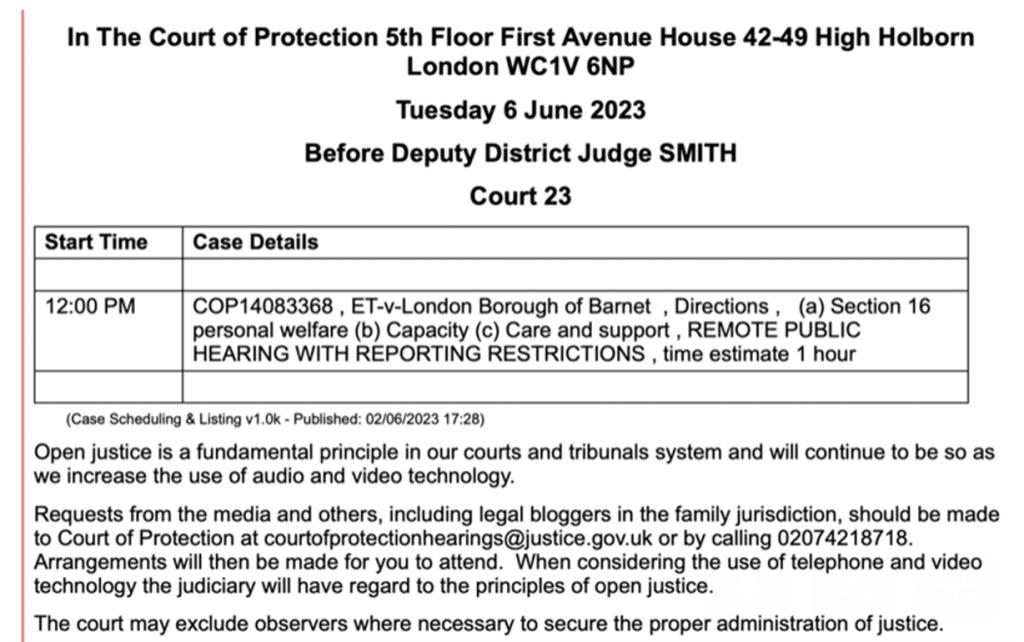
In this case, though, I happened to stumble upon the first hearing in the case.  Here’s how it was listed.

I chose it partly because it was listed before a “Deputy” District Judge (i.e. a part-time judge), and partly because its case number (beginning “14”) indicated to me that it is a newish case: last year, most of the case numbers began with “I3” and before that it was “12”.  And of course, it happened to be at a time I was free and wanted to observe a hearing.

The hearing

I wasn’t sent a Transparency Order, so I haven’t seen a printed version of the injunction against me, but right at the beginning of the hearing the judge asked me if I’d been sent it, and then when I said ‘No’ he read out the “subject matter” of the injunction (the things I’m not allowed to report) and said (and I agreed) that it was the ‘standard’ Transparency Order.  

The judge then did a sort of introduction – saying that the London Borough of Barnet (represented by Sarah Hellier) was the applicant, and that proceedings had been initiated following “safeguarding concerns, especially self-neglect and exploitation”, with “permission to bring proceedings granted on 9th May[i].  The problem today, though, was that the Official Solicitor (the person who would represent the protected party – ET –  at the centre of the case) “has not accepted the invitation to act yet” – so ET is unrepresented. This, said counsel for the applicant, was because the Official Solicitor had not yet received bank statements from ET’s mother, who apparently manages her son’s benefits, and had been asked for bank statements nearly a month ago so that the costs of the Official Solicitor could be sorted out.

Meanwhile, according to the judge, “the situation is quite desperate for him. He is refusing to engage with care.  There has been no opportunity to assess his capacity but there is reason to believe that he lacks capacity in relation to care and support.  He’s got no support with treating his diabetes.  He’s not engaging with psychiatric services.  His home is cluttered and filthy.  I would appreciate it if we could make some progress today despite the absence of the Official Solicitor because there are significant safeguarding concerns”.

The local authority social worker was in court and was asked what attempts had been made to get ET to engage voluntarily with social services.

SW: The last contact was back in April.  We tried again in May. He was running out of his property and we called out to him to see if he would engage with us and he said he was in a rush and to call back later.  He’s never at the property when we call.  There are concerns he’s been begging.  He’s aggressive if you approach him in the community.

Judge: Has he ever been aggressive with you?

SW: No. He’s just refused to engage with me.

Judge: Has he been in touch with any health care professionals?

SW: No. He’s not had any psychological intervention for a very long time.  The mental capacity assessment is not being progressed due to concerns about how he’s presenting.  The Care Co-ordinator is experiencing significant challenges in engaging with him. We are very concerned about him.

Judge: I see.  So the order you’re asking the court to make… You’re asking for an order granting permission to enter his property and use reasonable force if required to enable assessments to be conducted.  A Care Act assessment, and Mental Health Act assessment, and a mental capacity assessment relating to making decisions about residence and care, and capacity to conduct proceedings, and then authorisation of deprivation of liberty if it’s required, with the intent that all those assessments are filed with the court.

Counsel for LA: Yes.

Judge:  While appreciating your concerns with relation to ET’s welfare, I’m also concerned that this order is fairly draconian.  Given that the Official Solicitor is not yet on board, your suggestion is that a time period is allowed for the Official Solicitor to object to this order on ET’s behalf.

Counsel for LA: Yes.  Even if the Official Solicitor were here today, it’s very unlikely that the Official Solicitor would be able to make contact with ET, any more than we can.  Given the range of professionals trying and failing to engage with ET, it doesn’t seem very likely that he’d agree to sit down with the Official Solicitor with a cup of tea and engage with the Official Solicitor on his views about this application.  So, it’s really just a question of someone independent considering the proportionality of entering his home.

The judge asked whether requests to engage had been made in writing to ET.  It turned out they had not.  The judge’s view was that “before entering the property, make a written request for an appointment, with a date and time”. He said, “there’s got to be a further attempt first to deal with this by looking for ET’s cooperation” and “I would hope a more informal approach might work first of all”.    If ET doesn’t respond positively to a written request to permit this, then the local authority can come back to court – and next time the Official Solicitor will (hopefully) be there to represent him (“I am concerned there’s no representation from either his family or the Official Solicitor”).  

I got the impression that counsel for the local authority saw this as simply delaying the inevitable.  She raised further concerns (the risk of “heart attack due to drug abuse”, his other health problems, and “hoarding with the risk of fire, rats, and environmental health issues”). She said: “In my client’s view, there is little likelihood of a capacity assessment taking place without a court order and with restraint in place, based on the information before you about ET’s non-engagement”. 

The judge responded firmly and succinctly.  “Notwithstanding what you say about ET’s vulnerability, he doesn’t have a voice today”.

The judicial refusal to make orders against a protected party with uncertain capacity and without representation in court is something I’ve seen before, in a case before Mr Justice Peel – who was also told that the vulnerable person was a risk of death, in that case from ulcerated legs (see “No decision without representation”). 

The case will be re-listed for the first available date after 27th June 2023.

(UPDATE: I’m told the next hearing will be 21 July 2023)

The judge’s closing words were: “If as you anticipate, there’s still a failure to cooperate, there can be a proper discourse then with input on his behalf from the Official Solicitor.  This is probably an abundance of caution, but given the lack of transparency on the matter of capacity, I think that has to be the approach”.  

Reflections

The local authority has set in motion an application for an order which, if approved, would enable them to enter ET’s home, restrain him, and subject him to a set of assessments which (they believe) will be likely to lead him to be lawfully deprived of his liberty under the Mental Capacity Act 2005, or detained under the Mental Health Act 1983, while he is provided with the care and treatment he is assessed as needing. 

Of course, this sounds, to use the judge’s words, “draconian”.  

If ET were to recognise that he could benefit from care and treatment and voluntarily agree to all of this, then his quality of life would be enhanced.  But he’s “refusing to engage” and apparently doesn’t want social services or psychiatry involved in his life.  Unless he can be persuaded otherwise (and I’m sceptical that an appointment letter will have that effect), it seems that the judge will eventually (at the next hearing) approve an order which will lead to him being restrained and detained against his will, and provided with care and treatment whether he likes it or not.

Is this the right thing to do?

This is not an unusual scenario.  People with addictions, hoarding behaviours, and mental illness who “self-neglect” are often unwilling to engage with social workers and mental health professionals.  Simply accepting their refusals is obviously not always the right thing to do – and may even feel like “writing them off”.  It’s important to make sure people have the relevant information about what help is available and how to access it, and to help them consider the costs and benefits of accepting or refusing that help. Research suggests that what’s key in this situation is to “find the person” – building rapport, agreeing a plan, going at the person’s own pace, engaging in person-centered work (“Working with people who self-neglect”)  – but the problem here is that the social worker can’t engage with ET at all.  

I understand that there is harm to ET in his current lifestyle – both because he’s not getting medical and psychiatric care he could benefit from and (apparently) because he is being exploited. There will be a different kind of harm caused to ET if the court order is approved – harm to ET’s autonomy and sense of freedom to live his life the way he chooses.  To my way of thinking, the notion of ‘autonomy’ is also problematic in any version of it which says, in effect, either you do it voluntarily or else we’ll make you.

At best, we can hope that ET will come to realise that it was all for the best once (as seems likely) he’s found to lack capacity and is transferred to a placement for care and treatment in accordance with his best interests.

Postscript added 12th June 2023: A few people whose knowledge base in this area is greater than mine have commented on social media about this post, including Ian Brownhill who says: “This is interesting. It reads as though the local authority applied to the CoP to gain access to the property to do a suite of assessments, *including* a MHA assessment.” It does read that way, and that was my understanding at the time, but I’m now alert to the fact that I may have inadvertently conveyed that impression due to my own ignorance about the proper process for applying for an MHA assessment (which definitely was one of the assessments the LA wanted to do). I haven’t seen the draft order so I don’t know exactly what they were asking the judge to approve – and it may be that a separate application was made for the MHA assessment outside the context of this hearing: Ian Brownhill tells me that would be a s135 MHA warrant granted by Magistrates Court. Also Ian Brownhill says “Don’t think CoP could authorise to enter solely for purposes of MHA assessment. I could conceive a scenario under 16(5) MCA where a person might be assessed as a contingency.”

UPDATE: I have now received the PS from the local authority, which says: “The Council proposes at this stage an order from the courts to gain access to ET’s home to carry out a Care Act assessment, the aforementioned MCA and order for a MHAA to be completed by AMHP service. The LA can then set out its view on future best interests”. (PS received 7 July 2023)

Celia Kitzinger is co-director of the Open Justice Court of Protection Project. She has observed more than 440 hearings since 1st May 2020 and is a prolific blogger.  She is on LinkedIn (here), and tweets @KitzingerCelia


[i] Quotations are based on touch-typed notes taken during the hearing and are as accurate as I can make them: we are not allowed to audio-record hearings. They are unlikely to be 100% accurate.  I could not locate an email address for the lawyer representing the local authority and have not been able to request a position statement from her, so all the facts about this case are drawn exclusively from what I garnered from the hearing.

Struggling with transparency and a family under stress

By Celia Kitzinger, 9 June 2023

I’ve divided this blog into two parts.  If you can’t bear to hear me complaining (again) about the lack of transparency in the Court of Protection, please skip directly to Part 2, which reports on the substance of the hearing.  

I arrived late to the hearing (see Part 1) and I didn’t get to hear what the local authority had to say.  I heard only a few minutes of rather unilluminating discussion between the judge and counsel for the protected party. But I did hear from the protected party’s daughter and she was clear and frank and articulate, and what I heard caused me great concern.  That’s what’s in Part 2.

Part 1: Access issues (again)

Apologies to our readers.  It’s probably tiresome to read about the problems we have getting access to hearings.  It’s tiresome to have to keep writing about the access problems too.  It’s tiresome to keep living through the access problems – again, and again, and again.  I keep documenting them because until we get access to hearings sorted, we don’t have transparency.  Hearings are not “Public” – whatever it says on the listings – if we can’t get the link to observe them.  

I don’t think it’s a conspiracy to exclude us. I’m tired of having to say that too – but I do have to keep saying it because every time I describe access problems, I get a slew of responses, and about half of them (often from people involved in their own hearings in the Court of Protection or the Family Court) tell me that access problems are engineered by the court to prevent us from observing hearings, so that an oppressive and secretive court can continue its sinister, brutal and unfair decision-making unobserved.  I understand why they might think that, but I simply don’t think that’s true – not least because some of the hearings I’ve been admitted to without any difficulties at all are ones that have reflected extremely badly on the court (e.g. the covert medication hearings I wrote about here).  The other half suggest that it’s unreasonable of me to mention access problems because they are caused by court staff being over-stretched, lawyers and judges being exceptionally busy, and the court system being desperately underfunded.  Like I don’t know that. Like it isn’t blatantly obvious.

The point is that there is a strong judicial commitment to transparency – and our project is designed to support that judicial commitment.  So, if we know that transparency is not working, it’s important to say so. When we let everyone know that, and how, transparency has run into difficulties, we create the opportunity for people who run the court system – His Majesty’s Courts and Tribunal Service (HMCTS), the court staff, lawyers and judges – to figure out how to get it to work better.  If we don’t let them know what the problems are, there’s no opportunity for them to try to fix them.  

So, what happened with this hearing – which is clearly listed as “PUBLIC WITH REPORTING RESTRICTIONS”?

Here’s why, despite what it says on the listing (and despite the fact that I’m blogging about it), it wasn’t actually public.

  • Only 55% of the hearing was actually held in public.  Having requested access via an email sent at 8.04am, I was told by court staff (at 8.59am) that “the judge has approved your request” and that I should receive an email with the link shortly.  I chased the link at 9.48am, finally received it at 10.17am, and it was 10.19am by the time I’d clicked on the link, entered the information required, and been admitted to the hearing.  The hearing ended at 10:42am – so, assuming it began on time, that means I missed 19 of its 42 minutes, which means that 45% of the hearing was closed to the public.  (I have no reason to believe there were any other observers.)
  • When I joined, I had no idea what the hearing was about. Look back at the listing, it’s clear that – contrary to the Court of Protection’s own guidance for listing cases in county courts –  it doesn’t give any information as to what the issues are before the court (e.g. s.21A, deprivation of liberty, where P should live and so on). Nothing.
  • It was very difficult to piece together what the hearing was about from what I heard in court.  As I joined, the hearing was in full swing with the judge saying something about “starting the whole roundabout again[i] and someone called “S Allan, Counsel for P” responding that “Things change and people change and it would go forward unless or until that happens, then yes it would be resolved.”  Clear as mud.  I perked up when the judge asked, “So what order are you inviting me to make?”  but the response was along the lines of “We’re content with the Local Authority’s draft order – limited further investigation and a date for a future hearing”.  Of course, I had no idea what the local authority’s draft order says, or why, or what further investigation she was content to be ‘limited‘.  Usually there’s an opening case summary, as recommended by the former Vice President Mr Justice Hayden (here), but if there was one in this hearing I’d obviously missed it, and nobody thought to interrupt the hearing to provide a couple of sentences of orientation to what the whole thing was about.
  • On the basis of my reading of the listing, I think PM was the person at the centre of the case, and I think S Allan (who might possibly have been Sophie Allan at Kings Chambers) was representing PM as his litigation friend.  I googled “S Allan barrister” and sent an email via the Kings Chambers clerks, asking if it was her, and if so, requesting the Position Statement to help me understand what was going on (and also the Transparency Order).  I didn’t get a reply. I think her instructing solicitor was someone else whose name appeared on screen: Sonal Lala, so I emailed her with the same message.  I didn’t get a reply from her either[ii].
  •   I don’t think there were any other barristers in court, but Lynn Hull, who is a solicitor, seemed to be representing the local authority.  Looking at the listing again, PCC must surely stand for something-beginning-with-P County Council, who must be the second respondent – although Lynn Hull was at one point referred to as being “for the Applicant”, though I thought the applicant was the protected party.  It was all very confusing.  And then PM and KM, the third and fourth respondents (two “PM”s really doesn’t help!) are probably, I deduced, family members of (the first) PM.   I am a very experienced Court of Protection observer – I’ve watched more than 400 hearings, and I’ve learned a lot about how to ‘read’ listings and translate them into what I see on the ground.  But I was still baffled – and most members of the public would be far more at sea than I was.  All this detective work shouldn’t be necessary.  
  • Nobody sent me a Transparency Order.  Nobody even referred to a Transparency Order.  So I’m not bound by any injunction from the court not to name people involved in this hearing, because nobody at any point has told me I can’t name the person at the centre of the case, or their family members.  I do now know the name of the person at the centre of the case, and the name of his daughter, and his granddaughter, because they were mentioned in the hearing.  I’m not going to report them because I’m a decent human being and I don’t want to violate P’s privacy – but it’s simply wrong that the court hasn’t sought to protect P’s privacy, and perhaps most especially that the Official Solicitor (and her legal team) have not sought to protect P’s privacy.  In the absence of any reference to a Transparency Order I am reporting on this case on the assumption that if there were an injunction against me (which there isn’t), it would be in the ‘standard’ terms, and so I will comply with that imaginary injunction.  But most members of the public don’t know what the ‘standard’ terms of a Transparency Order are, or even that they should have been sent one.

Part 2: What was the hearing about?

As far as I can piece it together (see Part 1 for an account of why this is all so difficult), this case began life as an application to deprive PM of his liberty.  

I’m not sure what PM’s living arrangements are, but the judge (HHJ Tolson) said at one point that the draft order makes reference to his being “accompanied by a carer in all visits to the community” – which would, of course, often constitute the kind of ‘supervision’ requiring DOLS-authorisation. 

There seemed to be a dispute about whether or not PM has the capacity to make his own decisions about where to live and what care to receive.  I think the local authority and Official Solicitor take the position that PM does not, or may not,  have capacity to make these decisions – or, indeed, to make his own decisions about his finance and property (among other things).  I think the family members disagree.  S Allan said: “I got the impression that [Daughter] feels there’s a partiality to the present assessment”, and it seems there’s now a disagreement about whether or not there should be a further assessment of PM’s capacity across a range of domains, via a s.49 report.  PM’s daughter made a lot of this clearer for me when she was invited to address the court.  She does not want her father to have any more capacity assessments.  She wants the proceedings to come to an end.

I would like proceedings to come to an end.  Our father is doing extremely well at home – far better than the family expected.  But he’s absolutely miserable because of all the outside parties that have become involved in his life to the degree that they have.  He keeps apologising for the stress on the family, and we’re having quite a few tears over it.  He keeps saying he’s so sorry he got poorly, and this is all his fault.  I just feel it doesn’t matter what he says, or what he does, the other parties just constantly move the goal posts.  The stress is- I can’t begin to explain to you what this feels like.  We are all receiving medical help for the stress.  And it’s not stress due to my father’s illness – but due to all of this!  He’s an amazing man.  He just wants his life back. He wants to be PM as he always was.  He accepts he’s had a brain injury. He accepts help and guidance from the social workers.  He’s not resisting anything.  We just want to be a family.  And we are prevented from doing that, because at times when I’m not working and could be spending time with my father, I’m attending meetings, or filling in forms.  We as a family are helping him in every way we can. His stroke has shocked him.  He’s been shocked into seeing a solicitor and putting things in place, including Lasting Power of Attorney and – to our surprise – a will.  To be honest, we were only arguing about his capacity because we thought if he had capacity that would be the only way we could stop the Court of Protection from going on.  We are not legally minded.  We’re just a family.” (PM’s daughter)

The judge asked: “What is the difference between you and the local authority?”  She replied:

I believe, Sir- Your Honour, that they are trying to gain control over every aspect of my father’s life.  I appreciate that these things are put in place for unscrupulous families who are not acting in the best interests of the patient, but that’s not the case here, and the court should consider the family dynamic.  Everyone who’s had dealings with us, from the professionals in the hospital since our father’s stroke, through to the rehab team and onwards – they all say we have a very close relationship with him.  The neuro- professional, I’m sorry I can’t remember her name, she said she’s come across very close families before, but never anything as wonderful and unique as our family.  We have a great relationship with his social worker. We are not unwilling to accept care. We have asked for certain things, like a bath plug to stop the bath from overflowing and sensors in place before a reduction in the care package. We are recognising that he needs support.  We are not saying, ‘don’t help him’ or “don’t put in care‘.”

The judge asked whether PM is in fact accompanied by carers in visits to the community, and his daughter replied that he was “not very accepting of that”.  She thinks “it’s a pride thing” – that he doesn’t want to be seen as “vulnerable”, and doesn’t want his (many) friends and acquaintances in the community to see him with carers. He is happy to go out with family members, though – and his daughter started to describe a recent visit to a golf course.

The judge tries to explain that the capacity assessment matters because “if he has capacity, he can decide for himself, but if he doesn’t, I have to decide for him”.  The daughter says that if her father “fails the capacity test” then “I just believe he’s going to have his whole life swept away. I don’t think the other parties are acting in his best interests. It’s making him so unhappy”. 

She starts to explain what her father has stated in his Lasting Powers of Attorney (presumably supporting evidence of her view that he values his autonomy), but the judge interrupts and asks whether the LPAs were made “recently”.  Yes, a week ago, she replies.  My heart sinks.  Given what I’m inferring about professional views of PM’s capacity now, I am sure there will be an issue about his capacity to make LPAs.  Sure enough, the judge says: “We’ll probably have to look at that in the context of capacity as well, as there’s an ongoing dispute at the time.  But don’t worry about it.”  Hm!  I’d be worrying about it if I were her.  If only, if only people would make LPAs well ahead of the time they might need them – before the brain injury, the stroke, the road traffic accident, the dementia diagnosis. 

Inevitably, the judge agreed that the requested s.49 capacity assessments could be done, and that there should be a further hearing at which there would be judicial declarations of capacity, and best interests decisions for PM in relation to decisions for which he is deemed not to have capacity.

The solicitor for the local authority asked for the draft order to be amended to permit investigations into PM’s finances, for the purposes of assessing his eligibility for legal aid and for the Official Solicitor’s fees.  She said the local authority had paid the fees of the Official Solicitor so that PM would be represented at today’s hearing “but would be reluctant to carry on with that”.  The judge started to object to this (“the family will feel it’s intrusive and the money will come out of a public pot one way or the other”) but abandoned this quite quickly: “yes, alright, you can have that order”.  And he agreed that capacity to manage finance and property could be added as another element of the capacity assessment.  

It was agreed that there would be half a day set aside for a final hearing. 

Final Reflections

Obviously, I don’t have anything like a complete understanding of what is going on in this case – I have no introductory summary, no position statements, and I missed nearly half the hearing.

What I did pick up is the sense of a family trapped in a set of legal proceedings they don’t understand and don’t want to be part of.   A beloved father has (it seems) had a stroke and been left with brain damage which is causing some difficulties with day-to-day living.  He is willing to accept some assistance, but reluctant to accept other kinds of help.  It sounded to me as though there are close family members who want him to be happy and are supporting him in his wishes, and maintaining his autonomy as far as possible.  They are not ready or willing to cede his autonomy to the ‘best interests’ decision-making processes of the state.

I think very few families are prepared for the way the state intervenes when a relative is deemed to have “lost capacity”.  I often hear people’s shock and disbelief that the state can “take over” decision-making, and that professionals are suddenly the ‘best interests’ decision-makers on behalf of someone they have known and loved for decades.  The effect, however well-intentioned, is often to undermine the family – the very support system that the newly disabled person is so dependent on.

I have experienced this in my own family following my sister Polly’s brain injury in a road traffic accident.  Professionals swept in and took over – assuming (correctly) that they had the right to make best interests decisions for her, and that they needed to do no more than ‘consult’ us.  They made decisions we thought were the wrong ones.  It’s been devastating for our family. And I am terrified of something like this happening to me too.

I have put in place all the right paperwork to protect myself.  I have a Lasting Power of Attorney [LPA] for Health and Welfare and for Finance and Property registered with the Public Guardian.  I have an Advance Decision to Refuse Treatment [ADRT], and an Advance Statement.  I have written a document to be handed to any judge who is responsible for hearing my case in the Court of Protection in the future, explaining the things that matter to me, and what I do and do not want the court to do in considering my best interests.

Listening to the 55% of this case that was open to the public, I realised again the power and authority of the state to intrude into a family’s life together.  It wasn’t the fault of the judge (he seemed rather sympathetic to the daughter) nor – from what I could see – was it the lawyers who were to blame.  It’s simply the way the system works. I suspect the system was working as it should, with the right assessments being ordered and the right matters being considered, in line with the law: the Mental Capacity Act 2005.

That’s the tragedy for some of us.  Contrary to what many of the people who respond to our blog posts claim, I don’t think the court is riddled with corruption or that the lawyers and other professionals involved in hearings are (generally) deliberately lying to the judge or misrepresenting the situation, or even, as this daughter said, “trying to gain control over all aspects of my father’s life”.  It’s not (for the most part) about personal motivations of scheming professionals.  The system is working, slowly and inefficiently, in the way it’s set up to work.  The law says that once a person is deemed to have lost capacity to make their own decisions then (in the absence of advance planning tools like LPAs and ADRTs – and sometimes despite them) decision-making power and responsibility falls to professionals.  Not to family members.  That’s the law of the land. And by the time most people discover that, it’s too late to do anything about it.

Celia Kitzinger is co-director of the Open Justice Court of Protection Project.  She has observed more than 430 hearings and written over 100 blog posts.  


[i] As usual, we are not allowed to audio-record hearings, and so these quotations from the hearings are based on contemporaneous touch-typed notes and are as accurate as I can make them, but are unlikely to be verbatim.

[ii] After getting this blog post up on the site for automated release the following morning, I found an email message from the solicitor (sent just before 10pm) saying that she was checking whether the OS was happy to share the Position Statement or not.  I pulled the blog post from publication for 24-hours in anticipation of being (possibly) able to check my facts against that statement. Having not heard back from her subsequently, I am going ahead with re-scheduling this blog post, and will add a “Postscript” if the Position Statement is subsequently sent to me, and make any corrections to my understanding of the case at that point.

P loses bungalow option due to assessment delays

By Celia Kitzinger, 7 June 2023

This was a thoroughly depressing hearing.  

I asked to observe it (COP 12446297 before HHJ Godwin) without much idea of what it was about, simply because I had some time free and noticed a hearing in Wales – which we cover less than we should.   Access to the cloud video platform hearing was swift and efficient.  Everything went downhill after that.

I was sent a Transparency Order (with the link) which, as usual, says I can’t write anything likely to identify P or P’s family or carers, or where any of them live.  Unusually, though, the Transparency Order also says that I can’t name the local authority bringing the application.  I wanted to ask why the local authority can’t be named.  It’s a public body and should be held accountable – especially (as it turned out) when it seems to be failing badly.  I wrote an email to the person who’d sent me the link asking him to bring my concerns to the attention of the judge, and also raised the matter in the ‘chat’ box on the cloud video platform.  The judge did not address me about this, so I can’t name the local authority. I do not know how Article 8 and Article 10 rights were balanced in making the decision to prevent the public from knowing which local authority was involved.

Nobody provided a summary of the case for me as an observer and nobody volunteered position statements.  I have pieced together my understanding of this case on the basis only of what I heard in court.  

The hearing began with the judge expressing his “disquiet” about not having received the paperwork until an hour before the hearing.  The lawyer for the applicant local authority apologised, but didn’t explain why that had happened.

The judge had been provided with a draft order that had (I think) been agreed between the parties – but it seemed that several successive versions had been sent (including one very recently) and “the draft I have doesn’t indicate what time it was prepared”.  The draft order  also turned out to have multiple paragraphs with the same designation, which didn’t help when the applicant lawyer tried to go through it with the judge (“the first 2(b) or the second 2(b)?”).

Counsel for the Local Authority

Counsel for the local authority (Richard Alomo) said he would “talk the court through the order”.  He was not an impressive advocate.  He worked his way through the recitals, “confirming P’s placement, when she moved there, and the restrictions she’s currently subject to”, saying that she was undergoing assessment from an Occupational Therapist (OT) for two alternative placements.  The judge (HHJ Godwin) interrupted1:

Judge:  Why is it taking so long?  Why five months to do this form of assessment?

Alomo: It only started about 3 weeks ago.

Judge:  P is occupying a designated ‘assessment’ flat, and she’s been there since 31st January this year. I’m told the assessment will not be done until mid-June.  Surely when someone goes into an assessment flat, you expect them to be assessed?

Alomo:  I don’t disagree.  This is a complex case. There have been meetings every week. It has had to be taken slowly.  But the report will be ready by the end of June.

Judge:  Why was it only started three weeks ago?

Alomo: (pause). The social worker gave me an explanation for that.  I cannot find it in my notes.  My instructing solicitor can perhaps send me a note answering that question.

Judge:  She’s unsettled about the fact that she’s occupying temporary accommodation. It’s a matter of concern for her.  She needs a permanent home.  It’s taking five months since her placement started for that assessment to be made. And I’d told the assessment only started three weeks ago. That’s not fair on P.  

Alomo:  I don’t disagree with that.  I hope to be able to advise the court on the reason for that.  However, looking at the timetable moving forward it is not unreasonable to be looking at having the OT assessment by the end of June.

Judge:  It is unreasonable for the assessment not to start until May when she’s been there since January.  She’s not happy being there. We know that. And yet the assessment didn’t start until early May. This case is limping along, Mr Alomo, and there needs to be an injection of pace put into it so that she can move to a permanent home. […]. Well, we are where we are, but I am expressing disquiet that she’s been in that assessment flat for four months without anything happening at all.

Then it turned out there was a problem with the capacity assessment.  The most recent assessment of P’s capacity to make her own decisions about care and residence (and a host of other matters, including litigation capacity, contact, and internet use)  was a year out of date.  The judge was concerned that  “there is reference to a Special Education Needs report, but I haven’t seen it“.  He was also concerned that a capacity assessment needed to take into account P’s means of communicating as a profoundly deaf person – she uses British Sign Language, but also other means of communication, and it’s not clear what those are.  

Things were going to be further delayed by the need for a social worker’s report which (apparently) couldn’t be provided under after the Occupational Therapist’s report. 

The five months the judge had already found unacceptable was now stretching into six months.  He returned to his complaint, sounding very frustrated.  

Judge: Why wasn’t the OT assessment started until May, when she’s been occupying the assessment flat since January?  She herself is distressed to be occupying a temporary home.  She wants a permanent home. It is incumbent upon those caring for her that this assessment is carried out without delay, and five months is not without delay.

Alomo:  The work required of the social worker is quite extensive and it will take her some time to complete the work set out in that paragraph. There needs to be an analysis of the realistic options as far as P’s residence is concerned.  And it cannot be completed without the OT assessment being available, and that’s why we’re saying it will take until 21 July to be completed.

Judge:  Yes, but if the assessment had been carried out promptly, we wouldn’t be in this position.  I’m told she’s been informed she’ll be moving to the bungalow across the road, or to a flat upstairs in the building she’s in now.  She’s expecting that to happen.  I’m possibly stealing Ms O’Shea’s thunder, but really this matter should have been pressed forward a lot sooner than it has been.

Alomo: I acknowledge well and truly the concerns and apologise to the court.

There was then some discussion about how soon the case could come back to court, and the plan was to list it again for 3rd August 2023 at 10am.

Solicitor for P

Ms Clare O’Shea was representing P via her litigation friend.  She began by saying there was “quite a lot to unpick” in what Mr Alomo had just said. 

First of all, she said, it had been revealed in the course of the advocates’ meeting just before the hearing that the bungalow P had been hoping to move into “has already been lost”. 

Because of delay?”, asked the judge.

Well, as you know, they are like hen’s teeth”, said Clare O’Shea.  “Unless the local authority is prepared to pay to reserve a placement, they are just going to let it go as soon as someone comes along that it’s suitable for”.    

Judge:  She’s been told that she’s going to move into the bungalow and you’re telling me this cannot happen.  So, the options that I was advised were available are no longer available because of the delay.

O’Shea: This wasn’t drawn to your attention by Mr Alomo.

Judge:  When things are not going as you expect them to go, make an application!  Bring it back to court.  Let’s have the Health Board explain why there has been such a delay.  The court is here to help P, but her position has worsened. There has been a delay during which the options potentially available for  herin January are no longer available.

O’Shea: I agree there has clearly been a significant delay.  The statement of the former social worker set out all the assessments required, and they’ve just simply not been progressed.

Judge: No.

O’Shea: So, pragmatically, because they’ve not been done, the bungalow has been lost, and the flat is not reserved.  In the advocates meeting I did try to see if there’s any way, if options are going to be lost, I put it to them whether there was any room for manoevre.  The OT assessment, which the local authority says must come in before the social worker can make a best interests assessment of the placement options – could they not make a best interests decision sooner, just to try to maintain the one remaining option?  But the local authority said no. They said the OT assessment was really necessary.  I did put it to them that a move from the assessment flat to another flat in the same building was really like-for-like.  But they said it was a move from a ground floor flat to a first floor flat, though I’m not quite clear of the significance of that, so the OT assessment was required.  She loved the idea of the bungalow and was quite excited by it.  And now it’s not an option.

Judge: Not only that, but she’s going to see someone else move into it, across the road.

O’Shea: The social worker has indicated that those kinds of discussions about options won’t be had with P in future.  But when options might be lost, should there be consideration of whether the best interests decision should be made sooner.  When we come back to the next hearing, we are going to have lots of evidence, and no options.

Judge: I see from paragraph 18 of the order that the package of care proposed may be “on a trial basis”.  That almost begs the question  – if the flat upstairs is available now, why can’t the trial take place there now.  Otherwise, we will be back in court in August with no options at all.  Her hopes have bolstered by being told she’s going to move into the bungalow, and she going to see someone else move in there.  She’s distressed by being in temporary accommodation.  She wants a home of her own she can settle into.  By the time we have the reports that have been promised, the options are no longer available.

Alomo:  I will record that as something for the local authority to consider.

Judge:  It would be helpful to know why it is that this OT report is going to take a further two months.  Mr Alomo indicates it’s been in preparation already for three weeks.

O’Shea: It will alarm you, as it alarmed me, to be told-  The first bombshell at the advocates’ meeting was that it may not be ready until September. There were frantic discussions.

Judge:  That is quite scandalous.  

O’Shea:  I made loud noises at the meeting and there were phone calls made and an assurance, by phone, in the meeting, that it would be ready by the end of June.

Judge:  If it is not in by the end of June, bring this back to court. This is outrageous.

O’Shea: I give you my assurance I will keep a close eye on it. I did moot joining the Health Board. The social workers felt that the Health Board didn’t need to be joined as a party – there have been recent changes and they have a close working relationship.  But I think one more delay with the health side is going to necessitate them being joined.

Judge: It beggars belief that her psychological wellbeing is not being considered by the Health Board. I really do ask you to bring this matter back if there’s any suggestion of further delay.

O’Shea:  She is complex, and she’s been going through a tough time recently and is obviously struggling.  In their previous statement back in March, the local authority was saying they needed the OT assessment, and a Psychology assessment and a Speech and Language Therapy assessment.  They raised that, but a decision was made not to overwhelm P, so that’s why there is only the OT focus.  There will be a delay with Psychology because the psychologist is going on maternity leave.  So really, these assessments are not being progressed.

Judge: It begs the question, does the local authority need to instruct an independent Psychologist.  I can only ask you to bring these matters to the attention of the court so we can assist P.

O’Shea:  And the capacity evidence has been sort of parked.  When I was first instructed, one of my first actions was to look for experts in deafness. But then it looked as though there would be an early breakthrough all of a sudden, with specialist deaf placements.  But the breakthrough didn’t happen, and she came here. It’s safe to say I’m kicking myself for not progressing it at that time.

Judge: Evidence of capacity is fundamental to the jurisdiction of this court.  The restrictions she’s under do need to be very carefully considered.  She signs in a language of her own, as well as BSL.  There needs to be someone who can communicate with her.  With all due respect to the recently qualified social worker who assessed her capacity before, the report we have is fairly perfunctory.  She is using the internet and social media and has the ability to use social platforms, and she may have greater ability than is suggested.

O’Shea:  Your Honour, I absolutely hear you loud and clear.  I will make an application for an independent expert report.

Judge:  The sooner that application is made the better.

O’Shea:  I will go back through my file. I did a search previously.  I will look for an expert who can assist with the capacity assessment first, and then assist with the care plan, and with best interests as well further down the line.

Judge: Not too much further down the line. We need to move this case along. […]. This case really must be moved on, for her benefit.  I will list the case urgently if there are further delays.

Finally, the judge turned to Mr Alomo and apologised for what might look like “shooting the messenger” but re-emphasised that the local authority “must make every effort to bring matters to a happy conclusion. If there’s any more delay, and we need to join the Health Board, then we’ll do that. Include in the order that if there is any slippage, then the case must be restored to the list”. 

Mr Alomo, on behalf of the local authority, said that he had now had an answer as to why P’s OT assessment was only started in May, despite her having lived in the temporary ‘assessment’ flat since January.  The answer was “the Health Board has staffing difficulties and P has been on the waiting list for some time”.

The judge pointed out that there are Independent OTs available and ‘when there is delay causing distress to someone in P’s situation, consideration needs to be given to that”. 

I will be interested to see what progress has been made on 3rd August 2023 – by which time P will have been in the temporary assessment flat for more than six months(2).

Celia Kitzinger is co-director of the Open Justice Court of Protection Project.  She has observed more than 420 hearings since 1st May 2020 and is a prolific blogger.  She is on LinkedIn (here), and tweets @KitzingerCelia

1 Quotations from the hearing are based on contemporaneous touch-typed notes and are as accurate as I can make them, given that we are not allowed to audio-record hearings. They are unlikely to be 100% verbatim.

2The August hearing was adjourned. Instead of hearing the case, the judge approved an agreed order from the parties, in essence authorising a ‘transition plan’ enabling P to move into the bungalow (which had somehow become an available option again) in early September 2023. The next hearing was listed for 5th December to allow time for P to settle in and provide for an assessment of how it was working out for her. The judge also directed the parties to address the transparency issues I’d raised. See next blog post about this case called: “British Sign Language, capacity and transparency”.

A ‘bog standard’ s.21A case: Amanda’s (‘Anna’s) Mum

By Celia Kitzinger, 5 June 2023

Update April 2025: Following a successful application to vary the Transparency Order, the name ‘Anna’ can now be retired and Amanda Hill can speak in her own name. Her bio is at the bottom of this blog. In recognition of the many months when Amanda had to remain as Anna, this blog hasn’t been edited to remove ‘Anna’s’ name.

Nobody’s case should be described as ‘bog standard’ because everyone is unique, each family is different, and the Court of Protection makes decisions for specific individuals based on their particular circumstances and their personal values, wishes, feelings and beliefs.  Nonetheless, ‘bog standard’ was the phrase I found myself using – and was later called up on – when I spoke to Anna about her mother’s forthcoming court hearing.  

Anna’s mother, Mrs Jones (not her real name) is a widow in her eighties and has a dementia diagnosis.  Anna and her siblings (and Mrs Jones’ social worker) had agreed that Mrs Jones was no longer safe at home and moved her into a care home, initially for a period of respite for six weeks.  At the care home, Mrs Jones was assessed as lacking capacity to make decisions about her care and residence, and a best interests decision was made that she needed 24-hour care.  A standard authorisation of Mrs Jones’ deprivation of liberty was granted shortly afterwards.  

According to the local authority (and her family), Mrs Jones is generally doing well in the care home. She’s eating and sleeping well, accepting support with personal care, socialising with staff and residents, and she enjoys listening to music and joining in with communal activities.  However, when asked if she’s happy in the care home,  she generally replies by saying that it’s “like a prison”, that she doesn’t need to be in a care home, and that she wants to return home.

This court hearing, nearly a year after she was admitted to the care home, was a “Section 21A” challenge brought by Mrs Jones (via her litigation friend the Official Solicitor), challenging her detention in the care home as an unlawful deprivation of her liberty, on the grounds that it was not in her best interests.  

For Anna, the involvement of the court was a momentous and frightening prospect. She found the language and concepts used very upsetting.  As she later wrote: “whereas the law regards [our mother] as being deprived of her liberty, we, her family, believe that she is a vulnerable adult who is somewhere safe, protected and well cared for” (Anna’s blog post about the experience is here.)

Like most family members, Anna didn’t know ,when all this started, what the Court of Protection was, or how her mother could possibly have instructed a legal team, without her mother knowing anything about it.  She had been told that the court case was between her mother and the local authority that was depriving her of her liberty, and that the family was not formally involved.  If they did want to be involved they should consult (and pay for) their own lawyers. How could that be right?

Anna had not even been informed directly about the case. She’d learnt about it through her sister, Mary, who is also their mother’s attorney for both Property and Finance and Health and Welfare – appointed by their mother through a solicitor via Lasting Powers of Attorney forms, properly registered with the Office of the Public Guardian.  So Anna also wanted to know how it was that Mary’s decisions on behalf of their mother could be challenged like this?  She also felt there was an implication that Mary, and her siblings, had done something wrong by moving their mother to a care home – especially as the family had used deception to get her there, and subsequently sold her house to pay for the care home fees, something Mrs Jones was very upset about.  But the family had done what they all agreed was best for their mother, with the involvement of the social worker, and with Mary as their mother’s attorney making the decisions.  How on earth had this ended up in court?

Looking back on her experience a few months later, Anna put it like this: “When I first received an e-mail inviting me to attend a Section 21A COP hearing relating to my mother, my first reaction was anger (how have we got this far without the family being directly consulted?) and panic. What was the process? How would the family be involved and our voices heard? What was this secretive Court of Protection (COP) that was going to be involved in making fundamental decisions about my mother’s life?” (here)

So, when Anna got in touch with me via the Open Justice Court of Protection Project,  I found myself trying to explain to someone who was clearly upset and angry about the situation, what was involved in a challenge under s.21A of the Mental Capacity Act [MCA] 2005.  

What is a Section 21A challenge?

These challenges are very common in the Court of Protection.  They take place when there’s a standard authorisation restricting a person’s liberty under the Deprivation of Liberty Safeguards, and the person is objecting (through words or behaviour) to their placement.  When this happens, there’s a positive obligation on local authorities to assist the person to challenge their deprivation of liberty (Re AJ [2015] EWCOP 5). 

The starting point is Article 5 of the European Convention on Human Rights (incorporated into domestic law by the Human Rights Act 1998, s. 6 (1)) which says that everyone has the right to liberty and security of person and that no one shall be deprived of their liberty save in specific cases (which includes cases involving persons of unsound mind) and in accordance with a procedure prescribed by law. 

Article 5(4) provides: “Everyone who is deprived of his liberty by arrest or detention shall be entitled to take proceedings by which the lawfulness of his detention shall be decided speedily by a court and his release ordered if his detention is not lawful.” (Article 5(4) European Convention on Human Rights)

Since Mrs Jones was complaining that her placement was like a prison and saying that she wanted to go home, the s.21A challenge was exactly the right thing to do legally.  Nothing I heard from Anna gave me cause for alarm or led me to believe that there was necessarily any criticism of Anna, Mary or the other family members. 

I’ve watched dozens of cases in which people with dementia (or other “impairment[s] of, or .. disturbance in the functioning of, the mind or brain” s. 2(1) Mental Capacity Act 2015) have objected to being deprived of their liberty, with the result that their Relevant Person’s Representative has then brought a case on their behalf (e.g. here  and here).  Sometimes the outcome of the case is that person is  supported to return home, at least for a trial period to see if it can be made to work. One of my favourite judgments where this happened is Westminster City Council v Manuela Sykes [2014] EWHC B9 (COP) (also reported in the media, e.g. here and here). It didn’t work out – she was back in the care home after only a few weeks, but at least she was given the chance.   More often, another care home is found that better meets the person’s needs – for example,  in a different part of the country closer to family, or in the countryside rather than a city (or the other way around), or in an area populated by others of their own ethnicity/language/religion, or with other residents closer to their own age.  Sometimes people are able to move to a less restrictive environment, e.g. a care home rather than a nursing home, or supported living accommodation rather than a care home.  In the cases I’ve watched, it’s also common for the person to stay in the same accommodation but with some restrictions removed and enhanced opportunities to engage in activities that matter to them.

Talking with Anna before the hearing

From what Anna told me about her mother, it seemed as though the care home had many advantages as a place for Mrs Jones to live.

Anna and her siblings were very happy with the quality of care provided and reassured that she was safe and (mostly) happy there.  They were relieved that there were no more concerns about her unsanitary living conditions at home, about scorched clothes from cigarette burns, wandering into town, or leaving the cooker alight and causing a fire hazard.  And where could her mother move to now anyway, given that her home had been sold?  

The current care home specialises in caring for people with dementia.  It’s also very close to Mrs Jones’ former home, so it’s in an area she knows well.  Mrs Jones is now familiar with the staff and the care home building. Her family were anxious that the court would decide to move Mrs Jones to different accommodation – and that would be contrary to what they believed was in their mother’s best interests.  Anna later wrote: “With our lifelong in-depth knowledge of her, we believed she was in the right place for her well-being and safety: she had got to know the staff, she didn’t try and leave and we thought it would be cruel and distressing for her to move”. 

Anna told me that her mother would simply make the same complaints about not wanting to be in a care home, where ever she was placed. It would be hugely destabilizing for her mother to be moved and any move risked losing all of the advantages of her current placement.  I could see her point. 

And anyway,  Anna asked, how was it possible for the court to come in and overrule Mary, who was their mother’s lawfully appointed attorney – when Mary had made every decision after full consultation with, and agreement from, her siblings about what was in their mother’s best interests?

I struggled to explain the legal relationship between Powers of Attorney, the Deprivation of Liberty Safeguards, and s.21A of the Mental Capacity Act 2015 to Anna.  I’m not a lawyer and this isn’t an area of the law I’ve been engaged with myself.  I did know, however, that even properly appointed attorneys cannot simply deprive someone of their liberty without that person having the right to challenge it, and it seems important in human rights terms that this should be so, and that the state (in the form of the Relevant Person’s Representative and an Accredited Legal Representative or the Official Solicitor) should assist the vulnerable person to challenge being deprived of their liberty, and that a judge should be the decision-maker when this situation arises.  But I hadn’t noticed that – as Anna pointed out to me – the information available to attorneys overwhelmingly suggests that attorneys do have the right to make decisions about where the (no-longer capacitous) person should live and the care they receive.  

I explained that the Court of Protection is not “adversarial” – that it’s (usually) a largely collaborative process, with parties working together to find the best solution for the vulnerable person at the centre of the case.  I thought, on the basis of what Anna had told me, that there was a good chance that the court would actually agree with Anna and her family that it would not be in Mrs Jones’ best interests to move her from the care home.  I suggested that Anna and her siblings should consider ways in which their mother’s experience at the care home could be made better for her – less like a “prison”.  Were there things she would like to do that she’s not doing (or not doing very much) at present?  How could Mrs Jones’ quality of life be improved in her current place of residence?  Anna and her family came up with some ideas, which Anna included in a document she placed before the court.

Anna was very concerned that the family had not been involved in the process up to this point and wanted to participate in the court hearing as a litigant in person (i.e. representing herself and without having to pay for a lawyer[1]).  We discussed the difference between participating simply as an ‘interested person’ (a daughter) and playing a full part as a litigant, and Anna felt strongly that she wanted the latter role – and that this was something she could do for her siblings (and for her mother), speaking on behalf of them all, especially Mary who was exhausted by having been the person taking most of the day-to-day responsibility for their mother over the years, and did not want to have to take this on.  I reassured Anna that, in my experience of watching hundreds of hearings, it was usually straightforward for a family member who wanted to be joined as a party to be able to do so. (I had no experience of anyone trying to get a family member joined as a party against their wishes.)

In preparation for becoming a party to the case, as a litigant in person, I supported Anna to observe some Court of Protection hearings so that she had some idea of what to expect. Anna even blogged about some hearings (herehere and here).  We wanted to watch a hearing before the judge that would hear Anna’s mother’s case, but didn’t succeed in finding one in the time available. But Anna watched other judges with s.21A hearings and found them surprisingly approachable: in particular, District Judge Eldergill “made me feel very welcome and that it was not an imposition asking to observe“, and she found the tone of his hearings “positive” and “non-adversarial“. One of them concerned the powers of the person with Lasting Power of Attorney. Another hearing – concerning COVID-19 vaccination – involved a litigant in person (the protected party’s mother) and Anna saw the judge (HHJ Brown) as “fair and even-handed with someone presenting their own case for a family member“.

Meanwhile, during the period that Anna was watching hearings and preparing for her “litigant in person’ role, it seemed from what Anna told me that Mary was experiencing some pressure from the lawyers to accept being joined as a party – although this clearly wasn’t what she wanted. 

Before the hearing, Anna emailed the lawyers saying that she wanted to be a party in the case (and explaining that Mary did not). She also submitted to the judge a five-and-a-half page single-spaced document outlining the shared family perspective on what would be in Mrs Jones’ best interests.  It is a moving document, providing a biography of her mother’s life: how she was brought up in a large and  fairly impoverished family, with a strict religious background; left school at 14 to work in a factory; had a long – but not always happy – marriage until her husband died in 2019; and the relentless onset of dementia from the time of her diagnosis in 2016, since when Mary has gradually taken on more and more responsibility for managing her mother’s affairs, including her finances, upkeep of the home, buying aids like a mobile phone designed for people with dementia, arranging to have a commode fitted, and dealing with emergencies (such as when Mrs Jones was picked up by an off-duty police officer, or when she left the cooker alight and activated the smoke detector).  It vividly captures Mrs Jones’ personality – her fierce independence, her inability to accept that she has dementia, her conviction that she doesn’t need any care, that she’s going to get better, and her sense of shame at being “in care”.  Anna expressed the view that her mother should stay in the current care home (“a really lovely place to live” where she is “generally happy”) and she ends the document with suggestions about how her mother’s quality of life could be improved there (e.g. more time in the garden to feed the birds, which she’s always loved doing, and smoke; trips out to the hairdresser in town; and ways of addressing her spiritual needs, such as visits from the Parish Priest).

Finally, I also explained to Anna that her mother’s wishes and feelings – even though she has dementia, and even if, as seems likely,  she doesn’t have mental capacity to make her own decisions – would be taken very seriously by the court in making decisions about her.  

The hearing

The hearing for Anna’s mother took place (remotely) in June 2022 before HHJ Hildyard.  

I applied to observe the hearing in the usual way, by contacting the listing court.  

However, I would not normally have applied to observe this hearing if I hadn’t known the background to it. That’s because it had been wrongly listed as a “Dispute Resolution Hearing” and as “IN PRIVATE – NOT OPEN TO THE PUBLIC”. The listing included the following “Practice Direction 3B paragraph 3.4(1) – A Dispute Resolution Hearing is not an attended hearing for the purpose of Practice Direction 4C”.  Since talking to Anna, I knew that it was not a Dispute Resolution Hearing and so I simply asked for (and received) the link.  But it is a concern that hearings are wrongly listed in this way.  This hearing should have been listed as OPEN TO THE PUBLIC. The error was a transparency failure: it did not support the judicial aspiration for transparency.

The key people in court, in addition to the Judge (and me as the only observer) were: 

  • Asma Nizami, the barrister representing the applicant, Mrs Jones, via her litigation friend the Official Solicitor, and her instructing solicitor
  • Noleania Stowe, of Pathfinder Legal Services, the solicitor representing the respondent local authority, and a social worker
  • Mary – as an ‘interested person’ both as Mrs Jones’ daughter and as the attorney for both health and welfare and finance and property
  • Anna – as Mrs Jones’ daughter and as an applicant to be joined as a party

The judge began by running through the Transparency Order (i.e. the reporting restrictions) which were in the usual terms.  I could not write anything that might identify Mrs Jones, or any members of her family, or where any of them live. To do so is contempt of court.  The judge specifically addressed Anna and Mary, saying that “you aren’t legally represented so I want to make sure that you understand that this hearing is confidential, as in there must be nothing to identify the people involved. Those are the rules[2].

She then specifically addressed Anna, saying: “You’re here to be joined as a party. You’re welcome as far as I’m concerned”. 

She asked the barrister representing Mrs Jones whether she had “gone through the draft orders with [Mary] and [Anna] so that they understand what you are asking me to do”.  No, she hadn’t: “The legally represented parties had a pre-hearing discussion, but not with [Mary] or [Anna].”  The Official Solicitor’s Position Statement states: 

As [Anna] is not currently a party and the parties do not yet have permission to disclose information to her, no information pertaining to the application has been disclosed.  The parties were intending to file a consent order seeking permission to notify all of [Mrs Jones’] children of the application… The draft order was not filed as it became apparent that the children were already aware of the application”. 

No doubt this is all correct legal procedure, but I can entirely understand how the lawyers’ decision to proceed to a court hearing in the full knowledge that all four of Mrs Jones’ children were aware of the application, but without providing them with any information, could only add to the family’s stress and anxiety about the case.  I got the impression that the judge would have preferred it if there had been some pre-hearing discussion with Mary and Anna.  As she said later, “somebody might have asked me for disclosure in advance”. 

Joining Anna as a party

This was the part of the hearing that was – in my experience – rather unusual (not ‘bog standard’ at all!).  I haven’t previously seen a public body seeking to join a family member as a party contrary to that person’s wishes. 

The judge turned first to what she called the “preliminary” issue of whether Anna should be joined, as she wished, as a party to the case.  She checked her understanding that “[Mary] you don’t want to be a party but you’re prepared to set out a brief statement as you hold Power of Attorney for Health and Welfare and Property and Finance?” (“yes”); and “[Anna], you’d like to be joined as a party?” (“yes”)[3].

She then complimented Anna on having sent “an extremely detailed and very helpful document about your mother” which “gives the court a much fuller picture than it might otherwise have, and I’m very grateful to you for it.  This is your Mum, and I can see the care and love emanating from the papers”. 

Judge:  Have I understood correctly that [Mary] is quite exhausted and really wants to put you in the driving seat, albeit you will consult about the decisions with [Mary] and she will be directly involved in that.

Anna: Yes, that’s completely it. I’m prepared to represent the family.

Judge: If you were joined in these proceedings as a party, you’d be fully entitled to see all the papers, and I would make orders so you can have access to all the documents and round table discussions. It’s important for me to check I’ve understood the family position as you haven’t got lawyers.

Anna: Yes, thank you.

Judge: Ms Nizami, it came a tad late, but I have had Position Statements from you and Ms Stowe for the local authority, and you are in large part in agreement.  But on this preliminary issue, you say, on behalf of the Official Solicitor, that it’s not necessary for [Mary] to be a party.  But Ms Stowe, you say she does need to be a party.  Now, I can understand the sensitivities and difficulties for [Mary] in being a party.  Why do you say she needs to be a party?  In light of the sorts of directions I can give with disclosure and all of those matters, why should I be making [Mary] a party when it’s – to put it as  ‘against her will’ might be a bit on the high side, but it’s certainly not her wish.

The position statement for the local authority says: “Whilst the Respondent understands that [Mary] does not wish to be joined as a party to these proceedings, it is the Respondent’s view that it is preferable for her to be joined as a party as she holds the LPAs for property and financial affairs and health and welfare. [Mary] has played a key role in the care planning and decision-making for [Mrs Jones] and her input in these proceedings would be extremely beneficial”.  

In court, counsel for the local authority said:

The position of the local authority is that she’s the LPA and so a key player in determining decisions. At the time the care planning was undertaken, she informed the local authority that the home was to be sold, and has now carried out the sale.  [Mrs Jones] has made a number of statements to social workers about returning home, and if it’s necessary to get evidence about why the home was sold, then [Mary] has evidence about selling of the home. She was the decision-maker. At the time the house was sold, [Mrs Jones] had no knowledge her home was being sold”.

At this point, Mary looked a bit weepy, and Anna tried (unsuccessfully) to intervene.  I can absolutely understand how this version of events must have felt to the family.

Counsel for the local authority continued by saying that “to answer any questions fully about what was done, it would be in the best interests of the proceedings for [Mary] to be joined as a party, or some other mechanism found to ensure we have answers to questions”.

Judge:  As you say, it can be done by other means.  [Mary] can be asked to set out in writing anything in particular that’s relevant to these proceedings. It doesn’t mean she needs to be a party. You haven’t really addressed my question.  Why does she need to be a party if she doesn’t want to?

Counsel for LA:  She makes all the financial decisions in relation to her mother. In terms of benefiting this hearing, there’s a lot of information that could come directly from [Mary].

Judge: It could all be provided in other ways, couldn’t it.

Counsel for LA:  Yes.  The LA position was that we wanted the court to make a decision about that.

Having noticed that Anna was trying to come in and say something earlier, the judge invited her to speak now.

Anna:  Mary and I have always discussed everything. She’s never made any decision without consulting me and other members of the family. I’m very confident that I could provide the same information as she would.

Mary: I concur with that Anna has said.  I have always consulted everyone with regard to all decisions about my mother – financial decisions, and her care to be honest.

Counsel for the Official Solicitor:  Information can be provided without [Mary] becoming a party. This is not a situation where someone needs to be made a party when they’re reluctant to be made a party. The OS position is that it’s appropriate to proceed with [Anna] being a party and the court can make appropriate directions allowing [Anna] to disclose to [Mary].  There’s no indication that [Mary] is unwilling to cooperate. So it’s appropriate to have [Anna] as a party, and [Mary] as an interested party.

Judge: Well, if nobody has anything else to say, I agree with you, and see no reason why [Mary] at this point needs to be a party.  If any information is required of her that’s not available by other means, the court has case management powers.  My decision on the preliminary point is that [Anna] should be joined as a party and [Mary] is an interested party, and I will be making directions for cross-disclosure between themselves. […]. The problem we now have is that we have a party – Welcome [Anna], you are now a party – who is entitled to see the documents for this hearing, but hasn’t been sent them.  Somebody might have asked me for disclosure in advance.

The judge then offered Mary and Anna a choice of either remaining in court while she – the judge – read aloud the order that the lawyers for the OS and the LA had agreed, or, alternatively, a break of 15 minutes to read the draft order.  Anna said they would be happy to go away and read them.

Before adjourning, the judge raised another issue with counsel for the Official Solicitor.  “There are also practical suggestions about how to improve life for their mum at this home, and they all sound to me extremely good ones.  When we reconvene after [Mary] and [Anna] have had the chance to read the order, I would like you to be able to say to me that these matters have been directly raised with the home – or not, as the case may be – and then I can make any further observations.  There is no disagreement that she should remain at the care home at the moment, and for some months.  Can there be arrangements made for her to get out into the garden over the summer?  I don’t know how many times she does get into the garden.  Can you get into the detail please.

Counsel for the OS said: “We hear what you say.  Paragraph 4, roman 8, of the Draft Order says we are asking the local authority to take into account the suggestions from [Anna]”.  “Yes,” said the judge. “But that is in August.  Can something be done sooner than that?”

And then the court adjourned so that Anna and Mary could read the Draft Order, and so that counsel could contact the care home about the suggestions Anna had made about supporting her mother to get out into the garden more, and other quality of life issues. 

The Order

When the hearing reconvened, Anna said she had two questions about the order.  

One was “whether any of the lawyers had actually met my mother in person”. The answer, in brief, was “not yet”, although the solicitor for the OS would shortly do so, and she would file attendance notes about the meeting which would be available to all parties.  This led to the judge reflecting on whether she, too, would meet with Mrs Jones, or indeed invite her to attend the court.  “She’s got some strong wishes, and it’s really important that they’re taken into account and perhaps most important of all that they are properly heard”.

Anna’s other question was whether, since she was now a party, she was expected to share in the cost of the psychiatrist who was to be appointed to assess Mrs Jones’ capacity to make her own decisions.  (There were already two reports from a social worker finding that Mrs Jones lacks capacity to make decisions about care and residence, but the OS had identified some “flaws” with these assessments and wished to appoint another assessor).  As it turned out, the report was being requested under s.49 of the Mental Capacity Act 2005, which meant it would not cost anything to the parties.

Counsel for the Official Solicitor then reported back that there had been a discussion during the break about the suggestions Anna had made in the document she’d submitted to the judge for improving Mrs Jones’ quality of life, and the local authority “has no objection to the suggestions”.  The judge responded robustly.

I want to know what steps have been taken and will continue to be taken.  […]. I will have conduct of this case, and I’ll be very disappointed at the next hearing if these matters haven’t been addressed, or attempted to be addressed. I understand the difficulty with going to the hairdresser if she won’t use a wheelchair, but going to the hairdresser has been a very important feature of her life, so I would expect this to be given effect long before October [the date of the next hearing].  Sometimes this kind of detail is overlooked, and detail can make quite a difference on the ground”.

She then gave a brief oral judgment:

This is a s.21A challenge to a standard authorisation in relation to [Mrs Jones] who has, since July last year, been residing at a home where she’s under constant supervision, so the ‘acid test’ in Cheshire West is met.  I have heard submissions from lawyers – for Mrs Jones through the Official Solicitor, and for the local authority.  I joined [Anna], her daughter.  Also present was [Mary], another daughter who holds LPAs both for health and welfare and for property and finance.  It is abundantly clear from the papers that the court is not in a position to make final orders. There needs to be an up-to-date capacity assessment, and consideration as to whether current arrangements should be varied.  On an interim basis, I am quite satisfied that [Mrs Jones] lacks capacity to make decisions about her residence and care, and to conduct proceedings.  I will make various directions orders to produce evidence that’s required before the next hearing.  [Mrs Jones] herself has been very clear she’d like to return home.  Her home has been sold, but the court must consider whether there is any other realistic alternative to her current placement, at the same time as looking at ways of reducing restrictions and enhancing the quality of her life there.  I adjourn this case until 6th October at 10am.”

After the hearing

The second hearing never took place because after the second of two subsequent Round Table Meetings, the parties reached agreement, and the judge approved a final agreed court order and vacated the hearing.  Agreement between the parties is a common reason for hearings to be vacated (see Last minute vacated hearings in the Court of Protection).

Anna says:  “There remains a standard authorization in place, depriving mum of her liberty and authorizing restrictive measures in the care plan. However, as a result of the case, conditions have been put in place, specifying actions such as ensuring mum’s cultural needs are met. This is a positive outcome as a result of the case.”  You can read Anna’s account of the court case and her suggestions for how things might have run more smoothly in her blog post: ‘Deprived of her liberty’: My experience of the court procedure for my mum.

Final comments

This wasn’t a ‘bog standard’ Section 21A case for Anna to be involved in because she had no ‘standard’ by which to assess what her family was going through.  For her this was a unique and challenging experience.  

This wasn’t a ‘bog standard’ Section 21A case for me to watch because I saw – for the first time – a public body argue for a family member holding Lasting Power of Attorney to be a party against her wishes, and I saw how the judge dealt with that and decided that this was not necessary.  But more than that, I learnt from Anna how what was, from my perspective (and I imagine from the perspective of the lawyers involved) an otherwise fairly ordinary case can be experienced by family members as hostile, accusatory, and frightening.  

In her blog post, Anna makes some positive recommendations for improving family members’ experience of Court of Protection hearings – focussed especially around transparency and communication.  Her blog is essential reading for Court of Protection practitioners – and it’s also a useful resource for other family members caught up in Court of Protection proceedings.

New podcasts

Anna and Mary have also now contributed podcasts to raise awareness about their experience at the Court of Protection. 

A series of three podcasts, part of Conversations about Advance Care Planning with Clare Fuller, explores:

(1) the interplay of Lasting Power of Attorney and Deprivation of Liberty Safeguards (with Anna)

(2) the impact of attending the Court of Protection (with Mary)

and

(3) the terminology and legal framework that underpin the Mental Capacity Act, Lasting Power of Attorney and Deprivation of Liberty Safeguards (with Victoria Butler Cole KC)

The first episode (with Anna) is released on 5 June 2023, and the second and third will follow on 12 June and 19 June 2023 respectively.  You can access each episode and accompanying resource on Clare Fuller’s website or via your usual podcast platform.

Celia Kitzinger is co-director of the Open Justice Court of Protection Project and a prolific blogger about Court of Protection hearings.  She is on LinkedIn (here), and tweets @KitzingerCelia.

Amanda Hill is a PhD student at the School of Journalism, Media and Culture at Cardiff University. Her research focuses on the Court of Protection, exploring family experiences, media representations and social media activism. She is a core team member of OJCOP. She is also a daughter of a P in a Court of Protection case and has been a Litigant in Person. She is on LinkedIn (here), and also on X as (@AmandaAPHill) and on Bluesky (@AmandaAPHill.bsky.social).


[1] If a family member is the Relevant Person’s Representative (RPR), they are entitled to non-means-tested legal aid, meaning they could get a legal team (for free) to represent the person in court.  Usually, if someone is an LPA, they are also appointed by the local authority as the RPR.  It’s not clear to me why, in this case, Mary was not the RPR. This is something to bear in mind in making LPA appointments.  A donor should pick someone who would be willing and able to act as RPR in future, if needed.  It would have been useful for the family in this case if Mrs Jones had also appointed Anna as her LPA (a point Anna makes in her podcast).

[2] Quotations are taken from contemporaneous touch-typed notes. They are as accurate as I could make them, but are unlikely to be 100% verbatim.  Note that it’s the Transparency Order that prevents Anna and Mary from speaking under their own real names about what happened with their mother, because of the risk that this might identify her.  Family members are often surprised to learn about the restrictions this places on their own freedom to tell other people – including even other family members –  about what’s going on. This is often not discussed with families in advance. The standard Transparency Order can be varied – you just need to ask, and explain why it is in the vulnerable person’s best interests for it to be changed – and it’s easiest to do this early on, at the beginning of the case.  You can ask for it to allow you to tell some other people, or (indeed) everyone – while either continuing to keep the person’s identity confidential (e.g. talking to journalists but not letting them use your name or the vulnerable person’s name in print).  Or you can say you want to publicly name the person. For some examples of cases where judges agreed to allow the person at the centre of the case to be named,  take a look at these blog posts: “Waiving anonymity to promote care home visiting rights”; “Application to name a protected party in the context of ‘jigsaw identification’”; “Medical treatment for people with learning disabilities”.

[3] The judge referred to, and addressed,  the sisters pseudonymised here as “Mary” and “Anna” as “Mrs X” and “Mrs Y” – but I’ve used “Mary” and “Anna” to help readers follow the story line.

Pettifogging? Judge invites Office of the Public Guardian to reconsider application to revoke LPA

By Claire Martin, 2 June 2023

This was an application from the Office of the Public Guardian (OPG) for a declaration that P’s (purported) appointment of his wife and son as LPA and replacement LPA, respectively, for Property and Finance, was either not valid (because P lacked capacity to make the LPA) or should be revoked in any case because the attorneys have not acted in P’s best interests.  This application was resisted by the judge who invited the OPG to consider whether it is in P’s best interests to continue with the application.

Background 

I observed a video hearing on 11th May 2023 (COP 13942733). District Judge Eldergill explained to counsel for the Office for the Public Guardian), Tom Francis and to the two other parties (P’s wife and son) who were representing themselves, that ‘there is an observer present’. DJ Eldergill mentioned my name and invited Tom Francis to give an ‘outline of the case, so the observer knows what we are dealing with’. I really appreciated this short introduction. Quite often observers have to deduce what a case is about, without any opening summary. I did wonder whether this had also been helpful to the parties, as they looked (to me) to be feeling quite uncomfortable joining the hearing, for reasons which became clear as the hearing progressed. 

Tom Francis explained: “This application is brought by the OPG for declaratory and mandatory relief regarding an LPA executed on 4th Aug 2017, by the protected party. Some concerns were raised to the OPG … [which] seeks to clarify [whether] he would have lacked capacity at the relevant time. If the court makes that declaration then it stands that … the LPA is not valid. In the alternative, then the OPG is asking the court to revoke the LPA in any event, because the attorneys have not acted in [P’s] best interests, and they suggest a panel deputy, Ms X. We don’t have COP 5 or witness statements [from the first or second respondent]. It is hoped we can learn their position.[1]

I didn’t know (and I don’t think most observers would know) about declaratory or mandatory relief, or what a COP5 was, so I have looked them up. 

‘Declaratory and mandatory relief’ aren’t easy terms to find a layman’s definition for, and searches threw up tautological language in their efforts to define the terms. A legal expert explained to me that “‘declaratory and mandatory relief’ are terms for what the OPG is asking the Court to do in the case (‘relief’ being shorthand for what the Court Orders/Declares). [So, in this case], declaratory relief that at the relevant time P would have lacked the capacity to execute the LPA; mandatory relief (i.e. something obligatory, or of force) that the OPG cancel registration of that LPA.” 

COP5 is a form that people fill in to confirm that they wish to be part of proceedings in court. It is also known as ‘acknowledgement of service’. When I joined the hearing, Tom Francis was on screen with the two respondents, who were together at home. 

P (the protected party) is a man with Lewy Body dementia, and the two respondents are his wife and his son, the people he nominated as LPA and replacement LPA respectively.  P was not a party, and was not represented: I am not sure why. 

P has lived in a care home since February 2017. The OPG argues that when he made his LPA for Property & Financial Affairs, in August 2017, appointing his wife and son as his attorneys, P lacked capacity to do so. The OPG also argues that, even if the court finds that P retained capacity at the relevant time, it should be found that P’s wife is not carrying out the attorney’s duty in P’s best interests and that she should be displaced. 

The Hearing 

When DJ Eldergill joined the hearing, I was struck by his welcoming manner to all. This must have been a very difficult experience for P’s wife and son, and as the account of events unfolded, this view strengthened in my mind. 

Tom Francis was very facilitative and polite to P’s wife and son, but the contentions his client (OPG) was making were pretty devastating. It was said that ‘concerns were raised’ (though not by whom –  this might have been discussed at a previous hearing) about whether P had had capacity to make his LPA, and moreover that his wife, had, in effect, pocketed a lot of P’s money for her own benefit. 

What transpired was that P had made an LPA three months earlier than the contested August 2017 document, which had been rejected by the OPG due to the fact that P had not printed his full name on the application. It wasn’t clear whether a copy of this May 2017 LPA was in existence and DJ Eldergill pointed out that the earlier LPA was made when P had been certified by ‘a much more experienced solicitor and a registered MH nurse’ (rather than the Special Visitor on whose retrospective assessment the OPG was resting their case):

Judge: So in other words, had the LPA of May 2017 not been rejected there would be a valid LPA in existence even from the OPG view?

Tom Francis: I can see what you are getting at, but the OPG doesn’t have a valid LPA. It was rejected so the only one is from August 2017.

Judge: I can’t help feeling that’s an error on the OPG’s part. … The first question [quoting Schedule 1, para 3 of the MCA 2005] is: does the failure to print the full name have a material effect [on the validity of the LPA]? To me rejecting an LPA because someone hasn’t printed their name is verging on the absurd. Let’s say that’s right, that it is a material defect, then paragraph 2 [Schedule 1 MCA 2005] ‘The court may declare that an instrument which is not in the prescribed form is to be treated as if it were, if it is satisfied that the persons executing the instrument intended it to create a lasting power of attorney.’  This stems from the Law Commission report in February 1995. The OPG was rejecting EPAs, in those days, on very minor grounds, ‘pettifogging grounds’. [The report] recommended that in order to get rid of pettifogging – then the intention [was to be allowed.]  So, if the May LPA was in existence, then the court should have been invited to declare that it was valid. Can I ask [wife] and [son] – the May LPA when it was signed and rejected by OPG, was it sent back to you?   [Judge’s emphases]

P’s wife confirmed that the May 2017 LPA had not been returned. 

There was disagreement from the OPG about whether, even then (in May 2017), P would have retained capacity to make the LPA, and the OPG had instructed a Special Visitor (a consultant psychiatrist) who had written a report, retrospectively assessing P’s mental capacity and had concluded that “On the balance of probabilities from August 2016 onwards P would have lacked the capacity to understand or retain information in relation to his PFA [property and financial affairs]’ and further ‘In my opinion, based on the evidence I have seen, I think it is unlikely that [P] would have had capacity to create his LPAs on 4 August 2017” [Position Statement of OPG, kindly shared by Tom Francis]. 

I observed P’s wife and son patiently watching the conversation between the judge and counsel. They both looked quite bewildered by proceedings, and they had my empathy. 

It was then raised that the concerns about how the LPA duty was being carried out were due to the fact that P’s wife had sold the marital home and bought a smaller residence (in both her and her husband’s names) and had used some of the surplus money from the sale to make renovations to the new home. 

I was wondering why that was deemed a problem. The second part of the OPG’s application was that this was not in P’s best interests, and that the attorneys (P’s wife and son) were in breach of their fiduciary duty, and should be replaced by a court-appointed deputy for financial affairs. DJ Eldergill spent a few minutes asking P’s wife when she married P, where they married and the vows that they took. This was a very gentle conversation and the judge later referred to this conversation when expressing his views on the case so far: 

[P’s wife] purchased a new smaller property to live in, downsized, and in order to make that purchase she used some of his half for a property that he would not be living in, and transferred £12,000 from what was left over to install a new bathroom, windows and fireplace in the property. They [i.e. family] say – without specifying the exact reason –  that it’s what he would have wanted, yet you [OPG] say it’s a breach of fiduciary duty. Now, I have to say I have a lot of sympathy with their position at present. So, it’s quite common when one person develops dementia and the couple have been married for decades, one person needs to go into a care home, and the remaining spouse no longer needs a property of that size, sells a matrimonial home and moves into a new property. It’s sufficiently common that it’s dealt with in the financial assessment process to look at a spouse’s capital. The Care and Support [charging and assessment of resources] Regulations 2014. What they say is that if one’s spouse goes into a care home, the value of the property is ignored if the other spouse remains living in the property and also if any incapacitated people are living in the property. Then they say that if that property is sold and the remaining spouse moves into smaller property the Local Authority can ignore the value of what’s now the substitute property. [The judge gave an example of a partner living in a care home who makes their financial half available to their partner to purchase a property] …. It is normal for this to happen, to move into a smaller property. It would be unfair to take this new property into account. It’s still the case that [P] has a 50% share in the property. The only arguable ‘gift’ is the 12K for repairs. It seems unfair to take exception to that. It would be saying they can’t move into a property that needs repair. 

What would you say to that?

I thought, at this point, that DJ  Eldergill was taking a very human, relational approach (yet still aligned with the law, as he set out clearly) to people’s finances, rather than the technical, ‘fiduciary duty’ approach that the system gets mired in when working out who should pay for what when people need care. The judge mirrored these thoughts in his next remarks. 

Tom Francis: I can see the course the court is going in regard to that. It is not the entirety of the case. 

Judge: My more global concern … and the court is at fault here with some of our decisions…. taking too technical a view. The court has been asked to investigate an estate on the basis the money has been misused. That’s an extremely expensive option. It’s not ideal we have a solicitor interposing themselves into a marriage that has lasted many decades. I asked [P’s wife] about her marriage and she has explained that she has [referred to vows taken many years ago, sharing a life together and that the undertaking is ‘until death us do part’]. The pledge is to share what you have. That’s how marriages work after 40 plus years. You share. A best interests decision takes into account his wishes, feelings and values.  And the idea that he wouldn’t want his wife to have somewhere reasonable to live and the idea he would want to retain 50% for himself, I find a strange view. I am asking you to reconsider whether this is worth pursuing, to put his wife and son through this, frankly. Can we try and agree some directions? You have a right to proceed. Can we recite that the OPG has agreed to review whether to proceed with the application?

Tom FrancisYes, I will feed back to those instructing me. All I would say …. the application is predicated more … the OPG concern is that if it looks like [P] is going to remain in the care home for many years he may need more liquidity available to him.

There was discussion about whether a previous bank standing order was to remain in place – I understood this to be a standing order that P had set up some time ago to transfer money to his wife (and the Position Statement confirms that P set it up ‘many years ago’). 

Judge: But look, the standing order was made when he had capacity? 

Tom Francis: Yes, but we say the rationale no longer holds

Judge: He made that standing order to his wife and never cancelled it himself. It was a decision made with capacity. I need to be careful about overriding something he did when he had capacity and never revoked when he had capacity. In terms of whether it might become unaffordable, there are two approaches: the judge knows best or [P’s wife] knows best. At the end of the day [P’s wife] was the person he trusted, based on years of marriage, to make these decisions for him. I’ve never met him, I don’t know why I would think I would know better than she does. That’s the point of the LPA – you choose someone you trust. I struggle to see that she’s done anything that many spouses wouldn’t have done in this difficult situation. Let’s phrase it like this: we recite upon the court inviting the OPG to review whether it is in [P’s] best interests to continue. The court is expressing reservations about the application by the OPG. 

Directions

DJ Eldergill’s position at the end of the hearing was as follows:

I have to say, just on what I have read so far –  and I haven’t heard the Special Visitor’s oral evidence – as a general principle, I would prefer the evidence of an experienced solicitor who certified capacity at the time rather than someone’s retrospective judgment some time later. If it is done properly by a solicitor they have to satisfy themselves that the person understands and has capacity. We do have an experienced solicitor and an RMN stating that he understood what he was signing. That may change when [the Special Visitor] gives her evidence. I don’t think the presumption of capacity has yet been rebutted. The point of a trial is to hear the witnesses.

Tom Francis clarified the recitals that the judge was directing in preparation for a final hearing (should the OPG decide to proceed). I think I am right in stating that these were: 

  • To invite the OPG to review whether it is in P’s best interests to continue with the application
  • That the OPG must enquire about the existence of the May 2017 LPA
  • That, if the OPG decides to proceed, oral witness evidence will be required regarding whether the two LPAs were valid at the time they were made

DJ Eldergill had a conversation at the end with P’s son about whether he might need to be present (probably not) and the format of the hearing: 

P’s son: Would it be video link?

JudgeWhat would you prefer?

SonYes. Where we are it would take a long time to get to London.

JudgeWe’ll do it by video. It’s important that you’re both comfortable. You’ve had to adjust today. If we do go ahead, we’ll try to make sure you’re comfortable for the day.

SonGotcha

Reflections

I found this hearing gripping, mainly because the judge cut through what is presented as a very reasonable, clear-headed challenge (yet no doubt quite scary for the family to read in such sharp legalese) in such a human and compassionate manner.

On the one hand, the OPG is responding to ‘concerns’ (though I did not learn who raised those concerns) that P’s money is being misappropriated, and is also alleging that P lacked capacity to make the existing LPA. In any event, the OPG is proposing that, even if P did have capacity to make the LPA, his wife as LPA is mismanaging his money. 

On the other hand, the human story is that P and his wife have been married for over 40 years. P, many years ago, capacitously set up a standing order to his wife, for his own personal reasons, that he has never revoked. He also appointed her as his attorney (and his son as his replacement attorney) in an LPA that was certified by a mental health nurse and a solicitor (or as Tom Francis clarified, a ‘consultant private client’ to a solicitor’s firm. The judge said that ‘Consultant normally means a solicitor but a semi-retired person’). P’s wife – lawfully,  according to the judge – sold their marital home, bought a smaller home in both of their names (even though P was never going to live there) and used some capital to make the house habitable. 

I don’t know how much it costs organisations to make applications to the COP and arrange representation. I started to try to calculate the potential costs, but the range for fees is so wide that I abandoned the exercise. There are deputyship applications to the court, barristers’ fees, if there is a court hearing there is a court fee, as well as costs of the court staff and judges’ salaries. Then if a financial deputy is appointed, the fees for that official and the administration involved. 

In this case, P is on the deeds of the new home that his wife lives in. It seems, from what DJ Eldergill said, that there are rules that stipulate the property a spouse is living in is to be ignored, for the purposes of assessment of resources, and further, that any replacement property can also be ignored. P’s wife had registered the new home in both her and P’s names, so he still has a 50% financial interest in the new home. This area seems quite a minefield, because I also found this information on an Age UK leaflet, which seems contrary to the judge’s remarks: 

“If your spouse, partner, or other relative lives in a disregarded property, they may decide to move somewhere smaller or more manageable. The existing disregard only applies to your original property and once it is sold, your share of the proceeds of sale can be taken into account as capital in your financial assessment.”

I am assuming that the Local Authority will have carried out a care needs assessment and agreed a funding arrangement for P’s care, prior to him entering the home.  My understanding (though I am not an expert in this by any stretch) is that a deferred payment arrangement can be agreed, such that when your spouse or partner dies, then the care home fees are paid from the 50% share of the estate of the partner living in the care home.  Otherwise, how can the partner who wants to move to a smaller place afford to do this, without the money from their jointly owned property? Half the money is not likely to equal a whole house for the remaining partner. 

Whatever the legalities,  it feels as if we are in a terrible mess in this country, when the life of a couple who have been married for over 40 years can be intruded upon to such an extent that the OPG considers it proportionate to question an LPA that had been certified, including by a mental health nurse, for what would actually be quite a small amount of money (given the ignoring-the-existing-and-subsequent-property guidance). I am concerned, too, about proving, retrospectively, that someone lacked capacity for a decision when others, there at the time in a professional role, certified that they were satisfied that the person retained capacity to sign. 

If I have understood it correctly, the OPG would wish to be able to reclaim P’s 50% surplus from the sale of the marital home (I think the £12k that was used for renovations), and the standing order money that transfers to his wife monthly, which is in the order of £200 per month (and which P’s wife uses to buy him things in the home and to visit him by taxi because it is not an easy journey for her). Unless they are also proposing to make P’s wife sell her new home and release his 50% from that property, which I don’t think was the case. There is a wider issue here. The ‘care’ of a person is not only financial – ‘care’ also means maintaining the important relationships that have sustained that person throughout their life. Money can be used for the instrumental tasks and bricks and mortar and staffing to look after people no longer able to look after themselves – none of that will ever replace the love, affection, companionship and shared memories of family and friends, which are priceless (even in advanced dementia, when the feel of someone familiar’s presence might be so important. See here and here).

So, even if, legally, there is some money that should be set aside for P in a more transparent way, surely it would be much more compassionate (not to mention cost-effective, as the judge commented) to provide advice and guidance to P’s wife to enable that to happen. This does not seem like a case of a person pocketing money for their own benefit – the new house is in both names, she uses money for his practical needs and for transport to the home to maintain their connection. If I were the one in a care home, I would certainly want my partner to use as much of ‘my’ money as legally allowable for him to live comfortably and to keep us in regular contact. 

The only gap in this hearing for me – and this might be because there have been other hearings that I didn’t attend, where it happened – was that P as a person was not brought to life. DJ Eldergill did, however, clearly centre the couple’s marriage and their commitment to one another. P’s wife and son appeared to feel supported by both the judge and by Tom Francis, who explained to them (prior to the judge joining the hearing) what to expect. 

I hope that the OPG will reconsider their application to the court. Lewy Body dementia is enough for P and his family to contend with, without an application brought, arguably, on the basis of ‘pettifogging’. 

Claire Martin is a Consultant Clinical Psychologist, Cumbria, Northumberland, Tyne and Wear NHS Foundation Trust, Older People’s Clinical Psychology Department, Gateshead. She is a member of the core group of the Open Justice Court of Protection Project and has published several blog posts for the Project about hearings she’s observed (e.g. here and here). She tweets @DocCMartin


[1] Quotations from the hearing are based on my contemporaneous notes.  They are as accurate as I can make them but, since we are not allowed to audio record hearings, they are unlikely to be entirely verbatim.

‘It’s unclear how urgent this is’: A case concerning covert medication

By Daniel Clark, 31 May 2023

This case (COP 14023716) was heard before Theis J, via MS Teams, on Friday 26th May 2023 at 10am. 

It was not plain sailing for me to access this hearing but given its subject matter (covert medication) I was glad that, with a lot of help from Celia Kitzinger, I persevered. 

Issues with access

I sent an email requesting the link for this hearing at 20:38 on Thursday evening (which was almost as soon as I became aware of it). Having not heard anything by 09:30, and with the hearing due to start at 10am, I sent another email. Then, when I still hadn’t heard anything by 09:50, I rang the Court. However, the phone just rang and rang, with no answer.

Becoming quite concerned, I sent a message to Celia Kitzinger who asked me to forward her my emails, which she then sent on to the judge’s clerk. This was then sent to the court usher, and I finally received the link at 10:20. 

All of this meant that I was very late. I knew from the email with the link that the people present in the hearing, in addition to the judge Mrs Justice Theis, were  Toby Kippax (for the Applicant, the Local Authority), Varsha Jagadesham (Counsel for P via his litigation friend, the Official Solicitor), P’s solicitor via his litigation friend, and P’s social worker. 

I joined as  counsel for the Local Authority was speaking, and as soon as he had finished what he was saying, the Judge acknowledged that a public observer had joined the hearing and (after confirming with the usher that I had received the link late), essentially ‘paused’ the hearing to address me.

This felt a little uncomfortable, and became nerve-wracking when the judge entered into a brief exchange with me. In truth, I wasn’t sure how to address the judge so I decided to avoid using any title on the assumption that it would be ruder to get it wrong!

The judge explained what the hearing was about (more on that below), and explained the Transparency Order. The judge also apologised for the fact that I could not join the hearing from the start (and the court usher also sent me an email apologising for the link being late, explaining that she was ‘not made aware of anybody wanting to observe until just now’). 

As uncomfortable and nerve-wracking as this was, I think this whole situation demonstrates that observers are not deliberately excluded from hearings. Instead, this most likely results from an over-burdened and busy court system that wants to be accommodating but does not always manage to be. This may well be failures of open justice but they are not conscious, conspiratorial, failures. 

Background to this hearing

This hearing has a complex background, which is set out in the position statement of the Local Authority. 

P is a man in his 60s who has been diagnosed with an acquired brain injury, and refuses medication for diabetes. After a period of a few years of being homeless, P was discharged from a hospital to a placement. A few months later, P’s social worker and GP jointly assessed him as lacking capacity to make decisions about the treatment of his diabetes. 

At the start of May, P’s blood glucose level was very high, and he voluntarily began to take medication. However, he withdrew his consent for taking the medication when he began to experience some side-effects (diarrhoea), and he refused to take any medication that would alleviate these side-effects. 

Given concerns associated with the risk of untreated diabetes, the local authority made an application to the court asking for interim orders and directions (Section 48 of the Mental Capacity Act (2005). Section 48 of the Mental Capacity Act makes provision that, where there is ‘reason to believe that P lacks capacity in relation to the matter’, the Court may make an order or give directions ‘where it is in P’s best interests’ to do so, even though the presumption of capacity has not been finally rebutted. That application was heard by District Judge Webb on 17th and 19th May 2023.

At that hearing, the judge had made a declaration (contrary to the position taken by the Official Solicitor, who wanted to wait for evidence from a neuropsychologist, due to report in June) that for the purposes of Section 48, there were grounds to believe that P lacked capacity to make decisions about his diabetes. The judge referred the case to a Tier 3 judge (the most senior in the Court of Protection) to decide whether it was in P’s best interests to be covertly medicated. 

A directions hearing

The hearing I observed was a directions hearing before a Tier 3 judge , and its express aim was to establish just how urgently a decision was needed. For the local authority  this is an urgent issue because administration of covert medication should begin immediately. But the Official Solicitor did not think that the evidence on mental capacity was sufficient to justify this.

Counsel for the Official Solicitor explained that “it’s unclear how urgent this isIt is unclear from her [GP] evidence what is the likelihood or imminence of these complications arising….and whether or how amenable they would be to treatment”. So “there is a lack of clarity as to the urgency of this hearing”. 

The judge felt that there were some obstacles to her making a decision. She explained that “we don’t know how long the reserves of insulin are going to last” and she also needs to balance some logistical issues: the wait for evidence on capacity from a neuropsychologist, and P’s (long-standing) social worker being unavailable for a few weeks in June. She felt it was “far from ideal” for somebody to “step into [the social worker’s] shoes’ if it could be avoided. There was therefore a break of about two hours, and the Judge asked the court staff to make me aware when the hearing recommenced. 

At the end of this break, some progress had been made. Counsel for the Official Solicitor explained that the Official Solicitor wants some information regarding a “a risk assessment of the likelihood of [P] discovering he’s being covertly medicated, and what can be done to mitigate that risk”. This could be due to tasting the medication in his food or drink, or it could be to do with the fact that “by association he may decide something is not as it should be” (in the event the side-effects recur). The Official Solicitor also wants “the GP to set out, effectively a care plan, to identify symptoms that may indicate he’s [P] experiencing a medical emergency”. 

Given the time constraints posed by the social worker being unavailable for a couple of weeks in June, and the need for further evidence from the GP as well as the evidence on mental capacity from a neuropsychologist, the judge proposed that the case returns to Court just 7 days later on  Friday 2nd June 2023 at midday “with a time estimate of an hour”. This was with a view that either there could be a consensus with just a few things that need to be resolved or there may still be a lack of consensus, and “the court will be in a better position to consider the risks and make an informed decision”.

Reflections on the use of covert medication

The issue of covert medication has, of course, been addressed by the Court of Protection before. Most recently, to my knowledge, was a case concerning the covert administration of hormone medication. A covert medication plan had been approved in a ‘closed’ hearing and had been kept secret from A’s mother. The judge’s conduct of the hearing meant that, at a later (public) hearing, observers were also allowed to believe that A had not received medication, resulting in an ‘inaccurate and misleading’ blog post being published. Subsequently, concerns have been raised about observers being admitted to the hearing, and Aswini Weereratne has written a blog about guidance for covert medication. 

In 2020, Claire Martin and Alan Howarth wrote a blog about another case concerning covert medication. They were concerned that P’s previous wishes were not discussed, and that one of P’s medications (an antipsychotic) was viewed as ‘the least restrictive intervention’ when in reality ‘the use of antipsychotic medication is one of the most restrictive interventions’. 

The administration of covert medication is an ethical minefield for people who work in health and social care. Having worked as a carer, I have seen covert medication ‘up close’, and have mixed feelings about it. On the face of it, I have no overriding moral objection to covert medication when the medication itself is in a person’s best interests, and it is the person’s cognitive impairment that means they are not consenting to medication. I am morally opposed to the use covert medication where a person has refused medications, or certain medications, for all of, or a significant proportion of, their life.

However, I have felt uncomfortable with the level of deception that it necessarily brings into the caring relationship. I recall one gentleman who called me his “mate”, and said that he trusted me. What he did not know was that he was being covertly administered a medication that he thought he did not need, and would refuse when offered it overtly.

Whilst I was not administering his medication, I knew all about the covert plan and would sometimes encourage him to finish the breakfast that the medication was in. As such, in a sense I was complicit in the administration of a medication that a person who trusted me didn’t want to take. Would he have called me his mate if he knew that? I somehow doubt it. 

It’s for this reason that I think the caution of the Official Solicitor is wise. Not much was said about what P thinks of his placement (in fact, not much was said about P’s opinion at all) but I imagine there will be some staff members he gets on with (or at least gets on with better than others). Whilst the risks of consistently not taking this medication may be high, so too are the risks of rushing into a covert medication plan.

This case is set to return to court on Friday 2nd June, around midday. 

Daniel Clark is a PhD student in the Department of Politics & International Relations at the University of Sheffield. His research takes seriously Iris Marion Young’s claim that older people are an oppressed social group, and is funded by WRoCAH. He also works as a carer. He tweets @DanielClark132

‘Last chance saloon’: One more attempt at kidney dialysis or a move to palliative care?

By Celia Kitzinger25 May 2023

The person at the centre of this case (CG) is in his fifties with end stage kidney disease.  He’s been having kidney treatment since 2014 and dialysis since around 2016.  In January 2022 he suffered a hypoglycaemic brain injury, likely precipitated by self-neglect and poor management of his diabetes.  He’s currently in a hospital renal unit, where he’s been for almost a year,  and he’s increasingly resistant to the care package and in particular to renal dialysis, which is supposed to take place three times per week, for four hours per session.  

The Trust (Epsom and St Helier University Hospitals NHS Trust) applied to the Court of Protection on 20th April 2023 for a declaration that CG lacked capacity to make his own decisions about dialysis, and that it was in his best interests to be discharged to a nursing home and for dialysis to be administered to him as an outpatient.

But that changed just the day before this hearing.  

Having obtained a second opinion from a doctor at the hospital, and an assessment from an independent expert psychologist, the Trust’s position at the beginning of the hearing was now that continued attempts at dialysis are not in CG’s best interests and that he should be moved to palliative care. His survival without dialysis is estimated at between 7 and 10 days. At the time of the hearing, his last dialysis was 5 days ago.

There are two problems with continuing dialysis. One is that his femoral veins, and left jugular vein are compromised and can no longer be used for dialysis.  There’s only the right jugular vein now available.  The other problem is that CG keeps pulling out the dialysis lines.  He’s had around 12 lines over the last few months and they’ve all either failed, or he’s removed them.  He pulled one out last week and another was inserted on 12th May 2023 and he soon removed that one too. The Trust’s earlier position was that there should be one last attempt to insert a line, and that occurred on 15th May 2023, when a line was inserted – with no active resistance from CG – but he pulled it out the next day before it was possible to conduct dialysis.  He is described by the Trust as “increasingly resistant to care, shouting and spitting at nurses without apparent provocation”. 

The hearing

The case was heard (remotely) by Mr Justice Moor on 17 May 2023 at the Royal Courts of Justice.  The applicant Trust was represented by Nicola Kohn of 39 Essex Chambers. The first respondent, CG, was represented via his litigation friend, the Official Solicitor, by Ian Brownhill, also of 39 Essex Chambers. The Integrated Care Board (ICB) was represented by Sian Davies and the local authority by Rachel Baker.  Three witnesses were available in court – two doctors and the renal matron.

There was a characteristically helpful summary from Nicola Kohn (counsel for the Trust) at the beginning of the hearing.  She said that the Trust had hoped until very recently to seek authorisation for further steps to facilitate reinsertion of a line and continuation of kidney dialysis, with a view to discharge and ongoing care of CG as an outpatient.  But because CG is now actively and consistently resistant to treatment, the proposal instead is to move CG to palliative care.  She explained that CG has had no dialysis since 12th May.  Clinicians had discussed whether or not dialysis was still possible and agreed that the subclavian route was too dangerous because if CG pulled out the tubes (as seemed likely), it would not be possible to access the vein to staunch bleeding – so that is not a viable option.  This leaves only the right jugular vein and “if ordered by the court, there are still clinicians that will insert a line into the right jugular so that dialysis can be attempted, but the Trust is of the view that it’s not in his best interests”. 

All parties agree that as a consequence of his brain injury, CG lacks both the capacity to conduct the litigation and capacity to decide on his medical treatment.  He’s said, for example, that he does not think he has any health problems. He told the psychiatrist that he didn’t know what treatment was being undertaken or its purpose. When it was explained to him, he could not repeat what he was told.  However, in terms of best interests, the Official Solicitor has a question about whether it’s worth “one more go” at putting the line in, perhaps with distraction techniques to avoid him pulling it out again – and in particular, whether it might make a difference to CG’s ability to accept treatment if he could be discharged from hospital.

It became apparent that CG is very unhappy in hospital.  He is fit for discharge into 24/7 care, but no community placement is available – partly it seems because of some dispute between the ICB and the local authority as to who should pay for it.  (The judge was clear on this point: “I’m not having any truck with arguments between the two of you as to who pays for this. That is simply not on my agenda for today”.) The local authority’s search for a placement has been unsuccessful, with a number of placements refusing to accept him on the basis that his needs were too great.  

Witness evidence

The first doctor on the witness stand said that when he initially met CG he was “happy, sociable, had a sense of humour” but that as time has gone by, and CG has spent longer and longer in an acute setting, he’s become increasingly “disruptive and angry”.  “He’s wanted to be home. He repeats it in every conversation – and it’s said with the frustration of realising he can’t go home”.  A second doctor also gave evidence – unfortunately I missed most of that, though I did hear her agree that one more attempt to insert a line and deliver dialysis would be “a reasonable thing to do”. 

The renal matron, who knows CG very well, described him as “unpredictable”: “One day he says he doesn’t want to die and would welcome another line.  Other days he’s screaming, ‘I can’t do this anymore, take the line out, take the line out, take the line out’”.  His behaviour has “escalated” over the past three or four weeks, she said,  and said it’s been “very difficult to calm him down”: he’s “broken television screens where he’s smashed them, probably because he can’t change the channel”.  Asked by counsel for the Trust whether she thinks it would be in CG’s best interests for doctors to make one last attempt to insert a line into his jugular vein, she said: “If I thought he was going somewhere rather than here, somewhere with a good quality of life, then yes, I think by all means put in another line.  But if he’s going to sit here and languish for another couple of months, then no.”  Counsel asked “Do you think if there was somewhere else for him to go, he wouldn’t pull the line out?”.  “I can’t answer that”, she said.  “I would hope it would be motivation for him to leave the line in, but CG is a very difficult book to read”.  Counsel for CG via the Official Solicitor asked the same sort of questions:

OS:  Do you think it’s worth one more go at putting the line in, with staff members around him who know him best and perhaps distraction techniques?

Mt: If you had somewhere lined up for him to go.  Being here is very hard for him to bear.  You can see him gradually deteriorating.  He’s gone back to repetitive shouting, aggression, he can lash out at staff.

OS: Is he the most long-standing patient on the ward?

Mt: Yes.

OS: And some staff he gets on better with than others?

Mt: I spend a lot of time with him.  We’re of the same age group, so you have that rapport.  If I hear him screaming and shouting, I’ll go and sit with him to calm him down.  Because usually you can talk him down.  But the last few weeks, there has been no talking down.

OS: If he had a community placement, could you put a plan in place?

Mt: That would be no problem.

Counsel for the local authority asked what his “minimal level of nursing need” in the community would be: “round the clock one-to-one, but with someone else nearby for if he became aggressive”.  She followed up by asking if it would take time for new carers to build up rapport: “He’s the original chatty man. He will talk to anyone and everyone, and he is a very sweet guy when he’s feeling well”. 

Arrangements were then made for the judge to speak with CG (without observers present, so I left the hearing for this).  Before doing so, he checked that “there is no placement ready and able to take CG as of this week”, and it was confirmed that there was not.  “That’s the greatest frustration of this case”, he said.  “Last December all of the public bodies were aware that somewhere needed to be found for this man. It would be a great shame if he were denied this one alternative for want of a placement”.   After seeing CG, he reported back that he found him “quite weak”, and that CG “asked me if it was all being sorted out” and “wanted to remain alive”. 

Closing submissions

After the lunch break, counsel made closing submissions.  

For the Trust, Nicola Kohn said that CG’s wishes about treatment were unclear.  Sometimes he says “I just want to lay down and go away… I don’t want dialysis, it’s too much, I just want to die”.  Other times he says he doesn’t want to die and “just need[s] to take a chill pill”.  She emphasised that “the court has to choose between available options – which are between having another line inserted, and remain in hospital, and he’ll inevitably remove it.  Or a palliative care pathway.  And with a very heavy heart, the Trust position is that the palliative care plan is in his best interests”.

For the local authority, Rachel Baker made no submissions on best interests. She mentioned several placements that had been explored, none of which was actually an available option at this point in time (and two would only accept people over 65).

For the ICB, Sian Davies said there was no dispute on capacity or about the treatment plan.  “In the event of the court deciding on further treatment, as the Official Solicitor favours, the role of the ICB would be to continue to work with the local authority to identify a suitable placement. … We are not in a position to put forward anything more concrete in terms of a discharge destination. At the moment there isn’t anything that I can put before the court.”

On behalf of CG via the Official Solicitor, Ian Brownhill raised the “slim chance” presented by “one final attempt” to dialyse CG via his jugular vein.  Even if the judge were to accept the Trust’s evidence that he’d pull it out, at least he’d have that one chance – and if he did pull it out, “he switches at that point onto palliative care”.  It is, said Ian Brownhill, “a last chance saloon”.  He quoted from case law: “There is without doubt a very strong presumption in favour of a course of action which will prolong life” (Re J (A Minor) (Wardship: Medical Treatment) [1991] Fam 33 at 46E-47B, Lord Donaldson) – acknowledging that it “may be a very short prolongation of life” but that the Official Solicitor “considers the relatively minor burdens of reinserting the tube one more time to be in his best interests”. He also expressed “disappointment” that CG is in hospital, “when frankly he ought not to have been there, and ought to have been in the community”.  There was a brief discussion about whether, if CG were to move to palliative care, it might be better for him to die in hospital with people who know him, or whether there would be more benefit by being out of hospital, in a hospice setting.

The judge said he would take 15 minutes to reflect before giving judgment.

Judgment

When the judge returned at 2.45pm to give judgment, there had been an apparent development.  Completely unexpectedly (to me, anyway), counsel for the ICB reported that there were two nursing homes with vacancies that could be considered as options.  I got the impression this was rather tenuous – and counsel for the local authority immediately raised the point that the placements would need to assess CG and there would need to be some decisions made about restraint, and other “holes” in the care plan would need to be filled.  It may be that neither care home would actually be able to offer a place to CG but nonetheless, this seemed a rather dramatic eleventh-hour breakthrough!

I consider this very important”, said the judge.  “Until this information was available, I was minded to find that there was no nursing home available”.  

In a careful and detailed judgment, Mr Justice Moor declared that CG lacks capacity to litigate this case and to make his own decisions about kidney dialysis, and he summarised the evidence presented in court and the best interests decision facing him. He said he had found that CG wished to live if possible and “life is precious and should be preserved if it’s not unduly burdensome”.  He was “encouraged to hear that these care homes have spaces” and wondered “if the possibility of moving to nursing care would offer [CG] fresh hope and enable him not to remove the line”.  His conclusion was that “it would be wrong for me this afternoon to give up on treatment completely.  I take the view there should be one last attempt – but it is absolutely clear to me that it is one attempt, and there is to be no further one”.  So, the Trust will insert a new jugular line “and then full speed ahead to move him to a care home… I hope he’ll leave that IV line in place for long enough for that to happen.  He may not understand what is happening, and may not be able to prevent himself from removing the line.  It may be that there is not a care home in place. If he removes the line at any point, then there is to be no further attempt to reinsert it, and he should be moved onto a palliative care pathway.  I cannot be clearer about that.  It is the last chance saloon.”

The judge gave liberty to apply to court at short notice to authorise a move to a care home, either for ongoing dialysis or for palliative care.

Celia Kitzinger is co-director of the Open Justice Court of Protection Project. She has observed more than 430 hearings since 1 May 2020 and has written many blog posts about them. She tweets @KitzingerCelia

New home for man who lives in bathroom

By Celia Kitzinger, 23 May 2023

In July 2022, the man at the centre of this case (I’ve referred to him before as “Brian”) “retreated” to the communal bathroom of the care home where he’s lived since 1993, and has, in effect, been there ever since. I wrote about him a few months ago: “Man lives for months in care home bathroom“.1

He’s in his 50s, with a long-standing diagnosis of a learning disability, plus autism with “unusually acute sensory needs”, and he “exhibits challenging behaviours”.  My understanding is that the bathroom is the only place he feels safe.  His parents are both dead. But for Brian’s Relevant Person’s Representative (RPR) bringing this application in October 2022, when Brian had already been effectively living in the communal bathroom for well over two months, the court might never have known of his situation.

At the previous hearing, on 9th February 2023, everyone expressed concern about his “horrible situation” (Sophia Roper KC, counsel for the man via his litigation friend, the Official Solicitor), which was “hugely regrettable” (Toby Kippax, for the local authority) and “egregious” (Her Honour Judge Barlow).  At that stage, a solo-occupancy bespoke placement had been found, which met with the approval of the Independent Social Worker (Eleanor Tallon), but there was still quite a lot of work to be done to get it ready for him.  Also, arrangements needed to be made for how he would move from his current to his new home (‘the transition plan’).

This hearing, on 10 May 2023, was mostly concerned with the transition plan, about which there was some disagreement, in particular relating to risks associated with the possible use of restraint.  The plan is that Brian will be “encouraged, supported and asked” to get into the car to be driven to his new home.  It may be that he won’t agree to get into the car – and it seems quite likely that, even if he does, he won’t be willing to get out of the car on arrival.  If he won’t get into the car on the first day, the authorities plan to try again on a second day.  But then, if he won’t leave the car (on either day) there is a private provider standing by to restrain him and transport him to his new home. The Independent Social Worker (ISW) has identified a number of risks associated with (especially) restraint and “recommends that a wider multi-agency risk assessment should be formulated with everyone involved, so all the risks to which he’s exposed during the move, which are inevitable, are recognised and mitigated as much as possible”.  

Counsel for Brian via the Official Solicitor said that  the minutes of the MDT (Multi Disciplinary Team) meeting at which the ISW’s report was discussed “caused us some concern… the tenor of the meeting was quite hostile to the ISW’s recommendations”. She continued: “There is a strong flavour of ‘we are bored of this and we have worked very hard and done everything recommended and she just tells us to do more’”.  The local authority had not yet implemented all these recommendations.

Counsel for the local authority said the MDT “did and still do feel the plan will work on their analysis” and “don’t accept their plan was likely to fail”.  They acknowledge that the ISW recommendations “can only improve it” but are concerned that the additional work required to meet them could not be done in time for the following Tuesday, and would necessitate delaying the move.  This would be very far from ideal – not only because Brian would continue to live in a communal bathroom, but also because “he’s been given this count-down sheet with how many sleeps until the move, and so it’s about balancing that against the risk of things going wrong during the move” (Judge).  Counsel for the local authority added: “I don’t think there was ‘hostility’ to the ISW, merely ensuring that the implications were considered”.  As it turned out, however, having agreed at the MDT that “all professionals would use all reasonable endeavour to comply with the recommendations as set out by Ms Tallon”, it seems more achievable than had been expected, and it was hoped that it could all be ready on Monday so that the transfer could go ahead on Tuesday. 

The judge gave permission for the move to go ahead, with the proviso that if the Official Solicitor was not satisfied with the revised plan on Friday, she would make court time available at 4pm on the Monday to resolve any remaining disagreements. I was subsequently told the Monday hearing would not go ahead, so I deduce that the Official Solicitor was content with the final transition plan.  I assume, further, that the move did go ahead on Tuesday 16th May (or on the following day) and that Brian is now in his new accommodation.  The Official Solicitor asked for an immediate update on the move and the case will be back in court in mid-June to check on how Brian is doing.

I was dismayed by how long Brian had been left in the bathroom and horrified by some of the details of his life there. It was good to see professionals acting decisively and (the judge thought) speedily to resolve the situation once it reached court. The judge acted very much as a facilitator and mediator between parties in this hearing, supporting them in coming to an agreement about the transition plan. Her (placatory) view was that “this is one of those cases where no one’s quite as cross with each other as they think they are”.  She addressed the apparent frustration of the local authority by recognising their “remarkable achievements” in pulling out all the stops to get Brian rehoused quickly – at least after the lamentable delay in bringing the case to court in the first place, which was dealt with in the previous hearing (and was not mentioned today). She referred the “Herculean effort to get to this point”, commended the speed with which furniture and white goods had been purchased, and said “I don’t for a moment fail to appreciate how much work has gone into this case”, asking for that comment to be passed back to members of the MDT.  She also acknowledged that the professionals involved with Brian have other cases on their books and that because of their work with Brian, “other people are having to wait for their needs to be met”.   I recognise this concern. It seems to me that people whose cases come before the Court of Protection often get ‘gold star’ treatment – the court does its very best for them – but when there aren’t enough resources to go around, this may come at a cost to other vulnerable people.

Although this case clearly exposes some of the problems with the social care system, it’s also an example of the use of the Mental Capacity Act 2005 and the Court of Protection at its best. Brian had access to the justice system because, under the Deprivation of Liberty Safeguards (DOLS), he had been assigned – as should everyone in his situation – a (paid) Relevant Person’s Representative, i.e. “representation and support that is independent of the commissioners and providers of the services they are receiving” (Code of Practice (2008)). His RPR made an application to court under s.21A of the Mental Capacity Act 2005, challenging the standard authorisation for his deprivation of liberty in the care home – and Brian was provided with a legal team, through the Official Solicitor, to address his best interests. The court found it was in his best interests to move to another home, appointed a Panel deputy to support the financial planning for the move, and an Independent Social Worker who, as well as advising on the type of accommodation that would be suitable and making recommendations for the transition plan, also addressed his support needs and risk assessment more broadly, and the need for a positive behaviour support plan. An immense amount of time and effort has gone into putting right what has gone wrong in this case – and of course that has to be the right thing to do.

Celia Kitzinger is co-director of the Open Justice Court of Protection Project and has watched more than 430 COP hearings in the last three years. She is a prolific blogger and tweets @KitzingerCelia

1In my previous blog post about this case, I expressed concern about what I understood to be a proposed ‘retrospective’ transparency order. I would like to put on record here that the revision to the transparency order did not in fact retrospectively prevent us from reporting any information from the earlier hearing. The revision added the name of the private care provider to the list of people/organisations that could not be identified, on the grounds that identifying this small private care provider was one of the pieces of information likely – in conjunction with other information in the case – to identify Brian (and preventing the identification of Brian has always been the underlying aim of the transparency order).

On not authorising restraint for bowel surgery

By Celia Kitzinger, 17 May 2023

A man in his 70s with schizophrenia (Mr Clarke, not his real name) was diagnosed with malignant tumours in his bowel in mid-2022.  The applicant Trust (University Hospitals Plymouth NHS Trust) recommended surgery, but Mr Clarke declined it, stating variously that he did not have cancer, that if he would heal himself, and that even if he did have cancer, he would not want surgery due to his poor quality of life.  

After some delay – attributable I believe in part to some uncertainty about whether or not Mr Clarke had capacity to make his own decision about surgery – the Trust applied  (jointly with the Community Mental Health Services provider) on 17 April 2023 for a declaration that Mr Clarke lacks capacity to make his own decision about surgery, and that it would be in his best interests to have surgery.   I watched two hearings in this case (COP 14075898). 

The first hearing was on 24 April 2023 before Mr Justice Moor. It was very short and did not progress matters much because the Official Solicitor had not yet been appointed.  The judge simply made an interim declaration that there was reason to believe that the patient lacked capacity and put arrangements in place for another hearing as soon as possible.

On 10 May 2023, the matter came before Mr Justice Hayden, with Rhys Hadden of Serjeants’ Inn acting for Mr Clarke.  As at the earlier hearing, Jack Holborn of 39 Essex Chambers represented the applicant Trust, and Ian Brownhill of 39 Essex Chambers represented the mental health services provider.  By this time, the parties were all in agreement that Mr Clarke lacks capacity as to his care and treatment (and also lacks litigation capacity) and they had also reached a consensus position that surgery was in his best interests.  Moreover, Mr Clarke had recently had a change of heart, and agreed to have the operation.  As he told the Official Solicitor’s agent: “Every time I have turned it down because I just didn’t think I was worth it, but I have felt bad a few times, so I have said I will have the operation, I don’t know whether it is the same thing, or it has got worse, but yeah I will have the operation”.  

The issue in court was whether, if it turned out to be necessary, the court would give permission for physical restraint to be used to get Mr Clarke to hospital if he says, on the day, that he doesn’t want to go after all.  There might also be a need for restraint once Mr Clarke is in hospital but before he has surgery, and as part of his post-operative care. The application asked the court to pre-authorise restraint if it turned out to be needed.

The judge said at the beginning of the hearing that he was “not persuaded of the need for physical restraint” and that he was “by no means sure that compelling him into this operation against his will would be in his best interests”.  He pointed out that he had “proffered a view that is plainly different from what is said by all counsel.  Physically restraining people to compel them to have operations is something from which I instinctively recoil, but that doesn’t mean I’m right.  Occasionally, with psychotic mothers and caesareans, I have made such orders, but there is something intrinsically different in the context of motherhood and another life.  I would like to ensure that everyone has a chance to reflect on this…”. 

The doctor who was in the (virtual) courtroom raised his electronic hand at this point, and said he “completely agreed” with the judge in relation to physical restraint to get Mr Clarke to hospital and to keep him there during the 2-day period of tests and preparation prior to surgery.  But “in the time leading up to the operation, when he’s in the anaesthetic room or operating room – well, even the most sane people tend to wonder whether that’s the right thing to do at that point”.  

The judge took this on board, characterising it as “a realistic scenario of compliance until the scary bit – and then the panic”.  He gave counsel 15 minutes to discuss this between themselves while he went away to think about it.

On returning to court, Rhys Hadden said that the revised plan was for attempts to persuade Mr Clarke to come to hospital of his own free will, and that there would be no physical restraint – with the proviso that if the first attempt to admit him failed because he resisted, a second attempt would be made no more than a week or two later.    “On the specific point of physical restraint to administer the anaesthetic – if he reached that point and then said he was changing his mind, we would like to explore if light sedation pre-general-anaesthetic could be offered to calm any agitation he might have.” The doctor saw this as “entirely reasonable”.

However, counsel for the remained concerned about not authorising restraint “in that last ten minutes before surgery” (what the judge had called “the scary bit”).  Mr Justice Hayden gave a brief  oral judgment to resolve this issue.

The essence of the contested view is whether, following sedation and admission for general anaesthetic, if at that final point, Mr Clarke, who has bowel cancer, ceases to cooperate with the process, it would be in his best interests to restrain him until the general anaesthesia inevitably does its work.  In my judgment, while that approach might have a certain seductive attraction, it fails to recognise that surgery, preparation for surgery and recovery from surgery are part of a continuum, and no part of the process can be viewed in isolation.  Mr Clarke has delusional beliefs which are powerful, and one facet of those beliefs is persecutory.  There are a number of potential outcomes following this surgery, but one is that it may be necessary for Mr Clarke to have a stoma. The risk of that in his case is happily very low. That is not in any way to denigrate the stoma – merely to emphasise that Mr Clarke’s capacity to live with it is very limited, and such an outcome would be, for him, very problematic.  Establishing a cooperative, trusting relationship to the extent possible for someone with his condition is absolutely essential, and so to restrain him at any point in the procedure strikes me as corrosive of the relationship between doctor and patient.  Physically restraining someone against their will to have general anaesthesia for a serious operation is something that most of us instinctively recoil from, and for good reason – namely, that it is the repression of an individual liberty and it is disrespectful to individual autonomy.  People who lose capacity for whatever reason don’t necessarily lose autonomy, and accordingly, and for all these reasons, I consider that the plan which has been forged in discussion today, which contemplates the use of midazolam prior to general anaesthetic, is the right level of intervention.  I don’t in fact consider midazolam in these circumstances, properly analysed, constitutes chemical sedation, but it if does, then it is necessary and proportionate and I authorise it.  Post-surgery, it’s anticipated that the post-operative pain may result in combative behaviour which is difficult to manage, and in those circumstances I approve a level of sedation that may be higher than that required for other people as necessary and appropriate. That would constitute chemical restraint, but is balanced and proportionate and I authorise it.  There is no authorisation of restraint for conveyance to hospital.  I’ve made the order and it has effect as of now, even if not sealed by the court.”

Finally, Hayden J asked for arrangements to be made for a lawyer to visit Mr Clarke and tell him face-to-face what the court has ordered as being in his best interests.  From what the judge had read in the papers before the court, he had formed the view that “he is a man for whom a court order would appear to have a lot of significance. That is not so for everybody, but for him it clearly is” – adding “it comes to something when (laughs) respect for court orders is regarded as part of a delusional belief system, but it does seem to weigh very heavily in his mind”.  The judge said that more than one attempt ought to be made to encourage him to cooperate with surgery voluntarily.  If he does not, then the case can come back to court to seek authorisation for restraint.

Celia Kitzinger is co-director of the Open Justice Court of Protection Project. She has observed more than 420 hearings since 1st May 2020 and is a prolific blogger.  She is on LinkedIn (here), and tweets @KitzingerCelia