On Thursday 15th January 2026, I observed a hearing before District Judge Davies who was sitting remotely (via Cloud Video Platform) at Chesterfield Civil Justice Centre.
At the start of the hearing, the judge criticised me for the way in which I had acquired the link to the hearing. Whether he intended it or not, I experienced this as belittling.
After the hearing, I came to realise quite quickly that I’m not the only observer who has felt unfairly criticised by a judge. In comparison to some other accounts, my experience was what I’d categorise as being at the lower end of seriousness. But it’s quite clear that there’s a common theme of judges criticising observers for things that only happen because the process of sending links and admitting observers (the responsibility of HMCTS) hasn’t worked as it should.
Of course, observers are not above criticism. For example, I’ve seen one judge (Mr Justice Hayden) tell an observer who (accidentally) turned on their camera and microphone, while having a conversation with someone in the room with them during the hearing, that this was unacceptable and he would have them removed if it persisted.
That’s an example of fair judicial criticism.
But this blog isn’t about fair judicial criticism. It’s about unfair judicial criticism, and how it harms the judicial aspiration for transparency.
First I’ll explain exactly what happened on 15th January 2026, and then I’ll describe other people’s experiences of judicial criticism, and explain why this is bad for transparency.
Transparency matters: Judicial criticism of an observer
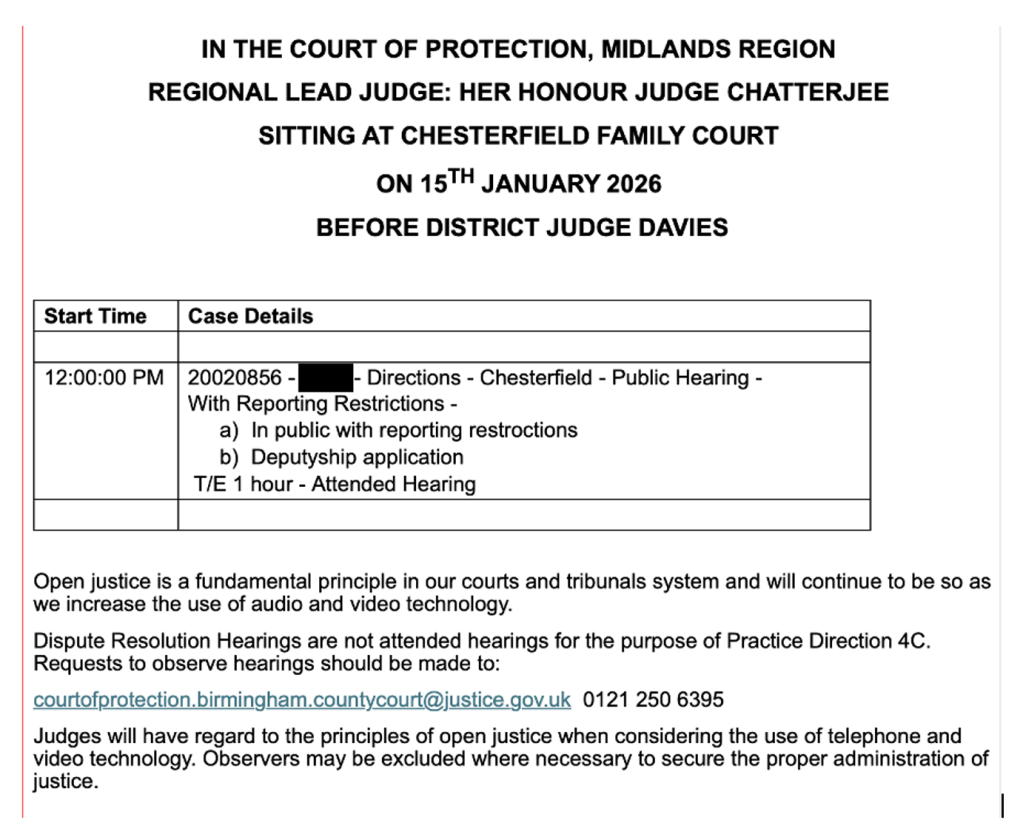
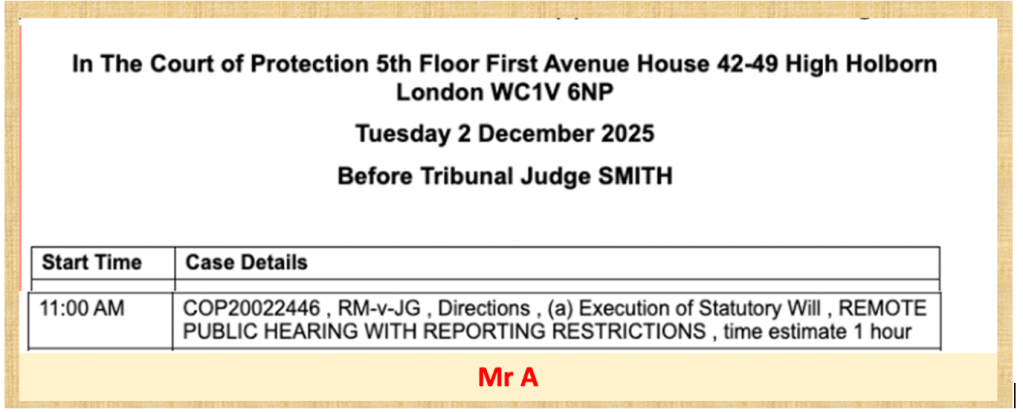
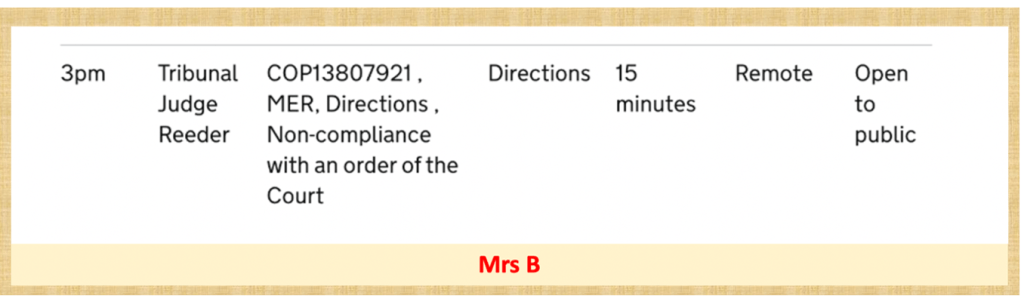
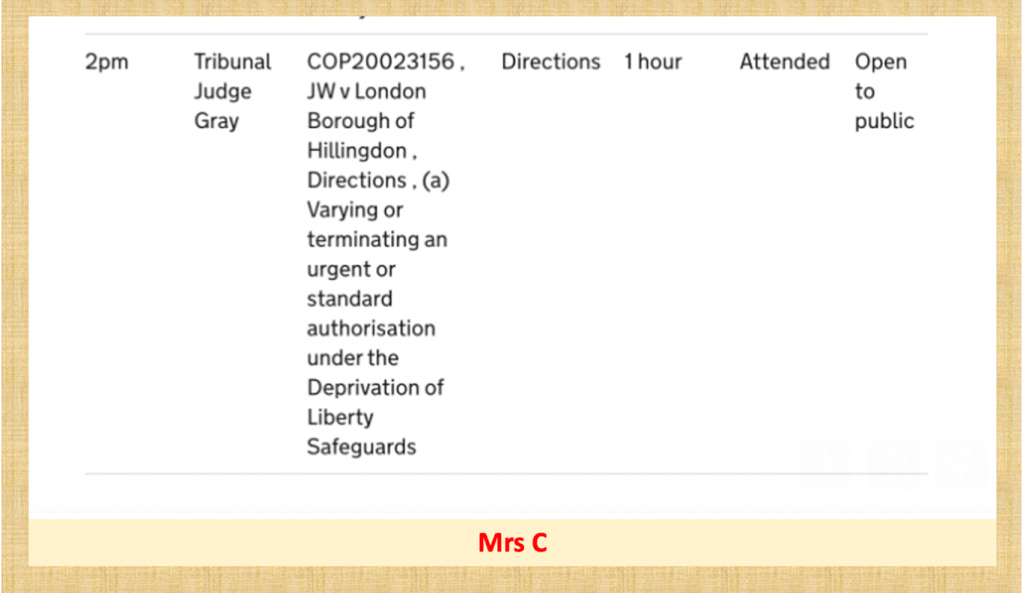
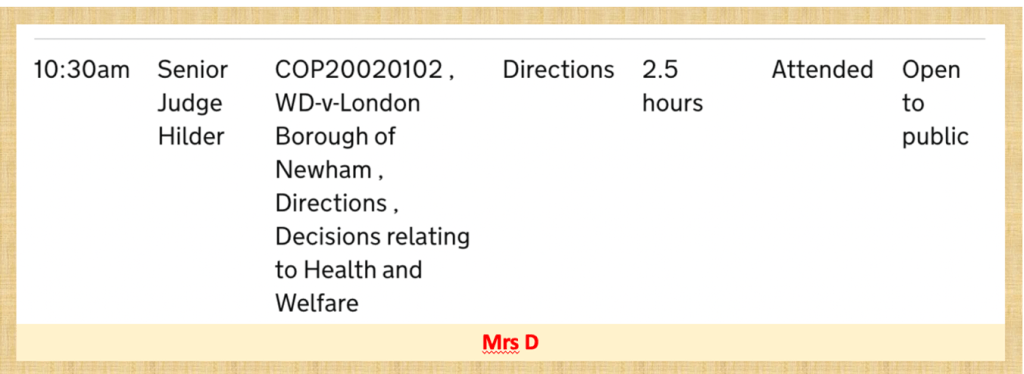
This case caught my eye because it was listed as being heard in person at Chesterfield Family Court. (See the listing from Courtel/CourtServe below: note all screenshots were taken after the hearing had concluded).
The listing is in error – there is no Family Court building in Chesterfield. But I know Court of Protection hearings can be heard at Chesterfield Justice Centre, which is within reasonable travelling distance from my home. As I recently submitted my PhD thesis, I have some time on my hands to watch hearings, and to make things even easier, the listing was posted to CourtServe around midday the day before. That meant I had plenty of time to plan my travel.
At 08:39 on the morning of the hearing, I sent an email to the hearing centre itself to enquire as to whether the hearing was definitely going ahead. I didn’t want to travel all the way to the court only to find out that it had been vacated! I did consider calling but felt like there’d be no chance I’d get through at 9am. Better to send an email, hope it’s noticed, and then call at 9:30 if I don’t get a response.
Court of Protection hearings are supposed to appear in a Court of Protection list on Courtel/CourtServe (and usually do), and we are asked to send requests to observe to the regional Court of Protection “hubs” – in this case, as indicated in the screenshot above, the Birmingham hub.
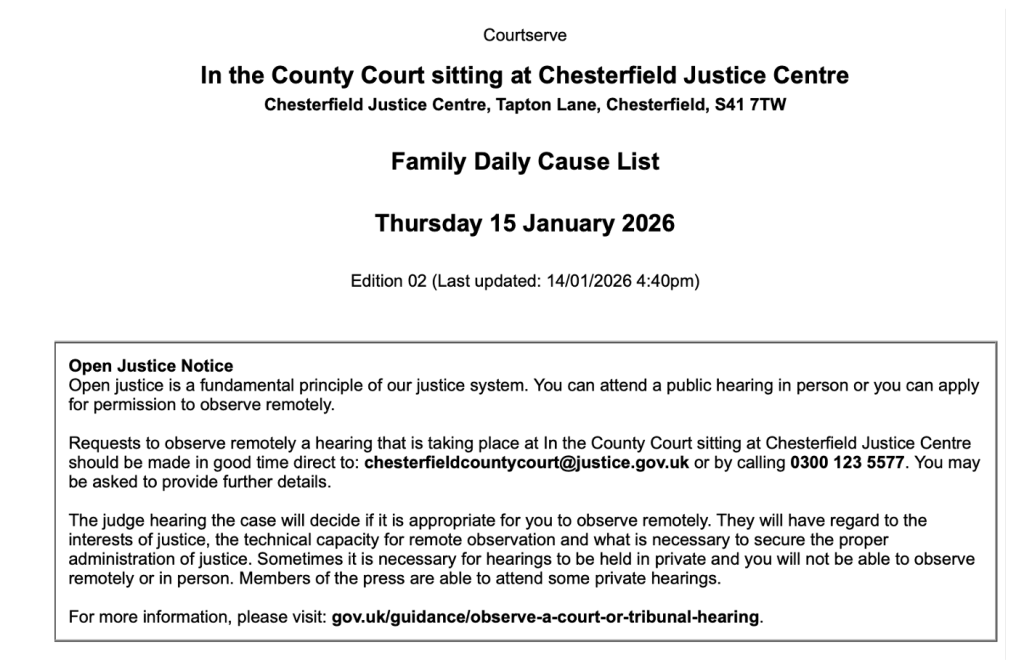
But I wasn’t making a request to observe; I was making a request for information. The Chesterfield daily cause list (in a different section of Courtel/Courtserve) gives the email address for the hearing centre itself.
As you can see, the “Open Justice Notice” tells youto contact Chesterfield Justice Centre directly if you want to observe a case that is being heard there. And even if it wasn’t in the CourtServe list, the court’s official webpage also includes its contact information. So, I thought, there’s really no harm in using that email address to enquire if an in-person hearing is definitely going ahead. Besides (I thought) the Birmingham hub would probably just forward my email to Chesterfield anyway.
I received an email response at 09:10 that said “the Court can confirm that this matter remains listed as a remote hearing”. Though I didn’t immediately notice, this response was actually sent by an Administration Officer at Derby Court. Somebody in Chesterfield must have forwarded my email to them.
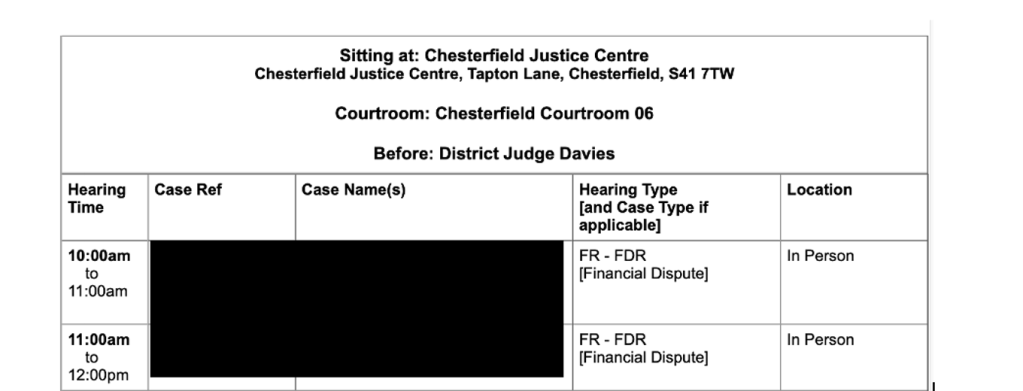
The fact the case was to be heard remotely was news to me. Confused, I double-checked both the Court of Protection list and the daily cause list. The case wasn’t even in the daily cause list as you can see below. I’ve removed the case name because they included people’s surnames. While I imagine that’s perfectly fine, I don’t actually know. And the parties probably never imagined their names would be broadcast in a blog like this – and certainly not in a publication that has nothing to do with them.
I therefore did what I thought was reasonable and, at 09:16, responded to the email (from the Derby court) asking for the link, Transparency Order, and position statements. I also said, “I appreciate this is an unusual way of requesting this so, if necessary, I am of course happy to direct this request via the Birmingham hub.”
At 09:30, the member of court staff asked me to “contact Birmingham direct”, who were copied into the email. After I didn’t get a response, I sent a follow-up to the Birmingham hub at 10:28.
My request to observe was “approved” at 10:56. At 11:10 somebody from Derby Court (but a different person in a different team to the one who directed me to Birmingham) sent me the Transparency Order, and said “the Judge would also like me to let you know both parties are litigants in person so it is unlikely there will be position statements” (my emphasis).
At this point, I thought perhaps the case had been re-listed, as remote, under Derby. I checked Derby’s daily cause list. Neither the case nor the judge featured.
At 11:54 I received another email from the same administrative officer. That email said “the Judge has asked me to inform you that the local authority will also be joining the hearing asking to be joined as parties but they too will not be filing a position statement” (my emphasis).
Before getting into with what happened at the hearing, I think it’s useful to set out what had happened so far.
I sent an email to the Chesterfield court asking whether the hearing was still going ahead.
At some point, somebody in Chesterfield sent my email to a team in Derby.
I received a response from Derby telling me the hearing was remote. When I asked for the link, I was directed to the Birmingham hub.
After I contacted the Birmingham hub, a member of staff in the hub told me my request to observe had been approved.
At some point, somebody in the Birmingham hub sent my contact details to a different team in Derby.
Somebody from Derby sent me the link and Transparency Order, and a couple of messages from the judge.
Court staff are hard working and over-stretched. But I cannot help but think that this is a deeply inefficient way of working – particularly because, as it turned out, the judge knew about my request to observe before I contacted the Birmingham hub.
When the judge (who was sitting at Chesterfield in a hearing administered by staff at Derby) joined the link at 12:03, he acknowledged my presence, as this same judge (who I have observed often before) has done previously. Somewhat unusually, he asked me to turn on my camera. He confirmed nobody objected to my presence (they didn’t). And then he addressed my request to observe.
The judge said that he’d had to tell court staff to “re-direct” my request to observe via the Birmingham hub because there needed to be a paper trail and that I should direct requests to observe to the hub, not the local courts, because there aren’t enough administrative staff to deal with requests to observe.
It seemed reasonable enough to convey this information to me. But the way in which it was done concerns me.
The judge had already asked the administrative officer to tell me two pieces of information in two separate emails (first that the parties were litigants in person and then that the local authority had asked to join the hearing). He could have asked them to give me this message, too, via email. But he didn’t. Instead, he chose to wait for the hearing where he could air his grievances in open court – grievances that could not reasonably be said to have had any effect on the administration of justice, and were completely irrelevant to the issues before the court.
I have an unfortunate habit of blushing when I’m irritated. I imagine I was blushing when the judge was speaking. Did he really need to hold-up the hearing to address me on how I’d requested the link? I assume he’d seen my emails (they’re usually forwarded to judges) and so must have seen that it was me who suggested I contact the hub if required. He therefore must also must have seen that my original email was premised on the idea that the case was to be heard in person.
But the situation faced by Claire, and the one faced by me, is different for one key reason. DJ Davies had already used an administrative officer to convey information to me. If he wanted to be helpful, why not just use those open lines of email communication?
Of course I didn’t say any of this. But, whether the judge was looking for a response or not, I was determined to say something. So I turned on my microphone and told the judge that the only reason I’d contacted the hearing centre was because the case was listed as in person, and I wanted to check it was still going ahead.
Not quite the zingy response I’d have liked but I liked the feeling of having to defend myself even less. As I saw it, the judge had criticised me in open court. I had a right to respond but had to do so on the spot. This blog is a more careful and considered response.
While I can make a further response to the judge, I know he can’t respond publicly to this. But he didn’t seem interested in my (admittedly half-formed) response at the time, anyway. He just said that it had initially been listed in person but that was changed yesterday. For future reference, I should direct requests to observe via the hub. And I could turn my camera off now.
As I’ve already shown, the case listing never reflected the fact that this was a remote hearing. If the judge did direct it to be listed remotely, he probably imagines that did happen. But it didn’t. And I don’t have a crystal ball.
I’ve observed DJ Davies on a number of occasions. I usually find him a welcoming judge. In fact, I often suggest that new and/or nervous observers attend cases that this judge is hearing.
But if this was my first time observing, I wouldn’t want to go back.
How unfair judicial criticism hinders transparency
I’m not the only observer to feel unfairly criticised by a judge.
In April 2025, Clare Fuller, an experienced observer, requested the link to observe a hearing before Senior Judge Hilder. She sent two chasing emails (so three in total) before giving up – only to be sent the link after the time listed for the start of the hearing. She joined the link as soon as she got it, whereupon she was admonished by the judge for making a ‘disruptive’ late access request. She was told to “consider that, in the future”. In the comments section of the blog, another observer (Amanda Hill) who was already in that same hearing, says she was “mortified” when she saw the “dressing down” delivered by the judge.
The comments on that blog are a revealing read.
Celia Kitzinger recounts a story of a new observer who requested to observe an 11am hearing before HHJ Beckley. The observer was sent a link with the notice that the hearing would start at 12 noon. Those of us who are experienced observers would have suspected a mistake and would have checked. But the observer (not unfairly) assumed that she had been sent the most up-to-date information. She joined the link just before 12 noon only to find that the hearing had concluded.
But it didn’t end there. She later received a message from the court: “HHJ Beckley is sorry that you were unable to attend this morning’s hearing as an observer. There may be various reasons why you could not attend, and he doesn’t need to know them. He would like to point out that an observer request creates work for very hard-pressed court staff and for either an advocate or judge to prepare an introduction to the case for the observer’s benefit”.
The observer was “devastated”, both because she missed the hearing and by the implied judicial criticism in the message.
Another comment is from Claire Martin. In March 2025 she had requested to observe a hearing before HHJ McCabe. She sent the email in good time but, when she joined the hearing, and Counsel for the local authority told the judge that Claire had asked for position statements, this happened:
The judge quickly and irritably interjected, saying: “I don’t know when you asked Ms Martin … these requests need to be raised far in advance … it’s a pretty unfortunate way to go about it … [telling off tone – v unpleasant] we are well into the hearing and we have important matters to discuss …..” [the hearing has just started] {These were my contemporaneous notes}
Claire says she felt “told off and humiliated […] If the court wants observers to request to observe, or request documents, “far in advance” then those involved in managing proceedings need to work out a way for observers to do so..”
In my case, I think the judge took the approach he did because he knows I’m an experienced observer (I’ve observed him many times) who knows court processes well. He also appeared to think the case had been correctly listed as a remote hearing. It therefore must have appeared as though I tried to circumvent the standard procedures, and in doing so created an extra issue for him to deal with – an issue that, amidst back-to-back hearings, he could have done without.
It’s important to say that I know I’m not immune from criticism, here. What I thought were my reasonable efforts to get clarity about whether this hearing was going ahead, and then my further attempts to get the link, seem to have created problems for HMCTS staff. Those miscommunications and misunderstandings swirled around a judge who probably didn’t even have time for a cup of tea (or however else he likes to relax) between hearings. And before he could have lunch he had to deal with a case that he anticipated to be between two litigants in person who hadn’t filed position statements, and the paperwork he did have was pretty bare bones.
It wasn’t my intention to exacerbate those stresses and, in future, I’ll just send any and all correspondence direct to the hub. That’s what I’ve learnt from this experience. I hope there’s some judicial learning from this experience, too.
The irony is that it’s because I’m an experienced observer that I took this somewhat unorthodox approach. New and inexperienced observers might have just turned up at the physical courtroom, expecting an in-person hearing, as listed. I know, from experience, that hearings are sometimes vacated (or move from in person to remote and vice versa) after the list has been published. I also know how to use CourtServe in such a way that means I can find the court’s contact details. And I know that telephone calls often go unanswered, so an early morning email is a good way to catch someone’s eye.
What does all of this tell us? I think it demonstrates that judges think that gaining access to observe a hearing is simple and straightforward. When things go wrong, experienced observers are frustrated but unsurprised. By contrast, judges appear both frustrated and surprised. From there, the default position seems to be (often) to assume the problem lies with the observer – though I know some judges are well aware of the problems we observers face when trying to gain access to a hearing.
We all know that the justice system is under-resourced, under-funded, and over-stretched. Requests from observers are one more task for busy court staff to process. And sometimes things will go wrong. When they do go wrong, the judicial aspiration for open justice is hindered because (at its worst) members of the public are excluded from hearings that they have every right to attend.
Judges are also over-stretched. But, to put it rather bluntly, they have the most power and status in their courtroom. They set the tone – and that tone must be one of civility. Open justice doesn’t just entail access to the court (though that is, admittedly, a fairly significant part of it). Open justice also entails an (at least implicit) suggestion that observers are welcome, because transparency matters, even at some cost to the court. If they feel rebuked, or unwelcome, this is a significant deterrent to observing again.
The interesting thing is that all of the judges mentioned in this blog are generally what I’d describe as “good” on transparency – and these were exceptional events. I’m pretty confident that the judges concerned did not intend to cause any offence to observers – which is why it’s important for them to learn that they did, so that they can be alert to the effects of their actions in future.
I don’t expect judges to get out the bunting every time an observer attends their courtroom. But I do expect them to treat us with courtesy. It’s a depressing experience to read that observers trying to do their civic duty for transparency and open justice are left feeling “devasted” or “humiliated” by the judge – who (they feel) is “irritable” and “unpleasant” to them, and has given them a “telling off” or “dressing down”. It doesn’t happen often but when it does happen it leaves a lasting impression. Each time a judge behaves in a way that leaves observers feeling like this it makes it just that bit less likely that whoever is observing them will want to do so again, or will advise others to do so.
That’s bad for transparency. And anything that’s bad for transparency is bad for the justice system.
Daniel Clark is a member of the core team of the Open Justice Court of Protection Project. He is a PhD student in the School of Sociological Studies, Politics & International Relations at the University of Sheffield. His research considers Iris Marion Young’s claim that older people are an oppressed social group. It is funded by WRoCAH. He is on LinkedIn, X @DanielClark132 and Bluesky @clarkdaniel.bsky.social.
Barristers, solicitors and legal executives are all lawyers, but they are different types of lawyers. There are many similarities and many differences. One is not ‘better’, more experienced or more senior than the other. They have quite different training and expertise and do different types of legal work. The system that operates in England & Wales is a ‘split’ system, where there is a division of labour between these two types of lawyers. In some countries (such as America) there is a ‘fused’ system where all lawyers can (potentially) do all things, although of course they will tend to specialise.
Training
Barristers and solicitors will all have done either a law degree or another degree followed by a one-year law conversion course. Those courses will teach them the basics of the main areas of law (things like Land Law, Contract Law etc). They will all then have done a vocational course, which is focused on how to be a lawyer rather than the law. For solicitors that includes things like handling client money and litigation, whilst for barristers it is heavily focused on advocacy, Both vocational courses involve learning about court procedure. After the vocational stage, solicitors will go on to do a 2-year training contract, working in a law firm under supervision, whilst barristers go on to do a one-year pupillage, working in a chambers supervised by a more senior barrister (a pupil supervisor). They will only be allowed to speak in court after the first six months.
The route for legal executives is more varied. Typically, a legal executive might not have a degree at all and might start out working in a law firm, and carry out their training over a number of years whilst working as a paralegal or assistant in the law firm, building up a portfolio of work and taking exams over a period of time. By the time they qualify they are often very experienced lawyers, and many of them have a particularly in-depth knowledge of the area of law they specialise in. For example, there are some very knowledgeable legal executives with a real specialism in family law. This route is often chosen by those with family / caring commitments or who have for whatever reason not been able to take a traditional route into law.
Solicitors and legal executives can do extra training to add to their rights of audience, and more recently barristers have been able to do extra training to be able to carry out litigation (see below – though not many do so).
Business structure
The explanation that follows tells you about the typical arrangements for most barristers and most solicitors – but as with much in life there are often exceptions to the rule. So, barristers are (usually) self-employed. Solicitors are (usually) not: they are employed or partners. Barristers don’t usually operate as partnerships or companies, and the majority trade as sole traders, but group together for economy and marketing under one roof which is called a ‘chambers’.
Because barristers within one chambers are all independent from one another they can act on different sides in the same dispute, but solicitors in the same firm can’t do this because they aren’t independent from each other and would have a conflict of interests. It is very common for a barrister in independent practice to represent one party involved in a case, and for their (independent) colleague in the same chambers to represent another, but when this happens they will have to be instructed by different solicitors firms. Legal executives will typically be employed within a firm alongside solicitors.
Advocacyand litigation
Barristers are specialist advocates or specialists in a particular area of law (or both).
Solicitors and legal executives do also specialise, and some do their own advocacy, but most solicitors are primarily litigators. This means meeting the client, working out what the case is, sorting out the paperwork, communicating with the other sides’ solicitors and where necessary instructing a barrister to advise about the law or to go to court and represent the client on their behalf. (There is currently a legal issue about what tasks legal executives are allowed to do, and which bits have to be done by a solicitor, which is likely to be clarified by the Court of Appeal soon in a case called Mazur.)
There are some differences between barristers, solicitors and legal executives’ rights of audience – i.e. which courts they are allowed to speak in. Barristers are allowed to speak in any court, right the way up to the Supreme Court. Solicitors are allowed to speak in the Family Court (and some in the High Court), and for Legal Executives it depends, but they can speak in most family court cases.
Barristers spend a lot of their time in court, talking to other barristers, dealing with witnesses giving evidence and addressing the Judge. Solicitors often come to court to support a barrister by taking a note or having the files to hand in case the barrister needs something. Increasingly often a barrister attends court without a solicitor. This is often more cost-effective.
A barrister is often paid by the piece of work, i.e., £x to attend for this hearing and £y to draft this document. A solicitor usually bills by the hour. Barristers are usually sent to court because it’s cheaper than sending a solicitor who bills by the hour or because the barrister is more experienced at dealing with the court side of the process (or both).
A client can instruct a solicitor directly, but to instruct a barrister you usually have to first instruct a solicitor, and the solicitor will instruct a barrister for you. An exception to this is ‘direct access’ instruction, where a client can instruct a barrister directly. This is only suitable in certain types of cases and only where the client can effectively act as their own solicitor. Not all barristers accept instructions in this way and most of those who do work this way will assess in each case whether the client and the case is one where they should agree to do the job without a solicitor. In some cases, it’s really better (and actually more cost effective) to have both.
Cab rank rule
All lawyers have very similar ethical and professional rules. They are all expected to be honest, to act in their client’s best interests, but to always put their duty to the court first.
One important distinction between barristers and other lawyers is a rule called the ‘cab rank rule’. The rule means that if a solicitor asks to instruct a particular barrister for their client, and that barrister is available and competent to carry out the job, they can’t say ‘no’ because they don’t like the client or their politics. This is to make sure that everybody is able to secure representation even if they are unpopular, unlikeable or look guilty. There are some exceptions when this rule doesn’t apply. One exception is that this rule doesn’t apply to direct access instructions, so a barrister is allowed to say ‘no’ if they don’t think the case or client is suitable to be worked without a solicitor. Another is when a barrister is working as an employed lawyer (for example in the Government Legal Department). Firms of solicitors (including legal executives) don’t have to apply the cab rank rule.
All lawyers have rules that restrict when and how they can pull out of working for a particular client once they have agreed to act – and rules that very occasionally mean they have to stop working for a client immediately (for example they will be ‘professionally embarrassed’ and have to withdraw from the case if they can’t continue without misleading the court)[1].
Piecework / continuity
A barrister will often – but not always – deal with a case all the way through, and the solicitor will check in with them regularly for advice and for them to oversee the case strategy. In other cases, a barrister is only briefed for a particular hearing or piece of advice, and instructions might be sent each time a specific piece of work needs to be done (a hearing, a piece of drafting), so there might be different barristers dealing with a case, although the solicitor will remain responsible the whole way through. This is because a solicitor is retained by a client and is responsible for dealing with what comes up as it comes up, but a barrister cannot always be available for a client to attend a particular hearing because these dates are not known at the outset. If a barrister has been previously booked to do something else for another client on the date in question, she will have to honour that first commitment, unless the first client agrees to their release (perhaps because an alternative barrister is offered that the client is happy with).
Judges
Barristers, solicitors and legal executives can become judges, although historically more judges have come from the bar than from solicitors and legal executives.
As with everything – the points above are not true all of the time, but they are generally applicable.
Teamwork
Barristers are divided up into ‘junior counsel’ and ‘senior counsel’ (also called ‘silks’ or ‘King’s Counsel’ or ‘leading counsel’). Junior counsel is any barrister who isn’t a King’s Counsel, right from the newbies to the very experienced. So, I was junior counsel until a couple of years ago, even though I’d been doing the job for 20 years (sometimes experienced juniors get called ‘senior juniors’ just to confuse you).
King’s Counsel are instructed when a case is really complex. Often – but not always – they will work with a junior, occasionally more than one junior, on a case because of the complexity and/or volume of work.
Whether or not King’s Counsel are involved, the system works best when all the lawyers on a team work together – as a team. One of the best parts of my job as King’s Counsel is working in a team with my junior and the solicitor or legal executive who is instructing me. We all have our part to play in getting a good outcome for our client, and each of us is as important as the other. The best teams and the best outcomes are produced when all the different types of lawyers respect one another’s roles and skillsets.
The best lawyers will also work constructively with lawyers from other teams, even when their cases are opposed.
Postscript 24 Jan 2026 – Dispute resolution
A solicitor has helpfully suggested that perhaps not all solicitors think of themselves as ‘litigators’ these days and it has prompted me to add a little p.s. She is right, I’m sure, that this is not how some solicitors view themselves, and indeed it is not even what they spend most of their time doing. In the world of family law, many lawyers – whether solicitors, barristers or legal execs – consider themselves dispute resolution specialists as much as lawyers. They might be dual qualified or trained as arbitrators, mediators, collaborative lawyers, ‘private judges’ or even therapists, and solicitors in particular sometimes offer a wrap-around service through their firms for families in crisis post-separation (financial advice, counselling and coaching for instance). Many family lawyers would say they are not about litigation as much as about avoiding it. But nonetheless, whenever a lawyer steers a client away from court as a way to resolve their dispute, they are doing so in the context of potential litigation (or in the shadow of the law as mediators often say), and using their knowledge and expertise about litigation to support clients through the process whether that is in litigation or pre-litigation or not. Hopefully that is a useful (further!) caveat to what I’ve said above.
[1] Editorial note (CK): People must have ‘litigation capacity’ in order to instruct a legal team (i.e. they must understand the proceedings sufficiently). It’s almost always (though not invariably) found in the Court of Protection that “P” (the protected party at the centre of the case lacks capacity to conduct proceedings which is why the Official Solicitor (or other ‘litigation friend’) is appointed to conduct the proceedings on their behalf in their best interests. Occasionally there are concerns that family members of protected parties may lack capacity to conduct proceedings – for a recent case, see Macpherson v Sunderland City Council [2025] EWCOP 18 (T3) (22 May 2025)
My sister, Polly Kitzinger, was a protected party in the Court of Protection concerning a statutory will. You can read a detailed blog post by Jenny Kitzinger about why – as Polly’s sister and as her Deputy – she made an application to the Court to approve a statutory will for Polly, and what the process involved: Applying for a statutory will: Observation and personal experience.
The court proceedings about Polly’s statutory will were decided back in 2022 but, until last month (December 2025) we weren’t allowed to publish anything about the case. Doing so would have been contempt of court.
We had to keep the proceedings about Polly’s statutory will secret because the judge (District Judge Ellington at First Avenue House) made her decision ‘on the papers’, i.e., by reading the application and the supporting evidence, and the submissions of the Official Solicitor, without hearing any oral submissions. Many decisions in the Court of Protection (especially financial ones) are made like this – ‘on the papers’, without hearings: it’s a relatively efficient and cost-effective way of dealing with uncontroversial applications. But it means that the proceedings are private.
In this blog I’ll explain:
(1) why cases decided ‘on the papers’ are private and can’t be reported;
(2) why we wanted to publish about Polly’s statutory will proceedings as a matter of public interest, and why we believed Polly would have wanted us to do this; and
(3) how I went about making the application to publish.
I hope this may be of assistance to others who want to publicise court decisions made on the papers.
1. ‘On the papers’ proceedings are private
Since 2016, with the launch of the Transparency Pilot, hearings in the Court of Protection are mostly held in public with reporting restrictions (the so-called ‘Transparency Order’) to protect the privacy of the person at the centre of the case (Practice Direction 4A)[1]. That’s what makes it possible for observers to attend hearings and blog about them.
But when a case (like Polly’s statutory will case) is decided ‘on the papers’, by a judge sitting privately in her chambers reading the paperwork, there’s no hearing. When there’s no hearing, there’s no Transparency Order – and so when judges make decisions in this way, the proceedings are essentially ‘private’, and section 12(1) of the Administration of Justice Act 1960 applies at subsection (b).
The publication of information relating to proceedings before any court sitting in private shall not of itself be contempt except in the following cases, that is to say-
(a)…
(b) where the proceedings are brought under the Mental Capacity Act 2005, or under any provision of the Mental Health Act 1983 authorising an application or reference to be made to the First-tier Tribunal, the Mental Health Review Tribunal for Wales or the county court.
What 12(i)(b) means is that when the Court of Protection sits in private (either because the judge has ordered a private hearing, or because the judge is deciding the case on the papers), it is contempt of court to publish (any) information relating to the proceedings – and possible sanctions including fines and imprisonment.
If there had been a public hearing with a ‘standard’ transparency order in place, we would have been permitted to publish information about Polly’s case in pretty much the same way that we’ve blogged about other statutory will cases[2]. The difficulty would then have been simply that it’s more complicated to conceal the identity of a protected party when you are writing about a relative, especially a relative with the same surname, and even more so when there is already information lawfully in the public domain about her, which would make it easy to ‘join the dots’. Since the car crash in 2009, we’ve published a lot about Polly – perfectly lawfully, and without breaching any transparency orders, since they only prohibit identification of someone as a P in the Court of Protection. We started long before any Court of Protection hearings with a website (welovepolly.org), chronicling her life up to that point: her adventures, her art, her political campaigning, and her advocacy for mental health patients to have their ‘voice’ heard. We’ve also spoken out about how she was given life-sustaining treatment she would have refused if she could, and about professionals’ failures to comply with the Mental Capacity Act 2005 or to elicit or show any respect for Polly’s own values, beliefs, wishes and feelings: we’ve spoken to journalists and medical ethicists, and used her story to campaign for greater awareness of Advance Decisions to Refuse Treatment[3]. So, if there had been a public hearing about her statutory will with a ‘standard’ transparency order in place we would undoubtedly have applied (as I and others have done many times before) to vary the transparency order[4], so as to be able to identify both ourselves and Polly.
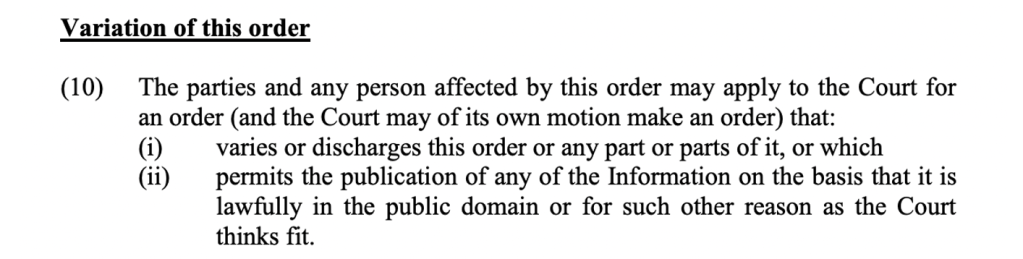
The transparency order even includes within it a helpful clause saying that anyone affected by the order can apply to vary or discharge it, or for an order permitting publication of information on the basis that it is lawfully in the public domain:
But in this case, we couldn’t apply to vary the transparency order because there wasn’t one.
We had to start from scratch with an application to publish information from private proceedings.
2. Why we wanted to publish about Polly’s statutory will proceedings
Asked for the grounds on which we were seeking the order permitting us to identify Polly as a P in the Court of Protection, here’s what I wrote on the application form (a COP 9 for case COP 11757133, submitted on 7th June 2025):
“Despite not having been served with a TO prohibiting us from making information public, I would like to ensure that we do not risk being in contempt of court in writing about the experience of making a statutory will application. I believe we may need permission to publish by reason of s.12 Administration of Justice Act.
We want to write about the experience of making a statutory will application because it’s a matter of legitimate public interest. Many people don’t know that it’s possible to do this, or that there’s any point unless P is very wealthy, yet it’s part of considering P’s best interests in the round, and we’d like families to be alert to this.
We also want to challenge the ‘stigma’ around statutory wills, which we discovered clearly present in discussions about the “secret” case heard in the Chancery court by Rajah J (https://rozenberg.substack.com/p/secret-justice) and it’s also manifested as a response to blogs we’ve published as part of the Open Justice COP Project about contested hearings featuring embattled families (e.g. https://openjusticecourtofprotection.org/2025/03/27/judge-approves-statutory-will-in-contested-hearing/). There’s a public perception that the purpose of statutory wills is tax avoidance and/or family fighting over money. We have a different and probably more commonplace story to tell.
It’s difficult, given our public profile and previous publications, to write anything about Polly anonymously – and we want (as Polly would have wanted) to be able to speak publicly in our own names, which is far more likely to gain public attention and engagement”
So, as I sketched out in the application, there are two key reasons for wanting to publish about Polly’s statutory will case: (1) Public interest; and (2) Polly’s values and wishes.
2.1 Public Interest
As a consequence of making a statutory will for Polly, Jenny and I developed an interest in statutory wills as they relate to disability rights and social justice.
As we watched public hearings about statutory wills and wrote some blog posts about other families’ experiences, we came to realise how poorly understood they are, even by professionals working with the Mental Capacity Act 2005.
Raising public awareness about statutory wills is clearly in the public interest: it supports and develops understanding of the law and can thereby empower people to act on behalf of those who lack capacity to make a valid will themselves. It can also encourage people to understand why it’s important to make a will while we still have capacity to do this for ourselves, and that it might be prudent to consider, in doing so, the implications of possibly living for some years (or even decades) without capacity to revise or revoke that will.
2.2 Polly’s values and wishes
We are very confident that Polly would want us to be free to write openly about her statutory will application, as we already have about other aspects of Polly’s life and treatment since her car crash. We are supported in this by everyone close to Polly.
Since the car crash in 2009, Polly hasn’t been able to give or to refuse consent to what we write about her. The question of ‘going public’ about Polly is something Jenny (as Polly’s Welfare Deputy) specifically consulted about very soon after Polly’s injury. She asked everyone close to Polly to write letters about her to create a clear sense of what people thought was important to Polly (her values beliefs, wishes and feelings) to help inform best interests decisions. Contributors included Polly’s then-partner, her parents, her sisters, and two friends – and Jenny wrote a summary too. Originally designed for her immediate care team, this report was subsequently made available more widely after further consultation with the contributors – all of whom agreed that this should be done without concealing Polly’s identity. Jenny’s introduction to the report summarises the issues as follows:
“Since submitting the report to Polly’s health care team, various other people have expressed an interest in seeing it – in particular, those involved in framing and developing the Mental Capacity Act (MCA) and those involved in training health care workers to implement the Act. The principles of the MCA were very close to Polly’s heart: she worked first as an advocate for Mental Health Service Users, and then as a ‘Service User Involvement Development’ officer – ensuring that the concerns of service users impacted on research, policy and practice. She passionately believed in the right of everybody to be treated in a way which accorded with their own values and beliefs, and campaigned for the right of those lacking mental capacity to be heard. I believe that she would have wanted her experience to feed into the process of delivering on the promise of the MCA and would, therefore, have encouraged me to make this report more widely available.
In making this report available I have carefully considered Polly’s rights to confidentiality and to privacy. My first instinct as Welfare Deputy (and as an academic who serves on research ethics committees) was to edit the report to ensure that she was not identifiable. However, after reflection, and discussion with those closest to Polly, I revised this view to take into account Polly’s own strongly held beliefs in this area. Polly and I had discussed how anonymity can reinforce stigma: why should there be any shame attached to lacking mental capacity? Polly also believed that anonymity could mask a form of identity theft, whereby those writing about the anonymised individual absolve themselves from the responsibility of being true to the whole person.
In my experience, when Polly weighed her ‘right to privacy’ against her ‘right to be heard’ she always gave priority to the latter, and she would have wanted her current experiences understood in the context of her life as a whole. The seven other people (partner, parents, other sisters and friends) who contributed to the report share this view of what Polly would have wanted. We therefore agreed that the report should remain clearly identifiable as being about Polly.”
Polly’s family and friends knew what Polly would want from the way she lived her life, the values she demonstrated through the choices she made, and through the way she expressed herself in family discussions about liberty and social justice – including violence against women, sexual abuse, same-sex marriage, disability rights, and rights at the end of life.
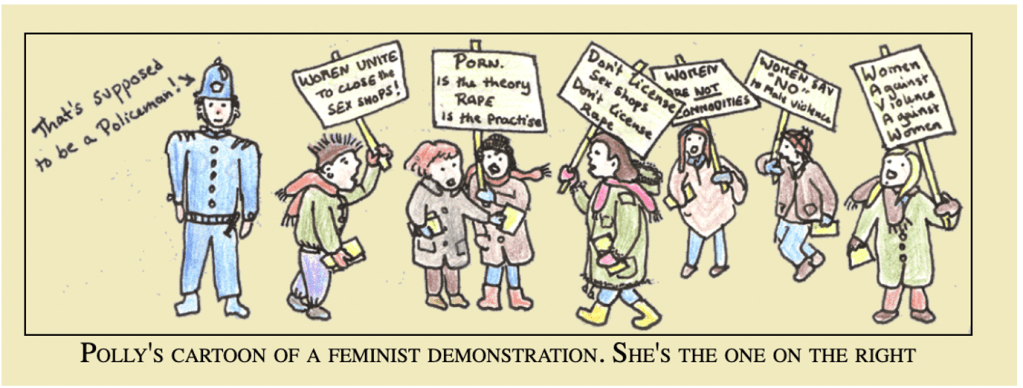
If Polly had been through her car crash and hospital treatment and recovered sufficiently to analyse and present what had happened to her, then we believe she would have told her own story publicly. She loved narrative, illustrating and even writing storyboards about events in her life, and she would have wanted to publicise her story to educate people and make a political intervention. Sadly, doing this herself is not an option – and so we are certain that Polly would have wanted her family to write about her instead. The thought that anyone outside the family could stop us (such as a court putting restrictions on what could be said in reporting on a court case about her) would have left Polly beside herself with rage.
3. Making the application
It was not a difficult process, but it was tedious with lots of fiddly forms to fill in, and some uncertainty and delay created by the Official Solicitor before she eventually declined the court’s invitation to act as Polly’s litigation friend. It also caused some distress to people who would rather not have been involved in the proceedings, in particular Polly’s former partner, who has subsequently provided us with a letter to the court asking not to be contacted about any future court applications concerning Polly. We worried that having to inform Polly about the application might also cause Polly some upset – not because she would oppose it, but because in order for it to make any kind of sense to her, we would have to remind her about the car crash, her brain damage and lack of capacity, the court’s decision-making power, and her statutory will, none of which she remembers from one conversation to the next. Fortunately, she did not seem unduly perturbed. We didn’t use lawyers, so there was no financial cost attached to the application for us, but there could have been a cost to Polly if the Official Solicitor had decided to act – and we took this into account in deciding to make the application. Overall, we’re glad we did this because it means we can now tell another part of Polly’s story, and we know this is what Polly would want us to do and it accords with our own core values and beliefs too, about making the personal public and political.
Here’s what the process involved.
7th June 2025 I submit a COP 9 form seeking an order that we can identify Polly as a P in the Court of Protection case concerning the statutory will, and that we can identify specific family members, in effect disapplying s.12(i)(b) of the Administration of Justice Act 1960.
4th July 2025 I receive an order telling me to “… serve the application on all persons notified or served in the Statutory Will application and the Official Solicitor” and to“file form COP 20B by 18th July 2025”. The COP 20B forms basically inform everyone about the application and give them the opportunity to be joined if they want. They are fairly simple to fill in (once I’d located everyone’s up-to-date address) and I sent them to Polly’s former partner, her sisters Jenny and Tess, and Polly’s niece and nephews (the people involved in the original will application) as well as to the Official Solicitor. I sent a “Certificate of Service” back to the court confirming that I had done so.
Anyone who wants to be joined to the proceedings then has the opportunity to let the court know via the “Acknowledgement of service/notification” form. Only Jenny completed one (it says at the top “if you do not wish to take part in the court proceedings, you do not need to complete this form”). On a form dated 16th July 2025, Jenny ticked the box that said she consented to the application, and filled in the text box providing the opportunity to give “any relevant information you would like the court to consider”. She wrote that: “Polly would’ve actively wanted any reporting restrictions about the statutory will application lifted (and as far as I can check this with her now in her current state, I’ve seen nothing to suggest that she feels differently now). Polly was always willing to talk publicly about things other people considered ‘private’; she believed the ‘personal was political’ and particularly valued open discussion about interactions with health/social care and legal institutions.”
The judge also invited the Official Solicitor to act as litigation friend and ordered that she “shall confirm her position within 14 days of service of the application and this order”. I served the order on the Official Solicitor on 6th July 2025, so that should have meant confirmation as to whether or not she wished to act as litigation friend by 21st July 2025.
The order issued on 4th July 2025 also said, “The Applicant shall notify (herself or through an agent) Polly (Margaret Alexandra) Kitzinger personally of the application and file form COP 20A by 18th July 2025”. I asked Tess, the sister who most frequently visits Polly, and who has the best communication skills with her, to notify Polly about my application and to fill in COP 20A. The form asks: “Describe the steps you took to explain the matter or matters to the person to whom the application relates and the extent to which they understood or appeared to understand the information given. Please also describe what, if anything the person to whom the application relates said or did in response to that notification.” Tess wrote: “On Monday I took Polly into the garden and spent almost an hour with her during which I tried to communicate the facts about the application and observed her emotional responses and used some closed questions so she could indicate yes/no. It is unclear how much she understood. She gave no reaction at all to some of the information or just shrugged her right shoulder when I asked some questions. She became a bit distressed and agitated when I described the court making decisions for her – furrowing her brow and flapping her right hand away from her body. She shook her head ‘no’ when I asked if she remembered there’d been a court application about her will. She gave the thumbs up when I explained how it had been rewritten. She said ‘yes’ clearly when asked if she would be happy to have the process of the application and the court decision about her discussed in public. When asked how happy she would be for Jenny to write up what had happened on a scale of one to ten, Polly replied ‘one hundred’” (14th July 2025).
18th July 2025 Everything was submitted by the 18th July 2025 deadline. Now we waited to hear (by 21st July 2025) whether or not the Official Solicitor wanted to accept the invitation to act as Polly’s litigation friend. That didn’t happen. A new order was issued extending the time for the Official Solicitor to indicate her consent to 29th September 2025.
19th September 2025 Both Jenny (as Deputy) and I (as applicant) received an email from Mark Higgs, the lawyer and case manager acting on behalf of the Official Solicitor: it was he who had also dealt with the earlier application for the statutory will. He apologised for the delay (“due to busy-ness followed by a period of leave”) and asked for updated details of Polly’s assets, net annual income and annual expenditure in order to check that the costs of the Official Solicitor could be met (appending details of charges). He raised the possibility of a visit, and possibly a hearing, to consider the issues. Jenny responded two days later (on 21st September 2025) with information about Polly’s current financial situation, and explaining that since the time of the statutory will application, Polly had lost her Continuing Health Care funding. Jenny pointed out that: “… the potential cost of the OS acting as Polly’s LF in this case could come to around 4K + VAT (a large proportion of Polly’s remaining savings). Given this I would question whether or not it is necessarily in Polly’s best interests for the OS to accept the invitation to be her LF for this non-contentious case.If the OS is minded to accept the invitation to become Polly’s LF then I would welcome more information about what the OS could/would do for her in this role and I wonder whether we could think of a strategy to reduce the costs ….”
29th September 2025 It’s the (extended) deadline for the Official Solicitor to let the court (and us) know whether or not she intends to act as Polly’s litigation friend. We receive an email “The Official Solicitor is still considering the court’s invitation to act and hopes the Applicant, Professor Celia Kiztinger [sic] and the Court will bear with her for a further 24 hours while she concludes her position”.
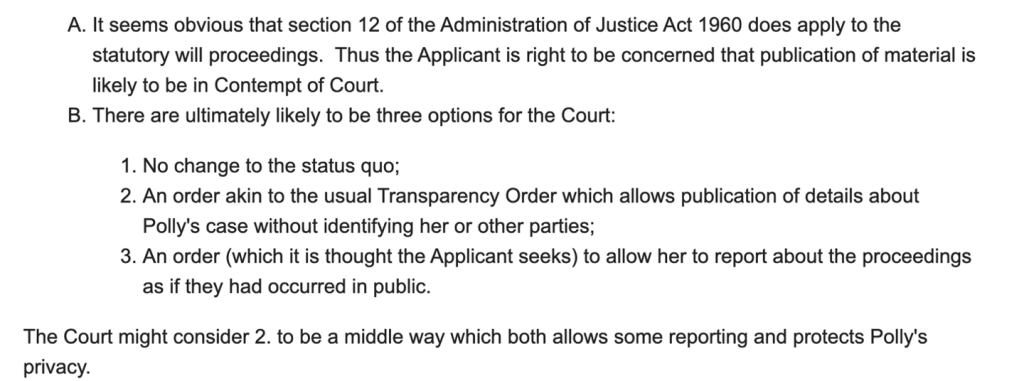
30th September 2025 The Official Solicitor “respectfully declines to accept the Court’s invitation to act as the Official Solicitor’s fees cannot be met by Polly”. Notwithstanding the fact that the Official Solicitor now has no standing to make any particular suggestions on Polly’s behalf, she offers the following (quoted from email from Official Solicitor):
We are surprised by this, since the Official Solicitor normally advocates for P’s “best interests” (as she conceptualises them) and not for a “middle way” between any perceived conflicts of interest[5]. Jenny responded:
As Polly’s sister, and her court-appointed Deputy (H&W and P&F), I confirm that option 3 is the outcome that I believe Polly herself would want – please see my submission on Form COP 5. Given the weight attached to P’s values, wishes, feelings and beliefs (while recognising that they are not determinative), my own assessment is that option 3 is also, for that reason, in her best interests.
I believe Polly would want to enable reporting about the proceedings as if they had occurred in public without reporting restrictions. She would particularly want her family to be able to write about this case in their own names, using her name in whatever we write.
I also note that not one of the parties involved in the case has a problem with this.
I hope that in considering the balance of Article 8 and Article 10 rights, the court will recognise that, in this case, there is no conflict between them, since Polly would wish to exercise both rights by having her family publicly tell her story.
10th November 2025 We receive a sealed court order that says that as of 8th December 2025 we are: “… permitted to identify Polly Kitzinger as a P as defined by The Mental Capacity 2005[6] in respect of whom the statutory will application was made. The Applicant may refer to those persons formally served with this application of 7 June 2025, the judge, the court and information relating to P which was put before the court in private in the statutory will application, save that P’s address shall not be disclosed.” (Order made by DJ Ellington, COP 11757133-04, issued on 10th November 2025). The delay in applying the order was to allow me, as applicant, to serve the order on everyone and to notify Polly of it (that meant all those COP 20A and COP 20B forms again, this time to tell people about the order rather than as previously to tell them about the application). I had to do this by 24th November 2025, and if anyone objected they could apply for a “reconsideration” (on a COP 9 form) within 14 days of receipt of the order.
A recital to the order says that it’s “undesirable” that it’s not been possible to appoint a Litigation Friend for Polly: “The difficulties include that the Official Solicitor requires security for her costs but P’s financial circumstances have changed considerably since the statutory will application. She now meets the financial eligibility for public funding on care and care is publicly funded but the Official Solicitor has not secured public funding of costs through the Legal Aid Board. None of P’s siblings are in a position to act as Litigation Friend as they have an actual or perceived conflict of interest and all consent to the application. The Official Solicitor has assisted the court with some observations” (§8). Nonetheless, given that the applicant (me), Jenny (Polly’s deputy) and Tess are all Polly’s sisters, and as such are persons who are “‘engaged in caring for P or interested in her welfare’ under the terms of sub-section 4(7)(b) of the Act”, and that we all (along with others served with application) support it, the judge was “satisfied that P’s interests and position can be properly secured without being joined to these proceedings and without making any further direction concerning her participation in these proceedings”. The judge noted, in particular, that: “There is no actual or perceived conflict which would warrant dismissing the application because it is the Applicant and Jenny Kitzinger who want to write about the statutory will application. That is inherent in the nature of the application and is appropriately addressed by full consideration of section 4 of the Act.”(§18)
8th December 2025: By 4pm, nobody has sent me any objection to the order or asked for reconsideration. When Tess told Polly about it, Polly gave it a thumbs up. We are now able to write about Jenny’s application for Polly’s statutory will.
Celia Kitzinger is co-director of the Open Justice Court of Protection Project. She has observed more than 680 hearings since May 2020 and written more than 100 blog posts. She is on LinkedIn (here), and also on X (@KitzingerCelia) and Bluesky (@kitzingercelia.bsky.social)
[1]There is a ‘general rule’ in the Court of Protection that hearings are to be held in private (Rule 4.1 Court of Protection Rules 2017) – but, in practice, there are very few private hearings. That’s because the Transparency Pilot, launched in 2016 and now incorporated into ordinary practice, “reverses the general position signalled by the Rules” in order to reflect the “well-known case law articulating the principles of open justice and personal privacy: there is now “a supposition in favour of a public hearing”(Lord Justice Jackson in Hinduja v Hinduja [2022] EWCA Civ 1492) with accompanying reporting restrictions
[5]The current position of the Official Solicitor in advocating solely for P’s best interests is exemplified in the position she has adopted in relation to disclosure of position statements for observers. The OS has created a template refusal to send (even anonymised) position statements to observers, on the grounds that P probably wouldn’t want observers to have access to “personal” information about them. She declines to send position statements unless ordered to do so by a judge. This is not a “middle way”: it explicitly declines to engage with Article 8/Article 10 balancing, which the OS leaves to the judge. In Polly’s case, we have good evidence that Polly would want (what the OS considers) “private” information published about her, so the logical corollary of the stance the OS displays in relation to position statements (i.e. to act in accordance with P’s presumed wishes) would surely be to offer (3) as being in Polly’s best interests.
Transparency and open justice are core to the operation of justice in a democratic society. They are addressed only in 7(g) which says that ‘the powers of the court or tribunal to achieve the Overriding Objective include […] allowing reasonable public access to court and tribunal decision-making.’
This is not sufficient.
The Rules should make clear that the Online Procedure does not justify derogation from the principles of transparency and open justice. In all cases where (but for the use of the Online Procedure), members of the public and/or journalists would be permitted to observe proceedings and/or inspect documents in the court record, this should remain the case where the Online Procedure is in operation. Where use of the Online Procedure can enhance public access, it should be used so to do.
The power of the court should include creating a mechanism for achieving transparency, and for publishing the procedure to be used for public access.
Public access to court and tribunal decision-making (including access to the process not merely the outcome) should not simply be “allowed” but should be actively promoted and where possible enhanced by the Online Procedure.
Recognising the range of practice across the courts, and the more restrictive practices currently in place in the Court of Protection and Family Court, methods for implementation of public access should be ceded to the relevant jurisdiction’s own Rules and judicial case management powers – but with the proviso that use of the Online Procedure cannot justify more restrictive access to court decision-making than would otherwise pertain to any given case. This includes public access to, and reporting (subject to embargos etc) of, proceedings held in private (or ex parte/without notice) as currently permitted in the COP at the discretion of the court.
On 3rd December 2025, HHJ Burrows handed down a suspended prison sentence (of 28 days) to Mr Jim Slocombe.
The proceedings in this case (COP 14240025) began on 13th July 2023 and concern assessment under the Care Act 2014 and for after-care under the Mental Health Act 1983 for a man in his forties (with schizophrenia, Ehlers-Danlos Syndrome and Autism Spectrum Disorder) who was, at that time, living with the Slocombes. The assessments were ordered to take place by 21 May 2024, and permission to appeal that order was refused.
The defendants, Mr Jim Slocombe and his wife Mrs Tess Slocombe, are alleged to have breached these orders by not permitting professionals to assess P – by preventing him from attending an appointment, and by refusing professionals access to P in the home.
The December hearing, which was heard in person at Burnley County Court[1], was the outcome of a series of attempted committal hearings, (previously blogged here: A committal, a closed hearing, and forced removal of P). Mrs Slocombe was unwell and left the proceedings, but Mr Slocombe admitted that he had disobeyed court orders but said that he considered it the morally right thing to do.
The public bodies bringing this committal application were Cheshire West and Cheshire Council, and Cheshire and Merseyside Integrated Care Board. They were represented by Ian Brownhill of 39 Essex Chambers.
The defendants, those accused of being in contempt of court, Mr Jim Slocombe and Mrs Tess Slocombe, were unrepresented, notwithstanding the fact that all defendants in committal hearings in the Court of Protection are entitled to free (non-means tested) legal representation.
This blog has five sections.
Background.
Court interpreter (and departure of one defendant)
Application for adjournment and admission of contempt of court.
A suspended sentence.
Reflections.
1. Background – earlier hearings
In 2022, P was an “informal” patient in a psychiatric hospital, having previously been detained pursuant to section 3 of the Mental Health Act 1983. Against medical advice, though it is important to note that in theory there is no power by which an informal patient can be kept in hospital, the defendants – Jim and Tess Slocombe – took him home.
As P had been detained under section 3, albeit not at the time of his discharge, he was entitled to funded aftercare under section 117 of that same Act. However, since discharge, public authorities have tried (without success) to assess him.
In July 2023, proceedings were brought under the inherent jurisdiction of the High Court seeking access to P. Then in March 2024, a judge (HHJ Burrows) made declarations that P lacked capacity in all domains. He ordered that the assessments take place by May 2024. Mr and Mrs Slocombe appealed this order but the Court of Appeal dismissed it as without merit.
The assessments did not take place. The public bodies made a “without notice” application (i.e. one Mr and Mrs Slocombe didn’t know about) for an order that P be conveyed to hospital for the purpose of facilitating the assessments. HHJ Burrows dismissed that application but made another order (endorsed by a penal notice) for P to be assessed, and for Mr and Mrs Slocombe not to interfere with that assessment. The Slocombes’ application to appeal was dismissed by Mrs Justice Theis (the Vice-President of the Court of Protection). Still, they did not allow professionals to have access to P, meaning that their non-compliance with the order of the court spanned May 2024 to October 2025.
Thus it came to be that a committal application was made. It was alleged there were two breaches of two court orders. Both had the purpose of ensuring P would have his needs assessed by professionals. Both made it clear that Mr and Mrs Slocombe would not, “interfere with the assessment process” (quote from the hearing of 3rd December 2025).
The committal application was first listed for hearing on 30th July 2025. On that occasion, the defendants did not attend court – for reasons some of which also arose in the hearing on 3rd December 2025:
I understand that they wanted the hearing to be adjourned on medical grounds – and also that they were asking for reasonable adjustments to support their involvement in proceedings, given their own disabilities (for which the judge stated they have not provided medical evidence). Neither defendant is legally represented because (they say) “we dislike the idea of needing to involve more lawyers in P’s confidential information and increasing the number of people we have to communicate with – verbally or written” (quoted from the position statement of counsel for the public bodies). The defendants clearly feel victimised: they have accused two solicitors for the local authority of bullying them and threatened to report one to her professional body. (Quote from: A committal, a closed hearing, and forced removal of P)
Having satisfied himself that he should neither continue in the absence of the defendants, nor issue a bench warrant that would compel their presence in court, the judge converted the hearing to an ex-parte hearing (a hearing from which a party is excluded and is not informed is happening)[2]. At this ex parte hearing, the judge ordered that P should be located (it wasn’t clear quite where he was) and removed for the purpose of assessment. The police attended a caravan, and removed him to hospital using powers pursuant to a warrant issued under §135 of the Mental Health Act 1983[3], from where he was detained under section 2 of the Mental Health Act and transferred to a Psychiatric Intensive Care Unit.
Vikram Sachdeva KC (at that point representing the council) had told the court that “[Mr Slocombe] was, uhm, not pleased to have them visit”. Indeed, at the hearing on 3rd December, it was clear that this “visit” had a lasting impact on Mr Slocombe and, I rather imagine, on P himself.
2.Court interpreter
The hearing of 3rd December 2025 was listed to begin at 11am but I was told it wouldn’t start until 11:30 due to “technical issues”. In actual fact, the hearing didn’t start until around 12:15 because there were further issues with acquiring court interpreters.
When I joined the link, I could see the barrister for the public bodies, who was wearing the traditional wig and gown that most people think of when they think of British courts. I only got one good look at the judge but it looked like he was wearing his judge’s robes and a wig. This level of formality in dress is unusual for Court of Protection hearings but, to symbolise the gravity of such applications, it is standard in committal applications and all cases before judges of the High Court (unless the judge directs otherwise). In fact, the Court of Protection rules dictate that “Advocates and the judge shall appear robed in all hearings of contempt proceedings, whether or not the court sits in public.”
I could also see a row of people sitting directly opposite the camera (so sitting horizontal to, rather than looking directly at, the judge’s bench). As the hearing got under way, and the issue of court interpreters was raised almost immediately, I came to realise that one of the people I was looking at was Mrs Slocombe.
The court was told that Mrs Slocombe had a bad headache. She did not want to continue because she was unhappy with the interpreter provided by the court. Instead, she wanted a specific interpreter from the British Deaf Association.
In response, the judge was saying, “well he’s not here so you’ll have to make do with what you’ve got. We’ll carry on”. Mrs Slocombe, with the assistance of the court-appointed interpreter, pressed the point, but unfortunately the interpreter she wanted was busy on the day of the hearing and therefore unavailable (to which the judge said, “well there we are. You can’t have what you can’t have”).
This was uncomfortable to watch. Mrs Slocombe was visibly distressed, and the judge was clearly of the view that there had been reasonable adjustments to ensure her involvement in the proceedings.
At some point after this brief exchange, I saw a woman (who I later learnt was Mrs Slocombe) stand up and leave the courtroom. I also later learnt that she’d produced a note (I think from a doctor) that said she was not fit to work and (this was handwritten) that she would not be fit to attend court until February 2026.
At the end of the hearing, the judge expressed concerns about the application that related to her.
Counsel for the public bodies agreed: “We would invite you to adjourn until a date in February 2026, at which point Mrs Slocombe can file evidence from the person in her note today. And in the intervening period the local authority and ICB will take the view whether it is in the public interest to pursue the application”.
The judge thanked counsel for this approach, and adjourned the application until the end of February.
But all this came after hearing the application concerning Mr Slocombe.
3.An application to adjourn becomes an admission of contempt of court
After hearing from Mrs Slocombe, the judge turned to Mr Slocombe who had made an application to adjourn. Unfortunately for Mr Slocombe (who I’ll refer to as “the defendant” from now on), this application to adjourn turned into him admitting that he had been in contempt of court.
I should say at the outset that I never once got the impression that judge intended for this to happen, and indeed at various stages he tried to steer the defendant away from that. The judge was also concerned about the defendant’s welfare. For example, when the defendant told the court that he was “feeling a little overwhelmed” the judge, in a friendly tone, said “let’s try and make this as underwhelming as possible”.
The application to adjourn was premised on Mrs Slocombe’s health (which I won’t say any more about because the judge essentially put aside the application relating to her) and the fact that both defendants wanted, but hadn’t acquired, legal representation. Defendants in committal proceedings in the Court of Protection are entitled to free legal representation.
The judge had some concerns: “why is it, all these months later, and in fact nearly two months after the last hearing, that you have still yet to get legal representation? […] you get legal representation for that free of charge. You have known that since May. What I don’t understand is why you told me yesterday, in your application [to adjourn], that you’ve now decided to take legal representation”.
To this the defendant responded that the issue wasn’t just about acquiring legal representation: “from our point of view, we found ourselves in a position where we had to breach orders”.
I winced at this. In the course of applying for an adjournment the defendant had, with no prompting from the judge, admitted the breach of orders. That being said, I’m not sure whether the defendant was ever going to say he hadn’t been in breach of court orders – his position was more that this breach was justified, and both defendants had previously said in writing that they intended to refuse access to P and to “contravene the order”.
The judge reminded the defendant of his right to remain silent, and said he wanted to remain focussed on the application to adjourn.
The defendant told the court that he had made some attempts to contact solicitors but had no luck. But the judge had little sympathy: “in the normal course of events I might be sympathetic to that. But you’ve had six months since these proceedings have started to get legal representation for which you won’t have to pay. And I want to know why [you haven’t got legal representation]”.
Owing to difficulties with oral communication, the defendant prefers to write. But “I write too much, I put down too much, and that’s been my problem. It’s not been for want of trying but I’ve been trying to write the wrong thing. It’s been so much going on in this case. In some ways it’s very simple but in other ways there’s so much of it.”
The judge, however, had seen some of the defendant’s writings, and described them as being “very clear, they’re very learned, they’re not always on the point but they do make a point”. He did however acknowledge that, since P was detained under the Mental Health Act, the defendants will be “devoting your resources to dealing with that. But that’s got nothing to do with you not complying with the order that this court, and before that I think the High Court, made to allow him to be assessed so he wouldn’t end up in a psychiatric hospital”.
Defendant:And that’s the tragedy of what’s happened.
Judge:On the face of it, the tragedy is that if he’d had the assessment two years ago, he wouldn’t have ended up in the hospital.
Defendant: If he was assessed in the right way.
Judge:This is the problem. The court said what needed to be done. You disagreed. You’re entitled to disagree but you’re not entitled to disobey the court order which is what you’re alleged to have done.
Defendant:That’s the difficulty. Trying to explain why we haven’t engaged a solicitor – it’s because, on the one hand, there’s so much to bring a person up to speed on. From our point of view the situation is not as simple as you’d put it. Because we had difficulty explaining it… we kept believing our best – because to us it seems relatively simple, we thought the best thing to do was try…
Judge: But you’ve made your comments. You’ve made your case in the past in front of me in a way that has been very easily comprehensive to me. I have understood your case all the way along and your case is that you want the people you want to assess [P], rather than the professionals put in by the local authority and ICB. The court said they are appropriate. They must do it. That’s where the disagreement was. It’s been resolved by the court. An order was made on behalf of [P]. The Official Solicitor, who was representing [P], was in agreement with that. It’s simple. You do what the court tells you to do. Where’s the complexity?
Defendant: Unfortunately, the complexity is – We understand that we are legally obliged to obey court orders. Unfortunately, we are morally obliged to do the best for [P]. And regrettably we found it impossible to explain the difference. So we find ourselves in a position … all we can ask is you take into account our mitigating circumstances.
Judge: Sorry. I don’t want to get ahead of ourselves. You’re asking me for adjournment. You’ve now said, without me asking you a question, you’ve got no defence to the application for committal because you know you should have obeyed the orders but haven’t. And you say you have a moral obligation. I don’t understand the moral obligation.
Again, I felt myself wincing during this exchange. Whether he realised it or not, and whether he intended to or not, the defendant’s application for an adjournment had turned into admitting the breaches of court orders and (at least in the eyes of the court) that he had no defence for doing so.
After this exchange, the judge carefully went over the history of the case, from when P was first admitted to hospital right up to his current detention. Mr and Mrs Slocombe were making an application (before a different court) to challenge that current detention but that had been adjourned.
Just as I was starting to wonder why the judge was going down this path, it became clear: the judge wanted to understand “what is going on in the background [that] has prevented you from instructing a solicitor to represent you in these proceedings”.
But no explanation was forthcoming.
For the defendant, there are two aspects: a legal aspect, which was the judge’s position, and the moral aspect, which was the position of the defendants. The defendant appreciated that “from a legal point of view” he can’t decide not to comply with court orders. But his position was that he can (and should) from a moral point of view.
The reason for this is that the defendant wants the assessments to be carried out in accordance with the Department for Health’s manual for good social work practice: Supporting adults who have autism. This manual gives (in the words of the defendant) “great detail how these sort of assessments should be carried out. It uses phrases such as ‘fail to plan, plan to fail’. Phrases such as, ‘if the person prefers written communication, that should be carried out as much as possible’”.
From the court’s perspective, the underlying submission – that P be assessed appropriately – had already been dealt with. Indeed, the judge said he’d previously found that the people who would be assessing P “were adequately trained to do so”.
At this point, discussion turned to the circumstances by which P was removed in October 2025. As was reported in the previous blog post, counsel had told the court that Mr Slocombe “was, uhm, not pleased to have them [the police etc] visit”. Here’s what the defendant said about that day:
Defendant: […] He [P] had an autistic meltdown. And that was when he was being assessed for his mental health. That is an exact example of why we have been sticking out against the wrong assessments. He gets misunderstood and ends up back in hospital. That’s why we wanted the right people to assess him, using the reasonable adjustments in that Department of Health document. What happened in that s135 arrest as we call it – we were in his caravan. You know the arrangement. On a quiet afternoon…it was the day after my wife collapsed in the waiting area so she was still resting from that. Fortunately, very fortunately, she was in the other caravan fast asleep. Because [P] and I have problems with visual disturbances, we have the venetian blinds. So I wasn’t aware that there was a throng of people gathering. Knock on the door. And the AMHP, she starts to explain who she is. Then I suddenly see this crowd of people….a transit van parked, blocking the road. That is the exit. Now the police car, blue lights flashing. So anyone leaving the caravan park had to find a different way, the wrong way round a one way system. So it was obvious to everyone in the park that something was going very wrong at our caravan.
Judge:Well someone was attending to execute a s135 order.
Defendant:We have to live there. They were humiliating [P].He was led out in handcuffs. Hugely humiliating. So anyway, I jumped forward – I opened the door, two policemen, two doctors as it turned out, the AMHP, about half a dozen people to do with this secure transport as far as I can remember. And bearing in mind you never see anything like that taking place in that park. And I almost had a meltdown. But realising the seriousness of the situation I managed to talk about it, try to explain there was a misunderstanding.
Judge:To who?
Defendant: To the AMHP. I was concerned [P] would come to the door to see what was happening so I tried to step out but the policeman said I couldn’t do that. So I stayed in the doorway, it was a discussion of 20 minutes. After the first 10 minutes, I would guess, [P]came to the door, and first thing he saw was a policeman. He’s had a number of difficult situations like that. So very quickly he became concerned about that. He could immediately see what was going to happen. As far as I know that wasn’t mentioned anywhere because the psychiatrist at [Hospital] explained the detention in very similar words you used, which sounds like people just walked in, had a chat – there’s no mention of an autistic meltdown. To me that’s dishonesty. And that’s the type of concern we’ve had throughout because we’ve seen it before. And we feel so strongly to it that we were prepared to disagree on the legal point because we feel strongly.
To be clear here, what the defendant was saying is that the reason they had not obeyed court orders was because they were concerned the assessments would not take place in an appropriate manner. In the defendant’s view, in October 2025, that’s exactly what happened and his worst fears came true – P found the situation exceptionally challenging, and he was detained under the Mental Health Act.
The exchange continued:
Judge: You’re not disagreeing. You’re disobeying. People can say they disagree. No judge takes offence at that. But not obeying it is a serious matter for which you could be sent to prison.
Defendant: We do understand that. Why do you think my wife collapsed last time? We find this very upsetting. [P], for the last 18 years, has been very badly affected purely by misunderstandings in 2007. That’s half his working life. And we’re not going to do anything that allows the next 18 years of his working life be thrown in the bin. Even if it means we end up in prison. If we’ve done everything we can to recover his life, get his life back on the rails – we certainly don’t enjoy this situation. But we couldn’t forgive us. The last thing we wanted for [P] was to end up hospital. The last thing we wanted, we tried everything we could to prevent that. But through misunderstanding –
Judge: You keep saying misunderstanding You keep saying you’ve done everything you could. What you could have done is allow the professionals to assess [P]. It wouldn’t have been the same situation as the 135 [warrant]. They would have attended wherever it was, they would have used their professional judgement to decide how far they could go with their assessment. If there was a meltdown they could have responded appropriately. Why didn’t you just let that happen?
From the perspective of the court, the actions of the defendant in frustrating access of professionals because it may be distressing to P was something of a self-fulfilling prophecy. In attempting to avoid what they thought would be distressing, the actions of the defendants had caused that situation come to fruition – something the court felt was avoidable.
Indeed, earlier in the hearing, the judge had said: “You say you prevented that [the assessments] from happening, for reasons that you say are good ones. And lo and behold, on 7th of October of this year [2025], he is back in a section, in a psychiatric hospital, and it seems that the tragedy there is that might have been avoided if there had been compliance with the order at an earlier stage. “
It was quite clear that the events at the caravan in October 2025 had a lasting effect on the defendant: a traumatic event compounded by the further trauma of a committal application. At times, the explanation for why the defendant did not comply with previous orders was subsumed into discussion of what happened in October. For example: “Even those last orders started off incorrectly and what would happen to us if an assessor turned up at a caravan and [P] wasn’t expecting them, and he wasn’t happy, he would have a meltdown”.
The judge had little regard for this: “But this is different. What happened on 7th Oct was exactly what everyone wanted to avoid. And your behaviour made it happen”.
It was fairly obvious at this stage that the gap between the view of the defendant and the view of the court was too great to be overcome. The judge gave a brief ex tempore judgment on the question of the defendant’s application to adjourn. Having satisfied himself that the defendant “doesn’t have any difficulty understanding what’s going on in court”, he said this about the defendants’ lack of legal representation:
“You would probably be better off with a solicitor or counsel representing you because they would be able to give you expert but also dispassionate advice about your situation. However, I do not consider that after all this time, and for a person of your intelligence and understanding of the proceedings, that it is appropriate, necessary, or proportionate for me to adjourn these proceedings in order for you to try to find legal advice. I am doubtful as to whether you consider you need to have legal advice and I’m very doubtful that your application to adjourn is anything other than, I’m afraid, a delaying tactic. Something that will cause delay to the court and for no good reason. I consider it’s appropriate to carry on without you being legally presented even though I recognise the seriousness of these proceedings.”
The charges (the breaches of the court orders) were then formally read out to the defendant. As he had already done so, the defendant again admitted the breaches.
4. Sentencing
A defendant in committal proceedings has the right to offer mitigation, and the defendant in this case had already offered much of it by the time he formally admitted the breaches.
In the defendant’s mind, there are two “lines”: the legal and the moral. For the defendant, it was the moral side that needed to take precedence. As the judge summarised, “Because of [P’s] autism, and perhaps because of your own experience, you have a particularly strong sense that you need to protect him notwithstanding anything the court said […] and my problem is, you would do it again?”
And, indeed. the defendant had made it clear he would do it again.
Having heard the defendant say he preferred to deal with things in writing, the judge confirmed that the defendant would prefer the sentencing decision in writing.
The judge then turned to Counsel for the public bodies, who reminded the judge of the judgment of the Court of Appeal in Re B (a child) (Sentencing in contempt proceedings). In that case, the mother had breached court orders three times. When considering the committal application, Ms Justice Henke declined to order a term of imprisonment because “sending you [the mother] to prison is not going to change your mind” and would“have no effect on the mother’s attitude or secure future compliance”.
The Father appealed to the Court of Appeal. In its judgment, the Court of Appeal remitted the case for rehearing before a different judge, and said: “It cannot be the case that a parent can repeatedly refuse to comply with orders made in the best interests of their child, knowing that a judge may well in those circumstances dismiss the committal proceedings as serving no purpose. To do so would undermine the authority of the court and have significant implications for other cases. Punishment for breach of court orders serves as an essential aspect of upholding judicial authority as well as ensuring compliance”. (§40 (Re B (A child) (Sentencing in contempt proceedings)[2025] EWCA Civ 1048). When the case was re-heard, by Mrs Justice Lieven, she (very reluctantly) sentenced the mother to a term of imprisonment (“sentencing in contempt proceedings”).
In summing up the options for the court to choose from, Counsel wore two hats: one as the representative of the public bodies who brought the application, and another as if he were representing the defendant. Here’s what he said:
Counsel for the public bodies (Ian Brownhill): Your Honour has the three options. First is sentence of immediate imprisonment. Second is suspended sentence. Third is a fine. Because of the court Your Honour sits in, it is an unlimited fine. I would point out, mindful of the fact Mr Slocombe isn’t represented, two things I would say if I were his counsel. The first is that he has accepted the contempt and you should reflect that in your sentence. The other thing I would likely do if I were representing Mr Slocombe is point out that the sentencing council does produce guidelines for sentencing people with mental disorders [the defendant had told the court about some difficulties he had, which I don’t reproduce out of respect for his privacy] …and in respect of that guidance I think it is something Your Honour can look toward. Paragraph 22 says where an offender is on the cusp [of imprisonment], the court may consider whether the disorder [makes a term of imprisonment disproportionate] … Equally I would submit to you, again as if I were standing up for Mr Slocombe, that he is a man of good character, who has caring responsibilities, and I would invite you to take into account all of those things. Putting my wig back on for the public bodies, there has been a lot of correspondence. They are not going to follow court orders. Mrs Slocombe said she was prepared to go to prison because she had the opportunity to read there. This is long-standing non-compliance.
In a brief ex tempore judgment, which will be developed in writing and then published, the judge found that “a custodial sentence is appropriate and necessary”. However, because of the defendant’s age (he’s in his 70s) and other mitigating factors, he made the sentence of 28 days imprisonment, suspended for 12 months. That means, if the defendant does not breach any orders in the next 12 months, nothing further will happen. But if there are further breaches, “you will be back here, and you may well be sent to prison”. We will add a link to the judgment at the beginning of this blog post when it becomes available.
5. Reflections
It’s not unusual for defendants in the Court of Protection to defend themselves against a committal application on the basis that they breached court orders on moral grounds, or even that the orders themselves were immoral.
In what is said to be the first publicly known case of a person imprisoned by the Court of Protection for breach of court orders, Wanda Maddocks disagreed with decisions made with regards to her father’s care. She removed him from the care home at which he resided, and fled with him to Turkey. She was given a sentence of five months imprisonment, though only served five weeks after apologising to the judge. She told the Daily Mirror, “he was really depressed in there” and “Dad improved 100% in Turkey. He was so normal. I knew only I could look after him”. In other words, Wanda Maddocks breached court orders because she felt it was her duty to do so.
More recently, Lioubov (Luba) Macpherson persistently breached courts that prohibited her from publishing information about her daughter, who is a protected party in Court of Protection proceedings. In a judgment upholding Mr Justice Poole’s sentence of three months imprisonment[4], the Court of Appeal captured one of the grounds of appeal as being based in the belief that the orders were “arbitrary and disproportionate injunctions” that “failed to protect [her daughter’s welfare” (§28(7)). Indeed, “Ms Macpherson said that she had been entitled to act in the way she had because no one was listening to her and publishing information online was the only step she could take to protect her daughter” (§31).
Like HHJ Burrows in this case, the Court of Appeal found this an unconvincing defence:
§33. […] The fact that she profoundly disagrees with the order does not entitle her to disregard it. There is nothing to support her repeated assertions of professional misconduct. Her very strong views have been aired on many occasions in the proceedings, but for the most part have been rejected by judges on the evidence. There is no merit in her assertion that the orders were unlawful. The straightforward position is that she was obliged to comply with the orders and deliberately chose not to do so.
Moral objection to court orders is also a recurrent theme in committal proceedings in the Family Court. In Re B (a child), cited above, the reason for the Mother’s non-compliance with the court’s orders was that complying with them would cause harm to the child (see §9 of the judgment).
It is perhaps unsurprising that the court finds defences such as these unconvincing. When a court order is made, particularly one with a penal notice attached, it is highly likely that somebody will have to do so something (or allow something to happen) with which they disagree. Disobeying that order undermines the authority of the court. Failing to enforce court orders, including choosing not to bring committal proceedings in the face of persistent non-compliance, makes the orders essentially worthless. And as this case demonstrates, P can be harmed by a failure to comply with court orders.
While contempt hearings almost always concern family members who have breached court orders, public bodies also fail to comply with court orders[5]though I don’t suggest that happened in this case: these public bodies have been unable to comply with the orders as a result of non-compliance by the defendants. That being said, such is the frequency of non-compliance by public bodies that Senior Judge Hilder sets aside time each month to hear these cases, summoning public bodies before her to explain their non-compliance. I’ve observed Senior Judge Hilder on a number of occasions. She’s an impressive judge with an unparalleled attention to detail. Suffice to say, I can’t imagine these non-compliance hearings are a pleasant experience for the professionals involved.
But, aside from this, the court is somewhat toothless in its response. Judges complain about public body non-compliance, and they’re clearly often very cross about it, but I am unaware of any Court of Protection case in which committal proceedings were brought against professionals employed by a public body. That’s perhaps because the threat of a penal notice is enough to finally push a public body into action.
But the fact remains that there is an asymmetry of power and influence between individuals and public bodies involved in court cases. Committal applications are the sharp edge of that asymmetry.
It would be easy for me to sit here and pronounce on how important it is, not least to the rule of law, that court orders are complied with. But what if my relative was the subject of Court of Protection proceedings? What if a judge, who had never met them, made orders that I felt were entirely contrary to their best interests?
Of course I’d appeal first – if I could afford it, and that’s a big if. Leaving aside the costs for lawyers, and assuming I represent myself, I’d have to find £265 to appeal to a more senior Court of Protection judge. What if a High Court judge had heard the initial application? Well if I had permission to appeal to the Court of Appeal, I’d have to pay £1,466. If I didn’t have permission to appeal, and needed the Court of Appeal to grant that, I’d have to pay £646 (with £1,466 to follow if permission to appeal was granted).
In addition, I’d need to recognise that an appeal isn’t an opportunity for re-hearing, and that I’d have to demonstrate a procedural deficit in the judge’s reasoning. What if I couldn’t? What if the decision was legally sound but morally wrong? What if I thought the decision was legally wrong but I couldn’t put together the money for an appeal? Would I simply go along with what I thought was a disastrous decision?
The truthful answer is that I don’t know. And I rather suspect that nobody else does either.
Daniel Clark is a member of the core team of the Open Justice Court of Protection Project. He is a PhD student in the Department of Politics & International Relations at the University of Sheffield. His research considers Iris Marion Young’s claim that older people are an oppressed social group. It is funded by WRoCAH. He is on LinkedIn, X @DanielClark132 and Bluesky @clarkdaniel.bsky.social.
[1] To represent the gravity of committal applications, they are almost always heard in person. Sometimes we have observed these cases in person but, as we often don’t know about them until the evening before, we usually have to ask for a link. For examples of committal applications we’ve observed and blogged about see:
[2] Unusually (for closed hearings), the judge permitted Celia to observe and also report on the hearing. Her blog demonstrates the great care the judge took in reaching his decisions. While another judge has permitted me to observe a series of ex-parte hearings, he did not give me permission to report on the content of the hearings. When those proceedings have concluded, I’ll publish a blog about that experience.
[3] Section 135 of the Mental Health Act 1983 gives the police powers to enter any premises, including a home, in order to locate the person and, if necessary, remove her or him to a place of safety. These powers can only be exercised following the grant of a warrant by the court. Such a warrant can only be issued if “there is reasonable cause to suspect that a person believed to be suffering from mental disorder—
(a)has been, or is being, ill-treated, neglected or kept otherwise than under proper control, in any place within the jurisdiction of the justice, or
(b)being unable to care for himself, is living alone in any such place,
Caring for aging parents who have declining physical and mental capacity can lead to family conflict. There may be different understandings of what the parent wants or needs (and how to balance independence and risk) and different views on likely future deterioration. This can be compounded by disputes about how finances are managed, who is doing the caring (or doing it best), and what sacrifices different offspring would have to, or are prepared to, make in order to provide support. These tensions can trigger pre-existing family fault-lines and can often be exacerbated by different personalities, roles, expectations and by people’s location – for example when one family member provides everyday care and another, who lives further away, has less regular hands-on involvement.
Mostly these tensions are muddled through for better or for worse, without the involvement of a judge. But where the situation involves an unresolved conflict about a person’s best interests – and a crucial decision needs to be made – then it may end up in the Court of Protection.
This is what had happened in the case I went to watch in person in Cardiff: COP 20015780 before District Judge Hussell on 5th December 2025. This is the third in a series of hearings I’ve observed (the last two were on 1st and 26th September 2025).
The protected party in this case (Mrs P) is a woman in her late 80s who lives on her own in the family home. She is a proud, independent woman – who enjoyed long walks in the mountains with her husband until two and half years ago, when he died under very traumatic circumstances. Mrs P was overcome with grief – but resisted the offer of professional help, apparently telling one of her daughters: “unless you can bring my husband back, I don’t want to see anyone”.
Since then, Mrs P’s health has deteriorated with a combination of physical issues and mixed dementia. She has also been diagnosed with anxiety. She eats and drinks very little. She lacks capacity to litigate or to make decisions about key areas of her life.
She is currently supported to live at home by carers coming in three times a day, and regular visits from her family. Her youngest daughter, who lives close by, visits three times a week and provides aspects of daily care (including, for example, being the one to bathe her mother as she dislikes ‘strangers’ doing this). Her eldest daughter, who lives several hours drive away, comes to stay about once a month. Mrs P also has visits from her grandchildren.
Mrs P has family who clearly care about her. She is also someone who had planned in advance, anticipating possible loss of capacity and acknowledging her own mortality.
Some ten years ago, she and her husband made a deed of transfer giving the family home (in which she still lives) to their daughters
Both daughters (jointly and severally) have LPA for Mrs P in relation to her finances
In addition, in 2023 Mrs P made her eldest daughter, her LPA for Health and Welfare.
Sadly, despite having a caring family, and trying to prepare in advance in this way, there is now a stalemate between her two daughters about what is in Mrs P’s best interests going forward.
The elder daughter, M, believes she should move to live nearer to Mrs P, and wants to use her mother’s funds to help facilitate this. She originally applied to the Court of Protection (back in May 2025) to authorise the use of Mrs P’s money (less than half her assets) to buy a house she’d identified right across the road from her mother. Indeed, she’d already had an offer accepted on the property. The plan was for M to move there, along with her household consisting of her husband, dog, and horses. She argues this would allow her to provide support in the way Mrs P would accept (she believes that her mother would not want anyone living with her); and that buying this house would be a reasonable financial investment for Mrs P. She promised that she would vacate the property if her mother needed residential care or when she died. (M did not intend to sell the home she currently lived in – so it would be available immediately if she needed to move back in).
The younger daughter (H) opposes this application. She does not think the proposed use of funds is in her mother’s best interests – nor, in her view, is it based on an accurate understanding of her mother’s needs. She anticipates that their mother will soon require 24/7 live-in care and wants her mother’s funds preserved to pay for professional full-time care.
The specific house purchase planned by M has fallen through – due to the lack of agreement between M & H and/or a court order. The decision now before the judge was about how to care for Mrs P while her younger daughter was away on holiday for 5 weeks. M was asking the judge to authorise that £3,000 of their mother’s money be used to rent a bungalow close by Mrs P while her sister was abroad, so that she could use that as a base during her sister’s absence.
The hearing on 5th December 2025
Mrs P’s daughters were both Litigants in Person. The judge took care to make them feel as comfortable as possible – offering guidance about procedure, paying attention to physical comfort in the court room, and trying to ensure the litigants had the support people they might need with them.
He was also clear about boundaries (e.g. when the sisters were tempted to interrupt) and throughout the proceedings he reiterated the importance of keeping Mrs P’s best interests at the heart of the decision and of avoiding this being derailed by the ‘seam of animosity’ between the sisters. At different points in the hearing he also expressed his disappointment:
“I was hoping this was something that could be decided by you as a family…you can’t keep coming back to the Court of Protection – technically you can – but as I’ve said throughout this case, the most important person in this case isn’t here in the room – your mother.”
“I am sure if your mother knew about this application she would be incredibly upset and disappointed that her daughters have not been able to work collaboratively.”
Position of the applicant, M
M, as the applicant, spoke first. She emphasised why her mother needed her close by, rather than having extra paid-for care. She highlighted the problems with the carers (lack of continuity and not always arriving at the best time) and described her mother’s resistance – “mum shuts down when they come in, she won’t engage with them. They can’t get her to eat and drink.” She contrasted this with how her mother perks up when M is around.
She also emphasised the reversibility of some of her mother’s mental and physical decline. She said her mother’s appetite had improved since her anti-anxiety drug had been stopped – “it made her too sleepy to eat and drink” – and pointed to the success of a recent cataract surgery – “she is more mobile and confident because she can see what she’s doing. Having the gift of sight back she is making food again – making her breakfast…The blindness was impacting her dementia massively”.
M had recently arranged a longer visit than usual to spend time with her mother and said she’d seen her mother change for the better already. Mrs P was now enjoying listening to choir music and, according to M: “Over 10 days she’s transformed” and “I’ve turned it round – she’s walking up the mountain two miles.” (She’d sent the court a video of this.)
M emphasised that by moving close to her mother while H was on holiday, she could provide important family support to supplement the professional carers – including not just practical assistance but also such things as accompanying her mother on a walk, or joining her in the evening for “a game of scrabble and a little glass of Baileys”. This is what her mother wants, and is in her best interests:
“She is adamant she doesn’t want full time carers. “I can’t breathe’’. She shows up every day fighting to have her own spade. … She is a warrior, a force to be reckoned with, she won’t put up with something if she doesn’t want it…My mother trusted me as her eldest daughter … her health LPA. I’m asking for the court’s support to fulfil my obligation.”
The judge did not question the value of M’s input into her mother’s life, or the need for extra arrangements to be put in place while her sister was on holiday. His questions focussed on why M would need £3000 to fund this. He explored her reasons for not simply staying in the house with Mrs P (M explained that her mother might become agitated and ask M to leave); whether she could draw on some of her own savings, and why there was a need to accommodate her whole household for a 5-week visit, including ensuring a field for her horses.M spelt out some of the rationale for her request and explained that putting her horses in livery would cost much more. She also emphasised that she was facing major upheaval, would be losing out on paid work, and that she believed the need to accommodate her whole household was appropriate: “why do I need my horses and husband with me? Because they are my life”.
Position of the respondent, H
H said she was ‘perplexed’ by what her sister was currently asking for and concerned about changing goal posts. She emphasised that she was the family member who saw her mother most frequently, organised her care packages and accompanied her to most of her appointments (“with limited support from my sister”). It was she who had most intimate weekly contact with their mother: “I shop for my mother.I bathe my mother – I can see how fragile she is when I am showering her, the rest of the family don’t see that”. She did not think it was reasonable (while she was on holiday) for M to take £3000 to cover housing expenses for the type of care provided “for free” by H the rest of the year. Although she hadn’t been able to view the video of her mother walking that had been submitted to the court – “I know how well or not well she was”. She added that the video would only show “a snapshot”, and questioned the appropriateness of her mother walking up mountains, stating that any walking “should be on the flat”.
H did not feel that her sister understood her mother’s needs: My mother needs supervision during the day for my mother to stay safe.…My fragile mother now needs much more support than my sister isoffering…I have concerns about the horses coming with my sister – my question is: when my sister is riding horses who is looking after my mother? I can’t understand why she can’t be in the house with our mother. …I strongly believe my mother wants company. And she could fall at any stage. Constant company might give her more opportunities to eat and drink…I think my mother’s funds should be used for my mother and not forthe lifestyle of my sister, of three horses”.
She clearly did not trust her sister – neither in relation to how M became her mother’s LPA for Health and Welfare, nor in relation to how she was managing her mother’s money. Nor did she think her sister’s current plan took into account her mother’s future needs: “My mother has mixed dementia –it’s only going one way…After the 5 weeks what’s going to happen then? It will remain that my mother will be frail and vulnerable on her own. She may say she doesn’t want carers, and then she says she wants them. My mother needs supervision at all stages now. I’ve watched my mother over two years now…I’ve watched her slowly deteriorate.”
Judgment
After hearing from both litigants, the judge ordered a break and said he would return with a judgment – and an hour later we were called back into the court room.
The judge outlined the legal foundation for the decision in relation to best interests and also the court’s authority under the Mental Capacity Act – section 23 2(a)
The judge ruled that he was not persuaded that it was in Mrs P’s best interests for £3000 to be spent on enabling M to step in to support her mother while her sister was away, but that he was prepared to authorise half that amount: £1,500
This was a very sad situation for Mrs P and the difficult decisions that had to be made had evidently placed a strain on family relationships. The debacle that led to the house purchase falling through had caused deep frustration. In each of the three hearings I’ve observed (two entirely online, and one in person), it has been obvious that each sister firmly believes she is right – and that the other is being unreasonable. In such circumstances, the idea of compromising with a position that is just wrong may feel unjust (and not in anyone’s ‘best interests’). The family schism ran deep – in the court room for this last hearing (the only one that happened in person), some other family members were present: they were all there to support M (the eldest daughter) and sat on ‘her side’ of the room.
Hearings like the three I observed in this case are not designed to delve into family history or to establish all the rights and wrongs of a situation. They are focussed on ensuring that evidence is available to the court to enable it to make a particular decision in a pragmatic way. Judges are then able to cut through a stalemate to try to make the best possible ‘best interests’ decision in the circumstances. This often seems to be some sort of compromise.
I thought the judge was very skilled and humane in the way he managed the hearing. Alongside his focus on making the decision about the £3000, he was obviously trying to support the sisters to put strategies in place that might stop the case coming back before him. He advised them to seek independent clinical assessment of their mother’s needs and prognosis to help them to plan ahead about how to use her money in her best interests – and said he was pleased to hear that a family conference with the professionals involved in Mrs P’s care had been planned for the following week.
He hoped the sort of best interests decision he’d made in this case was the sort of thing the two sisters might work out between themselves in future. He concluded with a plea to the two litigants: “The grievances are linked, possibly (I am not determining it) to a longer-term dispute. They must solve this for the sake of their mother. That is my plea to them. Otherwise, the concept of ‘best interests’ (except where the State is needed) should be, and remain, invested in the family.”
It wasn’t the best start for 2026. My first hearing (2nd January 2026, COP 13846183 before DJ Owen sitting remotely in Brighton) doesn’t reflect well on the Court of Protection.
The applicant, was P’s daughter (a litigant in person), and she and the judge were the only people in court (apart from me). She had applied to try to sort out what had happened to an application to become her father’s Deputy for Property and Finance, an application with “a very regrettably long history – it goes back to early 2022” (judge).
She really wants it sorted because the local authority has been paying her father’s care home fees pending her being able to reimburse them once she can get access to his bank account, which has been frozen. Several years on, “the county council is putting a lot of pressure on me – apparently the care home fees are up to £150,000 now. So, you know, I’m only trying to do what’s right”.
She’s obviously found the process of chasing the application frustrating. She said, “We’ve been contacting London (which I take to mean First Avenue House), and what happened was, when I called them in – when was it, September or October this year – basically we found out thatapparently a judge had the case and he’d been ill and was on long-term sick, and basically it just sat there and done nothing… so this is why nothing has happened and it’s just daunting really because all I want to do is pay Dad’s care home fees”.
The judge would clearly like to expedite the case but there are problems – beginning with the capacity assessment, which is “fromvery nearly 4 years ogo”.
Daughter: Yes, that’s what I’m saying. It’s been in the pipeline for 4 years – just waiting to hear something and not getting anything.
Judge: I’m not criticising you but… You are now living in [county] and so the address on the application form is no longer correct.
Daughter: Yes, we moved house, but it was correct at the time.
Judge: And when you made the application, your father was living in the same house as you, but that is no longer the case.
Daughter: No, that was in 2022.
Judge: The point is that the form I have got isn’t accurate. I’m not blaming you, but what this court hasn’t got is up-to-date information. It’s got forms from 2022. I understand that if your father had mixed dementia in 2022, he isn’t any better and is probably worse.
Daughter: Can I be honest. My dad can’t walk or talk or anything now. He’s just like a baby. It’s such a shame.
Judge: So he’s worse than in 2022.
Daughter: Oh my god, yes.
Judge: I understand he’s worse than he was and this is upsetting to you. But I’ve got a set of documents that aren’t up to date. […] Ms X, I regret this has happened, but the court needs more evidence. Have you got a pen and paper there? [delay while she locates that] It seems to me the court needs you to update the information from 2022, so where your address is given as [county], you need to give your current address. And you are no longer the carer for your father.
Daughter: No – he’s now in a care home.
Judge: You describe yourself as the carer in the application.
Daughter: Well, I was then.
Judge: Okay, I’m not criticising you, or trying to catch you out, but you need to go through the forms you submitted and where there’s information like that that is no longer the case, that needs to be corrected. The amount of money in the bank account may have changed too?
Daughter: I couldn’t tell you how much is in Dad’s bank account now because I haven’t seen it for a long time.
Judge: If it’s possible to find that out-
Daughter: I can’t. The bank won’t talk to me until I have a Deputyship.
Judge: Yes, it is a bit circular isn’t it. I did say “if” you are able to find out.
Daughter: The last we seen of Dad’s money was before the account got frozen, and I think it was just shy of £400,000. About £390,000 or £380,000 or something like that – I can’t remember. It’s the proceeds of his property. He sold his property. It’s his house money.
Judge: Well, if his bank account has been frozen, it will be the same.
Daughter: Well, he does get his pension go in there, and some other…. I can’t remember the name of it now. But anyway, it can’t be touched. It’s frozen.
Judge: Also, the county council should be informed that you are making this application.
Daughter: They do know, I’ve told them.
Judge: Also, that you’ve told your brother, your sister and your father’s sister – using the COP 15 PA Dep form.
Daughter: Yes, I have already sent these.
Judge: Did you send them in 2022?
Daughter: Yes. That’s what I’m saying. It’s just took such a long time. I don’t know if it’s been lost or what because, apart from me calling about it, it would just be sitting there dormant under the judge’s name that was off sick. I’m sorry if I seem agitated, but it’s a bit daunting really. I’ve got a mum that’s not very well now too, so I’ve a dad that’s sick and a mum that’s sick, and I feel like I’ve done it, and now I’ve got to go through it all again.
Judge: I’m not unsympathetic-
Daughter: No, I know you’ve got a job to do.
Judge: So, if you can inform all of those people about your application, and confirm that your father continues to lack capacity-
Daughter: Yes, I could get the social worker to do that for you.
Judge: I won’t need much persuasion about capacity, but because of the lapse of time… And specific confirmation that you’ve informed the county council who initially applied for the deputyship and then withdrew […] The court just wants to be satisfied that other people who might want to be deputies have been informed and don’t object, or haven’t taken any steps to object, and that the capacity issue is sorted. I will try to get it relisted as soon as possible, at which point I hope the order can be made.
Daughter: Thank you.
Judge: I’m going to ask the people in Reading to send you the forms they have.
Daughter: I moved this year but I’ve got a bag in the garage full of stuff, so I’ll sort that out. So ,it’s my current address, the capacity update and… I can’t tell you how much is in the bsnk account, but I can get those form to [the three family members]. And where do I send all this on to – that’s the worry.
Judge: The Court of Protection at Reading.
Daughter: The Reading one. Okay. It’s such a shame I didn’t know all of this sooner because I’ve known about this hearing for two months now and I could have got you all this information. But I will do it now and send it all on to Reading.
And that was that.
What a mess! Although it wasn’t the fault of this particular judge, and he seemed almost as frustrated by the situation as the applicant did, this is not the Court’s finest hour. The Court of Protection seems here (from what the daughter said, not contested by the judge) to have actively worked against P’s best interests. It cannot possibly have been in his best interests have his bank account frozen for more than three years – when the money could almost certainly have been invested and gained better interest elsewhere and debts would have been paid. And it’s clearly caused his daughter a lot of anguish, hard work, and unnecessarily duplication of effort – at a time when her mother is now also ill. The court’s failure, on this occasion, has created a situation that P would surely have wanted to avoid.
Celia Kitzinger is co-director of the Open Justice Court of Protection Project. She has observed more than 660 hearings since May 2020 and written more than 100 blog posts. She is on LinkedIn (here), and also on X (@KitzingerCelia) and Bluesky (@kitzingercelia.bsky.social)
In a single month, December 2025. I observed five hearings involving nonagenarians – people in their nineties.
I didn’t seek them out. I couldn’t have done so, as there’s no way of discovering the age of protected parties from the public court lists (or their diagnoses). It just transpired that of the 13 hearings I picked to observe that month, five of them (more than a third!) concerned people aged between 90 and 97 – quite a remarkable proportion of my observed hearings given that this age group constitutes less than 1% of the population. All five had dementia diagnoses[1]: one in three people in their nineties has dementia according to the Alzheimer’s Society and this can obviously cause loss of capacity in relation to key decisions, making Court of Protection applications more likely.
I can’t imagine that anyone would choose to be involved – or to have their family members involved – in Court of Protection proceedings as they approach the end of their life. I’m not sure, though, having considered these five cases carefully (and looked at others we’ve blogged about) that there’s much we can do to avoid it.
I’ll first provide a description of each of the five hearings[2], and then (in the last section, “Reflections”) consider why these cases arise and what we can – and can’t – do to avoid becoming a protected party in the Court of Protection in our later years.
1. A statutory will for Mr A (97-years-old)
Deputy District Judge N Smith sitting at First Avenue House (London) on 2nd December 2025 (COP 20022446) – remote
Back in May 2011, Mr A, then in his early 80s, made a will (without benefit of legal advice) naming his wife of thirty years as his sole beneficiary. His wife died in February this year (2025), so he’s effectively intestate.
If he were able to make a new will, he would surely do so, but he’s now 97, has advanced dementia and is “very frail”. He was acutely unwell earlier this year and is now on an end-of-life pathway.
Medical records have been sent to counsel acting for Mr A via the Official Solicitor (Norman Lamb of Ten Old Square) and there is no dispute about either the fact that Mr A now lacks capacity to make a will himself, or about the urgency of the case, given that his death seems imminent.
The applicant in this case is Mr A’s step-daughter, who is in her early 60s now, so would have been around 19 or 20 at the time her mother married Mr A (who has no children of his own).
The step-daughter is applying for a statutory will (s.18(1)(i) Mental Capacity Act 2005), naming herself and her brother as joint beneficiaries of Mr A’s will and as executors of it[3].
If there were no statutory will and Mr A were to die effectively intestate, the beneficiaries would be his three nieces and his nephew (his late brother’s children). Step-children do not inherit anything under English intestacy rules[4]. The effect of the proposed statutory will, then, is to divert money that would otherwise be divided between Mr A’s three nieces and one nephew and give it instead to his two step-children.
The step-daughter says in her evidence to the court that she and her brother have a “longstanding close relationship” with their step-father, and that since her mother’s death she has “remained closely involved in [his] day-to-day life and welfare”. For example, he appointed her with Lasting Powers of Attorney for both Property and Affairs and for Health and Welfare, and she’s “dealt with his finances, arranged and monitored his care, and kept in regular contact with the care homes”. The Official Solicitor says that the evidence is that Mr A was indeed “close” to his stepchildren with relationships “of trust and mutual confidence” and “goes so far as to suggest [he] treated them as his own children”. By contrast, “there appears to have been limited contact between [Mr A] and his nieces and nephew” (Official Solicitor) – limited, says the step-daughter, to “birthday and Christmas cards”.
The nieces and nephew have all given their consent to the step-daughter’s application – one with a witness statement (on a COP 24 form) and the others in emails. Counsel for P by the Official Solicitor describes the emailed responses as granting “informal” consent and would prefer completed COP5s – especially as it was not clear what documents or information had been provided to the intestacy beneficiaries to base their consent upon.
Given the urgency of the case, though, the judge authorised the step-daughter to make the statutory will in the terms drafted and approved by the Official Solicitor – but ordered that she must serve a copy of the order and the draft will on the nephew and three nieces within three days. The order says that they can apply for a reconsideration if they have objections, but must do so within 23 days of the order being served.
The order also authorises the step-daughter to pay costs of the Official Solicitor (£8,000) from her step-father’s funds.
2. Daughter struggling as financial deputy for Mrs B (96-years-old)
Tribunal Judge Reeder sitting at First Avenue House (London) on 15th December 2025 (Case 13807921) – remote
This was listed as a “non-compliance” hearing, and I was expecting it to be about a public body that hadn’t obeyed court orders (see previous blog post). But when I joined the remote link the only person in court other than me and the judge was the daughter of a 96-year-old protected party.
After explaining the transparency order and checking that the daughter understood why I was there (and didn’t object), the judge asked her how her mum was.
Daughter: She’s good. She has dementia and she’s weak, frail, and a few times they’ve moved her to palliative care… She’s just in the bed now. She doesn’t always recognise her children… But she’s okay.
Judge: Are you all managing to see her?
Daughter: Yes. The way we do it is we’ve got like a rota system so one of us goes in every day.
The judge then explained (in a kindly manner) why the court had become involved.
Judge: In July 2022, you were appointed as Property and Affairs Deputy for your mother and asked for authority to sell her house and you didn’t get it. You then filed a standard authorisation… I’m not sure the court has ever dealt with permission to sell your mum’s house?
Daughter: I understood I would have to make another application.
Judge: The reason the court is bothered is a letter sent to the court from [your mother’s care home] saying that the fees had crept up and you owed them about £35,000. They say they’d tried to contact you and not managed. What caused concern is they said then they’d have to serve notice on your mother. The court is concerned to see what can be done so your mum doesn’t have to move out.
Daughter: Oh! The debt is now cleared and we’re now in whatever is the opposite of arrears. What happened was, the fees went up about a fourfold amount after Covid, so I was using her money to cover her fees. I asked my brothers to contribute some money in the form of rent – as they were living in her house. This never happened, so we got into debt. It’s all been very overwhelming for me as all contact was with me and I didn’t have the funds. But it’s sorted now. Reassessment took away most of the debt.
Judge: That was local authority’s contribution, was it?
Daughter: Yes. So, it took away most of the debt and we are now about a month in advance.
Judge: So, if I were to contact [the care home], they’d confirm that?
Daughter: Yes
Judge: You sure about that?
Daughter: Absolutely positive. I think they even had a little dance when it cleared!
The judge then asked for financial details – how much the mother’s contribution is, her income (“pension and some bits and bobs”) – and then turned back to the question of the house. It turned out that two of Mrs B’s sons – her brothers, in their 50s – are living there: “Well this is the struggle. For a good few years, they weren’t paying any rent – just obviously paying the household bills. Since the financial assessment, I’ve asked them to contribute some money, One brother is doing and one isn’t. He’s refusing to pay. He feels why is he having to pay rent on a house his parents have paid for. I can’t get him to see the enormity of where we’ve been to and that even though the debt is cleared now, we need to have a safety net for Mum”. She explained “I don’t want to speak bad of someone, but he just has lived there rent-free all of his life“.
After exploring some issues relating to the brothers and their situation, and how much rent each is paying, the hearing continued:
Judge: How can the court help? It seems to me there have been difficulties financially to ensure your mum’s care fees were paid. In January this year, [the care home] was so concerned they decided they might have to serve notice
Daughter: They did – they gave me 7 days.
Judge: They like your mum. They didn’t want to throw her out. So, they wrote to the court and asked how it could be sorted out. And you sorted it out. Has your mum made a will?
Daughter: Oh, that’s another reason I’ll probably be back in front of you. She didn’t.
Judge: So, there are two things I can do. One is, I can give you authority to sell the property. That will come with complications if the boys are living there, but that’s an order I can make today. The order could also record the importance of ensuring financial security going forward. Having heard from you, I’m satisfied the debt problem is sorted out and that you acted as deputy to sort the problem out as soon as possible. My concern is more about the future. The order could say to [your brothers] that the court expects them to pay a reasonable rent, as determined by you as deputy. Given where the house is, the rent you are asking for is a very reasonable amount of money. You can talk to a couple of estate agents about what rental it would fetch on the open market, and then – given your mum might want them to live there – give them a generous discount. And then you could go and see a local solicitor about the will. I can’t give you advice, but see a solicitor and get it sorted out!
The judge was kind and supportive to this litigant in person throughout the hearing and it was obvious he was trying to help her. I’m not sure she’ll follow up on the statutory will (I don’t think she understood what could be possible, or the urgency of doing it right away if the way the money would be distributed on intestacy isn’t what her mother would have wanted, or in her best interests). But she had clearly been worrying about the situation and was grateful to the judge.
The hearing ended with the judge asking “How old’s your mum? My maths is terrible!”.
Daughter: She’s 96. She always used to say she was waiting for a telegraph from the Queen –I don’t know that she understands it will be the King now – so maybe she’s hanging on for that. She’s so frail, but she’s still a fighter.
Judge: I can’t give her a telegram from the Royal family but I can give her an order from the court.
Daughter: That’s such a weight off my mind. Thank you.
3. Deprivation of Liberty for Mrs C (97-years-old)
Tribunal Judge Gray sitting at First Avenue House (London) on 8th December 2025 (Case 20023156) – in person
Mrs C, aged 97 and already diagnosed with dementia, had a stroke in July 2025 and was admitted to (I assume) some kind of nursing home or care home. She must be indicating that she’s unhappy there, because this was a s.21A case, i.e. a review of whether or not her confinement in the current placement is a lawful deprivation of her liberty. The case has been brought on Mrs C’s behalf by her Accredited Legal Representative, Fernanda Stefani Araujo.
This was a very short hearing (about ten minutes, with an agreed order) so I didn’t learn much about Mrs C’s situation. She sounds very poorly, requiring “… round-the-clock care and oversight … due to her complex physical and mental health needs, which include cognitive impairment, reduced mobility, and a high level of dependency. Care staff fully support her with all aspects of daily living, including personal hygiene, dressing, oral care, skin integrity, eating and drinking, continence management, and mobility assistance. She is closely monitored to ensure her safety and comfort” (from the position statement for the local authority, London Borough of Hillingdon).
The local authority says that though they have a supervisory role in these proceedings, having granted the standard authorisation, the sole funding authority is NHS North West London ICB, who currently provide for Mrs C on an end-of-life care pathway, so they want the ICB to be joined as a party. The judge approved that. There is also supposed to be a social worker allocated to the case, and the judge asked for a statement about current care arrangements (from the ICB), and for information about whether P’s room has been “personalised”, about what’s happened about her belongings, and whether she has “access to the community”. I have asked for but not yet received the approved order (and the position statement from the ALR) which might help me better to understand what the issues are here that require the COP’s involvement, but (since Cheshire West) evidence of Mrs C’s objections to her current confinement more or less necessitate a s.21A application.
4. Contact arrangements for Mrs D (96-years-old`)
Senior Judge Hilder sitting at First Avenue House (London) on 5th December 2025 (Case 20020102) – in person
Mrs D, a widow aged 96, is living in her matrimonial home with one of her six (surviving) children, three of whom are parties to these proceedings, all as litigants in person. There are also eight or nine members of Mrs D’s family in court, including in-laws and grandchildren. It’s a crowded courtroom! Counsel for the local authority (London Borough of Newham) and counsel for Mrs D via her litigation friend the Official Solicitor are also in attendance[5].
In the background to these proceedings there is a financial dispute about who has interest in the property where Mrs D and one daughter are living. The case has been transferred (since August 2025) from the High Court where proceedings were started in relation to that dispute. Previous financial dealings relating to the property will be the subject of a report (due 24th February 2026) from Michael Culver, the interim panel deputy appointed in October 2025 after the Lasting Power of Attorney purportedly held by one of Mrs D’s daughters was disclaimed.
This hearing was almost exclusively about how Mrs D’s daughters and granddaughters could share out the time she has available between care appointments so that each of them would be able to see her regularly. It became apparent during the hearing that the members of this large family have disagreements not only about financial matters, but also about where Mrs D should live and receive care. Two daughters (M and S) each separately takes the position that Mum should live with her. M wasn’t in court, but S explained that “Access to my Mum has been very difficult. I have requested [of the sister who lives with Mum) to see her, and have been denied. If my mum can come and live with me, I’d see her as I want to. I love my mum. She’s my mum!” Senior Judge Hilder checked whether this might be different if there weren’t any difficulty with contact. “Then that would be fine. To be honest I think in her best interests, home is probably the best place. That’s where my mum’s heart is. She’s lived there a long time”.
The local authority believes it is in Mrs D’s best interests to remain living where she is. The Official Solicitor isn’t actively supporting a change of residence, but waiting for more evidence, including disclosure of care records, an up-to-date needs assessment, and witness statements from all the family members.
Senior Judge Hilder is very attentive to the needs of lay persons in her court – both as parties and more broadly as family members. She explained the meaning and purpose of the “third party disclosure order”: “Mrs D has her own legal representatives and they need to get to know her. One way is to get some records from the carers. So, they will write and say, ‘Dear care agency, please can you give to Mrs D’s own solicitors a copy of all the records from 1st June’ – only to her own solicitors. If they are relevant to the decisions that need to be made, then the Official Solicitor will disclose onwards, but otherwise these records won’t be disclosed to anyone else. That’s to stop us all from drowning in paperwork and it preserves Mrs D’s privacy.”
The judge also went carefully through the schedule and deadlines between now and the next hearing.
30th January 2026 for the needs assessment;
13th February 2026 for the family evidence (“By 4pm. Use the COP 24 form which has a statement of truth at the end – google and you’ll find it. Say what you think about the needs assessment, then where you think Mrs D should live, and then what you think she needs for her care.” And turning to counsel for the local authority, “So that all this is as clear as possible for the family, please spell it out in the order”.)
27th February 2026 for a response from the local authority
6th March 2026 for a ‘wishes and feelings’ statement to be obtained by Mrs D’s legal representatives
Week beginning 9th March 2026 for a Round Table Meeting (“So, to be clear for the family members, after all this evidence has come in, it’s time for everyone to get together and see if they can agree what’s in Mrs D’s best interests. It used to be done as a conversation sitting around a table, which is why it’s called that….”) Following discussion of dates and times and everyone’s availability it was agreed for Thursday 12th March 2026 (9.30-11.30am). “The LA will send everyone an Agenda by 4pm on 6th March and will arrange for a minute taker and circulate minutes within 7 days of the meeting. The idea of the meeting is that you all know what everyone else is saying, and you use this to try and reach agreement if you can. And if you can’t, then you work out the scope of the disagreement.”
24th March 2026 – deadline for the LA position statement (“I don’t require unrepresented parties to file position statements”)
10am 1st April 2026 Next hearing, in person at First Avenue House.
Finally, Senior Judge Hilder spent a lot of time sorting out arrangements for contact between each family member and Mrs D over the four-month period until the next hearing. I’m full of admiration for the painstaking and meticulous attention she paid to this, but also rather dismayed that it falls to a senior judge in the Court of Protection (with a salary of £173,854) to have to establish how the details of everyone’s school run, childcare arrangements and work commitments fit around their wish to see Mrs D, at her house, at their home, or at the home of another family member; how much notice Mrs D and the daughter she lives with would need to be given of an impending visit (48 hours); and what they’d do if she got too tired to engage, or wanted to go home early. And these family visits have to be fitted around the carer who arrives every day sometime between 9.30am and 10.15am, and the nurse who gives the insulin injection between 10am and 12 noon each day, the evening care at 4pm and church on Sunday. She checked how Mrs D would be transported from her home to other family members’ houses (not all of them have cars), whether she would be given something to eat while there, and how family members would communicate effectively while Mrs D was away from home (“Do you use WhatsApp? Because that’s quicker than email and you can get it to ping so you know a message has arrived?” (Judge)).
A large family all wanting to spend time with Mrs D is, as the judge said, “a lovely problem to have!”. As to whether it really needed to be decided by a judge – one would hope not, of course, but I have seen too many other cases where arrangements were agreed in loose terms with unparticularised details, or left to the discretion of the parties and by the time of the next hearing everything had fallen apart and discord between the parties was exacerbated as a result.
5. “A warzone”: Safeguarding, care and residence for Mrs E (90-years-old)
District Judge Lucas sitting in Slough County Court (London) on 18th December 2025 (Case 20006349) – remote
From what I’ve seen of it[6], this case is a disaster and I feel desperately sorry for the family at the centre of it.
“I don’t want to be accused of hyperbole,” said DJ Lucas, the Judge who has heard the case from the outset, “but we are in the middle of a war zone, and at the centre is a lady with dementia who has difficulties…” (July 2025 hearing). The more senior judge who was assigned the case for an urgent hearing in November 20025 (HHJ Greenfield) unknowingly used a similar military metaphor when he expressed concern about the parties “setting down battle lines”.
The matter has been before the Court for more than a year (since November 2024), with about seven hearings so far, and no date yet for a final hearing. It was back before DJ Lucas in December 2025, a month earlier than he’d anticipated (there’s a ‘case management’ hearing in January), because HHJ Greenfield was persuaded to order an earlier hearing after the urgent hearing before him, consequent upon the protected party having lost her litigation friend, due to lack of security for costs.
But in fact, nothing had changed. DJ Lucas opened the December 2025 hearing by saying: “I have real concerns about the progress of this litigation. I’m struggling to understand why we are back again…. There is a bundle of 1,800 pages… There is vast non-compliance with the last order. I dread to think how much money has been spent and we’re no further forward than last time – and it seems P’s finances have been completely exhausted by this litigation. I was assured there was an ongoing review of care, but it seems that hasn’t happened…”.
Mrs E is 90 years old, and has a diagnosis of Alzheimer’s with psychotic features. She lives at home with her daughter, and there is a barrage of allegations against the daughter ranging from threatening to kill her mother to being rude to carers. Safeguarding concerns are reported at every hearing. Initially, the local authority (Royal Borough of Windsor and Maidenhead) sought to ban the daughter from entering her mother’s home and from “interfering” with her care – but it transpired that the daughter owns the house (jointly with her mother and her sister), and she’s currently living there. So then they made an application that it’s in Mrs E’s best interests to live in a care home. The local authority has also applied for revocation of the Lasting Powers of Attorney for Health and Welfare held by the daughter (it’s “suspended” at present), on the grounds that she has failed to act in her mother’s best interests. The daughter opposes both those applications and has made her own application to be appointed (with her sister) as Deputy for her mother’s property and affairs (which is opposed by the local authority)[7].
Earlier in the proceedings, a fact-finding hearing was proposed, but by the July 2025 hearing that was in doubt since the “brief and unparticularised schedule of allegations” served by the local authority was “not in a form which facilitates the identification and/or resolution of disputes of fact between the parties and/or by the court” (order from July hearing). At the August 2025 hearing it was decided that a fact-finding hearing was disproportionate: instead, an independent social worker (ISW) was to be instructed to consider the risks to Mrs E of living at home with her daughter and where her best interests lie in respect of care and residence. At the December 2025 hearing, it was reported that the ISW had been instructed, but this had gone ahead without the parties having been able to reach agreement about either the letter of instruction or which parts of the bundle should be sent to the ISW. (The judge ordered that the full bundle should go to the ISW.)
In the meantime, and despite the danger the daughter is said to pose to her mother, there are no contact restrictions in place: they live together and sleep in the same room – not by choice, but because the cottage is small and has only two bedrooms. The local authority insists on a care package involving 24/7 care, and the night-time carers sleep in the daughter’s bedroom, so she’s moved in with her mother. The daughter says no night-time care is provided: the carers simply sleep on the premises. A recital at the previous hearing noted that the local authority had agreed to “provide an update regarding night-time care provision for P prior to the next listed hearing” but they haven’t done this. There’s also a dispute about use of the “Garden Room” (modern bedsit accommodation in a purpose-built construction installed in the back garden) which is currently unused. The carers won’t sleep there for fear of its distance from Mrs E’s bedroom compromising whatever (disputed) contribution they make to her night-time care. The daughter won’t sleep there for fear that her mother will risk her safety by coming to look for her, down steps and through the garden, in the dark.
Carers also accompany mother and daughter whenever they leave the house – not, says the local authority, to supervise contact (which the court hasn’t authorised them to do) but to provide support for Mrs E in accordance with the care package. The daughter says this isn’t needed and intrudes into their private and family life. The local authority has not completed the care and support plan scheduled for 1 November 2025 and now say they are unlikely to do so. A draft Working Together Agreement has been contentious and is not agreed.
There are also concerns and apparent disagreements about Mrs E’s mental health conditions – the level of Aripiprazole she’s receiving, her episodes of “agitation” and what triggers them, and whether in fact it is really necessary for the community mental health nursing team to visit her on alternate days (which her daughter worries may in fact contribute to Mrs E’s agitation). The judge authorised a s.49 report from the Trust covering these matters, but it won’t be available until after the date of the next listed hearing.
Finally, Mrs E remains a party but hasn’t had a litigation friend for the last two hearings. At the urgent November 2025 hearing before HHJ Greenfield, the Official Solicitor (OS) was discharged because there was no security for her costs. This was a source of contention between the LA and the OS. The local authority criticised the solicitor acting for the OS, complaining of “extremely high costs” and threatening a “wasted costs order” against the OS. Counsel for the OS described this as “a highly unusual and problematic position … from the local authority” pointing out that “it is the local authority’s delays that bring us back to court, once again”. The matter will be referred to the Senior Courts Costs Office. Following this exchange, counsel for the OS left the hearing.
By the time of the December 2025 hearing, the local authority said they would pay for an Accredited Legal Representative (ALR) to represent Mrs E, but only on condition that a charge is put on Mrs E’s share of the property she owns with her daughters, so that the LA can recoup the cost from her estate “when she is no longer with us”. This led to a discussion about a cheaper option – use of an advocate – but the judge ruled in favour of an ALR, to be formally appointed at the next hearing.
The next hearing, on 29th January 2026 was originally supposed to deal with case management towards a fact-finding hearing. The hearing is still planned to go ahead, but obviously not to that purpose: I’m not clear whether or not the ISW report will be available by then (the s. 49 report will not be), or what the issues will be for the court to address.
As a member of the public observing this case, I am appalled at what looks to me like a flagrant waste of public money, which seems only to have caused harm to this family for over a year. The burdens imposed on Mrs E and (especially) her daughter by the ongoing and inconclusive hostilities in this litigation “war zone” must be immense. This cannot be right.
UPDATE – June 2026
Since publishing this blog post I have stumbled upon an account of the same case written by the mother’s solicitor, Rod Campbell-Taylor. Here’s what he says:
In a recent case of mine coincidently written up by Celia, my client and her 89-year-old mother together spent over £175,000 on legal fees (the mother was represented by the Official Solicitor until she ran out of money), in a case that probably should never have been brought to court and certainly should have been concluded more quickly. My client, who was her mother’s health and welfare LPA and main carer, had suffered a short-lived bout of carer stress which had triggered a safeguarding investigation. When she later brought her dementia-suffering mother home from a care home before DoLS were put in place, the local authority went into overdrive.
The court, rather than identifying (and risk assessing) the relevant issues at an early stage, presided over the daughter’s night-time removal from the property she shared with her mother, which meant that she spent several winter months homeless. It was only after the local authority failed on successive occasions to set out any intelligible schedule of facts upon which to justify its concerns that an independent social worker belatedly confirmed that there was no risk to P or coercive or controlling behaviour.
With the suspended LPA reinstated, everything continued more or less as before the court’s intervention, albeit with my client financially and emotionally broken by 18 months of hell
Personally, I really don’t want a case to be brought to the Court of Protection about me, or anybody I care about, in my old age. It’s stressful for everyone, time-consuming (at a life-stage when there’s not much time left), and expensive. I’d rather spend my last months or years doing whatever I can still enjoy with the people I love – not being assessed for my decision-making capacity and interrogated about my wishes and feelings, so that my ‘best interests’ can be constructed on terms imposed by the administrative forms and formulae of the “person-centred” court bundle.
There are obviously some things we can do to make it less likely that we’ll be subject to the Court of Protection in our later years – including making robust wills, and creating lasting powers of attorney[8]. We can also plan ahead for care home fees, or for live-in home care, and discuss with family in advance how we expect that to be managed, and put key expectations in writing. Both Mr A’s stepdaughter and Mrs B’s daughter could perhaps have avoided court with these measures in place. But planning ahead will only take us so far.
If we survive for a decade or more after losing testamentary capacity, it’s quite likely that any will we’ve already made won’t fit our changed personal and financial circumstances in the way we might have hoped (hence the applications for statutory wills[9].) I think there are ways of creating more ‘flexible’ wills (e.g. with discretionary Trusts and a Letter of Wishes) but that’s also more complicated and more expensive – though I don’t know if it would cost more than the £8,000 Mr A’s stepdaughter had to pay the Official Solicitor to sort out his statutory will.
Although I’ve used Lasting Powers of Attorney to appoint family members to act for me, both in relation to Health and in relation to Finance and Property, I regularly see hearings where decisions made by people holding LPAs are overruled by the court, and they are placed in positions where they feel the only answer is to “disclaim” their LPA, or have it removed from them (Mrs D’s and Mrs E’s daughters). Of course, there can be good reasons for involving the court when LPAs are not validly made or when attorneys are abusive – but public bodies also initiate court hearings simply because they disagree with a decision made by an attorney. Although I hope that my attorneys can be my decision-makers in future if necessary, the reality is that they may simply be targeted for making the “wrong” decisions and we’ll all end up in court. And there are some decisions that attorneys can’t make anyway[10]– a statutory will is one, and “deprivation of liberty” is another. Both require court applications.
Following Cheshire West, if you’re living in a care home (or in any other way confined in a manner imputable to the state), and you’re thought to be objecting, then there is very likely to be a Court of Protection case about you – as there was for Mrs C. A court case might be a good thing if you’re deprived of your liberty unwillingly – as in the case of the “defenceless 91-year-old gentleman” who was “removed from his home of 50 years and detained in a locked dementia unit against his wishes” for well over a year. The court hearing resulted in his return home with a proper package of care, and £60,000 damages for his unlawful detention (Essex County Council v RF & Ors[2015] EWCOP 1). A court case might mean you at least get a “trial” of living at home – as did 89-year-old Manuela Sykes (with dementia) who was discharged from two months in hospital not back into her own home as she wished, but into a nursing home, where she was desperately unhappy. This was in spite of the fact that she’d had the foresight to appoint an LPA (instructing him that “My wish is to remain in my own property for as long as this is feasible”) and she’d made a “living will” (refusing life sustaining treatment). A year later, a judge ruled in favour of a trial at home it didn’t work out (she was aggressive towards carers), and after three weeks she was back in the care home, and died there three years later[11].
In my experience, s21A cases rarely result in a return home (or not for long). One woman in her 90s died in hospital waiting for a court decision (“Why can’t a 91-year old return home to her son?”); another was home for just 20 days after being diagnosed with a terminal illness “’Bureaucracy blots out the sun’: Telling Ella Lung’s story”. The protected party’s home is often said to be unsuitable, even ‘uninhabitable’, due to hoarding, clutter, lack of hygiene, disrepair, or simply its inaccessibility for the disabled person who can’t get up the stairs without a stairlift, or is at risk of falls without grab rails. It’s common for there to be lengthy delays while repairs and adaptations are sought. Family members (usually spouses or adult children) are often described in negative terms: in one s.21A case, the daughter of an hundred-year-old woman was said to be “coercive and controlling” and she didn’t “cooperate” with the social worker who wanted access to the house (“Centenarian challenges deprivation of liberty…”). Even people holding Lasting Powers of Attorney are often side-lined in s.21A cases, and treated (unfairly) as having suspect motives (see: “Our ordinary story…” for another nonagenarian example)[12]. Neither the public bodies, nor the court, seem able to make decisions with the speed required for timely and effective action on behalf of people over ninety – and in any case, there are often no realistic alternatives to institutional care (e.g. “home” has been sold, or the local authority refuses to provide a home care package). It’s not unusual for the protected party herself to refuse care: many elderly people find home care intrusive and upsetting, and are convinced (in the face of evidence to the contrary) that they don’t need it – like Manuela Sykes, or “Hattie” the 96-year-old I wrote about in “Resisting care….”). In many cases, the only concrete outcome of the s.21A application is to cause distress P and their family (“A court hearing and 23 visits from 16 officials”; “Final considerations for a s.21A challenge: Questions about truth-telling to someone with dementia…”; “‘What God has put together, let no man put asunder’: A s.21A challenge and the limits of Power of Attorney”).
If your relatives all argue about what’s best for you – including arguments about who gets to spend time with you and when – then that, too, can end up before a judge, as in the case of Mrs D. In another case we’ve blogged (“Eight litigants in person”), the applicant and her seven siblings were all parties in a case concerning their mother, aged 96 (with dementia) who lived at home with the applicant daughter. Arguments covered the use of the mother’s funds for building work to enlarge the mother’s bathroom and accommodate a paid carer, and the purchase of a car and contact issues. It seems unlikely that there’s anything much we can do to ensure that our relatives don’t disagree with each other about what we need, how we should be cared for, or who should visit under what circumstances (though an advance “letter of wishes” might help).
I recognise (with regret) that caring for me in my old age might well drive my nearest and dearest to entertain feelings of “suicide and homicide” (as Mrs E’s daughter unfortunately informed a professional) – especially in the context of failing health and social services, and the challenges of obtaining appropriate care. I don’t want this to trigger a full-scale “safeguarding” investigation or proposals for “fact-finding” hearings as happened with Mrs E – not even if someone raises the possibility of a trip to Dignitas (the Swiss assisted dying clinic), as a daughter did in another case concerning safeguarding for her elderly mother, leading to orders with a penal notice (“Safeguarding Mum: The ‘vile judgment’ and the daughter’s story”). I certainly don’t want court orders with penal notices against my wife or my sister (my two attorneys) in the event that the court tries to limit or restrain their behaviour.
But all of this is out of my hands. Like many others, I would like to believe that the people I trust, who I’ve appointed as my attorneys, would fulfil the trust I’ve placed in them and would be able to make decisions for me if I cannot. But some decisions are excluded, and others can be contested by professionals acting in my “best interests” (however they conceptualise those at the time). I can’t rule out becoming, in 20 years time, a non-capacitous and fiercely independent older person like “Hattie” who resists the home care package others believe I need. I can’t rule out becoming a victim of coercive or controlling behaviour, predatory marriage, cuckooing, or abuse (as many other vulnerable elderly people have done) – and I can’t rule out medical non-compliance with my Advance Decision to Refuse Treatment, in which event I actively want my attorneys to make an application to Court of Protection to compel them to comply and to seek damages against them. So I recognise that a COP hearing may be necessary for me in future – and even if (in my view) it isn’t, there’s nothing I can do to stop someone from making an application to the Court of Protection about me, and nothing I can do to stop a judge from deciding to hear it.
Celia Kitzinger is co-director of the Open Justice Court of Protection Project. She has observed more than 600 hearings since May 2020 and written more than 100 blog posts. She is on LinkedIn (here), and also on X (@KitzingerCelia) and Bluesky (@kitzingercelia.bsky.social)
Footnotes
[1]I think this is correct but it’s possible that I’ve misremembered in the case of Mrs D, the only person for whom I’ve not recorded a dementia diagnosis in my contemporaneous notes, but I think I recall it being mentioned in court. I do not have any court documentation for Mrs D so am not able to check this.
[2]Material purporting to be direct quotation from what was said in court is based on contemporaneous touch-typed notes and is as accurate as I can make it, but unlikely to be verbatim.
[3]The OS had already made some suggestions for changes which she’d accepted – including provision for who should inherit in the – (as she said) unlikely! – event that she and her brother were to die before Mr A.
[5]My account of this case is based solely on what was said during the hearing. I requested Position Statements of all parties via the judge, who approved disclosure from both the Official Solicitor and from the local authority – but as neither party had prepared anonymised versions (in compliance with Poole J’s guidance), directed that they should be sent to me after the hearing. I have never received them. The lay parties had produced documents headed (at least in two cases “Position Statements”) but the judge had not directed Position Statements from the lay parties and did not approve disclosure. If there are errors in my account of this case, this is due to my reliance of my notes from the hearing, not having received any documentation.
[6]I was alerted to this hearing by Claire Martin who has observed two previous hearings (and shared her notes with me) and asked me to observe this one because she was concerned about how Mrs E’s daughter is being represented to the court, and the likely consequences for her and for her mother of the way these proceedings are conducted. Having watched the December hearing, I share those concerns.
[7] The judge decided, at the December hearing, to split the proceedings, so that the Deputyship application is dealt with separately.
[8]Failing to appoint anyone with power of attorney means that if a family member or friend wants to manage your affairs, they have to make a court application for deputyship (as Mrs B’s daughter must have done), or that you end up paying for a professional deputy, It also risks fights between your nearest and dearest about who should act as deputy for you (e.g. a close friend and a family member both applied to be deputy – and refused to do it jointly – in this case of a 98-year-old with dementia, Re AW: [2015] EWCOP 16; a family member applied to be deputy in place of a professional deputy appointed by the local authority for a 95-year-old with dementia: Re JW[2015] EWCOP 82).
[9]My sister, Polly Kitzinger, made a mirror will with her partner when they bought their first house together in 2004, making each of them the other’s primary beneficiary. Five years later, she suffered devastating brain injuries in a car crash. Eighteen years on, that will was clearly not what she would have wanted, given her changed circumstances, with the house long ago sold and her partner married to someone else and no longer visiting her (see “Applying for a statutory will”).
[10]Other decisions that the person appointed as Lasting Power of Attorney cannot make include consenting to a marriage or civil partnership, or to sex (neither can the court); consenting to a divorce (from a marriage) or dissolution (of a civil partnership) – but the court can do this; and consenting to a child being put up for adoption or to treatment under the Human Fertility and Embryology Act 1990 – again the court can do this.
[11]Manuela Sykes was one of the first “P”s in Court of Protection proceedings to be publicly named, and she sounds an amazing woman. Check out her obituary and the recollections of her by Romana Canneti, a lawyer who was interested in the case from a ‘transparency’ perspective. The judgment, by DJ Eldergill, is Westminster City Council v Manuela Sykes [2014] EWHC B9 (COP).
I recently observed a case in the Court of Protection which (as many such cases do) raises significant issues of legitimate public interest.
Challenges with residence and care for a disabled person: The protected party, P, is living in what was intended as his “forever home”, but the public body who commissions his care now say he must move. The property may be unsafe, and the relationship between landlord and freeholder is said to have irretrievably broken down. It’s a sadly familiar story that speaks to the unstable and fragile position that people who receive care are in. Family members disagree with each other about whether or not that move is in P’s best interests. The hunt for a new property will likely not be easy – only 22% of houses built since 2022 meet government-defined guidelines of properties that are accessible or adaptable[1].
Court-ordered restrictions on contact between family members and penal notices: There are contact restrictions between P and one of his relatives (I’ll refer to that relative as “Relative A”.) These restrictions were, and I think still are, endorsed by a penal notice, meaning that breaching them could result in an application to commit Relative A to prison. Some Court of Protection lawyers report that contact restrictions and committal proceedings against family members are rare – but we see them very regularly, and one solicitor tells us that contact disputes arise in around 30-40% of her cases. Contact restriction engage Article 8 (right to family life) issues and are clearly of legitimate public interest.
I’d like to say more about both these matters and how they’ve arisen and developed in this particular case. especially the contact restrictions which have a long history already in the public domain – both in a blog post published by the Open Justice Court of Protection Project, and in a published judgment by a (different judge) in the Court of Protection.
But I can’t full publish a fuller account of the issues in this case because the Transparency Order prevents me from publishing anything “that identifies or is likely to identify … that any person is a member of the family of the subject of these proceedings….” (§6(i)(b)). That covers Relative A – and, in the specific circumstances of this case, anything that connects my report of these proceedings to the previous blog post or (especially) to the previously published judgment, would be very “likely” to identify Relative A. In fact, the published judgment names Relative A.
Any of the following would enable a sufficiently interested person to locate the judgment naming Relative A.
The case number. A simple search for the case number in either the National Archives, BAILII, or our blog index reveals the judgment naming Relative A.
The public body involved in the case – for the same reasons as above.
The judge’s name. A search of this judge’s name will make it highly like that you could identify the previous judgment.
The date of the hearing that this blog is about. With this knowledge, it would be fairly easy to look back through court listings and find the case, including its case number and the name of the judge.
The particular court in which this case was heard: Again, this is distinctive enough that the path to discovering the information I cannot disclose would be a fairly short one for anyone determined to uncover it.
Certain facts about the history of this case. A reasonably well-informed person would recognise those facts, and make the connection with information that is already lawfully in the public domain, enabling them to locate the published judgment naming Relative A.
Some people may think I’m being overly cautious. Indeed, the judge hearing this case thinks that I could report the case number without breaching the Transparency Order, and told me as much. But as I’ve said above, the case number provides a really easy and straightforward way to locate the published judgment that uses Relative A’s name.
A Transparency Order is endorsed by a penal notice. If I publish any information that “identifies, or is likely to identify” the information I cannot share, then I could be found to be in contempt of court. I could be fined, have my assets seized, or even be sent to prison for up to two years. It’s a scary and unsettling prospect.
So, I might be being over-cautious. But knowing that I could have been over-cautious, and chose not to be – on the word of a judge who might not have fully understood the implications – will be small comfort if I were subsequently found to be in contempt of court, and sent to prison.
This blog is in three parts. First, I’ll give a history of this case. Second, I’ll explain the court’s consideration of P’s residence (his is the only section of the blog where redactions are minimal). Finally, I’ll explain the submissions about contact restrictions so far as I can.
The history of this case
This case (COP [case number redacted]) has been heard by the judge I can’t name, sitting at the hearing centre I can’t name, for a number of years that I can’t specify. There is a previously published judgment that I can’t refer you to.
In a year I can’t tell you, P moved to his current residence (Residence A). For all intents and purposes, it was intended to be his forever home.
This year, the public body re-issued proceedings. They now apply for an order that authorises P’s move from Residence A to a new residence. I call it Residence B but the new residence hasn’t actually been identified yet. This is on the grounds that the property is unsafe, and the relationship with the landlord and leaseholder has irretrievably broken down.
Residence
At the hearing on the day I can’t report, the judge whose name I can’t report first had to consider residence arrangements.
The public body told the court that it appears that notice is going to be given for P to vacate the property. The public body seeks declarations that is in P’s best interests for a property search to begin. While they are keen to ensure some continuity in the care provider, counsel told the court: “[the public body] is trying to approach this very realistically, and is conscious there is a limit of properties, inquiries are ongoing with a great deal of determination and focus. But being aware as to the general lack of properties, specifically properties to meet [P’s] needs, in a desirable location which will assist the family to visit – the [public body] does consider those investigations need to be begin now, and as soon as an alternative is found a transition needs to start”.
The judge was evidently not happy about this: “At the first hearing once the proceedings were reinstated, I made very clear my grave concerns that P is [the sound wasn’t very good here so I’m not sure what the judge said]. It took an awful long time to find [Residence A] and that was going to be his permanent home. I again want to express my grave disappointment that [P] is going to have to move again”.
The difficulties with finding an appropriate new house for P to live in should not be under-stated. As referenced in the introduction to this blog, there is a significant lack of accessible or adaptable properties. Successive governments have known about the issue, and successive governments have “dropped the ball”.
Relative A, a litigant-in-person, was also not happy about this turn of events, and made it very clear. Relative A’s position is that there is no rush for P to move, and they described the public body’s approach: “They kept assuring not only me but everybody that this is the best option for him…it’s his best interests. It seems the definition of best interests for [P] is what suits [the public body] rather than him – because he was never taken into account”.
At this point, Relative A raised an issue that I can’t tell you about because of the Transparency Order.
Relative A also disputed that the relationship between the landlord and freeholder has broken down, submitting that there is no evidence of this, and describing some of the emails (I’m not sure between whom) as “mumbo jumbo”.
In brief, Relative A disputed the validity of the claims that P had to move, and wants P to stay where he is. However, counsel for the public body identified something of a tension in Relative A’s position: “Although [Relative A] has made it clear to us that [they] would wish [P] to stay in the current placement as long as possible, [they] consider there should not be a rush [to move him out], which is a slightly contradictory position. The [public body] is desperate not to find itself in a crisis situation”.
I don’t think this is a contradictory position. In fact, Relative A was fairly clear that their position was that P ought not to move, that there was no need for P to move, and that the application to move him was being rushed.
Another family member in court (Relative B) also didn’t want P to move “because no change is good for him” but conceded that P may have to move – so long as the new residence was in travelling distance, and the current care provider stayed the same. That being said, Relative B also wanted evidence “that it is not safe for [P] to stay any longer”.
Counsel for the Official Solicitor submitted that the court should make declarations that Residence A is no longer viable, that in principle it is in P’s best interests to move, and the property search should commence.
In an ex-tempore judgment, the judge again repeated that “when [P] moved to [Residence A] all parties were of the view that [Residence A] was going to be his permanent home.”
The judge nevertheless found that it is in P’s best interests to move. Given the scope of the court’s jurisdiction, it is difficult to see how a different decision could have been reached. At the same time, it is difficult (in fact, nigh on impossible) to reconcile this as being in P’s best interests.
The judge also declined to restrict the search such that only properties where the same care provider could be retained should be chosen. However, if two properties were found, and the care provider could only continue to work at one of them, “it will be difficult to persuade me that the better option is the one where they can’t”.
Contact restrictions
Relative A is the subject of contact restrictions with P and had made a written application for daily video contact with P – indicating,verbally in court, a further request that “I would like to ask you to restore it to the way it was”.
The judge was not willing to entertain this application for reasons that I cannot tell you because to do so would be “likely to identify” the information, lawfully in the public domain, that I can’t report. The Transparency Order severely limits what I can report of the exchange between Relative A and the judge.
Here’s what I can report. The references to misleading the court relate to a submission at an earlier hearing that daily video contact was already taking place. This is untrue, and counsel for the public body had apologised.
Relative A: That’s another example of misleading the court….the fact they always say, whatever [care provider] tell them, and present it without checking it first, and they present it in a statement to the court – it’s not professional, it’s ridiculous to be honest. They put me in a position in front of you as if I am lying. They apologise to the court but didn’t apologise to me….It seems it is simple for them to do whatever they want…It doesn’t work like this. These are professional people who should act professionally. Then we hear false claims, similar to [Relative B] who says the video calls are disturbing…I’m the one who has the evidence. He’s very happy with it. Where are they getting this information? How dare they lie to the court in front of the judge, none of them are true. They put me in a position to defend myself, to divert the court’s attention from other issues…They need to provide evidence I’ve been giving emails daily to ICB. And evidence from [Relative B] how does [Relative B] know the video calls are disturbing him? Let [Relative B] provide some evidence of that. [Relative B] has never seen a video call. It’s getting really annoying. [further explanation REDACTED].
Judge: Do you want to tell me why it’s in his best interests to have daily video calls?
Relative A: He calms down straight away, when I ask him to go to sleep, he goes to sleep [further response REDACTED].
Judge: [Question REDACTED].
Relative A: [Reply REDACTED].
Judge: [REDACTED].
Relative B opposed Relative A’s application. Relative B did think the daily video calls would be distressing. There is another reason why the judge and Relative B take this position but I can’t tell you what it is.
The position of both the Official Solicitor and the public body was that the application should be dismissed – but the Official Solicitor would endorse a review of the contact restrictions following the move to Residence B.
Ultimately the judge dismissed the application on two grounds. One was that the contact between various members of P’s family is “balanced”, and any change to the current arrangements could be disruptive to that. As to the other reason, I can’t tell you because of the prohibitive Transparency Order that, either by accident or design, means I cannot report information that is lawfully in the public domain.
This case will return to court on a day I can’t tell you before a judge I can’t name. To find the case, you’ll need to look at the listings for a hearing centre I can’t tell you, and ask to observe the case by reference to case number that I can’t give you.
Unless, of course, the judge grants my application for the Transparency Order to be varied.
Daniel Clark is a member of the core team of the Open Justice Court of Protection Project. He is a PhD student in the Department of Politics & International Relations at the University of Sheffield. His research considers Iris Marion Young’s claim that older people are an oppressed social group. It is funded by WRoCAH. He is on LinkedIn, X @DanielClark132 and Bluesky @clarkdaniel.bsky.social.
[1] With thanks to Gill Loomes-Quinn for pointing me in the direction of research about access to accessible and adaptable properties. For the avoidance of doubt, I did not breach the Transparency Order in asking for Gill’s help. She knows nothing about this case beyond what is in this blog.
At a private hearing in July 2024, Mrs Justice Morgan made a decision to refuse a Health Board’s application to remove a severely autistic 18-year-old woman (P) from the family home without notice to the family and using force if necessary. The judgment is published here: Hywel Dda University Health Board v P & Anor [2024] EWCOP 70 (T3).
The Health Board’s application was made in order to secure a series of assessments relating to P’s capacity, treatment, and care needs. According to the Health Board, these assessments couldn’t be done at home because P’s mother was exerting “undue influence” over P. The key witness upon which the Health Board relied was a Consultant Clinical Psychologist, named in the published judgment as Dr Amanda Bayley, who gave evidence, accepted by Morgan J, that the mother was blocking professional access to P in order to frustrate P’s wish to live somewhere other than in the family home.
Dr Bayley had also submitted evidence that the mother (she’s ZJ in the judgment and I’ll call her “Zoe”) posed a “flight risk”. On the basis of that evidence, several senior judges (possibly Theis J, certainly Cohen J and Morgan J) had made orders that hearings should be “without notice” to Zoe for fear that, if Zoe knew about the application to remove P, she would abscond with her daughter, and the opportunity to assess P’s needs could be lost forever. The alleged “flight risk” meant that Zoe had been deliberately excluded from the proceedings up to and including the July 2024 hearing. Zoe had been informed that the Court of Protection would be involved at some point, but the intention was to avoid her knowing that hearings were already taking place.
As with closed hearings generally, this led inevitably to procedural unfairness. The decision to hold closed hearings meant that the judge was having to decide on Hywel Dda UHB’s application to remove P from the family home without either mother or daughter having had any input into the proceedings. Zoe was not able to give witness evidence or to be joined as a party or to seek legal advice. A Litigation Friend (the advocate Beth Owen) was appointed for Zoe’s daughter, but there had been no contact between the Litigation Friend and P (because that would have alerted Zoe to the proceedings) and so the Litigation Friend was not in a position to report on P’s wishes and feelings at the hearing[1].
The Health Board’s application was opposed both by P’s Litigation Friend, who “strongly opposes any order which has the effect of removing P from her home without evidence of her wishes and feelings” §8), and by the local authority, Ceredigion County Council, who “wish to work openly and honestly with the family” (§6).
After hearing conflicting evidence from the professionals, the judge refused the application. Instead, she made orders that Zoe must allow professionals into the family home to assess P, and must not impede or interfere with their assessments. She also ordered that Zoe should be informed about the next hearings (to deal with the bests interests decisions consequent upon assessment and with deprivation of liberty safeguards) and invited to participate in them.
The published judgment is the formal public version of what happened to Zoe and her daughter, as told from the perspective of a Court of Protection judge in July 2024. Like all judgments, it’s a selective and incomplete version of events. It captures the judge’s view of the “facts” at a particular moment in an unfolding story, based on evidence put forward by the public bodies. It doesn’t – and couldn’t – represent Zoe’s version of events because she’d been excluded from the hearing. And after the judgment, there was new evidence before the court from an independent expert appointed to assess P – and that new evidence cast a very different light on the situation.
This blog post records Zoe’s voice – missing from the July 2024 judgment – and reports on how the proceedings continued through several further hearings, and eventually concluded in November 2024, with long-lasting consequences for Zoe, for P and for the family. There are lessons to be learnt from the July 2024 judgment, but only if we have the bigger picture.
My involvement
By the time of the July 2024 hearing, I was already in contact with the family at the centre of this case. Fearing that the Health Board wanted to take her daughter away, Zoe had contacted the Open Justice Court of Protection Project, nearly a year earlier, wanting information about the court’s procedures and how she could best protect her daughter.
The Project was not set up to provide support or information to family members involved in, or anticipating, Court of Protection proceedings. We are a small group of members of the public (none of us lawyers or journalists) committed to supporting the judicial aspiration for transparency in the Court of Protection by observing and blogging about hearings, and encouraging others to do likewise: we are unpaid volunteers. (For more information see our website: “About the Project” and “Meet the Team”.) Inevitably, though, desperate family members contact us for help. We are clear about the limits of what we can offer – but as some of us have our own family experience of the court, and as we have developed an increasing understanding of normal court procedures, we do sometimes offer informal support and information. It was on that basis that I was in regular contact with the mother in this case, initially by email, and later by video-calls as well, from August 2023 onwards. So, I approach writing about what happened in this case not only as a court observer but as someone who has been in contact with the protected party’s mother before, during and subsequent to these proceedings.
Closed hearings
Although I knew about the July 2024 hearing, I did not observe it – and I didn’t realise at the time that it was about Zoe’s daughter. Nor, of course, did Zoe. I saw the hearing in the public listings where it was labelled “private”. In fact, as we now know, it was more than that – it was taking place, by order of the court, without formally notifying either P or P’s mother. Hearings like this are commonly called “closed”, “without notice”, or “ex parte”[2]. This hearing, on 16th and 17th July 2024, was the third in a series of hearings in this case (COP 14216699) from Spring 2024 onwards, from which the mother was excluded by order of the judge .
Closed hearings represent a significant departure from normal judicial practice – and from most people’s understandings of natural justice. Even when they’re the right thing to do, they can cause harm to the excluded party, and even good decisions made in secret can leave the people excluded from the process feeling profoundly wronged. Judges have recognised this – for example by highlighting the importance of considering the impact of making a ‘without notice’ order on “… the rights, life, and emotions of the person against whom it is granted” (§41 B Borough Council v S & Anor [2006] EWHC 2584 (Fam)). Since observers are usually not permitted at closed hearings[3], they also defeat the judicial aspiration for transparency, and they add to public distrust of the law.
Closed hearings also necessarily restrict the evidence before the judge: in this case, the judge was not able to hear evidence from Zoe or to learn anything about P’s values, wishes, feelings and beliefs. By the final hearing in November 2024 (which I did observe), it was apparent that a lot of the “facts” reported in the published judgment are simply wrong. Crucially:
Zoe was not a flight risk – although the judge was not made aware of it at the time, Zoe already knew about the proceedings, believed (correctly) that their purpose was to remove her daughter, and had emailed the Health Board asking to be made a party (that email was not disclosed to the court until after the July 2024 hearing).
There is no evidence of Zoe having undue influence on, or being coercive and controlling towards, her daughter (according to Dr Mike Layton, the independent psychiatric expert subsequently appointed by the court, whose evidence was accepted by the judge).
In sometimes refusing appointments with her daughter, Zoe was seeking to act in her daughter’s best interests, because P was finding them so hard, and having ‘meltdowns’ as a result. At the final hearing in November 2024, the judge said she was “very struck by Dr Layton’s observation that continuing and multiple assessment was causing active damage to P”. Zoe had been making exactly that observation to me for more than a year, but since she’d been excluded from the July 2024 hearing, she’d been unable to give her evidence to the judge. On the basis of Dr Layton’s evidence about the assessments causing harm to P, the parties agreed (in advance of the November hearing) that all further assessment should be paused.
P did not want to live away from the family home – even suggesting this as a possibility caused her significant distress (said the independent expert, Dr Layton).
At the November 2024 hearing, the judge referred to a “sea change” in the evidence before her, and the Health Board has subsequently apologised to Zoe for the way the case was brought to court. It was clearly the view of the judge that Hywel Dda University Health Board should learn some lessons from what had gone wrong in this case – and I quote from what she said below. But – although both Zoe and I have requested one – there is no published judgment from the November hearing. The only public record of what happened to her family is the “false narrative” (Zoe’s term) of the July 2024 judgment. The facts that had emerged by the final (November) hearing are not in the public domain.
This means that the precedent-setting published judgment of a Tier 3 judge comprises legal analysis of evidence that the judge herself subsequently discredited in a later hearing. The judge corrected the record orally but not via a written judgment. It’s the uncorrected version that stands as the basis on which lawyers and others learn lessons for the future. For example, the published judgment was cited recently in a webinar by lawyers at Kings Chambers as an example of an injunction used in “a very extreme situation where other methods haven’t worked” and “you need injunctions to complete the assessment”[4] – which is a correct reading of the judgment but an incorrect reading of the actual situation and the facts behind the judgment, as they eventually emerged in subsequent hearings.
In my view, the lessons (for the Court of Protection) to learn from this case are not about when and how to impose injunctions on family members. The more compelling lesson is that the administration of justice is not well served by excluding parties from hearings. At the most basic level, it means you risk getting your facts wrong. It also undermines public confidence in the justice system. The Court also needs to be better informed about systems-generated trauma and how it affects those caught up in proceedings.
For Zoe, exclusion from her daughter’s Court of Protection proceedings between February and July 2024 has left her with a devastating feeling of injustice. She no longer trusts in the law to protect her family. She’s incredulous that it’s actually lawful for judges to make decisions about vulnerable people without any input from them or from the relatives who care for them. She says: “I feel my voice and P’s voice were stolen”.
She feels betrayed by the Health Board that attempted to get an order to remove P (by force and without notice) from the family home, and haunted by the thought of the lasting damage it would have caused her daughter if an application she was powerless to respond to had succeeded in her absence. She lives with the terror of what might have happened, and the fear that there are still people out there who want to remove her daughter and might try the same thing again. A year later, she says “I’m scared and traumatised by what happened, andthe fact it could have been so much worse is something I can’t stop thinking about”.
We’re told that “closed” hearings (i.e. those that exclude a party by order of the judge) are “extraordinarily rare”[5] – but the problem for us in the Open Justice Court of Protection Project is that we keep stumbling across these cases[6] – and since there’s no audit, nobody actually has any idea how many there are. There’s no research on closed hearings – not about their practical consequences for the administration of justice, nor how they affect those involved in, or excluded from, them (or, indeed, those of us who become aware of them as public observers).
Previous commentary on this particular case has focussed on the use of the inherent jurisdiction[7]and injunctions[2]. I’ve not seen any public discussion about the decision to exclude the mother from participation in proceedings about her daughter – and of course nothing about what led up to, and followed the hearing, or its effects upon this family. That’s what I’m going to focus on here[8].
This blog post was written with Zoe’s full participation (via emails and video calls) and she’s read and had the opportunity to comment on it[9]. She is determined to have her story heard, in the hope that other people will not have to suffer anything like this.
I’ve organised this blog chronologically into 5 sections.
1.“Waiting for proceedings to begin” describes what I learnt from Zoe about what was happening to her family before she was formally notified about the ongoing Court of Protection proceedings.
2. “Finding out about the closed hearings” explains what happened between 23rd July 2024, when Zoe and I became aware for the first time that court proceedings were ongoing, and 30th July 2024, the date of the first hearing Zoe was allowed to attend.
3. “The hearings” lists the six (or possibly seven) hearings I’m aware of and describes two of them in detail. In 3.1, I summarise the closed hearing of July 2024, drawing on the published judgment. In 3.2, I describe the only public hearing in this case, which I attended as an observer in November 2024.
4. “Aftermath” offers an account of what Zoe’s experience has been in the year since the November hearing, her ongoing trauma and lack of trust in both the healthcare system and the law (and my own response to this case).
5. “Lessons to be learnt?” reflects on the importance of published judgments to support understanding of where things can go wrong, and considers what could be done to improve practice to avoid parent-blame and systems-generated trauma.
1. Waiting for proceedings to begin
Zoe had been aware since August 2023 that the Health Board was considering a Court of Protection application, and she made contact with the Open Justice Court of Protection Project shortly afterwards. She’d been told about the likelihood of forthcoming proceedings by one of the professionals involved in her daughter’s care, but without any specific details. She expected to be notified and permitted to participate in the usual way. What she didn’t know (or didn’t know for sure) was why an application was being made, what it was for, or (later) that proceedings were actually in progress and that she’d been excluded from them.
By February 2024, she suspected that the court was already involved, although she was not notified until almost six months later. She hadn’t tried to abscond. Instead, she’d sent an email to the professionals involved in her daughter’s care, asking lots of questions about what the Health Board was applying for and why it was necessary, and how it affected her own role as a mother trying to make best interests decisions for her daughter on a daily basis. Her questions were, she says, “ignored”. Professionals may have been evasive, presumably in part because they were already involved in the court proceedings that Zoe was supposed to know nothing about. She says: “Dr Bayley whenever I asked would tell me she had done this process a lot of times – even telling me all of her clients were on Court of Protection and it was nothing for me to worry about. I would get the same response each time I asked. It was obvious they were fed up of me asking about it, and they weren’t being honest with me about it”[10].
Unable to get the information she wanted from the professionals, Zoe contacted the Open Justice Court of Protection Project again towards the end of February 2024, and that was the beginning of frequent correspondence between us over the next few months. This was the time period when (we later learnt from the judgment) the case was before three different judges on several different occasions. It was first before Theis J (I’m not sure when), and then Cohen J in March 2024 (I think both Theis J and Cohen J made case management decisions ‘on the papers’, i.e. without hearings). It was then before Morgan J for three case management hearings, from April 2024 onwards, culminating in the two-day hearing before Morgan J on 16th and 17th July 2024 . All these hearings were in private and without notice to Zoe.
On 29th February 2024, at my suggestion, Zoe sent an email to people she thought might be involved in the court proceedings: Ceredigion County Council Learning Disabilities Team, and two professionals employed by Hywel Dda UHB: her daughter’s psychiatrist, and her treating psychologist. She asked: “Whichbest interests decisions are you asking the judge to make? Please also confirm if there is a COP case number, judge, court, date and time for the hearing. Have the health authority produced a position statement yet? If so please provide me with a copy of this asap. Has a round table meeting been set yet?” She also said in that same email: “I request that I am made a party to the proceedings”.
Zoe tells me she never received a reply: “Why did all 3 of them ignore the email? Why was it not mentioned that I had actually asked to be made a party to the proceedings as I have been informed by the Open Justice COP Project I had a right to. I am guessing here, but had this email been acknowledged and not buried by all 3 people it was sent to, this would have made my supposed flight risk less believable. I believe this was a deliberate act to make sure neither myself or P could have a voice and be heard. Idon’t think it was right or fair to exclude myself and my daughter for almost six months”.
I don’t know why the professionals to whom this email was sent didn’t alert the Health Board lawyers – or, if they did, why the Health Board lawyers didn’t bring it to the attention of the judge. What’s clear is that the judge was not aware of Zoe’s request at the July 2024 hearing and didn’t learn of it until many months later, when Zoe’s legal team submitted it as evidence that she was not now, and never had been, a flight risk. The email shows, conclusively, that far from absconding with her daughter (as the Health Board claimed she would), Zoe was actively seeking involvement in the hearings she suspected were going on without her. “None of them mentioned receiving this email,” she says. “At no point was I a flight risk. I believe this lie was used to deny both myself and P fair hearings and justice”.
During this period, Zoe also tried, and failed, to find a solicitor. How do you find a legal team to represent you when you have no information about the proceedings, and no status in them?
For Zoe (and for her daughter), this was a period of immense distress and anxiety: they had picked up that something was going on in relation to the court but nobody would explain what was happening – and my own efforts to help were misguided insofar as I was minimising Zoe’s concerns about secret proceedings, and providing information and reassurance as if the case was going to be heard in public following normal practice. I’m dismayed to have inadvertently contributed to Zoe’s anguish by outlining for her a set of procedures and practices (based on what normally happens in the Court of Protection) which were never implemented in this case. When we discovered the truth about the closed hearings, the mismatch between what I’d told Zoe to expect, and the reality was shocking to both of us.
Just a couple of weeks before Hywel Dda UHB issued their application (on 28th February 2024), Dr Bayley, the psychologist working with her daughter, told Zoe that the court application was “to look at how [P] is currently being supported”. In response to Zoe’s questions, she and other professionals told Zoe that the Health Board was not seeking Deputyship (something else Zoe feared), and that the application was to ask the judge to make some best interests decisions, including decisions about issues relating to P’s medication and to the restrictions P was subject to at home (e.g. locks on the front door, on windows, and on some cupboards containing medical supplies and caustic substances). It is certainly true that these matters, which were likely to require authorisation of a “Community Deprivation of Liberty” (Re X and others: Deprivation of Liberty[2014] EWCOP 25) were on the agenda for the court (and as it turned out a Community DOLS was approved as part of the final order), but a focus on best interests in relation to “support” and “restrictions” seems rather evasive, given that we now know that the application was for removal of P from the family home.
It wasn’t clear to Zoe why a court application was considered necessary. She wrote to the psychologist: “I need to clarify what they hope to achieve from taking it to the Court of Protection. In my eyes, as a parent I would always act in [P]’s best interests therefore it shouldn’t be needed?”.
In her emails to me, she described her fear and anxiety about court proceedings and about the ‘welfare’ checks being made on her family. She said: “My local health authority are taking my 18 year old autistic daughter to the court of protection. They have told me they are not applying for deputyship but I believe I am being lied to […] They are now trying to steam roll ahead without being clear to me what their intentions are. They say they are just applying for best interests decisions, but I don’t believe they are being truthful. I don’t know how to deal with situation at all – it seems so wrong. I’mscared I will lose my daughter. Please can you help?”
Like many other parents, Zoe was dismayed by the change of approach since her daughter became an adult: “At the moment I know no one else going through this and it’s just so heart-breaking the authorities can do this, when up till my daughter turned 18 they didn’t care about them[11]”. In response, I provided information about possible avenues for accessing free legal advice (she’s on benefits). I also offered peer support, putting her in touch with another mother who’d been through Court of Protection proceedings for her young adult daughter.
I volunteered that an “observer” (either myself or another member of the core group) could come along and watch, the hearings which we could arrange as soon as she knew the date when the case would be heard. I told her there would be a “Transparency Order” permitting us to report on the hearing, while protecting the identity of P and her family. I explained it would also prohibit her from speaking about the case (in her own name) and since she’d already given me some information, I asked her to send me a copy when she received it. She replied: “I haven’t been served with a transparency order I don’t even know what one is, but as no papers have been filed yet I guess I am allowed to talk freely about what the health authority are trying to do in my daughter’s case”.
In other words, I dealt with Zoe’s questions and concerns as if the case (assuming there would be one) was going to be heard in public in the normal way. I didn’t take sufficiently seriously Zoe’s belief that secret proceedings were already in progress[12] – or that professionals might be “not truthful” about the application before the court.
Meanwhile, Zoe was dealing with “lots of demands for welfare checks” and unannounced visits from social workers, which contributed to her belief that the case was already “in the courts”. Zoe’s daughter, the person supposed to benefit from all of this, was finding the process increasingly stressful. At this point, neither Zoe nor I knew exactly what the Health Board wanted the court to authorise, but Zoe’s greatest fear was that it was to take her daughter away. Nobody ever told her that this was what the application was for: instead, the focus continued to be on medications and, in particular, the authorisation via deprivation of liberty safeguards of restrictions in the home. Here’s a flavour, from Zoe’s emails to me, of what she was experiencing during February and March 2024.
“My daughter is on medication but they [“they” is the daughter’s preferred pronoun] will refuse to take it at times and other times want to take more. Their psychiatrist and psychologist are not really helping them and at times they have made it worse causing meltdowns and upset. Their psychiatrist has said they don’t have capacity to make decisions re medication or medical decisions. Not long after that, Dr Bayley (their psychologist) said to them they didn’t have to take their medication if they didn’t want to, that the psychologist wouldn’t be cross.”
“Now I am even more confused. The psychiatrist is now saying they are not taking it to court for the medical decisions but the restrictions. In that we have medicine, cleaning stuff, sharps locked up, and lock the front door? We live on a main road, and my daughter has run out before into the road. Medicines, sharps and cleaning stuff are locked up because they have self-harmed a lot. Any advice?”
“P had window locks put in in 2021/2022 after jumping from a second-floor window when they were in crisis. We then had cupboard locks put in after they drank cleaning spray, which was suggested to us by social services. Medications were locked up, as P would frequently ask if they could have more medicine when they were feeling unwell and when they were low would want to take the lot. I was always honest and upfront that these restrictions were there to keep P safe, and at no point was I told they were unreasonable”.
In retrospect, I think the professionals may have been using medication issues, and the matter of restrictions in the home, as a ‘decoy’ or distraction from what the hearing was actually (centrally) about. This distraction was successful to the extent that Zoe and I then exchanged a series of emails in which I tried to explain community deprivation of liberty safeguards. But none of this was really to the point, and the ‘decoy’ simply added to Zoe’s sense of being unjustly accused by the implication that she was harming her daughter (e.g. by locking the front door) when in fact she was keeping P safe[13]. (At the final hearing on 6th November 2024, the judge approved all the restrictions Zoe had already put in place as being in P’s best interests.)
In what we now know was the run up to the July hearing, the pressure on Zoe and her family intensified as professionals increasingly sought access to her home to assess her daughter – and concerns about “safeguarding” now spiralled out to include P’s two siblings, both also young adults living at home. (These safeguarding referrals were, Zoe tells me, closed with no further action after the final hearing in November 2024.) Zoe said that these visits – especially those from the psychologist – were unsettling and disruptive for P. She asked for a change of psychologist on 16th February 2024, and she made formal complaints about Dr Bayley first to the Health Board (on 9th March 2024); and then to the Health and Care Professions Council (on 14th June 2024) – with subsequent updated addendums to, or renewals of, both complaints as later evidence became available to Zoe (e.g. from the court bundle). I understand that none of these complaints has been upheld and I am not aware that they’ve led to any sanctions against Dr Bayley, nor to any changes in the Health Board’s policy or practice. Complaints are still outstanding with the Health and Care Professions Council (HCPC).
During the first few months of 2024, Zoe’s priority was her desperate attempt to get better help and support for her daughter during periods of crisis. She identified professionals who she felt helped P (a nurse who was kind and listened to her); she asked for P’s risperidone to be increased in line with recommendations from the crisis team at the hospital because she could see its effectiveness; she chased P’s new mattress that had never turned up.
The large numbers of welfare checks and then unannounced visits following safeguarding referrals did not help her daughter at all, says Zoe. Eventually she tried to stop the visits (“P had asked for no more visits and given how distressed they were I agreed to no more”). She tells me that she still kept management at CTLD (Community Team for Learning Disabilities) updated on how her daughter was via regular emails. Here’s Zoe’s description (from an email to me at the time) of what was happening.
“Yesterday we had a visit from social services as a result of my daughter’s meltdowns and they came in and spoke to my daughter. They said they had to do a welfare check and I let them in because it looked like I had no choice. They got my daughter to agree to an assessment of their needs and what support they could offer. Then left saying they would be in touch. My daughter had a meltdown after they left and was very distressed saying they couldn’t remember what they agreed to and asked me what this assessment was. They couldn’t sleep last night as they were scared they were going to come back and take them and they today won’t open their blinds (as they don’t want anyone to come and take them) and are sat in their tent listening to music and crying.”
Here’s Zoe’s description of another visit: “We had a pet rabbit, Thumper, who was dying the day before we had the safeguarding team come in to interview P’s siblings. Our last day we had with Thumper was spent being interviewed. The next day we woke up to find Thumper collapsed in his hutch. As P’s siblings were comforting Thumper as he was dying, we had another visit from a social worker. P had broken down, was crying and screaming in the bedroom. The social worker was going on about that we needed to have a back-up plan as I wasn’t going to live forever. This wasn’t the right time to talk about it. P heard, P’s siblings heard, and P’s brother came through to the kitchen, tears in his eyes, and said “no, you don’t get to do this today”. On her way out, the social worker went through and intruded into the lounge where P’s siblings were cuddling and comforting Thumper as he was dying to say goodbye. The cruelty of this was what hurt the most. It was awful and heart-breaking.”
According to Zoe, the psychologist, Dr Bayley, was particularly insensitive to P’s needs:
“All Dr Bayley was interested in doing was constantly talking about respite care – despite us saying we don’t want that. She seems to not understand my daughter. I asked for the psychologist to be replaced because when my daughter was in crisis, she didn’t help them and just pushed respite constantly on my daughter without understanding that made my daughter feel we wanted to send them away – and then they had meltdowns. The hallucinations and voices were getting worse, and Dr Bayley ignored this. That was why I asked for a change of psychologist – a request that was ignored until my complaint to the HCPC when Dr Bayley was asked to step away from my family. I would like to know why the Health Board did not take my concerns seriously. Their failure to act allowed Dr Bayley to cause P and my family untold harm through their actions. Once the visits were stopped with Dr Bayley, P was able to settle again and stopped wanting to die. Dr [X] listened to how they were feeling and increased their medication. Their depression and self-harm decreased. They didn’t have any meltdowns for several months and we hadn’t had to call the crisis team or attend A&E”[14]
Zoe believes that Dr Bayley was “oblivious” to the harm that her visits were causing P and that the court application was a way of punishing Zoe for making a complaint about her: “I asked for a change of psychologist because Dr Bayley’s conduct was such that I could see the impact it was having on P – meltdowns and distress, and I was concerned about the long-term impact on P if this continued. Dr Bayley has never admitted the stress she caused P but has tried to deflect the blame on to me – with a reckless proposal to the court to remove P by force. It was less than two weeks after I filed the first complaint against Dr Bayley in February 2024, that Dr Bayley and the Health Board had managed to convince several judges and other services that I should be kept out of the hearings. They effectively silenced my voice and prevented me from being able to challenge what they said in court. This wasn’t about me being a flight risk. This was about punishing me for daring to complain”.[15]
Eventually, by Spring 2024, P had become happier, started crafting and painting again, and playing board games with the family. P also became able to go out of the house (e.g. shopping), so sometimes the family were not at home when unannounced visits with the nursing team were made. Zoe said: “During these last few months, we have had no contact with the crisis team as we have not needed to call them – and this should be something to be celebrated rather than make us feel we have done something wrong and sending social services round because we haven’t been in contact. I know where the Team are should we need them, but they just simply haven’t been needed because things are now going well”. Zoe says that because they weren’t home for unannounced visits, the Health Board started social services referrals, apparently taking the view that Zoe was refusing services. Another chasm opened up between this family and the professionals.
2. Finding out about the closed hearings
For almost a year, Zoe had lived with the stress and anxiety of Court of Protection proceedings hanging over her, unable to get anyone to explain to her what was going on, fobbed off with evasion, misinformation and bland reassurance. I had done little more than inform her about the usual procedures of the court. But the court was not following its usual procedures.
On 23rd July 2024, court papers were delivered through her letterbox (she’d not answered the door when a delivery had been attempted the previous week), and Zoe learnt that the Health Board had applied to the court to remove her daughter from the home – the one thing she and her daughter feared most. She discovered that there had been multiple hearings from which she’d been excluded and that there were now injunctions against her, compelling her to allow professionals to enter her home and assess her daughter. She emailed me the same day.
This was when I first realised that there had been closed hearings – and also (when Zoe sent me the case number later the same day) that the core team members on the Open Justice Court of Protection Project had actually asked about some of these hearings (listed as “private” in the CourtServe and on the RCJ website) at the time, and had been told they were private (as listed), but not that they were “closed”. I was shocked to discover that I had stumbled, yet again, on a series of closed hearings, and that I had failed to recognise what Zoe was up against. I was utterly dismayed at the impact of these closed hearings on Zoe – and, from what I knew from Zoe, on P, the very person the proceedings were meant to protect.
There is a long series of emails between us over the course of the week after the injunctions were served on Zoe and before the next listed hearing she was invited to attend. I bore witness to Zoe’s distress, anger and sense of utter helplessness in the face of the power of the court.
Closed hearings may sometimes be inevitable (though they weren’t, I think, in this case) – and I want the Court of Protection to think about the appropriate way to inform someone that closed hearings have taken place and that decisions have been made about their family member without their knowledge or involvement. I find it hard to come to terms with the casual cruelty inflicted on Zoe that day. Couldn’t someone from social services have reached out to her to tell her in person what had been happening before (or as soon as) the injunctions were served on her, offering to go through the paperwork, explain it, and answer her questions. She badly needed support – and I was ill-equipped to provide it, nor should I ever have been put in the position where it seemed that I was pretty much the only person Zoe felt able to ask.
Here’s Zoe account (in conversation with me) of what she experienced:
“I remember the day the court papers were pushed through my letterbox. I already had an inkling I was about to be served when I came home from a day out the week before to find a private investigator’s card pushed through my letterbox. I googled it, and found they are used to deliver court papers. I was absolutely terrified. When he next called round, I was in – but I didn’t open the door. I was scared the papers were for them to take P away. The guy pushed the paperwork through the door. I took them upstairs and sat on my bed. I ripped the envelope with tears streaming down my face as I started reading. They were seeking removal of my daughter and they’d never told me. The whole time they’d been lying to me. I just couldn’t read past the place where it was saying they wanted to remove P for assessment – I felt frozen with terror. It took a while before I could read on to the bit where the judge refused the orders they were seeking. And then I just couldn’t stop crying with relief. The hardest part was reading the paperwork and then coming downstairs to be with my daughter and trying to pretend everything was okay. I was breaking down crying over every little thing and struggling to hold it together.
The next day I got the massive bundle, some 100 pages long, and while reading it I was so angry at all the lies told in court, and the fact that I had been denied the right to argue against the lies, to show them for lies. It was hard to accept what had happened. It was hard to realise that I had no rights, no voice – that I couldn’t speak up for my daughter.
It was only when I read through the bundle that the true horror of what the Health Board and Dr Bayley were seeking became known to me. The plan was to use the police to force me from my home while they came in and took my daughter and all her belongings, removing every trace of my daughter while making me stand down the road. My son and other daughter were allowed to remain in the home, but not to interfere. My daughter would be driven away from the home, possibly medicated if they were distressed, and we would not even be told where they were until someone decided to tell us. It was basically legal kidnap of my daughter.”
At the time, although Zoe’s distress was very evident, that wasn’t the focus of the communication between us. We were concerned with getting legal representation, and ensuring that future hearings took place in public. Zoe was also trying to write a witness statement.
In an email on 23rd July 2024, Zoe asked me urgently: “What can be done? I don’t think this should be private given what they have done. They prevented me being able to put my case across. They say in the papers I can make a witness statement but don’t tell me how. It’s all so wrong and yet the judge acknowledged we have a right to have a private life free from interference from government bodies. If the judge had followed what the Health Board wanted, I would have had my daughter removed by force and not been able to do anything. I want it removed from private and heard in public then the health authority can’t get away with this.”
We focused on preparing for the next hearing listed for 30th July 2024. I explained that I didn’t know enough about the case to help her with a witness statement (at that point there was no published judgment and I had only Zoe’s account of what the injunctions against her were, and what had gone on in court[16]). I thought I could most usefully concentrate on helping her find a legal team. As far as I know, none of the lawyers involved in the proceedings offered her any support with finding legal representation[17](although the judge said at §53 of the published judgment that she wanted to “invite Counsel to provide ZJ with details of specialist practitioners to assist her in obtaining legal advice and representation should she so wish”)[18].
I checked Zoe’s legal aid eligibility and made some suggestions about which solicitors’ firms she might contact, adding (because time was very tight): “If we can’t get your legal team sorted in time, I can help you write a letter asking for an adjournment (i.e. a delay before the next hearing) so that you can get legal representation.” It’s very difficult for lay people to find legal representation at such short notice, and it added to Zoe’s sense of panic and despair. She felt overwhelmed, set up to fail – that it was just her against the lawyers, that she was already at a disadvantage having been “kept in the dark” about what was going on: “I think I have lost already before it even was heard from our side because the minute they chose to have it secret they effectively won, as they have heard only one side”.
By the end of the next day, a couple of firms had said ‘no’ to Zoe and one had pencilled her in for a consultation in a few days’ time. It wasn’t looking good. I emailed her saying: “You can ask for the hearing to be postponed. I will draft some words for you to send to the court to request that. It should be fine to make the request as long as you get it in before Friday 4pm. Get written evidence together that you are actively looking for legal representation (like that letter you forwarded to me from Irwin Mitchell[19]….”. We did eventually find a legal team (thank you to all the lawyers who pointed me in the right direction and to Jacob Simmons, then with MCJ Law and Francesca Gardner of 39 Essex Chambers) – but it was too late for representation at the next listed hearing on 30th July. The hearing took place and Zoe was able to speak in court, and to ask to be joined as a party and for all the substantive business to be adjourned until she had representation – and fortunately, the judge permitted the adjournment Zoe requested.
During this adjournment period, Zoe was worried about “doing something wrong”, which she feared would add to the risk of having her daughter taken away from her, while not really being sure what she was and wasn’t allowed to do. She strikes me as a very law-abiding person. Unlike members of other families who’ve contacted the Project, she has never attempted to share court documents, she’s been cautious about what she tells me, and she was anxious to follow to the letter the injunction served upon her (which I’ve never seen). After the July 2024 hearing, Zoe complied with all requests for access from professionals (in obedience to the court injunction) even when she thought them harmful to her daughter. Here’s a sample from our correspondence on 24th July 2024.
Zoe: My daughter’s solicitors have just emailed me and they are coming on Friday morning. I have a court order that orders me to let them in. So they will be meeting my daughter. My daughter doesn’t know what is happening and it’s very likely that once they are told they will struggle and possibly shutdown.
Celia: Can you help your daughter to understand some of what is happening and that [P’s representative] is there to represent her views? [The representative] will want to know your daughter’s wishes and feelings. She will ask to spend time alone with P talking about what P wants to happen. If you can find ways of supporting P so she doesn’t “struggle and shut down” but can tell [the representative] what she wants, that would be wonderful.
Zoe: I am not allowed to as they will class that as me interfering.
I didn’t really know how to respond to that: could it be seen as “interfering”, and by whom? I couldn’t imagine an injunction that would prevent Zoe from acting as I’d suggested – but then I hadn’t seen the injunction, and I assume it’s a “court document” I’m not entitled to read without the permission of the judge. I didn’t want to put Zoe under any pressure by leading her to believe I wanted her to send it to me.
I now know that the judge (in July 2024) had accepted the psychologist’s (Dr Bayley’s) evidence, that Zoe exerted “undue influence” over P – so maybe the injunction did prevent her from saying anything about the case to her daughter. Claims of “coercive control” and “undue influence” against Zoe weren’t something I knew about at the time, and nothing I’d seen or heard in my interactions with Zoe before or since has led me to think that might be the case. From my (non-professional) perspective, she seems to be a good and caring mother – against the odds, supporting her daughter through multiple crises in the extraordinarily stressful context created by the court proceedings. By the end of the proceedings, that also seemed to be the view of the court. The court-appointed independent expert, Dr Layton, was clear that he had not identified any evidence of undue influence, controlling behaviour or abuse. But that was all in the future.
3. The hearings
I’m aware of six (or maybe seven) hearings in this case: there may have been more. There are only two that I can write much about: the “closed” hearing with the published judgment (16th – 17th July 2024) and the final “public” hearing (6th November 2024) which I observed and which does not have a published judgment, although both Zoe and I requested one from the judge.
Here’s a list of the hearings I know about:
April – June 2024 I don’t know anything about what took place at the first two or three closed hearings before Morgan J. There is no public record of them. I assume they were case management and pre-trial hearings, and that they would have involved matters such as appointing a litigation friend, and deciding on what evidence needed to be before the court.
16th-17th July 2024 The information I have about what happened in the last closed hearing, on 16th and 17th July 2024, comes from the published judgment (Hywel Dda University Health Board v P & Anor [2024] EWCOP 70 (T3))[20]. Zoe has more information than I do because the legal team she was subsequently able to appoint made a successful application for the transcript of this hearing (which includes the cross-examination of P’s psychologist, Dr Amanda Bayley) – but my request to the judge for disclosure of this transcript to me was not granted.
30th July 2024 This hearing was not “closed”: Zoe attended it (and so did I). However, it was listed as “private”, which means that although I was able to attend as an observer with the judge’s permission, I can’t report on anything said in the hearing. Some of the information communicated in this hearing was reported in the introductory summary and/or in the position statements at the only public hearing in the case (on 6th November 2024), and that I can report on. On that basis I can say that, as Zoe had requested[21], the judge joined Zoe as a party, and adjourned consideration of substantive issues to allow Zoe the opportunity to consult with her soon-to-be-appointed solicitor and to be represented in court. The judge also accepted that Zoe had provided written confirmation that she would cooperate with the requirements for assessing P, and on that basis discharged the injunctions against Zoe. She said she would further consider Zoe’s request for future hearings to be held in public – but in fact only the final hearing was “public”.
14th August 2024 This was another “private” hearing – which I again attended with the permission of the judge, but the same reporting restrictions apply as with the hearing on 30th July 2024. I’m not sure whether it was at this hearing, or at the hearing two weeks earlier (30th July 2024), that the judge approved the appointment of an independent expert – consultant psychiatrist Dr Mike Layton (his appointment was discussed at both). He specialises in complex neurodevelopmental and neuropsychiatric conditions and has given evidence in other reported Court of Protection cases, as listed on his webpage. He is named in the (public) approved order of 6th November 2024 and his report was discussed in the hearing of the same date. I can also report – because it’s in the position statement provided at the public hearing, that “as at the date of [this] hearing [Zoe] raised significant concerns as to the conduct of the Health Board, and specifically the ex parte nature of the Health Board’s initial application”. I heard her raise these concerns in court – politely, articulately, and with unwavering sincerity. Her sense of having been deeply wronged was palpable.
6th November 2024 This was supposed to be a public hearing (and I was sent a standard Transparency Order), but it didn’t appear on either Courtel/Courtserve or on the Royal Courts of Justice Daily Cause list. If I hadn’t already known about it, I wouldn’t have been able to observe – and of course there were no other observers present[22]. The judge also approved release of the parties’ position statements for this hearing. Since this was a “final” hearing, I asked the judge to publish a judgment. She agreed to publish the judgment from the closed hearing, but only later realised (following my correspondence with her) that I was also requesting publication of a judgment from the 6th November 2024 (final) hearing. And that she declined. Zoe subsequently made the same request for publication of the judgment from the final hearing and told me: “the judge questioned why I was asking so long after the hearing finished and I pleaded I needed the truth out there, not the version that made the Health Board look like they were right – it was refused”. She subsequently wrote (with my help) to the Vice President (then Mrs Justice Theis) asking what could be done to ‘update’ the story so as not to leave erroneous information about her family in the public domain, suggesting a ‘postscript’ to the original judgment. That too was refused in a letter agreed between the Vice President and the President (then Sir Andrew MacFarlane). This leaves an false narrative in the public domain – unchallenged except in this blog post.
In the next two subsections I report on the two hearings about which there is public information: 3.1 covers the closed hearing with the published judgment; 3.2 covers the only public hearing in the case.
3.1 “A false narrative”: The closed hearing of 16-17th July 2024 (with a published judgment)
At the hearing on 16th and 17th July 2024, the judge refused the Health Board’s application for authorisation of forced removal of Zoe’s daughter from her home, without notice to the family. Instead, she made (under the inherent jurisdiction) “the minimum order required to address potential harm to P” (§49) which was an order that “enables entry and access to P for assessment purposes at the home and prevention of her removal from that address by her mother or by others on the instruction of her mother” (§51).
The published judgment from this closed hearing (Hywel Dda University Health Board v P & Anor [2024] EWCOP 70 (T3)) is dated 22 July 2024 on its face, but in fact it wasn’t published until the very end of November 2024, after the proceedings were over. Despite having requested a copy from the judge, I did not have access to the judgment until November, so I was trying to support Zoe after the July 2024 hearing while still not really understanding what had actually gone on. (Although Zoe had been sent the court bundle and the unpublished version of the judgment, she very properly did not share court documents with me.) Eventually, months after the end of the July hearing, I was able to see what the court had decided and the reasoning behind the judge’s decision.
Here’s a summary, based on the published judgment.
The applicant Health Board (Hywel Dda UHB, represented by their in-house lawyer, Rachel Anthony) said there was an urgent need for P to be properly assessed so that appropriate support services (and possibly continuing health care funding) could be put in place. Zoe was said to be obstructing access to P by refusing to allow professionals into the family home. So, they asked for an injunction – either under the Mental Capacity Act 2005 or under the inherent jurisdiction – that would have the effect of removing P from the family home immediately, and without notice to the family, for the purposes of assessment elsewhere (§7).
Neither the litigation friend appointed to act for P (the Independent Mental Capacity Advocate, Beth Owen, represented by Ian Brownhill of 39 Essex Chambers) nor the local authority (Ceredigion County Council, represented by Hannah Meredith-Jones of 30 Park Place) supported the Health Board’s application.
The local authority said that P’s mother “should be given notice before any order is made against her” (§6) saying that they wanted to work openly and honestly with the family. Reluctantly, they accepted that the July hearing could go ahead without Zoe’s participation, but supported the litigation friend’s position that “before there is any prospect of a move of P from the family home, [Zoe] should have the opportunity to make submissions” (§6). The litigation friend also “strongly opposes any order which has the effect of removing P from her home without evidence of her wishes and feelings” (§8).
Two key professionals involved in P’s care gave oral evidence during this hearing: Dr Amanda Bayley, P’s treating psychologist, and Ms Lisa Hewson, a social worker from the adult learning disability team. Their evidence was very different – both about P’s mental capacity (though neither had conducted formal testing) and about P’s wishes and home circumstances (§10-13 of the judgment).
It was on Dr Bayley’s evidence that the Health Board primarily relied in making their submissions that P should be removed from the family home as soon as possible, and without notice. The judge acknowledged that “Dr Bayley’s evidence should be treated with caution considering that ZJ had made formal complaints about Dr Bayley’s conduct” (§52(vi)) but did accept parts of that evidence in her judgment.
A disturbing part of Dr Bayley’s evidence was her claim that Zoe was exerting “undue influence” over her daughter – a claim accepted by the judge (§37).
One aspect of this alleged “undue influence” was, according to Dr Bayley, Zoe denying her daughter the opportunity of living other than at home with her. Dr Bayley painted a picture of P as someone who wanted to live away from the family home – and Zoe was said to be opposing her daughter on this, and preventing P from having access to professionals who might facilitate a move elsewhere. By contrast, the evidence from Ms Hewson was that “she did not experience P expressing a wish to live elsewhere” (§12). The judge seems to have preferred Dr Bayley’s evidence. Here’s how the judge puts it:
“I was interested […] to hear that P had at one point been able to express to Dr Bayley a wish to leave the family home and live elsewhere. So limited however, is P’s life experience, that her only concept of what elsewhere might be, was ‘hospital’ and so that is where she indicated she would like to go. This it emerged was because other than a short hospital stay for an infection, P had no experience or concept of not living at home with her mother. It did appear however to indicate that, at a point during Dr Bayley’s engagement with P, P whilst lacking the vocabulary and life experience to give it a name was able to engage in, and on Dr Bayley’s evidence to raise herself, the possibility of a different way of living. […]. Dr Bayley was also of the view that once a view had seemed to be articulated by P in which she expressed a wish to live otherwise than her present arrangements, that this was swiftly followed by rejection by the family of professionals and a shutting down of access to P.” (§11)
Dr Bayley’s witness statement also “described obstruction by [Zoe] to services and assessments for P and to the putting into effect of decisions. In her oral evidence Dr Bayley amplified this and was explicit that she had come to the view that a wish P had been able to articulate to her of living elsewhere and in a different way had been affected by ZJ and that rejection of professionals and access to P thereafter was a result”.
The judge said she “took particular note of the lack of response [from Zoe] to clinicians during periods of difficulty: of refusal to allow community learning disability nurses entry to the family home; declining assistance and visits …” (§37). She found “reason to believe at this stage that P is subject to coercion control or constraint” (§38).
The outcome of the hearing was that the judge authorised assessments of P in relation to her capacity to conduct proceedings, and to make decisions about residence, care, support, medication and property and affairs. Additionally, in relation to care, support and treatment, she authorised a medication review, a review of treatment needs and an assessment of P’s care and support needs (§44). These assessments were to be carried out at home. The judge said: “I will not at this hearing sanction the removal of P from her home address when I know nothing of her wishes and feelings; when I am making an order exceptionally ex parte and when I recognise the effect that the orders I make today will have on the rights, life and emotions of P and her family. Rather I will make the minimum order required to address the potential harm to P” (§49).
Because she did not think that Zoe would willingly or voluntarily allow the assessors into her home, the judge also made an injunction against Zoe, saying that she must permit access. “The thrust of the evidence I have heard and read at this hearing is strongly suggestive of ZJ controlling access to and ‘gatekeeping’ P and absent the injunctive relief is more likely than not in my judgment to resist or interfere with the intended assessments” (§49).
Finally, although the judge had heard the case so far ‘without notice’ to Zoe because of the “real risk … of ZJ absconding with P if she has notice” (§28), she made a declaration that Zoe should be notified of the hearings going forward, having decided that Zoe’s flight risk was small. This was partly because of Zoe’s limited resources (e.g. she has no car), and partly because she did not accept that fleeing from an abusive relationship with small children in the past should be treated as evidence that Zoe was likely to flee from the court with her now-adult offspring in order to evade its orders. The judge decided that Zoe would be given notice of further hearings.
It’s not true, Zoe told me, that P wants to leave the family home and live differently. When P asked to go to hospital it wasn’t, Zoe tells me, because that was the only way they knew to say they want to live away from their family. It was because they were really struggling (“hallucinating, seeing blood, dead bodies, and people hanged’) and they wanted to go to hospital to feel safe and to get better. Her daughter “never asked for respite or to live away from home like the Health Board said”. The offers of “respite” care actually frightened P says Zoe, and the idea of being taken away from home (other than to hospital in a crisis) was something P found very upsetting.
This was later confirmed by the independent expert appointed by the court to visit and assess P: Dr Layton said that “even hypothetical discussions” about the possibility of moving to live somewhere else could be “a significant trigger at the moment” and might “destabilise [P]”[23]. This was so serious a risk that he was not able to complete a proposed assessment of P’s capacity to make decisions about residence.
The judgment is cautious about what is communicated on the topic of Zoe and her life experience – but Zoe discovered from the bundle that the Health Board had put before the court a large amount of private and confidential information about her, some of it incorrect (e.g. claims about her mental health) and of dubious relevance to the case. She’s horrified that her experience of domestic violence, and other traumatic aspects of her past – not all of which can be reported – were used in effect to “re-victimise” her in the evidence presented to the court. The Health Board was “throwing out my whole life out there for others to judge and this should not have happened”. It felt to her as though she was on trial – as though she was being portrayed as “a mentally ill, unfit mother”.
3.2 Retelling the story: The final hearing (6th November 2024)
After a short “private” part to the hearing, the judge asked counsel for the local authority (Rachel Harrington) for a brief opening summary. Counsel gave an abbreviated history of the case, and updates since the July hearing – including Zoe’s full cooperation with the assessments as required of her in the family home.
“There have been no concerns raised about [Zoe’s] cooperation or involvement with the assessments. There has been success in undertaking the initial assessments from SaLT, the medications review, assessment of cognitive and adaptive function, and the CHC checklist (P did not meet the criteria for CHC funding). Dr Layton, the expert appointed to consider capacity, has provided a 105-page interim report. It’s ‘interim’ because of his concern that the proceedings risked destabilising P, who was not responding well to the myriad of professionals coming in to assess her – a concern shared by [Zoe] and the speech and language therapist”.
The position statement filed for Zoe (by Francesca Gardner) also records this: “prior to completion of his report (and prior to completion of his assessment), Dr Layton wrote to the parties, expressing concern as to the impact on P of ongoing assessments and asked the parties to consider the purpose of ongoing assessments […] Dr Layton was clear that he had not identified any evidence of undue influence, controlling behaviour, or abuse from [Zoe] … [Zoe] was and is relieved that Dr Layton identified the significant distress and ‘pressure’ that the repeated assessments and these proceedings are causing”.
The judge asked: “So what is the position of the parties today?”. It turned out that none of the parties wanted the case to proceed. Assessments had been carried out to the extent compatible with P’s best interests. P had been found (at least on an interim basis) to lack capacity in relevant areas, meaning that the court had jurisdiction under the Mental Capacity Act to authorise DOLS, including the “safety plan” agreed between the parties (such as locking windows and doors). It had been determined that P is not entitled to continuing healthcare – so it’s the local authority that’s responsible for commissioning services. With the exception of the local authority (which wanted a six-month authorisation), the parties had agreed on a standard one-year DOLS authorisation. The litigation friend (now Louise Williams) was to be appointed as P’s Rule 1.2 representative to be involved in scrutinising care plans.
The judge then drew attention to the notable difference between the situation today and at the July hearing. “There is no suggestion that P should be anywhere other than in the family home? Remaining at home is in her best interests?”. There was no dissent. The evidence about P’s home environment now seemed uniformly positive. The litigation friend for P said that P was “well-cared for and happy”. Counsel for Zoe spelt it out in more detail: “P lives in a loving home with her family, and is well cared for. This is demonstrated by the fact that the Health Board now invites the court to make an order that it is in P’s best interests to continue to reside at home, and to receive care from their mother. This is a world apart from the picture that was painted to the court by Dr Bayley in July 2024. The litigation friend for P has raised no concerns following her visits to the home: ‘Coming away from the visit with P, I must note the very different situation I observed in the family home to that portrayed in the evidence I have read as part of the application’” (Position statement from counsel for Zoe).
The judge then turned to the matter of DOLS authorisation, beginning with Zoe’s counsel (Francesca Gardner) with whom the interaction segued to address broader concerns about the case – in particular, the ’without notice’ proceedings kept secret from Zoe.
Judge: Ms Gardner – there are a number of striking features of the history of this case. The step I was invited – but refused – to take, to remove P from her home – is one that even the mention of a change of home appears to be the thing that causes her the single most anxiety and distress.[…] Alongside the fact that, contrary to what the Health Board evidence suggested when they asked to remove P from her- from their home, there has been no aspect of anything that’s been asked that [Zoe] has not cooperated with since then.
Counsel for Zoe: That’s right, My Lady. We are acutely conscious that we have on a number of occasions raised concerns about the way the proceedings were brought. That provides an important context as to why there are these ongoing anxieties and upset in the family unit. It is still unclear to [Zoe] why you were invited to take the step you were. And but for your extremely careful scrutiny of the evidence – and that of the litigation friend – this could all have been very different for P. In my client’s words, it has “terrified” her, what professionals could do. It has had a lasting impact. She welcomes professional support to open up P’s world, but this must be seen in the context of what’s happened. The door to the family home has been opened. There is significant access to P. No concerns have been raised when professionals have been in and out of the family home. There are positive reports about the home, the family relationships and mother-daughter attachment, P’s love of crafting, and her need to have quiet time alone in her bedroom. This could all have been achieved with [Zoe] being on full notice of this application – and the fact that it was done without notice has caused damage. Also, the opportunity to challenge Dr Bayley’s evidence has now been lost. My client is distressed. There needs to be a period of calm. The unanimous impression is that P is struggling with the number of ongoing assessments …. There needs to be some breathing space, to allow relationships to be built away from the scrutiny of the court. I respectfully urge you to be cautious if you are minded to conclude these proceedings for only six months: there is very little difference between court proceedings continuing and a DOLS in six months. We invite you to authorise for 12 months. If it were not in court already, this matter wouldn’t be before the court – there isn’t a dispute for the court to determine. We also ask you to discharge the Health Board as a party to the proceedings. The local authority will assume the role of applicant, and it would be for them to bring the case back to court if that is needed. The professionals unanimously say that the current arrangements should continue – which is compelling, given where the case was six months ago.
Judge: The first notice your client had of the proceedings … was when she was provided with the judgment…. My judgment was provided to the parties on 22nd July 2024 and she appeared fairly shortly thereafter in front of me. So to the extent that I look at cooperation from her side, I have as far as I can see an unbroken period of unstinting cooperation in all that has been asked of her from those wishing to see her daughter. She has expressed her frustration, dissatisfaction and dismay at the way the proceedings were brought, but has nevertheless worked alongside that for P’s good. I would be interested in knowing whether, on your instruction, your client trusts those who would be providing services and input without oversight of this court.
Counsel for Zoe: Her position is that Dr Bayley is no longer involved in this case. She is content to work with the local authority. The issue that arises with Dr Bayley – the main witness the Health Board relied on to seek the order removing P from her home – was not supported by the local authority.
Judge: You have invited the Health Board to clarify why they took the actions they did and you’ve asked whether the Health Board is going to apologise to the family, and reflect on its practices going forward.
Counsel for Zoe: The Health Board has not responded to that until this morning and says that the proposed form of words is yet to be decided. There has been no contact with [Zoe] or any acknowledgement that it ought to reflect on this. That is extremely disappointing.
Judge: (picks up on the issue of why she heard the case in July without notice to Zoe, as sought by the Health Board on the basis of Dr Bayley’s evidence; and responds to counsel’s suggestion – in the position statement – that she might say something about the exceptional nature of hearings without notice. This is not directly responsive to what Zoe’s counsel has said orally. If what follows is obscure to the reader, I think this is deliberate – she’s alluding to “private” information known to the parties but not for publication). I understand your client’s disappointment at the response of the Health Board to the invitation to offer an apology for the orders contended for and for how the case was brought. There will be some material not suitable for discussion at this part of the hearing, but it may be that that aspect which has disappointed your client today is pursued in some other quarter[24]. It is an aspect of the case that does trouble me because of all the reasons set out in my judgment, on the basis of the evidence before me at the time. It was an application that was acceded to by me, albeit that the orders contended for were not ones that I found should be made. Having acceded to that application for the reasons set out, and having regard to the relevant case law, I read with (pause) interest that your client (pause) invites a comment from me as to the exceptional nature of ‘without notice’ applications and the importance of transparency. Having, in the run up to this hearing, reconsidered the judgment that I delivered as to the exceptional nature of ‘without notice’ proceedings, they are proceedings that remain exceptional, and I don’t, for my part, regard it as necessary to say more than that. Nothing about this case leads me to think it appropriate that ‘without notice’ proceedings are any less exceptional than they ever were.
Counsel for Zoe: My client understands why you made the decision to hear the case without notice – the problem was the way the application was made. She was aware that court proceedings were in contemplation and contacted the Health Board and asked them, and they told her nothing. She contacted Professor Kitzinger who has been supporting her throughout these proceedings. It is the conduct of the Health Board that has caused concern, not your decision to hear this case without notice.
Judge: Yes. On the basis that you and your client will have a better picture of what informed the Health Board’s thinking when material has been disclosed to you, I will leave it to you to pursue it further – but the arena for pursuing it will be outside the court. I want to make sure your client understands that. Before concluding the proceedings (as appears to be the consensus), since proceedings are likely to do far more harm than any use they are likely to be for the family […] (choosing words with great care) I am sure that it is not lost on the Health Board that applications without notice are brought rarely and for good reason. I am sure also that it is not lost on this Health Board that if it finds itself considering doing so again, it may want to have very specialist advice from somebody who is a very senior practitioner in what is, on one view, a very niche area of law, before committing itself to such a course. I have no doubt that those lessons will have been absorbed. I also don’t lose sight of the fact it so happens P’s mother has responded to the judgments that I reached in a way that has been wholly positive and entirely cooperative, and that the Health Board has to balance in its mind that there might have been a different outcome. I am entirely satisfied that not only is there no reason for these proceedings to continue, but there is every prospect that more harm than any possible good will come out of doing so. In reaching that conclusion, I am particularly struck by the following aspects of the case. [Zoe], who was thought to be somebody who posed not only a flight risk but a risk of no cooperation at all for her daughter’s well-being absent the orders I was being invited to make, first learned of the orders from my judgment. Since then, she has cooperated entirely with everything asked of her. There have been no complaints about her behaviour, or the way she provides care to her daughter, or the way she cooperates with those professionals who’ve been in to assess her – and there have been many. I was very struck by Dr Layton’s observation that continuing and multiple assessment was causing active damage to P. The Health Board that was asking me to approve P’s removal without notice are now saying that she should stay there. I had wondered, although it was clear to me that [Zoe] had cooperated fully, whether she would feel that those providing services would need the oversight of the court for her to feel confident. She does not. The relationship with the local authority and their staff members has not been fraught with the same difficulties as those that attended the Health Board – and that largely related to a professional who is no longer involved. I have come to the conclusion that since the care and support that can be provided does not need the oversight of the court, and since the involvement of the court is such as actively to be unhelpful, it’s appropriate to draw these matters to a close today. I will provide that in the event that the 12-month authorisation is returned to court, that will be by the local authority. I am invited to discharge the Health Board as a party and I incline towards discharging them before making the rest of the order, because I think that is likely to assist with diminishing the anxiety of the family. In the event of any further application by any public body in respect of this family, it is to be made in the first instance to me, if available, or in the absence of that, to a judge of the family division. Only in the most exceptional of circumstances can I imagine that it would be appropriate for any application to be made without notice in this case again. I would expect that if an application were made to me, it would be on notice to [Zoe].”
I have a copy of the order from this hearing. It declares that P lacks capacity to decide as to care and support for neuro-developmental and emotional and behavioural needs and that “P is to reside and receive care at the family home”, subject to restrictions that amount to a deprivation of liberty including locked windows, doors and cupboards, and supervision in the home and in the community. The next DOLS application from the LA was due 12 months later, no later than 4pm on 5th November 2025 and “shall be conducted as a consideration of the papers unless any party requests an oral hearing or the Court decides that an oral hearing is required”. Any future applications must be made in the first instance to the Honourable Mrs Justice Morgan DBE.
And that was that, for the next year. At time of publishing this blog post, that DOLS application has been submitted and Zoe does not yet know the outcome.
4. Aftermath
This secret Court of Protection case and the role of the Health Board in Zoe’s family life has had a lasting negative impact. Zoe has lost all confidence in the health care professionals who were supposed to be supporting her daughter but who went behind her back to try to get her daughter taken away – and despite the outcome of the proceedings Zoe says “I find myself having very little trust in a legal system that allowed this injustice to go on for so long”.
She refers also to “guilt” and “trauma”. “Guilt is something I will carry for the rest of my life. Trauma too. This whole experience has changed me completely. It’s changed all of us.” The “guilt” comes from not having been able to protect her daughter from danger and from obeying court orders even when she knew that they were not in the best interests of her daughter: “I was having to put what the Health Board wanted above my daughter’s needs, under the threat of having P removed if I didn’t allow this to happen”. The “trauma” comes from the combined power of the Health Board and the Court of Protection and the helplessness she felt caught up in a system that harmed her daughter. Zoe complied with the injunctions served on her following the July judgment and she continued to comply (for fear of losing her daughter) with requests for access after the injunctions were lifted. They required her to allow professionals access to her daughter. She then found herself having to juggle very large numbers of appointments requested by professionals wanting access – sometimes conflicting appointments on the same day, and up to four appointments in a single week on one occasion – all of which she could see caused P increasing distress.
“Even though the Health Board said they would work with P and what P wanted, they didn’t. As you will see from letters with appointments, P was bombarded with appointments so close together. They pushed P to the point where they became distressed, sobbing, going non-verbal again and at serious risk of having a breakdown. This only stopped and appointments were ended when Dr Layton saw the effect this was having on P and contacted my daughter’s team, and said he was concerned it was impacting on my daughter’s mental health.” (Zoe)
Thing are better now. Zoe has good relationships (as she did before) with some professionals, and speaks warmly of Lisa Hewson (“P is teaching her to cross stitch at the moment”). She’s grateful to her daughter’s Litigation Friend, Beth Owen, who “made sure P’s voice was heard”. And P’s mental health has continued to improve.
But today, more than a year after the end of proceedings, Zoe is still clearly traumatised. She’s distraught about what has been done to her family and on high alert for potential danger to her daughter in the future. She goes over and over what happened, reliving it, overwhelmed with anxiety and dread. She absolutely doesn’t trust the Health Board not to try to remove her daughter again, and the annual DOLS procedure – which we hope will be approved on the papers – caused her acute distress at the possibility of another court hearing. Her view is that the Health Board doesn’t think they’ve done anything wrong – which means they might act that way again in the future.
On 27th November 2025 (after I had contacted the Health Board to say that I was writing this blog and offering right of reply), Zoe finally received a response to her complaint submitted almost 10 months earlier (on 6th February 2025), covering a number of matters which had arisen as a result of reading the court papers that had finally been disclosed to her. The response sent on behalf of Patient Support Services for Hwyel Dda UHB declines to engage with any complaints relating to “court proceedings, statements made by parties involved in the proceedings, information submitted in support of the proceedings and the conducting of the proceedings generally” because (they say) this is “not within the remit of NHS complaints regulations”.
The letter from Patient Support Services also says that “proceedings were part of a closed court application, and the Health Board is not at liberty to discuss or share information concerning this without the permission of the court”. This is simply not true. It does not require the permission of the judge for the Health Board (or for Dr Bayley in particular) to answer Zoe’s questions about why they did what they did during the course of proceedings. The Health Board was a party to this case, and Zoe was subsequently joined to it. She has been given a transcript of the July closed hearing and the judgment is publicly available. In a different world, I could imagine Dr Bayley and Zoe sitting down together, perhaps with an independent mediator, and going through what happened and why – a process which might help both of them to consider what was done, and the decisions made, and to understand each other’s perspective, to acknowledge where there is responsibility, error, misunderstanding and fault. That might look more like trauma-informed support for Zoe and her family. Sadly, there’s no indication that this is going to be possible – though I have seen something like this done effectively in a couple of other cases following contentious court proceedings, leading to learning from professionals, changes in procedure, and a sense of agency and restitution for family members.
It’s hard for me to see any positive outcomes having emerged from this family’s encounter with the Court of Protection, except possibly the appointment of the independent expert, whose assessment of P seems to have turned the tide (but obviously a second opinion could have been sought without this kind of court application having been made). It could have been worse – if the judge had authorised P’s removal without notice – but the very fact that it could have been worse is part of what adds to Zoe’s distress: the sense of disaster narrowly averted for a family with no power to influence the events. As someone who has accompanied Zoe through the experience of the last few years, my assessment is that the harm caused by this secret hearing has been immense and enduring.
For myself, I feel utterly undermined by the court’s decision to hold closed hearings. I experience a raw sense of moral injury that the court (unwittingly) put me in a position where my well-intended explanations emphasising the benevolently non-adversarial and open nature of Court of Protection proceedings served only to totally misled a vulnerable family. I have never made that mistake again. I now always raise with families the (remote) possibility of closed hearings and take very seriously any suggestion from families that this might be what’s happening.[25]
5. What lessons can be learnt?
One important reason why the outcome of this case was not even worse for Zoe and her daughter than it’s turned out to be was because some lessons had already been learned from earlier court proceedings that went badly wrong. This was a case that reached the Court of Appeal: Mazhar v Birmingham Community Healthcare Foundation NHS Trust & Ors (Rev 1)[2020] EWCA Civ 1377, The judgment (with which the other two judges agreed) was written by Lord Justice Baker.
The judgment concerning Zoe’s daughter records that the judge had regard to the Mazhar judgment and “… found it helpful in making decisions about P and her situation to hold in my mind that which is set out at the conclusion of the Judgment of Baker JL as ‘lessons to be learnt’…” (§20) and in particular that it “assists in determining as to whether an order could or should be made without P meeting with her Litigation Friend in the absence of ZJ”(§24). The judge cited the Mazhar judgment as confirming that “One of the most important factors when exercising the inherent jurisdiction (and under the statutory framework of the MCA 05) is the wishes and feelings of the adult concerned”. Those wishes and feelings were not available to the court, since Zoe had been denied the opportunity to participate, and the Litigation Friend had been unable to meet with P under these circumstances. It seems that the Mazhar case (brought to the attention of the judge in submissions by Ian Brownhill on behalf of the Litigation Friend) was a significant factor in the judge’s decision not to approve the Health Board’s application for an order authorising removal of P without notice.
The court decision to remove Aamir Mazhar from his home without consulting him or his parents (and contrary to their wishes) was made in a hurry by an out-of-hours High Court judge (Mostyn J) who was told it was a medical emergency. Aamir was young man with Duchenne Muscular Dystrophy whose capacity to make his own decisions was unimpaired by his illness. He was dependent on a tracheostomy which needed suctioning every hour or two, and mechanical ventilation. When no carers were available one night, Birmingham Community Healthcare Foundation NHS Trust made an urgent application to the High Court to authorise removing him to hospital, for fear that he might otherwise die without care in place. An order was granted under the inherent jurisdiction apparently on the basis of undue influence, for which the evidence was very slight: the Acting Clinical Lead for Complex Care, was reported to have said that “she cannot say that Aamir was not influenced by their [the family’s] views, which were forcefully expressed”. Some years later, Aamir Mazhar launched an appeal. The Court of Appeal found that “The Trust’s application for, and the granting of, the order for which there was no proper evidence and without giving Mr Mazhar the opportunity to be heard amounts to a clear breach of his article 6 rights and was a flagrant denial of justice”. The case was reported in the media (e.g. ‘Forcibly removed’ disabled man wins human rights case, BBC News 28 October 2020).
The Appeal came too late, of course, to protect Aamir Mazhar from what happened after the High Court judge approved the order. Shortly before 1 o’clock in the morning, two uniformed police officers, accompanied by three paramedics, arrived at his home, showed Aamir and his mother a copy of the order, and proceeded to remove him from the house. He has written about the trauma this caused: “I was in shock at being torn away from my family and my home in this way. … I felt worthless …. I truly feel that I was abandoned and let down by the professionals who were supposed to have cared for me and that my removal from home in these circumstances was unfair and completely unnecessary”. The judgment says that “Mr Mazhar concluded his statement by saying that he sincerely hopes that what he has experienced will never happen to him, or anyone else, again” (§18Mazhar judgment). That’s the judgment that helped to protect P from being removed from the family home in this case, so thank you to Aamir Mazhar!
A significant difference between the Mazhar case and the case concerning Zoe’s daughter was (as the judge noted) that the order to remove Zoe’s daughter from the home was not being sought urgently, and so there was time to hear evidence and to make a more considered decision. But the negative side of that is the length of time that Zoe was excluded from proceedings she suspected were happening without her, and the corrosive effect of that on her trust in the court and in the professionals involved. Many ‘ex parte’ or ‘closed’ proceedings are resolved quite quickly. Excluded parties can be informed about the proceedings and orders from the court just hours later (as in Mazhar where the application was made at around 6.30 one evening and Aamir Mazhar and his family learned of it less than 7 hours later when the police and paramedics arrived). In another case I watched, the orders were served on the family the next day (A committal, a closed hearing, and forced removal of P). But in this case, proceedings began on 28th February 2024 and continued through at least three hearings until Zoe was formally notified by the court on 23rd July 2024, nearly five months later. That’s a long time for closed proceedings to continue, with Zoe believing (correctly) that hearings were taking place, and having asked to be involved in them and dealing with evasiveness from professionals. I don’t know why it took so long. I invite judges in this situation in the future to be alert to the possibility (I would say likelihood) that excluded family members might often have suspicions or awareness of supposedly ‘secret’ proceedings, that the longer proceedings continue the more likely they are to learn of them, and that the distrust generated (in both the legal system and in the health and social care professionals involved) is wholly counter-productive.
As I wasn’t at any of the closed hearings and haven’t seen transcripts, I don’t know much about what happened except insofar as this is reported in the published judgment or in later proceedings. I know that the applicant did not provide an account of what Zoe’s case would likely be[26](until prompted to do so by the judge) and I know that the applicant did not reveal to the court that Zoe had written asking for information about the proceedings and seeking to be joined as a party (which seems less than “full and frank disclosure”[27]). Both those matters are in breach of existing guidance. I also know that much of the evidence initially provided by the main witness for the Health Board (and accepted by the judge) turned out to be wrong according to the independent expert (whose evidence was subsequently accepted). This points to the importance of judicial caution in accepting professional evidence – although this is hardly news for judges. Without a published judgment that summarises the developments in this case up to the final hearing in November 2024, it’s difficult to draw conclusions about what could have been done differently in this case, or to make recommendations for other closed proceedings. We can’t learn from it as we can from Mazhar.
Ultimately, it is for the judge, the legal teams, and the health care professionals involved in this case (and others like it) to consider how things could have been done better. I hope they will. This blog post points to some of the harm Zoe believes was caused as a result of the way the Health Board engaged with her family when she tried to protect her daughter from intrusive assessments, and then, subsequently, by the protracted closed proceedings. It would be nice to think that this post could prompt some creative thinking, and perhaps some discussion with P’s family, to support better practice going forward.
Parent blame and systems-generated trauma is now a well-documented area of research and activism in relation to Children’s Social Care Services: assessments in children’s care have been described as “a technocratic, adversarial mode of working” which intrude into family life and into the private intimate space of the disabled child, with inspections of bedrooms, bathrooms and kitchens[28]. It could be said that the same applied to the assessment processes in this case involving a young adult too. I don’t know whether Hywel Dda UHB provides assessors with any human rights or equality training that might enable them to determine when it would, or would not, be proportionate to act as they did with respect to assessments – but it seems unarguable that they got it wrong in this case, since the independent expert appointed by the court requested that assessments should cease because of the harm they were causing P.
Zoe’s traumatic experience resonates with that of many other parents who contributed to the book on Understanding Parent Blame. The authors call for a paradigm shift:
“…we found that the pervasive impact of interacting with services on the family members has resulted in them often reporting having difficulties in trusting professionals. This lack of trust would result in families being cautious or rejecting even the well-intentioned initiatives from professionals. This in turn will be likely to engender a defensive response if the professional is not sensitive to the extent to which the rejection is not based entirely on the current initiative, but rather is heavily influenced by the family’s history of previously being let down by services, namely trauma. The family is then labelled as a problem and this defensive response will then be interpreted as yet further evidence from the family’s perspective that professionals cannot be trusted, thus setting up a vicious circle of mistrust and family blame.”[29]
There is a “Trauma informed Policy” for Wales which incorporates a section on “Trauma-informed systems” which does seem to acknowledge that public systems such as health boards can cause trauma: “Systems that are not trauma-informed risk traumatising individuals again through multiple contacts and requests to retell or relive their trauma, or siloed working that focuses on individual problems based on expertise, rather than taking a holistic and often whole family approach to understanding the needs of people who may need support” (p.21). It doesn’t seem to have worked for Zoe.
As Luke Clements and his colleagues say, what these “Trauma Informed Policies” often don’t acknowledge is that many users of public services identify their most traumatising experiences as the way they have been treated by the public bodies they’d hoped would support them. “There is, therefore, a pressing need for public bodies, not only to take responsibility for the harm families experience when attempting to navigate their inaccessible, siloed, systems but also to dismantle and… to take action to eliminate this hazard – the hazard of systems generated trauma”.[30]
Finally, I contacted Hywel Dda University Health Board about this blog post, raising some questions and offering Dr Bayley right of reply. Their Senior Communications Officer sent an email (27th November 2025) as follows:
Following careful discussion with the people involved, we would prefer to offer a response as a health board rather than individually from Dr Bayley. Please see our response below:
Hywel Dda University Health Board’s Medical Director Mark Henwood said: “We are unable to offer a response to this case due to legal reasons.
“Hywel Dda is committed to providing a safe, supportive environment where patients can be confident that best practice is being followed at all times.
“We do not comment on an individual patient or member of staff in order to protect the confidentiality of that patient under our care and the member of staff.
Celia Kitzinger is co-director of the Open Justice Court of Protection Project. She has observed more than 600 hearings since May 2020 and written more than 100 blog posts. She is on LinkedIn (here), and also on X (@KitzingerCelia) and Bluesky (@kitzingercelia.bsky.social)
Footnotes
[1] From the published judgment at §4: “…whilst a Litigation Friend has been appointed for P it has been impossible for her to fulfil a significant part of her intended function in such a case by communicating with and seeking the views of P so as to enable the court to make informed decisions. What the Litigation Friend has done which has in those circumstances not only safeguarded P’s position from a legal perspective but has greatly assisted the court is to instruct from the first hearing and throughout specialist counsel on her behalf.”
[2] I think technically the proceeding probably weren’t “closed”, as these narrowly are defined in the (then) Vice-President’s Guidance: (“hearings from which (1) a party; and (2) (where the party is represented) the party’s representative is excluded by order of the court”) because Zoe was not a party to proceedings at this point – but that’s because she couldn’t apply for party status given that she’d not been informed about the proceedings. Denial of party status is discussed by Cobb J in KK v Leeds City Council[2020] EWCOP 64 and referenced by later judgments (e.g. In the Matter of P (Discharge of Party) AA[2021] EWCA Civ 512, ) as if it relates to what are now called “closed” hearings. Older vocabulary that continues to be used – and is in fact used in the published judgment from this case – includes ‘without notice’ hearings and ‘ex parte’ hearings – both of which seem effectively to refer to the same thing (and there’s some 2017 guidance on ‘without notice’ hearings from 39 Essex Chambers). In an earlier blog post, I discuss the various components of “closed” hearings in my blog post here: “Closed Hearings: Submission to the Rules Committee.”
[3] The Guidance on closed hearings states as follows: “The expectation is that a hearing which is to be closed will fall outside the usual transparency provisions provided for in Practice Direction 4C and should therefore be heard in private. This is consistent with the position in relation to closed hearings in other jurisdictions in which they occur. Further, given the very limited circumstances in which a closed hearing can appropriately be ordered, it is very likely to be the case that enabling public access would defeat the purpose of the hearing.” In fact two members of the Open Justice Court of Protection Project (myself and Daniel Clark) have observed – and later blogged – about closed hearings, and this has served to support open justice and maintain public confidence in the justice system, without any harm to P. see: “Closed hearings, safeguarding concerns, and financial interests v. best interests” and A committal, a closed hearing, and forced removal of P).
[5] Hayden J, former Vice President of the Court of Protection, responding to questions from legal journalist, Joshua Rozenberg, quoted in his blog post “Open Justice at the Court of Protection?”
[8] In response to my request for position statements at one hearing, the court accidently sent me some confidential information relating to Zoe’s background. I read it before learning of its confidential nature. I cannot “forget” it but I also cannot report it. I have taken that information into account in writing this blog post. It does not change my assessment that Zoe was very unlikely indeed to abscond with her daughter, nor does it alter my view that there was no necessity for closed hearings (as opposed to “private” hearings) in this case. I do however accept that, as transpired in later public hearings, there was justification for some “private” parts of the hearings.
[9] Zoe has approved what I say, but regrets that I decided on some significant omissions. These omissions may be remedied with a postscript to this blog post later, depending on the outcome of official complaints still in progress in the system. The delay in writing/publishing this blog post was occasioned by many factors including my hope that there would be an engaged and sensitive response to the official complaints (and earlier waiting for published judgments, and – from my perspective but not from Zoe’s – worrying that publishing this might make the situation for Zoe even worse).
[10] I invited Dr Amanda Bayley to respond to this point but have not received a reply. Here’s what I sent her:
Your evidence on ZJ’s “flight risk” and ZJ’s email of 29th February 2024: The title of my piece is currently: “Harm caused by closed hearings” – and by “closed” I am referring to the “private” hearings from which ZJ was excluded on the basis of evidence you gave the court relating to her alleged flight risk. I refer especially the hearing of 22nd July 2024 (the published judgment is Hywel Dda University Health Board v P & Anor [2024] EWCOP 70 (T3)). I have seen the email ZJ sent to you (and colleagues) more than four months earlier on 29th February 2024 in which ZJ clearly indicated her awareness of the court proceedings, and asked a series of questions – including requests for information about case number, judge, court, date and time of hearings and which best interests decisions the judge was being asked to make. ZJ also asked to be made a party to the proceedings. She tells me she never received any reply from you (or from anyone else). This email was placed before the court at a later (public) hearing, and I will be reporting on it in my piece, and expressing concern that it did not reach the court until many months later – when ZJ’s own lawyer brought it to the judge’s attention.
Can you explain why ZJ received no reply from you to this email?
Did you forward her email to the Health Board’s legal team who might have been able to provide the information if you could not?
Did you consider the implications of this email for the claim you subsequently made at the July 2024 hearing that ZJ was a “flight risk” (I raise this question because the judge did consider this at a later public hearing and considered that the email was evidence that ZJ was not only not a flight risk, but eager to participate in any court hearings about her daughter.)
I will be reporting ZJ’s view that not only did you fail to supply her with accurate information about the court proceedings in response to her email but also that you actively misled her over a period of some months when she asked about the court proceedings. You did this, she says, by minimising the likely impact of the COP case on her life and that of her daughter (e.g. by telling her it was “nothing to worry about”). Given that the hearing concerned an application for the forced removal of her daughter from the family home, you could reasonably have predicted that she would indeed “worry about” it if she knew what it was about. This leaves her feeling unable to trust health care professionals in future. She feels betrayed, lied to, and angry. Is there anything you’d like me to report about the course of action you took in respect of ZJ’s enquiries and why?
One outcome of the July 2024 hearing was that the judge decided that ZJ was NOT a “flight risk”. In particular, she did not accept that fleeing from an abusive relationship with small children in the past should be treated as evidence that ZJ was likely to flee from the court with her now-adult offspring in order to evade its orders. ZJ feels that her experience of domestic violence, and other aspects of her past (not all of which can be reported), were used – in effect – to “re-victimise” her in your evidence to the court. I will be reporting this. Is there anything you would like to say in reply?
You will know, of course, that the Health Board has apologised to ZJ for the way in which the case was brought to court.
[12] I think technically these probably weren’t “closed” hearings, as these narrowly are defined in the (then) Vice-President’s Guidance: (“hearings from which (1) a party; and (2) (where the party is represented) the party’s representative is excluded by order of the court”) because Zoe was not a party to proceedings at this point – but that’s because she couldn’t apply for party status given that she’d not been informed about the proceedings. Denial of party status is discussed by Cobb J in KK v Leeds City Council[2020] EWCOP 64 and referenced by later judgments (e.g. In the Matter of P (Discharge of Party) AA[2021] EWCA Civ 512, ) as if it relates to what are now called “closed” hearings. Older vocabulary that continues to be used – and is in fact used in the published judgment from this case – includes ‘without notice’ hearings and ‘ex parte’ hearings – both of which seem effectively to refer to the same thing (and there’s some 2017 guidance on ‘without notice’ hearings from 39 Essex Chambers). In an earlier blog post, I discuss the various components of “closed” hearings in my blog post here: “Closed Hearings: Submission to the Rules Committee.”
[13] The published judgment swiftly disposes with the restrictions on P at home in §3, focusing only on the “discussions” about the restrictions, rather than their substantive legal implications. The approved Order from the final hearing (6th November 2024) finds P lacks capacity in the relevant domains and approves all the restrictions Zoe had already put in place as being in P’s best interests.
[14] I raised this with Dr Bayley, via the Health Board, by way of offering her ‘right of reply’, but she did not respond – and the formal response from the Health Board does not address this at all.
[15] I asked Dr Bayley about this but received no reply:
“Relationship between ZJ’s complaints and the witness evidence you gave. Concern has been expressed both by ZJ and by the judge that there might be some relationship between ZJ’s complaints and the evidence you presented to the court. ZJ says: “I asked for a change of psychologist because Dr Bayley’s conduct was such that I could see the impact it was having on P – meltdowns and distress, and I was concerned about the long-term impact on P if this continued. Dr Bayley has never admitted the stress she caused P but has tried to deflect the blame on to me – with a reckless proposal to the court to remove P by force. It was less than two weeks after I filed the first complaint against Dr Bayley in February 2024, that Dr Bayley and the Health Board had managed to convince several judges and other services that I should be kept out of the hearings. They effectively silenced my voice and prevented me from being able to challenge what they said in court. This wasn’t about me being a flight risk. This was about punishing me for daring to complain”. The judge said that one factor she “held in her mind” in coming to her decision in July 2024 was that “Dr Bayley’s evidence should be treated with caution considering that ZJ has made formal complaints about Dr Bayley’s conduct” (§52(6)). Would you like to say anything about either ZJ’s or the judge’s comments?
[16] It was hard for me to get to grips with Zoe’s account of the injunction, the judgment and the reasoning behind it. Neither of us has legal training; neither of us had previous involvement in these legal proceedings; and although Zoe knew much more than I did about what was happening on the ground, she was (not surprisingly) panicking and distraught. Looking back through her emails now, I can see that she was asking me whether she can “dispute the deputyship” (but there was no deputyship), and was concerned that “if it’s proven my daughter doesn’t have capacity due to autism they will remove them from their home”. (My response: “You can dispute anything you want – but I definitely think you need a lawyer to advise you about how to go about it, and how to be most effective in arguing your position.” 24th July 2024). The published judgment is dated 22 July 2024, but it was not in fact published until at least four months later (some time after 21st November 2024) after I raised the question of publication with the judge (on 6th November 2024), was told she was “considering redactions” before publication and consulting with counsel for P and for Zoe (8th November 2024) and then that there was a delay due to competing work demands (21st November 2024). I think the date should on the published judgment should properly have been amended to indicate the date of publication correctly. It was not available to me at any point while the proceedings were live.
[17] It’s possible they intended to. Towards the end of the week Zoe told me, “The health authorities solicitor has emailed me wanting to speak with me, but I don’t trust myself to speak to them at the moment, so I haven’t replied.”
[18] I understand that Rachel Anthony, from the Health Board’s legal services, was in touch with Zoe by email on the following day (24th July 2024) to send her electronically the same documents as those already served on her in paper form the previous day through her letterbox. This email did not offer any help with finding legal representation.
[19] Zoe said, “I phoned and spoke to a woman, explained what you said. And they said they don’t take legal aid for this and I would have to pay” (23rd July 2024) – she subsequently forwarded me the email declining legal aid representation.
[20] I made an oral request in court for this judgment to be published – and also the judgment from the November hearing – (see §20 of the (then) Vice President’s Guidance on Closed Hearings: “The requirements of open justice still weigh heavily and require the publication of a reasoned judgment at the earliest possible opportunity to explain both the rationale for the holding of the closed hearing and (insofar as possible) the substantive decision reached at the hearing. https://www.judiciary.uk/guidance-and-resources/guidance-for-the-court-of-protection-closed-hearings-and-closed-material/
[21] Here’s a copy of the letter I helped Zoe write requesting an adjournment. I’ve reproduced it in full in case it might be useful to other people in a similar situation.
[22] My email complaining about the lack of listing of a hearing that I knew about. It’s of huge concern that when I know in advance that a hearing is going ahead (e.g. through family, lawyers or because I attended an earlier hearing in the same case), about 50% of the time it doesn’t appear on the public court lists (that’s excluding hearings that are vacated – these are hearings, like this one, that I actually attend and observe). This raises the spectre of large numbers of hearings never making it to the public lists – which means that even if the intention is to hear them in public, with a transparency order in place, they aren’t actually public at all, because most people will have no idea they are happening and if they’re not in the public court lists how would they ever find out? We should all be checking that hearings we’re involved in do in fact appear in the public lists on Courtel/CourtServe (and/or the First Avenue House or Royal Courts of Justice websites).
[23] Quoted in the Position Statement prepared by counsel on behalf of Zoe, 5th November 2024
[24] Zoe has pursued that (private) aspect of what was done and tells me she has got absolutely nowhere with her complaint.
[25] I am aware of two other cases in which families became aware, in advance, of what had been intended to be “closed” hearings: in both cases, counsel alerted the judge and the family took part in the hearings, without this causing any perceptible harm to P. I don’t know why that wasn’t done in this case.
[28] Luke Clements and Ana Laura Aiello (eds) 2025 Understanding Parent Blame: Institutional Failure and Complex Trauma. Policy Press. The quote is from a Nuffield Foundation report by Hood et al, cited in Clements and Aiello Chapter 2 p. 7.
[29] Peter Baker, Linda Hume and Vivien Cooper (2025) “Parent blame and complex trauma”, Chapter 3 in Understanding Parent Blame edited by Luke Clements and Ana Laura Aiello (p.31)
[30] From the last chapter, “Conclusions: The Way Forward” in Understanding Parent Blame edited by Luke Clements and Ana Laura Aiello, p. 179