Where shall P live? And the impact of a hearing on first time observers

By Claire Martin, Laura Eccleston and Jess Wright, 8th December 2024

Claire, a seasoned observer and member of the core team at the Open Justice Court of Protection (OJCOP) Project observed a hearing with two new observers: Laura Eccleston (an Admiral Nurse) and  Jess Wright (student nurse). This was their first time observing a Court of Protection hearing. The three of us were in touch during the hearing via WhatsApp.  Communicating via WhatsApp provides support for access, answers (if we can!) any questions during the hearing, and enables reflection in real time. It is increasingly a service we’re providing through OJCOP for new observers. 

It can be daunting to attend court for the first time on one’s own. Even after locating a hearing to observe, getting the link is not always straightforward. On this occasion we had not received the link quite close to the start time, so Claire emailed the court to enquire further. The clerk was very helpful and told us that the hearing was starting late. But most first-time observers would be reluctant to email the court chasing a link (and of course, it would be better if court communication were such that we were not placed in the position of needing to do that). 

The hearing was on CVP (Cloud Video Platform), which is not easy to navigate. For example the first box you encounter on logging on asks whether you want to join by ‘audio+video’ or as ‘an observer’. Well, we are observers, aren’t we? But no, that would be the wrong box to tick – if you do that it means that no one on the court side can hear or see you and you can’t turn on your mic or camera!  Sometimes this might not matter, but we’ve found in the past that judges and court staff (unaware of the implications of joining as “an observer”) often ask us to switch on our camera and to confirm that we can see and hear the court, and/or that we’ve received the Transparency Order.  On occasion they’ve removed us from the hearing when we’ve not responded (because, if we’ve logged on as “an observer”, we can’t).  So, what we advise everyone now is that they click ‘audio+video’ and later click, ‘guest’. All this is even before you are in the hearing, and sometimes before you have received the Transparency Order. (Later in this blog post, Laura reflects on the impact of reading the Transparency Order: it can be very off-putting for everyone, especially first-time observers.)

We were looking for a hearing about an older person, because we all work in older people’s mental health services, however the listings do not give that level of detail about the person at the centre of the case. So it was the listing of this case, as a “Final Hearing” which drew our attention. Final Hearings can be interesting because they are (often) the culmination of all of the evidence and the judge provides a judgment about the decision being made. This is what happened at this hearing.

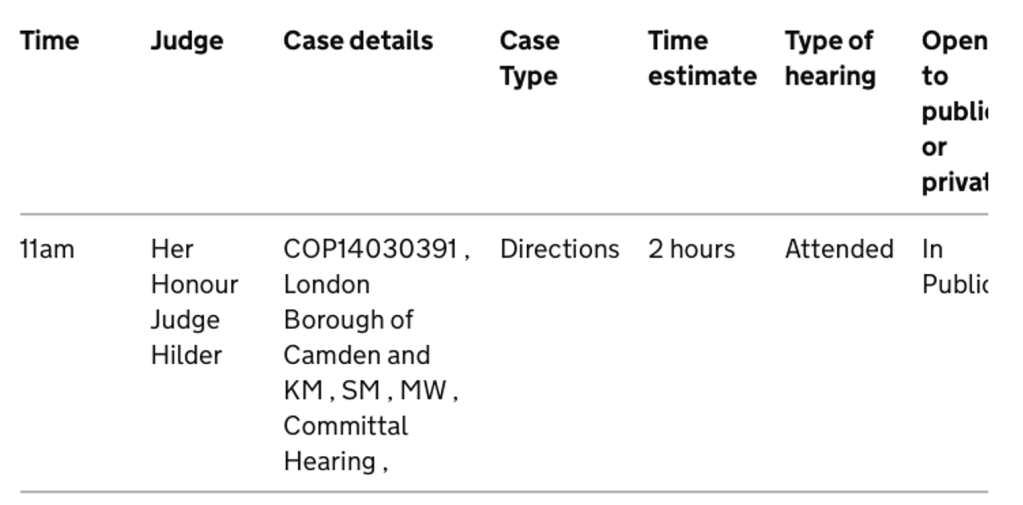
This is how the listing appeared in Courtserve/Courtel the Friday before the hearing: 

In turned out that the hearing was about where P should live and (although it wasn’t clear from the outset) we pieced together the information that P has been living in her current home (which we will call Care Home 1) for seven years. She doesn’t like it there and wants to move. Counsel for P (Bethan Harris, via her Accredited Legal Representative) said that there were ‘not a large number of options’. The ICB (Surrey Heartlands Integrated Care Board, represented by Conrad Hallin, who also represented the Local Authority, Surrey County Council) had put forward one specific option and P herself had proposed another. 

This was a final, remote, hearing (COP 14075656) on  Monday 25th November 2024, before DJ Nightingale in Guildford to determine where P will live in future. 

Transparency Matters

We had some helpful correspondence with the court clerk (noted above) assuring us that the link would arrive in time, and informing us that the start time had been delayed by at least half an hour because the judge was conducting a remote (private) judicial visit with P. We were also sent the Transparency Order, which tells us what we cannot report about the case. 

Unfortunately (contrary to guidance from the then-vice-president of the Court of Protection) an opening summary was not provided. We were all totally lost about what was happening. Even though Claire is a seasoned observer in the Court of Protection, she did not know what was happening either, other than that the matter seemed to be about where P should live. P was on the link too, with her sister (who was not a party to proceedings but was invited to address the court). 

Here are some WhatsApp exchanges illustrating the lack of understanding about what was happening in the hearing (The green messages are from Claire: 

It was only (after the hearing) on receiving the very helpful Position Statement from counsel for P, that we learned what are said to be P’s ‘impairments of the mind or brain’ [s.2(1)  MCA 2005] and the history of the case. 

The judge did spend several minutes at the start of the hearing addressing the fact that there were three observers and that we were bound by the TO and that:

The court has the power to exclude persons if it is in the interests of justice to do so, but the purpose of the injunction is to set out if third parties attend … it makes it clear that 3rd parties who attend a hearing such as this … [reading out TO]

Of course, it is important for us as observers to read and understand the TO – but it is also important for open justice for the wider public to understand what is happening in our courts, otherwise justice is not ‘transparent’. The judge, rightly, explained that observers in court are a potential risk to people’s (Article 8 ) rights to privacy. It would perhaps better support the judicial aspiration for transparency if this were to be balanced with acknowledgement of the public’s right to freedom of information (e.g. a summary) to comply with  Article 10 rights.

Background 

We learned from the Position Statement that P is a woman in her 50s who brought the application (via her ALR) to court in April 2023 under Section 21a of the Mental Capacity Act 2005. She wants to leave Care Home 1, and furthermore Care Home 1 is saying that it can no longer meet P’s needs. 

P (we were told in court) has been able to clearly express her views to the court about her care, what is important to her, and where she wants to live. She was on the video-link with her sister, sitting on her bed in her room and, at times, moving about. 

P has diabetes (we think Type I) and is understandably concerned about her dietary needs being adequately met. She experienced a diabetic coma in 2005, and lived with her mother until 2017, since which she has lived in Care Home 1. 

During these proceedings, P has been assessed by an expert consultant forensic psychiatrist (Dr O’Donovan) who has given P diagnoses of ‘delusional disorder in the context of post-traumatic stress disorder (PTSD) and significant health anxiety’. She reported that ‘these mental health conditions have a very significant impact on [P’s] behaviour and level of functioning’. We assume that it is these diagnoses which underpin the determination that P lacks the capacity to make decisions about where she lives and what care she receives. Dr O’Donovan’s view was that P fully understands the court process, can retain the information about the proceedings and communicate her views, but that she is not able to weigh up the necessary information in order to make decisions (for litigation, residence and care needs).

The Position Statement also describes P’s current view about her mental health diagnoses: she declines any and all treatment for her mental health and will not engage with the Community Mental Health Team (CMHT). Dr O’Donovan recommended a home for P that could ‘support adults with chronic and enduring mental health needs’. 

Where shall P live?

The ICB (Integrated Care Board – formerly CCG, Clinical Commissioning Group) has proposed one particular placement, which we will call Care Home 2. 

Care Home 2 is a specialised community hospital which provides acute and rehabilitation service for people with mental health needs. We learned that it has a ‘full multi-disciplinary team’ comprising doctors, nurses, psychologists, occupational therapists and dieticians. There are ‘step-down’ apartments on site and the aim would be to enable P to move into one of these semi-independent apartments (which have 24/7 support) in time. 

P does not like the idea of living in a ‘hospital’ setting and has herself approached a care home (which we will call Care Home 3). This care home is registered for EMI (Elderly Mentally Infirm). P knows the manager there, who supported her when she lived elsewhere. The court was told that P’s mental health needs, were she to move to Care Home 3, would be provided by the Community Mental Health Team. There is no current vacancy at Care Home 3. 

It was clear that all parties viewed Care Home 2 as the best place for her. P herself did not agree (but she is represented via her ALR, who makes submissions in what they think are P’s ‘best interests’, which might not – and in this case, did not – accord with P’s own views: see https://www.mentalcapacitylawandpolicy.org.uk/litigation-friend-or-foe/).

Counsel for PThe magnetic factor in this case […] on behalf of the ALR for P is where P’s needs would be best met, and where all P’s needs can be best met. The court has received information about the TYPE of place that Care Home 2 is, and the holistic provision that Care Home 2 makes – a range of professionals, who would be able to meet P’s needs across the board. [Counsel’s emphasis)

Counsel for the ICB and LAThey can fully meet her needs across the board, it has a good CQC rating, a full MDT to help her, a range of activities that she can participate in if she wishes to do so. They have great expertise in helping people with complex medical conditions – diabetes … which she has. There is no formal 1:1 requirement, but it can be provided if necessary. [There are] a lot of advantages to this placement, and although there are not a lot of options, this is a good option. She’s keen to move on from where she is now, this is a good and constructive option. […] The point is that it’s a specialist health placement – specialist in diabetes […] it needs to be carefully managed. There are specialists in the management of diabetes, so it’s not just about dieticians but about diabetes. The intention is for a transition plan to include [P] in considering her dietary requirements with the specialists who are in place. … to make sure she’s on-board with the proposals. 

The judge raised several of the concerns that P had spoken to her about: information about the care home, how the transition would be done (she’d previously not had control over her possessions and was keen to ensure this would not happen again), and the environment itself:

JudgeP thinks it will be noisy and she’s a quiet private person

Counsel for the ICB/LAI can’t see anything that would suggest that this will be a noisy environment, but if you want anything beyond the photographs I will need to ask [the clinical manager from Continuing Health Care].

Social WorkerI can’t add anything to the building or noise – I haven’t visited. [P’s] sister has visited …. I can only see what’s on the brochure. 

Judge [to sister]I don’t want to pressure you – do you have anything to add?

SisterI was explaining to [P] that the room intended for her is on the end of a block, a semi-detached [block]. When I visited, there was a common room and music, but not noisy. The venue is spacious and there is a garden …. a dining room, quiet areas … different spaces available – a female-only floor where [P] would be, no noise when I was there. Only 14 residents at the time, but it has capacity for more. The staffing ratio is higher … certainly I wasn’t aware – it has a nice homely atmosphere, someone was leaving and celebrating … a positive atmosphere when I spoke to staff. 

The judge gave an ex-tempore (oral) judgement, which authorised a move to Care Home 2 – the one that all, including (we were told) all of P’s family, supported. But where P herself does not want to go. 

The judge said that one of P’s concerns is that it is a hospital, and that Counsel for the ICB/LA had ‘explained that it’s not a hospital in a formal sense, but a community hospital with an MDT on site’. She ended her judgment by saying: “Care Home 2 offers the best opportunity for [P] to be cared for in a setting for all of her needs to be met holistically”

Reflections

As we listened to the hearing and began to understand that this was a final hearing to make what seemed, by the end, an inevitable judgment , we realised that P as a person had not been discussed at the hearing at all. Save for saying she was a ‘private’ person and that she does not accept any suggestion of mental health difficulties, we didn’t learn much about her. We know nothing about her likes and dislikes and the sort of place that she would prefer (save again for the one care home that she had approached herself, which had a private – not shared, like Care Home 2 – shower, and that P knew the manager). 

There was a suggestion that, once she was there, she would see that Care Home 2 was a good choice for her, be more likely to engage with professionals (including mental health professionals) and be able to develop her independence (which she was said to want to do). However, it was concerning to us that there was no evidence presented (orally, in the course of this hearing) to support this contention. 

However, as observers, we only see and hear a snapshot of the huge amount of work behind a court hearing, and it is likely that the court had much more of an understanding about these things than we did. 

Nevertheless, what we did see, at times, during the hearing was P strongly and visually expressing her views about what she heard. 

Laura 

I noticed how distressing it was for P as she was getting up and down and throwing her arms open, throughout the hearing, when arguments were being made for different places to those she might have wanted for herself. At the times I noticed this, it was at points where I also felt very confused with what was being said. I also questioned if more had been considered around her physical health conditions rather than the focus being on mental health. One of the questions this made me think of, was how some physical health conditions that people have managed for a long time don’t fit to new routines of different establishments and can made it difficult for people to function as they once did. Often, when people with diabetes are in ‘hospital’ settings, we get people to change lifestyle choices to fit the needs of the hospital, rather than look at what they can do in the community. 

At the start of the hearing P had a sheet wrapped around her and was walking around the room. One of the things that I felt was how undignified this was for her, and how everyone could see the pad she was wearing when she was getting into the bed, as she was wearing no pants. Why wasn’t this noticed by the court? 

My other reflections are about the process of attending the hearing itself. As a first-time observer, initially when I read through the Transparency Order, I was overwhelmed by the document. The terminology was difficult to follow, in parts. I was also taken aback by the statement about the injunction and how it stated a person may be found guilty of contempt of court and may be sent to prison, fined or have their assets seized. Had I not been supported to access the hearing I would not have gone any further for fear that I would do something wrong. Without support from Claire, I was also unsure about doing the blog as the Transparency Order would have put me off saying the people’s names (barristers and judge) and even identifying the person at the centre of the case as female.   

At the beginning of the hearing, the Transparency Order was highlighted by the judge. This was daunting and made me reconsider whether I should be attending.

Following the judge reading this we heard from the barristers. It was difficult to follow who was proposing what and on behalf of whom.

After attending, I felt I was able to recognise in more detail how the COP works. I also considered how difficult it can be for people who are waiting for life-changing decisions to be made. This has made me consider the importance of how we look at the wider picture for people and how we can improve their care.  As an Admiral Nurse, I work with family carers of people with dementia and I have experience, as a Community Psychiatric Nurse, of people detained under the Mental Health Act and of Mental Health Tribunals. 

My interest in observing the COP hearing was stirred when I attended a talk at work about fluctuating mental capacity in dementia and I learnt about the OJCOP project. 

The case left me with the following questions to reflect upon:

The difference between the Mental Health Act and Mental Capacity Act. The COP did make me consider the difference between the MCA and MHA and how different the timescales can be. Things seem to be more regulated and quicker in Mental Health Act detention and tribunals. The difference I have seen is how everyone will be reviewed under the Mental Health Act after a period of time if they have not made an appeal. Rights are provided to people on a regular basis with guidance around this. I can’t say that I have ever come across people having their rights explained around how they can challenge MCA 2005 decisions. I have so many times seen people being told “They’re on a DOLs”, and that’s that. I think that the Mental Capacity Act can be used as a least restrictive option to move someone to a different location. This often makes me wonder, if the Mental Health Act was used, would the person have more rights around being able to challenge.

How do we define what is a least restrictive option? Through the hearing they discussed what was available. When hearing this I considered how this varied between local authorities and how the outcome could be different in different locations. 

Submitted evidence: It was unclear through the hearing if services other than mental health services had been consulted. This led me to think about the importance of considering how all aspects of care should be looked at in detail to avoid diagnostic overshadowing.

Jess

Jess is a student nurse in the throes of her dissertation. Her immediate, post-hearing reflections are captured powerfully in these WhatsApp messages sent to Claire and Laura in the evening after the hearing was finished.

(The “good read” above is this blog about a 91-year-old woman who wanted to return home to live with her son.)

(In that last message, Jess is referring to feeling upset after the hearing, as she was about to leave work for home. She sent this message after arriving at home the same evening.)

What is clear from Jess’ statements above is how observing a Court of Protection hearing makes (what feel like) cold, legal decisions about people’s lives ‘hit’ you on a personal level. Watching P herself ‘sat and people discussing your life’ helps to develop a level of empathy that reading cases, or working as a professional in your role, don’t necessarily facilitate in the same way. 

We hope that P can find a way to feel comfortable in her new home and that, even though others think it’s the best place for her, that her own feelings and views are considered on an ongoing basis in future, whatever they may be.

Claire Martin is a Consultant Clinical Psychologist, Cumbria, Northumberland, Tyne and Wear NHS Foundation Trust, Older People’s Clinical Psychology Department, Gateshead. She is a member of the core team of the Open Justice Court of Protection Project and has published dozens of blog posts for the Project about hearings she’s observed (e.g. here and here). She is on X as @DocCMartin and on BlueSky as @doccmartin.bsky.social

Laura Eccleston is Community Admiral Nurse Lead at Gateshead Health Foundation Trust. 

Jess Wright is a student nurse, currently at Gateshead Health NHS Trust.


Application to appeal against judgment authorising withdrawal of life-sustaining treatment: Re XY

By Jenny Kitzinger, 4th December 2024

The Court of Appeal hearing I observed on the 26th November 2024 concerned an application for permission to appeal a Court of Protection judgment. 

I’d watched the original Court of Protection hearing (COP 20002405) in early November and blogged about it (“Withdrawing life-sustaining treatment: Faith and Science”). The judgment, handed down on 11th November – so just two weeks before the Court of Appeal hearing – authorised withdrawal of life-sustaining treatment from ‘XY’, a woman in a Prolonged Disorder of Consciousness.

In the course of the Court of Protection hearing, clinicians gave clear and unanimous evidence about XY’s catastrophic brain injuries, her lack of awareness and why there was no potential for any recovery: and they explained why they thought it was in her best interests for life-sustaining treatment to stop. Her family and friends gave clear and consistent evidence about why they believed that XY was aware of their presence, why they thought her condition might improve and why they thought life-sustaining treatment should continue – including, centrally, because that is what XY would have chosen for herself given her strong values and religious faith.

The subsequent judgment, by Mrs Justice Arbuthnot, authorised the withdrawal of life-sustaining treatment on the basis that, due to severe and extensive brain damage, continuing treatment was not in XY’s best interests. 

The application for permission to appeal was made by XY’s daughter. A stay had been placed on the withdrawal of treatment until the application could be heard.

I was particularly interested in how the appeal might be handled because I also have personal experience of representing a family member’s values and beliefs in relation to treatment decisions about her – and, like the family in this case, I was over-ruled. I return to this element of the hearing in my personal reflections at the end of the blog.

The parties, representatives and judges in the Court of Appeal

The daughter of XY was no longer represented by the team (funded by legal aid) that had acted for her in the Court of Protection. Instead, she had brought the application as a litigant in person. Shortly before the hearing, she’d gained pro bono (i.e. free) representation from Mr George Thomas (who was thanked by the judge for stepping in at very short notice). 

The other parties in the case were represented by the same barristers who had acted in the Court of Protection: King’s College Hospital NHS foundation Trust, where XY was receiving treatment, was represented by Mr Michael Mylonas KC. The patient herself was represented (via her litigation friend, the Official Solicitor) by Ms Sophia Roper KC. 

The judges in the Court of Appeal were Lord Justice Baker and Lord Justice Phillips

Access and transparency 

Observing a Court of Appeal [CoA] hearing is very straightforward compared to the Court of Protection if – as was the case for this one – it is live-streamed.

Many Court of Appeal hearings are clearly listed several days in advance, live streamed and recorded (see https://www.judiciary.uk/the-court-of-appeal-civil-division-live-streaming-of-court-hearings/). This means there is no need to email to ask for a link based on listings that are only available the night before and then anxiously await the link being sent. Also, you don’t have frantically to try to capture every word from a live hearing, you can concentrate on following the arguments, safe in the knowledge you can always go back to replay sections later to pick up certain details or quotes.

The main problem for transparency in relation to this case was that I had not yet seen the judgment. It had been handed down on 11th November 2024 but was not published, and not available to the public, by the time of the appeal court hearing. I understand that this was due to workload pressures on Mrs Justice Arbuthnot, who made the original COP judgment. Whatever the reason, it is challenging to follow arguments about why a judgment is (or isn’t) wrong without having read that judgment or being able to refer to it during the hearing.

The barristers had clearly made efforts to see if an anonymised version of the judgment might be available before the appeal hearing and Lord Justice Baker checked at the start of the hearing to ensure that redacted versions of the skeleton arguments were available to observers (thanks to Celia Kitzinger for asking for these and the barristers for making sure these were redacted and shared under very tight time pressures). The judgment from the Court of Protection was also published the day following the Court of Appeal hearing, so I have been able to read it prior to writing this blog.

The hearing

To be successful on appeal, an applicant needs to demonstrate that the original decision was wrong or unjust because of a serious procedural error or an error in applying or interpreting the law. Permission to appeal will only be granted if there is a good chance of the appeal succeeding, or there is some other compelling reason to hear the appeal.

The hearing about this application for permission to appeal lasted almost 3 hours. You can view the video-recording of the whole appeal on the Court of Appeal video archive page.  Some parts of it felt like a re-presentation of some of the arguments presented in the Court of Protection – so even if that is your main interest, rather than the workings of the Court of Appeal, I’d recommend listening to the recording for that reason alone.

Lord Justice Baker opened the hearing by asking for clarity about who was in court and welcoming the family members present (XY’s daughter, grandson and aunt – mostly seated back left of the court and off-screen). He explained that the Transparency Order from the Court of Protection does not apply in the Court of Appeal so new reporting restrictions would be ordered and he also (with apologies to the family for it sounding impersonal) clarified that the woman at the centre of this case would be referred to as XY for the purposes of this hearing. ‘XY’, it was made clear, was not just an anonymous set of initials – she was a unique individual with her own values and faith, a much-loved mother and grandmother, a popular member of her local community and with a large extended family in Jamaica.

The daughter’s position 

Counsel on behalf of XY’s daughter (the applicant), spoke first, and his submission to the court took up the majority of time (almost two thirds of the hearing). He started by outlining the grounds for permission to appeal and it soon became clear that XY’s daughter (originally acting as litigant in person, i.e.  without representation) had submitted a skeleton argument broader in its scope than the issues Mr Thomas wanted to focus on as grounds of appeal. For example, the daughter’s skeleton argument had apparently argued that there’d been procedural flaws in the CoP hearing because no independent neurological opinion was selected by, or with the satisfaction of, the appellant or her family. In fact, a neuro-critical care specialist, Dr Bell, had been commissioned by the daughter’s solicitors, but had arrived at the same conclusion as all the other clinical experts about XY’s level of consciousness, and took the same position as they did that it was in her best interests to have life-sustaining treatment stopped.

Once Mr Thomas had become involved, he had submitted an additional supplementary skeleton argument focusing on just two grounds of appeal relating to material errors in how the judge made her best interests assessment. First, the judge was not entitled to conclude that XY was unresponsive, given the evidence of friends and family that she was responding to their presence. Second, the judge failed to give sufficient weight to the significant amount of undisputed evidence from friends and family that XY would not want clinically assisted nutrition and hydration to be withdrawn. Although Mr Thomas touched on some other points (such as the issue of the independent expert), it was these two grounds of appeal that formed the basis of his submissions – and I use them to structure my summary of the submissions and my subsequent discussion.

Family evidence of responsiveness: In her judgment Mrs Justice Arbuthnot found as follows:

107 .”I find that XY does not track with her eyes nor does she respond to voices or commands to squeeze their hands. I can understand how a family who wish that this very much loved family member should recover are misinterpreting what they see. They see responses to their care rather than the reflexes controlled by the brain stem that the medical specialists identify. That is not to say that at some level XY is getting comfort from their touch, but it is not a conscious sensation.” 

and

117. Her family and friends visit her daily but she gets no enjoyment from their frequent visits. The evidence shows she does not hear her family when they visit or even knows they are there. 

Representing XY’s daughter, Mr Thomas took issue with such statements, arguing that the judge was wrong to dismiss the evidence of responsiveness presented by the family. He highlighted how family and friends visited XY often and sat with her for long periods of time; they had a long-term intimacy with XY that the nurses lacked and, unlike busy hospital staff, they had time to talk to, and pray with, her. He pointed out that six different witnesses had submitted written statements reporting having directly witnessed XY’s responses. He argued that, had the judge assessed the evidence in a properly balanced way, a different best interests decision would have been reached. 

Consideration of what XY would have wanted: In her judgment, Mrs Justice Arbuthnot found as follows in relation to what XY would have wanted:

111. XY has never stated her views about clinically assisted nutrition and hydration or on sustaining her life artificially in the circumstances where she is totally dependent on others and cannot function in any of the ways she used to, where she is not aware even that her family is visiting her. 

112. Despite not being in the best of health, she never had that sort of conversation with her daughter (or anyone else). We do not know how she would feel in the current situation that she finds herself in. We do not know what she would feel about the enormous pressure being placed on her family and friends of this very long drawn out, tragic situation. 

113. She worked in a hospital and is likely to have come across death and serious illness there but we do not know how she would feel about the continued treatment when the specialists and experts say it is futile. She was a woman of faith, but I question whether this loving mother and grandmother would have wanted the burden of the treatment to continue. She may have wanted her family to be relieved of the long drawn out pressure they are under. 

114. I appreciate the family know her best, particularly XZ [her daughter], but I am not convinced that this matriarch who always put her family first would have wanted them to continue going through what they have been.

Counsel for the daughter was critical of Mrs Justice Arbuthnot’s summary concerning XY’s viewsIt was, he said, wrong to say “We do not know how she would feel in the current situation” – there was a great deal of strong evidence that XY would, in fact, have wanted life-sustaining treatment to be continued. He quoted a statement from XY’s daughter that given XY had ‘died and been brought back to life’ (i.e. the one-hour plus ‘down time’ while paramedics tried to resuscitate her), her mother would believe God did this for a reason and she was here for a purpose.

He also highlighted that her religious beliefs were a key part of who XY was as a person and pointed to the importance of upholding her rights under Article 9 of the European Convention on Human Rights – which guarantees the right to freedom of thought, conscience, and religion. XY believed in the sanctity of life and in miracles and, crucially, that it is for God rather than medical staff to determine when someone’s life should come to an end.

He referenced case law supporting the ‘magnetic importance’ of P’s wishes where these can be determined with a high degree of certainty (whether those wishes are to have treatment continued or discontinued). He also highlighted case law that, where there is compelling evidence of a person’s wishes, treatment may be continued even if based on belief in miracles and even if clinicians view it as futile from a medical perspective. A key authority referred was the TG case (Royal Bournemouth and Christchurch Hospitals NHS Foundation Trust v TG & Anor [2019] EWCOP 21’)

Based on the evidence presented to the court, he said, there was no doubt or dispute about what XY’s wishes would have been, and one certainly knew ‘on the balance of probabilities’ what she would have wanted in her current situation. It may not have changed the best interests decision by the court, but the failure to give sufficient weight to this evidence was a ‘fundamental flaw’ in the judge’s approach to the decision she made. 

The Trust’s position 

Mr Mylonas as Counsel for the Trust spoke next – and the judge invited him to focus on the two main points addressed by Counsel for the daughter (responsiveness and account taken of XY’s views). 

The Trust took the position that there was no realistic prospect of the appeal succeeding and permission to appeal should not be granted. 

On family evidence of responsiveness: Counsel for the Trust reiterated the strong medical evidence and drew attention to a statement by Dr Bell that XY is on the lowest point of the Prolonged Disorder of Consciousness spectrum (i.e. what would have historically been called a ‘Persistent Vegetative State’). He referred to the statement from Dr Bell that the suggestion that XY was responding would be outside all acceptable medical knowledge. The CoP judgment had drawn attention to these points and, Counsel for the Trust said, “It is a fundamental basis on which any assessment of Best Interests must unfortunately lie, notwithstanding the family’s sincere hopes and beliefs that there is some meaningful response…”. He informed the court that the nursing care in ICU was a ratio of 1:1 (information that had been sought by email during the hearing) and highlighted the fact that these were specialist nurses who would know how to distinguish a reflexive from a purposive response. Addressing a question the judge had raised about WHIM and SMART testing (two tools often used in assessing patients in Prolonged Disorders of Consciousness), Counsel for the Trust explained that such tests were not typically used in ICU but, “with XY, there was CRS, Coma Recovery Scale, testing carried out which was conducted daily….that has showed a deteriorating condition with no improvements” although “regrettably those documents were not in the documents that were before Her Ladyship”. 

On what XY would have wanted: Counsel for the Trust submitted that there were some overstatements by Counsel for XY’s daughter of what could be derived from XY’s past conversation because, as the judge properly identified, the issue had never been discussed with XY. He contrasted this with the specific statements reportedly made in the TG case – albeit unfortunately not quoted in the TG judgment. He drew attention to statements from family about XY being a fighter and about her love of life – a life to which she could, in fact, never return according to all the medical evidence. In response to submissions on behalf of the daughter that she would have wanted life at any cost, Counsel for the Trust concluded: 

“She would never have envisaged this cost…this level of intervention and invasiveness would not be in [her] consciousness or contemplation…she undoubtedly did say, and would have said, to her daughter and those around her that she valued life, because of what it gave her: the opportunity to play with her grandchildren, her children and engage with all those around her. She can never do that. And the cost of her subsistence now – because it’s not even an existence at the level it currently is – that is, we say, far too grave a weight for her to bear…” [2hrs 23mins into the recorded version of the hearing]

The Official Solicitor’s position

The Official Solicitor acting as XY’s litigation friend was the last barrister to address the court. Ms Roper KC argued, on behalf of XY herself, that permission to appeal should be refused. 

On family evidence of responsiveness: She referenced the medical evidence about the condition of XY’s brain as already outlined by Counsel for the Trust and, like him, reiterated that what the family reported about responsiveness would be – as one of the medical experts had said – ‘outside all accepted medical knowledge’. Doctors, she said, were not challenging what the family say they saw: their point was that the movements they saw did not indicate awareness or responsiveness, as the family believed. She drew attention to an attendance note from an agent the OS instructed to visit XY: it confirmed that nursing staff caring for XY also (like the doctors) saw XY’s movements as reflexes not volitional responses. Nurses who witnessed XY’s movements during family visits said the same thing. 

On what XY would have wanted: Ms Roper acknowledged the very clear evidence that XY was a deeply religious woman. The OS position was that Mrs Justice Arbuthnot had meticulously set out the family evidence but was not persuaded that this evidence allowed one to infer that XY would have wanted to remain on intensive care for the rest of her life. The family witnesses had not engaged with that outcome, she said, because they retained a belief that XY was responding to them and that there was potential for recovery.

Re the TG case (used as an authority by Counsel for XY’s daughter), the OS pointed out  that TG had made very specific statements and that TG’s circumstances were different from XY’s circumstances in that the application was made very soon after injury (just two months compared with six months in this case) and also that it was possible for TG to leave intensive care and be transferred to a nursing home and a life not exposed to continuous invasive treatment (which was not medically achievable for XY).

Counsel submitted that the judge had considered the family evidence about responsiveness and about what XY would have wanted, ‘but ultimately did not agree’ with what the family thought on either matter. And the judge was entitled to be of this view on the evidence.

The hearing concluded with submissions about what would happen if the court refused the application to appeal – and there was a plan, were that to be the case, to give some time (5 days) for the family to engage in discussion of end-of-life care (as they had not yet felt able to do this) and for withdrawal to take place after that. (I worried about this being perilously close to Christmas.)

Finally, Mr Thomas reiterated XY’s strongly held religious views and that: “those views, I would submit, are far more likely to persist, and far less likely to change, based on the individual circumstances one finds oneself in”.

The judge ended the hearing by thanking the applicant (XY’s daughter) for her work in bringing the case to court – reflecting the whole framing of the ethos of the court as co-operative and respectful.

The Court of Appeal judgment

Permission to appeal was refused.

On the first main grounds of appeal (that the judge had not given sufficient weight to family evidence of responsiveness), Lord Justice Baker stated in the judgment that:

“It may be that [the daughter] was not cross-examined on her observations. But the challenge came from the unanimous evidence from the clinical and nursing staff that they had seen nothing to indicate any awareness in XY, and from the clinical and expert evidence that the evidence from CT scans and EEG recordings was indicative of a PDOC  [Prolonged Disorder of Consciousness] at the lowest end of the spectrum.”

The judgment goes on to state:

47. … the judge was plainly fully aware of the extent of the evidence from family members about XY’s responsiveness. ….

48. The judge gave conspicuously careful attention to all of the evidence about this issue [of responsiveness]. Her decision to prefer the evidence of the clinical and nursing staff about the extent of XY’s responsiveness, and the interpretation of the evidence advanced by Dr Bell and Professor Wade, was plainly open to her on the evidence. There is no real prospect of the Court of Appeal finding that she was wrong to reach that conclusion. 

On the second main ground of appeal (that the judge had not given sufficient weight to family evidence as to what XY would have wanted), the judgment does not address the issue of whether family/friends were cross-examined and had relevant questions put to them, but says:

52: … [Mrs Justice Arbuthnot’s] evaluation of the evidence of XY’s wishes and feelings, beliefs and values, was conducted in accordance with s.4(6) and (7) of the [Mental Capacity] Act. But important though her beliefs and values undoubtedly were, they were one factor in the overall evaluation of best interests. They had to be considered in the context of the totality of the evidence. 

53. In this case, the magnetic factor in the judge’s evaluation was the evidence about XY’s medical condition…

54. The judge was obliged to consider the family’s clear evidence about XY’s faith in the context of her present circumstances which, as Mr Mylonas submitted on behalf of the Trust, she could never have envisaged. As Ms Roper submitted for the Official Solicitor, the fact that she had a religious faith, and believed that it is God’s choice when someone lives and when someone dies, does not lead to an inference that she would have wanted to continue treatment in these circumstances. There is also force in Ms Roper’s further submission that the family’s views about what XY would have wanted are situated in their belief, contrary to all the medical evidence accepted by the judge, that there is a prospect of recovery. 

55. In those circumstances, there is no real prospect of the Court of Appeal concluding that the judge erred in her approach to XY’s beliefs and values and wishes and feelings.

The CoA judgment goes on to state:

…I have no doubt that the judge took their strong views about XY’s wishes and feelings into account, as she was required to do under s.4(7). But she was entitled to entertain doubts about what XY would have really wanted in these terrible circumstances, and equally entitled to conclude that the family’s evidence about her wishes and feelings was outweighed in the best interests analysis by other factors, in particular her very serious and deteriorating medical condition. As she said in her conclusion, “the futility of continuing further treatment and the increasing deterioration of XY’s brain outweigh the family’s views and what they consider might have been XY’s views in the circumstances.”

The full judgment can be read hereRe XY (withdrawal of treatment) [2024] EWCA Civ 1466

Reflections: what would P want? And who knows?

The place of a person’s own wishes in relation to medical treatment was central to this case.

The Mental Capacity Act 2005 is the key statute here. A person with capacity has the right to refuse or consent to any treatment on offer (they cannot demand treatments). They can also document refusals in advance in a legally binding ‘Advance Decision to Refuse Treatment [ADRT] (although very few people do this – for how to do so, see the ‘Compassion in Dying’ website). 

Once someone has lost capacity to refuse or consent to a treatment then (if there is no ADRT) the choice between available treatments becomes a best interests decision. What someone would have wanted then becomes only one component in that decision – and, of course, what they would have wanted may itself be subject to challenge, as demonstrated in this case.

Issues that played out in this Court of Appeal hearing in a variety of intersecting ways revolved around questions such as: 

  • What can one infer from what one understands of someone’s values and who can do so most accurately?
  • How might someone’s values or wishes change in specific circumstances, and how does that relate to the nature of those circumstances and the nature of their values (or beliefs, wishes, feelings)?
  • Who is the ‘someone’ whose wishes are considered (the ‘person before’ or ‘person after’ injury?)
  • How much weight should a person’s prior wishes be given in a best interests decision in relation to other factors? 
  • and anyway – in the case of wanting (as opposed to not wanting) treatment “we cannot always have what we want” (Lady Hale in Aintree) – even if one has capacity to make the decision. 

There is a large academic literature that explores some of these issues – ranging from surveys of doctors’ or families’ accuracy in predicting a person’s treatment preferences, or how people’s views shift when faced with severe disability, right the way through to philosophical debates about personhood and autonomy. Readers of this blog will no doubt have their own personal views about the proper answers to these questions as they reflect on their own values and wishes, and those of people close to them.

I’ve written about some of these debates previously e.g. in relation to the Paul Briggs’ case (‘When ‘Sanctity of Life’ and ‘Self-Determination’ clash”). My aim in the final paragraphs of this blog post is different. I want to explore the implications for family and friends involved in best interests decision-making about serious medical treatment.

What do families experience when they have sought to promote what they believe their family member would want – and when that is reinterpreted through the lens of a formal best interests process and/or over-ruled?

Of course, families are not inevitably the best people to advocate for a patient – they may not know what the person would want, or (if they do) they may not wish to advocate for it; they may be distracted by family conflict or trauma or simply overwhelmed by their own needs. But sometimes families are exactly the right people to promote ‘P’s voice’ – and that is the strong sense I got with this family.

The idea of what their mother, niece or sister would have wanted (in line with her, and their own, religious faith) was clearly a central guiding light – and, for them, a key determinate of the right way forward. They had conveyed a very strong sense of what those wishes would have been during the Court of Protection hearing, and demonstrated a remarkable resilience in the face of any challenge from expert evidence about XY’s condition and prognosis (which I suspect, XY would have demonstrated too).

I felt huge empathy for this family, and it resonated with my own experience after my sister, Polly Kitzinger, suffered catastrophic brain injuries back in 2009. It resonated even though, on the face of it, the experience of this family and mine might be thought to be diametrically opposed.

For a start, XY and Polly were very different people: XY was a woman of faith, Polly was an atheist; XY believed in the sanctity of life, Polly did not; XY believed in miracles, Polly did not; XY believed in submitting to the will of God whereas Polly insisted on her own will determining all her choices and what happened to her body, her life, her death. 

And as families, XY’s family and mine argued for different outcomes: XY’s family fought to have XY’s life-sustaining treatment continued, whereas we fought to try to have treatment discontinued. I wrote about this a couple of years after Polly’s injury (https://www.thehastingscenter.org/m-polly-and-the-right-to-die/) and gave an interview to the BBC in 2018 about the ongoing aftermath. (I know lawyers and judges will dislike the word “fought” in this paragraph – but that is how it often feels to families, despite the purportedly ‘non-adversarial’ approach of the Court of Protection.)

What XY’s family and my own family share is that both were committed to trying to represent ‘what the patient would have wanted’. Both they and we had a strong sense we knew what that was. Both XY’s family and mine, to a greater or lesser extent, shared some of the patient’s core values – though, personally, I found Polly’s emphasis on autonomy, choice and control a little extreme! 

Relating then to my own experience, I wondered how this family, and the community of friends around XY, experienced the formal best interests processes in the hospital and in the Court of Protection; how they felt about the arguments in the CoP judgment, and how they experienced their encounter with the Court of Appeal.

In my original blog about the CoP hearing in early November I wrote that: “everyone in court was careful first to acknowledge XY as the individual at the centre of the case and make it clear that her family and friends had been, and would be, heard”. 

In rounding off my summary of what family and friends had said I wrote: “The clinicians listening in court, and the judge, could have been left in little doubt about the values and beliefs that informed XY’s approach to life – and what those who knew and loved her believed to be the right way forward.”

The family were treated respectfully and sensitively in the Court of Protection. I suspect they did leave court feeling ‘heard’. There may have been an element of ‘therapeutic jurisprudence’ in the experience. 

But I wonder how it felt to family and friends when the Official Solicitor, who is charged with responsibility for representing XY, took a position that (the family believe) is diametrically opposed to what XY would want. I wonder too whether the judgment came as a shock – not just the outcome, but whether parts of the framing of the judgment felt particularly egregious.

Suggestions in the judgment that their discussions with XY had not been specific enough, or that she might (had she been able to) change her mind when faced with the realities of her medical situation (as defined by the medical experts) might well feel very disrespectful now – both to their evidence and to the strength of XY’s own faith. 

They may have been distressed by the fact that the judge extrapolated from what they said to come to a different conclusion: for example, rather than valuing being a ‘comfort’ to her family (as testified to the court by XY’s close friend) the judge speculated that XY might want to be allowed to die so that her family would be ‘relieved of the long drawn out pressure they are under’. This might seem like twisting their own words against them or speculation on matters which they had not been invited to engage with in the hearing. There was also very little challenge or cross-questioning of the family – which, at the time, seemed a kindness, but in retrospect was maybe a problem, as they may have felt they had no opportunity to rebut challenges to their evidence.

Knowing my own sister’s values and beliefs (although these were not religious), I felt fully able to infer what Polly would have wanted, despite never having discussed her precise medical wishes if she were to experience severe brain injury. I would have welcomed the opportunity to specify what I knew, and how I knew (under cross-questioning if necessary). I also agree with the submissions on behalf of XY’s daughter that someone’s core values, embedded not just in what they say but in the way they live their life, “are far more likely to persist and far less likely to change, based on the individual circumstances one finds oneself in”.

Family and friends may, of course, be wrong in what they infer, but at least they have years of context for their inferences. It may be hard to believe that the proposed alternative inferences made by judges are likely to be more accurate (even if those take into account a medical ‘reality’ that the family themselves refuse to accept).

A person’s wishes, what they want to happen, are not determinative in best interests decision-making. There are many COP judgments in which it is accepted that the protected party wants one thing (to go home, to have sex with someone, to have contact with family, to use the internet) that it is not in their “best interests” to do. And so, the judge makes a decision contrary to what that person wants. 

I wonder whether judgments which go against what a family believe to be what someone would have wanted are more painful to hear when it seems that the judge has not fully believed a family’s account of that person’s wishes and what that means for the present circumstances. Could this leave family members feeling they could – should – have done more to explain and persuade and provide evidence, so that the judge could really understand the person?

An alternative judicial strategy would be simply to make a best interests decision to over-ride what the judge accepts the person would have wanted (in circumstances of course, where they do accept it!). That might look like a naked exercise of judicial power (and responsibility) – and it is. But, given the ‘magnetic factor’ in the judge’s best interests evaluation in this case was XY’s medical condition and the futility of intervention –perhaps this would feel less undermining, than (in effect) refusing a family’s lifetime’s knowledge and experience of P’s fundament values and beliefs. 

That brings me full circle to the point I made in my blog about the original Court of Protection hearing: perhaps, given the clinical realities, doctors should simply have said that life-sustaining treatment was no longer an available option.

Jenny Kitzinger is co-director of the Coma & Disorders of Consciousness Research Centre, and Emeritus Professor at Cardiff University. She has developed an online training course on law and ethics around PDoC and is on X and BlueSky as @JennyKitzinger 

“Bureaucracy blots out the sun”: Telling Ella Lung’s story

By Richard Lung (with Celia Kitzinger), 1st December 2024

Sometimes holding on to me to keep steady, Ella walked out of the care home lounge into the entrance hall. To staff: “I want to go home to my son. Why can’t I go home? – It’s a free country!”  (Richard)

Ella Lung, in her nineties and suffering from dementia, was deprived of her liberty in a care home for just over two years: from 22nd November 2019 until shortly before her death, aged 96, on 16th December 2021.  

In the Court of Protection proceedings eventually brought on Ella’s behalf by the Official Solicitor, Ella and her son Richard feature as “EL” and “RL” (EL v North Yorkshire County Council & RL, COP 13539692).  There is no published judgment.  

The only published record of this family’s experience of how they were treated by health and social services, and by the court, is Richard’s detailed, impassioned, meticulous account of his mother’s life, and death, across fourteen journals in a series called “Family Splitting” published online (see Appendix). The journals document interactions between Ella and Richard during the period when, in Richard’s words, “Ella suffered over two years of unjust and anguished imprisonment”.   They tell an important story. 

During the course of the court proceedings, the local authority legal department sent Richard a letter saying that his writing  breached the “Transparency Order”: in the usual terms of the ‘standard’ order, he was not allowed to identify his mother as a protected party in Court of Protection proceedings. The Official Solicitor opined that the journals were an interference with Ella’s Article 8 right to respect for her private life.  What is clear from my reading of them is the deep love, respect and admiration Richard had for Ella, and the importance for him of chronicling what was being done to his mother in the name of her “best interests”.  He says Ella gave permission and was proud of her son, the writer.  He says that sharing their experience may help others in similar situations.

The reporting restrictions applied “until further order of the court” – so even after Ella’s death, Richard was still unable to speak or write publicly about their experience of the Court of Protection.

Earlier this year, I helped Richard to apply for the Transparency Order to be discharged.  He said in his application: “I understand that the purpose of the Transparency Order is to protect the identity of the vulnerable person at the centre of the case (i.e. my mother) and now that she is dead, there is no purpose to it. I want to be able to tell the story of what happened to my mother and to be able to make information about this case public. I understand that my right to freedom of speech (and the public’s right to freedom of information) should now trump my mother’s right to privacy (as she has died). In any case she did not want privacy about this. I have already published extensively about my mother (see: https://www.smashwords.com/profile/view/democracyscience) but have not been able to write about the role of the court due to the TO.”  

Richard’s application to discharge the Transparency Order was listed for an in-person hearing at Scarborough Justice Centre in July 2024, with a direction for all parties to serve Position Statements.  We are very grateful to Tor Butler-Cole for pro bono assistance in writing Richard’s Position Statement:  it undoubtedly made a huge difference by providing a clear and authoritative statement of the relevant legal framework and its application to this case.  She invited the court to decide the case on the papers.  

And that is what happened.  The local authority did not oppose and the Official Solicitor did not seek any role in the proceedings. The court issued an order on  9th July 2024 (two months after Richard’s application) vacating the hearing listed for 26th July 2024 and saying that “The transparency order dated 4 March 2021 is revoked, such that there are no restrictions on the identification of EL, any member of EL’s family or the local authority in connection with these proceedings”. 

So here is (an abridged version of) Ella’s story.  You can read the full story in the books listed in the Appendix.

Ella’s story

On 11th August 2019, Ella Lung was admitted to hospital after a fall at home. Richard had called an ambulance. 

At the hospital where she was treated, safeguarding concerns were raised on the grounds she appeared unkempt and dehydrated on arrival.  Richard describes this as “a suspicion of mother abuse, as baseless as it was base, and without exoneration or apology, against an old man, they knew nothing of, who had no history or record of any offenses”.  

Ella remained in hospital until November 2019, when a ‘best interests’ decision was made to discharge her – but not back home with a live-in carer, as Richard wanted.  Instead, with what the local authority later called Richard’s “agreement”, Ella moved into a care home.  This is how Richard describes what happened. (The extracts come from his published journals.)

Dilatory and doubting social services pressured me into giving in to put Mum in a care home. She languished over one hundred days in hospitals. I had to commute by train to see her. The social worker said she was looking for a “placement,” doubting my ability to cope at home, and not pursuing the live-in carer option, even when she answered her questions. Then saying she would have to look for care homes further afield. That is to say out of my reach, against which I protested. So, I found a care home on the outskirts of town, for which “understanding” the social worker thanked me. But it was another hospital environment, leaving Ella stuck in a chair from morning till night. Social services again blocked my mother from coming home with another live-in care agency […] I was manipulated. But when manipulation failed before the reality of Mum’s misery, compulsion followed, with misrepresentation and manipulation of the reality of Mum’s wishes. I am not criticising the undoubted inadequacies of care homes but the determination of social services to prevent my mother having live-in care, instead. Economics reduces care homes to patient parking zones. […] . I thought, in the old way, that people could check themselves out of hospital. Not so. With the care home, Ella was locked-in, like a safe deposit. It appears to be underpinned by a sinister-sounding legality called “deprivation of liberties”, just another brick in the wall of the New Feudalism. A live-in care agency says that 97% of people would prefer to stay at home, when needing care. A fact towards which social services have been strangely obtuse in pursuing “best interests”. This is not a reason, it is just social services asserting its dictatorship, thanks to politicians’ passion for autocratic administrative law. While keeping a smile, Ella asked eloquently, amongst other things, why was she not allowed to go home? She was not a criminal. She hadn’t done anything wrong. […] The social services sinecure was depriving her of all faith, hope and care. (from Home Free)

By the end of 2019, Ella had already been reduced to the depths of sobbing misery, at her incarceration. Social services’ so-called minutes of her “best interest” meeting dismissed her protests as nothing but “occasional distress”. (Distress usually is occasional. That does not excuse the breach of her human rights.) Ella was not even allowed to attend, to put in a single word, of her own, about her own best interests. Whereas, the “professionals” were, as “The Chair” called them, all agreed (in group-think lock-step) to take away her freedom to go to her home, she worked so hard for, to be with the son, who lived with her, for seventy years. (from Ella sobs her heart out)

By early February 2020, following a Care Review, there was another ‘best interests’ decision to keep Ella in the care home where her mobility and nutrition were said to have improved,  Richard did not agree that remaining there was in his mother’s best interests, and he reported (though it was disputed by the professionals) that Ella was unhappy there and wanted to return home.

And then came COVID-19 – with visiting restrictions, routine testing, temperature checks, and PPE.  

On 30 June 2020, according to a funeral director, every single care home in town had the covid. Social services twice stopped me from bringing Mum home with a live-in carer (as told in the second book in this series). They put her life in mortal danger, as a result. Yet, their Deprivation of Liberties renewal, which they have the gall to say is for her “safeguard,” is just a rubber stamping of her imprisonment. Ella is old and frail, and we dearly want to be back together at home, as we have been, all my life. Her love will be in my heart, till I die. Social services relentlessly obstructed my mother returning home. Afterwards, I found that the abduction of the helpless young and helpless old alike, children and the elderly, from their families, amounted to a national scandal. (from Short-wave memory Mum)

Ella went on to experience various health problems, including COVID and a skin problem originally thought to be shingles.

She was reported with COVID-19 on 13 December 2020 which is a year after the social worker detained her in the care home. Ella caught a water infection in the care home and was on antibiotics for 5 days which had to be repeated resulting in terrifying and exhausting hallucinations. Also, after being taken off a pureed diet, Ella suffered a prolapse, with much loss of blood, and was rushed to hospital for emergency surgery. […]  On 19 May 2021, I learned from senior staff she has the shingles, associated with age, weak immune system (vulnerable to infections), physical and emotional upset. Ella’s distress was unbearable; I was on the phone to her for nearly 2 hours.

Fearing for his own health (at over 70), as well as Ella’s, Richard restricted his visits to the care home (which also required the use of public transport). He and Ella were largely limited to near-daily telephone conversations, which Richard documented in his journals.  Here are some extracts:

(I phoned Ella, in the care home, every evening — mostly getting thru — for over a year. Besides anything else, her chronic captivity was a torment to her.) 

Ella: I worked hard, all my life, I only helped other people. I have no record. How did I end up in a place like this! It’s not what I saved for. 

Son: I’m trying to get you out, but I have no power to do so. 

Ella (with mother love, worried): Don’t work too hard at it. I don’t want you to hurt yourself. Then I won’t have you to look after me. It won’t make any difference. If they can’t be kind, there’s no help for it.

Son: I have to try (to get you home free. 

Ella : I’m not stopping you from trying, but don’t over-do it. It’s no help to me, if you make yourself poorly over it… 

Son: I would make it better, if I could, but I can’t. I would bring you back home.

Ella: Yes, I should be living in it, now. ‘Cos I own it. Why am I not there?

Son: The state is given too much power over family life. They’re making the excuse you’ve lost your memory…

Ella: I’ve got a good memory, for my age. Everybody has a memory lapse, and they can’t lock ‘em up, because they can’t hear [or remember things].

Son: I sympathise.

Ella: Never mind, sympathise: it’s a crime, in my opinion. Down to brass tacks: it’s wrong. I wish I was at home. I never go there.

Son: It’s social services, they won’t let you go there.

Ella: Oh dear, isn’t it terrible? You can’t go to your own home, you’ve worked all your life to get. I do miss you, and when I ring up, I get heart-ache.… It’s very cold in this attic spot…

Son: Yes, Mum.

Ella: Ridiculous, isn’t it? I don’t know what to do with myself. I just sit here, on a side seat. And I don’t know nobody personally. I want to sit near you. I don’t know why we had to be like this. I haven’t done anything wrong. You’d think they’d want (family to be together. They would be with their loved ones, I’ll bet. Why can’t I? I haven’t done anything wrong. Maybe I shouldn’t be alive.

Son: Mum, I love you with all my heart.

Ella: I know you love me, but I can’t do any good. I can’t see you; I can’t do anything. I’m so upset about that, because I should be with my loved people.

Son: The thing I feel like doing is bursting into tears.

Ella: I’m the same, and I don’t want two of us. We’ll keep our heads. I love you. I wish I was sitting with you, to talk to you (from Nobody Knows)

I’m sat in this empty bloody room. I’ve nobody to talk to. I might as well be dead, without this. How can I live without a friend or relative? Where are you? In me bed-room. I mean, can’t you come? My health is deteriorating [– tragically true — ] and I’m unhappy. […]  And I’m going to die; I know I am. What else can I do? Horrible bed and walls in this horrible place. It’s not me, it’s the council. It’s no good, day after day, night after night; it’s a nightmare. Every day, without any friends, any relatives, nothing. I’m fed up with it. I’m thinking can’t you get me out of here? I can’t do that; it’s against the law. [What Ella called a wicked law: deprivation of liberties.] It’s a free country, isn’t it? Not any more. No help, nothing. It just goes on and on and on. And I die, in between. What have I done? – Nothing. Just helped people, all my life. Never had anything special for myself. Once you’re tied-up, nobody can help you. And I’m stuck in this bedroom, and I’ve no hope. […] I worked best I could. I looked after me family. What the hell is wrong with this world? – I’m not even going to talk about it. You can’t change the local law; never mind. What’s wrong with this bloody world? [I have tried to get you home.] I know you have. But it doesn’t work. You’re too good for any of ‘em. You have to do things different.… Long lonely nights; nothing to look forward to. (from Mother and Son)

Ella suffers emotionally from separation from the son she loves, in the house, she earned. She suffers mentally from a punishing imprisonment she does not deserve. And she suffers physically as a pneumonia-history patient, acutely sensitive to the cold, that a normal care home does not suit. She is 95, set to die there, because social services only obstruct. 
I apologise for my imperfections of journal presentation. However, they give my aged, impaired mother, Ella the right to speak, that social services Best Interest meetings denied her. In these journals, she claims her right to love and liberty, which has been denied her. 
As John Milton said, hundreds of years ago, a nation that no longer values liberty to speak the truth, becomes a sixth-rate nation. (Since 1989, Britain has had secret courts of family law, and of protection, for the young and old, respectively. Disclosers of their proceedings are thrown in jail.) 
I have tried to catch the nature of Mum’s loss of a sense of time and place, in order to better understand it. I have treated her dream-like versions of reality, as her impaired mind’s functional attempts to hold her memories together, as best she can, and preserve her identity as an individual and my beloved mother. 
Social services detained my mother from coming back to her house, from a care home. It’s a long story … . Ella, an impaired 95-year-old lost her memory. A treasure trove of memory is still there, but she cannot reliably access it. Having lived with my mother for seventy years, I am the one person she wants to be with. Ella still has her intelligence. 
It’s as if a computer processor was still functional but is thrown on the scrap heap, for want of a memory deficiency, that could be relieved by an external memory drive. My life-long companionship puts me in a unique position to fill in Mum’s memory blanks, to the great improvement of her quality of life. Social services have obstructed that alleviation of Ella’s condition. And caused her untold distress – untold, that is, till I brought out this journal series on Family-splitting. (from So, you’ve got a prisoner mother)

Court of Protection proceedings were issued in March 2021 under Section 21A of the Mental Capacity Act 2005 and the case made its slow way through the Court of Protection, with capacity reports, witness evidence about Ella’s wishes and feelings, assessments relating to care and support needs, lists of alternative care options and balance sheets for best interests decision-making, and – towards the end – a transition plan about how Ella would be conveyed home. There were to be initial short visits home for lunch (which Richard considered just “cruel”) followed by a “trial” of living at home, with reviews at three monthly intervals.

It all proceeded slowly – as these cases usually do, but no doubt exacerbated by the pressures of the pandemic. For Richard this was all “bureaucracy” – an unconscionable delay for a beloved mother in her late nineties. Time was not on her side.  

And Ella’s “shingles” was causing concern. 

A visit on 8th September

Visiting nurse: Ella’s “shingles” have not improved with antibiotics. And we’ve tried two types of cream. They are maybe worse. I suggest she sees a specialist dermatologist.

Son: I agree. [That’s how they eventually found out that Ella had an aggressive skin cancer.] Also, if it’s not impertinent, I suggest, because shingles is worse with physical and emotional stress on the immune system, Ella would be better off at home.

Ella broke in: Yes, I don’t know what I’m doing here, being kept here, like I was a criminal. I want to be home to my family.

Son to nurse: I wrote a long letter, on 10 August 2020, to our GP. I was answered, by the clinic, on 10 September 2020, that: “We would be happy to give an assessment of Mrs Lung, when she comes home from the care home”.

Ella: I don’t know what I’m doing here. It’s like being a prisoner. Why can’t I go home to my family?…  I’m sorry, I bet you don’t like having to keep coming to this blooming hole to see me.

Son: No, I don’t like it, but it’s worth it, to see you.

At the end of September 2021, Richard  was informed that Ella been diagnosed with an aggressive cancer.  He put in an urgent request for her to return home for palliative care.  Ella and Richard spent 20 days at home together before Ella died.

As I read what Richard has written, and compare it with my own experience of observing more than 550 Court of Protection hearings since 2020, I recognise this family’s story in so many others. As far as I know, everyone acted in accordance with the law, and for Ella’s “best interests” and I can imagine the “mountains of official verbiage” (Richard’s words) that this case generated by way of evidence and assessment and balancing of pros and cons.  I doubt anyone did anything contrary to the law, or to the guidance issued by their professional bodies  – and yet the emotional devastation caused is undeniable.  I have seen it many times before when people who love each other are kept apart, when strong relationships are severed.  Physical safety can come at a high emotional cost.  

Richard’s own distress and anger is palpable.  Here’s what he’s written about the Mental Capacity Act: 

The Mental Capacity Act was explicitly designed to liberate the vulnerable. But officials triumphantly claim it is in their “best interests” to be put away (profitably enslaved to their “care”). The “best interests” excuse is a latter-day “divine right” of state, which has inherited the divine right of kings.

Criminal suspects are protected by criminal law, that due process, to ensure the truth is known, by all, beyond reasonable doubt.

Ordinary civilians are exposed to the chances of civil law. Instead of objective proof of the truth, subjective assessments of a balance of probabilities, as to the truth, is ordained. This, in practise, means that the state version of events, given by professionals (those proud to make money out of a broken system) is taken as a matter of course. The government is supposed to be supporting independence, at home, for the elderly. But such cases, as have escaped to public attention, show that “a wicked law” (so-called by one of its victims, my mother, Mrs Ella Lung) of deprivation of liberties, is bitterly contested.

Family is a life-time of caring relationships, that makes for the affection, no institution can give. The state should be promoting the former, not the latter. Family love, not state power, is the foundation of society.

Mother was subjected to a Deprivation of Liberties, that deprived her of her love of freedom and her love of family, in short, her love of life. State supervision left her with an undiagnosed cancer that killed her. She might have had a few more years to enjoy her life, and be enjoyed by the company of her son. We only had each other. 

My heart yearns for my mother, she was so kind, even while she wanted, so much, for so long, to be free. A country woman of the great out-doors “locked in a box,” as she said, by the state. God help her; officialdom wouldn’t.

Attempts by the local authority to prevent Richard from speaking out about this experience – citing the Transparency Order – added insult to injury.  It is hugely important that families can tell their stories, because we can all learn from them.  I am grateful to Richard for his reporting.

This body of words is all the body Ella has left, on this earth, this life. It isn’t much, but it is something that needed to be done, to honour her memory, and her suffering. I hope that knowledge of Ella’s state-induced misfortunes might save other helpless folk from captivity in institutions. These publications cannot now give Mother any worldly help, but they remain a witness, for the sake of other unfortunates.

Richard Lung is the son of Ella Lung and author of many books which you can see here https://www.amazon.co.uk/stores/author/B00MFYBCWE/allbooks. Thank you to Richard for sharing the photographs of his mother (and himself as a child) which illustrate this blog post. Richard says of the photo on the left that it was taken by his Dad and “could not have been when I was more than 5 years old. That makes it 1954 or slightly earlier – so my mother would be 29 or slightly younger“. The photo on the right “was taken by Dad’s nephew shortly before Dad died, perhaps no sooner than 2011 or 2012. Mum would be 86 or 87“.

Celia Kitzinger is the co-director of the Open Justice Court of Protection Project and the Project’s blog editor. Both Richard and Celia can be contacted via the Project’s email address openjustice@yahoo.com

Appendix: Richard Lung’s journals

1. Nutcracker (social services family-splitting) June 2020

2.  Home Free (How the misery makers of social services twice obstructed Mums home-coming with a live-in carer) December 2019

3. Talking To A Cat In The Moonlight (Poorly mind lovely mother) June 2020

4. Short-wave memory Mum (life-imprisoned on her life savings) July 2020

5. Impaired imprisoned innocent (speak thy grief)  – summary of previous 3 titles

6.  Power mannequins August 2020

7. So, you’ve got a prisoner mother September 2020

8. Ella sobs her heart out (October-December 2020) 

9.  Another man’s master (January 2021) 

10. Nobody knows (April 2021)  

11. Mother and son (April 2022) 

12. A nation neglectful of the elderly (May 2022)

13. They’ve taken my life (July 2022)

14. And him me’be (May 2023) 

Withdrawing life-sustaining treatment: Faith and Science

By Jenny Kitzinger, 25th November 2024

My interest in observing Court of Protection hearings is informed by my sociological research on Prolonged Disorders of Consciousness [PDoC] – a term used to include patients along the continuum from ‘vegetative’ to ‘minimally conscious’ states.

I’ve been researching family experiences of PDoC since 2010, shortly after my own sister, Polly Kitzinger, suffered a catastrophic brain injury. In joint research with another sister, Celia Kitzinger, we’ve been tracking patient pathways, and interviewing family members and healthcare professionals about decision-making.

We’ve also contributed to professional guidelines relating to PDoC and life-sustaining treatment (for the Royal College of Physicians and for the British Medical Association) and created online staff training, and a support resource for families.

Court hearings about treatment for PDoC patients can give powerful insights into how healthcare professionals and families navigate the intersections between law and medicine, culture and ethics.

The desperately sad hearing that I observed on 5th and 6th November 2024 concerned a woman in her fifties who suffered a cardiac arrest in early May 2024, which deprived her brain of oxygen and had left her in a PDoC. This case (COP 20002405) was heard before Mrs Justice Arbuthnot.

The woman (I’ve been asked to refer to her as ‘XY’) is at the centre of a strong family and community. Until her collapse, she worked hard in her job and relished a rich family and social life. She was a loving mother, sister, niece and friend – a person who loved life, was a great cook, and a woman of faith who regularly attended church. Since her collapse however (now 6 months ago), she has never regained consciousness and she remains in intensive care. The treating team, and all three ‘second opinion’ experts who looked at her case agreed that she was in the lowest level of Prolonged Disorder of Consciousness (what used to be called a ‘vegetative state’) and that there is no prospect of any significant improvement. Her clinical team had already decided that antibiotics or interventions such as a tracheostomy were not clinically appropriate and these treatments were not on offer.

The Trust responsible for her care (King’s College Hospital NHS Foundation Trust) was seeking a declaration that XY lacks capacity to make her own decisions about medical treatment – something not in dispute – and also that it is no longer in her best interests to continue with clinically-assisted nutrition and hydration [CANH] and assisted ventilation. The application was passionately opposed by XY’s family and friends.

The applicant Trust was represented by Mr Michael Mylonas KC. The patient was represented (via her litigation friend, the Official Solicitor) by Ms Sophia Roper KC. XY’s daughter was represented by Mr Parishil Patel KC.

This hearing starkly highlighted the gulf that can exist between clinicians’ and family views of a patient’s condition and it showed the ways in which family may seek to challenge expert diagnostic and prognostic assessments. It also vividly illustrates how family and friends’ approach to decision-making about life-sustaining treatment may be fundamentally in tension with the approach taken by medical professionals, including for cultural or religious reasons, and how barristers for each party attempt to address this.

I’ll first describe the medical evidence as presented on the first day of the hearing, and then describe what happened on the second day, when family members gave evidence and the lawyers presented their closing positions. I’ll end with some reflections.

Day 1: The medical evidence

The first day of the hearing focussed on evidence from three eminent medical experts with many years’ experience in intensive care, brain injury and neuro-rehabilitation. These were: Mr X (from the hospital where XY was being cared for); Professor Wade, one of the two second opinions instructed by the Trust; and Dr Bell (the additional second opinion expert instructed by XY’s daughter).

At the outset there was discussion of whether the judge had access to the medical notes – I wasn’t sure I heard right – but think there was mention of an anticipated 2000 pages of medical notes actually turning out to be 13,000 pages (which might not be unreasonable given XY has so far spent around 180 days in ICU).

Rather than go straight into this extensive medical evidence however, everyone in court was careful first to acknowledge XY as the individual at the centre of the case and make it clear that her family and friends had been, and would be, heard. Mrs Justice Arbuthnot checked at the outset how the patient should be referred to (e.g. clarifying that the name for XY used by family was actually different from the name that appeared in some medical records). Mr Michael Mylonas, barrister for the Trust, opened his introduction by describing how loved XY was, and acknowledging the large number of family and friends present in court. Mr Patel, representing the daughter, then said he’d like to introduce not only XY’s daughter but also her grandson, brother, aunt, cousin, and ex-partner as well as two friends. The judge made a point of welcoming them – throughout the hearing she also reminded clinicians giving evidence to use ‘lay terms’ and ‘plain English’ when explaining clinical findings, and seemed to do everything she could when family and friends were giving evidence to ensure they were as comfortable as they could be in the circumstances. I felt there was a clear commitment to treating XY’s family/friends with sensitivity throughout the hearing, and perhaps some hope that they might find it useful to hear the evidence presented.

The four key medical experts had provided the court with devastating and entirely consistent written testimony. The three who gave oral evidence in court explained the reasons for their clinical judgments, the tests and examinations that had been carried out, and provided further explanation prompted by cross-questioning. This included questioning around the usual issues in these cases such as how the effects of any sedation had been taken into account in assessing XY’s level of consciousness, the meaning of her behaviours, the margins of error in medical predictions and the nature of tests such as the Coma Recovery Scale – all of which were meticulously explored and unpicked during the course of the hearing.

The clinicians explained that their conclusion that XY was at the lower end of a prolonged disorder of consciousness was supported by a combination of factors, all pointing consistently towards a negative prognosis. These factors included: the nature of the initial insult to the brain; evidence from brain scans, and XY’s trajectory of change; and current presentation in terms of responses and reflexes.

Initial insult: Evidence from ambulance records showed that XY had suffered oxygen deprivation for well over an hour. There was physical evidence of this long ‘down time’ – it had damaged other organs as well as her brain. It was, said Dr A, “One of the longest cardiac arrests that I have ever encountered where there has actually been a return of spontaneous circulation” (Dr A).

Brain scans: Findings from structural and functional scans of XY’s brain carried out regularly since her injury give no hope for improvement. The last electroencephalogram [ECG] (the most recent of five) “shows no improvement” and is “profoundly abnormal”. The latest computer tomography [CT], Dr A explained “shows a deteriorating situation – with essentially shrinkage of brain; the medical term would be ‘atrophy’.” Any hopes that somehow the brain might repair or rewire itself were unjustified, given the global damage resulting from oxygen deprivation.

Trajectory since injury: The trajectory of the patient presentation over the six months since her injury was further evidence against hope for recovery. All that had happened during the first couple of months since her cardiac arrest was that her eyes had opened and she’d developed sleep-wake cycles and then there had also been a change in the characteristics of eye-opening (e.g. eye-opening to loud auditory stimuli). None of the medical witnesses thought that these changes altered XY’s prognosis. These were, the doctors explained to the court, simply characteristic of a normal evolution in this condition rather than anything to indicate improvement. The care taken with language was notable: at one point the treating clinician (Dr A), while drawing attention to the fact that such changes had also happened several months ago and there had been no changes since then, stopped himself on the verge of saying “improve” and replaced it with “evolve”: ‘Things have not continued to imp…… evolve over time’ (Dr A). The clear implication is that even if there had been a change, it would not necessarily have pointed in the direction of recovery.

 ‘Responses’/reflexes: The clinical witnesses also reported a lack of responsiveness – even to pain. The patient has a swollen and protuberant tongue and chews down on it – but although this has been distressing for staff, XY does not appear to have any pain response to this. (A special mouth guard is now used to prevent injury and regular general anaesthetic is needed to release and clean the guard). She also does not appear to respond to deliberately administered painful stimuli (such as is used in testing consciousness). The only potential marker of pain is when there is manipulation of the oral cavity and the mouth guard – when she shows increase in blood pressure and heart rate which could be explained by a “triggering of sympathetic nervous system” (Dr Bell). Movements made by XY likewise do not provide any evidence of consciousness, say doctors. In spite of the family belief that XY is now following commands at times, the tests and observations done by healthcare professionals do not support this. Family members felt that XY would move her foot to instruction, but Dr Bell said that his tests showed: “if you push the foot away, there would be backward pressure. If you pulled the foot downward, you’d get a similar backward pressure return to neutral – regardless of whether you were asking for it to be done. That is the basis on which I concluded that this was a spinally mediated reflex.” (Dr Bell)

A lot of time was spent on questions about the meaning of XY’s eyes, mouth, hand and feet movements with exchanges such as the following:

Counsel for daughter: Ms XZ (XY’s daughter) has taken videos – her mother can follow someone around the room [with her eyes] and is able to squeeze her hand…Would you consider that responsive to her environment?

Dr A: We have never been able to elicit such responses.

Counsel: But the family has reported that. Is that evidence of response to environment?

Dr A: There is a difference between what they’re reporting and what we are objectively seeing.

Counsel: Is that, in your view, evidence of XY reacting to her environment, if they’re right?

Dr A: I can’t deal in a hypothetical. We have not seen reactivity.

Counsel: Is it right to say that family, who know that person well, who have a history with that person, are able to elicit responses that doctors or nurses are not able to? That happens, doesn’t it?

Dr A: I disagree with you on that [in this case]

Counsel: So how do you explain that?

Dr A: I think what they are seeing is random eye roving.

Counsel: What about the squeezing of the hand?

Dr A: They are reflexes that are mediated by the spinal cord.

Judge: ‘Mediated’?

Dr A: The process relies on those parts of the brain that we already know have maintained function, such as the brain stem and the spinal cord. The hand movement [they describe] is independent of higher brain activity.

Counsel: They ask her to squeeze their hand, and she does it. Is that still explained by reflexes?

Dr A: I’ve not seen that response. And nobody that’s objectively examined XY has been able to elicit any such response.

Judge: When you say ‘mediated’, caused?

Dr A: Yes, caused.

One of the two second-opinion experts instructed by the applicant (Professor Wade) not only indicated that he did not think XY was responding, but said “I don’t think she has any awareness that individuals she knows are present … she doesn’t know whether a person (regardless of whether she knows them) is present or not”.

This view was supported by the third ‘second-opinion’ expert who had been instructed by XY’s daughter (Dr Bell, consultant in intensive care/anaesthesia). Although the daughter must have instructed this additional second opinion doctor in the hope that he might come up with a more optimistic view than the other experts, his findings were entirely consistent with what every other expert had found. When the Trust’s barrister asked Dr Bell “what are the prospects of XY understanding that someone is asking her to squeeze their hand and then squeezing their hand”. Dr Bell simply replied that this “would be outside all accepted medical knowledge”.

The family and friends listening in court (and the judge) could have been left in little doubt about the consensus from experts experienced in Prolonged Disorders of Consciousness in general, and about the condition of XY in particular.

Day 2: Family evidence and final positions of the parties

On the second morning, three family members (daughter, aunt and brother) testified from the witness box. The closeness of the family was very clear. XY’s daughter said: “She came to my house most days – she’s my best friend”; XY’s aunt said they’d speak on the phone almost every night: she had known XY even “before she was born” and went out with her often: “I was her basket for shopping – every time she wanted to go shopping, she’d call me”. Her brother said that his sister was like a mum to him: “the person who has always been there for me. She keeps me on the straight and narrow”.

In spite of all the evidence presented the previous day, these family members remained adamant that XY had a level of awareness unrecognised by the treating team. Her aunt, for example, said that XY had moved her mouth trying to speak to her and had held hands with the pastor when he visited. The daughter said her mother sometimes blinked or squeezed her hand on request, or lifted her feet when asked (“I’ve got videos and everything”).

Family members felt XY had already improved (her eyes open more, and she no longer needs dialysis) and “she has had a massive improvement…at first, she was lying down in coma with eyes closed doing nothing at all; now that’s not the case” (Daughter). It was clear that they would not give up on fighting for the opportunity for XY to recover: “If a person is in hospital you are meant to do every single thing, try everything possible…. I pray for her, tell her ‘don’t give up on yourself, you are a fighter, we love you, keep fighting’.” (Daughter)

They challenged the doctors’ prognostication: “only God knows” explained XY’s daughter, highlighting a story about a young boy who had defied pessimistic predictions from doctors. XY’s aunt expanded on the issue of faith from her point of view: “The doctors are scientists and religion is different. I don’t say nothing bad about them, but we see miracles work in our church. … I can’t believe what’s happened but I know we are going back to shopping in [local place] together– yes, that’s my faith” and (addressing the judge) “Give her a chance, because God is waiting to deliver her. She is a miracle girl.” (Aunt)

The idea of allowing death by ceasing life-sustaining treatment was anathema to their family culture and their faith: “She’s still here. She’s here for a purpose. It’s not for man to take someone’s life” (Daughter); “If they do what they are planning – it is like catch an animal and cut their neck while they are still alive” (Aunt). Pushed on what her mother would choose if the doctors were right, and she could not improve, the daughter replied “My mum would choose life over death. Her religion, she would never choose to die…she wouldn’t want me to give up on her. She would want us to fight for her.” (Daughter)

The final witness was a close friend of XY’s – who could not be in court but joined by video link. Her testimony focused powerfully on her friend’s unwavering commitment to her role within the family. “Her children are literally her life. I believe she would want to continue as long as possible and hold on to the hope that she can still be part of her family’s journeyHer presence, even in her current state, is a source of comfort and inspiration to her loved ones…[XY] would value any type of life that allows her to be present with her children because they are everything to her, her children and her grandchildren”. (Friend)

The clinicians listening in court, and the judge, could have been left in little doubt about the values and beliefs that informed XY’s approach to life – and what those who knew and loved her believed to be the right way forward.

In brief closing statements, the barrister for the applicant Trust re-emphasised that the expert evidence was “all of one voice” in concluding that ongoing life-sustaining treatments are of no benefit to this patient. He reiterated key medical evidence and the legal framework for the decision now to be made. He pointed out that XY had not discussed what she might have wanted in the circumstances she now found herself in and that, while her loving family had aspirations for her recovery, regrettably there was no prospect of her ever returning to them in any way that they so fondly remember her and no prospect of her gaining pleasure from their presence. “In those circumstances, the applicant asks that the court makes the declaration in the form sought.”

Counsel representing XY’s daughter went next. He did not dispute the strong medical evidence but instead reminded the court of the strong presumption in favour of life and that a best interest analysis must consider what XY herself would regard as meaningful. “Witnesses who know her”, he said, “believe that she is still present. It is too early to give up on her… Not because they don’t understand the bleakness [of her situation] but because they believe in the power of faith, the power of miracles, God – and they say that is XY, that is the essence of who she is”. They appreciate, he said, that professionals explain her behaviours, such as hand squeezing, as merely reflex – “they understand their [the doctors’] view – but they disagree”. In addition, “If XY could choose being in her current very compromised state – they all, without hesitation, are of the view that she would choose life.” He rounded off by saying “The family are not unrealistic, they are not unreasonable. There may come a time…they would say when God chooses…but it is not now”.

Counsel for the OS presented her closing statement last. She paid tribute to the woman who “was, still is, a central part of her family”. But her position was thatXY’s family fundamentally do NOT accept the full medical evidence and believe she has improved, that she knows they are there and responds to them”. Very sadly, she said, the medical evidence refutes this, and the circumstances could hardly be more stark: XY will remain in the state she is until she dies from another event such as further cardiac arrest or overwhelming infection. She will never leave critical care which is simply keeping her alive with no prospect of improvement. With immense sadness, the OS therefore supports the application. Ms Roper rounded off by addressing the feelings evident in some family statements which suggested an equivalence between what was proposed for their loved one and actively ‘killing’ her. She signalled the difference in law between allowing death by discontinuing treatment (which is lawful in England and Wales) and an intervention to bring about death (which is not lawful – although, of course, it is currently being debated in parliament). Stopping life-sustaining interventions does not, she said, mean bringing about XY’s death but means ‘ceasing medical intervention that has halted a process that started on 6th May”.

The judge said she would make her judgment on Monday 11th November 2024 – although at the time of writing I have not yet been able to see a copy of this.

Reflections

In this final section I want to reflect on (a) the features of PDoC that contribute to challenges for decision-making about life-sustaining treatment and (b) the role of the court in cases like this

The challenges of PDoC in decision-making about life-sustaining treatment

This case powerfully illustrates some of the reasons why it can be difficult to reach a consensus about a PDoC patient’s condition and future (let alone a consensus about the implications this has for life-sustaining treatment).

Prognostication after brain injury can be complex for many (but not all) patients and needs to be specific to the individual. Some seriously brain injured patients make progress, sometimes unexpectedly (and sometimes this is because previously accurate diagnosis and/or appropriate care and treatment has been lacking). Prognostication can need time; clinicians talk about giving patients a suitable period in which to ‘declare themselves’ (depending on the type of brain injury among other factors). It’s also true that patients may demonstrate more awareness with people familiar to them, so it is important to pay attention to what family and friends report.

During the course of this hearing, the clinicians were very specific about the reasons for their high level of prognostic certainty for this particular patient. The quality of care given and individualised attention to her specific diagnosis and prognosis were explained. The high level of certainty was convincing. But it was obvious that family members testifying in court did not ‘agree with’ (Counsel for daughter) or ‘accept’ (Counsel for XY via the OS) this medical evidence. Part of the resistance from family members was linked to their specific culture and faith – but it also seemed to be tied up with more general features about PDoC that are relevant to many families I’ve worked with (whatever their culture/faith). I pull out four key aspects of PDoC here

1. Background information about PDoC is absent and/or distorted:

  • Catastrophic acquired brain injuries come out of the blue, and relatives often have to process information while still in shock about someone being taken from them in the prime of life, and without the years of processing information about the condition that may happen with other types of disease (e.g. progressive neurological conditions).
  • PDoC itself is rare, therefore people do not have a general understanding about it (as they might, say, about dementia which, however imperfectly represented, is a more common experience).
  • However, they’ll have often heard stories about ‘coma’ – particularly the miracle recovery stories that are exchanged in everyday conversation and social and religious networks, as well as in the news and in films (check out this video on media representations of ‘coma’ here: https://www.youtube.com/watch?v=_hu-veDtj1w&t=55s)

2. Clinical information can conflict with family experience

  • The clinical information is highly specialised and difficult to make sense of. (The care needed to try to turn the clinical information into ‘lay language’ and ‘plain English’ was foregrounded during this hearing).
  • Patient presentation is confusing. What doctors are telling families (e.g. that the patient is unaware) may conflict with what families see. It does not fit with lived experience at the bedside (or media images of what unconsciousness looks like). I’ve explored this in depth in a previous blog: “Seeing is Believing”.

3. Not all injuries are the same

  • The brain is very different from other organs – but people may expect brain recovery to follow the same trajectory as physical recovery. In this case it was evident that the healing of XY’s kidneys gave the family hope for the healing of other areas of damage
  • Neuroplasticity allows for potential improvements in function after localised damage (e.g. from a stroke) but this cannot be extrapolated to the type of global, anoxic injury suffered by XY.
  • Deterioration may not be obvious to families (as it would be with neurogenerative conditions) even though deterioration may be inevitable (in this case, for example, brain atrophy).

4. The normal evolution of patients in PDoC can feed hope of further recovery

  • It is common for families to feel their relative is a ‘fighter’ simply through having survived the initial life-threatening incident and to believe that the patient has ‘improved’ simply as they stabilise physiologically.
  • The evolution from a ‘true coma’ to the vegetative state (which is typical of what happens early on after serious brain injury) is often interpreted by families as progress – with eyes opening and blinking being particularly emotive.
  • Finally, the person in PDoC may look relatively healthy and this can prompt optimism about the future. Indeed, I’ve had family members tell me that a patient is actually healthier than they were before. For example, if the serious brain injury is associated with the consequence of drug abuse or anorexia the person may look ‘better’ because they can no longer abuse drugs or because a normal body weight has now been achieved via CANH. This isn’t applicable to XY in this case, but I wondered whether her excellent care (in spite of difficulties such as the swollen and protuberant tongue) was giving an unrealistic impression of wellbeing.

One potential value of the hearing for the family was the thorough and skilled way these features of PDoC were addressed by the experts as they gave evidence.

The role of the court

The second element I want to reflect upon here is the role of the court in cases like this. In some ways, this hearing seemed to work really well. It was a formal and respectful forum for a thorough, open (and, of course, public) consideration of the issues. The family had the opportunity to hear from (and question) the clinicians at length about their assessment in this formal setting; and the clinicians, and judge, had the opportunity to hear from (and question) the family. Everyone contributing to this hearing showed a huge amount of care and commitment to trying to make the right decisions for this patient – and a strong sense of XY’s own values and beliefs (alongside the clinical evidence) was foregrounded in court. It may be that the court process was useful in ensuring all the high quality evidence was pulled together and also in providing assurance (to the family) that any decision reached was the responsibility of a High Court judge and that, whatever the outcome, they had fought as hard as possible for XY to have any chance of recovery and had never ‘given up’ on her.

However, I was left wondering about the pros and cons of this case coming to court at all. The clinicians looking after XY were confident that interventions such as tracheostomy and antibiotics were not clinically appropriate and not on offer. Might they not have come to the same conclusions about CANH (especially given XY’s condition six months on from her anoxic injury)? I didn’t really understand, from what was said in court, why they had not arrived at that position.

Perhaps it was because, although CANH is legally defined as “medical treatment”, for many people (clinicians as well as families) it can feel more akin to ‘basic care’. Or perhaps the stark assertion that a treatment is ‘not on offer’ feels easier to make in relation to a treatment that has not already been started – despite their equivalence in law? Or perhaps the team or the Trust (or the lawyers) took the view that it was necessary to come to court in light of some recent rulings?

A blog post by Alex Ruck Keene and Victoria Butler-Cole (“Don’t ignore the Serious Medical Treatment Guidance – but let’s be clear about what the law requires”) was prompted by a case earlier this year (GUP v EUP and UCLH NHS Foundation Trust [2024] EWCOP 3). They comment: “it is not always necessarily easy to distinguish between a dispute about clinical appropriateness (including, as a subset, futility) and a dispute about whether a treatment that is in principle appropriate is nonetheless not in the best interests of the person“. In the particular case they were examining though (which has clear factual similarities to XY) the Trust had obtained independent second opinions from two doctors and this, they suggest “is one where that dividing line has been properly tested” such that it is “likely to mean that the Trust is on much stronger ground in concluding that it does not need to go to court to get, in effect, no more than confirmation that treatment is not clinically appropriate.” That’s effectively what happened in this case too.

I wonder whether the clinical team in this case genuinely felt this was a best interests decision for XY such that they would have been willing to offer continuing life-sustaining treatment indefinitely if the court had so ruled. Or whether, on the facts of this case, the situation was such that further treatment was simply clinically inappropriate.

Postscript: The daughter sought and was refused permission to appeal this judgment. Read Jenny’s blog about it here: Application to appeal against judgment authorising withdrawal of life-sustaining treatment: Re XY

Jenny Kitzinger is co-director of the Coma & Disorders of Consciousness Research Centre, and Emeritus Professor at Cardiff University. She has developed an online training course on law and ethics around PDoC and is on X and BlueSky as @JennyKitzinger 

“It is a process that isn’t fair”: Structural injustice in the Court of Protection

By Daniel Clark, 24th November 2024

The words, “it’s a process that isn’t fair”, were uttered towards the end of the hearing on 21st November 2024 by Alison Harvey, counsel for the protected party’s mother in this case.  It’s rare to hear barristers explicitly criticise the fairness of court proceedings – and in this case, I think she is right.

The protected party, B, was taken into care in January 2024. Her mother, JB, desperately wants her to return home, but this has been opposed by the London Borough of Lambeth and by the Official Solicitor.  In the last 11 months, the court has authorised first taking B away from her family and putting her into care, and then her continued deprivation of her liberty in unsuitable placements where she is “suffering” (according to her mother) followed by a third move to another placement rather than a return home.  

This case (COP 14116349) has been heard by Mr Justice Keehan, who has been sitting remotely (via MS Teams). Counsel for the parties has remained the same throughout October and November: Sebastian Elgueta, of Garden Court Chambers, represented the applicant local authority. Alison Meacher, of Gatehouse Chambers, represented B via her litigation friend, the Official Solicitor. Alison Harvey, of One Pump Court, represented JB, B’s mother. 

I will begin, in the first section below, with a brief background to this case. Second,  I will discuss a hearing on 3rd October 2024, where the judge refused an application for B to move home. Next  in the third section, I will discuss a hearing on 31st October 2024, at which concerns about a Working Together Agreement, and contact between B and her mother, were raised.  In the fourth section, I’ll  report on a hearing on 21st November 2024 at which the judge found it was in B’s best interests to move to Placement 3 rather than move home. Finally, in the fifth section, I reflect on counsel’s explicit statement that the process “isn’t fair” to B’s mother, and I say that this can be best understood as a structural injustice. 

1. Brief background

Here’s a very brief background to what is becoming a long-running case. I have previously observed five hearings in this case and blogged about them in a single post here: Closed hearings, safeguarding concerns, and financial interests v. best interests

This case first came to court in 2023, when the local authority applied to the Court of Protection for an injunction that would guarantee access to the protected party (B) for the purposes of assessment – access which, they said, was being frustrated by her mother. 

In December 2023, serious allegations concerning sexually inappropriate images on B’s devices triggered a police investigation. The case was transferred from First Avenue House to the Royal Courts of Justice, for hearing before a judge of the High Court. 

In January 2024, Mr Justice Keehan approved the local authority’s application for B to move from her grandmother’s home (where she had been temporarily living) to Placement 1. 

For much of 2024, there were concurrent closed proceedings[1]. These are hearings from which the judge orders exclusion of a party and their legal representatives. This may give rise to disadvantage for the party that a judge has directed be excluded but they are perfectly lawful. In this instance, the judge excluded the protected party’s mother, from these hearings because they concerned the police investigation. 

On Wednesday 22nd May 2024, a hearing I observed in open court, Mr Justice Keehan heard an application by the local authority for B to move from Placement 1 to Placement 2. This was opposed by her mother and by the Official Solicitor, and the judge did not accept that the move was in B’s best interests.

On Friday 27th September 2024, I observed in an urgent hearing in which Mr Justice Peel (hearing this case for the first time) considered the same application. This time, however, it was brought because Placement 1 had said B would have to leave just three days later, on Monday 30th September. On this occasion, the move was only opposed by B’s mother. Peel J authorised the move to Placement 2, stressing it was “for an interim, short-term, period”. 

Since my last blog post there have been three further hearings: two in October 2024, and one in November 2024 in advance of P’s move out of Placement 2 which is projected to take place in the final week of November.

 I’ll explain what happened at the first hearing briefly, and then the second two in more detail.

2. The hearing on 3rd October 2024: A best interests decision between Placement 2 and returning home, pending a move to Placement 3

This hearing was already in Mr Justice Keehan’s list and was intended to consider B’s move from Placement 1. Notwithstanding the fact that B had already moved, Mr Justice Peel directed (and the parties agreed) that this hearing should still take place.

It transpired that the local authority had identified another placement, Placement 3, that they think would be more suitable for B (who had, by this time, moved to Placement 2). In the interim they, and the Official Solicitor, considered it to be in B’s best interests to remain at Placement 2. 

Counsel for B’s mother submitted that staff at Placement 2 “have been very kind to [her mother] – I know they’ve been anxious to support her, support [her daughter]”. However, Placement 2 is “a frightening place that is more restrictive, it is simply not in her best interests”. Another resident, who should receive 1-to-1 care, has been entering B’s room, and has been threatening toward both mother and daughter. 

Counsel for B’s mother further submitted that the court should authorise an interim move home. 

The judge however was “not persuadedI am fortified in that conclusion by hearing today that the relationship between [B’s mother] staff and the manager is very much improved…In relation to the issue today, I endorse the placement in the interim of [B] at [Placement 2]…We will consider the issue at the hearing on the 31stOctober”.

3. The hearing on 31st October: Problems at Placement 2 – a “Working Together” agreement and concerns with contact

It was immediately clear from the opening summary, provided by Counsel for the local authority, that the situation at Placement 2 had become worse. 

As set out in the position statement filed on the mother’s behalf, her daughter’s door is – on occasion – locked to prevent access from residents who have previously attacked her and tried to attack her daughter.  The daughter is also distressed by the screaming and shouting of other residents, and she is currently washed on her bed because there is no safe alternative. Furthermore, she has been experiencing a lot of pain, with an ambulance called for her on numerous occasions. It also appears that information is not flowing freely between Placement 2 and the local authority.

It also transpired that disclosure of care notes from Placement 1 have revealed an incident in which B was found (twice) with a man whose hand was on her leg. She became distressed when asked to leave this man’s company. While the parties did not know of this at the time, it appears this incident coincided with when B’s behaviour began to deteriorate (for example, she started pulling out her hair).  

I have split my report of this hearing into three primary issues: 3.1. a Working Together agreement that contains what were described by Counsel for B’s mother as “in effect unfounded allegations” against her; 3.2 communication issues with mother; 3.3. concerns raised about contact between mother and daughter, and how this affected the mother’s application for B to move home on an interim basis. 

3.1 The Working Together Agreement 

In his submissions, Counsel for the local authority said the court was initially going to be asked to approve a Working Together agreement. It was now decided that everyone should “continue working with [B’s mother] to arrive at an agreement” without the need for a court order.

A Working Together Agreement is a document that provides assurances (given by all sides) as to how individuals and agencies will interact to best support and safeguard a person. I had only ever heard about them in the context of supporting children, though Avaia Williams has blogged about a case in which a Working Together Agreement was drawn up to express expectations of conduct. In a similar way to this case, the Agreement was between a residential placement and P’s mother. 

Both the local authority and the Official Solicitor seemed to be of the view that that this document is a positive step forward, and that it will be possible to put it into place soon.

Counsel for B’s mother disagreed. In my previous blog, I reported that Alison Harvey’s advocacy was of an impressive standard. Things were no different at this hearing. In her submissions, she stated that the Working Together Agreement is “more like a behaviour expectations document and it does include what are in effect unfounded allegations against [B’s mother], disguised as expectations”. 

Counsel drew the Court’s attention to the fact that the document states that B’s mother should not visit B while under the influence of drugs or alcohol. This seems to be based on two sources. First, there was one reference, in a meeting record contained in the bundle, to there having been a historical report of a cannabis smell at home. There was no suggestion B’s mother had anything to do with this. 

Second, a carer from Placement 1 had recorded in B’s care notes that, when she and JB were assisting B to put on a cardigan, the carer could smell alcohol on JB’s breath. Counsel’s submissions on this were brief and to the point: “Well, [B’s mother] doesn’t drink so, no, she couldn’t [smell alcohol] and [Placement 1] have not proved a reliable record keeper.”

The mother’s Counsel resolutely rejected the suggestion that the mother has done something wrong, and reminded the judge that this position was supported by the police having not interviewed JB and having decided to take No Further Action. 

3.2. Communication between other parties and the mother

A consistent issue raised throughout these proceedings has been that B’s mother has some difficulties in processing all of the information related to the case. There are therefore some interim ground rules that the other parties must follow, including submitting evidence in a timely manner so that her legal team are able to take full instructions. 

These ground rules are not being followed, and Counsel for B’s mother submitted that the late filing of evidence (which I will address in the next section) “would be unacceptable in any legal proceedings, certainly not in these proceedings with the ground rules…We are not even seeing from the Official Solicitor the respect for the spirit of the ground rules when they cannot be followed to the letter…It’s not acceptable”. 

The judge, in a brief ex tempore judgment, acknowledged these submissions. He said, “I take on board the issues raised by Ms Harvey on behalf of the mother, about her and those whom she instructs receiving information late in the day, which, as Ms Harvey puts it, compromises to a degree the mother’s ability to engage in these proceedings. That must be avoided at all possible costs”. 

It seems to me that any continued inadequacy in the communication between the parties and JB may well violate JB’s Article 6 right to a fair trial. The Court of Protection is being asked to significantly interfere with her Article 8 right to a private and family life – so on grounds of equality of access to justice, she must be provided with the support she needs to be  able to engage fully in the proceedings. This is not just down to the role of the parties – the court also has an active duty to ensure that she can fully engage.

3.3 Concerns about contact

The reference to the Official Solicitor not following the communication ground rules was made because the legal team for B’s mother were told six days before the hearing that a solicitor (acting on behalf of the Official Solicitor) had visited B and reported that B had said she did not want to see her mother. 

B’s mother’s legal team did not know until the day before the hearing that there had been another visit, where B expressed the same views, on the 9th October. If they’d known on that date (or shortly thereafter), they would have had plenty of time over the next few weeks to receive instructions. As they did not find out until six days before the hearing (which was also just before a weekend) they could not gain full instructions on this point. 

In the words of Counsel for B’s mother: “we were beyond disappointed – we were angry”. 

In her submissions to the court, Counsel for the Official Solicitor explained that the Official Solicitor’s “main concern…is that the wishes and feelings expressed to those instructed by the Official Solicitor who have visited [B] is that she doesn’t want to see [her mother] or she only wants to see [her mother] at her request”. 

I have observed every public hearing in this case since January 2024, and nothing like this had ever been suggested before. It has been a consistent theme that mother and daughter are extremely close.

Counsel for JB submitted “we do not agree with what was said in that statement. It has been taken by a solicitor when [B] is not wearing her hearing aids and not with a Speech and Language Therapist” in attendance. Furthermore, B had told a Best Interests Assessor, after meeting with the solicitor on 9th October, that she did want to go home. 

However, Counsel for the Official Solicitor told the court that the solicitor visited B again, with a Speech and Language Therapist, after the visit of the Best Interests Assessor. On this occasion, B again expressed that she did not want to see her mother except by invitation. This is also the reason B’s mother’s legal team did not find out after the visit on 9th October  – the solicitor wanted to be sure that they had understood properly. 

Counsel for B’s mother submitted that the current plan was for B to be asked weekly when she wants to see her mother. However, this type of planning wouldn’t work because B makes plans in the here and now. Instead, Counsel submitted, B should be asked in the presence of her mother whether she wants to see her.

The judge said he found this that was not “a very good idea or a workable planIt may be that she [B’s mother] is, on occasion, present. But it must not be the case that she [B] can only be asked when her mother is present”.

Counsel for B’s mother accepted this, though pointed out that, “we are in the situation which has been raised before…B says what she thinks others want to hear. And just as there is a problem with speaking in front of her mother, there may be a problem with other people as well. It is important that her wishes and feelings are obtained where she doesn’t feel a certain answer is the desired answer. And we need to think very carefully about what she is asked and by whom”. 

During these submissions, I did recall that, during a previous hearing, it had been mentioned that B sometimes may respond to questions in ways that she thinks somebody wants her to answer. Indeed, the judge appeared to see some force in these submissions – he was nodding while they were being made.

The thrust of the submissions made on behalf of B’s mother was that B should return home while plans for Placement 3 were being finalised. Then, at another hearing, the court could decide whether it was in B’s best interests to move to Placement 3 or remain at home. 

However, the judge found that “at the moment it would appear that [B] does not want to have contact with her mother and that, for no other reason, means I cannot accede to [her mother’s] request that [B] move in the interim”. He was nevertheless clear that the local authority must “heighten its vigilance of [B’s] stay [at Placement 2]”, and the issue of contact “needs to be addressed as a matter of urgency”. 

4. Hearing on Thursday 21st November 2024: Judge rules P should move to Placement 3 (not home)

At the end of the last hearing, Mr Justice Keehan indicated that he would be content to deal with an application for a move on the papers (that is, without an in-person hearing). However, if that was not possible, he had space in his list for a hearing on 18thNovember. 

When 18th November came and went without a hearing in the daily list, I assumed that the matters had been dealt with on the papers.

I was therefore surprised when I saw this case in the daily cause list for 21st  November (I later found out the hearing was moved at the request of the local authority, though I don’t know why). As it was listed for the morning, I was able to observe and sent my request for the link to the court the evening before. 

This was dealt with expeditiously by the court staff, and a solicitor acting for the local authority also sent me the position statements filed on behalf of the local authority and (after checking with her Counsel) that of B’s mother.  As is a common theme in this case, I never received the position statement of the Official Solicitor. 

It became clear from reading the position statements that the hearing was to be about a proposed move from Placement 2 to either Placement 3 or home with her mother. The position statement on behalf of B’s mother explained that, while she wanted B to move home, she would rather B move to Placement 3 rather than remain at Placement 2. 

The position of the local authority and the Official Solicitor was that it is in B’s best interests to move to Placement 3 because this will help her to develop some independent living skills. She would have a flatmate who both parties considered to be “compatible” with B – a phrase that evoked images (in my mind) of a type of conveyer belt social care where people live together without having had the chance to decide for themselves whether they actually get on. 

Counsel for B’s mother submitted that there was no reason that B could not develop independent living skills at home. B’s mother also disputed the “compatibility” of B with the other flatmate due to (possible) differences in their respective abilities and level of independence. 

Concerns about contact remained. Counsel for B’s mother disputed that B does not want to see her mother, submitting that the questions put to her on this matter are complex and misleading. The Speech and Language Therapist is, she submitted, acting as an intermediary but this is an inappropriate role for them to take on. 

Counsel for B’s mother gave specific examples of how these questions were leading. She submitted that an attendance note filed by the Official Solicitor detailed that B was asked, “do you want to see [name]?”, and so on. However, when it came to questions about seeing her mother, the structure of questioning changed. Counsel told the court that the question became: “Remember you didn’t want to see mum? Well, is that still your view?”

Neither Counsel for the Official Solicitor nor Counsel for the local authority disputed this characterisation of the way the questions were posed. Having not seen the attendance note, I can only assume that this is an accurate report of how the questions were asked. This is yet a further example of the way in which B’s mother is being continually disadvantaged.

Counsel for B’s mother submitted that B “is being passed around like a parcel. We have seen a decline in her physical health, her mental health, how she describes herself as feeling. There’s no question – she is not the same as she was at the start of these proceedings”. 

Rather than a “rushed third transition”, Counsel submitted that B should return home to live with her mother. A transition plan could be perfected, and the court could decide whether B should remain at home or move to Placement 3 at a later hearing.

In a brief ex-tempore judgment, Mr Justice Keehan said this: “The Official Solicitor is satisfied that the discussions that have taken place with B have elicited her current wishes and feelings and, in particularly and importantly, for whatever reason, B does not wish to see her mother. On the basis of the evidence and submissions presented to me…I consider it is in B’s best interests to move to Placement 3. In any event, I do not consider it in her best interests to move home, not least because she does not wish to see her mother. Hopefully, for the benefit of B and her mother, that will change, and there will be a resumption of contact between them in due course”. 

5. Reflections on a concerning case

I have been observing this case since January 2024, which means that I have been able to trace the subtle changes in the positions of the parties.  

Throughout this year I have had a feeling, which has been growing in intensity, that B’s mother is significantly disadvantaged in this situation despite the skilled advocacy of her barrister. As her barrister put it at the end of her submissions on 21st November, “it is a process that isn’t fair at the moment despite efforts to make it so”. 

In particular, the closed proceedings in the case have disadvantaged the mother and her legal team because they were excluded from knowing what was happening during a police investigation. Now, a Working Together Agreement contains what B’s mother describes as “in effect unfounded allegations”  against her. 

The position statement filed on behalf of B’s mother for the hearing on 21st November says that this agreement, as it stands, would only prejudice carers against her. This draft, the position statement goes on to say, has further persuaded her that professionals “appear determined to think the worst of her and to present her in the worst possible light”. 

These problems are exacerbated by the fact that, despite clear instructions from her legal team concerning communication, the parties are not following these ground rules. 

This is all the more worrying that it is the case of her legal team that the breakdown in communication which triggered the original court proceedings was due to ignoring the best way to communicate rather than conscious evasion on the part of B’s mother. As Counsel for B’s mother put it in an earlier hearing: “There is a steadfast ignoring of the best way to communicate with [B’s mother] and we say that that is at the root of the original concerns that the local authority had about communication, keeping appointments, etc. They have not distinguished between unwillingness and inability.”

All of this is placing B’s mother at a significant disadvantage. I am quite confident that these disadvantages amount to a what the political theorist, Iris Marion Young, calls “structural injustice”.  

A “structural injustice” is not one in which individual actors consciously choose to cause injustice to others. Instead: “Structural injustice exists…when social processes put large groups of persons under systematic threat of domination or deprivation of the means to develop and exercise their capacities, at the same time that these processes enable others to dominate or to have a wide range of opportunities for developing and exercising capacities available to them. Structural injustice is a kind of moral wrong distinct from the wrong action of an individual agent or the repressive policies of a state. Structural injustice occurs as a consequence of many individuals and institutions acting to pursue their particular goals and interests, for the most part within the limits of accepted rules and norms” (Iris Marion Young, Responsibility for Justice, p52).

I do not doubt that the majority of those who work in the legal and social care sector want to do what is best. For the most part, they are neither malign actors nor consciously working to exclude and disadvantage. 

However, the theoretical force behind the concept of structural injustice is that we can describe certain processes (like closed proceedings) as an injustice without also making a claim that those who engage with them are bad actors. 

Rather, certain structural processes mean that certain classes of people are disadvantaged while others are not. They are acting “within the limits of accepted rules” – like closed proceedings and the creation of a Working Together Agreement that makes family members feel like they are seen as a problem. For example, the Working Together Agreement in this case says that B’s mother should not be abusive to carers without also including a comparative commitment that carers will not be abusive to her.

Just as family members excluded from hearings feel that the court suspects them of doing something wrong, so too a ‘Working Together Agreement’ to regulate contact with professionals clearly signals some perceived problem in the way they have previously conducted themselves in relation to those professionals, a problem that the agreement is designed to ‘put right’.  

Family members are structurally disadvantaged both by closed hearings and by Working Together Agreements because both are initiated by others to “manage” families who are thereby positioned as posing some kind of risk either to the justice system or to the health system, such that extra-ordinary practices need to be adopted in relation to them.

The Court of Protection needs to acknowledge this head-on if it wants to mitigate the disadvantage and injustice that family members can feel themselves to be experiencing.  

Daniel Clark is a member of the core team of the Open Justice Court of Protection Project. He is a PhD student in the Department of Politics & International Relations at the University of Sheffield. His research considers Iris Marion Young’s claim that older people are an oppressed social group. It is funded by WRoCAH. He is on LinkedIn, X @DanielClark132  and Bluesky @clarkdaniel.bsky.social.


[1] Members of the public are ordinarily also excluded from closed hearings, though Mr Justice Keehan did permit me to observe one (at the end of August 2024). I haven’t reported on the contents of this hearing and I am not allowed to do so. But, as I also stress in my previous blog, “the fact that the judge allowed me to observe demonstrates his view that members of the public can be trusted to observe closed hearings without jeopardising the integrity of a case” – so permitting me to observe does represent a positive move for social justice.

An in-person hearing on anorexia (Re CC): Observer’s rollercoaster and the role of “hope”

By Sydney White, 21st November 2024

My experience observing the final hearing of Re CC (previous hearings blogged as: Respecting autonomy in treating anorexia nervosa and Treatment for Anorexia Nervosa: A brief directions hearing) was tumultuous in more ways than one. I’ll first describe my unusually challenging time as an in-person observer at the Royal Courts of Justice and how it translated into a greater appreciation for the importance of transparency. I’ll then discuss Mr Justice Hayden’s final decision and the role of “hope” in the case. 

In the hot seat?

On the first day, the hearing was scheduled to begin at 11:30, so I arrived at the Royal Courts of Justice at 10:30 anticipating a lengthy entry process. Luckily, there was no line and I whisked through security. I thus had upwards of an hour to take in the enormous magnificence of the Courts; the space is staggeringly beautiful. 

I wanted to be absolutely sure I was not late, so at 11:00 I made my way to the (rather less impressive) Queen’s Building where the hearing was to take place. When I found the courtroom, the family were all waiting outside, mingling with counsel. The person we now refer to as “CC” (though the case had been listed and reported under different initials at the time) was off to the side, standing alone. Trying to be as respectful as possible, I sat down a few tables away from the group and focused my attention on my laptop, though the urge to watch and listen to the family was intense. Then I heard my name loud and clear: “Sydney White”.

My head whipped around instinctively, and my heart began thundering when I realised that one of the family members had uttered my name. She had her phone open and was pointing to the screen, showing it to counsel for the Trust, Adam Fullwood. I quickly realised that she was referring to the blog post I wrote on the case, which had gone up the day before. She was concerned about anonymity, specifically about the fact that I had used the initials of the protected party from the public court listing. The family member also brought up the blog post by Daniel Clark, which mentioned that CC belonged to “a large Jewish family”. Mr Fullwood agreed to bring up the matter in court. 

Trying to stay as calm as possible on the outside, internally I was in a panic. I messaged Celia Kitzinger (the blog editor of the Open Justice Court of Protection Project),  terrified that I had broken the Transparency Order or would have to face questioning from Mr Justice Hayden in court. I debated saying something then and there, but decided to stay quiet to avoid raising conflict. Celia reassured me that we had done everything in accordance with the Transparency Order and if necessary, I must attribute responsibility for anything under dispute to her as blog editor, since she had made the final decisions about what to publish. She offered to make herself available to the court (remotely) if that seemed appropriate.  I wrote up a little speech based on her words in case Mr Justice Hayden did, in fact, ask me to say anything.

There I was, my first time ever observing a hearing in person, stomach turning and heart pounding because I thought (rather dramatically, looking back) that Mr Justice Hayden would soon be admonishing me or that one of the family members would begin shouting at me when they learned that the girl at the back of the courtroom was, in fact, “Sydney White” herself. When I wrote my name down on the attendance sheet, I felt like I was painting a giant red X on my chest.

I steeled myself and waited for the hearing to begin. Mr Fullwood raised the issue before the judge; he did not say my name but stated that blog posts had gone up which referred to the protected party by the initials orginally selected by the court. Mr Justice Hayden pondered the issue briefly, then said “The initials will be changed”. 

And that was that. I breathed a sigh of relief.

The other point of view

Underneath my fear during that 15-minute experience, there was another emotion coursing through me: guilt. I felt ashamed that I had caused this family stress and, at least in their minds, potentially exposed the difficulties of a loved one to the world. As important as it is for us to maintain open justice in the Court of Protection, I also understood how they could feel what they were feeling. I was sympathetic to their point of view.

Mr Justice Hayden put it nicely in his response to Mr Fullwood when the issue came up again at the end of the day, this time specifically about the references to CC’s Jewish family. He looked at the family and said: ”If I thought there was a chance of identification through [the blogs] I would shut it down in the blink of an eye. I think you’re being understandably anxious“. The judge also reiterated the purpose and importance of Transparency Orders, stating that “…a young person is entitled to some degree of privacy in this process. And so her Transparency Order is in place which permits all members of public to hear everything that goes on in the case but prevents them from…learning anything at all about the individual”.  Thus, Transparency Orders balance patient privacy and open justice – at least in theory (see Daniel Clark’s ‘postscript’ about the transparency order in this case: Treatment for Anorexia Nervosa: A brief directions hearing.)

People can have legitimate disagreements, of course, about whether a balance has been correctly struck.  Hayden J’s judgement (discussed below) dives into the minutiae of CC’s family and religious community. Although that level of detail seems quite exposing, those factors were key in allowing Hayden J to reach his decision because they illuminated crucial features of CC’s methods of thinking and interactions with the world. I think in cases like these, where the issues of capacity and best interests are so intricately tied to the patient’s personal characteristics, some degree of privacy may have to be sacrificed in order for a judge to present a well-reasoned case. 

In a way, this event ended on a high note: it provided an opportunity for CC to assert her autonomy and participate in the proceedings. Mr Justice Hayden wanted CC to be the one to choose the new initials to allow her, in his words, “to exercise her autonomy in as many ways as possible”. The protected party did not, ultimately choose the initials – she said she didn’t care. But it was not all for naught: in place of the initials that the court had originally used in public listings and in the Transparency Order, her mother chose “CC”.  Although we were not required to do so by the Transparency Order (because they cannot operate retrospectively), we changed our blog posts to reflect that choice.

Hope – the judge’s decision

I want to reflect on both the hearing and the published judgment (Barnet, Enfield and Haringey Mental Health NHS Trust v CC & Ors [2024] EWCOP 65 (T3)) specifically in relation to the concept of “hope”.

The first day of the hearing was dominated by evidence from doctors: Dr Matthew Cahill, an independent expert consultant psychiatrist, and ‘Dr W’ who has been treating CC for several years. The conversation quickly became what was essentially a debate about whether ketamine treatment was in CC’s best interests at this time. Dr W thought it was; Dr Cahill disagreed. 

Throughout the hours of medical evidence, a recurrent theme was the importance of the hope that CC had vested in ketamine treatment. For example:

Dr Cahill: We need to be mindful that there was very much a hope of receiving ketamine…we should be mindful of the consequences.

Hayden J: You’ve already heard me say that I recognise how much hope she had vested in ketamine, but that doesn’t mean I will be satisfied it’s in her best interests.

And on the second day, when giving evidence CC’s father said: “She needs to come out today with the same hope that she had with the ketamine”.

Mr Justice Hayden recognised this when he gave his oral judgment, stating that “Dr W’s position was essentially that she had invested so much hope in the ketamine that for her not to get her way would cause her to lose hope. And so that set up an utterly invidious dilemma. Dr Cahill thought ketamine was bound to fail, and Dr W thought ketamine was utterly integral for any way forward”.

The main factors that ultimately led to Hayden J’s decision against ketamine treatment were (1) the risks of ketamine treatment and lack of evidence regarding its use for patients with anorexia and autism spectrum disorder (ASD) and (2) Dr Cahill’s opinion that the core issue driving CC’s depression and disordered eating was her ASD. Dr Cahill firmly believed that “all other treatments would be futile” if CC’s ASD was not treated. 

And yet Mr Justice Hayden emphasised in his judgment that ketamine was not entirely out of the picture for CC. The Trust will bring the judge a plan for “robust, muscular, well-supported and properly resourced ASD therapeutic treatment …accompanying a plan to encourage CC to seize the opportunities that she has and to endeavour to cooperate by taking on and retaining as many calories per day as she can. Alongside that, Dr W and Dr Cahill are going to consider suitable medication. That regime may or may not lead to consideration of a ketamine-based therapy in the future. The therapeutic intervention contemplated may make that quite unnecessary if it succeeds. But if it doesn’t succeed, and if we do find ourselves at the end of the road, then I signal to CC that that is an option that will remain open and available in my mind”.

Thus, the judge did his best to maintain and encourage CC’s hope. CC will continue receiving treatment. Her life will go on, and it seems, paradoxically, that a key factor in reaching that decision was the judge’s recognition of the hope she had in a treatment he refused to grant her at this time. As he said in court: “I have listened to her and her family, the doctors and her nurse. I have been left with a prevailing impression of a young woman in whom the lifeforce beats strongly. Her psychiatrist has introduced and discussed with her the possibility of ketamine treatment. She has invested this with all her hopes and dreams. As the evidence has progressed, I have come to feel that she sees it as her salvation. There could not be a heavier or greater investment in it. But, to my mind, that can only signal the clearest possible will to live. Why else would she be so preoccupied with it?  Irrespective of its suitability, the risks and advantages, the extent to which she reposits hope in it seems to me to show she has hope and chooses life”.

This comment from Hayden J – and the case overall –  makes for an interesting and instructive contrast with another I watched recently, also before Hayden J and also concerned with an anorexic protected party.  In both his oral and written judgment, Hayden focuses on CC as a unique individual and explores her wishes and beliefs in detail.  He was not able to do this for  the anorexic patient in the case he heard recently under Schedule 3 of the Mental Capacity Act 2005. As I discuss in another blog post, (Cross-jurisdictional challenges and Schedule 3 in a case of anorexia: Health Service Executive of Ireland v SM [2024] EWCOP 60), Schedule 3 allows Orders from the Irish Courts to be recognised and enforced in England, but also prevents the kind of intense engagement with the individual at the heart of the case shown here. 

By comparison with the oral judgment in court, in the published judgment Hayden J seems to rein himself in. There is no mention of “lifeforce” or “salvation”. Instead, Hayden J describes CC as being “immensely enthusiastic” about ketamine (§38). The concept of hope was used in a more measured, objective way; the judge writes that “to invest so much hope in Esketamine, only for it to fail, would leave CC with no hope and no alternative plan that she could begin to contemplate. If Esketamine is to be tried, it must have the best possible opportunity to be successful” (§45). In this way, Hayden J uses hope to justify his decision regarding CC’s treatment, rather than as evidence of her “lifeforce”.

Hayden J also uses hope in a different way in the published judgment: he emphasises his own hope for CC and her family. His comments on the possibility of ketamine being used in the future are rephrased to: “[CC] must not perceive my decision as ideologically resistant to what may yet prove to be, and I hope will be, a progression in the treatment of this awful and insidious condition” (§47).  He states, [m]y respect for her and her family is, I hope, obvious”, and acknowledges that “whilst it is not the judgment CC would have wished for, she will, I am confident, understand it… I hope she will be able to take some heart from it” (§48).  

The reasoning presented for his decision is essentially the same in the written form of the judgment as it was orally in court, but the language and tone of the published version are more restrained. 

Closing thoughts

All in all, my first time observing a Court of Protection hearing in person was tumultuous, but fruitful. I learned that being an observer can be intimidating, though mine was perhaps an extreme (and hopefully unique) case. I learned that the balance between privacy and open justice is a very fine one, and that sometimes a well-reasoned judgment demands more detail about an individual’s life than she might be comfortable with.

I also learned that the difference between what happens in the courtroom and what makes it into a published judgment can be striking. When analysing cases during my research, I will remember that although the judgments are often emotional, they can still be a subdued representation of what happened during the hearings. Observing this case has provided me with a much broader understanding of mental capacity and best interest assessments for anorexia nervosa patients. I’ve looked under the rug, so to speak, and found that the judgments I read are just one part of a much bigger picture.  

Sydney White is currently undertaking her MPhil (Master of Philosophy) in Medical Law at the University of Oxford, having recently graduated from Oxford’s undergraduate law program. Her dissertation will focus on the Court of Protection’s approach to best interests assessments for patients with anorexia nervosa under the Mental Capacity Act 2005. Her fascination with Medical Law brought her to the Open Justice Court of Protection Project.  She has previously published these blog posts: Respecting autonomy in treating Anorexia Nervosa, and Cross-jurisdictional challenges and Schedule 3 in a case of anorexia: Health Service Executive of Ireland v SM [2024] EWCOP 60. She can be found on LinkedIn at www.linkedin.com/in/sydney-e-white, on Twitter/X @sydwhiteCOP and on Bluesky@sydneywhite

Note: Direction quotations are taken from contemporaneous notes and I believe them to be correct, but since we are not allowed to audio-record court hearings, they are unlikely to be 100% verbatim.

The patient with no friends or family: A challenge for best interests assessment

Jenny Kitzinger, 15th November 2024

It felt quite lonely and empty in Court 33 in the Royal Courts of Justice when I went (in person) on 14th October 2024. 

The case (COP 14234849) concerned a man in his early 60s who’d suffered a cardiac arrest in 2017, been resuscitated, and then remained in a prolonged disorder of consciousness [PDoC] ever since. He had no visitors, and at the time of the court application no family or friends had been identified and very little was known about his life before his injury, except that he had been very socially isolated.

The central issue to be determined by the court was whether or not it was in his best interests to continue clinically-assisted nutrition and hydration – although it soon became apparent there were also some more general issues at stake.

Usually, when I go in person to a hearing about PDoC there are family present – indeed, historically my reason for going along to a courtroom (as opposed to, more recently, just attending online) has been precisely to support the patient’s relatives in court. I’ve done this as an offshoot of my research in the Coma & Disorders of Consciousness Research Centre: we often have people coming to us for help when they have concerns about their relative’s care, particularly when they are frustrated by failures or delays in addressing best interests around life-sustaining treatment.

Going to this hearing made me realise that of multiple PDoC court hearings that I’ve attended, I’ve only twice before been at hearings without family or friends present. Once this was because the patient’s brother was too distressed to go (although he’d submitted a detailed statement) and asked me to go along instead; another time, the family were expecting a simple ‘directions hearing’ and were happy for me to simply report back to them – but the judge decided to make a final ruling because the evidence was already so compelling. (The man in question had already been a permanent vegetative state for over 20 years and his parents were clear that he’d not have wanted that: see Kitzinger J & Kitzinger C. (2017) Why futile and unwanted treatment continues for some PVS patients (and what to do about it) International Journal of Mental Health and Capacity Law. pp129-143.)

So, being in court this time felt very different. There was nobody who knew the patient and could try to articulate his possible views – no family members who might disagree with each other about what those might have been. There was nobody to miss or mourn him, and no sense of an individual who was part of a family or community. 

There were almost no resources for the court to work with in an effort to ensure that the protected party’s voice was heard as much as possible, no material to ensure that his wishes and values were ‘present’ in the court. Extensive efforts had been made by the clinicians involved. The Official Solicitor, who’d been able to deploy third party disclosure orders, had also tried to gather information. But it had proved impossible to find anything that might give the court insight into this patient’s wishes, values, beliefs and feelings that might be relevant to his current situation.

This lacuna not only impacted on the atmosphere and process of the hearing, it also, of course, created challenges for making a best interests decision and raised questions of principle about how to assess the patient’s best interests. It is that which makes this case so particularly interesting.

It also accounted for the presence of a journalist sitting on the press benches. The majority of court hearings about adults in PDoC do not receive media coverage. What attention they do get may be random (a journalist just happens to be in court on the day), unless the press are informed in advance that there may be something interesting about a particular case that makes it of more general public or legal interest.

The hearing

This case was heard before Mrs Justice Theis, the vice president of the Court of Protection.

The application was brought by the NHS North Central London Integrated Care Board [ICB] responsible for funding the patient’s care – represented by Claire Watson KC. The application was for the court to determine whether it was in this patient’s best interests to continue to receive clinically assisted nutrition and hydration (CANH). The court was also being invited to produce some general guidance about how to handle best interests when there is very limited evidence about a patient’s wishes, feelings, belief and values because of the absence of friends and family.

The other parties were the Royal Hospital for Neuro-Disability (where the patient resides) – represented by Ms Katie Scott, KC and the protected party, known as ‘XR’, represented (via his litigation friend, the Official Solicitor) by Mr Michael Horne KC.

The patient had suffered a severe hypoxic ischaemic brain injury in 2017 (then in his 50s) and had been an inpatient at the Royal Hospital for Neuro-Disability (“the RHN”) since Spring 2018. 

The treating team and second opinion experts agree that he is in a prolonged disorder of consciousness [PDoC], with no prospect of any recovery, and at the lowest end of the spectrum (what historically would have been labelled a Permanent Vegetative State). His treating clinician, Dr A, felt that in the absence of knowledge about XR’s wishes, the decision about clinically-assisted nutrition and hydration was ‘finely balanced’.

Two second-opinion experts gave oral evidence in court: Professor Wade, Consultant in Neurological Rehabilitation and Dr Hanrahan, Consultant in Neuro-rehabilitation. Both took the position that it was clearly not in XR’s best interests to continue with CANH. 

Professor Wade testified first – and he was cross questioned about how he’d made his diagnosis, and in particular why he thought it was possible that, even in his highly compromised state, XR might experience some form of pain (‘in the moment’, without the ability to anticipate, explain or remember it). He was also asked in what way XR’s condition or treatment might be considered ‘burdensome’ if he, in fact, could not experience that burden, and asked about XR’s day-to-day life and his future. It was clear that XR’s future was one of inevitable deterioration, but he was clinically stable. If life-sustaining treatment continues, he might die soon anyway from a one-off incident, or alternatively he might live on for another 10, or even 20 years.

Dr Hanrahan gave evidence next. His testimony and cross-questioning covered a similar range of issues. Generally, this presented a very consistent view of XR’s diagnosis and prognosis but it was clear that Dr Hanrahan had a different view on the potential for pain – judging it inconceivable that any pain could be experienced given the severity of the brain damage. He agreed with Professor Wade, though, that it was right to provide treatment ‘as if’ pain might be experienced.

There were other questions to both experts, including some that sounded rather critical from the Official Solicitor, asking Professor Wade about why he thought it was a straightforward best interests decision to discontinue CANH for this patient and on what basis he had speculated about what XR’s wishes might have been. Counsel for the Official Solicitor, Mr Horne, drew attention to, and problematised, inferences about what XR might want by reference to survey data about what ‘most people’ would want in this situation. He also challenged a postulation that a man who lived in such an isolated way probably valued his privacy and would have found his current situation of total dependence in a hospital anathema to the way he lived his life. Mr Horne pointed out that further rigorous investigation that the Official Solicitor had been able to do (e.g. using powers to get information disclosed from other organisations with which XR had had contact during his lifetime) had revealed more information than others had been able to obtain, and that one could not assume that how someone lived was necessarily though choice.

The closing statements from all three parties concluded that it was not in XR’s best interests for CANH to be continued. 

Each closing statement also argued for more judicial guidance for cases such as XR’s, with the Official Solicitor concluding that, without the appointment of the Official Solicitor and bringing these cases to court, clinicians risk making unjustifiable inferences and also: “marking their own homework and being judges in their own courts”. It was not clear to me from the hearing what general principles were being drawn from this case and how that might inform judicial guidance about cases ‘like XR’ in future, and I didn’t feel I’d heard the evidence around that unpacked in court (although there was much more information in the Position Statements which I received later, after they’d been redacted). 

The judgment

The judgment has now been handed down. It’s available here: NHS North Central London Integrated Care Board v Royal Hospital for Neuro-Disability & Anor [2024] EWCOP 66 (T3) (14 November 2024)

Is CANH in XR’s best interests?

A far as the key question about CANH is concerned, the judgment is straightforward. Mrs Justice Theis rules that it is not in XR’s best interests to continue to be given CANH.

Delays – again!

The judge is highly critical of delays in considering this patient’s best interests. She quotes the Official Solicitor’s statement that “even in a specialist facility such as the RHN”, XR remained “drifting in a vacuum of ineffective best interests decision making for a number of years.” Such delays, the judgment emphasises, are ‘wholly unacceptable and contrary to the patient’s best interests”. The judgment also spells out an important message for Integrated Care Boards. Annual reviews of the care the ICB commissions:

 “.. should include active consideration by the ICB at each review to be vigilant that the care package includes an effective system being in place for best interest decisions to be made in these difficult cases so that drift and delay is avoided. The ICB should not just be a bystander at these reviews.” 

The issue of CANH being given by default without any best interests assessment is a depressingly familiar point. Judges have been criticising this in case after case for many years now, and it’s something I’ve written about in several articles (e.g. Kitzinger, J & Kitzinger, C (2016) Causes and Consequences of Delays in Treatment-Withdrawal from PVS Patients: A Case Study of Cumbria NHS Clinical Commissioning Group v Miss S and Ors [2016] EWCOP 32Journal of Medical Ethics, 43:459-468.)

Ironically, in some ways the recent cases exposing delays in relation to patients at the RHN may be partly because this hospital has made efforts to get systems in place, and review patients’ best interests – following major criticism of how another patient, ‘GU’, was treated by the RHN in a judgment published in 2021 (North West London Clinical Commissioning Group v GU [2021] EWCOP 59.) 

While the RHN undoubtedly has more work to do, I am very concerned that some centres with a large number of PDoC patients never seem to have any cases come to court. This leads me to suspect that these centres may not be carrying out best interests reviews of CANH at all, as it seems unlikely that all of their patients have clear-cut best interests, where there is no dispute about CANH or where the decision is never finely balanced.

General guidance? 

The judge declined to produce the general guidance requested in the application from the ICB. But it was interesting to see though that a lot seems to have happened by way of evidence-gathering, reflection and discussion around the general points since the hearing. Not least, some parties may have changed their positions or arguments, with consultation happening with those involved in producing professional guidelines about PDoC for the Royal College of Physicians and the RHN position moving away from requesting judicial guidance in these cases.

The Official Solicitor, however, had reportedly remained of the opinion that a discrete sub-category of cases where CANH discontinuation is being considered should come to court. 

Later, in §84 of the judgement, it is stated that if judicial guidance requires cases ‘such as XR’ to be brought to court the Official Solicitor submits that this will facilitate “a reduction in the pool of patients who are unlawfully receiving continued longstanding life-sustaining treatment by default because of an absence of family or friends to consult”.

It is not obvious how implementation of the suggestion in para 80 could result in facilitating such a reduction in treatment by default for these patients as outlined in para 84. It seems more likely to exacerbate the problem by creating a new barrier (the need for court application) to withdrawal of treatment from Ps without family and friends.

Clearly, a “reduction in the pool of patients who are unlawfully receiving continued longstanding life-sustaining treatment by default because of an absence of family or friends to consult” could only be achieved if the category of cases which “must” be brought to court were composed not only of those cases where there is a consensus within the treating clinical team that it is in Ps best interests not to continue life-sustaining treatment (as suggested in para 80), but also those cases in which the treating clinical team have adopted the position that (since family and friends are not available to argue a contrary position), treatment should simply continue indefinitely. 

The reality on the ground is that clinically stable PDoC patients are routinely given CANH and other treatments by default, often for decades. Our research shows that withdrawal of treatment that is not in a patient’s best interests often comes about only with the intervention of family members to advocate for the patient, and that without families to raise concerns about ongoing treatment, it is likely to continue by default. (Withdrawing artificial nutrition and hydration from minimally conscious and vegetative patients: family perspectives).

There is a great deal more in the judgment to analyse, including reflections on how Independent Mental Capacity Advocates might investigate when patients are unable to communicate values, wishes, feelings and beliefs themselves and have no family or friends. Finally, this judgment could also usefully be analysed in relation to the question of when treatments are ‘on offer’ or not, and when a decision is a ‘best interests’ decision at all – a matter that does not seem to have risen to the surface of the arguments made in this case. 

Jenny Kitzinger is co-director of the Coma & Disorders of Consciousness Research Centre, and Emeritus Professor at Cardiff University. She has developed an online training course on law and ethics around PDoC and is on X and BlueSky as @JennyKitzinger 

Declaration of conflict of interests: Jenny Kitzinger has recently been on a work placement at the Royal Hospital for Neuro-disability but had no involvement in this case and did not observe or write about the hearing as part of her placement activity.

A review of transparency and open justice in the Court of Protection

By Daniel Clark, 13th November 2024

Headlines in 2016 described the Court of Protection as a “most sinister” and “most secret” court. It ‘left a 94-year-old without savings or dignity’

Looking back from the perspective of 2024 at the early years of the Court of Protection (since its modern incarnation in 2007), it is clear that it’s come a long way in its approach to open justice. 

In a series of decisions made in 2014-2017 by Sir James Munby, the-then President, the Court of Protection became much more open and transparent. 

It is now common practice for cases to be heard in public (subject to a Transparency Order). Where a judgment is not published (which is still usually the case) members of the public or journalists who have observed the hearings are still able to report on it.

These reports can usually identify public bodies involved in the case, as well as the judge, the lawyers and the expert witnesses. Sometimes (though not often) we can also identify the protected party (P) and/or their families.

However, the judicial aspiration for transparency is not always met. Even when it is, it is not always clear what authorities the judges and lawyers are appealing to. 

This research project

The Open Justice Court of Protection Project wanted to understand what guides judges’ decision-making about issues relating to transparency and open justice. What rules, Practice Directions, and case law is there? When can we be legitimately excluded from hearings (or part of them)? How can we be confident that we should be able to name a public body, and how can we make that argument if we meet resistance? 

What is the decision-making process if the protected party, or their family, want to be named in reports of hearings?  And from an equally important perspective – how does the Court protect the privacy of the protected party (and their family) and what can we do when it fails?

A requirement of my PhD funder, the White Rose College of the Arts and Humanities (WRoCAH), is that I undertake a Researcher Employability Project (REP). This is separate from the PhD itself, and the idea is that I complete a research project with an external (non-university affiliated) organisation.  

The stars, one could say, aligned. WRoCAH approved my placement with the Open Justice Court of Protection Project (22 days for 2 days a week) and I started working on this project from July 2024. A requirement of a REP is that there is some form of tangible output. One of these outputs is this blog. (Another blog, about access to physical courtrooms, is forthcoming.)

This blog will be divided into 6 parts. In section (1), I give a brief history of transparency (or not) in the Court of Protection. In section (2), I address the fact that, unlike many other decisions the Court makes, the decision to make a hearing public or private, or to name a public body, is not a best interests decision. It is a decision reached by weighing Article 8 and Article 10 rights – a balance that is thrown hugely off kilter in closed proceedings.  Three pivotal issues relating to transparency and open justice are then highlighted: in part (3) identifying public bodies; in (4) identifying P, and in (5) identifying P’s family.  Finally, I will discuss in section (6) how P’s right to privacy is sometimes breached not by public observers, but by the court.  I end with some “Final Reflections’.

1. A (brief) history of transparency

It’s fair to say that the Court of Protection used to have, and for some still does have, a bad reputation on the transparency front.

Concern about ‘a forced caesarean birth’ and the imprisonment of Wanda Maddocks (who removed her dad from a care home against court orders) paved the way for the Daily Mail to campaign to open up the Court of Protection. 

In November 2015, the Daily Mail declared ‘victory’: the Court of Protection would ‘throw open their doors at last’ in a six-month transparency trial, starting in January 2016.

For its part, the Court had been concerned with ‘a need for greater transparency’ for some time. In January 2014, Sir James Munby (the then-President of the Family Division) had signalled that he wanted to take ‘an incremental approach’ to transparency.

First, he wanted to see more judgments being published[i]. Then, he would issue more formal Practice Directions (which guide how practice should be undertaken in the Court of Protection), and then there would be a change to Rules. 

A roundtable held in 2014, at the University of Cardiff, was influential in guiding the implementation of this Pilot. Mr Justice Charles, in a judgment handed down in a case usually referred to as “Re C”, set out detailed expectations for the Transparency Pilot. This began in 2016.

The intention was for feedback to be gathered on the experience of holding hearings in public but, according to the Court of Protection handbook, no such exercise ever took place. Instead, the Pilot was repeatedly extended until public access was incorporated into standard practice when new Practice Directions took effect on 1st December 2017. From then, transparency and open justice was the order of the day.

The doors of the Court were open but the public and the press weren’t frequently coming through them. In fact, it’s still quite rare now to see members of the press in hearings. The Daily Mail may have campaigned for greater access to the court but they don’t make much use of that today. 

Then, in 2020, the COVID-19 pandemic happened. The work of the court did not stop – in fact there was an increase in applications during this time.  Mr Justice Hayden, by then the Vice-President of the Court of Protection, issued Guidance on 31st March 2020 making explicitly clear that the court could sit remotely, and how that could work.  Reading this document is a disconcerting experience. The world being described, one of lockdowns and restrictions on free movement, is both like something from a history book and something that happened yesterday.  The judge was clear that the move to remote hearings does not mean that the public should be excluded from hearings. In his words: ‘Transparency is central to the philosophy of the Court of Protection. Whilst it will be difficult to ensure that a Skype hearing is as accessible to the public as an ‘Open Court’, this does not mean that transparency can become a casualty of our present public health emergency’. 

Celia Kitzinger attended the first entirely remote Court of Protection hearing (on Tuesday 17th March 2020). She was supporting Jill Stansfield, who at the time had to be identified under a pseudonym (“Sarah”). Her father, who can now be identified as Brendan Atcheson, was the protected party.  Mr Justice MacDonald reported that the feedback from this hearing was ‘universally positive’. It would appear, however, that he didn’t think to ask Jill or Celia what they thought. In the words of Jill (writing then as “Sarah”): “It felt like a second-best option. It didn’t feel professional. It didn’t feel like justice.  It felt like a stop gap to ensure a box was ticked – rather than a serious and engaged attempt to make decisions about my Dad“.

To his credit, MacDonald J revised his initial report, adding that ‘it is important to note, however, that feedback provided by a lay party in the proceedings provides a significant counterweight to the foregoing positive assessments, and points up important matters to which those conducting remote hearings, and those participating in remote hearings should pay careful regard’. 

With remote hearings becoming the norm, Celia Kitzinger and Gill Loomes-Quinn co-founded the Open Justice Court of Protection Project on 15th June 2020. The Project sought to support the judicial aspiration for open justice, alerting lawyers, judges, and HMCTS to barriers to transparency (such as inadequate case listings). It also shines a light on the work of the court, by encouraging members of the public to observe hearings and blog about what they see. 

2. Not a best interests decision: Private hearings, closed hearings, and public hearings

Three rights are engaged in considering whether a hearing should be public or private: Article 6, Article 8, and Article 10 of the European Convention of Human Rights. No right takes automatic precedence over the other and, indeed, many complement each other. 

Article 6 concerns the right to a fair trial. As with the other Convention rights, it is a qualified right. The relevant parts read as follows: ‘[…] everyone is entitled to a fair and public hearing within a reasonable time by an independent and impartial tribunal established by law. Judgment shall be pronounced publicly but the press and public may be excluded from all or part of the trial in the interests of morals, public order or national security in a democratic society, where the interests of juveniles or the protection of the private life of the parties so require, or to the extent strictly necessary in the opinion of the court in special circumstances where publicity would prejudice the interests of justice’.

I have only found one instance when the Court of Protection has sat in private ‘in the interests of […] national security’. This was when the court considered (and ultimately approved) an application to allow further testing of Sergei and Yulia Skripal, who were exposed to a Russian nerve agent. 

Private hearings

Private hearings are heard from a default position that members of the public and press are excluded, though in fact they can be admitted at the judge’s discretion. Ordinarily there is a total reporting ban, but an observer can apply afterwards for permission to report on particular issues. 

Practice Direction 4C (Transparency) sets out the exact reasons why a judge may decide to sit in private. These are strictly limited reasons, as follows: 

(a) the need to protect P or other people involved in proceedings; 

(b) the nature of the evidence; 

(c) whether earlier hearings have been in private; 

(d) whether the court location has the facilities to allow general public access; 

(e) whether there is a risk of disruption if the general public have access; 

(f) whether, if there is good reason to deny access to the general public, there is also good reason to deny access to ‘duly accredited representatives of news gathering and reporting organisations’. 

I think some of these reasons lack a certain reflexivity. For example (c) could well create justification for later hearings to be heard in private simply because somebody, at an earlier stage in the case, had failed to draw up a Transparency Order. In that situation, a case would become private by default, and not because of an express order from a judge (for two examples, see: “A private hearing before DJ Glassbrook” and “Can the court require certain information to be reported and specific words to be used as a condition of publication about proceedings?”) 

Nevertheless, this is a useful list for understanding when a judge might be minded to make a hearing private. Until recently, however, there was no such (public) guidance for closed proceedings.

Closed hearings

Unlike private hearings, which all parties are expected to attend, closed hearings are held when a judicial order excludes a specific party (and they may not even know that the hearing is happening). These tend to be heard without the press or public present[ii]

In cases such as these, other hearings may continue with the participation of the otherwise excluded parties but they do not know what is happening in these closed hearings or even that they are taking place – as happened in the proceedings recorded as Re A (Covert Medication: Closed Proceedings). In that case, “A” was removed from the care of her mother and placed in a care home. Here she was supposed to be receiving medication that would commence a delayed puberty. “A” was reported to be refusing to take her medication, and it appeared both to her mother and to public observers that she wasn’t receiving it. Until, that is, Mr Justice Poole disclosed that, in parallel closed proceedings, HHJ Moir (by now retired) had authorised the use of covert medication. This was done without the knowledge of “A”’s mother or her legal team. 

The court can also authorise the use of closed materials: when a specific party will not have certain materials shared with them (see, for example ‘A ‘closed hearing’ to end a ‘closed material’ case’). The first reported time that the Court of Protection considered withholding materials was in RC v CC & A Local Authority [2013] EWHC 1424 (COP). In this case, a birth mother (RC) wanted to reintroduce indirect contact with her adopted daughter (CC), who was 20 at the time of the application. HHJ Cardinal considered whether documents disclosed to RC should be redacted or unredacted (where the latter would reveal CC’s whereabouts).  While the judge did not consider that RC would “act improperly in abusing such information [say in an attempt to trace her]” (§33), he nevertheless decided it was strictly necessary to withhold disclosure – and also limited disclosure of some evidence to the birth mother’s Counsel alone.

In February 2023, after the Open Justice Court of Protection Project raised serious concerns about closed hearings and their impact on transparency in relation to the Re A case, the then Vice-President of the Court of Protection, Mr Justice Hayden, issued guidance on closed hearings. This makes it clear that the starting point must always be that all parties can participate fully but this can be diverged from when it is necessary to secure P’s Convention rights or there are ‘compelling reasons for non-disclosure’ (such as the wider public interest). The decision to hold closed hearings is a case management, not best interests, decision. 

I have not found many judgments that relate to closed proceedings or closed materials. There are, however, two things to point out. First, the Open Justice Court of Protection Project blog index has many examples of closed material and closed hearing proceedings[iii]. Second, it would appear, these proceedings only disadvantage family members. I have found no recorded instance of a public body being the excluded party. 

Public hearings and the Transparency Order

Article 8 and Article 10 are the rights that should be balanced when formulating Transparency Orders but, as Celia Kitzinger points out, we know they are actually being drawn up as boilerplate documents rather than as a result of anxious consideration. Regardless of this, these are the rights that are engaged (even if a judge doesn’t properly acknowledge this). 

Article 8 rights concern the right to respect for private and family life. Again, this is a qualified right. As the Convention puts it, there will be no interference by a public authority in the exercise of this right ‘except such as is in accordance with the law and is necessary in a democratic society in the interests of national security, public safety or the economic well-being of the country, for the prevention of disorder or crime, for the protection of health or morals, or for the protection of the rights and freedoms of others‘.

Article 10 rights are the right to freedom of expression, which includes the freedom to hold opinions, and to receive and impart such opinions or information without any interference by public authority. This is also a qualified right. In the words of the Convention, ‘the exercise of these freedoms, since it carries with it duties and responsibilities, may be subject to such formalities, conditions, restrictions or penalties as are prescribed by law and are necessary in a democratic society, in the interests of national security, territorial integrity or public safety, for the prevention of disorder or crime, for the protection of health or morals, for the protection of the reputation or rights of others, for preventing the disclosure of information received in confidence, or for maintaining the authority and impartiality of the judiciary‘.

When the court has decided that a case should be heard in public, a Transparency Order restricts information that can be communicated about the case. The ‘standard’ form of the Transparency Order is here: https://www.judiciary.uk/wp-content/uploads/2017/11/cop-transparency-template-order-for-2017-rules.pdf. This is a legal Injunction, breach of which may be contempt of court, resulting in a fine, having your assets seized or being sent to prison. 

The Information that you cannot communicate (listed in §6 of the standard form of the Order) has the overriding objective of protecting P’s (Article 8) privacy. However, it is worth noting that it only protects P’s privacy in relation to the court case. It would not prevent somebody from writing, in detail, about P’s life. They just couldn’t mention the fact that the person is or has been a protected party. The Information usually includes anything ‘that identifies or is likely to identify’: 

  • P as the subject of proceedings
  • Members of P’s family
  • Where any of these people live or are cared for, or their contact details.

The category of P’s family is usually undefined and, therefore, very broad. This means that certain members of P’s family may be prohibited from talking about the fact that their (for example) cousin was involved in a court case. What is the likelihood that they would know an injunction prevents them talking about the court case? And is this really just? 

Sometimes, a public body is also included in this list of prohibited ‘Information’ (I will discuss this in the next section). Other times, treating clinicians and care companies are included. Save for exceptional circumstances, the rule is that expert witnesses should not be included in this Information. 

When a person is alleged to be in contempt of court, and committal proceedings are commenced, the general rule is that the person alleged to be in contempt (the alleged contemnor) is publicly identified. Court of Protection Rule 21.8(5) states that the court can decline to identify a party “if, and only if, it considers non-disclosure necessary to secure the proper administration of justice and in order to protect the interests of that party or witness”. 

This does not extend to protecting the interests of a party other than those of the alleged contemnor (e.g. the protected party at the centre of proceedings). Since the alleged contemnor is often a family member of P and not infrequently shares their surname, there are ongoing concerns that naming alleged contemnors in Court of Protection proceedings risks identification of the protected party – a concern which may in fact have been at the heart of the contempt of court proceedings in the first place. 

It is worth noting that there are some anomalies and inconsistencies between the COP rule and the Lord Chief Justice’s Updated Practice Direction: Committal for Contempt of Court – Open Court (March 2015)(see the analysis in Esper v NHS NW London ICB (Appeal: Anonymity in Committal Proceedings).

It is within the court’s power to restrict the publication of any information relating to a case. However, as Mrs Justice Roberts put it in Re BU, “the court cannot and should not make reporting restriction orders which are retrospective in their effect” (§109). 

That being said, the standard Order has effect “until further order of the court”. This means that family members have to apply to the court if they want to speak openly about their family’s involvement in a court case, even after P has died. I struggle to see how an open-ended order is compatible with Article 10 rights. The Supreme Court is expected to express a view on this when it hands down judgment in Abassi and Hasstrup. These are two cases, joined together on appeal, that pose the same question: was the Court of Appeal right to discharge all reporting restrictions concerning the withdrawal of life-sustaining treatment from two children?

Every so often, members of the public have received a Transparency Order that includes P’s full name either on the face of the Order or in the file name. Sometimes, the prohibited Information (such as the care home at which P resides) is not anonymised in the Order. This is a flagrant breach of P’s privacy. Nevertheless, some lawyers don’t see the problem with this: when we raise it with them, they tell us that there isn’t a problem because we are bound by the Order anyway.

However, it has been clear from my research that, from at least 2017, it was the intention that Transparency Orders would be anonymised. Mr Justice Charles (the then Vice-President of the Court of Protection) published an amended version of the original Transparency Order. There is no ambiguity: the face of the Order should include ‘the initials chosen to identify P’ and the parties should appear ‘in appropriately anonymised form’. The rationale is emphasised in the Court of Protection handbook, which states: 

The Transparency Order is a public document and therefore P’s full name should no longer appear in full in it. Likewise, the names of the parties should be ‘appropriately anonymised’; although as with judgments public bodies should normally be named in full. except where naming the public body could give rise to ‘jigsaw identification’ of P’ (§14.26).

It’s this issue of jigsaw identification that I will now consider. 

3. Identifying public bodies

Local authorities, NHS Trusts, and Integrated Care Boards are all public bodies. They are all funded by taxpayer money, and the taxpayer has a right to know how that money is being spent. As Mr Justice Keehan put it, in Herefordshire Council v AB (a Family Court case), ‘the public have a real and legitimate interest in knowing what public bodies do, or, as in these cases, do not do in their name and on their behalf’ (§50, my emphasis).

On very rare occasions (such as in the Re A case discussed in the previous section), a public body is not identified because of a risk of jigsaw identification. In A Local Authority v The Mother & Ors (another Family Court case), Mr Justice Hayden explained the meaning of jigsaw identification like this: ‘The potential for jigsaw identification, by which is meant diverse pieces of information in the public domain, which when placed together reveal the identity of an individual, can sometimes be too loosely asserted and the risk overstated. As was discussed in exchanges with counsel, jigsaws come with varying complexities. A 500-piece puzzle of Schloss Neuschwanstein is a very different proposition to a 12-piece puzzle of Peppa Pig. By this I mean that whilst some information in the public domain may be pieced together by those determined to do so, the risk may be relatively remote. The remoteness of the risk would require to be factored in to the balancing exercise when considering the importance of the Article 10 rights’ (§18).

It is now generally the case that the Court of Protection permits the identification of public bodies. In fact, it is such common practice that judges don’t really comment on it unless they are making a decision the other way; that is, that they are choosing not to name a public body. 

At the time of writing, the most recent example of this is A Local Authority v ZXThe issues that the case concerned were ‘extremely disturbing’ (in the words of HHJ Burrows), and the judge was concerned that identification of the local authority would pose a significant risk of jigsaw identification. Indeed, the facts of the case (as set out in the judgment) are so singular that I can see how the judge reached that conclusion. HHJ Burrows was however keen to publish a judgment so that the public could still scrutinise ‘the judicial process and the conduct of the parties and others involved in litigation’ (a quote from Jack Beatson’s ‘The Rule of Law and the Separation of Powers).

Concerns about jigsaw identification and the nature of the facts of the case persisted after the judgment was handed down. An appeal against the judge’s decision that ZX lacks capacity to engage in sexual relations was heard in public on 13th November 2024, but not (as is common practice) live-streamed, although we know at least one member of the public attended in person, and two attended via remote link.  

Sometimes public bodies do make arguments about a risk of jigsaw identification which are ‘too loosely asserted and the risk overstated’. On those occasions, members of the public have made applications to vary Transparency Orders (a right anybody affected by the Order has). The Open Justice Court of Protection Project’s blog index has many such examples[iv].

G v E & Anor (a case from 2010) is an important source for formulating basic arguments about the identification of public bodies. In this case, Mr Justice Jonathan Baker (as he then was) found that Manchester City Council had infringed P’s Article 5 (right to liberty) and Article 8 (right to private and family life) rights. The Council did not want to be identified in his public judgment; the judge found against them.  He identified three salient factors: the size of the local authority can reduce the risk of identifying P; taxpayers need to know what is happening so that a local authority can be held accountable; and publicity can shine light on the issues that local authorities are facing in the implementation of their obligations (§16).

4. Identifying P

Unlike many other decisions the Court of Protection makes, the decision as to whether to name a protected party (or allow others to do so) is not a best interests decision. It is instead the weighing of Article 8 and Article 10 rights. 

There is, in effect, a blanket ban on naming P. This is a default position that assumes, given the private nature of the matters before the court, that P would want to be anonymous and also that it is in their best interests to be anonymous.  If someone wants to name P, or P wants to name her-or-himself, there is lots of protracted and anxious consideration of the matter. 

In my research, I have identified twenty-one protected parties in the Court of Protection whose names have been published (in judgments) since 2009. These people represent a very small percentage of those who are actually “Ps”. One of the first was Steven Neary, who Mr Justice Peter Jackson (as he then was) found had been unlawfully deprived of his liberty by the London Borough of Hillingdon (§32).

On very rare occasions, some protected parties are named in published judgments without an explanation of why, and against the wishes of their family. This happened in a case concerning the withdrawal of clinically assisted nutrition and hydration (out of respect for the family’s wishes, who did not want P to be named, the hyperlink is to an open access paper which discusses the case but does not name P).  

After the death of her father, “Sarah” (whose father was the protected party at the centre of the first remote proceedings of the pandemic), engaged in a lengthy but ultimately successful application to vary the Transparency Order. Her father can now be identified as Brendan Atcheson, and “Sarah” can now be identified as Jill Stansfield. Of course, Jill Stansfield is not the only person who has successfully applied to vary the Transparency Order. In essence, the arguments that families employ are that, since P has dead, she or he no longer has a right to privacy. 

In another unusual case, the Court of Protection had treated Aamir Mazhar as a protected party. He was removed from his home after an out-of-hours application to the Court of Protection, and a Transparency Order prohibited his identification. However, it was subsequently found that he “has the capacity to make decisions about his life, including about his care and treatment” (§3). Aamir Mazhar chose to identify himself during (Court of Appeal) proceedings. 

I stress, yet again, that these are unusual circumstances. Quite often, a judge will not vary a Transparency Order so that P can be identified even when P would like to be identified. 

I’ve found four general overlapping categories of applications to name P in public: P has died; P wants (or would have wanted) to identify her-or-himself; the press wants to name P; P’s friends or family want to identify P. In my view, it is these last two categories that are the most common.    The case of Manuela Sykes combines the two. Manuela Sykes was a former politician who was described in the judgment of DJ Eldergill as having, ‘played a part in many of the moral, political and ideological battles of the twentieth century’. She was a trade unionist, an advocate for the homeless, ‘and a campaigner for people with dementia, from which condition she now suffers herself’. At the time of the hearing (in 2011), she was living in a care home and objecting to her deprivation of liberty. She wanted to move back to her own home (which the judge authorised, albeit for a trial period that ended with her return to a care home).

The press wanted to name Manuela Sykes as the party to proceedings, and some of her close friends agreed they should be able to. As a result, the judge had to grapple with whether Manuela Sykes’s Article 8 right to a private and family life took precedence over the Article 10 rights of the press, and her family and friends. After a weighing exercise (which you can find in the published judgment), the judge found that there was ‘a clear public benefit’ in the publication of her name. This was supported by the fact that Manuela Sykes had been a life-long campaigner, and had been open about her diagnosis with dementia. 

Sometimes, P’s family want to be able to identify P because there will be benefits to other Ps and other families involved in Court of Protection proceedings. Other times, there may be a tangible benefit to P. Jordan Tooke and William Verden were two young men who were in need of a kidney transplant. In both cases, their family applied to the court to vary reporting restrictions so that they could be identified. In being able to use their name and pictures, the families felt that this would increase the chance of finding an altruistic kidney donor. 

Sometimes, reporting that precedes a Court case essentially means that “the horse has already bolted”. A Transparency Order prohibiting the identification of P would achieve very little.  Andy Casey was a healthy young man who was assaulted in a pub garden. Testing confirmed that his brain stem had died (meaning he was legally dead) but his family did not accept this. The NHS Trust made an application to the Family Court for declarations that he was dead, and it was lawful for organ support to be withdrawn.  Andy Casey’s family wanted his name to be known, and media reporting of the case prior to a judge making a Transparency Order meant that making one at the time of the hearing would have been entirely pointless.  Though not heard in the Court of Protection (the Official Solicitor declined to act as Andy Casey was dead, and therefore did not have “best interests” in the legal sense of the term), the principles of transparency still apply. As Celia Kitzinger and Brian Farmer noted in a blog about the case, ‘there may be lessons here for families who want to speak out’. 

Of course, not every application to be able to name a protected party is approved. In LF v A NHS Trust & Ors, Mr Justice Hayden considered an application by G’s father (LF) for the discharge of all reporting restrictions. LF said that this was so the family could start a GoFundMe page to raise funds for a new vehicle. On that occasion, the judge did not grant the application. While accepting that he was restricting LF’s Article 10 rights, he considered this to be ‘a proportionate and necessary intervention’ to prevent any attempt at disrupting P’s move from hospital to a care home.  We blogged about this case a year later, when the court considered allegations that P’s family had tampered with her medical equipment. 

When a judge authorises the identification of a protected party, it naturally follows that their family will also be identifiable. After all, the “jigsaw” becomes a lot smaller when you know a name. 

5. Identifying P’s family

In Southend-On-Sea Borough Council v Meyers (a case heard under the inherent jurisdiction of the High Court), Mr Justice Hayden allowed the identification of Mr Douglas Meyers. However, Mr Meyers was keen to protect the privacy of his son, KF. The judge prohibited his identification. 

What of families who do not want to be able to name P but do want to be able to identify themselves? This is the position of “Anna”, whose mother (who is still alive) was a “P” in a now concluded court case. You can read about it here: “‘Deprived of her liberty’: My experience of the court procedure for my mum”. “Anna” does not want to have to use a pseudonym but a Transparency Order prevents her from writing in her real name. She has written a blog about this situation. It is worth reading it in full but I have picked out a few paragraphs that succinctly explain the problem:

‘As part of the case, we had to confirm that we would comply with the Transparency Order (TO) issued as part of the process. This was a standard TO, typical of the one used in most COP cases (as explained here: Transparency Orders: Reflections of a Public Observer ).  I didn’t hesitate to agree. As far as I was concerned, I could see the purpose of it, protecting mum’s privacy. 

I didn’t foresee how much of a burden it would become, as I have wanted to share our story in order to raise awareness of the process, and so that other families can benefit from our experience. […] Now I find myself living in a parallel universe. In order to write and talk about the case, I had to create a pseudonym “Anna Jones Brown”. But, with my real identity, I’m not allowed to talk about it, or refer my friends and family to Anna’s activities, such as the blogs I have written or the Podcasts that [my sister] and I recorded with Clare Fuller (https://speakforme.co.uk/podcast  N° 55, 56 and 57). 

If you have read my blog or listened to the Podcasts, you know more about our experience than my family and friends do.’

It is not just “Anna” who wants to be able to identify herself, and the Project has blogs about other cases in which a family member has asked to be able to identify themselves (see, for example: “She wants to tell her Court of Protection story but will the court allow her?”)

This research project therefore incorporated what, if anything, case law has to say about family members who want to identify themselves but not P. I have only been able to find one such case. In what was a complete surprise to me, it was actually a judgment handed down prior to the Transparency Pilot. The case, Re M, concerned allegations that E, a mother, had imposed a factitious disorder on her son, M. Among other issues, the court was asked to consider an order that would prohibit M’s parents (E and A) from discussing the case with anybody other than their legal representatives.

Mr Justice Baker declined to make such an order. He said: ‘It is certainly none of my business what E or A do with the rest of their lives and I do not discourage them from publishing their experiences or views on the many issues that have arisen in this case’ (§43).  This came with a catch, however. The judge prohibited the identification of the local authority, social workers, and any others associated with ‘the events of this case’. This was because ‘there is a significant risk that M could be identified because of the highly unusual facts of this case’. So, M’s parents could identify themselves but not M, his address, or the local authority. 

This is by no means perfect.  However, it is proof that it can happen. Judges can permit families to identify themselves while, at the same time, keeping P’s identity secret. Hopefully, this logic will be accepted so that “Anna”, and many others like her, can finally step from out of the veil of anonymity.  

6. When P’s privacy is not protected

The steps towards greater openness and accountability in the Court of Protection are to be applauded. However, the court’s actions can (on occasion) infringe P’s Article 8 rights. 

For example, P’s name (and even P’s address) has sometimes been posted in the public lists. When the Open Justice Court of Protection Project sees this, one of its core team contacts the court to alert them. As the lists are posted in the late afternoon/evening, the court office is usually closed by the time somebody sees the email. By that time, P’s name has been on a publicly accessible website (CourtServe) for quite some time. 

As I discussed in the second section of this blog, Transparency Orders should not name the people whose identity is protected by the injunction. However, it is not uncommon for members of the public to receive a Transparency Order with P’s name on the face of the Order or in the filename. Recently, I received a Transparency Order that included not only P’s name but also P’s date of birth on the face of the order. 

Several members of the public have received a “record of information” – essentially, a full list of the exact information that the Transparency Order prohibits us from identifying and which we might otherwise not have any access to (such as P’s address and telephone number and the home contact details of P’s family). 

This seems difficult to square with the Court’s commitment to protecting P’s privacy. It is one thing to hear the name of a care home mentioned briefly during a hearing. It is quite another to be given a document that tells you exactly where that care home is and how to contact it. This may arise from confusion between a Transparency Order and a Reporting Restrictions Order but in “Re C” (referred to in section 1), Mr Justice Charles was clear that a Transparency Order (in the standard form) does not contain a schedule identifying those who cannot be identified (§195(i)).

It is also becoming quite clear that not all judges are giving anxious consideration to whether a case should be heard in public or in private.   In pursuit of the appearance of open justice, it seems that some judges are automatically making hearings public (by authorising a Transparency Order) without any consideration of what would actually happen if a member of the public turned up to observe. 

As Eleanor Tallon has detailed, when she asked to observe a hearing listed as a “Public hearing with reporting restrictions”, she was sent a link but on joining, she learnt that P was distressed at the thought of a member of the public being present. The judge therefore decided at that point to hear the case in private – which was a perfectly legitimate decision (though Eleanor goes on to say that the judge may have misapplied the Civil Procedure Rules). However, the case number indicates that this is a long running case and clearly nobody had thought to discuss with P the possibility of a member of the public being present until one of us turned up.  Not discussing the possibility of an observer being present is, in my view, potentially harmful to P, as well as disrespectful. According to the Court of Protection’s own rules, there is a general expectation that P will be told about proceedings that concern them. Surely part of that discussion should include the possibility of a member of the public being there. 

This is a concern that is also acknowledged in the Court of Protection handbook. Its authors write: ‘The [Open Justice Court of Protection] Project team and the observers who have sat in on hearings have asked searching and important questions about the practices and processes of the court. However, it is also legitimate to identify that facilitating that access has come at some cost in terms of the (scarce) resources of the court. It is also legitimate to identify that there are some situations in which insufficient focus has been paid to the impact upon P of (in effect) broadcasting – or at least, narrowcasting – a hearing‘ (§14.4, my emphasis). While this shouldn’t be taken as an appeal for more hearings to be made private, it is an issue that the Court needs to seriously grapple with. 

There are some judges who have tried hard to strike the balance between privacy and open justice. For example, Mr Justice Poole recently informed “A” and her mother why members of the public were observing, and advised them to move two seats along. This gave them more privacy from observers, as they were now out of camera-shot, while also facilitating open justice. 

One way for the Court to strike a balance between P’s privacy and its commitment to open justice (which are not always mutually exclusive) is – as both Poole J and Hayden J have done on several occasions –  to hear an application for a private hearing in public court. That way, the public can make submissions themselves (such as suggesting other ways to safeguard P’s privacy that P may find acceptable). It would also be a clear signal that there’s no conspiracy in the decision to hear a particular case in private. Instead, it’s a result of the proper balancing of Article 8 and Article 10 rights.

Final reflections 

The Court of Protection has come a long way since the damning headlines of 2016. Indeed, the general commitment to open and transparent justice is one that should be recognised and applauded. There are certainly lessons here that the Family Court should take careful note of.

I have no doubt that these moves to greater transparency have been assisted by the work of the Open Justice Court of Protection Project. The work of the Project in educating and informing about the role of the Court, as well as alerting HMCTS to barriers to transparency, has greatly improved matters in this area. 

In fact, it’s because it’s clearer how to obtain video links for Court hearings that more members of the public have observed hearings. In turn, this has created a need for judges and lawyers to further consider how to make hearings transparent in practice (rather than only theoretically so) such as ensuring that observers can actually see and hear the courtroom during hybrid hearings. Despite time pressures and resource constraints, HMCTS staff, lawyers, and the judiciary have worked hard to try to make sure that justice is being seen to be done. At the risk of stating the obvious, it would not be possible for the public to know about the work of the Court of Protection without their efforts.  

Things are by no means perfect but it’s a vast improvement since 2020, let alone 2016. 

This blog is a result of research conducted as part of a Researcher Employability Project (REP), which is funded by the White Rose College of the Arts & Humanities (WRoCAH). Notwithstanding this funding, which only Daniel is in receipt of, the Open Justice Court of Protection Project retains editorial control over this blog. Furthermore, the views expressed in this blog are those of Daniel, and not those of WRoCAH. Further information about the REP can be requested by sending an email to openjustice@yahoo.com

Daniel Clark is a member of the core team of the Open Justice Court of Protection Project. He is a PhD student in the Department of Politics & International Relations at the University of Sheffield. His research considers Iris Marion Young’s claim that older people are an oppressed social group. It is funded by WRoCAH. He is on LinkedIn, X @DanielClark132   and Bluesky @clarkdaniel.bsky.social.


[i] It is worth noting that the number of judgments published in the Family Court far outweigh the number of judgments published in the Court of Protection. This may be because cases in the Court of Protection more often conclude in agreement with no decision or judgment necessary, but experience invites me to believe that this isn’t the full story. I have observed a number of (sometimes contested) hearings, including before Tier 3 judges, where a “final judgment” was handed down but where no subsequent judgment was published.

[ii] As far as I know, I am the only member of the public who has been permitted to observe a closed hearing. I wrote about this fact, though not what actually happened, in this blog: “Closed hearings, safeguarding concerns, and financial interests v. best interests”.

[iii] For example
A ‘closed materials’ hearing on forced marriage” by Celia Kitzinger 
Emergency placement order in a closed hearing” by Celia Kitzinger
Closed hearings, safeguarding concerns, and financial interests v. best interests” by Daniel Clark 

[iv] For example
What to do if the Transparency Order prevents you from naming a public body” by Celia Kitzinger
Prohibition on identifying Public Guardian is “mistake not conspiracy”, says Judge” by Celia Kitzinger and Georgina Baidoun
Prohibitive Transparency Orders: Honest mistakes or weaponised incompetence?” by Daniel Clark
Centenarian challenges deprivation of liberty – and judge manages transparency failings efficiently” by Celia Kitzinger
My experience at Weymouth Combined Court: listing, access, and transparency” by Peter C Bell
Judge approves P’s conveyance (against his wishes) to a care home – and tells lawyers to “just stop!” routinely anonymising public bodies in draft Transparency Orders” by Daniel Clark

Respecting autonomy in treating Anorexia Nervosa

By Sydney White, 29th October 2024

I knew I wanted to research the Court of Protection’s approach to patients with anorexia when I read A Mental Health Trust v BG [2022] EWCOP 26. The truly harrowing facts of that case (also reported by a blogger, here: Anorexia and refusing nutrition: An observer’s perspective on A Mental Health Trust v BG) showed me just how high the stakes are for Court of Protection judges, and how soul-wrenching cases on anorexia can be. 

I recently began my MPhil in Medical Law, studying the relationship between life, autonomy, and the COP’s application of the best interests test to withdrawal of treatment from anorexia patients. That’s why I was drawn to observe Re CC when I saw it listed on the Open Justice Court of Protection Project website, knowing it was about anorexia because Daniel Clark had previously observed it (and blogged about it here: Treatment for Anorexia Nervosa: A brief directions hearing).  It was an opportunity to see what I’m studying in practice, rather than through written judgments. 

The case (COP 20003709 on 22nd October 2024) was heard by a different judge from previously: it was Hayden J this time. It concerns CC, a 21-year-old woman with diagnoses of anorexia nervosa, depression, and autism. The Trust seeks a declaration that treatment requiring the use of force or restraint is no longer in her best interests, and that she should not be treated against her wishes.  This is also the position of CC’s parents and the Official Solicitor on behalf of CC.

This was my first time observing a hearing, and I observed it remotely. It was an in-person hearing in the Royal Courts of Justice, which I attended virtually via MS Teams. I was impressed with how easy it was to gain access – the link came through about 15 minutes after I sent my original public observer request. I was less impressed by the quality of the virtual hearing. Poor sound quality seems to be a reality of watching in-person hearings remotely – one of the give-and-takes for open justice. 

Counsel for the Trust (Adam Fullwood) began the hearing by drawing attention to the online observers and their potential impact on transparency. Mr Justice Hayden seemed to interpret this as a request for us all to turn our mics and cameras on and state who we were (though Fullwood did not put it in those terms). This was very quickly dismissed by the judge; he said he was fully aware that this was a “sensitive and difficult case”.

Fullwood then made the Trust’s submission: further evidence in the form of a report from a medical expert was required for the court to determine CC’s capacity to make her own medical decisions. This submission was ultimately successful, despite the judge’s concern about the delay this occasions. The expert (Dr Cahill) will meet with CC next week and the next hearing is listed for a day and a half on 30th and 31st October 2024.

Proceedings and Autonomy

‘Autonomy’ is a word that comes up often in this area. Judges and patients implicitly define it as the ability to dictate the path of one’s life. In these sorts of cases, it most often refers to the freedom of the patient to decide for herself whether feeding and other treatment for anorexia nervosa should continue and, sadly, how her life should end.

In this hearing, I found it intriguing how CC’s counsel (via the Official Solicitor, Fiona Paterson KC) used the term ‘autonomy’ in relation to the proceedings. Paterson stated that CC “is at the centre of the proceedings which are here to promote her autonomy” and that the “proceedings themselves” exist “for CC to assert her autonomy”

It is an important but often overlooked point that long, confusing judicial proceedings can be an added agony for patients and families who are already going through desperately sad times. CC’s ability to directly observe and take part in the hearing was, as Ms Paterson rightly pointed out, of great importance in preserving her autonomy. Ms Paterson stressed the significance of “the very fact we are here today with [CC] sitting beside me”. CC did, indeed, sit right next to Ms Paterson for the duration of the hearing, her elbow propped on the desk and her head resting on her hand, with her parents sitting on the bench in front of her. 

Ms Paterson and CC spoke with each other repeatedly – Ms Paterson seemed to be explaining things to CC, asking her questions, consulting her and genuinely engaging with her. Ms Paterson’s body language was also indicative of a true connection—often bending down and leaning in to CC to listen intently. She stressed how important it was that “at the very least CC leaves court with a greater understanding” of Hayden J’s decision and the proceedings to come.

Similarly, Hayden J had a private ‘judicial visit’ with CC for about 45 minutes. Such visits are key to recognising and supporting patients’ autonomy. Reports from psychiatrists and family members can only do so much; hearing about a patient’s experiences from them, face-to-face, permits and encourages patients to participate in the proceedings, as required by s.4(4) of the Mental Capacity Act 2005. Hayden J, himself, has stated that private judicial visits can be “driven by respect for P’s dignity” and “a signal of respect” to family members (Official Judicial Visits to (Guidance) [2022] EWCOP 5 (10 February 2022).

Given its incredible difficulty (and often lengthiness), it’s encouraging to see the court making efforts to ensure that patients understand and engage with the judicial process to the greatest extent possible. Exercising autonomy by shaping the trajectory of one’s life depends on understanding all the factors at play. So, even though autonomy is so often (and rightly) used in reference to the experiences of anorexia patients in hospitals and clinics, it’s also important not to lose sight of patients’ experiences in the courtroom. 

A ‘Human’ Process for All

As a researcher, it’s easy to get into a rhythm of reading judgment after judgment, a pattern that results in viewing patients and their families as words on a page. The events are summed up into 10 pages of factual background, objective medical evidence, and solemn discussion. Viewing this hearing as a public observer flipped that process on its head. 

Watching the hearing was striking because of the sense of amicability and co-operation between all parties. The atmosphere was inquisitorial rather than adversarial – everyone was clearly determined to work together to reach the conclusion that was best for CC. Indeed, there were moments of chuckling and teasing by Hayden J, like when he remarked to CC’s father that it “must be a common occurrence in your house of… girls; you don’t have a chance to finish a sentence” (CC had been interrupting her father and filling in pauses while he gave his statement.)

The time in the courtroom was not (all) spent wiping tears or sitting in grave silence. The parties shared smiles, laughing at Hayden J’s comment on his (private) “wide-ranging discussion” with CC, which included everything “from ketamine treatment to Balenciaga trainers”.

This is not to say that counsel or Hayden J were not taking the matter very seriously. The judge took very seriously CC’s request to be treated with ketamine, even looking at a report obtained by CC’s father which had not been filed in the proceedings And Hayden J did not beat around the bush, stating to counsel for the Trust (who referred to the current treatment plan as “suboptimal”) that “you can use whatever euphemism you want, but we are still discussing death”. 

The amicability was striking to me because it humanised CC. Listening to her speak and hearing the laughter of the judge and her parents reinforced the fact that the cases I study concern real people who possess quirks and individuality. For example, Hayden J remarked that in his conversation with CC he learned that she was “an avid reader” when young, particularly enjoying psychological thrillers. He recommended that CC read his judgment in Re WA ( Avon and Wiltshire Mental Health Partnership v WA & Anor [2020] EWCOP 37 (16 July 2020) (also blogged here: Hunger Striking for his Identity: Autonomy, Capacity, and Justice), stating that she“may find something in WA that helps her understand the process of the court” and that “whilst it is a totally different case there are some striking parallels”. I was impressed by how, in making this recommendation, Hayden J showed legitimate respect for CC and her individuality. 

There has been no final decision on whether CC has the capacity to make treatment decisions for herself. But by interacting with CC in this way the judge made it very clear to CC (and all watching) that she is and will always be a person, not a combination of various medical diagnoses and trauma. 

This was a reminder that I needed. In my dissertation, I will argue for the protection of the autonomy and dignity of patients with anorexia nervosa. Ironically, as I undertake that research, I must remember that they are more than subjects of compulsory feeding. They are people who laugh and read and wear designer trainers to get through difficult times.

Sydney White is currently undertaking her MPhil (Master of Philosophy) in Medical Law at the University of Oxford, having recently graduated from Oxford’s undergraduate law program. Her dissertation will focus on the relationship between life, autonomy, and the Court of Protection’s approach to cases concerning force-feeding of patients with anorexia nervosa. Her fascination with Medical Law brought her to the Open Justice Court of Protection Project. She can be found on LinkedIn at www.linkedin.com/in/sydney-e-white, on Twitter/X @sydwhiteCOP and on Bluesky@sydneywhite

Cross-jurisdictional challenges and Schedule 3 in a case of anorexia: Health Service Executive of Ireland v SM [2024] EWCOP 60

By Sydney White, 11th November 2024

This case (COP 13398706) concerns a young woman (SM) with a diagnosis of anorexia nervosa and a history of depressive episodes. 

She’s “habitually resident” in Ireland but has for some time been receiving treatment at Ellern Mede, a specialist eating disorder provider in England. Hayden J has heard this case before and issued an earlier judgment: Health Service Executive of Ireland v Ellern Mede Moorgate [2020] EWCOP 12.   

SM has remained in England since the 2020 judgment, with regular authorisation of her continued deprivation of liberty – of which this is the most recent. There is also a published judgment arising out of this hearing: Health Service Executive of Ireland v SM [2024] EWCOP 60 (T3).

At the hearing I observed on 24th October 2024, the applicant, the Health Service Executive of Ireland (HSE), was represented by Henry Setright KC and Steve Broach KC (although the latter was not in court). The Irish High Court, finding that SM continues to lack capacity to make decisions regarding her treatment, had made an Order on 14th October 2024 that she should continue to be treated by Ellern Mede in England.  Henry Setright KC brought that Order — a “protective measure” under the Hague Convention — to the Court of Protection under Schedule 3 of the Mental Capacity Act 2005, which gives effect to the Hague Convention on the International Protection of Adults 2000, so that the Order could be recognised and enforced in England. (The mechanics of Schedule 3 are explained in greater detail in Hayden J’s recent judgment – §§13-23, Health Service Executive of Ireland v SM [2024] EWCOP 60 (T3)) – and also in Open Justice Court of Protection Project blog posts (e.g. Irish cases in the Court of Protection and Another Irish Schedule 3 case: “An oddity in the Court of Protection”).  

Hayden J was obviously somewhat uncomfortable with what he was being required to do.  He found it “disturbing” (he said) that he’s “been making orders depriving [SM] of her liberty continuously since 2019, from late adolescence into young adulthood”.  It seems he would have liked more information about SM before continuing to make another such order, but there is a limited jurisdictional basis on which an English judge can revisit the findings of the Irish Court. 

The hearing took about two hours, and Mr Justice Hayden did decide again to recognise and enforce the Irish Order – on the basis that he would receive from the HSE by 21st November 2024, a report describing SM’s current life, presentation and day-to-day routine, and a report from a psychiatrist evaluating SM’s capacity to make decisions regarding her treatment, including a reasoned analysis justifying the maker’s conclusions “to include inter alia consideration of the test pursuant to s.1 of the Mental Capacity Act 2005, and whether the presumption in English law of [SM] being capacitous has been displaced” (Recital K: Approved Order of the court, 25th October 2024).   The judge said in court that he was “not anticipating an extensive report, but I think given the length of time she’s been under the restrictive regime of my Order, I would like to be reassured on these points – respecting my obligations under s.5 and acknowledging the force of comity in this area”.  

Furthermore, Hayden J’s Order recognising the protective measures of the Irish High Court “shall apply to further orders made in Ireland to the extent that they extend the duration of the protective measures contained in the said Order of 14 October 2024, without need for further application to the Court of Protection”.  This may be a response to Henry Setright’s report that “SM’s anxiety and condition deteriorate proximate to hearings… hearings cause a deterioration”.  

Cross- jurisdictional approaches in the courtroom

As is typical of Schedule 3 cases, SM was not a party to the case, so all exchanges in court were between the HSE’s representative (Mr Setright) and the judge. It can definitely be said that the Order from the Irish court was not “rubber-stamped” – as some have feared might be the case.

Mr Setright’s composure and strong arguments were impressive, especially during Hayden J’s scrutiny of the Irish court’s approach to establishing patients’ capacity – a scrutiny he pursued with some rigour while saying, “Please don’t think in investigating it in this way I intend any disrespect to the Irish High Court judges…. I have the greatest respect for… their experience in this sphere”.[1]

Hayden J drew attention to the fact that the Irish order emanated from the inherent jurisdiction of the High Court:

Judge:  In Ireland it’s the inherent jurisdiction. That wouldn’t be the case here, by virtue of the MCA.

Setright:  Developments in Ireland tend to replicate, or are similar to (I shouldn’t suggest imitation) the provisions of the Mental Capacity Act….

Judge:  I know the great interest Irish judges take in the MCA, as many judges throughout Europe do, and I mean no discourtesy to other judges that, flexible though the inherent jurisdiction is, the discipline of the MCA is not there.  It’s a slightly amorphous concept, the inherent jurisdiction. And one of my concerns is that it’s paternalistic in its complexion. And I found myself wondering whether there was an element of paternalism here, at least sufficient for me to investigate.

Later, there was this exchange:

Judge:  The whole of the inherent jurisdiction has coursing through it a paternalistic element.

Setright: That is the English inherent jurisdiction

Judge: I see it in the Irish inherent jurisdiction as well, and why would it be otherwise.  It is there in parens patriaalmost by definition.

Setright: The HSE would encourage Your Lordship not instinctively to elide the Irish and English inherent jurisdictions.

Judge: I’m not “instinctively” doing it.

Setright: Forensically, then.

Judge:  But when I read the Irish inherent jurisdiction judgments, they remind me of the English inherent jurisdiction for which we are criticized and I think rightly so.

Setright: The English team here is concerned to bring home to our Irish counterparts that paternalism in that way is simply not a feature of the Irish jurisdiction.

Hayden J takes a somewhat different approach in the published judgment: “Evaluating capacity ‘through the lens of the inherent jurisdiction’ appears to be a very different exercise from that required by the MCA in this jurisdiction. I emphasise ‘appears’ because the jurisprudence regulating the application of the inherent jurisdiction in the Irish Court may serve, as I strongly suspect it does, to deliver a similar approach to our own.” (§29)

It is “human instinct”, said the judge, “to want to keep a talented young person at the centre of the process alive, nourished and hydrated – there’s a human instinct to want to feed”, but against this “autonomy is vigilantly to be guarded”.  He raised, in particular, a concern with the possibility that SM’s apparent acquiescence to treatment is “learned helplessness” (a term used about SM by a consultant psychiatrist, see §25 and §26 of the published judgment). 

The judge did not seem convinced that the Irish courts had done all that was necessary—or all that should be done—to displace the presumption that SM has litigation capacity and subject matter capacity. He stated that:

“It’s obvious that the Irish court evaluated capacity on the balance of probabilities test. That’s old habit. We in this jurisdiction start with the presumption of capacity and have to displace that on the balance of probabilities. Those two tests are sometimes conflated in this jurisdiction, but this case reveals a clear difference of approach, I think”

This comment emphasises the importance (for Hayden J) of the presumption of capacity enshrined in the Mental Capacity Act 2005, which, for the English courts, can be displaced only by a careful application of the test in ss. 2 and 3. In his written judgment, Mr Justice Hayden states “this fundamental safeguard is the gateway to the jurisdiction of the MCA”.  

The question”, said Hayden J in court, “is whether there’s any difference evidentially between what’s needed to displace the presumption of capacity [the English approach] and what’s needed to establish incapacity on the balance of probabilities [the Irish approach]”.

It was perhaps unsurprising, therefore, that Mr Justice Hayden heavily scrutinized the decision of the Irish courts. He said that he has “not heard any analysis of how they came to [their] conclusion” on SM’s lack of capacity, and brought up some evidence that suggested (to Hayden J) that SM may in fact have capacity. This point made it into the published judgment: “SM’s recognition of the benefit of treatment at Ellern Mede and her careful navigation of the issue of consent also show indications of, at very least, some degree of capacity…in this sphere”(§27).

Although Mr Setright emphasised the importance of a cooperative relationship between the two jurisdictions, Mr Justice Hayden held that “however cooperative it may be, I want to see what [their decision] is rooted in”. These comments reflect the tension that arises in Schedule 3 cases, when the Court of Protection cannot conduct its own assessments but must rely on those of the Irish courts. 

And even if Hayden J were to find a difference between Irish and English approaches to capacity in this case, the court would nonetheless be bound to accept the Irish finding of fact on capacity unless (for example – as Mr Setright pointed out) it would be “manifestly contrary to public policy to proceed…”.  He said: “It doesn’t follow, as night follows day, that a different approach would result in a public policy consideration: it may do. It may not”.  Nonetheless, he was keen to “allay the court’s concern” and to reassure the judge that the capacity decisions from the Irish court were “sufficiently in keeping with the English model as not to involve a public policy exception”. This argument appears in Hayden J’s judgment at §36.

I was fascinated to observe the judge’s dissatisfaction with not being able to communicate with SM directly, and his determination to ensure that her lack of capacity had been properly established. 

At the same time, in his written judgment, Mr Justice Hayden quoted what he himself had said in the previous judgment in this case, where he held that the “striking benefit” of the Schedule 3 regime is that “it provides clarity of responsibility. There is a clear, unbroken chain of command from patient to court. It also provides an avoidance of ‘jurisdictionalconfusion’. which ought always to be regarded as inherently dangerous” (§23)In a way, therefore, the ‘clash’ of jurisdictions is to be welcomed because it makes the jurisdiction under which the case ultimately falls abundantly clear. 

Schedule 3 and Anorexia Nervosa Cases

The tensions that arise in Schedule 3 judgments seem to be exacerbated in cases concerning patients with anorexia nervosa. Treatment of anorexia often involves extreme intrusion into bodily integrity, including long periods of compulsory feeding under restraint. Mr Justice Hayden stated that this area is “so often incredibly delicately balanced and the one area of the Court of Protection in which I hear the most conflicting evidence”. Anorexia patients are often ‘on the cusp’ of having capacity and the decision depends on a plethora of medical and non-medical evidence. The Court of Protection’s lack of access to this evidence due to the operation of Schedule 3 was frustrating, both for Mr Justice Hayden and for me as an observer. 

Considering the delicate balance in this area, the reports that Mr Justice Hayden requested regarding SM’s day-to-day circumstances are to be welcomed. I see them as essentially a caveat to his enforcement of the Order; the Order is recognised on the basis that Hayden J will receive evidence which satisfies him that SM does lack capacity to decide her own treatment. Indeed, in his written judgment, the judge held that he was obliged to do so under the Human Rights Act 1998. It is encouraging to see Court of Protection judges recognising, as Mr Justice Hayden did, that “autonomy is vigilantly to be guarded” when applying Schedule 3 of the Mental Capacity Act. 

Sydney White is currently undertaking her MPhil (Master of Philosophy) in Medical Law at the University of Oxford, having recently graduated from Oxford’s undergraduate law program. Her dissertation will focus on the Court of Protection’s approach to best interests assessments for patients with anorexia nervosa under the Mental Capacity Act 2005. Her fascination with Medical Law brought her to the Open Justice Court of Protection Project.  She has previously published this blog post: Respecting autonomy in treating Anorexia Nervosa.  She can be found on LinkedIn at www.linkedin.com/in/sydney-e-white, on Twitter/X @sydwhiteCOP and on Bluesky@sydneywhite


[1] Direct quotations were checked with Celia Kitzinger, who also observed this hearing, and we believe them to be correct, based on our contemporaneous notes.  Since we are not allowed to audio-record court hearings, however, they are unlikely to be 100% verbatim.