By Daniel Clark, Eleanor Tallon, and Heather Walton, 24th July 2025
“The case concerns a young autistic man residing in a supported living setting, andproceedings have been ongoing. The real issues between the parties, as Iunderstood them, are in relation to his care and support and whether the currentpackage is appropriate. Perhaps the most contentious matter is the question of hissocial media and internet access. An outstanding matter is the Deprivation of Liberty and whether this should be authorised going forward.”
That’s how District Judge Clarke summarised this case (COP 13261362) at a hearing on Monday 14th July 2025. At this stage, the proceedings had been ongoing for over 15 months, and look set to continue until at least October 2025.
DJ Clarke has overseen this case for the majority of the time it has been in court. She sits at First Avenue House, in London.
Daniel has followed this case for nine months. He has observed the case:
In person on 3rd October 2024 (“the October hearing”)
Remotely on 17th December 2024 (“the December hearing)
Remotely on 6th February 2025 (“the February hearing”)
Remotely on 31st March 2025 (“the March hearing”) – also observed by Heather.
In person on 14th July 2025 (“the July hearing”, and focus of this blog)
Three of us observed the July hearing together (Eleanor and Heather remotely) and we kept in touch via WhatsApp during the hearing. We all contributed to this blog, bringing unique perspectives as observers.
Daniel is a PhD student whose research concerns older people; it addresses the exercise of state power within care arrangements – an abiding issue in this case.
Eleanor is an Independent Social Worker, Best Interests Assessor (BIA) and Expert Witness. She is also a Doctoral Training Pathway (DTP) student, and her research explores how complex welfare decisions are made under the MCA 2005, with a specific focus on ‘who is the decision maker?’, aligning with the central, contentious issue in this case.
Heather is the mother of a “P” in the CoP and has made a successful application to vary the Transparency Order that applied in her daughter’s case. She has a special interest in peer-supporting other parents with children who lack capacity as well as observing and noting the treatment and the experience that parents and family members have within the court process.
We made contemporaneous notes during the hearing and checked the material quoted in this blog post with each other to try to ensure that extracts purporting to represent what was said in court are as accurate as possible. None of us uses shorthand so these extracts are unlikely to be verbatim.
We are grateful to counsel for providing Position Statements. Daniel received the position statements from all five of the parties, though he had made a formal (COP 9) application for disclosure. Due to time constraints, the judge did not have time to hear the application in full – but she did express her “expectation” that he’d be sent the position statements.
Eleanor requested position statements informally (within her email, asking to observe the hearing). On 15th July, the day after the hearing, she chased the request with all the parties, but has so far been provided with only two (neither the Trust nor the LA has sent theirs). Nonetheless, receiving even some of the Position Statements was new for Eleanor, who says: “This was the first time I’ve received position statements as a public observer (after observing about eight hearings). It made understanding the case and blogging about it accurately much easier. When I followed up my request for the position statements, I quoted the judgment in Re AB (Disclosure of Position Statements) [2025] EWCOP 25 (T3), which was published the same day (15th July 2005). It seems this judgment has made a positive impact on transparency and open justice already”.
There are five parties: two applicants (the ICB and local authority) and three respondents.
At the July hearing, the NHS South West London ICB was represented by Sophy Miles (it’s previously been Ulele Burnham). With this exception, there’s been continuity in the counsel representing the parties across the different hearings.
The London Borough of Wandsworth is represented by Peggy Etiebet.
The protected party, XY, is represented by his litigation friend, the Official Solicitor who instructs Eleanor Leydon.
XY’s mum, who is one of his Personal Welfare Deputies, is represented by her pro-bono counsel, Oliver Lewis. At the February and March hearing, she represented herself because her Counsel was unavailable.
The South West London & St George’s NHS Trust, added as a respondent at the December hearing, is represented by Chiara Cordone.
This blog combines the commentaries of the three authors and is divided into four sections, as follows.
(1) Eleanor discusses the issue of XY’s access to the internet, and in particular a dispute about whether it is his Personal Welfare Deputies or the court that can make these decisions.
(2) Daniel discusses reductions in the supervision of XY from 2.1 to 1.1
(3) Daniel reflects on how two exchanges between the judge and Counsel for XY’s mum typified asymmetric power dynamics.
(4) Heather explains why the exchange detailed in 3 (above) left her wishing that professionals would think harder about the effect they may have on the families involved in Court of Protection cases.
Where it is relevant to the issues in this blog, we have quoted directly from these two previous blogs.
1. Who is the Decision Maker? – By Eleanor Tallon
This case interested me due to my experience as a social worker and BIA working in the Local Authority, as an independent mental capacity assessor, expert witness, and case manager in private brain injury rehabilitation. In all these contexts, capacity and care planning regarding social media and internet use have been live, challenging issues.
The subject matter also resonates with the focus of my MA/PhD research at the University of Birmingham, which explores the application of the MCA (2005) within private rehabilitation case management, and the question of ‘who is the decision maker?’ in complex welfare matters.
In XY’s case, the prospective change in care provider and the involvement of the Autism Intensive Support Team (IST) are promising developments. However, these proceedings have been characterised by stagnation – particularly around decision-making and care planning on social media and internet use.
It seems that the agencies have not worked together effectively to implement a protective framework in XY’s best interests. Commissioning disputes and questions around decision-making authority are an apparent stumbling block.
I will focus on: (1) The ‘progress’ so far; (2) The hearing on 14 July 2025: Best interests v commissioning decisions (3) Social media and internet decisions
1.1 The ‘progress’ so far
The position statement of XY’s mum highlights that there have been ongoing concerns about XY’s ability to make decisions about his online activities and the associated risks. Decision-specific capacity assessments were completed in October 2019, June 2020, and February 2022. They all concluded that XY lacks capacity to use the internet/ social media.
Further to this, XY was deemed to lack capacity on various health and welfare decisions. In March 2022, DJ Beckley (as he then was) appointed XY’s mum, and three other family members, as personal welfare deputies (PWDs).
Following best interests meetings held between clinical professionals, the care provider, and PWDs, restrictions were placed on XY’s digital devices.
However, in May 2024, XY’s community mental health coordinator removed the restrictions to XY’s online access without consulting his PWDs. This issue was brought to the attention of the Court of Protection by XY’s mum (PWD), who maintained that removing the restrictions was not in XY’s best interests.
Following a direction made at the October hearing, the Local Authority (LA) was to file evidence on the restrictions deemed necessary for XY’s internet use and whether to commission Cyber Spider (online security specialists).
Seemingly, the LA did not agree to commission Cyber Spider, and XY’s mum made an application for the court to appoint Cyber Spider as a Rule 15 Expert, whereby they would be instructed to provide a report on online risks and safety measures (the costs of an Expert Report are generally split between the parties).
At the December 2024 hearing, as documented in a previous blog, the benefits of having Cyber Spider involved were discussed:
Counsel for XY’s mum told the court that, “their reports have been very useful in providing the parties and the court [in other cases] on how certain websites can be blocked before certain times. XY is very technologically capable and Cyber Spider have the expertise to put in place software that blocks his ability to…without the provider turning off the Wi-Fi. It has to be done in a XY-specific and autism informed way. There has to be some nuance”.
The judge declined the application to appoint Cyber Spider as Rule 15 Expert.
During the March hearing, XY’s mum again raised the question of Cyber Spider being commissioned. The judge made it clear that she could not force the LA to commission Cyber Spider, and there were objections by the ICB, the Trust, and the LA around funding an Expert Report.
Yet, as reported in the last blog, there was the option of the court directing a report to be provided from a statutory body under section 49:
[The Judge] pointed out that neither she nor any of the parties could properly explain what possible restrictions are available. It therefore seemed logical to direct “a section 49 report from a cyber expert – not necessarily Cyber Spider”.
On 31 March 2025, the court made a section 49 order directing Professor Andy Phippen (who has expertise in online safety) to write a report by 30 May 2025. However, the report prompted some disagreements, particularly from XY’s mum, due to Professor Phippen’s perceived reluctance to recommend technical forms of online monitoring. It was noted that there was no consultation with XY or the family, and little recognition of the impact of XY’s autism.
As a result, questions were put to Professor Phippen, who responded by 7th July 2025. The upshot was that the Professor recommended a specialist assessment by a provider such as Cyber-Spider to inform the development of a tailored intervention plan, and that this may include technical strategies such as device monitoring and security checks (detailed in the ICB’s position statement).
The parties were back to square one.
All the while, XY is presumed to be at risk, , with ongoing concerns related to XY’s use of the internet (as expressed in June 2025 by the lead psychologist in the Autism IST, and documented in the Position Statement of XY’s mum).
1.2 The hearing on 14 July 2025: Best interests v commissioning decisions
Counsel for the LA told the court that, on receipt of Professor Phippen’s report, they were considering commissioning an assessment from Cyber Spider (or another provider) and that a decision would be made by the end of the week. It was clarified that the commissioning decision referred to funding an assessment rather than an ongoing service. There was further emphasis on making clear what the assessment would entail and the need for an accelerated time scale.
Judge: As part of the decision-making process, are you consulting with anybody other than the ICB? The deputies or any other person?
Counsel for LA: As far as the best interest decision, yes. As far as the commissioning decision, no.
This exchange exemplifies the distinction between making a best interest decision (under section 4 MCA) and the decision taken by the budget holder. Such decisions may be viewed in isolation, but in practice, they can be difficult to separate. At a later point in the hearing (discussed by Daniel in section 3 below), the judge referred to this as a workability issue.
A best interests decision can only be made based on tangible options. There must be a realistic prospect of funding for the service/ intervention, or treatment being decided in the person’s best interests. Likewise, there must be sufficient funding granted to meet identified needs and outcomes. This warrants close liaison between all parties and clear justification for both welfare and commissioning decisions.
1.3 Social media and internet decisions
In XY’s case, the decision advanced by his PWDs was that restrictions on XY’s internet use (in addition to a supportive and educational plan) are in his best interests, and that Cyber Spider was the best option in terms of assessing and recommending appropriate interventions.
The PWDs also assert that they have the authority to make decisions about XY’s internet use in his best interests.
Conflicts have arisen because, up to the current hearing, funding has not been agreed for Cyber Spider to provide an assessment. Even if funding is agreed, there are technical legal questions about whether a PWD has, or can be given, the authority to be the decision-maker for social media and internet use.
The local authority’s position is that the court should make the best interests decision on social media and internet use.
Even before grappling with that thorn (to which I will return in section 1.4), it seemed the parties were unclear about who should make a best interests decision or recommendation in the first instance, as evidenced by this exchange.
Counsel for XY: Professor Phippen could recommend, but he would not make a best interest decision. It’s not entirely clear that even if Cyber Spider were commissioned, it would be for them to make the best interests decision. I understand from Dr Lewis [Counsel for XY’s mum] that Cyber Spider will ask the parties to decide on outcomes. If there is a dispute, it’s not entirely clear what would happen.
Judge: So, what are you saying I should do next?
Counsel for XY: We need clear evidence on the approach and if the provider [Cyber Spider] is willing to make the best interests decision. If not, who should make the best interests decision?
Judge: Essentially what you want me to do is expand the evidence to include whether the provider commissioned is going to make a best interests decision recommendation. Does anyone disagree that this should form part of the directions?
Counsel for LA: The LA understanding is slightly different. Cyber Spider must attend the individual to undertake their assessment. In relation to the best interest decision, we understand they make recommendations as appropriate, which would involve different options of support and intervention, and then a further decision needs to be made.
On reflection, I would agree that a best interests decision could not be made by Cyber Spider, though they would be well-placed to make recommendations.
In my experience as a Best Interests Assessor and in other roles, I have reviewed care plans that include restrictions on internet and social media (where the person cannot decide on them) and where there were no welfare deputies in place. Decisions had been made collaboratively between professionals, providers, family, and representatives following the section 4 (best interests) checklist and involving the relevant person.
In those circumstances, I advised that the commissioning authority seek legal advice, and/ or refer to the Court of Protection to request specific authorisation on the internet restrictions, given that there is an interference with Article 8 rights (to private and family life) , which does not fall within the scope of a DoLS authorisation as per Schedule A1, MCA, or judicial authorisations for deprivation of liberty under Article 5).
1.4 The authority of a personal welfare deputy (PWD)
Whether a PWD has the authority to decide on internet and social media use is of great significance, not just in this case but on a much broader scale. The argument put forward by Counsel for XY’s mum is summarised here:
If the PWD does have authority under the current deputyship order, they will make the decision.
If the PWD does not have authority, they will make an application to vary the order to include decisions on the use of internet and social media, and they will make the decision.
If the Court follows the submission of the LA that the Court should make the decision, it will need to be clarified as to whether the Court has the power to make the decision where there is a deputy who has authority and is willing to make it. And if yes, in what circumstances should it do so?
The PWDs invite the Court to transfer the matter to a senior judge, given that there is no applicable case law and the outcome will be relevant to all PWDs appointed.
In my view, an authoritative determination is needed because the practical scope of a welfare deputyship can be ambiguous, and issues relating to internet use and cyber safety are prevalent.
The leading case on capacity to use internet and social media is Re: A (Capacity: Social Media and Internet Use: Best Interests)[2019] EWCOP 2, which states that a decision to use internet and social media is not the same as a decision to decide on the person’s contact with others. As per section 20 of the MCA, only the court can make decisions regarding restricting access to the person. This is also set out at 7b of the OPG Deputy Standards.
PWD orders typically include authority to make decisions on general care and could also include decisions on participating in social and leisure activities (which is a different category to deciding on day-to-day care). My understanding is that the PWD order in place for XY includes decisions on leisure activities. Would this include online leisure?
Having reviewed the ICB position statement, they do not express a concluded view on this matter, but reference is made to Re A, specifically para 26, which states that “wider internet use is different from general issues surrounding care”. In any event, the ICB contends that even if a decision on social media and internet use can be made by the PWDs, it remains subject to a commissioning decision by the relevant public body.
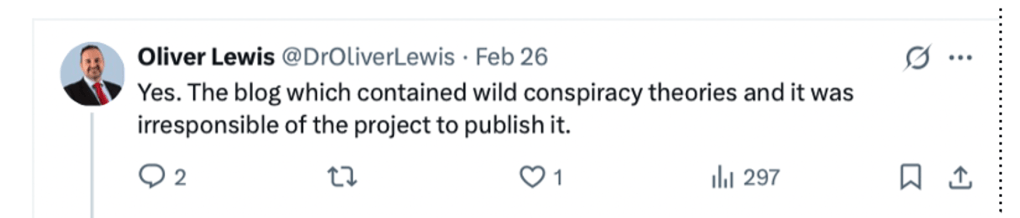
Around halfway through the hearing, the judge addressed Counsel for XY’s mum (Dr Oliver Lewis) and queried the request to transfer. Dr Lewis raised that case law has indicated that where a new, distinct point is to be decided on the function of a deputy, it has either been the senior or Tier 3 judge who determines those matters. Dr Lewis then made clear his position that the distinct point of law should be reviewed by Senior Judge Hilder.
From my perspective as an observer, it seemed that the judge wasn’t entirely welcoming of the suggestion to refer the matter to a senior judge. In fact, she appeared critical of Dr. Lewis from the outset (as discussed by Daniel in section 3 below). This was surprising given his commitment to support XY’s mum pro bono, and from what I saw, he was acting with utmost professionalism.
I will certainly be intrigued to follow this case, not least to see whether there is light at the end of the tunnel for XY and his family. But also, whether the case is transferred to a senior judge, and whether a legal determination is made. This could cast a far-reaching light on the decision-making powers of a PWD.
2. Reductions of supervision – By Daniel Clark
Aside from the ongoing uncertainties around internet and social media decision-making, I’m glad to report that there have been developments in finding alternative care providers since the last hearing, which is typified in this exchange:
Counsel for ICB (ICB): There has been significant progress. A Best Interests Meeting was held on 28th May… We have narrowed it down to two. Following collaborative discussions including the views of the Trust and the Autism IST [Intensive Support Team], who have been a positive addition.
Judge (J): Sorry I’m going to cut across you…I understand there was due to be discussion last week with providers.
ICB: A meeting took place last week with [Care Provider A]. They expressed confidence in meeting XY’s care needs. They were provided with the updated PBS plan that Dr W worked on. It was agreed that the next step would be to invite XY’s family and members of his MDT to meet with them, and they were fully supportive of that approach…We do not have a date for that to take place but it will be actively pursued.
J: And the other provider?
ICB: That meeting will take place on Wednesday of this week. It is timetabled so to be in a position for a commissioning decision by the 8th August, [including having] assessments and input of family and the MDT.
J: In terms of the progression from 2:1 to 1:1, is it now fully 1:1 with a second person on stand by?
A pivotal issue in this case has been level of supervision involved in XY’s care. Following an unsuccessful attempt at reducing the level of supervision, at the February hearing the judge had authorised up to 2.1 support as a necessary and proportionate deprivation of XY’s liberty. She was clear that this did not mean he had to receive 2.1 supervision.
At the March hearing, the court heard that XY continued to be distressed by this level of restriction. However, the judge considered this to be “micromanaging too far at this stage”, and told the parties to come up with a plan for transitioning down the level of restriction.
At the July hearing, it was clear that the parties had been listening. XY now receives 1.1 support during the day (with a second person nearby, on standby, if needed) and 2.1 support at night (one person awake and one person asleep, if needed).
The judge had also been to visit XY at his home, and noted the importance to him of reducing this further still. She asked about why there was 2.1 at night “when it’s 1:1 in the day…And can I be clear that the reason I’m asking is that it is a matter of real importance to him that reduces”.
Counsel for the ICB told the court that, by the end of the week, the ICB will have a plan for the reduction in this support. Counsel also assured the judge that the plan will be shared with the other parties and family members before it is implemented.
In previous blogs, I have been very critical of the conduct of the local authority and ICB. It was pleasing to see that there was some progress in this distinct area.
3.A stark exposition of power dynamics – By Daniel Clark – with comment from Eleanor Tallon
This hearing started with “an observation” from the judge: “Mr Lewis, your position statement surprised me because the title does not contain any anonymisation, not least it contains the full name of the individual at the centre of this litigation despite the fact it was your client, the mother of XY, who sought full anonymity and requested that the initials not be used, and so these proceedings have proceeded since that time with him being referred to as XY.”
For clarity, it did not appear to me that the judge was criticising the lack of anonymisation because the position statement may be sent to observers. Rather, she was critical of the fact that the position statement filed for the court’s attention was not anonymised.
There is not usually any expectation that position statements filed with the court are anonymised. In practice, they’ve rarely been anonymised – even when subsequently sent to observers. In fact, I’ve observed six hearings (in two cases) before DJ Clarke and, having reviewed my notes from those hearings, this is the first time that she has raised the issue of anonymisation.
Poole J is clear in his recent judgment (Re AB (Disclosure of Position Statements)) thathe would “usually allow a variation of the Transparency Order so that a non-anonymised position statement may be provided to an observer who is at an attended hearing and who has the Transparency Order, rather than insisting on full anonymisation as a condition of provision” (§37.2).
Many judges have been concerned about the dehumanising nature of anonymised court documents. Mr Justice Mostyn has described anonymising orders as, “a terrible practice. I have struggled to imagine the impact on a person, particularly someone who is close to the line between capacity and incapacity, of reading a formal order which rules his life profoundly, in which his identity is stripped away and he is simply reduced to initials. It would surely be utterly demoralising, and perceived as patronising and insulting. I cannot identify any justification for this practice and I reiterate my comments in GU that it should not continue” (§39, my emphasis).
When Counsel for XY’s mum asked if he could address the judge on that matter, she said she didn’t “want to spend time” on it. Counsel attempted to pursue the issue, seeking to explain that “the position statement is not published…the initials [would need to be] anonymised in public”. Indeed, the reason for the request to change initials was premised on a risk of online identification.
The order that set down the February hearing stated that, “the court also notes that [XY’s mum] has requested, on behalf of the First Respondent, that the terms of the transparency order be varied so as to further anonymise the First Respondent [XY] by use of different initials to prevent his identification online”. This was re-stated by the judge at the hearing: “because of concerns raised by [XY] to [his mum] about his personal details being on the internet…I made directions in relation to revoking the previous Transparency Order and revising it to anonymise [XY]”.
I think the point that Counsel was pursuing was that court documents be placed online, and therefore anonymity within them is unnecessary.
Unfortunately, as observers, we don’t have an agreed note of what the judge said at this stage. We do however agree that she did not want the issue to be pursued further.
This exchange had the rather chilling effect that, for the rest of the hearing, the protected party was referred to as “XY”. This is extremely unusual – although it’s happened at least once before to our knowledge (see “Anonymising P and his family in the courtroom: An unnecessary and unhelpful precaution”). To my memory, XY’s first name had been used in previous hearings. In my view, this further dehumanises a person who is already at risk of being lost in court proceedings – especially where discrete legal and procedural issues are being discussed.
This also set the tone for a later exchange between the judge and Counsel for XY’s mum.
The nature of the dispute between the parties, as detailed by Eleanor above, is far from an academic one. It will also affect more than XY’s deputies. It’s an important point of law, and I can see the attraction of transferring the case to a more senior judge for a declaration on that point alone.
It was therefore quite shocking to me when the judge took a somewhat different approach to the issue. When asking Counsel for XY’s mum to expand on the point about transferring the case, she also commented that she’d like to “make a few observations”.
The second of the two “observations” was the matter for workability: if the deputies make a best interests decision that is within the scope of their powers to make, but the local authority makes a commissioning decision that they will not fund that best interests decision, where does that leave matters? Eleanor has discussed this above.
The first observation was a tangential discussion of the circumstances in which it is possible for the court to revoke a deputyship. Here’s what happened (from the contemporaneous notes of myself and Eleanor) – you’ll see that the judge moves fluidly between the workability issue, and the issue of the court’s powers to revoke a deputyship:
Judge (J): “I’ll come back to this but I’m going to make a couple of observations…you need to think carefully about the issue to be decided, by who, and what you want decided. I would observe that the authority of a Personal Welfare Deputy is granted by the court and can be removed from the court. One of the grounds in section 15 of the MCA…is it could be varied or discharged by further order, and in particular if the deputies are not in acting in what the court considers as the best interests of the individual who lacks capacity. Your position statement as it currently stands does not appear to have fully addressed those issues in the sense that, if the court were involved in considering best interests, and determining whether or not an attorney was acting in best interests …that is something that which may run alongside or separate from submissions you have already made. There is also clear indications in the MCA that, when appointing a deputy, the court must consider the scope, and that a decision of the court is preferable to the decision of the deputy.”
Counsel for XY’s mum(Counsel):Those points could be applicable to any decision made by a deputy…
J: I’m simply observing that the best interests decision relies on commissioning. There are other provisions in the MCA that your position statement doesn’t address, and the biggest issue might be the workability one…which ranges from commissioning to …
Counsel:The position statement and my client’s witness statement does address workability….The main thing they’re focused on is [that] XY is presumed to be at risk of harm.
J:That is a significant concern of the court, which I have expressed previously. But there are many ways in which to address that. What I’m concerned about is, if there is a commissioning decision that runs contrary to the best interests decision made by the deputies, assuming that is something that they are entitled to do, there may be a challenge in another court, and this must be factored into the issues. The court will not need a party to raise this issue to consider whether to vary or indeed discharge that order…That can be involved in these proceedings…I don’t want to dwell on this any further. I agree it is not a matter I can make determinations on today. I will look at the draft order and what you have agreed but, at the moment, I am minded to give you an opportunity to consider all of these points before making a referral to a senior judge.
This contemplation of the grounds on which a deputyship can be revoked was unprompted. Having had the benefit of access to the position statements, I am entirely unsure where the idea even came from.
As far as I am aware, no party is suggesting that XY’s deputies are acting other than in his best interests. In fact, as the exchange went on, I discretely looked around the courtroom to see if I could identify a glimmer of recognition in anybody’s face. I saw at least one person frowning. Another was staring intently at the desk in front of them A few people were shuffling uncomfortably in their seats. XY’s mum and the other deputies were sitting behind me, and I can only imagine what their body language would have revealed.
Shortly after the exchange, the judge adjourned for “five to ten minutes” (it turned into twenty). The speed with which the courtroom emptied suggested to me that this adjournment came as a relief to everybody.
The fact that the judge chose to go down this path left a sour taste in my mouth. It seemed to be a thinly veiled threat that proceeding with the application runs the high risk of the deputyship being revoked.
Of course, what the judge was saying is technically true. The court can, of its own motion (without being asked), make an order that it considers to be proportionate and necessary. One of those orders is the revocation of a deputyship.
This, however, misses the point.
Given the fact that this was not foreshadowed, the exchange felt more like a hostile assertion of asymmetric power dynamics. The not-so-implicit message was, “I have the power here – don’t get on my wrong side”. That it was directed (through counsel) at family members was shocking enough. From what I’ve seen, the family have only acted in XY’s best interests (including issuing these proceedings in the first place). This made it even more shocking.
This is a direct contrast with how the judge has conducted this case so far. At previous hearings, she has struck me as an impressive judge who was clearly frustrated with the lack of progress. When XY’s mum has represented herself, the judge has taken care to ensure that various steps have been understood – including during a technical discussion about the instruction of an expert at the March hearing.
The Open Justice Court of Protection Project frequently supports family members of a current or potential “P” to observe hearings.
I dare say that, if this had been the first time somebody in that position was observing the Court of Protection, it would have done nothing to reassure them.
Comment from Eleanor Tallon
I was particularly shocked following the exchange (about the referral to a senior judge) between Dr. Lewis and DJ Clarke in which DJ Clarke alluded to the powers of the court to revoke the deputyship. Without having seen the position statements at that point, I wondered if there were concerns about the conduct of the PWD that had not yet been openly discussed, but I’m now aware that is not the case.
I considered whether this reflected a ‘stamping of authority’, or the judge’s ongoing frustrations with a case riddled with delays, or general stress from an extremely pressured and time-intensive role. Whatever the reason, it appeared that XY’s mum and her barrister took the brunt of it, which seemed unfair. Notwithstanding this, XY’s mum presented as very calm, polite, and focused on the well-being of her son.
4. Some reflections on observing the court (Heather Walton)
I come to these observations from a personal viewpoint. I’m the mother of a “P” in the CoP and having made a successful application to vary the Transparency Order that applied in my daughter’s case so that I can say this publicly (thank you OJCOP and Celia!), I am interested in peer-supporting other parents with children who lack capacity as well as observing and noting the treatment and the experience that parents and family members have within the court process.
My deep (and perhaps unreasonable) hope is that professionals within the CoP process begin to understand the stress and trauma that can be associated with the experience for families who find themselves in the thick of CoP proceedings. There is no doubt that some professionals see this and understand better than others – but we have a very long way to go.
Myself and a couple of other observers were watching online, whilst the case was heard in person. This caused a few issues from the outset, as whilst we could see some people in the court, we couldn’t observe everyone and it was hard to ascertain who was speaking sometimes. The audio was also dire and I missed quite a lot of what was said.
There were a few moments within this case that really stood out for me – and not for the right reasons sadly. I absolutely and utterly appreciate how hard judges work and the frustrations that they feel on late admissions and professionals within the court not being ready with answers. This session was delayed by half an hour as representatives weren’t ready – the Round Table Meeting (RTM) beforehand was still ongoing when the hearing should have started.
But the only thing that should matter – should ever matter – is the “P” at the heart of the case. And judges and legal professionals have a responsibility to the family, (especially – though that wasn’t the case here – if they are litigants in person) to guide them through the court process. Sometimes a little bit of thought about word choices and tone are all that are required but would make a huge difference.
Daniel has explained a strange interlude relating to deputyship, when the judge pointed out that deputyship could be revoked. Even though this is obviously legally correct, it seemed an extremely strange and bluntly unkind thing to mention in the court. How on earth did those members of the family who are deputies feel when she said this? What was she implying? Quite possibly nothing, but this is where the careful thought about words and their impact on others should be at the front of a judge’s mind.
The judge had visited XY since the last hearing. She expressed that he was very keen to change his 2-1 staffing overnight to 1-1 and she wanted to make this happen for him as quickly as possible.
This frustrated me because it is an issue that has been returned to throughout this case. Why did the judge reject it as “micromanaging too far” at the March hearing but then openly endorse it at this July hearing?
Those of us with young people lacking capacity in our families will understand how a brief visit by an unknown professional can throw out all kinds of anomalies – which is why advocating professionals should establish a stable base and relationship with the person before asking any questions at all. It may be in this case that these changes to staffing are appropriate, but it is not something that a judge who has met someone once should be handing out as something to be done without discussions with carers, parents and those around the young adult.
At the end of the hearing, the mother of XY thanked her Counsel and Mckenzie friend for their support. The judge said, “That’s not appropriate, you can give thanks outside of the hearing [after a pause] though I’m grateful that you are getting the support you need, as it can be very difficult acting as Litigant in Person”.
This was another slightly jaw-dropping moment, as it was completely unnecessary and not kind. The mum in this case demonstrated a wonderful attitude which I hope served as a demonstration to everyone in the court of how we should all treat others.
I am a realist. I do not expect all the professionals in the court to always demonstrate the Thumper Principle (“if you can’t say anything nice, don’t say anything at all”) – that would be extremely difficult and I understand that.
That being said, I wish that professionals thought harder about the effect they may have on the families involved. It is the professionals’ job within the court and they are paid for it (though on this occasion Oliver Lewis was working pro bono). But for the families, it is their lives, and the unnecessary stress that can be caused by thoughtless comments should never be forgotten.
Daniel Clark is a member of the core team of the Open Justice Court of Protection Project. He is a PhD student in the Department of Politics & International Relations at the University of Sheffield. His research considers Iris Marion Young’s claim that older people are an oppressed social group. It is funded by WRoCAH. He is on LinkedIn, X @DanielClark132 and Bluesky @clarkdaniel.bsky.social.
Eleanor Tallonis an Independent Social Worker, Expert Witness, and BestInterests Assessor. Eleanor is also an ESRC-funded Doctoral Training Pathway (DTP) student at the University of Birmingham. Her research focuses on the application of the Mental Capacity Act (2005) in private brain injury case management. Eleanor can be contacted via email eleanor@mcaprofessional.co.uk or through her website mcaprofessional.co.uk and found on LinkedIn or X(Twitter) @Eleanor_Tallon
I went to a friend’s 60th birthday party last weekend. Jane has a lot of friends from different walks of life and encouraged us to meet new people. When guests arrived, not only did we have badges with our names on, we were also given a list of two people who Jane had carefully selected, because she thought we would have something in common. It was fun searching for Sally and Helen and I’m glad I got to talk to them. Naturally both Sally and Helen asked me what I was currently doing. I explained about the Open Justice Court of Protection Project and about my PhD on family experiences of the Court of Protection, media representations and social media activism. I felt so relieved to be able to talk openly about why I’m interested in this subject: that I have experience of the Court of Protection myself, because my mum was a protected party, ‘P’.
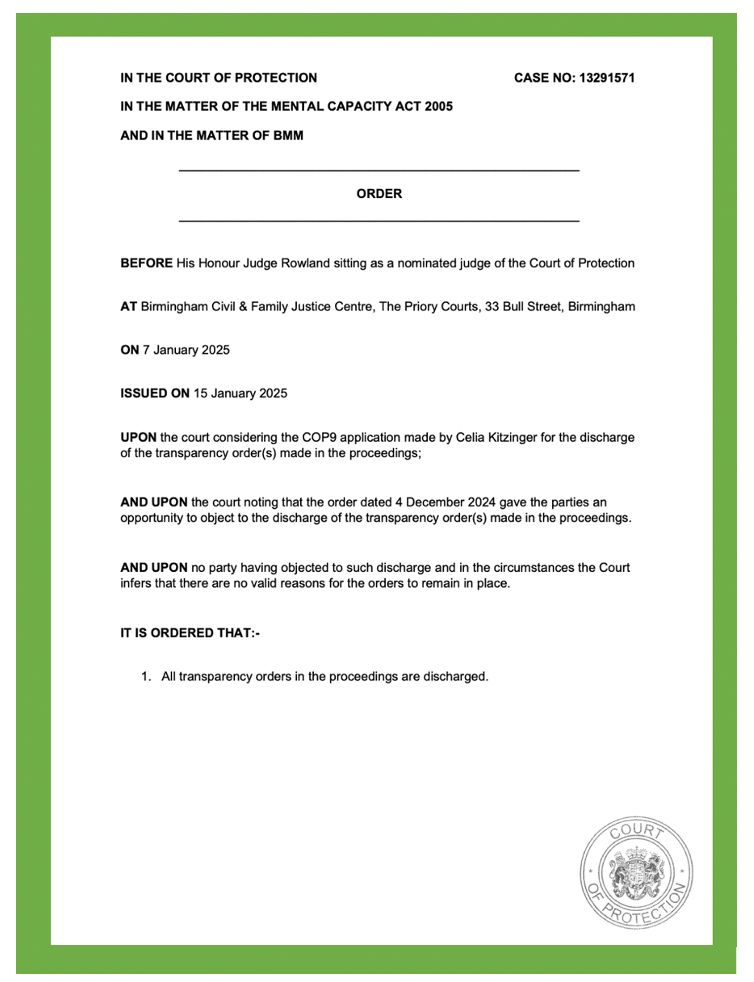
Up until four months ago, just for saying that, I risked the Court finding me in contempt and fining me or seizing my assets or even committing me to prison. That’s because I am subject to a Transparency Order (TO), an injunction restricting what I can say about the case. One aspect of the TO has now been varied (changed) so that I can now openly say these simple words publicly: I am a family member of a P in a Court of Protection case.
I must admit that I am slightly nervous about writing it, because the TO is still in place. I’m still not allowed to say anything that would reveal my mum’s identity, where she lives or who any of her carers are. My siblings still aren’t allowed to say anything at all about the case and I can’t name them. The injunction is in force “until further order of the court”. His Honour Judge Murch decided not to vary it to “until the death of P” as I wanted. So, when Mum dies, I will have to apply to the court to ask that the TO is discharged completely. I hope that writing this blog doesn’t have a negative impact on that process.
Making the application
Mum moved into full time care in July 2021. That sparked a Court of Protection process that finished with an agreed final order in December 2022. But my involvement in the case ignited a passion for open justice, which resulted in me becoming a core team member of the Open Justice Court of Protection Project in June 2023, regularly observing and blogging about hearings, and now my PhD research. I quickly felt constrained by having to keep my identity a secret. In July 2023 I wrote a blog about that: Gagged – in whose best interests? I had to write that as ‘Anna’. I was fed up of hiding behind ‘Anna’ and not being able to say who I really was. I asked Celia Kitzinger if she would help me apply to change the TO.
We decided that writing a letter would be the best approach, hoping that the judge who had heard the case, HHJ Hildyard, would agree to change the TO without the need for a formal application. Celia and I drafted the letter, with some informal lawyer input. The four page letter, dated and sent 13th September 2023, set out in detail why I wanted the TO changed and in summary asked for the following:
I was full of hope that the letter would do the trick. But my hopes were very quickly dashed. The next day, 14th September 2023, I received the following reply from the court:
My heart sank. I’m not a lawyer and although I have been a Litigant in Person, and have learned a lot about the CoP over the past four years, it was still a daunting prospect. I barely understood the paragraph from the judge. At least I knew I had Celia to support me. I wondered whether I would have to represent myself as I had done for the original hearing, but after Celia asked around, I was incredibly lucky to get pro-bono legal representation from Irwin Mitchell, first from Kirsty Stuart and then from Mathieu Culverhouse, as well as their paralegals. And amazingly there was some input from Alex Ruck Keene too. But the wheels of justice move slowly and I could never have foreseen that it would take 17 months before my legal team submitted the formal application.
Why did it take so long? That’s a good question. But there were a lot of factors. Changes of personnel in my legal team naturally led to delays, with new people needing to get up to speed. There seemed to be some uncertainty on behalf of Mum’s Litigation Friend, the Official Solicitor (OS), as to whether she still represented her, as the substantive hearing had finished. Eventually they decided that she didn’t. This came as a relief to me, not only because it meant one less party to negotiate with, but for financial reasons. Mum automatically received legal aid for the S21A appeal that was the subject of the original case but that had stopped now that case had finished. Although this application related to the original case, and it had the same case number, the legal aid agency confirmed to Mum’s representatives that legal aid would not be available to Mum in relation to my application. She has savings above the threshold so she would have to pay for her representation herself. I have heard that a minimum fee to be represented at an attended hearing by the OS is £20,000 (I remember Senior Judge Hilder saying that in a hearing I observed). As mum’s savings are being used to pay for her care (she is a self-funder), of course I feel morally obliged to pay Mum back for any costs, as I am responsible for the application. But that’s a lot of money for me, and for most people.
There was also a lot of to and fro with the Local Authority. I believe it was lucky that at least there was some continuity on the LA legal team. However, I was no longer a Litigant in Person as I had legal representation so that meant I couldn’t communicate with the LA legal team directly. There were a lot of emails between me and my legal representatives and the LA about what the LA would agree to. For example, I wanted all of my siblings to be able to say they were a family member of a protected party in a CoP case. But the LA were concerned because one member of my family shares a surname with my mum (my brother), and others live in the same town (my sister who is LPA and my brother). I’m not sure what they thought the problem was with my other sister, who like me lives overseas. In any case, the practical problems were far greater for me than for my siblings, due to my involvement with Open Justice Court of Protection Project and my PhD about the COP. In the end, the LA agreed only for me to be named as the family member of a protected party. The LA wanted an additional clause added that prevents me naming any staff caring for Mum and I agreed to that. I wondered if they were worried that I will be critical of Mum’s carers, but I think they are heroes for all the work they do at Mum’s home.
As time went on, I realised that there was a chance Mum would die before the case got to court (she’s now 91). In order to avoid another application after that, I asked that the duration in the TO be changed from ‘until further order of the court’ (which is what it read initially) to ‘until the death of P’. That way all restrictions would fall away when Mum dies. The LA agreed to my request. My siblings are, and always have been, fully behind me and supported this application.
Finally, after all the negotiations and multiple drafts of documents, the application was sent to the court on 23rd February 2025:
The court considers the application
My legal team and I hoped that due to all the hard work that had gone into the application, the court would approve the application ‘on the papers’, that is without a hearing. That would be less nerve-wracking for me and my siblings, use less of my legal team’s time and be much less costly for the taxpayer, who are paying for the LA’s legal representation as well as the judge and court’s time.
That wasn’t to be the case though. I was away on a week’s holiday when I received a very unwelcome email from my legal team:
To put it in a nutshell, I live in France, and the judge was concerned that I am outside the court’s jurisdiction and therefore wouldn’t comply with the TO – in particular the recital added to it which required me to give an “undertaking” “not to refer to BB or other family members by name, the town in which BB lives, or the name of staff supporting BB or the name of the care home and its location in any public discussion of the case”. The court would only vary the TO to permit me to identify myself as a family member of BB if I gave this undertaking.
On one level, I can understand the judge’s concern. On another level, I found it bewildering, as I have lived in France for over 20 years, had been joined as a party to the case by HHJ Hildyard, and have always respected the original TO dated 29th March 2022. Why would I breach a varied TO when I had always respected the first TO? Where I live had never been raised as an issue before. I wondered (and still wonder) why it had become an issue now that I was asking the court to vary the TO. The issue also applies to my eldest sister, who also lives outside the jurisdiction, but that didn’t come up.
I also didn’t understand the point about not hearing evidence from me if I was outside the jurisdiction at the time of the hearing[1], even though it was to be a fully remote hearing. There was some confusion about that – would I have to go to somewhere in the UK on 20th March to access a remote hearing? In the end, I stayed in France. And the judge didn’t hear any evidence from me.
I was very nervous in the run up to the hearing, there was so much riding on it for me. I was glad that Celia said she was available to observe. I also observed a hearing before HHJ Murch (a judge I’d never seen before) so that I could see what he was like and prepare myself for the day. I did as much preparation as I could. But there was one last curveball that I hadn’t expected.
The evening before the hearing, the OS solicitor sent an email to the court saying that although they no longer represented Mum, the court might think that it was appropriate that Mum be represented in respect of the application, based on the documents they had been copied in on, that is the suggested change to the TO. I was stunned and furious when my legal team passed the information on to me. What possible harm is there to mum from all this? She didn’t even understand about the case going to court in the first place. And we know, from knowing her and from what she said to various people including her then RPR, that she didn’t want to go to court. And yet the court case was still having consequences. Would the application be adjourned, and the uncertainty drag on? And would I end up paying thousands of pounds? I honestly wondered whether it was all worth it. It was so stressful I couldn’t sleep. I woke up in the night and wrote this, which I sent to my lawyer early the next morning and asked to be read to the court if necessary:
Statement from Amanda Hill 20th March 2025 BB 13899903
I woke up in the middle of the night last night and I couldn’t get back to sleep. Thoughts were going around in my head about today’s hearing. How would I be able to get across how I feel about not being able to say who I really am?
I remembered how it felt that day, last October, when I observed a hearing before Senior Judge Hilder. There were only six people in the courtroom, including the judge, one advocate, two parents, and me sitting at the back of the courtroom. P was not represented.
The advocate had explained to the parents before the hearing that I would be observing and I was from ‘Open Justice’.
As we were leaving the courtroom after the hearing, the mum stopped, turned to me and said “You’re Anna, aren’t you?”. I could feel myself going red and getting hot in the face. I spontaneously blurted out “Well, if I was, I wouldn’t be able to tell you.” But we looked each other in the eye and I could tell she knew. Then she said “I’ve read your blog”.
So, I could argue based on ‘Article 8’ and ‘Article 10’ rights but what it boils down to is that I just want to be able to say publicly: “Yes, I’m ‘Anna’ and I am a family member of a P in the Court of Protection”.
In any case, the time for the hearing had finally come and there was nothing else I could do. I was so nervous.
The hearing on 20th March 2025
The hearing lasted about 45 minutes. At this remote hearing I was represented by Mathieu Culverhouse of Irwin Mitchell and his paralegal, who had done a lot of the work in pulling the application together. Unfortunately, there wasn’t a barrister available to represent me pro-bono so I appreciate Mathieu Culverhouse representing me, as it’s not normal for a solicitor to take that on. The LA was represented by Francis Hoar of Field Court Chambers. The court had agreed that my siblings (and my sister’s husband who is joint LPA) could attend the hearing even though they weren’t parties. My two sisters and my brother-in-law attended. My brother couldn’t as he was working. Celia Kitzinger observed, as did Kim Dodd, a regular CoP observer. I didn’t make any notes as I was so involved in the hearing. To be honest, it passed in a bit of a blur for me as I was so anxious.
The judge didn’t address me and my siblings directly at all, only speaking to the legal representatives. The two parties, my legal representatives, and the LA were in agreement and Mathieu Culverhouse didn’t get to read out my statement. He didn’t need to. The judge seemed satisfied that I would comply with the (legally binding) ‘undertaking’ not to breach the varied TO, even though I live outside the court’s jurisdiction of England and Wales.
For this I have to acknowledge the considerable contribution of Francis Hoar, Counsel for the LA, who was incredibly helpful in addressing the judge’s anxieties about me living in France and therefore outside of the court’s jurisdiction. The position statement he prepared dealt with the jurisdiction issue comprehensively. The points he raised were also “gratefully adopted” by my legal team. I’m not sure the judge would have varied the TO were it not for the arguments put forward by Counsel for the LA and I am very grateful to him. The TO was amended further due to his intervention. I have included the relevant paragraph as an appendix, as well as the case law that was cited in the position statement, as maybe it will be useful to other families who live outside the jurisdiction.
The matter of Mum not being represented at the hearing was also addressed by Counsel for the Local Authority, in his position statement. Paragraph 8 states “CBC wishes to ensure that it provides its opinion to the Court as the independent public body responsible for BB’s care and for authorising her deprivations of liberty under the standard procedure under the MCA. This is important in circumstances where the Official Solicitor (the ‘OS’) has been discharged from representing BB as her litigation friend, albeit she has informed the parties that she does not object to the Application.”
The judge accepted that Mum did not have to be represented by a litigation friend at this hearing to vary the TO. But he did decide it would be best not to change the duration to ‘until the death of P’ in case the OS want to make representations about discharging the TO completely after she dies. The following was inserted into the order:
Paragraph (8) of the Transparency Order is removed and replaced with the following
wording: ‘This Injunction shall have effect until further order save that any party or
interested person may apply to vary it upon the death of BB; and that any such
application shall be considered in the first instance on paper by HH Judge Murch or
his nominee if available, or by any other judge’
That means that when Mum dies, on top of the usual grieving process and planning her funeral, I know that I will be thinking about applying to the court to discharge the TO. It’s an extra burden I could do without, especially with the uncertainty about what the court will do. I can only hope the application is straightforward and can be considered ‘on the papers’ without a hearing.
The key change made to the TO – the change that means I’m free to say I’m the family member of a P was this one. The standard sentence in the TO saying that it’s forbidden to publish “any material or information that identifies or is likely to identify that: any person is a member of the family of the subject of these proceedings” was revised to read instead “… any person, save for Amanda Hill is a member of the family of the subject of these proceedings”.
I was finally free to be open about my Court of Protection experience. I received the sealed court order on 8th April 2025.
A weight lifted from my shoulders
I really hadn’t appreciated how much the TO was weighing on me and how much being free of it would feel like a weight has lifted from me. I became emotional saying publicly for the first time that I was the relative of a P in the Court of Protection when I presented my PhD research to my fellow PhD students at the annual conference of the School of Journalism, Media and Culture, Cardiff University, in May. That completely surprised me.
I’m already seeing the benefit more widely of being able to talk more publicly. For example, I’ve been asked to speak at a Regional conference for DoLS assessors in September 2025. I was contacted after one of the organisers read my second blog about our story. The objective is for mutual learning. It’s exactly the sort of outcome I wanted when making the application. It is also really important for me to be open with future research participants about the fact that I have been involved as a family member of a ‘P’ too.
I don’t think the court has any idea about the impact on family members of feeling gagged. And what harm is it really causing Mum that I am now free to speak about the CoP case? None in my opinion. Mum doesn’t remember the case or my application to vary the TO, although I have told her. And she’s said she’s proud of me. She’s not rich or in the public eye. She’s an ordinary member of the public and we are an ordinary family, like most others involved in Court of Protection cases. Is the veil of secrecy imposed by a TO on P’s family really necessary as a default position?
And is a duration of the TO ‘until further order of the court’ really needed as a default, as research I carried out for Cardiff University showed is the norm? In a sample of 32 TOs from 1st October to 31st December 2024, the duration was ‘until further order of the court’ for 29 of them. That means that if a family member wants to talk openly about their Court of Protection experience, even after their family member has died, they have to apply to the court to discharge the TO. Is that really a sensible use of court time? And taxpayer’s money?
I hope that this blog post has shed light on how hard it can be to challenge reporting restrictions, even with the support of a legal team. I’d like to think that this blog can help other family members understand what it can take to ask the court to vary a TO. I also want professionals involved in the CoP to understand more about what it can be like for a family member covered by a Transparency Order and why the term ‘gagged’ is used by families so often.
All in all, I wonder whether it really does have to be this hard and take so long for TOs to be varied. Are prolonged reporting restrictions always in P’s best interests – or is the Court of Protection being over-cautious? I ask myself that a lot.
Amanda Hill is a PhD student at the School of Journalism, Media and Culture at Cardiff University. Her research focuses on the Court of Protection, exploring family experiences, media representations and social media activism. She is a core team member of OJCOP. She is also a daughter of a P in a Court of Protection case and has been a Litigant in Person. She is on LinkedIn (here), and also on X as (@AmandaAPHill) and on Bluesky (@AmandaAPHill.bsky.social)
Appendix
A new paragraph was inserted into the TO to deal with the jurisdiction issue. This is from the approved order, dated 8 April 2025, paragraph 2:
Following paragraph (5), a new paragraph (5A) is added to the Transparency Order as
follows:
(1) Except as provided in paragraph (2) below, the terms of this order do not
affect or concern anyone outside the jurisdictions of England and Wales,
Scotland or Northern Ireland
(2) The terms of this order will affect the following persons in a country or state
outside the jurisdiction of this court—
(a) the respondents or their employees or agents;
(b) any person who—
(i)is subject to the jurisdiction of this court;
(ii) has been given written notice of this order at his residence or place of
business within the jurisdiction of this court; and
(iii) is able to prevent acts or omissions outside the jurisdiction of this court
which constitute or assist in a breach of the terms of this order; and
(c) any other person, only to the extent that this order is declared enforceable
by or is enforced by a court in that country or state.
This wording came from Paragraph 12 of the LA position statement (see below).
In order to assist other families outside of the Court’s jurisdiction, I think it might be helpful to quote extensively from the position statement, and again I thank Francis Hoar for the time he took to consider this matter:
The jurisdictional issues arising out of AH living in France and the implications upon the proposed undertaking of AH.
§10: Counsel settling this position statements has searched for judgments in the Court of Protection concerning undertakings given by a person outside the jurisdiction without success. However, in both Re P and Re J, transparency orders were made in the Court of Protection and the Family Division of the High Court that applied to persons outside the jurisdiction of England and Wales (or, indeed, the United Kingdom). Thus, CBC is satisfied that the Court has jurisdiction to make such orders and would be able to enforce them in the same way as it would be able to enforce any order against a person outside the jurisdiction; and that it is appropriate for the Court to exercise its discretion to do so in circumstances where AH is willing to comply with that jurisdiction.
The agreed draft order to vary the Transparency Order.
§11: While CBC had agreed the draft order, it considers on reflection that it should be amended as indicated above..
§12: On reflection and having considered authority, CBC asks the Court to add a provision to the draft order that reflects the position in freezing orders that apply outside the jurisdiction and that was approved by Mumby P in Re J (at para 65). Adapted to this case, the Court is asked to add the following paragraph to the Transparency Order :
(1) Except as provided in paragraph (2) below, the terms of this order do not affect or concern anyone outside the jurisdiction of this court.
(2) The terms of this order will affect the following persons in a country or state outside the jurisdiction of this court—
the respondents or their employees or agents;
any person who—
(i)is subject to the jurisdiction of this court;
(ii) has been given written notice of this order at his residence or place of business within the jurisdiction of this court; and
(iii) is able to prevent acts or omissions outside the jurisdiction of this court which constitute or assist in a breach of the terms of this order; and
any other person, only to the extent that this order is declared enforceable by or is enforced by a court in that country or state.
[…]
§14: CBC have considered whether the Court should make an order that AH may be served with the order outside the jurisdiction. However, given that she has solicitors in England who are permitted to accept service and no enactment, rule, Practice Direction or order directs personal service (including Practice Direction 4C applying to transparency orders), it considers that such an order is unnecessary and that r. 6.3(3) of the Court of Protection Rules 2017 would require the varied Transparency Order to be served on her solicitors.
ORDERS APPLYING OUTSIDE THE JURISDICTION
§16: As has been said, Mumby P made orders restricting the reporting of proceedings against persons outside the jurisdiction in Re J and Re P.
§17: In Re. J at paras 44-65 he set out in detail the background to the Court’s jurisdiction to make orders against persons outside the England and Wales. At para 52 he observed that:
As can be seen, there are two separate principles in play. First, that the person who is to be injuncted must be amenable to the court’s jurisdiction. That goes to jurisdiction. Second, and because equity does not act in vain, that the court will not grant an injunction which is idle and ineffectual. That goes to discretion….
§18: It will be noted that AH – who is already bound by the Transparency Order – is clearly amenable to the Court’s jurisdiction given her application to vary it.
§19: Munby P went on to note (at para 55) the following part of the judgment of Re Liddell’s Settlement Trusts [1936] Ch 365
‘It is plain that this Court has jurisdiction to order a person in this country to perform an act abroad; but it is said that this Court has no jurisdiction to make an order requiring a person resident abroad to do an act there. Notwithstanding the strenuous argument of Mr. Archer it appears to me that his proposition is wholly untenable. The moment a person is properly served under the provisions of Order XI that person, so far as the jurisdiction of this Court is concerned, is precisely in the same position as a person who is in this country.’
§20: AH has been served with the Order and has solicitors in this jurisdiction who will be served with the Order as it is varied. Should the Court consider it appropriate, it could also make an order that the varied Transparency Order may be served on AH outside the jurisdiction.
§21: Munby P then noted with approval Butler-Sloss LJ’s finding in Wookey v Wookey; S (A Minor), Re [1991] Fam 121 said that ‘there must be a real possibility that the order, if made, will be enforceable’ (see para 62 of Re. J).
§22: Applying these principles, CBC submits that that there is no reason why the Court should not impose this injunction on AH outside the jurisdiction.
***
Footnote
[1] A recent judgment from Poole J about hearing evidence from people outside of the jurisdiction says “Day after day parties participate and give evidence in cases before the Family Division of the High Courtand the Family Court by remote video link from abroad.” (§112, Newcastle CC v JK and Ors (Care Proceedings: International Abduction: evidence from abroad) [2025] EWHC 1767 (Fam). In paragraph 123 he concluded: “Accordingly, I ruled at the hearing that I would receive evidence by video link from Austria from the Father and the Paternal Uncles notwithstanding the correspondence from the FCDO. [Foreign, Commonwealth and Development Office]”
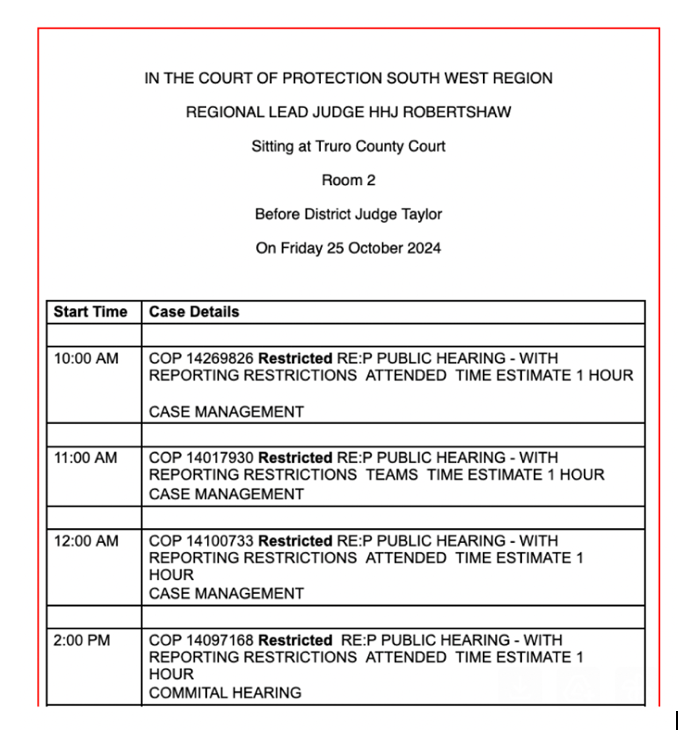
Since October 2024, I have been asking the Court of Protection (via the Bristol hub) for information about what happened at a committal hearing before DJ Taylor sitting in Truro at 2pm on Friday 25th October 2024. It’s COP 14097168 – the last in the CourtServe listing below.
The hearing was listed as public, but when I asked to observe it, I was not sent a link. Instead, I was told it had been vacated. This seems not to have been true – and I was subsequently promised (but, despite multiple reminders, have never been sent) a transcript of the hearing.
Today I learnt what happened at the hearing from which I was excluded. I discovered that the case heard by DJ Taylor in October 2024 subsequently went on to be heard a couple of months later by a different judge (HHJ Paul Mitchell), and he published a judgment (Committal for contempt of court: Council v Orange and others), one paragraph of which (§14) reports on the 25th October hearing.
I now know that at the October committal hearing (the one I was told had been vacated), the judge (DJ Taylor) handed down a suspended prison sentence of 7 days and also attached a “Power of Arrest” order to the injunction previously made (and previously breached) forbidding the contemnor from going to the home of the protected parties. (The alleged contemnor was not – I think – represented at that hearing. I don’t know who represented Cornwall Council at that hearing, but it may well have been Christopher Cuddihee, who represented the council at the hearing with which the judgment is concerned).
I had to google “Power of Arrest” since I’d not come across it before. It’s “a power attached to an order that enables the police to arrest a person whom they have reasonable cause to suspect of being in breach of the order, even though that person may not be committing a criminal act. Where a power of arrest is attached, the police do not need a warrant to arrest the person in breach of the order.” (Thomson Reuters Practical Law Glossary, “Power of arrest”).
The problem, I now know, is that DJ Taylor did not have authority to make a “Power of Arrest” order, and should not have done so.
The effect of the judge’s “Power of Arrest” order at the hearing from which I was excluded was that the defendant was wrongly arrested when he breached the injunction again. HHJ Mitchell who heard the case two months later says so in his judgment:
44. … [I]n my Judgement the Power of Arrest should not have been added to the Injunction Order.
45. The Court simply had no power to do so, sitting as a Court of Protection. That Power has since been removed, but it does mean that there was an element of wrongful arrest.
In determining sentencing, HHJ Mitchell takes into account “that [the contemnor] was wrongfully subject to a Power of Arrest” (§46).
I have checked this point of law with a number of Court of Protection (and other) lawyers and am confident in reporting that the Court of Protection can’t attach a “Power of Arrest” directly. This is because the High Court cannot do so under its inherent jurisdiction (Re FD (Inherent Jurisdiction: Power of Arrest)) and the Court of Protection’s powers here are derived from those of the High Court. The Court of Protection can put a penal notice on an order, and a breach of that notice can lead to committal proceedings, and, in turn, to arrest. But DJ Taylor did not have the power to make a “Power of Arrest” and that action short-circuited the procedure[1].
One of the oft-quoted purposes of open justice is to “keep the judge himself, while trying, under trial,”[2] as the eighteenth-century jurist Jeremy Bentham proclaimed.
If I’d been admitted to the hearing before DJ Taylor, my ears would have pricked up at the phrase “Power of Arrest” and I’d have started googling it and then asked around (as I have done now). I’d have written a blog post within a week of the hearing saying something to the effect of “Oi! DJ Taylor has done something I don’t think the judge has the power to do“. Or if, unaccountably, I hadn’t researched it and simply written a blog reporting the facts of what happened, I think it’s quite likely that some of the lawyers who read our blog posts would have spotted the problem for themselves. Either way, I’m optimistic that it would somehow have got back to DJ Taylor who would have corrected the error – and the defendant wouldn’t then have been subject to wrongful arrest two months later.
This illustrates one important reason why hearings need to be open. There was, in all likelihood, a cost to justice in excluding me from that hearing – not just a cost to the abstract principle of transparency as a good in and of itself, but quite possibly a concrete practical cost to the administration of justice. Keeping the judge, while trying, under trial, can sometimes be a reality – even for members of the public who observe hearings.
I don’t know why I was not admitted to the hearing and I don’t know why I haven’t been provided with the transcript I was promised.
My primary concern in writing this blog post is not the committal proceedings as such but rather the lack of transparency about what has been going on – and its implications for my belief in the integrity of the justice system. There are only so many times you can say “cock-up, not conspiracy” before it begins to sounds like a hollow refrain.
Background
25th October 2024
I sent an email, time-stamped at 11.49am, asking to observe the committal hearing. At 14.05, I received an email from an administrative officer at the Bristol Civil and Family Justice Centre saying: “I would like to confirm that this hearing has been vacated”. This seems not to have been true.
I responded by thanking the administrative officer for that information but also pointing out that the listing of the hearing seemed to be non-compliant with the relevant Practice Direction in that neither the name of the applicant nor the name of the person alleged to be in contempt of court had been published. So, I asked for this information.
28th October 2024
I was sent a “response from the judge” telling me that the applicant was Cornwall Council and the alleged contemnor was David Orange. I was also told: “No further hearing listed – matter dealt with today. I have ordered a copy of the judgment to be transcribed and will be requesting that the hub publish through the appropriate channels.” That judgment has never, to my knowledge been published.
I wrote to senior HMCTS staff asking: “Please can you investigate urgently how it came about that I was informed by Bristol Admin Officer, [NAME], that this hearing was vacated when the judge tells me that the matter was in fact dealt with that day”. I received no response.
11th/12th November 2024
I contacted the court to say, “I have been looking out for this judgment and have not yet located it. Can someone advise me when it will be available (and where) please”. I got a reply the next day: “The transcription is not yet available, we will let you know once we receive it.”
26th- and 28th February 2025
I’d been intermittently checking for a published judgment, and failing to find one, and had heard nothing further from the court, so I wrote again. “Hello – is this judgment available yet please? The matter was dealt with in October 2024 and I was promised a transcript when one was available – which I imagine it might be more than three months later?” (26th February 2025)
This reply came through a couple of days later. “Thank you for your email. The transcript for case 14097168 has been requested. I apologise, we have not yet received a copy of the transcript, when this becomes available I will provide you with a copy of the transcript for the hearing that took place on the 25 October 2024.” (28th February 2025)
3rd March 2025
I acknowledged the reply of 28th February and asked for more information. “Thank you for letting me know that the transcript is not yet available. It does seem to be taking a rather long time. Is it possible please to know – in the interests of open justice and transparency – whether a finding of contempt was made, and if so what the penalty was please.” (3rd March 2025)
I have never received a reply.
16th May 2025
I tried again: “Is this transcript ready yet please? The hearing was on 25th October 2024 so it’s been more than six months now.” I have never received a reply.
So, over the course of more than six months, I was aware that someone (a person called David Orange) had been before the Court of Protection for alleged contempt of court, and that he must have faced the possibility of a prison sentence. But I had no idea whatsoever what Cornwall Council alleged he had done, or what the injunctions were that he was said to have breached. I did not know whether or not the judge had found him guilty. I did not know whether or not he had been sent to prison. When I asked for this information, I simply got no response. This is not open justice.[3]
HHJ Mitchell’s published judgment
Today, in the course of reviewing the dismal history of my attempts to get information about this case, and poised to send yet another letter to the court, I discovered that a judgment has been published about this case: Committal for contempt of court: Council v Orange and others. It was published on the judiciary website (which is hard to search) and not on BAILII or the National Archives, which we regularly check for judgments. It’s not a judgment from the hearing I’d tried to observe, but from another hearing a couple of months later before a different judge. But it does report on what happened at the hearing I was excluded from.
The published judgment is dated 6th January 2025. I’d been told in late February 2025, when I asked for the judgment, that there was no transcript available for the earlier hearing – and if that is true, it might explain the vagueness and apparent uncertainty in HHJ Mitchell’s judgment, which is hedged about with provisos in relation to earlier proceedings[4] . But on reading this judgment, I was able to discover what happened at the October hearing – and what I have learnt only adds to my concerns about transparency.
Rather surprisingly, the published judgment names not only David Orange but also the “two vulnerable elderly people”, both of whom have dementia, who are the protected parties in this case[5]. The published judgment also gives the full postal address of the home where they live (also referred to as “the Property”). I have not reproduced that information here, because – although this information has now been publicly available on the judiciary website for more than six months – it seems an invasion of their privacy and not necessary in the interests of transparency[6].
It turns out that there was an injunction (issued by DJ Taylor on 9th July 2024[7]) against David Orange saying that he “must not return to enter or attempt to enter [the Property] except with prior agreement of Cornwall Council”. This was to protect the viability of the care package for the “two vulnerable elderly people” which was at risk due to his “obstructive behaviour”, “aggression”, and “verbal abuse” towards care providers commissioned by the local authority. The hearing I’d asked to observe concerned breaches of that injunction.
The judgment by HHJ Mitchell records:
On 25 October District Judge Taylor dealt with a Committal Hearing. That was in respect of an allegation of breach of the Injunction or allegations of breaches I think on three separate occasions, when David was said to have been at the Property in breach, and the Judge found the breaches proved. The Court duly imposed a suspended prison sentence of 7 days suspended for 6 months. A Power of Arrest was added to the Injunction. (§14, Committal for contempt of court: Council v Orange and others).
As I was reading the judgment, I paused at this point to google “Power of Arrest” since I’ve not seen it added to an injunction before. I’ve seen judges make “bench warrants” – and I wasn’t sure if they were the same thing. It seemed not. It looked complicated. I asked some lawyers for help, both privately and publicly on X and Bluesky. I learnt that the court has to fill in Form N110A (click here) which asks for the “statutory provision” under which the “Power of Arrest” order is made – and I don’t know how that was completed in this case since (lawyers tell me) there doesn’t seem to be any statutory provision for “Power of Arrest” in the Court of Protection.
In any case, perhaps predictably, David Orange breached the orders again, after the hearing of 25th October 2024. Given that the judge at that hearing had added Power of Arrest” to the injunction, his breach (going to the home of the protected parties) led to his being arrested by the police on 6th December 2025 and held in custody for some period of time (HHJ Mitchell is not sure how long – “He appears to have been held or detained for less than 24 hours” §43).
A committal hearing was listed for 19th December 2024 but adjourned since David Orange did not attend court. He didn’t attend the subsequent hearing either, but the court decided to proceed anyway. The judge said, “Plainly, proceeding in his absence is potentially prejudicial to him, but I have to say that it is unclear if anything is to be gained by putting this off on a further occasion because all indications are that non attendance is deliberate.” (§23, Committal for contempt of court: Council v Orange and others).
The judge considered evidence from the police officer who arrested David Orange at the Property (who recognised the defendant as someone he’d been at school with). He heard from the lead social worker who confirmed that “there is no record of David Orange being in touch with the Local Authority requesting or agreeing any arrangements to visit the Property” (§31). The judge was “entirely satisfied that the Council has established the case beyond reasonable doubt” (§33) and (after making sentencing reductions relating to the unlawful arrest and the period of detention already served and considering the sentence in its “totality”), he determined on an overall total of 14 days imprisonment for contempt of court.
So, finally, I know what happened to David Orange.
Conspiracy?
Over and over again in my dealings with the Court of Protection, I tell others – and I tell myself – that the problems we face are “cock-up not conspiracy”. I share the perspective articulated by my colleague on the Open Justice Court of Protection Project, Daniel Clark, in a recent blog post reflecting on the errors in Transparency Orders. He said: “I try not to see conspiracy behind the multiple transparency failures of the Court of Protection. The judicial system is busy and overstretched, and mistakes are (unfortunately) inevitable: links won’t be sent in time, listings won’t be always accurate, video links won’t always be set up.” (Prohibitive Transparency Orders: Honest mistakes or weaponised incompetence? )
The problem is that there are just so very many transparency failures. Adherence to the view that the Court of Protection is basically striving for transparency requires us to believe in cock-ups on an industrial scale.
In this case, I’m prepared to believe that the listing of 25th October 2024 was botched (or, more technically, non-compliant with the Practice Direction) as a result of error – since naming people in listings doesn’t come naturally to staff in the Court of Protection, and committal hearings requiring this are relatively scarce. Also, the names of the applicant and the alleged contemnor were swiftly provided on request. But why was I told by an HMCTS staff member that the hearing was vacated, when DJ Taylor told me two days later that the matter had been dealt with that day, and that a transcript of the judgment had been ordered? Why, despite the judge’s offer to send me the transcript and my multiple requests, have I never been sent a transcript of that judgment? Why was I left to discover for myself, in HHJ Mitchell’s judgment some months later, a vague summary of what happened at that hearing? Could the apparent “cock-ups” in transparency relating to DJ Taylor’s hearing possibly have anything to do with the fact that he made an error of law, resulting in unlawful arrest? I’m not asserting that, but it becomes harder and harder to believe that everything I’m encountering is unmotivated cock-up.
No part of my experience of this hearing has been transparent. And sadly, the experience I’ve had with this case is not so very dissimilar to my experience of seeking transparency in other committal cases, including notably the case of Tia Bench – a judgment I chased for almost two years (see the Postscript and subsequent Update to this blog post). My faith in the judiciary’s aspiration to open justice is becoming increasingly strained by the weight of experiences like these: they could easily be read as evidence that actually transparency is not much valued, and may even be deliberately obstructed. There are days I feel like giving up.
Judges continue, of course, to trot out the slogans. Justice must not only be done but be seen to be done. Publicity is the very soul of justice. Sunlight is the best disinfectant. Even the one about how transparency keeps the judge, while judging, under trial – which might in fact have had direct relevant to this case and prevented an unlawful arrest.
But fine words butter no parsnips.
Celia Kitzinger is co-director of the Open Justice Court of Protection Project. She has observed more than 600 hearings since May 2020 and written more than 100 blog posts. She is on LinkedIn (here), and also on X (@KitzingerCelia) and Bluesky @kitzingercelia.bsky.social)
Footnotes
[1] Thank you to the lawyers who took time to answer my questions about this including Alex Ruck Keene and Jacob Gifford Head.
[4] For example, HHJ Mitchell says (the emphases are mine): “The Local Authority commenced welfare proceedings in the Court of Protection in, I think May of this year…” (§5); “[X] has, as I understand it, significant health and social care needs…” (§6); “I think [Y], also needs significant support…” (§7); “ I think that was in the autumn of ’23…} (§8); “allegations of breaches I think on three separate occasions (§14).
[5] It’s not entirely clear from the judgment whether or not both of them (they are husband and wife) are protected parties, or just the husband.
[6] Other published committal judgments avoid naming protected parties and have certainly not provided contact information for them. Where possible (it’s not always possible), other judgments have also avoided specifying the nature of the relationship between the contemnor and the protected party. In my view, based admittedly solely on my reading of this judgment, there is no reason why this should not have been so in this case. There seems no reason to publish the names of the “two vulnerable elderly people” at the centre of this case, and no reason to give their home address. Other people are also named in the judgment including the police officer who arrested David Orange and two different social workers.
[7] The judgment, published on 6th January 2025, does not state the date of this hearing. It has been transcribed from an oral judgment delivered in December 2024 (I think 30th December 2024 is implied by §19). There are several references to events “this year” which must be read (despite the January 2025 date of the published judgment) as referring to events in 2024 (e.g. “May of this year” §5; “on 9 July of this year” §11).
Editorial Note (Celia Kitzinger): The hearing took place over two days on 24th and 25th June 2025, and there was a shifting group of six or so observers, some of whom took part in discussion about the case which contributed to the ideas expressed in this blog post. I observed only the second day of this two-day hearing: I heard the judgment, and a detailed exchange about s.19 of the Senior Courts Act (in relation to the MCA and inherent jurisdiction) and its importance in progressing consistency in anorexia cases moving forward. This legal discussion was technically too sophisticated for us observers to follow, especially as we do not have access to the “legal framework” document cited as an Appendix to the Trust’s position statement: that part of the hearing is not covered here. I am grateful to counsel for sending me their position statements and have drawn on them in editing this blog post to try to ensure accuracy. The blog is in two parts, written independently by two different observers, and reflects their perspectives on what they saw. We understand there will be a published judgment and will add a link to it if so.
Update: The judgment has been published and it’s here (click on the live link): Re FF[2025] EWCOP 26 (T3)
No easy answers – by Elissa Novak
The Court of Protection rarely makes headlines, but it wrestles with some of the most difficult questions in law: autonomy, capacity, dignity and consent. For the protected person at the centre of these cases, its rulings can sometimes be a matter of life or death.
On 24 and 25th June 2025, Mr Justice McKendrick presided over one such case (COP 20014975).
The protected party, FF, has a long-standing diagnosis of anorexia and Emotionally Unstable Personality Disorder (EUPD). She was diagnosed aged 18 and has had multiple hospital admissions to try to treat her anorexia, including naso-gastric feeding and percutaneous endoscopic (PEG) feeding, involving significant restraint or force at times. She is currently receiving treatment for her anorexia under s.3 Mental Health Act 1983, with a treatment plan that grants her extended s.17 MHA leave so she can return to her supported living placement for up to one month, before returning to hospital where she can (lawfully) be force-fed via a naso-gastric tube. All the parties (including FF’s father) agree that FF lacks capacity to make decisions regarding treatment for her anorexia (including specifically decisions about nutrition and hydration).
The Trust had applied for declarations and orders under the Mental Capacity Act 2005 that active treatment against FF’s wishes is not in her best interests upon her liability to be detained under the Mental Health Act ceasing. In other words, treatment (including food and hydration) for her anorexia will no longer be forced upon her, and the ceiling of care is the point of her refusal.
I observed the first day of the two-day final hearing of FF’s case. I understand that a judgment (approving the Trust’s application) was made on the second day, and that it will be published. (A link to the judgment will be added to this blog post when it appears).
The applicant NHS Trust (Leeds and York Partnership NHS Foundation Trust) was represented by Ms Emma Sutton KC.
The first respondent was FF by her litigation friend the Official Solicitor, represented by Ms Katie Scott.
The second respondent was FF’s father, anonymised in accordance with the Transparency Order as “GG” was a litigant in person.
All parties supported the Trust’s application to stop the enforced treatment (and the threat of enforced treatment) which compels FF to take nutrition and hydration. It was before the court not because of disagreement but because (as the Trust put it) “the decision could be regarded as finely balanced, having regard, in particular, to the dichotomy of [FF] not wanting to die, but equally being unable to take the necessary steps to ensure that she has an adequate calorific intake to sustain life”.
Even watching remotely, with occasionally patchy audio, the gravity of what was at stake was undeniable. This was not an adversarial case but a solemn one – attuned to the ethical weight of a decision that created the very real prospect that FF would die.
Mr Justice McKendrick, made it clear he wasn’t there to manage FF’s care or second-guess doctors. He zeroed in on two clear issues: “One is whether it is in FF’s best interests to receive medical treatment namely artificial hydration and nutrition administered by restraint or sedation… and on a full merits review do I agree or do I disagree with the responsible clinician not to impose treatment pursuant to section 63 of the Mental Health Act.”
FF has not consumed an oral diet for around 3 years. She describes food, fluid and medication as “poison”, her current circumstances as “tortuous”, and forced feeding as being like “rape”. She does not consider herself to be unwell and does not believe that her weight is a problem. She is frail and unable to walk long distances. She is “unkempt”, believing that washing her hair and her clothes “adds to the calories”. She also considers that staff can transfer calories to her through their hands and asks that they wear gloves when touching her.
She wasn’t present in court, but in her absence we learned about her through the evidence of those who know her best. Her long-time treating clinician described her as, “Incredibly intelligent. She’s quite sarcastic and has a dry sense of humour. She always asks about me and how I am.” Her father spoke with pride and sorrow about the daughter he has seen both thrive and struggle. A young woman who had at one point stabilised her weight, lived independently, completed a university degree gaining a 2:1, and who actively sought help when she realised her eating disorder was re-emerging in 2021. Her father’s reflection on that moment from 2021 may be the most quietly damning detail in this entire case. When FF went to her GP and asked for help, she was told her BMI was too high to qualify for a referral. For someone living with anorexia and emotionally unstable personality disorder, it was a devastating message. It not only denied her access to treatment, but confirmed the most dangerous cognitive distortion her illness reinforces: that she wasn’t “thin enough”. The impact was profound, it sent the message that help was conditional on further deterioration, and that care would only come when she was at her most unwell.
That moment, her father believes, marked the start of her steep decline. He spoke about how profoundly that decision had harmed his daughter and his hope that someone, somewhere, would revisit the guidelines that allowed it to happen. The impact of that moment echoed through the evidence of her treating clinician, who described how FF came to believe she had to be visibly unwell to deserve help: “She felt all of the difficulty she experienced was present because she was too ‘fat’… and that prevented her getting the support she required. So, she lost weight and deteriorated again to elicit the care that she had experienced previously.”
As FF’s condition worsened, her life was sustained through forced feeding via nasogastric and PEG tubes, sedation and physical restraint involving up to eight staff members at a time. These interventions were stark to hear described in court — invasive, relentless, and violent. Yet despite their severity, they had been only minimally effective. Over eighteen months of enforced treatment, FF’s weight increased by less than half a stone. Her treating clinician argued that the regime was not only ineffective, but actively traumatising. That whilst it kept her alive “I don’t think she has much of a life. I think her quality of life could be very different outside of that detention.” This detention, she felt, had failed to address the core belief driving FF’s deterioration: that if she was “not seen as poorly enough” she would lose support. This resulted not only in physical deterioration but in a painful erosion of independence and life skills, with FF at one point needing her carers to hold cups to her mouth to help her to drink. This had created a situation where the care team felt “anxious” about responding to signs of improvement, in case FF saw this as a sign of recovery and a threat to the care, connection and safety she so desperately craves.
This cycle of coercion and fear was reflected, with painful clarity, in reports of FF’s own views, which spoke openly of suffering and a wish to die. But her treating clinician, echoing the view of FF’s father, urged the court to see beyond the surface of those words, saying: “ I don’t want to invalidate her distress in any way but …I don’t think she wants to die. I think she wants the torture to end and the fear to end but she doesn’t know how that can happen because of never experiencing anything other than forced treatment.”
Throughout her evidence the treating clinician was candid about the risks involved in ending enforced treatment but was firm in her belief that detention had become part of what was keeping FF unwell. Her proposal was not to withdraw care, but to redefine it, from something imposed on FF, to something shared with her. A way to prove that care will not vanish if she gets better. That her team will remain by her side, not because of a court order, but because she matters. As she put it, FF “has never experienced treatment of her own volition”. This, she believes, could be a turning point that allows FF to take charge of her illness and “experience those relationships outside of those restrictive frameworks”
The clinician also acknowledged a second, more painful possibility: that ending the use of the Mental Health Act might lead to rapid deterioration. FF could lose weight, disengage, and physically decline to the point of death. But even in that scenario, she held onto a thread of hope, that reaching a point of crisis might prompt FF to decide she wants to live, and to seek help voluntarily, without force. In that version of events, treatment would not begin with restraint, but with consent and that difference, the clinician suggested, could be crucial to her long-term recovery.
This was not merely theoretical. The clinician pointed to past moments when, despite repeatedly expressing a wish to die, FF had at the brink, chosen life. In one such episode, she developed a serious fungal lung infection that required the removal of part of her lung. Faced with that emergency, FF actively engaged with treatment and gained weight. It was, the clinician argued, powerful evidence that when given space and agency, FF could recover not through compulsion, but by choice.
That same possibility had begun to show itself in quieter, more everyday ways. For much of her adult life FF has been detained under the Mental Health Act, subjected to repeated episodes of forced feeding, restraint, sedation, and fear. And yet, within that profoundly traumatising system, FF has developed relationships with carers, built not because of coercion, but in spite of it. Moments of trust, unmoored from calories or compliance, have allowed FF to express small but significant preferences. She has begun choosing the more calorific Pepsi Max over flavoured water, reading fashion magazines, watching Netflix, and asking to spend more time with carers in the evenings – brief glimpses of FF, slowly and tentatively, rediscovering herself.
After hearing submissions, Mr Justice McKendrick turned to the practical realities that would follow the removal of the Mental Health Act framework. He acknowledged the limits of his role, stating: “I’m not making a decision on whether she has capacity in respect of future medical emergencies.” But he pressed both barristers on what would happen if FF presented at A&E with a physical emergency, a broken bone, a cardiac arrest, and was unable to consent. Would clinicians have the authority to act? What if she asked to be restrained again? Would the law protect both her and those caring for her?
Both barristers agreed that the proposed care plan and draft court order needed clarification to ensure it could be lawfully and practically implemented. Responding to Mr Justice McKendrick’s concerns about ambiguity, particularly in emergency scenarios, they confirmed that revisions would be made. Ms Sutton, for the Trust, said the plan could be updated to reflect FF’s wish for all reasonable steps to preserve life, even if she were unconscious, and agreed to formally include a “pros and cons” guide already developed by FF’s care team. Ms Scott, for the Official Solicitor, supported refining the order’s language to align with the wording in the Mental Health Act, something frontline clinicians were experienced with which would allow them to make decisions about FF with confidence.
Throughout their submissions both Ms Sutton and Ms Scott kept FF’s humanity in view. Ms Sutton teased out the difficult legal arguments with precision whilst Ms Scott ensured FF’s voice was not lost in the process. Her questioning of the treating clinician drew out difficult truths about FF’s vulnerabilities, the scars of long-term care, and the desperate logic shaped by anorexia and EUPD, whilst holding onto the faint thread of hope her treating team are trying to protect.
The session ended with Judge McKendrick thanking the treating clinician and GG for their respective roles in FF’s life. He indicated he would reflect further on the wording of the order overnight and reconvene the next day to hear evidence from the medical expert. He invited any further submissions on ancillary issues, including clinician anonymity.
FF’s case offers no easy answers. It sits at the raw edge of law and medicine, where autonomy, trauma, and consent intersect in painful and unpredictable ways. I left the hearing with two strong convictions: that the current regime was doing more harm than good, and that stepping away from it carries a very real risk to FF’s life that in almost any other circumstance, would be unthinkable. I felt anger too, at the moment a GP told FF she wasn’t thin enough to access help and shared her father’s hope that out of this failure, someone will review the guidelines that allowed it to happen. What struck me most, though, was how aligned the parties were in their aims to find a better, more humane path forward. The question now is whether, in letting go of compulsion, the system might finally offer FF something closer to choice, dignity, and the chance of real sustained recovery.
Elissa Novak is a full-time carer for her son. She has previously published about another anorexia case here: Judge approves use of esketamine in anorexia case: Re CC She can be contacted via the Open Justice Court of Protection Project: openjustice@yahoo.com and is on X @ElissaNoves
Evidence from the treating clinician – by Brittany Murphy
The treating clinician’s evidence was powerful and emotional. It was obvious that she cared a great deal about P, as her patient and as a human being. She remarked upon FF’s personality. She described FF as an empathetic and caring individual: she is someone who remembers snippets of information others tell her so she can ask after their lives. It was obvious that the clinician has a close relationship with P and is motivated by what is best for her. This was evident in her explanation of what would happen in terms of FF’s care going forward, and how she would remain a part of it in the way that she could to ensure stability for FF.
When asked questions in court her answers were exacting, and precise. She was clinical where necessary, but overall concerned to speak of FF not just as a patient, in terms of her illness and her treatment options, but also of FF as a person, someone who has hopes and aspirations, and who has achieved a great deal with her life. The evidence cut to the heart of the matters before the court. She was able to describe the duality of FF in light of her illness in detail. The central problem is that FF’s wishes to refuse future treatments and her desire to live are contradictory in all of the evidence in the case. The treating clinician also noted that although FF sometimes expresses indifference about dying, when she is actually in at-risk situations she expresses fear of death. She also noted that P has made vast improvements in recent months, changes which for the ordinary person seem minimal but which are huge and which the clinical team intend to continue supporting.
Listening to the treating clinician speak about the case, was distressing because she so capably humanised FF, describing some of her interests, and showing a great level of care for for her, and her own distress at FF’s current situation and the decision before the court. Sometimes in court, the people at the centre are presented with a necessary detachment. In this case where the decision could well lead to FF’s death no one shirked from the humanistic approach, instead celebrating FF for who she is and for the progress she has been made so far, whilst exploring the difficult decision of how best to proceed to “empower P in some way”.
And the judge’s compassion in this case, when speaking about FF, when delivering his judgement and in his interactions with those who care/know most about FF (family and clinician) was really note-worthy. At times, he seemed a bit emotional and it seemed to me as if he choked up at points and had to stop to regain his composure at various points: when describing FF’s qualifications, how long she has been undergoing treatment, and at the end of his oral judgments at the end too when he was talking about balancing a best interest decision with the fact that the decision he made may be followed by FF’s death.
Brittany Murphy is a BTC and LLM student at Cardiff University with a keen interest in all areas of Health Law, including the Court of Protection, Clinical Negligence and Personal Injury. Her dissertation has a focus on vulnerable adults, the management of their finances, and the Court of Protection’s role in this. Brittany observes in the Court of Protection to gain a better understanding of this area of law.
The case I observed in person before District Judge Clarke sitting at First Avenue House on 9th June 2025 (COP 20015914) was brought by the London Borough of Lewisham (the “LA”) and concerned a deaf adult with a mild learning disability (“P”), who was represented by the Official Solicitor (the “OS”).
This matter encapsulates many of the nuanced challenges health and social care professionals routinely grapple with when capacity, communication, housing, and safeguarding collide. This hearing had a time estimate of 1 hour, during which the court was set to consider P’s capacity, best interests, and deprivation of liberty. The OS applied to the Court for an order allowing an expert capacity assessment.
The case is centred around P’s refusal to leave his long-term home, a property he has occupied since 1988 despite its dangerous disrepair. A report in 2022 deemed the property uninhabitable. The living conditions are profoundly concerning, with a lack of electricity and water, possible asbestos, structural issues, and significant hoarding. P has continued to resist engagement or attempts to access the property since that time. He also refused to attend court or meet professionals for this hearing.
The protected party presents as a highly vulnerable adult with significant communication barriers. He is deaf, but he does not fully understand or use British Sign Language (“BSL”). This means someone fluent in BSL, such as an interpreter, would not necessarily be able to communicate with him. Instead, he has a unique and idiosyncratic method of communication that uses images. This information is shared effectively only with one social worker, DS, who is retiring imminently. The depth of the connection P has with DS and the trust she has managed to build has proven difficult to replicate.
One question that needed to be answered was, “How can we engage with P with minimal distress?” The LA solved one aspect of this question. The LA reached an agreement with DS to compensate her for continued assistance in supporting P. This is clearly ideal for helping P, and it is hoped that DS can assist with communication moving forward. The court ruled that an application for a BSL interpreter could be made if DS was unavailable. However, employing DS in her retirement raises questions as to whether such a measure is an appropriate option. Many social workers will have clients with whom they have a particular understanding. For practitioners, this raises an essential point: transitions and succession must be anticipated and planned with exceptional care to avoid deficiencies when social workers leave their roles.
Another aspect was where the assessment could be completed. The OS submitted that, ideally, P would be assessed in a space familiar to him. His current home is not possible because it is unsafe, and nobody has been able to access it. The best location would be a familiar place that P cannot suddenly leave. One option suggested was the LA offices, where he goes for chats with DS, but he does not necessarily attend on the days for which he has an appointment. Now DS will be retired, which means she will only be there at the allotted times.
Additionally, the parties cannot know what date and time to book the expert. This remained a problem to be solved despite the best efforts of the parties and the court.
Difficulties such as these show the extent of the problem-solving elements involved in this area of law. Health professionals reading this will understand the tension between the urgency of removing a vulnerable adult from unsafe conditions and the ethical and legal imperative to assess capacity properly and facilitate participation. There is no shortcut to these obligations. The answer is rarely one-size-fits-all, and engagement is not a luxury; all reasonable measures should be taken to ensure it. The court itself was creative, too, by permitting a photograph of the court to be taken to familiarise P with how the court might look. This request was unfamiliar, but the court carefully considered it. The judge concluded that a photo could be taken as long as the courtroom was empty and the judge had risen. This showed the court’s willingness to assess and facilitate novel means of enabling participation.
A third aspect is the choice of expert to carry out the capacity assessment. In this case, the preferred expert is Dr Sue O’Rourke, a consultant clinical psychologist with specific BSL and complex communication expertise. This was despite her unavailability for the next two months (until August). This choice was not about convenience but quality. As the OS rightly argued, given the number of failed attempts to engage P, only the “gold standard” will do. The alternative expert suggested was believed to be below the standard required. This shows that knowing and understanding the personality, skills and qualities of your expert is essential. Then, you ask the question of how the expert will engage with the individual. Engaging an expert without considering these factors seems insufficient.
A fourth aspect was improving the court’s understanding of the plan for P. The OS accepted that steps still need to be taken before the OS can take a position on removing P from his home, including the completion of the capacity assessment. The judge noted that there is no clear indication of what works need to be carried out, how long P will need to be absent from the property, or where he will be housed if he is removed – all of which need to be satisfactorily arranged before an order can be made. Interestingly, a third-party service that supports self-led hoarding clearance and property recovery with a trauma-informed, empowerment-based model is being reintroduced. It is a creative step despite its limited success with P in the past. Its re-involvement reflects a broader principle of multidisciplinary problem-solving, whether professionals are social workers, psychologists, or housing officers. This case is a reminder of how our roles intersect and why creative, person-centred approaches are vital.
The Court ordered the following:
The landlord be notified in writing that, under Rule 9.14, they would be bound by the proceedings as if joined. Should they fail to cooperate, a formal application for joinder would be considered.
A 21-day deadline was set for initial disclosure (30 June 2025), allowing time for an urgent ‘CoP9′ application on 48 hours’ notice if required. If the landlord failed to provide an alternative accommodation list by the deadline, they were to set out proposed options, including property type, location, and estimated timeframes. The court agreed that hotel accommodation was unsuitable and directed that this be reflected in the order.
Coordination was to be managed through DS, available until 20 June 2025. A handover document outlining future engagement strategies was required before her departure. This had been completed and was to be served on the OS by 16:00 the day following the hearing. The judge required DS to provide a final statement before leaving her post, explaining her most recent contact with P, information relayed to him, and arrangements for any unplanned visits by P to LA offices. The judge also acknowledged the breadth of DS’s informal contribution and directed a formal order requiring her to provide a statement.
Dr O’Rourke’s report is due by 29 August 2025. The OS took charge of the first draft of the Letter of Instruction, due by 11 July 2025. The LA was to respond by 18 July 2025, and the final letter was to be sent by 16:00 on 21 July 2025. The letter would confirm dates for Dr O’Rourke to assess P. The LA anticipated it would take seven days to confirm DS’s availability. These timelines were to be recorded in the recitals, with details on transition arrangements.
A Roundtable Meeting was set for 25 September 2025 to allow three working days before finalising the bundle. The final hearing was scheduled for 1 October 2025.
The LA is required to file the bundle and permission statement at least five working days before the hearing. The OS is then to file its permission statement three working days before the hearing.
Any application to vary was to include a justification. The judge ordered that the hearing could not be vacated without two working days’ notice and express permission.
This case contains five key takeaways for practitioners in that regard. First, start succession planning early when a key worker with a unique rapport is about to depart. Second, assessments involving communication difficulties could require expert, culturally competent input. Third, capacity assessments must not be rushed, and the timeline must serve the person’s needs, not institutional convenience. Fourth, multidisciplinary collaboration is essential in ensuring good outcomes. Fifth, participation must be creatively facilitated, not just documented as “attempted and failed.”
Whether P can be supported with engaging remains to be seen. However, cases like P’s are why the Court of Protection exists. They are not easy or quick, but they matter.
Daniel Holt is a barrister keen to develop a practice in the Court of Protection, public law, community care, and education law. He combines legal rigour, compassionate advocacy, and lived experience to support those navigating complex systems. His early education at a special needs school informs his commitment to proceedings involving disabled people and people with mental illness who are often underrepresented. Daniel undertook an LLM in Human Rights Law, focussing on mental capacity and drafting a dissertation on the Mental Capacity Act 2005, European Convention of Human Rights and the United Nations Convention on the Rights with People with Disabilities. Daniel has a strong media presence as follows: LinkedIn: https://www.linkedin.com/in/daniel-holt-228161263/ Twitter: @daniel_p_holt. Instagram: daniel_p_holt1 Snapchat: danielpaulholt Youtube: https://www.youtube.com/@daniel_p_holt. TikTok: funnydisabledbarrister
It’s been more than 10 months since I applied to discharge the transparency order in a s.21A case concerning a woman in her 90s who was deprived of her liberty in a care home. She died in January 2023. Her son wants to publish his account of “over five years of hell” in the Court of Protection.
But there is a transparency order, issued by HHJ Harris sitting at Stoke on Trent County Court on 26th April 2019, which threatens him (and me) with prison, a fine, or seizure of assets if we publish anything that would reveal him to be a family member of a (now former) protected party. The order also prohibits us from identifying his deceased mother – and it bans us from naming the applicant local authority (see §6 from the order, below).
The (sealed) order from which the above extract is taken is in the ‘standard’ terms, except for the ban on naming the local authority (§6(i)(c)) – which is unusual and, as I know from raising challenges to other transparency orders with the same prohibition, often unintended both by the judge who makes the order, and by ‘successor’ judges who subsequently hear the case. It’s unlikely that the local authority made an application to any of the judges who heard this case for their identity to be protected. It’s unlikely that they would have succeeded in any such application if they had made it (see “What to do if the Transparency Order prevents you from naming a public body” and “Getting it right first time around”). But, as in so many other cases, an ‘accidental’ injunction is still an injunction and breaching it risks contempt of court.
And P’s son is subject to these “gagging orders” indefinitely. The duration of the injunction is “until further Order of the court” (§8). I don’t know why someone decided that the injunction should prevail “until further Order of the court” (there are other options in the ‘standard’ template, including until P’s death). I doubt it was ever discussed in court.
So, acceding to the son’s wishes, I made an application to discharge this transparency order (and any others applying to the same case). Since the protected party is now, sadly, deceased, I thought it would be straightforward (especially in the aftermath of the Supreme Court decision in Abbasi). But no.
First there was a considerable delay (more than 3 months) before HHJ Rowland, sitting at Birmingham Civil and Family Justice Centre dealt with my application, which I submitted on 17th August 2024.
Then, after issuing an order discharging the transparency order on 7th January 2025 (since he’d received no objection from the local authority), HHJ Rowland stayed that order on 18th February 2025, giving the local authority a second chance to object, correspondence having apparently gone astray. Their new deadline was 4th March 2025, more than six months after submitting my application. The local authority missed that deadline too. Then they did submit an objection two days later, on 6th March 2025 – following which there has been judicial silence, despite several chases both from me and from the solicitor for the local authority.
This has left everyone involved in the case (me, the son, the local authority, and a social care team leader for the local Trust who wrote a witness statement supporting the LA’s objection) in a legal vacuum.
I have detailed the chronology below because it is unfortunately not atypical in my dealings with the Court of Protection on transparency matters. Long delays, failures to respond, and (in this case) resultant uncertainty about what can and cannot be reported are inimical to open justice. This account exposes the persistence and hard work it takes for a member of the public to seek – so far without success – discharge of a transparency order, two years after P’s death.
Experiences like these do not enhance public confidence in the court and do not support the claimed judicial commitment to open justice. For anyone starting from the perspective that the court is corrupt and determined to hide its proceedings from public scrutiny, this whole experience looks like corroborating evidence.
Although his mother died more than two years ago, P’s son still feels the weight of court prohibitions preventing him from speaking (in his own name) about the role of the Court of Protection in the last years of her life. This is a self-evident interference with his freedom of speech and it’s hardly surprising that he is cynical about the court.
What has gone wrong here?
Chronology
17th August 2024
I submitted a COP 9 asking for the following order:
“Discharge of the Transparency Order dated 16 April 2019 made by HHJ Harris – an injunction preventing identification of:
(1) BMM as a subject of the proceedings (and therefore a P as defined in the COP Rules 2017);
(2) the family members of BMM, which includes the second respondent [her son];
(3) the name of the applicant local authority in these proceedings (§6).
There may be (I’m not sure) another TO prohibiting identification of the Trust and/or other public bodies – if so, discharge of that too.”
I set out the grounds on which I was seeking the order as follows:
“The key ground for this application to discharge the reporting restrictions is to further the judicial aspiration for open justice and transparency in the Court of Protection.
The injunction was in place to protect the Art. 8 privacy rights of BMM, who has now sadly died […] COP PD24B states that orders should be in place for no longer than is necessary to achieve the purpose for which they were made. BMM no longer has need of the protection of anonymity.
The second respondent, [NAME OF SON], actively wishes to tell his story about his experience of the Court of Protection in relation to his mother. His Article 10 rights to freedom of expression are engaged and there are no Article 8 privacy rights currently protected by this injunction to balance against that. The local authority does not have any Article 8 rights to be balanced. It is very unusual to anonymise a public body in any event, and it is not clear what the grounds for this could have been.
I understand that the second respondent wishes also to name the Trusts and hospitals involved in his mother’s care. This is not prohibited by the injunction I have seen (but there may be a second TO I have not seen).
4th December 2024
Although I’ve been told by the Senior Judge (HHJ Hilder) that COP 9s relating to transparency matters are recognised as urgent and dealt with speedily by the court, I did not receive any response for more than three months.
Then I received an order made by HHJ Rowland on 4th December 2024. It noted in a recital that “various transparency orders were made in the proceedings and that such orders last until further order” (I have not seen any other transparency orders and don’t know what they say – none have been referenced in any objections to my application, and I think the one I have in my possession may actually be the most recent, superseding prior orders – but I’m not sure, and neither is P’s son). Another recital records that BMM has died and that Court of Protection proceedings have come to an end. The order then says:
The COP9 application of Celia Kitzinger shall be sent by the Court to all parties to the proceedings.
In the event that any party objects to the discharge of the transparency order(s) made in these proceedings they must by no later than 4pm on 31 December 2024 send to the Court, to the other parties and to Celia Kitzinger a COP24 statement setting out the grounds for their objection
In the event that any party does not submit a COP23 statement objecting to the discharge of the transparency order(s) the Court may infer that they have no objection
The file will be referred to HHJ Rowland on 6 January 2025 to give further directions on paper.
This order was made without a hearing. Any party may apply to the Court to have this order set aside, varied or stayed. Any such application must be made no later than 7 days after this order is served.
31st December 2024
There had been no application to set aside, vary or stay the order as per §5 quoted above, and so I waited to see whether I would receive any objection by 4pm on 31st December 2024. This was the deadline for receipt of any objections to discharging the transparency order(s). I did not receive any objections. So I waited for further directions to follow after HHJ Rowland’s review of the file on 6th January 2025 (as per. §4 above).
15th January 2025
I received the order below, made on 7th January 2025 and issued on 15th January 2025. Hurrah! It says “All transparency orders in the proceedings are discharged”. We thought that was it!
24th January 2025
On 24th January 2025, the local authority made an application to dismiss the order of 7th January 2025. They said they had not seen my COP9 application or the judge’s order of 4th December 2024. They wanted time to “review and take necessary instructions”. That application was dismissed by the judge, who noted that my application and his order had been sent by email to all parties on 5th December 2024. He quoted the email address to which they had been sent.
12th February 2025
The LA made another application to stay the order, stating that the person to whose email address my application and the judge’s order had been sent is no longer in their employment.
17th February 2025
In a new order dated 17th February 2025, issued on 18th February 2025, the judge noted that “the Court would expect [the local authority] to have measures in place for another member of staff to receive and act on any email”. He also said that the local authority “has been in possession of the application and orders now for some time” and that “a further opportunity to take instructions will not be entertained”. The new order states as follows:
IT IS ORDERED THAT:
The order dated 15 January 2025 is stayed until 4pm on 4 March 2025
In the event that any party objects to the discharge of the transparency order(s) made in these proceedings they must by no later than 4pm on 4 March 2025 send to the Court, to the other parties and to Celia Kitzinger a COP24 statement setting out the grounds for their objection.
In the event that any party does not submit a COP24 statement objecting to the discharge of the transparency order(s) the Court may infer that they have no objection.
The effect of the 15th January order was to discharge all the reporting restrictions. P’s son sent me a lovely thank you letter.
The effect of the 17th February order (so more than a month later) was to reinstate those reporting restrictions.
This means that if I’d published a blog post between 15th January and 17th February 2025, naming P’s son, his mother, and the local authority, I would not have been in contempt of court.
In fact, I was taking a break from the Project during that period (backpacking in Tasmania and New Zealand with limited internet access). I didn’t return until 24th February 2025, and it was only some days after that, as I worked my way through my emails, that I discovered what had happened. I checked with P’s son. He had not been informed that the reporting restrictions were back in place (which seems an odd omission, given that he had been sent the order issued on 15th January 2025 discharging those reporting restrictions). However, he told me he had not in fact publicised his mother’s Court of Protection case. If he had, I would have promptly so informed the court and pointed out that the effect of the reinstated order was to make a retrospective transparency order, which is completely unacceptable. This whole episode, and the uncertainty (indeed anxiety and fear) it creates puts the court in a very poor light.
4th March 2025
The next judicial deadline (4pm on 4th March 2025) passed without my receiving any objection to discharge of the transparency order.
5th March 2025
I wrote to the court to ask for confirmation that, as no objection had been received, the stay on the order of 15th January 2025 (i.e the order discharging the transparency order(s)) was now lifted. Here’s what I wrote:
“I did not receive a COP 24 statement from [Local Authority] before 4 pm yesterday raising any objections to the discharge of the transparency order(s) in this case. Please can I have formal confirmation that the judge’s stay on his order discharging the transparency orders is now ended and that the stayed order is in force.” (my email to the court dated 5th March 2025)
I have never received a reply.
6th March 2025
Two days after this (second) deadline mandated by the judge, I was copied into an objection to discharging the transparency order, sent by the local authority solicitor. It was accompanied by a witness statement (unsigned on first sending, and then resent with a signature) from the local authority’s Social Care Team Leader explaining the basis for their objection. According to the witness statement (which took a different perspective from the local authority’s application in that regard), “our objection is not to the Transparency order being lifted but to any individual’s [i.e. employee] being named by [P’s son]“.
The transparency order I’ve seen does not in fact explicitly prohibit the naming of any individual employee in connection with this case – although it could be argued that naming employees (including members of the inhouse legal team as well as social workers etc) is implied since this could perhaps be said to be “likely to identify” (§6.1) the local authority, at least for anyone sufficiently interested to track down these people’s place (or former place) of employment.
This is puzzling. If the concern is the naming of employees, then a proper remedy (from the point of view of the local authority) would surely be an application for an order prohibiting public identification of whichever named employees they want to protect – not an wholesale opposition to the discharge of the existing order, which is their current position.
19th April 2025
On 19th April 2025, I sent a new COP 9 application (copied to the local authority solicitor) seeking a declaration that “the sealed order to HHJ Rowland dated 7th January 2025 (issued on 15 January 2025) wherein the judge orders that “all transparency orders in the proceedings are discharged” is now back in force and that no reporting restrictions apply”.
The grounds on which I am seeking this order were set out as follows:
“HHJ Rowland’s order of 7th January 2025 discharging the transparency orders was stayed to allow objection from [the Local Authority] , which they were required to submit by 4pm on 4th March 2025. They did not do this. No COP 24 statement was received from [the Local Authority] before 4pm on 4th March 2025. So, I took it that the transparency orders were discharged, but did not receive confirmation (requested on 5th March 2025). An COP 24 was subsequently submitted after the judge’s deadline (on 6th March 2025) with a witness statement by [Social Care Team Leader], stating “Our objection is not to the Transparency order being lifted but to any individual’s [i.e. employee] being named by [P’s son]” (§16). This would seem to require a new application.
“It is now well over two years since the death of P, and it is not clear to me or to family members whether we can publish information about these proceedings. If the judge has decided to continue the stay on his Order pending the making of a decision about naming the local authority’s staff members, please could I be so informed at the earliest possible opportunity. I am concerned at the length of time it is taking to get clarity that reporting restrictions are discharged – open justice delayed is open justice denied.” (my application of 19th April 2025)
14th May 2025
Almost a month later, neither the local authority solicitor nor I (nor P’s son) had received any information about the status of the orders. On 14th May 2025, the local authority solicitor sent an email to the court (copying me in) asking for an update as to whether the judge has “made a determination on this matter”. I thanked him for chasing it. As far as I know, there has been no reply.
27th June 2025
Another month, and more, went by. Still nothing from the court. On 27th June 2025, the local authority solicitor sent an email to the court, copying me in, saying he was leaving their employment and transferring the matter to another (named) employee who (he said) was copied into the email. She wasn’t. Fortunately, I have been able to locate her on LinkedIn.
A plea to the court
This blog post documents, in excruciating detail, ten months of a failed attempt to get a transparency order discharged two years after the death of the person it was designed to protect. As a member of the public, acting in good faith to support P’s son and to advance the judicial commitment to transparency, I’m depressed and frustrated by this protracted sequence of events. It shouldn’t be this difficult. I’m still unsure whether or not the transparency orders are now discharged and I’m anxious about publishing anything – and of course so, too, is P’s son. This uncertainty has a chilling effect on transparency. I am hoping this public blog post will serve to spur the court into action and will be updating this post if and when matters progress.
Celia Kitzinger is co-director of the Open Justice Court of Protection Project. She has observed more than 600 hearings since May 2020 and written more than 100 blog posts.
“But in America, in my home, they are persecuting people for using their right to free speech and voicing their dissent. This is happening now.” (Bruce Springsteen, during his concert at Lille, Saturday 24 May 2025[1])
As well as saying people are persecuted for using their right to free speech, Bruce Springsteen also said that America is corrupt, and that democracy is dead there. I’m sure a lot of people agree with him (and a lot of people don’t) but I doubt that many people would question his capacity to litigate, because he expresses those views.
I didn’t expect to be sitting at a Bruce Springsteen concert and thinking about Lioubov (Luba) Macpherson[2] – a litigant (and recently also a protected party) in the Court of Protection. But hearing what he had to say made me think about beliefs, free speech and the capacity to conduct legal proceedings.
Two days before the concert, on Thursday 22nd May 2025, I had observed the last ten minutes of Mrs Justice Theis handing down her judgment in Luba’s case (COP 13258625), which we’ve been following, and reporting on, for some time. Theis J’s judgment concerns whether Luba had capacity to conduct contempt proceedings on 22nd January 2024 (contempt of court proceedings that resulted in a prison sentence) and whether she has capacity now to conduct an upcoming appeal against the judge’s decision to commit her to prison as the outcome of those proceedings. On 22nd May 2025, Theis J decided that Luba does have litigation capacity now for the upcoming Court of Appeal case, and that she had capacity to litigate in the Court of Protection back then as a litigant in person in a committal hearing too.
The published judgment, Macpherson v Sunderland City Council [2025] EWCOP 18 (T3)is clear that Ms Macpherson holds “strongly held beliefs” that affect how she conducts litigation but that this “does not equate with lack of capacity on its own” (§56).
Luba has been concerned with Court of Protection proceedings in one way or another for several years. In this blog post, I’ll start by setting out a brief “Background” to the case before writing about the four hearings I’ve observed concerning Luba’s capacity to conduct proceedings:
The Court of Appeal hearing of 3rd December 2024: before Lady Justice King, Lady Justice Asplin and Lord Justice Birss between Lioubov Macpherson (Defendant / Appellant) and Sunderland City Council (Claimant / Respondent). The judgment can be found here: Macpherson v Sunderland City Council[2024] EWCA Civ 1579, with Oliver Lewis and Beth Grossman (instructed by Burke Niazi Solicitors) for the Appellant, and Sam Karim KC and Sophie Hurst (instructed by EMG Solicitors) for the Respondent
The Court of Protection hearing of 18th February 2025: before Theis J, between Lioubov Macpherson (By her litigation friend, the Official Solicitor) (Appellant) and Sunderland City Council (Respondent) with Oliver Lewis and Beth Grossman (instructed by Burke Niazi Solicitors) for the Appellant, and Sam Karim KC and Sophie Hurst (instructed by EMG Solicitors) for the Respondent
The Court of Protection hearing of 30th April 2025: before Theis J between Lioubov Macpherson (By her litigation friend, the Official Solicitor) (Appellant) and Sunderland City Council (Respondent) with Oliver Lewis and Beth Grossman (instructed by Burke Niazi Solicitors) for the Appellant and Sam Karim KC and Sophie Hurst (instructed by EMG Solicitors) for the Respondent
Luba Macpherson has been involved as a party (sometimes as a litigant in person, sometimes with legal representation) in a long-running Court of Protection case concerning her daughter, referred to as “FP” in the judgments, who has been diagnosed with paranoid schizophrenia. Luba’s daughter lives in a care home and Luba believes she is being abused and is being given medication that is making her symptoms worse. She has regularly communicated her views on these matters to her daughter, with the result that the court has authorised various forms of contact restrictions (and at times a total ban on contact). More detail is available in a published judgment (SCC v FP and others [2022] EWCOP 30) and in a previous blog about this case: An ‘impasse’ on face-to-face contact between mother and daughter.
The case concerning her daughter is now concluded. Luba appealed the decision and the appeal was dismissed. There is no further recourse for the substantive proceedings to be re-opened.
During the proceedings concerning Luba’s daughter, the Court of Protection judge, Poole J, made an injunction prohibiting Luba from posting material about FP on the internet. He said:
“The purpose of preventing the Defendant from posting films of her daughter and naming her through posts on social media platforms, is to protect FP. Not only is it a gross invasion of FP’s privacy to do so but, in this particular case, the nature of the Defendant’s publications about FP is to create the wholly misleading impression that FP is being abused and “tortured” by those caring for her, as sanctioned by a “corrupt” court system.” (§30Sunderland City Council v Macpherson [2023] EWCOP 3
After Poole J made this injunction, Luba continued to post material about FP on the internet (she still does). Her rationale for breaching the injunction is that the court is engaged in a cover-up. She says she wants “ to show the distress that my daughter suffers daily, because so-called professionals keep my daughter in deliberately induced illnesses to suit the agenda that she lacks mental capacity“. (from Sunderland City Council v Lioubov Macpherson [2023] EWCOP 3).) She has “hundreds of videos to show the degree of distress and deplorable care, but it has been completely ignored by the Court and by the Regulators. This is why I have posted some of the videos on the Internet, just out of desperation”. From Luba’s perspective, the judge has ordered her to “delete material evidence” about her daughter’s deplorable care, and she is determined to expose it (see: “An ‘impasse’ on face-to-face contact between mother and daughter”).
In January 2023, Poole J found Luba in contempt of court for having breached his injunctions by posting material about her daughter online. The judge imposed a suspended 28-day sentence (judgment here ([2023] EWCOP 3). ) We’ve also blogged about it: “A committal hearing to send P’s mother to prison”).
Luba appealed against this 28-day suspended sentence. Her case was heard on 4th May 2023 before Lord Justice Peter Jackson, Lord Justice Dingemans and Lady Justice Elisabeth Laing, in person, in the Court of Appeal (and there’s a published judgment here: [2023] EWCA Civ 574). Celia Kitzinger attended the hearing, at which, she said, Luba delivered a passionate, articulate and searing oral submission. Luba has subsequently published the text of this speech on her Facebook page, and it’s reproduced in an Appendix to this blog post to provide additional background to the case from Luba’s perspective. It’s important in explaining why Luba disregarded Poole J’s orders, even knowing she risked a prison sentence. Her 4th May appeal was dismissed.
After having received a suspended 28-day sentence, and after her appeal against it was dismissed, Luba continued to post videos and other material about her daughter. The local authority issued fresh committal proceedings – although by now Luba had relocated to France, where she was outside the jurisdiction of the court. Since Luba declined to return to the UK for the contempt hearing, the judge made a warrant for her arrest. At a hearing on 22nd January 2024 (which Luba attended remotely from France), Poole J imposed an immediate 3-month sentence for the new breaches, plus the 28-day sentence from January 2023, making a total of 4 months of imprisonment. We blogged about that hearing too: “Warrant for arrest of P’s mother”).
Luba wants to appeal that judgment (sending her to prison for 4 months) in the Court of Appeal. She filed her application to appeal a long time ago, on 21st March 2024, but it’s still not been heard. First there was a delay in securing legal aid, and then a delay due to a failed attempt to secure a transcript of the committal hearing. Most recently, the appeal has stalled altogether due to Luba’s own legal team having raised concerns that their client lacks capacity to litigate. So, it is now more than 14 months since Luba issued her application to appeal, and still it hasn’t been heard. We expect the appeal to be heard before the court term ends on 30th July 2025, and will alert readers (via social media and our “Featured Hearings” page) when we know the date for the hearing – as we’re sure Luba will on social media too.
I pick up the story from 3rd December 2024, when Luba’s appeal against her custodial sentence first came before the Court of Appeal – only to be sent back to the Court of Protection (before Theis J) for determination of her litigation capacity. As I outline above, that issue has now been resolved: the judge finds (on the balance of probabilities) that Luba does have capacity to conduct legal proceedings (both the earlier committal proceedings, and the upcoming appeal).
Why did Luba’s ‘strongly held beliefs” lead the Court of Appeal to make an interim declaration that she lacked litigation capacity? And how did the court reach a decision? Here’s what happened at the four most recent hearings relating to this matter.
The Court of Appeal hearing 3rd December 2024: Court makes interim finding of Luba’s lack of capacity to litigate proceedings
The hearing on 3rd December 2024 was listed as Luba’s appeal against the custodial sentence imposed by Poole J almost a year earlier (on 22nd January 2024). I watched it remotely and when I logged on, two counsel were in the physical courtroom: Oliver Lewis, originally counsel representing Luba; and Sam Karim KC representing Sunderland City Council, the public body which had made the committal application, alleging that Luba had breached the judge’s orders. Luba attended the hearing remotely, via a video-link (she was still in France and subject to the arrest warrant).
It was clear from the start of the hearing that there was a problem. It transpired that Luba’s legal team had doubts about her capacity to instruct them in this appeal and had brought this to the attention of the court in advance of this hearing. The court had authorised an expert assessment of Luba’s capacity to conduct the proceedings – a paper-based exercise, as Luba had (not surprisingly) declined to meet with the psychiatrist. The psychiatric report had reinforced those concerns about Luba’s capacity, so she was now deemed a (potential) “protected party”. The CoA hearing was for the court to decide what to do, given that situation.
The hearing opened with a statement from Lady Justice King to those of us observing that there was a reporting restriction order in place to protect FP’s identity[3]. She went on to say that even though Luba was now also a (potential) “protected party”, as someone who may lack capacity to conduct proceedings, Luba could be publicly named. Lady Justice King said that Luba “is clear and has always been clear that she would wish her name to be in the public domain. I have considered whether that is appropriate but in consultation with My Lady and My Lord (i.e. Lady Justice Asplin and Lord Justice Birss, sitting beside her on the bench), we are very clear that we should honour Ms Macpherson’s wishes in that regard.”[4] The intention of the court’s reporting restriction order was to give Luba “the openness she desires, while protecting the Article 8 privacy rights of her daughter” [5].
Lady Justice King then revealed (for the observers this was the first time it was explicitly announced) that the matter “initially listed as an application for appeal against immediate imprisonment” now concerns the issue of “whether [Luba] has capacity to prosecute this appeal”. She asked Oliver Lewis to outline “how we’ve reached this current situation and your proposal of how we proceed today”, and she’d then hear from the parties. Finally, “without sounding like a primary school teacher, can I ask everyone to be very respectful and let everyone have their say and not talk over each other”. This last statement seemed to be aimed at Luba: based on what had happened in previous hearings, the judge may have worried that Luba would interrupt proceedings by speaking when, according to court etiquette, it wasn’t her turn. I looked to see how Luba would respond, and I saw her nod in acceptance.
Oliver Lewis then summarised how things stood – and he was at pains to point out that he was not representing Luba at this hearing, and that documents he’d submitted to the court were not (therefore) “submissions” on behalf of Luba but rather “notes by counsel”. Here’s how it’s recorded in the published judgment: “It should be noted that Mr Lewis, and those instructing him, were at all times diligent in reminding the Court that they did not act upon the Appellant’s instructions and were not making submissions to the Court, but merely assisting by way of providing information and presenting the Court with a number of alternative ways to progress the matter.” (§18, [2024] EWCA Civ 1579,)
Nonetheless, he stated that his instructing solicitor was in WhatsApp contact with Luba, and if she had any concerns, she could contact him. The judge asked Luba to confirm that was okay, and Luba again nodded her head.
In terms of the history of the case, Oliver Lewis outlined the contempt of court case before Poole J which led to Luba being sentenced to 4 months in prison. He said that he had been contacted by Luba in connection with appealing that sentence back in January 2024: she already knew him as he’d acted for her at an earlier stage of the committal proceedings. Oliver Lewis had then got in touch with Mr Michael Barrett, who was to act as Luba’s solicitor for the appeal, but applying for legal aid was a “tortuous process” and it wasn’t approved until 31st May 2024 (the Judge congratulated Mr Barrett on his tenacity). Then the legal team requested a formal transcript of the whole committal hearing but “they” (presumably the transcription service) were under the misapprehension that the request was for the judgment – which in fact had already been published – rather than for the hearing as a whole. Now “the transcription company have said that the audio is too poor to provide a transcript”.
The judge commented that she’d been sent three different versions of the transcript of the judgment itself: the one that’s been published on the National Archives, another where “……only difference is that it includes some conversation that took place during course of judgment where Ms Macpherson became frustrated and the judge turned her mike off”, and then a third, which was the second one with some minor amendments. She thought it “safest … if we all stick to the one in the National Archives”.
I understood from Oliver Lewis’ response that the relevance of the transcript was that in the course of that hearing, Poole J made numerous comments about Luba’s “world view or approach or conduct” – including that she can become “angry and unfocussed” (§6 ([2024] EWCOP 8), that she believes her daughter is being “persecuted” and health care professionals are “part of a conspiracy to torture FP” (§9 ([2024] EWCOP 8); and that the Court of Protection and the Court of Appeal are “corrupt” (§10 [2024] EWCOP 8). Poole’s published judgment also says that “these beliefs are […] deeply entrenched”, and that, despite Luba’s numerous complaints and appeals, there’s no evidence to support these beliefs. Oliver Lewis’ point (I think) is that Poole J’s judgment displays a clear orientation to the possibility that Luba has mental health issues which might influence her capacity with regard to litigation, but despite noting this, Poole J went on to make a judgment sending her to prison without properly considering the implications of the mental health issues he himself had flagged. Unfortunately, since it’s not proved possible to get a transcript of the whole hearing, any such defence would have to rely solely on the published judgments.
Matters came to a head at a meeting (described as a “conference” in the legal documents) in November 2024 between Luba Macpherson, Oliver Lewis (her COP counsel) and Beth Grossman (a media law specialist)[6]: According to Oliver Lewis, “suffice to say that all three of us had concerns about her capacity to instruct Mr Barrett. We are bound by our duty to the court to follow (this) up and to raise any concerns with a client[7]and asked if she’d speak with a psychiatrist and submit to a remote capacity assessment. There should be no shame or stigma in that. We stressed it was neutral and a Litigation Friend being appointed would not mean that she would be silenced in any way: her wishes and feelings would be ascertained and it is a core duty of the litigation friend to tell the court what her wishes are. She refused the remote assessment. I telephoned the Ethics Line of the Bar Council, who said our actions were what would be expected”.
When the Court of Appeal (in the form of Lady Justice King) was informed of the situation, she permitted counsel to instruct a psychiatrist to carry out a paper-based review “not as good as a psychiatrist interviewing her, but we thought that would be better than nothing”. The published judgment sums up this process: “On 6 November 2024, Mr Micheal [sic] Barrett, an experienced Court of Protection solicitor together with counsel Mr Oliver Lewis, a specialist Court of Protection counsel, and Beth Grossman, specialist media counsel, had a remote conference with the Appellant. During the course of the conference each of the three lawyers had concerns about the Appellant’s capacity to conduct the appeal proceedings. As required under their professional obligation, those concerns were raised with the Appellant and she was invited to participate in a capacity assessment which was arranged for 18 November 2024 with Dr Pramod Prabhakaran a psychiatrist experienced in conducting capacity assessments for the Court of Protection. The Appellant declined to co-operate with such an assessment in strong terms.” (§11 [2024] EWCA Civ 1579)
Given that Luba had declined to meet with him, Dr Prabhakaran could only conduct a “paper-based assessment” of Luba’s capacity, based on materials provided to him by the legal team.
Oliver Lewis then went on to describe some of what was contained in Dr Prabhakaran’s report and outlined his conclusions, which are set out in the judgment:
Acknowledging the limitation of a paper-based assessment, Dr Prabhakaran concluded that there was no evidence of a disorder of thought on the Appellant’s part, but there was on the balance of probabilities, evidence of persistent persecutory ideation relating to various professionals and institutions. By reference to the material made available to him, he said: “This suggests that [the Appellant’s] persecutory beliefs persist, even when presented with evidence that could contradict them. Delusions are firmly held beliefs that persist despite evidence disproving or challenging them. For the individual experiencing them, these beliefs feel entirely real and are often resistant to change, regardless of efforts to challenge or disprove them. Based on the information reviewed, it is reasonable to consider, on the balance of probabilities, that [the Appellant’s] beliefs may have reached the threshold of delusional intensity.” (§14 [2024] EWCA Civ 1579)
Dr Prabhakaran concluded, from his paper-based assessment, that “In my opinion, on balance of probabilities, the information available suggests the possibility of a delusional disorder.” (§15 [2024] EWCA Civ 1579))
Having set out the psychiatrist’s conclusions, the hearing then moved on to discussing “Option 3” – although no information had been provided to observers as to what Options 1 or 2 were. The judgment published subsequently does set out the three options before the court: “Options 1 and 2 were that the Court at the listed hearing of the appeal on 3 December 2024 either (Option 1); declared that the Appellant had litigation capacity or (Option 2); declared that she lacked litigation capacity. Both of these options were quickly dismissed, there being no sufficient evidential basis upon which this Court could have concluded either way. The focus of the hearing was therefore on Mr Lewis’ “Option 3” an option favoured also by the Local Authority”. (§19 and §20 [2024] EWCA Civ 1579))
Option 3 turned out to be sending the case back to the Court of Protection, to determine whether Luba had capacity at the time of the January 2024 committal hearing (something Lady Justice King said “goes to the heart of the appeal”), and whether or not Luba has capacity now to appeal Poole J’s committal judgment. The Court confirmed that it had all the powers of a lower court in relation to an appeal and therefore was able to make an interim declaration that the Appellant lacked litigation capacity. The Court invited the Official Solicitor to act as interim litigation friend. Oliver Lewis suggested that “(as) she’s lost faith in Mr Justice Poole and the Court of Protection, it may be appropriate to transfer (the case) to the Vice-President” ( i.e. Mrs Justice Theis). Lady Justice King acceded to this request: “While not accepting any criticism of Mr Justice Poole, we perfectly understand she would struggle to cooperate with any capacity assessment unless the matter was being considered by fresh eyes”.
In summary, Option 3 was that the court could make an interim declaration that Luba lacked capacity to conduct the current proceedings. She would become a protected party in the Court of Protection, and the Official Solicitor would be appointed as her Litigation Friend. That means she couldn’t choose her legal team directly, or represent herself as a Litigant in Person. This was explained in the judgment: “Option 3 was that that Court could make an interim declaration pursuant to Section 48 of the Mental Capacity Act 2005 (“MCA 2005”) on the basis that the Court had “reasons to believe that the Appellant lacks capacity”. Option 3 envisioned the Court of Appeal then transferring the case to a Tier 3 (High Court) Judge of the Court of Protection in order to determine the matter of capacity before the matter was returned to the Court of Appeal to hear the substantive appeal on a “firmer capacity footing”” (§ 20 [2024] EWCA Civ 1579).
Counsel for the Local Authority also agreed with Option 3.
I could see Luba was listening intently to the proceedings. The judge then invited her to speak. Here, as best as I could capture it (with Celia Kitzinger’s input too), is what happened next:
Judge: Ms Macpherson, as you will be aware, we are not dealing with your appeal. We know you are appealing the sentence of immediate imprisonment. But we can’t get on to the appeal until we have dealt with the issue raised by Mr Barrett as to your capacity. I know you don’t agree. Mr Barratt and the legal team have no alternative, once they’ve formed the view (wrongly in your view) that there’s an issue with your capacity, but to take the steps they’ve taken. We know you don’t agree, but procedurally that’s absolutely where we are. What we have to decide is what we do about that information, because the issue of capacity has now been raised.
Luba: The issue about my capacity comes from faulty notes because they write in their notes out of context and I inform them, and still they insisted. Let me say my say, and then I let you decide which way you go. I will not in any way undergo capacity assessment. After six years in the COP, I witness misinterpretation of capacity assessment. My daughter’s experience is against Mental Capacity Act. The psychiatrist made the decision my daughter lacks capacity six months before he met her. I can prove that COP has no jurisdiction and that MCA was misused. So, no way I will go through capacity assessment. How I fight my case? Please consider the issue now is the European Court of Human Rights. It’s a very dangerous game just because of inaccurate notes and lies by my supposed-to-be representatives. I will read my speech because I have prepared it.
Judge: I think what you are saying in summary is that you don’t trust any psychiatrist because in your view an independent psychiatrist has wrongly assessed that your daughter lacks capacity. I want to understand your case and your submissions.
Luba: What I want to say is in Britain today Court of Protection lawyers are abusing the law and the people who are already vulnerable are being mistreated. Courts are being misused so that authorities can act. The MCA is supposed to empower, but authorities can act without accountability. My family is harassed and tormented because LA would not provide services and fabricated a story that my daughter needed protection from me. They fabricated stories, abused her with treatment. And Oliver Lewis said there was supposed to be trauma informed treatment – what’s happened to that? And Oliver Lewis – what happened to his ‘trauma-informed’ treatment’?” [Note: This has been corrected as requested by Luba , who says: ” What I said was in direct reference to Oliver Lewis’s own Skeleton Argument from several years ago, which he authored during the earlier committal proceedings. In that document, he spoke at length about the importance of trauma-informed treatment, how I had been “set up to fail,” and how there had been procedural errors and breaches of Articles 6 and 8 of the ECHR. So at the appeal hearing, I was not quoting him vaguely, I was asking a pointed question:“What happened to his ‘trauma-informed’ treatment?” Because the trauma hasn’t ended, it has worsened, and tragically, Oliver Lewis later became part of the machinery that inflicted it.He went different route based on lies.”]
Judge: Pause!
Luba: Let me get it out of the way. I’m very upset by the treatment of my own lawyers. They misuse the MCA by claiming my inability to instruct them. This is only faulty notes – and they shamelessly lied. I can prove that. The question of my capacity is only because I disagree with them. But is anyone questioning their capacity because they disagree with me?
Judge: I’m sorry, Ms Macpherson-
Luba: I have to say! I’ve been waiting for transcripts as promised and eventually I am told the audio is of very poor quality, this is more lies. This is intolerable and beyond the limits of endurance. Now my barrister wants it all delayed again. There must be no further delays. It must be heard today. Oliver Lewis says that’s the way the system works and I have to accept it: I have a recording. It’s been seven precious years of time with my daughter. I lost seven precious years with my daughter. (Note: This has been corrected, as requested by Luba who says: “Misquoted: “Seven precious years of time with my daughter” This was almost certainly a mishearing, perhaps due to my accent. What I actually said was: “I lost seven precious years with my daughter.” There was no “time with” her, that is the point. These were lost years, taken by a system that I was desperately trying to challenge.) No Christmas together. No birthday parties. I lost time with my daughter. My daughter lost time with me.
Judge: Please stop, or I will turn off the microphone.
Luba: No, no, no no. No, listen to me.
(Judge turns off mike)
Judge: I understand your deep frustration at the poor quality of the recording. I can only apologise on behalf of the system. While there has been a delay, you want to appeal against the sentence imposed on you by the judge. You accepted that you had breached the injunctions and your appeals were dismissed without merit. You are coming to this court, as you’re entitled to do, if you have capacity, to appeal against your sentence. I know that you are living in France. As far as your daughter is concerned, your right of appeal is exhausted or not taken up. She is living in a placement which is approved by the court. This court is not now concerned with those issues.
Luba: (I can see Luba is talking but I can’t hear her as the judge has muted her.)
Judge: We want to hear what you have to say about assessment of your capacity. You say your lawyers have shamelessly lied and made false notes and only raised concerns about your capacity because you disagreed with them. I understand your frustration at the various delays. I understand you’ve declined to come back to this country. Now I will turn on the mike again and ask if there’s anything else you want to tell us about whether your appeal should now go to a different High Court judge as to your capacity to pursue this appeal. If the judge decides you have capacity you would come back here. If the judge decided you did not, then the committal order would be discharged because it should not have been made.
The judge unmutes Luba.
Luba: In no way will I go under capacity assessment in England. European lawyers have no doubt about my capacity. I can do it in France. After six years of legal abuse, I don’t trust the system in England. My lawyers have told me I have to accept the system, but claims about my capacity are part of a pattern that I have a weakness. They use same speech. I hope you see what is going on with the system. This is another extension of mental health abuse. They are covering up the faults of Local Authority and Court of Protection and against everything Article 6 of the Human Rights Act lays down. This is a cover up and defamation of my character. I have no mental illnesses or cognitive impairments. No assessment of my mental capacity can be made that takes hearsay evidence from others. No assessment can be made except at the moment of decision. I ask my solicitor to study the Mental Capacity Act. There have been multiple mistakes in law. I have explained to my solicitor the steps that must be taken.
Judge: You are drifting away from the subject.
Luba: No, I’m saying what my lawyers said to me. But it must be my defence that I publish videos to show the injuries caused in care-
Judge: You are drifting away from-
Luba: No, no, no, I am trying to explain. It must be my defence that I publish photos and videos-
Judge: I am going to turn off your mike because we’re no longer dealing with the issues that are before us.
The judgment records what happened in the following way: “The Appellant [Luba] expressed her views about Option 3 [a CoP determination of her capacity to litigate] clearly and strongly over a remote link. She became at times agitated and unsurprisingly, had difficulty in limiting her submissions to the issue of the necessity (or otherwise) for there to be a capacity assessment and determination. The Court was obliged to turn off the Appellant’s microphone on a number of occasions during the hearing when she was unable to restrain herself or to listen to what was being said by others.” (§21, [2024] EWCA Civ 1579).
The order the judge made was adoption of “Option 3” which the judge read out in full. Rather than declare either that Ms Macpherson has litigation capacity (Option 1), or that she lacks litigation capacity (Option 2), the court declared that having considered the available evidence, there was “reason to believe” (the wording of s.48 MCA 2005) on the basis of the psychiatric evidence that Luba lacks capacity in relation to conducting the appeal – although they “had in mind the limitations of the paper psychiatric assessment.” (§25). The court made an interim declaration that she lacks capacity, and invited the Official Solicitor to act as litigation friend on an interim basis. The judges referred the case back to the Court of Protection, for a High Court judge to determine the matter of capacity, before the return of proceedings to the Court of Appeal to hear the substantive appeal (against committal).
Because of the interim capacity ruling, the finding from that January 2024 hearing was put on hold and the arrest warrant paused too. Luba could not be arrested and imprisoned until the capacity issue had been decided. But the injunctions prohibiting Luba from publishing information about her daughter remained in place.
Luba made it clear that she was unhappy with this outcome.
Luba: Why you are not listening that doubt about my capacity comes from lies about conference notes?
Judge: I was listening, and if you remember I read back to you your submission about that.
Luba: Are you joking, people? You are judges and lawyers and you are abusing the law.
I am not participating in that. I am going to European court. I explained to my solicitor on daily and weekly basis that appeal must be against perjuries of social workers, lack of capacity, criminal actions of barristers in withholding (missing word?). The judge acted beyond his powers by instructing police to walk away from criminal activities. I found an expert who is willing to examine my daughter’s prescriptions and the interactions of her drugs.
Judge: Ms Macpherson, Ms Macpherson, Ms Macpherson! Enough! If you cooperate you will have an opportunity to tell the expert who’s instructed. You will have an opportunity to say all of that. You will be able to explain it to the expert.
Luba: The administration of justice- This is a- I was not even allowed to say my say at this hearing.
Judge: I’m going to turn off your mike and make the orders.
The Court of Appeal hearing ended shortly afterwards.
The next hearing (intended to determine Luba’s litigation capacity) was listed before Mrs Justice Theis, the Vice-President of the Court of Protection, on 18 February 2025. Luba promoted the hearing heavily on social media and asked people to watch it.
2. The Court of Protection hearing 18th February 2025: Courts seeks to determine Luba’s capacity to litigate proceedings, but independent expert did not appear
It’s unfortunate that there were transparency issues with this (fully remote) hearing, before Mrs Justice Theis. Although there were quite a few people on the link when I joined, I know of at least one person who tried to observe and couldn’t, and from looking at Luba’s social media accounts afterwards, I discovered she wasn’t the only one. I think the court staff found it difficult to manage the demand for links.
In this hearing, Oliver Lewis was representing Luba but taking instructions from the Official Solicitor rather than from Luba directly (since the Court of Appeal had made an interim declaration that Luba lacks litigation capacity).
The original plan was for evidence to be presented at the hearing in order for the judge to come to a decision about Luba’s capacity to litigate – but in the event, this turned out to be a very short hearing, only about 30 minutes, as there was a problem. The court could not get hold of the expert witness, Dr Prabhakaran, the psychiatrist who had conducted the paper-based assessment of Luba’s capacity. He had not responded to requests for further information. Indeed, even on the morning of this hearing, a call to his secretary proved fruitless. It seemed that he was “ghosting” the court.
Without his evidence, the court did not have sufficient evidence to make a decision as to Luba’s capacity. Oliver Lewis, proposed that, if subsequent efforts to contact Dr Prabhakaran failed, a second psychiatrist should be appointed by the court and “instructed to conduct a desktop review”. He said: “I am also filing a correspondence bundle which (consists of) several hundred pages ….We will be going back to an independent expert to be instructed within seven days and give them 6 weeks to report”. I gathered that the correspondence bundle was correspondence between Luba and her legal team. The new expert would consider both that bundle of documents and the bundle for this hearing, and a new hearing to consider all the evidence would be held in late April 2025.
Counsel for the LA, Sam Karim KC, stated that it was a “shame that Dr Prabhakaran is not in contact…if he is not willing or able….. (to) provide further evidence, he should be asked to explain”. Theis J agreed with the proposal for the appointment of a second expert, although she also wanted to know more about exactly what efforts had been made to contact Dr Prabhakaran. She also stated “I hope Ms Macpherson will cooperate with the assessment …then the assessment has the benefit of her engaging directly”.
There was also the issue of who represented Luba. Oliver Lewis explained that Luba had applied to remove the Official Solicitor (currently she was instructing him) as her litigation friend but argued that “the application is premature as these proceedings before you are to determine capacity, so we see that as a matter for the Court of Appeal, and Ms Macpherson proposes no alternative litigation friend”. There was then some discussion about the legal rules over who should hear this appeal from Luba to remove her litigation friend, as it was the Court of Appeal that had appointed the Official Solicitor as Luba’s litigation friend, and not the Court of Protection. In the end, the judge stated that “it’s not a formal application, ……it is a two-page document, it sets out wishes but no alternative is proposed. So, I’m not going to make any determination today in that matter, but Ms Macpherson will hear what I am saying, and she can refer the matter to the Court of Appeal if she wishes”.
Finally, Oliver Lewis stated that there had “been all sorts of satellite applications (which he set out)… part of a pattern of satellite, if I could put it that way, litigation ..that Ms Macpherson wants to re-open the substantive proceedings and wants the court to get to grips with injustice as she sees it. But I have explained to Ms Macpherson that these proceedings are to deal with capacity”. He wanted to make clear that the original substantive proceedings to do with Luba’s daughter have finished. Matters now concern only contempt sentencing, and Luba’s capacity to litigate those proceedings.
Mrs Justice Theis listed the next hearing as in-person, in a couple of months time, at the end of April. She explained that Luba would be able to attend the hearing in person, as there was no longer an active warrant for her arrest. If she wanted to attend remotely, she should “make that application with reasons”. She added that she would prefer the expert to attend in person too, but similarly they could apply for remote attendance.
And that was the end of the hearing. Unlike previous hearings I’ve observed, the judge did not invite Luba to speak.
In short, because the psychiatrist, Dr Prabhakaran, who had written the report on Luba’s capacity to litigate proceedings, was not available to give evidence, the hearing could not proceed. Either he would give evidence at a future hearing, or the court would appoint a new expert to assess Luba’s capacity.
3. The Court of Protection hearing 30th April 2025: Evidence from the expert as to Luba’s capacity to conduct proceedings
As Mrs Justice Theis had directed, this was listed as an in-person hearing. Unusually, this time the court was robed (i.e. the lawyers were wearing wigs and gowns).
Luba had again promoted her hearing heavily on social media, asking people to come along.
In the event, the court provided a link for observers (as it often does for in-person hearings) and I was able to observe it remotely, along with four others whose names I recognised from my involvement with the Open Justice Court of Protection Project. There were also a couple of people I could see at the back of the courtroom, in the area where members of the public usually sit, so I think there were also other observers I didn’t know.
The seating arrangement in court was quite striking. On the right-hand side (from the judge’s perspective) of the front bench, where counsel usually sit, I saw Luba, dressed very smartly in black, with a big black bow in her hair. She was sitting next to a man who did not appear to be a lawyer, and in front of Sam Karim KC (counsel for the Local Authority). Oliver Lewis was further away from her, to the left. Luba is very familiar by now with court protocol and I am pretty sure she knowingly selected for herself the position usually taken by the applicant counsel.
The hearing started with Oliver Lewis (counsel for Luba again, but as at the last hearing instructed by the Official Solicitor) explaining to the judge who the man sitting next to Luba was. He turned out to be Barry Gale of Mental Health Rights Scotland. He said that Luba wanted Barry Gale to act as her McKenzie friend. A McKenzie Friend is someone who isn’t a lawyer but who provides support to a person involved in a legal hearing: their role is to assist a litigant in person (i.e. someone who doesn’t have legal representation) during court proceedings. Oliver Lewis pointed out that Luba was not a litigant in person: he was representing her. He proposed that Barry Gale “can sit next to her and support her, take notes, and quietly offer support and suggestions (like a ‘normal’ friend)”, but that he could not formally act as a McKenzie friend. The judge asked Luba if she was content with that and Luba replied “Yes, what else can I do?”. So, Luba was supported by her ‘non-McKenzie friend’. In practical terms, this made very little difference – but symbolically it did rather draw attention to the precariousness of a protected party’s position when “their” lawyer (appointed via a litigation friend) takes a position contrary to their own. In this hearing, Oliver Lewis (acting for Luba) submitted that Luba lacked capacity to conduct proceedings. By contrast – and in line with Luba’s own position – counsel for the local authority (Sam Karim KC) submitted that she did have capacity. (At one point in the proceedings, as a break had been called, I saw Luba turn towards Sam Karim KC and thank him.)
Dr Prabhakaran, who’d been missing from the previous hearing, was back and now appeared in person in the courtroom. There was no explanation as to his non-appearance for the February hearing. The hearing focussed on Dr Prabhakaran’s assessment of Luba’s capacity to conduct proceedings so that the judge could decide:
Does Luba have capacity to conduct an appeal against the prison sentence she received from Poole J on 22nd January 2024?
Did Luba have capacity to conduct contempt proceedings on that date?
Dr Prabhakaran’s capacity assessment was still ‘on the papers’, i.e. based on a desk-top analysis of her correspondence and social media posts, rather than on a clinical interview with her. There was a last-ditch attempt to remedy this, but it failed. Oliver Lewis explained to the judge that, as both Dr Prabhakaran and Luba were now at the court in person, he’d asked Luba if she wanted to meet with Dr Prabhakaran, so that he could interview her in person, but Luba, he said, had declined the invitation. She did so again in court. She said “He can observe me in this court hearing. I give you this opportunity to test me….I’m here to prove that I’ve got capacity. Let’s do it!”
The judge said it was “a matter for her”, but again suggested that Luba might want to meet Dr Prabhakaran before he gave his evidence. Luba said that she could meet him afterwards, so that “he gives his evidence and then I give mine”. The judge stated that was the wrong way round but Luba stood firm. She pointed out that he’d “had his opportunity on 18th February, but he didn’t attend”, adding “I don’t like to be accused of delusions….it’s a joke”.
The plan for the morning was then set out: the expert witness, Dr Prabhakaran, would be questioned first by Oliver Lewis (whose witness he was), then by Sam Karim KC and then by Luba herself, with a 30-minute time limit for each of them suggested by the judge. This surprised me. Luba, now in the role of a protected party, was going to be allowed to question an expert witness, even though she had her own legal representation!
But first, before the questioning of Dr Prabhakaran started, Oliver Lewis told the court that there had been a problem when Luba had arrived in the UK a couple of days before the hearing. She was “very unfortunately arrested” and “spent the night in custody” after she got off the ferry from France. Apparently, the Court of Appeal order staying the warrant for her arrest had “not made its way on to the police computer”. This was pretty shocking!
It was also clear that Luba had written an opening speech she wanted to read to the court but the judge said “the better course is to get on with the doctor’s evidence. Once we’ve heard that, everyone will have the opportunity to say what they want to say about capacity”. Luba did not challenge that.
Oliver Lewis opened the questioning by asking Dr Prabhakaran about his experience with capacity reports in the COP and established that he’s produced about 140 reports on capacity, a “large proportion” of which deal with capacity to conduct proceedings. Counsel explored the limitations of a capacity report based only on documents and without medical evidence, and the doctor accepted that this had hampered him but that the documents nonetheless provide “a rich picture” that offers “a lot of information about Ms Macpherson’s ways of thinking”.
Counsel asked Dr Prabhakaran whether Luba’s background, in particular the fact that she grew up in the USSR and post-Soviet Russia, could influence her judgment of institutions, even though she has lived in the United Kingdom for 30 years. Dr Prabhakaran replied that he had practiced for 25 years in London and that the Russian people he knew “have managed to put aside suspicions” and he found there was much more trust by them in the UK legal system.
Dr Prabhakaran went on to say that he had formed his opinion, on considering all the documentation, that Luba has a “complex belief system (that) included individuals, the court system, professionals….(in her) desire to pursue justice for her daughter”; the belief system was “fixed and pervasive”; she has a “suspicion and belief that the system is conspiring against (her)….the local authority being responsible for care was the initial focus of persecution beliefs …which now expanded to the legal system”. He reported that Luba had “written letters to the Prime Minister, the leader of the opposition, and others… highlighting a complex conspiracy by lawyers and other professionals”.
He did accept that he had not been able to test his “logical conclusion” that Luba lacks capacity to conduct proceedings, by meeting her. After the judge asked him whether he would like to be able to have the opportunity to do that he replied “ideally, yes”. He stated that the disturbance or impairment to the mind or brain was “a complex delusionary personal belief system”, which could be limited to this very small issue of capacity to conduct proceedings in this case, and which may not affect other areas of her life. So, she could have capacity to conduct proceedings concerning a dispute with a neighbour about a fence boundary, for example, while not having capacity to litigate in any matters regarding her daughter’s case. Oliver Lewis asked if the delusional beliefs had got worse over time and Dr Prabhakaran thought that they had.
I noticed that Luba was sitting and listening very carefully to all that was being said. She did not try to interrupt once.
Then it was the turn of counsel for the LA, Sam Karim KC, to question Dr Prabhakaran. His questions focussed on how many purely paper-based assessments he had done previously (very few, usually it was paper and interview). Dr Prabhakaran confirmed that he had spent days reading the information, including some social media posts, but he had not had access to Luba’s medical records, which would usually be the case for a capacity assessment. He stated (again) that there would be benefits to having a conversation with Luba, and that confidentially one-to-one would be better than through an exchange in court as part of giving evidence. He said that the core issue was her system of beliefs that has led to a mistrust of the entire system. Her inability to use and weigh relevant information was secondary to her belief system and that this meant she was not making “unwise” capacitous decisions, but rather displaying evidence of a lack of capacity. He added that her delusions were not “bizarre” ones such as imagining that she could fly like Superman, or hear messages through the radio, and that her delusions were “understandable in the context”. But he found them to be delusions nonetheless.
Both counsel and the judge drew attention to the fact that at various points in the proceedings, Luba had been represented by solicitors and barristers (including Oliver Lewis) who considered that she did have capacity to litigate – or at least took instruction from her without demur, and did not raise any concerns about their client’s litigation capacity with the judge (then, Poole J).
Then it was Luba’s turn. She thanked the judge for being given the opportunity to speak, and the judge reminded her that she must ask questions and not make statements. As Luba was speaking, the judge helped her to turn some of her statements into questions. Luba had obviously prepared carefully.
She began by asking Dr Prabhakaran what he considered to be delusional beliefs. “They are fixed beliefs that are against the factual evidence” he replied. “Okay,” said Luba, “you think that delusions are beliefs in things that did not happen, but I have so much evidence that these things did happen…. Where is the evidence that my beliefs are delusions if I have material evidence that exactly shows abuse?”
The judge intervened to rephrase the question to Dr Prabhakaran as: “So, can it be said that Ms Macpherson’s beliefs are delusional if she has material evidence that her daughter hasn’t been protected?” Dr Prabhakaran replied that the evidence Luba was referring to applied to “just one group of carers” and that she was accusing “the system” of abuse – which, he said, “is much wider than where there could be a genuine grievance”. Later he added, “There is an element around your daughter’s case that concerns health care professionals, but it’s expanded to cover (I think I heard him laugh here) most organisations”.
“The attempted abduction you describe as delusion – why?” asked Luba. This relates to an incident previously reported by Luba when she says there was an attempt to abduct her and place her in a mental hospital. “I didn’t consider it in isolation”, said the Doctor. Luba persisted: “What evidence do you have there wasn’t an abduction?” and he replied “I don’t have evidence one way or the other”. She also replayed to him his statement that “Ms Macpherson may meet the threshold for delusional intensity” asking “Do you agree that ‘may’ implies uncertainty?”
At one point Luba did stray on to the (for her) important issue of her daughter’s diagnosis and treatment but the judge reminded her that “we are not dealing with treatment for now”. So, Luba returned to the issue of “presumption of capacity” embedded in the MCA 2005: “Did you consider my decisions, while unwise in your view, might still be capacitous?”
When Luba finished her questioning, the discussion in court started to revolve around why Luba’s legal team in earlier proceedings had not raised the issue of her capacity to conduct legal proceedings, and then returned to whether Luba would consent to being interviewed by Dr Prabhakaran. She still declined the offer.
One final issue was whether Luba could ask questions of her legal team. She believed that they had lied, and that their notes from the November 2024 meeting, when the question of capacity had first come up, were faulty. However, Mrs Justice Theis pointed out that the Court of Appeal (§24 of the judgment) had already considered this issue and stated that the court “can see no basis for the allegations against the legal team” who had “acted wholly in accordance with their respective codes of practice” and that there was no reason to believe they had acted inappropriately. As a result, Theis J did not allow Luba to question them.
Mrs Justice Theis then asked for written submissions “limited to 10 pages” from both counsel, and from Luba herself. She said there would be an in-person hearing at which she’d hand down judgment on 15th May 2025, and she asked Luba to attend in person. Her final point was to reiterate that the relevant border authorities need clarity, so that Luba is “free to go in and out of the country”.
Several aspects struck me as unusual at this hearing. This was a hearing with a protected party, P, present in court, represented by her litigation friend, the Official Solicitor. But this protected party, Luba Macpherson, chose to sit in proximity to the legal team for the local authority and indeed thanked the local authority’s counsel for his questioning of the expert witness. Luba was also allowed to have a “(non-McKenzie) friend” helping her in court, even though she was represented in the hearing by a legal team. Finally, and virtually unknown in my experience for any other “protected party” in the Court of Protection, Luba Macpherson herself was allowed to spend 30 minutes questioning the expert and to make written submissions after the hearing. Given the skills Luba displayed during the course of the hearing, and the way in which the court had allowed her to participate, I remember thinking that it would have been remarkable if Theis J had decided that she did not have capacity to conduct proceedings.
4. Handing down of the judgment 22nd May 2025: Luba has capacity to litigate
The judgment was delayed until 22 May 2025. Luba kept her followers updated on X – but there was another problem with transparency. When the listing for the handing down of the judgment was published the evening before, it stated that the hearing was “Applications in Court as in Chambers”, which means it wasn’t open to the public, so I assumed that I would not be able to observe. However, just before the hearing was due to start at 10.30, the listing was updated to say “in open court”. Unfortunately, I didn’t become aware of that until 10.45. I sent a request for a link immediately, but I wasn’t admitted until 11.16. I could see that Luba was attending remotely. Otherwise, I was the only other person on the link – not surprisingly. When hearings are supposed to be open to the public they really do need to be properly listed as such in good time – and this is especially important when a protected party or their family (like Luba in this case) really want observers to be present. It felt quite undermining of Luba that this wasn’t properly listed.
When I joined, I could see Oliver Lewis and Sam Karim KC in court but I realised that the judgment had already been handed down, and I’d missed it. Theis J was addressing Luba. The first words I heard Theis J say were “national archives” which led me to believe that she was allowing publication of the judgment. I heard Luba ask her if this would be a “new precedent”. The judge didn’t answer this question but said that she would issue her order, and the case would go back to the Court of Appeal, and they would list a new appeal. She then said to Luba “It is up to you to retain legal representation; that’s up to you”. That’s when I realised that the judge had found Luba to have capacity to conduct proceedings. The published judgment is here: [2025] EWCOP 18 (T3)
Oliver Lewis asked about arrangements for discharging the Official Solicitor as litigation friend and Theis J replied that as it was the Court of Appeal that had invited the OS to represent Luba, it would be the Court of Appeal who would deal with that. Oliver Lewis also referred to the “discharged bench warrant” and Mrs Justice Theis stated that it “might be sensible to record that Ms Macpherson said she is back in the country”. Luba had confirmed that she was planning to stay in the UK. Now that she has been found to have capacity, she could be arrested again. I don’t know if the bench warrant will only be reinstated after the Court of Appeal hearing. The legal aid certificate would remain, and the judge stated that the court would “ease passage back to the Court of Appeal” and it should be listed for “sooner rather than later”.
And with that the hearing ended. I looked at Luba on the link. She was smiling broadly.
The judgment was published the following day [2025] EWCOP 18 (T3). Mrs Justice Theis found that Ms Macpherson has capacity to conduct her appeal against Poole J’s prison sentence, and that she’d had capacity to conduct the earlier contempt proceedings that led to that prison sentence. Her reasons (set out in §56) were:
(1) The presumption of capacity is “a fundamental safeguard of human autonomy” which “requires cogent, clear and carefully analysed information before it can be rebutted”.
(2) The court needs to guard against finding a lack of capacity based simply on reference to an aspect of a person’s behaviour (s2(3) MCA), like Ms Macpherson’s entrenched and strongly held views
(3) Whilst her capacity to conduct this appeal is decision and time specific, the “wider evidential context” cannot be ignored: for example, she was able to conduct the appeal in May 2023 as a litigant in person that involved similar issues, namely committal, and the Court of Appeal did not raise issues regarding her capacity to conduct that appeal, even though she was unrepresented.
(4) There is only limited weight the court can attach to Dr Prabhakaran’s paper-based assessment. He had not seen the medical records, did not interview anyone else who knew Ms Macpherson and was unable to assess Ms Macpherson in person. “Despite his experience and expertise set out in his report, Dr Prabhakaran’s written and oral evidence was hesitant, somewhat superficial and lacked any considered analysis or underlying rationale.” Also, his reports and oral evidence lacked any real consideration of the presumption of capacity, what steps could be taken to support capacity and consideration of unwise decisions. He failed to consider adequately, or at all, the history where Ms Macpherson had been able to conduct similar proceedings, despite her fixed and firmly held beliefs.
(5) “During the proceedings before this court Ms Macpherson has largely complied with directions made following the referral from the Court of Appeal and participated in the hearing on 30 April 2025, with the support of the person present with her in court and accepted the decision I made to manage the issues she could raise and the questions she asked”.
(6) “It is not unusual behaviour for litigants who hold strongly held beliefs to make multiple applications to the court. “It does not equate with lack of capacity on its own and can be managed by the court through the exercise of appropriate case management powers.”
Reflections
Luba’s postings on X after the judgment are jubilant. She thanked the judge.
She published a poem translated from the Russian about “a sudden truth” and wrote of herself (in the third person) as someone not delusional, not broken – as someone fighting for justice and truth[8].
The finding that she has litigation capacity seems to have spurred Luba on in her campaign. This is Luba’s pinned X post (with the pixelated photo of her daughter redacted):
Luba’s posts have inspired a dedicated following on X and Facebook, creating a space where others who feel misunderstood or abused by the courts (both the Family Court and the Court of Protection) can also speak out (often, necessarily, anonymously), with hashtags like #MiscarriageofJustice #ExpertWitnessReform and #LegalAbuse. She connects her own experience with other newsworthy failings in the justice system, including the Post Office scandal. I am interested in learning more from Luba about how she has developed her social media campaign, the changes she wants to create, and how successful she thinks her campaign is.
Judgments are rarely published from the Court of Protection but this blog includes excerpts from two: one from the Court of Appeal hearing and the other from the Court of Protection hearing that followed it. It is very useful to have the judgments to understand why a judge (or judges) have made the decisions they have, and to understand how judgments are understood and received by parties to the case, and by the public.
In reading judgments from hearings I’ve observed, and formed certain opinions about, it’s interesting to reflect on the choice of words: like “bizarre” (§13 of the CoA judgment) which refers to “emails from the Appellant written by her in somewhat bizarre terms, as recently as 22 November 2024”. Poole J’s judgments also use the word “bizarre”. The choice of the word “bizarre” seems to me to be leading the reader to an assumption about Luba. And §21 of the same judgment states: “The Court was obliged to turn off the Appellant’s microphone on a number of occasions during the hearing when she was unable to restrain herselfor to listen to what was being said by others.” There is a certain etiquette that the court is used to and expects others to follow. But lay people are not familiar with it. Luba had prepared a speech that she wasn’t allowed to deliver and was trying to get her voice heard. I imagine it was very frustrating for her. The judgment presents one narrative; I formed a different point of view from observing the hearing.
Judgments are very powerful tools of justice, analysed by legal experts and used by lay people such as me. I believe that, much like media reporting, how litigants are represented, or framed, in judgments is to a certain extent an editorial choice. The use of certain words, and how exchanges within a hearing are reported, matters. It is an area I plan to explore more in my PhD research.
The 30th April 2025 hearing lasted for five hours, including breaks. Luba listened intently to the questioning of Dr Prabhakaran and put together questions of her own. Her questions were of course not as rigorous or well-constructed as those of the qualified and experienced barristers, but I admire her ability to speak in court, especially as English is not her first language. As somebody who lives in a country where English is not the main language, I know how difficult speaking in a second language is. I wouldn’t be able to do what she did. I also reflect on how having an accent can impact how people see you and what they think of you, as I’ve had experience of that too.
As the day of the judgment approached, I found myself thinking about it more and more. How, if Luba was found not to have capacity to conduct proceedings, that would set the bar for capacity so very high. No capacity, for a very limited context, based on a paper exercise, including a review of emails and social media posts. Because of her beliefs. Beliefs that are shared by many people – including, as Bruce Springsteen said, albeit in a very different context, in the quote with which I opened this blog, that she is being persecuted for using her right to free speech and voicing her dissent.
Luba believes “the system” (a term that came up repeatedly across the hearings) is against her and she has lost trust in it to protect her or her daughter. From what I know, she isn’t alone – and there have been aspects of how this case has unfolded that can only have increased her mistrust. One example is her arrest after her return to the UK to attend the 30th April hearing, because Border Control were not aware that the arrest warrant had been ‘stayed’. When the judge commented that the ‘stay’ had “not made its way into the system”, I thought to myself well, that won’t help Luba’s trust in ‘the system’.
I believe that Paragraph 56 (2) is a very important part of the judgment: “The court needs to guard against finding a lack of capacity based on reference to a person’s condition or an aspect of their behaviour which might lead others to make unjustified assumptions (s.2(3) MCA). An aspect of Ms Macpherson’s behaviour are her entrenched and strongly held views, yet it has been shown over an extended period of time when those views have not significantly changed, she has been able to effectively conduct and be involved in litigation concerning directly or indirectly the Court of Protection proceedings regarding her daughter, both with and without legal representation.”[2025] EWCOP 18 (T3).
Shortly before the judgment appeared, I’d attended a webinar for the book launch of Dr Charlotte Proudman’s new book, He Said She Said, on 28 April 2025, with Louise Tickle and Kate Kniveton in discussion with Dr Proudman. Looking through the list of participants during the webinar, I’d say that over 90% (and possibly more) were women. There were many comments in the chat that the Family Court is corrupt, and a lack of trust in the legal system came through very clearly. So-called conspiracy theories are rife on social media – indeed, Oliver Lewis used X to claim that one of the Open Justice Court of Protection blog posts (reporting on a different case in which he also acted as counsel) contained “wild conspiracy theories”[9].
I can’t imagine anything worse than having your capacity questioned when you are fighting against something you believe to be a grave injustice, especially concerning a family member. In my opinion, if Luba had been found to lack capacity to conduct proceedings because of her “entrenched beliefs” that would have opened the door for a lot of people involved in CoP proceedings with “entrenched beliefs” to be found to lack litigation capacity – with the result that they would lose the right to act as litigants in person or to instruct a legal team in CoP proceedings.
The case will now return to the Court of Appeal, where it will be decided if Poole J’s decision in January 2024 to commit Luba to prison for four months for contempt of court will stand. I would be very surprised if she keeps the same legal team.
Amongst Luba’s social media posts celebrating Mrs Justice Theis’ decision that she has litigation capacity, I found this particular one striking:
A New Chapter Begins
Today, I share this with a full heart and steady voice:
I have won.
The Court has accepted that I do have capacity –
to speak, to decide, to stand for truth,
and to fight for what is right!
After years of being silenced, doubted, and pushed to the margins, justice has found its way through.
This is not just a personal victory –
it’s a light breaking through the cracks,
a voice rising from the shadows.
I stood not just for myself, but for my daughter,
and for every mother, father, carer, and soul
who has suffered under systems too quick to judge,
too slow to listen, too hidden to heal.
This is more than a judgment.
It is a beginning.
A whisper becoming a voice,
a voice becoming a wave,
a wave becoming change…
To every one of you who stood beside me —
who believed in me when the world did not —
thank you.
Your strength carried me through the storm.
The sea is still wild,
but now the wind is with us.
Hope is rising.
We go on — stronger, together
Amanda Hill is a PhD student at the School of Journalism, Media and Culture at Cardiff University. Her research focuses on the Court of Protection, exploring family experiences, media representations and social media activism. She is a core team member of OJCOP. She is also a daughter of a P in a Court of Protection case and has been a Litigant in Person. She is on LinkedIn (here), and also on X as (@AmandaAPHill) and on Bluesky (@AmandaAPHill.bsky.social)
Appendix: Luba Macpherson’s speech to the court at the Court of Appeal hearing of 4th May 2023
Thank you for giving me the opportunity to speak.
I will begin my speech by commenting on the previous two appeals.
As you are aware the Court of Appeal has denied me two Appeals, but the Judges, Rt. Hon. Lord Justice Peter Jackson, who looked at the 06.12.22 and 30.06.2022 Orders, the same as the previous Judge Rt. Hon. Lord Baker, who looked at the 30.06.22 Orders, both showed disregard to the Law. Both of them completely ignored my “Grounds for the Appeal” document about procedural errors and multiple mistakes in Law. Both of them ignored material evidence that amounts to wilful neglect and documents such as Psychiatric and Human Rights Abuse Report, and two COP9 Emergency Applications in regards to serious medical mistreatment, including numerous Safeguarding Concerns.
Rt. Hon. Lord Justice Peter Jackson has criticised me for being “legally incoherent” in my Skeleton Argument, but he completely ignored another Skeleton Argument, prepared on my behalf by my last Barrister. He himself demonstrated that he has no respect for the Law at all. He has referred in his Order to the Court declaration in October 2020 in regards to Mental Capacity. He cannot even see anything wrong with that. He does not understand the Mental Capacity Act 2005 that it is against the Law to declare a person as lacking capacity permanently or on old statements, simply because “Capacity is Time Specific”. Both Judges also failed to see that since the October 2020 declarations, other Professionals accepted my daughter’s capacity. This was outlined in the Medical Negligence Form. I have supplied you with a lot of documents such as the Affidavits, with a Grounds of Appeal document, and the latest “Skeleton Argument” document made on my behalf by my last Barrister. I also supplied you with a bundle of 64 additional documents on which I would like to rely in my Appeal. I hope that your Honour studied them, because it would be impossible for me to go through all of them at this short hearing, but I would like to mention at least some of them.
First document that I would like to rely on in my Appeal, which I already mentioned in my correspondence with the Court of Appeal, is the latest ground-breaking judgment made on 31 of March 2023 by Lord Chief Justice of England and Wales, Lord Burnett of Maldon. In this Judgment, Lord Burnett overturned the High Court judgment of the President of the Family Division Sir Andrew McFarlane ruling. It states that: “People involved in legal proceedings be publicly identified & that people caught up in disputes with the State be allowed to tell their story or on matters of general public interest.”
That Judgement against Sir Andrew also shows that there must be no use made to prosecute because Care Staff and others may be upset. But in my case that was the reason for going to Court in the first place, and continues to be used against me when writing the Court Orders, such as those restricting access and communication and the use of a native language. Because I complained about deplorable care, and about medical abuse and about an overbearing and intimidating attitude from the Managers and inept and ignorant Social Workers, I was accused of undermining Professionals and restrictions were put in place. Please note that as soon as I was excluded from my daughter’s care, things went out of control all together. Under the Court of Protection my daughter has been abused day after day with all sorts of wrong drugs that were tried in the past and discontinued, because of their bad effect. She was twice assaulted physically. She evidently suffered from deplorable care. She suffered from psychological trauma. The Court of Protection ignored and allowed all these things and was used to persecute and punish us. It deprived my daughter of everything that is dear to her heart, all possible through perjury by the Social Workers.
The Court Orders that I am objecting to are based on lies and perjury committed in sworn statements and in Court. The first Social Worker resigned (or was pushed) as soon as she left the witness box. Her statements were not proven in fact, but relied on hearsay evidence, which would not be allowed anywhere else. Not one of her hearsay claims was backed with any statements or testimonies. She also knew what was going on regarding gaining LPAs, and the GP acceptance of full capacity, yet she then claimed to make three assessments in a week, but has kept no legally required records of them. The GP assessment was sent to the Court and completely disregarded without mention.
The second Social Worker has made statements that she herself showed to be false in her comments to her Regulators. She lied about a tribunal and she failed to adhere to the Mental Health Care Plan issued when [FP] returned against her will to Placement 1 that had been the scene of so many medication errors and mistakes. [FP] was to be returned to Hospital if anything was amiss in the first 7 days, but no action was taken on day 2 when [FP] suddenly and mysteriously became unwell. There resulted 5 weeks of screaming and PRN before readmission, with more admitted errors. The admission report showed bruises, overgrown toenails, matted and odorous pubic hair causing pain to the genital area. Is this proper care? No, it was neglect, but the Police were advised to walk away and not investigate. Why? Why were those medical records not given to the Court?
The above is only a very small portion of the huge amounts of paperwork that has been generated. Judge Poole has not investigated anything, preferring the judgments of Judge Moir who not only had a prolonged gap of three and a half months, when I was under Oath, in the case, but a bereavement and surgery before her retirement. She would not investigate missing documents, withheld documents, obvious perjury from a Carer, a lack of Statements against me, or Carers that did speak in Court for me. Yet Judge Poole has accepted that everything is above board without the benefit of seeing the wrongdoings in procedures and the errors of Judgements.
This is one of the reasons why I went public with my story, because nobody would listen and correct wrongdoings. Now, my daughter has been blocked from using her native language, and her computer and telephone, despite a Psychiatrist’s advice that it would be of utmost cruelty. She cannot pursue her love of poetry and the arts, or converse with her Russian friends at home. This is nothing short of discrimination. Where can I turn now to get the correct medication for my daughter? She was perfectly balanced in May 2020, and is now again on a known problem drug for her, and taking PRN medication to counter the effects. Why is nobody doing anything about that? A fortnightly GP visit is only allowing her torture to continue.
She was born with Cerebral Palsy, which affects her mobility, yet in five years, she has had no therapies for that. The Saunas, hydrotherapy, swimming, walking, and massage have all been put aside, and her legs have suffered as a result. This is not care as it should be! We now find ourselves with a heavily monitored once a fortnight telephone call. She is a young woman in a foreign land and she has been stripped of everything including her Mother. She is as unstable in medication as she was five years ago when I was struggling with no help. I was blamed for her condition, but nothing has changed under the alleged professional care that is sadly lacking. Yet our family has been split apart based on lies and falsehoods to protect the Council and a Council regulated Care Home. I have the documentary proof but nobody is willing to break the chain of corruption that swamps the Family Courts.
Despite the attempts to break my daughter mentally by keeping her on harmful cocktail of drugs, my daughter demonstrated her capacity all the way throughout this horrific abuse. It was shown to the Court in numerous videos and statements. Her previous Psychiatrist accepted her mental capacity. He said this to me in person. What happened next, can only be described as criminal. I will not repeat it again, because you have all of the information, including medical records and Psychiatric and Human Rights Abuse Report, but I must say that after a disastrous five weeks of wilful neglect and her readmission to hospital, all she needed was to put her Clozapine level up, but she ended up on all sorts of wrong drugs some of which were already tried in the past and discontinued, because of their bad effects. She was discharged in that unstable state to a new care home and now nobody will listen or correct the meds, despite my daughter’s and family’s constant requests. She is stuck in an engineered condition, tortured daily, crying for help, but ignored.
Judge Poole has also shown bias against me by claiming that my views are bizarre. How can he reasonably say that, without investigating the medical records that show [FP] is being given a drug that was recognised in the past as causing her problems? He has made no attempt to uncover why my views are as they are, despite material evidence and many thousands of pages of alleged evidence that should never have been accepted as credible. Judge Poole has ignored everything that was given to the Court and merely taken a stand to continue Judge Moir’s judgements without considering the background of them. Judge Poole along with every Regulator refuses to look properly at the evidence and has made an Order for Committal against me for breaking Orders that have no foundation in truth or reason. I have no means of showing my disapproval without help from the Regulators, the Police, or anybody else. So I made my comments on Social Media simply because the Confidentiality Order against me is unfair and based on false evidence. Sunderland City Council showed the same methods during the Witherwack House inquiry. Contemptible for a public body, but they refuse all scrutiny, run to Court, and remove everybody that could give evidence from the scene.
To back up the above Statement, please see the document number 2, a “Position Statement on behalf of LM”, written on 15 April 2020 by one of my previous Barristers Adam Fulwood, from 39 Essex Chambers. He has warned the Local Authority and Judge Moir for that matter about the delays and impact it will have on the family. In paragraph 7 (a, b, c, d, e, f, g, h, i, j, k), he stated that “fairness” must be placed at the heart of the decision. He was concerned then that [FP]’s views are not taken in consideration. Three years on and still nobody takes [FP]’s views into consideration, the right opposite, despite my daughter’s wishes and feelings that didn’t change since this process began, her deprivation became more and more severe, which is not fair on [FP] and the family. Also, Mr Fulwood speaks about significant delays, which I already mentioned in my above statement and the difficulty to properly assess the credibility of witnesses that have already giving their evidence. He said in his statement para 7:
h) The prospect of having to carry out a meaningful analysis of those witnesses evidence some 9 months later gives rise to a significant risk of “unfairness” that is likely to undermine the final decisions reached.
i) The Council submits that the evidence could be concluded within the 3 days allocated and suggest written submissions from the parties could then be provided. LM agrees.
j) The distress that will be caused to this vulnerable family by further delay will be significant.
k) It would clearly be in P’s best interests to conclude these proceedings as soon as possible.”
This was in April 2020. Why was this ignored by everyone, including the Judge and the case was allowed to drag on for another three years on nothing but hearsay evidence? Whose fault is that? Further to that, in his “Further Capacity Evidence” section, Mr Fulwood confirms the improvement in [FP]’s condition by the Responsible Clinician. He also pointed out that the Litigation Advocate has provided evidence in his statement dated 14 April 2020 that demonstrates that my daughter has got capacity. He then states:
“It is a fundamental principle of MCA that capacity is time-specific and should be kept under regular review by the relevant decision-makers”.
He then invited the Court to conclude that updating evidence. We all know what happened next. [FP] was discharged against her wishes to the same place, as she called it “of despair” and suffered five weeks of wilful neglect. Her next Responsible Consultant destabilised my daughter’s condition even further. He has experimented with all sorts of drugs, including daily use of multiple laxatives that is not recommended to use with a stool softener. I was documenting all of the Medial Errors as it went. The problem is that it has been ignored by all of those responsible, including the Trust, Social Services, CQC, Ombudsman, GMC, MNC you name it.
In November 2020, Mr Fulwood made an Application on my behalf for permission to Appeal. The Grounds for the Appeal as follows:
(1) “The learned judge fell into error in making a final order without adequate analysis of all the relevant information and without providing adequate reasons for her decision.
(a) the Court of Protection can only make decisions that P could make if she had mental capacity to do so; and
b) as at 21 October 2020 P could not make a decision to reside with LM and/or RM as she was subject to compulsory detention in hospital under section 3 of the Mental Health Act 1983.
(2) If, contrary to the above, the learned judge had the power to make a final order under section 16 of the Mental Capacity Act 2005 that P does not reside with LM and/or RM she fell into error in making that order for reasons that include:
(a) there was insufficient evidence to enable the court to properly consider P’s best interests in relation to her living with LM and/or RM at an unknown but future point in time;
(b) there was insufficient evidence as to what care and support might be available to P should she live with LM and/or RM in the future;
(c) there was insufficient evidence as to P’s wishes and feelings as to living with LM and/or RM in the future;
(d) there was no evidence from those responsible for deciding whether P is ready for discharge from hospital and what after-care services would be required following her discharge; and
(e) there was no consideration of the possible salutary effect the judgment might have on LM and/or RM in the future and how that might impact on any future decision as to where EO might reside.
( 3) The learned judge fell into error in failing to consider or consider properly how a final order excluding the possibility of P living with her mother and step-father would have on her right to respect to family life guaranteed under Article 8 of the European Convention on Human Rights.”
I will not take much more of your time. There are numerous documents and statements that I have submitted to you, including my daughter’s written consents forms and letters to the Court, but I must bring your attention to one document, which is a Skeleton Argument made on my behalf by my last Barrister. By the way, I was blamed in my Appeal that it is “without merit”, but you can clearly see that I am not the one who said that my first Appeal ref: 2022/1412 was not dealt with. My last Barrister Oliver Lewis from Doughty Street Chambers said the same. He, the same as my husband and me has spotted a lot of procedural errors. He also said a lot about “Trauma – Informed Treatment”. He also evidently explained in his Skeleton Argument about “Set up to fail” dirty business. This is exactly it – we went through five years of daily-inflicted trauma and numerous set ups to make me fail. You don’t have to go far to see that. Please see my latest correspondence with my Criminal Solicitor. She simply set me up, claiming that I agreed that I “breached the Orders”, when in fact I didn’t.
Please see that he also stated that the Article 6 to a Fair Trial has been breached. On that basis, I am asking you please to discharge all of the Orders, because they are not in compliance with the Article 6 of Human Rights Act, and are based on nothing but false and hearsay evidence, with too many irregularities that have been ignored by Judge Moir and completely disregarded by Judge Poole.
I respectfully request that Your Lordships grant my appeal against all Court Orders.”
Endnotes
[1] Thanks to my daughter Emma for videoing this speech by chance, which means that I can quote it verbatim and don’t have to rely on my memory.
[2] We are permitted to name Luba following a ruling by Poole J at this hearing that she could be named, as is usual for those accused of contempt of court facing prison (and in line with guidance set out in Practice Direction: Committal for Contempt of Court – Open Court). We have consulted Luba about how she would like to be referred to in our blog posts, and she tells us she’s content to be referred to as “Luba”.
[3] Ironically, the case was wrongly listed using a set of initials that had already been changed in a previous Transparency Order, the better to protect FP’s identity, thereby actually putting her identity at risk. (This frequently happens when initials are changed, both in the COP and when cases transfer to higher courts.).
[4] On behalf of the Open Justice Court of Protection Project, Celia Kitzinger had sent a letter to the court arguing for transparency in respect of Luba’s name. For the court, reporting restrictions preventing publication of P’s name is part of “protecting” P, but it can also be understood – and is understood by Luba – as a violation of the right to be tried in a fair and open court. Our letter to the Court of Appeal also points out that anonymising Luba in any reporting of this case would be unachievable in practical terms. I’ve included an extract from that letter here, because it may be of use to others facing potential reporting restrictions in similar situations.
I understand from Ms Macpherson that there is some suggestion that the appeal hearing on Tuesday 3rd December 2024 may be held in private and/or that there will be an injunction to prevent her name being used in any reporting of the case.
I am writing to you now to ask that:
(a) the hearing should be public – and either (preferably) live-streamed or a video-link made available for observers
(b) there should be no injunction preventing the publication of Lioubov (Luba) Macpherson’s name (and no attempt to sever the link between this appeal hearing and the previous history of this case).
For the avoidance of doubt, I am not suggesting that the name of her daughter should be made public.
My position that the appeal hearing should be held in public is rooted in the long-standing and shared judicial commitment to transparency in the courts – particularly when someone is facing a custodial sentence and also when they face a court-ordered diagnosis they don’t accept and (potentially) a concomitant decision of lack of capacity to conduct proceedings. These are very serious human rights matters of legitimate public interest. They raise complex questions and concerns about due process and the requirements of a fair trial, and in relation to the UN Convention on the Rights of People with Disabilities (see Art. 12 “Equal Recognition before the Law”). For these reasons, this is not a hearing that should be held in private.
Furthermore, for reasons I give below relating to the publicity that this case has already received, I do not think it will be possible to report on a public hearing without it being apparent that Ms Macpherson is the appellant, nor would it be right to do so. Public understanding requires explicit connections to be made between this appeal hearing and the previous judgments (and other materials) that have been published over the last few years.
1. Ms Macpherson’s name is already in the public domain such that it is unlikely to be possible to secure meaningful anonymity for her in any reporting of the case. Ms Macpherson’s name is in the titles of judgments (Sunderland City Council v Lioubov MacPherson EWCOP 8 (22 January 2024) andLioubov Macpherson v Sunderland City Council {2023] EWCA Civ 574 (4 May 2023)) and in the press (e.g. in the text of this BBC article, “Sunderland mum spared jail over ‘bizarre’ claims about daughter’s care” as well as in our blog posts. There is an argument, then, that “the cat is already out of the bag”. An injunction preventing public observers (or the press) from reporting anything that might identify Ms Macpherson would in reality prevent pretty much any reporting at all – making it a very serious interference with transparency. I can’t see but that it would also impact upon publication of a judgment. How do you report on an appeal without being able to identify the judgment (naming Ms Macpherson) against which she is appealing. How would anyone make sense of it?
2. Ms Macpherson wishes the hearing to be public and for her name to be published. Her own strong wishes and feelings on this matter must weigh heavily in any decision to derogate from the general rule that hearings are in public.
3. Ms Macpherson is very likely to publish material about the Court of Appeal hearing whether or not there is an order forbidding her (and others) from doing so. It is her consistent refusal to comply with court orders preventing social media publication of information she’s been ordered not to publish that has led to the custodial sentence against which this is an appeal. Another injunction preventing her from publishing about the latest development in her case would, realistically, only result in another breach. In fact, Ms Macpherson has already published information about the forthcoming Court of Appeal hearing on social media.
[…]
To conclude, Ms Macpherson’s name has been in the public domain for a long time in connection with this case, and as far as I am aware it has not led anyone to track down her daughter nor has it caused harm to her daughter – and transparency is what Ms Macpherson herself wants. Like many people, she objects to a “secret” court. It is now practically impossible to secure her anonymity in any event – and any attempt to do so would come (on the facts of this case) at a heavy cost to open justice.I ask the court to conduct the hearing in public, to live-stream the proceedings or to provide a video-link, and not to impose reporting restrictions on Ms Macpherson’s name.
[5] For clarity, I’ll quote substantially from the published judgment, as well as the notes I took. I don’t touch type though, so these notes are not complete and are unlikely to be 100% accurate. . In places, I’ve added additional words in parentheses to try to make them more understandable. I’ve used ellipses when I know I missed parts of what was said. Celia Kitzinger also observed this hearing and I’m grateful to her for checking my notes against hers and amending where she has more detail than I do.
[8] I’ve removed any reference to the name of Luba’s daughter, and the pixilated image of her, before re-posting, so that I’m not in breach of the Transparency Order.
[9] The blog referred to is this one: “Let us be alone as a family again”: An application for unsupervised contact at Christmas. As blog editor, Celia Kitzinger tried to get to the bottom of what these “wild conspiracy theories” were. She tells me they may relate to one of the blog author’s questions and comments about standards of proof in civil versus criminal litigation. She subsequently tried and failed to get a lawyer to write a factual blog post addressing this matter (in general terms, unrelated to the specific case being reported) – volunteers still welcome. There was some subsequent very interesting discussion about how bloggers report on cases and the use of personal experience and opinion in court reporting. Scroll down to the end of the blog post to see the concerns expressed by lawyer Sam Green and the responses from Daniel Clark (who co-authored the blog) and from me (since I’d also observed it). Compared with unexplained accusations of “conspiracy theory”, these courteous exchanges were a productive way of negotiating disagreement.
I had some unexpected time on Monday 16th June 2025, so I had a look at the listings the night before, and this one caught my eye because it said ‘FINAL HEARING’, so I knew that the judge’s determination on the matters listed (‘capacity and best interests’) was likely to be delivered.
I asked for link – there was nothing in this list entry (from Courtserve) to tell me whether it was remote, hybrid or attended, so I just assumed there would be one. In fact, had I looked at the page for First Avenue House in London (as I did later), I would have seen that it stated that the hearing was “attended” – which usually means (and did in this case mean) “in person”.
Had I looked at the First Avenue House listings first, I might have felt deterred, but we’ve had many experiences of the court staff, if at all possible, providing a remote link for us, even for in-person hearings. And so it was for this particular hearing: COP 99011621 before Tribunal Judge Reeder.
I received the link to observe at 9.40am on the day of the hearing, along with the Transparency Order, which I had requested. I had also sent a message to the judge, via the court staff, requesting that the parties be permitted to share their Position Statements, which are very helpful to us as public observers because, as well as outlining the parties’ positions for the hearing, they often provide historical context to the case. In hearings where an opening introduction is not provided (contrary to the guidance), Position Statements often mean the difference between understanding and not understanding the case, making open justice more actual reality than mere aspiration.
The hearing start time came and went. I was waiting in the MS Teams ‘lobby’ and, getting a little worried that my tech might be at fault, I emailed the court to check whether it was starting late. The member of staff replied very quickly confirming the late start (thank you!) and just before the start time (of 10.51), I received both Position Statements from counsel for the parties (as requested of them by the judge). I really appreciated this – and the process was so much more efficient than (as is often the case) taking up time either during or after the hearing to address the request to share Position Statements.
Background to proceedings
The protected party (“AF” are the initials used for him in the listing) is a 78-year-old man currently living in a care home in London. He has lived there since November 2022. Up until that point he was living with his long-term partner who I will call X. In the hearing, she was described as his ‘common-law wife’. Prior to November 2022, AF assaulted X and was detained for four months under the Mental Health Act 1983. When he was discharged from hospital he went to live in the care home. He would prefer to be back living with X.
AF has several psychiatric diagnoses, for which he receives psychiatric medication including a depot injection of Haloperidol on a regular basis. There was some confusion in the hearing about whether AF is subject to a Community Treatment Order, and counsel for the Local Authority confirmed later that he is not.
In December 2023, a ‘standard authorisation’ was granted to deprive AF of his liberty in the care home. This included (I believe) not going out alone for his own safety. In May 2024, s21a proceedings were issued to challenge that. So, proceedings in this case have been live for just over a year. Subsequent authorisations for deprivation of AF’s liberty have been issued, pending the outcome of the case.
The remaining issues for the court to determine (as outlined in the LA’s Position Statement) are:
(a) Does AF lack capacity to make decisions about residence?
(b) Does AF lack capacity to make decisions about his care?
(c) Does AF lack capacity to make decisions about accessing the community?
(d) Does AF lack capacity to conduct these proceedings?
(e) Are the qualifying requirements for the standard authorisation met?
(f) What further best interests evidence is required, in the event the court concludes that AF
lacks capacity in the relevant domains?
Earlier in proceedings it had been determined that AF retains capacity to make decisions about sexual relations.
The Hearing
I found the hearing an instructive experience in how a judge works out, bit by bit, whether a protected party in the Court of Protection retains mental capacity for specific decisions, and how important that process can be.
This was a very routine s21a challenge for a P deprived of his liberty (in several ways, including where he lived, his freedom to go out alone and what care he received). There are very many such cases, most of which do not make it to the court. But what unfolded in the hearing made me think that everyone who is subject to a deprivation of their liberty needs a robust, independent eye (with authority to make change) on how those decisions are made in people’s ‘best interests’.
The protected party, AF, was at the hearing, represented by Kyle Squire (via his Accredited Legal Representative (ALR)). They were both sitting out of view on the remote link. I could see the judge, and Louise Thomson, who was representing the Local Authority (Royal Borough of Kensington & Chelsea).
When the hearing started, the judge spoke to me. I put on my camera and microphone. TJ Reeder confirmed with me that I had received and understood the Transparency Order. He also checked that I had received the Position Statements and reminded me that they are ‘unredacted’ (i.e. they hadn’t been anonymised) and that I should ensure that I look after them carefully (or words to that effect). I confirmed that I understood their confidential nature.
The judge then asked me if I was part of the Open Justice Court of Protection Project and when I said I was, he said ‘so you’ll be familiar with all of this’. At that, he asked me to turn off my camera and microphone.
Kyle Squire (KS), counsel for AF via his ALR, opened proceedings at the invitation of the judge:
KS: [I have the] observer in mind – shall I outline the issues? Judge: Timewise – I am afraid we need to crack on. She has the Position Statements.
So, I had to quickly try to work out what was happening. I had only received the PSs about 5 minutes prior to the start of the hearing, but they were short, so I was able to bring myself up to speed.
There had been a jointly appointed expert witness (a Professor Afghan – I’ve not been able to find a website to link to so as to identify him) whose evidence had been questioned at a previous hearing [I think in May 2025] and he had been tasked by the court to complete a further assessment addressing specific questions (more on this later). He had completed this subsequent assessment via a remote meeting with AF [on 2nd June 2025].
Counsel for AF submitted that “the ALR on behalf of AF does not accept the conclusions of Professor Afghan […] Whilst we are grateful the expert has met with AF, it’s not a robust assessment. It does not meet with the statutory criteria”. Counsel went on to submit that Professor Afghan had not “set out what he relies on, it’s clear from the assessment narrative that the information considered is not the right information which was set out in the letter of instruction to him”.
So counsel for AF was clearly saying that the expert witness had not provided the ‘relevant information’ to AF on which to base his conclusions in the mental capacity assessment.
One example was the capacity assessment regarding residence decisions. Counsel for AF said that this had been done incorrectly. The expert (in his report) had said that AF had identified two options – to go back to live with X, or to stay where he is (or in the ‘general area’ in a care home). The expert is reported to go on in his report to “criticise AF for identifying [living with X] as an option. The point my instructing solicitor makes is that it’s not clear that AF knew that living with [X] was not an option”.
Counsel quoted from the expert’s report that AF demonstrated an ‘inconsistent expectation that he will be able to reside with [X]’, but that it was only on that day that it was known that X had informed parties that living back with her was not an option, and that it wasn’t clear whether the expert had shared that information with AF when he did the capacity assessment. Counsel submitted that the expert report did show that AF could understand, retain weigh and communicate the ‘relevant information’ provided by the LA about where he could live and what care he would need to receive, because he was able to say what ‘general area’ he would live in and talk about what care home would be able to provide the type of care he would need.
The judge said, “yes, he also consistently acknowledges that” [in relation to his care needs], going on to say that “it may be [Professor Afghan’s] conclusions are that he lacks capacity, but I need to see his workings out”.
I have heard judges say this before in relation to expert witness evidence, and Mr Justice Poole published guidance in a judgment in 2020, aimed at assisting experts to understand how best to assist the court when making and reporting capacity assessments. In this judgment Poole J states at §28:
‘”e. An expert report should not only state the expert’s opinions, but also explain the basis of each opinion. The court is unlikely to give weight to an opinion unless it knows on what evidence it was based, and what reasoning led to it being formed.
f. If an expert changes their opinion on capacity following re-assessment or otherwise, they ought to provide a full explanation of why their conclusion has changed.’ (§28 [2020] EWCOP 58]
Counsel for AF continued that Professor Afghan had failed to set out how AF’s reported lack of capacity is as a result of his diagnoses or ‘impairment of the mind or brain’ (the ‘causative nexus’), that the expert (in his report) “simply states ‘I have provided my rationale’, but it doesn’t come close to displacing the presumption of capacity”.
After counsel for AF made further submissions about the limitations of the capacity assessment, the judge then said:
“How does … in the ALR’s view … what’s the position of squaring this report with the EARLIER report of 24th February. It is striking that they are entirely opposite?”
It transpired that Professor Afghan, in February 2025 had assessed AF as having capacity for all relevant decisions, and then assessing AF as lacking capacity for all relevant decisions, save for contact with others.
The Position Statement for AF shows the stark change in the short space of time:
‘Capacity
6. The court now has two reports from Prof Afghan, the single joint expert psychiatrist in these proceedings. The court will be aware that in the first, dated 24 February 2025 the expert concluded that AF:
(a) Has capacity to make decisions about his residence;
(b) Has capacity to make decisions about his care;
(c) Has capacity to decide to have unescorted community access;
(d) Has capacity to made decisions about his contact with others, including [X];
(e) Has capacity to engage in sexual relations;
(f) Has capacity to conduct proceedings.
7. In his addendum report, dated 3 June 2025, the expert concluded that [AF]:
(a) Lacks capacity to make decisions about his residence;
(b) Lacks capacity to make decisions about his care;
(c) Lacks capacity to decide to have unescorted community access;
(d) Has capacity to made decisions about his contact with others, including [X];
(e) Capacity to engage in sexual relations was not reassessed;
(f) Lacks capacity to conduct proceedings.’
Counsel for AF said that the ALR regarded this as a “complete volte face […] without explaining why”.
Of course, under the MCA 2005, capacity is time and decision specific, so it could be the case that AF’s capacity had changed between those two time periods. However, counsel for AF strongly advanced the position that the expert’s evidence did not “soundly apply the statutory principles and tests, and [that] the conclusions are not robustly reasoned”.
I wondered what the Local Authority position was going to be in relation to the ‘volte face’ in the expert’s evidence.
The following exchange between TJ Reeder and counsel for the LA (LT) was interesting:
LT: As you have seen [the] Local Authority’s view is that AF lacks capacity to make the decisions and accepts there are some areas where he DOES have capacity, but in relation to these decisions, residence and care, our submission is that he lacks …
J: How do you square that [with the expert’s change of evidence]? […] Professor Afghan has had two opportunities to report to court and one opportunity to explain and assist in relation to some misgivings about understanding his methodology in first report. […] So really what I could do with help on is how I square that Professor Afghan provides two reports in a short timetable and comes to different conclusions in relation to key matters (residence and care). In the first report … one of the things that was striking was that AF got full marks on the mini-ACE [a 30-point cognitive screening test that is a short form of the Addenbrooke’s Cognitive Examination, covering the domains if attention, memory, verbal fluency and clock drawing] and in the second [report, there was] no evidence that [he had deteriorated]. […] I need the workings, especially when he reaches entirely different conclusions. I am struggling, with your submissions as to why Professor Afghan’s second report is evidential … notwithstanding that he gives the opposite conclusions to his first report.
LT: He did the addendum [second report] AFTER hearing what was required of him.
J: Help me with residence and care. It is quite striking that we go from ‘has capacity’ to ‘lacks capacity’.
LT: Yes it is
J: I’d expect that to be explained, the change of opinion.
Counsel for the LA said that a second assessor, a (Social Worker) DoLS (Deprivation of Liberty Safeguard) assessor, also deemed AF to lack the capacity to decide on where he lives, at around the same time and that AF had given different responses in relation to returning home to live with X.
It was interesting to me observing the judge tease out the reasoning for submissions – to help him to weigh the evidence to make a decision. He was finding it hard to follow a logical path to a determination of incapacity for the decisions at hand. The judge said – multiple times – “I am struggling to understand”.
The judge decided to examine the DoLS form that counsel for the LA had just referenced:
J: Let’s look at the DOLs form, at the moment I am not impressed with Professor Afghan’s report and no one has yet been able to explain to me how one goes from capacity to no capacity in such a short space of time.
LT: It [the DoLS form] does state what the relevant information is […] and at the bottom of that box, when [he was] asked to ‘repeat to me what we have discussed’, he mentions when he can go out on his own, where he is living and not much else.
J: Yep, what significance is that?
LT: It’s expressing recall of the conversation they had had and information relevant to the decision.
J: [quoting from the DoLS form] ‘I asked him to repeat what we’d discussed ….. going out, where [he is] living, care…’ What else would they have discussed?
That’s [the judge is explaining that it is too high a bar to expect more recall]. I’m not sure, that’s how a functional thought process works, isn’t it? He’s repeated the headlines – has he missed any? He doesn’t appear to have done?
LT: No. He’s repeated the headlines and doesn’t appear to have missed any.I take your point.
J: So, his lack of capacity is [reported to be] based on being unable to understand the relevant information, and [being] unable to retain it. What’s he unable to understand?
LT: What he’s saying in the paragraph I just took you to, but you didn’t agree.
J: Which is what?
LT: I understand. I just refer to the information at the top, saying he’s not able to understand the relevant information.
J: It’s the workings. What IS IT he’s not understanding? I am struggling.
Counsel for the LA didn’t respond to that question.
J: Again, it’s wrapped up in these statements which could suggest a degree of insight. He’s asked if he can come and go: he says ‘Yes, but traffic is an issue’. Again, context is important, [he’s showing] awareness. […] There are two occasions where he wants to prove himself but acknowledges it’s busy and that he needs help. The retention point is just due to limited cognitive ability. Where can I find the workings for that? […] Look somebody needs to help me. You say that this is evidence that AF lacks capacity for residence and care. Can you help me with the workings?
LT: I can’t.
So, the Local Authority’s position was that the court should accept the expert witness’s evidence that AF lacked capacity for the decisions in question. And the judge could not discern the evidence to back up this position.
The judge asked counsel for AF the ALR view about the DoLS form:
KS: I would simply say that the reasoning is simply not sufficient to conclude that the presumption is rebutted. The rationale is not there. Some of the points […] don’t make sense. It’s surprising the assessor is able to conclude that AF is unable to retain ‘due to limited intellectual ability’ … AF is not someone who lacks intellectual ability in my submission.
Whether or not AF ‘lacks intellectual ability’, Section 2 (3) of the Mental Capacity Act 2005 makes clear that:
‘A lack of capacity cannot be established merely by reference to—
(a) a person’s age or appearance, or
(b) a condition of his, or an aspect of his behaviour, which might lead others to make unjustified assumptions about his capacity.’
At the start of the hearing counsel for AF had suggested instructing a further expert. The judge later returned to this proposal:
J: Does the ALR have any [further] submissions on that?
KS: Erm …. Yes it’s difficult
J: What do you say I should determine or direct today?
KS: First of all, I’d invite you determine that the evidence of Professor Afghan is not sufficient to displace the presumption of capacity, for all the reasons we have discussed.
J: So why should I pause for further evidence? Isn’t your submission that we should discharge the authorisation?
KS: Yes erm…
J: Doesn’t it follow?
KS: Yes it does, yes I think that has to be right. The opportunities have been given to [Professor Afghan]. In my submission then, the qualifying requirement isn’t met and the opportunity to terminate should be given.
J: I need to be clear that this is the ALR’s position. If you need to make a phone call then do.
KS: Yes I think I need to.
The position of the ALR was not clear and counsel needed a break to take instruction. And the position of the LA was:
LT: If you are of the view that you not able to determine he lacks capacity TODAY, we would say we need further evidence [from a new expert witness].
At this point Professor Afghan joined the link. The judge informed him that the court was having a short break and to return in ten minutes. When the court reconvened, the judge checked with both counsel and agreed that the expert’s attendance was not required.
The position of the ALR was now clear: “The ALR says that the standard authorisation should be discharged today. There has been ample opportunity for the LA to discharge that burden [of proof to displace the presumption of capacity] and they have not done so at this point, and they are unlikely to do so speedily”.
And the position of the LA, also shifting from the start when it said to accept the expert’s evidence, was that the LA’s view now was that “Professor Afghan’s assessment and the DoLS assessment […] that there’s no workings out. We would seek further assessment. We wouldn’t seek discharge”.
The judge made a swift ex tempore judgment:
“Am going to make a short judgment which I will speak. […]. The gist of this is that my determination [is that] there is insufficient evidential […] [a] compelling body of evidence to discharge the statutory presumption [of capacity]… that means I am not satisfied that you lack capacity.
At this point I heard AF say, “Does that mean I am off the hook?”
The judge said he would explain in more detail:
“Between February and June 2025, [dates of] those two reports, nobody has suggested that there has been a material change in AF’s presentation [or] his functional abilities.
One therefore looks quite carefully for the reasoning for the reversal of an expert’s opinion from capacity to lack of capacity. What is apparent between the exchanges between counsel is that it is impossible to find adequate reasoning for the change in opinion.”
“I am asked to consider by the LA the parties putting their heads together to find yet another expert to assess AF. It seems to me [that would be] inappropriate case management and an interference with AF’s rights.”
“It seems to me the only proper course of action available is to exercise the power under s21a. The court orders – directs – the supervisory body [the LA] to terminate the standard authorisation in force”
At the very end of the hearing P spoke again:
J: That’s my decision. [AF] I wish you well
P: [What’s the] long and short?
J:My decision is that there is not enough evidence for me to say the court makes decisions for you. You can make decisions yourself. Please work with people at the [care home] and your social work team.
P: I can go out on my own?
J: The court’s not making any restrictions on that. Be sensible about it. You’ve not been out on your own for a long time .. yeah… ‘getting back on your feet’ as you called it. As I said, you have the benefit of a skilled social work team and the people at the [care home] struck me as lovely. You don’t have to listen to me any more!
Reflections
AF was quiet throughout this hearing. He made a few interjections, but I was struck by how much he didn’t intervene, given what transpired in the proceedings. I felt quite astounded on his behalf that there seemed to be no reasoning provided by the expert for the stark change in the assessment of AF’s capacity to make these important decisions in his life. How could this happen?
Then I thought: what if AF does in fact lack the capacity to make these decisions for himself and his best interests have not been served? The court seems to have been badly served in this case. Reflecting on some of the hearings I have observed over the past five years in the Court of Protection, and the detail and care with which capacity assessments are often conducted, I know that robust judicial determinations can be made, based on good evidence. All decisions in the Court of Protection – I think – are difficult. All judgments involve people (the assessors, health professionals, judges) – who do not know, or know well, the person at the centre of the case – making important recommendations and decisions about their life.
This case concerned me because, despite the capacity assessments not providing adequate rationale for the conclusions (of lack of capacity in many areas), the Local Authority’s submissions were to accept those assessments as adequate evidence. I found myself wondering how they had reached the conclusion themselves to make those submissions, given that the judge clearly ‘struggled’ throughout the hearing to make logical sense of the two assessments. How often are capacity assessment reports accepted without question, when people’s lives do not come to court? I was relieved to observe the judge scrutinise the capacity assessment process to the degree that he did, but alarmed that the expert report was so poor.
For now, AF is ‘off the hook’ – but possibly at risk if in fact a better report, properly conducted, would have established that he does in fact lack the requisite decision-making capacity.
Claire Martin is a Consultant Clinical Psychologist, Cumbria, Northumberland, Tyne and Wear NHS Foundation Trust, Older People’s Clinical Psychology Department, Gateshead. She is a member of the core team of the Open Justice Court of Protection Project and has published dozens of blog posts for the Project about hearings she’s observed (e.g. here and here). She is on X as @DocCMartin, on LinkedIn and on BlueSky as @doccmartin.bsky.social
By the Core Team of the Open Justice COP Project (Celia Kitzinger, Gill Loomes-Quinn, Daniel Clark, Amanda Hill and Claire Martin), 15th June 2025
It was launched – with no funding and no clear plan about what we were going to do beyond observing a few hearings and writing some blog posts – on 15th June 2020, by Celia Kitzinger (retired academic psychologist) and Gill Loomes-Quinn (disability scholar-activist).
It was the beginning of the pandemic. Court of Protection hearings had almost all moved from physical courtrooms where – at least in theory – the public could observe them, to ‘remote’ hearings via telephone and video-platforms, where they’d become pretty much inaccessible and were mostly marked “PRIVATE” in the lists.
By chance, Celia had been involved in the first all-remote hearing of the pandemic: a contested hearing about life-support treatment. She was supporting the patient’s daughter through what turned out to be a terrible experience in the new virtual court, as Celia describes here: Two years on: A postscript to remote justice. That’s what initially spurred us to create the Open Justice COP Project to monitor what was happening in these new “remote” hearings.
We had no idea, back then, just how difficult this would turn out to be, or how enthusiastically others would join us, or how big and influential this Project would become, or that five years later the eminent barrister Alex Ruck Keene KC (Hon) would describe it as “an amazing achievement – one of the few silver linings of the pandemic”.
Who we are and what we do
Born of our passionate belief that “publicity is the very soul of justice” and our strong desire to support the judicial aspiration for transparency, the Project has developed as a core team of five volunteers who do the day-to-day management of the Project and make its practice and policy decisions: Celia Kitzinger, Gill Loomes-Quinn, Daniel Clark, Amanda Hill, and Claire Martin.
Anyone who’s been watching closely will have realised that a core team member called “Anna” disappeared from the group (with no fond farewells) earlier this year, and was replaced with Amanda Hill. They are one and the same: “Anna” was a pseudonym. After a great deal of hard work, and many delays, Amanda finally succeeded in March 2025 – with the pro bono help of a legal team from Irwin Mitchell (thank you!) – in getting the Transparency Order for her Mum’s case varied, so that she can identify herself as the daughter of a protected party in the Court of Protection. Last time we published a photo of the core team, we had to obscure Amanda’s face so that she couldn’t be publicly identified. We’re thrilled that Amanda can now reveal herself and we can say “Welcome Amanda” (two years later). (You can read more about Amanda’s experience as a litigant in person in the Court of Protection here: “Our ordinary story ….and how it became an unbelievable family experience of the Court of Protection“.)
We’re grateful to Tor Butler Cole KC for her help in particular in the protracted struggle to discharge the Transparency Order preventing Jill Stansfield, daughter of the protected party in the first-ever all-remote Court of Protection hearing of the pandemic, from speaking out in her own name. Then pseudonymised as “Sarah”, it was her story, and the brutal nature of her COP hearing, that motivated Celia and Gill to launch the Project back in 2020. Today, Jill Stansfield draws on her experience to promote Advance Decisions to Refuse Treatment: following her father’s sudden collapse, he was given medical treatment (for years) that she is sure he would have refused if he could (“Why is it important to start advance care planning conversations early and before crisis”).
It is striking to us how people seek to use the distressing and sometimes unfair experiences they’ve suffered in health and social care (and/or in the justice system) to try to make the world a better place by sharing information with others and offering support. Discharging or varying reporting restrictions so that people can speak out about their experience is often essential for that to be effective. We’d like to be able to help more families who want to speak publicly about their Court of Protection experience in their own names, and we’ve developed some expertise in challenging Transparency Orders over the years. Please get in touch with us if you’d like support with this.
“OJCOP have been amazing to me personally. As a parent and ‘litigant in person’, they have helped me to get my Transparency Order varied so I can speak about my experience of going through the court, and most importantly be able to share the experience with other bewildered parents with disabled children who are going through the same often overwhelming process. Happy birthday OJCOP! May you have many more birthdays and continue helping others like me to understand the mysteries of the Court of Protection!” (Heather Walton, parent and litigant in person in the Court of Protection)
In addition to the core group of five, there’s a shifting group of around 100 people in a WhatsApp Observers’ Group. We are in contact most days, exchanging information about hearings we’re hoping to observe, and the challenges we’re confronting.
We also have an Advisory group of three lawyers (see “Meet the Team”) and we’re enormously grateful to them for the work they do – often at short notice – to provide us with information and support especially in relation to getting the law right when writing and editing blog posts.
We run “webinars” (hosted by Claire and Amanda) to offer support on how to observe hearings, and we offer to “buddy up” with people who would like someone to attend their first hearings with them (usually virtually). Thousands of people – health and social care professionals, disabled people and their families, and those with experience of the Court of Protection as protected parties, litigants in person and expert witnesses – have developed the confidence from our website and/or our webinars to watch Court hearings.
Although we still have no regular funding, we were lucky enough in the last year to receive money from two different university sources (the White Rose University Consortium and Cardiff University) to support PhD students Daniel Clark and Amanda Hill (separately) to carry out paid research on transparency issues in the COP. As a result, we now have a health and safety policy and employees’ insurance – even though we don’t employ anyone! If you’re interested in doing something similar on placement with us, do get in touch![1]
Blogging about hearings remains a key part of what we do to publicise the work of the Court of Protection. We’ve published 580 blog posts over the last five years (91 in the last year), including (on request, for a judicial training event) “Fifteen Top Transparency Tips for Judges”. We’ve seen some indications that our “tips” have been effective in changing judicial behaviour, which is encouraging.
With the appointment of Nicklin J as Chair of the Ministry of Justice’s new Transparency and Open Justice Board, it may be that the landscape for court observers is changing. We have contributed to the Board’s consultation exercise with “stakeholders” (Response to the Transparency and Open Justice Board proposed “key objectives”) and we know that the Board is aware of the problems we frequently face: unhelpful court lists (though they have significantly improved lately); difficulties with access (no response to emails; links that don’t work); and problems with hearing and seeing the court (both in person and remotely). Perhaps the Board’s proposed new “Open Justice Champions” within HMCTS will come up with solutions? We’ll report back on that next year.
We know that there are ongoing challenges – possibly specific to us in the Court of Protection – as regards both committal hearings for contempt of court (Contempt of court proceedings: Are they transparent?) and with the listing and holding of closed hearings (those from which a judge directs that one party and their legal representatives should be excluded). We expect to work on these issues over the coming year.
Open justice can sometimes feel like an uphill struggle – not (by and large) because anyone is actively opposed to it, but because the overriding objective of the court is to do justice – and letting us see it being done sometimes falls by the wayside. The judges’ lists are full, the lawyers are busy with last minute conferences with their clients and navigating unwieldy bundles, HMCTS is understaffed and under-resourced. Even if everyone felt as strongly as we do about transparency, it would still be hard to accomplish given the constraints on the ground. So we have tried – and we think on the whole HMCTS staff, the lawyers and the judiciary have tried – to treat open justice as a collaborative endeavour: we are all pulling together in the same direction, and sometimes we fail nonetheless. Figuring out where things are going wrong and how best to put them right is more productive than blame and suspicion.
So a big thank you to all the ushers, clerks, office staff and administrators in HMCTS who have dealt with our recurrent complaints about listings and access over the last year; to the solicitors and barristers who’ve negotiated our requests for position statements and opening summaries; and to the judges who’ve engaged with the needs of observers in court, including (importantly) not just handing down orders about reporting restrictions but making time for us to make oral applications to vary them there and then thereby averting lengthy COP 9 applications and the need for further hearings before open justice can be accomplished. We increasingly realise from talking with court observers in other jurisdictions (as members of the Courts and Tribunals Observers’ Network) that the Court of Protection may well be more committed to transparency and open justice than other courts.
Feedback
Finally, we’re delighted with the positive feedback we’ve received about the Project, from judges and lawyers, from health and social care professionals and from members of the public. Of course, we do also value critical feedback, corrections to our blog posts and challenges to our approach – and we do receive those frequently – but just for one day, on our birthday, we’d like to focus on praise and congratulations for what we’ve achieved.
The Project featured in a previous High Court judgment by Mr Justice Poole as “an important project that makes a significant contribution to transparency and public understanding of the workings of the Court of Protection” (§68 Re A (Covert medication; closed proceedings) [2022] EWCOP 44. This year, a judgment by Mrs Justice Arbuthnot (involving an application by Celia to vary a Transparency Order) referred to the Project as having “an important role in supporting public understanding of the Court of Protection which was, and arguably still is, a little-known court” (§17, Norfolk County Council v CA & Ors[2025] EWCOP 16 (T3).
Solicitor Heledd Wynn values the Project for the way it helps her “to understand the things that we as lawyers take for granted as we are trained to do so – language, protocol, procedures”, thereby alerting her to the need to “translate” for non-lawyers.
Law students tell us that it’s shown them that “the publishing of judgments is not sufficient for open justice. The opportunity to observe hearings has provided greater insight into the COP than I could ever have achieved through reading books and judgments” (Rebecca Pritchard, final year LLB law student, University of South Wales). “The OJCOP has enabled me to engage with an area of law that was previously unfamiliar to me- an area I had only seen listed among the services offered by barristers’ chambers, without fully understanding what it involved”, says Brittany Murphy, LLM student at Cardiff University, adding: “Were it not for the project, I would not have known how to observe Court of Protection (COP) cases, nor felt empowered to do so. Thanks to the guidance it provides, I have not only been able to observe such cases but have also developed a strong academic interest in the field, and will be writing my LLM dissertation on COP proceedings”.
Another law student, Sarah Shee, says the Project has taught her “so much about the workings of the court and its functions and the different organisations and people represented.”
“It’s shown me how relevant statute and case law work when applied to practice in different situations: e g capacity for sexual relationships, moving placement and housing, advance directives, whether or not to feed an unconscious anorexic patient, whether to put a long-term ventilated patient with irreversible brain damage on a palliative pathway, parental contact with P…. All so varied and interesting. The judgments really show the analytical way in which law is used and synthesised to make a decision. I’ve been impressed by how empathic a lot of the judges are and how they can understand and analyse complicated medical issues despite having had no medical training. It just brings law alive and also gets you really thinking about ethical issues. As a student of mental health law, it has been a brilliant insight into the COP and the sort of cases they have. It’s brought my academic studies alive seeing the different cases and judgements. I have honestly learnt so much. It’s like doing a module in COP (but without exams/essays thankfully) I can’t wait to have time to get more involved.” (Sarah Shee, studying for LLM in Mental Health Law)
The Project is also valued by health and social care professionals:
The OJCOP Project has deepened my understanding of the legal issues surrounding CoP proceedings, the ethical complexities they present, and the raw human emotion often absent in published judgments. I have also had the privilege of connecting with inspiring colleagues and mentors who have influenced my progression as an Expert Witness in the CoP and my journey into socio-legal research. (Eleanor Tallon, Independent Social Worker)
“I feel incredibly grateful… I’ve grown, learned, and been inspired by the passion and knowledge shared by everyone. It’s a privilege to be part of something so meaningful, and I’m excited for all that lies ahead.” (Laura Natale, social worker)
As a psychiatrist with a special interest in complex anorexia, the OJCOP Project is a rare gem. Hearings have deepened my understanding of the workings of the CoP and significantly improved my practice – especially through observing cross-questioning of clinical teams and independent experts. Observing hearings in the Court of Protection is a must for every medic working with anyone who lacks (or may lack) capacity. The Project is a fantastic support and resource. (Adaeze Bradshaw, Consultant Psychiatrist)
The Open Justice Court of Protection Project provides valuable insight into these proceedings. As a Mental Capacity Act Lead in the NHS I find reading about the experiences of those with an interest in the person’s welfare, and others with a link to ‘P’, particularly insightful and valuable food for thought in my day to day practice. (Edd Bartlett, Mental Capacity Lead Professional, Berkshire Healthcare NHS Foundation Trust)
In case management I think what you’re doing is making the COP processes much more accessible and providing learning opportunities to those in the field. In particular I think it helps those on the ground working with challenging aspects of capacity and best interest decision-making to understand what needs to go to court, whilst also being more confident about what does not, how to make good decisions and how important their documentation is around all of these aspects. It is something I’d encourage all those in complex case management to follow and to get involved in. (Vicki Gilman, Executive Director at Social Return Case Management Ltd and past chair of BABICM)
There’s no substitute for watching the decision-making process of the judges and the care and attention they take to get the judgment right for the person at the very heart of the hearing…. The OJCOP team provide their expertise to navigate you through the practicalities of attending the hearings and how to maintain safe behaviour (accidentally being in contempt of court was one of my worries!). (Emma Heron, Lead NHS Research Nurse)
It’s not just professionals of course. There are members of the public who observe hearings and read our blogs because they hold Lasting Powers of Attorney, court appointed Deputyships, or act as Relevant Person’s Representative – or simply because someone they care for (or they themselves) may lack – capacity in some domains and/or because they’ve become caught up in COP proceedings already. Unpaid carer, Maggie Bruce-Konuah, has described how “observing COP hearings has brought the MCA to life for me — seeing the principles enacted in real time has been truly eye-opening and I’m grateful to all who’ve made this access possible”. All of us, MCA professionals as much as the rest of us, could potentially be involved in Court of Protection proceedings and that’s an important reason why transparency really matters in this of all jurisdictions. Former litigant in person, Kim Dodd, makes this point powerfully in her appreciation of the Project’s role
“I’m in awe of the OJCOP Project team’s energy, approachability, knowledge and dedication, and am grateful for the hours you’ve sacrificed, individually and collectively, over the last five years to help the judiciary and legal professionals creep steadily towards their stated aspirations of open justice. The concept of open justice in the CoP is especially critical because as citizens (unlike with the criminal and civil courts) we cannot conduct our lives in a way which puts us out of the court’s reach by not committing criminal or tortious acts. Becoming a P, or a family member of a P is something that can happen to anyone. Happy Birthday OJCOP! Amazing individuals. Amazing progress. Thank you.” (Kim Dodd – member of the public and previous Litigant in Person in CoP proceedings)
Finally, a special thank you to everyone who’s blogged for the Project over the course of the last 12 months (in alphabetical order): Georgina Baidoun, Daniel Clark, Kim Dodd, Laura Eccleston, Ty Glover, Keir Harding, Amanda Hill, Ruth Hughes KC, Hita Jadeja, Celia Kitzinger, Jenny Kitzinger, Gill Loomes-Quinn, Richard Lung, Claire Martin, Ruth Meyer, Sophie Monaghan, Elissa Novak, Rebecca Pritchard, Lucy Series, Tim Sugden, Eleanor Tallon, Heather Walton, Sydney White, Meg Niven Withers, Jess Wright
We’d also like to thank each other for being such a great team! Happy Birthday to us!
Le soleil ni la mort ne se peuvent regarder en face.
You cannot stare straight into the face of the sun, or death.
François de La Rochefoucauld, Maxim 26
Over the course of the last year or so, I’ve been thinking about what provisions I want to put in place in the event that I might lack capacity to make my own decisions about my health and social care in future. I’ve watched so many hearings concerning people who haven’t considered, in advance, at a time when they did have capacity to make those decisions, what they would want in the future – and that’s caused untold heartbreak for their families, and challenges for the court, in trying to establish what their former wishes would have been, and how to make a best interests decision that properly takes into account those former wishes, feelings, values and beliefs[1].
And so, I’m trying to make an Advance Decision to Refuse Treatment [ADRT] (currently in draft form) and I have also drafted an Advance Statement. I already have in place Lasting Powers of Attorney (both for Health & Welfare and for Property & Finance). In this blog post I reflect specifically on my concerns about my ADRT in the context of a case before Mr Justice Poole (COP 20006397). I observed a two-day in-person hearing (remotely) all day on 22nd May and part of the day on 23rd of May 2025. I have not observed previous hearings in the case, but have read blog posts about them which provided essential background [2].
The story is terribly sad. AB is a 43-year-old man who is being given medical treatment to keep him alive in a minimally conscious state. There’s a document that AB made not long before his brain injury, that he called a “Living Will” (not a legal term, but one which is commonly used), which includes refusals of life-sustaining treatments, including clinically assisted nutrition and hydration (i.e. the feeding tube, which is the main treatment currently keeping him alive). There’s been a dispute about whether these treatment refusals constitute a legally binding valid and applicable Advance Decision to Refuse Treatment (ss. 24-26 MCA 2005): that’s been resolved: the court has now ruled that they do. But the family also says that the document is fraudulent (that it’s not his signature on it) or if it is his signature, then it was made under duress or undue influence. Meanwhile, the Trust continues to give him medical treatment which is quite possibly contrary to his legally binding instructions, and may also be contrary to his best interests – although these seem not to have been properly addressed. There is a bitter dispute between AB’s birth family and fiancée that is likely to be aired in court at the next hearing on 30th June-3rd July 2025.
For me, this case is of great interest because it involves determination of the legal status of an Advance Decision to Refuse Treatment (ADRT) so I clearly have a personal stake in the outcome of this case.
My Advance Decision to refuse treatment
I am completing my ADRT with the very clear and helpful ‘Living Will’ service on the Compassion in Dying website. I have procrastinated and prevaricated, not because I don’t want to complete it, but because I want to ensure that I have properly considered what treatments I am refusing, under what circumstances, and that whatever I sign is valid, and will apply when I want it to.
At the same time, I have noticed that I have found it a harder document to complete than I anticipated. I muse on the potential reasons for this later (see “Reflections” at the end of this blog), but on a practical level I have needed to think in a lot of detail about which specific treatments I would wish to refuse under which specific circumstances. And from a current position (for me) of not knowing what those circumstances would be, because I do not have a life-limiting or chronic condition that has a predictable trajectory with putative treatments that I can consider in advance, with foresight, and decide whether or not I would wish to consent to them.
However, ADRTs aren’t set in stone, they can (and should) be revisited and revised (if appropriate) regularly, at least yearly. That’s the advice I have heard many times, given the nature of the document and the nervousness that they can engender in health settings. So, I am now thinking that it is enough to know the broad canvas of what treatments I would and wouldn’t want if, at some future time, I wasn’t able to make a capacitous decision myself (e.g. life-sustaining treatments in a long-term coma are definitely on my “refusal” list), and I can add nuance and detail in years to come.
Furthermore, what I do know about myself and what matters to me, tells me that I should complete an ADRT now, because I know for certain that I would not want to endure some ‘benefits’ of modern medicine, simply to keep my body alive in specific circumstances, like those for AB, the man at the centre of this case. His ADRT, which has now found to be valid and applicable (though his family is asserting it is a forgery or made under coercion), stipulated the kinds of things that I too would want to refuse for myself.
My interest in this hearing and its outcome is therefore heavily influenced by the direct impact it will have on how I make plans for my own future, in the form of my ADRT and Advance Statement.
Mr Justice Poole is an excellent judge in my opinion. I have observed him to be pragmatic, clear and humane in many other hearings. The fact that he is the judge for this case made me eager to observe and understand the issues before the court and how they are resolved. How could AB’s ADRT have reached such a point of dispute, and (for him) after such a long time following his initial brain injury? How would the court navigate the questions of validity and applicability for an ADRT? What does this mean for those of us who want to write our own ADRTs and have them respected in future?
Sadly, though, this hearing made me less, not more, confident that my ADRT will be respected in a future scenario when I cannot decide contemporaneously for myself. This is not due to the way Mr Justice Poole conducted the hearing for the case that I observed, but due to the way in which the NHS Trust has handled AB’s ADRT from the get-go, necessitating the court process, leading to protracted litigation, and revealing disturbing issues in how AB’s care was managed.
In the May 5th 2025 blog, Celia Kitzinger noted: “The capacitous person’s right to refuse medical treatment was recently reinforced by Mr Justice Hayden who said: “It is important to emphasise … that there is no obligation on a patient, who has decision-making capacity, to accept life-saving treatment. Doctors are not obliged to provide treatment and, perhaps more importantly, are not entitled to do so, in the face of a patient’s resistance. This reflects a mature understanding of the importance of individual autonomy and respect for human dignity” (§9 NHS Heartlands ICB v JH [2023] EWCOP 3)”
I understand that the circumstances under which AB’s living will came to light are in dispute, and that is the reason his purported ADRT is in doubt. That will not be the case for me – I intend to speak to my GP about my ADRT, and ask her to put it on my medical file. At a time when I am not worried about my health, I will share it with my family and close friends, so that they know what medical treatment I want to refuse in future and under what circumstances. As noted in the earlier blog post: “a valid and applicable Advance Decision to Refuse Treatment stands apart from best interests decision-making: it represents the person’s own decisions and its treatment refusals must be complied with, whether or not others consider them to be in the person’s best interests“.
This point of law is emphasised by Mr Justice Poole in the judgment for this case:
A signed, written ADRT that is valid and applicable to the clinical situation is legally binding on clinicians. There is no need for a best interests discussion because the patient has made their decision and it is to be treated as if it is their decision at the time when a question of treatment arises. The wishes of the family cannot override a valid and applicable ADRT nor can clinicians’ views of the wisdom of the ADRT. (§53.3 (AB (ADRT: Validity and Applicability), Re [2025] EWCOP 20 (T3) (10 June 2025)
So, I am at pains to ensure it will be my decision – and that my family will not be under any pressure to contribute to decisions about me in future. I know what that might feel like and I do not want them to be faced with such a scenario. Some years ago, my mum had an emergency with her appendix. Two options were available: either she could have surgery to remove the appendix or alternatively the doctors offered to treat her with antibiotics (called non-operative management of appendicitis). She was at extremely high risk of death with the surgery (because of her other health conditions). She was at extremely high risk of death without the surgery. It was her decision. When the doctors came to discuss the decision with her and me, I remember panicking inside: ‘What if I say that I think she should have one option and she dies, or has brain damage from no oxygen if they operate?’ I looked at her in distress and said ‘I don’t know what to say’. My mum, bravely and to look after me, said ‘I have to make this decision’. She had the surgery and survived it. She was able to make that capacitous decision though. Had she not been, then I (as her Health & Welfare attorney, and given that the doctors were saying the decision was hers because both options were available) would have had to make the decision for her.
Although this scenario is not the same at all as AB’s, it illustrates why I want to make an ADRT: not only to prevent me enduring a life I would not want to endure, but also to look after my family.
Although I have a Lasting Power of Attorney in place for health and welfare, I want to ensure that the burden of any decisions made on my behalf by my attorneys is not more distressing than it needs to be for them. How can I confidently protect my attorneys and ensure that – at least for some life-and-death decisions – it is I, ultimately, via my ADRT, who remains the decision maker?
An alarming case in court
What I observed in this hearing alarmed me, particularly in relation to questions of whether AB’s ADRT was ‘applicable’ in the circumstances he was in: there was a startling lack of clarity – after more than a year in hospital – about whether or not he had ‘emerged’ from a prolonged disorder of consciousness, and how his current diagnosis and prognosis related to his statements in his ADRT. It made me think that – unless I can absolutely and clearly define what I mean, for example, by ‘quality of life’, ‘recovery’, ‘functioning’ – potentially gossamer-thin differences and distinctions could be used to argue to continue ongoing treatments that I have refused, in order not to ‘give up’ on me.
In this case, AB’s meaning of the word ‘quality’ was questioned by the treating NHS Trust. AB wrote in his ADRT: “I would choose to not have any lifesaving treatment if I were to have a bad brain injury that caused life changing permanent disabilities and not [sic] quality of life.”” The blog post reporting on the March 26th 2025 hearing (which I didn’t watch) reports the the NHS Trust’s position on the applicability of the ADRT at that time: “ ….. was that the ‘Living Will’ says that P “wants no life-sustaining treatment if he was to have no quality of life – rather than no life whatsoever. The degree of recovery that can be achieved cannot be determined at the point of brain injury – it takes a year, potentially three years, and some quality of life is very possible. Whether or not he will have quality of life is yet to be seen”.”
By the time of the hearing on 22nd-23rd May 2025, the Trust’s position had changed, as Mr Justice Poole records in his judgment:
§25 The Trust’s position has changed significantly during the course of these proceedings. Whilst it initially contended that the ADRT within the Living Will was not valid, at the pre-hearing review on 12 May 2025, by which stage Mr Harrison had been instructed as Counsel for the Trust, it informed the Court that it accepted the prima facie validity of the document. When AB was in the care of the Trust it believed that he had a realistic chance of progressing towards a quality of life that it believed he would find (or would have found) acceptable. At the date of the pre-hearing review on 12 May 2025 the Trust believed that the prognosis remained unclear. Following receipt of the up to date records from placement J and Professor Wade’s report, the Trust informed the Court that it did not challenge Professor Wade’s conclusions on the issue of AB’s current prognosis and did not challenge the applicability of the ADRT.
§26 The Trust has accepted that it, rather than CD [AB’s fiancée] ought to have made an application to the Court of Protection when the existence of the Living Will had been made known and a serious issue had arisen as to its validity and applicability. It further accepts that it ought to have done more to alert McFarlane P to the fact that it was treating AB contrary to the terms of the ADRT having determined that it was either invalid or inapplicable. The Trust has apologised to the Court for these errors and has informed the Court of a change in its internal protocol.
I fear that my family might be put in a position of thinking that any scintilla of doubt (about what I meant by ‘quality of life’, ‘recovery’ or ‘functioning’) would mean that my prior refusal of treatments X, Y or Z should not apply.
For example, this excerpt from my values statement that accompanies my draft ADRT says: “I love sharing time together, playing games, chatting, eating and enjoying each other’s company. If I were unable to do this in a meaningful way with the people I love, I would consider my quality of life not worth living“.
Would my word ‘meaningful’ be queried by clinicians in the same way ‘quality’ was queried for AB? How can I be clear so that people know what I intend when I use specific words? I understand that health professionals want and need to be certain of their own legal footing when making life and death decisions. I would certainly want to be. How this Trust acted in relation to AB, however, makes me think that their approach was not driven by a desire to make sure that they knew what AB himself would have wanted, but by something else. Perhaps the uncertainty (and expense?) of the legal process? Or a paternalistic imperative to keep someone alive at all costs (despite their apparent – potentially legally binding – wishes)? Or were they simply distracted by the arguments about contact between AB and his family (which are part of the ‘living will’ but not part of the ADRT)?
Celia Kitzinger argues passionately that citizen-led (as opposed to clinician-led) advance care planning is deeply anomalous in the NHS context, and leads to lack of respect for ADRTs people draw up outside of the NHS forms and procedures, like AB’s, and like Celia’s own. She reports her own experience of this: “One senior intensivist at a professional seminar on ADRTs announced that if I were to collapse in front of him during the course of the seminar, he would not hesitate to resuscitate me in my best interests, even knowing my decision to refuse resuscitation“.
I think she may well be right. I recently spoke in an NHS context about fluctuating mental capacity and presented some legal cases and judgments. I was dismayed to hear some (very experienced) clinicians say that they would ‘over-ride’ someone’s previously expressed wishes about treatment, in order to keep them alive. Their view was essentially: how can the person know in advance what they will and won’t accept as an adequate quality of life, until they are faced with the situation? And because they think someone cannot know in advance, they believe they should act in accordance with their own values in this respect.
There’s a valid point here: how does any of us know, exactly, how we would feel about and respond to being in a severely brain-damaged (or any other incapacitous) state? We don’t.
But for me, that’s not the point. This line of reasoning risks prioritising clinicians’ values and feelings over those of the patient, and is a dangerous, and controlling, path to follow. The law is that, for those of us who feel sufficiently moved to think ahead and want to try to exert some control over what is done or (more accurately) not done to us medically when we lose the capacity to consent to or decline treatment, we can legitimately record those instructions in a legally binding way that treating teams must follow. Surely this protects the medical teams as well?
The Position Statement from the Official Solicitor (OS) at the 22nd May 2025 hearing I observed states the following:
What this case does underline is how important it is for a Trust to properly ventilate these matters before the court. The history of this case is not acceptable.
On the last occasion, the Trust accepted that it ought to have:
(a) made an application to the court, in respect of the ADRT, as soon as they considered there was an issue as to validity / applicability;
(b) alerted the President of the Family Division (when the matter came before him in respect of the contact application) that they were treating P contrary to the ADRT, having determined it was in some way either: (i) invalid or (ii) inapplicable;
(c) made contemporaneous records of their decision making in respect of the validity or applicability of the ADRT.
The fact that safeguarding professionals both at the Trust (and outside of it [3]) did not identify the issue with the ongoing treatment against the background of the living will is remarkable. The Official Solicitor cannot say any more than that in these proceedings.”
Trusts should also have an eye to their own finances in such cases. In relation to costs the OS Position Statement also says: “The Official Solicitor’s position as to costs remains reserved, especially in respect of the instruction of Professor Wade. Many of the costs could have been avoided if the Trust had correctly proceeded with bringing this matter to court earlier”. The Trust in this case did not seek an expert opinion with respect to prognosis, nor did they seek legal clarification of the ADRT – that was, shockingly, initiated by AB’s fiancée. It is clear in Poole J’s judgment that, where there is disagreement of the kind that occurred here, the case should have been referred to the court. It was the Trust’s responsibility to make the application:
Unless the ADRT is clear, questions as to its applicability under MCA 2005 ss25(3) and (4) and, if the treatment under consideration is life sustaining treatment, s25(5), require careful consideration and may require legal advice to be sought, as the RCP PDOC Guidelines 2020 recommend. […] The Trust had the resources and experience to make a prompt application for a determination of the validity and applicability of the ADRT and it should have done so. The need to make a prompt application when the validity, admissibility or authenticity of an ADRT are in doubt or dispute is clear: administering a treatment to a person who has refused it through an authentic, valid and applicable ADRT is as unlawful as is providing treatment to a person with capacity who refuses consent to it. MCA 2005 s26(5) allows treatment to be given “while a decision as respects of any relevant issue [relating to an apparent advance decision] is sought from the court” but that is not a reason to delay seeking a decision from the court. §53.7 AB (ADRT: Validity and Applicability), Re [2025] EWCOP 20 (T3) (10 June 2025)
The Royal College of Physicians Prolonged Disorders of Consciousness (RCP PDOC) Guidelines can be found here.
Alex Ruck Keene KC, summarises these issues in his blog about this judgment: “Even advance decisions that clearly exist (i.e. where there is no doubt that the person had the relevant decision-making capacity, and was not under coercion) pose ethical dilemmas […] However, even more problematic is the situation where those involved do not know what questions to ask, or actions to take, in the face of knowledge of a potential ADRT being in play. Poole J’s guidance is therefore particularly useful for setting out so clearly what needs to happen“.
My fears are about those involved in my future care not knowing ‘what questions to ask, or actions to take’ despite knowing about and being in possession of my – legally binding – ADRT.
Reflections on mortality and planning for the future: Staring into the sun
Existential psychotherapist Irving Yalom quotes the maxim from La Rochefoucault with which I opened this blog post, likening facing one’s mortality to ‘staring at the sun’. That’s also the title of his book (downloadable here). He says:
“It’s not easy to live every moment wholly aware of death. It’s like trying to stare the sun in the face: you can stand only so much of it. Because we cannot live frozen in fear, we generate methods to soften death’s terror. We project ourselves into the future through our children; we grow rich, famous, ever larger; we develop compulsive protective rituals; or we embrace an impregnable belief in an ultimate rescuer.
Some people—supremely confident in their immunity—live heroically, often without regard for others or for their own safety. Still others attempt to transcend the painful separateness of death by way of merger—with a loved one, a cause, a community, a Divine Being. Death anxiety is the mother of all religions, which, in one way or another, attempt to temper the anguish of our finitude. God, as formulated transculturally, not only softens the pain of mortality through some vision of everlasting life but also palliates fearful isolation by offering an eternal presence and provides a clear blueprint for living a meaningful life.
But despite the staunchest, most venerable defenses, we can never completely subdue death anxiety: it is always there, lurking in some hidden ravine of the mind. Perhaps, as Plato says, we cannot lie to the deepest part of ourselves.”
Yalom, Irvin D. 2008. Staring at the Sun: Overcoming the terror of death. San-Franscisco: Jossey-Bass.
Perhaps our wish to make future plans via ‘Living Wills’ is about us not lying ‘to the deepest part of ourselves’.
In relation to wills (i.e. last wills and testaments), the National Wills Report in 2024 reported that “over half of people have written a will in the UK, including 57% of men and 50% of women. That means that (on average) between 40-50% of people do not have a will. The stats below show the breakdown by different groups:
I fall into the groups ‘living with a partner’ and ‘with children’ and I have had a will (and LPA) for a long time.
Why haven’t I finalised my ADRT? I have been thinking about it for several years. I have been drafting it online for at least the past year or so. Maybe a part of me agrees with the caution: how do I know what I would want in future situations of which I currently have no personal experience? Maybe part of me has a fantasy, suggested by Yalom above, that there will be an ‘ultimate rescuer’ and that I might be making premature decisions that would mean I die when in fact I could have lived in a way that was acceptable to me. Maybe I just can’t face ‘the anguish of [my] finitude’.
All of that might be true. A version of a head versus heart dilemma. I know (in my head) that the reality, like for AB, is that being alive following severe brain damage is not a life I would want to live, or to put my family and friends through with me.
Also, my line of work is with older people, many of whom have dementia or other neurological conditions. So, although those experiences are not my own personally, I have witnessed life for people with such conditions, their families and friends, and I know my own views on what I would and would not want in those circumstances. I have worked with many inspiring people who have faced their own ‘finitude’ and have been able to guide others around them, both professionals and those close to them, to respect their wishes.
Yet maybe, in my heart (which possibly reflects why so few of us engage with advance care planning in the form of wills, ADRTs, LPAs), it’s hard to imagine that this sort of scenario will happen to me, and even if it did, it’s too upsetting to contemplate.
For me though, the grit in the oyster is that I know, if I make myself think about it and stare at the sun, what I would find intolerable (if I had conscious awareness). I also know that, if I did not have conscious awareness, and was not going to regain that awareness to a point where I could advocate for myself, I would not want to be kept alive.
I am wondering whether my procrastination is a slow but sure process akin to the complex ‘on the balance of probabilities’ approach that I have often seen in the Court of Protection at its best. I will never know for certain (how could I, and how could anything like this ever be certain?) but it is on balance my considered wishes and feelings for my future self who has lost the ability to tell people at the time. I know myself better than any professional would, who is meeting me for the first time, and I definitely don’t want ‘best interests’ decisions being made for me by others who have never known me, if I can help it.
For me, this is taking time. For others it might be much more straightforward. For others still, an ADRT might not be something they wish to make at all, and they would rather doctors make those decisions for them. All of these positions are within our gift to adopt.
But many people do not know about the existence in law of ADRTs – including those working in health and social care settings. If we don’t know about the possibility of making our wishes and feelings known, how can we make an informed decision about our futures? And how can we help those we work with to decide whether they would like to make these provisions for themselves?
Without this sort of planning ahead for when we lose capacity to make decisions for ourselves – which, let’s face it, is very likely to happen to very many (probably the majority) of us – then others will have to make those decisions for us.
And there will be loads and loads of decisions. Some relating to refusal of medical treatment (so ADRTs) and others not. What will I wear? What will I eat (I am vegetarian and have never eaten a steak and never want to!)? Where will I live (I am not keen at all on communal living and quite like being on my own)? There are small daily decisions as well as important, ‘macro’ decisions like those covered in ADRTs about refusing medical treatments. Our wishes and feelings about what we would want daily life to be like can be covered by an Advance Statement (which is also part of the ‘Living Will’ service with Compassion in Dying) to accompany an ADRT. Advance Statements, though not legally binding, do have legal standing and provide some guidance and protection for us in our future care when other people are making best interests decisions for us.
Mr Justice Poole reproduces some of AB’s ADRT in his judgment. At present AB’s family is alleging that the ADRT is fraudulent or coerced. The judicial finding on that allegation is to be determined at the end of this month (June 2025). I quote some of AB’s ADRT here (from the judgment), because I really like the way it is written in ordinary layperson’s terms. I think it conveys a sense of how one might ‘stare into the sun’ and reach an on-balance view, and I find it as sobering as I do inspiring in its straightforwardness[4]:
Ҥ28 The relevant parts of the document which ostensibly amount to an ADRT are as follows (without corrections but with anonymisation and a redaction to protect the identity of a relative who took their own life):
‘Reasons
3.1 I’m making this living will because: I do not want my life artificially prolonged. I want to stay in control of my life. I want to make my own decisions. I have witnessed loved ones having a bad death. I’m getting older I want to be prepared. I think I might have throat cancer. I want to make choices while I have capacity. I want to make things easier for [CD]
4. Statement of Circumstances
4.1 have witnessed firsthand the impact on those living with dementia and the impact on family. My Nana had dementia before she died, but she died before her death it was just her body surviving. She was a shell of the person she once was, if I ever diagnosed with dementia I would not want any lifesaving intervention such as lifesaving surgeries, lifesaving antibiotics CPR or other lifesaving protocols during any time that I have dementia.
4.2 … if I ever have … sepsis I would want lifesaving treatment. I would not want loss of multiple limbs if this is what was needed due to the sepsis to survive, I would not mind loss of one limb but not multiple limbs, if I needed multiple amputation I would choose to refuse lifesaving and life sustaining treatment.
4.3 […] I would choose to not have any lifesaving treatment if I were to have a bad brain injury that caused life changing permanent disabilities and no quality of life. I would choose to refuse any life sustaining treatment, I do not want to prolong my life and do not wish for my life to be sustained by medical life sustaining treatment. It is of my personal opinion that it is no life for a dog to live on life sustaining treatment, I wouldn’t put my dog through that, I certainly do not want that for myself.
4.4 I have personally witnessed the devastating effect of dementia, brain damage and life changing disabilities. In a professional capacity I have trained people who have brain damage on different levels and disabilities on different levels, I have nothing against people with dementia, limb loss, brain damage or disabilities, I treat everyone the same with respect but it is not a life I choose for myself, I’m an active person who likes to be in control of my life and I do not want to live with dementia, limb loss, serious brain damage where it causing me to live with permanent life changing disabilities or life altering disabilities.
5. Life sustaining or lifesaving treatment I refuse
5.1 I refuse any medical treatment, including anything intended to prolong or sustain my life in the event that I have dementia, multiple amputation from sepsis or a bad brain injury causing life-long life changing disabilities. The treatment I refuse includes:
• cardiopulmonary resuscitation (CPR)
• mechanical ventilation, both invasive and non-invasive
• clinically assisted nutrition and hydration
• antibiotics for life-threatening infections and serious infections
5.2 I’m a very active person and have always been an active person, I would not choose to have tubes or machines keeping me alive, I strictly would not choose to have my life prolonged with dementia, limb loss or bad brain damage causing permanent disabilities. This would not be life to be it would be suffering, I want a dignified death.
6. Quality of life definition
6.1 The impact of health on my ability to live a fulfilling life. Physical, psychological with social functioning and well-being.
6.2 If I were to get dementia, multiple limb loss or a bad serious brain injury I do not want to live in a care home, nursing home and do not want to live a life with 24 hour care where I cannot do basic living for myself example going to the toilet, having a shower, cleaning myself, getting dressed. I want to have the dignity in death that I have in my life, all my life.
6.3 I do not want to live a life on artificial food, hydration or on medication to keep me alive for the rest of my life.”
8. My Decisions
8.1 I confirm that I refuse medical treatment to prolong my life by keep me alive by artificial means in the event of:
a. I’m medically diagnosed with and suffering from Dementia or Alzheimer’s I do not want to live with this
b. I suffer from severe permanent disability mentally or physically which I’m unlikely to recover to have a quality of life without full time care
c. I suffer from bad brain damage which I’m unlikely to recover to have a quality of life without full time care
d. I have multiple limb amputations which I’m unlikely to recover to have a quality of life without full time care
e. I am unlikely to regain the ability to make these decisions for myself
I have told people my wishes above which they will attest to, if I need to refuse medical intervention, I would only want medical treatment to free me from pain. I wish to be given pain relief to alleviate pain and distress aimed at ensuring my comfort. I’m not an organ donor and do not wish to be. I want a dignified death, my grandad was a strong, dignified man who had a dignified death. I want a dignified death, I want to protect my wishes.’”
I am finding this case disturbing, vicariously – for AB, his fiancée and family – and also personally. Given what’s happened with AB, I feel all at sea about whether there’s any point in making a ‘Living Will’ (i.e. an ADRT and a carefully articulated advance statement about my wishes and values). I now have very little confidence that clinical teams will follow the law when it comes to my ADRT. It could be that most of the time ADRTs are followed without difficulty and when they are, of course, this doesn’t end up in court. I don’t know. I await the final outcome of the case with great interest.
Claire Martin is a Consultant Clinical Psychologist, Cumbria, Northumberland, Tyne and Wear NHS Foundation Trust, Older People’s Clinical Psychology Department, Gateshead. She is a member of the core team of the Open Justice Court of Protection Project and has published dozens of blog posts for the Project about hearings she’s observed (e.g. here and here). She is on X as @DocCMartin, on LinkedIn and on BlueSky as @doccmartin.bsky.social
Footnotes
Editorial note: There are now three published judgments, as listed below. Click on the link in the name of the case (the protected party, “AB” can now be named as Carl Gardner)
[3] The local authority was conducting safeguarding enquiries while P was an inpatient at the Trust and were aware of the living will document.
[4] Please don’t use this ADRT as a model for your own. The charity, Compassion in Dying, can help you think through what you want and produce an ADRT specific to you, which (we hope!) will be recognised as valid and applicable by NHS services and won’t end up being disputed in court. They offer downloadable forms and also a nurse-run helpline (tel: 0800 999 2434) 11am-2pm Monday to Thursday.