Making it possible for families to tell their Court of Protection stories: How we got the reporting restrictions changed (while P is still alive)

By Celia Kitzinger, 29th August 2025

Earlier this month, Sandra and Joe Preston published an account of their experience in the Court of Protection and queried whether the case about their relative’s “deprivation of liberty” was a good use of judicial time, tax-payers’ money and in the public interest.  You can read their blog post here.  “A court hearing and 23 visits from 16 officials: Family doubt that ‘Deprivation of liberty’ is working in the public interest”. 

The person at the centre of this case (“P”) was Joe’s mother, who has dementia and lives in a care home. Sandra and Joe describe how concerns about DOLS dragged on for years, raised by successive RPPR (Relevant Person’s Paid Representatives) resulting in numerous short-term standard authorisations, before eventually resulting in a s.21A challenge in the Court of Protection in June 2025.  Much to Joe and Sandra’s relief, the judge approved an Order that Joe’s mother should continue to reside at the care home where she had been living (they say) “as happily as her condition would allow for the past four and a half years.  Nothing needed to change and there was nothing that could be done to make her life better”. It was a good outcome, but the process leading up to it had been gruelling: Joe and Sandra felt like “criminals” being “dragged through the court” and Joe’s mum was distressed by continual interrogations from professionals about where she would like to live. Professional concerns about “deprivation of liberty” became an intrusion into their family life for people who “certainly didn’t want our last days/weeks/months together taken up with Court of Protection and DOLS bureaucracy but instead to spend what precious time we may have left with her before the inevitable happens”.  Their blog post raises important questions about why this was all considered necessary.

The implementation of statutory Deprivation of Liberty Safeguards and the way they are (or are not) working in practice is a matter of legitimate public interest. I very much admire Joe and Sandra for the civic responsibility they have demonstrated by publicly sharing their experience, in an accessible form, as a contribution to debate and critique of this area of the law.  They also want to be able to reach out to other families whose loved ones are going through DOLS and offer the kind of  understanding ‘listening ear’ that comes from shared experience. Publishing a blog post was a way of telling people about their experience and offering to make themselves available to support others.

But there was an obstacle preventing Joe and Sandra from achieving these laudable aims.  There was a court injunction against them, preventing them from identifying themselves as family members of a “P” (protected person) in Court of Protection proceedings.  The injunction meant that Joe and Sandra could have written anonymously about the case, but as soon as they used their own names, they were identifying themselves as “member[s] of the family of the subject of these proceedings”, as the order puts it – and that would have breached the injunction.  Breaching court injunctions is a serious matter: on the first page of the order it says (with capitals and bold type as reproduced here): “ IMPORTANT: If any person disobeys the order … they may be found guilty of contempt of court and may be sent to prison, fined or have their assets seized

Almost all families in the Court of Protection are bound by the same injunction: it’s the “standard transparency order” produced by default for all Court of Protection hearings and it says that nobody can publish information that identifies (or is likely to identify) the person at the centre of the case as a “P” in Court of Protection proceedings, or their family members. Sometimes the identity of other people (or even public bodies) is also protected. The transparency order in the case concerning Joe’s mother (COP 20009718) also included the manager of her care home. 

As in almost all the 400+ transparency orders I’ve seen, the order against Joe and Sandra lasted  “until further order of the court”: in other words, indefinitely.  They would still not be able to write or speak publicly about the Court of Protection case, even after Joe’s mother died.

So, this blog post is about how we got the injunction changed, so that Joe and Sandra could identify themselves as the son and daughter-in-law of a protected person in Court of Protection proceedings (and could do so while the protected person was still alive).  I hope it’s useful to other families who also want to speak about their experience in the court.

If you’re reading this blog because YOU want to speak out about a Court of Protection case, it’s important to understand that it’s usually much more straightforward to change (“vary”) or get rid of (“discharge”) the transparency order after the protected party’s death[1].  Much of the challenge in this case was to do with the fact that the person at the centre of this case was still alive – meaning that there are (legitimate) concerns about her right to privacy. 

Each case is different and needs to be considered in relation to its particular facts. These facts might include: what are P’s wishes and feelings about the application; how easy is it to identify P if family members speak out about the case, and is it likely that anyone would take the trouble to try to identify and locate P  – and if they did, what is the likelihood of harm to P?; who opposes the application and why?. It’s all about balancing the benefits (of free speech) against the costs (of harm to P, including invasion of their privacy). We’ve published several other blogs about  (successful) applications to vary transparency orders concerning living Ps: “A mother now free to tell her Court of Protection story” reports on Heather Walton’s (contested) application to name herself as the mother of a daughter with Down Syndrome involved in a DOLS case; and “I’m finally free to say I’m a family member of a P” reports on the protracted process endured by Amanda Hill to get the court to vary the transparency order so that she could identify herself as the daughter of a mother with dementia involved in a DOLS case.  (In both cases, it was the local authority – rather than the Official Solicitor – that raised the most objections and concerns about variation to the order, and in Heather Walton’s case the local authority actively opposed the application.).

So, now I’ll describe what we did in this case that resulted in the judge agreeing to make a new transparency order which “does not prevent the persons bound by this Injunction […] identifying Joseph and Sandra Preston as the son and daughter-in-law of [P]” (§8(i)(f), order of DJ Mullins, made on 10th June 2025 and issued on 20th June 2025.  The process followed here might not be right for every application – you’ll need to consider the particular facts in your own case.

How we got the reporting restrictions changed

Getting the reporting restrictions changed was very much a team effort between me, Joe and Sandra. We didn’t use a lawyer – we didn’t think we needed to (and few lawyers have experience of the complexities of varying transparency orders in the Court of Protection – I’m pretty confident I know more than they do!). I’ll report on (1) the application forms we filled in – one from Joe and then later one from me; then (2) I’ll describe what happened at the hearing; and finally (3) the oral judgment – as is the case for the vast majority of Court of Protection cases, there’s no published judgment (another reason why this blog post and so many others that we publish matter for transparency is important).

 1. Application to vary the transparency order (COP 9)

With my help, Joe made a formal application to vary the transparency order, using a COP 9 form. You can download one here: https://assets.publishing.service.gov.uk/media/602a3d8bd3bf7f03208c2b40/cop9-eng.pdf.

There is no charge for making an application like this.

Anyone affected by a transparency order can make an application to vary or discharge it (it says so on the standard order at §10).  I make a lot of COP 9 applications every month to vary transparency orders (mostly to stop prohibitions on naming public bodies). The person making the application does not need to be a party to the case (in fact, Joe and Sandra were not parties), so long as they are “affected” by it – as Joe and Sandra clearly were: the order prevented them from speaking out in their own names about the case and interfered with their freedom of speech.  (Likewise, I was affected by the order because I wanted to publish a blog post by Joe and Sandra about the case, and I would be in breach of the transparency order if I did so with their names on it.)

It’s not a particularly long or difficult form to fill in, so long as you know exactly what you are asking for and what your arguments are as to why what you want (discharge or variation of the order) is the legally right thing to do. It has two sections:

Section 1 is very easy. It asks for the details (address, phone number etc) of the person filling in the form and their solicitor’s details if relevant (you don’t need a solicitor). It also asks: “What is your role in the proceedings?” and offers four boxes to tick:

  • “Applicant” (in this s.21A case, that was Joe’s mother)
  • “Person to whom the application relates”
  • “Other party to the proceedings”  
  • “Other (please give details)”

 Joe ticked “Other” and then typed into the text box: “Son, Next of Kin and Lasting Power of Attorney (both) for the Applicant”.  When I complete the form, I put: “Member of the public and co-director of the Open Justice Court of Protection Project, a voluntary organisation established in June 2020 to support the judicial aspiration for transparency by encouraging members of the public to observe hearings and to blog about them.”

Section 2 is harder. It has three sub-sections. The first asks: “2.1 What order or direction are you seeking from the court”.  The second asks: “2.2 Please set out the grounds on which you are seeking the order or direction”.  The third says “2.3 Any evidence in support of your application must be filed with the application notice” and gives some instructions. (I’ve never used 2.3 – though looking back, I think I probably should have done, since I have submitted witness evidence later; I’m grateful for the court’s tolerance of missteps by litigants in person who don’t fully understand the rules.) It’s the content of these sections that you probably need some help with – because they need you to be very specific about how you want the order changed (if that’s what you’re asking for) and/or to explain why it’s lawful to change or discharge the order now, and why in fact the court should do so on legal grounds (not just because you want them to!). I gave Joe a lot of help with filling in this form (and am happy to help others – just email the Project).

The form is badly designed.  There are character limits for the text boxes but it doesn’t say what those character limits are: if you type too much in the boxes on the screen,  then even if you can see all the words in your version of the document, it’s quite likely the text will turn out to have been cut off and be invisible to the recipient.  For that reason, Joe just put a couple of sentences in the text boxes and then attached some pages of text.

For 2.1 (What order or direction are you seeking from the court?), Joe wrote:

Variation of the Transparency Order (TO) made and issued by DJ Ellington on 16 January 2025, in the standard terms.  The variation will (i) permit identification of myself and my wife as family members of [P]; and (ii) cause the injunction to cease to have effect upon [P’s] death. Proposed wording is attached.”

It’s important to be very clear and factual and to specifically identify the order you are seeking to have changed – especially as in any COP proceedings there may have been more than one TO across the course of the hearings (and – as here – the TO was not necessarily made by the judge who is now hearing the case). It’s also important to say what exactly you want changed and how.  If you can offer some proposed wording (which can be challenging since we’re not trained to write legal documents), it can help the court. I helped Joe with the wording by drawing on the wording in other TOs that had already been varied to permit other family members to speak out.

In the attached document, Joe further specified that “The intended effect of varying §6 is to permit identification of myself and my wife as [P’s] son and daughter-in-law. It is not intended to permit identification of P (e.g. by name), or where she lives or is cared for, nor is it intended to permit identification of professionals involved in this case”.  He then set out the proposed variations. I’ve illustrated them here by reproducing the original text of the order and adding in red the changes Joe was asking for.  (If you have your own transparency order, you might want to look at it now and see how it would need to be amended to achieve the effect YOU would like to happen.)

In response to 2.2 (“Please set out the grounds on which you are seeking the order or direction” Joe wrote: “In the particular circumstances of this case, variation of the Transparency Order in the proposed terms strikes the right balance of my own and my wife’s ECHR Article 10 right to freedom of speech (and the public’s Article 10 right to freedom of information) with [my mother’s] ECHR Article 8 privacy rights. See attached.”

The ”attached” document explaining Joe’s grounds was five pages long.  It began by saying that the current order was “an unjustified restriction on our freedom of expression”.  He explained that he and his wife wanted to “talk and write about our experience as a family, in particular as regards the effects of the Mental Capacity Act 2005 on our lives… and our experience of court proceedings…”.   He said that they wanted to be free to “openly share information about the COP case with friends and family, and with other people involved in DOLS and COP, for example through the Open Justice Court of Protection Project”, and that they wanted to do that in their own names, since this would have greater impact than an anonymous text.

Joe said that unlike other cases where the protected party has been named (I gave him a list of examples of such cases including William Verden, Robert Bourn, Michelle Davies, Laura Wareham, Manuela Sykes, and if you google their names you can learn about them), he was NOT making an application to name the protected person (his mother)  – or anyone else in the family. If you are not actually applying to name P say so explicitly, because (especially if P is still alive) it will make your application less controversial. Joe acknowledged it it was possible that people would be able to figure out her name from knowing that she’s Joe’s mother – but also thought it very unlikely that anyone would bother (why would they?).  He wrote movingly about what his mother’s likely views would have been:

We know that, when she had capacity, [my mother] would have wanted us to be able to publish information about her legal case. She would trust us to be sensitive and respectful of her privacy in doing so.  She has been caught up in a legal situation she could not have imagined in advance and would want us to be able to talk to other people about that, so that they can better prepare themselves for this sort of situation. She would want her friends and family to know the broad outline of what is happening in her life. She would be proud of me for wanting to use my experience to help other people, having instilled in me since an early age, values such as honesty, integrity, respect, kindness, and considering others.  She would not want me to shy away from an opportunity to support and assist others and she would consider it the coward’s way out to simply move on without looking back and sharing lessons about what went well, or less well, in order to do better next time.  If she knew that I had turned down an opportunity to help others, she would be unable to conceal her disappointment in me, and were she not quite so frail, she would probably threaten me with a clip round the ear.”

Finally, Joe also mentioned his reasons for wanting the duration of the order changed from “until further order of the court” to “until the death” of his mother.  This change, he said, would “obviate the need for another COP 9 application to discharge the TO on the death of [my mother], which would be distressing for me after my mother’s death, and also take up court time unnecessarily”.  He also pointed to a recent Supreme Court case (Abbasi) which – as I’d explained – is widely understood as making blanket reporting restrictions for indefinite periods (like “until further order of the court”) entirely untenable (see “Reflections on the Supreme Court’s judgment in Abbasi on the duration of reporting restrictions”).

Joe submitted the COP 9 form and we waited to see what would happen next. There was already a date listed for a final hearing concerning the substantive issues in the case (the s.21A matter) before District Judge Mullins sitting at First Avenue House in London on 10th June 2025.  Sandra reminded me (when I sent her an earlier version of this blog post) that “the local authority and the Official Solicitor tried to get us to delay putting in the COP 9 until after the s21A proceedings had finished” – which would have left the injunction hanging over their heads until another hearing could be arranged. We hoped we could get the judge to squeeze it in at the last moment while there was a hearing still listed (and which would otherwise have been vacated since the parties had now reached agreement, and the judge would be given a draft approved order agreed by everyone, including Joe and Sandra). Lots of hearings are vacated and if a judge actually has a slot available due to a vacated hearing, my view is always ask them to use it! Doing that definitely paid dividends. The judge did look at the draft approved order and made some changes that Joe and Sandra thought were helpful. And he did deal with the issue of the transparency order (which is what took up most of the hearing).

On learning from Joe and Sandra shortly before the hearing that there were some concerns from the local authority about the application to vary the transparency order, I also submitted an application of my own (very last minute!) asking to be joined as an applicant (or as an intervenor, or simply given permission to speak to the court) due to my experience with the Open Justice Court of Protection Project which has led to many applications for varying and discharging transparency orders.

DJ Mullins directed that both Joe’s application and mine (with me joined as an applicant) should be heard on the hearing on 10th June 2025.

2. The hearing

The first part of the hearing dealt with the s.21A deprivation of liberty issue for Joe’s mum.  Everyone agreed that she was now settled and happy in the care home and there was no need to consider alternative placement options.  She’s shown “no signs by word or action of objection to [the care home] since April 2024” and she has informed her solicitors that she “loves” the staff and “likes” the care home. The local authority apologised for the delays in bringing the application to court.  The standard authorisation was extended for another six months, and it was agreed that it was fine for Joe to act as his mother’s RPR.  This was all good news for Joe and Sandra (and for Joe’s mother).

Then the judge turned to the transparency order.

Joe talked about how much he cared for his mother and said he wouldn’t have made this application if he thought it would cause harm to her.  But the whole DOLS process had been “stressful and upsetting” to him and to his wife.  They feared they had already inadvertently breached the TO (e.g. by writing to their MP about the case) and they wanted now to “remove some of the fear from what has been an overwhelming process” by being free to talk to others about what has gone on.  Plus “Mum would be pleased that these challenges might create the opportunity for us to support others”.  Sandra added: “it would turn a negative into a positive”. 

Poignantly, Sandra also gave a very moving example of the effect of the TO on her life that very day.  “I’m here today”, she said, “on the anniversary of my Dad’s passing,  I had to tell my mum something about why I couldn’t be with her today – but I couldn’t say much without breaching the transparency order”.  She became tearful, adding: “I don’t want to be bound by these issues that tie us in knots when we’re seeking to help others”.

I don’t remember what I said: I couldn’t speak and make notes at the same time.  But I have a position statement which covers the basics, including:

  • the need for an “intense focus” on competing Article 8 (right to privacy) and Article 10 (right to freedom of information) as set out in Re S by Lord Steyn
  • the clear and legitimate public interest factors in this case, given an ageing population and increasing numbers of families facing the challenges of caring for elderly parents with dementia
  • the lack of evidence of any harm to Joe’s mother, given that the parties acknowledge that Joe clearly has his mother’s best interests at heart
  • the evidence that Joe’s mother trusted him and Sandra to act in her best interests (she appointed them both with Lasting Powers of Attorney)
  • the evidence that she would want Joe and Sandra to be able to speak publicly about what has happened
  • the risk to public perceptions of the justice system if family members’ freedom of speech is curtailed without compelling and robust reasons as to why it is necessary and proportionate so to do.

In the event, neither the Official Solicitor nor the local authority opposed our applications to vary the Transparency Order.  The local authority raised various caveats – including

  • concerns about “editorial guidelines and/or standards” of the Open Justice Court of Protection blog (For anyone facing that objection in future, it may be useful to quote Lieven J: “it is of the greatest importance to understand that it is not for the Court to consider the quality or fairness of the reporting. The Court is not an arbiter of the editorial content of reportingTickle v Father & Ors, [2023] EWHC 2446 (Fam))
  • a suggestion that the court “may find the justification that the amendment is necessary because writing under one’s own name rather than a pseudonym ‘has greater impact’ to be relatively weak”.  Tell that to Lord Rodger in Guardian News and Media Ltd and Ors [2010] UKSC 1: “’What’s in a name?’ ‘A lot’, the press would answer. This is because stories about particular individuals are simply much more attractive to readers than stories about unidentified people. It is just human nature

The local authority also resisted the suggestion that the (revised) transparency order should expire automatically on the death of Joe’s mother, proposing instead that the order should extend for an additional three months. The justification for this seemed to be to protect Joe and Sandra on the grounds that their position “may change” when she dies, because “loved ones passing is a very difficult time”.  It seemed unclear to the judge (and to me) what the local authority envisaged might happen on P’s death that could be averted by this variation.  At most, he said, “there might be a simple and dignified statement” added to the blog posts, naming her and recognising her death. 

3. Judgment

The judge thanked all the parties for their submissions and (very graciously) added that he was “grateful to Professor Kitzinger for bringing her experience of transparency and transparency orders and practice into this case and making an application of her own and for her position statement and oral submissions”. 

He said he would make a short judgment. After acknowledging the competing rights at play, he said he would allow the application to vary the order in the terms requested – although he would achieve this by discharging the current transparency order and making a new one.

The judge said that in coming to his decision he had taken into account the relevant legal framework and the facts of this case. He highlighted the motivations behind the application that weighed heavily with him in lifting the restriction on naming Joe and Sandra.

Mr and Mrs Preston have emphasised that the story they want to tell is their story – about the stresses and strains of being part of this process  and having a loved one who is going through this journey through dementia. They want to share their experience with the aim of helping and supporting others – and I think – and it’s a legitimate reason – helping themselves by discharging an obligation [Joe’s mother] would have wanted them to discharge. The change to the transparency order will also allow others to identify them and comment on their role in the case. They are aware of that, and Professor Kitzinger’s presence here today, representing the Open Justice Project she pioneered, embodies that fact – although this is not of course the only organisation or set of people that might want to write about this case, and not everything written about Mr and Mrs Preston will be what they would have wanted.  But what this reminds us of is how important this court’s presence is, and the importance of getting out into the open people’s experience of the process of coming to court and what works well and doesn’t work well.”

The judge acknowledged that there was a risk that Joe’s mother would be identified by virtue of Joe and Sandra’s names becoming public, and that there could be an effect on her own privacy – “and in a different way a consideration that even though she’s not named,  if Mr and Mrs Preston are named and wider public domain debate – even to the modest extent anticipated – takes place, then  her circumstances will move more into the public domain than she might have wanted.”.  Having said that, he acknowledged facts which militated against too much negative impact: she has a different surname from Joe and Sandra, and Joe is “absolutely clear his mother would have wanted to have him make use of her situation to help others even if that involve some degree of invasion of her privacy”.  His conclusion was that during her life-time the balance was clearly in favour of the revisions suggested. 

The judge also decided “on the facts of this particular case”, in favour of an order that ends on Joe’s mother’s death – i.e. without need for a further court application to discharge it.  That’s because he “accepted that [Joe’s mother] would have wanted to help other people and I sought to identify what interest of hers would be protected in that 3-month period proposed by the local authority and I struggle to see what the interest would be”.

Aftermath: what’s changed now that the transparency order is discharged?

In the three months since DJ Mullins changed the transparency order for Joe and Sandra Preston they have written two blog posts.  One deals with what went wrong in their family experience with DOLS:  “A court hearing and 23 visits from 16 officials: Family doubt that ‘Deprivation of liberty’ is working in the public interest”. Their blog post has been influential in prompting discussion and debate about the role of the Relevant Persons Paid Representative and we making plans to develop this.  Sandra has also taken the step of attending hearings at First Avenue House as an observer – and she’s written a blog post about that:  My first experience of being an in-person observer at First Avenue House (London): HHJ Beckley decides on where P should live and receive care 

Discharge of the transparency order has felt like a burden lifted in their personal life with family and friends. Joe says: ” The relief of being able to update friends and family who care about Mum has been immense.  Mum’s oldest friend, who used to phone her every week and stopped only when she could no longer make sense of their conversations, called this week to ask how she was and to see how we had got on at court, and it was such a relief to be able to tell her about the court’s decision.

Because they are able to be open about their family experience of caring for an elderly parent with dementia – including their experience of DOLS and the COP – others with similar experiences feel more able to turn to them for support and understanding. Joe says: “A couple of weeks ago we were asked for advice by a friend of ours whose mother has been displaying challenging behaviour due to her vascular dementia; she said that knowing a little of what we had been through made her feel more able to talk openly with us.  Another friend who is caring for his elderly mother and facing challenges over deputyship also admitted he felt more able to confide because he knew that we had faced issues with court processes”. As I read this I was reminded that Joe and Sandra had raised in court their desire to help others in similar situations and that I was struck at the time- and am still more forcibly struck now – by the dismissive response of the local authority. The local authority said that, although educating others and sharing experiences is “a legitimate and justifiable aim under Article 10“, this argument is “… tempered by the fact that those involved in Court of Protection proceedings have the right to apply to become parties to that litigation and/or to seek expert legal advice should they choose. Mr and Mrs Preston will be providing … anecdotal accounts of their interaction with the public bodies and the courts, and are not in a position to offer any legal advice”. And that, I think, rather spectacularly misses the point! It’s precisely the “anecdotal account” – the experiential story – of Joe and Sandra’s interaction with the public bodies and the courts that strikes a chord with others, brings the law to life, and helps everyone to better understand the effects of law and social policy on our everyday lives. A big thank you from me to Joe and Sandra for their willingness to do this after a gruelling and distressing few years. It takes courage and commitment to (as Sandra put it) “turn a negative into a positive” by reaching out to help others.

Finally, although the court case is over, the challenges Joe and Sandra face are not. I’ll leave the last word to Joe: “We may have been able to close the door on the court case, but we cannot hide from the fact that Mum’s illness is still there and provides us with daily challenges.  That feeling of dread whenever the phone rings and we see that it’s the care home is one that we can’t avoid – but knowing that we can no longer be found to be in contempt of court is one weight lifted off our shoulders.”

Celia Kitzinger is co-director of the Open Justice Court of Protection Project. She has observed more than 600 hearings since May 2020 and written more than 100 blog posts. She is on LinkedIn (here), and also on X (@KitzingerCelia) and Bluesky @kitzingercelia.bsky.social)

Footnote

[1] Discharging a transparency order, even after the death of the protected party, can also pose difficulties too – especially if family members disagree between themselves about whether or not people’s names should be in the public domain. This is probably more likely when the Court of Protection case has also involved disputes or disagreements between family members  See “When families want to tell their story”.   Public bodies – local authorities, ICBs, Trusts – can also oppose discharge of a transparency order even after a person’s death as here: “Silence from HHJ Rowland” – and as that blog post illustrates only too clearly, the legal processes can be impossibly complex and unhelpful.

Lieven J grapples with cuckooing and the effect of a DOL order

By Daniel Clark, 27th August 2025

This case concerns a young man with a hypoxic brain injury arising from a cardiac arrest. He is a drug user and a victim of cuckooing, (which is when a person’s dwelling is taken over without their consent for the purposes of committing or commissioning a crime). The applicant local authority seeks orders that it is in P’s best interests to move from his current property to a supported living setting.

I first observed this case (COP 20015137) before HHJ Chatterjee on Tuesday 29th July 2025. It was listed as an “urgent application” but it transpired that it wasn’t as urgent as the listing implied. While there was a tight timeframe, due to ongoing possession proceedings, the case had actually been in court since April 2025.

At that July hearing, HHJ Chatterjee set down the case for another hearing on Friday 15th August 2025 before Mrs Justice Lieven, and it’s the August hearing before Lieven J that this is the focus of this blog.

In the first section of this blog post, I set out the background of the case, including a brief overview of the July hearing. In the second section, which focuses on the August hearing before Lieven J, I will address the judge’s consideration of (a) whether a deprivation of liberty order is appropriate and (b) whether there should be an exclusion order to prevent the recurrence of cuckooing. I conclude, in section 3, with some thoughts on Lieven J’s approach to the case.

I am grateful to the parties for providing me with their position statements for both the July and August hearings – and although I didn’t have time to read them before the judge joined the August hearing,  Adam Fullwood (counsel for the local authority) gave a very detailed and helpful opening summary.

1. Background to the case and the July hearing

The protected party in this case is a man in his twenties who has been known to the local authority since childhood. He is a substance user addicted to a highly flammable substance which resulted in a cardiac arrest and subsequent hypoxic brain injury (a brain injury resulting from interruption of the brain’s oxygen supply).

He currently lives in a rental property, where he is a victim of cuckooing: threats are made against him, people steal from him, and he frequently flees to a family member’s property. The property at which he currently resides is now the subject of possession proceedings on the grounds of anti-social behaviour and breach of tenancy. The applicant local authority is increasingly concerned about his welfare and is searching for a new placement for him.

There are only two parties to this case: the applicant local authority and P, the respondent, who is represented by an Accredited Legal Representative. His aunt and mother are not parties to the proceedings and were not present at the July hearing, but did participate in August.  (It transpired at the August hearing that they hadn’t know about the July hearing and P’s aunt was understandably, and clearly, frustrated about this – but Lieven J considered it to be an act of omission rather than deliberate exclusion, and put it down to the fact that the parties had been working at pace during a period when it seemed P may soon be homeless.)

At a hearing on 29th July 2025, before HHJ Chatterjee who was sitting at Derby Family Court, the local authority indicated that they had identified a suitable placement. However, contract negotiations were ongoing because of the very real risk of fire arising from P’s substance use. By the August hearing, those negotiations had collapsed. However, another suitable place had been found.

Back in July, HHJ Chatterjee seemed stuck in terms of what she could actually achieve. The court could not make any declarations or decisions because it did not know what the available options were.

Furthermore, P’s litigation friend, represented on this occasion by Alex Cisneros of 39 Essex Chambers, expressed reservations about a transition plan, with the potential use of force, when there may well be other options available. He described this as “the most restrictive option. It’s a very significant step for [a man in his twenties] to be put in a [care setting] in this way. I think it’s right that the court invites creative thinking”.

At the July hearing, HHJ Chatterjee set down another hearing for Friday 15th August 2025. As I understood it, neither she nor any other circuit judge in the Midlands region was available. However, she did not think that the case should be heard by a Tier 1 (district) judge, and therefore listed it before Mrs Justice Lieven (the lead judge for the Midlands region, and Tier 3).

While I was somewhat surprised that a High Court judge would be used to essentially fill a gap in judicial availability, I took it at face value that Lieven J would hear the case on that basis. It turned out that there was more to it than that.

2. The August hearing before Mrs Justice Lieven

Contrary to what was implied at the July hearing, the case was not transferred to Mrs Justice Lieven merely because HHJ Chatterjee was unavailable. As Lieven J put it, HHJ Chatterjee, “felt it [the case] had become stuck, so I’m not going to give directions and let everyone off the hook. Let’s figure out where we’re going”.

As with HHJ Chatterjee, Lieven J’s first concern was the possession proceedings. It turned out that they had been adjourned until later this year, and this seemed to be welcome news to the judge and the parties because it permitted greater flexibility.  

In this section, I’ll first (2.1) explain the judge’s consideration of whether a deprivation of liberty order is appropriate in this case. Then (2.2) I’ll explain the discussions concerning what can be done about the ongoing cuckooing.

2.1 Is a deprivation of liberty appropriate?

With possession proceedings on the backburner, the judge had more time to focus on a concern that she had: “I’m very dubious about any judge moving [P] into a placement he is adamantly opposed to going to because it very rarely works in any context. From my reading of the papers, [P] is not someone who is likely to go, ‘oh, this was a good idea after all’”.

Counsel for the local authority told the court that they were considering P’s clear objections. One of the things they wanted to consider was whether a move could be presented “in a less restrictive way. It may be that [P] says he is willing to think about this if the restrictions are much reduced. He doesn’t want to be forced”.

It became clear that the judge also had reservations about forcing P to do anything. She took considerable time understanding the local area at which Home 2 was located, including looking at the brochure to ensure it didn’t look “institutional”. She asked whether it’s “a condition of the accommodation that there is a DoLS”.  While the social worker sent an email to find out, the judge focussed on the issue some more.

Judge: I am very, very unwilling to make a DOL [deprivation of liberty] order in this case. This is a man who has consistently had access to the community. He has not committed criminality in the community. He’s not actually put himself that much at risk in the community. The risk seems to be in [the current property]… I am very, very unconvinced as a point of principle that depriving someone of their liberty in order to force them to undergo therapy is a good way forward”.

Counsel for LA (LA): I hope the court will understand why the LA is concerned for [P]

Judge: There’s no question about that

LA:Those risks are significant

Judge: I’m not diminishing the risk, Mr Fullwood, both to [P] and, let’s be frank, to others as well. But I’m trying to get away from a knee-jerk reaction that someone who poses a risk therefore gets locked up. I don’t think that is a sensitive issue.

LA: We take that, but we are faced with a situation where nothing seems to be working. We had frank discussions at the Round Table Meeting – there must be some utility in what we are asking the court to authorise. We accept there would be no justification for a DOL authorisation to lock someone up, to lock [P] up, if he will not engage with the therapy.

Judge: It goes further than that. We don’t lock people up in the United Kingdom if there is some utility to it… I am not going to authorise locking him up to force him to have therapy.

At this point, the judge moved on to another topic but, for completeness, I’ll stick with the issue of the DoL order to which she subsequently returned.

At this hearing, P’s aunt and mother were present, and the judge spent a lot of time hearing the aunt’s views (it was mentioned at the start of the hearing that her views were also that of P’s mother).  Despite not having party status, P’s aunt (and mother) had been provided with the court papers (on the understanding they were returned) and Lieven J heard from the aunt at great length.

The aunt told the court that the family’s position was that “this decision should be down to [P]”. After being asked whether they could persuade P to accept the move, the aunt told the court that she thinks they could. In addition, she was willing and able to take him to see the new accommodation (which, at the end of the hearing, the judge said she’d like to happen).

Turning to P’s counsel (Arianna Kelly on this occasion), the judge wanted to get to the bottom of what P was actually objecting to. Is it because he’d see it as undermining his autonomy? Is it because he doesn’t like being around other people? Or is it another reason entirely?

Counsel told the court that the objection arose from the fact that P, “wants a flat of his own and he doesn’t see that as a type of care setting – just ordinary accommodation where there is nobody else living with him”.

To the judge, this explanation meant “it seems to me there may be a presentation issue”. As the proposed flat is self-contained, with carers in the block but not the flat itself, it would be – for all intents and purposes – closer to the type of “ordinary accommodation” that P wants.

As the hearing was coming to a close, Counsel for the local authority confirmed that they had received an email from the provider that said they “would not be in a position to accept him without a DOLS due to the significant risk he poses to himself and othersCould I suggest we go back to them? I think the way in which the court is wanting us to take this is not necessarily going out into the community – it’s what’s happening inside the property”.

That’s exactly what the judge was concerned about.

Judge: And what immediately springs to my mind is that what may be needed is a contract of expectations by which, for example, he agrees the staff can come in and check the property. Now, to be frank with you, any landlord in their right mind would have a condition like that.

LA: And it could be that part of the occupancy agreement … another phrase that seems to be gaining traction is that rather than calling it a contract of expectations, it’s a working together agreement

Judge: … Something that makes the landlord or the provider feel that they’re keeping other residents safe. Let’s be frank, you’ll be worried about the other residents.

LA: And can I be so frank as this hearing has been? The key issue is the staff have power to remove [the substance].

Judge: That’s going to be a problem, isn’t it? I know in the papers there’s something about it not being addictive, but it clearly is addictive where [P] is concernedIf they think he’s not going to use it, they’re deluding themselves.

LA: [I think at this point Counsel said, “they may think a DoLS would prevent that”.]

Judge: That’s not a DOL!  That’s a landlord and tenant – it’s an intrusion into – it’s a breach of the covenant of quiet enjoyment.

LA: They may not think that… with the court’s authorisation they may feel assured that if the court authorises this arrangement without a DOLS stopping him going into the community, that’s authorised by the court and isn’t on them.

Judge: It may be helpful to have a recital that I would expect [P] to enter into an agreement that would allow [Provider] to enter the flat in order to check for health and safety. I appreciate that would be a departure from the normal covenant of quiet enjoyment.

2.2 What can be done about the cuckooing?

Earlier, I said I’d return to another topic that the judge was also concerned with. Toward the end of the discussion about the meaning of a DOL, the judge had said, “to be frank I am a bit stunned that, given the principal risk is [Person X] and another [person] coming into [P’s property], the really obvious thing to do is get an exclusion order. Why somebody didn’t get that months ago –“ At this point she tailed off, later describing an exclusion order as costing “next to nothing and would solve the problem’.

Counsel for the local authority explained that he thought the police were taking this forward, and that it can be raised with the housing association. However, given the serious risk that these people pose to P, the judge said, “we may have to consider immediately getting an exclusion order. I can’t see a possible reason not to do that. The evidence is that they are exploiting [P].

When talking through the possibilities and practicalities of P moving, the judge asked the aunt whether it could be said that, “one of the advantages of moving him to [An Area] is that it gets him away from these undesirable people”.

The aunt agreed: “if I had space in my house, he would be living here, because of these people. He is a severely vulnerable adult”. She seemed to think there was some sort of “restraining order” that prevented contact between P and these people but she wasn’t sure.

Despite Lieven J’s ruminations on immediately obtaining an exclusion order, she didn’t actually mention this again. I wondered whether it featured in the approved order but, despite the fact that I am entitled to see it and therefore asked for it, I never received it. However, I do know that, by the time of the next hearing, Lieven J had directed evidence from the police as to what they are doing.

3. A common sense approach from Mrs Justice Lieven

At the start of this hearing, Mrs Justice Lieven’s attention was directed to my presence in the hearing. She was very welcoming: “Can I just say that I think it’s extremely good when members of the public attend…it’s important the wider world know what’s going on in cases like these”.

I knew that Mrs Justice Lieven is very welcoming of open justice because she’s a member of Transparency and Open Justice Board. I’ve also observed other hearings where she has said similar things.

However, other members of the public wouldn’t necessarily know any of this. It’s an important element of open justice that members of the public are made to feel that  their presence is welcome and valued. In just a couple of sentences, the judge achieved that.

I was particularly struck by Mrs Justice Lieven’s exploration of what a deprivation of liberty would actually achieve in this case. She had established both that P enjoyed going out into the community, and also didn’t pose a risk to himself or others while in the community. Why, then, should there be a deprivation of liberty order?

This is particularly pertinent given the belief that P would seriously object to any setting that is overly restrictive. The judge took steps to keep P at the centre of the decision-making without being waylaid by legal processes that seem detached from the lives of the people they are meant to assist.

This also seems to me to be a common-sense approach. I dare say that Mrs Justice Lieven would also describe it as such – throughout the hearing, she used phrases like “let’s be frank” and “to be frank”. From the perspective of an observer, this direct way of speaking was like a breath of fresh air. Rather than relying on euphemism, or leaving interpretation ambiguous, the judge was direct and to the point.

I was also impressed by the way in which the judge ensured that P’s aunt was involved in the hearing. As I have already signalled, she spent quite a bit of time asking for her opinion on various matters.

The aunt was not a party but her knowledge, and by extension the knowledge of P’s mother, was clearly valued. Indeed, the judge noted it would be more beneficial for the aunt and the mother to talk to P about the move. At one point she said, “my reading of the notes is that [P] is more likely to be favourably disposed to his aunt and his mum than professionals…it’s only natural after all. And so, if we’re going to sell this to him, they’re the ones to sell it to him.”

A little later, she reiterated the point: “I can’t emphasise too strongly that it is natural for someone in [P’s] position to trust his family members more than professionals. To be open to them, to not have suspicions…it’s not an unnatural response”.

Ultimately it is HHJ Chatterjee, not Mrs Justice Lieven, who will be making the decisions in this case. At this hearing, Lieven J’s role was to provide directions so that HHJ Chatterjee can make a decision at the next hearing in September. 

It seemed to me that this is likely to be the case, and I hope to find out for myself when the case returns to Derby Family Court in mid-September.

Daniel Clark is a member of the core team of the Open Justice Court of Protection Project. He is a PhD student in the Department of Politics & International Relations at the University of Sheffield. His research considers Iris Marion Young’s claim that older people are an oppressed social group. It is funded by WRoCAH. He is on LinkedIn, X @DanielClark132  and Bluesky @clarkdaniel.bsky.social.

Timely and effective access to the court:  Four case studies with judges struggling to deliver on transparency

By Claire Martin, 25th August 2025

Transparency and open justice are principles at the heart of our justice system.  Last year, the Lady Chief Justice created a Transparency and Open Justice Board, chaired by Mr Justice Nicklin, who said that the Board will “set objectives for all Courts and Tribunals, focussing on timely and effective access in terms of listing, documents and public hearings”. (Mr Justice Nicklin’s speech at the workshop held by Court & Tribunals Observers’ Network on 4th June 2025 at Green-Templeton College, University of Oxford, can be found here).

Mr Justice Nicklin acknowledge that transparency cannot be achieved merely by allowing members of the public and journalists to enter a court room (either in-person or via a remote link). Simply being present in court does not necessarily mean that we can understand what’s happening.  We need to be able to grasp what key issues are at stake in any given case; what the relevant facts are (and what remains uncertain and needs to be established); what statutes and case law apply and how they are interpreted; what is disputed between the parties and why.  Without this, we can’t observe or appreciate that (or how) justice is being done.

I’ve observed over a hundred hearings in the Court of Protection since I became involved with the Open Justice Court of Protection Project in 2020. Even though I am more familiar, now, with the language used in this court, and some of the procedures and ways of working, hearings can remain impenetrable to me – and to other observers –  if the court launches into a hearing as if everyone in the court knows the background to what’s happening.

So, what is ‘effective access’? As observers, we do not have access to the documents in the court ‘bundle’.  If we’re observing a hearing in a case we’ve not watched before, and if the court does not provide us with either an opening summary and/or the position statements, then it’s like joining in the middle of a complicated conversation.  We don’t have a clue what is happening and have to (try to) piece things together as we go along.

Three things that really help any observers in court are: (i) Position Statements ii) Opening summaries and (iii) Approved orders. Here’s why.

(i) Position statements

Position statements are especially helpful because they set out each party’s current position in relation to the matters before the court. Typically, they are somewhere between one and eight pages. They generally list the “essential reading”  from the bundle to which observers do NOT have access (e.g. expert reports, witness statements) and then rehearse the background and basic facts of the case and set out the party’s position with reference to relevant statute and case law. 

The current situation, since Poole J’s judgment in Re AB [2025] EWCOP 25 (T3)  is that observers can request, and counsel can provide, anonymised position statements without need for permission from a judge. The guidance says: “If an observer wants to see a party’s position statement they should ask the party in advance of the hearing and state their reason. If they cannot contact a party in advance of the hearing (whether at court or otherwise) they may make the request (with reasons) to the court and that request can be passed on to the party or their representatives.” (§36(4))

    We usually cannot “contact a party in advance of the hearing” because – unless we have been following a case over successive hearings (and even then, counsel can change) – we don’t know in advance who is acting as counsel. That information is never on the public lists.

    Since the Re AB judgment was handed down on 15th July 2025, the Open Justice Court of Protection Project has amended its guidance for observers to advise asking for position statements at the outset, when emailing to request the link for a hearing (if observing remotely) or on spotting someone official (like a court usher) or someone recognisable as a member of a party’s legal team (if observing in person).   

    When we request position statements, we are required to give a reason for wanting to see them, but Poole J acknowledges that there is a “low threshold” for what constitutes a good reason, “at least where what is being sought are copies of skeleton arguments or written submissions which are central to an understanding of the case, and that in many or most cases it will be easily cleared” (§27).  The wording suggested by the Project is: “so that I can follow the hearing and to support accurate understanding and reporting of it”. This has never been queried and seems to be routinely accepted as a legitimate reason.

    If any party refuses to send a position statement, Poole J’s judgment sets out a procedure whereby we can make an oral application to the judge (§36(7)). 

    It sounds straightforward in theory.  In practice, it’s rather more complicated.

    (ii) Opening summaries

    Way back in 2020 the then-Vice President of the Court of Protection, Mr Justice Hayden published guidance making “a small practical suggestion to improve access to the business of the Court when press or other members of the public join a virtual hearing”.  He pointed out that “[w]hilst the judge and the lawyers will have read the papers and be able to move quickly to engage with the identified issues, those who are present as observers will often find it initially difficult fully to grasp what the case is about. I think it would be helpful, for a variety of reasons, if the applicant’s advocate began the case with a short opening helping to place the identified issues in some context. This is my usual practice when sitting in court ….”

    This turned out to be a valuable suggestion from Mr Justice Hayden.  An opening summary of the facts of the case and the issues before the court was then, and remains now, very helpful in orienting us as observers at the outset of the hearing. If we don’t get PSs, or only get them a few minutes before or after a hearing begins (which, understandably, is often the case), an opening summary is especially important.

    We rarely receive PSs with sufficient time to read and digest their contents in advance of a hearing.  This is because hearings are generally not listed until the evening before the day of a hearing, and unless we know a hearing is on a specific date – and who all counsel are – we cannot request PSs until then. Inevitably, our emails are not read and actioned until the next working day.  So, an opening summary is important for transparency even when PSs may have been provided in the minutes before or after the start of a hearing (or when there is an intention – or direction – to provide PSs subsequent to a hearing).  Also, we’re not lawyers and PSs can be dense legal documents and hard for us to follow. In addition, there are often advocates’ meetings between parties after the PSs are written, meaning new developments may have been communicated to the court via subsequent emails, so the parties and the judge are proceeding on the basis of information which we don’t know about.

    We generally get opening summaries when the judge asks counsel to provide them, or provides one themselves (which in my experience has been frequent). Sometimes judges ask observers if we would like an opening summary, which is helpful. Sometimes counsel ask if they can provide one if the hearing seems otherwise set to proceed without one. 

    A good opening summary typically includes: basic details about P including diagnoses/impairments of mind or brain, and any determinations as to P’s capacity; what issues are before the court (and any disagreement between the parties); and what the judge needs to decide. These opening summaries can usually be provided in just 3 or 4 minutes.

    (iii) Approved Orders

    An approved court order (as described here by the National Legal Service): “… records an official judgment or way forward, as agreed by a Judge. A court order can be final (at the end of a hearing) or interim (which is in place until a final order can be made). What is in the order depends on the case presented to the judge and what evidence is necessary for just determination of the particular case”.

    We can request from the judge the approved order from any case heard in public (to which we have a right under COP rule 5.9) aftera hearing has concluded, but they are sometimes not sent (even after repeated chasing).  One judge (HHJ Redmond) recently asked counsel to send me the approved order without my asking for it, which was very helpful and efficient, saving email requests to the court office staff, who we know are overburdened in their roles.

    Four case studies

    Two weeks after the hand down of the judgment in Re AB, (between 28th and 31st July 2025), I observed four hearings (all remotely) in the Court of Protection, and it’s these I’m drawing on as case studies to illustrate how the provision of position statements, opening summaries and approved orders to members of the public actually works in practice.

    The hearings were (1) COP 13634847 before HHJ Clayton, Birmingham; (2) COP 13851997 before DJ Glassbrook, Northampton; (3) COP 20000888 before DJ Lucas, Slough; and (4) COP 20006349 before DJ Lucas, Slough. In this blog I will focus on what happened following my request (in each of the four cases) for Position Statements (requested in advance of the hearing) and approved orders (requested after the hearing).  I will say for each hearing whether or not there was an opening summary (provided by whom and how), and consider the extent to which each hearing was actually transparent to me as an experienced observer seeking to advance the judicial aspiration for transparency.  What’s clear from my experience, I think, is how much  work it takes – for observers, court staff, counsel, solicitors and judges – to try to fulfil the judicial aspiration for open justice in the Court of Protection.

    Most Court of Protection hearings are held not in London before specialist and Tier 1 (T1) judges,  but in county courts across England and Wales.  The four hearings I observed (summarised below) were in Birmingham, Northampton and Slough before T1 and Tier 2 (T2) judges.   Each of the four hearings concerned key matters of legitimate public interest: an objection to a deprivation of liberty (1); a ‘‘failed Re X” case (2); arrangements for two sisters who had been ‘decanted’ from their home due to hoarding and cuckooing (3); and the management of what the judge described as “a war zone” between family members and carers for a woman with dementia (4).

    So how did the courts do with transparency in relation to these hearings concerning matters of legitimate public interest.

    Position Statements

    Across these four hearings, I received only ONE position statement in time for the hearing itself (sent ten minutes before the hearing began). The other PS in that first case (before HHJ Clayton) had apparently been filed only 3 minutes before the hearing began, and the judge hadn’t seen it either (1).

    In relation to the second hearing (before DJ Glassbrook), I was told that there were no Position Statements filed, and for the third (DJ Lucas), that there were position statements but the judge hadn’t received them yet. 

    In the case of the fourth hearing (DJ Lucas again), I received no PS before the hearing started, despite the judge having tried to help by emailing the court office, asking for my request to be passed to counsel so that they could send me their PSs before the hearing.  I have since received all three: two during the course of the hearing and one the next day after it had been anonymised.

    There were seven Position Statements prepared in total (the hearing before DJ Glassbrook had no PSs) across these four hearings. I received one before the hearing, two during the hearing, and one the day after the hearing. That means that I have received four of seven PSs, and three are still missing despite follow-up email (and chasing) requests.

    Opening summaries

    There was no opening summary for two of the hearings (before HHJ Clayton and DJ Lucas).  In one case the judge (DJ Glassbrook) provided an opening summary; in the other (the second one before DJ Lucas), there would not have been one but that counsel for P via the Official Solicitor (Gemma Daly) intervened to ask the judge’s permission to give an opening summary for me as an observer (thank you!), which was immediately granted. 

    Approved orders

    Three of the four orders (all requested on 3rd August 2025) have still not arrived more than three weeks later, despite chasing.  I don’t know why not.  In relation to DJ Lucas’ orders, I was told that one was delayed until a date for the next hearing had been decided on, and I received the other on 20th August 2025.  The approved order I’ve received is extremely helpful to me because it sets out clearly what was directed by the judge at the hearing, meaning I don’t have to rely entirely on my (contemporaneously typed) notes if and when I report on that hearing, which (in this case before DJ Lucas COP 20006349) I hope to do after the next hearing.

    Problems on the ground

    Here’s more detail about each of the cases, focusing on the problems as they emerged on the ground.

    1.  HHJ Clayton, COP 13634847  – Birmingham (28th July 2025)

    This was the first time I was asking for Position Statements since the Poole J judgment (and guidance) in Re AB. So, I asked for the TO and PSs and cited Poole J’s judgment in my email requesting the link for this remote hearing.

    I almost gave up on this hearing (listed for 10am) as it hadn’t started by 10.30am, but at 10.40am I was contacted by counsel for the OS, sending me the PS and asking whether I had received the TO. I replied saying I hadn’t received the link to observe – or the TO. The link then arrived – but no TO. A court officer sent me the TO at 10.49am and I was admitted into the hearing at 10.51am. So, in this case, I received the (anonymised) PS from a party before getting the link to observe the hearing or the TO.

    I looked at the PS and it sounded an interesting case concerning a 70-year-old man with a diagnosis of Korsakoff’s syndrome, alcoholic amnestic syndrome , ‘cognitive impairment disorder’ (wonder whether they mean ‘mild cognitive impairment’ – since ‘cognitive impairment disorder’ isn’t a recognised diagnosis), COPD, rheumatoid arthritis, macular degeneration, anxiety and depression. He is objecting to his current supported living residence, which is why the case has come to court. He wants to go back to the area where he lived before and be near his family. He is divorced and his three children don’t want any contact with him, sadly.

    It’s a best interests decision and the Local Authority has, seemingly, been dragging its feet.  It also transpired (much to the judge’s displeasure) that the Local Authority (LA) had not filed their PS until 3 minutes before the start of the hearing. I have emailed the ‘solicitor advocate’ for the LA (Patricia McCausland) requesting their PS but I have not (yet) received it.

    My engagement with the important issues in this case was overshadowed by the judge’s behaviour towards me as an observer.

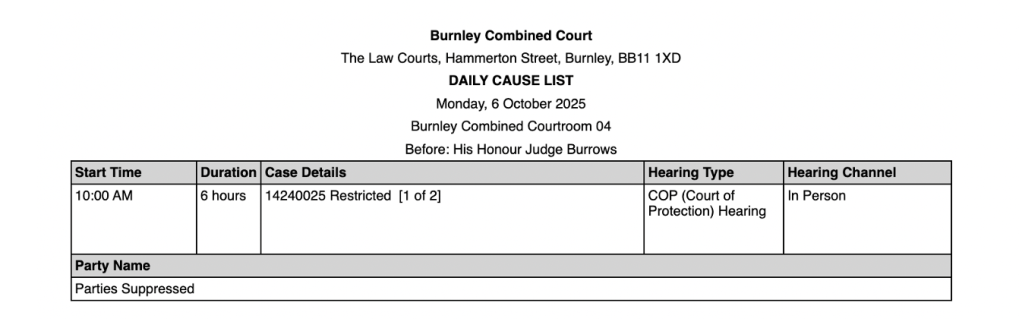
    There was no opening summary, but the judge addressed my request for PSs. In this particular case, the hearing was on a Monday, so I had emailed over the weekend (which we as observers often do, having read the listings on Friday afternoon or evening). She said that if I email my request at the weekend when the ‘court offices are closed’, there’s very little time to respond on the day. I spoke up and said that public listings (via Courtel/CourtServe) don’t usually appear until close or subsequent to office closing hours the day before a hearing, so it’s not usually possible to request either the link to the hearing, or the Position Statements, any sooner than the evening before. The judge didn’t respond to this. She said they had delayed the start of the hearing to ‘deal with [my] request’. She also said she didn’t know why I thought the hearing started at 10am when it had always been listed to start at 10.30am. It may, I suppose, have been listed at 10.30am in the judicial diary, but it was most certainly listed for 10am in Courtserve – as displayed below. Judges often don’t know how their cases appear in the public lists.

    It’s unsettling to (in effect) be told off by a judge in open court. I have been told – many times – by judges that I should request links and documentation ‘earlier’ – and that’s frustrating advice, since it’s simply not possible to follow it. If we’re at work (which most public observers are), then given the time at which public listings appear, we can’t email until that evening or (given domestic responsibilities) first thing the following morning – or (for Monday hearings like this one) over the weekend. The Open Justice Court of Protection Project has previously published blogs by those of us chastised by judges for what feels to us like something entirely out of our control.  We wish judges would understand that – and appreciate the negative effect on transparency and open justice of their apparent irritation and misplaced advice (see: Why members of the public don’t ask earlier to observe hearings (and what to do about it) and If this had been my first court observation, it would have been my last!)

    The default assumption from the judiciary seems to be that we observers have failed to make timely requests when we could and should have done so (and are consequently making unbearable demands on the court)  – when in fact the public listing system does not support transparency, or enable us to make earlier requests, as it should.

    2. DJ Glassbrook, COP 13851997 – Northampton (31st July 2025)

    At this hearing, there were just four people:  me observing, the judge, one  lawyer (Anslem Billy, acting for Northamptonshire County Council and not a barrister but an ‘Adult Social Care Lawyer’ according to his email signature) and P’s sister (who is applying to court to be her sister’s 1.2 representative). [I had not received anything except the link in advance of the hearing – no TO and no PSs.]

    The judge, DJ Glassbrook, was very welcoming.  He immediately addressed the fact that an observer was present at the hearing (I think so that P’s sister understood) and read out the Transparency Order (which was in ‘standard’ terms – preventing the identification of P or any of P’s family), saying it is ‘his practice’ not to anonymise public bodies. It transpired that the one lawyer involved did not have the Transparency Order either.

    The judge explained the situation  to the sister very straightforwardly.  “The Court hearing is not private. People not directly involved may attend. Ms Martin is an example –  nobody may publish anything ….. [he explained the standard TO and not anonymising public bodies] …. There is an injunction which gives her the details. Ms Martin quite properly asked for the Transparency Order.  The challenge that I have is that, unlike a High Court judge,  I do not have a clerk.  I don’t have time for emails.  I have to do my best to fit things around other hearings. I had hearings at 10 o’clock this morning, and 11 o’clock and 11.30. The time before 10 o’clock was preparation for other hearings. So, I simply don’t have the wherewithal to deal with things as promptly as perfect. When Ms Martin asked for the Transparency Order,  I sent an email back to the central hub in Birmingham saying ‘Please let her have a copy’.”

    The judge asked me if I wanted to comment.  I asked if he wanted me to put on my camera (‘Yes why not!) and then said ‘You have observed before –  indeed we have met before’.  I agreed that we had, and said I hadn’t received the TO. The judge said ‘That doesn’t surprise me’. I also said that I’d requested the PSs for the case, to which the judge replied ‘I don’t think we have any?’ The lawyer confirmed: “There is no PS!’.

    I know – from looking frequently at court listings – how judges’ daily lists often include back-to-back (or even simultaneously listed) hearings. We also know, at the OJCOP Project, that around one in three hearings is ‘vacated’ (cancelled) on or just before the scheduled hearing day. Perhaps this is why judge’s diaries are so jam-packed. But what if they do all go ahead? That morning, for DJ Glassbrook, was one of those mornings. I was left wondering what judges’ employment contracts contain, and whether they are allowed breaks or a cup of tea. And then they have observers requesting things from them on top of all that.  Open justice is a fundamental part of our system, but it can’t be the most efficient use of a district judge’s time, or a cost-effective use of staff skills, for them to be sending and chasing emails to court staff asking for documents to be sent to observers.

    It was the judge who provided the opening  summary. P is a woman (I don’t know her age) with a diagnosis of schizophrenia. She lives in ‘bespoke accommodation’. The Re: X fast-track application was declined (by a previous judge). I knew from Eleanor Tallon’s  blog that, sometimes: “‘Re X’ applications are made, and upon reviewing the evidence, the court decides this streamlined process is not appropriate and the case needs to be heard”. 

    DJ Glassbrook explained that, in this case: ‘capacity evidence is not the most stringent I have seen’, expressing consternation that the capacity report from the consultant psychiatrist contained ‘bald assertions rather than, ’This is the conversation, these are the answers I had back and from that it is apparent that….’. That bit is not there. And then, retain information, it is more a bald assertion rather than ‘the reason I come to this decision is’”. The solicitor said that everyone agreed that P lacked capacity for the decision in question, including P’s sister, and that the hearing had been listed on a ‘fast-track process’. The judge said ‘That may be right, that we have the correct interim declaration, but I need to set a final hearing if we get that far. I wouldn’t be very chuffed if we get there and the evidence doesn’t stand up. We do not have the necessary evidence to make final declarations:  the evidence not strong. Of course, the fundamental point, firstly, if this lady has capacity, [is that] I don’t have jurisdiction, and if she HAS capacity then any deprivation of liberty cannot possibly be authorised by anybody and it would mean she’s free to get up and go wherever she likes. I know it’s not a s.21a case but there are similarities. I am being asked to authorise deprivation of liberty, and I can’t do that if she’s got capacity.’ [Judge’s emphasis]

    DJ Glassbrook was very facilitative to P’s sister, explaining the options for legal aid, what a 1.2 representative needs to know, and the advantages and disadvantages of becoming a party (one disadvantage being that ‘if we end up having an independent expert on capacity, all parties would need to chip in on paying for that’).

    The judge had (in a previous hearing, that I didn’t observe) directed that an ALR be appointed – it hadn’t happened, so he picked one himself and told the lawyer to sort it out and ensure P’s sister got all the documentation. He asked the lawyer to send me and P’s sister the TO. I tracked down the email for legal services in Northampton County Council and sent him my email and I received the TO later that same day, and a promise to send me the sealed order when it’s available.  The next hearing for this case is Monday 22nd September via MS Teams.

    3. COP 20000888 – DJ Lucas, Slough (31st July 2025)

    At both this and the 3pm hearing on the same day (my fourth case study), DJ Lucas was very efficient and helpful. He welcomed me to the hearing and checked that I had received the Transparency Order (which I had, along with the one for his next – 3pm – hearing, at 07.43 from the court hub).  

    I think 7.43am is very early for court staff to be sending out TOs. I had received an auto-response from the Reading hub (which Slough comes under), saying:  ‘HMCTS staff are working under significant pressure due to a lack of staff and the current urgent need to triage, list, vacate, and re-list cases. Your enquiry will be addressed, but it will take longer if these are alongside emails asking for updates’. The whole system seems under enormous strain.

    Counsel for P started by stating that the PSs for the hearing had been ‘filed late’. DJ Lucas said, ‘I don’t have any PSs. Unfortunately, at three minutes past two they haven’t made their way to me’. That explained why I had not received them prior to the hearing.

    But then the court launched straight into the substantive matters of the hearing without an opening summary.  I found it hard to understand at first. I gleaned that the applicant is Wokingham Borough Council, represented by Louise Thomson and that  P was represented by Tim Baldwin, via the Official Solicitor.

    The case concerned a woman (I don’t know her age or ‘impairment/s’) who is currently living in ‘decanted’ accommodation: what an awful phrase – they all used it – she’s not a bottle of port!  She’s been ‘decanted’ with her sister, while their council house (in her sister’s name) is being deep cleaned and repaired. There is some suggestion of ‘cuckooing’ and some unsuitable associates of P’s sister, who also seems to have her own challenges. She hoards, which led to a rat infestation (hence the ‘decanting’). The local authority wants P to move to independent supported living and has identified a suitable place. They want P’s buy-in, and she seemed keen on the move when her sister was not there, and then less keen when she was. So, there was some suggestion of inappropriate influence or even coercion and control, but it was not explicitly named. The OS position was not settled on a view as to whether P should be (forcibly) separated from her sister, with whom P wishes to stay living. The judge said ‘her sister seems to have a strong presence – the expert report is that her sister has a lot of influence over her’.

    It then transpired that P and her sister have been ‘decanted’, together, for almost two years. At first the judge thought it was one year, saying:  “The sisters have been decanted from their home for a year now. Well, if it were my home and I was told I would have to move out for a 2-day job to be done and here we are a year later, I suppose [there’s] clearing up to be done, but even so this is an extraordinary amount of time”.

    The judge wants a statement from the Local Authority housing department about why the works are taking so long. Counsel for the LA said that delays were ‘due to completing electricity checks at the property’, and the judge replied ‘Does it take long for an electrician to go round? Is it that extraordinary for a Local Authority with housing stock to carry out an electricity check?’. My thoughts exactly.

    Interestingly, once he realised that it was two years since the sisters had been ‘decanted’, the judge floated a theory that it might be ‘convenient’ for the local authority that the property isn’t ready for them to move back to, stating ‘that is how it appears’.

    The plan is for the LA Social Worker to show the proposed new accommodation to P on her own (without her sister) and to ascertain P’s own wishes and feelings about the proposal to move there (without her sister, since it was reported that ‘it seems likely’ that the placement would not accept P’s sister as well – another unknown that the judge asked to be clarified by the next hearing). The case might end up with the LA applying for authorisation to force P to live separately from her sister, but they are not yet at that point. The case is back in court in the week commencing 13th October 2025 (or as soon as possible thereafter).

    I managed to follow quite a lot of what was going on in this hearing, even without the PSs or an introduction – this is because the judge himself had not received the PSs and counsel needed to apprise him of their positions.

    4.  COP 20006349 – DJ Lucas, Slough (31st July 2025)

    At this 3pm hearing DJ Lucas opened proceedings by introducing me as an observer and  asking if I had been sent PSs. When I said ‘No’, he said (with marked irony) ‘That’s great news, because I specifically asked the court office to ask for them to be relayed and specifically requested that her email be forwarded to allow that to happen. Sorry they have not reached you. My apologies. I have tried my best to facilitate’.

    The judge checked and none of the lawyers had received my request from the court office. The judge asked me to put my email in the group chat and for them to forward the PSs to me, and he reminded counsel at the end to send me their PSs. I received two PSs during the hearing and the third the next day.

    Although he didn’t remember to give (or request) an opening summary to this case (or the previous one that I observed before him), DJ Lucas had clearly tried very hard to arrange for me to be sent PSs in advance of the hearings. There has to be a better way to get this done than using up judges’ time like this.

    The case was very interesting. It concerns residence and care for P, who is a 90-year-old woman with dementia who lives in her own home with her daughter (L). Another daughter (D) was in the hearing. At home P has live-in care, with a new provider: that’s because service from the previous provider broke down. Issues before the court relate to residence and care in her own home, and also to the Lasting Power of Attorney for Health & Welfare that L holds. The COP has suspended this LPA during these proceedings, in part due to allegations against L by the Local Authority. There are currently no contact restrictions in place and no person has proposed, at the moment, that P should move from her own home, but there have been suggestions (from a previous social worker) that she should move to a care home. The applicant is the Royal Borough of Windsor and Maidenhead (represented by Michael Paget). Both daughters  are to become property and affairs deputies and no one disagrees with this.

    Proceedings have been going on for some time (the TO I was sent was dated November 2024). Efforts to try to improve relationships on the ground between L and the carers have been made – and there continue to be allegations against L by the LA (and vice versa). A fact-finding hearing regarding these allegations is likely. A ‘schedule of allegations’ needs to be properly compiled and meanwhile, in the approved order (which I received on 20th August) there is a ‘Schedule to Order’ setting out the expected behaviours for both L and the carers in relation to caring for P and communications between them all.

    It looks like the next hearing will be ‘mid-Oct to mid-Dec’, so (given that we cannot – unlike journalists – sign up for ‘alerts’ for specific hearings from the court) I will need to keep checking the listing in Courtel/CourtServe for hearings in Slough in those months to ensure I do not miss it.

    Conclusion

    These four case studies show the problems with transparency in practice in relation to position statements,

    • 4/7 position statements (only one of them before the hearing) – but not a surprising finding when the judges hadn’t received them in advance either
    • 2/4 opening summaries – judges simply forgot about these when under pressure of time and trying to also to sort out the position statements for me, and for themselves
    • 1/4 approved orders – the other three are quite likely still stuck in the system somewhere and not yet available to anyone, three weeks later, and one awaits listing of a next hearing before it can be finalised.

    Despite this, I think everyone – including the judge who chastised me – wanted to deliver on transparency. Expressions suggestive of frustration, exasperation and cynicism that the system would support the judicial aspiration to transparency were common across the hearings. The problems are systemic as the whole justice system seems to be unravelling without sufficient staff or resourcing.

    There are so many places where things can go wrong.  Court staff at regional hubs (from which we request links to observe) don’t always pick up our emails in time to forward our  requests to the court at which the hearing is actually taking place. The hearing courts then don’t receive our requests in time to send us link. Even when the requests are passed on before the hearing to the judge, judges’ diaries can be so choc-a-bloc that they simply don’t have the time to give the go-ahead for a link (or to approve court documents to be sent). And even when the judge does receive an email and seeks to ensure that the observer gets a TO and PSs, as the cases before DJ Lucas show, this is sometimes not actioned in time by court staff – probably due to an unrealistic list of demands on the overburdened court staff, rather than any deliberate obstruction. The outcome is the same though – open justice becomes the casualty. It’s clear that judges themselves are frustrated by this.

    Court staff seem run off their feet in many hearings we observe, and  they almost always appear to try their best to facilitate access for observers; district judges’ listings look wholly unrealistic to an outside eye, with no time for a comfort break, lunch or simply time to think.  Like seats on an aeroplane, they are booked in the expectation that some will  not be filled (which is often so and is another cause of problems for observers (see “a day in the life of a court observer” for an observer’s experience of multiple vacated hearings).  Requests for approved orders seem to get lost –  most likely in the avalanche of duties for court staff. When court staff, lawyers and judges already feel harassed and overburdened, it can feel as if open justice needs to go to the end of the queue.

    If Nicklin J’s words are going to butter any parsnips then the court system needs to grapple with how it can efficiently respond to people who want to understand what happens in court and grant us (as Nicklin J hopes) “effective access in terms of listing, documents and public hearings”.

    Claire Martin is a Consultant Clinical Psychologist, Cumbria, Northumberland, Tyne and Wear NHS Foundation Trust, Older People’s Clinical Psychology Department, Gateshead. She is a member of the core team of the Open Justice Court of Protection Project and has published dozens of blog posts for the Project about hearings she’s observed (e.g. here and here). She is on X as @DocCMartin, on LinkedIn and on BlueSky as @doccmartin.bsky.social

    Commentary on Re YD (Refusal of Withdrawal of Treatment) [2025] EWCOP 31 (T3)

    By Jenny Kitzinger, 20th August 2025

    A couple of weeks ago I observed a hearing about ‘YD’, a 60-year-old man in a Prolonged Disorder of Consciousness at the lower end of the spectrum (a vegetative state). The Trust had made an application that it was in YD’s best interests to withdraw life-sustaining treatment, specifically clinically assisted nutrition and hydration. This was opposed by YD’s family and friends as well as (by the end of the hearing) the Official Solicitor acting as YD’s litigation friend.

    At this contested hearing, the Trust’s witness (YD’s treating consultant) and the independent expert (Dr Andrew Hanrahan) gave evidence that continuing life-sustaining treatment was not in YD’s best interests. The witnesses for the family, YD’s two partners and a close friend, all thought that clinically assisted nutrition and hydration should continue and that it is what YD would want for himself. I blogged about the hearing and what the witnesses had to say here: “A patient with “unusual” spiritual beliefs: Is withdrawing a feeding tube in his best interests?”.

    The judgment has now been published: The Hillingdon Hospitals NHS Foundation Trust v YD & Ors (Refusal of Withdrawal of Treatment) [2025] EWCOP 31 (T3) (12 August 2025).  The judge, Mrs Justice Theis, Vice President of the Court of Protection, decided that it is in YD’s best interests to continue to receive clinically assisted nutrition and hydration to keep him alive.

    The judge acknowledged that the best interests test must “consider matters from the patient’s point of view”, though this is not “determinative” (§80) and she thought that she “now has a rounded picture of the values and beliefs that would be likely to influence YD’s decision if he had capacity” (§82). His values include “long held beliefs about the healing power of the mind, body and soul” and beliefs “regarding the spiritual world and healing” (§83). The judge said: “Having looked at the wider evidential picture I do not accept the narrow view taken by Dr Hanrahan [who thought it was not in YD’s best interests to continue with CANH] as it did not pay sufficient regard to the evidence of YD’s beliefs and values and wishes and feelings” (§87). The strong presumption in favour of life is not, she said, displaced in this case (§87).

    I was pleased to see that, after making the decision for YD, the published judgment goes on to discuss the need for the ICB to play an active role in cases like this, and comments on the need for appropriate funding and placement for patients in YD’s situation (§88-§92). The firm representing the NHS Trust which made the application emphasised this:

    “A significant aspect of the evidence was the spotlight it placed on the challenges faced by acute Trusts in managing patients in prolonged disorders of consciousness, and the question of who should initiate applications of this nature. […] Mrs Justice Theis highlighted the need for clearer guidance on when and how ICBs should be involved in Court of Protection applications. […] Importantly, the judgment reinforced that ICBs cannot remain passive. Mrs Justice Theis stated that ICBs must take a proactive role, avoiding delays, ensuring all relevant parties are represented, and seeking urgent directions from the court where necessary.” (“Law and Belief: Navigating clinical certainty and spiritual conviction in the withdrawal of CANH”)

    The role of ICBs (and previously CCGs) has been an issue in several cases I’ve observed going back to 2016 (whether or not the concern raised during the hearing made it into the published judgment), so I hope Mrs Justice Theis’s foregrounding of such issues in the published judgment will help to focus minds on resolving problems.[1]

    In this commentary, however, my focus is on the decision in Re YD, which I explore in relation to:

    (1) its legal context, particular how ‘best interests’ decision-making plays out when the protected party holds strong religious or spiritual beliefs;

    (2) the broader context of best interests decision making beyond the courtroom, drawing on my experience of similar cases that never reach the court;

    (3) new media and social media coverage of the judgment and wider discussion it prompts – including the question of the cost of ongoing life-sustaining treatment for patients in these cases.

    1. The legal context of the decision in Re YD

    Some commentators were surprised by the judgment that it was in YD’s best interests to continue to receive clinically assisted nutrition and hydration. I was not. It is regularly the case that judges take very seriously the patient’s religious and spiritual values. Having watched the proceedings, I did not find the judgment entirely unexpected – especially given the final position taken by the Official Solicitor representing YD, who argued that it was in his best interests for clinically assisted nutrition and hydration to continue. Judges typically pay particularly close attention to the arguments raised by the Official Solicitor.

    In my view, this was a ‘finely balanced’ case. On the one hand, the medical evidence advanced in favour of withdrawing treatment (i.e. that YD would never recover consciousness) was compelling. On the other hand, those who knew YD well provided strong and consistent evidence that he would want to be kept alive even without what medical science understands by ‘consciousness’. The question of whether or not the available treatment is in YD’s best interests really depends on the weight given to his values and beliefs as they apply to this situation – especially as there is not much evidence that he currently feels pain or is suffering particularly, which might have weighed in the balance against continuing treatment.

    Although the evidence was that YD would want a ‘chance to heal’, the medical consensus was that continuing to provide him with clinically assisted nutrition and hydration would not actually provide this opportunity. From that perspective it was not in his best interests for this treatment to continue. But I recognise that the “chance to heal” (or the wish to “die trying to live”, as Sudiksha Thirumalesh put it in a related context) can be a very important value, and that where continued treatment is on offer (as it was here), capacitous patients do frequently chose it, even when doctors may doubt that it is in their best interests to do so (although in those cases perhaps the treatment or outcomes are rather different).

    Regardless of the outcome, I felt that best interests principles were carefully explored both in the hearing and in the judgment – as is the hallmark of almost all CoP hearings I’ve observed. I certainly agree with many others who’ve published commentary on the judgment that great care was taken to ascertain, and to respect, the patient’s own perspective. As one commentator wrote (responding to Joshua Rosenberg’s summary of the judgment):

    So, I do not share the view expressed by Rosalind English (in her blog post for the UK Human Rights Blog) that the judgment in this case was “a surprising and unusual decision”. She contrasts it with the outcome in Airdale v Bland [1993] 1 All ER 821 – the landmark case about Tony Bland, the young football fan left in a permanent vegetative state after the Hillsborough disaster. The decision in Bland was to withdraw clinically assisted nutrition and hydration. But these sorts of decisions are very fact-specific. In Bland, there was no evidence at all about what the young man at the centre of the case would have wanted for himself. As that judgment records: “At no time before the disaster did Mr Bland give any indication of his wishes should he find himself in such a condition. It is not a topic most adolescents address”.

    What the House of Lords (now the Supreme Court) considers, at length, in the Bland judgment is how to balance “sanctity of life” against treatment withdrawal when both family and clinicians believe that discontinuing life-sustaining treatment is in the patient’s best interests, and when the patient’s wishes are not known. What the Re YD judgment considers is how to balance “sanctity of life” against treatment withdrawal when clinicians believe that discontinuing life-sustaining is in the patient’s best interests, but his family and friends do not, and when (unlike Bland) there is consistent and strong evidence of the patient’s own wishes, which are that he would want life-sustaining treatment to be continued. And of course, there is also more than three decades of case law between Bland and Re YD – and some of those cases have resulted in judicial decisions to continue treatment. It’s not obvious to me why Rosalind English would conclude that the decision about YD raises challenges which would require “a root and branch review of the “best interests” test”. The Court of Protection frequently makes decisions which give great weight to the patient’s own values, wishes, feelings and beliefs: it is making decisions on behalf of patients who cannot decide for themselves, and the court chooses between available options paying particular attention to what the person themselves would choose if they had capacity so to do.

    Of course, the Court of Protection cannot compel doctors to provide treatment contrary to their clinical judgment – any more than a capacitous patient can compel a doctor to provide clinically inappropriate treatment. Nor can it compel health or social services to provide any other service that is simply not on offer for any reason, including cost considerations – that takes a judicial review. But in this case the continuation of treatment was an available option. There was no suggestion that doctors (or other health care professionals) would refuse to provide formula for the feed or decline to replace the feeding tube if it became detached. This is different from some other cases where doctors are clear that a particular treatment is not being offered to the patient – like the tracheostomy, which was not an available option for the ventilated patient in a different case (Balancing patient welfare and procedural fairness: Withdrawal of ventilation before Hayden J)

    The role of the CoP is quite properly to make decisions between available options (whether that is life-sustaining treatment or anything else, e.g. where P should live). Given that clinically assisted nutrition and hydration was an available option in this case, the question before the judge was whether or not it was in P’s best interests to receive it – and given the particular facts of this case (including that he would have wanted it, and his partners’ devotion to him, and that he probably isn’t in pain) she decided that it was.

    The fact that his wish to receive continued treatment was based on unusual spiritual beliefs (rather than, say, an established religion) does not change the seriousness with which he himself held them,or the weight that the court should attribute to them in considering his best interests – a point eloquently made by Katie Gollop KC representing YD via the Official Solicitor.

    Strong spiritual beliefs have been seriously considered in multiple Court of Protection hearings about life-sustaining treatment and given significant weight alongside other factors such as the burdens of treatment for the individual in their particular circumstances. Cases are always fact-specific – and there seems also to be a diversity of judicial approaches to balancing the various factors involved.

    Sometimes judges make the decision to withdraw life-sustaining treatment in the patients’ best interests, even when there is strong evidence that they would have wanted it continued. For example, the published judgment by Hayden J in Northern Care Alliance NHS Foundation Trust v KT & Ors [2023] EWCOP 46 concerns a Pentacostalist Christian pastor whose family were firmly of the view that “his faith was such that he would want his life to be sustained for as long as possible, in whatever circumstances and whatever the challenges” (§3). Having heard from family and friends Hayden J was clear that KT was a man who lived his life by the Pentecostal sword and most likely would have wanted to die by that same sword i.e., in accordance with his Pentecostal beliefs.” (§31) and stated I have found that KT would have wanted continued life-sustaining treatment, even in the face of a coma with a terminal diagnosis of chronic kidney disease stage 5.” (§32). Nevertheless, Hayden ruled that life-sustaining treatment should be stopped.

    On the other hand, there are cases where judges have found continuing life-sustaining treatment to be in a person’s best interests[2], due to the strength of their religious conviction. McKendrick J recently found it was in the best interests of a devout Muslim man whose “Islamic beliefs would be likely (highly likely) to influence his own decision whether or not to continue with the NG tube if he had capacity”. Taking into account the patient’s view (as reported by the family) that “PK would view it as wrong and contrary to Islam for me to authorise the removal of his NG tube”, the judge authorised continued treatment (University College London Hospitals NHS Foundation Trust v PK & Anor [2025] EWCOP 17 (T3))

    In sum, patients’ values, wishes, feelings and beliefs (including any religious/spiritual beliefs) are factored into best interests decision-making, alongside factors such as their current experience (if any), the nature of medical interventions they are subject to, and the patient’s specific diagnosis and prognosis. Given the array of factors considered in best interests decision making the judgment in this case (with such strong evidence about the strength and relevance of P’s spiritual beliefs) it is not an entirely surprising outcome.

    2. Beyond the courtroom

    Decisions to continue clinically assisted nutrition and hydration (and many other life-sustaining interventions) are being made outside the court all the time. Many people are maintained indefinitely in prolonged disorders of consciousness, long past the time at which clinicians (or indeed family) believe they will ever recover full consciousness. Nobody knows how many such patients there are in the community (nursing/care homes and homes) across England and Wales (it’s not properly audited) but it is estimated to be tens of thousands (4,000–16,000 patients in vegetative states, with three times as many in minimally conscious states).

    In the vast majority of these cases, the clinical decision to continue life-sustaining treatment has never been considered by a judge. Sometimes treatment is continued by default simply because nobody has considered doing otherwise (irrespective of the patient’s own values and beliefs) (see Kitzinger J & Kitzinger C. (2017) Why futile and unwanted treatment continues for some PVS patients (and what to do about it) International Journal of Mental Health and Capacity Law. pp129-143).

    But sometimes there are positive best interests decisions to continue treatment. In many settings where I do training and/or support families of patients in prolonged disorders of consciousness, I am aware of decisions made following best interests meetings to continue clinically assisted nutrition and hydration for patients with diagnoses/prognoses similar to YD’s. The patient’s religious or spiritual beliefs often play a part in these decisions and usually carry more weight – and results in more consensus decision-making – than do other common reports from family members which sound superficially very similar, such as ‘he’s a fighter’, ‘he’d want a chance’, ‘he needs more time to heal’. This is because religious/spiritual views often meet the Grainger criteria[3].

    As a society, we do give significant importance to spiritual and religious belief, and to people’s freedom to practice their religion. So, it seems right that this is supported (where possible) once a person loses the capacity to act in accordance with their own religious/spiritual views and/or to make their own religious/spiritual choices. (Although in my experience, statements from family and friends about the patient’s religious beliefs, and about the inferences that can be drawn from this, are not necessarily interrogated in the typical healthcare setting with the same rigour as in a court hearing) [4]

    So, although some commentators have identified the outcome in the YD case as “unusual” in continuing life-support for a vegetative patient, in fact it is typical of many decisions currently made outside the courtroom in similar circumstances, in care homes and nursing homes across the UK.

    3. News media and social media coverage of the judgment

    What was unusual about this case was the amount of public discussion it generated.

    Unlike most Court of Protection hearings, which – although open to journalists and to the general public – conclude without any public discussion of the decisions made (this includes life-sustaining treatment cases), this case has attracted quite a lot of media attention and social media comment.

    Public discussion was supported by the publication of the judgment (not all judgments are published) and by reporting of it by the eminent legal commentator, Joshua Rosenberg (“Patient must be kept alive: Hospital refused permission to withdraw nutrition and hydration).

    It also seems that its ‘news value’ was heightened by the use of evidence from a spiritual medium and by the opportunity, from some media, for a rather prurient focus on the fact that YD has two partners.

    There were significant differences between the judgment and the public discussion that ensued in relation to three issues, as I discuss below:

    • 3.1 spiritual beliefs,
    • 3.2 the fact that YD has two partners (previously unaware of each other’s existence),
    • 3.3 the cost of maintaining people in permanent vegetative states.

    3.1 Spiritual belief

    The court treated YD’s spiritual beliefs with the same respect as it would have accorded to more formal or conventional religious beliefs. The Official Solicitor presented a strong and coherent argument (in relation to the Grainger criteria, see endnote 3) about why this should be the case, and her approach is mirrored in the published judgment. The evidential status of statements from the medium was carefully discussed in court (see footnote 4 of my original blog about the hearing: “A patient with “unusual” spiritual beliefs: Is withdrawing a feeding tube in his best interests?”.).

    Public commentary – especially on social media -sometimes supports this approach

    But social media also includes incredulous comments that YD’s beliefs (described as ‘hocus pocus’) were taken seriously in court. ‘Please tell me this is a joke!” wrote one commentator. Another thought the court was being guided from “beyond the veil”.

    “It appears the legal and medical decision-making in the Court of Protection is now being guided by someone from “the other side”, via a medium!. […] In effect, the decision to continue life-sustaining treatment seems to have come via counsel from beyond the veil” [Zain de Ville, response to Joshua Rozenberg] [5]

    3.2 Two partners

    The court treated both YD’s partners (he was married to neither) as key witnesses and also heard at length from a close friend of YD. The words “family” and “next of kin” are not used in the Mental Capacity Act 2005: rather the court must consult (in addition to deputies, attorneys and anyone else named by the patient as someone to be consulted) “anyone engaged in caring for the person or interested in his welfare” (§7 (b)).

    There’s no hierarchy about who should be consulted or the a priori weight to be given to their evidence. I’ve been personally involved in supporting best interests decision-making processes where valuable information about the protected parties’ values and beliefs has come from a neighbour and a hairdresser for example; and another where the patient’s ex-wife turned out to have more relevant and compelling information than his current wife. My experience is that decision-makers (at least in the context of a court case) examine evidence about the patient’s prior values without making any prior assumptions based on the evidence-providers ‘next of kin’ status. This case has been identified by Alex Ruck Keene as offering “a case study in the navigation of complex relationships going beyond ‘next of kin’ to identify those who were expert in the person”.

    The fact that the two women did not know of each other’s existence prior to YD’s injury was highlighted in the legal proceedings only in so far as it was valuable as independent triangulation of evidence. The judgment notes that it was “striking” that even though the two partners were completely unaware of each other’s existence until YD’s injury “they were each able to independently confirm many common features about YD’s wishes and beliefs.” (§83).

    There was no discussion of the situation in terms of deceit or secrecy in the court or in the judgment. The only hint of this by the women themselves during the hearing was when one of the partners said YD never wanted her to visit him at times when parking charges where operational outside his house: in retrospect she recognises that this meant it was a safe time for him to see his other partner: “I think me and [the other partner] took it in turns to be there”. In the judgment the judge simply records that his family and friends recognise that YD’s relationships were “compartmentalised” (§74).

    Public commentary, however, put a rather different spin on this. Multiple newspaper headlines referred to “secret lovers” to describe the two partners e.g. “Comatose man’s secret lovers join forces to keep him alive” (Daily Telegraph 13/8/25) and “Comatose man’s secret lovers join forces to keep him alive – after only finding out about each other when he suffered a brain bleed (Mailonline 14/8/25). The story was picked up by outlets such as the Daily Star (which describes itself as “News with a Wink”): “Comatose man’s secret lovers try to keep him alive despite finding out his cheating ways” (14th August 2025, Daily Star online).

    These headlines (and text referring to his “double life” and describing the patient as an “unfaithful lover”) led to salacious comments on social media and ‘below the line’ including speculation about the two women’s relationship and ’jokes’ about sexual prowess, infidelity and women spurned (e.g., see comments below Daily Mailonline).

    The treatment of this case chimes with another genre of stories where sudden critical illness exposes illicit relationships -see stories (in the last couple of months) such as: “I uncovered my husband’s dirty secret while he was in a coma” (Metro, 26/7/25)) https://metro.co.uk/2025/07/26/uncovered-husbands-dirty-secret-a-coma-2-23714693/ and “Don’t Tell the Bride: Star […] recalls how she uncovered her husband’s affair while he was in a COMA (MailonLine, 19th Aug 2025, https://www.dailymail.co.uk/femail/article-10476687/Dont-Tell-Bride-star-uncovered-husbands-affair-COMA.html).

    3.3 The cost of caring for patients in a permanent vegetative state

    The third striking difference between the judgment and public discussion of it was the attention given to the resources needed to care for these patients.

    The published judgment considers operational factors relating to treatment decisions for patients in prolonged disorders of consciousness (such as the role of the ICB and when patients should move from specialist neuro-rehabilitation units to care homes) (§88-92) and this was highlighted as significant by the legal firm representing the Trust. It raises crucial issues for those involved in designing and delivering care – but seemed to be of little wider public interest: neither the mass media, not general social media discussions picked up on this point.

    By contrast, the issue of cost per se of keeping people alive in long term vegetative states DID feature in public discussion –in spite of the fact that this was NOT mentioned in the judgment. In comments below the Mailonline article, for example, readers suggested that if the two women want YD kept alive then they should pay for it, and commented on the “pointless waste” of “taxpayers’” money at huge cost to an over-stretched NHS.

    On a different platform, in response to Joshua Rozenberg’s blog, another commentator wrote very critically about YD’s (and his partners’) wishes and the person-centered approach of the court. This commentator sharply reframed the case in terms of being self-centered and highlighted inequalities:

    “I wonder if the two partners are doing the heavy nursing care or are simply sitting by the bed chanting?! And who is paying the bill? As a full-time carer, working full time, of my elderly bed bound father and unable to get help, I find the selfishness in this case difficult to take. This man receives care whilst others do without.” (David Holroyd response to Joshua Rozenberg blog)

    This issue was also brought to the fore by Rosalind English who points to “the profound and continuing financial burden on the public purse for prolonging unconscious life at all costs” and says:

    “…one day it will occur to cancer patients being denied treatment or sufferers from severe cardiac conditions on never ending waiting lists for surgery that perhaps public money should be spent on them, rather than keeping PVS patients alive for years if not decades.” https://ukhumanrightsblog.com/2025/08/13/patient-in-permanent-vegetative-state-to-be-kept-alive-court-of-protection/]

    Alex Ruck Keene picked up on this point, suggesting that this issue needs to be faced head on: “Just as in the case of admission and treatment in ICU, we tend to seek to avoid hard discussions about cost-benefit analysis of the sort that are now familiar in the context, say, of cancer drugs. For my part, I would suggest that there is an increasing need for work to be done to establish a framework within discussions about such costs can be considered in a transparent fashion and in a way which resolves the uncertainty justly.” He argues that, without this, there is the risk of concerns about costs leading “no doubt inadvertently” to distortion of the clinical framing of the person’s condition and of the treatment; or “distortion of best interests decision making (for instance, by asking whether the person would wish to be continue to be kept alive at the cost of “diverting” resources from others).”

    The financial cost of keeping patients alive in prolonged disorders of consciousness is virtually never raised in court judgments. That’s because the court is focused narrowly on what is in the best interests of the particular patient at the centre of the case. If clinicians are willing to offer a range of treatments – including clinically assisted nutrition and hydration and all the skilled nursing and allied healthcare input that’s needed to keep these patients alive – then the court’s role is limited to making a decision as to whether or not taking up the treatment on offer is in the protected party’s best interests. (Conversely, if clinicians decline to offer a particular treatment, there’s nothing the court can do). But despite the absence of any consideration of cost in the judgment itself, this case, more than any other I’ve watched, seems to have focussed minds on this question of cost in sustaining patients in prolonged disorders of consciousness. This may perhaps be because of the unusual nature of YD’s beliefs, and the fact they were not part of a traditional religion, but I think the points raised are important, in this and similar cases. It’s right, in my view that the cost of treatment was NOT raised in the judgment: this should not be part of any best interests discussion for individuals. But there is clearly some legitimate public interest in what treatments should be on offer to patients, and in questions of resources and equity.

    Jenny Kitzinger is co-director of the Coma & Disorders of Consciousness Research Centre, and Emeritus Professor at Cardiff University. She has developed an online training course on law and ethics around PDoC and is on X and BlueSky as @JennyKitzinger 

    Footnotes


    [1] It’s very useful when judgments highlight operational issues that have been revealed during the course of the hearing – even if this has not been fully investigated as part of the hearing and no specific conclusion can be drawn or recommendations made. For the last ten years or so I’ve repeatedly heard discussion in court hearings of the key role that should be (and sometimes is not) played by the organisations that commission care (now ICBs and before that Clinical Commissioning Groups [CCGs]). Concerns have particularly been raised in relation to delays in best interests decision-making – which was not the issue in this case. However, concerns aired in the courtroom do not always make it into the published judgment. For example, we know, from observing the hearing, that there were clear operational issues in addressing the best interests of ‘PC’ (a woman in her early 30s who had catastrophic brain injuries from a cardiac arrest) which prompted the Official Solicitor to call for a review of both the hospital’s and the ICB’s procedures and protocols. Along with Celia Kitzinger, who also observed the hearing, we recorded part of this discussion in our blog: “Family tragedy and institutional delay in best interests decisions about life-prolonging treatment”. But in the judgment the judge, Mr Justice Cusworth, included only one sentence which acknowledged that these concerns had been raised and evidence filed, but simply stated that this “had not been the subject of dedicated submissions before me. My focus in this judgment is solely an assessment of PC’s best interests”, NHS North Central London Integrated Care Board v PC & Ors [2024] EWCOP 31 (T3). By contrast, in a case I observed back in 2016 (and in which we’d supported the family), the judge, Mr Justice Hayden, highlighted the issue of delay in the judgment (with its own sub-heading) and commented that although he had “not been required to investigate” the problem “It needs to be stated that the avoidance of delay in medical treatment cases is an important imperative…” and he then went on to make a very strong statement about this principle (§13) (Cumbria NHS Clinical Commissioning Group v Miss S and Ors [2016] EWCOP 32). This part of the written judgment was very important for the patient’s family– (who felt their loved one’s dignity had been compromised and that they themselves had been put through years of distress and frustration). It was also helpful when other families came to us for assistance in trying to urge other CCGs at the time to take responsibility for helping progress cases about life-sustaining treatment in a timely manner. We described the role of the CCG, the operational challenges and delays in this case in detail here: Causes and consequences of delays in treatment-withdrawal from PVS patients: a case study of Cumbria NHS Clinical Commissioning Group v Miss S and Ors [2016] EWCOP 32

    [2] In some cases, judges considered ongoing life-sustaining treatment to be in a patient’s best interests even though the family provided evidence that the person wouldn’t want this, e.g. W v M [2011] EWHC 2443 (COP)

    [3] This is a reference to the case of Grainger plc v Nicholson [2010] IRLR 4 (EAT) To meet these criteria a belief (1) must be genuinely held; (2) It must be a belief and not an opinion or viewpoint based on the present state of information available (3) It must be a belief as to a weighty and substantial aspect of human life and behaviour. (4) It must attain a certain level of cogency, seriousness, cohesion and importance and (5) It must be worthy of respect in a democratic society, be not incompatible with human dignity and not conflict with the fundamental rights of others. Beliefs in veganism, Scottish independence, gender critical beliefs and more have all been held to be philosophical beliefs protected under the Equality Act 2010, on the principles set out in the Grainger case.

    [4] In one hearing I observed, the patient’s diagnosis was very similar to YD’s and evidence from the family echoed that in the YD case in many respects – P was “a Muslim who believed only God could choose a time of dying”; he was reported to have said “when your time is up, your time is up, until then you don’t give up, no matter what’”; and his family characterised him as “a man who can and would want, to fight on”. (“He deserves a chance”? Continuities and shifts in decision-making about life-sustaining treatment). However, the OS took the position that clinically assisted nutrition and hydration was NOT in this patient’s best interests and argued that “[t]he whole basis of which the family would want him to continue [to receive this treatment] is based on the possibility of a miraculous event going against all the medical evidence, that he might improve or recover”. The judge (Arbuthnot J) acknowledged this man’s religious faith but taking all factors into account, ruled nonetheless that in was in his best interests for clinically assisted nutrition and hydration to be discontinued. (The judgment was subsequently published as Mid Yorkshire Hospitals NHS Trust v NB [2022] EWHC 3682 (Fam).  In another case, this time  before Theis J (the judge in the case I’m reporting on in this blog), the judge found  that withdrawal of ventilation and CANH was in the best interests of a 27-year-old patient who was in a PVS following a car accident, in ICU and ventilator-dependent, despite withdrawal of treatment being contrary to the Christian beliefs he had been brought up with (Kings College Hospital NHS Foundation Trust v X [2023] EWCOP 34). In neither of these cases did the judges conclude that P’s religious faith would have meant they’d definitely have wanted life-sustaining treatment continued. Court of Protection hearings pay attention to spiritual/religious faith but involve interrogation of it – and how any such beliefs might apply to their current situation.

    [5] I wonder if, in spite of the court’s careful approach here (the messages were NOT treated as evidence from YD), the use of messages from this medium in court may be misunderstood in future, or even used to promote the idea that spiritual mediums can provide a direct line to comatose patients and that this has somehow been endorsed by a judge. Some mediums already promote their services to families of patients in prolonged disorders of consciousness, or other conditions such as dementia. (eg. https://www.lightbloomhealing.com/coma-communication; https://www.grief2growth.com/can-mediums-reach-people-with-dementia-with-stephanie-banks/)

    My first experience of being an in-person observer at First Avenue House (London): HHJ Beckley decides on where P should live and receive care

    By Sandra Preston, 18 August 2025

    On 13 August 2025 I went to First Avenue House (the London headquarters of the Court of Protection)  for the first time as an observer – rather than as the relative of a Protected Party (as described my blog post here).  I had chosen to do so to gain a greater insight into Court of Protection proceedings and in order to support the Open Justice  COP Project.

    I navigated my way through security without incident, having learned on a previous occasion that my mirrored lipstick case was considered a hazardous item – I’d had to hand it in and remember to collect it (having been given a numbered receipt() on my way out – so I’d left it at home this time round. 

    The building houses both the Family Court and the Court of Protection.  The Court of Protection  is on the fifth floor.  I went up in the lift,  and on exiting, you have to let the counter clerk know you are there and the purpose of your visit, and fill in an attendance form..  Armed with a list of the hearings I was most interested in observing, we identified one that the clerk assured me would be going ahead at midday.  I had to sign in with my name and address (home or work address or email address is fine) and in return was given a copy of the Transparency Order (TO) to read in the waiting area. 

    Some confusion on the part of the clerk meant I was given the TO for a different  hearing, which it transpired was happening remotely, so I sat in the waiting area long after midday.  It’s not a bad place to sit though as you pick up on lots of interesting discussions between the various legal teams.  Unfortunately, by the time the mistake was realised and I was given the right document the hearing had started so it was too late to join.  I agreed to return at 2pm to observe a hearing before HHJ Beckley (COP 14219478) – and then everything went really smoothly as the counter clerk seemed keen to make amends for the earlier confusion.

    After signing in (again),  reading the Transparency Order and waiting a short while in the waiting area, someone came over to me I was asked to go into Court 23 and to take a seat at the back of the court.  The clerk told me the judge wanted to know why I was there, so I said I was observing on behalf of the OJCOP project.  I got a few wary looks from the parties as they filed into court, but the judge explained that I was observing on behalf of a well-known group of bloggers  – which prompted the applicant to enquire whether this meant I was from the media; I reassured him I was not.  Judge Beckley asked if I wanted to see the Position Statements or whether an Introductory Statement would suffice.  I opted for the latter as it would have been difficult and time-consuming to read the Position Statements on my mobile phone.

    His Honour Judge Beckley said the case was to decide whether to discharge an 86 year old woman from hospital to a nursing home or to her son’s home as per his wishes. She was suffering from vascular dementia, stage 3 kidney disease, stage 2 diabetes, hyperthyroidism and required a hoist to move between armchair and bed.  Nobody disputed the finding that she lacked capacity to decide for herself where to live and receive care. 

    The applicant was her only child and next-of-kin.  He was accompanied by a representative who was invited to join him at the front of the court so that she could speak on his behalf. The protected party was not in court. She was first respondent, and was represented by the Official Solicitor as Litigation Friend.  The Local Authority was the second respondent.  The applicant and respondents disagreed over where P should live so this was a contested hearing. 

    The applicant was seeking an order that it was in his mother’s best interests  either stay in hospital or be discharged to live at his home rather than to a nursing home.  He wanted her to stay in hospital until he had a clearer idea of what could be done to facilitate a move to his home.  She had been in hospital since January 2025 and was familiar with her environment, which he felt was important for someone with vascular dementia. 

    The Local Authority disagreed, saying it was not in her best interests to stay in hospital given she was not receiving therapeutic or rehabilitative treatment.  The work needed to adapt his property, for which permission had yet to be sought from the council, made it too far removed an option to keep her in hospital.  Nor did they think it a workable option for him to provide the level of care needed, which was significantly greater than before her hospital admission.  They argued that living in a more congenial, residential environment with the company of others and where she might be allowed to keep her cat, could add to her well-being. 

    The OS invited the court to rule out a return home.  It would compromise P’s privacy and dignity, and the size and layout of the property would not support live-in carers. They stressed that it did not need to be a once-and-for-all decision.  If P’s condition improved and her care needs reduced, the court could look at a future return home.  If the Local Authority was not willing to make funds available, a judicial review would be needed; it would not be in her best interests to remain in hospital until then.

    The judge decided that P should be discharged from hospital as soon as possible to a nursing home as her care needs were greater than a care home could provide.  He set the next hearing for 3 October 2025.  The applicant’s representative would be on holiday on that date, but the Judge refused the applicant’s attempts to delay on that basis.  He said the matter could be dealt with in one hour rather than two, given today’s contested hearing had lasted only an hour.

    The applicant opposed the Local Authority’s recommended nursing home and asked if he could recommend one himself.  The Judge asked him to work with the Local Authority to agree upon a suitable nursing home and that if a consensual option were identified ahead of 3 October (there was to be a Round Table Meeting in the week beginning 15 September) the hearing could be vacated.  If the applicant wanted to vary the date of the 3 October hearing he would need to do so via a COP9. 

    The applicant did not hold a Lasting Power of Attorney (LPA) for P, and his application for deputyship had previously been turned down by another judge (DJ Clarke).  HHJ Beckley said that P had chosen not to make an LPA and that this was a capacitous decision.  It was not clear to me whether this meant that because she had actively chosen not to make an LPA when she had the capacity to do so, it prevented him from applying for deputyship, or whether there was more to her decision not to make an LPA which had resulted in the previous judge’s rejection of his application for deputyship.   

    The applicant expressed concerns that the Local Authority had cut him out of decision-making and consultations and discussions had taken place without asking him for his views.  He had asked for copies of documents but they were held in individual departmental files rather than one central file.  The lack of disclosure led him to feel he’d not been able to put his concerns across and he described the flow of information as poor.  I had some sympathy for him given our own experience (with a different Local Authority). 

    Reflections

    Imposter syndrome almost stopped me from going to observe, but I’m glad I didn’t let it get the better of me.   My main concerns – bumping into one of the lawyers involved in our own case, or being exposed as a fraud for having previously been at First Avenue House as the relative of a protected party – were unfounded.  The court staff were really helpful, despite the initial confusion over which case I was there to observe, and it helped that Judge Beckley was clearly familiar with the OJCOP. 

    The waiting area gets busy and you hear lots of tannoy announcements asking individuals to report to particular courtrooms.  Given the confusion at the start of the day, I wondered how I would know when and where to go or whether I would miss another opportunity.  More unfounded concerns – when it is time for you to enter the courtroom, the court clerk will collect you from the waiting area and escort you to the courtroom. 

    I would recommend taking a list of the day’s hearings with you if you visit First Avenue House (the daily cause list is available online here: https://www.gov.uk/government/publications/court-of-protection-daily-hearing-list ).  This helped me to work out with the counter staff which cases were going ahead and which had been vacated or were happening remotely.  It was definitely good to have a back-up plan.  I would also suggest you take a book to read (and water, and a snack) as you can spend quite a lot of time sitting in the waiting area feeling a bit spare, surrounded by fraught relatives and harassed legal teams.

    Sandra Preston is the daughter-in-law of a P who was involved in Court of Protection proceedings, as she describes in her earlier blog post, written jointly with her husband, P’s son, Joe Preston. You can read it here: A court hearing and 23 visits from 16 officials: Family doubt that ‘Deprivation of liberty’ is working in the public interest. Sandra can be contacted through the project email on openjustice@yahoo.com.

    Sentencing in contempt proceedings: Punishment and coercion in a case before Lieven J

    By Celia Kitzinger, 14th August 2025

    A mother who refused to obey court orders was sentenced to 28 days in prison, and her pre-teenage daughter was to be taken into foster care, in a case I watched in the Family Court on 11th August 2025.

    The judge, Mrs Justice Lieven, ordered the local authority to send social workers immediately to the mother’s home to collect the child –  and as soon as the child had been removed, the police would arrest the mother and take her to prison.

    The judge made it absolutely clear that she did not want the mother to go to prison.  She said she was in an “invidious position” because “I have the Court of Appeal telling me I have to send this lady to prison, effectively.  I have a mother who I suspect has engineered a situation where there is nobody to look after the child, and a local authority who has effectively washed their hands of the situation”. 

    I’ll describe what happened, and why, and reflect on its implications for other committal cases in the Court of Protection.

    Background

    The parents of the child at the centre of this case are Slovakian.  They separated in 2017 and shortly afterwards Anna Benciková and her daughter relocated to England without the father’s knowledge or consent, where they have remained ever since.  The father, Pavel Koco, remains in Slovakia[1].

    Following a protracted history of Hague Convention and Children Act 1989 litigation initiated by the father, first to try to get the child returned and then to get rights of access (both unsuccessful), a fact-finding hearing took place (in August 2021) before HHJ Lloyd-Jones – who did not find the mother’s allegations of domestic abuse to have been proved (on the balance of probability). Her application for permission to appeal that judgment was refused. 

    Following a final welfare hearing, the judge made a “live with” order to the mother and refused her application to terminate the father’s parental responsibility. In advance of any court consideration as to whether direct communication or contact between the child and her father was in her best interests, the judge further ordered the mother to:

    (1) provide a written welfare update to the father via his solicitors on a monthly basis;

    (2) allow the Guardian to meet with the child to carry out “Storyboard”/Life-story work – a therapeutic child-centered intervention led by a Guardian or social worker to help the child know the identity of her father and understand something of her life story and personal identity. 

    These are the court orders the mother has not obeyed, and that is why she is in contempt of court and now faces a prison sentence.

    The mother is utterly opposed to complying with these orders and says that doing so would cause harm to her daughter. She says the father has told “repeated lies” and that he is “willing to destroy a child’s life for money”.  She says he treats his own child as “just another victim in his life long criminal career” (he has served a term of imprisonment in Slovakia for fraud).  She says: “I do not want my daughter to become comfortable with compulsive lying, destroying people’s lives and leading a criminal life”.

    She has on three occasions (June 2024, August 2024 and March 2025) been found to be in contempt of court (and twice fined) for not obeying these orders.  On the most recent (third) occasion, the judge adjourned sentencing to give the mother one final opportunity to comply.  She said:

    Only because of [your daughter] am I going to do this. I am going to adjourn sentence for a month. In the meanwhile, I will direct that there will be life story work between the Guardian and [your daughter], and I will request the Guardian – but not direct her – to explain to you what life story work is. If having had it explained to you, you still persist in ignoring court orders, I will consider how I will sentence you.  Taking into account the fines don’t work because you don’t pay them in full, and you appear to think it is right to ignore court orders, this is your very last chance.”

    When the matter was listed again for sentencing on 6th May 2025, the mother had failed (again) to comply with the Court’s orders.  There had been no “life story work” for the child and she’d not taken the child to see the Guardian.

    At the sentencing hearing, the judge, Henke J, decided not to impose any sanction.  The judge said she had concluded that imprisonment would be pointless because “sending you to prison is not going to change your mind”.  A prison sentence (suspended or immediate) would, the judge said, “have no effect on the mother’s attitude or secure future compliance”, and imprisoning her would cause “emotional, psychological and financial” harm to her daughter.

    The father then made an application to appeal against the judge’s decision not to imprison the mother. He argued that the judge failed to engage with the core purpose of contempt proceedings, namely to uphold the authority and effective functioning of the court. 

    It was heard by the Court of Appeal on 29th July 2025 and judgment was handed down the next day.  You can read the full judgment here: Re B (A child) (Sentencing in contempt proceedings) [2025] EWCA Civ 1048).

    The hearing I watched on 11th August 2025, back in the Family Court, was a consequence of what the Court of Appeal had decided – so the decision of the Court of Appeal is essential background to understanding why Mrs Justice Lieven felt she had no option but to make the decision she did.

    Court of Appeal

    The Court of Appeal found that the approach taken by Henke J in the Family Court was wrong in principle.  One legal commentator[2] summarises the Court of Appeal’s decision as follows: “A court must mark serious contempts with a proportionate penalty, even where it doubts that compliance will follow – otherwise the authority of court orders collapses. The case crystallises an important doctrinal point: anticipated non-compliance is not a lawful reason to withhold punishment for proven contempt”. 

    The judges found that Henke J’s conclusion that “sending you to prison would have no effect” (based on what the mother herself had said) was wrong: until a prison sentence is actually imposed, the judge cannot know whether or not it will coerce compliance.  Even if it does not result in compliance:

    It cannot be the case that a parent can repeatedly refuse to comply with orders made in the best interests of their child, knowing that a judge may well in those circumstances dismiss the committal proceedings as serving no purpose. To do so would undermine the authority of the court and have significant implications for other cases.  Punishment for breach of court orders serves as an essential aspect of upholding judicial authority as well as ensuring compliance”. (§40 (Re B (A child) (Sentencing in contempt proceedings) [2025] EWCA Civ 1048)

    The judgment continues:  “… the judge was wrong in imposing no sanction on the mother and in those circumstances the matter will be remitted to the High Court for reconsideration of sentence” (§41 (§40 (Re B (A child) (Sentencing in contempt proceedings) [2025] EWCA Civ 1048)

    So, the case was sent back for re-sentencing, and that’s what I was watching in the Family court.

    The hearing

    I don’t usually watch hearings in the Family Court – unlike the Court of Protection, there are rules restricting who can watch these hearings and as I’m not an accredited member of the press, or a lawyer, I have no right to attend them.  This hearing was different though.  As a committal hearing, it was listed as “for hearing in open court”. 

    The listing caught my attention as I was scrolling through looking for Court of Protection hearings because I thought I recognised the names of the two people in the list – and a quick google search confirmed I was right.  They’d featured in a “Case Commentary” (see footnote 2) which I’d read because, although it related to Family proceedings, I figured the Court of Appeal judgment on committals would be relevant to the Court of Protection too. 

    The “Case Commentary” had emphasised the Court of Appeal’s view that (in the words of the commentator)  “punishment cannot be jettisoned simply because coercion may fail”.  It listed as a “Key Takeaway” of the judgment: “Courts must not abdicate the punitive element of contempt jurisdiction merely because the contemnor predicts (or even demonstrates) continued defiance”.  There are often cases of “continued defiance” in the Court of Protection, so I wanted to know what would happen when this case was sent back to the High Court.

    When I joined the remote platform, I realised that both parents were attending remotely, and there was also an interpreter (I think for the father, but she was asked also to interpret for the mother).  The judge was in the physical courtroom (Court 46 at the Royal Courts of Justice), and so were two lawyers, who I eventually figured out (there being no introduction) were counsel for the father, and a lawyer representing the child’s Guardian.  The mother was a litigant in person – although she’s entitled to legal aid, she had not been happy with lawyers who had previously represented her and chose to represent herself at this hearing. 

    I later learnt (when the judge handed down her decision at the end of the hearing) that the case had been before Mrs Justice Lieven a week earlier, on 4th August 2025, and that the judge had imposed a 28-day suspended prison sentence.  It was suspended in order to give the mother “yet another opportunity to comply with the orders and take the child to meet the Guardian. I fixed an appointment last Wednesday for the mother to do that. However, yet again, the mother failed to comply”.[3] So now, with “yet another” last opportunity for compliance having gone by, the case was back in court.  As you’ll see, there were a couple more “last opportunities” for compliance offered by the judge at the eleventh hour in the court hearing. The mother did not avail herself of them.

    The hearing began at 11.13 (I was told the judge had several hearings all scheduled for 10.30am and had chosen another one to hear first).  This was the opening exchange (Note:  the mother spoke in English):

    Judge:              Why are you not here physically in court.

    Mother:          I do apologise. I am sorry I couldn’t make it. I do apologise. My father is not here to be with [my daughter] and there is nobody I could leave her with.

    Judge:              Do you have anyone to look after her?

    Mother:          No.

    Judge:              Where’s your father gone?

    Mother:          Slovakia

    Judge:              Does he know you’re going to prison today?

    Mother:          (pause) He needed to go back because of the doctor and he is under stress and couldn’t be here.  I have informed him about my suspended sentence and the hearing today.

    Judge:              Have you taken [your child] to the Guardian?

    Mother:          No.

    Judge:              You have acted totally irresponsibly. You have left me with no choice but to put you in prison and put your child into care. Whereas if you had acted responsibly,  none of this would have happened. This is 100% your fault.  You have absolutely deliberately harmed your child. You have left me no choice but to send your child to strangers today by your irresponsible and selfish behaviour.  Do you understand.

    Mother:          (silent)

    Judge:              Do you understand?

    Mother:          I have good reasons for that.

    Judge:             Well other judges have found otherwise and, whatever your reasons, the reality is that your daughter is going to have to go to complete strangers tonight and that is because of your incredibly foolish choices. Let me go to Ms King. What are we going to do?

    Ms King represented the child’s Guardian. She said that the LA had previously (in connection with earlier hearings) done a telephone assessment with the mother about what arrangements were in place to care for the child in the event of a prison sentence, and the LA “was satisfied that the maternal grandparents would look after the child”. She added that “The Guardian was always concerned about that because there had been no face-to-face meeting – only telephone”.  The local authority was not in court.

    Judge:             The grandfather has gone back to Slovakia. I’ve no reason to believe the grandmother is here. Where is the Guardian?

    King:               She’s in another hearing.

    Judge:             I am now feeling I have been put in an invidious situation.  I have the Court of Appeal telling me I have to send this lady to prison, effectively. I have a mother who I suspect has engineered a situation where there is nobody to look after the child and a local authority who has effectively washed their hands of the situation.  If I issue a bench warrant, then the police will go round. They will arrest the mother. They will take the child into emergency protection and then deliver her up to the local authority. Am I right?

    King:               Yes.

    Judge:             Are you saying I should do that?

    King:               I have no instructions.

    Judge:             You represent the child. I need to know what you think I should do.

    King:               The Guardian recognises that the mother is in contempt of court. If the mother is to go to prison, we say the LA is to go and collect [the child] first – not witness her mother being arrested.

    Judge:             Absolutely not.

    King:               The only other option is to make an Emergency Protection Order

    […]

    Judge:             So, Ms Benciková, can you hear me

    Mother:          Yes

    Judge:             So, unlike you, I am thinking of the best interests of your child. I do not want police to go round and arrest you and then put [your child] in the back of a police car. I do not think that would be good for [your child] – she’ll remember that for the rest of her life.  I’m going to adjourn until 2.30. I order [the local authority] to attend, and the Guardian, at 2.30. And effectively at 2.30, I’ll  order the LA to go round with an Emergency Protection Order. And you’ll be arrested at 3 o’clock. Or 3.30.  Do you understand?

    Mother:          No.

    Judge:             Ask the interpreter to say it in Slovakian.

    (interpreter speaks)

    Mother:          The judge is going to make this order for 3.30?

    Judge:             What that means is you have one last chance. The Guardian is in [city] – you can get in the car, or on a bus, and you can go and meet her with [your daughter], or you will go to prison and [your daughter] will go into care with total strangers.  Are you going to take her now or are you going to prison this afternoon and let your daughter go into care? It’s your decision.

    Mother:          I don’t….

    Judge:             You are acting in as stupid, selfish and self-centered way as any parent who has ever come in front of me.  You must now take responsibility for your own actions.

    Mother:          Can I have five minutes.

    Judge:             You’ve had YEARS, Ms Benciková. This has been going on for years. I will leave the court and return in five minutes.

    When the court resumed, the judge asked “So, what are you going to do?” and the mother replied that she wanted to talk to a solicitor.  The judge said it was “too late, far too late for that”.  It was coming up to midday and the judge said she would adjourn until 2.30pm. On returning to court, she wanted the local authority there “and they have to be ready to take the child into care immediately – they should have been engaged already but we didn’t know the grandfather had gone abroad”.  To the mother she said: “Get ready to go to prison this afternoon. The police will come round and arrest you. And be in no doubt, if you leave the house with [your daughter] we will arrest you somewhere else. For the first time for a long time, will you think of the harm you are causing [your daughter] and try to minimise the harm to her and make it as little painful as possible.

    She double-checked with counsel for the father that he was still seeking committal (yes), and left the courtroom.

    When the hearing resumed, shortly before 3pm, a representative of the local authority had joined the link, and so too had the Guardian. The LA reported that an emergency placement had been found for the child until 18th August – and they would find somewhere for her after that date as required.  The Guardian was asked for her view as to what the court should do and confirmed that “it’ll be in [the child’s] best interests to be removed from her mother’s care prior to her mother being taken in to custody”.  The judge moved on to the question of how soon the Guardian could visit the mother: 15th August, she said (i.e. five days later) – but she hadn’t (it seemed) taken into account that the mother would likely be in prison by then.  The judge was focussed on “how in practice is she going to purge her contempt and get herself released? I’m into practicalities here?”.  This took some explaining – I don’t think “purging contempt” is language accessible to most people – and it was agreed that a video-link with the prison would be feasible if the mother wished to provide the updates about her daughter ordered by the court.

    Finally, the judge asked if there was anything the mother wanted to say. (The mother spoke in English throughout – using the interpreter to understand what others, especially the judge, was saying.)

    Mother:             How long will you put [my daughter] away from me?

    Judge :               Well as long as you are in prison. […]  And effectively, Ms Benciková, you have chosen to go to prison, because I have given you every opportunity to comply with the order. Effectively you have chosen to go to prison and chosen to put your child into state care. Even this morning, I gave you another opportunity, but you haven’t taken it. So you will be in prison for 28 days and [your child] will be in foster care for 28 days.

    Mother:          Please don’t do this to my child. She, she, she’s innocent. Please don’t do this to my child.

    Judge:             Well Ms Benciková, I’m not doing it. You’re doing it. Even this morning-

    Mother:          Don’t do this to my child. She is absolutely innocent about anything. She doesn’t know anything about anything. Please, don’t do it. She is innocent, she is a happy healthy child.

    Judge:             Well Ms Benciková, you have not helped her AT ALL.  This is entirely 100% YOUR fault. I am forced into a position I do not want to be in and I’m extremely unhappy about it.  But you have given me no choice.  Because even this morning I gave you a choice to go and see the Guardian and you refused to do it. So is there anything else you want to say and then I will make the order.

    Mother:          I do not understand when she will be- She will be taken away from me today or when is it going to be?

    Judge:             Yes. It will be in about 55 minutes.

    Mother:          In 45 mins you’re going to take her away from me (distressed, hyperventilating)

    Judge:             Yes.

    Mother:          Please, please, please don’t do this to her (hyperventilating). Please, she-

    Judge:              Well, Ms Benciková, will you take her to see the Guardian tomorrow morning? (yet another, final, “last opportunity”)

    Mother:          (hyperventilating) Please give me more time.

    Judge:             No. No more time. Will you take her to see the Guardian tomorrow morning

    Mother:          Please, please!

    Judge:             No, I’m sorry. You can’t keep begging me but not agreeing. That’s the point of the court.

    Mother:          Sorry I couldn’t hear this – can you translate somebody to me.

    Judge:             Translator, can you ask her again whether she will take the child to see the Guardian tomorrow morning.

    Mother:          It’s going to be harmful for her. It’s going to be very harmful to her. In a psychological-

       Judge:             I’m really sorry, Ms Benciková. I’ve heard all that before. I am now going to make a ruling. [Your daughter] will be taken into care and you will go to prison.

    And with that, the judge delivered her judgment. 

    It was brief.  The judge was “intensely  conscious that the mother is in the hearing, extremely distressed, and that the upshot of this situation is that I’m about the send the mother to prison this afternoon, with the result that [the child] will be placed in foster care, away from the mother this afternoon”.  So, she referred to the background to the case as set out in the Court of Appeal judgment and said “I will not repeat it”. She briefly outlined the case and said:

     “I am in the situation where the mother has consistently and persistently refused to comply with court orders. That is a matter that has to be closely considered by the court. I am also of the view that the only way the Guardian will get to meet the child is by sending the mother to prison and placing the child with foster parents who will take her to meet the Guardian. In those circumstances, I consider I have no choice but to lift the suspension and send the mother to prison for 28 days. […] I am inclined to agree with Mrs Justice Henke that it is unlikely that sending the mother to prison will take us any further forward in the long term to end with better re-establishing the relations between [the child] and the father.  However,  given the mother’s total refusal to comply with court orders,  I would ask the mother to consider firstly, the harm that SHE has caused the child by refusing to comply with orders. Second that the child will meet the Guardian, as I told the mother would take place last week. I’m concerned that the mother should not be taken to prison in front of the child, so I am asking [the local authority] to ask the social workers to go round and collect the child now and then the police to go and arrest the mother once the child has been removed. I should say at the end that the mother is not represented today, but at our last hearing I explained to her, yet again, that she was entitled to legal representation but she said she had previously had lawyers who had not represented her properly, and she said she did not want the opportunity to get lawyers.  I have also gone to great lengths to explain the process to the mother and to try to persuade her to comply with the orders, so that the case would not reach this unhappy conclusion. The mother has absolutely refused to listen to the advice the court has given. That’s the end of the judgment.”

    During the judgment, the mother was weeping, shaking at times, had her head in her hands and looked extremely distressed.  It was upsetting to watch what was happening.

    Reflections

    Court orders are binding. Wilful breach will be punished, whether or not this is likely in the long run to compel compliance – because otherwise the authority of the court is undermined.  That is necessary for the proper operation of justice, says the Court of Appeal.  This is how it looks in practice.

    The implications of this Court of Appeal judgment are exactly the same for the Court of Protection as for the Family Court: if people repeatedly breach orders they will eventually be sent to prison even if that isn’t going to make them comply.

    It’s interesting though, to note the difference between this Court of Appeal judgment and another case heard nine years ago, concerning Teresa Kirk – who was in contempt of court for breaching court orders by taking her brother, who had dementia, to a care home in Portugal (where he was born) and refusing to return him to England, despite the Court of Protection having determined that this was in his best interests[4].  The Court of Appeal judgment is here: Devon County Council v Teresa Kirk [2016] EWCA Civ 1221.

    In the Teresa Kirk case, the Court of Appeal (specifically LJ McFarlane) wrote as follows:

    By analogy, the stark facts of the case I watched before Mrs Justice Lieven raise the question of whether the Family Court was justified, on the basis that it was in the child’s best interests to do so, in making an order which placed her mother in jeopardy of a prison sentence unless she complied with it.  The question that, perhaps, should have been addressed was: “are the welfare reports to the father and the “story board” work still in the child’s best interests if they can only be achieved by sending her mother to prison” – when it’s clear (as the judge said) that this would cause the daughter “emotional, psychological and financial” harm.  Those issues may perhaps have been addressed – I don’t know, since none of the earlier judgments seems to have been published.

    I’ve seen the same dilemma emerge in many committal cases I’ve watched in the Court of Protection. Attempts to prevent family members from acting in ways the court considers contrary to P’s best interests lead to orders with penal notices.  But family members have their own opinions about what is in the best interests of the protected party, and they act in accordance with their own views rather than comply with (what they see as) the misguided version of P’s best interests promoted by the court.  When court orders are breached, family members are at risk of prison sentences – but having their family members put in prison is rarely in the protected party’s best interests, so these orders can sabotage the wellbeing of the very people they are designed to protect.

    The new Court of Appeal judgment which led to the Family Court hearing I’ve described here clearly increases the pressure on judges to punish contemnors (“I have the Court of Appeal telling me I have to send this lady to prison, effectively”). It upholds judicial authority and the rule of law – but can in doing so cause harm to children and protected parties, thereby amplifying the dilemma at the heart of these cases.

    Celia Kitzinger is co-director of the Open Justice Court of Protection Project. She has observed more than 600 hearings since May 2020 and written more than 100 blog posts. She is on LinkedIn (here), and also on X (@KitzingerCelia) and Bluesky @kitzingercelia.bsky.social)

    Footnotes


    [1] This was a public committal hearing and the names of both parents are already in the public domain as applicant (the father) and defendant (the mother).  There is a reporting restrictions order protecting the name of the child and some other details.

    [2]No-order is not an option”: The Court of Appeal re-states the duty to sanction contempt in Family proceedings – Commentary on B (A Child) (Sentencing in Contempt Proceedings) [2025] EWCA Civ 1048

    [3] All extracts purporting to be direct quotations from the hearing are based on contemporaneous touch-typed notes.  They are unlikely to be completely accurate, but they are as accurate as I could make them (and it was somewhat less challenging than usual to take notes at the time in this hearing compared with some others because speech was slowed to accommodate the interpreter).

    [4] The Teresa Kirk case was widely reported in the media and was mobilised as a cause celebre in some of the early calls for transparency, having come (said the Daily Mail) “to represent all that is wrong with Britain’s shadowy Court of Protection”. There’s a characteristically incisive analysis of the case by barrister Barbara Rich in a blogpost for the Transparency Project, here (“Teresa Kirk and the Court of Protection – the end of an ‘astonishing story’”). 

    The problem with Motability Hire Agreements: A Deputy’s concerns in the COP

    By Amanda Hill, 11th August 2025

    Update 30th September 2025: The OPG have now issued a press statement summarising what deputies should do and an address to contact Motability. You can read about it here:

    Update 2nd September 2025: I’ve now received a copy of the approved order for this hearing so I’ve added a section at the end of the blog with the relevant information

    Working like clockwork. This implies each small part moves in precise harmony to keep the larger system functioning. Wouldn’t it be wonderful if the state was like that? I’ve recently observed a hearing that reflected the exact opposite.

    Deputies, both lay (mostly family and friends) and professional, play a crucial role managing property and affairs for vulnerable people.  They experience a lot of difficulties at the coalface, and leading up to the hearing I observed, many different components combined to create a problem that nobody seems to be able to solve and nobody is taking responsibility for.

    At the centre of this hearing was Deborah Pardoe, CEO of AST, Allied Services Trust, which is a deputy as a Trust Corporation.  She’s doing her best to highlight significant problems but coming up against “the system” – or rather different parts of the system: human, legal, digital, governmental.  She’s ended up frustrated and disappointed that she couldn’t achieve the outcome she wanted, in spite of the achievements that did result.

    At its heart, the issue at stake in this hearing was a risk that Deputies for Property and Affairs face (as do professional and lay attorneys) . But more fundamentally than that it highlights that a Deputy for Property and Affairs really has nowhere to turn to for support and advice, nobody who will take up an issue on their behalf. They are appointed by the Court of Protection and supervised by the Public Guardian, but neither the court, nor the Public Guardian provide deputies with support: that’s not their function. And deputies don’t have power over other parts of the system that impacts how deputies function. That’s the backdrop to this hearing.

    Deborah was the applicant in this case, for and on behalf of AST, and she was a Litigant in Person. She wanted to highlight a risk faced by deputies and was trying to find a way of eliminating that risk. She had identified a flaw in in the system, and wanted it changed.  The power of the Court of Protection is circumscribed – it couldn’t do what she wanted, but the case shows the court can nevertheless be used to facilitate solutions to seemingly intractable problems.

    The flaw in the system she was concerned about concerns Motability Hire Agreements.  These agreements clearly expose deputies, both lay and professional, to personal and professional risk. She applied to the court over two years ago now to try to seek a remedy for the flaw, not just on her behalf but on behalf of the thousands of other lay and professional deputies she believes are impacted by this issue. She has been persistent in her application and it’s now being considered before the President of the Court of Protection, on 18th July 2025.

    In this blog I’ll first outline the specific problem with Motability Hire Agreements that led to this application[1] and then set out what happened at the hearing.  I’ll end with the Deputy’s reflections on her experience

    1. Motability hire agreements

    The background to this hearing is quite technical but has important legal implications. Many of you may have heard of the Motability Scheme. This allows the higher mobility element of certain benefits such as Disability Living Allowance (DLA) and Personal Independence Payment (PIP) to be exchanged to lease a vehicle. Anyone eligible for a Motability vehicle must enter into a legal agreement with the Motability Scheme. If, however, someone lacks capacity to manage their property and affairs, then someone else with the necessary authority such as a deputy, an attorney or an appointee must sign the agreement on their behalf.

    Deputies for Property and Affairs are appointed by the Court of Protection, to manage the property and affairs of the protected party ‘P’. Section 19 (6) of the Mental Capacity Act states that a deputy for property and affairs is P’s agent: “A deputy is to be treated as P’s agent in relation to anything done or decided by him within the scope of his appointment and in accordance with this Part”. Therefore, when a deputy (acting within the scope of his authority) contracts with a third party on behalf of P, they do so as agent for P and not as principal under the contract. However, the contracts issued by Motability treat the deputy as “hirer” and impose obligations upon them as if they were the principal under the contract and not the agent of P. Insurance issued in respect of a Motability Vehicle is issued on the basis that the deputy, and not P, is the insured party.

    This leads to a risky legal position for the deputy. It is common for Motability vehicles to be driven by someone other than the hirer, such as carers or family members of the person who lacks capacity. There are concerns that if a deputy is named as principal on the lease agreements, the deputy becomes liable for the actions of the drivers and users of the vehicles. For example, any claims on insurance would be made against the deputy and any offences committed by the driver, such as speeding, would in the first instance be charged to the deputy. AST have highlighted further concerns that any claims could affect the deputy in obtaining their own personal insurance or professional indemnity insurance.

    The underlying problem is compounded by outdated government IT systems and the way Motability systems talk to them. The current IT system operated by the Department for Work and Pensions (DWP) cannot record a status of “deputy for property and affairs appointed by the Court of Protection”[2]. The DWP computer system is unable to distinguish between a deputy, attorney or appointee. Motability can only act on information recorded by the DWP. Because of this, Motability systems cannot recognise that a deputy for property and affairs acts for P as agent and not principal, and do not distinguish between the legal status of agent and principal.

    The consequences of this situation are that a P may not get a vehicle to which they are entitled (if a deputy refuses to sign the agreement due to the risk involved) or the deputy signs the agreement and is faced with the risks outlined above.

    AST acts as corporate deputy for property and affairs, appointed by the Court of Protection, for their client, the protected party ‘SS’. When AST became aware of their risky legal situation, they informally contacted the Ministry of Justice (MOJ), the DWP, Motability and Motability’s insurers to achieve a solution. Although Motability put in place a manual workaround, according to Deborah Pardoe, this wasn’t fit for purpose.

    Therefore, on 28 April 2023, AST applied to the Court of Protection in relation to SS to try to obtain an order for Motability and its insurers to recognise the status of a deputy and to record the deputy as an agent rather than the principal.

    The wheels of justice moved slowly and it wasn’t until 20 December 2024 that the court gave directions that Motability, the insurers, the DWP and the MOJ should seek to resolve the issues and report back to the court. No resolution was forthcoming, however, and on 23 April 2025, the court directed the Public Guardian to provide a report to aid discussions. The Office of the Public Guardian is an executive agency of the Ministry of Justice and its role is to support and supervise deputies, investigate concerns, and safeguard people who lack capacity.

    AST applied to the court to progress matters. §5 of the PS from the DWP states: By a COP9 dated 19 June 2025 AST invites the court to join the various organisations involved as parties to these proceedings. AST seeks orders (a) directing Motability and Royal Sun Alliance (or any other insurer) “to acknowledge the Court Order appointing Allied Services Trust as Property and Affairs Deputy for SS” and (b) to direct Motability to “issue a Motability contract and insurance policy in the name of the client SS and not AST”; (c) to direct the DWP to record AST as a Court Appointed Deputy and not an appointee. (For clarification, Motability cars are now insured by Direct Line, who took over from Royal Sun Alliance in 2023).

    According to §14 of the PG’s PS, Senior Judge Hilder listed the application for a hearing before the President of the Court of Protection. The court’s order of 23 June 2025 states:

    the court considers that

    a) the ability of DWP to give proper recognition to deputyship status and

    b) the engagement to date/willingness of the Office of the Public Guardian to engage with systemic problems in the operations of deputyship are matters of such significance that they ought to be considered further by the Court.” (my emphasis)

    The positions of the DWP, Motability and the Public Guardian

    Reading the position statements (PS) of the organisations involved provided me with valuable insight into issues about jurisdiction.

    A major factor affecting this hearing was the relationship between the organisations and the power of the Court of Protection over those organisations.  The DWP is responsible for transferring mobility allowances to Motability Operations Limited (MOL). MOL is an independent company but its systems rely on information provided by the DWP. The Ministry of Justice funds and oversees the Office of the Public Guardian, and is responsible for the operation of the MCA 2005, but has no role in the administration of the Motability scheme. The DWP is completely separate to the OPG. The Court of Protection (CoP) is responsible for making decisions in the best interests of P if they are found to lack capacity. The CoP, although it appoints a deputy for property and affairs to act in P’s best interests, has no responsibility towards the deputy. MOL and the DWP do not believe that the court has jurisdiction to order them to do anything.

    The nub of the issue was that the court could not order the DWP, or Motability, to act. And the OPG had limited responsibility for the problem too. The court was effectively being used to facilitate a resolution to the problem. And the applicant was faced with a problem to which there was no easy solution, and nobody was accepting responsibility for solving it.  §13 of the Public Guardian position statement states “the issue appeared to relate to the internal processes of the various bodies concerned”. Processes need to be improved – but what can be done?

    The DWP is refusing to change its IT system.  §7 (b) and (c) of the DWP PS states that “the amendment to the computing systems that AST anticipates would be a substantial piece of work that the DWP is not in a position to effect at this time; and a proportionate, pragmatic approach as proposed by Mobility Operations Limited should be put in place”.

    Motability have acknowledged that there is an issue with its current IT systems but also assessed that it would be too difficult to change their IT systems. However, they can use a “manual work around”. This can be done as long as the DWP can confirm that P is in receipt of the relevant qualifying benefit. Therefore, it still involves the DWP and MOL communicating.

    The manual workaround that was trialled in early 2023, between AST and MOL, with the contract being manually altered to show P as the principal did not work, as information was not disseminated to the Insurance Provider, the DVLA and other third parties.  When the details were altered on the IT system, it meant that all correspondence would be sent to P, and not the deputy. So, the IT system changed the principal back to AST.

    The new workaround agreed at this hearing is to show “P as the principal, by his/her Deputy” detailing the deputy who is named, and the AST address used for correspondence. The contract also records P’s address as the registered owner. This information can be retained on the Motability IT system and can be sent to the insurance provider, DVLA etc (which was not happening previously).

    I also note from the position statements that the Public Guardian did not wish to be joined as a party to proceedings. The DWP submitted in its position statement that it was not desirable for it to be joined as a party. I couldn’t find any reference in the PS for MOL as to its position on being joined as a party. I understand that the Ministry of Justice and the Insurance Company for Motability (Direct Line) were invited to attend the hearing but didn’t.

    2. The hearing

    The hearing for COP 13704625, Friday 18th July 2025, was listed on the Court and Tribunal Hearings (CaTH) as follows:

    “SS” is the P who ATS acts as deputy for. In common with most Royal Courts of Justice listings, the substantive content of the hearing was not indicated. I had no idea what the hearing would be about but as I haven’t observed a hearing before the President and I happened to be in London for another hearing that day, when I saw the listing the evening before, I decided to observe in person.

    I arrived at the Royal Courts of Justice in good time for the hearing and made my way up the grand staircase in the West building to the 1st floor, where I knew Court 33 was located. I could see a number of people around a table just in front of the courtroom. I gathered that they were in some sort of discussion before the hearing. They were discussing a draft order but apart from that I wasn’t actively listening and couldn’t hear what they were saying anyway.  When the courtroom door opened at 10.20, they all made their way in and I followed them. I approached the clerk at her desk and said that I wanted to observe the hearing, asked for a copy of the transparency order (TO) so that I understood the reporting restrictions and mentioned that I would like a copy of the parties’ position statements. In a short time, I had received a hard copy of the position statement from the PG and MOL. Counsel for the DWP asked me for my email address and sent it to me immediately. This is in line with guidance in Poole J: AB, Re (Disclosure of Position Statements) [2025] EWCOP 25 (T3). I also received a hard copy of the TO from Counsel for the PG.  I really appreciated being given the position statements so quickly once I had entered the courtroom but I didn’t have time to read them before the hearing started, so I didn’t understand what it was about.

    The hearing began when Sir Andrew McFarlane, President of the Court of Protection, entered the courtroom just after 10.30am and without any preamble, addresses “Miss Pardoe” and asks her to speak as “it’s your application”. 

     Deborah Pardoe, appearing as a Litigant in Person, started to say something about the application.  After a short while,  David Rees KC representing the Public Guardian stepped in and offered to do the introductions. The other representatives were: Nicola Kohn 39 Essex Chambers representing the DWP and Eliza Eagling 5 Stone Buildings  representing MOL.

    The judge didn’t acknowledge me at all during the hearing and he didn’t do anything to make me feel particularly welcome.  There was also no summary for my benefit as advised by the former Vice-President, Mr Justice Hayden (“The Court of Protection and transparency”). These points are listed in our blog Fifteen Top Transparency Tips for Judges. I hope it’s not going to be the case that now that judges are aware that observers are likely to be provided with position statements (PSs) they will be less willing to allow time for a summary. We still need an opening summary since PSs are often sent so close to (or after) the time of the hearing that we don’t have time to read them by the time the hearing starts, as was the case with this hearing.

    I must admit, sitting at the back I found it quite hard to hear in places, and difficult to follow. There were no microphones. I remember thinking that I was glad I would have the PSs to read afterwards.  I’ll do my best to give a flavour of what I heard and understood. The hearing proceeded as follows:

    The judge states that he has been given a draft order and asks if it has been agreed. Ms Pardoe says not all of draft order has been agreed. The judge comments that the CoP understands the jurisdiction issue, repeats that a draft order has been agreed and is about a deputy not being named principal in the hire agreement. The judge then asks Ms Pardoe what jurisdiction the Court of Protection has to order the DWP to do something. Ms Pardoe replies “I don’t know, that’s why I’m asking the court”. The judge states that no court has jurisdiction and asks her “did you take legal advice?”. Ms Pardoe replies something about the DWP that I couldn’t catch.[3] Counsel for the PG then speaks and says that they have had a meeting outside the court. The CoP has limited powers when it comes to public bodies (he must include MOL as a public body even though technically I don’t think it is, as it’s a limited company), as it makes decisions on behalf of P. It is proposed by the organisations that Motability (MOL) change the hire agreement so that the P will be the principal and they will update all bodies including DVLA. (I think this refers to the revised manual workaround).

    There was some technical discussion that I couldn’t follow at this point.

    The judge then states that the order isn’t agreed. It is agreed by the public bodies but not the applicant. The collective case is that the court has sympathy for her position but that there is no remedy the CoP can order. Counsel for the PG states that there has been constructive discussion, and that the matter has been before the CoP for some time.

    “Two years” the judge states baldly. He then asks how the order can be publicised to deputies. Counsel for the PG replies that court orders are not usually published on their website. The judge states again that it would be useful for “some sort of public recital” to go out so that there is wider publicity for deputies and MOL:  “If some good is going to come out of this, it needs to be publicised so people in future won’t (be uninformed? )…I am grateful to the PG for co-operating with this process”.

    He then speaks to Counsel for MOL, asking her about manual entry to the system. She states that it may take some time for the process to be automatic, for MOL IT to be able to speak to DWP systems and that may stop a disabled person from receiving a vehicle ….so there would have to be the manual workaround. Other deputies should know who to contact (at MOL). The judge states that it is good to know that efforts can be made to alter Motability systems and he is grateful to Motability.

    He then turns to Counsel for the DWP but as she doesn’t have a microphone and I am sitting right behind her, I can’t hear what she says in reply.

    The judge then says: “Miss Pardoe, what further do you wish me to do?

    Ms Pardoe states that steps have been agreed and are a significant improvement. She then asks “As a deputy who do we go to for support with this sort of matter? The OPG are helpful but there are areas as a deputy that ….(I can’t hear).

    There was then the following exchange about who a deputy could turn to.

    Judge: …and you feel you are being fobbed off without an easy avenue to resolve….

    Ms Pardoe: This isn’t about P, it’s about being a deputy and discharging their role.

    Judge: “But that’s not a role for the CoP, and what have you achieved now compared to two years ago?

    I felt there was an implicit criticism that by following through with the application, she had wasted the court’s time.  But it was Senior Judge Hilder who had referred the matter to the higher court, so presumably Senior Judge Hilder must have felt that something more could be done.

    Ms Pardoe replied that the previous workaround “didn’t work” so the proposal made, if it worked, would be an improvement. The judge asks her if she is content for the court order to say the applicant is content, as well as the public bodies. I think she agrees. She asks about the delay in the roll out of the manual work around.  Counsel for MOL replies that Motability is contacting its IT teams but can’t promise anything with regards to timelines. She mentions a special team is in place. The judge agrees to add a sub-paragraph to the order that mentions the “best endeavours” of Motability to deal with the issue quickly for individual applications.

    The judge concluded by saying that the “court having no power to do anything has achieved something by bringing everyone together”.  

    The judge then rose just before 11am. The hearing was over after just under 30 minutes.

    Counsel stayed in the courtroom and were talking about how to publicise the workaround more widely. I then realised that they were looking at me and mentioning whether a blog could be published. I said that I didn’t think that would be a problem.

    One difficulty I have encountered in writing this blog is that I haven’t received a copy of the approved order, because it hasn’t been sealed yet. The draft had to be amended and holidays are slowing things down.

    I understand though that the approved order places the onus on an attorney or deputy to contact Motability to request the workaround. Motability will use its “best endeavours” to apply the Manual Amendment to the hire agreement. (section v of the order).

    3. Reflections from the applicant

    I contacted Deborah Pardoe after the hearing, in order to make sure that I had understood everything correctly.

    She has been advised that the Public Guardian is working with external communications and stakeholder engagement teams for the order to be advertised as soon as possible so that deputies know about the workaround. She said that this situation has raised the question of who a deputy or attorney can go to for quick effective and efficient help and support.  

    She also told me “I wanted to ensure that those working for and on behalf of the vulnerable of society are protected, by a correct working practice, and the correct recording of a deputyship appointment, and importantly for the Law from which those attorneys and deputies hold appointment to be respected by third parties”.

    I asked her what she thought had been achieved from the process. She is clearly frustrated and disappointed that the onus is still on the deputy or attorney to contact Motability. She said that many deputies aren’t aware of the risk. What, for example, would happen if somebody was killed by a Motability car driver and the agreement was with the Deputy?

    When I asked her what she thought she’d achieved, she summarised it like this:

    “What has been achieved?

    1. A temporary revised manual workaround.

    Although the opportunity to have a defined timeline on how, where and when that workaround will be put in place was lost.

    • Recognition by Government Departments and Motability that there is an issue with the current DWP and Motability IT systems that do need to be addressed.
    • Motability now acknowledging the Deputyship Order rather than relying on incorrect information supplied by DWP.

    However, Motability have no requirement to evidence that processes discussed at the hearing will actually be implemented, “best endeavours” is a woolly term and non-committal.

    • Awareness that there appears to be no effective and efficient system to provide support to deputies or attorneys, hence the reason the case was taken to the President.

    Whilst the above achievements are progress, there remains the disappointment that the Court did not use the opportunity of the hearing to go further to protect the position of the deputy.

    This case was not about the Court requesting third parties to make changes for P, (case law relating to this stance was heavily relied upon during the hearing) it was about the Court requesting that the DWP and Motability acknowledge and respect the Deputyship Order appointing a Deputy.  This case was about the Court itself being respected, and for those working on its behalf to be protected.

    Simply, the Court of Protection make decisions to protect the vulnerable of society, the Public Guardian is required to oversee those decisions.  How then, can the Court of Protection and the Public Guardian have no ability to protect those working for and on behalf of the Orders that the Court have made?

    The hearing was brought before the President because of the lack of proactive engagement and resolution from those attending the hearing (and the Ministry of Justice and Direct Line who elected not to attend) and lack of support to the deputy from the Public Guardian in the two years leading up to the 18 July 2025.  HHJ Hilder gave all parties opportunity to engage.

    Whilst the Public Guardian is in the process of arranging for the order to be published/advertised, following the hearing, the where, when or how the Final Order is to be published/advertised to support all those involved with Motability Vehicles is yet to be mentioned. Motability were not requested to evidence any advances they make to their internal systems to the Public Guardian.  Further the onus will currently remain upon the deputy, attorney or appointee to request the manual workaround…… but how can anyone ask for something if they do not know there is something to be asked for!

    As a result, the many thousands of deputies, attorneys and indeed appointees currently remain working at risk.

    A little tongue in cheek…… This case can be summed up as follows:

    Everybody, Somebody, Anybody, and Nobody

    A team had four members called Everybody, Somebody, Anybody, and Nobody.  There was an important job to be done.  Everybody was sure that Somebody would do it.  Anybody could have done it, but Nobody did it. Somebody got angry about that because it was Everybody’s job.  Everybody thought Anybody could do it.

    Nobody realised that it’s Everybody’s job.  Everybody wouldn’t do it. It ended up that Everybody blamed Somebody when Nobody did what Anybody could have done.”[4]

    Sections from the approved order dated 18th July 2025 (added to blog 2nd September 2025):

    AND UPON the Applicant, Public Guardian, Motability and the Secretary of State for Work and Pensions agreeing and the Court recording that:

    1. The Applicant is a Trust Corporation for the purposes of s.64(1) Mental Capacity Act 2005 and s.68(1) Trustee Act 1925.
    2. A person appointed as a deputy for property and affairs for P pursuant to section 16(2) of the Mental Capacity Act 2005 is, in accordance with s.19(6) MCA 2005, to be treated as P’s agent in relation to anything done or decided by the deputy within the scope of its appointment and in accordance with the MCA 2005.
    3. Accordingly, the Applicant, in acting as deputy for property and affairs for SS is to be treated as SS’s agent.
    4. Motability agrees to manually amend (“the Manual Amendment”) the hire agreement in the cases of SS and those other individuals in respect of whom the applicant acts as deputy for property and affairs and to recognise and name SS (or as the case may be the individual for whom the applicant is acting as deputy) as hirer thereunder (the manual amendment on Motability’s IT systems automatically generates an update to relevant third party service providers including the insurance provider and DVLA).
    5. Motability will use its best endeavours to apply the Manual Amendment to the hire agreements in respect of other individuals who are acting by their deputy or attorney under an enduring or lasting power of attorney upon request from the said deputy or attorney, as the case may be.
    6. Motability agrees to take steps to ensure that the status of a property and affairs deputy as agent for “P” (and the status of an attorney under a Lasting Power of Attorney as agent for the donor of the power) is understood and recognised by its organisation.
    7. The represented public bodies agree that the resolution of the IT difficulties as between Motability and the Secretary of State for Work and Pensions is a policy decision that falls outwith the powers of the Court of Protection.

    AND UPON the Secretary of State acknowledging that her use of the terms “appointee” or “corporate appointee” as a badge on its IT system, Searchlight, may cover appointees, attorneys under enduring and Lasting Powers of Attorney (under Schedule 4 and s.9 Mental Capacity Act 2005) and deputies (under s.16 Mental Capacity Act 2005).

    Amanda Hill is a PhD student at the School of Journalism, Media and Culture at Cardiff University. Her research focuses on the Court of Protection, exploring family experiences, media representations and social media activism. She is a core team member of OJCOP. She is also a daughter of a P in a Court of Protection case and has been a Litigant in Person. She is on LinkedIn (here), and also on X as (@AmandaAPHill) and on Bluesky (@AmandaAPHill.bsky.social)

    Footnotes


    [1] I am very grateful for the receipt of position statements from the represented organisations who attended the hearing: The Department for Work and Pensions, the Public Guardian and Motability Operations Limited. I also received some information after the hearing from AST, who did not write a formal position statement. They submitted a summary and request for decisions to the Court.  These have all helped me to understand this hearing better and enabled me to increase the accuracy of my reporting.  I have heavily relied upon these documents, especially for the background to the hearing.

    [2] Only AST have tested this in court in relation to their client SS in COP13704625. But the issue is believed to be much wider.

    [3] Deborah Pardoe told me afterwards that she had spoken to a lawyer informally but was worried about legal costs to the charity of obtaining formal representation. They offer their services on a not-for-profit basis.

    [4] Anonymous poem, widely attributed to Charles Osgood: Osgood, C. (n.d.). The responsibility poem. In Apple Seeds: Inspirational quotes and short stories (J. Bartley, Ed.).

    A patient with “unusual” spiritual beliefs: Is withdrawing a feeding tube in his best interests?

    By Jenny Kitzinger, 8th August 2025

    As someone with both an academic research interest in coma and prolonged disorders of consciousness [PDoC] and with family experience in this area, I’ve watched and published about many Court of Protection hearings dealing with continuation or discontinuation of life-sustaining treatment for such patients.[1] But this is the first case I’ve seen which has included consideration of messages conveyed via a spiritual medium about the wishes and feelings of a PDoC patient.

    It was very interesting to observe how the court handled this aspect of the case in attempting to grapple with what the patient might want now as part of the ”best interests” process.

    The 60-year-old man at the centre of this case (“YD” are the court-assigned initials for him) suffered a stroke in early October 2024 and, following hospital treatment, he’s currently in a specialist rehabilitation unit. Both the treating clinician and the independent expert diagnose him as being in a vegetative state, i.e. unaware of himself and his environment. They think there is very little prospect of any neurological change. In their view, clinically assisted nutrition and hydration (CANH) is no longer in his best interests.

    His friends and family disagree: they believe he is conscious and may still improve, and they are confident that he would want CANH to continue so that he can try to “heal himself”. As one of YD’s partners said” “YD always says he is going to live a very long life and that he values life. YD does not believe in giving up and would see this through to the end. He wouldn’t want his life taken before he was ready. He hasn’t chosen to give up on life yet”.

    The hearing (COP 20017687) was before the Vice President of the Court of Protection, Mrs Justice Theis, sitting at the Royal Courts of Justice on Monday 4th August 2025. I was watching it remotely, but all the parties were in the physical courtroom: only one witness (a treating doctor) provided evidence online.

    The case was brought by the Trust (represented by Eloise Power) as an application to the court to determine that continuing clinically assisted nutrition and hydration (CANH) was not in YD’s best interests, and to approve a terminal care plan.

    The Official Solicitor, acting as the litigation friend for YD (Katie Gollop) reserved her position until after hearing the evidence.

    The second and third respondents were the patient’s two partners JG and MB. These two women had been YD’s partners for 20 and 24 years respectively, but without previously knowing of each others’ existence. They had met each other only after YD’s catastrophic brain injury. They are now supporting each other, and often visit him together. They have very similar views of what YD was like as a person and what medical treatment he would want. They were jointly represented (pro bono, i.e. for free) by Andrew Hockton, and they oppose the application.[2]

    The witnesses in court (in the order they gave evidence) were:

    • Treating clinician: Dr N (a rehabilitation consultant)
    • Independent expert: Dr Andrew Hanrahan, the Lead Consultant for the Brain Injury Service at the Royal Hospital for Neuro-disability, Putney, specialising in neurological rehabilitation and neuro-palliative management of complex neurological disabilities and disorders of consciousness.
    • The patient’s two partners: JG and MB
    • A close friend of the patient: Mr T

    This blog has three sections. First, I address YD’s diagnosis and prognosis and the evidence from the medical experts. Second, I explore YD’s values, beliefs, wishes and feelings, as represented in evidence from his family and friends. Third and finally, I discuss the parties’ closing statements. This included a rather surprising twist in that operational issues in relation to patient care were highlighted – in particular regarding when patients might move from specialist neuro-rehabilitation centres to nursing/care homes – especially when disputes about best interests might be involved – and the interplay between NHS Trusts (which provide services) and Integrated Care Board [ICBs] (which commission those services). No judgment has yet been handed down: a link will be added from this blog post to the judgment when it’s available.

    1. YD’s diagnosis and prognosis: Evidence from the medical experts

    The doctor in charge of treating YD, Dr N, was called into the witness box first and the independent expert, Dr Hanrahan, was the final witness in the hearing. Both were questioned (for over an hour each) on whether all the appropriate tests and interventions had been done to establish the correct diagnosis and prognosis. Reference was made throughout to the Royal College of Physicians (RCP) 2020 guidelines on Prolonged Disorders of Consciousness

    Such scrutiny is an important part of court hearings about PDoC patients, which often involve family members who feel more should be done in the face of clinicians who believe everything appropriate has already been tried (e.g. When another assessment is not needed: Best interests decision-making for a patient with a prolonged disorder of consciousness). In this case, one focus was on whether it would be useful to pursue another attempt at a lumbar puncture to rule out Normal Pressure Hydrocephalus. The independent expert, Dr Hanrahan, was clear there was no need for this. There was ample evidence of what was causing the disorder of consciousness (e.g. from the MRI scan).

    The clinical experts were also asked whether there’d been appropriate consideration of behavioural evidence of consciousness. Systematic structured assessment of YD’s behaviours had been conducted in accordance with the RCP guidelines – using the Wessex Head Injury Scale and the Coma Recovery Scale revised (CRS-R) scores. These tests suggest a vegetative diagnosis. But both his partners think YD sometimes cooperates with treatment (e.g., opening his eyes for eyedrops or his mouth for mouthcare) and that he responds to them (e.g. squeezing a hand or looking at them). They’d submitted videos to the court (which the clinicians had watched, and the judge confirmed she’d looked at too) to demonstrate that YD was showing awareness of himself and his surroundings.

    Both clinicians completely accepted that his partners might be the people most likely to observe any responsive behaviour, indicating consciousness. As the treating clinician commented:

    Dr N: The family are extremely devoted. Both of them have been very verbal advocates for YD. They are there by his bedside without fail every evening. There is no reason to doubt their love and care for YD.

    OS: There is some evidence they are quite attuned to YD?

    Dr N: Yes. Patients respond better to people they know and family can pick up subtle cues that someone who has never seen [the patient] before and doesn’t know him may miss. With humility, I have to accept they may be better people to interpret his verbal and non-verbal cues.[3]

    However, both Dr N and Dr Hanrahan pointed to the difference between what was observed and how an observation might be interpreted. They suggested observations could be interpreted differently by a hopeful family member versus a clinically trained professional looking systematically for reproducibility and responses to specific stimuli. For example, Dr N, accepted that the patient does open his mouth and his eyes at times – and this might coincide with a request to do so for mouth or eye care – but systematic testing had failed to establish response to command. Under cross-questioning, Dr Hanrahan explained that he believed that a statement from one of YD’s partners to the effect that that YD had moved his leg while being changed to protect his modesty was her (mis)interpretation of a crossed spinal reflex, and not an intentional movement.

    There was some detailed discussion of ‘visual fixation’ and what research shows about the significance this might or might not have for a VS diagnosis (apparently the national RCP guidelines on this might change in light of new research) – but, in any case, under cross-examination from the Trust’s barrister, Dr Hanrahan confirmed that in his view YD’s behaviours did not in fact meet the criteria for visual fixation: the description of his eyes drifting and stopping was different from the visual behaviour involved in seeking out an object or person of visual interest.

    The clinicians acknowledged what the partners had reported observing (and also occasionally corroborative notes from an occupational therapist and a nurse, highlighted by the partners’ barrister). However, Dr Hanrahan confirmed these very occasional observations did not change his assessment of YD’s diagnosis or his prognosis informed by an overview of all the medical evidence and the systematic testing. Under cross-questioning Dr N seemed at one point to allow for the possibility of YD being in the borderline between VS and ‘MCS minus’, but he too came down on the side of a VS diagnosis on the balance of probabilities and did not see YD’s prognosis changing.

    It’s common in hearings about PDoC patients, for family and clinicians to have different experience and understanding of the person’s behaviour. Other OJCOP blogs have explored this – including the way videos of the patient are used to document and support competing explanations (“Seeing is Believing? Patient Videos in Life-Sustaining Treatment Disputes”; “Use of videos in assessing consciousness: A clinical perspective”).

    One feature of this case that reinforced the partners’ sense of hope and their conviction that YD was determined to improve was the fact that he is medically stable and that his movements are increasing and getting stronger. The (uncontested) observation of medical stability turned out to be used very differently by YD’s partners, and by the doctors.

    For Dr Hanrahan, a shift towards more or stronger movements was not a surprising element of ‘change’ (he would not call it ‘improvement’): it was normal for vegetative patients to stabilise over time (though not always as well as YD). It is, Dr Hanrahan said, precisely because YD is medically stable that he can be very confident that he has the correct diagnosis and prognosis: “One of the hallmarks of assessing Disorders of Consciousness is you first have to medically optimise the patient. YD has been medically optimised and he is stable. I can’t invoke medical complications like infection or seizures to say there might be some awareness lurking somewhere, that he has hidden covert consciousness. The medical stability has given us a more valid diagnosis.

    Notably, though, Dr Hanrahan did not take YD’s medical stability for granted: he emphasised that it was dependent on multiple nursing and medical interventions –and was unlikely to be sustained indefinitely. Dr Hanrahan was uncompromising in how he presented YD’s future: “The diagnosis is stark. I cannot think of any prospect of recovery. All that remains is opportunity to deteriorate – and he will: he’ll aspirate or get an infection and that will be a distressing situation to manage and it will happen, on the balance of probabilities, in the next weeks or months. There will likely be neurological deterioration too. […] What we have here is chronic permanent severe brain failure.

    Dr Hanrahan went on to state his view that: “The YD I’ve been given to see with the narrative of family, that person has permanently departed […] What makes YD, YD has gone.”

    2. YD’s values, beliefs, wishes and feelings, and evidence from his family and friends

    This issue of who YD was and/or is now as a person – and what constitutes his personhood – was the key focus for the other parts of the hearing. Testimony from, and cross-questioning of, three people close to YD (his two partners and one of his closest friends) focused on YD’s own perspective (and his partners’/friend’s) on consciousness, the specific “values and beliefs” expressed by the patient in the past, and what he might want in his current situation. I’ll present each in turn.

    2.1 Evidence from JG (Partner)

    JG was the partner who gave evidence first. She has been with YD for 20 years and described him as: “humorous, determined, unique, and very supportive…He loves to learn and he looks outside himself – into the universe or even beyond, about why things are the way they are.”

    It was noticeable that none of the witnesses who knew YD before his injury hesitated to describe him in the present tense. This contrasts with previous hearings I’ve watched where friends and relatives occasionally stumble over the use of tense, perhaps saying ‘he was…’ and ‘correcting’ themselves to ‘is’ (or vice versa).

    YD has not ‘departed’ as far as JG is concerned. She has a clear sense of connection with him at a “spirit level”, including through dreams in which “he would get up and talk or walk […] He was healthy in my dreams, but it was- MB was there, so it wasn’t a memory, if that makes sense: it was a future.” I found this very moving testimony – it reminded me of how, in the first year or so after my sister’s car crash, I had vivid and repeated dreams in which she appeared completely healthy and well (although, unlike JG, I did not experience these as spirit connection or visions of the future – so found them quite distressing once I awoke).

    JG’s spiritual beliefs are a key element of her approach to the current situation and are core to her relationship with, and understanding of, YD. She talked about his long-standing engagement with spiritual mediums, ability for astral travel and explained “He is an empath – can feel the energy of people around him.” The significance of a particular spiritual medium became clear at this point.[4]

    Mr Hockton (counsel for the family): You say both you and MB (other partner) strongly believe he can communicate his thoughts to you through a medium that he’s known for 6 years. And you’ve provided WhatsApp messages of YD’s thoughts since January this year.

    JG: Correct

    Mr Hockton: […]. They include messages which you take seriously and understand to be communications through the medium with YD. They include observations such as, taking a few at random, “he said to tell you that, whatever has been said, he’ll prove them wrong”.

    Asked how she interpreted this message, JG explained it confirmed her belief that“he’ll work on healing himself and do more than they think he can do”. She also said the first messages from the medium made her happy because it let her “know he was present and knows who we are […]” and also “because it was in his vernacular, the words he would use, the way he would talk. And it was a period of time he couldn’t talk”.

    Again, I found this testimony particularly moving because it reflected my own experience when my sister was in intensive care, and I suddenly remembered that there was a lovely birthday message from her on the cassette of my old answer phone (this was back in 2009). I still recall the urgency with which I rushed home to take out the cassette before it might be recorded over. Sixteen years on I still occasionally play the message (now safely digitised).

    In addition to describing YD prior to his injury, JG talked a lot about her experience of him now – including movements she saw him make and the ways in which she thought he sometimes responded to her. It was clear she was very attentive, noticing every small change in him (including the more frequent and stronger movements over the past couple of months): “he’s done more in the past two months than in the eight months previously. If he had six months more, who knows where he could be“.

    She was confident about YD’s conscious engagement with his own healing and drew a conceptual distinction between mind and brain – “I feel his mind is more intact than the health of his brain so he would still be able to communicate with us”. Asked by counsel for the Trust whether perhaps she was “desperate to see things” and therefore might misinterpret what was going on, she rejected this assertively: “No, I see what I see and I feel what I feel“.

    JG (along with YD’s other partner, MB) is involved in YD’s physical care and spends hours at the bedside. She has noted specifics such as, for example, that he “opens his right eye wide if he has a problem going to the toilet.” She saw this as a form of communication: “On one occasion we checked his catheter and it was blocked with sediment and his heart rate had gone up quite high…once the blockage was removed he was able to relax. So he’s able to communicate in that way that there is an issue that needs to be resolved“.

    She was supported in her thinking about appropriate care by the Reike practitioner that she (and/or MD) employs to give ‘distance Reike’ (explained here: https://www.reikifed.co.uk/reiki-distance-healing/). “The Reike practitioner connects with him on an energetic level even though she’s not physically around him and she can pick up any areas of his body where he’d like energy directed to help him heal or relax.” This Reike master had noted, for example that “His throat chakra was showing red”. This was even though, before the Reike session, “she didn’t know he’d had a problem with his throat” and “I agreed and he’d had a lot of suctioning and he didn’t want anyone to put anything else down his throat. We stopped suctioning him that deeply to give his throat a chance to heal“.

    JG’s conclusion based on what she knew about YD (both before and since his brain injury) was that: “he refuses to give up on his life and wants to continue living as long as he is able to. My conviction is that [YD] has not given up on himself … he wants to continue living and try to improve however small, until he passes away in a natural and unforced way”.

    Asked by the OS whether her current involvement in YD’s life would be sustainable if he was to go to a nursing home and live for years, JG was adamant: “I will do whatever I can if he needs me to improve. Or just to be with him so he knows I love him. There’s not really a question of my not being there…”.

    2.2 Evidence from MB (Partner)

    MB has been in a relationship with YD for 24 years. She was weeping as she took the stand but soon composed herself with the support of the court and once she started talking about YD – who she described as “very strong, very determined” and someone who “fights with everything he has”.

    Asked how often she visits him, she said on a daily basis for around six hours (sometimes more) each time. She was convinced that her partner was not in a vegetative state: “He IS aware. I’d sometimes come in after JG and give him a kiss on his cheek and he’d open his eyes immediately to see who is kissing him”.

    Like JG, the key message that MB took from the communications with YD via the medium was that YD “is trying to heal himself and he would like the opportunity to do so”. She explained that: “to stop feeding him and to stop his water – that would stop him from doing what he is trying to do. He would want to go when he was ready to give up and go and not before“.

    Her evidence was very similar to JG’s, but she added descriptions of incidents that highlighted YD’s high pain threshold and his views about end-of-life care. She’d had a conversation with him about palliative care and syringe pumps:“he would say unless the person is physically suffering and the body shows signs of deterioration. the body should go when it’s ready to go”.

    Both women were questioned about possible other interpretations of YD’s values and spirituality. For example, they were asked to respond to suggestions that his being a very private man might make the current assault on his physical privacy a burden, that his belief in holistic medicine might lead him to reject clinically assisted nutrition and hydration, and that his spirituality might make him happy to now detach from his physical body. Neither accepted such alternative interpretations.

    Like JG, MB was committed to continuing to be at YD’s side. When asked if there was anything else she wanted to tell the judge she simply said: “He’s trying. Please give him a chance and opportunity to show that. And not end his life at the moment. Maybe later on when he does show signs of deterioration and he’s giving up. But he’s not at the moment“.

    2.3 Evidence from Mr T (Friend)

    Mr T gave evidence on the basis of his knowledge of YD as a colleague and friend. Like the two partners, he described YD’s charisma: he was a “unique, driven, determined individual – I’ve never met anyone in my life like YD”. Like them, he talked about YD’s spirituality, and his quest for knowledge through reading. He showed a new dimension to YD by describing how YD supported him in caring for his mother with severe dementia, and how YD emphasised the importance of not taking away her dignity. He had come to the same conclusion as YD’s partners about what YD would want in his current situation and he stated about his friend’s future: “I know as long as those two women are there, he’ll have his dignity.”

    In combination, these witnesses conveyed a very strong (and consistent) sense of YD’s distinctive values, wishes, beliefs and feelings.

    The reported beliefs of YD were also shared by the witnesses themselves to a great extent. Trying to separate out the wishes of family/friends from the potential wishes of a protected party can sometimes be challenging. In this case the shared spiritual beliefs if anything made me more confident in the way these witnesses thought about what YD might have wanted as they had a rounded view of how these beliefs might apply in a range of circumstances. My feelings about this were reinforced partly because of the power dynamics. It seemed clear that YD was a ‘charismatic’ person, much loved and admired by the witnesses who were all younger than him and, in each case, he had mentored, influenced and nurtured the belief systems of the witnesses (rather than the other way). Having listened to what they had to say, I believe that if YD had been able to sit up and hear from the doctors about his situation, he would indeed have taken the approach his family and friends said he would.

    3. Closing submissions and my reflections

    The judge invited written closing submissions for the following day, keeping open the possibility of a hearing, if necessary, at 2pm that afternoon. In the event the hearing was vacated, but on request (approved by the judge), the barristers all shared their closing submissions with observers.

    The family and the OS took the position that continuing treatment was in the patient’s best interests. The Trust said it was not. The closing submissions emphasised key points from each parties’ opening submissions, and highlighted diverse elements of the oral evidence, sometimes (not surprisingly) with different emphasis and to different ends.

    Each final statement also highlighted some of the relevant legal framework. The position statement on behalf of YD’s partners, for example, draws attention to the case of Aintree University Hospital NHS Foundation Trust v James [2013] UKSC67 on the importance of considering the matter from the patient’s point of view. It also refers to the recent decision in Re PK [2025] EWCOP 17 (T3), a case before McKendrick J in which the judge made a decision (to continue treatment) contrary to the best interests formulations advanced by two experienced clinical witnesses, including the single joint expert, Dr Hanrahan (who was also the expert in this case). The statement from the OS also extensively addresses YD’s belief system and the elements that meet the Grainger criteria (Grainger plc v Nicholson [2010] IRLR 4) and hence qualify as a philosophical belief protected under the UK’s Equality Act.

    For me, though, the most interesting element of the closing submissions was the way in which the OS has responded to some of the oral evidence about operational issues highlighted by the two expert clinical witnesses.

    I’ve done a lot of research on the ways in which PDoC patients are cared for, and specially on the procedures for making best interests decisions about life-sustaining treatment (see cdoc.org.uk). For well over a decade, I’ve also been supporting families facing catastrophic brain injury at different points in their ‘journey’ through the system. These families have represented a range of views about the right outcome for their loved one in relation to CANH. My experience of supporting these families has informed the development of online training for healthcare professionals (cdoctraining.org.uk), as well as work I’ve done with organisations to improve their processes.

    As anyone who researches or works in this field knows, all aspects of PDoC patient pathways are informed by a complex network of factors including legal frameworks, NHS funding and healthcare delivery structures, and other matters ranging from the role of personal injury compensation claims to the organisation of (mostly private) nursing/care homes. Improving the interface between these different players/forces is key to delivering on patients’ best interests even if this not at the forefront of ‘best interests’ discussions for individuals.

    There were two occasions during this hearing when each of the doctors seemed to go ‘off piste’ and aspects of this broader context came to the fore. I recognised on each occasion a common frustration I hear from clinicians in this field about the operational challenges involved in caring for PDoC patients, and in attempting to ensure the right pathway for them through different services, and to protect their best interests. I refer to the comments as ‘off piste’ in the setting of this Court of Protection hearing in so far as, arguably, the points being made were not directly relevant to YD’s best interests as an individual – although of course they provide important context.

    Under cross-questioning from the OS (her question was actually about the relationship between YD’s partners and the treating team), the treating clinician volunteered information about his own position on bringing the case to court. He said that MB had lately been somewhat “frosty” with him, saying “why couldn’t you just let him go to a nursing home and just let him have a natural end. And part of me sympathises with her”. He expanded, without prompting, to say that he “would have avoided [the court case] if at all possible” and then explained why he felt he had to make the application.

    Dr N: Use of our beds for patients who are not evolving rapidly is not a good use of the beds. […] we have a highly skilled & multi-disciplinary team and the aim is to support patients to return to some form of independence. We only have one or two patients in PDoC because we believe these beds must be used by patients for an assessment period, and then to be moved to nursing homes or homes. These sorts of assessments and deliberations that take months [I think he meant in finely balanced or disputed best interest cases that need to go to court] should not be taking place in acute beds. So when MB asked “why don’t you just move him into a nursing home” – I think moving him to a nursing home would have probably been the right thing to do.

    Under re-examination by counsel for the Trust, his attention was drawn to the fact that in answer to Ms Gollop’s question “you spoke of the use of beds in your unit”. Counsel asked, “What is the purpose of your unit?”

    Dr N: We’re a neurological rehabilitation unit. Most of our patients are able to interact with their environment and engage with physiotherapy, speech and language therapy, occupational therapy etc. But because of our experience we do take PDOC patients with the intention to see if they will, with time, emerge and benefit from interventions. Some do – within a month or 6 weeks from intensive care…they change and improve and go from VS to MCS and then they emerge. Unfortunately, YD has not. That is where our interpretation of the MCA means we are duty bound to ask what is in his best interests, and if necessary to ask that question of the court [is it right to continue with CANH]. If we send a patient to a nursing home, then years down the line it come to the attention of court, we will have been failing in our duty and we are criticised for negligence. But the process of doing the assessment and taking a case to court blocks a bed and is an enormous burden on our resources. We are doing the right thing, but it is not an easy choice for us to make.

    The challenge Dr N faced was palpable.

    On the one hand, sidestepping a court case by accepting the family’s view of best interests and simply moving YD to a nursing home as his family and friends wanted could have been the “right thing to do” in terms of allowing family views of best interests to prevail and freeing up a bed for other patients, but realistically that course of action might not be in his best interests and, in addition, might risk YD being left there without any ongoing expert reassessment of his best interests – once a patient has left specialist care, feeding tubes are often continued by default. (We have supported families where PDoC patients have been left without any review of their best interests in relation to CANH for decades (e.g Kitzinger J & Kitzinger C. (2017) Why futile and unwanted treatment continues for some PVS patients (and what to do about it) International Journal of Mental Health and Capacity Law. pp129-143)

    On the other hand, ensuring that YD’s (contested) best interests are fully examined while he is in a specialist unit under Dr N’s care is also “doing the right thing” (and compliant with RCP Guidance) – but has its own challenges and is an expensive option both financially and in relation to other resources.

    So, Dr N had not taken the easy way out – but both options have problems. It is an operational problem that needs addressing.

    Discussion strayed into broader operational issues for a second time in Dr Hanrahan’s cross examination. Again, it was prompted by direct questioning from counsel for the OS who asked “an open question”, saying that “it arises out of some of the evidence this morning”. She was interested in the effects of a particular judgment (https://www.judiciary.uk/wp-content/uploads/2025/02/NHS-South-East-London-Integrated-Care-Board-v-JP.pdf) on clinicians’ decision-making. She wanted to know whether Hayden’s decision in JP about the need to review patients in PDoC might have “stood in the way of doctors feeling empowered to transfer patients to a nursing home in accordance with the wishes of family and friends who wanted that, even if the doctors didn’t agree but didn’t feel strongly enough to oppose it.” This question prompted Dr Hanrahan to talk about the context and policies in his unit to ensure quality and timely best interests decision-making. He also highlighted the challenges of finding appropriate placements, the variation in practice across Integrated Care Boards, the fact that the NHS only allows for 180 days for assessment at specialist centres, and the “wretched form” (the NHS continuing health care Decision Support Tool) which is used to determine eligibility for funding – all of which can pose problems for patients in Prolonged Disorders of Consciousness and those who care for them. The OS responded by commenting that the response was ‘illuminating’, and then tried again to ask about the implications of the Hayden judgment to which Dr Hanrahan simply said he didn’t know enough case law. The OS then moved on to ask whether YD would be increased risk of pressure sores or infections if moved to a nursing home.

    These responses from both Dr N and from Dr Hanrahan clearly raised concerns for the OS. In her final submission, the OS notes “It is understandable, if somewhat troubling, that Dr N, regards him [YD] as a bed blocker” – and goes on to emphasise that in a case like this, “neither the financial cost to the NHS nor the burden on the staff who will be providing YD’s care are in play”. Her statement then suggests that: “… both YD’s treating doctor, and the independent expert instructed within the proceedings, have had NHS resources in mind when providing evidence. It is rare for that to emerge as frankly as it has but perhaps it is unrealistic to think that doctors treating patients who have suffered brain damage resulting in PDOC are unaffected, consciously or unconsciously, by their appreciation of consequences for other patients of continuing to provide an individual with a PDOC and high nursing and/or medical care need with CANH for what could be years.

    She adds: “The evidence about Dr N’s discussions with the Trust about YD, and Dr Hanrahan’s about system wide Trust/ICB negotiation about resource allocation for the few patients with PDOC whose continued treatment is in dispute, must have been upsetting for them to hear”.

    I don’t know whether or not YD’s family members were upset by the extended discussion of resource and operational issues during the hearing – but it is certainly something that families with relatives in PDoC often become aware of. Operational/resource issues are a common part of the discussion among networks of PDoC patients’ relatives, and this issue comes up often in our research interviews. I personally lobbied for months to get my sister in a Prolonged Disorder of Consciousness out of a (more expensive) hospital bed into a (more appropriate) neuro-rehab placement. Later, after she ‘emerged’ from PDoC, I also lost a battle to keep her in a particular care setting that I thought best for her and from the outset the annual reviews using the (“wretched”) Decision Support Tool have been agonising and have not felt fit-for-purpose for her level and type of disability and needs.

    Unlike the OS, however, I did not hear the clinicians’ comments as in any way suggesting that their decision-making was affected “consciously or unconsciously” by resource allocation issues per se, or that their decision-making was somehow being distorted because of the expense involved in “continuing to provide an individual with a PDOC and high nursing and/or medical care need with CANH for what could be years”. This is perhaps partly because I’ve heard some very similar discussion about operational issues and budget boundaries from clinicians (or service managers) who have a conscientious objection to ever withdrawing CANH from a stable PDoC patient and from one neuro-rehabilitation consultant who told me he would never initiate a referral to court if family objected (regardless of what he thought might have been the patient’s own wishes).

    What I heard in what Dr N and Dr Hanrahan said in this hearing was an attempt to ensure that PDoC patients were in the right place, with the right assessment and funding to meet their needs, including the requirement for robust best interests decision-making – and (in the context of this particular case) that these principles had been brought to bear on YD as an individual. These doctors were talking about the context in which they struggle to try to do ‘the right thing’ not just the easiest thing – where the easiest thing could mean sidestepping a difficult conversation about a difference of opinion with a family and simply discharging a PDoC patient to a nursing home and getting them off the books.

    The OS’s closing submission suggests that a working party could be useful and the Trust’s closing submission gave additional detail about the role of the ICB in this case and how the Trust had acted to try to avoid any delay in making a decision about YD’s best interests. The Trust also agreed that “there is scope for further work […] in relation to the timing of applications of this nature”.

    It can be a ‘diversion’ but it can also very useful when system problems are highlighted in court hearings – I hope action will indeed be taken.

    I understand that the judgment in relation to YD will be published next week (and a link will be posted here). My thoughts are with him, and his family and friends.

    Jenny Kitzinger is co-director of the Coma & Disorders of Consciousness Research Centre, and Emeritus Professor at Cardiff University. She has developed an online training course on law and ethics around PDoC and is on X and BlueSky as @JennyKitzinger 

    Footnotes


    [1] For a list of academic articles I’ve published in this area see: https://cdoc.org.uk/publications/academic-articles/. For a list of my blogs about PDoC cases see: https://cdoc.org.uk/blogs-about-court-cases/

    [2] I’m grateful to have received opening and closing Position Statements from the barristers (all of whom are from Serjeants’ Inn Chambers): they have very much enhanced my understanding of this case.

    [3] Quotes are as accurate as possible given that no audio recording is allowed. I’m grateful to Celia Kitzinger for cross-checking my quotes against her own notes from the hearing.

    [4] The Official Solicitor’s opening position statement (on behalf of YD) comments that as far as the OS is aware this is the first time that “those interested in P’s welfare and who also care for him […] have adduced evidence of messages sent by a medium”. The Position Statement goes on to say: “The Official Solicitor suggests that the medium’s messages and the Reiki Master’s statement are admissible evidence. It assists the court with the context in which JG and MB’s evidence about YD’s present wishes should be evaluated and, potentially, it goes to their Art 8 rights which are engaged […] However, this is evidence of theirs, not YD’s”. Adding that “If the medium’s messages were being adduced solely as evidence that YD is sending messages, that evidence would probably be inadmissible because it is incapable of proof within the confines of the court process” (§16 and §19, Position Statement from OS). For more about medium communication with PDoC patients in disorders of consciousness see https://www.youtube.com/watch?v=2GNrGZK6_S4 and https://www.erinpavlina.com/blog/2018/02/can-a-medium-speak-to-a-person-in-a-coma/

    A court hearing and 23 visits from 16 officials: Family doubt that ‘Deprivation of liberty’ is working in the public interest 

    By Sandra and Joe Preston, 7th August 2025

    In February 2025, we found ourselves stepping into the Court of Protection for the very first time, as relatives of a Protected Party (P).  We returned there in June for the second and final hearing, and although we came away with a positive outcome, it had taken over four years to reach this point.  We cannot help but question whether this was a good use of judicial time, tax-payers’ money and in the public interest. 

    Here is our story which we can now tell, in our own names, following a successful application to the court to discharge the ‘standard’ transparency order and make a new one which “does not prevent the persons bound by this Injunction […] identifying Joseph and Sandra Preston as the son and daughter-in-law of [P]” (§8(i)(f), order of DJ Mullins, made on 10 June 2025 and issued on 20 June 2025).

    Joe’s mother was diagnosed with Alzheimer’s in 2019, having been treated for depression after being widowed.  She continued to live in her own home with a good support network in place when Lockdown struck.  Unable to grasp that the country was in the throes of a pandemic which meant friends and family couldn’t visit, she found herself increasingly isolated and depressed.  This led to three failed suicide attempts within six months, the last of which resulted in doctors discharging her to a care home (a long way from where we live) on the grounds that living independently, even with a care package, posed too great a risk.

    Fortunately, she had already put Lasting Powers of Attorney (for Finance and Property and for Health and Welfare) in place through her solicitor, and after three months in the care home to which she was discharged, we were able to transfer her to one local to us so that we could visit more often.  Covid was still prevalent at the time and she could not understand why we ‘abandoned’ her at the entrance, as she later went on to accuse us of having done, as we were not allowed to enter the care home and help her to settle in.  We were able to talk to her through the window: the care home did all they could to facilitate contact between residents and their families at a most difficult time.

    “Deprivation of Liberty” and questions about a s.21a appeal:  May 2021-February 2023

    A few months into her stay at this care home, she again tried to self-harm and on one occasion she tried to abscond from the garden, in the belief she could come and visit us at our house which we had reassured her was not far away.  The care home manager advised that she’d need to move to a more secure floor to reduce the risk of her leaving and being harmed.  This was the first time we heard about Deprivation of Liberty Safeguards. The first DOLS authorisation was issued in May 2021, valid for three months “to ascertain whether P’s behaviour constituted an active and consistent objection to her placement”.  She told the first Consultant Psychiatrist who visited her as part of the DOLS process that she was happy to stay at the care home with her current care and support and was assessed to have capacity to appoint Joe as her Relevant Person’s Representative (RPR).  Joe was never formally appointed RPR by the Supervisory Body (the London Borough of Waltham Forest); something we only recently discovered is a legal requirement.

    Two months after the DOLS expired, a four-month authorisation was granted, still with Joe as RPR.  The DOLS stated the shorter time period was to allow her to receive input from local mental health services and for staff to monitor her for any evidence of an objection to her placement.

    This expired in turn, and three months later, in May 2022, a two-month authorisation was granted to allow care home staff to gather a record of her views and behaviour, so that the Supervisory Body could form an opinion as to whether they amounted to an objection, something the Best Interests Assessor (BIA) felt he was unable to determine.  We were told that a Relevant Person’s Paid Representative (RPPR) would be appointed by the Supervisory Body as there was a conflict of interest with a family member taking on this role given that they supported the care home placement.  The RPPR would determine whether P’s occasional requests to go ‘home’ amounted to an objection and if deemed necessary, they would support her in lodging a Section 21a appeal through the Court of Protection.  The RPPR made one visit in July 2022, noting how settled she seemed to be at the care home and concluding that further work was needed to determine the precise nature of what she wanted to happen, given the inconsistencies between what she was reported to have said about wanting to live with Joe, and what she had told him, which was that she did not want to live with him.

    In November 2022, four months after the latest DOLS had expired, and following a visit by a second Consultant Psychiatrist and a third BIA, it was recommended that a 16-week authorisation was adequate to facilitate a Section 21a appeal.  The Consultant Psychiatrist noted she was disorientated with time, place and person and had little insight into her illness or care needs.  Once appointed, the new RPPR visited her in January and February 2023.  In her report, the RPPR wrote that a S21a challenge would only have been raised had P continued to object to her placement, but that on her second visit no objections had been mentioned and she had left P happy, content and playing Bingo.  The DOLS expired with no S21a appeal having been lodged. 

    A s.21A challenge to Deprivation of Liberty formally raised and laid to rest?  March 2023

    But then, in March 2023, it looked as though a s.21a appeal was going to become a reality.  The next six-month authorisation was granted in March 2023 following a visit by yet another Best Interests Assessor (by now, this was No 4) who advised Joe that he could be the RPR, with a S39D IMCA appointed to help him lodge a S21a appeal.  His mother continued to say she wanted to go ‘home’ and couldn’t understand why she had to wait for someone to escort her to different areas of the care home.  We asked her where she meant when she said ‘home’ and she told us the name of the town where she had lived as a young child.  Her frustration at not being allowed to move around the care home unescorted led to her occasionally banging on windows and doors, which was noted in care home records.  We were not convinced that a S21a challenge was necessary – because Joe’s mother was safe, cared for and content at the care home.  We both believed her objections were to the situation she found herself in – with diminishing cognition, a feeling of being cooped up and having to wait for staff to escort her inside and out.  The only thing that caused her real distress was when someone from the Supervisory Body took it upon themselves to interrogate her as to where she would like to live.  This could unsettle her for days at a time.

    The S39D IMCA gave us a list of law firms we could approach for help, but provided no guidance or support beyond this.    In an attempt to explore a more practicable, non-litigious way of resolving concerns about her liberty, we asked that a best interests meeting be convened with representatives from the DOLS team, the care home and relevant NHS bodies.  Before any such meeting took place, another Best Interests Assessor (No 5) visited and raised with her the issue of banging on doors and windows.  This latest assessor concluded that Joe’s mother did this simply when she wanted to go to the floor where activities she enjoyed were taking place.  We finally seemed to have found a BIA who took the time to try and understand the person, rather than relying on information which was distorted by being passed from one person to the next.  The BIA later informed us that the case had been reviewed by the S39D IMCA and they had concluded there was no need for a S21A challenge and the DOLS authorisation was extended to March 2024. 

    We thought the S21a issue had been laid to rest and continued to visit Joe’s mother each week. Her cognition and speech were increasingly affected by the Alzheimer’s and it was becoming almost impossible to work out what she was trying to tell us or what she understood from our conversations.  She seemed settled and happy though, and it was clear she loved the staff and enjoyed the varied programme of activities and outings offered to the residents.  This was also evident in photos posted on social media by the care home.  We found visits challenging from an emotional perspective, as a little more of her disappeared each time we saw her, but we took great comfort from the fact she still recognised us (and still does).  The next Psychiatrist (No 3) and BIA (No 6) who visited her in May 2024 noted she lacked capacity to make decisions about where she should live, but both agreed she seemed happy and settled.

    A decision to proceed with a s.21A Appeal: August 2024

    It therefore came as a shock to receive a call from the DOLS Practice Manager in August 2024 telling us that because of the historical objections, a decision to proceed with a S21a challenge had now been taken and a third RPPR would shortly be appointed to take her case forward.  We were told that despite having LPAs in place, only the Court of Protection could determine whether she should continue to reside at the care home where she had been living since 2021, or whether she should be allowed to move back to her property (which had been sold to pay for her care home fees), or move in with us as she had allegedly told others she would like to do, or move to an alternative self-funded care setting proposed by the Local Authority.  

    Joe’s mother had never once told us she wanted the matter to go to court and would be mortified if she knew, or could understand, that legal aid was funding advocates and solicitors to take her case to court.  We were made to feel like criminals because the Supervisory Body officials were unwilling or unable to provide a coherent explanation as to why the S21a process was necessary, other than citing ECHR obligations, and we could not understand what it was designed to achieve.  We certainly didn’t want our last days/weeks/months together taken up with Court of Protection and DOLS bureaucracy but instead to spend what precious time we may have left with her before the inevitable happens.  If we were simply to be dragged through the courts for a judge to opine that she was in the best and safest place, was this really an appropriate use of public funds?  If multiple psychiatrists had confirmed she lacked capacity and that her best interests were served by living in a care home, why did it need a judge to be paid a small fortune to reach the same conclusion as the medical experts?  We could not conceive of what alternative the judge might propose; we could not keep her safe by having her to live with us, nor could she keep herself safe were it to be suggested she could live independently in the community.  The stress this caused us cannot be put into words. 

    It felt to us that the Supervisory Body were now on some sort of crusade.  The new RPPR made their first visit in late September 2024, followed by a visit in the company of the Official Solicitor’s representative in December 2024.  Their report of the visit records that Joe’s mother was unable to engage in meaningful conversation, seemed confused and disorientated to time and place and could not express her views and wishes around her current placement.  We could not help but ask each other whether this was the first time they had encountered someone with Alzheimer’s.  Despite hearing no objections from Joe’s mother about her placement, they chose to forge ahead with the S21a application.  We were informed on 21 January 2025 that it had been lodged with the Court of Protection and a first hearing set for early February.  We were also informed that the S21a challenge obligated the Local Authority to undertake a Needs Assessment under the Care Act 2014.  A Social Worker visited in March and concluded that Joe’s mother required 24-hour support and that her care needs were being met to a high standard at her current care home.  Finally we had found someone who agreed with us and we felt hopeful for the first time in a long while that common sense would prevail.

    Court of Protection hearing: June 2025

    Much to our relief, at the Court of Protection hearing in June, the judge approved an Order which determined that Joe’s mother should continue to reside at the care home where she had been living as happily as her condition would allow for the past four and a half years.  Nothing needed to change and there was nothing that could be done to make her life better. 

    But what a long and protracted process it had turned out to be, with Joe’s mother having received no less than 23 visits from 16 different officials over four years. 

    The Supervisory Body did submit to the Court of Protection that they wished to have on record that they recognised there had been too much delay in bringing proceedings, and that in hindsight the number of short-term authorisations was too great, which resulted in a number of professionals attending upon the protected party (Joe’s mother) which must have been unsettling.  They admitted that, with hindsight, it would have been right to ‘grasp the nettle’ of proceedings earlier.

    The final approved order acknowledges that the protected party had been “subject to at least 9 short-term standard authorisations since May 2021” and that since April 2024 she had (according to her care records) shown “no signs by word or action of objections” to where she is living. The local authority acknowledged the family’s concerns “in respect of the delay in bringing these proceedings” and “apologises for the delays that were incurred“. The judge said that “a copy of this order shall be placed on [P’s] social care file and be provided to any Best Interests Assessor” and that “it shall accompany any future application to the Court of Protection“.

    Transparency Order

    To make matters worse, included in the bundle of documents we had been sent on 21 January 2025 in preparation for the court hearing, there was a Transparency Order which warned us that if we were ever to reveal our involvement in Court of Protection proceedings, we could be found guilty of contempt of court and may be sent to prison, fined or have our assets seized.  Over the course of four years we had obviously spoken to friends and family about our travails with the Local Authority in relation to Joe’s mother, and had often been asked whether the Court proceedings of which we had spoken were going ahead.  We were now deeply concerned that we’d be found to be in breach of the Transparency Order if we answered any of their well-meaning questions.

    Having stumbled across the Open Justice in the Court of Protection website earlier in the year, and being unable to afford legal representation ourselves, we decided to approach Professor Celia Kitzinger for help.  Thanks to her support and timely interventions (she helped us to write the application and was then joined as a co-applicant in the case), we were able to get the Transparency Order discharged and replaced with a less draconian version, which allows us to speak and write openly about our experience, in our own names, something we very much want to do in order to offer support to others who find themselves in similar situations.  Furthermore, the Transparency Order no longer states that the restrictions remain in place “until further order of the court” but end with the death of the protected party. (Celia will be writing separately about her application to vary the Transparency Order.)

    Reflections

    In a podcast about the legal framework that underpins LPA and Deprivation of Liberty (https://speakforme.co.uk/podcast-episode-57),  Victoria Butler-Cole KC explains why it is very difficult to draw a clear line between the cases where you do need these protections and the cases where you don’t and why it’s safer to err on the side of caution and give the protection to everyone who might need it.  She acknowledges that S21a challenges do reach the Court of Protection where everything is fine and nothing needs changing and nothing can be done to make life better in terms of an individual’s care arrangements.  But from the perspective of caring family members caught up in a seemingly futile Court of Protection case, would it not make sense and spare the public purse and provide speedier justice if cases like ours could be sifted out long before they reach the judge’s bench?  The stress this causes to families like ours, who are doing the best they can in difficult and emotional circumstances, and who care about our relative far more than any of the officials ever will, should surely factor into decisions about which cases merit this level of scrutiny?  At the end of the day, nothing has changed for Joe’s mother as a result of her case coming before the judge.  Sadly, the same cannot be said for us.

    Joe and Sandra Preston are the son and daughter-in-law of a P who was involved in Court of Protection proceedings.  They can be contacted through the project email on openjustice@yahoo.com.

    Balancing patient welfare and procedural fairness: Withdrawal of ventilation before Hayden J

    By Celia Kitzinger, 4th August 2025

    The case, COP 20018026, before Mr Justice Hayden on 22nd and 23rd July 2025,  appeared in the Royal Courts of Justice Daily Cause list as concerning “serious medical treatment[1].

    In an opening summary[2], counsel for the applicant explained that the case was about a man in his sixties who’d suffered a significant stroke and had been unconscious on a ventilator in the Intensive Care Unit (ICU) since 12th May 2025  – so more than two months.  He was not showing any signs of neurological improvement, and his physical condition has deteriorated.

    The clinicians said that very limited support is currently being provided by the ventilator and there is an 80% chance of “success” in withdrawing mechanical ventilation – meaning that the patient would be able to breathe on his own and would survive extubation.  Once extubated successfully, he could then to be transferred out of the ICU and could be cared for in a nursing home.  If extubation failed, the patient would receive only palliative care: doctors would not return him to mechanical ventilation, or administer a tracheostomy.

    The family want ventilation to continue.  They believe that he will recover.  They say they believe in miracles.  According to the clinicians, “extensive and detailed attempts to reach agreement with the family” have failed  – and so they’ve brought the case to court.

    It seems that this was intended to be a directions hearing – but Mr Justice Hayden, following his well-versed dictum that “delay is inimical to Ps’ best interests[3] heard it there and then, and made a declaration that it was lawful for the ventilator to be withdrawn.

    I’ll describe what happened at the hearing, and what I learnt from the Position Statements, and end with some reflections about the tension between protected parties’ rights not to be given treatment contrary to their wishes (or best interests) on the one hand, and the right to a fair hearing (for everyone) on the other hand. 

    The hearing

    It’s listed as a hybrid hearing and I’m observing it remotely. All the parties are in the physical courtroom: only some family members (they’re not parties) and a medical witness are attending remotely. It’s listed to start at 10.30am, but doesn’t begin until 11:39am (I don’t know why). (NB Quotes purporting to record what was said at the hearing are based on my contemporaneous touch-typed notes – they are as accurate as I can make them but unlikely to be verbatim.)

    The applicant NHS Trust is represented by Francesca Gardner (of 39 Essex Chambers).  The protected party (“P”) is represented by David Lawson (of Serjeants Inn Chambers) via his litigation friend the Official Solicitor.  There are also family members in court: P’s second wife and one son are in court in person, one daughter[4] and P’s brother are together on the video platform and another daughter joined for the second day (also online). It was said that the wife required an interpreter and that the son would take on that role today.

    After the opening summary, Mr Justice Hayden – a judge who looks to me to be in his mid-sixties  –  comments that “80% odds at age 65 are pretty good odds for anything, actually” (it does sound self-referential!).  He goes on to say that “It’s a long time since I’ve seen a Position Statement with as little information as this.  And I’m the wrong judge for that.”  I take this as reference to this judge’s intensely P-focused approach.  He then “interrupted” (his word) counsel’s opening speaking slot by turning to P’s son, sitting in the front row with P’s wife, and asking him a series of questions about P (“I’d like to know a bit more about your dad”). This does not elicit a great deal of information: P “liked politics and watching news all the time”, he was clearly a family man “every day he called the rest of the family to find out how everyone is”, he enjoyed cooking but not – Hayden J asked (as always!) – football. Then the judge asked questions directly about the current situation, though P’s son had not been sworn in and was not, at this point, giving witness evidence.

    Judge: There’s a good chance he will be able to manage without the ventilator, and that may mean he comes out of hospital into somewhere more private that better promotes his dignity, and closer to your family.  The doctors don’t guarantee that, but 80% odds are very good.  But that’s not you want.

    Son:     Yes. I have a strong belief he will come back to life.

    Judge:  Tell me what you want to happen.

    Son:     The hospital tell me they have done whatever they can do. They can’t do any more. I have a strong belief he will come back to life.

    Judge:  So what do you want them to do?

    Son:     I want them to continue the ventilator – because his pulse, everything, is working. So why they want to remove the ventilator?

    Judge: They think it very likely he will survive.

    Son:     Of course.

    Judge:  Some would say he deserves that chance.

    Son:     Yes.  My Lord.

    Judge:  That it’s not in the gift of his children. That he deserves that right – to come off the ventilator, to have a peaceful life.  In hospital it’s noisy, there’s little privacy, there’s little peace.

    During this exchange, the daughter on the link has her (electronic) hand up and she’s been writing in the chat (“He will not – they don’t even know he will survive”). I’m not sure whether or not the judge sees it. It’s swiftly deleted – not, I think, by her.

    Mr Justice Hayden then turns to counsel for the Trust.

    Judge:  Taking that 80% chance as opposed to staying in hospital on a ventilator doesn’t on my reading of the papers look delicately balanced.

    Trust:   No.

    Judge:  I can see, I can feel, the grief of the family.  Sometimes grief ambushes logic. It may be necessary to give the family a little more time.

    Trust:   The ventilator treatment is burdensome and would have stopped weeks ago. It’s only because of this dispute that he is still on the ventilator.

    Judge: (to son) This is about what is right for your dad. And that is different from what you want for your dad. You want him there for ever and ever, and that’s not going to happen.  For any of us.

    Another message comes through on the chat from the daughter on the remote link: “There is going to be 0% he’s going to survive”.

    The hearing has been going for half an hour.  At 12.10, the judge asks observers and lawyers to leave the video platform “to give family time to talk among themselves”.  I leave – not optimistic that this strategy will result in any positive developments.

    Position Statements

    Now that I have a stronger sense of the dynamics of this case, I read through the Position Statements properly. 

    The applicant Trust

    The Trust seeks a declaration that P lacks capacity to conduct proceedings and to make decisions about his medical treatment (that at least is uncontentious). They want an order that it’s in his best interests to undergo withdrawal of mechanical ventilation and a determination as to whether it is in his best interests to receive only palliative care. 

    They’ve submitted a joint witness statement from two Consultants in Intensive Care medicine and anaesthesia. It describes how P collapsed at home, was found on the bathroom floor,  and was transferred to hospital with a suspected stroke. In hospital, his condition deteriorated further, with a fall in consciousness level to a Glasgow Coma Scale of 9 and several seizures. A crash call was made, he was sedated, his trachea was intubated and he was admitted to ICU where he’s remained ever since.  He is unconscious, and “does not display any signs of awareness to stimuli”. He has never shown any evidence of being aware of or recognising his family. Although he sometimes opens his eyes, this seems to be random, and not in response to stimuli (such as his name being called) – and there’s no evidence of any emotional responses.  

    In the event that withdrawal of ventilation fails, the Trust is not willing to perform a tracheostomy or to reintubate P and recommence mechanical ventilation.  The clinicians say that  “any improvement in his condition is exceptionally unlikely” and they are “concerned about artificially prolonging [P’s] life with mechanical ventilation and burdensome and undignified care and interventions on a daily basis, which is not felt to be in his best interests”.

    The patient’s life expectancy in his current situation (on the ventilator) is “likely to be measured in weeks to months”. If extubation is successful, his life expectancy would likely be exactly the same (“weeks to months”).  If extubation fails and he is given only palliative care, the doctors estimate life expectancy as “hours to days”. If, however, extubation were to fail and a tracheostomy were to be inserted (obviously not by this Trust as they say they’re not willing to do it), then his life expectancy would be “months, possibly years[5].  

    The Trust clarifies that the daughter (the one on line in the hearing, who’s been sending messages in the chat box) “opposes the application” and that she “wishes to speak on behalf of the family, and it is not anticipated that the other family members will actively participate in the proceedings”.  Clearly the Trust had not reckoned on this judge’s determination to ensure family participation across the board: in fact, in turns out that the son, the wife, and another daughter all address the court.  

    The Official Solicitor

    The Official Solicitor (OS) gives a more detailed and technical medical account (and there are some minor discrepancies between the OS and the Trust e.g. as to whether the Glasgow Coma Scale dropped to 8 or 9) – but the medical picture is much the same.  Quoting the medics, the OS says that an EEG shows “diffuse severe encephalopathy” and “outcomes are likely to be extremely poor if he survives, with significant disability, and risk of a vegetative state”.  He doesn’t show any signs of pain or distress.  A consultant in stroke medicine says that neither ongoing intubation nor tracheostomy is in P’s best interests “as there is no scope now for neurological recovery”.  There is no mention of whether or not another medical treatment the patient is currently receiving (clinically assisted nutrition and hydration via nasogastric tube) is in the patient’s best interests. (This isn’t part of the Trust’s application.)

    The OS also quotes the views of family members that P should not be removed from the ventilator.  The spokesperson daughter said: “if it is time for him to go, he should go naturally” and “the family will not assist him in his death”.  She said he would want to go on living because he has children and grandchildren and that the family has faith (they are Methodists).  Given the risks the family has been told are associated with tracheostomy, they were not sure, she said, that a tracheostomy was in his best interests.  The hospital Trust has given names of solicitors’ firms to the spokesperson daughter and the lawyers plan to seek (free) representation for her for the final hearing.  (This makes apparent to me, for the first time, that this is not intended to be a final hearing.)

    There’s also a legal point to consider.  Would the clinicians actually continue to keep P on the ICU and continue mechanical ventilation (which they consider “burdensome“, “undignified” and probably clinically unnecessary to keep him alive) in the unlikely event that the judge were to decide it was in his best interests to continue to receive it?  And what would happen if extubation were not successful? If re-intubation and a tracheostomy are not now available options (because the Trust is not willing to offer them), then really there isn’t a best interests decision between treatment options available to the court to make.  “It may be”, says the Official Solicitor, that the applicant is seeking something closer to a declaration of lawfulness in relation to extubation”.  

    The hearing resumes: Official Solicitor seeks adjournment

    When the hearing resumed about half an hour later, the judge stated firmly that “the chat facility has been disconnected. Nobody is to use it”.  I understand why, under the circumstances – but this is mildly concerning to observers since it’s common practice for us (often invited to do so by the judge) to use the chat to highlight technical problems when we can’t hear or see what is going on.  I hope this won’t be necessary.

    Counsel for the Trust says that the outcome of the family discussion has been to confirm that the spokesperson daughter (“in particular”) opposes the application. She “disagrees with the way the case has been presented and with the medical view on extubation”.  Where to go from here?  “My Lord, we are entirely in your hands” (that’s what lawyers regularly say when they mean “it’s up to you what to do next, and I’m not going to make any [more] arguments about that”).

    You know my view that in these circumstances delay is harmful to P”, says the judge.  And indeed those of us who’ve watched similar hearings before this judge do know that – and we’ve reported on it before (“Delay is inimical to P’s welfare”).  The judge adds (though it’s “not a criticism”) that “this case has arguably taken too long to get to court”. The implication is clear that the judge wants to make a decision about P’s medical treatment very soon – today, or tomorrow.  So, it’s looking as though this would be a final hearing.

    Counsel for the OS says he wants to “express opposition to that course of action”.  The judge seems surprised: “that is not a submission I would expect to hear from the Official Solicitor”: I take it that this reflects the judge’s view that delay is inimical to P’s welfare, a view he expects the OS to share.  The OS explains that it’s important to get legal representation for the spokesperson daughter so that the judge can hear the views “on behalf of the family”.  The judge gives that short shrift: “She can’t speak on behalf of the family, can she. They have different views. It’s rather a challenge to speak on behalf of those with whom you disagree”.  Counsel for the OS stands his ground: “She’s a party who wishes to take part in proceedings and has some concerns about how long she’s had to get legal representation” – but when pushed to say “how long?” she’s had, he’s forced to say “I don’t know”. He adds that the other family members “are not parties and because they are not parties they’ve not had sight of the bundle, including the medical records”.  I gather from what he says (although the judge cuts across him so it’s not wholly clear at this point) that the predicted 80% success rate for extubation is news to the family.  The judge says pointedly that these are “powerful submissions” on behalf of the spokesperson daughter, “but what about YOUR client, Mr Lawson?The court’s focus is on a man with an 80% chance of coming off a ventilator,  who has been on it far too long, and the parties are proposing maintaining it another two-and-a-half weeks” (I take it that’s the proposed date of the final hearing – though I haven’t seen the draft order).

    By now the judge sounds exasperated.  “It’s as plain as a pikestaff””. He says  “I have no difficulty understanding their case, even if the Official Solicitor does”.  He adds that “speaking to P’s son, it struck me that he had a very good understanding of the situation, while wrestling with his own grief and his love for his dad”. (That wasn’t quite so apparent to me, as an observer.)

    Counsel for the Trust has predicted the judicial impetus to hear the case today and she’s on the ball: she says that “in anticipation of you wanting to hear this case now”, she has ascertained the availability of the clinicians and yes, they can give evidence.

    The judge turns to the spokesperson daughter and says, “I’m going to let you be joined as an intervenor. I’m not going to accept you as the voice of the family”.  I doubt she knows what an “intervenor” is – when she asks for an explanation of what he’s said, he replies only “because they have different views from you and I’m going to hear from anyone who wants to speak to me”.  He asks her about legal representation and she says she “got notice about a week and a couple of days ago” and “nobody wants to take the case”.  Counsel for the Trust says, “just for clarity, a list of solicitors was sent on 1st July” (that’s more than three weeks ago) – and the judge turns to counsel for the Official Solicitor.

    Judge:  Mr Lawson. Twenty-one days!

    OS:   Our concern, obviously, is only to ensure that the family are able to take part collectively and individually, in a way that is productive for them. We always recognise, of course, in these cases, the burden on the person who is receiving treatment.

    Judge: The focus here is that he has a limited reliance on ventilation and there’s a real prospect of success in coming off it – and already the best part of a month’s delay.  It’s difficult to see how P’s interests are the focus.  Rather than drifted off to the margins.

    We break at 13.05 for lunch, resuming, we’re told, at 2pm (actually 2.08) by which time it is hoped that there will be some representation for the daughter, the erstwhile “family spokesperson” and would-be party, now “intervenor”.

    But when we resume, nobody has been found to act for her.

    There’s a discussion between the judge and counsel for the Trust about the basis for the application.  When “there are no options” (since the judge cannot compel the Trust to give treatment they consider unethical), is the hearing “actually needed at all?”.   In explaining why the application was brought, counsel for the Trust refers to another case heard previously by Hayden J, GUP v EUP & Anor [2024] EWCOP 3, at which he had expressed the view that “where there is conflict, it is in everyone’s best interests, but most importantly P’s, to bring an application to court”.  That, too, was a case where the Trust reached the view that a certain treatment was no longer clinically appropriate, and told the family that it was not available to P, and the family disagreed.

    Trust:   It would have felt inherently difficult, and wrong, had the Trust engaged this family  as extensively as they have in best interests matters then only to say, ‘we’re going to take this decision in any event’. But of course, My Lord, if you take a different view…

    Judge: No, no.  As you put it, Ms Gardner, having involved the family in best interests decision-making to the extent that they have, it would leave a real feeling of unfairness if the Trust went on to take the decision without ventilating the issues before the court.  It could be argued either way. Yours is a compassionate approach.

    This exchange highlights a position (apparently shared between the counsel for the Trust and the judge) that the hearing is the ethically right, fair, and compassionate thing to do for the family – a sort of therapeutic jurisprudence.

    The hearing proceeded, for now, with witness evidence from the son.   

    P’s son – witness evidence

    The son was sworn in and the judge took him through the answers he’d previously given about his dad (his interest in international politics, cooking etc) before turning to the medical evidence.

    Judge: You told me you had a real belief – which I took to be a faith – that he will get better.

    Son:     Yes.

    Judge: Do you know that the evidence in this case indicates that your dad is not going to get better.  Do you know that?

    Son:     I hope my dad gets better.

    Judge: I know that.  That wasn’t the question though.  You pray for a miracle, do you?

    Son:     Yes.

    Judge: Ms Gardner is going to put some medical options to you.

    Trust:   The consensus of the doctors is that it’s time to have the ventilator withdrawn.

    Son:     They discussed that with me, and I disagree.

    Trust:   I know.  But you know, don’t you, that all the doctors agree?

    Son:     That’s why I said they discussed it with me.

    Trust:   Why do you disagree?

    Son:     Because I was thinking once they remove, then his life is gone.

    Trust:   The doctors, Dr [Name] you’ve met, thinks there is an 80% chance if the ventilator is withdrawn that your father will survive.

    Son:     He said that, but because I am not a medical practitioner I did not (inaudible)

    Trust:  The force of the concern of the doctors is that it’s a lot to put his body through.

    Son:     I was just, like I said, having a hope that he’d come back to life.

    Judge: When you go to see your dad, what is the thing about his surroundings that strikes you most forcibly? Do you understand?

    Son:     No.

    Judge:  When I have been to ICU, what strikes me most is how noisy it is.

    Son:     I don’t know.

    Judge: Whirling, beeping, ongoing activity.

    Son:     Yes, for the second week….

    Judge: And how invasive it is, how many tubes.

    Son:     I think it’s two, or three.

    Judge: Would you consider your dad to be a brave man?

    Son:     Yes.

    Judge:  What makes you say that?

    Son:     That’s how I know him for a long time. Whatever he will do, he’ll have hope in it.

    Judge:  Your views here are only relevant insofar as they help me to understand what your dad would want for himself. You are here to help me to understand that, not what you want.

    Son:     I know miracles work.

    Judge: Do you think he would want to come off the ventilator and take his chances?

    Son:     Consult the medical team.

    Judge: No!  This is not a medical matter. What would he want?

    Son:     That he recover.

    Judge: Stay on ventilator or come off ventilator?

    Son:     What is good for him. As of now, he cannot talk.

    Judge: That’s why you’re here, to tell me what he would want. As his son.

    Son:     I know he’s definitely going to get better.

    Judge:  You know that isn’t answering the question, don’t you. Why won’t you answer my question about what your dad would want?

    Son:     I need to consult the medical team.

    Judge: No you don’t. If he comes off the ventilator he has an 80% chance. […] I think you do know what he would want.

    Procedural fairness – judge declines the OS request for adjournment

    The position of the Official Solicitor had been that the hearing should be adjourned so that the family could get legal representation.

    After witness evidence from the son, the judge turned to counsel for the Official Solicitor and asked, “any change in the OS position?”.  Counsel referred to “the Re A case in the Court of Appeal” which I had to google afterwards. I’m pretty confident it’s this one, originating in the Family Court: Re A [2022] EWCA Civ 1221.

    In Re A, a hospital Trust applied to withdraw a ventilator froma baby with devastating brain injuries. The parents lost their legal representation three days before the hearing (their application for legal aid was turned down) and asked for an adjournment of three weeks to find lawyers to act for them (either pro bono or with crowd funding).  Hayden J refused their application, went ahead with hearing the case (including evidence from the parents, devout Muslims, who believed that the decision should be made by Allah not by man). He handed down a judgment the next day ordering that ventilatory support should be withdrawn due to the severity of the baby’s brain injury which meant that he was unable to benefit from treatment, and the burden of treatment itself. 

    The Court of Appeal found that Hayden J’s decision in Re A not to permit an adjournment so that the parents had a chance to get legal representation was procedurally unfair. They identified two reasons why procedural fairness is important: (1) because it helps to improve the chances of reaching the right result (“the path of the law is strewn with examples of open and shut cases which, somehow, were not”) and (2) because “justice is intuitively understood to require a procedure which pays due respect to persons whose rights are significantly affected by decisions taken in the exercise of administrative or judicial functions”.[6]  The judge should, the court said, have properly considered the immense importance of the issue to the parents (the life and death of their child),  and the fact that they had lost their representation, through no fault of their own, just days before the hearing.  Hayden J should also have recognised the daunting task they now faced in representing themselves as litigants in person – with complex medical evidence at a time when their child was lying critically ill in hospital.  They were also non-native English speakers.

    Counsel for the Official Solicitor distinguished the case before Hayden J today from Re A to the extent that the parents had expected to have a legal team to represent them, whereas the family in the current case seem to have made no progress with obtaining lawyers over a three-week period.  But he emphasised that there is a 20% chance that removal of the ventilator will result in P’s death so this is an immensely important issue for the family. He also said that just a few weeks earlier, it had been said at ‘best interests’ meetings that post-extubation tracheotomy or re-intubation were on offer as ethically available options – that had changed relatively recently – and also that only one member of the family had received the medical evidence in the case.  “None of them has the full bundle. They literally haven’t read it yet. […]. We remain concerned that the family have not yet had the application papers and are therefore in a very difficult position. Lawyers would find it a challenge to take on this case and prepare for a hearing tomorrow, but a non-specialist…..”.

    The judge asked: “Has the Official Solicitor herself taken this decision?” – referring to Sarah Castle – and when it seemed she had not, he said, “I’ll rise. I want to hear it from her.”

    After a short interval, counsel for the Official Solicitor reported back. The Official Solicitor, he said, asks for an adjournment, for one week – less to allow an opportunity to obtain representation and more because she is “keen for all voices in their family to be heard on an equal footing”, which isn’t possible at the moment because only the one daughter has received the medical evidence in the case.  She wants to enable all family members to “have the papers and the opportunity to understand the evidence before the hearing”.  The judge pointed out that there would be medical evidence given in court the next day.  “But without any notice – they’ll hear it live, as lay people, about a critically ill relative” said counsel.  It was, he said, “difficult to see that they can contribute, if they wish to, from a cold start tomorrow morning”.

    This position was not well received.  The judge said “I can’t imagine this court would do anything other than listen to all the family members, and ‘on an equal footing’ is so trite as not to need saying”.  Counsel for the Trust said their concern was “if you accede to that request, we may be in exactly the same position in another week”.  Moreover: “there doesn’t seem to be any active request from any of the family members to have the court papers” – nor was there any request from them to become parties.

    Here’s what the judge said (as best I could capture it) in making his decision to proceed with the hearing, refusing the application for an adjournment so that the family could get legal representation.

    A little while ago, in response to the question ‘what would your father want if he could speak?’, the son was unable – pointedly unable – to answer the question.  The only reasonable inference to be drawn from that is that he knows his father would very much want to take the opportunity to leave ICU.  Most of us would.  In that indirect way, P’s voice comes into the courtroom.  Short of the miracle his family pray for, there is little prospect of any medical recovery, but there is the opportunity to greatly improve the quality of his life at the end.  ICU is the last place any person would want to be.  Given the delay that’s already taken place in effectively depriving this man of that opportunity for greater comfort, I cannot see anything eclipsing the need to do that now.  The medical issue, properly analysed, is not a complex one, and it’s one I would have thought well within their grasp of understanding: the opportunity of a more comfortable life off the machines, even though there is a 20% risk that will cause his death. It’s a probability of something positive for him.  On an intellectual level, there is no coherent contrary argument – though of course it’s different on an emotional level.  This is the only significant thing that can be done for this man, and it’s a very significant thing.  So, I decline the Official Solicitor’s request to adjourn so that all the family  can have the papers.  I do not think that eclipses the obligation to make a decision in this case.  I have said before that the Mental Capacity Act does not import the avoidance of delay in the way that the Children Act does, but that requires to be read into it as a facet of P’s Article 8 and Article 6 rights.

    And with that, he asked the wife if she would now like to give evidence.

    Wife’s evidence

    The wife’s witness evidence is interpreted by the son who comes into the witness box with her.

    Judge:  It is very brave of you to give evidence. What I want you to tell me please is a little bit about P.  What kind of a man is P?

    Wife:   Oh, very brave.

    Judge: Was he a good father?

    Wife:   Yes.

    Judge:  If they take him off the ventilator, there is an 80% chance that he would be okay without it. Do you understand?

    Wife:   Yes.

    Judge: It’s understandable that you would worry that he might be in the 20%, but these are good odds.  Now what would P tell me if he was here.  Would he want to take those odds or not?

    Son:  (interpreting) She said that whatever decision you make, she will pray that he will recover.

    Judge:  (something about knowing his wishes – I missed it). He and I are of very similar age. I get the impression that he would go for the 80% chance?

    Wife:   Yes.

    Judge: Yes?  If you think ‘yes’, that’s the end of it.  That’s good enough for me.  You say ‘yes’?

    Wife:  Yes.

    Judge: Thank you.

    After a brief exchange about where P would be discharged to if he were to survive extubation (the family live in a different city from the hospital where P is being treated) –Hayden J says: “Both of these last two witnesses have given utterly compelling evidence, not just in what they said but in the way they said it. They smiled, with absolute confidence that they know what this man would have wanted – and they are both very close to him”.  (I didn’t find the evidence as compelling as the judge did – the first witness had declined to answer the question about what P wanted, and the wife simply responded “yes” (twice) to a leading question.) Counsel for the Trust points out that these two witnesses (unlike the daughter, who says in court that she has mobility issues, which is why she’s attending the hearing remotely) “have seen him, they’ve visited, they’ve been at his bedside”.  “More than that,” says the judge, “they know his temperament. And the combination of that and the medical evidence, well, it makes my difficult job as a judge about as easy as it gets”.

    The judge calls on the daughter. Does she want to come back tomorrow?  She does.  He ends the hearing by saying, “Well, we have worked our way substantially to a resolution. Tomorrow morning then at 10.30am”.

    In fact, the start of the hearing on 23rd July is substantially delayed –  until nearly noon. It turns out that the son had been unwell during the night, and was discharged from hospital at 3am, causing concern for the family and delaying their attendance at court.

    Medical evidence

    The lead consultant (attending remotely) gave evidence, having examined P that morning, that his condition is unchanged. He has a Glasgow Coma Score of 8 and no evidence of awareness.  He is receiving 21% oxygen (“essentially air”) and there is “a greater than 80% chance” that if mechanical ventilation were removed, he would not need it and would breathe on his own.  The daughter is offered the opportunity to ask questions – I didn’t manage to get down everything that she said (and the replies) but here’s my best attempt.

    Daughter:  I need some explanation, because I do not understand how you managed to calculate that he had a 20% chance of surviving and then to find out through court documents that he had 80% chance. That is a big jump. You are telling me that he’s brain dead even though some parts of his brain are working.  My fear was that once he comes off, you guys cannot guarantee as a doctor that he can survive the 10 minutes or 20 minutes it takes to pop him over.

    Doctor:       We discussed the chances of success at the best interests meeting, but I don’t recall giving a 20% figure at that time. I have checked the records and there is nothing quoting that figure.  We did discuss the chances of success or not success and being honest with the family, we did need to say we couldn’t give certainty.

    Daughter:   I believe that’s misleading us, the family, and now it’s in a document that’s been presented to the judge, and you should have shown it to us.

    Doctor:       We’ve had six weeks that’s passed since that best interests meeting and during that time we have (missed what was said)

    Daughter:   You cannot guarantee that he is going to survive when you take him off there. If there’s an 80% chance and he does not survive, how are you going to explain that to us, the family?

    Doctor:       We will discuss palliative care and how to manage his death in a comfortable and dignified manner.

    Daughter:   But he will be dead. So he won’t be able to receive that care you put forward for him.

    Doctor:       He wouldn’t immediately die, and so we would have time to address those end-of-life care needs.

    Daughter:   But what if he’s gone past the point that you can deliver that care?

    Doctor:       I would like to reassure you that we deal with these situations, day in and day out.

    At this point the judge intervenes. He asks whether the daughter, who has mobility problems, has been able to see P on ICU via a video-link. She hasn’t.  He asks the doctor to describe what it’s like for P. The doctor runs through a list of interventions P receives: a pressure alleviating mattress, turning every two hours to prevent pressure sores, a urinary catheter, management of bowel incontinence, compression devices on his legs, medications injected into his stomach each day to prevent blood clots, and suctioning.  He has “sympathetic activity” (i.e. activity in the sympathetic nervous system) when he’s turned or suctioned – “rapid heart rate, sweating, contracture movements, all of which look deeply unpleasant”.  He says, “it’s distressing to see him on a daily basis in the condition that he’s in”.

    The daughter asks if she can say something – the judge tells her “later”, and asks his own question: would P be exposed to a risk of ICU syndrome (probably not due to his lack of awareness).  Then he asks “what would be life for P if he comes out the other side?”.  The doctor explains that he’d still be dependent on nasogastric feeding and suctioning to help clear secretions, daily bed bathing, barrier cream, and the urinary catheter will stay.  The daughter turns away from the camera and puts her head in her hands.  Later she turns back and is wiping her eyes. When eventually invited by the judge to speak, she looks upset and says she has now forgotten the question she was going to ask.

    Counsel for the Official Solicitor asks the doctor some questions in cross-examination: how often does he see the patient (a minimum of once a week); was there a conversation with the family about terminal extubation on 29th May, and what were the chances of success then?  “What is the use of this?” asks the judge, “hypothetically deriving a percentage risk retrospectively”. The doctor says: “I would have described a position where I thought there was a reasonable chance of extubation being successful, trying to communicate there’s a reasonable chance this will work, and therefore this is something we need to try, but making sure they understand there’s a chance of failure, so they’re not surprised if it doesn’t work”.  The judge intervenes: “You may not be aware that now they understand the high probability of success, both [P’s wife] and [P’s son] say that undoubtedly [P] would want to take that risk himself.  That really is the end of the case as far as I’m concerned, but we’re just (pause) dotting the I’s and crossing the t’s.

    Counsel for the Official Solicitor has another go at asking a question, but he doesn’t get to finish it.  “Do you have an understanding how it is that some members of the family-“.  “Mr Lawson, this is NOT helpful”, says the judge.  (I suppose the question was headed towards interrogating the 20% success figure that the daughter had previously taken to be correct.)

    Asked about the options available to P if extubation were unsuccessful,  the doctor is clear that “as you can see from the best interests discussions, tracheostomy is not a treatment that myself or [another intensivist] felt should be offered at that point”.  He says it “is not a treatment that would improve P’s neurological situation. It could lead to significant harm, including an uncontrolled death.  There’s no benefit, and it could lead to harm, so it is not a treatment we would offer”.  The judge asks, “Is it unethical?”.  The doctor replies, “Absolutely”.

    Counsel for the Official Solicitor pursues the point.

    OS:         It was on offer earlier, wasn’t it – but not considered to be in his best interests.  Is that wrong?  Was it not available as an option?

    Doctor:  When we are explaining treatment options to the family it would be disingenuous not to discuss tracheostomy as a possible treatment, because that’s something they’ll be aware of from the wider community.

    OS:         Is it right that it wasn’t said to be unavailable.

    Doctor: That’s right. We did not say explicitly to the family that it was not available at that time.

    OS:         You discussed the practicalities of performing a tracheostomy.

    Doctor: Time has passed. Tracheostomy won’t lead to neurological recovery.  The reason not to do a tracheostomy is because his neurological condition is so severe and so persistent and unchanging and the tracheostomy would not treat it.

    OS:         Doesn’t a PEG also not support neurological recovery and just maintain the person. It’s intrinsic in one of the options, isn’t it, to discharge to a nursing home.

    Doctor: My understanding is that he has a naso-gastric tube which would negate the need for a PEG.

    OS:         Isn’t it logical that either a tracheostomy and feeding support should be offered, or neither should be offered.

    The judge intervenes to stop this line of questioning. It’s not helpful.

    Finally, counsel for the OS asked, “Can you help us with your opinion about what other experts in your field, and other units, would advise about available options?”.  The doctor replied: “As an intensive care community, given the severity of his neurological injury, its persistence, and failure to improve, the community would support extubation, and if that extubation were to fail, they would support palliative treatment”.

    That was the end of the doctor’s evidence.

    Daughter’s evidence

    Before the daughter gave evidence, the court was told that the second opinion doctor confirmed everything the doctor who had given evidence had said.  Then the judge addressed the daughter. Her response, by the end, was surprising.

    Judge:   Both [P’s son] and [P’s wife] said P would want to take the 80% chance to get off ICU.[7]

    Daughter:  We would want him to be alive. It would be nice to help him get back to family life.

    Judge: I am taking your evidence to help me understand what he would decide for himself. What do you think?

    Daughter:  He would take that chance, that opportunity.

    Judge:  I think that’s the end of the matter. If that’s what he would want, that’s what he’s going to get.  When every single member of his family tells me he would go for those chances, I couldn’t possibly make any other decision, could I?

    Daughter:   You are right, Your Honour.

    The daughter adds that her sister is also available on the link and would like to give evidence.  She does (briefly, and without being sworn in) but there’s interference on the line and I can’t hear what she says.  I gather, from the judge’s response, that she supports her sister.

    I’m regard this decision as one of the easier ones that I have to undertake”, says the judge – announcing that (as it’s now 1pm) he will now adjourn and return (briefly) at 2pm.  I’m unable to watch the rest of the hearing, but learn from another observer that it was short.

    Reflections

    I am left with a sense of disquiet about this case.  I don’t really doubt that the outcome (withdrawal of the ventilator, followed by palliative care if that’s unsuccessful) was the right way to go – indeed, on the basis of the evidence presented in court, it’s difficult to see how any other outcome was possible, given that this Trust was not willing to offer ongoing treatment and the lead doctor gave evidence to the effect that it was unlikely that “the intensive care community” in any other hospital would provide ongoing ventilation or a tracheostomy (though see footnote 5).

    But precisely because there were no other available options before the court, and the outcome seemed a fait accompli, it is hard to see why the hearing was necessary.  The judge suggested that the need for a hearing could be argued “either way”, and I understand his wish for compassionate engagement with the family.  But since there was apparently no “best interests” decision to make about treatment options, and only one possible outcome, the hearing seemed redundant – at least insofar as Court of Protection hearings are designed to make decisions between available options. 

    The decision of Hayden J in the GUP case (GUP v EUP & Anor [2024] EWCOP ) – the case cited by counsel for the Trust as a reason for bringing the case to court – appears to directly contradict the approach taken by the Court of Appeal in AVS v A NHS Foundation Trust & Anor [2011] EWCA Civ 7 and the Supreme Court in N v A CCG [2017] UKSC 22.  Here’s what two very respected lawyers have to say on the matter:

    “.. we remain very doubtful that the Court of Protection is the correct forum for seeking a declaration of lawfulness in respect of a determination that a course of treatment is not clinically appropriate – rather, we suggest that the correct forum is the King’s Bench Division under Part 8 of the CPR, not least so as to avoid the slide into best interests language / analysis that (on one view) took place in Re EUP.   We also have squarely in mind the Court of Appeal decision in AVS v A NHS Foundation Trust & Anor [2011] EWCA Civ 7, which made clear that disputes about best interests where the treatment option is not on the table should not be entertained by the Court of Protection” (Alex Ruck Keen KC (Hon) and Tor Butler Cole KC  https://www.mentalcapacitylawandpolicy.org.uk/dont-ignore-the-serious-medical-treatment-guidance-but-lets-be-clear-about-what-the-law-requires/)

    By the end of the hearing, it seemed as though there was a consensus as to the way forward – with the daughter who had been the most confrontational of the family members explicitly stating that the judge was “right” to make a decision in favour of the Trust’s application.  It seemed that the family had been coaxed (if that’s the right word) into recognising that the only available option was what P would want for himself under the circumstances – and if so, that is surely eases their pain in accepting it, though I found the process whereby they were led to this position at times uncomfortable to watch. Reconciling the family to an inevitable outcome must be a good thing and I think that’s what happened, and I have no evidence that they thought anything unfair had taken place in court. I suppose I would have hoped that this could have happened out of court (especially as their opposition seemed based on not having been told – or not understanding – the likely success of extubation: could better communication or mediation have averted the need for a judge to bring about this reconciliation?

    The Trust’s decision to make an application for withdrawal of one life-sustaining medical treatment (the ventilator) but not another (the feeding tube) was raised by counsel for the Official Solicitor in his cross-questioning of the doctor, but was cut off by the judge. I would have been interested to hear the Trust response. I presume their decision was entirely pragmatic. As long as P is on a ventilator, he’s stuck in the ICU – which is probably not necessary to sustain his life, is not good for him, and uses a valuable resource that could be made available to someone else with a better chance of recovery. Without the ventilator, P can be moved out to a different part of the hospital and then (if he survives) to a nursing home, and the question of clinically assisted nutrition and hydration can be negotiated (or, more likely, ignored) by someone else. I didn’t see any indication that the family would be likely to agree that withdrawing tube feeding would be in P’s best interests – and raising it now would only add to their distress. If the doctors are right about P’s prognosis, and if he survives extubation but continues to receive tube feeding, he will most likely become another of the many patients being maintained in prolonged disorders of consciousness around the country – possibly, if he breathes on his own better than they expect, surviving for years.

    It seems unlikely that the outcome of this case would have been any different if the family had been given the opportunity to instruct a lawyer to argue their case.  It felt to me like a forgone conclusion.  But at least legal representation would give everyone more confidence in the outcome and it would  clearly have been more in line with the requirements of procedural fairness. – though the family members themselves did not seem unduly concerned about this. But at the same time as I want to advocate for P’s family to have legal representation (if they want it), I worry about the price that P might pay in terms of the delay that this imposes – something that was also clearly at the forefront of the judge’s mind in this hearing.

    The disquiet I feel about this case is matched by the disquiet I feel about another case concerning a patient in a prolonged disorder of consciousness heard recently by a different judge, Mr Justice Poole[8].  The facts of that case are very different. The patient had made an Advance Decision to Refuse Treatment (ADRT) which – if valid, applicable, and authentic (all of which the biological family contested) – was a binding refusal of life-sustaining treatment in the very situation he was now in: eventually, the judge ruled that the ADRT was binding, treatment was withdrawn and P died.  But it is indisputable that for six months, between January and June 2025, while the court was hearing this case, P received treatment that he had wanted to refuse, and in fact had refused in a binding legal document. Withdrawing the unwanted treatment was delayed by the necessity of court proceedings –  and in addition was delayed longer than was justifiable  (in my view) by the judge’s scrupulous attention to procedural fairness, with the family given every opportunity to advance their position and pursue arguments which (as far as I know, given that the family refused me access to their position statements) were wholly speculative and lacking in any evidential basis. Procedural fairness may, arguably, in this case, have caused harm to P, by extending the period of time that he was treated against his will.  

    What concerns me, in both these cases, is the tension between P’s welfare (he shouldn’t be given burdensome treatment, or treatment he’s refused) and the perceived need for a hearing, and for a procedurally fair hearing – which takes time to arrange and is delayed by waiting for parties to find representation, and ensuring that family concerns or accusations are addressed.  I acknowledge, of course that P, too, has an interest in the procedural fairness of a hearing, insofar as it is the approach most likely to result in the correct outcome.

    I know that judges are aware that P’s welfare and procedural fairness in hearings can sometimes pull in different directions: both Hayden J and Poole J indicated as much in the course of their respective hearings. They resolved it in different ways – perhaps (from my perspective) too quickly in one and too slowly in the other.   I suspect there is no one “right” way to resolve this fundamental dilemma.

    Celia Kitzinger is co-director of the Open Justice Court of Protection Project. She has observed more than 600 hearings since May 2020 and written more than 100 blog posts. She is on LinkedIn (here), and also on X (@KitzingerCelia) and Bluesky @kitzingercelia.bsky.social)

    Footnotes


    [1] Over the five years that the Open Justice Court of Protection Project has been in existence, there has never before been any indication in the listing as to what hearings in the Royal Courts of Justice are about  – with the sole exception of committal hearings. We welcome this development.

    [2] My understanding of this hearing was significantly helped by the fact that, in line with the new guidance from Poole J, both counsel sent me (anonymised) Position Statements before the hearing started.  Thank you!

    [3] E.g. Re GU [2021] EWCOP 59 and recently in the Family Court, Guys and St Thomas’ NHS Trust v J (a Minor) & Ors [2025] EWHC 1988 (Fam)

    [4] According to the position statements, this “daughter” is either an adopted daughter or “not [P’s] biological daughter but identifies as his daughter”.

    [5] Over the course of my research with the Coma and Disorders of Consciousness Research Centre, I’ve seen vegetative patient who’ve had tracheostomies for many months or even years in specialist units and nursing homes.  A few days after this hearing, I watched a case before Theis J and learnt that the protected party, who is in a vegetative state, used a tracheostomy for more than five months before being successfully deintubated in March 2025. The Trust has now made an application for withdrawal of CANH. (COP 20017687).

    [6] “the path of the law…” quoting Megarry J in John v Rees 1970] Ch 345, at 402; “justice is intuitively understood…”, quoting Lord Reed at §68 in Osborn

    [7] Actually they didn’t.  The son refused to answer the question – on the basis of which the judge inferred that this was the son’s view of what his father would want.  I expect the inference is correct, but the inaccuracy jars. The wife simply gave confirmatory responses to a leading question posed by the judge.

    [8] See my two blog posts “Determining the legal status of a ‘living will’” and “Validity and applicability of an advance decision to refuse treatment” – and the judgment by Poole J: Re AB (ADRT: Validity and Applicability) [2025] EWCOP 20 (T3)