What is wrong with Deprivation of Liberty and selling P’s home to pay care fees?

By Jenny Kitzinger, 10th February 2024

Mr G is a man in his sixties with vascular dementia and frontal lobe damage. The Court of Protection has found that he lacks capacity to litigate and to make decisions regarding his residence and care. He has lived mostly in residential care since 2019 – but he doesn’t want this, and believes he is perfectly capable of returning to live in his own flat. The question before the court now is: should his flat be sold?

Over the last four years, I have observed multiple court hearings about Mr G (and blogged about them eight times), so when I saw his case number appear in the listings again (COP 13382192) as a Section 21A application (again), I was eager to find out what was happening. The case was listed before HHJ Tindal, who’d also been the judge in all the previous hearings I’d observed. 

The application by the Local Authority was to renew the DoLS – and, it turned out, also to get a declaration from the court that it was now in Mr G’s best interests to have his flat sold to pay for his care fees (or, more precisely, to pay his debt to the Local Authority for care fees they had paid so far). 

The Local Authority was represented by Olivia Kirkbride. Mr G was represented (via the Official Solicitor as his litigation friend) by Kerry Smith. Also present was Mr G’s court appointed deputy for property and affairs. 

Mr G himself did not attend.

This is the latest chapter in a very long-running saga.

In 2020 I wrote about Mr G’s strong and powerfully expressed views in two hearings in Autumn 2020 where he argued against being ‘incarcerated’ against his will (‘Influencing ‘best interests’ decisions: An eloquent incapacitious P’). 

I also addressed the fact that the Official Solicitor as Mr G’s ‘Litigation Friend’ opposed his return home in these hearings on the ground it was not in his best interests (‘Should P’s ‘Litigation Friend’ instruct P’s lawyer to promote P’s wishes and leave ‘Best Interests’ to the judge?’

Another hearing followed in December 2020 at which the judge had hoped to make a decision about Mr G’s residence – but this wasn’t possible due to delays in putting together viable options to choose between; something which the judge criticised as evidence of a lack of co-operation between statutory agencies. See my blog: ‘Unseemly turf wars and uncoordinated care’.

Mr G remained in the care home until the end of September 2021 when it was ruled that he should be allowed to return home with a support plan in place, but within a fortnight, I was watching another court case – an emergency hearing – because serious concerns had been raised by the professionals involved. 

A series of four more court hearings followed during the remainder of 2021 as efforts were made to support a trial of Mr G living at home with the support of his partner/ex-partner, Miss F ( “A trial of living at home – a “suspended sentence” of returning to care”).

Previously Miss F had been seen as more of a threat than a help, but a fact-finding hearing to address allegations that Miss F was abusive found this to be untrue (‘Abuse and coercive control? A fact-finding hearing and exoneration’), and in October 2021 Miss F was enrolled to support Mr G living in the community (‘A judicial U-turn? From ‘no contact’ to ‘main carer’.) 

By 20th December 2021, however, Mr G was returned to residential care (‘Untenable and unsafe: A trial of living in the community breaks down’).

Mr G has remained in residential care ever since, presumably with another Section 21A application each December – as I assume he continues to object. 

This hearing about Mr G’s Deprivation of Liberty (19th December 2024) was straightforward in one way. The judge said there was no evidence to change his view that it was not safe to return Mr G to the community. He also commented that, if anything, Mr G seemed to have disengaged from the process compared to his own previously very active record of participation. This was perhaps, the judge speculated, because Mr G had lost interest in proceedings or simply because he had no more to say. The DoLS was approved with no evidence presented orally against this (except for clear statements from the Official Solicitor that Mr G opposed it, though she did not.)

The application in relation to selling the flat, however, led to some more interesting points. The judge felt it was hard to make a ‘best interests’ decision to “do something Mr G doesn’t want to happen [i.e. sell his flat] to repay the Local Authority for “care home fees for somewhere he doesn’t want to be”. There was, he said, a lack of information to inform such a best interests decision given a lack of clarity about the flat’s value, at what point in time Mr G could have been said to have access to it, and quite what might be owed to the Local Authority. The judge pointed out that if, for example, the flat sold for £50,000 and the debt was £250,000 then selling the flat would ‘not make a blind bit of difference’ [to Mr G] – “The only best interests served by selling the flat would be the Local Authority’s”. But, in Mr G’s mind “selling the flat would cut off Mr G’s hopes of ever going home”.

Trying to find a pragmatic way forward, the judge suggested that one option was that the Local Authority sue Mr G for recovery of the debt – in a court that would simply look at the civil merits of the case, rather than making decisions predicated on Mr G’s best interests. 

In the context of the Court of Protection, the best HHJ Tindal felt he could do in the circumstances was to authorise Mr G’s finance deputy to make the decision about whether or not to sell the flat at the appropriate point in time in the future. She could do this on the basis of Mr G’s best interests and investigating the value of the flat and the value of the debt. He added that he didn’t want to put the finance deputy on the spot but did ask if she wanted to say anything – like (he suggested), “For heaven’s sake, what are you doing man?!”. The finance deputy indicated that she didn’t want to say that, instead expressing her understanding, and acceptance, of this plan.

Just as the hearing was concluding, a message was received from Miss F (who had supported the unsuccessful trial of Mr G living in the community back in 2021). She was trying to join the hearing and having difficulties with the link. With apologies to her, the judge decided it was neither practical nor appropriate to try to link her by phone. The hearing was over, and, he underlined that he had not made an irreversible decision – simply, in relation to the flat, authorising the deputy to make this decision some time in the future if she deemed that appropriate.

Jenny Kitzinger is co-director of the Coma & Disorders of Consciousness Research Centre and Emeritus Professor at Cardiff University. She has developed an online training course on law and ethics around PDoC and is on X and BlueSky as @JennyKitzinger 

Judge approves use of esketamine in anorexia case: Re CC

By Elissa Novak, 3rd February 2025

Despite her own best efforts, and the support of her family and those involved in her care, a 21-year-old autistic woman diagnosed with depression and anorexia nervosa is facing the very real prospect of death. 

This is the desperate situation at the heart of the hearing I observed (remotely) on 3rd December 2024 before Mr Justice Hayden. 

The person at the centre of this case (COP 20003709) is CC, an “intelligent” and “bright” woman who is now “severely malnourished…not engaging with the recommended treatment, putting her at significant risk of harm if not death”. 

Part of a large family described as “ultra-orthodox Jewish”, CC was present during the hearing, watching proceedings off-screen, alongside her parents, from a room in the hospital where she is receiving treatment.

There was a sense of quiet urgency to this hearing that I have not experienced before. Counsel for the Trust, Adam Fullwood, requested that the judge, Mr Justice Hayden, make declarations on the day of the hearing – something the judge had not anticipated in advance, but was prepared to do. 

Mr Justice Hayden had heard CC’s case before. The Open Justice Court of Protection Project has published three previous blog posts reporting the case:  “Treatment for Anorexia Nervosa: A brief directions hearing (with a new postscript on transparency)“; “Respecting autonomy in treating Anorexia Nervosa” and “An in-person hearing on anorexia (Re CC): Observer’s rollercoaster and the role of “hope””. There is also a published judgment: Barnet, Enfield and Haringey Mental Health NHS Trust v CC & Ors [2024] EWCOP 65 (T3)

In a hearing on 30th and 31st October 2024 (so just a little more than a month before the hearing I’m reporting on here), CC’s treating clinician made a strong case for her to be treated with esketamine – a psychedelic drug which might help her to engage with talking therapies. In that judgment, Hayden J said: “Esketamine may well be an option for CC, perhaps even in the near future, but if it becomes an option, it must have the best possible chance to succeed, following the plan which Dr X has suggested, and which I am persuaded is in CC’s best interests. That plan is to be refined and considered further at a directions hearing in a few weeks.”

Mr Justice Hayden was not satisfied that esketamine was in CC’s best interests at the time of that earlier hearing, but as he pointed out to Mr Fullwood at the start of this hearing, there is an “important distinction” between not being satisfied that esketamine treatment is in CC’s best interests at this time, and deciding it is not in her best interests at all. This case was back in court to consider esketamine treatment.

The hearing on 3rd December 2024

Mr Justice Hayden is a fascinating judge to observe. The hearing lasted just shy of an hour but in that time he grappled with the physical and emotional implications of esketamine treatment, CC’s understanding and expectations, and the role that her autism and trauma played in this and in the potential treatment outcomes. This was not, by any stretch of the imagination, a simple case – and yet somehow it was concluded within an hour with all parties seemingly happy, heard and cautiously hopeful for the future. 

Since the last hearing, Mr Adam Fullwood (for the Trust) and Ms Fiona Paterson KC, (representing CC via the Official Solicitor), had worked together to identify specialists to support the case for treatment. Prior to this hearing, the court had been provided with expert reports from a consultant psychiatrist who leads a ketamine service and by a consultant anaesthetist who had been instructed to address concerns around risks relating to CC’s low BMI and physical frailty. Both were present during the hearing alongside the clinician who had given evidence at the last hearing and one of the doctors from CC’s clinical team. 

It was explained throughout the hearing that the two experts were in agreement that the physical risks to CC could be managed and mitigated by ensuring that recovery equipment was available and that she was continuously supervised while under the influence of the esketamine. Mr Fullwood outlined that the treatment would involve slowly titrating doses of intranasal esketamine until CC was in a dissociative, dreamlike state. According to the evidence, this dissociative state would be key, as it is at this point that patients are best able to engage with, and therefore benefit from, talking therapies. 

Although there seemed to be agreement that the physical risks could be mitigated, it was less certain whether the emotional risks could be. Hovering over this hearing, though not discussed in detail, was CC’s past history of trauma. Mr Justice Hayden was, in his own words, “disturbed” by the risk that placing CC into a dissociative state may re-traumatise her. A difficult balance had to be struck between the potential emotional harm and trauma of esketamine treatment and the likelihood of harm and potential death without it. As Ms Paterson explained, CC had already tried many therapies both via the NHS and privately to no avail. Given the seriousness of CC’s current situation the Official Solicitor felt it was “worth taking the risk, as the risks [of esketamine treatment] can be managed…the alternative [is] she carries on struggling as she has done up until now”. 

In summarising Ms Paterson’s position, the judge spoke candidly: “CC knows I tend to speak quite bluntly. That is something that she and I have in common: she tends to speak quite bluntly too…. I’m also not allergic to the word ‘death’… Such is her physical condition, so depleted is it, such is the paucity of options left available to her given the many treatments she has tried, and such is the paucity of her condition that if nothing is done she will die…. Against that grim prospect, it’s worth trying almost anything because the alternative is so bleak”.

CC, who at this point was visible on her own screen, smiled as Mr Justice Hayden spoke of their shared bluntness. He went on to say that it is“not often the risk balance matrix comes in this stark way… I think there is unanimity now that CC should try the esketamine treatment…. I don’t think analysing the risk in this way requires me to take a greater than average risk…. This unlicensed drug has sufficient positive indications from its very limited research base to be worth a try…. It’s not a miracle cure – it will require hard therapeutic work, which will be difficult, but it will make that work potentially easier for her”. He said he was beginning to understand that esketamine “opens up more effective involvement in therapy” which will in turn “help develop CC’s understanding of her relationship with food & her ASD [Autism Spectrum Disorder]”.

It seemed at this point that Mr Justice Hayden might be ready to make the declaration requested, but there were lingering concerns about the likelihood of re-traumatising CC, the consideration of her autism in relation to the treatment and the lack of an exit strategy for ceasing treatment.  One of the expert witnesses confirmed that he had treated autistic patients with eating disorders before and, though “particularly challenging”, he believed they had benefited from treatment.

Mr Justice Hayden then declined to call other witnesses and spoke directly to CC:  “I’m going to make the order. It’s not an easy declaration for me to make as this is an unlicensed drug & carries potential significant side effects and risk of relapse … I don’t want to wrap things up for you because that’s not the young woman I’ve come to know…. You prefer to confront things full on, as they are, rather than wrapped up in platitudes…. T his is not a miracle cure…I. I requires therapeutic hard work on your part alongside the esketamine, but with your body mass as it is and your prognosis longterm being so poor, this has got to be worth a go. So we’re going to go for it…. how do you feel about that?”.  CC replied:  “I’m happy to give it a go”.

Asked to rate how she felt about beginning treatment on a scale of 0 to 10, with 0 being the unhappiest, she said,  “I’m not going to get my hopes up too high, because then I’ll just get disappointed but I have a bit of hope…between 5 & 10” and the judge replied:  “I think that’s exactly the right place to be…that’s the intelligent place to be, that’s what I’d expect of you…I’m going to make the declaration…I think you know that I will be rooting for you, hoping you do well, wishing you luck”.

On reflecting on this case, I keep being drawn back to CC’s smile as Mr Judge Hayden spoke of their shared bluntness. That moment of understanding and validation felt important. At its best, the Court of Protection can be person-centred, reflective, holistic and compassionate – and this was true here. Though no doubt made easier by both parties being in agreement about CC’s best interests, it was notable that both Mr Fullwood and Ms Paterson had worked collaboratively together to provide the best evidence to the court. There was at all times genuine concern and warmth shown towards CC.

As an observer I had little time to get to know CC as the rich and complex individual she is, but I came away sharing the judge’s sentiments and wishing her luck. 

Elissa Novak is a full-time carer for her son. (She can be contacted via the Open Justice Court of Protection Project: openjustice@yahoo.com) and is on X @ElissaNoves

Dispute about capacity and best interests in a s.21A application

By Daniel Clark, 31st January 2025

Mr H has lived in A Care Home since 2022. He is challenging his deprivation of liberty, pursuant to s21a of the Mental Capacity Act 2005[i], but the respondent local authority think that it is not in his best interests to return home. 

A brief (25 minutes) hearing in this case (COP 13269646) was heard on Friday 15th November 2024 at 2pm before District Judge Anderson, who was sitting remotely (via MS Teams) at Bradford County Court. 

Hannah Bakshani, of St John’s Buildings, represented the applicant Mr H, via his Accredited Legal Representative (ALR). Pippa Pudney, of Spire Barristers, represented the respondent local authority, Calderdale Metropolitan Borough Council. 

Prior to the hearing, the parties had agreed a draft order and sought to vacate the hearing. The judge, however, was not content to do this, and ordered that the hearing remain so that she could receive clarification on various points in the order. 

Some of these related to Mr H’s dietary requirements, though this wasn’t expanded on except to note that the court needed to know the issues around this prior to the next hearing. 

Another point of clarification was Mr H’s request for a judicial visit. This is something that the judge was “very open to in principle [but] I understand he’s expressed concerns about lots of visits from professionals so the timing needs to be considered carefully”. It was agreed that his legal team would discuss this with Mr H, and then inform the court.

The two issues I will focus on in this blog are (1) Mr H’s diagnosis, and (2) his property and finances. 

  1. Questions surrounding Mr H’s diagnosis

For somebody to be lawfully deprived of their liberty by the Court of Protection, there must be (at least) “reason to believe” that they lack capacity to consent to their residence and care. 

A capacity assessment is made up of two tests: a functional test (can the protected party (P) understand, retain, and weigh the information relevant to the decision prior to communicating a decision) and a so-called ‘diagnostic’ test (in the rather general words of the Mental Capacity Act 2005, does P have an “an impairment of, or a disturbance in the functioning of, the mind or brain”).

A “causative nexus” must also be established: that is to say, it must be demonstrated that the lack of capacity is caused by the “impairment or disturbance” in the mind or brain.

 As explained in an earlier blog, the statutory basis for the causative nexus (though not the phrase itself) is in s2(1) of the Mental Capacity Act: ‘a person lacks capacity in relation to a matter if at the material time he [sic] is unable to make a decision for himself in relation to the matter because of an impairment of, or a disturbance in the functioning of, the mind or brain’ (my emphasis). 

If any of these three elements is missing, it cannot be finally determined that P lacks capacity. If that is the case, P can also not be lawfully deprived of his liberty (though the court can make an interim declaration that P can be lawfully deprived of his liberty while further assessments take place if there is “reason to believe” that P lacks the requisite capacity.

It is important to stress there is not actually a statutory requirement for any specific diagnosis to be made. In North Bristol NHS Trust v R, Mr Justice MacDonald considered an application for declarations that it is lawful, and in R’s best interests, for an elective Caesarean operation to be performed. MacDonald J considered the question of whether a formal diagnosis was required before the court could made declarations as to capacity and best interests. He found that this would be undesirable: “To introduce such a requirement would constrain the application of the Act to an undesirable degree, having regard to the complexity of the mind and brain, to the range of factors that may act to impair their functioning and, most importantly, to the intricacies of the causal nexus between a lack of ability to take a decision and the impairment in question” (§47).

In the case of both R and Mr H, there was uncertainty about what their diagnosis actually is. As Counsel for the local authority put it, there is “some lack of clarity around [Mr H’s] diagnosis and how that feeds into his functional ability”. 

The judge was concerned by this, and it was one of the reasons that she declined the application to vacate: “This is a case where the first Form 4 [detailing P’s eligibility to be deprived of his liberty] that I have seen details that P has a cognitive impairment due to a brain injury The Form 3, dealing with best interests, refers to a brain injury as well as epilepsy. The most recent standard authorisation includes a Form 4 setting out that his symptoms and presentation and history are consistent with “Korsakoff’s and alcohol-related dementia”. There’s no mention of a brain injury and Form 3 mentions Korsakoff’s diagnosis in 2016. I want to address how that best be addressed.”

I did wonder whether this was a semantic problem. Korsakoff’s syndrome is a type of alcohol related brain damage; that is to say, it is a type of brain injury. There is a need to clarify what, exactly, Mr H’s diagnosis is.

However, the reasons for clarifying Mr H’s diagnosis go beyond ensuring that paperwork is consistent. As Counsel for Mr H told the court, “Korsakoff’s is a complicated diagnosis. It was made in 2016 and we’re not sure how it has progressed. He hasn’t been consuming alcohol, or not excessively, since admission to new placement. We need to know if he has received further medical attention”. Indeed, Dementia UK reports that 25% of those with alcohol related brain damage recover fully, 50% recover partially, and 25% progress ‘with damage to the brain and nervous system’.  

In other words, not only might Mr H no longer lack capacity but he also be missing out on much-needed medical support. 

The judge therefore directed that medical records should be disclosed to the local authority and ALR. Following this, there may be a request for an independent expert to review Mr H’s capacity.

However, the judge was alive to the fact that these reports can take up to 12 weeks to be completed. She therefore directed that there must be “an early application for further evidence…. I’ll be a bit disappointed if we get to the next hearing and it’s at that point the evidence of capacity is raised again. If there’s dispute about the need for capacity evidence, I’ll do my best to list a short hearing”.

2. Questions around Mr H’s property and finances 

The second reason that the judge declined the application to vacate was that she required further clarification on several points in the draft order.  

Another issue, which is what I found most baffling, was first mentioned in the local authority’s opening summary. Mr H wants to return home and this is, in theory, an available option: “He has a rented flat that remains available to him though I understand it isn’t furnished”. In closing, the judge clarified that he has, “one, maybe two, properties as well as a rentalI understand from [Mr H’s] representatives that he wasn’t supported to return home after what was intended to be a short term stay at the current placement in 2022”.

There was no explanation for why Mr H was not supported to return home nor why (it sounds like) he is renting, or the landlord for, a property that he can’t live in. This is information that the judge wants to know before the next hearing.

It did however strike me that it sounds as though Mr H’s deprivation of liberty was either not authorised or reviewed until recently, at which point his objections were heard. This would not be beyond the realm of possibility: a recent Age UK report states that, in 2022/23, 126,000 DoLS applications were not completed (p3). While I do not know Mr H’s age, these figures refer to all DoLS applications across all age groups.

These resource pressures come, in part, from the way that the Cheshire West judgment (which established an “acid test” for identifying deprivations of liberty) resulted in multiple people being considered to be deprived of their liberty. This increase in applications far outpaced the number of professionals who were able to assess whether a person’s living arrangements amounted to a deprivation of liberty, and whether that was in their best interests.   

Despite the significant policy implications, the acid test has not actually been discussed in any great detail in the House of Commons. The proposed Liberty Protection Safeguards would have been a helpful way to relieve some of the pressure, but these plans were shelved, and there seems to be no sign that parliament will return to this any time soon. 

This means that the backlog will grow and grow, and more and more people will be deprived of their liberty without adequate safeguards. As the Age UK report comments, ‘there is inevitably a risk of injustice for some individuals, whose lawful right to liberty will have been inappropriately denied’ (p4).

Hopefully all of the issues that DJ Anderson was concerned about will be fully explained and resolved at the next hearing, which will be in the week commencing 3rd February 2025. 

Daniel Clark is a member of the core team of the Open Justice Court of Protection Project. He is a PhD student in the Department of Politics & International Relations at the University of Sheffield. His research considers Iris Marion Young’s claim that older people are an oppressed social group. It is funded by WRoCAH. He is on LinkedIn, X @DanielClark132  and Bluesky @clarkdaniel.bsky.social.


[i] For some blogs by the Open Justice Court of Protection Project that detail s.21A applications, see:  “A ‘bog standard’ s.21A case: Anna’s mum”; “‘What God has put together, let no man put asunder’: A s.21A challenge and the limits of Power of Attorney”; “Improving P’s quality of life pending a s.21A change in residence”; “Resisting Care: An unsuccessful s.21A challenge from a ‘feisty’ 94-year-old”; and “Inspired by Bournewood: A s.21A challenge and delay in the court”.

Delays for “a most distinguished man” deprived of his liberty

By Claire Martin, 8h January 2025

This is a long-running s.21A deprivation of liberty case. There’s a final hearing listed for 13th January 2025, by which time the case will have been before the courts for almost three years.

A pre-trial hearing was before HHJ Beckley on 9th December 2024, held remotely at First Avenue House in London, and that’s the hearing I’m reporting on here. 

Background

I only became aware of this case (COP 1347207T) in March 2024 – and it was at that hearing that the phrase “a most distinguished man” was used by counsel for the protected party (P) to describe him (see: “A most distinguished man”).   Counsel also said at that hearing that P has consistently stated that he does not want to be living where he is now and that “proceedings have been DOGGED by delay” (her emphasis) and there has been “no tangible progress

At the March 2024 hearing, it was said that the protected party has experienced depression and alcoholism from 2010, followed by a brain injury (in 2013) that has affected his short-term memory and left him with seizures, which have led to further injuries. Following a long period of living in a location he’s unhappy with, he wants to move back to the area he knows best, and where his mother lives: Kensington and Chelsea. He also wants to register with his previous GP.  At the hearing in March 2024, there were two possible placements available and under consideration: one in his preferred geographical area, the other not.  

After that previous hearing in March 2024, I reflected at the end of my blog post: “This case seems beset with issues, not only finding an appropriate place for P to live, but also with budgets and who will do what, when. This is the way of things, I understand. I know from my own experience that it is the same in the NHS. People get lost in the melee though – and, even when professionals try their best, delays inevitably happen. Such has been the impact on P’s life here, it seems”.

This blog is an update on the progress of the case in the last nine months. Not much has changed.

Hearing of 9th December 2024 

The protected party continues to be represented (via his Accredited Legal Representative[ALR]) by Alison Harvey. At the start of the hearing, she gave an exceptionally helpful summary of progress since the previous hearing, which shed further light on the delays and provided an update on the current position – in essence, that P had said that he did not want to move to either of the options identified at the March 2024 hearing. So, this hearing was to prepare for the final hearing in January 2025, in relation to what the options were now. 

Here’s as much of the summary I could capture – unlikely to be completely accurate since we are not allowed to audio-record hearings and I rely on contemporaneous typed notes:

This is a case that has been going on for a considerable amount of time – it started March 2022. The applicant Mr M is described by his psychologist as a very educated and intelligent man who enjoys socialising and is compassionate and kind – he was somebody whose physical and mental health has declined after his divorce. He had a number of problems with alcohol. He moved into a property owned by his mother, in a smart part of the borough. His behaviour became too difficult for his mother, and she moved out. He had a fall in 2013, he was admitted to hospital. The fall led to a brain injury and fairly catastrophic consequences physically and in his mental health. I was struck [by the ?] statement – how many times he’s been in hospital. He’s not in good physical shape. He was discharged to a placement that couldn’t cope and then discharged to the current placement. He has undergone rehab both physical and psychological. He’s made progress but remains someone who needs considerable support.

Two things – the property owned by his mother is of a status and in a position he would like to retain, [There is] also emphasis on getting back to the GP surgery from when he lived there. Proceedings [have been] dogged by every possible procedural difficulty and delay. When proceedings opened the Royal Borough was in dispute with Health regarding CHC [Continuing Health Care] funding; it professed itself unable to carry out an assessment of needs and it seemed orders hadn’t been complied with in terms of [….] and then it wasn’t as court had ordered, and we were told it couldn’t be done. It was suggested that the Royal Borough did not have access to all properties in the Borough, and that Health had access, and that they should be joined as a party etc. Considerable time was spent with the LA saying that Health could do what the LA couldn’t. Health came back and said this simply isn’t true. They had nothing possible to add. So, finally, that avenue of enquiry was shut down and attention shifted to whether there were [Provider Name] properties in the Borough that the LA could identify that would be suitable for Mr M. That was sorted and the idea that Health had extra access was knocked on the head in June 2023. […] Finally some options, two options, emerged in the Royal Borough, in March 2024. Those options subsequently crystallised with an offer in [Provider Name] in the catchment area of the old GP surgery and we all thought ‘Victory!’. He went to see it and declined on the basis it was on the route of the Notting Hill Carnival. He declined the other option because it was in Wembley. [That was] no great surprise. 

One thing in the run up to this hearing – it is intended as a pre-trial review, a final directions hearing. One thing is that the LA was content for him to stay where he was, but that’s been thrown into doubt by the PS for this hearing…. The family read it as saying that was not possible. The respondent’s case takes a different view.  That brings us up to date.” 

The judge, HHJ Beckley, asked about P’s current wishes for where he lives. It seems he believes he should be able to return to the family flat where he lived before, and believes that the ‘machinations’ (Alison Harvey’s term) of one of his sisters (who owns the flat) is preventing this move. 

Alison Harvey went on to say that they ‘have reached the end of the road’ in relation both to the possibility of P living with his mother in a family-owned home and to the chance of re-registering with his previous GP surgery. P has recently said he would rather remain where he is if he can’t go back to live in the family home in Kensington and Chelsea. 

There was then discussion about P being placed on the housing register to try to find suitable properties in the area of his preference. It was quite surprising hearing this, since it had been discussed (and ordered) at the March 2024 hearing that the social worker would be responsible for doing this. Back then, I wrote: “There was dispute between P’s counsel/ALR and the Local Authority about who should be doing what and paying for it. For example, at one point, searching for potential properties to buy was raised as an option, but counsel for the Local Authority was clear that “It is not the case where we intend to go and look for somewhere in the property market. It is not the job of RKBC”. Who should make the application for social housing was a further issue. Counsel for P was firm:  “May I say … the legal aid agency wouldn’t fund [ALR] to fill out any of those forms. There’s no way they’d pay him“. The judge confirmed that this was authorised to be the Social Worker’s role.” (from my previous blog)

The Position Statement for P (kindly shared by Alison Harvey) states: “The court ordered that the local authority make an application for [P] to be put on the housing register by 9 April 2024. Finally that was done, but the agreed application for a two bedroom property with adequate room for a live-in carer was not made and the process derailed so that he was only considered for single occupancy sheltered accommodation, for which he was unsurprisingly rejected.  Therefore we still do not have the application as ordered.

So, the application was made, “finally”, for P to be placed on the housing register (seemingly, according to the Position Statement, after the court order deadline of 9th April 2024), but for the incorrect accommodation, and the application was rejected, so this hearing was taking place no further forward in terms of potential alternative places for P to live. 

Michael Paget represented the respondent local authority, Kensington & Chelsea Borough Council (KCBC). He presented information about the process of first applying to, then being considered for, housing on the housing register in the LA. I didn’t fully follow all of what he said: 

MP: P’s best interests are to be at [current care home] and his best interests are met there. [This has] never prejudiced P […] we are moving towards confirmation that the requirements under the schedule for best interests are met here. One element is outstanding – that is in relation to the housing register: when making an application to register [if P] is incapacitous it has to be done by someone else. It’s going to be made on his behalf, the Social Worker can do that for him, in the context of Part 6. They can do that for him …

Judge:: I can authorise that .. 

MP: Yes and that was implicit in the last order you made. And you will also remember that when making an application under part 6, it’s not conditional, whereas what happened was that P made the application and then the housing department looked at it and thought that supported [living] was the best option, but in fact you just need to be on register and then they will look… so we’ll make the application. [P] can go on the register and at the same time an assessment about whether he will be able to be provided care in standard accommodation. It may not be available, but he can be placed on the housing register. So that feeds into a difference of style in paragraph 2, that the LA is going to make an application on his behalf and it will actively manage his listing on the housing register.” 

Another issue raised by counsel for P was contact with P’s mother and how much the LA is doing to actively facilitate this. P has not had face-to-face contact with her since September 2024 (three months) although he speaks to her weekly by phone. There was dispute about whether the LA responsibility for attending to P’s relationship with his mother should be excluded from the court order. 

Michael Paget, for the LA, suggested that it was ‘not needed’.  Alison Harvey, for P, submitted the opposite:  “…proximity to his mother is important. It has been consistently for the LA to keep an eye on how the relationship with his mother is managed – we wouldn’t agree to have that deleted; it is a very relevant feature of the choice of location for him…”

The judge ordered the following: “Two matters then, for today: first is in relation to the application made by the LA on P’s behalf, so he joins the housing register maintained by LA. The wording will say that the respondents shall make the application for P to be placed on the housing register and actively manage it.  I agree that‘s a role … the LA’s responsibility. They are not able to make a direct offer … but I would expect, in terms of evidence, an update on the application is to set out what active management had been … [done] … by the housing team. Para 3 (8): it’s very important that contact between P and his mother is maintained as much as it can be. That is repeating an order.”

Reflections 

I have observed (and bloggers for the Open Justice Court of Protection Project have described) many cases where a public body has not complied with a court order, or not complied within the allocated timeframe. It seems to me that there are no consequences for the public bodies in these instances. A simple process of reinforcement will mean that, over time, public bodies learn that court orders not complied with do not carry any penalties. So why comply? 

In this particular case, the glacial speed is remarkable. The application was made in March 2022 – that’s almost three years’ ago. It’s quite a simple case really: where P will live that is best for him. Yet the LA seems to be dragging its feet, with no consequences. Where is the motivation for public bodies to act on court orders when there are no consequences for not doing so? Whereas there seem to be draconian consequences (committal hearings) when P’s family does not comply with court orders, such as contact or reporting restrictions.

Meanwhile, P in this case languishes not knowing what is going to happen to him, after almost three years, when his mother who is said to be ‘very elderly’ lives a distance away from him and he has very little in-person contact with her. 

It must be hugely frustrating for everyone involved (especially following what felt like ‘Victory!’ at the March 2024 hearing) that P turned down an (apparently) otherwise suitable  property in his preferred geographical area, and within the catchment area of his previous GP, on the grounds that it was on the route of the Notting Hill Carnival.  It’s only 3 days a year!

This case feels depressingly bogged down with (most likely) many systemic factors giving rise to the delayed progress. Surely this is all so much more expensive for services themselves in the end? 

The most striking aspect of this case to me was the arduous to and fro – and, it turned out, incorrect – position of the Local Authority that it was the responsibility of Health to secure a property for P. This sort of stalemate is all too common in public services and should really stop – it paralyses a system and makes lives hellish for those we are there to serve. 

Claire Martin is a Consultant Clinical Psychologist, Cumbria, Northumberland, Tyne and Wear NHS Foundation Trust, Older People’s Clinical Psychology Department, Gateshead. She is a member of the core team of the Open Justice Court of Protection Project and has published dozens of blog posts for the Project about hearings she’s observed (e.g. here and here). She is on X as @DocCMartin and on BlueSky as @doccmartin.bsky.social

Urgent Serious Medical Treatment on Christmas Eve

By Celia Kitzinger, 7th January 2025

The protected party was in court from her hospital bed on Christmas Eve.  She’s been in hospital since 10th December 2024 with pneumonia and empyema.  She’s also HIV-positive and “significantly immunosuppressed” (she’s not been taking her anti-viral medications).  She’s inconsistent as to whether or not she agrees to accept investigations and treatment.

The case (COP 20008509) was before Mr Justice Cusworth, with Adam Fullwood as counsel for both the applicant and respondent Trusts (Barts Health NHS Trust and East London NHS Foundation Trust), and Ian Brownhill representing P via the Official Solicitor.  

The applicant Trust was asking for declarations that P lacks capacity to conduct proceedings and to make decisions about her medical treatment pursuant to s.15 Mental Capacity Act 2005.  She has a diagnosis of “active psychotic disorder” which manifests in “delusions, erratic thought processes and behaviours that have been challenging”,  for which she is detained under the Mental Health Act 1983 and receiving psychotropic medications.  The Trust also wants the judge to order that it is in P’s best interests to receive the medical treatment identified in a care plan made the day before the hearing, which includes intravenous antibiotics (which I think were already being administered when she agrees to them) and a chest drain to be inserted under general anaesthetic as she shows “resistance and non-compliance”: GA will also enable other investigations to take place.  Without the treatment, her doctors say there is a risk of life-threatening septicaemia.

This case was heard on 24th December 2024, four days after the end of the court term. It’s listed to return to court on 10th January 2025, three days before term starts. According to the judiciary.uk website, the legal year for the High Court (so COP cases at the Royal Courts of Justice) is divided into four terms: Hilary, Easter, Trinity and Michaelmas[1].  Last year’s Michaelmas term ran from Tuesday 1 October to Friday 20 December 2024.  The first new term of 2025 starts on 13th January 2025. The Court of Protection doesn’t really close over the “vacation” periods.  Certainly not for urgent medical cases in the High Court[2]

Counsel for the Trusts gave a helpful opening summary, as invited by the judge (who also authorised the release of Position Statements).  He described P as “a 31-year-old transgender woman from [a South East Asian country] who was trafficked in 2013 and has been forced into sex work”.  He said she’d been moved across different countries, and within England has been known to different local authorities. At some point she was moved to a place of safety and supported by the charity, Women’s Aid.  At some point there was apparently a husband in the picture but “they parted in 2021, he in effect kicked her out of their home and she became street-homeless”.  Counsel described her medical condition and the fact that oral antibiotics are not proving effective. Her inflammatory markers are worsening.  In pre-hearing discussion, it had been agreed that a s.48 (i.e. interim) declaration that P lacks capacity to make her own medical decisions was appropriate and that the treatment proposed by the Trust was in P’s best interests and ought to take place quickly.  It had already been organised that treatment could take place that afternoon if approved by the court.  Additionally, questions about an IMCA[3] report, locating P’s husband, and the need for a further roundtable meeting were all raised.

I was in little doubt, after hearing the summary and the outcome of the pre-hearing discussions, that the Trust’s medical treatment plan would be approved. The judge wanted to know P’s views.  He had already greeted P over the link and asked if she wanted to talk to him and learnt that her lawyer, Ian Brownhill, had never met her (he introduced himself to her at that point), nor had the OS agent, who had attempted to do so but P was asleep at the time.  The judge said it was “appropriate that she gets to talk to Mr Brownhill and expresses her views” and called a 15-minute adjournment so that could take place.

When the hearing re-started 20 minutes later, it turned out that both counsel and the judge had (separately) consulted with P about her wishes.  To Ian Brownhill she’d indicated support for the proposed treatment but said she wanted to go home, see her husband, and indicated that she doesn’t have access to her phone. The judge said “P was more limited in terms of what she said to me, which was she wanted to go home, and I didn’t hear from her that she was consenting to the proposed course of treatment.  If that’s what she told her advisers, and she is consenting to stay in hospital for the next few days while the treatment is undertaken, that is something I’m willing to sanction. I’m concerned though if the hospital is not proposing to let her go for two weeks or more”.

It turned out there had been at least two recent occasions on which P had expressed support for the treatment plan: to her IMCA yesterday, and to Ian Brownhill today.  As to “going home” and “seeing her husband” that may not be practicable if she doesn’t currently have any home, if in fact her relationship with her husband broke down three years ago (and/or may possibly raise safeguarding issues in this very complex situation). In any event going home is “outwith the court’s jurisdiction as she’s under the Mental Health Act and this is not an option available to her”. When her s.2 Mental Health Act detention comes to an end, either she will be detained under s.3 or it may be that she’s no longer under its remit “in which case everything goes back to the Mental Capacity Act at which stage, My Lord, you have the full jurisdiction to determine where she lives and receives care and support, depending on the situation with regard to mental capacity”. 

Counsel acknowledged there were gaps in the evidence, particularly since Tower Hamlets, the local authority and primary safeguarding authority, had not been involved in the case.  There’s an order against the local authority to provide information, a third-party disclosure order against the police, and an order to get information from the Home Office since P is a victim of human trafficking.  But what was needed today was an urgent medical decision dealing with P’s immediate needs now.  Other issues can be dealt with later when there is a better view of the bigger picture.  

The judge approved the medical treatment plan and closed the hearing by saying that he hoped progress could be made so that information is in place by the time of the next hearing to make decisions “with a deal more confidence that what we are doing is right by P”.  He ended by thanking P for her participation and saying, “I hope what we’ve done ultimately works out for the best for you”.

The next hearing is provisionally listed for two hours on 10th January 2025 before the same judge in the Royal Courts of Justice to cover welfare questions including ongoing HIV treatment and P’s care and support arrangements upon discharge.  It may be, though, that matters will be dealt with under the Mental Health Act rather than the Mental Capacity Act, or that proceedings will need to be adjourned depending on P’s medical condition and the availability of the requisite evidence. 

Celia Kitzinger is co-director of the Open Justice Court of Protection Project. She has observed more than 590 hearings since May 2020 and written more than 100 blog posts. She is on LinkedIn (here), and also on X (@KitzingerCelia) and Bluesky @kitzingercelia.bsky.social)


[1] “Michaelmas” is a Christian festival celebrating St Michael, observed in many Western Christian liturgical calendars on 29thSeptember (see: https://www.historic-uk.com/CultureUK/Michaelmas/)   It’s long been one of the four quarter days of the English, Welsh and Irish financial, judicial and academic year.  Because it falls near the equinox, it’s associated with the beginning of Autumn.   The  High Court term names parallel those of Oxford University, where students are taught in three eight-week terms: Michaelmas (October – December), Hilary (February – March) and Trinity  (May-June). At Cambridge, they’re called Michaelmas, Lent and Easter.  Durham has Michaelmas, Epiphany and Easter. Most English universities call similar blocks of time the Autumn, Spring and Summer terms, and many have now moved from “terms” to “semesters”.  It’s common, worldwide, to find blocks of teaching time organised with reference to religious festivals (e.g. Diwali in India, Sukkot, Hannukah and Passover in Israel, the Prophet Mohammed’s birthday in Oman, the Chuseok Festival in Korea and the Qingming Festival in Taiwan. The traditional divisions of the Scottish legal year are organised with reference to Candlemas, Whitsunday, Lammas Day and Martinmas (also used by St Andrew’s University).

[2] There was also an urgent medical treatment hearing on 23rd December 2024 (Daniel Clark will be blogging about it) – and I think it very likely that there are others over this period we won’t get to know about, because office staff are not available to put up listings and they are being organised at very short notice (within a matter of a few hours).

[3] An IMCA is an “Independent Mental Capacity Advocate”, a role created by the Mental Capacity Act 2005 (§§35-41).

Another committal hearing, another anonymised defendant

By Celia Kitzinger, 3rd January 2025 (amended 7th March 2025)

Update: At the February 2025 hearing, Claire Martin – a core team member of the Project – made oral and written submissions that the defendant should be named. She was successful. We will post a link to Claire’s blog about the February hearing as soon as it is published. On 7th March 2025, in the light of an email received from P’s legal representative, some (relatively minor) changes have been made to this blog post: they are not “corrections” to anything previously published, but reflect the sensitivities of this case. The amendments do not affect the substance of the reporting, or the views expressed.

The London Borough of Camden filed an application seeking committal for breach of an order made by HHJ Hilder.  An in-person hearing was listed before the judge towards the end of December 2024. I observed via a remote link.  

As it turned out, the defendant was unrepresented and the hearing was adjourned so that he could get legal representation.  

In this blog post, I will (1) raise some issues about the fact that the judge has ordered, for the time being, that the defendant should not be named; and (2) describe what happened at the hearing.

1. Naming alleged contemnors in Court of Protection proceedings

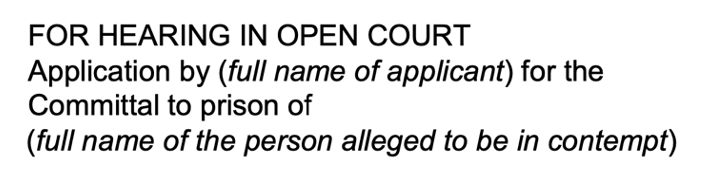
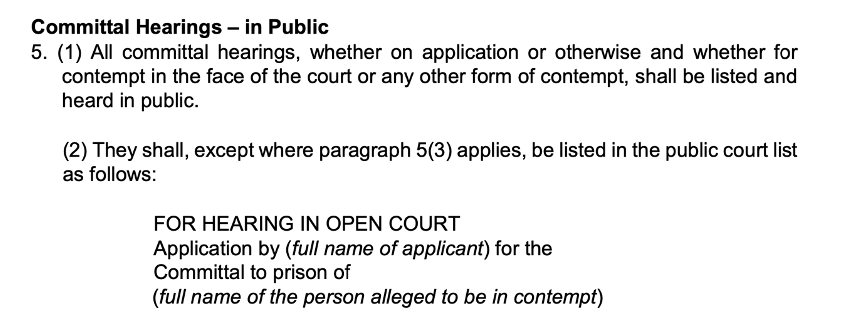
The Practice Direction Committal for Contempt of Court – Open Court says that open justice is “a fundamental principle” and that “the general rule is that hearings are carried out in, and judgments and orders are made in, public” (§3). The alleged contemnor should normally be named and committal applications listed as follows:

§5(2)

Any derogations from the principle of open justice “can only be justified in exceptional circumstances, when they are strictly necessary as measures to secure the proper administration of justice” (§4).

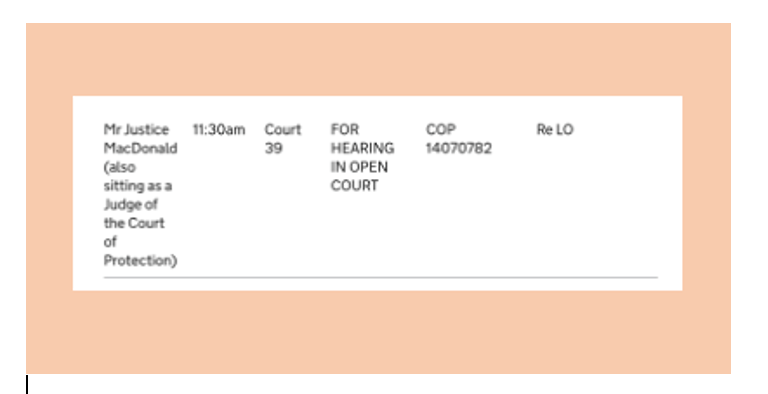
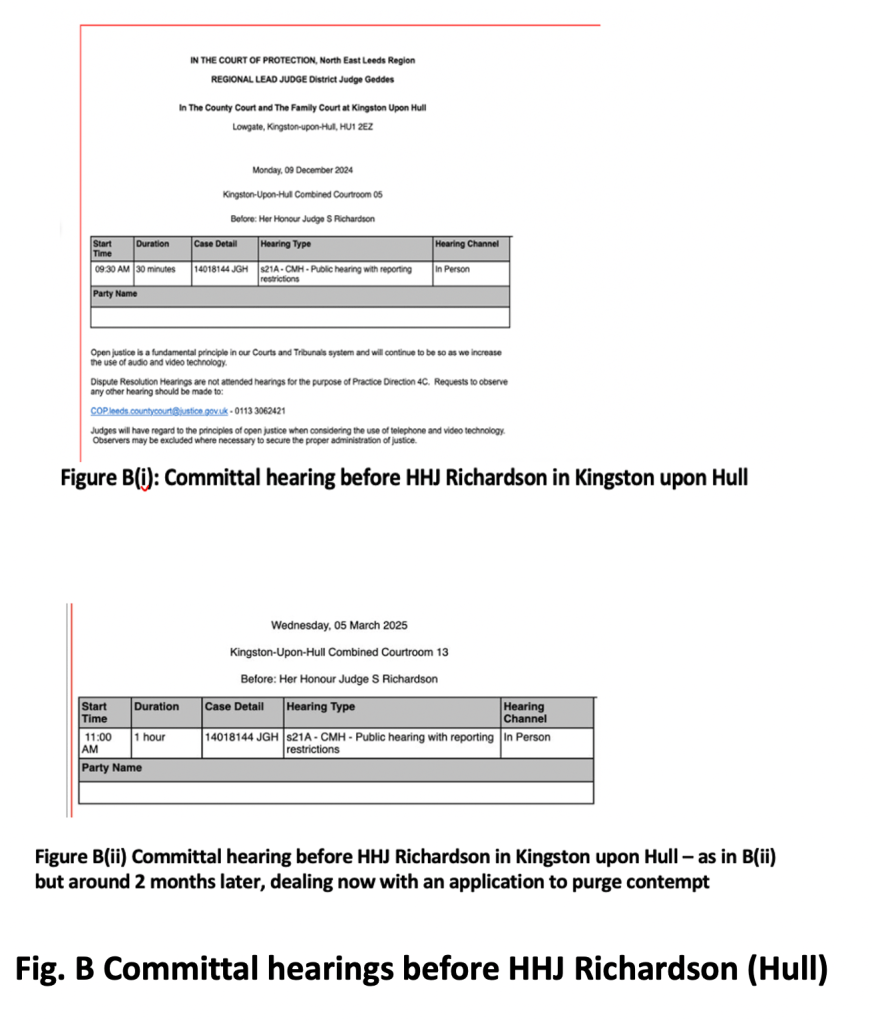
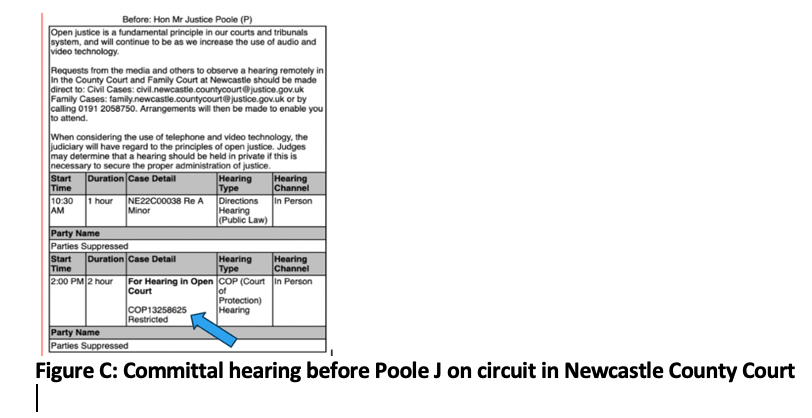
Here’s how this case was listed.

The list names the applicant (the London Borough of Camden) – albeit not as the applicant –  but it does not name the defendant, the alleged contemnor. There is a list of initials but it’s not possible from this listing to know which of the persons referenced with initials is the defendant.

In fact, I knew in advance that “MW” was the defendant because a week earlier I’d been served with a sealed order made by HHJ Hilder informing me that “Pursuant to Rule 21.8(5) the names of the Defendant MW, the First Respondent ([initials]) and the Second Respondent ([initials]) shall not appear in the public listing of the hearing, and the involvement of any of them in committal proceedings shall not be published by any other means.  The Court will consider at the hearing whether this prohibition should be continued or terminated…”.  

Here’s what Rule 21.8(5) says:  “The court must order that the identity of any party or witness shall not be disclosed if, and only if, it considers non-disclosure necessary to secure the proper administration of justice and in order to protect the interests of that party or witness.”

The order from HHJ Hilder gave no reasons as to why she considers that non-disclosure of the identy of these three people is “necessary to secure the proper administration of justice and in order to protect the interests of that party…”.

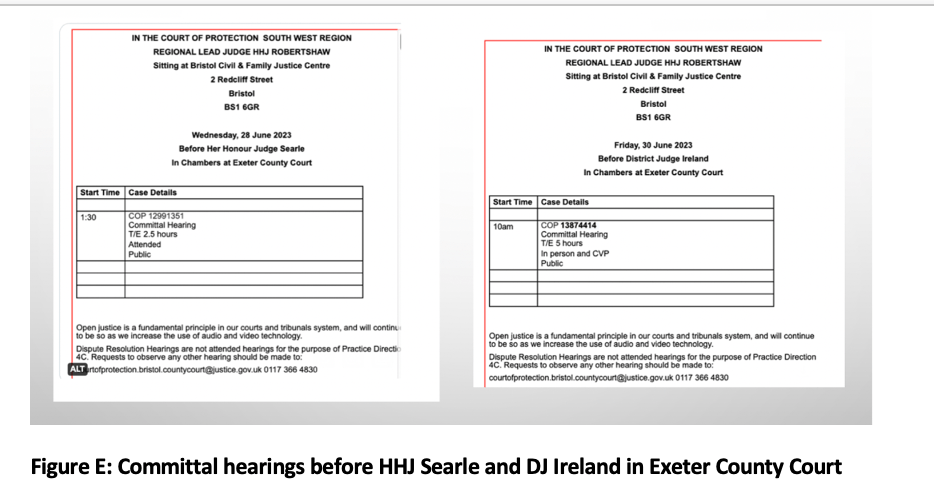
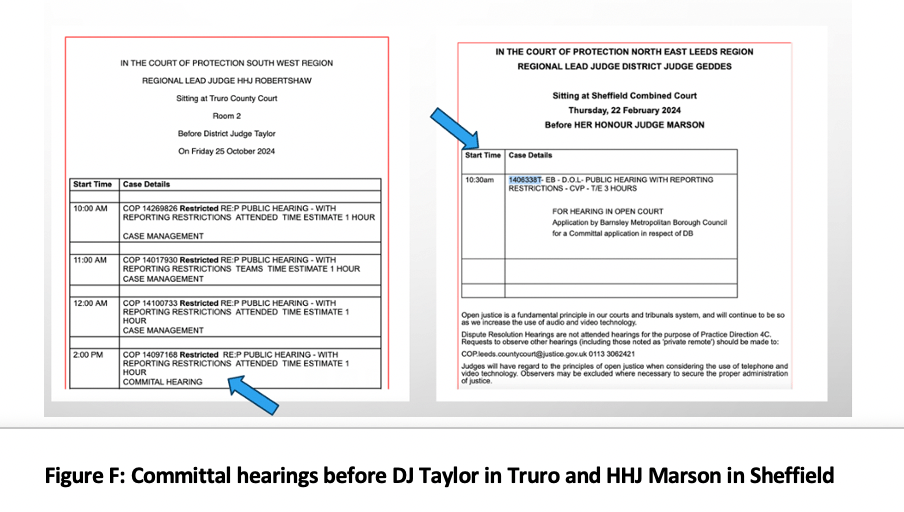
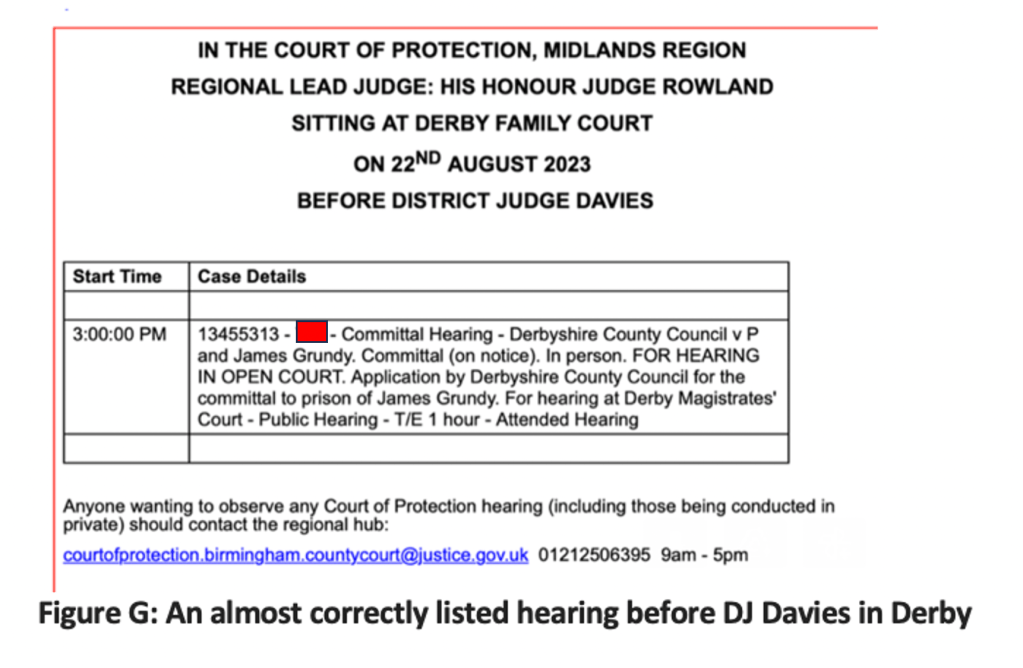
I made some deductions because, on the face of that order, one set of initials is followed by the words “(by her litigation friend, the Official Solicitor)”, indicating that she is “P” in these proceedings. I know from observing previous committal proceedings that judges are generally concerned to continue into committal proceedings the protection already afforded to P’s identity in court proceedings up to that point.  I’ve seen this in the cases in which contempt proceedings were brought (and custodial sentences made) against James Grundy and Luba McPherson (as I described in an earlier blog post: Capacity and Contempt of Court: The case of LB): in both cases the defendant was named, but P was not. 

I know that identification of the defendant causes judicial concern if there is reason to believe that they are a person who may not themselves have the requisite capacity – either to conduct proceedings, or to understand and comply with a court order.  When this happens, they become, in effect, another “P”.

Capacity issues were raised in relation to both James Grundy and Luba MacPherson but this was after judgments naming them had already been published.  At the Court of Appeal hearing for Ms MacPherson, the question of whether or not she should be anonymised going forward (perhaps moot, in my view, as this was clearly a case where that ship had sailed), was dealt with very quickly on the grounds that she herself opposed any attempt to conceal her identity from the public.  I have also watched hearings concerning the contemnor now initialised as “LB”, whose name was briefly in the public domain after sentencing[i], but whose identity is now protected by a non-disclosure order pending a judgment on her capacity that due to be handed down in January 2025.  (All these cases are discussed in my blog post Capacity and Contempt of Court: The case of LB.)

I do not think, however, that “MW”s identity can be protected by a non-disclosure order on the grounds of lack of capacity, because this would lead to questions about whether the order he is alleged to have breached should have been made in the first place (could he understand it, and the consequences of breaching it? Was he capable of compliance?). I am not aware of any capacity issues having been raised concerning MW.

The only other reason I can guess at as why it would be “necessary to secure the proper administration of justice and in order to protect the interests of that party…”that MW’s identity should be protected is that publication of their identities risks public identification of P, via jigsaw identification (that would be the “proper administration of justice” bit) and (it’s “and” not “or”) MW’s own ill-health, which is referred to in the order (“The Court is mindful that MW has health limitations”). 

I’m not at all sure that these are good reasons for not naming MW, who is potentially facing a prison sentence.  Taking the second issue first, why would it be in the best interests of someone with “health limitations” to risk being sent to prison, or fined, or having his assets seized without people knowing his name?  And, in relation to the risk of identification of P, most of the defendants in contempt of court cases in the Court of Protection are family members or close friends of P, which means it can always be argued that knowing who they are might risk the public becoming aware of P’s identity.  In practice,  both in the Court of Protection (e.g. Re Dahlia Griffith [2020] EWCOP 46) and in the Family Courts (e.g. Manchester City Council v Maryan Yuse, Farad Abdi & the children [2023] EWHC 1248 (Fam)) family members have been named in judgments and there is no evidence at all that members of the public  (or journalists) have subsequently tracked down the Ps or children concerned or harmed them in any way.  The risk of identification is also mitigated in this case as the relevant surnames are different.  In any case, as  former PA journalist, Brian Farmer, wrote to the judge considering the naming  – or not – of Luba MacPherson (the judgment was later published as: Sunderland City Council v Macpherson [2023] EWCOP 3

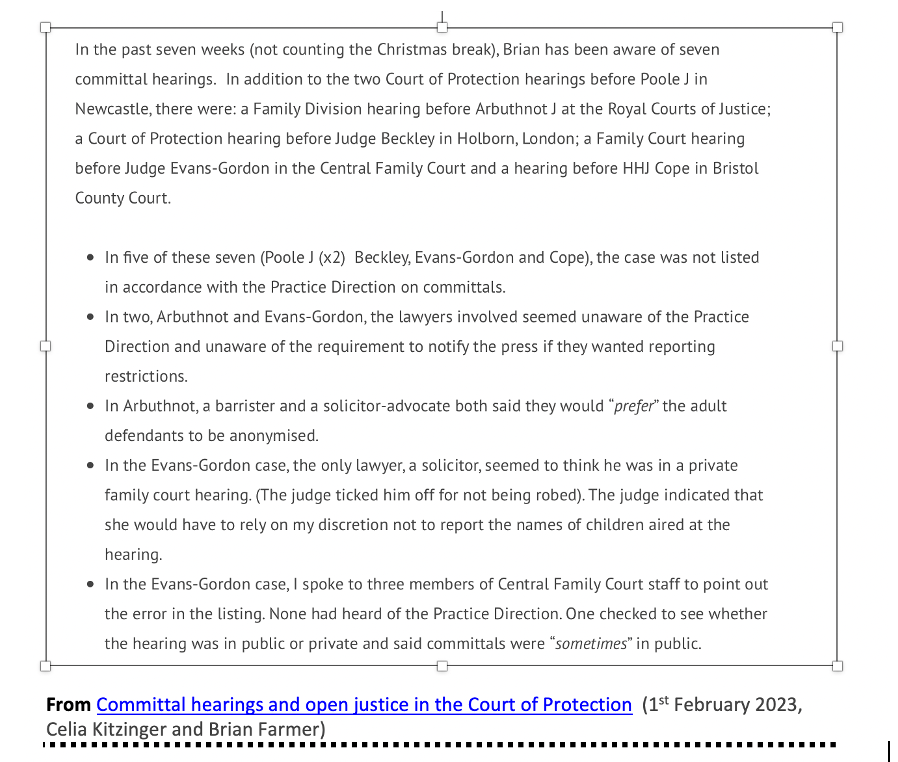
The vast majority of people won’t read your published judgment, they’ll find out about the case through the media. In reality, how many passengers on the Seaburn omnibus are going to read a report in the Sunderland Echo then try to piece together an information jigsaw? Dr Kitzinger and I might have the inclination and ability to track down your earlier anonymised judgment on Bailii, but will the average person really even try? Will they really start searching for the mother’s Facebook and Twitter accounts? Why would they? People have a lot on their minds at the moment. They’re struggling to heat their homes, struggling to pay food bills, war is raging, Prince Harry is on the front pages, Sunderland look like they’re going to miss out on promotion. In reality, this case isn’t big news and I suspect the vast majority will glance at any report, think how sad life is and how lucky they are, then turn to the back page to check the league table. (“Committal hearings and open justice in the Court of Protection”).

Finally, in this case, I think there may also be a concern from P herself about the identification of her family members and I notice (from another order of HHJ Hilder made after the hearing)  that there are plans for her to attend the committal “remotely by MS Teams from the office of her solicitors”.  So maybe it is P’s anxieties that have led to the non-disclosure order relating to MW.  But I’m not sure that would comply with the wording: “necessary to secure the proper administration of justice and in order to protect the interests of that party…” where “that party” clearly refers to the defendant as opposed to P (a matter addressed in Esper v NHS NW London ICB [2023] EWCOP 29).

To be clear: I do not want to make an application to name P (or the other party initialised in the listing). My concern is only with naming the (alleged) contemnor. But in my experience, despite the Practice Direction and the Court of Protection Rules, as well as Poole J’s guidance in Esper that defendants in committal hearings should normally be named, in practice they are normally not named.  The court is repeatedly finding reasons why they should not be. I find this concerning.  

I wish Brian Farmer were still doing court reporting for PA and could come along to the next hearing in this case and argue the case for transparency with his customary aplomb.  Unfortunately, he moved on a different job with the BBC about a year ago, and we public observers have rarely seen any journalists in the Court of Protection since then – and when they have attended, they have not addressed the court.  It can feel like a disproportionate burden for members of the public to pick up the important work that Brian Farmer used to do – and obviously it should never have all relied on the hard work and dedication of a single journalist. I would give it a go, but will be out of the country and unable to attend the next hearing if it goes ahead as planned on 3rd February 2025.  Moreover, jigsaw identification and the balancing of Article 8 and Article 10 rights is very fact-specific and I don’t know enough, at present, about this particular case to submit a written application for the naming of MW.  So, I anticipate that this will be yet another committal hearing where the defendant is never named.

2. What happened at the December 2024 hearing?

The hearing started with an opening summary from the judge.  The proceedings had begun, she said, with an application made in P’s name for assessment of her capacity across a number of domains including residence, care, contact, and use of social media.  MW is a party to proceedings only in so far as the court is considering his contact with her. There are injunctions (with a penal notice attached) against MW, forbidding him from: 

  • having face-to-face contact with P, except as organised and supervised by the local authority
  • sending her any communication between 6pm and 9am
  • sending her any communication that refers to sexual activities, her health, members of her family, these proceedings, her work or study, or that threaten violence against her
  • complaining about P to the police.

The local authority says that MW has breached these injunctions. There is a sworn affidavit from another family member and from a social worker reporting on visits and text messages, and both were available in court to give evidence.

At the hearing, I learnt about the family relationships between the people whose initials appear in the listings.  I’ve chosen not to report the nature of those relationships here, because they would add to jigsaw identification in the unlikely event that MW is named in future.  Also, suppressing this information now might make it more likely – if someone were to make an application to name MW in future  – that the application might be successful if it could be accompanied by an injunction preventing any reference to the particular family relationships that pertain to these three people.  I’d like to leave that open as a possibility for the court.

Although the hearing was in person, MW was attending remotely, with permission of the judge, due to his health issues. He was having difficulty with the technology, particularly in hearing what was being said (and it seemed his first language was not English, which must have added to the problems).  I think he was holding the device to his ear, which meant we could only see the side of his head (and the red curtains behind him).

The judge opened the interaction by saying: “Mr W, it appears you don’t have legal representation: would you like to tell me about that?” and she reminded him that he’d been given a list of solicitors to contact.  “Yes”, he said, “I contacted every single one of them. They said they could not help me”.  

The judge asked if he had given the committal order to any of the solicitors. “Well, I don’t know what you mean, but I have tried all of the solicitors that have been sent to me.  Here I am at a disadvantage to everything.  My memory has gone and I am taking [18?] pills a day and [the cancer?] is making me forgetful. I’m not in my right mind, in other words, so I am really at a disadvantage.”

The judge asked “if the court is able to send a solicitor round to your house today, would you let them in?”.  He replied enthusiastically, “Yes – oh thank you so much, yes!  They are making it up here as if I am a full abled man without anything. Some of these things are not my fault and some of it is lies”. The judge intervened: “Let me stop you there. It’s important that you know you have the right to remain silent.  I understand that you would like a solicitor”.  He affirmed that he would, and the judge addressed the lawyers, saying that “funding will not be an issue” (that’s because of non-means-testing legal aid for committal hearings) and “it doesn’t seem appropriate for the court to proceed without a solicitor”. She then asked for a “proposal as to where I could go next”.

Counsel for the represented parties confirmed that they’d already sent MW a list of solicitors’ firms specialising in Court of Protection work –  but the judge remarked (and I agreed with her analysis) that, “it’s not clear to me that he’s contacted them in respect of the committal”.  In analogous situations I’ve observed in other cases, the hearing is then adjourned in the hope that the unrepresented party will acquire representation in the interim – and often that doesn’t actually happen, so cases proceed with the party still unrepresented several weeks or months later, and the outcome of the decision to adjourn turns out to have been simply more delay.

I was surprised to see HHJ Hilder being very proactive here.  She instructed MW to stay on the line while she went to “see if I can make some arrangements for a solicitor”. I’m not entirely sure how this was done – it’s slightly unorthodox I think – but I believe that the judge’s clerk was tasked with phoning the firms on the list, overseen by the two lawyers.  In any case, she returned with the name of a solicitor who was available and would be coming to visit MW that afternoon.  By this time MW was no longer visible on screen, and nobody was sure whether he was actually able to hear her or not, but she addressed him in case he could, reminding him that the injunctions still applied between today’s date and the date of the re-listed hearing.

There was a brief discussion between the lawyers and judge concerning additional alleged breaches of the injunctions since the local authority had filed its original application. The judge asked for these to be filed by 20th December 2024 so that they could be considered alongside the earlier alleged breaches.  

The judge also asked whether anyone wanted to make an application for the case to be heard in private (nobody did – but I suppose MW may do so once he’s represented) and then whether anyone wanted to make an application for naming the defendant (or either of the other two anonymised parties).  Counsel representing P (by her litigation friend the Official Solicitor) made a case for keeping the first and second respondents anonymised – which I totally support – but indicated that the Esper judgment means that the identity of the defendant must be public (that’s my reading of it too).  HHJ Hilder said she’d “read the Esper judgment with a fine tooth-comb” and seems to dismiss that suggestion. I got the impression that neither counsel had made representation to the judge previously concerning the naming or otherwise of the defendant and that the decision to protect his anonymity had been made (for reasons possibly opaque to both counsel as well as to me) without consultation. I didn’t feel able to make any application for MW to be named at this point (though HHJ Hilder asked whether I wish to and would have given me time to make an oral application): I was a bit daunted by the “tooth-comb” comment, didn’t feel I knew enough about the case, hadn’t been given any substantive reasons why the case had so far departed from the (putative) norm of naming the defendant (so didn’t know what position I might be arguing against), and I was concerned about making an application in any event with MW unrepresented (and no longer in court). I also thought that under the circumstances I was unlikely to be successful.

The hearing ended shortly after midday.

Celia Kitzinger is co-director of the Open Justice Court of Protection Project. She has observed more than 590 hearings since May 2020 and written more than 100 blog posts. She is on LinkedIn (here), and also on X (@KitzingerCelia) and Bluesky @kitzingercelia.bsky.social).


[i] The judge confirmed that she did not intend the new non-disclosure order in this case to apply retrospectively – only going forward.  However, the new order would have prevented me from doing any further publicity on social media or via links from upcoming posts to the blog post I had already published, since it revealed information the reporting of which newly prohibited – including not just the contemnor’s name, but also the gender of the protected party.  I was disconcerted to hear one of the lawyers remark during the hearing that it “wouldn’t take more than a few minutes” to change the blog post – as though my concern might be rooted in the time it would take, rather than in the principle of retrospective reporting restrictions.  I am becoming increasingly weary of these issues: a year or two ago I would have raised objections and sent a follow-up email after the judge dismissed what I had to say with the comments she “didn’t need to hear further” from me (honestly, she did!), but I simply fixed the matter and put it down to yet another failure to engage properly with transparency in the Court of Protection. [Update, 7th March 2025: I now regret not addressing this matter in that hearing. Similar issues have arisen twice since then in relation to two different committal proceedings.] 

“Let us be alone as a family again”: An application for unsupervised contact at Christmas

By Daniel Clark & Kim Dodd, 23rd December 2024

Like many other people, the protected party, CA, goes to church on Christmas morning and then enjoys spending the rest of the day with her family. She has done this for many years. Following court orders that all contact with her daughter must be supervised, a carer will need to be present at all times.

Her daughter (DA) wants this family occasion to be unsupervised between 8am and 8pm on Christmas Day.

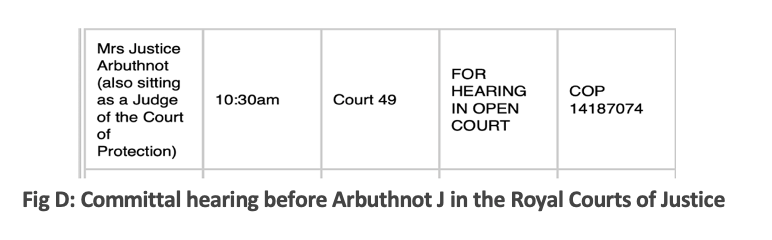
On Tuesday 10th December 2024, Mrs Justice Arbuthnot, sitting remotely (via Cloud Video Platform) at Cambridge County Court, heard this application. 

The parties in this case (COP 14187074) have had the same representation in Court of Protection proceeding since July 2024. Oliver Lewis, of Doughty Street Chambers, represents Norfolk County Council. Malcolm Chisholm, of 1GC Family Law, represents CA via her litigation friend, the Official Solicitor. DA represents herself as a litigant-in-person, and she is supported by a McKenzie Friend. 

Oliver Lewis was joined by Jordan Briggs, who is undertaking Doughty Street Chambers’ first specialist Court of Protection pupillage. As it happens, Jordan is the co-author (with Celia Kitzinger) of the only Open Justice Court of Protection Project blog that considers an application for contact (between mother and son) over Christmas. Unlike the application that this blog concerns, that application was dismissed in its entirety (see: Covid vaccination and a Christmas visit).

This blog will (1) present the background to this case, informed by two blogs previously published by the Open Justice Court of Protection Project as well as a judgment published in October. Next (2) it will discuss issues relating to transparency before (3) addressing an expert report by Professor Dubrow-Marshall about a potential treatment for CA’s daughter. Then (4) the blog will address the substantial matter before the court – an application for contact on Christmas Day to be unsupervised. It concludes with reflections by (5) Daniel Clark and (6) Kim Dodd on their concerns with this hearing.  

In this blog, we uses the same initials as those used by Mrs Justice Arbuthnot in her published judgment to refer to the mother (CA) and her daughter (DA): Norfolk County Council v C & Ors [2024] EWCOP 64 (T3). There is no disrespect intended to the family. 

1. Background to the case

The protected party, CA, is in her seventies and has a diagnosis of Alzheimer’s Disease. That diagnosis, Mrs Justice Arbuthnot notes in her published judgment, may not have been the correct one (§3). 

We blogged about this case before when it was heard by HHJ Beckley back in January 2024 (“When two legal teams turn up in court to represent P: Disputed capacity to conduct proceedings“). The judge was asked to make declarations as to whether there was ‘reason to believe’ that CA lacked litigation capacity. She disputed this, and was joined in court by her own choice of legal representative. A representative of the Official Solicitor was also present.  HHJ Beckley concluded that, “do have reason to believe that she lacks capacity to make decisions in relation to this litigation.”

This meant that CA’s own legal team was dismissed and the Official Solicitor acts for her.  The judge also decided that there should be a capacity assessment for contact, and a fact-finding hearing to establish whether CA’s daughter exerts coercive control over her. In the meantime, her family gave an undertaking (which is a legally binding promise) that they would only have contact with CA if a carer was present to supervise. 

The local authority made clear at the January 2024 hearing that, if CA is found to have capacity to make decisions about contact (so cannot be prevented by the Court of Protection from choosing to have contact with her daughter), they will then apply for restrictions to this contact under the “inherent jurisdiction” of the High Court. 

It was therefore not surprising that, by June 2024, the case had been transferred to the High Court for hearing by Mrs Justice Arbuthnot. At this hearing, (blogged here:Complex issues for the court and plans for an ‘omnibus’ capacity hearing), it was decided that there would be an “omnibus” hearing to consider all aspects of CA’s capacity at the end of July 2024. As it turned out, that hearing was adjourned to give an expert, Dr Barker, the opportunity to further assess CA’s capacity to make decisions across multiple domains.

In a multi-day hearing at the start of October 2024, the court conducted a fact-finding exercise. The subsequent judgment (Norfolk County Council v CA & Ors [2024] EWCOP 64 (T3)) details multiple allegations made by Norfolk County Council that amount to allegations that CA’s daughter  has acted in an abusive and threatening manner toward her mother, and exerts coercive control over her. These allegations included calling her mother a ‘drug addict’ (§26), holding a wet continence pad in her mother’s face and saying ‘have you pissed yourself again, mum’ (§28), attempting to force feed her mother pizza (§39), and throwing lasagne over her mother’s head (§48). There was also a suggestion that DA had ‘spoken of [taking her mother to] Dignitas in Switzerland’ (§47), and threatening that she will be moved to a care home (§64). 

While CA’s daughter accepted that some of these things happened, she contested many of them. It was, in the words of the judge, her belief ‘that the local authority are “out to get her”’ (§67). The judge did not accept this and, ‘on the balance of probabilities…[found] the allegations proved’ in their entirety (§71). She considered ‘that CA is subject to the undue influence of her daughter in a number of different ways…it is clear…that CA says what she thinks her family would like her to say’ (§70). 

The judge also heard evidence relating to CA’s mental capacity to make decisions across various domains. The judge found that CA lacks capacity to litigate, to make decisions about her care, and to manage her property and affairs. However, she does have capacity to make decisions about contact with her daughter, as well as enter into (and revoke) an LPA for health and welfare. 

Finally, the judge considered whether contact restrictions could be authorised under the inherent jurisdiction of the High Court. This is a legal mechanism by which the court can make orders to protect “vulnerable” adults who otherwise have the mental capacity to make the specific decision. 

The judge used the inherent jurisdiction ‘to impose a supervised framework around contact’ (§142). This meant that all contact between CA, her daughter, and her ex-husband would be supervised by one of her (live-in) carers. The judge was fortified in this decision because a graph, presented by CA’s social workers, showed a decline in the number of “incidents” since the daughter had made undertakings about contact.

The judgment sets out plans for three further hearings. One in December 2024 (the subject of this blog); a second in January 2025 to consider ‘an application for committal for contempt for alleged breaches of undertakings given to the Court in February 2024’; and a two-day final hearing in April 2025.

2. Transparency Matters

Following the hearing, another observer (and member of the core OJCOP team) Amanda Hill and I both contacted Oliver Lewis (for the local authority) and Malcolm Chisholm (for the Official Solicitor) to ask for their position statements. We also asked Malcolm Chisholm if he would extend our request to CA’s daughter. 

It is extremely unusual to receive the position statement of a litigant-in-person (both of us have tried and failed previously). Quite often, receipt of position statements makes clear the position of the statutory bodies, while we have to rely on the oral submissions that a litigant-in-person made during a hearing.  So we were pleased when it was confirmed that DA would be happy for us to be sent a copy of her position statement.

Before we could be sent these position statements, the judge (Mrs Justice Arbuthnot) needed to give her permission. This is because all documents submitted to the court become, essentially, the court’s property – it is for them to decide who receives them. Malcolm Chisholm had been in contact with the judge’s clerk to make this request, and then chased it a few days later. We were very grateful when he confirmed that the judge was content for the position statements to be shared, and he sent us the position statement he filed on behalf of the Official Solicitor. At the time of writing, we have not received the position statement of either the local authority or DA. 

3. Expert report of Professor Dubrow-Marshall

By the time of the hearing on 10th December 2024, Professor Dubrow-Marshall, a specialist in coercive control, had spent somewhere between five and eight hours with CA and her family. He considered the relationship between CA and her daughter to be ‘enmeshed’, but that he could offer therapeutic intervention.

This intervention would take the form of four sessions with CA, four sessions with DA, and then four sessions with other members of the family. It was not explained what these sessions would involve, though the Official Solicitor’s position statement describes them as “a form of one to one therapy” and “a set of interventions” complemented by one -to-one sessions with individual family members. The aim is to increase understanding of how loving relationships can spill into coercive control without those involved realising it. 

Given the amount of time already spent with the family, the Official Solicitor had confirmed with Professor Dubrow-Marshall that these sessions could be truncated – that is, fewer sessions may be possible. He could also offer some sessions in the run up to Christmas, which would allow him to predict both how many further sessions were needed, as well as how much that would cost. 

The local authority and Official Solicitor commend this report, and think that the sessions would be of benefit to DA and CA. There was, however, a sticking point – the local authority would not fund them because they are considered “treatment”, and the onus would be on DA to self-fund these sessions. The cost was not given in court nor in the Official Solicitor’s position statement, but it was clear that they are expensive. 

It was quite clear from DA’s oral submissions that the cost may be prohibitively expensive, and she’d rather receive counselling from a trusted person with whom she has previously had counselling. The brief discussion on this point went like this:

DA: I have spoken to him [Professor Dubrow-Marshall] …openly and transparently…We have talked about the case, our feelings….I’m going to see my GP and am going to ask for more counselling, funded by the NHS… I have opened my heart up to him, he has given me coping strategies.

Judge: You are saying that essentially “the sessions are done, I can’t pay for more and I want to go down the counselling route”.

DA: Yes.

While the judge’s summary may be a more concise version of what DA submitted, it left quite a glaring omission in the sense that DA did recognise some benefit from having met with Professor Dubrow-Marshall. She also clearly thought that counselling via the NHS would be helpful for her, and it wasn’t entirely clear to observers what the difference (apart from cost) would be. 

Toward the end of the hearing, the judge put this matter like this: “The key is with [DA]. I can’t order the local authority to pay for the work that Professor needs to conduct…She must realise that, if she’s not going to provide the evidence that the court will need, all of us will be looking at an unchanging risk. We might be able to have limited unsupervised contact.”

It sounded to me like DA was being given a choice: fund these therapy sessions yourself or contact with your mother will remain, for the most part, supervised. This occurred to DA too, who asked, “Are you basically saying that if I don’t agree and pay for it, I won’t be able to have unsupervised contact?” The judge said “no” to this but I’m struggling to imagine what else this could mean – presumably that there would be some limited unsupervised contact.  

It also wasn’t clear that DA understood what the treatment would actually be (the judge told her to read the Professor’s report to find out). 

So, in sum, DA is being asked to undertake treatment that she doesn’t seem to fully know the nature of, and then pay for that treatment with absolutely no support for the costs.  

The judge told DA to discuss it with her family.

4. Christmas contact

The majority of this hearing was taken up with a consideration of an application from DA for 12 hours of unsupervised contact on Christmas Day. The initial submissions were as follows:

DA: Good afternoon Your Ladyship…. I would love all of Christmas Day with my mum and my family , as has been the case for [over 50 years]…. We would like our time back together for the day…. That would involve [DA’s partner, Mr H] who isn’t supervised…. it would be [Mr H] cooking for mum which would be from 8am, which I thought respectful to carers…. It would be a travesty for my family not to have Christmas together.

Judge: You could obviously have Christmas together. You’re saying Christmas together but unsupervised. The order doesn’t prevent you having Christmas together…Why is it a problem that it should be supervised?

DA: It’s the intrusion. I feel when we have the carers here – we’re being looked at, we’re being written about. We don’t have time to be together…. Last year I did go for a court order to have it unsupervised and it was lovely [at this point, DA became visibly upset and started crying] Please, just Christmas Day. Let us be alone as a family again. Sorry I am emotional. I shouldn’t be. That’s my application. I request it.

Mr H, DA’s partner who has no restrictions on his contact with CA, explained that last year the family had unsupervised contact from 8am-8pm. He would be doing the cooking, and would be present throughout. In essence, he was quite willing to say that he would effectively “supervise” the situation. 

The judge was keen to drill into the detail, asking how he would manage supervising, cooking, and going to church. Mr H was clear this it was perfectly manageable, and that they could plan more precisely the day before – including doing some food preparation. This did strike me as a somewhat peculiar line of questioning. Many people attend church, cook, and spend time with their family on Christmas Day – I wasn’t altogether clear why the judge seemed to imply that this would be difficult. 

The position of the local authority was that the risks associated with contact at Christmas were the same as in January and October, and that 12 hours of unsupervised contact would be too long. However, they agreed with the Official Solicitor’s proposal (discussed below) that there should be two hours of unsupervised contact per day in the run up to Christmas. 

However, where the local authority differed with the Official Solicitor is that the local authority did not treat Christmas Day as a reason to make an exception concerning contact. Therefore, they only supported two hours of unsupervised contact on Christmas Day.  

Counsel for the Official Solicitor submitted, first, that CA appears “more relaxed than she was in October”, and she had told a solicitor that, “things seem to have settled down and [DA] accepts I’m not as bright spirited mother as I once was and she treats me accordingly”.  The Official Solicitor’s position statement paints a more detailed picture. It explains that CA thinks she and her daughter better understand each other now, and she’s happy with the fact that her daughter visits every day. 

The position of the Official Solicitor was that 12 hours of unsupervised contact would be too much. However, the Official Solicitor thought that unsupervised contact was possible. This would be best starting as soon as possible after the hearing, for a period of 2 hours every day (to correspond to a time when the live-in carer has a break, and ordinarily another carer takes their place).  This would mean that unsupervised contact on Christmas Day would not be a sudden departure from the norm, and that short periods of unsupervised contact in the weeks before Christmas could in essence stress-test the proposition that unsupervised contact is safe for CA. In turn, this would mean that contact on Christmas Day could be longer. 

The judge decided that “there should be two hours of unsupervised contact as soon as possible, and six hours on Christmas Day with the expectation that [Mr H] will be present…but the injunctive orders I’ve made still apply. It will be unwise in the extreme to bring up the care homes or Switzerland or anything else you’ve brought up in the past. Don’t do that. It will become evidence and then it becomes even less likely you’ll continue with unsupervised contact. If there are problems, I can bring this into my list with very little difficulty indeed”.

The judge seemed to trust that Mr H would intervene if DA did begin to talk about these things, describing him as a “decent normal human being”. The implication, of course, was that DA is not. When there was a reference to DA not accepting some of the judge’s findings (DA disputed this), the judge said, “that’s her personality. That’s the type of person she is”. Mr H gave a promise that he would be present throughout the day but this was not, at first, enough for the judge. She wanted to go further stating, “I think I will ask you to give an undertaking(my emphasis).

As another observer, Amanda Hill, pointed out after the hearing, to most lay people, there isn’t really a difference between making an  “undertaking” and a “promise”. But in the law, these are two  very different things. An “undertaking” has a penal notice attached. If you breach it, it’s like breaching a court order – you can even be sent to prison. We’re both certain that’s what the judge meant here. 

Luckily for Mr H, Malcolm Chisholm picked up on this point towards the end of the hearing, as he suggested that there should be a “light touch approach, not a formal undertaking” and the judge agreed to that. 

5. Daniel Clark’s reflections

There were times during this hearing when I got the impression that DA and the judge were speaking past each other. 

For examplewhen DA made her submissions that, “it would be a travesty for my family not to have Christmas together”, the judge’s response stuck out to me: “You could obviously have Christmas together. You’re saying Christmas together but unsupervised. The order doesn’t prevent you having Christmas together”. The judge’s response struck me as somewhat pedantic. It was quite clear what DA was asking for, and also why she was asking for it. To say “you could obviously have Christmas together” (my emphasis) doesn’t engage, in any meaningful way, with the emotion that lay behind the submissions. The judge’s response may represent a technically legal truth. But how many people would consider that having their every interaction supervised amounts to what they mean by having Christmas with their family? I certainly wouldn’t.  

A similar thing happened when discussing Professor Dubrow-Marshall’s proposed treatment plan. DA’s preference is to have counselling with somebody she knows and trusts. The judge, however, put it somewhat differently, saying: “you are saying that essentially ‘the sessions are done, I can’t pay for more and I want to go down the counselling route’”. As I noted above, this left out the fact that DA did recognise some benefit in having met with Professor Dubrow-Marshall. 

There were two approaches being taken in this hearing. On the one hand, the judge was concerned with emphasising what is technically, legally, true, and also summarising DA’s (at times lengthy) submissions.  But, on the other hand, DA was (like most of us would be) concerned with the practical and emotional implications of those orders. This was either ignored or missed by the judge. 

It’s also worth noting that CA was present throughout this hearing, seated next to her daughter in what looked to be her living room. On multiple occasions, DA asked the judge whether she would like to hear from CA.  On a couple of occasions, it looked like CA was starting to say something. Every time, the judge declined the offer. I found this uncomfortable. I’ve observed many hearings in which P has been present and, if they’ve asked to speak, the judge has agreed. In fact, the Court of Protection’s rules state that “P should have the opportunity to address (directly or indirectly) the judge determining the application and, if so directed, the circumstances in which that should occur” (§2(d)).  For whatever reason, that didn’t happen in this hearing. Perhaps it’s to do with the judge’s assessment (discussed in section 1) that CA may say what she thinks her family wants her to hear. Perhaps the judge thinks that she doesn’t need to hear from CA because she is represented by the Official Solicitor (though the Official Solicitor can present a case that is different to what P wants them to present).  Whatever the reason, it seems to me that there’s a very real risk the person at the centre of this case could get lost. 

6. Kim Dodd’s reflections

At the end of this eighty-minute hearing, the judge ordered that the family would be allowed six unsupervised hours together on Christmas Day, with, at the Local Authority’s suggestion, some two-hour unsupervised (practice?) visits to be arranged in the interim. The judge closed the hearing by wishing participants a ‘Happy Christmas’. I don’t know how P and her daughter (or my fellow four co-observers) felt after the hearing. I felt distinctly uncomfortable. 

There are two versions of this story. According to P’s daughter, social and care workers have made some false allegations about her, resulting in deep injustice and a breach of her family’s Article 8 rights, and she is emotional and angry about this ‘vendetta’ against her. The other version, preferred by the Court, is that, given the ‘findings’ the Court has made about the way the daughter has behaved towards her mother, such interference meets the required threshold of being ‘necessary and proportionate’.

The evidence for the way that the daughter has treated her mother is based on evidence from social workers and caregivers, and the judge has taken the view that they would have no reason to lie (expressed in §24 of the published judgment as well as during this hearing). 

Had I observed this case eighteen months ago, I believe I too would have subscribed to the premise that professionals would not lie to the court, but my lived experience with my late father teaches me otherwise.   

Having watched this hearing, I now have some deep concerns. What if my dad’s awful treatment at the hands of the State is not an isolated case? What if such cases are prevalent, and left unchallenged in the legal system due to the system’s unpreparedness to accept that the evidence before the court may not be true?

There can be several reasons for people from state organisations such as Local Authorities, to misinform the court.  There’s an obvious inherent risk for an occasional personality clash between carers and family members as a potential motive for misinterpretation or lies.  There can also be financially driven motives: safeguarding allegations against family members seem to be a common theme in cases where Ps are forced from their own homes into institutional care. Local Authorities are strapped for cash and short of housing. Forcing vulnerable people (the rich and the poor alike) into care may have a very positive effect on Local Authorities’ budget. It would surely be naïve to ignore the risk of such an ‘agenda’ being a driving force in case management?

I will continue to watch this case with interest and will raise a glass to P and her family at the appropriate time on Christmas Day (though the exact timing of the six-hour window of family privacy was not specified).

If the allegations about P’s daughter had been tested to the higher standard of proof of the criminal court (given that many of the allegations against her, including coercive control, constitute crimes) I would feel more convinced that the outcome of this case so far was a just one. 

Instead I have deep concerns about unchecked power and the efficacy of the system which theoretically protects vulnerable people.

Daniel Clark is a member of the core team of the Open Justice Court of Protection Project. He is a PhD student in the Department of Politics & International Relations at the University of Sheffield. His research considers Iris Marion Young’s claim that older people are an oppressed social group. It is funded by WRoCAH. He is on LinkedIn, X @DanielClark132  and Bluesky @clarkdaniel.bsky.social.

Kim Dodd has previously blogged for the Open Justice Court of Protection Project (“A newly addicted observer’s reflections“) under the pseudonym of “Jean Louise” as she was at the time a respondent in her dad’s CoP proceedings and subject to a Transparency Order preventing her from identifying herself as a family member of a protected party. That TO  has only just been discharged as a result of her dad’s death (the order had effect “until further order of the court OR the death of P“).  Having retired early from her own corporate career and studied for a Master’s of Law, Kim has developed her interest in law generally and particularly in the area of the law on coercive control. She is on LinkedIn (here).

Capacity and Contempt of Court: The case of LB

By Celia Kitzinger, 18th December 2024

The hearing I observed on 5th December 2024 (COP 14045574) before HHJ Tucker sitting in Coventry was an application to send someone to prison.  The hearing lasted for about 35 minutes and I was able to observe about 20 minutes of it, missing the beginning due to not having been sent the link until half an hour after the listed start time.

There are new allegations that LB (the initials used in the previously published judgments) has breached a court injunction – an injunction she’s breached many times before.  At an earlier hearing she received a suspended sentence of five months in prison, on condition of no further breaches.  If she is found to have breached the injunction again, it is expected that she will now serve that prison sentence.

Recently, however, an expert has provided a report saying that LB doesn’t have the requisite mental capacity – which would mean (said the judge) that the injunction should not have been made and no further steps can taken in relation to committal.  The other parties (the Local Authority and the Official Solicitor [acting for the protected person]) do not accept that expert opinion and there’s a full-day hearing on 19th December 2024, where the expert will present her evidence and be cross-examined.

Background

The protected party, X, is “an intelligent young adult” who has suffered very serious physical, emotional and sexual abuse from LB.  X wants to maintain a relationship with LB but not to be subject to bad behaviour from LB which, according to the published judgments, includes demanding money, asking X to have sex with men to pay LB’s debts, including drug debts, and selling (or threatening to sell) intimate images of X (Lincolnshire CC v X & Ors [2023] EWCOP 52). 

Injunctions made by Mrs Justice Lieven were served on LB (and another respondent) on 5th May 2023.  The injunctions said that neither of them should have contact with X – not by telephone, by post, or via social media.  

On that very date, immediately after receiving the injunctions forbidding contact, LB phoned X, saying it was “all lies”.  She phoned again multiple times that month, as did the other respondent, asking X to stop the injunctions (obviously not within X’s power), and asking for money from X, and variously claiming that LB was in a coma in hospital and “dying and it is all your fault”, and that LB was prostituting herself.  The judge found this behaviour to be “manipulative”,  “cruel and calculating”.  In a subsequent hearing, she found  “very little evidence… of any genuine remorse on the part of the respondents”.  Given that X also values and wants to maintain a relationship with LB, LB’s behaviour caused X “intense distress, upset and confusion”.  The judge sentenced both LB and the other respondent to a period of 5 months in prison.  Since there had been some months’ gap between the last breaches and the sentencing hearing, the judge suspended the custodial sentence on condition there were no further breaches (Lincolnshire CC v X & Ors [2023]  EWCOP 53). 

To protect X, who is anxious, frightened and “dysregulated”, due in part to her diagnoses and mental health conditions, and also as a consequence of these proceedings, the committal proceedings were – very unusually and after careful consideration – held in private. The two published judgments concern first, the decision, made in the context of the judicial commitment to open justice, to hold the proceedings in private (EWCOP 52); and second, the committal decision (EWCOP 53). 

The hearing of 5th December 2024

When I saw the listing for this case, I assumed that it was nothing to do with the committal, but rather that it concerned decisions for X’s ongoing welfare.  That’s because it wasn’t listed in accordance with the Practice Direction for Committal for Contempt of Court hearings: it didn’t say it was a committal hearing and didn’t name either an applicant or an alleged contemnor (which listings for committals are supposed to do) so I had no reason to think that’s what it was.  But it turned out to be exactly that. 

It took some persistence to gain admission to the hearing.  I asked for the link the evening before (19.22 on 4thDecember 2024), resent the request at 09.19 the following morning, and finally received the link at 10.30am for the hearing, which of course had already started.  I gather it started around 15 minutes before I joined.

The applicant was LB and as I joined her lawyer, Will Harrington (of Harrington Solicitors), was saying that “the defendant has a report saying she’s not got capacity, so this is a live issue”. 

I gathered that there had been a previous hearing a month earlier (4th November 2024[i]) at which LB’s solicitor had raised concerns as to whether LB: (a) has capacity to conduct these proceedings; (b)) understands the terms of the injunction made by Lieven J; and (c) understands the condition attached to the suspended sentence previously imposed by the court.  Proceedings had been adjourned to allow for her capacity to be assessed by a consultant psychiatrist, whose report was now before the court.  I think it is being said that she has, or may have, a learning disability as the “cause” of her lack of capacity.

Concerns have been expressed about the quality of the report.  The psychiatrist “appears to be raising the bar of capacity to conduct these proceedings, and understand the terms of the injunction too high” said counsel acting for X via the Official Solicitor  (Benjamin Harrison, Serjeants’ Inn Chambers). 

The judge decided that the hearing on 19th December will be used to determine LB’s capacity.  Either she will have the requisite capacity, in which case her lawyer can take her instructions and the committal hearing will proceed (with reasonable adjustments if necessary, e.g. “it might need to go slower”).  Or she won’t have capacity, in which case the judge hoped to get the Official Solicitor on board to represent her (obviously with a different lawyer from the one representing X via the OS).  “The point I’m making,” said the judge, “is this. Can I ask the OS to be effectively on standby so they can become involved in these proceedings at short notice?

Counsel for X said he thought that was “a proportionate and appropriate way forward”.  

Counsel for LB said he had “a preference for the OS to be instructed today, but can understand the view that is putting the cart before the horse”.

The judge pointed out that she could “invite the OS to act for the defendant in the light of the report, but it’s a live issue with regard to capacity, which will be determined on the 19th.  It’s up to the OS what she wants to do.  If she says ‘no’, and declines the invitation, well, fine.  If she says ‘yes’, there we are – and she may have to step away at a later point if LB has capacity.  Does anyone oppose that process?”.  Nobody did. 

There was then a brief discussion about the advisability (or not) of inviting an addendum report from the consultant psychiatrist prior to the next hearing – as submitted by LB’s counsel, who was “uncomfortable that [the psychiatrist] whose duty is to the court is going to be ambushed by questions she has no notice of.  She should have notice of questions from the litigation friend so she knows what the issues are. The evidence will be better for having had time to think about the issues raised by other parties”.  Counsel for the Local Authority (Jack Anderson of 39 Essex Chambers)  expressed concern about “cross-examination by email” and counsel for X referred to “full-throated remarks in my Position Statement saying the expert has got things wrong”. I think the outcome was that there was no invitation to provide an addendum report, but that the judge ruled Position Statements should be provided to the expert in advance of the hearing (and I think she said the rest of the bundle too).

Reflections

I’ve watched several committal hearings this year at which a question mark has arisen as to whether the person found to be in contempt of court (and facing a prison sentence as a consequence) has the requisite mental capacity – by which is meant, separately, (a) their capacity to conduct the proceedings; and (b) their capacity to understand and make decisions about the injunction itself. I’ll start by outlining what I understand to be the law in this area – bearing in mind I’m not a lawyer and happy to be corrected by those who are.

An injunction can be made against a protected party (i.e. a party, or an intended party, who lacks capacity, within the meaning of the Mental Capacity Act 2005, to conduct the proceedings), but only if he or she understands the nature and requirements of the injunction (Wookey v Wookey [1991] 3 All ER 365). This is because the test of capacity to conduct proceedings and the test of capacity to comply with an injunction are two  different tests (see P v P (Contempt of court: Mental capacity) [1999] unreported).

Capacity to conduct proceedings is set out in case law predating the Mental Capacity Act 2005: Masterman-Lister v Brutton & Co. [2002] EWCA Civ 1889 – but in terms clearly congruent with the Act, being based on early reports on which the Act was based.

§79. The Judge found assistance in recommendations made by the Law Commission in 1995, in Part III of its report Mental Incapacity (Law Com No 232). The report drew attention… to the need that a person should be able both (i) to understand and retain the information relevant to the decision which has to be made (including information about the reasonably foreseeable consequences of deciding one way or another or of failing to make any decision) and (ii) to use that information in the decision making process. I that that he was right to have regard to those recommendations. I think he was right, also, to have in mind the qualifications … that a person should not be held unable to understand the information relevant to decision if he can understand an explanation of that information in broad terms and simple language; and that he should not be regarded as unable to make a rational decision merely because the decision which he does, in fact, make is a decision which would not be made by a person of ordinary prudence.

Capacity to conduct proceedings is fleshed out in more detail (albeit in relation to matters that sound very different to those with which the Court of Protection is concerned) in Bailey v Warren [2006] EWCA Civ 51:

“…The assessment of capacity to conduct proceedings depends to some extent on the nature of the proceedings in contemplation. I can only indicate some of the matters to be considered in accessing a client’s capacity. The client would need to understand how the proceedings were to be funded. He would need to know about the chances of not succeeding and about the risk of an adverse order as to costs. He would need to have capacity to make the sort of decisions that arise in litigation. Capacity to conduct such proceedings would include the capacity to give proper instructions for and to approve the particulars of claim, and to approve a compromise. For a client to have capacity to approve a compromise, he would need insight into the compromise, an ability to instruct his solicitors to advise him on it, and an understanding of their advice and an ability to weigh their advice…” §126 

The ability to manage the dynamic nature of proceedings is emphasised by Macdonald J in TB v KB and LH (Capacity to Conduct Proceedings) [2019] EWCOP 14: he said that legal proceedings are “not being simply a question of providing instruction to a lawyer and then sitting back and observing the litigation, but rather a dynamic transactional process, both prior to and in court, with information to be recalled, instructions to be given, advice to be received and decisions to be taken, potentially on a number of occasions over the span of the proceedings as they develop.” (§29)

Capacity to understand and comply with injunctions means being able to understand the orders made, and having the capacity to obey them (Wookey v Wookey [1991] 3 WLR 135 ).  In P v P,  the Court of Appeal held that a limited degree of understanding could be sufficient to found liability for contempt. There was no need for a full understanding of the finer points of law provided the contemnor understood what he must not do and what the consequences of a breach might be. It’s also been observed that a person might well understand the terms of an order when explained but then, by reason of their mental impairment, be unable to make the decisions necessary to comply with that order thereafter (Cooke v DPP [2008] EWHC 2703 (Admin)).  Where there’s evidence, retrospectively, that – due to an impairment in the functioning of their mind or brain – the person did not understand the injunction at the time it was made, or was unable to make decisions to comply, then the injunction should not have been made in the first place and proceedings against them must end. 

Committal hearings are not particularly common in the Court of Protection, and committal hearings at which the suggestion is made that the presumption of the contemnor’s capacity is displaced are even less common.  I’ve observed two others recently – in both cases (as in the one I’ve reported on above) after prison sentences were handed down.

1. James Grundy

There’s a published judgment from August 2023 (Committal for Contempt of Court: Derbyshire County Council -v- Grundy) which sentences Mr Grundy to 28 days in prison for having visited P, unsupervised, at her home on two separate occasions in breach of the injunction forbidding this. 

The sentence was suspended – but just a few months later, on 15th January 2024, the case was back in court.
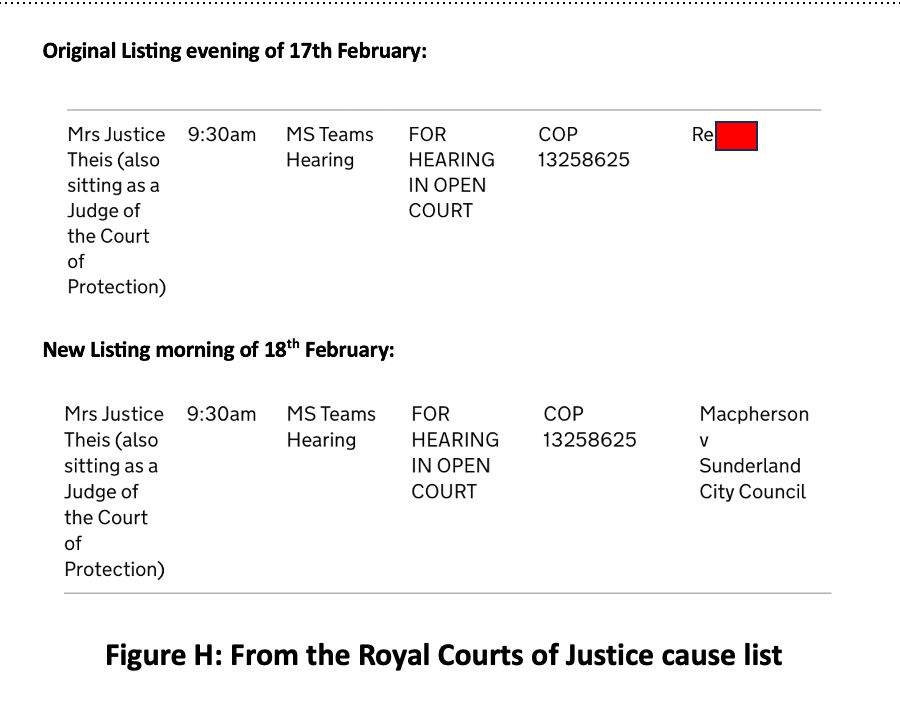
Mr Grundy’s solicitors, who previously accepted that Mr Grundy had capacity to instruct them, now said his capacity was in doubt, and his social worker had produced a report saying that he did not have capacity to conduct the proceedings. 

The judge asked whether the Official Solicitor would be willing to act for James Grundy at the next hearing, which is what happened six weeks later.  The OS took the position that that expert evidence was required as to Mr Grundy’s capacity and that such evidence ought to be obtained prior to any substantive orders being made on this application. The judge ordered an expert assessment. (I blogged about the case here:  Committal and sentencing with a possibly incapacitous contemnor.)

A subsequent committal hearing listed for 15th October 2024 was vacated, and I was then unaware of subsequent hearings (though the judge reports that they were correctly listed) until the judgments were published reporting the outcome. James Grundy was found to have capacity to understand the injunctions against him; breaches of those injunctions were proved (the judge watched “irrefutable evidence” in the form of footage from police body-worn cameras showing Mr Grundy visiting P’s house in breach of the injunction), and Mr Grundy was sentenced to 28 days immediate imprisonment (see Derbyshire County Council v. James Grundy (by the OS) and P (by SB, her litigation friend). Derbyshire County Council v Grundy [2025] EWCOP 1 (T1) (20 January 2025); Derbyshire County Council v Grundy [2025] EWCOP 2 (T1) (29 January 2025)).

2.   Lioubov (Luba) McPherson

Luba McPherson received a prison sentence of four months – handed down by Poole J in the Court of Protection because she repeatedly breached court orders forbidding her from posting articles, videos and audio-recordings of her daughter on social media. She has done so, she says, “ to show the distress that my daughter suffers daily, because so-called professionals keep my daughter in deliberately induced illnesses to suit the agenda that she lacks mental capacity“.  She refers to her daughter’s treatment as “torture” (all quoted in the judgment, Sunderland City Council v Lioubov Macpherson  [2023] EWCOP 3)[ii]  

On 3rd December Ms McPherson had intended to appeal against this prison sentence in the Court of Appeal but found instead that her capacity to conduct the proceedings was in question – something she vigorously contests. 

The published judgment from the Court of Appeal reports that Ms McPherson’s solicitor, and other members of her legal team, became concerned about her capacity to conduct proceedings during the course of a conference with her in preparation for the Court of Appeal hearing and “she was invited to participate in a capacity assessment which was arranged for 18 November 2024 with Dr Pramod Prabhakaran a psychiatrist experienced in conducting capacity assessments for the Court of Protection”. She declined “in strong terms” ([2024] EWCA Civ 1579).  The court gave permission for Dr Prabhakaran to conduct a paper-based assessment of Ms McPherson’s capacity (i.e. without meeting her, based on emails and other documents Ms McPherson had sent to her legal team). On the basis of those documents, the psychiatrist found on the balance of probabilities “the possibility of a delusional disorder” and that  “due to her firmly held beliefs which persist despite evidence against these, on balance, her ability to use and weigh up information relevant to the court proceedings is likely to be affected as a result”.  The Court of Appeal, having “reason to believe” that Ms McPherson may lack capacity, has referred the case back to a High Court judge for determination and continued the stay of the sentence of imprisonment pending a decision on her capacity, after which the case will return to the Court of Appeal. We will be blogging updates about this case (and will link to them here in due course).

I don’t know how contemnors in general feel about the view that they may lack relevant capacity in relation to committal proceedings (they may simply be relieved that it means no prison sentence) but Luba McPherson made it very clear to the Court of Appeal that she is outraged by any such suggestion. The person’s own views about their litigation capacity are included in the “Certificate: Capacity to Conduct Proceedings” intended for use by capacity assessors as a standard form of report on the matter.

In conclusion: Together, these three cases raise serious concerns about the Court of Protection approach to the people (almost always family members) against whom judges make injunctions and issue committal proceedings. The intention of these injunctions to to protect (what the court determines to be) P’s best interests – and to deter actions contrary to those. When there are different views about P’s best interests between court and contemnor, or when the contemnor is simply unable to understand or comply, or refuses to do so, the situation rapidly becomes deeply problematic. It’s rarely the case that P actually wants to see their family members or close friends sent to prison. It seems to me that (on the whole) judges and lawyers (especially of course the Official Solicitor acting for the protected person whose best interests were the focus of the case from the start) are very much alive to these concerns, but nobody seems to know how best to address them.  

Celia Kitzinger is co-director of the Open Justice Court of Protection Project. She has observed more than 580 hearings since May 2020 and written more than 100 blog posts. She is on LinkedIn (here), and also on X (@KitzingerCelia) and Bluesky @kitzingercelia.bsky.social)


[i] I don’t know for sure, and I can’t now check because we can’t search for past hearings in Courtel/CourtServe, but I strongly suspect that the 4thNovember 2024 hearing, like the one I’m reporting on here, was also incorrectly listed and did not comply with the Practice Direction.  We are always on the look-out for interesting hearings and we scan the lists every day. It’s unlikely we’d have missed a hearing that said it was a committal hearing.

(ii) We’ve been following this case for a while, and have previously blogged about the committal hearings (see: “A committal hearing to send P’s mother to prison”; and “Warrant for arrest of P’s mother “; see also “An ‘impasse’ on face-to-face contact between mother and daughter” for some background to the case). Luba McPherson had already made an unsuccessful appeal against the custodial sentence as a litigant in person: the judgment dismissing her appeal is here:  Lioubov Macpherson v Sunderland City Council [2023] EWCA Civ 574.

Anorexic teenager in 10-day induced coma for re-feeding: What next?

By Celia Kitzinger, 14th December 2024

A teenager diagnosed with anorexia was refusing food. She was also refusing a nasogastric (NG) feeding tube.

More than a year before, she’d spent time in an eating disorder unit, detained pursuant to s.2 of the Mental Health Act 1983. I don’t know where she was living or what treatment she was receiving (if any) immediately prior to the events that led to this hearing.

By late November 2024, she weighed just under 32kg, with a BMI of 12, acute renal failure and liver dysfunction. The Trust said that she was too medically unwell to be treated under the Mental Health Act [MHA] 1983 and decided to provide treatment pursuant to s4B McA 2005 (according to her doctor).

On 26th November 2024, doctors gave her a general anaesthetic, ventilated and sedated her, and fitted her with an NG tube, believing this to be in her best interests.

She did not consent to any of this – there was a view that she lacked capacity to refuse the treatment (sic), but no formal capacity assessment was mentioned during the hearing. And it’s not clear (said the Official Solicitor) “how aware [she] was of the proposed treatment plan before it was put into effect”.

The treatment seems to have been effectively to save her life by “re-feeding” her (apparently against her wishes) in an induced coma.  

On the day of the court hearing, she was on the tenth day of an induced coma.  

The Trust had applied to court to seek retrospective authorisation of the life-sustaining treatment they had already provided, and for authorisation of further orders concerning their “Treatment and Restraint Plan”.  

The hearing

The case (COP 20007289) was listed for a remote hearing (via MS Teams) before  Ms Debra Powell KC sitting in the Royal Courts of Justice on 5th December 2024.  The judge had a busy list, and the hearing (listed for 10.30am) was delayed while she heard other cases. There were also “technical issues” . So the hearing didn’t actually start until 13.11, at which point the judge simply dealt with the various errors in the Transparency Order[1], and then asked to be told of disputed issues (basically the use of anti-psychotics, it transpired) before adjourning for a lunch break until 14.15.

On resuming the case at 14.15, it became clear that pre-hearing discussions had moved the case along. Conrad Hallin of Serjeants Inn, acting as counsel for the applicant Trust (Ashford and St Peter’s Hospital NHS Foundation Trust) gave a brief summary of how matters stood.

Treatment already provided had been pursuant to s.4B MCA 2005 (according to the Trust).  The Official Solicitor (represented by Nicola Kohn of 39 Essex Chambers) said that “it does not appear to the OS that the treatment thus far delivered to [the protected party] has been anything other than appropriate and provided to her in her best interests“. But it was, she said, “unclear” as to “how, or indeed why s4B MCA 2005 should be relied upon where the initial act of placing [the protected party] in a coma is completed. It is even more unclear how or why the court is invited to apply s.4B retrospectively”.  The OS did not consider that the question of retrospective authorisation for medical treatment should be considered at this time, especially since there was so little information available about that treatment.  The OS wanted to see the medical records, and suggested – on the basis of the limited information available to her – that it could have been appropriate to make an application for lawful authority from the court pursuant to ss. 15 and 16 of the MCA 2005 at the time the treatment was anticipated. But for the purposes of this hearing, she took a “pragmatic” approach: “The priority today is seeing that she is appropriately cared for going forward”. This matter was not further addressed.

Turning to future treatment, counsel for the Trust reported that the patient had responded well physiologically to the treatment she was being given while in an induced coma.  She’d been receiving 1,700 calories a day intravenously, with a plan to increase that by 200 calories a day to reach 2,500 to 3000 calories a day.  The level of absorption was not yet optimum, but that is “as expected“, and it’s likely she would be extubated soon – possibly at the weekend.  (The case was being heard on a Thursday). 

There was a “Treatment and Restraint Plan” before the court, designed to manage her care once she is conscious again.  She will be weaned from the ventilator, the NG tube will be removed, and she will reawaken. At that point, as the OS pointed out, she will realise what has been done to her and will find herself physically altered by weight gain.  It seems likely that she will become “agitated” at this point and the intention is to treat her with low doses of anti-psychotics to manage “emotional dysregulation and negative emotional thoughts”. 

There was an extended (and sometimes rather impassioned) discussion about the legal basis for providing anti-psychotics subsequent to the medical process of extubation.  This related to concerns about the relevant scope of the Mental Capacity Act 2005 (specifically Schedule 1A) and whether treatment should instead be authorised by the Mental Health Act 1983 – with case law (notably Re JS [2023] EWCOP 33) invoked to support both positions.

 The OS suggested that “as soon as she is extubated and no longer ventilated and her physical condition has stabilised, a mental health assessment is carried out forthwith, so the Trust  can consider whether or not she falls under the auspices of the Mental Health Act, and provide a viable framework for providing her with treatment”.  Her concern was that using the Mental Capacity Act 2005 to authorise the use of anti-psychotics on the ward to manage patient behaviour, risked pushing the Act “beyond its proper confines”.   She used and then retracted the word “manipulation” (“that’s stronger than I intend it to be”) to describe “any device that’s devised to put off putting in place a mental health assessment as soon as possible”.   

Council for the Trust confirmed that they would seek a mental health assessment “as soon as she’s fit and well enough for that to happen – which is envisaged before the end of next week”. The problem is that “she won’t fall under the scope of the Mental Health Act until she’s become capable of being assessed”.  He said:  “It can’t reasonably be argued that she falls within the scope of the Mental Health Act before an assessment can take place, and it would be wrong, and artificial, for her to lose out on a treatment that is clearly in her best interests just because of a misreading of the Act – in my submission”.

The OS replied that it’s “not about denying her treatment; it’s about scaffolding her rights appropriately”.  And continued…. 

OS: it can’t be right to say that a patient isn’t within the scope of the MHA if you haven’t assessed them, because you could then not assess them in order not to bring them within the scope of the Act.

Trust: If someone is capable of having a mental health act assessment, maybe. But that cannot be said of someone who is not physically capable of MHA assessment. And the idea that the High Court has no ability to allow that person to have appropriate anti-psychotic treatment must be wrong as a matter of principle.  The Official Solicitor’s position is a mistake of law.  She cannot have a mental health assessment until she’s physically fit and well, and it cannot be right that there’s no way of providing the medications she needs until then.

Judge:  The OS concern was that a mental health assessment might be delayed for whatever reason, and that might mean a longer-than-anticipated period of anti-psychotic medication

OS:  The concern of the OS, without criticising the Trust, is that there’s almost no medical evidence, and the court is being asked to oversee a really significant care plan.  We are simply urging caution.  It’s appropriate that the question of mental health assessment isn’t allowed to fall into abeyance. There is a concern that anti-psychotics are not intended immediately post-ICU but indefinitely.

Judge: Another way of dealing with this is to introduce a limitation in time on how long….

Trust:  “… for such time as is required for a mental health assessment to take place”.

Judge: That is what is causing the OS concern.

Trust: Unnecessarily, in my submission.

Judge: I hear that.

Trust: I can seek instructions, but something like “two  – or three – weeks or until such time as the MHA intervenes if there’s a positive mental health assessment, whichever is the sooner”. What’s important is that authority under this court should fall away if the assessment is positive.

This was followed by some discussion as to whether 14 or 16 days was an appropriate timescale to bring the case back to the court if needed (with reference to Christmas and whether or not there would be “some semblance of a functioning court”). The judge told them to agree between themselves after the hearing was finished, and established that once they’d sorted that out, “that would resolve the draft order”.  

I had been aware throughout the hearing that the father of the teenager at the centre of this case was in court throughout.  I rather doubt he followed what was going on (I struggled with the discussion of the legal framework) and when asked if he wanted to say anything, he responded quite reasonably that he’d been “listening hard but find it hard to navigate”.  He’d previously been asked if he’d wanted to be a party and had said he did not (said counsel).  He seemed content to leave the decisions to doctors and to the judge and said he was “grateful to you all for helping and finding the right outcome for [my daughter].  Everyone in this court – and Dr X and all the medical team.”  His one question was whether his daughter would have someone with her at all times. Counsel for the Trust confirmed that she would be “three-to-one for feeds and a minimum of one-to-one at all other times”.  

And with that, the hearing ended.  

I asked for the approved Order shortly afterwards[2] but have not received it just over a week later.  I found this a difficult hearing to follow and if it turns out (when I do receive the approved Order) I have misunderstood or misreported some aspect of what was decided by the court, I will amend this blog post accordingly.  

Reflections

This hearing was unlike any other I’ve watched concerning an anorexic patient.  Hearings usually focus on capacity (e.g. can the person make their own treatment decisions – anorexics often argue that they can) and best interests (usually, is treatment against their wishes nonetheless in their best interests). Judges are usually also very concerned to hear the patient’s wishes and feelings and to learn what they want to happen.

In this case, I heard nothing about the patient’s own wishes before she was placed in an induced coma – other than, of course, her refusal of food and NG tubes. And now nobody can ask her about her wishes because she’s unconscious. Presumably her father could have given some account of what he thought her wishes and feelings might be, but he wasn’t asked (at least, not in the hearing) and didn’t volunteer.

The capacity issue was a foregone conclusion – and the cause of the lack of capacity at the time of the hearing was not the anorexia but the fact that the patient was in an induced coma. For now, and for some period after she was ‘brought round’ she would clearly not have capacity to make her own treatment decisions. After that, when she returned to her usual level of mental functioning, it wasn’t clear (to me) what her capacity in relation to treatment decisions would be. Presumably it wasn’t clear to the court either, as only an interim capacity declaration was made. 

And it seemed to be taken for granted that it would be in her best interests to receive anti-psychotics and other medication associated with recovery from ICU – and subsequently also, in order to prevent tube removal and manage her predicted “agitation“. The only area of debate in court was whether it was the Mental Health Act or the Mental Capacity Act that provides the legal framework for anti-psychotics on the ward. I was struck by the fact that nobody mentioned psychological therapies (but perhaps they were part of the “Treatment and Restraint Plan” that I’ve not seen).

In practice, NG feeding contrary to a person’s stated wishes is usually delivered to young people with eating disorders under the Mental Health Act 1983[3] (rather than the MCA). Although it often involves forms of physical or chemical restraint, that rarely extends to the extreme of a 10-day induced coma. I do have questions about how it came about that this young woman got sick enough that an induced coma became (apparently) the only way of saving her life. Could nothing have been done sooner? More than a week in ICU is not a safe intervention (especially for someone with anorexia[4]). 

Research finds that although receiving compulsory tube feeding is, not surprisingly, traumatic at the time (and sometimes leads to PTSD subsequently), patients are frequently grateful for it later[5].  As one ‘expert by experience” puts it: “Although I don’t remember the event clearly, I was NGT fed under resistance as a 17-year-old on an eating disorders unit. It was horrible to have part of my free will stripped away from me, but looking back, there were no alternatives. I was too unwell to think logically. I’d completely given up and didn’t understand or care what the consequences were. Eight years on, I’m grateful. I’m in my second year of studying medicine and have been fully recovered from anorexia for years”. [6]

Stories like these are reassuring, since the anorexics I usually see in the Court of Protection are desperate for compulsory treatments to stop, having found them (as one woman said) “traumatic in the extreme”.  I realised while listening to this case that the anorexic patients I’ve heard from in past hearings are all somewhat older than this teenager: one woman in her forties says, “I think when you are at the start of anorexia, if you can have full weight restoration the first couple of times – treated quite aggressively and, yes, forced NG-feeding, then I think they stand a really good chance. That’s when it’s not so ingrained. Over time, anorexia becomes more and more you. It becomes your new normal” (see Anorexic woman gets to make her own (incapacitous) decisions, says Hayden J).  For a teenager, “aggressive” treatment may be more justifiable.   

I doubt it feels that way to this young woman at the moment though.

I have searched for, and not found, evidence-based research and professional guidelines about re-feeding anorexic patients in induced comas under general anaesthesia. I have many questions. Under what circumstances, and having exhausted what options, is it recommended that refeeding in an induced coma should properly be offered (or compelled) for these patients? What are the potential benefits and harms that require to be weighed up by doctors and other decision-makers contemplating this course of action?  Are there follow-up studies assessing the long-term effects of refeeding under general anaesthesia (e.g. do the patients so treated go on eventually to recover from anorexia when they would otherwise have died, or do they experience a ‘revolving door’ of admissions? do they report significant trauma or PTSD from this treatment? what psychological therapies do they need by way of support relating specifically to the intervention rather than the anorexia per se?). What can we learn from people who’ve experienced re-feeding in induced comas – either with or without their consent or agreement? Without answers to these questions, it is not obvious to me that this young woman has been receiving the right treatment.

I am aware that there are strongly divergent views about treatment for anorexic patients contrary to their wishes and there has been criticism of the Court of Protection both for ordering treatments that patients are refusing, and (more recently) for not ordering that patients should be treated against their wishes. In this case, treatment was already under way, so that was not a decision the court was required to make.

UPDATE (16th December 2024): Since publishing this post, I have been referred to the Royal College of Psychiatrists Guidance on Medical Emergencies in Eating Disorders. It is a helpful and detailed document and I’m working my way through it. I have not yet located its advice concerning induced coma.

Celia Kitzinger is co-director of the Open Justice Court of Protection Project. She has observed more than 580 hearings since May 2020 and written more than 100 blog posts. She is on LinkedIn (here), and also on X (@KitzingerCelia) and Bluesky @kitzingercelia.bsky.social)


[1] The Transparency Order erroneously anonymised the Trust  (Ashford and St Peter’s Hospitals NHS Foundation Trust) and (bizarrely!) the advocate representing the protected party (Nicola Kohn): the judge ordered variations to permit naming both. The Trust also sought to make changes to the TO regarding the protected party’s initials (which the judge approved). After the hearing, I noticed that the Transparency Order included this on the face of the Order (upper case in original): “YOU SHOULD READ THE ORDER CAREFULLY AND ARE ADVISED TO CONSULT A SOLICITOR AS SOON AS POSSIBLE”.  I have never seen this on a TO before (and I’ve seen around 500 of them). So I wrote to the judge (and to the Vice President of the Court of Protection, Theis J, who had made the Order in the first place) to express my concern that members of the public were being advised to consult a solicitor as the ‘price’ of observing a hearing.  I explained that this does not accord with the judicial aspiration to transparency.  I was subsequently sent an amended Order with this sentence removed (and the other matters corrected).  It is unfortunate that court time is being taken up with basic errors like this when judges are under pressure dealing with the substantive business of the hearings.  

[2] We are entitled to approved Orders from public hearings under COP rule 5.9 which reads: “Supply of documents to a non-party from court records. 5.9.—(1) Subject to rules 5.12 and 4.3(2), a person who is not a party to proceedings may inspect or obtain from the court records a copy of any judgment or order given or made in public.”

[3] Fuller SJ, Thomson S, Tan J (2022) Nasogastric tube feeding under restraint: practical guidance for children’s nurses. Nursing Children and Young People. doi: 10.7748/ncyp.2022.e1457

[4] Seller, C.A. and Ravalia, A. (2003), Anaesthetic implications of anorexia nervosa. Anaesthesia, 58: 437-443. https://doi.org/10.1046/j.1365-2044.2003.03130.x (especially for someone with anorexia) and can itself cause a cluster of psychiatric symptoms often known as “ICU Syndrome”. How did it get to this stage? What other possibilities were considered along with way?

[5] Tan JOA, Stewart, A, Fitzpatrick, R, Hope T, (2010) Attitudes of patients with anorexia nervosa to compulsory treatment and coercion, International Journal of Law and Psychiatry 33(1): 13-19.

[6] Fuller, SJ, Chapman, S, Cave E, Druce-Perkins J, Daniels P, Tan J 92022) BJPsych Bulletin https://www.researchgate.net/publication/359067593_Nasogastric_tube_feeding_under_physical_restraint_on_paediatric_wards_ethical_legal_and_practical_considerations_regarding_this_lifesaving_intervention#pf5

A mother now free to tell her Court of Protection story

By Amanda Hill, with Heather Walton and Celia Kitzinger, 10th December 2024

Something significant happened in the Court of Protection on Wednesday 30th October 2024. 

Not within the grandeur of the Royal Courts of Justice with a blaze of media attention, but in a regional court: Bournemouth and Poole. 

The case (COP14106873) was listed the evening before on Courtel/CourtServe, along with 30 or so other cases for that day. Most people would probably have missed it. It was listed as “Vary the Transparency Order”. I knew about it because I had blogged about the case before.

The decision the judge made at the end of this hearing was that, very unusually, a family member of a living P was allowed to identify herself as such. Although this decision was made on the facts of this individual case, I believe that it is a decision that should have ramifications for other family members who want to tell their Court of Protection story openly. These are stories that deserve to be told but are often banned by Transparency Orders, so the judicial decision that this mother can tell her story should inspire others to consider making applications as well.

Back in August, I (Amanda) wrote a blog about “HW”, who wanted to tell her story about being involved in a Court of Protection (COP) case: She wants to tell her Court of Protection story but will the court allow her?

The Transparency Order covering her daughter’s case, like the Transparency Order in most COP cases, prohibited family members from even saying that they have a relative who is or has been involved in a COP case. 

HW (now I can call her Heather) applied to have the Transparency Order varied (changed) so that she could talk about her experience of the Court of Protection openly, in her own name. 

Celia Kitzinger, co-director of the Open Justice Court of Protection Project, supported her application and acted as Intervenor in the case. 

At a (remote) hearing on Wednesday 30th October 2024 before District Judge Bridger sitting in Bournemouth and Poole Combined Court Centre, the judge approved Heather Walton’s application.

In this blog, I’ll set out the arguments for and against the application from the various parties, and the judge’s decision and the reasoning behind it. Heather, P’s mum, adds her thoughts too, and Celia rounds the blog off with her own comments.

The hearing

At the beginning of the hearing, the judge organised a “batting order”: Heather Walton as the applicant (acting as a litigant in person) was asked to speak first, followed by Celia Kitzinger as the intervenor who supported her application.  They were followed by P’s litigation friend the Official Solicitor and P’s father (who were both neutral about the application), and then counsel for the local authority (Wokingham Borough Council) who opposed it. 

Applicant:  Heather Walton

Heather made a moving and passionate plea to the court to allow her to tell her story as a parent of a protected party so that she will be able to support other families going through the Court of Protection process and help educate social workers and other professionals about what it is like for a family member. Here’s what she said (thank you to Heather for sharing her notes with me):

Speaking from the heart, I adore my daughter, she gives me so much joy and I’ve met so many amazing people from being her mum. It’s important that the court understands that. 

I do not see that varying the Transparency Order, as I’ve asked to, will cause her any possible harm. Of course, if I thought it would, I would not be making this application. 

 I didn’t choose to be involved in these proceedings – neither did my daughter. That’s true for most families involved in the Court of Protection. 

The court has worked to ensure my daughter’s best interests and I’m grateful for its decisions. My daughter is settled and happy. 

Although I believe the outcome is a good one for my daughter, the whole process of court involvement is something that I have found stressful and upsetting. It’s not a criminal court, but it’s hard not to feel that you’re being judged and that you’ve done something wrong and to fear the power of the court. I’ve learnt that many families feel that way.  

Sir James Mumby said there was “a need for greater transparency in order to improve public understanding of the court process and confidence in the court system.”

This variation will give me the opportunity to help other families going through the process to feel supported and less isolated, something that I know I personally would have really valued during this experience. It will mean I can talk with social workers and those in the legal profession and help them to understand what families’ experiences are.

I’m not asking to name my daughter. 

I’m not asking for the release of court documents. 

There’s nothing in the Transparency Order at present to prevent me from discussing publicly in the press, online or anywhere else any aspect of my daughter’s private life – or my own life, or other family members. The only thing the Transparency Order prevents me from saying is that we’ve been involved in Court of Protection proceedings – that [Daughter] has been a “Protected Party”.

So the arguments against varying the Transparency Order on the grounds that private information about [my daughter] could “get out” into the public arena are null and void because the Transparency Order does not prevent me from talking about my daughter’s private life. It only prevents me from saying she’s a “Protected Party”. 

I haven’t disclosed personal information about my daughter to people inappropriately.  I don’t want to.  I want to talk about the role of the Court of Protection in family life.

I have a right to free speech, and believe that there is a legitimate public interest in understanding more about Court of Protection proceedings, as well as a real need for training for social work and legal professionals. 

There is also a huge need to offer support to families going through the process. 

I am willing to give reasonable undertakings to protect my daughter’s privacy. I have always respected my daughter’s privacy and I will continue to do so, whatever the decision today.”

Heather said that she would be willing, if required, to make “undertakings” to the court – for example (as suggested by the Official Solicitor), she would be prepared to say simply that she was a “family member” of the protected party – rather than identifying herself as P’s “mother”.   She pointed out, though, that this would negate some of the benefit she thought she could bring to other families, as a parent has a particular role and point of view. 

Intervenor: Celia Kitzinger

Celia said that she was appearing on behalf of the Open Justice Court of Protection Project (OJCOP), which had been set up to support the judicial aspiration for transparency. 

She emphasized the purpose and effect of a Transparency Order.  It is made to protect P’s privacy (not that of other people except in so far as that might impinge upon P) and it’s quite circumscribed in scope.  It applies only to information about the protected party in relation to the court proceedings.  There is nothing in the Transparency Order to prevent Heather Walton from talking with parents of other children with Down Syndrome or disabilities.  The Transparency Order does not prevent her from talking to social workers about how they could provide better support for parents with disabled children.  It does not prevent her from sharing her experiences with journalists either.  Heather Walton can do all these things without breaching the Transparency Order.  The only thing the Transparency Order prevents her from doing is talking about that which relates to the Court of Protection proceedings.

The only new information that the variation Heather was seeking would reveal to the world, is information about the Court of Protection proceedings themselves: that they happened, and what the court experience was like for her.  She would be able to say: “I’ve been through it; this is what it’s like”. 

The Open Justice Court of Protection Project is often approached by people anxious about possible forthcoming proceedings, and helps with understanding how it’s an inquisitorial (rather than adversarial) process, explains that family members can write statements for the court, can speak to the judge, and that – if they are litigants in person – the judge is supposed to help them in line with the Equal Treatment Bench Book. And Heather wants to contribute to this public education and support about the Court of Protection.  That’s her key interest – not revealing private information about her daughter.  Celia ended by saying that preventing Heather from talking about her experience has a chilling effect on transparency and open justice.

The Official Solicitor (representing Heather’s daughter)

Counsel for P, Rachel Sullivan acting via her litigation friend the Official Solicitor (OS) did not oppose the application. She stated that in considering the application, the court is faced with balancing P’s right to private life (Article 8) with her mother’s right to freedom of expression (Article 10).  Neither right has precedence over the other, and the court is faced with a fact-sensitive balancing exercise.

Although P has a legitimate and reasonable expectation of privacy in relation to the proceedings, the interference to P’s Article 8 rights to a private life were likely to be limited and there was unlikely to be ‘jigsaw identification’ of P. If P’s identity were to be revealed, there is a hypothetical risk of harm to P but it is unlikely to materialize.  Against that, Heather’s Article 10 rights were being restricted by the current order – and her motive for speaking out was not a self-serving purpose but to create greater understanding of the court, and this is “compelling” and should “carry weight”.  

Heather’s daughter had been asked about the application and (although it seems she did not really understand the meaning of confidentiality), she was “unconcerned”.  Her response was that she trusted her mum and is “okay with it if Mum’s okay with it”.

P’s father 

P’s father (also a party in his own right) stated simply that he wasn’t opposed to Heather’s application either, as long as P’s safety was not compromised.  “Like any parent”, he said, that was his “priority”.

Counsel for the Local Authority (Wokingham Borough Council)

Finally, Counsel for the LA, Verity Bell, set out the local authority’s position, opposing the application, under three headings. 

The principal reason for the local authority’s opposition was protection of P’s Article 8 rights.  She’s a young adult with her whole life ahead of her and once a decision was made to make information about her mother’s role in the Court of Protection public, that decision would have a degree of permanence. Any information that Heather put out in her name, for example on social media, would be there forever.  The subject matter of the proceedings is personal to P: that the court has a role in her life, that she is deprived of her liberty by the state – these are all things that will be on permanent record. Counsel continued by saying that although P might trust her mum now and be content with her mum’s decision now, her feelings might evolve as she grew older. On that primary basis, counsel for the LA stated that the curtailment of P’s Article 8 rights were not outweighed by Heather’s Article 10 rights. 

Two other arguments were that if Heather is able to speak out about her role in a Court of Protection case, then other family members might be identified (despite the fact that they’re still covered by the Transparency Order); and that Heather’s rights are not in the wider public interests (“she’s not seeking to hold the state to account – the benefit accrues only to a small pool of potential families seeking her guidance or support”).  She concluded by stating that P is entitled to expect a degree of privacy and the infringements to her Article 8 rights are not justified or proportionate. 

Judgment

The judge then gave his decision – and ruled in favour of the application. 

He stated that P’s mother wished to tell her story of her COP experience not from an anonymous impersonal position but to be able to say “my name is – ”, and to assist others by physically getting involved in person (not simply anonymously in writing), and “there are a goodly number of people who likely will wish for some assistance”. He said there is a human-interest story that is wholly lacking if someone can’t say “I am who I am and I can assist you if you wish”. There is a legitimate public interest in the Court of Protection.  

It was also very important that there’s no evidence of likely harm to P in the unlikely event that she were actually to be identified. P herself “has the utmost trust in her mother to act in her best interests and I accept that: both mother and father have acted in her best interests in the past and will do so going forward. Neither of them will cause her risk of harm. Why would HW do anything other than seek to protect her daughter from harm? The balance of harm firmly falls down on side of HW.”

The judge said he did not see that there is a need for Heather to be limited to saying that she was simply a “relative”: he is satisfied that the personal element of a “mother” is better:  “Every member of the public likes a personal interest story” –  and “Heather Walton”, as he started to call her, (having referred to her as HW before), is the “mother” of a P in the Court of Protection. There is the ability for her to be able to assist other people going through COP proceedings. She has an Article 10 right to say who she is and a true story adds a very important element. She has a personal wish to assist other people and tell her story. 

The judge then confirmed that he would allow the amendment to the Transparency Order, allowing Heather Walton to be named. 

There was then a discussion about what “undertakings” might be asked of Heather – and this proved quite difficult to sort out (e.g. saying that P’s “private life” was not to be disclosed was felt to be too broad and unenforceable).  It was finally agreed, on the suggestion of Counsel for the OS, that the court order should say – as a recital rather than as an “undertaking” – that Heather would not seek to disclose details of P’s daily routine or care. The judge agreed that this was a sensible, practical and pragmatic way forward. And, after 50 minutes, with those words, the hearing ended. 

I could see that Heather was beaming.  

Reflections

In my opinion, the judge came to a very pragmatic and sensible decision.

To me, it is odd that the only thing a Transparency Order prohibits is a person mentioning that their loved one has been involved in a COP case. 

Heather has obviously found being involved in court proceedings stressful and distressing. Rather than trying to forget about it, she wants to use that experience to help other families and to help educate professionals about what it is like for families. This will provide support for other families and a better understanding of the Court of Protection. I wish her well. 

I also hope this judge’s decision will have implications for other family members who want to tell their Court of Protection story in their own name. 

One final thought. It struck me in this hearing that the OS, acting for P, was not opposing the application. The only party opposing the application was the Local Authority. They seemed to be putting themselves in the position of the OS, and saying they opposed it on P’s behalf. I did find that an interesting position, and I wondered why they considered themselves to know better than P’s own representatives what was best for P.

A note from Heather (P’s mum)

I am thrilled to be able, now, to identify myself as a mum of a disabled young adult who has been through the Court of Protection process. 

Our court journey was not long (5 months in total) and was a very simple case (not everyone agreed about where she should live). It also ended well in terms of a decision being for the right placement for my daughter (in my opinion). And yet it was one of the most isolating and stressful experiences I have been through. 

I knew nothing about the system, I hadn’t chosen to go through the process and I wasn’t financially able to get my own legal representation. For those of us who care for adult children without capacity, the Court of Protection is a bewildering thing. We assume that because we have always cared for them and made decisions for them, that is how it will always be. To be plummeted into court proceedings, where complete strangers who do not know our children will make the decisions is, putting it bluntly, awful. It feels wrong in so many ways. 

During the short 5-month case, we experienced three different judges, a change of social worker, changes in solicitor and counsel for both my daughter and the LA, and a variety of “advocates”, some of whom were spectacularly incompetent. 

A previous counsel for the Official Solicitor came to one of the earlier hearings with wrong information, which was presented as fact, and with her mind already made up before she had listened to any of the arguments. She was adversarial rather than inquisitorial. So, a real mixed bag of professionals! 

My daughter got to the point where she was refusing to speak to anyone about her wishes. 

But we were saved in the end by the solicitor acting for the Official Solicitor, Eleanor Bulmer of Butler & Co Solicitors who showed great sensitivity and managed to skilfully draw my daughter out and get responses from her without her shutting down. And also by the judge, DJ Bridger, who as Amanda notes, was pragmatic and sensible, but also kind and sympathetic to us as parents.

As anyone with disabled children, or parents or siblings lacking capacity in one or more areas will know, it is rarely our relatives that cause the problem. It is the system – the constant bewildering change of professionals, and the lack of understanding that we, their family,  know the person inside out – that causes the stress. The Court of Protection process is like the rest of our lives, only on speed – totally reliant on the knowledge and skill of professionals – some who are much more skilled, knowledgeable and sensitive than others.

I genuinely hope going forward that I can share the journey alongside other parents going through the experience. And also, that I can hope to make professionals more empathetic and understanding regarding the impact on family members. They have a job to do: but for us, it is our life. 

I look forward to working alongside others with the Open Justice Court of Protection Project and would like to pass my heartfelt thanks to Celia Kitzinger, without whose incredible knowledge and understanding of the system I would not have been able to get this result.

A note from Celia Kitzinger

I’ve made – and helped others make – hundreds of court applications for variation or discharge of Transparency Orders.  But this one was special.  

Most of the variations I ask for are to permit naming public bodies (like the Local Authority or the ICB or Trust).  In fact, the original TO used in Heather’s daughter’s hearing prohibited identification of the local authority – and that was the first thing I asked the judge to change (and it was changed without difficulty, as it usually is).   When the variation I’m applying for is to permit identification of a family member, it’s always been after the protected party has died (e.g. the sad case of Ella Lung). Until now. Heather’s daughter is very much alive!

Here’s what the TO looked like after the judge removed the clause prohibiting identification of the Local Authority, but before he ruled that Heather could be identified.  It’s the “standard” form of the Transparency Order.

Here’s how it looks now (we only got the sealed order this week, in early December) – with the clause prohibiting identification of the local authority removed, and “Heather Walton” added as an exception to the clause  preventing identification of the family.  With this small but significant change, Heather is free to share her story.

It took time to achieve this result. Heather first contacted me on 29th November 2023, saying she’d like to make herself available to support other families involved in COP proceedings, and we quickly identified the problem that this wouldn’t be possible with the TO in place. Heather made a formal application to vary the TO on 8th May 2024 which was heard on 30th October 2024 – and although the judge gave an oral decision on the day, it’s taken a further month or so to receive the sealed order. So just about a year from start to finish. But an excellent result and we’re all delighted.

Amanda Hill is a PhD student at the School of Journalism, Media and Culture at Cardiff University. Her research focuses on the Court of Protection, exploring family experiences, media representations and social media activism. She is on LinkedIn (here), and also on X as (@AmandaAPHill) and Bluesky (@AmandaAPHill.bsky.social)

Heather Walton is the mother of a “P” who was involved in Court of Protection proceedings.

Celia Kitzinger is co-director of the Open Justice Court of Protection Project. She can be contacted through the project email on openjustice@yahoo.com