Detention in hospital, capacity and treatment: Silent contributions from P in court

By Celia Kitzinger, 7th November 2024

The protected party (P) is in his twenties with an acquired brain injury and a spinal injury that’s caused paraplegia. He also has a long history of illegal substance abuse and is diagnosed as suffering from Post-Traumatic Stress Disorder, maladaptive coping strategies and likely an “executive functioning deficit”.  

He’s been receiving inpatient hospital treatment for about the last two weeks for lower right leg cellulitis and osteomyelitis on his sacrum but will soon be medically fit for discharge.  He objects to being in hospital and wants to leave as soon as possible. 

The case (COP 14244533) came before HHJ Burrows on 29th October 2024, sitting remotely in Preston.  It was listed in Courtel/CourtServe as concerning: “Whether P lacks capacity regarding residence, care and treatment. Discharge from Hospital. Deprivation of Liberty”.

The protected party was in court throughout, visible on screen seated close to the computer and listening intently to the proceedings.  But P didn’t get to speak to the court: there was no indication that he expected to be able to do so, or was unhappy about not being invited to do so.  His microphone was switched off.  Sometimes he appeared to be asking questions of the person seated beside him (part of his legal team, I think), triggered by particular observations from counsel or the judge.  Sometimes he didn’t wait for a response from that person, so I figured he was expressing an opinion about what he heard, rather than asking a question.  Occasionally he twisted around to speak to his mother, seated some distance behind him, next to an older man (maybe also a relative?) who was never introduced.  

His legal representative via the Official Solicitor (Ben McCormack) mentioned at one point in his submissions that  “P is listening very carefully”. I saw that too.  I also saw that P, via his gestures, facial expressions and mouthed responses was keeping up a running commentary on what was happening in court (as I’ll describe below).

The issues before the court

Basically, the problem is that the “urgent authorisation” depriving P of his liberty expires tomorrow (having already been extended once) but the parties are of the view that he can’t be discharged until there is somewhere for him to live and receive care and treatment – and at the moment there isn’t anywhere.  

The care home P formerly resided in has declined to readmit him, after experiencing a range of difficulties in managing his care including illegal substance abuse (visitors are believed to be supplying him with street drugs)  and treatment non-compliance.  

The applicant ICB (represented in court by Aisling Campbell) is asking the court to rule that there is “reason to believe” that P lacks capacity to make his own decisions about care, residence and treatment, and that it’s currently in his best interests to reside in and receive treatment at the hospital.

The local authority (represented by Roger Hillman) also expressed concern about the expiry of the urgent authorisation  and the need for court authorisation of a DOLS in P’s best interests.

The judge said it clearly wasn’t in P’s best interests to be in hospital – and that it wasn’t in the hospital’s interests to have him there either.  He referred to the position statement from the Trust (not currently a party to proceedings) which he paraphrased as saying that “hospitals are not good places to be, they’re full of infections and he shouldn’t be in a place where he’s at risk of becoming ill”.  He added that – although the Trust had not made this point – P was also “occupying a bed that others may benefit from more than P currently is”.  

The  Trust raised the issue of capacity – because “if P has capacity there is no option to compel him to remain”.  The Trust representative, Ed Pollard, said that “clinicians have assessed P as having capacity for care and treatment decisions” so if they are expected to detain P in hospital against his wishes, as the applicant asks (apparently on the basis of a medical report from a doctor who assessed P in the community before the hospital admission), then they would welcome interim s.48 declarations “to provide the clinical team with reassurance that they’re operating under an appropriate legal framework”.  P is not allowed to leave the hospital grounds and is subject to continuous supervision, “and the longer these restrictions go on, the higher his frustration is predicted to become”.  

Counsel for P said that the question for the court (predicated on an interim declaration that P lacks the relevant capacity) is “whether it is in P’s best interests to reside and receive care at the hospital” – which is, as the judge retorted, “the only place where he can reside and receive care”.  Counsel pushed for an urgent timeframe for the public bodies to come up with a workable alternative and asked for “on a weekly basis, a detailed spreadsheet of all the work being done for P to find a place where he could live”.

The judge was somewhat resistant to organising a next hearing very soon.  He said it was “a difficult case, but I’m not quite sure what the purpose of the court is at the moment apart from devising timetables and authorising DOLS and not making any difference to what is happening to P on the ground. […] I’m concerned that these hearings cost a lot of money – all these people on the blankety blank screen in front of me are doing a good job, but this is also taking them away from their job […]. I’m concerned to make sure he isn’t just filed away and left until something crops up, but what concerns me is having hearings that are pointless: what’s a reasonable timescale?”.   

Judgment

The judge approved the Order in the end  “with the big proviso that P needs to leave the hospital as soon as possible.” He was “acutely mindful that these are interim declarations and  there is in fact to some extent a dispute about the assessment of his lack of capacity… and at the next hearing, the whole issue of capacity will have to be revisited”.  So, on the basis that there “reason to believe” that P lacks the requisite capacity,  P will continue to be deprived of his liberty in hospital (although there’s no medical need for him to be there) until the next hearing, likely to be mid-November.

Silent contributions from P

When P is invited to speak to the judge in open court, we normally report as accurately as we can what they say.  In this case, I am limited to reporting on his silent contributions – but I think they do not leave any doubt about his wishes and feelings on the matters under discussion. They also show that he almost certainly disagrees with the position taken by his court-appointed litigation friend – in that he indicates his own view is that he has the requisite capacity that counsel asks the judge to declare (for now) that he lacks.  

Here are my observations of P’s silent (or inaudible) contributions.

  • The ICB  is leading on discharge planning: they’re looking for single occupancy accommodation but will “need to source a property and then start a recruitment drive”. (P nods vigorously.) Until then,  one possibility is that P lives with a family member or in Air B&B.  “With live-in carers?” asks the judge.  (“No!” P mouths at the screen).
  • Counsel for the ICB refers to “the strength of his feelings about the restrictions”.  (Vigorous nodding from P).  She said that the Mental Health Trust had found “no acute mental illness” (nods from P) but that concerns had been raised in relation to capacity for contact (P wrinkles his brow in apparent puzzlement and shakes his head). There is also an assessment finding that he lacks capacity for treatment decisions (P’s eyebrows shoot up,  and he shakes his head slowly from side to side in apparent disbelief).
  • The draft order before the judge declares that P lacks capacity in relation to residence, care and treatment and the ICB submits that “the court can properly make s.48 interim declarations that P lacks capacity to make decisions about care and treatment”.  (P shakes his head.
  •  The ICB raises the matter of an assessment of P’s capacity to manage his finances.  (P looks shocked – his mouth open in a display of horrified disbelief that his capacity in this domain should be questioned). She adds that it will take “a month to assess his capacity”.   (P opens his eyes very wide and jerks his head backwards – the sort of non-verbal communication that says something like “this is unbelievable!!”)
  • The judge says, towards the end of the hearing: “I’ve decided it’s intolerable for P to remain in hospital with no obvious endpoint. There really has to be something in the meantime that can accommodate him.  I appreciate there are risks with him being outside a hospital setting, but there are risks to him being in a hospital setting too.” (P clearly mouths the word “Thank you!” at the screen).

Reflections

This is only one of many hearings I’ve watched where someone is occupying a hospital bed when there’s no medical need for them to be in hospital – simply because there’s nowhere else for them to go (most recently “A protracted hospital stay: A next hearing in the ‘renal failure’ case).  The BBC reported last year that across England around 60% of patients classed as fit to leave remain in hospital at the end of an average day, with the biggest obstacle being a lack of beds in other settings, such as care homes and community hospitals.

There is nothing the Court of Protection, or any of the lawyers, can do in this situation.  If there’s no placement option on the table, the judge can’t compel anyone to provide one.  As HHJ Burrows said: “the problem is he’s fit for discharge but he can’t be discharged because that means having a package of care in place […] there’s no point dragging the ICB to court when they haven’t found anywhere, or when they have found a provider but still need to source the package of care. There’s no point having a hearing so I can just shout at the ICB for no reason”.

I hope to be able to report on progress at the next hearing. 

Celia Kitzinger is co-director of the Open Justice Court of Protection Project. She has observed more than 580 hearings since May 2020 and written more than 100 blog posts. She is on LinkedIn (here), and also on X (@KitzingerCelia) and Bluesky @kitzingercelia.bsky.social)


How much court ‘oversight’ should there be in long-running COP cases? 

By Claire Martin, 6th November 2024

This hearing (COP 11868452), before HHJ Tolson, on 23rd September 2024, at Reading County Court, was listed as  a two-hour ‘fact-finding’ hearing (to establish disputed ‘facts’ about the actions of the parties).  It turned out to last only thirty-five minutes and was the final hearing in the case. 

think the planned fact-finding hearing was to establish whether P’s cousin, who I will call C, was coercively controlling of P and whether restricting or banning contact was in P’s best interests.  It was no longer needed as some facts have now been established in relation to criminal proceedings against C. C pleaded guilty in separate, criminal, court proceedings, to defrauding P of over £30,000 (and the police believe that the final sum is likely to be much higher). He awaits sentencing in November 2024. P has also been working, unpaid, for C in his business for many years, and has sustained injuries and harm (including dehydration and a work-related fracture) whilst working for him. 

P was represented by Dr Oliver Lewis (via P’s Litigation Friend – I am not sure if this was an ALR – Accredited Legal Representative but it was stated that the Litigation Friend was not the Official Solicitor) and the Local Authority was represented by Michael Paget. I have not named the Local Authority in this blog post because I think I am forbidden (by the Transparency Order) from doing so.  I have addressed this matter at the end of the blog post – see the section below called “Transparency Matters”.

I am going to record what I know of what has happened so far in this long-running case, then describe the process by which HHJ Tolson came to a very quick judgment. I will end by discussing the role of the Court if Protection in ‘oversight’ of people’s care and then mention transparency matters.  

What has happened so far? 

There have been several hearings in this case already, but no opening summary of the case was provided in court and proceedings moved at pace, so it was quite difficult to follow what was happening. This is contrary to Mr Justice Hayden’s (former vice-president of the Court of Protection) guidance which states: “a small practical suggestion to improve access to the business of the Court when press or other members of the public join a virtual hearing. Whilst the judge and the lawyers will have read the papers and be able to move quickly to engage with the identified issues, those who are present as observers will often find it initially difficult fully to grasp what the case is about. I think it would be helpful, for a variety of reasons, if the applicant’s advocate began the case with a short opening helping to place the identified issues in some context.”

This guidance is reflected in a recent Open Justice Court of Protection Project blog, “Top Tips for Judges”, which includes this as “Tip 14”: “Ensure that the hearing starts with an “opening summary”, detailing the basic facts of the case and the issues before the court.  This would also be in line with the advice of the former Vice-President, Mr Justice Hayden (“The Court of Protection and transparency”). Some judges prefer to do this themselves; others ask counsel for the Applicant to do so.”

Unfortunately, due to lack of an opening summary I don’t know what is said to be P’s “impairment of, or a disturbance in the functioning of, the mind or brain” (S2 (i) MCA 2005) such  that he is unable to make decisions about his care, contact and finances (the three areas of capacity I think were the subject of best interest decisions for the court in this case). I also don’t know where P is currently living. 

What I do know is as follows: 

  • P is a man who has only one relative, his cousin, C – who has now pleaded guilty to defrauding him
  • At the time of the hearing, P didn’t know why his contact with C had been stopped – so he did not know that C had defrauded him of a significant amount of money, only (Oliver Lewis said) that C had ‘done something wrong’
  • In between hearings for P, C’s criminal case has been heard, and he has pleaded guilty to the charges of fraud, meaning that the fact-finding planned for the hearing was not necessary. 
  • The dispute between parties at this hearing was about whether this should be a final hearing or whether the court should retain some oversight of P’s future contact arrangements with C:
    • The Local Authority submitted that they were ‘seeking to conclude proceedings today’
    • Counsel for P submitted that ‘the court needs to take time to ascertain what is in P’s best interests (in relation to contact with C)’. 

A Quick Judicial Decision

The hearing was quickly into submissions – once it had been established that facts in relation to C’s treatment (in particular coercive control) of P were not necessary. 

Counsel for P submitted that the benefit of continuing the litigation would be “…that P would have a Litigation Friend, in the name of Miss XX, and who he trusts, and she can inform court about what his wishes and feelings are. This may be a dynamic situation, but there is a defined piece of work about information gathering from P and [C], because we are IN PROCEEDINGS – it is inappropriate to direct them to go away and do this themselves, then a future final hearing could be vacated by consent at that stage.” [counsel’s emphasis]

The Local Authority was proposing, in their counsel’s words, that  ‘the Local Authority can go off and explore that, without the supervision of the court’. 

I was interested in how the court would go about making this decision about how much ‘supervision’ the Court of Protection has over P’s life and the relevance of ongoing, ‘dynamic’ decisions. In this case, the Local Authority was very keen to end the court proceedings before P knew about the extent of his cousin’s abuse of their relationship.  This would be, then, without the court knowing the impact this information about his cousin’s abuse would have on P, and the nature of ongoing contact between them. In my experience of observing Court of Protection hearings (around 60 since 2020) this seemed precipitous. I have generally observed judges ensuring that the court is furnished with a clear contact plan and that it is in place and working (when contact with an abusive relative is proven) before proceedings are ended. 

At this hearing there was no discussion of P’s wishes and feelings in relation to C, save for his counsel mentioning that ‘all we know about P’s wishes and feelings is that he’s OK with supervised contact’. This, of course, is before he knows about the fraud. 

On the day of the hearing, the Local Authority was reported (by Oliver Lewis, acting for P) to have changed the details on the supervised contact plan (from monthly to weekly) without explanation. “In my submission, the court should look at a well thought through options appraisal. […] the Local Authority needs to discuss plans with [C], then… he may say ‘I don’t want contact’.  So, it would raise P’s expectations [to have a weekly contact plan put in place]. So further work needs to go on. The court needs to take the time to ascertain what is in P’s best interests – whether monthly or weekly – but further work needs to go on. This hearing can’t be a final hearing, it can be a fact-finding hearing. It can find facts and do more work around what is in P’s best interests with regards to contact.” (Counsel for P)

After counsel for both parties had made their opening statements the judge intimated his intent straight away: “Yes hmmm, I’m not sure about that Mr Lewis …. these hearings continuing after today.  I am not sure what purpose that would be. Circumstances could change over time …. I can’t see the merit in justifying the proceedings, at significant expensive as they are, continuing in those circumstances.” 

It felt to me very much that counsel for the Local Authority wanted to hurry the judge and the proceedings to an end: “There’s going to be a decision to say no unsupervised contact with the caveat. It doesn’t warrant the supervision of the court”. But counsel for P pointed out the risks of curtailing the court proceedings: “Your Honour they’re not agreed [the contact arrangements] because it says [outlined what draft order said about contact] …. There aren’t any supervised contact arrangements RIGHT NOW, so in any event, even if there are, he {P} should be prohibited [from directly contacting his cousin] because the arrangements should be organised by someone other than P. In no circumstances should P be allowed to contact [C] directly. [Counsel for P, his emphasis] 

In response to this submission, the judge simply directed amendments to the draft order to reflect that others should arrange supervised contact for P with C. 

HHJ Tolson then gave what he described as his ‘short judgment’ (which I reproduce here, as far as my contemporaneous typed notes could capture his speech, so there are likely to be gaps and possible inaccuracies): 

“I think these proceedings should come to an end today. They are very longstanding and at considerable public expense. We have sought to engage the cause of the problem (P’s cousin) over a long time and have failed. This has demonstrated that a relationship between P and [C] is manifestly not in his best interests, save potentially in one limited respect. That the two men have been close is obvious from the papers, but what has happened is that charges of fraud brought by the CPS have been subject of pleas of guilty by him. He has defrauded P at least by £33,000 and the police view is [likely] more than that. Other concerns …. Did it involve a form of modern slavery? P was working unpaid in [C’s] [nature of business] business? Was the state of P’s unhygienic cluttered accommodation down to [C’s] actions? Were the conditions under which P worked for  [C]  such that he was injured out of [C’s] negligence? All of the above arguably demonstrated that the relationship could only be styled as one of coercive and controlling behaviour, so extensive as to characterise the entire relationship. The Local Authority and P’s Litigation Friend now agree that the court should issue an injunction against [C], preventing all contact save one limited respect. What they do not agree on is whether proceedings should end today or whether further work should be done to better define circumstances under which P may spend time with [C] in future. That the injunction should be issued is in my view clear. It is equally clear is there should be a declaration that it is in P’s best interests that he should not have any unsupervised contact with [C]. But as I have said in the past the two men have been close. P lacks capacity, but that does not mean his wishes and feelings are not significant. Suppose it is the case that in future he wishes to spend time with [C] and that [C] is a) at liberty and b) wishes to spend time with P, then [this can be arranged]. My difficulty with continuing proceedings is that it will vary over time … [P’s cousin is] due to be sentenced in November … will he be in prison? ….{missed} [there are] questions not answerable at this and future hearings. The right way to go is to give the Local Authority [permission] to organise supervised contact if it feels it is right to do so, and is (a) in line with P’s wishes, and (b) if [C] consents. Exceptions should say [amendment to the court order such that the Local Authority must organise the contact]. This is a fact-finding hearing, there is no need to make fixed decisions … Findings should record the convictions of fraud, the Local Authority does not pursue any other findings. I do think proceedings should conclude today.  Right, that concludes the judgment.”

And that was that – a thirty-five-minute hearing. 

Court of Protection ‘oversight’ or ‘micromanagement’? 

This hearing led me to wonder whether there is any guidance about how much supervision or oversight is the ‘right’ amount? When should public bodies, in this Local Authority’s words, ‘go off and explore …. without the supervision of the court’?  The court can’t oversee ALL best interest decisions. Which ones should it oversee? Which ones does it oversee and what is that based on? 

In a recent Court of Appeal judgment (upholding the judgment of Mr Justice Poole in the Re: Covert Medication: Residence case) Lord Peter Jackson (who wrote the judgment with which the other two judges agreed) addressed the fact that the Court of Protection is not a ‘supervisory’ court: 

… the Court of Protection exists to make decisions about whether a particular decision or action is in the best interests of the individual. It is not a supervisory court, as confirmed by Baroness Hale, giving the judgment of the Supreme Court in N v ACCG [2017] UKSC 22, [2017] AC 549 at [24], in a passage referred to by the judge: “…the jurisdiction of the Court of Protection (and for that matter the inherent jurisdiction of the High Court relating to people who lack capacity) is limited to decisions that a person is unable to take for himself. It is not to be equated with the jurisdiction of family courts under the Children Act 1989, to take children away from their families and place them in the care of a local authority, which then acquires parental responsibility for, and numerous statutory duties towards, those children. There is no such thing as a care order in respect of a person of 18 or over. Nor is the jurisdiction to be equated with the wardship jurisdiction of the High Court. Both may have their historical roots in the ancient powers of the Crown as parens patriae over people who were then termed infants, idiots and the insane. But the Court of Protection does not become the guardian of an adult who lacks capacity, and the adult does not become the ward of the court.”

§90 in Re A(Covert Medication: Residence) [2024] EWCA Civ 572

HHJ Tolson, in this case, did think the court had discharged its duty to ‘make decisions about whether a particular decision or action is in the best interests of the individual’. The best interests decision, for P, was that supervised contact could be arranged with C (if both P and C agreed), and that others must make the arrangements. He referenced, a few times, how long and costly the court case had become. 

So, why continue to have ‘supervisory’ oversight, when a decision had been made, and public bodies enact best interests decisions for people day in, day out, without the Court of Protection’s involvement? 

I don’t know the answer to that question. All I know is that I have observed other cases in the Court of Protection where lengthier monitoring, supervision, oversight or what I have heard some public bodies call ‘micromanagement’ (see this blog) happens routinely. Why not this one? 

The case referenced in the Court of Appeal judgment above (and we have blogged about many times) has been in the Court of Protection since 2018. At a recent hearing (see blogs here and here) it was ordered that the case must come back before the court in another twelve months, when the Deprivation of Liberty authorisation is due for review. So that will be eight years in proceedings. Whilst this could be ‘on the papers’ rather than in a court hearing (as long as there have been no changes or difficulties) the Court of Protection retains oversight. 

The decision for P in this case, though, wasn’t about Deprivation of Liberty (although I suspect he was deprived of his liberty as he would be unlikely to be deemed capacitous to decide where to live, go out etc., given the description of his level of exploitation from C). So, I am guessing that a Deprivation of Liberty authorisation did also apply to this case.

Eleanor Tallon, addresses ‘micromanagement’ in this blog about the Court of Protection streamlined process (known as Re: X) which is ‘designed for non-contentious cases which allow for judicial review without an oral hearing (or ‘on the papers’)

To some, it could be seen that the court is tasked with micro-management of a care plan, and there may be some debate as to whether this is best use of court time, as it should be the responsibility of the provider and the commissioning body to ensure that the care plan meets the legal and statutory requirements around care standards and human rights.

But in practice, support plans may fall short of this, and often it is these types of cases that come to the attention of the court for further scrutiny.”

The blog continues: 

I was reassured that the Judge in Cassie’s case was intent upon seeking specific evidence to address the discrepancies between the care planning and the actual implementation. In effect, it was highlighted that a support plan may sound wonderful, but the real question is whether the plan is being carried out effectively.

The proof is in the pudding.

In this case, though, as Oliver Lewis submitted, “[t]here aren’t any supervised contact arrangements RIGHT NOW”. So, the court wasn’t authorising a plan that had been formulated. And indeed, it did not know whether P, or indeed his cousin, C, wanted to have continued contact with each other. The ingredients for the pudding hadn’t yet been selected. 

Another long-running case is that of Tony Hickmott, who was detained in a psychiatric hospital for many years. His parents made an application to the Court of Protection in 2019 and the judge ruled that Tony must be discharged from hospital. He has been living in a renovated house with care since October 2022. However, this is not going as well as hoped and recently the case has come before the court again (blogged here). One issue is the role of the court and whether ongoing involvement is warranted. In the blog, Amanda Hill writes: 

I found the discussion around the role of the Court of Protection interesting. Initially the court had been involved to order Tony’s discharge from hospital. Now the parents want the court to stay involved to ensure that Tony is receiving appropriate care. Although counsel for the parents [also Oliver Lewis]stated that the court’s role isn’t to “micromanage”, it seemed to me that without the Court’s continuing involvement, Tony’s parents fear that there is no mechanism for ensuring improvements are made to Tony’s care and that he receives good ongoing care. 

The judge seemed to accept in the hearing that the court will continue to be involved on an ongoing basis. She said “…you are right that the main purpose was achieved. Tony is now living in the community. The court will probably be involved in the rest of Tony’s life for the Deprivation of Liberty authorization. So, the dispute between the parties is about the nature of that involvement”.” 

One difference between Tony Hickmott and P in this case, of course, is that Tony has loving parents who advocate strongly for the court’s assistance in ensuring his care is good enough. P in this case has no other relative, other than his exploitative cousin, C. Could it be that when faced with relatives who are desperately trying to secure adequate care for their relatives, judges are more likely to agree to the court’s ongoing involvement? I don’t know – and I can’t find guidance on what criteria apply to oversight of the implementation of court orders. Is there any? 

In this case, the judge’s decision felt cursory and without a full explanation of why the contact plans for P shouldn’t be scrutinised by the court. 

As well as cost, court hearings are often unsettling for P, and/or their relatives and many people do not want them to continue. In the case of Re: A, that is certainly the situation for A and her mother who experience the court, and services involved on behalf of the state, as intrusive and unwelcome. Although the substantive hearings for that case are at an end, the possible developments in A’s case are also dynamic and, as HHJ Tolson warned in this hearing ‘[c]ircumstances could change over time’, so they could for A. I feel uncertain about why, in this case, the potential for change over time weighs less heavily in favour of the COP remaining involved, than for A in her case. 

From what I heard in this hearing, P is a very vulnerable man, who has lived under the coercive control of his cousin for many years, seemingly believing he is working for him, yet in reality having been subject to what seems to be a form of modern slavery. He was not paid for his labour. He also suffered physical harm as a result of that labour. If P is under a Deprivation of Liberty authorisation he will have an RPR (Relevant Person’s Representative). He has no one, other than statutory services, to look out for him. 

Transparency Matters

The hearing was listed like this:

It correctly lists it as a public hearing, which is as it should be, and tells us it is ‘hybrid’, meaning some of the parties are in the physical courtroom and others attending via a remote link. 

The court clerk had helpfully sent the Transparency Order about two and half hours before the start of the hearing (and told me I would receive the link from the court directly). I received the link for the hearing ten minutes before it was due to start, so I was starting to get anxious I wouldn’t receive it. 

The importance of receiving the Transparency Order well before the hearing is that it enables us to check the subject matter of the injunction – what we can and cannot report. Sometimes public bodies are included in the injunction and (although  there are sometimes very good reasons to anonymise public bodies – for example if it might put P at risk or make their identification inevitable) the default position is that public bodies should always be named in public hearings. They are accountable to us, the public, paid for by our taxes. 

On this occasion there did appear to be an injunction against naming the public bodies involved in the case. This is what it said:

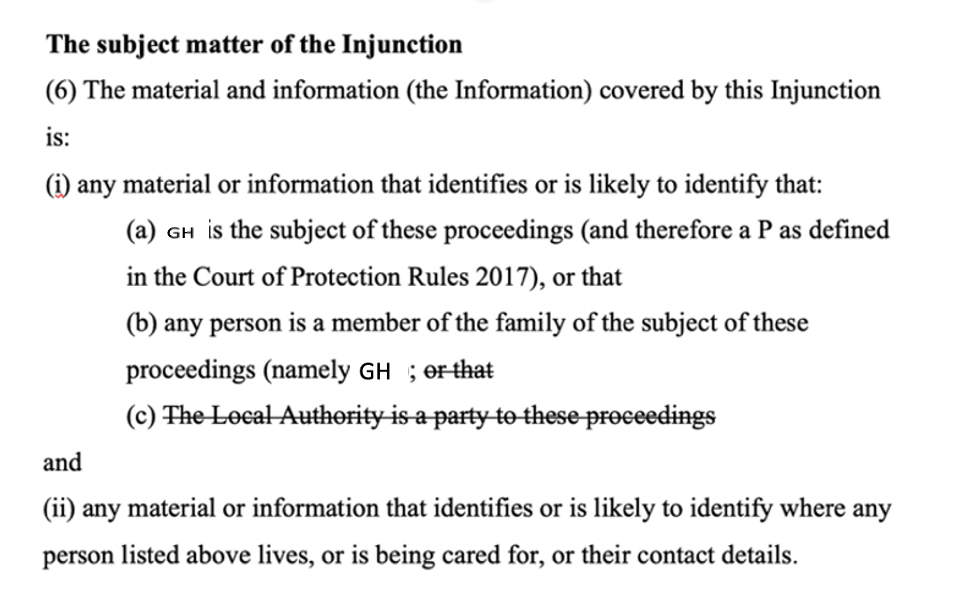
The subject matter of the Injunction

6. The material and information (the Information) covered by this Injunction is:

(i) any material or information that identifies or is likely to identify that:

[…]

(d) any professional or organisation that is involved with the planning,

arranging, commissioning, reviewing, regulating and/or monitoring PC’s

care

I took the opportunity to email the staff member back asking her to raise the TO with the judge:

Dear XX 

Please could this be brought to the attention of HHJ Tolson. Thank you.

Dear HHJ Tolson

I am a public observer and core team member of the Open Justice Court of Protection project. I am hoping to observe a hearing before you this afternoon. 

I would like to clarify the TO for the case COP 11868452. 

It is 6(i)(d) that I wish to clarify. I read this as meaning that I CAN name a provider public body (such as a Local Authority or an NHS Trust) in any reporting about the public hearing. 

If I have misunderstood the wording of the TO and the “professional(s) and organisation(s)” included in “planning, arranging, commissioning, reviewing, regulating and/or monitoring” P’s care are indeed public bodies involved in the provision and delivery of care, I would like to request a variation of the TO to enable me to name any public body that is involved in the case. I understand that there must be careful consideration and balancing of Article 8 and Article 10 rights in a decision such as this. It is unusual for us to be required to conceal the identity of public bodies – paid for by our taxes and publicly accountable for their actions.  

Many thanks for your consideration of this matter and thank you for your support of open justice.

Yours Sincerely

Dr Claire Martin

Public Observer and Core Team Member of Open Justice Court of Protection

HHJ Tolson didn’t refer to my query in the hearing (which judges often do, because the query relates directly to the transparency of the case, and it is far more efficient than needing to address the issue after a hearing has ended).

I didn’t receive a reply, so I sent a formal application via a COP9 form on 20th October 2024 requesting that the Transparency Order is varied to enable the naming of the public bodies involved in P’s care. This is what I said: 

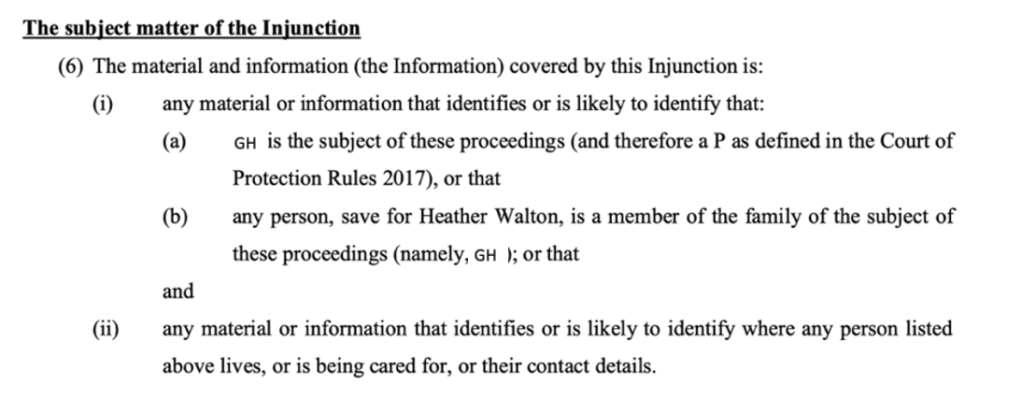
Update: On 15th November 2024 I received an email from the court attaching an amended Transparency Order. It was the previous Order, amended in red. Here’s the front page.

And paragraph 6 had been amended as I requested. Here’s how it looks now.

Success! Ir would be even better if the court could get it right first time in future.

Claire Martin is a Consultant Clinical Psychologist, Cumbria, Northumberland, Tyne and Wear NHS Foundation Trust, Older People’s Clinical Psychology Department, Gateshead. She is a member of the core team of the Open Justice Court of Protection Project and has published dozens of blog posts for the Project about hearings she’s observed (e.g. here and here). She is on X as @DocCMartin and on BlueSky as @doccmartin.bsky.social

A protracted hospital stay: A next hearing in the ‘renal failure’ case

By Celia Kitzinger, 3rd November 2024

At the end of October 2024, a man in his forties with Down Syndrome and learning disabilities, was removed from his home and transferred to hospital against his own and his father’s wishes.  

The ‘extraction and conveyance’  (as it had been referred to in the earlier hearing, reported here) went better than expected.  No physical restraint was required. 

The hospital assessed him, diagnosed Stage 5 kidney disease (which means he needs dialysis to stay alive) and inserted a tunnelled line. The subsequent dialysis sessions have gone well – and perhaps surprisingly – his father, who has never left his side, has encouraged and supported him to have this treatment while he’s been in hospital.  

Now the case is back in court for the next decisions that need to be taken.

The Honourable Ms Justice Sonia Harris

The judge who authorised DM’s transfer to hospital is a new High Court judge, Ms Justice Harris, who only took up the appointment a month ago: there’s a photo of her (and some information about her) on the ‘new appointments’ website.  She’s a family law specialist and was formerly a law professor at the University of Birmingham: she’s published books on family law, the future of legal education and the law profession, and aboriginal child welfare in Australia and Canada.

A few weeks ago (at the 18th October hearing), she made a difficult, but ruthlessly logical, decision not to authorise the immediate forcible removal of this vulnerable man (DM) to hospital until one more attempt had been made to support his father to bring him in voluntarily. That attempt was made the day before the earliest day that the forcible removal could be done (so didn’t delay his admission or treatment) – so although it didn’t work out, and it was necessary to implement the Trust’s plan (which she authorised on 21st October),  involving a special ambulance and the police the following day, at least everything was done that could have been done to secure the father’s cooperation before moving to coercive measures. Other than creating some anxiety and uncertainty for Trust staff about the possibility of DM and his father turning up at the hospital earlier than expected, it’s hard to see any negatives to this. It was a good decision.  

I was immediately struck by the judge’s supportive and facilitative approach to transparency.  She told the three observers that we were “very welcome”, checked that we had the Transparency Order, and authorised sharing of the parties’ Position Statements, which her clerk then sent out to all three of us.  

She’s obviously a desperately-needed appointment: when trying to find a date for a next hearing in this case, it turned out she had no availability for a one-day hearing before February 2025.  It seems quite likely that when this case comes back to court, it will be heard by a different judge.

What are the issues before the court?

The problem now is that DM is medically fit for discharge (subject to recovery from a recently acquired respiratory infection which is expected to clear up after the weekend) – but he’s going to continue to need dialysis three times a week for the rest of his life.

If he returns home, it’s very unlikely that his father will voluntarily bring him to hospital, or to a clinic, for dialysis ever again.  That’s because the father’s view is that there is nothing wrong with his son.  The doctors, he says, are fabricating his son’s  illness –in fact they want to kill him. He believes that professionals are not safe to be left with his son, and he stays by his son’s side at all times.

So, rather than let DM return home (which is what he wants and his father wants),  the local authority is looking for a supported living facility for him.  The judge was being asked to authorise DM’s deprivation of liberty in hospital until a suitable placement was found – which was envisaged to be 3-4 weeks, given that a potential placement had been identified and he was being assessed for it that very afternoon, as the court was sitting.  A deadline of 22nd November was mentioned as a plausible date for a next hearing to authorise DM’s discharge to this placement, on the assumption that they would accept him.

What happened at the hearing?

The hearing lasted a little under an hour and the (represented) parties seemed to be in agreement on the way forward.  

There was some concern that DM’s father, who has been joined as second respondent to the case, and does not have legal representation, was not in court.

On behalf of the applicant Trust (the Royal Free London NHS Foundation Trust), Victoria Butler Cole KC reported that there had been “strenuous efforts to persuade DM’s father to join the hearing” and there were “people on the ground with a laptop able to facilitate his attendance” from the hospital, but he’d made it very clear that he would not attend.  He doesn’t believe that there are real court proceedings – he thinks the court orders are “fake”. The Trust is asking the judge to authorise DM’s continued deprivation of liberty in hospital, after he is fit for discharge.  This is because they accept the local authority’s conclusion (not yet, as the Official Solicitor pointed out, endorsed by the judge) that DM should not return home but should move to a supported living placement as soon as practicable. In addition to the DOLS-authorisation, the local authority (said the Trust, who supported this) was asking the court to make orders against the father to allow them to assess DM when the father is not around (essential for a capacity assessment relating to contact between DM and his father, for example).  Counsel for the Trust  reported the advocates’ agreement that there should be no penal notice attached to these orders since it’s not clear whether DM’s father is capable of understanding the injunction, it’s unlikely that a penal notice would have a material impact on his compliance, and “no one can envisage a situation where seeking to commit him for contempt of court could be the way forward”.  

On behalf of DM via the Official Solicitor, Sophia Roper KC reported that although the OS had given anxious consideration to DM returning home in the short-term (while a supported living placement is sourced), the view was that this is not likely to be successful – which I took to mean that DM would miss his dialysis appointments, with the result that the distressing ‘extraction and conveyance’ plan would have to be repeated “and is likely to lead to a greater degree of upset and trauma in the long run”.   

On behalf of the Local Authority (the London Borough of Barnet), Katie Scott said that of the options available to the court, “remaining in hospital, though not very palatable, is better than returning home”.  She ran through some of the (unsuccessful) efforts that had been made to support DM’s father to understand and believe that his son is ill and that the hospital treatment will help him, and said, “it’s almost impossible for [DM’s father] to comply with a court order that he doesn’t accept is real when he also believes that the hospital is trying to kill his son”.

Bad news

At 14:32, Katie Scott faltered in her submissions and then reported the contents of an email that had just appeared on her screen.  “I’ve just been notified’, she said, “that the care providers who have gone in to see DM today are not going to offer him a place. That’s very disappointing. It would have been perfect for him.”

Suddenly it didn’t look at all likely that DM would be discharged on 22nd November after all. There was no backup plan – no ‘second choice’ placement possibility standing by.  Everything was (in the judge’s words) “in undefined free fall”. 

Counsel for the Trust said that they were not going to discharge DM if there was nowhere for him to go, but they’d already been “nervous” about keeping him in hospital three or four weeks after he was fit for discharge and now it looked as though a much longer time would be needed.  

The Official Solicitor said she was “very unhappy at the idea that the timing will slip” and urged the local authority to take action (for example by “commissioning an independent social worker to do a desk top search”), making some rather sharp observations about the local authority’s failure to comply with a previous court order and the inadequacy of “pressures of other work” as a legitimate explanation for any future failure to comply: “The LA said they would make their ‘best efforts to comply’ with the order but last time they did not in fact comply and the OS is not making a fuss about it because we are all trying to find a productive way forward, but there will be a limit”.  She also dropped in a concern about “the stage to which DM had to get to before this was eventually brought to court” – which I took to be a complaint about the local authority’s repeated attempts over some time (during which DM’s health deteriorated) to support the father to get DM to hospital for assessment and treatment before the Trust eventually brought the case to court.  Despite the ‘inquisitorial’ (rather that adversarial) approach of the court, there is clearly some friction between the Official Solicitor and the Local Authority in this case.  

It’s not clear now when the next hearing will be, or who will hear the case:  the judge was over-committed already, she’ll investigate other judges’ availability (although 2nd December was mentioned as a possibility if a five-day-case she’s hearing in Birmingham doesn’t require the full five days).  The judge is “maintaining hope that [DM’s father] will attend”. 

The hearing ended rather sadly, with the judge saying: “I’m very pleased DM is tolerating the treatment and that his health is stable, but obviously there are significant concerns about where we go next”. 

Reflections

Unfortunately, it looks as though DM (and his father, who will not voluntarily leave his son’s side) will be living in the hospital for many more weeks until a suitable placement is found for DM.  

There’s also likely to be a problem with care and residence arrangements once a placement is found. The father wants DM to return home and will undoubtedly oppose his removal to a supported living placement.  The point was made that he’ll want to simply move in with DM in his new home, which is why capacity and best interest decisions around “contact” need to be determined.   The projected contact restrictions will be distressing to both father and son. 

In the words of Victoria Butler-Cole KC, “it’s far from obvious what the right answer is in this case, and there are going to have to be some very difficult best interests decisions“.

From what I’ve seen of this case so far, I am optimistic that this judge (if she keeps the case) and these highly experienced, skilled and compassionate advocates, are in a position to arrive (eventually) at a solution that will cause the least harm and most benefit possible to DM and his father – although how they will do that remains to be seen.

Celia Kitzinger is co-director of the Open Justice Court of Protection Project. She has observed more than 580 hearings since May 2020 and written more than 100 blog posts. She is on LinkedIn (here), and also on X (@KitzingerCelia) and Bluesky @kitzingercelia.bsky.social)


An urgent case: Renal failure and an application for forced ‘extraction and conveyance’ to hospital

By Claire Martin, 31st October 2024 

P is a man in his 40s, with Down Syndrome and learning disabilities. Two years ago, in 2022, he was diagnosed with ‘significant renal problems’. They’ve been difficult to monitor because P’s father, with whom he lives, is said to believe that doctors intend to harm his son.

The applicant NHS Trust (the Royal Free NHS Trust in London) says that P’s life might now be in danger.  The Trust is seeking authorisation to remove  from his home (by force if necessary) to hospital so that further tests can be carried out and decisions made about treatment in his best interests. 

I’ve observed two hearings in this case (COP 20000635) before Ms Justice Harris at the Royal Courts of Justice.  First, an urgent (remote) hearing on Friday 18th October 2024, and then a hearing three days later on Monday 21st October 2024. I’ll first describe the first hearing in some detail, to convey the complexity of such pressured decision making in the court. Then I’ll summarise the judgment in second hearing, which was predicated on the aftermath of the first. I’ll end with some final thoughts about urgent medical decisions in the Court of Protection and plans to forcibly remove someone from their home. 

18th October Hearing 

This first hearing consisted of some quite detailed opening submissions and then witness evidence, and cross-questioning of the witness. I’ll cover each in turn.

Opening Submissions

Victoria Butler-Cole KC represented the applicant NHS Trust. Sophia Roper KC represented P, via the Official Solicitor. P’s father is also a party to the case but (I think) has never attended court for any of the previous hearings, and he wasn’t at this hearing. 

I reproduce the opening submissions[1] by both counsel in full because I think they give a flavour of how urgent applications are made to the court, and the types of really difficult decisions judges are faced with, when pressure of medical urgency is presented to them.  

As I listened to the submissions, I wondered what I would do if I were the judge. As you read them, you might usefully consider what YOU would do, faced with this information.

Victoria Butler-Cole KC gave a helpful introduction to the case. I knew nothing about it in advance, so this brief summary made all the difference to my understanding of proceedings: 

For the benefit of the observers I can see online, the application by the hospital is for authority to implement a treatment plan for a 43-year-old man with Down Syndrome, learning disabilities and very severe kidney failure. On Tuesday next week, [conveyance] by ambulance, even if [he’s] resisting – [then] immediate blood tests taken [at hospital].  None [has been] taken since 30th August 2024. [He will be] sedated with general anaesthetic and, depending upon how bad his blood tests are, he will either be given hemofiltration or long-term plan for dialysis [with] insertion of a tunnelled line – and dialysis over the next few days. The reason for [this] plan being sought now is that P is known to be very severely affected by kidney disease. Since August, the court has made a number of orders and [there has been] repeated failure by [P’s] father to take him to medical appointments. Crucially, [there are] no further blood tests, so we don’t know how bad his condition is. On  [date in September 2024], P visited his GP and declined a blood test – his  legs were itching. This is a sign [that the] kidney is deteriorating further. [A] decision [was made] on 11th October … the offer was blood tests the following Monday, but despite indicating he would do it, his father did not take him for the tests. 

The Trust’s clear position is that the court needs to make this order urgently today. Steps need to take place between now and Tuesday to get everything ready and all agencies involved. The OS queries why it took until August this year to get proceedings issued, and the court reaching a decision in P’s  best interests. We are where we are, and the medical consensus is that P needs to come to hospital urgently. He either needs immediate hemofiltration, or dialysis in a number of days. He will reach the point [where he will] either die or reach a position where he can’t use the dialysis. Unfortunately, his father has a number of objections to facilitating P’s involvement with the treating team. Some relate to a historical complaint about his late wife’s care. The attendance note from the solicitor shows there are other issues – the bottom line is he doesn’t recognise or understand how important this is and doesn’t understand his son may die. The OS has raised a number of issues – one is why district nurses haven’t been able to go to the home and take blood tests.  We have tried, and the reason given is that P can get to the GP surgery. [inaudible] …. A very short and easy read [social story] for P  … he wasn’t able to get any benefit, but nevertheless a short document has been provided. 

The OS is concerned about the police. The police know they must not go in in a heavy-handed manner. The police are aware that they are not the first port of call. Further questions [have been] raised about the secure ambulance company – [and] physical restraint if necessary: have they got information about the risks posed to him about restraint? The consultant can explain – [the] first is that he has unhealthy bones – [there is a] greater risk of injury to P’s bones, and second is he is known to have some sort of breathing difficulty. He doesn’t breathe clearly [and to pay] particular attention to ensure the airway isn’t obstructed. Dr X [renal consultant] can give evidence about the plan, to be amended as required. If there are any questions, then Dr X and Dr Y [anaesthetist] can answer about sedation and anaesthetic. I would invite you to listen to that evidence and make a decision  today and then another hearing, possibly the week after next. The long-term question is how to go about giving P long-term dialysis and is it in his best interests to happen. To some extent, admitting him to hospital on Tuesday is recommending that it is in his best interests. Otherwise, he won’t have had a fair opportunity at maintaining his life. One question, if it is in his best interests, is whether [P can stay with his father]. The LA is involved with the family – they would need to identify what the options are if he is discharged somewhere else, not in the care of his father.” 

Sophia Roper KC, for P via the Official Solicitor, resisted the LA’s proposal on a number of grounds.  The order for forced conveyance on the following Tuesday could wait until Monday afternoon if necessary – and the father could be ordered to take P for blood tests on Monday morning, the results of which would make for more informed decision-making.  The transfer plan needs to be better developed to safeguard P. And neither P’s father nor the LA were in court.  She was particularly concerned about the father’s absence on procedural grounds of fairness, but also worried that removing P from the home now, without giving his father the opportunity to comply with court orders, would make an already difficult situation still more difficult.  She said: 

Counsel for P:Our position remains that we are supportive in principle, but we don’t agree that the court should hear the application or make a decision today, We propose [that the court] hears it on Monday. We were told when we arrived that it [the conveyance to hospital] wasn’t going to be until Tuesday because the police can’t be lined up until then. I appreciate …[inaudible] … [and my] submission is that this can be heard on Monday so [that a] proper amended plan can be heard on Monday. The application is based on [obtaining] blood tests. We were told [on the] 30th August that blood tests are the primary indication for this request to be dealt with VERY urgently. The only evidence since then has been reference to itching legs. In respect of blood tests, those blood tests were known to the Trust on the 27th September [when we were] last in court. [It transpired that P did go to the GP in September but refused to have the blood tests required. His itchy legs were observed, and this is known to be a sign of renal deterioration]. The OS doesn’t understand why this was not raised at the hearing. We do have numerous queries about the plan, and we have set some out in the Position Statement. The plan is important because it is the plan, not the order, which will govern the transfer. [There are] a number of agencies, working together –  they may not even have met each other before. It needs to contain all the precautions and safeguards. I don’t want to dwell on the history of this case, but the court cannot be confident about that. Our request is for adjournment – [father] has been served with [inaudible] – I asked Ms Butler-Cole at lunch if he’s been served with an injunction. I don’t know if he has. […] If he has, it can only have been late this morning. There is a simple requirement of fairness – proper notice. […] There is no suggestion that this is a proper case for ex parte … he appears not to have had adequate notice. So, the OS position is that the court should adjourn the substantive application until Monday, and join the Local Authority [LA] NOW; they are integral to this plan –  in particular anything around the easy read document and needing to communicate it to P, rather than simply saying we’ve produced it. The LA should be required to carry out welfare checks over the weekend, and [inaudible] we would ask that that is done by the end of tomorrow. We submit that the court should also make an order, not with a penal notice, directing him [P’s father] to take P for blood tests on Monday morning. If he does comply with that order, without imposing a penal notice on him, it will give some indication of what he would do but also gives the results of blood tests. If he does not comply, the court is in no worse a position. Court should direct that the LA attends on Monday – they were asked today and hoped that they could help with a number of things. The lawyer for the LA did not think he could assist, so decided not to [attend]. It’s not that he was unable to attend, he chose not to attend. They are integral and they should be here. 

We also ask that Private Transport UK has a representative available remotely and the same an appropriate contact from the police – though we recognise the chances of getting someone from the police is low. Earlier this week, the court heard a hearing and someone did attend from the private ambulance service. We would ask the Trust serves the LA with the order made today and everything is served on [P’s father]  by the end of today, including any application for an injunction and draft order and explanation of evidence on which the application is made. You will see that [P’s father] may have some of his own problems [referred to evidence from the October draft order]. He’s not my client but the court should be cautious about making an injunction against someone who may not be in a position to understand it.

Your Ladyship, although there have been orders including recitals for [P’s father] to do things, and he has elected then not to take P to appointments, there has not been an order to date that he take P to appointments. He should be given that opportunity. There is a window of opportunity for him to demonstrate that compliance. [counsel’s emphasis]

Judge: So [this is the] last chance, potentially, to avoid a highly distressing [situation which is] unlikely to provide the foundation for any long-term treatment of [P’s] condition

Counsel for P: That is entirely the point. To put it bluntly it’s all very well getting him into hospital – but it might destroy future [compliance]. We don’t know that it will. It’s not to say that district nurses won’t attend without investigating that further and getting blood tests through [P’s father’s] cooperation. It may be that he does take him in on Monday. The reference in the plan to other investigations … they could be done if he presented. The transfer plan has two alternative parts – one for immediate hemofiltration, if the blood test shows it is [necessary], then hospital will be 24 hrs ahead. If it’s less urgent,  then the hospital will still want to keep him in hospital, probably sedated in intensive care. There is a strategy with no exit plan – there are notional plans to discharge him somewhere else, other than with his father, but no consideration has been given to that.”
                                                                                                                                             

I gleaned from these submissions that: a) there have been several hearings for P before, in relation to his kidney failure and how to monitor it; and b) that the Official Solicitor is wondering why the NHS Trust is bringing the application as an urgent case, when (she said) ‘those blood tests were known to the Trust on the 27th September’. I think what she meant was that the Trust knew that the blood tests weren’t taken in September, and it was known that there were clinical signs of deterioration in P’s condition because he was scratching his itchy legs – which is a sign of kidney failure. And the OS was asking – why wasn’t anything done then?  My sense was that the OS was trying to establish: why now? And why so urgent that it has to be done by force, when all the usual steps (court orders and preparing P via a social story) have not yet been taken in relation to securing the father’s cooperation. 

The proposal by the NHS Trust did make me wonder: if it’s SO medically urgent, why are they waiting until Tuesday, four days ahead? 

Having heard these two submissions, the judge had to make a decision about whether or not to order P’s forced conveyance to hospital by ambulance on the following Tuesday.  (What would you decide in this situation?)

The judge expressed her emerging thoughts: 

“Ms Victoria Butler-Cole KC, I see some force in what has been said by the OS. In terms of urgency, well of course this is urgent, but on your own plan this cannot be implemented until Tuesday, which does give some time. You have the medical team here and their time is valuable – but [I see] three benefits.  [First, it enables us] to allow the Trust to address the concerns about the treatment plan and put as robust a plan in place [as possible]; Second, it does give the opportunity for [P’s father] to attend court, to understand, through orders made today, the point of seriousness this has now reached for his son and in terms of legal intervention, and gives proper notice and proper opportunity to consider matters and be heard, if he so chooses to attend. And we can be satisfied procedurally, [that] fairness [has been] afforded.  And, third and most powerfully, if there is still any prospect of avoiding this being done in this way, which will  inevitably be highly distressing for P and his father, we should take every opportunity to do so. If the order can be made today, that P is presented at hospital for blood tests on Monday morning, that will give us better information about his state of health and the clinical recommendations of the team. But I am concerned that if we don’t attempt it, and the plan of the Trust is implemented on Tuesday, we are on a pathway in terms of any long-term care for a chronic issue [and] we may have undermined prospects… […] It might not work and the adverse consequences for P are unavoidable – but it at least it gives an opportunity at this eleventh hour to see if can be avoided.” 

Counsel for the Trust said that the OS’s submissions did not ‘bear reality’, stating that even if P did go to the GP, the blood-test results would not be returned within a timeframe that would work. 

Harris J asked whether there was any reason that the court couldn’t order attendance at hospital rather than the GP. Counsel for the Trust said that hospital would be ‘more sensible’ but maintained that if P attended hospital on Monday, and needed immediate hemofiltration, the clinical team couldn’t delay treatment until after a subsequent hearing. This made sense – if P was seen at hospital and deemed at significant risk, then waiting to provide that treatment would be unethical. Counsel for the Trust continued: “I am concerned some things suggested don’t bear relation to what is achievable and realistic for P”. 

Counsel for P clarified that her submission was that the court would reconvene on Monday not Tuesday. The judge further queried the reasoning of the Trust’s position:

I don’t fully understand that submission. My understanding is, of course blood tests need to happen and clinical team’s [view] is that it is urgent. As I understood it, in terms of the treatment pathway, there is urgent dialysis or treatment options spread over a few days and blood tests will tell us what level of crisis it is at this point. I take your point – but I had understood two levels of urgency. On your own plan, it wasn’t until Tuesday that you were able to get the blood tests. Of course, if you can take them on Monday and they show imminent intervention [is needed] then that is what happens, otherwise then it can come back to court.”

This seemed eminently sensible to me. If P’s father did take him to hospital, as ordered, for the necessary blood tests on Mondaythen the clinical team would be in possession of knowledge about P’s condition earlierthan they had planned in the proposal (which was Tuesday, by forced conveyance). 

Counsel for P insisted: I will quickly make a point:  obviously were P to get to hospital voluntarily, it would be immensely preferable than by ambulance with restraint.

Following the judge’s suggestion that the court could decide to make an order for P’s father to take P to hospital on Monday morning, counsel for the Trust wanted to establish that there would be ‘no delay to the Tuesday plan’, were that not to happen. 

Counsel for the Trust:

I would just draw your attention to the fact that the solicitor had tried to explain to [P’s father] that it is in P’s best interests to have the blood test. It reignited his anger and he said it was P’s decision and he asked for the name of the judge, and said he would publish it all over the world. My submission is that it is highly unlikely that he is coming to hospital on Monday morning. 

So, whereas the OS wants to give the father one more chance to cooperate in securing his son’s medical treatment, the Trust’s view is that this simply won’t work and that things are beyond that point already.  

Witness Evidence

Next, the consultant responsible for dialysis, Dr X, was sworn in. 

Counsel for the Trust had been keen for the clinical team to give evidence and to have an opportunity to explain why they believed their plan to be the most persuasive. 

Dr X explained that P was likely to need urgent treatment of one form or another and that the plan that they had formulated meant that P wouldn’t be waiting in areas of the hospital unnecessarily, which was why (even though they were now saying it was urgent) they weren’t proposing to do the tests over the weekend. She said that Tuesday would be the safest day with resource availability planned to make P’s experience as smooth as possible. She was clear that ‘it is very important that the court understands’.

Counsel for the Trust enquired whether attending somewhere else in the hospital would mean that the blood results would be ‘obtained more swiftly’. Dr X explained that in A&E P could be ‘moved through more quickly’, but expressed concern that, should the blood results suggest urgent treatment was needed, the clinical team would ‘have no powers to hold him in hospital unless he was so clinically unwell we could invoke the usual processes’. She also confirmed that she was worried that, if P did attend A&E, and if he did have the blood test, he would be free to leave whilst the results were awaited. 

Counsel for the Trust asked Dr X about her views on the ‘other suggestions’ that had been made by the OS:

Dr X: They are based on a number of false assumptions. Being fair to P’s father needs to be balanced with what can be put in place for P.  There has been a repeated pattern of behaviour from [P’s father] over two years – that’s not going to change just because a court order has been put in place. [P’s father] has a profound suspicion of hospital medical professionals. He has taught P to think that doctors will kill him. P believes they killed his mother. [It has] been instilled in him over a period of years. The chances that he [P’s father] will cooperate with a plan to bring him to hospital on Monday is very low indeed. He wouldn’t understand what the blood tests will mean on Monday – I have no reason to believe that [P’s father] would allow P to pop into the ambulance – I don’t think it’s helpful. I understand the rationale and have sympathies with not wishing to do harm to P, but that’s based on my and others’ knowledge over the years.

Dr X was then cross-questioned by Sophia Roper, counsel for P. Dr X confirmed that P had attended hospital as recently as 1st October, for a CT scan. She explained this was because no needles were involved (and he believes that needles mean doctors are going to kill him). Dr X also explained that, at the beginning of September, tests suggested that P had ‘severe renal problems but nothing of a life-threatening nature’ and that she has become increasingly concerned, week by week, that, without blood tests, the extent of P’s kidney failure is unknown. She emphasised ‘When someone has poor kidney function like this, it’s not uncommon for them to be without symptoms – people tend to think there’s nothing wrong, when in actual fact they are in an extraordinarily vulnerable position’. 

It is understandable that when medical facts are presented so starkly, alongside a clear plan for how to investigate and treat the patient, the way ahead might seem obvious. But that would be to conflate the medical facts about a person’s health with how (not what) care is delivered. 

I found counsel for P’s forensic logic an instructive lesson in not conflating the question of what should be done with how it should be done.  

Counsel for P: We don’t take issue with the point that he is extremely fragile and vulnerable. There is no dispute between the Trust and the OS on that point. It is the way in which he comes into hospital. 

She then took the witness through detailed questioning about what the process of attending at different departments in the hospital would entail. What time will be allowed to ‘persuade’ P to comply? What time is P anticipated to arrive at hospital? How long do the blood tests take to come back? 

Counsel for P established that some blood test results were almost immediate and some took up to 90 minutes. Why can’t P therefore be directed to turn up (on Monday) at 11.30am, when blood results would then be back by 2pm latest? Dr X explained: No, because if he’s directed to come to hospital, it’s different to going to phlebotomy

Counsel for P: Why can’t he be directed somewhere he can get the [quickest results]? 

Dr X: That is possible, obviously assuming he turns up at all.

Counsel for P: Of course, but it would be the same speed the following day.

The flavour of Dr X’s answers was essentially about the level of perceived control the hospital team had over the situation, once P was in hospital. Of course, if the Trust’s proposal was endorsed by the judge, then P’s father (on the Tuesday) wouldn’t even be at the hospital – a far preferable scenario for the treating team. Whereas, Counsel for P was suggesting a plan that would mean P and his father would (if they complied) be at the hospital together, and Dr X was concerned that, in the unlikely event this happened, P’s father would attempt to leave the hospital with P, regardless of the results (if he waited for them at all). 

Dr X confirmed: “It’s possible but it puts us into an uncontrolled situation. We would be approaching them and saying ‘blood tests are abnormal and you need to stay’, without having lined up and in place behind that, what to do if they say ‘No’.”

Dr X went on to say that everything had been lined up for Tuesday: secure ambulance transport, Local Authority staff known to P, police presence, where the tests are carried out (not in A&E), bed space, an anaesthetist available for a full day, consultants that know P. The hospital had clearly put a lot of thought into making sure that resources, in the form of people on the ground, were available in a planned way on the Tuesday. 

I was impressed by the forensic manner in which counsel for P cross-questioned Dr X, however. Although the hospital plan seemed eminently sensible (from a controlled, clinical, perspective), counsel for P did not lose sight of the fact that the plan, if it was initiated, would mean forcible removal (what they referred to as ‘extraction and conveyance’) of P, likely with restraint, and potential need for police intervention if P’s father became aggressive. This would be likely to be traumatic for P – surely better to be avoided if at all possible? 

It transpired that the plan itself had not been discussed with P, nor was it included in the easy-read documents provided to him outlining the plan (in general, rather than the specific ‘extraction and conveyance’ plan). 

Counsel for P: I am trying to work out when this plan is going to be put to P. If you don’t know, please say you don’t know. The plan earlier this week with the learning disability nurse, suggested that the learning disability team complete a social story with P about the upcoming admission, then another for a joint visit with two other Local Authority staff (Social Worker and Learning Disability nurse) …

Dr X: That’s correct but P’s father cancelled the visit.

Dr X couldn’t inform the court about whether it was still hoped that the social story meeting would happen, which meant there was doubt as to whether any explanation of admission plans would be offered to P before his ‘extraction and conveyance’. How would he know what was going on? It was sounding quite frightening for P. 

Further questioning about the ‘extraction and conveyance’ plan focused on chemical and physical restraint, under what circumstances and where these would be administered, exactly where the police will be standing when the secure ambulance service knocks on P’s door, what the police know about P’s father’s views (Dr X: What we have conveyed to the police is what we know – that he holds a number of very clear beliefs about what would happen to P if he goes to hospital. Obviously, they’re not normal beliefs). 

Dr X then gave evidence about the potential clinical interventions once in hospital: the worst-case scenario would require general anaesthetic and critical care for renal replacement therapy; if the results suggest less urgency, then dialysis in a number of days would be indicated. He will require what Dr X called a ‘tunnelled line’, which, she explained (unlike an emergency line at the side of the neck) is situated further down at the front of the chest, near the armpit. Dr X: It’s undeniably present, but it doesn’t stick out of your body, and does need to be kept dry. […] For the first few weeks, it’s thoroughly covered and sutured [in place].

Counsel for P explored how P would be prevented from pulling it out. Dr X explained that, ordinarily it is removed under local anaesthetic. It sounded like if P did try to pull it out, it would be extremely painful. The hospital had lined up 1:1 nursing and the Local Authority had confirmed a known support worker for 8 hours a day for the time that P was in hospital. Dr X said that P would be ’distracted and kept busy’ to attempt to prevent him from pulling out the line. 

It did seem to be a very detailed plan with various staff lined up to provide support, both during the ‘extraction’, at hospital during investigations, and afterwards, to facilitate whatever treatment was needed. 

The judge then questioned Dr X to clarify exactly what would be the disadvantages to the clinical team of implementing the plan proposed by the Official Solicitor. That was an interesting exchange: 

Judge (J): Thank you Dr X. [What are the] advantages and disadvantages of each approach? What is being suggested is a possible order today for [P’s] father to attend with his son on Monday morning at hospital, for the purpose of taking blood tests. I understand from your answers, that it can be done in such a way that will work most effectively, [for an] order to come to clinic for blood tests and results in an hour and a half. You don’t see that as something the hospital couldn’t accommodate on Monday morning? 

Dr X: He would need to come to A&E. I am not bringing someone to outpatient phlebotomy – it doesn’t sit within their normal remit […] I know we’re talking about subverting …

J: I am not suggesting subverting anything…

Dr X: If we are trying to avoid restraint the order would have to say he would present to A&E and that he would have to stay until the results are back.

J: I am trying to understand advantages and disadvantages – the Monday or the Tuesday. You say on Monday he would have to come into A&E, is that correct?

Dr X: Yes. One test is not available unless he comes through A&E.

J: But that’s what you plan on Tuesday. To bring him into A&E?

Dr X: Yes – also A&E because it’s a safe place to have those tests.

J: So, if [he attends] voluntarily on Monday morning and takes the tests, what prevents you taking them on Monday? 

Dr X: If he comes into A&E on Monday morning, same …. way.

J: OK so … if that process takes place and the bloods are taken and he leaves with his dad, and [there’s] no restriction on him doing so and you don’t stop him, what is the disadvantage to YOU in terms of clinical decision making, in having those tests back and knowing what you are facing? [judge’s emphasis]

Dr X: I think it’s about the decision I would be making would be different. At the moment, I am making a decision it’s better to wait until Tuesday when we have resources in place – police etc… an allocated renal consultant, weighing up against benefit of waiting longer. As a team we think it’s better to do that on the information now. If he attends and has blood tests Monday, that completely changes my decision making – I can’t say …. for example, [that I] know it’s fine to wait until Tuesday, but I might know his life is at risk and he needs to be brought back to hospital urgently and we wouldn’t have those resources in place, but morally I would have to be trying to get him to hospital – I might be sending an ambulance – contacting court for emergency order, he might be coming in at night…

Dr X was clearly concerned about a process that had multiple uncertainties, and the team had decided that, whilst urgent, a more managed process of bringing P into hospital was preferable, which meant delaying for another four days. The judge, nevertheless, followed her line of questioning about the advantages and disadvantages to the clinical team

J: I understand – don’t misunderstand me,  I understand the difficulties of this. In a sense, ignorance is bliss to some extent. Once you are possessed of the information you might need to bring him in, but if you don’t have it until Tues morning you are not in that ethical dilemma?

Dr X: You can only make decision based on the information you’ve got. If he had blood tests, we would struggle to bring him in any sooner anyway. It probably wouldn’t make a great deal of difference. I think there’s something about the futility of this and context of multiple, multiple …. I don’t understand why this was not mandated by court previously. [Dr X’s emphasis]

J: That’s not my focus today. … So, it may still be the right decision that nothing is done until Tuesday, to have the wraparound care, but what you might be possessed of is information about IMMEDIATE life and death care [that] otherwise, you won’t have the immediate benefit of. [That is] one potential beneficial outcome for him?  [judge’s emphasis]

Dr X: I don’t understand why you’d wait until Monday on that basis. If the intended benefit …. If your point about dealing with an urgently life-threatening result is the driver, why would we wait until Monday?

J: I am trying to understand the various advantages and disadvantages. In terms of benefits to the hospital and yourself as a clinical team, is there any benefit to you in having clearer knowledge and understanding before he is extracted and brought to hospital – any benefit to you as a team, whenever they are taken, of are you down pathway 1 or pathway 2? Rather than taking blood, waiting and then plan?

Dr X: Yes there’s an obvious – knowledge is always a good thing but what I would say is that if P does attend for a test on any day and it shows we need to initiate immediately – then it will need to be immediate …

J: From a hospital management point of view, does it make any difference as you’ve said, in attempting to get these blood tests via their own free will on a Saturday ..

Dr X: It’s a resource issue – for theatre and anaesthetics it’s an issue, not A&E. Staffing and numbers on duty at the weekend are significantly reduced. So, there are issues. As we discussed when we weighed up the pros and cons in the absence of blood tests, we decided it’s better to do it in the calm light of a fully resourced weekday, and the police have already told us they will struggle to commit the resource. But of course, we would have to act if the bloods showed [P’s life was imminently in danger].

J: All right thank you Dr X. That’s helpful.

So, the balance was between enabling a better resourced, calm and controlled situation at the hospital (but P being forcibly ‘extracted and conveyed’) and a less controlled, more unpredictable situation at hospital (but- potentially, in the OS plan – P attending voluntarily with his father) and avoiding the distress and likely physical restraint at home. It was abundantly clear that the hospital had no expectation that P’s father would obey such a court order, and Dr X expressed some frustration that the court had not acted sooner (seemingly at earlier hearings). 

I kept wondering what I would do in the judge’s shoes. I was struggling to understand why not make the court order for P to attend hospital on Monday? If he attends, the team has information about P’s condition earlier, even if he leaves and they then need to enact the ‘extraction’ plan. If he doesn’t attend, nothing has been lost and procedural fairness (for P’s father) has been followed. 

After a break of ten minutes for counsel to take instruction, their positions remained the same. 

Victoria Butler-Cole for the applicant Trust: 

“I have had a helpful discussion with Dr X and Dr Y (anaesthetist). We don’t have an objection to the court listing another hearing to allow [P’s] father to have a chance [to attend court] – but we don’t support a court order for him to take P to hospital prior to that time. The results won’t be in for 90 minutes on that afternoon. If they are bad the doctors will be clinically and ethically obliged to act on them. [This will] involve sending an ambulance to wherever he is – home or the Royal Courts of Justice, if he has attended with his father. That will mean that the sorts of steps in a carefully planned treatment will be done on a Monday evening, there won’t be staff familiar with the plan, to execute it, on duty, and none of the planning that has been put in place – and my instructions are that it won’t be as safe.”

The judge, again, found this argument difficult to understand logically: 

“Sorry Miss Butler-Cole, if that’s the clinical decision that it is a better and safer route to await until Tuesday morning, what is the ethical dilemma? Either the results come back and if they are so, so, so concerning that it can’t wait, then surely, it’s better to know that information; otherwise, it risks the life of P. If they’re bad but overall, it can await until Tuesday for a safer extraction and treatment plan, that’s in the best interests of the patient. I am struggling [to understand]  how being possessed of the information …. how can that be a bad thing for the clinical team to be possessed of that information in terms of a decision to treat P?”

I found myself flip-flopping between positions. The strength of the argument from the Trust clinicians was powerful: they know P’s father, they have tried and tried and tried to secure his cooperation with treatment for P, they are worried that if (and to them it was a big if) P attended hospital on Monday, all of the careful plans for tests with familiar clinicians in attendance, dedicated community team support staff on hand and secure ambulance and police back up would be derailed. 

Counsel for P then made lengthy final submissions, with the most (for me) persuasive point being: 

“Arguably [this is a] draconian retrieval plan, everybody can see the long-term risk to compliance. The argument about not making an order for Monday. The OS shares the court’s struggle with the logic of that. If P comes in on Monday and urgently requires treatment and legal authorisation is needed, s4 Mental Capacity Act [can be used]. If resources are there, then the hospital can do it. It may be the bloods are such that it is immediate; it may be it can be explained to P. If clinicians think it’s a bad idea, he is no worse off than under the Trust application. But if he is seriously ill on Monday, it must be in his best interests to receive it then, than for clinicians to remain in ignorance until Tuesday.” 

After setting out the various issues that were not in contention, and the detail of counsels’ submissions for those that were, Ms Justice Harris delivered the following judgment: 

The issue for the court to determine is whether or not [P’s] father should be ordered to attend at hospital on Monday. I am going to make that order. 

I am satisfied that making that order is in the best interests of P and the advantages of such an order clearly outweigh the disadvantages. It also gives, in my judgment, a final opportunity, a lesser draconian and proportionate approach with engaging [P’s] father’s compliance with best interest orders of this court. What the Trust seeks is of course a very draconian intervention on Tuesday – it may well be the only approach in the best interests of P on Monday – but it is incumbent on the Trust and this court to try to avoid every possible measure to avoid that if it can be secured. It would be for [P’s] father to attend for blood tests at A&E with P on Monday at 11am and to comply with the recommended treatment by the clinical team. 


In terms of the disadvantages of such an approach, I am satisfied that it is difficult to ascertain any disadvantage to P in attending on Monday morning, for blood tests, which give vital and important information to the clinical team as to necessary treatment. If his father attends with him , it will furnish the clinical team with vital information, and in my judgment the earlier they have that information, the better. First, it will help them to understand the urgency with which he requires treatment. It may be that he doesn’t require urgent treatment and that Plan B …. [can be put in place] and [they can] seek to implement dialysis in a planned way. In my judgment that will be important information for the clinical team on Tuesday if extraction and conveyance is required. 

Alternatively, if the results suggest that such is the deterioration to P’s health that we are now in a critical position, it much surely be in the best interests of the clinical team [to know] as soon as possible. I appreciate that it places them in a difficult decision-making position, [they] may need to consider accelerating plans if the tests suggest a critical stage in his health. But it must surely be in P’s best interests that they are furnished with that information, rather than what has been described as deliberate ignorance and waiting until Tuesday. 

Whilst matters may be urgent it may still be in [P’s] best interests to await Tuesday, to ensure the best possible conveyance and safest. If required, an urgent application can be made for court decision-making around any accelerated plan. The court is available to assist. 

In my judgment, it will assist P himself in terms of any social story work to help with extraction — what is known about the urgency of treatment and what it will involve. And in terms of engaging [P’s] father. So, in my judgment, in terms of the benefits to P they are, firstly, that any extreme urgency is identified in terms of need for admission and treatment, the team can make properly informed decision making. And in terms of any admission, knowing in advance will assist them on Tuesday morning both in terms of explaining to his father and P at hospital. 

I understand the Trust are deeply sceptical that ordering [P’s] father to do this is not going to be successful – [he has] not engaged over a long period. I am clear that every proportionate step must be taken.  [P’s] father has not yet been ordered by this court to attend for any blood tests. The next proportionate step is to make that order and give him the opportunity to comply before we go to that draconian measure. It may yield no positive result, but it is incumbent on us to attempt for the best interests of P and in the long-term best interests for treatment. And to engage [P’s] father in the least distressing way. In my judgment, P has nothing to lose. There are no perceived disadvantages for the clinical team, P or this court, being armed with the best possible accurate information. 

I am going to make that order in Ps best interests this afternoon and relist for 2pm on Monday afternoon.”

21st October Hearing

The hearing started at 2.35pm. Counsel for the Trust was now Parishil Patel KC. There were also two further counsel: a Mr Lockhart for the Local Authority (I think) and Jake Rylatt (I think, but I don’t know who he was representing). Sophia Roper remained counsel for P via the Official Solicitor (and was on remote link). 

Two witnesses (one for the private secure ambulance service and one a Social Worker) were also in court on the remote link.

P’s father had not taken him for blood tests that morning. 

Parishil Patel KC, for the Trust, submitted that they were seeking the same authorisation as before: that P be brought by secure ambulance to hospital the following day for investigations and appropriate treatment, using the least force necessary.

Sophia Roper for P said “we are happy to proceed as Mr Patel suggests”, subject to confirmation from the ambulance service that they understand P’s particular physical health vulnerabilities and understand the ‘personalised approach’ needed to keep him safe. 

The judge spoke to the representative from the ambulance service who confirmed that P’s needs were understood. 

A final issue that counsel for P raised was about the police. The Social Worker informed the court that, in fact, there was no guarantee that the police would be available the following day. Police attendance would be first response officers, not officers who had been briefed previously about the plan. The Social Worker himself was to call 101 in the morning and they would do their best to attend. This seemed very different to the definite police presence proposed at the hearing the previous week. It was later agreed that the court order would state that the plan would only go ahead if the police confirm their attendance in the morning. The transfer team (ambulance service, social and support workers) did not feel safe to carry out the ‘extraction and conveyance’ unless the police were present. Further, however, it was made clear that the police would not be involved in any restraint of P himself. 

Parishil Patel confirmed the final plan: 

The plan will be implemented in the morning of Tuesday 22nd October 2024. Police involved in the development of the plan have indicated that they should be able to attend the home, subject to other commitments that day. [Social Worker] will call the police to request their attendance and the plan will only proceed if the police are in attendance. The police will remain outside the property unless they are required to manage [P’s] father’s behaviour. The transport team is to manage P’s safe transfer to hospital. The police are NOT involved in P’s transfer to hospital. 

In the event that P and his father are not at the property on Tuesday morning, [the team] will attend later and if required on the Wednesday morning. 

If it’s possible to admit P to hospital, the clinical team at the hospital should have a good idea by Friday 25th October [about P’s needs]. 

Harris J then gave her final judgment authorising that plan. It is anticipated that the case will return to court on Friday 8th November 2024.

Final Thoughts 

I was struck, in both the Friday and Monday hearings, by the calm consideration that the judge and counsel for P gave to what were presented as the only realistic options for P’s medical needs to be addressed. 

Of course, in the end, the hospital staff were right: P’s father did not take him for blood tests, even with a court order. I don’t think that made the judge’s original decision wrong. The Trust’s prediction (of non-adherence to the court order) turned out to have been correct – but nothing had been lost by one last attempt at securing P’s father’s cooperation. 

I imagine it is very difficult to deny medical teams’ proposals in the face of what is presented as a requirement for a very urgent decision in their favour. However, in this case, the interim order did not detract from the Trust’s original plan at all – so I fully understand why the judge made the decision she did. I think it was right at the time Harris J made it. The problem with approving the Trust’s plan on the Friday was that (in Sophia Roper’s words) a ‘draconian’ order would have been made – without the last-ditch attempt to work with P’s father and avoid a potentially traumatic ‘extraction’ for P. 

But, it wasn’t to be.

So, then, on the Monday the Trust’s plan became the right decision. 

Ian Brownhill’s blog for the OJCOP project, on conveyance plans in the Court of Protection, suggests the following: 

“What a good conveyance plan looks like

In my experience, good conveyance plans consider the following issues:

  • P: Who is P, what is their prior experience of medical treatment, what are their future needs likely to be, how can we prevent their needs intensifying? What does P want?
  • Property: Where does P live? How do we extract them from that property? What is our lawful ability to enter? How do we physically enter?
  • People: Who do we need to be part of the conveyance? Is this a case where we need to use sedation (or even general anaesthesia) in someone’s living room, or is it a case where P will be driven to hospital in a family member’s car? Do we need other parties (perhaps a fifth P) to be involved?
  • Passing it on: Who do we need to share P’s experience with for the future? What can we learn from this case that we can pass on so that other professionals might learn from it?”

My observations of the two hearings certainly fulfilled the first four points above. I deduced from the Trust doctor’s evidence that the Trust and Social Work team have been working hard to ‘prevent [P’s] needs intensifying’, to no avail. The only query I had about the wider ‘system’ around P being less facilitative was the mention (at the Friday hearing), by counsel for the Trust, that P’s GP wouldn’t provide for district nurses to attend to P at home, with the aim of carrying out blood tests. The reason the Trust was given was that P can get to the surgery. This approach seems unhelpfully obstructive – especially when the concern was of significant deterioration to P’s health. Though it seems unlikely (should they have gone to his home) that P and his father would have cooperated, it would have provided another opportunity to avoid what will have been a ‘draconian’ and distressing experience for P last week, being forcibly removed from home and  from his father, possibly restrained both physically and chemically and taken to hospital for procedures he is terrified about. 

I hope that the ‘extraction and conveyance’ of P to hospital went as well as it possibly could for him. 

Claire Martin is a Consultant Clinical Psychologist, Cumbria, Northumberland, Tyne and Wear NHS Foundation Trust, Older People’s Clinical Psychology Department, Gateshead. She is a member of the core team of the Open Justice Court of Protection Project and has published dozens of blog posts for the Project about hearings she’s observed (e.g. here and here). She is on X as @DocCMartin and on BlueSky as @doccmartin.bsky.social


[1] These are accurate so far as my contemporaneous notes allowed me to type them. We cannot record the hearings, and some phrases are missed and there are likely to be some inaccuracies).

Treatment for Anorexia Nervosa: A brief directions hearing (with a new postscript on transparency)

By Daniel Clark, 28th October 2024

It was a first hearing for this case (COP 20003709) on 4th October 2024  and it was brief – about 25 minutes according to my notes. 

It was heard before Mr Justice Poole, who was sitting in-person at the Royal Courts of Justice. 

This was the first time I’ve seen a hearing in person. I arrived at the Royal Courts of Justice in plenty of time but it is worth stressing that when the Open Justice Court of Protection Project tells you to leave plenty of time to get through airport-style security and find the courtroom – believe them! Your belongings go through a scanner and you have to take a drink of any fluids that you have. 

I couldn’t see any obvious signs for the courtroom but I was assisted by a very helpful man at an enquiries desk, who gave me clear and precise instructions on how to find Court 39. After a pit stop at the café (conveniently in the direction I was heading) all I could do was wait outside the courtroom. 

This turned out to be an instructive experience. I didn’t know what type of case I was about to observe (I’d picked one at random). However, I deduced it must be a Serious Medical Treatment case because the waiting barristers were in ‘wigs and gowns’ compared to the less formal business attire that they usually wear for Court of Protection hearings. 

I also knew that the hearing was delayed because the one prior was overrunning – something I probably wouldn’t have known if I’d been on a video link but did know because one of the barristers was kind enough to tell me. After a long delay (over an hour after the listed start time) I got to see inside a courtroom that I have only ever seen via a video link. It was smaller than I expected but, in contrast to some reports of in-person hearings, I could hear clearly. 

Present at the hearing were two barristers. Adam Fullwood, of 39 Essex Chambers, was representing the applicant Trust – Barnet Enfield and Haringey Mental Health Trust. Fiona Paterson KC, also of 39 Essex Chambers, was representing CC via her litigation friend, the Official Solicitor. 

There was also a video link, on which was the Trust’s instructing solicitor (I didn’t catch her name) and one of CC’s treating clinicians. 

In a very helpful opening summary, counsel for the Trust explained that at the centre of this case is CC, ‘a 21-year-old woman who comes from a large Jewish family’. She has diagnoses of anorexia nervosa and (as I learnt from the Trust’s position statement) a major depressive disorder and autism. 

At the start of October, ‘there was an attempt at ligature [details redacted in line with Samaritans’ reporting guidance] […] It appears this time of year […] has been very stressful, and it may have been triggering. We’re going to look into that’

CC has restricted almost all nutritional intake and, as a result, ‘she is at risk of collapse’. CC has experienced numerous hospital admissions for the treatment of her anorexia, some of which included the use of restraint and force for ‘feeding’. Understandably, she has found these experiences incredibly traumatic, which is compounded by some previous traumatic experience(s) (I got the impression that everybody was trying their best to not say what this was). 

She has made it clear that she will ‘purge’ any ‘feeding’ given under restraint. 

The Trust was now seeking declarations that it is lawful, and in CC’s best interests, to not receive ‘feeding’ (or any other treatment for her anorexia) with the use of force, and that it is in her best interests too only receive the treatment (including ‘feeding’) that she consents to. 

The case came before the court as an urgent application at the end of September, and it was listed for the following week. This allowed time for the Official Solicitor to be formally instructed.          

The hearing was intended to be a full day, final, hearing. However, there were two pivotal reasons why this could not happen. 

First, CC and her parents could not be in attendance. This is because it was Rosh Hashanah, which is the Jewish New Year. As a result of their observance of this festival, they could not travel to the court and nor could they use electronic devices (so could not join via video link). CC’s parents, who want CC to make a recovery but also oppose the use of restraint, wanted to be added as parties and secure legal representation. 

Second, the Official Solicitor had not yet met with CC in order to ascertain her wishes and feelings. CC’s wishes and feelings appear to be ambiguous because sometimes she expresses views that indicate a wish for continued life. The Trust’s position statement stated that the meeting with CC needed to be in person because (according to her clinicians) she prefers face-to-face meetings and consultations.  

Both Counsel were seeking an adjournment, and the judge gave some case management directions. 

First, in light of the evidence currently before the court, he made interim declarations that CC lacked capacity to conduct litigation, and to make decisions concerning her care and treatment. 

Second, the judge considered when the case should be heard next. The Official Solicitor was seeking to instruct Dr Cahill but he had not yet been instructed, and it was possible it would take until November for him to file his evidence. Given the fact that the expert wasn’t yet instructed, I was a little confused as to how this could have ever been a final hearing. 

The judge would not be available in November, and so the case would need to be re-allocated to another judge. Despite making enquiries, he knew neither a date nor a judge for the final hearing. However, he was clear that he felt the case needed to be heard before an experienced Court of Protection judge – that is, not a deputy or new full-time judge. This was, he said, because of the complexity and sensitivity of the issues in the case, and not out of any disrespect for those other judges. 

Counsel for the Trust acknowledged that, now proceedings were live, the case could be listed for an urgent hearing if anything changed. 

This also meant that the judge could not give a personal commitment to meeting with CC if that’s what she wanted. However, he was “sure whichever colleague hears this case will be happy for that to be arranged”.

Third, the judge addressed the fact that the Order explicitly stated CC’s sisters could be joined as parties. Counsel for CC explained that this was “because it may be that her sisters have a different view about what should happen from that of her parents”.

The judge was concerned that “if it’s in the order, they might think I expect that” and he didn’t “want to signal that they should feel obliged to join”. Instead, the judge said they should be “told of their entitlement to being joined as a party” but that this needn’t be in the Order.

Finally, the judge asked whether CC already knew about the application. When he was assured that she did, he said this: “it might be important for her to know that the court is endorsing that she makes the decisions for now…and nothing will be done without her consent”.

Update: The next two hearings in this case were observed and blogged by Sydney White: Respecting autonomy in treating Anorexia Nervosa and “An in-person hearing on anorexia (Re CC): Observer’s rollercoaster and the role of ‘hope’)“. The judgment is published here: Barnet, Enfield and Haringey Mental Health NHS Trust v CC & Ors [2024] EWCOP 65 (T3) (31 October 2024)

Postscript re. the Transparency Order (21st November 2024)

On 7th October 2024 (the Monday after the Friday hearing), I looked over the Transparency Order again because I wanted to make sure that I hadn’t missed anything before writing this blog post. At that point, I noticed that on the face of the Order was CC’s full name and date of birth. 

When I realised this, I sent an email to one of the lawyers involved in the case, saying:

“I have read the Transparency Order, and also have a copy of it. I feel it’s important to point out that the protected party’s forename and surname, and date of birth, is on the face of the Order, though the Order is anonymised throughout [it later came to my attention this is incorrect – see below]. My understanding is that, as a general rule, Transparency Orders should be anonymous throughout. 

More specifically I am concerned that, if there are numerous people who observe the next hearing, the court office providing a copy of this form of the Transparency Order would de facto broadcast the protected party’s full name and date of birth to multiple members of the public. I wonder whether this ought to be amended in order to further safeguard CC’s Article 8 rights.”

I received a response from counsel on 9th October 2024 that said this: “I didn’t realise the TO [Transparency Order] you were given was not anonymised but I will raise this with the OS [Official Solicitor] and the court.” It was my assumption that, by the time of the next hearing, nearly two weeks later, the matter would have been resolved.

I was unable to observe that next hearing (on 22nd October 2024) but Celia Kitzinger and Sydney White did (see Sydney’s blog post about it here: Respecting autonomy in treating Anorexia Nervosa). On receipt of the Transparency Order, Celia noted that it still had not been anonymised. She also noticed (which I had missed) that the second page of the Order contained the name of two witnesses who were covered by the prohibited “Information” (the things we cannot publish). Celia immediately sent an email for the attention of Mr Justice Hayden, who was now hearing the case. She said: “I appreciate that the people who receive the TO will – in all likelihood – learn of these names anyway, and that §6 prevents us from reporting them, but it is unusual, and not recommended practice […] to name the people whose identities we cannot publish on a public document”.

Once the hearing started, the judge raised the issue in open court. He was also of the view that the Order ought to be anonymised. Despite my email earlier in the month, I understand that counsel did not display any evidence that this matter had previously been brought to their attention.   

I’m told that counsel then indicated that the names would be removed from a revised TO but as of today (21 November 2024) neither Celia nor Sydney has received a revised Transparency Order. 

It is not uncommon for members of the public to receive Transparency Orders that have not been appropriately anonymised. Sometimes (not in this case) P’s address is also not anonymised.

It is one thing to hear P’s name mentioned during a hearing. It is quite another to see it written down in a public document. In fact, a Transparency Order is rather self-defeating if it broadcasts prohibited Information. 

I am well aware that some lawyers do not think that this is a problem – we are, after all, bound by an Order once we receive it (as Celia acknowledged in her email to Hayden J).  However, as I discovered during research over the summer, it has been the intention since at least 2017 that a Transparency Order should be anonymised: see, “A review of transparency and open justice in the Court of Protection”, particularly s2 (“Not a best interests decision: Private hearings, closed hearings, and closed hearings”) and s6 (“When P’s privacy is not protected”).

Finally, it is clear from a subsequent blog post by Sydney White that insufficient thought had been given to the wishes of the young woman at the centre of this case with regard to anonymisation, and this caused distress to her, and anxiety to the observer on the occasion of the final hearing (see: “An in-person hearing on anorexia (Re CC): Observer’s rollercoaster and the role of ‘hope’)“).

Protecting P’s privacy is an important element of the Court of Protection being able to sit in public. More care needs to be taken that mistakes such as this don’t happen. 

Daniel Clark is a member of the core team of the Open Justice Court of Protection Project. He is a PhD student in the Department of Politics & International Relations at the University of Sheffield. His research considers Iris Marion Young’s claim that older people are an oppressed social group. It is funded by WRoCAH. He is on LinkedIn, X @DanielClark132  and Bluesky @clarkdaniel.bsky.social.

Moving forward in Re A (Covert Medication: Closed Proceedings): A social work perspective

By Meg Niven Withers, 25th October 2024

Editorial note: This is a second blog post about the same hearing we’ve already blogged about here: A is back home and taking her medication voluntarily: The final hearing in Re A (Covert Medication: Closed Proceedings). We are also planning a future blog post reflecting on this case as whole.

As a registered social worker/ academic, I have a particular interest in Adult Safeguarding and how the Court of Protection functions to safeguard and promote the legal and human rights of people who have been assessed as lacking capacity. I also want to better understand the experiences of service users and their families subject to what can be intimidating, complex and drawn-out proceedings in a system that aims to have their best interests at heart. Becoming a volunteer observer with the OJCOP has provided me with the opportunity to learn more about both of these things and the commentary here is a brief summary of some of my reflections on this occasion.

The start of the hearing I watched (COP 13236134 before Mr Justice Poole on Monday 14 October 2024, 2pm, at Sheffield Combined Court) was delayed because the protected party, A, had wanted to speak to the judge –  and at the outset he stated that he had taken the opportunity to explain to A the presence and the role of volunteer observers. In addition, he asked A and her mother (B) to move seats so that their faces were not seen in the video feed which seemed to me to be a concrete example of applying the Transparency Order to practice, even within a courtroom setting.

 Poole J asked the LA’s advocate to summarise the case at the outset but this was brief and focused on the positive outcomes that had been achieved since the previous hearing where Poole J decided A should return home. It is only because I have been following this case through previous OJCOP blogs and commentary that I was able to gain any understanding of A and B’s past history, the COP decision making to date and how this information played out in the hearing here.

A large part of the hearing was taken up with how A was to be represented and safeguarded in legal and practical terms if and when the court order was discharged. The ensuing discussion between the advocates brought my thoughts back to the central tension that exists within the legal framework between wanting to respect a person’s Article 8 rights to privacy and a family life while at the same time safeguarding a person’s health and wellbeing where they lack capacity, but also what that might feel like from the person’s point of view. The COP here is being asked to strike a balance between wanting to put in place the least restrictive interventions as possible while at the same time leaving room for state agencies and appropriate legal frameworks to be put in place in order to have some oversight of A’s health and well being over the longer term. 

There was consensus that the way forward would be through the discharge of the existing court order and an application made for  a Community Deprivation of Liberty (DOL) authorisation because although A is now living at home, she is not free to leave the house without support and she is effectively under continuous supervision and control. This set of circumstances means that the acid test is met as detailed by the Cheshire West decision for people who lack capacity to consent to agree to their care arrangements (P v Cheshire West and Chester Council and Q v Surrey County Council, (2014 UKSC19). It is a measure of Baroness Hale’s clarity and precision in communicating a complex idea that social care practitioners are very familiar the premise that a gilded cage is still a cage, and it was intriguing to hear it cited here by the representative for A (via the Official Solicitor).  Additionally, the  DOLS Code of Practice (2005) sets out  a number of questions  that have to be satisfied in order to make sure that any decision is made in P’s best interests, one of which is imputability to the state. In other words, there should be evidence that the state is responsible in some way for the deprivation of P’s liberty.  I was therefore intrigued, given that all the participants were very well aware of the protracted and difficult history of the case, to hear counsel for the OS spending some time setting out how the case was indeed imputable to the state, and citing case law in support of his request for a DOL authorisation. It seemed to me however that there was less time given to another key question, the (re) evaluation of whether the deprivation of liberty authorisation was indeed necessary to prevent harm coming to A but more a recognition of this is how A now lives her life at home and a desire to have some kind of legally acceptable oversight in place for what happens next. 

Certainly, on the face of it, A’ s return home has been a positive one with some aspects of the community access and support plan drawn up by the Local Authority now in place, albeit that other significant elements – such as finding carers that are acceptable to A and B – are still to be resolved. I did wonder if the implications of the decisions being made were apparent to A and B. The LA’s advocate observed that both were smiling when she commented that things were going well for them at home, but the reality is that they are likely to experience ongoing and significant state intervention with potentially daily visits from carers, fortnightly visits from health and social care practitioners, medical and hospital appointments etc. While living at home with her mother has been what A has been asking for all along, and the court has determined that it is in her best interests to do so, it may not feel like the least intrusive option given the level of scrutiny and stress they will be exposed to – a point alluded to by counsel for B when he requested that any visits should take place away from the home, explaining that B has OCD and is compelled to clean the house after any visit.  A and B haven’t always been aware of the decisions being made or accepting of the reasons why they were made and now they are being asked to place their trust in agencies and professionals and to work with them to achieve care plan outcomes.

Equally I was a little surprised therefore to hear that the DOL authorisation should be reviewed in 12  months’ time, in effect at the end of the authorisation period, given the concerns voiced on the implementation of the care plan and  who would act as A’s representative during this time. An authorisation can be reviewed at any point if there is a change in circumstances, but again I am unsure if A and B know that the LA can bring the case back to court at any time from what was said in court, other than a comment from the judge to say “that it all depends on what happens this year”.  It is likely that B will not be entitled to any further legal representation or Legal Aid after the hearing is concluded and there was uncertainty who would represent A going forward. Even when a Rule 1.2 representative is identified to speak on A’s behalf, there is the issue of continuity for A and B and how are they going to be supported to make play their part in what remains complex, and what are likely to be fraught decision making processes. My sense is that careful, sustained relationship building between professionals and with A and B is what is needed here to help them so far as possible to understand not just the authorisation but also how it affects them and to be able to meaningfully exercise their rights going forward. The risk otherwise is that mistrust of professionals endures, positions remain entrenched and the case is returned to the Court of Protection once again.

Finally, I also noted that the representative for B called her either mum or mother for the most part whereas the representatives for the LA and the OS called her Mrs X which seemed to me to be to a more respectful, less reductive, acknowledgement of B as a person. Both Poole J and the counsel for P (via the OS) took the time to thank and commend A and B on being in court but at the end, it was noticeable just how quickly both left the courtroom and without them speaking to or being acknowledged in turn by their legal representatives. 

 Research in 2017 by  Lucy Series and colleagues at Cardiff  University on The Participation of P in Welfare Cases in the Court of Protection has highlighted the challenge of promoting  a human rights model of participation based around the idea that P has a fundamental right to participate in proceedings that will have serious consequences on their lives.  My observation here is that the judge and lawyers were paying close attention how they could best represent and support A’s legal rights but it nevertheless remains extremely difficult for P to challenge professional decisions made within the welfare incapacity jurisdiction, with systems and processes that continue to exclude rather than include P.

Meg Niven Withers is a Senior Lecturer in Social Work in the School of Health and Social Wellbeing at the University of the West of England. She can be contacted at meg.nivenwithers@uwe.ac.uk

Tony Hickmott: Not the happy ending everyone had hoped for

By Amanda Hill and Lucy Series, 24th October 2024

Hopes were high back in 2022. Tony Hickmott[1] who had spent 21 years in a secure Assessment and Treatment Unit (ATU), was finally moving back to his home town of Brighton, close to his parents, Pam and Roy. This was seen as a new beginning for Tony, who has autism and learning disabilities. Unfortunately, things have not worked out as hoped. 

This is a blog in two parts.  In the first part, Amanda Hill, a PhD student at Cardiff University researching the Court of Protection, reports on the most recent hearing in this long-running case. She also considers the ongoing role of the Court of Protection in a person’s life, the role of Tony’s parents and the media, and reflects on what being “at home” means. In the second part, Lucy Series, Associate Professor at the University of Bristol, researching mental capacity, social care and deprivation of liberty safeguards, reflects on Amanda’s report of the hearing and provides her own commentary on the case.

First, some background. In 2013, after a number of years of being held in a psychiatric hospital, Tony stopped meeting the criteria to be there. But he could not be discharged from hospital because a suitable placement could not be found for him. The Court of Protection became involved after an application by Pam and Roy (represented by Dr Oliver Lewis of Doughty Street Chambers) in June 2019. After a number of Court of Protection hearings, the judge ruled that Tony should be discharged from hospital. He returned to his home town of Brighton on 31st October 2022, to live in a specially renovated house with care from a bought-in provider.  The parents’ lawyer, Oliver Lewis, celebrated the court decision as creating “the possibility of equal justice, equal opportunity and equal dignity for Tony Hickmott:  Tony Hickmott goes home.

Jayne McCubbin of BBC News, also wrote about Tony’s discharge from hospital in this article: Tony Hickmott: Autistic man to be released after 21 years in hospital. She described his parents’ high hopes for Tony’s new living arrangements at that time: “They are looking forward to seeing their son living freely again – with support – in a bungalow close to where they live. “I can’t wait for him to make us a cup of tea,” Pam added. “He wants to go to the pub with me,” said Roy. “I’ll have a pint and he’ll have a half and he says he’ll have a cheese roll. That’s what he wants, a cheese roll. I can’t wait. It’ll be heaven.

The Hearing of 20th September 2024, by Amanda Hill

I joined this hearing (COP 13471388 before Senior Judge Hilder) at First Avenue House by MS Teams. Oliver Lewis was again counsel for Tony’s parents Pam and Roy. Unfortunately, due to the hybrid nature of the hearing, the sound was not very good overall and I missed the names of the other legal representatives.

Counsel for Tony’s parents set out the current situation. In short, it seems that despite hopes of an active life for Tony, including activities such as going to the pub, his life is severely restricted: Tony has been discharged from hospital “and thank goodness for that” but not a lot else has been achieved. The care plan is quite old and Tony has been “barricaded” into the bedroom, the kitchen is bare and awaiting renovation, the home has been stripped back and, all in all, is similar to a seclusion room. Pam and Roy have not been able to take Tony out for several months and they do not understand why they have been prohibited from doing so. The reality is very different from the hopes of Tony’s parents when he was discharged from hospital. Counsel for Tony’s parents described Tony’s living arrangements as being like“an institution in the community”.

Counsel for Tony’s parents described Tony’s care too.  He said that Tony is being looked after by an unregulated care provider. This has implications for Tony in that staff can’t provide personal care to him, including brushing his teeth. They can prompt Tony, but they can’t do it for him. This is leading to dental problems. Clipping his nails is also not happening. Counsel for Tony’s parents said these were the consequences of non-registration and that as a result “his personal care needs are chronically not being met”. 

There was quite some debate about the role of the Court of Protection and who should continue to be parties. Tony’s parents want the Court of Protection still to be involved – to provide independent oversight into what is happening “on the ground”.  NHS Sussex ICB argued that “proceedings should come to an end, as they have ceased to be useful” and they wanted to be discharged as a party. Senior Judge Hilder decided that the COP did still have a role. Although counsel for Tony’s parents suggested another hearing in 6 months, the judge ordered a hearing in a year’s time. This will be the annual review to look at whether the Deprivation of Liberty should continue to be authorised.

The new applicant will be the local authority, Brighton and Hove City Council,  with NHS Sussex ICB  as 1st respondents, Tony’s parents as 2nd and 3rd respondents and the Official Solicitor (representing Tony) as the 4th respondent. Sussex Partnership NHS Foundation Trust and NHS England were discharged as parties. A future hearing date was set for 2pm for 2 hours on 19th September 2025. 

Counsel for the local authority mentioned that the CQC (Care Quality Commission) had confirmed that Tony’s case “is next in the queue”. The judge replied that being next in the queue “does not mean next to be dealt with because something more urgent could come up”. These comments were in response to the unregulated care Tony is receiving. Round Table Meetings must be held to assess ongoing progress. The judge stated that although the court remains there if needed to be called on, “I hope this window allows a breathing space and that matters can be dealt with….it is not the end of the work”. She also authorized Tony’s Deprivation of Liberty but said that if things become more restrictive there would have to be a return to the court earlier than the listed date. 

The role of the Court of Protection

I found the discussion around the role of the Court of Protection interesting. Initially the court had been involved to order Tony’s discharge from hospital. Now the parents want the court to stay involved to ensure that Tony is receiving appropriate care. Although counsel for the parents stated that the court’s role isn’t to “micromanage”, it seemed to me that without the Court’s continuing involvement, Tony’s parents fear that there is no mechanism for ensuring improvements are made to Tony’s care and that he receives good ongoing care. 

The judge seemed to accept in the hearing that the court will continue to be involved on an ongoing basis. She said “…you are right that the main purpose was achieved. Tony is now living in the community. The court will probably be involved in the rest of Tony’s life for the Deprivation of Liberty authorization. So, the dispute between the parties is about the nature of that involvement”. She also referred to the funding responsibilities of the ICB and the local authority, so I think that there was an element of disagreement over who would fund on an ongoing basis. 

The discussions about the ongoing role of the Court of Protection had implications for the parties involved, as I have referred to above. The judge, in considering future arrangements, said “I’m concerned about level of representation of Tony” and mentioned that there could be a “new advocate who has not seen anyone” and a risk that “the court loses continuity”. It seemed to me that the judge wanted to ensure that Tony continued to be represented, that there was some sort of continuity but also that the previous hearings were terminated. This resulted in the change of parties and who was the applicant etc. The COP case number will, however, remain the same.  

The judge’s acknowledgment of an ongoing role of the court in Tony’s life should not be interpreted as meaning that the court will become Tony’s guardian. That is not the role for the court, as clearly stated in the appeal in Re A (widely known as the “covert medication: closed proceedings” case)  [2024] EWCA Civ 572:

……the Court of Protection exists to make decisions about whether a particular decision or action is in the best interests of the individual. It is not a supervisory court, as confirmed by Baroness Hale, giving the judgment of the Supreme Court in N v ACCG [2017] UKSC 22[2017] AC 549………the Court of Protection does not become the guardian of an adult who lacks capacity………The Court of Protection has become a fixture in A and B’s lives. If that is necessary because the court is for good reason unable to bring its involvement to an end, so be it, but it should not be mistaken for normality.” (§90)

One important distinction from the “covert medication:closed proceedings” case is that here, it is Tony’s parents who want the Court of Protection involvement to continue, not the public bodies. 

The role of Tony’s parents, Pam and Roy

Tony’s parents made this application before the court because they have concerns about Tony’s care and living conditions. I have seen cases where that can lead to friction between those providing care and family members. This has resulted in a breakdown in relationships between carers and the family, leading to a placement being terminated, for example in this case that I wrote about: Crisis point – is hospital a viable option for P? In that hearing, which exposed tensions between P’s mum and previous carers, leading to a new placement needing to be found for P, the judge said: “I stress to the court that the (new) placement needs to work. If it is put to me that the relationship is deteriorating, I will put measures in place to ensure that the placement is retained”. 

There is no suggestion here that Tony’s residential arrangements are threatened. But counsel for the parents submitted that Pam and Roy were being blamed for the difficulty in recruiting a manager for Tony’s house. He stated “for the record” that the parents were not involved in the first round of recruitment and that they didn’t know how they could be seen to be influencing recruitment. He suggested that blaming the parents was creating a culture of lack of transparency and trust. To me, this highlights how difficult it can be for positive relationships between families and care providers to be maintained, where families have concerns about the care of their family members. 

Pam and Roy expected that they would be able to spend more time with Tony after his discharge from hospital and so I found this comment from Oliver Lewis in the hearing particularly striking and sad: “They say they just want to be Tony’s parents and have been robbed of that for many years…they now only see him through the window once a week…and want to hand over to carers that they have confidence in.” As Pam and Roy are both now in their early 80s, I’m sure this situation weighs heavily on their minds. 

An institution in the community?

This term that Counsel for the parents used really struck me and it reminded me of some work done by Dr Lucy Series, Associate Professor in Social Care Law and Policy at the University of Bristol. She wrote Deprivation of Liberty in the Shadows of the Institution. In that book she writes about the shift in the 20th Century from large institutions into community living, including to “family homes” and reflects on the meaning of “home” and “institution”. In Tony’s house, I don’t know why the kitchen seems to be unuseable, which doesn’t seem typical of a home. The fact that Tony’s parents can’t take him out as they had wished also mean heavier restrictions than expected by his parents when he was discharged from hospital. The description of Tony’s living arrangements that I heard about in the hearing did not seem much like a “family home” to me.

Media coverage

This case has been extensively covered in the media and I wondered whether there would be journalists observing this hearing, for example Jayne McCubbin from BBC News. However, when I joined the MS Teams link before the hearing, Kim Dodd and another person I know from the Open Justice Court of Protection Project’s WhatsApp Observers’ Group were the only other people on the link. I couldn’t see all of the people in the courtroom though because of the camera angle. However, part way through the hearing Jayne McCubbin did join the hearing via the MS Teams link. I found out later that Jayne had applied for the link like the rest of us, but unlike us, she had not been admitted to the hearing at the start. This meant that she could not write an update, having missed a great deal of the hearing. Tony’s parents obviously welcome media attention, to keep raising awareness about Tony’s situation, so this was unfortunate, to say the least. 

Conclusion

The voice of the person at the heart of this hearing, Tony, was absent. However, from what I heard, there is still a long way to go before Tony can really be described as being “at home”, enjoying the freedoms that it was hoped would be achieved with his discharge from hospital. I hope for him, and for his parents, that things improve over the next year and that the hearing planned for September 2025 will show that efforts being made have borne fruit. 

2. Commentary on this case, by Lucy Series

Amanda and the Open Justice Court of Protection team kindly invited me to comment on this case. I am an Associate Professor at the University of Bristol, and my research is on mental capacity, social care and deprivation of liberty safeguards. I had been following Tony Hickmott’s case in the media and in published judgments, but I did not observe the hearing that Amanda describes here, so I am just basing this comment on her blog post.

Reading this made me feel very sad. Tony’s case was one of the more extreme examples of people with learning disabilities and autism who end up detained in psychiatric hospital settings known as an ‘assessment and treatment units’. Whereas most mental health patients who are ‘sectioned’ under the Mental Health Act 1983 are discharged within a few weeks or months, more than half of all patients with learning disabilities who are admitted to these settings remain there longer than two years, a third for over five years, and over 300 for more than a decade (NHS Digital). Tony was reportedly in hospital for over 21 years (BBC News, 2022). It is largely thanks to the persistence of his parents, the inventive strategy of his legal team and a judge who really cared about the situation, that he got out at all.

It is therefore really sad to hear that Tony is experiencing such restrictive care in the community. Social care can be really restrictive – I call this social care detention in my book. This can happen for a number of reasons. Sometimes it is because it is cheaper to put people in congregate settings, so that care providers can deliver economies of scale through routinising and standardizing care; ‘personalisation’ and privacy are traded off for pounds saved. But that doesn’t seem to be what is happening here. It sounds as if Tony is being supported in what seems to be – legally speaking – his own home. Only it doesn’t sound much like the kind of place most of us would call home. A home is a place where we have a degree of privacy, freedom to move around within our homes, and we get to make our homes by interacting with the material surroundings. Our homes also allow us to connect with others, offering hospitality to our loved ones. A name on a tenancy doesn’t make it truly one’s own home; it is the rights and freedoms one enjoys within it that matters. 

There are some strange, but sadly not unusual, features of this case from a legal and regulatory perspective. Firstly, Tony’s care is being provided by an unregulated provider, and because of this they say that they can only prompt his personal care and not directly support him with it. From a regulatory perspective this is odd – the regulations which specify what activities must be ‘regulated’ explicitly include ‘the prompting, together with supervision, of a person’ within their definition of personal care.  In other words, if the description here is correct, they are already providing an activity that CQC is supposed to regulate. It sounds as if the provider is trying to get registration sorted, so this isn’t a criticism of them. But it is worrying that the council has had to rely on an unregulated provider at all – especially since the care they are providing certainly sounds extremely restrictive. (It would be bizarre, when we think about it, if unregulated providers were allowed to detain people in their own homes, but not cut their toenails…).

The other feature of this case that may become important is that there is some debate about the Court of Protection’s role. Tony’s parents want the court involved, perhaps because they trust the Court after its ability to help pave the way for Tony to leave the hospital.  Tony’s family are worried about the level of restrictions their son is still subject to, they are sad and disappointed that their contact with him is so restricted.  Because Tony is deprived of his liberty in the community in a ‘domestic’ setting the only way to authorise that and give him safeguards is through the Court of Protection. For the public bodies, this is potentially quite a costly exercise, especially if – as here – there are underlying welfare issues and disagreements that the family are asking the Court of Protection to look into. 

One of the challenges is that the Court of Protection has no power to resolve any underlying issues around the care plan. It cannot make CQC register the care provider any quicker. It cannot fix Tony’s kitchen. It cannot change who provides care, or how much the public bodies spend on it. The Court of Protection’s role is – as Lady Hale put it in N v ACCG (2017) – to stand in the shoes of the person who is unable to make the decision… and makes the decision for him’. In other words, just in the same way that other people who rely on the NHS and/or local authorities to provide care and support cannot demand that particular kinds of support are provided, neither can Tony nor anyone (including the Court of Protection) acting on behalf of Tony. This is because the Court of Protection is what is known as a ‘private law’ court, it is not supposed to be there to judicially review the decisions of public bodies.

The Court of Protection is not the only court to be asked to authorise poor quality or even truly grim care plans. Family Court judges are increasingly outspoken about these issues in cases involving children in care. Sir James Munby, retired President of the Family Court and the Court of Protection, recently wrote about this in the Guardian. But although it’s great to see the judges speaking up for people, where does this lead in the end? Nothing can solve the problems the judges are seeing in their courts without the government properly funding social care. 

That all being said… Tony’s care plan seem to be involve things that go well beyond ‘ordinary’ care provision based on the person’s consent. His carers appear (from the blog post) to be restricting Tony’s freedom to come and go from his own home, to move around his own home, and to see his family. These are things the Court of Protection could reasonably want to consider, because they are interferences with the ordinary rights and freedoms that adults expect to enjoy, and they go to the question of whether the deprivation of liberty is necessary and proportionate.  The Court of Protection can also play a powerful role in many cases in cutting through difficult relationships between public bodies and the person’s family, and forcing public bodies to justify and evidence any restrictions imposed on family relationships. To put it bluntly: most people would expect to be able to see their family within their own homes without interference, so the case to justify these significant restrictions on rights to home, family and private life, needs to be made. 

I also wonder about this whole ‘standing in the shoes of the person’ business, which seems to hamper everybody’s ability to challenge a poor care plan. If the person had capacity, there are steps they could potentially take to address it. In theory, if there were potential alternative care providers, one could request a direct payment to pay them, or employ personal assistants directly, or ask an independent care manager to provide this. All the levers and pulleys of personalisation are, in theory, available to the court, ‘standing in the person’s shoes’. The person could also make a complaint, escalating that to the Ombudsman if necessary. They could, technically at least, bring a judicial review if it was felt the care plan did not discharge the statutory duties required of the public bodies concerned. I wonder how often the Court of Protection considers these steps, or at least instructing others (e.g. the person’s legal team) to consider these steps on the person’s behalf?

The reality though, is that in a situation where even the NHS and councils – with all their purchasing power – are having to rely on unregulated care providers, it is likely that coming up with alternative care plans would be a challenge.  The Court of Protection might be standing in a person’s uncomfortable shoes, but it seems it cannot change them. 

Amanda Hill is a PhD student at the School of Journalism, Media and Culture at Cardiff University. Her research focuses on the Court of Protection, exploring family experiences, media representations and social media activism. She is on LinkedIn (here), and also on X as @AmandaAPHill and Bluesky @AmandaAPHill.bsky.social

Lucy Series is an Associate Professor in the School for Policy Studies at the University of Bristol. She researches and teaches mental capacity, disability rights and adult social care law and policy. She blogs at The Small Places. You can read her book – Deprivation of Liberty in the Shadows of the Institution – free of charge here or on Kindle. She is on Bluesky here: @thesmallplaces.bsky.social


[1] It is very unusual for a ‘P’ (a Protected Party) in a Court of Protection hearing, or their family, to be named publicly.  Usually there is a Transparency Order (also known as an injunction), in place which means that P can’t be identified as a protected party (“P”) in the Court and so (in order to protect P’s identity) neither can P’s family members, nor (often) people who’ve been in court to give evidence, e.g. a manager of a care home, or a social worker, or clinicians treating P in a hospital). There are usually restrictions preventing references to where P lives as well. It’s different in this case because Tony and Pam had already been named in the media before the case began. In May 2019, Pam and Roy had felt so desperate about Tony’s situation that they decided to go to the media and this article in The  Mail in Sunday was published: “Vulnerable man locked in solitary confinement for 10 YEARS: Horrifying case revealed in new report as Health Secretary is finally stung into action, naming the family because at that point, Tony wasn’t a P (Protected Party) in a Court of Protection hearing and was not covered by a Transparency Order. Once Tony became a P in June 2019, neither he nor his family could be named in connection with the case.  In October 2021, BBC News and Sky News applied to be able to name Tony, his parents and where he lives. Senior Judge Hilder granted the application, saying “Mr Hickmott’s parents want to raise awareness of their son’s situation” and “It’s their story too.” Her reasons are set out in the judgmenthttps://www.bailii.org/ew/cases/EWCOP/2021/63.html

A is back home and taking her medication voluntarily: The final hearing in Re A (Covert Medication: Closed Proceedings)

By Claire Martin, 23rd October 2024

Editorial note: Another observer (Meg Niven Withers, a social worker) also watched this same hearing and has blogged separately here: Moving forward in Re A (Covert Medication: Closed Proceedings): A social work perspective

The case (Re: A) has been in the Court of Protection since 2018 and we’ve been following it since May 2020.  It is now at an end. 

It concerns a young woman with a mild learning disability and primary ovarian insufficiency who refused to take HRT medication without which she would not achieve puberty. The judge, HHJ Moir, found that this was due to her mother’s influence on her and authorised her removal from her mother, and deprived her of her liberty in a care home where she didn’t want to be.  The court restricted and then stopped contact between the young woman and her mother in the hope that (without what they determined was her mother’s discouraging influence) she would agree to take the medication – and when that failed, the judge held “closed” proceedings (excluding the mother, and public observers) and authorised covert medication. When HHJ Moir retired, and another judge, Mr Justice Poole, took the case on, he almost immediately ordered that the closed proceedings should come to an end. After a series of public hearings, he finally ordered that A was to be informed that she had been covertly medicated, that it was now her decision whether or not to continue to take the HRT medication (which – now she’s achieved puberty – is clinically recommended for life on a maintenance dose) and that she would finally be allowed to return home to live with her mother, after 5 years living in a care home. That judgment was appealed by the Local Authority, the NHS Trust and the Official Solicitor but was upheld in the Court of Appeal. 

There was then an ‘implementation hearing’ on 24th June 2024 (blogged here) which focused on how these decisions were to be put into practice.  

By the time of the hearing I observed, on Monday 14th October 2024, before Mr Justice Poole, sitting at Sheffield Combined Court, the young woman (A) had been back home with her mother for just over three months (since 5th July 2024) and taking her HRT medication voluntarily. The judge said: “A’s return home has been a success”.

I was very pleased to be able to observe this hearing. This is a case that has been of significant interest to me, both as a public observer with the OJCOP project, and as a clinician working in health services, with a keen interest in how we use our power in relation to those we care for.

In this blog I am going to report on the hearing, focusing on the outcome of implementing Poole J’s 2024 judgment, then discuss the transparency issues, and finally end with brief reflections.  

The hearing

A and her mother (B) were in court, along with counsel for all parties: 

The hearing started late because A spoke to Poole J in private first. The judge informed the court: “I was delayed as I was meeting [A] and I told her there would be observers”. Poole J did an excellent job of balancing open justice with ensuring that A and her mother were informed of the reasons for our presence and with enabling them to retain some privacy. 

Sophia Roper (counsel for the applicant Local Authority) gave an opening summary: Very briefly, [this is a] long-running case concerning [A] … the court will recall that some time ago [A] left her mother’s care and was placed in a residential placement away from her mother. There was a period of no contact with her mother and a period of restricted contact. In your Lordship’s most recent judgment, [you decided] it was in [A’s] best interests to go home. I am not going to go into further detail.  I will focus on the positives. My Lord, [A] did go home on the 5th July and she has been there ever since. You’ll have seen from evidence filed that things are going well. She is smiling when I say that. Both the comments of the social workers and the most recent and detailed statement by her mother have demonstrated how successful this is … at the moment … proving to be. There have been …there are still a number of recent teething issues … attending medical appointments.  … [A] does not agree to meet the consultant in charge of her hormone treatment and as a result she is being transferred to her GP[1].

It was only on rereading my notes about what counsel said here that I realised she did not refer, at all, to the very important fact that A is voluntarily taking her medication.  This was eventually reported to the court by the mother’s counsel,  Mike O’Brien.

Counsel for the LA continued: In terms of other things since [A] went home – the social worker has visited [A] at her home, so has the Community Learning Disability Team, fortnightly meetings. Despite [A’s] reluctance to engage with yet more professionals, she has been willing to do so. This has not yet extended to accept care from community agencies … We have had discussions with Mr Mike O’Brien (counsel for A’s mother) as to what might be done … an agency has been engaged but so far [A] has said she doesn’t want support from them. Mr Mike O’Brien thinks that if specific younger carers [could be identified] … she may be interested. The Official Solicitor’s position is that all that can be done is to provide encouragement. 

So, it seemed that, despite all predictions from statutory bodies at the previous June 2024 hearing, A has been willing to engage with professionals from the Learning Disability service and social workers. She has not wanted to go out with carers, as per her ‘Community Access Plan’ and the suggestion was that this might be because she would prefer carers closer to her age. I wondered, also, whether the ‘Community Access Plan’ was a plan that A felt she owned, had been part of drawing up and contained things in it that she wanted to do. All those boxes might be ticked, and just not have been referred to in the hearing. Although, Mike O’Brien did then ask “I would want to be sure what that means – whether B would be consulted”.  Counsel for the LA replied: “We would circulate and ask for B’s comments, but it is ultimately the LA care plan. It follows the line set out in [social worker’s] witness statement.

I thought that the language was interesting: ‘it is ultimately the LA care plan’. I would say it is ultimately A’s care plan, though I might be splitting hairs here, and I think Sophia Roper meant that the LA is drawing up the care plan, and although A’s mother can comment, she is not the author of the document. 

Counsel for the LA confirmed that a Deprivation of Liberty in the community is, technically, taking place (A cannot leave her home without supervision) and that the LA has oversight, though not control of, this situation. This arrangement was said to be ‘imputable to the state’ (counsel for LA) and therefore, the court would also need to review the authorisation of this Deprivation of Liberty in twelve months’ time: “Broadly the view between advocates is that proceedings need to shift from ongoing welfare decisions to moving to a process which the court needs to adopt under Liberty Protection Safeguards – to review Deprivation of Liberty in the community.” (Counsel for LA)

At this point in the hearing, I still wasn’t sure, even though counsel for the LA had gone through the draft order for the court, whether A had chosen to take the HRT medication voluntarily at home. 

The fact that A is now taking her medication voluntarily emerged piecemeal and with stated caveats during the course of the hearing. It was not specifically stated in the opening summary from the LA counsel – and yet this was the key issue that had led to her being removed from her home with her mother in 2019, had led to contact with her mother being stopped (then restricted) and had resulted in her being covertly medicated each day for several years.

There was reference to a recent hospital admission in September 2024 (unrelated to the HRT issue), during which a blood test was taken, and which did not show expected HRT levels. However, the doctor at the hospital has advised that, given that A had been unwell, the blood tests ‘should not be taken as evidence that she had not been taking [HRT]’ (Counsel for the LA). The judge clarified ‘[A] did take it in hospital’. 

Counsel for B (A’s mother) clarified the situation at home: “The first thing to say – this is the first hearing since [A] went home – is that the court made the best interests decision requiring to allow her to go home. I appreciate the various issues about blood tests, but she is indeed taking the medication … after 5 years of attempts by [listed others], her mother was able to get her to do so within a day“.

Poole J expressed some caution in relation to that assertion, but Mike O’Brien asserted that “[g]iven that they have [agreed that A will take the medication] ,… [A] should be given praise that she has taken [the HRT].” Poole J concurred: ‘Ye,s she has reached that decision herself’

So, A had decided, herself, to take the HRT at home. This was the opposite outcome from that predicted by the statutory parties when they appealed Poole J’s judgment this year. I don’t know what, exactly, A’s mother’s role was in A’s  decision to do that.

The court has always expressed deep scepticism about whether A’s mother would ever encourage her to take the HRT. A May 2020 ‘Case Summary’ helpfully provided to us (by LA Counsel) states unequivocally: “P’s Mother … insists that P’s behaviour is caused by her situation, that she would improve were she to be allowed to return home and that she would engage with treatment then” but continues to say that this statement “must thus be treated with the utmost scepticism”. (§24)

Both things can be true though: i.e. it can be true both that A’s mother failed to encourage her to take the medication AND that once she was removed from her mother she refused to take the medication because of the situation she’d been placed in.  I would suggest:

  1. It might have been true that A’s mother had (as HHJ Moir found in her original judgment) ‘failed to encourage’ her to take the HRT:
  2. And, A’s mother might also have been correct that, once A was removed from her home (and I would add, her key attachment relationship), her ‘behaviour is caused by her situation’

It takes little imagination to put yourself in A’s shoes. A has a mild learning disability and a diagnosis of Asperger’s. She lived at home all her life until age 18, with little formal schooling, hardly any other relationships (it was reported) other than those with her mother and grandmother, and some contact with her mother’s friends and their children. She was described by HHJ Moir as having an ‘enmeshed’ relationship with her mother – which is a specific psychological term emphasising “the role of family relationships in an individual’s ability to function. According to Minuchin, enmeshed family members struggle to define themselves outside the family.” [see website here]. And then – in 2019 – she was abruptly removed from her home. Notwithstanding the clear and rational reasons for this – to facilitate medical treatment to protect her long-term health – the court, I would suggest, did not appreciate the strength of an ‘enmeshed’ relationship, nor the damage that can be caused by a sudden removal of that relationship. The Case Summary (from May 2020, after A had been moved to the care home) continues: 

19. Issues regarding P’s care continue. In particular: 

a. P neglects her personal hygiene, has not showered since 17 March 2020 and continues to use wipes to clean herself; 

b. P refuses to change her clothes, and has not done so fully since 23 March 2020; 

c. P will refuse to eat and drink for periods of time; 

d. P is regularly refusing to take her epilepsy medication with the required frequency, and this has worsened over April and May 2020; and 

e. P is also refusing to engage in any social activities and is spending increasing time in her room. 

It was submitted at that time “that there is a consensus of opinion amongst those involved in P’s care that P is still being largely influenced by P’s Mother, and negatively so, to this end”. It wasn’t considered, however, that an abrupt removal of your main relationship might be the cause of the deterioration in mental wellbeingWhatever the situation between A and her mother in relation to the HRT, and although there is no surefire way to know this for a fact, by all accounts A continues to take this medication by choice. It is perhaps worth mentioning that (at previous hearings) it was said that once A had gone through puberty she was at far less risk of health complications than if she had not taken the HRT to enable her to go through puberty. The HRT medication she now takes was described as ‘maintenance’ medication, which, whilst important, was not as vital for her health and wellbeing. 

It was interesting to hear the expectations in relation to A’s mother. Sam Karim (counsel for the OS), referring to A’s clinical appointments said: “I thought it was undisputed, that [A’s] mother would take all reasonable steps for her daughter to attend appointments.” Poole J clarified, in his ex-tempore (oral) judgment, the extent of expectations for A’s mother in relation to her medical care: “She will use her best endeavours to attend medical appointments

This is all set against the backdrop of the entire system around her believing that she will do the exact opposite. That view, of course, was informed by their engagement with A’s mother in 2018 following the awareness (during a hospital visit when she was acutely unwell with seizures) that A had not gone through puberty. It would be very interesting to go back to understand the nature of that engagement and the safeguarding alerts that were raised. I wonder whether, for her own reasons, A’s mother might have been frightened and defensive at that time, and felt intruded upon, and she herself might have needed a lot of help, as well as A. This might have been offered to her, of course, and the Local Authority and NHS Trust might well argue that, had they not brought proceedings to court, then A’s mother might never have reached the position she is in now, encouraging her daughter to take the prescribed medication and allowing carers to take her out and about. It will never be known where alternative paths might have led.

Here are some key points from Mr Justice Poole’s oral judgment at this hearing. In his nutshell summary of the history of the case, he said:

“The case first came before me some time ago: even then it was a complex issue in the COP. At that time [there were] difficult circumstances: [A] [was in a] residential home, an order was made that resulted in her [not seeing her mother] … [she was in] receipt of medications, which she knows about now, and the circumstances. An application by her mother for a decision on best interests for residence was made in the absence of knowledge of the medications. It also had an effect on the observers, [they were] not aware of the closed hearings. In any event, a series of decisions was made by the court … [and] ultimately earlier this year, the difficult decision was upheld on appeal, to make a best interests decision for [A] to leave the residential home and return home to the care of her mother, and to inform her of what had happened in terms of the medications.”

In relation to what has happened following the implementation hearing in June 2024, Poole J said:

[A] returned home on the 5th July this year, Her mother has told the court in evidence that [A] takes the HRT daily by choice and she supports her to do so. […]  She also told me that it shouldn’t have been administered to her [secretly]. Unfortunately, [A] had to go into hospital for an acute medical issue in September for 8 days: she took the HRT. Her mother was supportive of this. This is very welcome news to the court, given the involved history of the case, [which is] set in a number of published judgments. [A] is engaging with her GP. [A] says she enjoys going out in the local area, city centre… [lost] she doesn’t want that to have to change. I have read discussions with [A] with the solicitor instructed by the OS, sparing [A’s] blushes … [she uses] abusive language … but she certainly made her views clear … I do urge her to engage with those who do seek to help her – medical professionals, social workers. There has been some engagement with health care professionals, inpatient care for example.”

 In relation to the judgment which ordered that A must return home, be informed about the covert medication and be allowed to make her own decision about whether to continue to take the HRT, Poole J said:

“The OS records that [A’s] return home has been a success, largely .. It’s right to say matters might have taken a different turn if the court … [inaudible]. So far it has been to her benefit and is a success. I recognise risks, but the fact is that they haven’t [happened ]…. Firstly, though I accept [A] and her mother will not see Dr X, the Trust has tried their best to support [A] and her mother, they have the court’s thanks. Likewise, the Local Authority have, over a number of years, tried to support [A] and her mother. They might not see it that way, but they have tried to offer support. [inaudible] … Also, and very important, [A] and her mother … [A] has taken the right decision to take this medication, and the court had to place trust in you [speaking directly to A’s mother].”

And in relation to next steps Poole J declared: 

Parties have taken the position that the court should now make an order which brings to an end repeated proceedings in relation to residence, care, and contact with others, but which would allow for a review as follows: [care] arrangements and there will be a support and assistance community plan. Under that plan there will be a Deprivation of Liberty. There will be restrictions on her that amount to Deprivation of Liberty. I authorise [them] as necessary and proportionate in A’s best interests, but as case law dictates, there should be a review within 12 months, and a date will be set for a review hearing.”

Mr Justice Poole concluded proceedings by addressing A: 

Thank you all very much indeed … the substantive proceedings [now] come to an end. [A] I wish you the best – if things go well there will be a review in a year’s time. It might be on the papers, but that depends on what happens in the next year. [A] you remain at home with your mum and it’s very nice to meet you”. 

I heard A say ‘thanks’ and we saw A and her mum make a very speedy exit out of the courtroom together. I think I would have done the same. 

Access Issues

This is the listing for the hearing below. It was listed under the Sheffield Court of Protection Courtserve listing service, which is helpful as it means that the public can see when a High Court judge is on ‘circuit’ and means that observers in that area who might want to observe a High Court judge in person are alerted to the case. It should also be listed in the Royal Courts of Justice Daily Cause List, and unfortunately it wasn’t. The COP case number is also wrong (it is missing a digit and should be 13236134). I had been expecting the hearing to be held a little later (as had been suggested at the last hearing) and I came across it by chance and noticed ‘NCC v A and B’. Luckily, I was able to observe. 

The judge noted that observers had been provided with the Transparency Order (which prevents us naming the public bodies in this case). Poole J turned his attention to what we could actually observe:  ”The camera is at the moment just showing a shield … [court staff moving camera around – judge making sure observers could have a good view of the court – but we couldn’t see him and the court] now they can see me in side view … if it could swing to the right a little bit, I don’t know [A] and [B – mother], move along two seats along [he explained to give them more privacy from observers so they were out of camera-shot, and also explained why there were observers in court].It was heartening to see a judge take time to ensure, firstly, that the protected party (A) and her mother (B) could be afforded some privacy within what was a public hearing, and that open justice was achieved.

It’s not the judge’s fault that, in this particular court, there was only one camera, meaning that we could either see counsel as they addressed the judge, or the judge when he spoke to counsel. It is often hard to hear what is said in court when the hearing is hybrid (i.e. some people are in a physical  courtroom and others on a remote link), and not being able to see each person speak makes it even harder. Other courts (for example, some regional courts and some courtrooms in the Royal Courts of Justice) have multiple cameras to enable all people who will be speaking to be seen at the same time. This seems to me to be the minimum technology required for effective transparency.

Microphones are another issue. In this hearing (as with many others)  it was often hard to hear counsel if they moved away from their microphone (they stand up to address the judge), and I don’t think the judge was always right in front of his microphone (though of course we couldn’t see him, because the camera was on the main courtroom, not the bench!): his voice was, at times, very quiet. Clip-on microphones would make much more sense to enable a hearing to be properly ‘public’, because of course just being in a room, or on a remote link, does not enable true access to a hearing if the sound quality (and/or camera access) is poor. 

Final thoughts

At the end of the last blog about this case,  I commented on how sad I felt about what has happened,  and A and B’s experiences. At the end of this hearing I felt very differently. 

A had spoken to the judge. She had made her views about the carers and health care professionals very clear to him. He spoke to her kindly and compassionately. She was able to hear what people in court had to say about her and her mother, and, importantly, she strode out of court on her own before anyone else (other than the judge) had left. 

There is something about being able to have agency and choice that is very important to us all, even if we are deemed to lack ‘capacity’ for certain decisions. 

Now that the substantive issues have been decided and the case is effectively over, we will be publishing a reflections blog about Re A, the issues it raises and the views and feelings which have been stirred in relation to what has been a key case for the Court of Protection. 

Claire Martin is a Consultant Clinical Psychologist, Cumbria, Northumberland, Tyne and Wear NHS Foundation Trust, Older People’s Clinical Psychology Department, Gateshead. She is a member of the core team of the Open Justice Court of Protection Project and has published dozens of blog posts for the Project about hearings she’s observed (e.g. here and here). She is on X as @DocCMartin and on BlueSky as @doccmartin.bsky.social

Appendix 

Previous blog posts about and published judgments from this case 

In reverse chronological order – start with the blog at the bottom to read ‘from the beginning’

The published judgments are:


[1] It later transpired that A’s GP has not agreed to oversee her HRT medication, and I wasn’t clear, at the end of the hearing what the plan for that was. The judge explained: “it’s clearly in [A’s] best interests to have oversight of her HRT and if that requires involvement of her GP … then I hope that will happen. I have discussed with [A] the need for medical involvement …  and sometimes we don’t like seeing doctors but it’s necessary to do so sometimes.”

Can the court require certain information to be reported and specific words to be used as a condition of publication about proceedings? 

By Celia Kitzinger, 16th October 2024 (updated 21st October 2024)

It seems unlikely that the court has the power to require me to report information dictated to me by the judge, or to use specific words, as a condition of publication – but where is it written down that’s so?

When I asked around, lawyers told me that it’s so obvious that judges can’t mandate reporting in this way as to need no authority to back it up. The best I could find was Poole J stating clearly that “The court cannot dictate the detail of what reporters write or broadcast” (§20(vi) Re BR and others (Transparency Order: Finding of Fact Hearing) – although it is clear from the judgment as a whole that his focus is on reporting restrictions and do not also encompass, as in the case I’m reporting on here, the court dictating that certain things should be said. Perhaps it’s never occurred to anyone that a judge would mandate reporting of particular information? But a judge has.

In response to my emailed request to report on part of a private hearing before DJ Bland, the judge gave me permission to publish conditional upon the inclusion of  particular information and on the use of specific words in my report.

‘The court gives permission asked for in paragraphs 1 & 2 on condition that […] the family members are referred to as “they/them” instead of [xxxxxxxx   the redacted words are conventional gendered pronouns]…. any publication should record that there was no formal application made by any party to convert the proceedings from private to public, save for there being a short discussion at the beginning of the hearing’

(Email from Lancaster Family Court, 11th Sep 2024 at 10:37)

I’ve never been sent anything like this before.  I experience it as interference with my freedom of expression and with the Project’s editorial independence.

I object to the judge’s instructions about how I should report this case on principle.  I don’t think a judge should tell me what to write.  I also object on two specific grounds (further explored in section 5 of this report).

  1.  In my view it’s misleading to report (as I am required to) that “there was no formal application made by any party to convert the proceedings from private to public, save for there being a short discussion at the beginning of the hearing“.
  2. Use of the pronoun “they” for an individual person can imply a trans or non-binary identity.  No such identity was apparent for either of the family members in this case – both of whom used gender-specific pronouns to refer to each other, so the judge is requiring me to use non-preferred pronouns for these people.

I’m also not at all sure that it is within the judge’s power to make this Order (if it is an Order).  But I’m not a lawyer – and I’ve delayed writing and publishing this blog post while I researched the matter.  

Reporting of private proceedings is banned except insofar as the judge gives permission for any such reporting, in accordance with the Court of Protection Rules 2017. Section 4  – which says that the court can make contempt of court orders relating to communication about private proceedings “on such terms as it thinks fit” (§4.2(4)).  

The Rules provide some (non-exhaustive) examples of the sorts of orders this could cover – all of them prohibitions on the publication of certain information, and s.4(d) says that the judge can “impose such other restrictions on the publication of information relating to the proceedings as the court may specify”.  Practice Direction 4A likewise says that the court has the power to “restrict or prohibit the publication of information about a private or public hearing” (§1(d)). 

 So, it’s possible, with a literal reading of the Rules and Practice Direction, that the judge is entitled to impose a restriction on me to the effect that I can only publish the information I want to report if I also publish the information (and use the pronouns) he wants me to report – because the court can do “as it thinks fit”. 

I’m not sure, though, that it would have been envisaged by those who produced these documents that a judge would think it fit to require publication of certain information as a condition of publishing other information.  Both the Rules and the Practice Directions refer to “restricting and prohibiting” publication: neither suggests that a judge might conditionally mandate publication.  It seems an odd thing to do.  I can’t see that publishing the information the judge says I “should” publish is necessary to protect anyone’s identity or to ensure the just outcome of the case. I don’t know why I’ve been ordered to do this – or why the judge “thinks fit” to make this Order. 

The outcome of my enquiries is that I am not going to risk disobeying what (in the view of some of my contacts) is an “Order” from the court.  The advice I’ve received is that if I didn’t include the information above in a published blog about the case, and if I didn’t refer to each individual family member as “they”, I would risk being in contempt of court.  Even if the judge is over-reaching his powers in making this Order, I would need successfully to appeal his decision before the Order could be discharged (and I’ve now missed the 21-day cut-off period for making that appeal).

So, I’m writing a blog post in which I describe what happened and my concerns about this in relation to transparency, while complying with the Order to which I object, in the hope of encouraging others to reflect and opine on what was done, and on what should have been done.

As it happens, the Order that I should include certain information as a condition of publishing anything about this hearing is only one of my concerns about this case.

The judge, DJ Bland, is on the Open Justice Court of Protection Project “Watch List”.  That’s a list of judges we try to keep an eye on, because there have been problems in the past with gaining access to, or reporting on, their hearings.  Despite our expressions of concern sent to the judge and to HMCTS, these problems have continued and are apparent again in this case before DJ Bland, so this blog covers a range of transparency concerns. The sections are as follows: 1. Listing and access; 2. A private hearing; 3. My request to report on the proceedings; 4.  Reporting restrictions; and 5.  Mandatory reporting requirements – which addresses the matter of the judge making permission to publish conditional on my saying certain things and using certain words.

1. Listing and access 

I initially asked to observe this hearing (COP 13681604), without knowing anything about it, simply because it was before a judge on our Watch List (DJ Bland) and because I also noted that it had been wrongly listed (see Courtel/CourtServe listing below – it’ the third one down).

  • It appeared only in the Daily Cause List for Lancaster and not in the Court of Protection list which is where it’s supposed to be.
  • It doesn’t say anything about the issues before the court.
  • It doesn’t say whether it’s private or public.
  • There are no contact details provided for would-be observers.

The depressing fact is that these problems recur repeatedly in connection with  DJ Bland’s hearings[1].  

The listing errors are likely to be outside of the judge’s control, since listing is done by staff employed by His Majesty’s Court and Tribunal Service (HMCTS).  But regardless of where the responsibility for the failures lies, the effect is that DJ Bland’s hearings are regularly inaccessible to members of the public.  

As I wrote to HMCTS in relation to this hearing, “ Given the odds are stacked against any observer being present, I would like to observe it please.  Can you send me the link” (email, 1st September 2024, at 21.21)

I received a prompt reply, giving me the judge’s response: “this is a Public hearing relating to deprivation of liberty in relation to care and residence and that it is an Issues resolution early final hearing, which information is contained on the list displayed to court”. (email, 2nd September 2024, at 09:59)

So, from DJ Bland’s response, I took it that the hearing should have been listed as “Public” – albeit that this information was missing from the publicly available list. This was unsurprising.  Around 95% of listed Court of Protection hearings (leaving aside dispute resolution hearings, hearings on the papers, judicial meetings with P and so on) are heard in public – but  this fact is sometimes omitted from the public listings and it is common to have hearings erroneously listed as “private”[2]

2. A private hearing

So, although the CourtServe list didn’t say whether this hearing was public or private, the judge assured me, (in the email sent to me that morning at 09:59) that “this is a Public hearing”.  It turned out he was wrong about that.   

Judges sometimes don’t know whether their own hearings are “public” or “private” because the distinction sometimes turns on whether or not they have made a Transparency Order (which in turn depends on the lawyers having prepared a draft Transparency Order and put it in front of the judge to approve).  That seems not to have happened in this case.  As far as I can tell from what happened in court, the hearing was “private” by default (for lack of a Transparency Order) and not because the judge had at any point made an Order to say that the hearing should be private.  In fact, there didn’t seem any reason why it should be, and nobody argued that it should.

Shortly after I joined I video-platform, and before the judge entered, one of the lawyers (Hannah Haines, joint head of the Court of Protection team at Nine St John Street – and also herself a Court of Protection Tier 1 judge and a part-time Mental Health judge) explained to staff that the proceedings were currently private. There was no Transparency Order.

When the judge joined at 14.16 (after a delay occasioned by connection problems for family members) he announced that an observer had joined the hearing and asked if there were any objections.  There were not.   

On the basis of submissions from the parties, none of whom opposed the hearing being 

made public, I expected the judge to confirm that the hearing would be public.  He did not.  

He gave a brief judgment stating that “on balance it is not appropriate to convert the proceedings to a public hearing” but that he would “allow Ms Kitzinger to observe the hearing, without being able to report anything”.  

And with that the substantive proceedings began.

The judge’s reasons for deciding to hear this case in private (albeit with me present as an observer) were not clear from his judgment.  Neither he nor the advocates in court offered any Article 8/Article 10 analysis of the issue. 

3. My emailed request to report on the proceedings

Since, in his oral judgment, the judge had specifically banned me from reporting anything at all, I wrote to the judge after the hearing seeking permission to report on part of the proceedings – “specifically, that part of the hearing where you sought the parties’ position on whether the hearing should be held in public or in private (and if in private whether they were content for an observer to attend) – plus your judgment on the matter”.  

I explained: “This is because I am writing a piece about how judicial decisions are made to hear matters in private. I have attended about two dozen hearings at which judges have dealt with applications  – usually for hearings to be private – and about 50% of the subsequent hearings have in fact been held in private (and I’ve usually been excluded at the point that decision is made).  This is of obvious public interest and a crucial matter for understanding the way in which open justice and transparency operates in the Court of Protection.  I would add that it is my experience that the submissions (and judgment) as to whether or not a hearing should be (or continue) in private is often held in public and I can normally report on it (subject to a transparency order).  I appreciate that is not so in this case.”

I further explained that I wanted to report that proceedings had been going on for a long time, and that ”the family members manifested obvious [XXXXXXXX redacted – an emotional reaction] via [[XXXXXXXX  redacted – a behavioural display of emotion] – during the hearing”.

4. Reporting restrictions

The judge’s response was to permit publication subject to conditions which included both reporting restrictions and mandatory reporting requirements.

In my email seeking permission to report on part of the proceedings, I suggested two reporting restrictions: the kinship relation between Relative A and P, and he name and type of placement where P lives.  These would have been the restrictions I would have suggested for inclusion in the Transparency Order if I had been given the opportunity to argue that the proceedings should be made public.  The judge, in his response, did make these reporting restrictions. He said he gave permission to publish on condition that “any reference to [P’s] name is removed with her being referred to as “P” and that the term “placement” should be used instead of [XXXXXXXX  ]” and also required that the kinship relationship between Relative A and P should not be identified.  I’m content with all that.

Additionally, though, he prohibited reporting on two other matters: “the report should not refer to anything from the hearing which includes the length of the proceedings and the family members being [XXXXXXXX – the redacted term is an emotional description], as this would be taken out of context”.

Judges, lawyers and family members frequently comment on the duration of proceedings during the course of hearings (often critically) and we regularly report these comments.  The duration of proceedings is of course public information, since the public website, Courtel/CourtServe, publishes lists of hearings (and we reproduce them) informing the public when hearings are happening.  It is possible to deduce something about the length of these proceedings from publicly available information – such as this tweet from 2nd February 2021, which show that the case was before Senior Judge Hilder three-and-a-half years ago.

The judge has prohibited me from reporting what was said about the duration of proceedings during the course of this hearing, or people’s views about that.  So I won’t report on those matters. Additionally, the judge has banned me from on reporting the family members’ displayed emotional reactions in court. Both restrictions are unprecedented in my experience and the only reason the judge gives for making these reporting restrictions is because “this would be taken out of context”.  I’ve never heard this given as a reason for a reporting restriction before.  The usual grounds are protecting P’s identity and privacy, or that of the family, or preventing interference with the administration of justice.  

I’m not sure what the judge means by “taken out of context”.  By me? By readers?  And what “context”?  Clearly the duration of the proceedings and family members’ emotions are in the “context” of the court proceedings.  Admittedly I don’t know very much about these proceedings.  Even when I’m provided with an opening summary and Position Statements and even when I’ve been following a hearing over months or years (none of which applies here), the “context” I have for what I see and hear in court is much less than that of the judge, who has a whole bundle.  Not knowing enough about the context is always a problem for observers – and I recognise it must sometimes be a problem for judges and lawyers who read our blog posts and form the view that we might have written them differently if we had been privy to more information about the case.  But those are the constraints within which transparency in the Court of Protection operates.

5. Mandatory reporting requirements

My primary objection to a judicial edict that I “should” report certain information and use particular pronouns as a condition of publishing anything about the hearing is an in-principle objection. I think this is an interference with my Article 10 freedom of expression rights – and in this case there are no Article 8 privacy rights to balance against them (or none that were raised in court or in subsequent correspondence with the judge).

I also have specific objections in this case to the particular information the judge tells me I “should” report.  

First, I believe it would be misleading for readers to rely on the statement the judge says I must include:  i.e. that “there was no formal application made by any party to convert the proceedings from private to public, save for there being a short discussion at the beginning of the hearing” (Email, 11th September 2024 at 10:37).

I’ve complied with this condition by quoting the judge’s words, but this is not how I would choose to represent what happened. It is true that no party made an application to convert the proceedings from private to public.  It is also true that no party opposed making the proceedings public.  Additionally, it was clear that one party (the family member and litigant in person I’ve anonymised as Relative A) would have welcomed publicity – but the judge did not inform this person about the possibility of making an application to convert the proceedings from private to public.  Finally, of course, a judge can make proceedings public even if no party asks for this – and indeed, even if a party opposes it (though nobody did).

Here’s what happened.  

Submissions were made by Hannah Haines (for the ICB) and by Kerry Smith of Garden Court North Chambers (for the protected party via an Accredited Legal Representative). I report what they said with the usual caveats about accuracy, given that I’m not allowed to record hearings and these quotations, based on contemporaneous touch-typed notes, are unlikely to be 100% verbatim.

The proceedings are currently private.  There is a difference between holding a hearing in private and preventing an observer from attending.  An observer can attend a private hearing but no information can be published in respect of those proceedings. The ICB is concerned about some matters if the proceedings were to be made public for the following reasons.  First there is a  history of safeguarding concerns of a personal nature regarding P.  Second, concerning [Relative A] there are more pertinent issues.  [Relative A] has indicated a desire to go to the press about [their] views regarding P’s  treatment and residence.   Proceedings being private make a very clear delineation in terms of no information being published outside of the proceedings. The concern is that if proceedings are public and a Transparency Order is in place, then there is a more nuanced area in terms of identification of P in terms of residence.  Geographical area, [location of placement] and other circumstances may make it easy for P to be identified, even if the strict terms of the Transparency Order are not breached. My client is content for you to make a decision and is not going to object to proceedings being made public or to them being kept private.”  (Counsel for the ICB)

The Accredited Legal Representative is neutral – recognising there are competing considerations.  There is a matter of proportionality in making a Transparency Order when this is the final hearing and the case has been heard in private until now.  We acknowledge the concerns of the ICB.  [Relative A] has advocated previously for matters to be public and is here to represent [themself]. [They] wants to shed light on P’s situation and would welcome an independent observer to these proceedings.”(Counsel for P via the ALR)

Relative A was also asked whether they had any objections to my attendance at the hearing and reporting of it and said “No, that’s fine” – though it has to be said that I got the strong impression that their attention was not very much engaged with the matter of my presence in court as there were other burning issues very much at the forefront of their mind.

So – no party objected either to my presence as an observer in a private hearing, or to making the hearing public.  

It seemed likely that in fact Relative A would have supported my application (or even made one of their own) if they had understood what was going on – as indicated by Counsel for P via the ALR. 

The “concerns” raised by Counsel for the ICB relating to the identification of P on the basis of jigsaw identification from reporting about the geographical area of the case seemed to me to be both unlikely to materialise in reality and also as readily solvable with simple amendments to the standard Transparency Order.  Nothing I heard later in the hearing changed that view.   There was nothing to indicate that this hearing was in any way more challenging for transparency than many other cases which are routinely heard in public.

My opinion wasn’t sought – but if I had been offered the opportunity to speak (the judge is of course under no obligation to permit a member of the public to address him in court), I would have asked for the hearing to be made public and suggested ways of drafting a Transparency Order (e.g. with some minimal restrictions relating to place of residence)  to avoid the (remote) risk of P being identified as outlined by counsel for the ICB. 

Second, I have also been required – again as a condition of reporting – to refer to individual family members (who identify themselves in conventionally gendered terms) as “they”.  In the context of contemporary gender politics, this is simply offensive. I could have written about them without revealing their sex/gender if required to do so (and without using “they”) but the judge specifically required me to use “they”.  I suspect he is unaware of the political issues at stake and that this was merely an attempt to provide an additional layer of anonymity. The Open Justice Court of Protection Project guidance for bloggers (available for download here) specifically advises against this strategy for anonymising people. The Equal Treatment Benchbook (Chapter 12) advises judges to use people’s preferred pronouns where possible, and this judge did so in court.  A blogger should not be compelled by judicial edict  to refer to a person customarily referred to as  “she/her” or “he/him” as “they”  implying a non-existent trans or non-binary identity and departing from that person’s preferred pronoun use.

So, to return to my opening question and the title of this blog post: Can the court require certain information to be reported and specific words to be used as a condition of publication about proceedings?  Or is this judge over-reaching his authority?  Does the judiciary need more training on transparency? Should I have appealed – and what might have happened if I had?  And what are the implications of decisions like this for transparency and open justice in the Court of Protection? I’m also wondering whether DJ Bland’s order (if it is an order) is “ultra vires” – i.e. it wasn’t within his power to make it: if that’s so I would have a defence for breaching it, but it’s not something I want to risk.

Finally, the end result of holding the proceedings in private, and restricting/mandating my reporting of the case, is that I’m not able to write anything about the substantive issues. They were interesting, and concerning, and raised some problems relating to litigants in person and family members’ involvement in Court of Protection proceedings. I would have liked to report on the substantive issues – and the litigant in person, Relative A, would have no doubt welcomed the publicity. But that hasn’t happened due to the judicial decisions relating to transparency in this case. Transparency is clearly the loser.

Celia Kitzinger is co-director of the Open Justice Court of Protection Project. She has observed more than 560 hearings since May 2020 and written more than 100 blog posts. She is on LinkedIn (here), and also on X (@KitzingerCelia) and Bluesky @kitzingercelia.bsky.social)


[1] See Amanda Hill “Apologies for any inconvenience caused”: A failure of open justice, 29th February 2024 and Celia Kitzinger Just another failure of open justice: DJ Bland in Lancaster County Court, 11th July 2023.  It happened again in 7th October 2024.  We are missing many of the DJ Bland’s hearings because they are incorrectly listed. Additionally, for months at the beginning of this year, the contact telephone number for the North West Regional hub (the contact for DJ Bland’s hearings – as well of course as a lot of other hearings in the Manchester area) was wrong: it went through not to the Court of Protection but to Adoptions.  It took multiple emails from us to correct this, and it was wrong again for some hearings in October 2024.  And in February this year, an observer was denied access due to the court’s “internet problems”.

[2] See: “Private” Hearings: An Audit.  Recently HHJ Cronin (COP 13683207, 26 September 2024) read out in court the listing as it appeared in her own list, demonstrating that all the information that should have been (and wasn’t) in the Courtel/CourtServe listing was in fact in the list provided by the court. Something is going wrong, it seems, when HMCTS court staff enter the data into Courtel/CourtServe – and it is very much to the detriment of open justice, and must be very frustrating for judges for whom this is an important aspiration.

Fifteen Top Transparency Tips for Judges

By the Core Team of the Open Justice Court of Protection Project, 15th October 2024

The Open Justice Court of Protection Project (henceforth OJCOP) was founded by Celia Kitzinger and Gill Loomes-Quinn in June 2020 to support and promote the judicial aspiration for transparency in the Court of Protection, by encouraging members of the public to observe and blog about hearings. You can find our website here: “Open Justice Court of Protection Project”.

Since 2020, it has become common to find public observers in the Court of Protection – many of whom have no connection with this Project.  Others attend with our support – and we’re aware that observers include a large proportion of professionals working with the Mental Capacity Act 2005, as well as people who are concerned that they may be a future P in the Court of Protection, and family members of Ps in upcoming cases.  We know that for all observers, especially those observing for the first time, anxiety levels may be high in relation to court protocol and – for remote hearings – the correct use of technology.

The tips in this document are indicative and not exhaustive. We’d welcome feedback.  And, if you can make the time, we suggest that you observe a hearing for yourself – by randomly choosing one from the Courtel/CourtServe listings. You might be surprised by just how different the experience is compared with sitting in court as the judge.

Transparency Orders

  1. Does a hearing need to be (wholly) private?: If you are asked to order that a case should be heard in private (without a Transparency Order), please consider holding in public at least that part of the hearing at which you consider the application to hold the substantive matter in private – and there may be other parts of a case that can be public even where part is properly private.  Please remember that you can admit an observer to a private hearing (including a ‘closed’ hearing) at your discretion. 
  2. Check the Transparency Order: Prior to a public hearing, check the Transparency Order for unusual prohibitions (e.g. prohibition on identification of a public body) or omissions (e.g. not protecting the identities of people/parties who’ve joined hearings subsequent to the TO being drawn up). If we notice an omission during a hearing, we will try to notify the court but our messages don’t always reach the court until after the hearing. If an Order prohibits us from identifying public bodies, we routinely ask for it to be varied since this is often a mistake or something that has been done without a balancing of the relevant Article 8 and Article 10 rights.   
  3. Ensure observers have received the Transparency Order: Ideally, we should receive a copy of the Transparency Order before the hearing starts. If we’ve not been sent a copy and you need to make a verbal Order, please don’t refer to it as being “in the usual terms”. Some members of the public will not know what this means. Even if they do know what this means, we have found that this is not always an accurate description of the Order we later receive.
  4. Silent affirmation of receipt of Transparency Orders from observers: Some judges say to all observers that they assume that they have read and understood the Transparency Order, and tell us to speak up if we have not. This saves court time because it means the judge does not have to ask each person individually, and it also reduces the anxiety that some people experience when observing a hearing. 

Listings

5. Courtel/CourtServe: This service is the main way we learn about hearings and it’s the source we rely on as public observers. Please check how your hearings appear on the Courtel/CourtServe listing – it may not be as you expect or indeed as you have directed. For example, around 50% of judges whose hearings are listed as “private” tell us they’ve been so listed inaccurately – and this has the effect of making the proceedings private by default. To understand the scale of the issue, you may find it useful to read this report by Celia Kitzinger: “Private Hearings: An Audit”. 

6. “Late” Requests: Be aware that messages from would-be observers may reach you rather later than you would like. This is because we cannot usually ask for remote links until the evening before a hearing because the lists are not published until then (and court staff are busy and may not spot them or forward them to you immediately). You may find it useful to read this blog by Claire Martin, who explores in detail why we do not ask for hearing links earlier: “Why members of the public don’t ask earlier to observe hearings (and what to do about it)”.  [Addition April 2025: Rebuking members of the public for “late” requests has a serious deterrent effect on open justice: Clare Fuller describes feeling “humiliated” by a sharp response from a judge after joining a hearing late due to HMCTS staff not sending her the link until after the hearing had started: “If this had been my first court observation, it would have been my last“.)

7. Last-minute changes to a hearing (e.g. from in-person to remote or moving a hearing earlier or later than publicly listed) need to be communicated to would-be observers by updating the public listing and by emailing or verbally informing those who have asked to observe or are waiting outside a courtroom to do so. Recently, an observer waited in the corridor outside an RCJ courtroom for an in-person hearing to start, while the judge sat inside conducting the hearing remotely.

Courtroom door notices

8. Notices on the door? Ask someone to check notices on the courtroom door – there may be a big “PRIVATE” sign on the outside.  Would-be observers have given up and gone home when confronted with a private sign on a courtroom door – even when it says “public” in the listings. 

During the hearing

9. Welcoming observers: Please do try and make observers feel welcome. Some members of the public have told us that they been made to feel very unwelcome. Small things (e.g. when you thank counsel at the end of the hearing also thanking observers for taking the trouble to come and support the judicial commitment to transparency) are always welcome. 

10. Please don’t ask why we’re observing: If a case is for hearing in open court, we don’t need to give a reason for why we want to observe a hearing.  We appreciate that it can be helpful for P and P’s family to know who is watching and to be reassured that these are people they can trust, so explaining about the role of the Open Justice Court of Protection Project in trying to ensure that justice is seen to be done may be a helpful way to do that. Please bear in mind that asking observers in open court why they want to observe a hearing can place them in a difficult position when (for example) their reasons relate to their own current or future COP proceedings, or to their own impairments or family experience.

11. Video and audio: Check that all observers can see and hear. Encourage counsel and court staff to speak up or ask somebody to ensure that microphones are available. This is especially important during in-person or hybrid hearings. If possible, during hybrid hearings try to ensure that a camera is positioned on whoever is speaking. It can be quite difficult to differentiate between disembodied voices. Being admitted to a hearing but not being able to hear it is not open justice (See: “The silent courtroom: A remote hearing without sound – and why transparency matters”;” Inaudible in-person proceedings: A practical barrier to transparency and open justice”).

12. Who’s who in court? At the start of the hearing, ask the applicant (or if they’re not represented, the Official Solicitor) to identify the names of all the legal representatives and any others who will be addressing the court. This is so that we can accurately report on a hearing, and so we know who to ask for position statements. While it may be court etiquette for counsel to be referred to as Mr/Ms X, knowing their first name can help us find the right person online. This is not as relevant for remote hearings as counsel have their full name on screen (and clear introductions at the start do not mean everybody must be referred to as such for the duration of the hearing). (Also, we often don’t learn the name of applicant counsel until late in the proceedings because they never introduce themselves.(

13. Position statements: It’s hard to follow a hearing without access to position statements. It’s helpful if judges give counsel permission (if required) to share position statements with us either before or at the very beginning of a hearing. Please don’t wait to be asked: it’s difficult for observers to create a ‘speaking slot’ to make this request, and although counsel may be aware that we want access to position statements, they are otherwise preoccupied and may forget.

14. Opening summaries: Ensure that the hearing starts with an “opening summary”, detailing the basic facts of the case and the issues before the court.  This would also be in line with the advice of the former Vice-President, Mr Justice Hayden (“The Court of Protection and transparency”). Some judges prefer to do this themselves; others ask counsel for the applicant to do so (or another barrister if the applicant is a litigant in person).

15. Court documents: When discussing an Order, evidence, or other court documentation during a hearing, remember that we do not have access to the court bundle e.g. we do not know what is in “section 10 of the draft order”. Reading it aloud – or screen-sharing – makes that transparent. 

Thank you for your commitment to transparency and open justice in the Court of Protection.

The Project’s core team authored this document for use in judicial training. You can find out more about the core team members of the Open Justice Court of Protection Project here: “Meet the Team“. With thanks to Daniel Clark for taking the lead in drafting this document.