Transparency requires free and timely public access to skeleton arguments in the Court of Appeal

By Celia Kitzinger, 28th July 2024

Why were members of the public asked to pay £626 to read skeleton arguments from a case in the Court of Appeal?  

Not me. I got them for free after I asked the lawyers, one of whom asked the judges during the course of the hearing whether I could have them. The judges approved their release to me (in anonymised form) without mentioning any fee[i].  

But members of the public don’t normally have a “hotline” to the judges like this.  Few other members of the public know in advance who the lawyers are likely to be, and still fewer feel it’s appropriate (or even acceptable) to send them emails asking for their skeleton arguments.  Most people can’t count on the lawyers – and, as it turned out, at least two of the three judges – knowing them from previous meetings or by reputation, and apparently feeling positively disposed towards granting their request on that basis.  It feels as though my (free) access to the skeleton arguments was because I got special treatment.  While I’m grateful for the arrangements made for the Court Office to send me the skeleton arguments, that doesn’t translate into “open justice” or “transparency” for the public more generally.  

Many members of the public want to read to read skeleton arguments and have legitimate reasons for wanting to do so.  

This particular case (Re PC, 18 July 2024) concerns end-of-life decisions for a woman in a “prolonged disorder of consciousness”.   The other people who asked the Court Office for the skeleton arguments include: a consultant in rehabilitation; two PhD students from Cardiff University, one researching family experience of the Court of Protection and the other researching court end-of-life decision-making; an academic researcher specialising in prolonged disorders of consciousness; and a staff member of the charity Compassion in Dying, that works to improve healthcare policy at the end of life. Most of them had watched at least part of the hearing as it was happening, live, but had been unable to follow it without the skeleton arguments – a problem I also experienced.

All these people – and, as far as I know, all other members of the public who asked the Court Office for skeleton arguments – were sent a letter telling them to make a formal application, and pay an application fee of £626[ii].   

This is an extract from the email.  It quotes Master Bancroft-Rimmer, a senior lawyer in the Court of Appeal[iii], who seems to have been consulted by court staff before they responded to requests from the public: 

If you wish to apply for a copy of the skeleton arguments from the court file, you are required to make a formal application for permission, pursuant to CPR 5.4C (2) and PD 5A, paragraph 4.3, on an application notice (form N244) with the court fee of £626 or a fee remission certificate.” 

This response raises virtually impenetrable barriers to transparency and open justice.  

Cost as a barrier to transparency

Charging the public £626 to even ask for the skeleton arguments pretty much blocks the request. It’s an outrageous amount of money to expect people to pay for the chance of getting to read three electronic documents (around 20 pages each) which, in this case, have not only already been prepared for the court, but have also been anonymised – on judicial instruction – and lodged with the Court Office.  

Nobody who got in touch with me about this even considered paying up. I wouldn’t either!  Some people gave up at this point and that was the end of “open justice” as far as they were concerned.  

There were some suggestions for ways around the problem. One person decided to write direct to the lawyers, bypassing the Court Office, in the hope of obtaining the documents for free from them.  Another suggested finding someone eligible for the “fee remission certificate”[iv] mentioned in the email who’d be willing to apply without having to pay, and who would then share the documents with others who wanted them.  I’m not sure whether that would be lawful, or what conditions are (or could be) attached to documents we receive from the court. 

Since I’d already received the skeletons (for free),  I wrote to the Court Office myself, asking if I could get the court’s permission to share them. I was told on Friday 26th July, a week after the hearing, that  the judges who heard the appeal have confirmed that I may share my electronic copies of the redacted skeleton arguments with colleagues and members of the public.  If you want them (for free!), email me via the Open Justice Court of Protection Project contact form (here). 

It’s a pragmatic workaround, under the circumstances, but not a good model for transparency in the future.  It can’t routinely be me who supplies the public with free skeleton arguments from the Court of Appeal.  

Procedural requirements as a barrier to transparency

Even supposing that members of the public were willing to entertain the possibility of paying £626 (which we clearly are not), there’s also the challenge of finding the right form and working out how to fill it in.  

A competent google search on the alphabet soup of initialisations in that email from Master Bancroft-Rimmer (“CPR 5.4C (2)”, “PD 5A”, “N244”) does yield – at least for me – the relevant information.  It undoubtedly helps, though, that I already know that “CPR” stands for “Civil Procedure Rules” and “PD” stands for “Practice Direction” – and I’m already familiar with these rules and directions, so perhaps my google search was “customised” to find them again quickly[v].  Nobody else who’d asked for the skeleton arguments was confident of what exactly they needed to do to apply for them, even if they had been willing to pay the fee.

Lawyers don’t seem to realise how challenging their taken-for-granted terminology can be for the rest of us.  Even phrases like “pursuant to” (used by Master Bancroft-Rimmer) are opaque to many people.  Looking back at the email, there are fairly obvious ways in which its content could have been expressed in Plain English, more appropriate for the non-lawyers to whom the email was sent.  It would also have helped to send a link to the relevant form to fill in.  Some attention to accessibility would at least create an impression that the court was seeking to facilitate transparency, rather than putting insuperable barriers in our path.

Form N244 is relatively accessible, at least by comparison with the Rules and Practice Directions, and it comes with “Notes for Guidance” supplied.  But it seems more suited for applications from parties to vary or set aside a judgment, or to adjourn a hearing (examples given in the Guidance) than for requests from the public for skeleton arguments.  I can see the form could be used to request a skeleton argument, but it’s clearly not designed with that purpose in mind. Members of the public confronted with Q3 (“What order are you asking the court to make and why?”) said things like: “but I’m not asking the court to make an order – I’m just requesting the skeleton arguments”). This form is yet another barrier to open justice.

So, in this case, there was opaque and off-putting signposting from Master Bancroft-Rimmer as to what procedure members of the public should follow if they wanted to pursue access to the documents; and the relevant form is ill-designed for that procedure.

Delay as a barrier to transparency

I only obtained the skeleton arguments for this appeal after the hearing had finished.  

At lunchtime, I gave up watching the live hearing because I couldn’t understand what was going on.  

Without the skeletons, I had no idea – after two and a half hours of watching the applicant barrister make oral submissions – what the grounds of appeal actually were. That’s fatal to any adequate understanding of an appeal hearing!

There were two different reasons why I didn’t receive the skeleton arguments in a timely fashion.

First, because the Civil Procedure Rules require barristers to ask the judges’ permission before sending skeleton arguments out to anyone (like me) who isn’t an “accredited” court reporter.  They didn’t get the opportunity to do that until 2.00pm on the day of the hearing.

Second, because the judges decided, perfectly reasonably, that the skeletons should be released to me only in redacted (anonymised) form, without the names of people whose identities are protected by the reporting restrictions[vi].  The problem was that the legal teams had not already prepared anonymised skeletons for the public, so they needed to redact them before sending them to me.  Counsel for the ICB, Rhys Hadden, was aware of the problem: he said: “I don’t know if it’s feasible for it to happen as I’m on my feet (“on my feet” means “while I’m standing up and making my submissions to the judges”)  but in any case, we can do that and otherwise we may send them at the end of the hearing”. (2mins 57 secs,  Part 2, Re PC).

Non-availability of redacted skeleton arguments has been a problem before for observers in the Court of Appeal.  I blogged about it here: How not to do open justice in the Court of Appeal.  The published judgment in that case – in which both an “accredited” journalist and  I were denied access to skeleton arguments during the hearing, because they hadn’t been redacted in anticipation of our requests, includes this paragraph: 

 “Regrettably, however, and in breach of the requirements set out in para 33 of PD52C, the parties’ open skeletons were not all formulated in a way they considered suitable for disclosure to court reporters. As a result, the court was unable immediately to meet requests by two observers to provide the skeletons, and it was more difficult for those observers to follow the arguments during the hearing. In future, this is a point which should be considered by the parties and the court during preparation of an appeal.“ (§23, In the matter of P (Discharge of Party), [2021] EWCA Civ 512

Yet here I was, three years later, in the same position – listening to a hearing I didn’t understand because I hadn’t yet been able to access the skeleton arguments.

On receipt of the applicant’s skeleton argument, the grounds of appeal became pellucidly clear: each of the four grounds of appeal is numbered and given a heading in bold, followed by a clear exposition.  So then, I was able to watch the recorded appeal hearing on YouTube, and it all made perfect sense.  But I should have been given the resources I needed to make sense of it at the time. 

The delay in sending me the skeletons was a delay in open justice.  

Open justice delayed is open justice denied.

Why timely public access to skeleton arguments is essential for transparency

As a seasoned court reporter (I’ve watched more than 550 court hearings), I was very well-placed to be able to understand the Court of Appeal hearing as it unfolded in real time.

I’d already watched this case in the Court of Protection, blogged about it (here) and read the judgment that was under appeal (NHS North Central London Integrated Care Board v PC & Ors [2024] EWCOP 31 (T3).   Additionally,  the matter of best interests decision-making in relation to clinically assisted nutrition and hydration for people  in a prolonged disorder of consciousness is at the centre of my work as an academic scholar[vii].  

Given this background, I expected to write about the hearing as it was happening by live-tweeting on Twitter/X, so that other members of the public could learn what happens when a Court of Protection case reaches the  Court of Appeal.  Instead, my only live tweets were about the failure of open justice.

After the hearing was finished and I’d received the skeleton arguments, I also tweeted the four grounds of appeal as revealed by the applicant’s skeleton argument. It cannot possibly be against the law (I decided!) to publish the grounds of appeal from a court hearing held in public. (Tweet thread is here: https://x.com/KitzingerCelia/status/1816722272020836852)

Listening again to the applicant’s submission on the recording with the skeleton in front of me, I can see the problems I faced: 

  • The first ground of appeal (“declining to adjourn to obtain expert medical evidence”) is pretty much unrecognizable from the way it was presented in court, where it appears (without the skeleton) to be an extended complaint that the second-opinion medical witness had changed his mind (about the patient’s likely experience of pain) and failed to comply with the national Guidance. 
  • The second ground for appeal (“conducting an assessment of PC’s experience of pleasure”) was alluded to, but never separately articulated or identified as a ground of appeal.
  • The third ground of appeal (“failing to determine the relevance of covert consciousness”) was presented in a form I understood at the time. 
  • The  fourth ground of appeal (“deciding that it was appropriate to cease CANH for someone with a low burden of care who had expressed no wishes not to have care”) –  which is the one applicant counsel started his submissions with – was confusing for an observer who didn’t have the skeleton because of frequent interventions from the judges which derailed its internal logic.  

None of this is to be critical of the advocate concerned.  His oral submissions assumed – as he was of course entitled to assume – that the judges had all read his skeleton and so he didn’t need to repeat the information in it.  As a result, I was lost. I had no idea even how many grounds for appeal there were, let alone what they were.

This experience drives home precisely the extent to which “The availability of skeleton arguments […] deployed in open court hearings is essential to any meaningful concept of open justice” (Nicklin J in Hayden -v- Associated Newspapers Ltd [2022] EWHC 2693 (KB) [32]).

What can be done?

As far as I can tell, everything done by the lawyers, the judges, and the court staff both in relation to my request (which resulted in the skeletons eventually being sent to me for free) and in relation to other members of the public (who were told to formally apply and pay £626) was in accordance with the rules and practice directions.  

Everyone followed the rules.  It’s the rules that are the problem. The rules themselves undermine the judicial aspiration for transparency. They need to be changed.

Abolish the distinction between “accredited” and other court reporters

First, the rule that says the public have to apply to the Court for permission to obtain the skeleton arguments should be abolished.  We should be entitled to skeleton arguments (which should be prepared in advance in anonymised form) as of right on the same basis as “accredited” court reporters (which means people with a relevant court security pass or journalists with a  “press pass”).  Like these “accredited” court reporters, we should be supplied with skeleton arguments on request before the hearing starts.

It’s simply impossible for the court to achieve the judicial aspiration for transparency so long as the rules continue to make an outdated distinction that privileges some court reporters  (in particular the subset of journalists who are “accredited”) over the rest of us when it comes to access to court documents.  

Mr Justice Nicklin, Chair of the new judicial Transparency and Open Justice Board ,said in a lecture earlier this year:  “Developments in society, and in communications, mean that where journalists once sat in Courts, now sit a new breed of court reporters. Often representing or reflecting particular interests, they are providing welcome additional eyes and ears of the public in reporting what takes place in our Courts and Tribunals.”(Newcastle-upon-Tyne Law Society Annual Lecture 2024 )

But the unwarranted distinction in Civil Procedure Rule 5.4C between “accredited law reporters and accredited media reporters” on the one hand, and those of us who are neither lawyers nor journalists on the other, actively impedes this “new breed of court reporters” from doing the work of transparency and open justice. 

Develop a clear procedure for access to skeletons by people watching via live-stream or recording

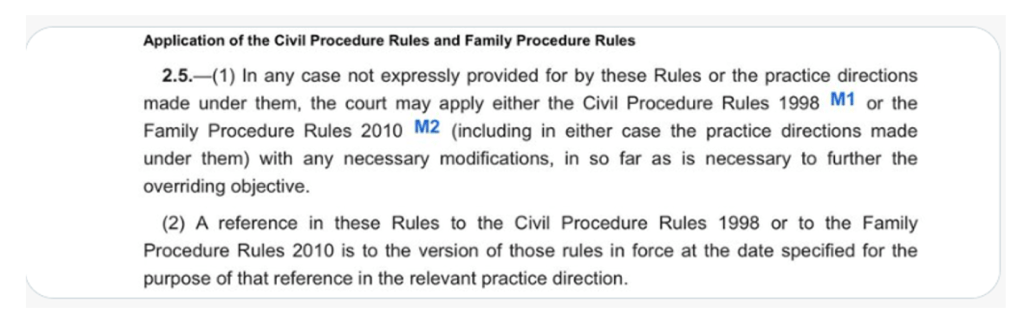
Civil Procedure Rule 5.4C seems to presume an in-person hearing, with court reporters attending in person (see §33)[viii]. This clearly needs updating.

The implication in the Rule is that paper copies of skeleton arguments will be supplied to “accredited” reporters and it’s stated that anyone else wanting copies must make an “oral” application (§33(5)).  This clearly needs updating since it must recurrently be the case that more people are observing live-streamed hearings via YouTube than in the physical courtroom.  We need to be sent electronic, not paper, copies of documents and we cannot make “oral” applications for them since we have no “oral” access to the courtroom when watching a hearing via YouTube.  Nor is there any advertised provision for us to email the Court to request skeleton arguments in advance of the hearing, nor any space provided at the start of the hearing for us to have emailed applications for skeleton arguments heard. This rule is simply not fit for purpose in relation to court reporters observing remotely.

I’m told that the procedure for making skeleton arguments available to non-parties in digital form is currently under review. I don’t know if that review is limited to the Court of Appeal or if it’s a wider review, and I haven’t been consulted as part of this review (if any court reporters have been consulted, I’d love to hear from you).

I hope the review includes consideration of the basic requirements to get this to work in practice. At best, this would involve placing all the anonymised skeletons and other open-access documents on the dedicated Court of Appeal website alongside the case summary and YouTube link so that they can be downloaded by anyone (“accredited” or not) who wants them.  I don’t think any of the courts does this – although I have seen skeletons posted on legal and campaigning websites and links to them from social media  (with or without the need for court approval, I’m not sure): take a look at some in the footnote.[ix]

Failing that, and at a minimum, there should be public information that skeleton arguments are available, how to access them, and prompt response to requests in advance of the hearing.

In conclusion….

There are some very positive aspects of transparency in the Court of Appeal.  Live-streaming (which is like watching a live television programme) is massively preferable to the Court of Protection’s use of MS Teams or Cloud Video Platform, which involves sending out links and logging in, and all the challenges of video-platforms.  It’s also really positive that hearings are recorded and made publicly available on YouTube (see https://www.judiciary.uk/live-hearings/re-pc/).

But it turns out that simply watching the Court of Appeal hearing – either live or on the recording – is not in and of itself sufficient for transparency.  

I very much doubt that the importance of skeleton arguments to the understanding of a case comes as any surprise to judges or to lawyers.  The matter has been repeatedly raised in key judgments over the years (e.g. Cape Intermediate Holdings v Dring [2019] UKSC 38).

It’s time to fix it. Fixing it will require collaboration between the judiciary, lawyers, and HMCTS, in consultation with court reporters, to figure out how best to deliver on transparency with regard to skeleton arguments. 

In the short-term, I would like to see judges take responsibility for ensuring that skeleton arguments have been anonymised in advance of hearings, that they are lodged with the Court Office, and that court reporters (accredited and otherwise) know how to get hold of them in a timely fashion, and without a charge. This might mean taking up a few minutes at the beginning of the hearing, after dealing with reporting restrictions and before moving to the substantive business of the hearing.  

I’ve also raised the matter with the judiciary’s new Transparency and Open Justice Board and await developments. 

Celia Kitzinger is co-director of the Open Justice Court of Protection Project. She has observed more than 550 hearings since May 2020 and written more than 100 blog posts. She is on LinkedIn (here), and tweets @KitzingerCelia


[i] You can watch the lawyer, Rhys Hadden, Counsel for the ICB, asking the judges, and see their responses in the YouTube video recording of the hearing – right at the beginning of Part 2, which covers the afternoon session. Part 2 Re PC YouTube video)

[ii] I think the fee is taken from here: https://www.gov.uk/government/publications/court-of-appeal-civil-fees-form-200/civil-appeals-office-fees-from-1-may-2024 (Thank you to Zena Bolwig who responded publicly to my Twitter enquiry as to how this fee could have been arrived at.)

[iii] The role of “Masters” in the Court of Appeal Office is outlined here: https://www.judiciary.uk/guidance-and-resources/judicial-authority-of-court-officers-in-the-court-of-appeal-civil-division/

[iv] I googled this and discovered the rules for obtaining a “fee remission certificate” are here: https://www.gov.uk/get-help-with-court-fees

[v] “CPR 5.4C (2)” means Civil Procedure Rules Part 5, which is called “Court Documents” (https://www.justice.gov.uk/courts/procedure-rules/civil/rules/part05).  The rule referred to here is Rule 5.4(C),  “Supply of documents to a non-party from court records” (https://www.justice.gov.uk/courts/procedure-rules/civil/rules/part05#5.4C).  “PD 5A” means Practice Direction 5A (https://www.justice.gov.uk/courts/procedure-rules/civil/rules/part05/pd_part05a) which is a supplement to Part 5 of the Civil Procedure Rules and deals with court documents.  The form “N244” is here: https://www.gov.uk/government/publications/form-n244-application-notice

[vi]  It’s somewhat ambiguous (at least to me) whether the judges gave permission at this point for the skeletons to be released only to me, or more broadly to observers generally.  The rules indicate that each “non-accredited” court reporter is required to ask individually, and to give their reasons for wanting the skeletons.  I believe I was the only such person with a request before the judges at the time the decision was being made.  LJ Bean said  “Subject to redactions being made, there’s no reason why skeletons shouldn’t be released, certainly to Professor Kitzinger” (2:46 mins into Part 2  Re PC). It may be that if asked by counsel they’d have confirmed at this point that they could also have been released to other members of the public – but that question was not raised.

[vii] I’m co-director of the Coma and Disorders of Consciousness Research Centre at Cardiff University. l also served on the British Medical Association core editorial group that produced guidance on clinically assisted nutrition and hydration and on the Royal College of Physicians Guideline Development Group that produced guidance on prolonged disorders of consciousness.

[viii] This is odd, given that there is a note at the bottom saying the Rule was updated in April 2024, by which time there had been probably hundreds of live-broadcasts from the court. Live-streaming of selected cases in the Court of Appeal began in 2019 to improve public access to, and understanding of, the work of the courts. For more information, including links to upcoming life-streamed Court of Appeal cases, see: https://www.judiciary.uk/the-court-of-appeal-civil-division-live-streaming-of-court-hearings/

[ix] Here are a few examples from Twitter/X.

The Court of Protection at its best?

By Georgina Baidoun, 24th July 2024

The Open Justice Court of Protection Project posted the following alert on X and I felt I should rise to the occasion, given that the appointment of deputies for property and financial affairs is my particular interest area. The court listing isn’t specific about the type of deputy but there are very few appointments of health and welfare deputies.

According to the Transparency Order, AL, the protected party, was the applicant. TL was the respondent. I’m afraid that order of things didn’t make a lot of sense to me in the context of the current hearing, but perhaps it reflects the history of the case. Neither party had legal representation. 

The judge explained that she had arranged this hearing so that she could explain the actions she was going to take, rather than TL simply receiving a piece of paper. She didn’t anticipate that there would be any need for further hearings. 

From the conversation that took place between the judge and TL (there was no opening summary and I did not request position statements, given that the parties were unrepresented), I put together the following likely scenario, but relationships were not clarified and nor was the background to the two essentials in the case. The first was that P was the subject of on-going county court insolvency proceedings and the second was that he had been assessed and found to be lacking in capacity to manage his property and financial affairs and the judge was about to make an order to that effect.

It seemed likely that TL was P’s wife. Since P was being treated in an NHS neurological facility, it also seemed likely that he had been subject to a catastrophic event, especially as the judge referred to the fact that he would be assessed again, possibly in 6 months’ time, when his capacity might have improved. 

TL had applied to become the COP deputy for P’s property and financial affairs and also sought permission to raise an immediate loan to be secured on P’s home (which they jointly occupied and might have jointly owned). It was the judge’s opinion that, with all ‘the additional matters that TL was handling’, the best solution at present would be to appoint an interim professional deputy who would work in P’s best interest, which would also include helping TL. The problem was that there was no money to pay a deputy and the judge was therefore exploring the possibility of employing one who would agree to being paid after the house was sold. Selling the house and downsizing was the longer-term goal but that would require a ‘trusteeship application’.

TL was in contact with a mortgage broker to arrange a loan and was hoping that the judge would give approval for that at this hearing. She wanted to know what information she could share and with whom. The judge agreed that it would be sensible to share with everyone concerned the judgment that P lacked capacity to manage his property and financial affairs. She hoped that the urgency for arranging a loan could be avoided if the impending insolvency hearing was postponed. That was not a matter for her but she hoped the county court judge, with whom she had been in contact, would make that decision once he was informed of the capacity judgment. The priority now was to appoint an interim deputy but no order could be made to that effect until someone could be found who was prepared to undertake the role.

My thoughts

I was very impressed by the sensitivity of the judge in this case. She chose to hold a hearing so that a conversation could take place and so that she could explain what actions she had taken and would be taking to make progress. There was no suggestion of differences of opinion, simply a desire to make what must have been a dreadful situation for TL as manageable as possible.

Georgina Baidoun was the lay Court of Protection Deputy for her mother’s Property and Financial Affairs until her mother died in 2021. Because of the difficulties she experienced with several applications to the Court, and with the Office of the Public Guardian in connection with her annual report, she has retained an interest in these areas, including attending Court of Protection Users Group meetings. She is keen to share her experiences in the hope that she can help others who have to engage with these institutions with very little help or guidance. She tweets as @GeorgeMKeynes

Anonymising P and his family in the courtroom: An unnecessary and unhelpful precaution

By Amanda Hill, 21st July 2024

This blog is about an all-remote hearing before a judge (HHJ Brown) who ruled – very unusually for a Court of Protection hearing – that no parties’ names should be used in the course of the hearing. She asked for the protected party (P) to be refered to with an initial all the time, rather than by his first name.  She directed that P’s mum should be referred to as ‘Mrs A’ throughout. All place names were to be anonymised too.

The judge made this decision because there were observers present, even though we had all received the Transparency Order.  In my view, this decision, made with the best of intentions to protect the family’s privacy, had a negative impact on the hearing. It’s the first time I’ve ever seen a judge do this. I hope that I don’t see this unusual decision again. 

Background to the hearing

The case (COP 12219141) has been blogged about before: COVID-19 vaccination with sedation: Instructing an expert. When it was listed as back before the court, this offered an opportunity to find out what had happened since the last hearing. A message was posted on the Open Justice Court of Protection’s Observers’ What’s App group to see if anybody could observe it[1] and four people, including me, were available and requested the link in the usual way, as outlined on the OJCOPP website. The hearing was listed for one day and was due to start at 10am. 

From the previous blog, I knew that P has a learning disability, Down’s Syndrome and autism. Although that blog was about whether P should receive the Covid vaccination, the situation for this hearing was different. It turned out to be a hearing to do with P’s residence and care,  and contact with his mother.  P’s mum wanted him to go and live with her rather than in supported living. If he couldn’t do that, she wanted increased contact with him (her contact is currently restricted by the court) and she also wanted certain elements specifically inserted into his care and support plan. P’s mum, whom I shall refer to as Mrs A, (as the previous blog has already referred to P as DA) was present and gave oral  witness evidence and was subject to cross-examination. A Social Work Team Leader also gave oral witness evidence.

The judge’s reaction to observers attending the hearing

P was represented via his Litigation Friend the Official Solicitor by Bethan Harris. The Local Authority was represented by Kate Round and Kate Mather represented P’s mother.   Celia Kitzinger emailed requesting everyone’s position statement. Position Statements set out the position of the respective party and usually greatly enhance understanding of a hearing. The issue of the position statements came up at the start of the hearing as in response to Celia’s email one of Counsel checked with the judge whether they could be provided to observers.

At this point, the judge decided that all observers could be provided with the Position Statements but that they should be anonymised first. She actually read out the names of the four observers to whom the Position Statements should be sent. This meant that the legal teams had to spend time during the lunch break anonymizing the Position Statements but it also meant that we received them before the hearing started again after lunch, and so we had the chance to read them and understand more about the issues at hand. This was very beneficial for open justice.

However, the judge also decided that no names or place names should be used in course of  the hearing itself. This was very unusual. It’s not something I have seen before in the hearings I have observed. And Celia confirmed to me that she has observed over 550 hearings and has never seen a judge take such action. 

Impact of the  judge’s decision  

(i) Impact on the hearing – a person-centred focus? 

The judge was acting with the best of intentions, to protect P’s privacy. However, it was clearly an effort for everybody to remember to use ‘P’ instead of his name.  I got the impression that it was very hard for Mrs A to hear her son talked about as P and indeed for her to use that term. She was very emotional anyway, and she seemed to hesitate before saying P, as though it was an effort to remember to do that. I felt that it was dehumanizing, reducing her son to an initial. 

It was clear to see during the hearing that it was already a very difficult situation for her and I believe that the additional worry of thinking about having to refer to her son as P and listening to him referred to that way made her feel even worse. At times she was crying and she was finding the hearing difficult. It was an extra effort for all the participants not to identify P by name, and sometimes of course his name slipped out (as I had guessed it would), including by the social worker team leader who was a witness. 

In my opinion,  it added a degree of additional stress for the witnesses, who are probably not used to appearing in Court of Protection hearings. I also wondered what the impact would have been on a P themselves if they had been in court.

(ii) Impact on observers 

Speaking for myself, observing the hearing felt very uncomfortable. I was conscious that because of my presence the judge had made a decision that was making the hearing more difficult for those involved. If there had been no observers, those present would not be worried about naming P – the judge had made this decision solely because there were observers present.  Maybe for legal teams and professionals the impact would be less, but I suspect that they also would prefer to have named P. However for his mum I felt the situation was unbearable. She was struggling with her emotions and having to remember not to name her son surely added a degree of extra tension and stress. I felt bad that my presence had contributed to that. And I also felt that it was an unnecessary action by the judge to have taken, as though we weren’t trustworthy and that we wouldn’t adhere to the Transparency Order. 

(iii) An over-reaction? 

Observers are subject to Transparency Orders. This means that when we publish something about a hearing, restrictions are placed on us as to who and what we can identify. If we don’t follow the provisions in a transparency order, we can be found in contempt of court. So even if P’s name had been openly used in court, I would not be able to name him or publish any other identifying information. 

One of the barristers, Kate Round, recognised the force of the transparency order on observers, and at one point she deliberately named the care home where P had lived at one time. She did this at a time when Mrs A was upset, and I may be wrong but I felt that she did it to make it easier for Mrs A. She said “Do you remember when P moved to LR (fully named in court) – I’m going to name it, everyone knows there is a transparency order…..”. This was a recognition that even where names were used in court, observers would not be able to refer to them in anything published after the hearing. So there are already rules in place to protect P’s privacy and I would question whether it was really necessary for the judge  to impose additional restrictions in the hearing itself – restrictions that in my opinion made the hearing more difficult for those participating. Maybe it comes down to a training issue for judges, as Her Honour Judge Brown was not obstructing open justice and had welcomed us into her courtroom and ensured observers were sent (anonymised) Position Statements . It  seemed to me to be overly cautious.  Despite the fact that P’s name is routinely used in court hearings, I am not aware of any instances over the last four years when observers have breached the transparency order forbidding publication of P’s name. So, the system seems to work well as it is, without this additional precaution.

One contrasting approach is that of Mr Justice Hayden. He insists that a person’s name should be used, and that anything else would be dehumanizing. He makes clear that the transparency order prevents observers from identifying P, their family and where they live. This is a neat and simple solution. Going further in a hearing to protect P’s privacy is therefore unnecessary. 

Open justice in the Court of Protection has come a long way since Celia Kitzinger and Gill Loomes-Quinn launched the OJCOPP in June 2020. Most judges are making it easier for observers to attend court proceedings and more observers are coming forward. However, this hearing showed that there are still improvements that can be made, not least in how judges assess what it means to have observers in a hearing.  

Amanda Hill is a PhD student at the School of Journalism, Media and Culture at Cardiff University. Her research focuses on the Court of Protection, exploring family experiences, media representations and social media activism. She is on X as @AmandaAPHill


[1] The Open Justice Court of Protection Project runs monthly webinars on how to observe a CoP hearing and those attending can ask to be added to the WhatsApp group. The purpose of the group is to alert members to upcoming hearings and for core team members to provide support observing if needed and possible. I was not able to join for the whole day due to other commitments. Celia Kitzinger has kindly allowed me to use her notes from the part of the hearing I didn’t observe.

Appointment of a Deputy – and some good news for transparency

By Georgina Baidoun, 16th July 2024

I was interested in this hearing (COP 13826049) before DJ Griffiths sitting at Exeter on 11th July 2024 because it was listed as concerning the appointment of a deputy for property and affairs.

Before the hearing began

I was surprised to find that the Transparency Order I was sent in advance of the hearing  did not mention a Deputyship but said:

(3) The attended hearing is to be listed as follows: 
a) Where KW should live; 
b) Authorising a deprivation of liberty 

The explanation became apparent during the hearing but I afterwards saw that the court administrator had responded to my query saying “the issue of where P will live is not before the court today, only the Deputyship issue that has arisen”.

In fact, the procedural issues were at least as interesting as the substance of the hearing and it was another good day for open justice.

When the hearing was about to begin, it was noted that one participant was having difficulty joining. The judge said that he had himself had a similar difficulty! It was agreed that, while waiting for this participant, the barrister for the Local Authority, Matthew Angus, would summarize for me what had happened previously. The judge did not ask me if I had received the transparency order and whether I agreed to abide by it but he did assume that I was there on behalf of the ‘transparency project’ (by which I took him to mean the transparency project called the Open Justice Court of Protection Project rather than the Transparency Project, which specialises in Family Courts), to which I assented.

The story so far was indeed mainly concerned with health and welfare issues. P was a man with learning disability who needs care under the ‘Care and Support Act’, which I think is now the Care Act 2014, clinging on to its old name for those who have long worked in this area, as Mr Angus has done. There were two of P’s family members involved in the case, his mother and his brother, although neither were joined as parties or in attendance. Three members of the local authority were in attendance but did not participate. Others in attendance were a barrister and a solicitor acting for P on behalf of the Official Solicitor in the health and welfare aspects of his case.

Previous hearings had been concerned with where P should live and constraints on contact but also, in January 2022, with an application by the local authority to be appointed Court of Protection deputy for P’s property and financial affairs. The issue referred to in relation to that hearing was the need to obtain a copy of P’s father’s will but I assume nothing was resolved because that was also the main issue at this hearing. 

The hearing

The judge opened, with everyone now in attendance, by noting that there was now an agreed draft of the latest decisions about P’s residence, which I suppose was essential background even though the current hearing was about property and affairs. 

Mr Angus then set out the local authority’s position. The deputyship application was concerned with moneys (and possibly a tenancy) inherited from the father that were being held for P by his mother and brother. The local authority already held the Department of Works and Pensions appointeeship for P (allowing them to collect his benefits) and it would be easier for them if they could have responsibility for other assets too.

When the original application was made in January 2022, P’s mother had objected. Since then, there had been issues relating to P’s capacity to manage his own financial affairs. It seemed that he had been judged not to have such capacity but there was a separate question as to whether he had capacity to litigate. It was now also not clear whether the mother had capacity to litigate or, indeed, whether she still objected. Her last objection had been recorded in March 2022. (I have no idea why nothing seemed to have happened in the intervening period.)

The judge responded to Mr Angus by pointing out that “the local authority’s convenience was neither here nor there” and that any decision would be based entirely on P’s best interests. P was not currently a party to the case and the two lawyers present at the hearing who were acting on behalf of the Official Solicitor had no formal role, since they were only instructed to act in health and welfare matters.

The judge moved on to next steps. He would be asking the Official Solicitor to act as P’s litigation friend in this matter too. He would also seek to join P’s brother as a party. Once joined, he would be required to provide any financial information he held concerning the father’s will, but he could then apply to be discharged, if he so wished. It was also necessary to discover whether the mother had capacity to litigate or whether she too needed a litigation friend. Also, whether she still objected to the application. The application to appoint a property and affairs deputy would be separated from the health and welfare case, a separate number allocated and a new Transparency Order prepared.

The judge noted that if, when all the necessary financial information had been collected, it was discovered that there was very little in the way of assets, it might not be necessary to appoint a deputy at all. The amount of money available would also inform the Official Solicitor about the costs of acting in this case.

The Transparency Order

I had asked for the Transparency Order when I asked to attend the hearing and was sent two (sealed) versions: one made by DJ Scott on 10th January 2024 and the second made by DJ Griffiths on the very day of the hearing I was observing (11th July 2024).

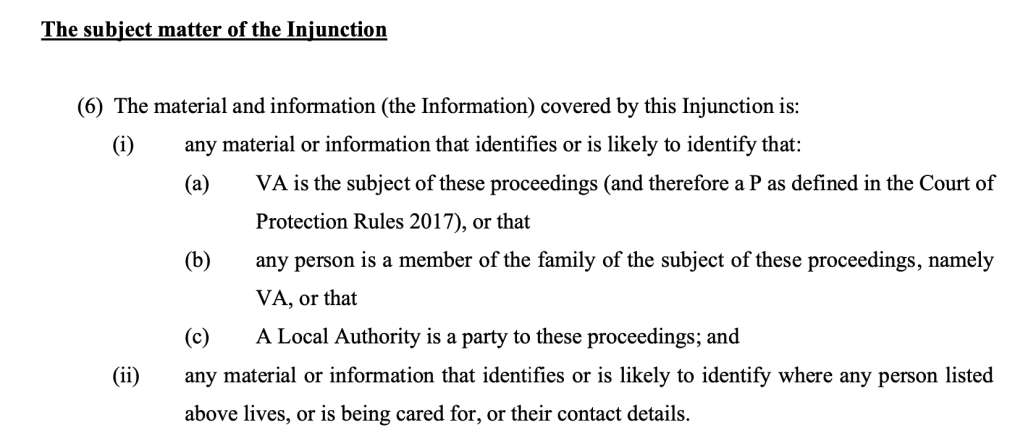
The earlier-dated Transparency Order prohibits identification of the local authority.

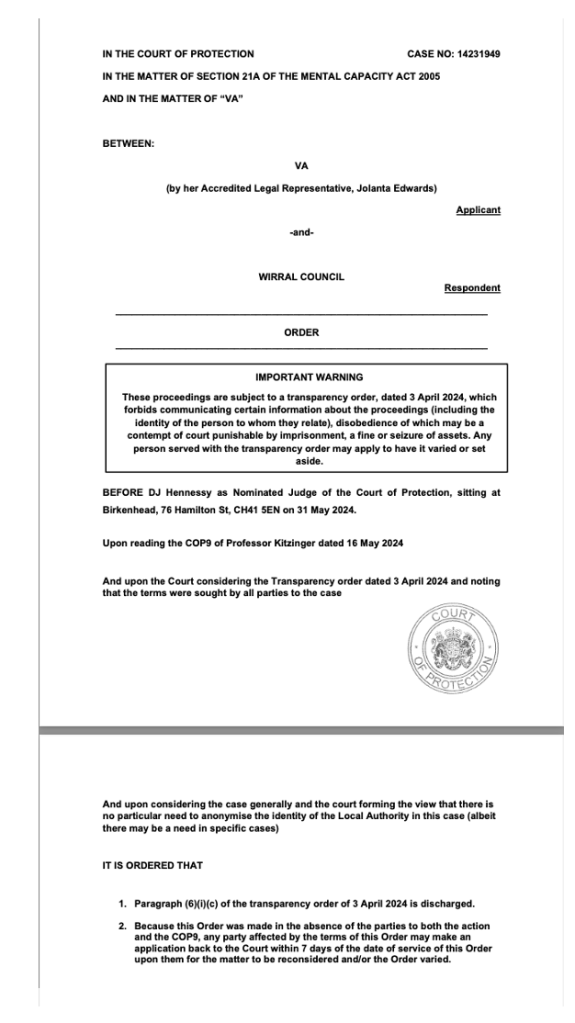
The subsequent Transparency Order says that the earlier one “erroneously includes the identity of the Local Authority within the protected subject matter” (see below) and amends it to correct that error.

The “amended” version strikes through the prohibition on naming the local authority (see 6(i) (c)).

This is excellent news. 

There have been at least two other recent occasions on which Transparency Orders have prevented identification of Devon County Council and have been challenged by observers (see: “Getting it right first time around”). The Open Justice Court of Protection Project has identified a recent spate of these erroneous Transparency Orders and has done some work to alert both HMCTS and the judiciary to the problem. I think it is fair to assume that the amended Transparency Order is a direct result of the work that the Open Justice Court of Protection Project has done – and it’s very reassuring to know that the judge did it on this occasion without having been prompted to do so by an observer’s complaint. 

This marks real progress for open justice!

Georgina Baidoun was the lay Court of Protection Deputy for her mother’s Property and Financial Affairs until her mother died in 2021. Because of the difficulties she experienced with several applications to the Court, and with the Office of the Public Guardian in connection with her annual report, she has retained an interest in these areas, including attending Court of Protection Users Group meetings. She is keen to share her experiences in the hope that she can help others who have to engage with these institutions with very little help or guidance. She tweets as @GeorgeMKeynes

Anorexia and the capacity to make decisions about nutritional intake

By Ty Glover, 14th July 2024

Back in 2007, a spate of television programs focused on “size 0” and “super skinny” bodies with the focus being on the then (and now) fashionable trend for size 0 models. Although I did not watch all of those programs, I recall one in which Louise Redknapp, wife of former footballer and current TV pundit Jamie Redknapp, presented “The Truth about Size Zero“. In that program Louise vividly articulated the misery and difficulty of achieving the goal of dropping two dress sizes and reaching size 0 for which the program was designed. Her physical, emotional, and psychological distress at achieving that goal, despite support from expert nutritionists, was clearly described.

At that time I was a relatively inexperienced Consultant in Eating Disorders, but I had already witnessed such suffering, and this programme had a significant impact on my thinking. Given that, after oxygen requirements, fluid intake, and excretion, food intake can be considered as one of a human’s most fundamental needs, it became clear, both due to my early experience and Louise Redknapp’s articulate description, that avoidance of appropriate calorific intake was profoundly aversive and to continue in such a pattern of behaviour would require a psychological force of immense proportions.

My experience since then has only confirmed that belief. Anorexia Nervosa is a profoundly powerful condition. It is classified as a Mental Illness (ICD-11 6B80) and recognised as an impairment of the mind with respect to the Mental Capacity Act 2005. Its ability to derail the life path of articulate and intelligent people, usually young women, has to be seen to be believed. Their inability to simply accept sufficient calories to maintain weight is extremely difficult to overcome. The lengths to which such patients will go to avoid calorific intake and weight gain is remarkable. The misery and depression which goes alongside this behaviour is consistently reported by patients and their families as well as clinical observers.

It is only by understanding the profoundly aggressive nature of anorexia nervosa that one can begin to understand the disparity between otherwise cognitively intact young woman and their intrinsically harmful thinking and behaviour.

It was, therefore, no surprise to receive Celia Kitzinger’s request for me to explain how such articulate and intelligent young women could possibly be deemed to lack capacity to make decisions when they appear, on the surface, to be so coherent and insightful. Her request was prompted (she said) by a recent case before Mr Justice Hayden at which public observers watched “Pam” gave powerful and eloquent evidence to the court about her wish to be discharged from treatment (see Anorexic woman gets to make her own (incapacitous) decisions, says Hayden J).  Despite her articulate and intelligent self-presentation, none of the parties (including the Official Solicitor who was acting for “Pam”),  argued that “Pam” had capacity to make decisions about her nutritional intake for herself.  The judge and all the parties (except “Pam” herself) accepted that the presumption of capacity in the domain of nutritional intake had been rebutted.  This was queried by one of the observers in a comment on the  blog post:  “I think the main surprise for me on the day was the difficulties the psychiatrists had with demonstrating why Pam lacked capacity to make decisions about her treatment. It felt like it was assumed that because the illness itself and decisions about being fed are so intertwined, NO patient with anorexia can be deemed as having capacity to make decisions regarding treatment? This was in contrast with how eloquently Pam put her case across – surely if anybody was going to be deemed as having capacity it was this lady?” (Nat Davies).

It is only by understanding the profoundly intrusive nature of anorexia nervosa on an individual’s thinking in regard to nutritional intake, weight gain, whilst also understanding the limits of this impact with relative preservation of thinking in other domains (e.g., financial, emotional and medication decisions etc.)  that one can realistically comprehend how such a disparity can occur.

Although an individual with anorexia may be unable to decide between an apple and Mars bar despite their “life depending” on the acceptance of a Mars bar, they may articulately, coherently, and capacitously make decisions about finance, relationships and medication without any cause for concern.

This highlights the specific and time related nature of capacity decisions. It is clear to me that patients with severe “active” anorexia almost always lack capacity to make decisions about nutritional intake whilst under the influence their anorexic condition. The overwhelming nature of the anorexic cognitions endured by patients with anorexia in relation to weight gain, or in anticipation of weight gain, mean that they will almost always, under the influence of that condition, make decisions regarding nutrition which are almost certainly lacking in capacity. It is in the domain of weighing matters in the balance that this lack of capacity should be understood.

The overwhelming impact of anorexia nervosa on an individual’s ability to weigh matters in the balance is, in my opinion, incontestable. The avoidance of weight gain and the restriction of dietary intake (or the urge towards compensatory behaviour) is such that I have no doubt that most patients, if not all, who are enduring an anorexic condition lack capacity to make decisions about the nutritional intake which is most appropriate for their overall well-being.

There is also a clear, though not universal, impact on a patient’s ability to understand the nature of nutrition and their body weight. Many patients erroneously believe that they are of normal (or above normal) weight, and they also believe, in a similarly erroneous way, that normal dietary intake will have a profound effect on their weight with massive weight gain anticipated. These errors of comprehension are directly attributable to their anorexic condition.

It is not possible, given the construction of the Mental Capacity Act 2005, to believe that such patients retain capacity to make decisions related to calorific intake in the face of such an overwhelming psychological impairment.

There is, however, no doubt that these individuals retain capacity in most, if not all, other domains of cognition. There may well be an impact from their condition on their relationships, emotional state, and motivation, including some suicidal thinking. That does not, however, mean that capacity in these other domains is necessarily impaired. It is my practice to assume that most patients with anorexia nervosa lack capacity only in the domain of nutritional intake. For example, I rarely, if ever, insist that patients take medication against their will as there is, as yet, insufficient evidence to take such an authoritarian position.

There is no doubt, in my mind, that these individuals almost always retain capacity to make decisions about finances, relationships, and about with whom they should associate. There is also little doubt that they retain capacity to make decisions about residence and their own living circumstances. Given that they also remain articulate and often insightful with regards to nutrition, it is unsurprising that such patients might appear to many observers in the Court of Protection to be expressing capacitious views about their own anorexia. That appearance is misleading. As explained above, anorexia has such a profound effect on an individual’s ability to weigh matters in the balance and often also on the ability to correctly comprehend  one’s own circumstances, that, in most cases, the presumption of capacity is rebutted.

Only by understanding both the severity of anorexic cognitions, the profound impact of those cognitions on the ability to both understand and weigh the relevant information in the balance and the restricted nature of this psychological impairment can one reconcile the determination that patients lack capacity in relation to nutritional intake with their capacity to make decisions in most, if not all, other domains and their apparently coherent and insightful ability to articulate their own position.

Ty Glover is a Consultant in Eating Disorders Psychiatry and an Independent Medicolegal Expert with experience of the Court of Protection, whose knowledge of this field draws from his experience over the last 12 years as an expert witness in numerous complex cases of serious medical treatment involving eating disorders in the broadest and narrowest sense of that term – as well as further experience as an expert witness in the Court of Protection in relation to mental health problems unrelated to disordered eating.

Complex issues for the court and plans for an ‘omnibus’ capacity hearing

By Claire Martin, 9th July 2024

At the centre of this case is Mrs G who has come to the attention of the court because carers have alleged that her daughter is abusing her.  Mrs G is said to complain to carers about her daughter’s behaviour, and then to retract these statements later. Her capacity to decide about contact with her daughter (amongst other things) is now in question. Mrs G’s daughter denies, vehemently, all of the allegations, including a report that she threw food over her mother. 

Mrs G was given a diagnosis of Alzheimer’s disease in 2021, which is now also in question. A jointly-instructed independent expert has informed the court that his assessment suggests this diagnosis is incorrect and that Mrs G retains capacity to litigate and decide her care and support. The Local Authority disputes the independent expert’s assessment on these matters. 

Mrs G wants to instruct her own legal representative. Even if Mrs G has capacity to do this, there is concern (from the Local Authority) about whether she can she do this freely without undue influence from her family. Her daughter holds  Lasting Power of Attorney (both for Property & Finance, and for Health & Welfare);   the Local Authority made an application for this to be suspended. along with many issues of capacity for Mrs G. 

We observed a hearing for this unusual case, COP 14187074 (which we have blogged before), before Mrs Justice Arbuthnot (a Tier 3 judge), sitting in Norwich County Court, on Thursday 6 June 2024. 
At the time of the previous hearing on 17th January 2024, two different legal teams had turned up in court to represent Mrs G and the judge decided that her representation should be via the Official Solicitor since there is reason to believe that she lacks capacity to conduct proceedings in a case concerning whether she is subject to control by her daughter.

This post covers (1) Accessing the hearing; (2) Who’s who in the hearing; (3) Background to the case; (4) Issues for the court at this hearing; (5) What happened at the hearing; (6) Mrs G’s daughter, the Inherent Jurisdiction and undertakings; and finally, (7) Reflections.

1. Accessing the hearing

When I joined the hearing – which was an in-person hearing – which I and another observer were watching remotely – we were the only people in attendance on the remote link.

It was very hard to follow what was going on for two reasons: there was only one camera in the court and the courtroom appeared to only have one microphone (the judge, at the bench, had her own). In the morning session, we could only see the judge on camera. Others spoke and it wasn’t always clear who was speaking. After emailing the court clerk, the camera was turned to face the courtroom in the afternoon session. This meant we could see all those present in court, but not the judge, whose disembodied voice we heard well because she had her own microphone. This did make it somewhat easier to follow proceedings, though we witnessed the court usher moving the one sole microphone between people as they spoke, causing some difficulty at times to shuffle it between them all. At times, he forgot to move it, meaning we hardly heard some of what was said. So, overall, the sound access to this hearing was patchy. We have done our best to piece together what happened! We have had the benefit of the Position Statement for the Official Solicitor (kindly shared with us by counsel, Malcolm Chisholm) which has helped us greatly to understand the facts of the history of the case. 

2. Who’s who in the hearing?

At first we were unsure who was representing Mrs G. As noted, we couldn’t see the courtroom and when the hearing got underway at 11.49am, it was exceptionally hard to hear the voice of the person who turned out to be Oliver Lewis, counsel for the Local Authority. We don’t know whether the case was introduced, but we heard him mention the Transparency Order [TO] (which we hadn’t received at this point) and the judge said that ‘it applies’. We did receive the TO at 12.09 from the court clerk and checked to see what it covered, and to ensure that we are not in breach of any of the injunctions in this blog.

As is usual, we cannot name or publish anything that is likely to identify Mrs G, or members of her family. We are not restricted from naming the Local Authority, however, which is Norfolk County Council. 
Mrs G was now represented by her Litigation Friend the Official Solicitor [OS], and Malcolm Chisholm  was counsel for the OS.

The only other person formally able to address the judge was Mrs G’s daughter, who was representing herself.

We heard all three speak during the morning session, though could not see them.

Mrs G put her hand up at one point and the judge invited her to speak. More of that later. When we rejoined for the afternoon session, we could see that there were other people in the courtroom too, including Mrs G herself, and others sitting beside her, who turned out to be her ex-husband and her daughter’s partner. We think there were also solicitors for the Local Authority and for the OS.

3. Background to the hearing

We were very thankful for the Position Statement from the Official Solicitor to help us understand the background to this case.

Mrs G is a woman in her 70s. She lives in her own home with a live-in carer, though Mrs G asserts that she can be more independent. In 2021 Mrs G was diagnosed by the local memory clinic with Alzheimer’s dementia. Her daughter holds Lasting Powers of Attorney for both Property & Affairs and for Health & Welfare. 

Mrs G came to the attention of the Local Authority in February 2023 when she spent a period as an inpatient period for a chest infection. Health care professionals raised concerns with the local authority about Mrs G’s daughter (we are not sure what exactly the concerns were). There was some dispute about Mrs G’s needs on discharge from hospital, and this has led to the application to the Court of Protection.

The council asserts that Mrs G needs live-in care to support with eating, prompting for personal hygiene, cleaning and ‘accessing the community’. The council also alleges that Mrs G’s daughter has ‘overridden her autonomy’ and that has assaulted her. Mrs G’s daughter denies all accusations and asserts that her mother has capacity to make all her own decisions. The council has applied to restrict contact between Mrs G and her daughter, as well as the daughter’s ex-husband and current partner. 

Importantly, there have been two more recent (2024) psychiatric assessments of Mrs G. One was done by a previous treating clinician (who we think was instructed by Mrs G or her daughter) who assessed Mrs G as having ‘mild cognitive impairment’ and stated:“I believe she has capacity to decide her care needs, where she should live and decide who should have financial control over her assets. In addition, with support, she has at present legal capacity”. The other was by Dr Barker, an independent expert psychiatrist, jointly instructed by the legal teams in this case. He also reached the conclusion that Mrs G had a “…relatively mild, memory impairment, particularly with spontaneous recall, which is common with normal ageing, but not typical of Alzheimer’s disease … [Mrs G’s] cognitive impairment has not yet reached a level at which a diagnosis of dementia would be appropriate, and her cognitive testing has markedly improved since the diagnosis of Alzheimer’s disease was given in 2021, suggesting this diagnosis is incorrect”.

4. Issues for the court at this hearing

The issues were mainly about deciding how the case was to proceed.  There are many substantive issues for the court to decide: 

  • Litigation capacity
  • Capacity [and best interests, if appropriate] for other decisions – including where to live, contact with her family, care and support, appointing (and revoking) an LPA 
  • Fact-finding regarding allegations of bullying and coercive control levelled at  Mrs G’s family, principally her daughter. This is considered under the Inherent Jurisdiction.
  • Potential committal proceedings against Mrs G’s daughter – depending on the outcome of the fact-finding – we think (though are unsure) for breaches of the court order in relation to contact with her mother. 

5. What happened at the hearing?

Sound was very patchy at the start, except for the judge who was more audible. What was clear was that this hearing is what is called a ‘directions’ hearing – the judge and Oliver Lewis were immediately engaged in considering how many days of court time were going to be set aside to hear evidence about various matters: capacity, fact-finding “and then we go from there” (as the judge put it).

There is a significant amount of paperwork for this case, especially allegations against Mrs G’s family from various professionals involved in her care  – the judge referred to ‘some direct, some not direct’ and advised counsel for the Local Authority to ‘choose your best evidence’. 

And does Mrs G have litigation capacity? If she does she can instruct her own legal team. Counsel for the OS said: “This is a case where all capacity issues overlap: litigation capacity, care, residence, contact and support, LPA …. [There is] artificiality when we look in silos… you may take a view to deal with all capacity issues at the same time. If I am here for the OS I am advancing a case on a best interests basis, taking into account her wishes and feelings, but I can’t take instructions from her [poor sound quality] …. about her own capacity … The neater way is a one-day litigation capacity hearing and see where we go from there.

Of course, if Mrs G has litigation capacity, she might prefer to instruct a different legal representative, i.e. someone other than Malcolm Chisholm. This issue, therefore, needs addressing first. Oliver Lewis was very clear on the position of the Local Authority, that – regardless of litigation capacity – they would still submit that Mrs G needs to be protected under the Inherent Jurisdiction, due to what they say is coercive and controlling behaviour from her family. The Local Authority also disputes Dr Barker’s findings, so he will need to be called to be cross-examined. 

Counsel for the OS and counsel for the Local Authority took different positions on how to handle the multiple capacity issues in this case. The Local Authority proposed all capacity issues to be dealt with together whereas the Official Solicitor advocated for only litigation capacity to be considered at the next hearing. The Position Statement for the Official Solicitor states that the ‘Official Solicitor is in an invidious if not impossible position, namely acting as litigation friend in the best interests of a protected party who asserts (with the strong backing of an expert witness in two detailed reports) that she has capacity to give instructions on all relevant matters’. 

Mrs Justice Arbuthnot wrestled with this during the hearing, describing the dilemma as finding the ‘the least worst option’. Here are the arguments and considerations presented to the judge: 

Counsel for the Official Solicitor – on behalf of Mrs G: “…. Litigation first …. rather than all at once. My submission would be just on the matter of litigation capacity, not the others, so that if your determination is that P has litigation capacity, she’s in a position to instruct, so that other capacity issues get resolved on that basis. […] there is a sharp distinction between the two roles [acting for the OS and acting directly for a client with litigation capacity]. So litigation capacity needs dealing with in a separate silo.” [Counsel’s emphasis] 

The judge was initially persuaded by this argument: “I think he’s right it should be litigation first”.  But counsel for the Local Authority:  said “In my submission there are dangers of that approach.”  Linking litigation capacity to coercive control, he continued: “There are indications in my submissions that Mrs G lacks capacity to conduct proceedings as well as [other capacity issues]. It would be artificial to separate it out. If we were in the King’s Bench division ….. [if there was a] neighbourhood dispute, and someone’s capacity was in question, it’s different, but in this case EVERYTHING is related to capacity, and the control issue. If [Mrs G] has litigation capacity, first it’s unlikely that she would lack subject matter capacity… it’s unlikely, if possible; but if the court finds she [doesn’t lack] capacity, she’s in no worse a position, she can choose not to continue and instruct a solicitor of her choosing. The court is still going to be dealing with fact finding – she will just have the right to be protected, as the OS will remain.  Of course, it’s any litigation friend’s responsibly, especially the OS, to make sure the court knows what P feels about each capacity area. The court won’t be deprived of knowing what P thinks about each of the capacity areas.” [counsel’s emphasis]

Mrs G had her hand up at this point and the judge invited her to speak: She said: “My relationship with my daughter is terrific [very quiet no microphone in front of her] … I need to be able to carry on… [inaudible]. The judge assured her that she was trying to work out ‘how the hearing about your daughter can be broken into pieces’.

Mrs G: I want to continue my relationship.
Judge: … We are not stopping the relationship – it is my job to make sure it is safe. 

After an exchange with Mrs G’s daughter to explain the process of addressing the capacity issues, followed by the fact-finding and the implications of that for contact with her mother, the judge returned to the matter of how to deal with litigation and other capacity issues:  “At the moment we are trying to work out HOW MUCH should be done on those days. The OS says only litigation capacity – or the whole lot. [To Oliver Lewis] Can you just explain why the whole lot again?”

Counsel for the Local Authority: It’s very rare for someone to have capacity to litigate and [then not have capacity for other issues] …. My example of the neighbourhood dispute over a fence. Case law suggests capacity has to be looked at in the round. Litigation capacity has to be looked at in relationship to the proceedings [as a whole] – [capacity to decide about] care, contact, make/revoke LPA , and in the Inherent Jurisdiction case, whether she is a vulnerable person subject to coercive control by [her daughter]. In my submission, Mrs G has said to numerous health care professionals she doesn’t want her daughter to be as controlling as she is, when her is daughter not there. Totally understandable, it’s not critical of Mrs G. She’s said the opposite to many professionals. It would be in my submission, entirely artificial and wrong to deal with litigation capacity as if it’s a silo, and unconnected to other areas of capacity. I would say that about any COP matter, but especially where at the centre are these allegations of influence and control. It could be that if the court determines capacity in an omnibus hearing in one day and finds it’s not possible to determine capacity in any or in some of the areas, then it may be that court would direct an assessor to carry out an assessment of capacity AFTER the court has found out the facts. Dr Barker says he didn’t put the allegations to Mrs G because he didn’t know which ones had happened or not. He couldn’t come to a true assessment about capacity …that could be one of the outcomes. 

It seems that the Local Authority is saying that the reason they do not currently accept Dr Barker’s (independent expert) capacity assessment (that Mrs G retains capacity for all matters) is because he didn’t put to her the full relevant information about the allegations against her daughter. According to Dr Barker, he did not do this because he did not know which allegations were proven. So, the Local Authority is submitting that his conclusions regarding capacity cannot (yet) be relied upon. And further, that there should be a fact-finding hearing under the Inherent Jurisdiction if Mrs G is found to retain capacity in any matter. This argument confuses me. If the Local Authority is saying Dr Barker’s assessment is not reliable because he did not put the (proven) allegations to her – then how can a capacity hearing (before the fact-find) determine her capacity?

Nevertheless, Mrs Justice Arbuthnot then said: “I am now moving in his [Oliver Lewis’] direction.

Counsel for the OS tried again: “It’s to do with [Mrs G’s] voice in the proceedings. At the moment, we have been supplied as her litigation friend and obliged to present her case in her best interests. That’s not the same as her being able to instruct as she wishes. […]  If it proceeds to inherent jurisdiction, and the court determines she is vulnerable, then the OS can be joined as a party. That’s for the future …. [Judge: Yes] Er … I have made my position clear. I suppose I could live with capacity being dealt with on the same day, but that comes with a health warning… If she HAS litigation capacity, and wants to rely on Dr Barker … does she want me, or someone else? The case is complex and dynamic. I agree we need to separate out the case and … I could live with everything being dealt with on the same day, but it might get more complicated on the day.”

The judge exclaimed: “[It is] such a technical thing. All capacities together or separately. Certainly, fact-finding …. It is SO technical this and very unusual, terribly unusual.” [Judge’s emphasis]

So, an ‘omnibus’ hearing to determine all aspects of capacity in question, including litigation capacity, was planned over two days in July 2024. 

6. Mrs G’s daughter, the Inherent Jurisdiction and undertakings

Understandably, both Mrs G and her daughter were concerned about their relationship, and contact. We couldn’t hear a lot of what Mrs G’s daughter was saying, though she was clearly expressing concern about proceedings: “If this continues, we could go round and round”.

    The judge clarified: “…there will be a fact finding under the Inherent Jurisdiction. [There are] two proceedings side by side. One Court of Protection [for] capacity etc., the other Inherent Jurisdiction. My powers are to protect someone, even if they have capacity. Capacity is not the be all and end all. I can still protect her as a vulnerable person.” [Judge’s emphasis]

    The judge assured Mrs G’s daughter that “a decision will be made” regarding capacity, and that Dr Barker and Mrs G’s social worker will be giving evidence in regards to capacity and then, following a fact-finding, “if I find that bullying has happened” another independent expert (on coercive control and bullying  Prof Dubrow Marshall) will be instructed “to make it safer”. The judge qualified this with “I have to be persuaded he’s going to be necessary”. 

    Earlier in the hearing counsel for the Local Authority had referred to ‘undertakings’ having been breached by Mrs G’s family. The judge dealt with this toward the end of the hearing. 

    The distinction between an ‘undertaking’ and an ‘order’ is, according to this website: 

    It wasn’t specified which undertakings Mrs G’s family was said to have breached, but Oliver Lewis (for the LA) asserted that “there has been a question of a few alleged breaches of these undertakings … undertakings have had limited effect. There have been no consequences.”

    JudgeWhat does it say about telephone calls, I haven’t got it in front of me?

    Counsel for the LAIt says contact shall be supervised until further order.

    Judge: It needs to SPELL OUT, it seems to me, that any phone calls are [subject to that]… [judge’s emphasis]

    Counsel for the LAHappy to spell that out for greater clarity.

    JudgeI will need someone to type it out and print it out and no one will leave court until they’ve signed.

    Mrs G’s daughter said that she was “never told that I couldn’t speak to my mum without being on loudspeaker”. The judge confirmed to Mrs G: “when [you speak on the phone] to your daughter, son-in-law or ex-husband, it needs to be on speaker phone. You can talk privately but it needs to be on speaker phone.” (But it’s not ‘private’ if it’s on speaker phone for carers to hear, I would argue.)

    Mrs G’s daughter continued, that Social Services had “completely misjudged our family”, talking about the scrutiny they had been subjected to: “We didn’t know a safeguarding was on, we didn’t know what it meant. [She – the live-in carer] heard words between us and suddenly a safeguarding … they had the wrong end of the stick. [They are] trying to control a frail elderly lady who loves her family, [to] coercively control her, it’s ironic. They write down everything we say, word for word, supervised contact. My mum has stood her ground on multiple occasions since January. She’s been interrogated about her private life with her family constantly. I have been reading transcripts from [Social Worker, plus she listed three others]. Mum has not wavered once. She would not be without us all. … they haven’t seen any coercion.” 

    Mrs G’s daughter was also very clear that the original diagnosis of Alzheimer’s dementia was ‘incorrect’: “Whatever you decide …. Mum doesn’t have Alzheimer’s. … It’s a witch hunt on my family … I would like you to give my mum her capacity back”

    I don’t think Mrs G’s diagnosis of Alzheimer’s has been officially changed, but her previous treating clinician and the expert witness both suggest (in their reports) that she does not have Alzheimer’s disease. 

    Counsel for the LA raised a final issue for the undertakings – not to mention the possibility of a care home to Mrs G. He said that ‘other allegations’ were distressing Mrs G, and that the Social Worker wants Mrs G to remain at home. It was hard to work out who was alleged to have said what, when, but there was a suggestion that Mrs G’s daughter was mentioning care homes to her mother. She denies this and Mrs G’s husband said that it was the Local Authority that was talking about care homes when Mrs G was in hospital. The judge was emphatic: “NOBODY must mention care homes to her. … The point is DON’T. There’s no point in mentioning it. …” Mrs G’s daughter said something in response that we could not hear and the judge reiterated: “Well it’s not on the table, it’s not proposed, this lady wants to stay at home. It is NOT to be talked about.”

    The hearing came to quite an abrupt ending following this exchange – after agreeing dates for further hearings – and what the judge said to conclude the hearing was inaudible. 

    7. Reflections

    This was a very interesting hearing about a difficult case – for all concerned.  From an observer’s perspective it covers much of what the Court of Protection is about – whether or not P has capacity for many decisions, including litigation capacity itself; whether, even if P retains mental capacity for any or all decisions in question, she is subject to coercive and controlling behaviour from her family (‘bullying’ as the judge put it) and, if she is, what is to be done about managing contact between P and her family; Lasting Power of Attorney; best interests in respect of all decisions should P be found to lack capacity; and then the possibility of committal for P’s daughter (for allegations which – to us – are not clear at present). All these issues together make it a very compelling case of great public interest. 

    I was intrigued by two things that Mrs Justice Arbuthnot said in respect of Mrs G’s relationship with her daughter. At one point the judge said to Mrs G’s daughter: “My job is to work out, under the Inherent Jurisdiction, is to work out if your mother can continue to have a relationship with you, safely …. We’ve all had strong relationships [referring to altercations and emotions running high in all relationships]” [my emphasis}. Later, the judge said: “IF I make certain findings – this is a mother who wants to see her daughter and a daughter who wants to see her mother. I wouldn’t want to get in the way of that.” [Judge’s emphasis]

    In the first quote, the word ‘if’ confirms that a court order could be made to prevent any further contact between mother and daughter. The second quote seems to suggest the opposite, but I think that the judge is, on the one hand, outlining a possible legal scenario (that the court does have the power to prevent contact between P and specified people) and on the other hand, is expressing a view that she does not want to do this. Mrs G and her daughter were (understandably) anxious  about the ongoing uncertainty (Mrs G: “I want my relationship to continue”). The court is following correct procedure, of course: where there is allegation of coercive control and a vulnerable person, this must be taken seriously and looked into carefully. At the same time, the fear and panic that potentially having your mother-daughter relationship ended by court order must be difficult to bear. The judge later confirmed “We are not stopping a relationship; it is my job to make sure it is safe.” I am not sure I would have felt reassured by the end of this hearing that this was a certainty – and I still feel unsure, given the fact that the court will consider coercive control, bullying and potential committal of Mrs G’s daughter. 

    A final thought on Mrs G’s diagnosis. I wasn’t clear whether this was going to be clarified at the next hearing, either by the witnesses (Dr Barker the expert witness and Mrs G’s Social Worker) or Mrs G’s treating team . It could have been mentioned and I missed it being discussed. It seems to me to be very important, not only for the court case (i.e. the nature of Mrs G’s ‘impairment in the functioning of her mind or brain’ for the purposes of the Mental Capacity Act 2005 Section 2), but also for Mrs G herself. Does she have dementia? It was suggested that she was given this diagnosis in 2021 when she was ‘very poorly’ (daughter). It is notable that Dr Barker’s April 2024 report suggested that he had repeated the cognitive tests that Mrs G had previously completed and found that her scores had ‘markedly improved’. This is three years later, which would not be expected if someone has Alzheimer’s dementia. One of the defining characteristics of this diagnosis is ‘insidious onset and gradual progression of impairment in one or more cognitive domains’ [see here]. Diagnosing any dementia is not an exact science, involves clinical judgment as well as standardised assessments and neuroimaging: the NICE Guidelines outline best practice here. Incorrect diagnoses of dementia can be made (see here and here for example) and monitoring of a diagnosis is important because there is no, one, single test to confirm the presence of the disease whilst someone is alive. 

    The next hearings for the case are on 22nd and 23rd July 2024 (to determine capacity issues, including litigation capacity) and then 2nd – 4th October 2024 (fact-finding regarding allegations of coercive control and ‘bullying’). 

    Claire Martin is a Consultant Clinical Psychologist, Cumbria, Northumberland, Tyne and Wear NHS Foundation Trust, Older People’s Clinical Psychology Department, Gateshead. She is a member of the core team of the Open Justice Court of Protection Project and has published dozens of blog posts for the Project about hearings she’s observed (e.g. here and here). She tweets @DocCMartin

    Daughter’s home in jeopardy when mother dies and father lacks capacity

    By Georgina Baidoun, 4th July 2024

    This case caught my attention because it was listed (see below) as concerning “authorising a gift or settlement of property” – and it turned out to be a substantial gift (a house). 

    My request to observe the 11.00am hearing (COP 13569463) before DJ Ellington was answered with a link and Transparency Order received well in time for me to prepare myself. 

    When the hearing started, the applicant questioned my presence and I replied that I was simply a member of the public, but that I was also connected to the Open Justice COP Project. The judge asked me if I had received the Transparency Order and I confirmed that I had and agreed to abide by it.

    The parties

    The only party in attendance was the applicant, who was the professional Court of Protection deputy for P’s property and financial affairs.

    The respondent was P himself, who the judge said was not yet joined as a party, which I think is unusual. I assume the reason was that there was no-one to represent him, the Official Solicitor having refused without giving reasons.

    P’s daughter had been expected to join the hearing but she was not a party and, after attempts to contact her failed, the judge started without her. When she did join, she said that the Official Solicitor had refused to act for P because of costs, P having very little in the way of assets. The judge wondered whether there was an alternative to the Official Solicitor and later suggested maybe ‘just someone independent’ if it turned out there was no opposition to the application.

    Application to make a gift

    The gift for which the Court’s approval was sought was half of a home currently lived in by P’s daughter. It had been jointly owned by her parents and lived in by her and her mother until her mother died, her father having left many years before. She was her mother’s sole beneficiary but joint ownership of the house meant that it had passed in entirety to her father. He lacked mental capacity to deal with his property and financial affairs and was living in a care home, with his care was being funded by the Local Authority under Section 117 of the Mental Health Act – see note below. 

    Before a substantial gift can be made by a deputy (or an attorney) everyone likely to be affected must be officially informed, including any public sector organisation which might have an interest in ‘deprivation of assets’ needed for care costs. (The judge later referenced Practice Direction 9E in this respect – see note below). The applicant believed that the Local Authority had provided sufficient assurance that they would not oppose a gift on these grounds but the judge said she needed more evidence.

    Another issue was the ‘family tree’ and who else in the family might have an interest. P’s mother was still alive but in poor health and living in a care home and there were two other relatives who had said they had no objection, although they had not done this by means of the official COP5 form. The judge said she needed more assurance that there was no-one else who should have been informed. The applicant believed that, according to intestacy law, the daughter would be the sole beneficiary when her father and his mother died.

    At this point, the daughter belatedly joined, having possibly had technical issues because she later dropped out again for a while. She was clearly very distressed by the whole court process which she said had been going on for 4 years; she said she’d had only 24 hours’ notice of the current hearing. The judge explained that this hearing had been called as a matter of urgency because the mortgage on the home was coming to an end and she wanted, if possible, to avoid the threat of repossession. Other issues were not being considered at this point.

    The daughter said that her father had written a statement saying he wanted to give her the home and that these problems could have been solved several years previously. (It later transpired that she had applied to be the deputy for P so maybe she thought she could then have made the gift herself without involving the court.) The applicant said that, if there were to be a change of ownership to include the daughter, a new mortgage would depend on her earnings, which she had confirmed were uncertain.

    There seemed to be some confusion here and the judge intervened to check whether the gift applied for was for the whole or half of the home. The applicant replied that it was for half only, to get the daughter into the position intended by her mother’s will. She would jointly own the home with her father who had sufficient income to pay his share of the mortgage. The applicant suggested that P might have a statutory will made according to intestacy rules, which would confirm that the daughter would inherit the home after he died.

    P’s daughter, on the other hand, believed that she should be gifted not half but the whole of the home. Without full ownership she would not be able to sell it. The judge said this would have to be the subject of a separate application. 

    The deputyship

    It seemed that much of the daughter’s frustration arose from an on-going issue about the deputyship for P that was not being considered at this particular hearing. I think that she had originally applied to be deputy but her application had been contested and an interim deputy had been appointed while the case progressed. A major problem with not being a deputy was that she had no legal standing with the mortgage provider and any negotiations about the future had to be undertaken through the applicant.

    Next steps

    The judge agreed that the applicant should have the court’s authority to negotiate with the building society to see if a new mortgage could be arranged. This would require details of the daughter’s income, which she was ordered to supply to the applicant.

    For the rest, the judge determined that, before she could make progress, she would need:

    • Forms from the relatives (COP5) acknowledging service
    • Form COP20B from the LA confirming they would make no future claim on P’s assets
    • A genealogist to confirm that there were no other potentially interested relatives
    • Relevant details relating to the future of the mortgage
    • If possible, any thoughts the Official Solicitor might have as to P’s interests and the reason why they had declined to represent him
    • If possible, someone independent to represent P.

    At the daughter’s request, she agreed to add her as a party to future proceedings.

    The judge suggested an early date for the next hearing but P’s daughter asked for a delay. It was arranged for 24 September 2024.

    My thoughts

    With increasing numbers of young people living with their parents for much longer, this case is likely to represent a problem that others will face in future. It underlines the need for parents to think carefully about what happens when they die or if they lose mental capacity. Here the problems were compounded by neither the mother nor her daughter seeming to have understood the difference between joint ownership of the home and tenants in common. Perhaps the father would have been prepared to alter the ownership arrangements if the potential consequences had been considered before he lost capacity. 

    Georgina Baidoun was the lay Court of Protection Deputy for her mother’s Property and Financial Affairs until her mother died in 2021. Because of the difficulties she experienced with several applications to the Court, and with the Office of the Public Guardian in connection with her annual report, she has retained an interest in these areas, including attending Court of Protection Users Group meetings. She is keen to share her experiences in the hope that she can help others who have to engage with these institutions with very little help or guidance. She tweets as @GeorgeMKeynes

    Notes

    Some people who have been kept in hospital under the Mental Health Act can get free help and support after they leave hospital. The law that gives this right is section 117 of the Mental Health Act, and it is often referred to as ‘section 117 aftercare’.
    https://www.mind.org.uk/information-support/legal-rights/leaving-hospital/section-117-aftercare/

    Practice Direction 9E – Applications relating to statutory wills, codicils, settlement and other dealings with P’s property
    https://www.judiciary.uk/wp-content/uploads/2017/12/pd-9e-applications-relating-to-statutory-wills.pdf

    Exemplary open justice: An in-person hearing at Teesside Combined Court 

    By Claire Martin, 2nd July 2024

    I have observed more than sixty Court of Protection remote hearings (via MS Teams or Cloud Video Platform) but only one hearing in person, at a regional court (Newcastle). There were real challenges with that one – such as no listing of the hearing on the noticeboards at the court and no court staff to assist. So, I was excited and also a little bit nervous to be going to Teesside Combined Court in Middlesbrough to watch a whole day hearing. 

    I am delighted to be able to report what a positive experience it was, as a public observer, and would highly recommend in-person observations if they could all be like this one. 

    In this blog I won’t be reporting on the substantive issues of the hearing  but on the process and experience of accessing the court in Middlesbrough as a public observer in the Court of Protection. 

    Background

    A case we’ve been following for a long time before Mr Justice Poole (COP 13236134) was  listed for 11.30am, Monday 24th June 2024, in person at Teesside.  Here’s how it was listed – as “ATTENDED” (i.e. in-person) – when the lists were published on the Friday before.

    I hoped to observe remotely, so I emailed the court to ask whether it might be possible to set up a link, but by this time it was Friday evening and I was concerned that the court staff might not read my email in time and I might miss the hearing. I was observing with a clinical psychology trainee, Amy (who will be writing her own blog about the experience), and we liaised about what to do over the weekend.

    Given a history of staff (across different courts) not sending out links in time, we decided, since we live in the North-East, to drive to the court together to observe in person. I emailed the court staff again on the Sunday night to let them know we would be coming along in person,  so as not to put them to the trouble of setting up a link if we were the only people who’d asked for one. 

    As it happened, the court staff were very responsive, emailing back at 10.10am on the Monday morning, informing me that a remote link could be set up (and indeed they had received another request for a remote link, which they set up for that person). They sent the Transparency Order at the same time (the injunction which informs us what we cannot report about the hearing – usually the identity of P, the protected party, anyone connected to them such as family members, or any information that is likely to enable their identification). It’s important we receive this document in writing before a hearing so that we understand and do not breach the court’s reporting restrictions. 

    I was pleased that we had decided to go along in person: if a link hadn’t been available, we wouldn’t have had time to make that decision, and get there in time for the start of the hearing.

    It was a very, very hot day. We made sure we left in plenty of time to get to Middlesbrough, find somewhere to park, walk to the court and get through security. We built in a lot of contingency time in case of delays. 

    Finding the court

    We were a little bit flummoxed working out which court we were visiting. The listing said: ‘County Court and Family Court in Middlesbrough’ but didn’t give an address.  When we put the court name into Google Maps, what came up is ‘Teesside Combined Court Centre, Russell St, Middlesbrough TS1 2AE’. As the court listing does not have a full address or postcode, we wondered whether there were two courts and whether we would be walking to the correct one. Newcastle has two courts – Newcastle Quayside Law Courts and Civil Family and Tribunal Courts – at opposite ends of the city a long walk from each other. 

    The Court of Protection sits under the Family Court, so I thought that the ‘Combined Court Centre’ might not be the correct place. There were two other courts in Middlesbrough – Teesside Magistrates court (I knew it wouldn’t be that one), and Teesside Justice Centre, which (on Google Maps) is listed as ‘Family Court’. What to do? We decided to go with Teesside Combined Court Centre because that’s what came up when we put the words  from the listing (County Court and Family Court, Middlesbrough) into Google Maps. Luckily we had made the right call. 

    It can be confusing knowing where to go when you are not part of the court system – I wonder whether people who need to attend courts for their own hearings experience  the same uncertainty we did. 

    A simple solution would be to list the full address and postcode of the court. Some listings do this (such as Court of Protection hearings at First Avenue House in London), see for example the listing below for a hearing on 1st July. 

    I had a quick look at all Court of Protection hearings on CourtServe for July 1st 2024 and found that there are several listing inconsistencies: some have place name only, some court name only (the most common) and some have full address including postcode.  

    Table 1: CourtServe Listings for the Court of Protection for July 1st 2024

    Middlesbrough now had the full address and postcode for 1st July! Very helpful when there are three courts in the city and Google Maps comes up with confusing instructions. 

    I’ve learnt subsequently that I could have used “Court Finder” to get this information – but I didn’t know about that at the time, and I’m guessing lots of other people don’t either.

    A really good experience of open justice in person

    Here are the ingredients that made this such a good experience.

    Efficient and polite security

    When we arrived at the court there was a table to place bags on for searching. The security guards were very respectful and polite, asking us to remove items rather than rooting around in our bags. We needed to show the keyboards of our laptops and then pass through the security scanner ourselves. The guards used a scanning wand to ‘frisk’ us and this was done efficiently and comfortably. Any ‘offending’ items had to be handed in and collected after the hearing. I still had my brush with mirror (glass) and tweezers and perfume (glass) which I should have remembered to leave at home after the last in-person hearing I went to! It didn’t matter as the staff were very personable, popped them in a bag, gave me a ticket and it was all dealt with speedily and professionally. 

    This is in stark contrast to some recent reports of over-zealous court security and inappropriate, sexualised language and touching as part of entry searches in different courts (see here and here).

    Accurate listing

    As soon as we were through security, we saw on the left-hand side there was a noticeboard with the court’s hearings for that day.  One of the security guards asked which hearing we wanted, and we mentioned Mr Justice Poole. The hearing was there on the board, with the courtroom number.  the guard said he wasn’t sure it was public, and we showed him the listing on the board which said ‘public’. Then he told us which floor the courtroom was on and we made our way there. 

    This contrasts with the other in-person I have attended in Newcastle (and blogged about here) when the noticeboard did not have the hearing displayed and we couldn’t find court staff to help us to find out where the case was being heard. 

    Helpdesk

    The hearing we were observing was on the second floor of the building. There was a helpdesk as we went into the main court room circular corridor, with two people ready to assist. They were very helpful. Again, they said that Court 4 was ‘usually for the Family Court’ and wasn’t likely to be public. I explained that it was a Court of Protection hearing and was listed as public, and that I had observed this same case before, remotely. She was very happy to take us along to the court and, given that we didn’t know the etiquette and how to alert the court usher that we were there, the person from the helpdesk went into Court 4 for us to find the court usher, Olivia, and tell her we were there. She made it seamless, which was much appreciated because we didn’t want to walk into the courtroom when we were not meant to, but equally didn’t want to miss the hearing. Olivia came out of the court and took our names and told us when to come back, and that all parties would be waiting outside, and we could enter with them. 

    Again, this contrasts with my experience on the day in Newcastle where there were no staff to ask for help – that could have just been that day, or perhaps they were elsewhere dealing with other matters, but I didn’t notice a helpdesk in the style that Middlesbrough had one. It’s a very good idea – I saw the helpdesk staff assisting lots of people (who seemed to be looking for the court for their own hearings), not only to locate the right court, but also explaining to them what to expect in terms of when things started and where to sit and wait. 

    Courtroom Seating which meant we could see and hear proceedings

    On entering the court room, we saw Olivia sitting in front of (and lower than) the judge’s bench, at her own ‘bench’ ready to administrate proceedings. We entered to the side of the courtroom and, given that we had met her already, and she knew who we were, I asked her where to sit and she indicated the side benches. This turned out to be a very good perspective because  we could see the faces of counsel and the judge (unlike in Newcastle where you sit at the back and can’t see – or often hear – counsel, because they face the judge). Being able to see everyone’s face also meant we were better able to hear what everyone was saying.

    Another public observer, Tim Sugden, blogged about his experience, noting that, when sitting at the back of a court, “what counsel in the front row said was difficult to hear”.  He made the important point: “It’s not open justice if you can’t hear what is being said in the courtroom.  My experience is that this is a recurrent problem in magistrates’ courts – and now I’ve found the same problem in the Court of Protection as well.”  I have also observed remote hearings which were very difficult to follow because the sound quality was so poor. Celia Kitzinger has blogged about a remote hearing that had no sound at all – and even though there were several people (not all observers, she didn’t think) on the remote link, and she alerted the court staff to the problem, the hearing went ahead regardless! 

    Hybrid hearings (that are part in-person and part remote) can be particularly challenging, depending upon how sophisticated the court sound system is. Even when there are microphones for each person who is going to be addressing the judge (and for the judge themself) people do not sit still (understandably!) and when they move about, and especially stand up, the microphone does not go with them. At a hybrid hearing at the Royal Courts of Justice, Gill Loomes-Quinn commented in her blog contribution (here) that “the sound quality via the remote link was suboptimal”. Gill struggled to hear witness evidence from a nurse in the case, and this was at the Royal Courts of Justice, where I would expect the sound technology to be good.  Sometimes it’s not only public observers who cannot hear, as Tom McBride described, in this evocative piece describing the Royal Courts of Justice hearing in the same blog

    The screen, split up into three different video feeds (showing the witness box, the judge’s chair, and the remainder of the courtroom), gradually becomes busier as barristers, witnesses, observers and staff enter through a door in the corner of my screen. I hear bits and pieces of hushed audio through microphones set up in the courtroom, though nothing is clearly audible. Initially, I assume this is because the remainder of the microphones are yet to be turned on; later, I learn that it is in fact only this microphone which works, which becomes apparent to me when a barrister asks a witness to speak more loudly so that her audio can be picked up.

    I teach at a university from time to time – they have small, attachable microphones with a clip-on control box, that we are asked to wear so that when we move about the sound quality is not diminished for the audience. They are rechargeable and sit in docking stations. This would be a good solution.

    No inaccurate prohibitions on electronic devices

    There was no problem taking in our laptops and mobile phones (although mobile phones, understandably, had to be switched off or on silent). And there were plug sockets to plug our laptops in. There was someone sitting in front of us, also typing notes on a laptop – I think she was a junior lawyer, because one of the barristers came up to speak to her at the lunch break. 

    This positive experience contrasts with the confusing and incorrect advice in a report by HMCTS recently published (and later updated in May 2024) about public access to the courts, stipulating that laptops and other text-based electronic devices could not be used in courts. This letter, from the Courts and Tribunals Observers’ Network, challenged the report as follows: 

    The Network reported that the Lady Chief Justice responded to the letter,  acknowledging “that the HMCTS advice wrongly suggested that laptops could not be used in court and noted that the service had taken steps to make the necessary correction”. 

    However, despite the correction, some courts continue to prevent people from using their electronic devices – see Peter Bell’s recent experience in a Magistrates’ Court in Weymouth:  “I am looking on my mobile phone to find the listing to try and locate the name of the Defendant and the case reference when the Legal Advisor barks across the well of the Court at me – is that a mobile phone? I hold it up and say, I am trying to look at the hearing list …I am told that I must switch off any mobile phone when I come in to Court (see later for my comments on this). I do as I am told – he is much bigger than me! – and switch off my phone.” 

    Observers were treated as a routine in court proceedings

    When proceedings were underway, the judge noted at the start that observers were present and checked with counsel that we had been sent the Transparency Order. We did not have a sense that we were unwelcome aliens, a threat to the court, or a risk-management issue. These sorts of unsettling experiences have been described by some other observers

    In this blog about a hearing before HHJ Burrows, Celia Kitzinger describes how she and another observer tried, and failed, to attend the hearing because the decision not to provide a link (why not?) was made too late.

    Had we known earlier that the hearing could only be observed in person, one of us might have made the 1-2 hour journey to Preston to observe it.  But the judicial decision not to provide links to this hearing was conveyed to us way too late to make this possible – and this must surely have been evident to the judge if he’d given it a moment’s thought. […] Of course, sometimes it’s simply not possible, especially in regional courts, to provide video-access to fully in-person hearings because courtrooms aren’t supplied with the appropriate equipment or there are no staff available to set it up.  Requests for remote access can impose intolerable burdens on the court or its staff.  But in this case, the non-availability of a video-link was attributed not to resource problems but to a judicial decision simply not to provide it.”

    On another occasion, Amanda Hill received no response from the court, either by email by telephone, and when she did get to speak to someone, the hearing had finished. She was simply told “sorry for any inconvenience caused”. And in this blog, George Palmer, a law student, was refused entry despite having sent requests in plenty of time (and another observer being admitted to the remote hearing): “Disappointed, I was left unable to join the hearing, without a sufficient explanation by the court as to why my emails were not passed across to the judge.”

    So, all in all, given the variety of experiences of observers of different courts and judges, we’re impressed by our experience in Middlesbrough. We were admitted without fuss, and sat silently observing, without feeling unwelcome or in the way. 

    Good ongoing communication

    We were kept informed (again by Olivia) when the break after the morning session turned into a full lunch break (which was not the initial plan). We were sitting in the corridor waiting for the hearing to resume but a decision had been made to have a lunch break and she came to let us know. She must have had lots of other jobs to do but she kept us in mind. 

    An on-site café

    There is an on-site café at Middlesbrough court, which made things much easier. If you leave the court building for any reason you must go through security again. We did, in fact, opt to do that after eating lunch because it was hot in the building – and getting back in through security was as efficient as the first time. But the cafe meant that if time had been tight, we could have stayed on site. Many courts don’t have this – the answer is to take a packed lunch and some snacks (and a bottle of water).

    Final Observations 

    Observing in person means not being able to wear your slippers and change your clothes if you are too hot or too cold. It was an exceptionally hot day, and the court building had no air conditioning, or fans in the courtroom. I had dressed for the weather but I will always make sure to have layers in future in case the room is air conditioned (do UK courts have this facility?) or in case it gets too hot. As observers on this occasion, we were actually closest to the open windows in the courtroom, with a gentle breeze wafting in. They had to be closed at one point due to building noise outside, and I immediately started to feel hot and sticky. I very much felt for counsel who were wearing their wigs and weren’t seated near the windows. The swelteringness of it! 

    Being an in-person observer, watching how a remote observer is admitted and responded to, meant that we could see how the court usher made sure the remote observer had true access to the hearing. I don’t know what the experience was on the other end, but before the hearing was underway, the usher checked that the observer could see the court and hear. At first there was a glitch in joining and the usher patiently dealt with this. I have had several experiences as a remote observer checking I could hear – when the usher is speaking, often sitting in front of a microphone. What then happens in the hearing is that counsel (in particular, although judges do this too when they are shifting their attention between screens and witnesses for example) stand up to address the judge. This means that they move away from their microphone and often become inaudible. This must have happened on this occasion because at one point the usher asked Katie Gollop KC to reposition her desktop microphone because the remote observer could not hear her. I assume the observer emailed the usher and was responded to straight away. Another exemplary aspect of this hearing, for open justice. I have recently observed a different (remote) hearing in Norwich, however, where there was one microphone shared between all counsel – the usher had to scurry about the courtroom switching it between people as they addressed the judge. 

    A final observation is about the compassion I witnessed the judge show to the mother of P (the protected party). She was in court for the hearing (which was about plans to return her adult daughter to live with her – after five unhappy years in a residential care home). At the start of the hearing P’s mother sat alone behind all counsel (who are on the front bench facing the judge) and their solicitors and junior counsel who sit on the row behind them. She was behind a pane of glass and in what turned out to be the dock. I thought that quite ironic, because the way she has been characterised by the Local Authority and NHS Trust certainly positions her as the culprit in these very sad proceedings. I don’t know whether she knew she was in the dock, and her own legal team had not directed her elsewhere. However, when Poole J entered the court room he said, kindly: “You are sitting in the dock! Is there somewhere else you can sit?” 

    P’s mother laughed diffidently and moved to the side of the court, directed by (I think) her legal team, sitting beside them for the remainder of the hearing. Whatever her role in her daughter’s life, it must have been very hard for her on her own in this intimidating courtroom, hearing counsel unanimously blame her for what has happened. I hope she could hold in mind the small gesture that Poole J showed to her at the start of the hearing. 

    We will blog about what happened in the hearing soon. 

    Claire Martin is a Consultant Clinical Psychologist, Cumbria, Northumberland, Tyne and Wear NHS Foundation Trust, Older People’s Clinical Psychology Department, Gateshead. She is a member of the core group of the Open Justice Court of Protection Project and has published several blog posts for the Project about hearings she’s observed (e.g. here and here). She tweets @DocCMartin

    Photo credit: The copyright on this image is owned by Oliver Dixon and is licensed for reuse under the Creative Commons Attribution-ShareAlike 2.0 license. It’s been slightly cropped for the display here.

    Prohibitive Transparency Orders: Honest mistakes or weaponised incompetence? 

    by Daniel Clark, 28th June 2024

    I try not to see conspiracy behind the multiple transparency failures of the Court of Protection. The judicial system is busy and overstretched, and mistakes are (unfortunately) inevitable: links won’t be sent in time, listings won’t be always accurate, video links won’t always be set up.

    However, I must admit that I’m struggling when it comes to Transparency Orders. Time and again, we’re being sent Transparency Orders that stop us identifying public bodies. In 2024 alone, we’ve been told that we can’t identify Councils, the Public Guardian, and even the Official Solicitor. 

    This is more than an administrative error: somebody has drafted the Order, the parties have (presumably) agreed to it, and then the judge has ‘ordered’ it. That’s a lot of people who have seen its prohibitions so, it’s fair to assume, they must have been agreed upon for good reason. 

    Or is fair to assume that at all? 

    In this blog I’m going to write about two cases where I’ve asked for a Transparency Order to be varied. What I describe isn’t unique but it will hopefully show that Transparency Orders seem to be written on auto-pilot. That isn’t good for open justice, and it isn’t good for court time.

    First I’ll explain what a Transparency Order is. For those of you who are familiar with how the Court of Protection works, you might like to skip to the next section, where I’ll explain the first of two cases. Finally, I’ll ask: is this all an honest mistake, weaponised incompetence, or something altogether different? 

    What are Transparency Orders? 

    Transparency Orders are injunctions made by the court intended to protect the identity of the protected party (P) from becoming widely known. They engage in a delicate balancing act between two articles of the Human Rights Convention: a right to privacy (Article 8 rights) and a right to free expression (Article 10 rights). You can see the Transparency Order template here: https://www.judiciary.uk/wp-content/uploads/2017/11/cop-transparency-template-order-for-2017-rules.pdf

    When authorising Transparency Orders, judges consider the balance between P’s right to privacy and the rights of others (family members, the public,  the media and indeed P themself) to talk about court proceedings. This means that Transparency Orders will usually only prohibit the publication of information that identifies, or is likely to identify, P, or her family, or where any of these people live, or are cared for, or their contact details. Unfortunately, this has the effect that P’s family members are unable to talk about the case if they’re using their real names, as “Anna”, a member of our core team, has described (“Gagged – in whose best interests?“).

    Victoria Butler-Cole KC has produced an annotated draft Transparency Order that also makes reference to what Transparency Orders don’t usually prohibit. She notes that “normally you will be allowed to name the local authority, CCG or NHS Trust who is involved in the case”. This isn’t something new: this draft was published in 2016. 

    It’s important that we can talk about the involvement of public bodies in Court of Protection cases. After all, they’re funded by taxpayers and therefore accountable to the public. If they act in secret, their actions cannot properly be said to be open to scrutiny.  

    Sometimes, P will be very well known in her local area. In these instances, a case might be made that a local authority should not be identified because to do so would increase the risk that P may be identified. This is, however, a very rare situation, and it’s usually the case that we can agree not to publish other pieces of information about P in order to safeguard P’s Article 8 rights while also ensuring our Article 10 rights.

    One of the standard provisions in a Transparency Order (usually §10) is that “any person affected by this order may apply to the Court for an order…that: (i) varies or discharges this order or any part or parts of it”. I am affected by each Transparency Order that I receive because it restricts my Article 10 rights in some way.

    I am therefore in a position to ask a judge to vary a Transparency Order, as I did in the two cases that I will now discuss. 

    Case 1: The London Borough of Lambeth steps into the light

    This case (COP 14116349) concerns a young woman who was removed from the care of her mother, and put into a care home. We’ve blogged about it before (“Two law students’ first observation of a COP hearing“).

    There has been such a significant interference in P’s family life that it is clearly in the public interest to know which local authority is acting in this case. 

    There is also some “closed material”  in this case, i.e. P’s mother (who is a party) is not being told something relevant to the case, and the Metropolitan Police have asked the court to keep it that way (for now). 

    On Wednesday 22nd May 2024, this case was listed before Mr Justice Keehan, who was sitting remotely (via MS Teams) at the Royal Courts of Justice. I received the link and, after chasing it, I also received the Transparency Order. 

    I was disappointed by what I saw. The Order was sealed by DJ Eldergill in July 2023, and prohibited identification of ‘any party to these proceedings’ (see 6(i)(c).  This is what it looks like:

    This means that I am prohibited from  identifying the local authority in this case. I also believed it meant that I could not identify the Official Solicitor, who represented P as her litigation friend. This is because I have seen the Official Solicitor being described as added as a party to proceedings, though I understand that technically P is a party and the Official Solicitor is P’s litigation friend.  In any event, neither the judge nor the barristers corrected me, which I take as implicit acknowledgment that my understanding was correct. 

    I immediately sent an email, marked as “URGENT”,  for the attention of the judge, with permission for it to be shared with the parties. After making the judge aware that I’m familiar with the need to balance Article 8 and Article 10 rights, I wrote:

    Counsel for the local authorityIn respect of naming the local authority, we’re adopting a neutral position. It’s a matter for the court.

    Judge: [Counsel for P], do you have any observations?

    Counsel for PThere are no observations on behalf of the Official Solicitor. 

    Judge: [Counsel for P’s mother], I don’t suppose you do?

    Counsel for P’s mother: No observations.

    Judge: I’m content to vary the Transparency Order. Thank you very much for raising it. 

    With that, I had permission to name the London Borough of Lambeth as the applicant in this case, and also to identify that the Official Solicitor represented P. 

    Case 2: The long fight to name Wolverhampton City Council

    This case (COP 14158444) concerns an older woman (JG) who lives in a care home. She was challenging her deprivation of liberty under s21a of the Mental Capacity Act 2005, and wants to return home. JG was represented by her Accredited Legal Representative (ALR). 

    On Wednesday 10th April 2024, I asked to observe this hearing, which was listed before HHJ McCabe, sitting remotely (via MS Teams) at Wolverhampton Family Court. I received the link and Transparency Order, which was approved by HHJ McCabe in February 2024. 

    Upon opening the Transparency Order, I saw (to my dismay) that it prevented me from identifying the local authority. As I’ve done before and since, in this situation, I sent an email for the (urgent) attention of the judge.

    In my email, I also acknowledged that the Transparency Order prohibited me from identifying the care home at which P resides. However, the Order specifically named the care home, meaning that it told me P’s address.

    This troubled me because I would be furious if I found out my personal address was being publicised in this way, and so I felt that the Court should have its attention drawn to it. 

    Between my email and the hearing beginning, something went wrong. The judge only received my email as the hearing was starting (she was reading it as she joined the link) and the parties had not received it. She did not feel happy addressing it at this hearing but did give me permission to file a position statement by 4pm on 21st May 2024. 

    With guidance and feedback from this Project’s core team, I set to work. I was also asked by the parties to send me the original email so that they could begin to take instructions, and I did so. When I heard nothing further from them, I assumed that there must be a concern P could be identified from reporting of the name of the local authority. 

    In my position statement, I rehearsed the arguments about finely balancing P’s Article 8 rights alongside my Article 10 rights.  I then developed this further:

    Holding my breath, and assuming I’d be facing some stiff opposition at the hearing, I waited for the parties to file their position statements in response. 

    First came the position statement of the Accredited Legal Representative, on behalf of JG, who expressed “no objection…The ALR notes the contents of Mr Clark’s position statement and in particular the authority of A Local Authority v A Mother [2020] EWHC 1162 (Fam)”. In some cases the identification of a local authority may risk the identification of P, but this was seen by the ALR as only “a minimal risk” here. 

    On the morning of the hearing came the position statement of the local authority. This also recognised the authority of Mr Justice Hayden’s judgment in A Local Authority v A Mother. Wolverhampton City Council “respectfully agrees with the view of the ALR”, and therefore did not oppose my application so long as neither JG nor her social worker were identified. 

    At the next hearing on 4th June 2024, proceedings were concluded. The court found it was in JG’s best interests to remain in her current care home, alongside continuing work to meet her cultural and spiritual needs. The court also agreed that the Transparency Order ought to be varied.  

    And that was that. After almost 2 months of waiting, I could finally say that Wolverhampton City Council was the respondent local authority in this case.

    Honest mistakes or weaponised incompetence?

    I found these two experiences extraordinary.

    Not one of the parties in either case had anything to say about these highly prohibitive Transparency Orders. They offered neither an explanation nor justification. In fact, in the second case, the parties explicitly acknowledged that the risk of identifying P was so minimal that such a prohibition couldn’t be justified.

    And yet, these prohibitions didn’t appear in the Order by magic, did they? Somebody put them there. A judge approved them. So, the question becomes, why put them in if there’s no need for them? 

    Is it just an honest mistake? Well, it could be. Many Court of Protection lawyers and judges also practice in the family courts, which tend to prohibit identification of public bodies. If a Transparency Order is being filed in a rush, perhaps they’re being written and approved on auto pilot.

    But that would mean an awful lot of mistakes.

    Having seen so many of the types of Transparency Orders such as those described above, it’s hard not to think that some public bodies are paying lip service to transparency and open justice. The onus for making sure that open justice actually materialises in practice is left with members of the public.

    The problem with that is that it can be very intimidating to make the types of application I’ve described. I’m not legally trained – but in both of these cases, I was essentially telling the court, “I think you, and the lawyers in this case, are wrong”. That can be an intimidating thought (and it was when I first started challenging these Transparency Orders but I soon moved past that). 

    It also takes up time: time that isn’t freely available to members of the public who are trying to promote transparency in the Court of Protection but who also have other responsibilities. It took a while to write a position statement, and edit (and re-edit) it. And for what? For the parties to say they had no objections. 

    So, is this weaponised incompetence? According to Psychology Today, weaponised incompetence ‘is when someone knowingly or unknowingly demonstrates an inability to perform or master certain tasks, thereby leading others to take on more work’. 

    This does seem to fit the bill. Somebody somewhere has performed a task that flies against the standard Transparency Order: they are unable to master this task. As a result, others (in the cases above, me) have to take on more work to address the task not being done as it should. 

    Regardless of how we understand these prohibitive Transparency Orders, there’s one thing that’s certain. In the words of DJ Geddes, lawyers need to “just stop” routinely anonymising public bodies: “the more [Transparency Orders] that are right, the less time we have to spend on them when there’s much more important things to be thinking about including the actual facts of this case.”

    Daniel Clark is a member of the core team of the Open Justice Court of Protection Project. He is a PhD student in the Department of Politics & International Relations at the University of Sheffield. His research considers Iris Marion Young’s claim that older people are an oppressed social group. It is funded by WRoCAH. He tweets @DanielClark132.


    [i] https://www.ons.gov.uk/visualisations/censuspopulationchange/E08000031/ [13th May 2024]

    [ii] https://www.carehome.co.uk/care_search_results.cfm/searchtown/Wolverhampton [13th May 2024]

    What does a Deputy for finances do?

    By Ruth Meyer, 26th June 2024

    I am quite often asked by people what I do in my job.  The role of Deputy for finances appointed by the Court of Protection does not really mean much to many and probably sounds a bit scary!

    I’ve been a Deputy for about 11 years although I have been involved in deputyship work for the last 22 years when I was the deputy’s assistant. The great thing about that was the fact that I’ve ‘grown’ with my clients and have known them since they were very young. My move to become a Deputy was a natural one and I stepped into the shoes of the previous deputy who retired. However, I was very excited to take on the role but also felt the weight of responsibility as the buck now stopped with me!

    My own background is very modest. I grew up in the 70’s in South London and went to the local comprehensive school. I am one of four children and the daughter of an immigrant. My mother is English and my father is Asian. He was born in Burma but spent his childhood in Singapore during the Second World War. I was therefore raised to be careful with money and never ever took it for granted. I think this background has helped me understand how hard it can be for families.

    I did well at school. People in our local neighbourhood helped tutor me. My dad was very keen that I had the educational opportunities that he unfortunately was not able to have. I obtained a law degree at Southampton University and did my legal training at a small firm in Winchester before qualifying as a Solicitor.

    I was able to spend six years practising Wills, Probate and Tax and this gave me an excellent great base of knowledge to have as a Deputy.

    This was followed by a six-year career break when I had two children. I was fortunate to have the opportunity to live in the USA on a non-working visa – my husband was working there. However, I sat and passed the New York Bar and worked in a legal clinic to provide free legal advice for those that need it. I certainly learnt to turn my hand to what was thrown at me!

    Finally, on returning to the UK I took a job dealing with Court of Protection matters, gradually building up my own team.

    Much of my day is spent meeting and talking to my clients and making “best interest” decisions on financial matters that they cannot make themselves. Many of my clients have been damaged at birth due to clinical negligence although I also act for those that have acquired a brain injury, perhaps through a road traffic accident. 

    Many of my clients can make everyday decisions i.e. they can manage a small bank account but they would struggle manage larger sums and most of my clients have a compensation award that needs management. Many of my clients are under the age of 30 and so I also work closely with their parents or another relative. Quite often I will take a client on who is still a very young child and I have to be really mindful that not only has the child been impacted by the negligence but also their parents have been through a lot.

    Decisions can cover buying a house, paying for care and therapy, purchasing specialist equipment and investing money.  Absolute care must be taken as this money has to last my client for the rest of their lives and for many this is all they have.  They cannot work, have no other income and are vulnerable individuals.

    So, how do I make these decisions?  The Mental Capacity Act 2005 states what must be considered as far as possible as well as who to consult.  It gives you a good steer. I can only make a financial decision if my client is unable to make it themselves and when I do make such a decision it must be in their best interests. For instance, I will look at what benefit they will obtain, the cost of it and the joy it may bring them. I’ve recently agreed to fund a weekend at a music festival for my client and her carer. She is in her 20’s and is desperate to go! It’s a sizable expense but I think she will gain enormous benefit in attending. Due to a brain injury her opportunities for social interaction are limited and I want her to have this opportunity.

    For every decision I will try and consult the client as far as possible and usually parents or a carer. These are the people who know my client well and I’m sure they know them better than me!

    Many decisions are of extremely high value.  However, what is important is how that decision impacts my client and what is best for them.  Sometimes it is the low value decisions that can have the biggest impact and it is those decisions that make me realise why I love what I do.

    Recently, I agreed to fund a weekend away for a teenager and his grandmother and I have thrown in a food allowance so that they can really enjoy their time away without financial worry. 

    This is a rare break that my client can have with his grandmother who dotes on him but financially would struggle to fund this.  She will be going as his carer and it means my client has an opportunity to spend some quality time with his grandmother.

    With these sorts of decisions, of course, a Deputy needs to consider the finances but equally, they need to consider the benefits from other angles.  My client has had a tough life.  His parents divorced and his mother is unable to look after him and lives in long term care.  His father has struggled with being a sole parent.  So, this is the perfect opportunity for my client to spend some time with his grandmother.  Family is important.

    The day after I made the decision, very unexpectedly I received a telephone call from the grandmother to thank me for this “act of kindness”.  I told her to enjoy the time with her grandson and just bring back some happy memories.

    Sometimes, a financial decision is not just about the money.

    I recall one decision for a young brain injured adult. He didn’t want a deputy but he was stuck with me! He wanted to spend his compensation from a road traffic accident on exactly what he wanted. The problem was that he was vulnerable and he didn’t really have sufficient insight on what could possibly go wrong. He desperately wanted a job but could get one.

    Eventually he asked me to give him some of his money so that he could set up a vodka tasting business. I must admit that I prejudged the situation and had grave doubts that this would be a success. Despite this, I asked him to put together a basic business plan and then come back to me – and he did! I looked through the plan and knew instantly that it would only be a matter of time before the money would be lost.

    I thought carefully about this. Even though it was significant sum of money, it wasn’t absolutely huge and I figured he would learn a lot from setting up his own business and this would give him the dignity he craved in having a job. Three months in and the money was gone and the business ceased. However, my client did learn a lot and really enjoyed working out the challenges. I’m really pleased I supported him in this. Sometimes an unwise decision may be the correct one.

    A year later he had regained sufficient capacity to no longer be a protected person in the Court of Protection and has since gone on to set up businesses in America and Australia.

    Strangely, I have never looked back and felt I have made the wrong decision. Every decision, no matter how small is carefully considered. 

    I rarely get into a disagreement with a client or family as to a decision but I do warn them at the outset that we may not agree on everything and if that happens we need to have a discussion. If there really is an unresolvable disagreement, I can ask the Court of Protection to make a direction but that is costly to my client and time consuming. Usually, I will try and get some tangible evidence as to why I can’t agree a particular request for funding something. An example was when a client wanted to build a sensory garden for their son but we really didn’t have sufficient funds. So, I obtained a report as to how long the funds would last if we spent that money and we decided to delay it until we had saved enough. That garden is stunning and my client loves being in it but at the time I just couldn’t justify the cost.

    On another matter I decided it would be beneficial for me to pay for the education and therapy of my client who had moved to the USA. The monthly amounts were high and I had forgotten to obtain a Court Order allowing me to send money out of the jurisdiction. This meant I was put before the Senior Judge to explain why I had made that decision. The judge was extremely thorough and went through all the financial entries with a fine toothcomb. I was terrified that I had done something wrong (and I had) but it was a genuine error which the Judge was able to rectify by putting an Order in place. It was a lesson learnt and a very stressful experience!

    As you can see the work of a financial deputy can be very varied but also it is an absolute privilege in being able to work, support and help those that are extremely vulnerable. I’m very fortunate to have a job I love.

    Ruth Meyer is a Partner and Head of the Court of Protection Team at Boyes Turner in Reading and can be contacted on rmeyer@boyesturner.com.