Final considerations for a s21a challenge: Questions about truth-telling to someone with dementia and, yet again, issues with the Transparency Order

By Daniel Clark, 2nd May 2024

Mrs B has a diagnosis of dementia and has lived in a care home for over a year. She does not want to live in a care home; she wants to return home and can see no reason why she can’t. However, her home has been sold and she doesn’t know about it.

This case (COP 14152805) was heard before District Judge Christopher Taylor, who was sitting remotely (via MS Teams) at Bristol Civil & Family Justice Centre. The hearing I observed, on Thursday 11th April 2024 at 11:00am, marked the conclusion of these proceedings, which had been constituted as a s.21a challenge to Mrs B’s deprivation of  liberty.

Representing the parties were Counsel for Mrs B, Emma Harrison of Butler & Co Solicitors, instructed by Mrs B’s Accredited Legal Representative, and Counsel for Bristol City Council, Kate Meller. Mrs B’s sons have been involved in the proceedings, and had contributed their opinions throughout, but they were not present at the hearing. 

When proceedings had first begun, Mrs B spent much of her time in her bedroom and did not engage with any activities. Now, she often eats in the dining room and enjoys taking part in some of the activities on offer. 

Given this change, the court is satisfied that it is the best interests of Mrs B to remain in her current care home. However, there were a few matters to deal with. This blog will discuss them, and then discuss the Transparency Order.  

Should Mrs B be told her house has sold?

The first matter for the court to deal with was whether Mrs B should be told that her house has been sold. While there is no dispute that she lacks capacity in relation to her care, residence, and finances, there was a question about whether being told her house had been sold may assist in her understanding that remaining in a care home is the only option (notwithstanding the fact that she has been assessed as requiring 24-hour care). 

Counsel for Mrs B explained that there were three options available: to not tell Mrs B, to tell her once, or to tell her regularly. Counsel explained that her “family were very clear they didn’t want mother to know they had sold her house, and the care home were clear that she would forget very quickly and it would be very distressing”. 

Given that they could not take instructions from Mrs B, her Accredited Legal Representative was neutral on the matter. On the other hand, Counsel for the local authority endorsed the assessment of Mrs B’s social worker. This led to the conclusion that it was in Mrs B’s best interests to not be told about the sale of her house at any point. 

This is because being told may, in the words of the judge, cause “agitation and distress and cause difficulties”; in particular, it may put a strain on the relationship with her sons and the care staff. This may only be short-term if Mrs B forgets but there was also a risk that she would not forget, making the strain more long-term. 

The judge saw this potential for distress as the predominant factor in formulating this best interests decisions, and declared that it was in Mrs B’s best interests to not be told. Instead, the care home should carry on as they are, which is distracting and diverting when Mrs B asks about her house.

Despite the fact that, of course, I haven’t met Mrs B, I found this really quite remarkable. A person can only be said to lack capacity if they cannot understand, retain, use, or weigh, the relevant information, or communicate a decision. However, if someone is denied access to some of the relevant information, their capacity surely cannot be adequately assessed.

By not telling Mrs B  – even once –  that her house has sold and that she therefore cannot return to it, the court is endorsing a situation where Mrs B does not hold all of the relevant information. How can she expected to understand, retain, and weigh-up this information if she has not been given it?

There is also a considerable literature on the ethics of “lying” to people living with dementia. The Alzheimer’s Society employ the example of a person asking for a deceased family member: how should a carer react? Typically, it would be quite distressing for a person to be reminded that their mother has died. 

However, it can also be distressing for the question to be ignored. Here, perhaps it is better to lie by omission (such as distracting them), which is the approach the court is endorsing in Mrs B’s case. In my experience as a paid carer, it’s much easier to think about distracting somebody than actually doing so. If you desperately wanted to see a family member, would you accept someone trying to distract you with a cup of tea or a walk in the garden? 

Some researchers have problematised the idea of “therapeutic lying”; the term employed when carers lie because they think it is the kindest way to avoid distress. Given that we accept truth-telling as a moral good, why would it be morally acceptable to take lying to be a standard part of care for those living with dementia? This can lead to the dehumanisation of the person. The fact remains, however, that truth-telling can be extremely distressing.

“Anna” has explained that part of the process of her mum’s s21a challenge was that her family had to tell their mum that her house had been sold. They hadn’t done this before because they wanted to protect her feelings; they knew it would upset her and they were right. “Anna” writes that telling her mum was “a moment I will never forget. When I told her, mum told me she hated me and would never forgive me. She even told me that she didn’t love me anymore and not to go to her funeral. She was very upset and distressed and obviously I was too”.

This is a stark reminder that there are very real consequences of a radical approach to truth-telling: it can be distressing not only to the person but also to their family. Not one of us can predict whether we’ll develop a dementia and we certainly can’t predict how we’ll react to being told distressing information. However, there are some steps we could take.

Researchers who asked people living with dementia what they think about lying discovered a complex picture. In sum, whether somebody wanted to be lied to depended on the personal views of the person. Interestingly, nobody who thought lying is “always wrong” thought that avoidance of potentially upsetting topics was lying. 

In that research, the researchers suggested that “advanced directives” could “be a fruitful way of identifying people’s preferences towards truth-telling, informing their future care”. In the United Kingdom, this could be included in an Advance Care Plan and is, I think, the best solution open to us (at the moment). 

A potential costs application

Another matter requiring a conclusion was that when she was a patient in hospital, just prior to her move to the care home, Mrs B was very clear that she wanted to return home. This was ignored, and no proceedings in the Court of Protection were commenced. 

Her Accredited Legal Representative therefore wanted a costs Order to be made, which would allow the Official Solicitor to investigate whether it is proportionate to bring a claim under the Human Rights Act on Mrs B’s behalf. 

In effect, this Order would recognise it as lawful for Mrs B’s Lasting Power of Attorney to release funds so as to cover the costs incurred by the Official Solicitor while she investigates this claim. 

The judge was theoretically happy with this Order. However. Mrs B’s LPA for financial decisions is one of her sons, and it was not clear that he had been made aware of this application. The judge was therefore not happy to make the order sought because he wanted to allow him time to make representations. The judge will deal with the matter on the papers, “provided I am satisfied they’re aware of it and have had sufficient time to respond”. Alternatively, he will list the matter to be brought back before him. 

Unusually, I got to see the draft Order under discussion because the judge had not received it, and so asked Counsel for Mrs B to share her screen. This was a great moment for open justice, even though it did only happen because an email was taking too long to be delivered.

It is so much easier to be able to follow the discussions about an Order when we can actually see it. As far as I am aware, only one Court of Protection judge (Hayden J) routinely asks for his screen to be shared so that observers can see the documents, including witness statements, that he is looking at. It would be great if more judges started doing this (and not just because they were experiencing tech issues!)

What will Mrs B be told? 

Mrs B was a social worker, and as such she was quite aware of certain processes: namely, detention under the Mental Health Act 1983. Her Counsel explained that she often asks, “Why am I here, I’m not under section”. The idea that she might be, or that she is being held by virtue of a mistake, was understandably distressing. 

The court was therefore asked to consider whether it should send a short letter or short judgment to Mrs B, explaining that it has been found to be in her best interests to remain in the care home. It did not seem to me that the judge even had to think twice about this: he expressed that he was “more than happy to draft a letter setting out the position”, and for this to be sent out on court-headed notepaper with his signature. 

This is fairly common in Family Court cases, and is (thankfully) starting to find its way into the Court of Protection. For example, Mr Justice Poole detailed in one judgment ([2024] EWCOP 5) that he would write a letter to the protected party explaining the decisions he had made. Similarly, so that P will continue to trust his family and treating teams, John McKendrick KC (sitting as a judge in the High Court) explained in a judgment([2023] EWCOP 51) that he sent a letter to a protected party explaining that the court, and nobody else, was responsible for authorising surgery to which he was not consenting. 

In my view, this is a very encouraging way of ensuring that a protected party is treated as more than just a case number: it ensures that they are recognised as a person whose views and wishes are respected even when they cannot be accepted. 

The Transparency Order

I received the Transparency Order for this case prior to the hearing and, upon reading it, was dismayed to find that it prohibited identification of the local authority 

This is quite unusual: a local authority is a public body, funded by the taxpayer and therefore accountable to her or him. However, it cannot be accountable if the taxpayer does not know what it is doing. For this restriction to be justified there would need to be a fairly compelling reason why the identification of a local authority would (or could) lead to the identification of P. 

At this stage, I knew nothing about this case. However, as a matter of principle, I wrote an email for the attention of the judge. Here is some of it:

This can be quite a scary thing to do but I’ve done this before, including before a High Court judge. I’m therefore “used to it” in a way that can only come from practice (practice that, really, I shouldn’t have ever needed to have!)

The judge dealt with this matter at the start of the hearing. Counsel, who had also been sent my email, did not see a reason why identifying the local authority should be prohibited. They were however conscious of the fact that Mrs B’s children have had strong views throughout proceedings but they were not present and therefore not able to express what they thought about my application. 

The judge, however, did not feel the need to hear from Mrs B’s children before making a decision. After all, this was an “issue of transparency” but I was not proposing that Mrs B should be identified. Clearly, the judge did not think that identifying Bristol City Council would somehow lead to an identification of Mrs B. 

While I was happy that the judge agreed to vary the Transparency Order, I was also dismayed that I needed to apply for this in the first place. At some stage, a lawyer had drafted the Order and a judge had approved it. If there was no compelling reason why identifying Bristol City Council would identify Mrs B, how did this prohibition find its way into the Transparency Order in the first place? 

A few months ago, I observed a case before District Judge Geddes and an almost identical situation with the Transparency Order was played out. In this instance, the judge said of routinely anonymising public bodies, “just stop doing it […] there’s much more important things to be thinking about including the actual facts of this case.”

Clearly, more lawyers need to hear this.

Daniel Clark is a member of the core team of the Open Justice Court of Protection Project. He is a PhD student in the Department of Politics & International Relations at the University of Sheffield. His research considers Iris Marion Young’s claim that older people are an oppressed social group. It is funded by WRoCAH. He tweets @DanielClark132.

Challenges relating to capacity to engage in sexual relations

By Amanda Hill, 30 April 2024

As a prospective PhD student researching families in the Court of Protection, I wanted to learn more about capacity, how capacity assessments are done and how Court of Protection judges determine whether somebody has capacity to make decisions. So, when I saw this hearing (Case COP 133330937) listed for 6th March 2024 on the Open Justice Court of Protection Project Twitter (X) page, it sounded an interesting hearing to observe as the case involved various different decisions about capacity: 

Although the hearing was listed for 2 hours, it actually only lasted for about 30 minutes. 

Having read the position statements from both the local authority, East Sussex County Council, (the applicant) and the Official Solicitor (OS) (representing P, the first respondent) before the hearing, I knew that a lot of work had gone on behind the scenes to ensure that the parties were in agreement about a way forward. But even though the hearing was short, I learned a lot from it, including the role of expert witnesses and about the process of capacity assessments. I was able to do this not only from observing the hearing but from receiving the position statements (PS) in advance so I thank the parties’ representatives for allowing me to have them. 

The PS from the OS was particularly useful because it was 22 pages long and included a lot of detail about the law relating to capacity.  It also included an annex at the end which detailed a summary of the expert witness’s conclusions and reasoning of the various capacity assessments she was being asked to make, over a number of different areas. I will start by setting out the background to the hearing, before describing the hearing itself and then reflecting on what I have learned from it, including about the role of expert witnesses, the role of family and how I experienced open justice. 

Background

P, the protected party in this case, is a young woman with complex needs arising from a brain injury acquired when she was 7 years old.  She lives with her mother and siblings. P currently has a boyfriend (T) who is under the age of 18, T. P wishes to be in a relationship with T, and engage in sexual relations with him. It is also reported that she wishes to have children. She doesn’t agree with some of the restrictions in place, including those which affect her freedom and ability to spend time with T, unsupervised. She does not disagree with all of the support in place for her, though, and she wants to remain living in the family home with her mother. 

The LA first applied to the court in January 2023, wanting declarations regarding P’s capacity to make decisions in various domains.  They also applied for an ‘authorisation of deprivation of liberty in her best interests’. Since that time there have been various case management orders made through previous hearings, round table meetings and discussions with the parties, interested persons[1] and the joint expert, Dr Lilley[2], who had been appointed to conduct the capacity assessments. 

The case had now reached a hearing on 6th March 2024, 14 months after the initial application. The PS for the OS outlined the issues before the court, which were whether P has capacity to make decisions about: 

a) her residence

b) her care

c) contact with close family members

d) her contact with others (excluding close family members)

e) contact with a person with whom she may wish to engage in sexual relations

f) decisions about the support she requires when having contact with a person with whom she may wish to engage in sexual relations

g) engaging in sexual relations

h) her use of the internet and social media 

and about her capacity to: 

i) conduct the legal proceedings

The court was also being asked to determine best interests for P in relation to her care arrangements and whether the restrictions that amount to a deprivation of liberty are necessary and proportionate to the risk and likelihood of harm for P. The final issues for the court were what evidence and plans were required to determine P’s best interests in relation to arrangements for contact with T, arrangements for contact with other persons with whom P may wish to engage in sexual relations[3] and finally P’s use of the internet and social media. 

I reflected on reading this that 14 months is a long time in a young adult’s life, especially one who wanted to spend time with a boyfriend, and that there were a lot of issues before the court. One sentence in the PS for the LA particularly struck me: “it is not in P’s best interests for the proceedings to drag on indefinitely nor for them to be a vehicle to micro-manage all aspects of P’s welfare.”

Assessment of P’s capacity to make decisions in the various domains was conducted by Dr Lilley, who wrote four reports. According to the local authority, “her opinions on capacity remained consistent apart from in one area: consent to sexual relations.” It seems as though there had been a lot of debate around this specific domain, and in particular around a difference between P’s capacity to engage in sexual relations with T, and engage in sexual relations with non-specific others. Dr Lilley’s initial conclusions were that P lacked capacity to engage in sexual relations, then that she lacked capacity to engage in sexual relations for anyone other than a person such as her boyfriend T.  A meeting was held in late January 2024 between Dr Lilley and all the interested parties.  Following that, Dr Lilley wrote a fourth and final report, with that recent view being that P does have capacity to engage in sexual relations. As all parties are now in agreement, it was deemed that it was not necessary for Dr Lilley to attend the hearing. 

The agreed position between the parties now being put forward to the court was that P lacks capacity to conduct the proceedings, make decisions about her care, make decisions about her contact with others, except for contact with close family members she knows well, and to make decisions about using the internet and social media. 

She does, however, have capacity to engage in sexual relations and make decisions about her residence. 

The reason for the hearing was that the court was being asked to make final declarations as to these assessments of capacity and the best interests decisions on behalf of P outlined above. 

The hearing on 6th March 2024[4]

The hearing started at 11.20 am and finished at 11.50 am. Judge Lusty was in a physical courtroom but everybody else was appearing remotely. On logging on, I had added the label “public observer” to my name and I was glad I did because on joining the hearing Judge Lusty asked Lindsay Johnson, Counsel for the LA, to introduce everybody. Judge Lusty also asked me to confirm that I had received, read and understood the TO and I confirmed that I had. 

The other people in court included Counsel for the OS Gemma Daly, solicitors for both the OS and the LA, P’s case manager at the care provider, a privately instructed Clinical Psychologist, a member of the social work team and a representative of P’s Property and Affairs deputy. It struck me that everybody attending the hearing was a professional involved in the case. P was not present and neither were the other two respondents to the case, nor any other friend or family member. 

There was no summary of the case (so it wasn’t best practice in accordance with guidance from the former Vice-President of the Court of Protection, Mr Justice Hayden). But as I had received the parties’ position statements in advance it was probably thought unnecessary, which – as I believe I was the only observer –  it would have been. 

Counsel for the applicant local authority

Lindsay Johnson set out the latest developments. He started by saying that Dr Lilley had updated her report following the very useful meeting on the 31st January. It had clarified views and there was now an agreed position as to P’s capacity across a number of domains, which were included in the draft order (and as I have set out above). He stated that her capacity to make decisions with regards to residence was that she could choose between two different options but that was not an imminent issue. He was asking the judge to make final declarations, to build on interim court orders. But there had been a major change in Dr Lilley’s views on P’s capacity to engage in sexual relations, from the original view of no capacity, to a modified view of capacity to engage in sexual relations with T, to now being assessed as having relations to engage in sexual relations. This meant that capacity issues had been agreed. 

Best interests decisions now needed to be made, but at present the judge did not have all the evidence before her.  A draft plan of contact was in the order, including plans for unsupervised contact between P and T, where there was general agreement. There would be a return to the court if more restrictive measures were proposed. In essence what remained to be determined was a plan for P to have contact with other people, the so called TZ N°2 plan. The social worker was going to prepare that, which would then be agreed with the OS. 

The best interests of P with regards to use of the internet and social media was also outstanding. Mirroring software that allowed for proportionate monitoring of social media was the restriction currently in place. It was proposed that the draft care plan should include everything with regards to best interests before the court, namely the TZ N°2 plan and methods for monitoring social media and internet use. 

Lindsay Johnson also raised the fact that P’s mother should be given an opportunity to provide a statement to the court if she wished to. She had not taken an active role in proceedings to date and had not chosen to file evidence. He said that he wanted her to have a voice in the proceedings, although he was in no way suggesting that she didn’t want to be involved in P’s care. He proposed a round table meeting and /or an advocates meeting. 

At the final hearing, the arrangements for care, via the care plan, will be presented. The judge will have to decide if the proposed plans posed proportionate restrictions to P’s liberty.  

Counsel for P (via her litigation friend the Official Solicitor)

Gemma Daly stated that the OS accepted the conclusions of the order. With regards to capacity, the judge could make s.15 final declarations on the matters in the order. The concerns about Dr Lilley’s evidence had now been resolved now that she had changed her position. The connected concern about contact with others had also been resolved. Contact with close family was now a separate issue and it was deemed that P does have capacity in that domain, as a distinction to “contact with others”. Dr Lilley’s view was that P could gain capacity when she gets to know somebody over time. The difficulty in this case was the distinction between capacity to engage in sexual relations with somebody (which she was deemed to have) but the fact that she lacks capacity to make decisions about contact with others. 

Gemma Daly referred to a paragraph in Dr Lilley’s most recent report which reads. “I now consider that P does have capacity to make decisions about sexual relations with others generally, not just with T. She does understand and retain the relevant information and she is capable of using and weighing it and communicating to make decisions about engaging in sexual relations”.  With regards to contact with others, “P lacks capacity to make decisions about contact with others, with the exception of close family members she knows well and has known for many years. This should be subject to review”. 

Gemma Daly stated that logically there was a distinction between capacity to engage in sexual relations and capacity to make decisions about contact with others in this case. She went on to say that there was not a longitudinal approach to capacity in this case and the judge was not being asked to make an order as to this as it would be contentious. She went on to outline that the “causative nexus”, the cause of the lack of capacity, was a mental disorder and was not due to P’s age or maturity. However, because of her age and maturity, her capacity would have to be kept under review. 

In terms of capacity for decisions as to the use of the internet and social media, Dr Lilley had not had the opportunity to assess whether she has capacity. (The report states that she lacks capacity but that “this should be subject to review, particularly as restrictions are reduced and more information about her current functioning becomes available.” P had not been able to hold information in mind because of her impulsive behaviour. Education has helped, but she still lacks capacity. The order asks for review periods to be added to the care plans.  

In terms of best interests, Gemma Daly referred to §33 of her PS, stating that P’s capacity to “engage in sexual relations with others would be restricted somewhat by best interests regarding her contact and the support she requires”. She referenced Mr Justice Hayden’s comment in Manchester CC v LC & KR [2018] EWCOP 30 that “It has been canvassed that if the court is to restrict LC either in part or, potentially, fully in such a sphere (i.e. where she has capacity) the court ought to only consider such measures under the parens patriae jurisdiction of the High Court.” (I understood by this that if P wanted to engage in sexual relations with somebody other than T but was restricted because she was not deemed to have capacity to have contact with them and a judge would have to decide whether it was in her best interests for contact, then that would have to be heard in the High Court. At present it isn’t a situation that has arisen.) 

Summing up

The judge then summed up. She said that things have moved on since they were all together and she didn’t underestimate the effort that had been put in, especially by Dr Lilley. She was satisfied that she could make s.15 final declarations in the draft order which had been read by Mr Johnson. She appreciated that Dr Lilley’s views had changed but the evidence had made it clear why they had changed. She was not in a position to approve a final order because it was necessary to continue interim restrictions. However, there were sensible directions to hopefully take the case to the point of concluding, to the benefit of everybody.   The final hearing is listed for 2pm – 4pm 28th May 2024. 

The judge finished by asking that her thanks be sent to Dr Lilley and by saying that “everyone’s approach has been conciliatory which has been very helpful”. 

Reflections 

This hearing underscores the importance of an expert witness to decisions about capacity. Clearly a lot of work had gone on behind the scenes and I thought it was interesting to hear about a case where an expert witness had changed their opinion, and to be given an insight into the process that led to that. This hearing underlines that people can have (or lack) capacity for different things and at different times and that there is no such blanket term as ‘having capacity’, which I think lay people like myself can sometimes assume. 

I did wonder why neither P nor any family member was at the hearing. I was pleased to note that Lyndsey Johnson was keen for the family’s voice to be heard. This case highlights that, sadly, anybody at any time can become a P in a COP case through an unexpected injury, and any family can find themselves involved too. That’s why open justice is so important in increasing understanding and awareness of the Court of Protection. 

Finally, the process of gaining access to be able to observe the hearing was an exemplary instance of open justice.  I sent a standard email to the court, requesting the video link, the transparency order (TO) and the position statements (PS) at 7am the morning of the 6th March. I received the TO at 7.35am, from the administration officer of the SE court hub. I then received the link to the hearing from the clerk to HHJ Lusty at 8.30am. I was then surprised to receive another email from the administration officer at about 9.50am, saying that Judge Lusty had informed her that “Counsel for the OS is just waiting for instructions from her solicitors about the disclosure of their position statement”. And then at 10.10 am I received both PSs, a full 50 minutes before the hearing was due to start, giving me a good amount of time to read them. This was the first time I could recall being sent the PSs before the hearing. I have sometimes been sent them when I have requested them again after a hearing but I would say that more often than not I am not sent them. 

So, in this case I was able to really appreciate what was covered in the hearing. The PS was redacted so that P could not be identified, nor the other two parties. This was in line with the TO. It was so useful to me to have read both of these before the hearing started. 

Amanda Hill is a PhD student at the School of Journalism, Media and Culture at Cardiff University. Her research focuses on the Court of Protection, exploring family experiences, media representations and social media activism. She is on X as @AmandaAPHill


[1] These included P’s Property and Affairs deputy, her case manager, and a psychologist, who were all present at the hearing I observed. A social worker was also present. 

[2] I have been unable to identify who exactly Dr Lilley is, as she was not named in full in either the court documents or during the hearing 

[3] This was identified in the LA PS as a TZ-style plan, after TZ (N°2) [2014] EWHC 973. Daniel Clarke has blogged recently about another case involving a TZ-style plan here

[4] It is forbidden to record any part of a hearing and I don’t touch type so my notes will not be 100% accurate.  

“For now, it’s a ‘no'”: Court considers access to Grand Theft Auto

By Gill Loomes-Quinn, 28 April 2024

Grand Theft Auto – a series of action-adventure games – was at the centre of this hearing.  The protected party (C ) doesn’t want restrictions on his liberty to play the video games – but is (his carers say) “unable to cope with the emotional impactof them. Gaming “leads him to try and copy in real life what he sees happen in some games as the boundaries between fantasy and reality blur for him”.  This includes assault and threats of physical and sexual violence against both his carers and/or the public. Work to increase C’s self-awareness of these issues has not been wholly successful.

And so the case (COP 12521181) was in court on Monday, 3rd April 2024 before District Judge Wylie, sitting in Lancaster.  It was a case, about which judgments have previously been published (A Local Authority v C & Ors [2021] EWCOP 26Re C [2021] EWCA Civ 1527) – which is what stimulated our interest in watching the hearing – but the issues facing the court in today’s hearing were entirely different to those addressed in the published judgment. 

The protected party, C, is 30 and has Klinefelter syndrome and autism.  He is said to enjoy sports, music and history. The application from the local authority was for a further 12 months authorisation of his continued deprivation of liberty relating to residence and care, following an objection by his Rule 1.2 representative

Having read the previous judgments, it was really great to hear from C’s senior social worker, via Ben McCormack, counsel for C (by his litigation friend, his Rule 1.2 representative) about how successful the support arrangements were proving – thanks largely to the “fantastic job”[1] being done by his care provider according to an “unusually detailed care plan”; and of how settled and “improved” C’s quality of life had become, following a period between 2014 and 2017 of residence in a secure hospital with “very limited options”. 

This hearing served as an important reminder to me that ‘life goes on’ for protected parties following a hearing or the publishing of a judgment; and that for many disabled people, the influence of the MCA 2005 legal framework, and often the Court of Protection, is long-term, and can cover a broad range of facets of a person’s life.

THE HEARING

Access

Having emailed the court with my request for the hearing link at 22:58 the evening prior, I spent the morning of 3rd April checking my email periodically to see if the request had been successful. I always find this process fraught and anxiety-provoking due to the opacity and seeming randomness underpinning it. On this occasion, however, being in contact with Celia alerted me to the fact that she had been successful and had received the link before me. She was also able to provide me with an alternative email to contact (for a court in Blackpool, for some reason). Following a protracted period of email exchange with a court administrator in Blackpool, I received both the link and the Transparency Order by lunch time and was ready for the hearing.

Transparency

The hearing started at 3:05pm with a discussion regarding the Transparency Order. Counsel for C via his litigation friend and Rule 1.2 representative (Ben McCormack) argued for amendments to the Order to bring it in line with the terms of the restrictions in operation in previous proceedings concerning P before the Court of Appeal in 2021. The proposed amendment would increase the scope of the restrictions to include: the identity of C’s litigation friend at the time and now (both of whose specific geographical location could potentially serve as a means of identifying C); the identity of the Local Authority; the names of P’s social worker, healthcare professionals and other carers; P’s age; and the name of any hospital in which he had received treatment. Ben McCormack argued that there had been no material changes in P’s life since 2021 to suggest that different restrictions would be appropriate now, and care needs to be taken to ensure P’s care package is maintained without disruption – particularly in view of the high profile previous judgments. These amendments were endorsed as ‘sensible’ by counsel for the Local Authority (Roger Hillman) and were approved by the judge. 

Celia Kitzinger raised two questions relating to reporting the hearing and the risks of identification of the protected party: (1) whether it would be acceptable to refer to P’s age as “in his twenties/thirties” – in answer to which it transpired that his exact age of 27 was previously included in the Court of Appeal judgment from 2021. The information was therefore already in the public domain and so it could continue to be reported in these terms; and (2) whether reporting that the case was being heard before District Judge Wylie in Lancaster was identificatory (this was agreed not to be the case). 

Celia asked her questions by turning on her camera and mike (observers usually have these turned off during proceedings) and speaking at an appropriate point in the proceedings (i.e., while no one else was speaking but before the hearing moved away from the theme of ‘transparency’ issues).

It’s self-evident that the role of members of the public present during a hearing is simply to observe, and to refrain from taking any active part or exerting any influence on the substantive proceedings   Sometimes, however, especially in the absence of journalists in court, we have a role in ensuring the practical implementation of open justice.  Celia’s intervention provided an example of how this role can assist the court in clarifying the scope and detail of the Order – thereby supporting the court’s policy commitment to open justice. This is increasingly common as observers gain the knowledge, skills and confidence to perform this role. For examples of observers’ engaging actively with the contents of the Transparency Order to ensure that both Article 8 (P’s right to privacy) and Article 10 (the public right to information) are appropriately balanced see: Daniel Clark’s blogs: “When P’s best interests aren’t in a Council’s financial interests”; “Judge approves P’s conveyance (against his wishes) to a care home – and tells lawyers to “just stop!” routinely anonymising public bodies in draft Transparency Orders“; and Claire Martin’s, “A most distinguished man”).

Issues before the court

After the discussion of ‘transparency’, Roger Hillman (counsel for the applicant local authority) opened with a proposed outline of today’s hearing. He suggested that after a short summary of the current situation from him, there would be a break in the hearing for the judge to speak (remotely) with C while everyone except C’s litigation friend and solicitor left the call. We would then rejoin at a prearranged time for any judgment to be handed down. This was accepted by the judge.

In the opening summary, I learned that a “commendable achievement” had taken place regarding C’s care since the placement commenced in 2017, following a period between 2014 and 2017 when C had been in a secure hospital placement with “very limited options”. Challenges attributed to C’s autism and learning disability, particularly his emotional dysregulation, have apparently been addressed via a detailed care plan “which is quite a volume in its own right”, and which focuses on “working with C to achieve outcomes for him and to involve him in identifying solutions”. C’s care provider was commended for doing “a fantastic job”.

Two ongoing issues in C’s case related to his objections to decisions restricting his access to the computer game Grand Theft Auto (GTA) (because of its apparent disruptive impact on his emotional wellbeing); and to his consumption of fat-intensive foods and sugary drinks (because of concerns regarding his weight). An amended care plan had been sent through and a Positive Behaviour Support (PBS) Plan is to be filed as well. This is to include recommendations about how to manage the implementation of the best interests decision concerning P’s food and drink intake, and what to do when P challenges this. Subject to this document being filed in 3 weeks’ time, Hillman asked that the court approve the care plan in its amended form (along with the restrictions), as appropriate, necessary, and proportionate; and to renew the standard authorisation (of the DoLS) for the next 12 months. He added that the current litigation friend could continue to be Rule 1.2 representative in the run-up to the next review in 12 months. He then invited Ben McCormack (counsel for C)  to tell the judge something of the “preoccupations” of C and the subjects of his complaint. This was to assist the judge in her upcoming meeting with C.

McCormack began by indicating that, for C, this was a hearing where the court was going to decide whether or not he would be able to play GTA. Apparently “we know he wants to play GTA” but there is a “sophisticated analysis and justification” as to why this is not in his best interests as “it’s a game that triggered lots of disruption to the carefully calibrated care plan he’s got”.

The parties, including C’s litigation friend, agree that GTA is not in C’s best interests – so  access to GTA is “not an issue between the parties” and “there isn’t a dispute between the parties to the litigation”.  By contrast, however, C himself very much wants to play GTA: that’s “his preoccupation and likely to be what he wants to talk to you about”.

We then heard about why the care plan in a broader sense was said to be in C’s best interests. As background context, McCormack reminded the court (and informed any observers unfamiliar with the case) that C had been in hospital for three years; adding that it was “rare” to find someone with his sort of history to be now discharged and “living successfully in the community” with a “sophisticated and knowledgeable team” who “really understand what makes him tick”. C is “consulted” and “helps to design” systems that assist him to “navigate the difficult parts of his life”. The position of C’s litigation friend is that the care package is working well and although C is deprived of his liberty, this is in his best interests. The “tidying up of documents” [following today’s hearing] is not going to affect materially this position, and it is thought unlikely that any other hearings will be necessary. Referring to his position statement, McCormack suggested that “we think it would benefit P to feel that this was an end to the case”, and that if the judge were to agree that no further oral hearings would be necessary and that the care package is working well, “it would be helpful if you could make sure C is aware of it”. He concluded by asking if he could assist the court with “any further groundwork” for the judge’s meeting with P. 

There followed some discussion between Ben McCormack and the judge, beginning with the judge enquiring as to the detail of C’s “food issues’” It turns out that P reportedly wants to lose weight but isn’t managing to do so [N.B., there is relevant literature indicating that “weight and body composition variations” are associated with Klinefelter syndrome, although this was not referenced in the hearing]. A referral to an NHS dietitian is apparently ongoing but currently subject to a waiting list. It is envisaged that the PBS plan will cover what staff should do when C “goes behind those rules” aimed at supporting weight management. However, counsel considers it unlikely that C will want to discuss this issue much with the judge.

In relation to the game C is prohibited from playing, the court heard that GTA is “not some backstreet, under-the-counter game – it’s a huge part of popular culture, one of the best-selling video games in the world”. C would have been able to see people talking about it and watch clips of people playing it on YouTube (emphasising to me the potential for social exclusion and marginalisation to result from seemingly intensely individual best interests decisions made in the Court of Protection). Then, before the court was cleared ahead of the judge’s meeting with P there was a brief exchange about how P had managed his previous interaction with a judge – in the hearing before Mr Justice Hayden reported here. Addressing the judge, counsel said that, when preparing for the current proceedings, P said he “rather hoped you were as good as the last judge he had”!

We were then asked to leave the video-platform  while the judge met with P.  We were told we would be sent an email when the judicial visit was finished and it was time to return.

Submission from the Local Authority

When we returned to court, Roger Hillman made his submission on behalf of the Local Authority. They are keen to see this “successful” placement continue and thrive, but note that life is not always “plain sailing or easy for C” as he has “mental health problems and problems with managing his emotions if they get the better of him” – including when he “mixes up reality with fiction or make believe as appears on the video screen”. It is for this reason that the Local Authority wants the court to rule that the ban on C’s playing of GTA continues. He conceded that “C may disagree and have his own opinion on that”, adding that “nothing is forever” and the decision “can be reviewed” in future, but as things stand, he hoped the court would say the care plan is a “reasonable and proportionate approach”. He therefore asked the court to approve that restriction in the care plan. This was followed by some brief discussion of the procedural formalities concerning the filing of the care plan and PBS Plan with the court and the judge’s authorisation of the deprivation of C’s liberty for the following 12 months. 

Submission for C (via his litigation friend)

McCormack made his submissions on behalf of  C, which echoed many of the points made by Hillman: C has an “ongoing interest” in accessing GTA and “nobody’s ruling it out forever”, but currently this can’t “be effectively managed” and is therefore a proper restriction of his liberty. Further, considering C’s care plan more generally, the position of C’s litigation friend was that while C ’s life is “tightly controlled in many respects”, when read as a whole, the court should approve the deprivation of his liberty as appropriately within the scope of Article 5 of the European Convention of Human Rights.

Judicial Decisions

After more discussion about the procedural formalities to follow today’s hearing, the judge concluded by saying that she would adopt McCormack’s proposal that a COP 9 form with either a final order or a request for a further hearing (in the event that an order could not be agreed by the parties) should be filed with the court, with deadlines of 24th April for the PBS plan and 8th May for the COP 9 or request for a further hearing being confirmed. She explained that she “had considered very carefully the detailed care plan”; adding that P “has a level of insight” into the issues caused for him by playing GTA – although “he said to me it was the fault of the staff rather than the impact of the game”. The judge’s view was that this is “proportionate and necessary” and can be recorded on the face of the order. She was “entirely satisfied it’s in P’s interests that the care plan should be approved and he shouldn’t have access to GTA, knowing he will be very disappointed” but “for now, it’s a no”. 

Reflections

Today’s hearing was a reminder for me that the lives of the Ps we read about in the (relatively few) published judgments to come out of the Court of Protection continue beyond the proceedings that produce those judgments[2]. As in this case, a ‘P’ may find themselves the subject of court proceedings multiple times over the course of many years; and this caused me to reflect on how for many disabled adults, the socio-legal framework of mental capacity legislation can enmesh itself into their lives across a broad range of issues and domains over the course of a lifetime. In such instances, while a hearing such as this may function as a ‘snapshot’ into a person’s life,  a longitudinal, holistic view of the law’s impact on life is also crucial. 

Throughout the hearing I noted the juxtaposition of the technical, legal, somewhat ‘abstract’ framework of the Deprivation of Liberty Safeguards (DoLS) authorisation alongside the more ‘real world’ concern with access to the GTA game that was exercising P, described as the “point” of the hearing from his perspective. And it was certainly novel, to me, to see the court taken up with the question of access to a computer game

Gill Loomes-Quinn is co-director (with Celia Kitzinger) of the Open Justice Court of Protection Project. She tweets @GillLoomesQuinn 


[1] Care has been taken to be as accurate as possible in quoting. However, as recording of court proceedings is prohibited, quotes cannot be guaranteed to be verbatim.

[2] See also:  “The immediate steps in the aftermath of that judgment”: Increasing concerns, a TZ care plan, and judicial continuity 

When P’s best interests aren’t in a Council’s financial interests

by Daniel Clark, 21st April 2024

The court has previously found that it is in the best interests of Mr B to remain in his current care home. However, unless he obtains Continuing Healthcare funding, he will have to move because the local authority aren’t able to meet the high cost of the care home. To add insult to injury, the Transparency Order prohibits me from identifying which local authority is involved in this case. 

This case (COP 13978955) was back in court on Wednesday 13th March 2024. It was heard before District Judge Parker, who was sitting remotely (via MS Teams) at Birmingham Family Court. Varsha Jagadesham, of No5 Barristers Chambers, represented Mr B via his litigation friend, the Official Solicitor. Unfortunately, I can’t tell you who represented the respondent local authority because she is employed by that local authority.

I will first explain the issues with the Transparency Order, and then detail what happened during this hearing. 

Transparency matters? 

I received the link for this hearing very late. The case was listed to start at 12noon but another observer and I didn’t receive the link until 12:15. When we joined the link, the judge seemed confused by our absence and I think it’s fair to say that this was an administrative issue rather than a conscious attempt to exclude us.

We hadn’t received the Transparency Order but the judge explained that it was in the usual terms. I took that to mean that it prohibits the publication of information that identifies, or is likely to identify, P or where he lives, or any of his family. 

However, when I requested the Official Solicitor’s position statement I also asked for a copy of the Transparency Order. This was simply so I could provide Celia Kitzinger, our blog editor, with a copy: after all, she is also bound by the Injunction but can’t comply with its terms if she doesn’t see it. 

I was surprised to see, in the section that details the Information covered by the Injunction, that I cannot publish “any material or information that identifies or is likely to identify that […] A Local Authority is a party to these proceedings”. This also means that I can’t identify the ICB because to identify the ICB would mean someone could reasonably identify the local authority. The ICB are no longer a party but are nevertheless very involved in this case. 

These are not the usual terms of a Transparency Order. A Transparency Order should protect P’s identity and it is very rare indeed for the identification of a local authority to make it possible to identify P. I was confident, having had the benefit of already attending the hearing and reading the Official Solicitor’s statement, that risk was so small as to be almost non-existent. 

I therefore wrote an email to the judge asking for the Transparency Order to be varied. I believe that the name of the public bodies are of legitimate public interest for two reasons. First, as I will explain, its finances are of real importance in this case. Second, public bodies are funded by our taxes, and the public have a right to know how that money is being spent (or not spent). 

The judge responded reasonably quickly, asking the parties to seek instructions. He explained that, if there was no objection, the Order would be amended. If an objection was received, submissions would need to be made and the matter dealt with at the next hearing.

Unfortunately, I have heard nothing since. I have delayed writing this blog in the hope that an amended Transparency Order would find its way into my inbox. It has not but, with the next hearing only a couple of weeks away, I have made the decision that this blog should be published without the identity of the local authority and ICB.  I will update it (assuming I am allowed to do so) with the names of the public bodies when I hear back from the judge.

Improving Mr B’s quality of life 

Mr B has a diagnosis of a progressive neurological disorder which is the cause of his lacking capacity to make his own decisions about where he lives and receives care.  He has challenged his deprivation of liberty (at a care home) under s21a of the Mental Capacity Act 2005. At a hearing in December 2023, which we have not observed, the court found that it was in Mr B’s best interests to stay at his current home due to risks associated with falls and choking. 

In the words of the judge at the start of this hearing, “this decision didn’t go down too well”. The Official Solicitor’s position statement explains this in more detail. Mr B was very upset with the decision, and had (out of character) been verbally and physically aggressive towards carers. He has reported being low in mood, is communicating needs rather than having a conversation, and hasn’t engaged in any group activities (which he previously did). 

Part of the focus of this hearing was to look at what could be done to improve Mr B’s current situation.  The judge was clear that Mr B simply cannot be coerced to be out and about; “he needs to get back into the pilot seat”. 

Given his love of football and the cinema, there will be further assessments on how visits to both of these can be accommodated, as well as how he could visit family. The judge also mentioned that he understands that Mr B’s Netflix subscription has lapsed, and he wondered whether that could be sorted too. This will mean Mr B can watch his favourite film series. 

Overall, I was very impressed with how familiar the judge was with Mr B’s likes and interests. Clearly, he wanted to ensure that Mr B’s quality of life could be improved as much as possible, and took an active role during the hearing to ensure that nothing was missed. 

Finances 

Mr B’s stay at his placement was being funded by an ICB, which had been a party to proceedings. However, following a Continuing Healthcare funding review, he was assessed as being no longer eligible for this. 

While his sisters are appealing the funding decision, the team in charge of the review are very busy and it will take some time. To offset these delays, the social worker has submitted a new CHC checklist (by which claims are assessed) but this could also take some time. 

The local authority is funding the care home but, because of its high costs, they are not willing to do this indefinitely. They may withdraw their funding before any appeal or new assessment is complete. Another potential care home has been identified but this is less than desirable. The judge put the situation like this:  “I appreciate the local authority are trying to continue the funding but they cannot continue it ad infinitum. Suffice to say, in December I made a best interests decision on the basis that Mr B remains in his current home. It would add insult to serious injury if, having made that decision, he then is moved away from a place where he has been for a significant period of time, which is local to his family, which the other home isn’t…There’s a tipping point [for people, especially given] all the adversity and difficulties he’s coming to terms with. That’s really worrying.”

This is a truly intolerable situation. It is not the fault of individual actors, all of whom are focussed on Mr B’s best interests. It does, however, speak to the financial management of a certain Council. It also speaks to the decision-making processes of a certain ICB: how can somebody with a progressive disorder be assessed as eligible for CHC funding only for this decision to be revoked? 

There’s an awful lot to be said here. This case raises questions about the conflict between P’s best interests and a local authority’s financial interests. It also raises questions that I can’t actually ask in this blog because to ask them would probably lead to someone being able to identify the local authority. 

Hopefully, by the time of the next blog, the Transparency Order will have been varied so that this case can be reported fully. 

This case will return to court on Friday 10th May 2024. 

Daniel Clark is a member of the core team of the Open Justice Court of Protection Project. He is a PhD student in the Department of Politics & International Relations at the University of Sheffield. His research considers Iris Marion Young’s claim that older people are an oppressed social group. It is funded by WRoCAH. He tweets @DanielClark132

A contested capacity hearing

By Nell Robson and Claire Martin, 19 April 2024

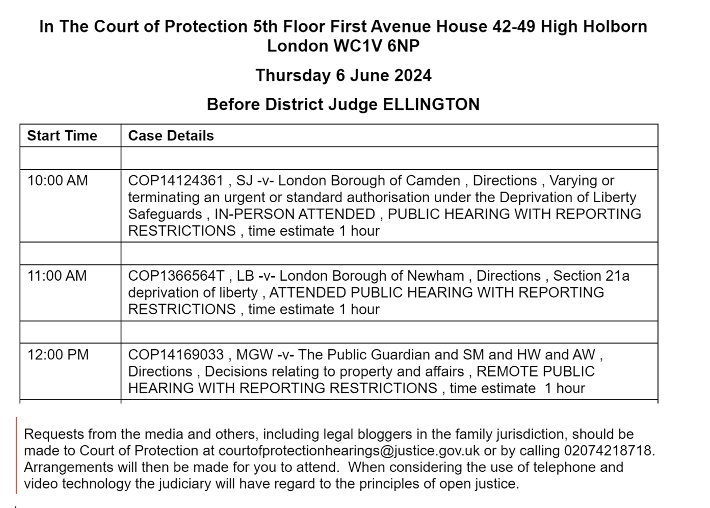
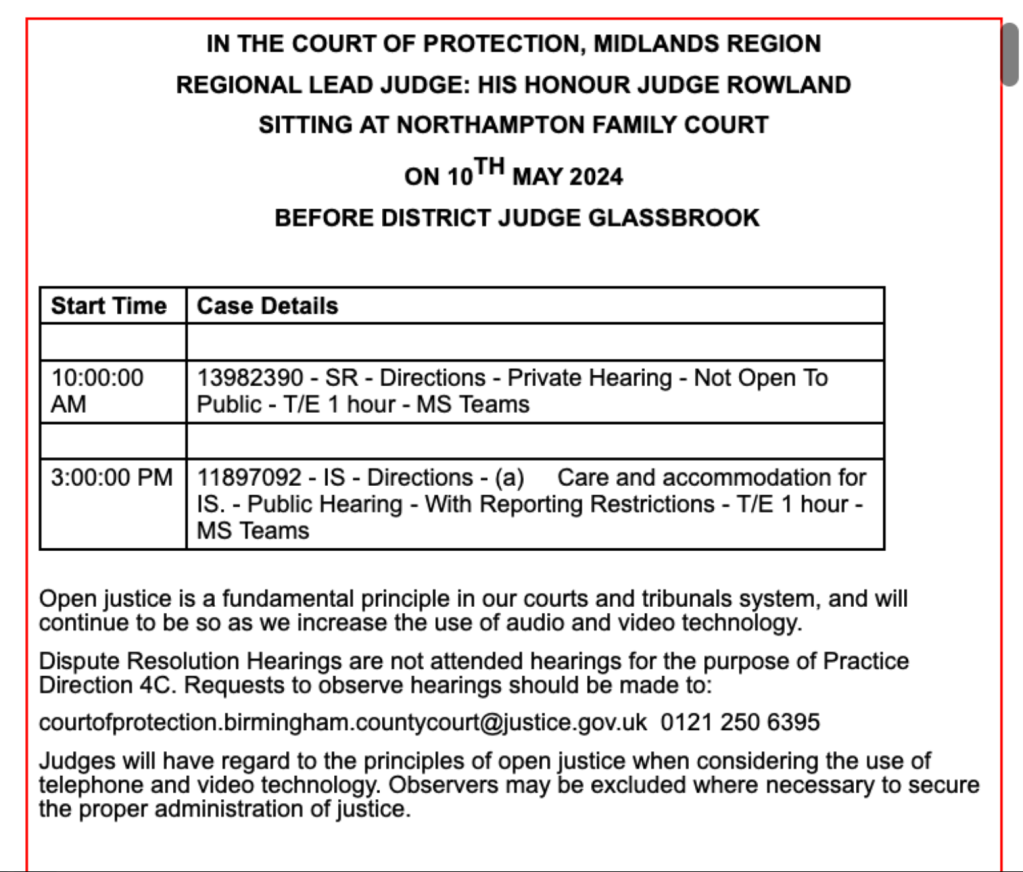
We observed a hearing (COP 14181752) in Derby before District Judge Lubega on the 12th April 2024. It was listed like this on CourtServe: 

My (Nell’s) interest in this hearing was piqued because I am a sixth form student currently completing an EPQ (Extended Project Qualification) about capacity and best interests for pregnant and birthing women. So, I have been looking out for cases where capacity is an issue (and finding cases that specifically relate to pregnancy and birth decisions is hard because the listings often do not say what they are about in that amount of detail). 

We were really pleased to be sent the link – and the Transparency Order – for this hearing in plenty of time and the court staff joined us early to check that we could hear and see. Thank you! 

The Context (Claire) 

The application was from Sheffield City Council and the respondent is P’s father and 1.2 Rule Representative

We learned (in a very helpful summary, invited by DJ Lubega, from Navpreeth Gihair, counsel for the Local Authority) that P is a 19 year-old woman who has diagnoses of autism and pathological demand avoidance disorder (PDA). She has been living in a care home (which she chose from options available) since December 2022 and is said to be happy there. Counsel for the Local Authority said that P has ‘chosen to be mute since February 2020’. We didn’t learn the context for this situation or how P currently communicates her wishes and feelings. 

The issues for this hearing were:

  • The authorisation of current restrictions for P on the internet and computer games – it was reported that P will ‘self-neglect and will prioritise gaming over everything’. So, at the moment, the internet is turned off overnight so that gaming is prevented, as well as at specific times through the day to enable certain activities, such as eating. 
  • P’s capacity for deciding where she lives – and although this is not a current issue (P is happy where she is, as is her father), there is a dispute between the Local Authority and P’s father about her capacity to make this decision. 
  • Who is authorised to take P out of her home. 

Not much was discussed in relation to the restrictions currently in place – we think that the judge agreed to the draft court order to continue with those restrictions in the care plan (Judge: “I am content with the care plan”). 

In relation to the other two issues, P’s father said: 

“[P’s] regime currently is appropriate – better than for years, she has a good routine. The care provider needs to be CQC registered: that’s down to them. The only issue really is [P] needs to be able to decide where to live, but that’s not something on the table so [….] As far as free to leave goes, she wouldn’t go anywhere on her own anyway. Where she lives, there’s no parks etc., she always needs somebody to support her [talked about needing a car to get anywhere at all]. The issue here is, they were stipulating a group of people who weren’t able to help her, and excluding a group of people who were able to help.”

It seemed that only the current care home staff were allowed to take P out, but P does not have as good a relationship with them as with staff from another care agency or with her father (and other family members), who – we think – are the ‘excluded’ group of people that P’s father refers to. She won’t go out with the ‘stipulated’ group of people, meaning, in other words, that she doesn’t get to go out. 

It was agreed that a recital in the court order would ensure the current restrictions are changed such that “[P] would need to be accompanied by someone appropriate to look after her” (judge). 

The final issue before the court was whether or not P has the capacity to decide where she lives. In September 2022, P’s social worker assessed her as lacking capacity for this decision. P’s father disagrees with this but is concerned that pursuing an up-to-date capacity assessment might be distressing for her – given that where she lives is not a live issue at present. He said “She is forming relationships with the psychiatrist and I wouldn’t want to see that go backwards”. 

Counsel for the Local Authority said, in relation to outstanding issues for the court: 

“The only factor is regarding whether she has capacity or not. That was raised by [P’s father]. He is still saying to court that P can make these decisions, and the Local Authority is saying the contrary. These proceedings are to approve the deprivation of liberty. It’s whether there is an active challenge to the capacity evidence. That is of concern. If he is saying ‘she can make these decisions for herself’, then the entire court procedure is predicated on fact that she lacks capacity. So, I would be hesitant to end proceedings today if [P’s father] is saying that she has capacity.”

The judge confirmed “I don’t think I had in mind a final order today” and proceeded to think about whether and how P’s capacity might best be determined, including appointing an ALR (Accredited Legal Representative) and commissioning a Section 49 report.

Different Views on Capacity (Nell)

Since this was the first time I have ever observed a hearing, and didn’t know what to expect, or know anything about the case, it was extremely useful that counsel gave a summary of the case at the start of the hearing (as I’m told was recommended by the former Vice President).  It allowed me to think about the matters at hand during the hearing rather than being concerned with trying to work out the facts of the case. If that had not been provided I can imagine I would have found it much harder to understand what was happening and what was being decided in the hearing. I could focus on the proceedings to help me to see how capacity is approached.

The current support network surrounding P is based on the findings that she lacks capacity for a multitude of things, however this was (partly) disputed by P’s father. This highlighted how a perceived lack of capacity should not be assumed – different people have differing opinions on whether P has capacity. And even though a social worker had assessed P to lack capacity to decide where to live, this is not set in stone and challenges can be made to such decisions. I learned that a section 49 report may be requested from people caring for P, to help the court understand and decide P’s capacity for certain decisions. In this blog it explains:

“A common scenario when a section 49 report might be considered is when P’s capacity is in question. In such a case, the parties might seek an order requiring the NHS Trust to arrange for a  consultant psychiatrist to assess P’s capacity and produce a report. Depending on the particular circumstances, the appointed clinician might also be asked to consider additional, specific areas of capacity and to make recommendations regarding the management of P’s condition and best interests more generally.”

In the hearing it was also interesting to see the court balancing the potential need for a renewed capacity assessment, whilst also considering how undertaking the assessment might destabilise P. The father highlighted his worry that undertaking a new capacity assessment could cause P to backtrack in the progress she has made. He also showed a nuanced understanding of capacity in stating how P may not have capacity to sign a tenancy agreement but does have the capacity to decide where she should live: 

Father: The only other thing is being entitled to decide where to live. In my opinion, she’s the only person who’s made sensible decisions about where to live. Including where she lives now. Whether she should be signing a tenancy agreement is another thing, we have no grounds to prove [talked about P not making poor decisions in the past and knowing where she likes to live]

I thought this was an important point: he uses past evidence of good decision making to suggest that this demonstrates capacity for future decision making in the same domain. This is an important aspect of looking at capacity: just because someone lacks the capacity for one decision it does not automatically mean they lose capacity for other decisions. 

Concerning the development and completion of my EPQ, it was useful to see how capacity was considered in a hearing where opinions differed about whether or not P had capacity. I can imagine opinions often differ around whether someone has capacity or not and it is important that if a person is assessed as lacking capacity for a decision, the judgment that they lack that capacity must be certain and based on clear evidence. If the evidence was not ascertained correctly, then that opens the potential for the right to autonomous decision-making being taken from a capacitous person. I think that would be a dreadful situation. 

In regard to medical decisions, it can mean the difference between whether someone can choose their own medical care or not. In my EPQ this is whether a woman is able to autonomously able to refuse medical interventions such as a caesarean section, or if it can be decided that she must endure one against her wishes as she has been assessed to lack mental capacity to make that decision. Assessments of capacity, by others, control whether people are able to make autonomous decisions or not, which restricts their freedom and control of their own life. It really highlighted to me the importance of making the correct judgement and what a difficult job judges must have.

The Outcome (Claire and Nell)

DJ Lubega agreed the final wording for the court orders, which included the appointment of an ALR and the importance of stating that anyone ‘appropriate’ to accompany P outside of her home was permitted. The judge was clear that, although P was not currently stating she wished to move out of her current home, the existing court authorised restrictions that she is subject to, do amount to a deprivation of liberty, and would continue to amount to a deprivation of liberty even with a wider pool of people taking P out. Addressing P’s father the judge said: 

“If you’re saying she has capacity to make the decision for herself, if she turned around next week to say I want to live somewhere else, then this needs to be bottomed out. It needs to be done in a lawful way and needs further consideration from the court. My question is [….] given the concerns both parties have expressed about the impact on P, what process should take effect. Is the entire process needed? Can it be streamlined?”

Counsel for the Local Authority confirmed: “There is scope for it to streamlined. It may be that when the ALR is involved, there is a different way. The work with P by the psychologist will continue in any event. We are all alert to concerns about further distress and need to build a relationship carefully. Simply, that if we need further capacity evidence … the psychologist has said that if we need one then it needs to be done very carefully. We need to understand how that can be better approached in her best interests. We don’t know how at this stage.”

We didn’t learn very much at all about P as a person in this hearing – there have been several hearings in the case, so this is perhaps not surprising. We wondered why P had not spoken since 2020 and how she communicated her wishes and feelings – and it sounded like she was able to do so. P’s father, as well as P herself, seemed to be very happy with the care she receives where she is living now, and all parties were concerned about disrupting her relationships and stability by subjecting her to a capacity assessment; an assessment that is needed for the Court of Protection to have jurisdiction in relation to decision making about where P lives, both now and in future. 

Given that P is not expressing any desire to leave her current home, and everyone was worried about the psychological impact of more assessments, we were unsure why proceedings could not be brought to a close without a determination about capacity for that decision. Then, if and when P did express a wish to move home, a capacity assessment could be carried out at that time. 

A ”short, final hearing” (judge) is planned for 27th June 2024. 

Nell Robson is a sixth-form student completing an Extended Personal Qualification entitled: “What are the challenges in making best interests decisions for pregnant/birthing women?”

Claire Martin is a Consultant Clinical Psychologist, Cumbria, Northumberland, Tyne and Wear NHS Foundation Trust, Older People’s Clinical Psychology Department, Gateshead. She is a member of the core team of the Open Justice Court of Protection Project and has published dozens of blog posts for the Project about hearings she’s observed (e.g. here and here). She tweets @DocCMartin

“A most distinguished man” 

By Claire Martin, 15th April 2024

A hearing before HHJ Beckley on 18th March 2024 (COP 1347207T) started off with counsel for P (Alison Harvey) describing the person at the centre of the case as “a most distinguished man’”. He is used to living in Kensington & Chelsea and wants to go back there to live. 

I am able to name the Royal Borough of Kensington & Chelsea (RKBC) because – although the Transparency Order (TO) that observers are served originally stated that RBKC could not be named – I emailed the judge before the hearing started and asked him to consider changing (‘varying’) the injunction. 

At the start of the hearing, HHJ Beckley said that this issue had been “helpfully raised” and that “… the TO unusually, and in my view erroneously, says RBKC shouldn’t be identified. There’s no reason that RBKC shouldn’t be identified. That will be taken out of the order“.

We have found that (as this case illustrates) it is much easier to vary a Transparency Order before or during a hearing than afterwards. So, it really helps to be sent the TO prior to a hearing. 

The Hearing

P (I am not sure how old he is) was a professional man in the STEM sector. He has lived where he currently resides since 2020.

From 2010 he is said to have experienced depression and alcoholism and then in 2013 he had a brain injury that has affected his short-term memory and has left him with seizures, which have led to further injuries. Up until some time in the mid-late 2010s he lived with his mother, but she moved out because she felt unsafe. Then he was evicted from the family property and had a further seizure in 2018 which eventually led to him living where he lives now. 

P is the applicant in this case, via his ALR (who kindly shared their Position Statement so that I could better understand the current situation). The application was to challenge the authorisation of P’s deprivation of liberty at the place where he currently lives. The respondent is the Royal Borough of Kensington & Chelsea. Two family members, his niece and his sister, were also (remotely) at the hearing, but they are not (yet) parties in the case. 

P really does not want to be living where he is now. He has consistently stated this. Counsel for P said that “proceedings have been DOGGED by delay. By the last hearing we reached a state of considerable vexation from his ALR” (her emphasis). The proceedings have been ongoing since March 2022 and “we have no tangible progress to show for it for [P] in terms of getting back to the area where he wants to live”. 

P had been assessed by various care homes, and had repeatedly been turned down for a place to live. However, on the morning of the hearing, a company (which had previously declined to offer a place) had come forward with a place for P. 

This was presented as an opportunity for P. He hadn’t yet seen it though, and had “turned his nose up” at it, being in a ‘less smart area of Kensington and Chelsea’. His counsel said “we hope that when he visits it he will feel more positive about it”. 

However, it transpired that P’s family was somewhat concerned about the proposed move. The court was told that “they are involved at every step. Ultimately they are consulted and involved rather than having power to force the court to complete options“. Alison Harvey, Counsel for P, proposed a plan: “… an initial transition meeting, an opportunity for the family to see [the care home] so they can take a view, and then a transition plan which would include provision for [P] to visit the placement. Advice would be sought as to how to present that to him, make it as positive as possible. See if we can reach agreement on a transition plan. We are dependent on [P] wanting to go. That remains a question for all of us.

Other options would be considered in parallel, in case it didn’t work out. The relief in P’s counsel’s voice was palpable when she said “having been through a very rocky period we have achieved for the first time a concrete option to explore within Kensington & Chelsea, and that’s very exciting for everybody“.

Counsel for RBKC (Catherine Rowlands) and P’s family seemed less excited about the developments. 

Catherine Rowlands said, “Your Honour, the proposal that [P] should go to [the care home] is not set in stone. He has at the moment said that he’s not even willing to look at it“.

RBKC would place P on the waiting list for a council property (which would require a care agency for independent living) and the social worker was to do that. This was a “fallback” (said the judge) and “this isn’t going to magic a property rapidly“.

The judge then addressed P’s family. P’s sister spoke first. She said  that she was concerned about P moving out of the place where he is now because of a potential reduction in support. She mentioned that he currently receives psychological support from a psychotherapist and that he has epileptic fits and is concerned about whether he will receive 24/7 support. A further concern is access to alcohol and potential trouble with the police. 

P’s niece (who is a doctor) expressed pleasure that progress had been made, though she had reservations. She was concerned that the place being proposed now had, only the previous week, said that their care home was not appropriate for P, “so we’ve done a 180“. She also said that, despite being told that they would receive communications about the case, the family received everything “last minute” and that she felt this was “being pushed through … it feels like due diligence isn’t being done”. She outlined significant care concerns: “The website [of the proposed care home] mentions offenders and ex-offenders. My uncle is very vulnerable. With my healthcare hat on … he needs a consultant neurologist like he has in [current residence]. Who’s going to do that? Timing is my big concern – the neuropsychologist has concerns about [GP and hospital appointments].”

Counsel for RBKC and (I think) P’s social worker, who was also at the hearing, both tried to reassure the family that “transition planning is going to be thorough“.

The judge, similarly, stated: “Again, just to set [sister and niece’s] minds at rest. It’s not proposed that [P] will move before the next hearing. This is a best interests decision. […] [It has been] absolutely clear throughout the proceedings with [P] … he wants to be in RBKC. I do take into that view, his family’s views.”

So, that was the plan. P was to be encouraged and supported to go to look at the new proposed place to live, P’s social worker was to be authorised to make an application for social housing in RBKC as a ‘fallback’ and the family was to be involved in considerations. 

At the end, P’s niece spoke up:  “One request I would have, in front of everybody, if documents are being submitted please can we have them in plenty of time? The cynic in me says: do we get them late so we can’t have a voice? You will hear my voice! I ask court that everyone sticks to time and we have two weeks”.

She explained that time is needed to translate and discuss the proposals with P’s mother, whose first language is not English. The judge engaged with this request, suggesting that the Local Authority’s evidence should be received a month before the hearing. 

Reflections

This case had clearly been long and arduous for all concerned. It was clear that there is not a preponderance of specialist places to live for P, that can meet his needs and that are in his preferred area to live. Finding the balance between those two things has clearly been challenging. 

There was dispute between P’s counsel/ALR and the Local Authority about who should be doing what and paying for it. For example, at one point, searching for potential properties to buy was raised as an option, but counsel for the Local Authority was clear that “It is not the case where we intend to go and look for somewhere in the property market. It is not the job of RKBC”. Who should make the application for social housing was a further issue. Counsel for P was firm:  “May I say … the legal aid agency wouldn’t fund [ALR] to fill out any of those forms. There’s no way they’d pay him“. The judge confirmed that this was authorised to be the Social Worker’s role. 

This case seems beset with issues, not only by finding an appropriate place for P to live, but also with budgets and who will do what, when. This is the way of things, I understand. I know from my own experience that it is the same in the NHS. People get lost in the melee though – and, even when professionals try their best, delays inevitably happen. Such has been the impact on P’s life here, it seems. 

I thought some of the language used was interesting. P was presented as “a very distinguished man”, which made my ears prick up. I am reminded of medical letters that often start off “I had the pleasure of meeting this delightful lady….’” or some such accolade. What about people who are not “distinguished” or “delightful”? Are those adjectives relevant? Maybe they are. We were told that, although where P was living was a specialist placement and it has rehabilitated him: “…. it is not where he wants to be. He identifies very strongly with Kensington & Chelsea. The borough is central to his identity, as a resident of Kensington & Chelsea, and as a very smart man of a very smart suburb“.

Perhaps that is the case. Maybe I am being a bit picky here. I wondered why that way of describing him was chosen, rather than, say, that P previously lived in Kensington & Chelsea and this is where he feels at home and would prefer to live. P was also very keen to be registered with his previous GP, with whom it seemed he had a good relationship. This was presented as follows:  “If he is in the borough, the surgery which he is very fixated on is more likely to accept him as a patient.” It made me wonder whether the rest of us, when thinking about things that matter to us and that we can autonomously pursue, would consider ourselves to be “fixated” on those things? 

These are just little words, here and there. I think, though, that they might be more readily applied to others, rather than how we would choose to describe ourselves, when we speak for ourselves. 

The next hearing for this case is planned for Wednesday 5th June at 10.30am. 

Claire Martin is a Consultant Clinical Psychologist, Cumbria, Northumberland, Tyne and Wear NHS Foundation Trust, Older People’s Clinical Psychology Department, Gateshead. She is a member of the core team of the Open Justice Court of Protection Project and has published dozens of blog posts for the Project about hearings she’s observed (e.g. here and here). She tweets @DocCMartin

Extraordinary restrictions – “family are the experts”

By Celia Kitzinger, 14th April 2024

In an earlier blog post (“Unusual restrictions” for a 17-year-old), Claire Martin reported feeling “very alarmed” by restrictions to which this young man is subject, in self-contained padded rooms, behind a locked door, with 4:1 supervision.  The judge in that hearing, DJ Glassbrook, had said these were “extraordinary restrictions which require extraordinary justification”.  He gave only interim authorisation of the restrictions which is what has led to this next hearing just two months later, before a more senior (Tier 2) judge, HHJ Rowland, sitting in Birmingham. 

The young man at the centre of this case  (COP 14169995) has “autism spectrum disorder”, “bipolar disorder” and “severe learning disability”.  He moved to his current placement in November 2023, having previously been detained in hospital under s.3 of the Mental Health Act since 2016 (so for 7 years).   The extreme restrictions are said to be necessary because “his condition leads him to be a significant danger to himself and others”.  He will shortly turn 18 and the application before the court is to consider his best interests in relation to residence and care and in particular to consider whether the unusual restrictions applied are necessary and proportionate deprivations of his liberty.  

The applicant local authority, Buckinghamshire Council, was represented by Francis Hoar of Field Court Chambers.  

The young man, W, was represented via his litigation friend, the Official Solicitor, by Gemma Daly of Doughty Street Chambers.

His grandmother appeared as a litigant in person (also representing the united view of his mother and sister) having been joined as a party at the last hearing. Her contribution to the hearing was very significant.  She disagreed with the Official Solicitor’s perspective, explained the family view succinctly and clearly, and the judge seemed entirely persuaded.  “Thank you”, he said, “it’s the family who are the experts”.  

Here’s what happened.

Most of the hearing was spent going through the draft order, which I didn’t have a copy of so it wasn’t particularly easy to follow exactly what restrictions the judge was being asked to approve.  I heard that the bedroom and living area are padded and both doors – one to the garden and one to the staff office and kitchen area – are locked.  He’s not free to leave the placement without support from staff. The garden is fenced and there was mention of his trying to scale it in the past, which is why he needs supervision in that area. I gather that physical restraint is also used.

There was some discussion of something that sounded like “ProAct Skip” and when I googled it after the hearing I discovered PROACT-SCIPr Methodology which is a Positive Behaviour Support practice.  Staff encourage a “Positive Range of Options to Avoid Crisis” (e.g. a choice of bath or shower; a choice of what to eat; a choice of TV channels) while attempting to reduce restrictive practices (e.g. he was previously supervised while sleeping at all times and is now only checked every 15 minutes).  The methodology also uses Therapies (e.g. sleep therapy has been identified as a need for this largely nocturnal young man). 

The Official Solicitor then raised her particular concerns which related to the use of “seclusion”.  Although she’d not put in a formal application, she raised the likely need in future for a jointly instructed independent expert to address this, and other aspects of the restrictions.

One of the consequences of W’s condition is that he will often charge – he’s a strong young man – he will charge at staff, and because of his strength that can obviously present a risk to himself and to his staff.  So, if he runs or charges at staff, they leave the padded area and retreat behind a locked door and monitor W via an observation panel.  The Official Solicitor suggested, and it is agreed, that detailed records must be kept of any such incident of seclusion and staff must unlock the door when he’s no longer charging.  We have asked for a narrative description of incidents when W is left alone in the padded area in response to incidents that challenge. […]. There is very limited information currently as to the frequency and duration of these seclusive episodes. On the balance of the evidence, the Official Solicitor cannot submit that this practice is necessary and proportionate.  We cannot agree that the court should authorise seclusion at present – or what would be “seclusion” if in a Mental Health Act setting[1].  This is a highly restrictive practice.  We cannot agree that it is appropriate and should be authorised by the court.  And it is not in the care plan that detailed records must be kept – so if the court is not with me on this, then that must be added.  There is no formal application for an independent expert before the court, but my instructing solicitors have inquired of three different Independent Social Workers in the last two days since the seclusion issue became apparent. This case is very likely to require expert evidence”.

The grandmother was then asked if she had anything she wanted to say.

Grandmother:  I may not understand 100% everything that’s been said because this is all very new to us as a family, but I do have some concerns about what the Official Solicitor has said.  It’s really essential that W has some time away from people.  He will charge at them because he wants people out of his sight, and he can’t verbalise that.

Judge:  So you think he’s regulating himself?

Grandmother: Yes.  And when he charges he can injure himself and others, which is why people have to leave.  Last time I went, he charged at me and the carers but they were able to go back in quite quickly.

Judge: How long was it before you went back in?

Grandmother:  I didn’t go back in.  I will be honest, he frightened me.  He’s a big lad, nearly 6 foot, and I’m a small disabled lady.  But staff were back in in five minutes.  If he charges, it’s because he doesn’t want them there.  From a family perspective, they’re doing exactly the right thing by leaving the room and giving W the space he needs.  The problem is- I’m sorry if I’m speaking out of turn, I don’t know, I find it very difficult but I’m his expert and my daughter is his second expert, and what we want is to keep W safe, and the people looking after him.  We do want the staff to be protected as well. The history is that he’s injured staff, and staff have been hospitalised and staff have left because of stress and not being able to cope and that affects his care. The other thing is, I will not support another expert coming in and making judgments about W at this moment in time.  Mr M [Note: I don’t know who Mr M is or what is role is] has been absolutely brilliant, and he comes from an external organisation.  Also, we’ve engaged with the CQC with regards to looking at DOLS and they’ve extended their remit and they’re an external organisation and they’ve gone in and monitored his care.  Introducing new people to W is difficult and it’s difficult for the family and for professionals too.  We’ve all got enough to do.  I hope I haven’t spoken out of turn, Your Honour.  We love W and we want him to be safe, and his current placement has been absolutely brilliant.

Judge:  Thank you.  It’s the family who are the experts because you are the person who has known him for the longest.

Counsel for LA:  Do you want me to respond on seclusion?

Judge: I don’t need you to respond.  I will leave in [the paragraph of the order dealing with seclusion] with additional wording in bold. I have some sympathy with the concerns the Official Solicitor has raised about practices of seclusion, but it seems to me that one can see, inferentially at least, the justification for it in W’s best interests – and in terms of the proportionality of this step, given his practice of charging at others, which gives rise to the potential of injury to himself and those who are caring for him.  But I do need some understanding of how the practice is used, how frequently and for what duration.  And I won’t make an order today for expert evidence. That needs to await a proper application, but it also needs to be considered in light of what Mr M has to say – assuming he’s provided reports to the local authority about how W can best be managed.

Counsel for the LA: I would add that although the seclusion is in part to manage the risk to the care support workers, that’s also a matter of concern to W, because of the risk they’ll leave the placement.

Judge: Continuity of care is very important because he’s beginning to establish relationships with these people, which is very important.

The next hearing will be on 24th April 2024, before HHJ Rowland in Birmingham.

Celia Kitzinger is co-director of the Open Justice Court of Protection Project. She has observed more than 500 hearings since May 2020 and written more than 100 blog posts. She is on LinkedIn (here), and tweets @KitzingerCelia


[1] Seclusion is defined in the Mental Health Act Code of Practice as follows.  “Seclusion refers to the supervised confinement and isolation of a patient, away from other patients, in an area from which the patient is prevented from leaving, where it is of immediate necessity for the purpose of the containment of severe behavioural disturbance which is likely to cause harm to others” (para 26.103)

Two hats: Mother as Rule 1.2 representative and (now) litigation friend

By Celia Kitzinger, 11 April 2024

This was a short hearing about a long-running case[1] concerning a man in his twenties (MA) who has a learning disability and autism.  Following an unpublished judgment by Hayden J back in July 2021, MA lives at a placement where he is deprived of his liberty.

 In July 2022, the local authority sent a COP DOL11 renewal application to the court requesting renewal of MA’s deprivation of liberty under the Re X streamlined procedure[2], but there have been a number of delays – some due to a backlog of applications in the court system, and some caused (says the local authority) by his mother.  

At the last hearing, on 23rd February 2024, seven weeks earlier (we blogged about it here: Judge declines to authorise a deprivation of liberty (for now)) the mother – who is also MA’s Rule 1.2[3] representative – said that she’d not received or had time to consider her son’s updated care plan or his Positive Behavioural Support plan.  The observer wrote: “Given that MA’s mother had been unable to file a witness statement that reflected her views on MA’s current care, the judge declined to authorise the deprivation of liberty at this hearing. He listed the case again for a one-hour hearing at 2pm on Wednesday 27th March 2024.” So, this was that hearing held, as previously, before Deputy District Judge Reeder, sitting (remotely) at First Avenue House.

In an opening summary, counsel for the applicant local authority, London Borough of Haringey,  Rebecca Hancock of Field Court Chambers, said that MA’s mother/ Rule 1.2 representative has now read the relevant documents and provided a statement in response which raises some issues which would be properly dealt with as s.16 Welfare proceedings, rather than a second or third go at dealing with this under the streamlined procedure.  This includes the mother’s concerns about medication,  support levels, activities and social stimulation, and contact between MA and his family.

The judge noted that “arrangements made in relation to family time didn’t appear to correlate with what was actually happening” and told counsel to make sure the new care and support plans were up to date.  The court order of March 2022 required active review of family time every three months, but that hasn’t happened.  On behalf of MA, via his mother/Rule 1.2 representative, Richard Alomo of No5 Chambers said that there hadn’t been any review of family time – but that this has now been provided for in the draft order, which (with both parties’ agreement) also reconstitutes the proceedings as a s.16 Welfare case.  The parties have also agreed on what evidence needs to be before the court for the next hearing: my understanding is that it includes information about staffing levels, how waking night care operates, the current activity plan, and a review of contact arrangements.

I think the parties disagreed as to whether or not the judge should authorise MA’s ongoing deprivation of liberty in his current placement while the broader issues are considered. I haven’t seen the final order and I’m not sure whether the judge did or did not do so.

The parties also disagreed as to whether or not his mother should act as MA’s litigation friend in the reconstituted s.16 proceedings. The local authority thought the Official Solicitor should take that role, in part because of the possibility of a conflict between the mother’s strong views about contact with her son, and the need to act impartially as MA’s representative.

The judge said that the court “might now have reached the end of the road as far as the Re X procedure is concerned” given that “you had one stab at redoing it and things were still not in proper order”.  He said he was “presently minded  to reconstitute it as a welfare application”.  He considered the question of whether or not the mother should be appointed as litigation friend, noting that the Official Solicitor is the litigation friend of last resort and that the mother had “conducted herself perfectly properly as a 1.2 representative at the same time as being MA’s mum”.

The ability she’s shown to wear two hats is the same for a litigation friend.  Nobody has raised issues or evidence to support her being prevented from being litigation friend.  When talking about family time, she needs to be led by MA’s wishes and to support MA’s wishes.  I can see nothing in the paperwork, nor has anyone pointed me to it, that would constitute a challenge that mother couldn’t meet wearing both hats.  Unless there’s a compelling argument against it, then, I will appoint Mum as litigation friend for MA.  If things reach an impasse, I can reconsider that position, but let’s hope that problem does not crop up.”

We hope to observe when the case is next back in court.

Celia Kitzinger is co-director of the Open Justice Court of Protection Project. She has observed more than 500 hearings since May 2020 and written more than 100 blog posts. She is on LinkedIn (here), and tweets @KitzingerCelia. She can be contacted via openjustice@yahoo.com

Footnotes

[1] I discovered that other observers had actually watched this case  – before first Williams J and then Cohen J –  right back in the very first month at the beginning of our Open Justice Court of Protection Project in 2020. Here’s what Upeka de Silva says about it in June 2020 – in the very first blog post we ever published.   “The case (listed as Case 13155577 Re: M), created a rollercoaster of emotions.  It related to a contact order between a mother (the applicant), a brother (litigation friend) and a local authority care home in which P was currently residing. While there were Covid-19 related concerns in relation to visiting, the primary tension seemed to be about a breakdown in trust and cooperation between the mother who wanted to bring and share lunch with her autistic son and the care home who had refused her admittance for a period. It was heart-breaking to think this had to come to court. On the other hand, Mr Justice Williams maintained unwavering focus on what is right for P and preventing him being exposed to a toxic atmosphere. The hearing lasted an hour, an order requiring both flexibility and stability was granted, and I left feeling reassured that person-centred decision-making, an issue I feel strongly about, prevailed.” (Upeka de Silva, June 2020, One and a Half Remote Hearings in the Court of Protection) ( Also covered by David Haxon, July 2020 (before Cohen J) “A stop-start hearing”).  There don’t seem to have been public observers (at least known to us) at the subsequent hearings before Hayden J

[2] See  ‘Failed Re X’: Deprivation of liberty and Re X (the streamlined process) – a social work perspective.

[3] What is a Rule 1.2 representative

Family tragedy and institutional delay in best interests decisions about life-prolonging treatment

By Celia Kitzinger and Jenny Kitzinger, 9th April 2024

In July 2020, a woman identified in the judgment as “PC”, collapsed at home with a cardiac arrest. This was totally unexpected: she was otherwise fit and well (and only in her early 30s). Despite resuscitation from her family and then from the Ambulance service, her heart stopped beating for at least 30 minutes. She sustained severe generalised hypoxic brain damage.

It turns out, from later investigations, that she has “long QT syndrome”. This is an inherited heart problem that affects the heart’s electrical activity and can cause cardiac arrest (there’s an NHS page about the condition here). She wasn’t aware of this – and the NHS does say that some people with long QT syndrome don’t have any symptoms and don’t know they have this condition until something goes wrong.

PC had been a lively, active, fun-loving person who loved to walk outdoors, travel, and listen to music. At the time of her collapse, she’d been about to start studying for a biomedical degree 

More than three years after her cardiac arrest, PC has been assessed as being in a disorder of consciousness in the lowest end of the spectrum of awareness (Minimally Conscious State minus [MCS-]). This means she is able to focus on and track objects or people in her environment. When subject to interventions that might be expected to cause pain (and sometimes spontaneously too) there is also facial grimacing, moaning and profuse sweating – but there is a question mark over whether or not she actually experiences pain. She’s unable to communicate or interact socially with anyone, including family members. She cannot show that she recognises people and is unlikely to be able to discriminate between them. She breathes on her own, but receives clinically assisted nutrition and hydration (CANH) via a tube into her stomach.

According to the independent expert, Professor Derick Wade, Consultant in Neurological Rehabilitation: “Almost all recovery seen after hypoxic brain injury occurs within 12 weeks, possibly with a few people improving a little over the second 12 weeks”. The medical consensus more than three years on is that PCs condition is permanent and there is no prospect of any improvement.  

Like most people, unfortunately, PC hadn’t made any formal advance decisions about what she would want in this situation. Nor had she ever discussed what she might want with her family. As her sister said, “It never crossed anyone’s mind before to even speak about it because she was very healthy”. 

So, it was up to those providing life-sustaining treatment – and now up to the judge – to decide whether or not continuing to provide it is in PC’s best interests. 

This blog post is divided into two parts.  

The first part (“I. Best interests and delay”) is largely based on the documentation received from the court[i].  Without it, we’d have very little idea of what was going on. It should provide a useful summary of the case as it stands at present – and since the case will be back in court in late April, it will provide useful background reading for anyone wanting to observe that hearing.  

The second part (“II. The hearing”) deals with what actually happened in court on the day. It gives a sense of the challenges faced by observers, and also of the kinds of procedural issues the court has to deal with in addition (and prior) to hearing substantive weighty moral and legal end-of-life issues. For non-lawyers, we hope it conveys a sense of what lawyers spend a lot of time doing – arguing about reporting restrictions, searching for colleagues willing to act pro bono, and arguing for or against adjournments – all the messy business of law-in-action.

I. Best interests and delay

There seems to have been a delay in bringing this application to court – and indeed, a delay in considering whether or not continuing treatment was in PC’s best interests. 

As far as we can tell from what happened in court, and from the documents we’ve received, PC was diagnosed as having a “permanent” disorder of consciousness in Spring 2021, following multiple testing and brain scans at the Royal Hospital for Neurodisability (RHN) where she’s an inpatient. However, there was no best interests meeting with relevant professionals and members of PC’s family until March 2023 (so two years after her MCS- became “permanent”). There was no explanation available to the court as to why this best interests meeting was so delayed. 

The apparent failure of the Royal Hospital for Neurodisability to hold a timely best interests meeting for PC is especially surprising given the court had extensively criticised the RHN for delay in decision-making about another patient, ‘GU’, in June and July 2021 – so just a few months after PC was admitted to their long-term care ward.

The case of North West London Clinical Commissioning Group v GU [2021] EWCOP 59) concerned a 70-year-old man in a prolonged disorder of consciousness (‘GU’) who had been cared for in the RHN for many years. The (then) Vice President, Hayden J commented that the hospital (an acknowledged ‘centre of excellence’) was actually “a long way behind the curve” in engaging with up-to-date legal and professional standards. Reviewing the evidence presented in the independent report, and hearing from the family, Mr Justice Hayden considered it “highly likely” that GU had been subject by the RHN to treatment that was not in his best interests for some time. He also criticised the fact that the RHN were not party to the proceedings, commenting that “The hospital can’t be allowed to hide away from responsibility by not confronting decisions that need to be taken and then not joining legal proceedings”.  We blogged about the case here:  Clinically-assisted nutrition and hydration: Decisions that cannot be ignored or delayed

In a supplementary hearing after deciding the substantive matter before the court in GU, the judge made a series of very powerful observations about the obligations imposed upon treating bodies to ensure proper consideration of whether continuing treatment is in a person’s best interests, and to take proper steps to secure timely resolution of any dispute. See our earlier blog post: “Burdensome and futile” treatment and dignity compromised: Poor practice at a leading UK hospital. We would have expected this case to have prompted the Royal Hospital for Neurodisability to ensure best interests decision-making for all patients in their care – including PC.  

It was clear that the Official Solicitor had the same expectation. In her position statement for the PC case, the Official Solicitor referred back to the case of North West London Clinical Commissioning Group v GU [2021] EWCOP 59 and expressed a concern that “lessons may not have been learned, and significant delays in bringing cases of this nature to court are still occurring”. She further submitted that there should be “an independent review of the evidence disclosed by the ICB and RHND to ascertain whether the protocols and procedures in place to ensure timely best interests decisions are made for patients in PDOC are consistent with the Royal College of Physicians Guidance and are sufficiently robust to ensure that delays in cases of this kind will not be repeated”. 

A documented best interests meeting for PC did not finally take place until nearly two years after her diagnosis of her condition as permanent, in March 2023. At that meeting all present agreed that it was no longer in PC’s best interests to continue with clinically assisted nutrition and hydration (CANH). The treating clinicians were all of this view, and so were the family. Her mother said that PC “wouldn’t want this life as she was independent and active” and her friend said “hand on heart she would want to go”. The position of the family was confirmed in a letter written by PC’s sister received in early April 2023. Their view at that point was that this was not a quality of life that PC would have found acceptable for herself.

An independent second opinion expert, Professor Derick Wade, also concluded that there was no prospect of improvement in PC’s condition and, after speaking to the family, he also came to the view that it was no longer in her best interests to continue CANH. After review by the RHN Ethics Committee in May 2023, it was agreed that CANH would be discontinued on 14th June 2023.

Then, following a visit from a cousin in early June 2023, both parents changed their position and stated that they now felt that CANH should continue.  

In subsequent statements, this cousin stated that PC “was a fighter who held onto life very tightly”. Her view is that, whatever the medical evidence says, “we as her family will always have hope that one day [PC] will eventually heal; time is the best medicine”. She described looking into PC’s eyes and feeling that PC is saying to her “I want to live… do not let them take my life away from me…. I can definitely see in her eyes that she would want to continue living and having hope that one day her body, mind and soul will recover from this trauma”. 

The mother says she feels “guilty” about the decision made at the previous meeting – which she sees as about “killing” her daughter. She wrote: “[PC] is my daughter and as her mother I cannot bear losing her as she is the reason I am alive. I fight every day for [PC].  I will commit suicide if [PC] dies...”. 

Her father says he believes that “she is fighting” and will “come back to life”. He wrote: “Please do not stop her medications as she is our beacon of light… As a father, I want the best for my daughter and she deserves to live”.  

Her mother told the solicitor that they are hoping for a miracle and that she would “prefer [PC] to give up on her body herself and pass away like that; I don’t agree with withdrawal of CANH”. She believes “if she is to let go herself it would be natural and not by the hospital”.  

A friend of PC’s now opposes withdrawal of CANH out of concern that the mother “may not be able to cope mentally or emotionally with the consequences”. 

Other family members, notably PC’s sister (and possibly her other siblings – this wasn’t clear) maintain their original position but have chosen no longer to be involved in the process.

Following the parents’ change in position in June 2023, a court application could – maybe should – have been made immediately. 

Instead, further assessments were completed. They continued to show a low level of responsiveness, and no evidence of significant awareness. There seems to have been an increase in pain behaviours such as crying, grimacing, moaning and frowning. Despite pain medications and an antidepressant, PC often shows apparent distress in response to suctioning and at times when staff are handling her, e.g. washing her, or moving her into a wheelchair, and also sometimes these occur spontaneously. The clinical evidence is that she does not smile or display pleasure. 

These pain behaviours are distressing for the nursing care team and to family members – some of whom do not visit because it is so distressing to observe. It was stated that between 1 August 2023 and 31 January 2024, PC was visited on 14 out of 184 days – mainly by her mother and sister. [Note: At a subsequent hearing, the number of visits was disputed – it seems visits take place without family members necessarily signing in and we think it was accepted that there have been many more visits than indicated here.)

An application to the Court of Protection was eventually made on 2nd February 2024. That’s 3 years after PC was diagnosed as having a “permanent” disorder of consciousness, and nearly a year since the original best interests decision was made that continuing treatment was not in her best interests.  

The ICB (North Central London Integrated Care Board) is the applicant in this case (this is the ICB that commission PC’s care). The application is seeking a determination under the Mental Capacity Act 2005 that PC lacks capacity to conduct proceedings and to make decisions regarding her medical care and treatment, and that it is lawful and would be in PC’s best interests for those treating her not to continue to provide CANH and for her to transfer to a palliative care pathway.

The Vice President, Mrs Justice Theis (we think on the papers, i.e. without an actual court hearing) made directions in February to join PC as a party to the proceedings, invited the Official Solicitor to act as PC’s litigation friend, and gave directions to file evidence, including evidence from the applicant ICB addressing any delay in bringing the application. She also made a transparency order.

Having considered all the evidence to date, the Official Solicitor “with great sadness” and subject to hearing oral evidence from the family and from the medical experts, takes the position that the benefits of continuing CANH are outweighed by the significant burdens – especially the risk that PC may be experiencing pain. The Official Solicitor also raised a concern about “unacceptable delay” in bringing the application to court. Furthermore, said the Official Solicitor, “it remains unclear if the question of whether it is in PC’s best interests to continue CANH was considered at all in the period from 15 March 2021, when she was admitted … for long term care, and 8 March 2023, when the process of making a best interests decision was started”.  

The hearing (COP 14034582) before Mr Justice Cusworth was listed for two and a half days, from 25th-27thMarch 2024 – but in the event it was adjourned just after half past two on the first day. It will be back in court on (some or all of) 24th, 25th and 26th April 2024.

II. The hearing

We didn’t know what this hearing was about in advance – Celia just happened to choose it as one to observe, and all the information in the previous section emerged later. Celia (after some delay caused by confusion about the transparency order discussed below) was eventually able to alert Jenny, who then joined from lunchtime onwards.

It was a hybrid hearing, starting at 11am on 25th March 2024. Counsel and the judge were in the physical courtroom, but some people, including one medical expert, were attending remotely via video-link. Hybrid hearings can be challenging for those of us on video-links – in particular it can be hard to hear what’s going on in the court, and we rely on someone to move the camera (or to set up additional cameras) to capture counsel, the judge, and any witnesses.

It was quite a disjointed hearing with several adjournments and with a muddle at the beginning which negatively affected transparency and open justice.  

In summary, here’s what happened, under three hearings (1) Transparency issues; (2) Legal representation for the mother; and (3) Considering delay.

1. Transparency issues (Celia)

The applicant counsel – be-wigged, and distant to the camera so I had no idea who he was – gave a verbal description of the transparency order already made by Mrs Justice Theis (which observers had not been sent). He explained that the order protects (as usual) P and P’s family. It also protects the identity of the treating clinicians, which is less usual and which – when this restriction is applied – is often lifted at or shortly after the end of a hearing, or after the protected party has died. 

Following counsel’s account, the judge said “during this hearing until the end when the transparency order can be reconsidered, there must be no reporting of what is going on in court”.  

This was a very unusual restriction. We are normally free to blog, or otherwise communicate about hearings during adjournments and breaks in the hearing and before the judgment – and have done so frequently.  

Counsel then offered to give an opening summary of the case but the judge said, “I don’t require any more detailed opening” – so that left me in the dark as to what the case was about.  

This was all extremely frustrating because on joining the hearing, I’d noted that Professor Derick Wade had been named as someone available to give expert evidence – and this alerted me to the possibility that the case would concern someone in a prolonged disorder of consciousness, since that is Professor Wade’s area of expertise. But (a) I didn’t know that for sure since there was no opening summary; and (b) I couldn’t alert anyone else to this hearing since the judge had said I mustn’t report “what is going on in court”. I wanted to alert other members of the public that this might be a hearing of interest to people with family and/or professional interests in prolonged disorders of consciousness and end of life decision making (specifically Jenny Kitzinger, and the PhD student we both supervise, Rhiannon Snaith). What the judge had said meant I couldn’t do that, and I wasn’t sure whether or not this accurately reflected the transparency order made by the previous judge (Theis J) and if not, whether the judge had intended to extend the transparency order made by Theis J.

I sent an urgent email to the judge via the RCJ email address:

The judge responded to the effect that he had not intended to extend the restrictions beyond those already in place in the order made by Theis J, sent me the Position Statements, and asked whether it would helpful for him to request a summary. Thank you!

By this time, though, the ICB had asked for a variation in the transparency order along the lines the judge had so fortuitously suggested, asking for “no blogging today until there’s greater clarity about the issues in this case”.  As I still didn’t really know what the hearing was about (not having yet had time to read the position statements), I wasn’t in a strong position to oppose this. I did turn my camera on and raise with the judge the fact that I’d now contacted a couple of people to tell them about the hearing (Jenny Kitzinger and Rhiannon Snaith who have research interests in prolonged disorders of consciousness and end-of-life court decisions respectively). I also said that I’d like to be able to say something about the issues before the court on the Open Justice Court of Protection webpage under “Featured Hearings” (granted!).  Given that, at that point, it appeared that the restriction on blogging would last for only a couple of days, and I wasn’t actually planning to blog in that time period anyway, I didn’t press the point. 

Later, when it became apparent that the case wasn’t going to be decided in the next couple of days,  and that it would be a whole month before it would be back in court, I checked back with the judge and was told I could write a blog – which is how this blog post became possible.

2. Legal representation for the mother

The ICB was represented by Rhys Hadden and PC was represented via her litigation friend the Official Solicitor by Claire Watson KC (both of Serjeants’ Inn Chambers). 

The mother was in court, but unrepresented. She asked to be joined as a party to the proceedings and for the hearing to be adjourned so that she could find a legal team.  

She was crying and her words were translated via an interpreter.  She said, “I don’t want to lose my daughter like I lost my other daughter, otherwise I will kill myself”.  Her other daughter, it transpired, had died by suicide

The judge was sympathetic but firm: “Is there a solicitor you have approached already – someone you want to instruct?

Right now there is no one”, she said, “but we can research and find”.

How long do you think you will need to find a  solicitor and instruct them and then come back to court?” asked the judge

In shortest time as possible”, said the mother.

The judge expressed concern (“I don’t want this to be adjourned for a lengthy period”) and turned to counsel, both of whom opposed the application for an adjournment.  Counsel for the ICB acknowledged there “has already been delay” and said “further delay is not in PC’s best interests”. In particular, the ICB “would not want instruction of further experts”.  Counsel for PC pointed out that as the mother wasn’t a party, she’d not even seen the papers before the court until a few days ago. However, she said “the Official Solicitor feels strongly there must be a prompt determination and any further delay would be contrary to those interests. With a heavy heart and great sadness, we do not feel able to support an adjournment on this basis”. 

The judge took a different position.  Given, he said, the “extraordinary delay” there has been already, he “can’t help feeling a short further period of delay would not be disproportionate”. 

The judge said he would rise to allow time to find out how quickly it might be possible for the mother to find a legal team and come back with the case; once he had a suggested time-line he would make a decision as to whether that was proportionate.  Addressing the mother directly, he said, “What I’m at the moment NOT minded to direct is that you should instruct your own medical evidence because that would lead to a much longer delay”. 

Counsel returned with the matter still unresolved and the court rose early for an extended lunch break.  As counsel for the ICB said, any further delay should be “purposeful”. If there is no realistic possibility of legal representation for the mother, then there is no point in delaying further.

Resuming at 2pm, counsel announced that they’d found a colleague, David Lawson, willing to act for the mother pro bono. 

3. Considering Delay (Celia and Jenny)

Having adjourned the substantive matter of whether or not continuing CANH is now in PC’s best interests, the judge suggested that the matter of “delay” in relation to considering her best interests over the years and months since her original injury could be addressed over the course of the remaining time already allocated to this hearing.  Counsel were in court and doing it now would free up time next month.

Counsel for the ICB made the rather surprising submission that it wasn’t in fact necessary to spend any time considering the delay.  This was because, he said, both the hospital (which, anyway, wasn’t his client and wasn’t in court) and the applicant (the ICB) accept there has been delay in bringing this case to court. 

The Official Solicitor pointed out that “simply accepting there’s been delay doesn’t address the issue of WHY there has been delay. The Vice President said there should be evidence about why there was delay”.

The judge clearly shared the view put forward by the Official Solicitor and suggested that if the ICB was not ready to proceed today, then there were still two more days of allocated time for the hearing: “you could file tomorrow and I could decide on Wednesday”.   Counsel asked for a longer deferment, pointing to the “risks of the court making findings against a non-party”.  Although the Official Solicitor pointed out that Theis J had asked for an explanation of the delay back in February, so that the answer should have been prepared and set out in writing before the court by now, the judge decided that it would be preferable to have a careful explanation set out in writing and gave the hospital 14 days to produce something to be considered at the next hearing.

Delay in making best interests decisions about  life-sustaining treatment for PDoC patients is a problem that we’ve been highlighting for almost a decade now[ii]. Over the course of the last ten years we’ve supported many families in cases reaching court and delays have repeatedly been challenged in hearings e.g. in 2016 Hayden J‘s final judgment highlighted the imperative to avoid delays that were not ‘clinically purposive’.  Stating that “respect for a patient’s autonomy, dignity and integrity requires all involved in these difficult cases to keep in focus that these important rights are compromised in consequence of avoidable delay” (para.13 Cumbria NHS Clinical Commissioning Group v Miss S and Ors [2016] EWCOP 32).

Some of the underlining causes of delay have been addressed since then by changes in the way cases are managed in relation to court hearings – a change that resulted from the Re Y judgment (An NHS Trust v Y UKSC 46). In addition, more timely decision-making has been supported by the production of the RCP National Clinical Guidelines on Prolonged Disorders of Consciousness following Sudden Onset Brain Injury(2020) and the British Medical Association Guidance on Clinically Assisted Nutrition and Hydration (2018). These guidelines not only emphasise the importance of timely and regular best interests decision-making but give step-by-step guidance on how to do this. 

But it’s still the case that delay in best interests decision-making remains one of the main reasons family members approach us for help. In spite of positive changes it seems that some centres may be struggling with a backlog of cases where no best interests meetings have previously been held, and they may still be finding it difficult to conduct best interests decision-making processes in a timely manner, perhaps especially in the face of family divisions or fluctuating feelings. We also suspect that some centres caring for a great many PDoC patients may still be avoiding making best interests assessments all together – a suspicion in part informed by the fact that, as far as we can see, very few cases – or no cases at all – are reaching court from some centres which we know to have large numbers of PDOC patients. It is unlikely that these centres have no situations where there is disagreement about the person’s best interests, or where the decision is finely balanced. An important questions for us (and for the Official Solicitor?) is what is happening in these centres, who continue to maintain many patients in PDoC without ever triggering court applications about their best interests.

So, this all means that the next hearing for PC is not only significant for PC and her family, but may have wider implications for the care of other patients.

Celia Kitzinger is co-director of the Open Justice Court of Protection Project. She has observed more than 500 hearings since May 2020 and written more than 100 blog posts. She also co-directs (with Professor Jenny Kitzinger) the Coma and Disorders of Consciousness Research Centre. She is on LinkedIn (here), and tweets @KitzingerCelia. She can be contacted via openjustice@yahoo.com

Jenny Kitzinger is Professor of Communications Research at Cardiff School of Journalism, Media and Culture. She also co-directs (with Professor Celia Kitzinger) the Coma and Disorders of Consciousness Research Centre and runs online training for healthcare professionals about law and ethics. She tweets @JennyKitzinger


[i] We’ve received Position Statements from the applicant, the North Central London Integrated Care Board, (represented by Rhys Hadden of Serjeants’ Inn Chambers) and from the Respondent, PC by her litigation friend, the Official Solicitor (represented by Claire Watson KC also of Serjeants’ Inn Chambers), plus an “Agreed Case Summary and List of Issues”.  The mother was joined at a party during this hearing: we have no written statement from her.

[ii] Kitzinger, J. and Kitzinger, C. 2018. Why futile and unwanted treatment continues for some PVS patients (and what to do about it). International Journal of Mental Health and Capacity Law 23 , pp.84-149; Kitzinger, J. and Kitzinger, C. 2017. Causes and consequences of delays in treatment-withdrawal from PVS patients: a case study of Cumbria NHS Clinical Commissioning Group v Miss S and Ors [2016] EWCOP 32. Journal of Medical Ethics 43 , pp.459-468. (10.1136/medethics-2016-103853)

“The immediate steps in the aftermath of that judgment”: Increasing concerns, a TZ care plan, and judicial continuity

by Daniel Clark, 8th April 2024

In a recent published judgment, it was found that  EE has capacity to make decisions about sex and contraception ([2024] EWCOP 5).  Her decisions may possibly be unwise ones (she’s said she wants to have a baby) but as the judge put it “however strong is the impulse to protect, the follies of the capacitous are not the business of the Court of Protection” (§50).  The judgment poses challenges on the ground for the people caring for EE since the court also found that she lacks capacity to decide on contact with others, including her former boyfriend.  

The hearing I observed on Wednesday 13th March 2024 (COP 13961414) was a case management hearing in the aftermath of that judgment to explore its implementation in practice, i.e. revisions to her care plan, including how she would be supported to make contact with people, and what staff would do if she decided that she wanted to have sex with someone.  Not much progress has been made, so it was a short hearing.  

I’ll report on the hearing in the third section below, but first I’ll say something about how to access published judgments, since that’s likely to be of use more generally to other people interested in the Court of Protection who may not have done this before, and then (second) I’ll summarise the published judgment, before describing (third) what happened in the hearing.

1. Accessing judgments

It is quite unusual for judgments in the Court of Protection to be published on an open access website, such as the National Archives (which is my preference for locating judgments) or BAILLI (which is useful for locating earlier judgments)  Throughout the court system, one-in-five listed judgments are not published at all, though I suspect this number is much higher for Court of Protection judgments. 

When we know something about a case before attending a hearing, this is usually because we’ve previously blogged about it or because somebody has previously observed and told us what that hearing was about. 

However, we knew quite a lot about this case because – although we’d not previously observed it – a judgment had recently been published, and I was able to locate it.  

When I saw the listing, I remembered that Mr Justice Poole was recently “on circuit” in Sheffield, and I had a feeling that I recognised the case number. 

Having first used the search function on the Open Justice Court of Protection Project website (and found nothing, since we hadn’t blogged about it), I turned to the National Archives because I knew that a number of Poole J’s judgments had recently been published there. Unfortunately, the website does not have a function that allows searching for case numbers but I could narrow it down by setting a year limit of 2024, selecting Court of Protection judgments, and including the judge’s name. Below is a picture of my search. 

I had to click into a few and, just as I was starting to think I was mistaken, I found what I was looking for. While it is not possible to search for case numbers, each published judgment does include the case numbers in the top right-hand corner. You can see it in this picture: 


Although I’ve observed hearings where judgments have previously been published, I’ve not observed a hearing after the publication of a final judgment (at least, one that was also published and accessible to me).  I thought (rightly as it turned out) that this would give me an opportunity to see how the work of the Court continues after a ‘final’ judgment.

2. The published judgment

The judgment was handed down on 8th February 2024, following a hearing on 29-30 January 2024. I will briefly summarise this judgment before turning to the hearing I observed, but you can read the full judgment here:  https://caselaw.nationalarchives.gov.uk/ewcop/2024/5  

EE is a 31-year-old woman who wants to have a baby. However, at issue was EE’s capacity to engage in sexual relations, to decide on contact with others, and make decisions about contraception. 

Both parties agreed that EE lacks capacity to make decisions about contact with others. This is because of “her inability to use or weigh the risks that others pose to her […] recently she handed her smart phone to a stranger who had offered her money for it on the internet. She met him and he made off with her device without paying her for it. She had been unable to weigh the risks and benefits of this contact” (§29).

Both parties also agreed that EE has capacity to decide to engage in sexual relations. This is because to not do so “would exceed the practical limits to require EE to envisage the risks to her or her baby should she become pregnant following intercourse” (§26). In other words, there was certain information that EE did not weigh up but it would set too high a bar to demand that she must be able to weight it up before being assessed as having capacity. 

The applicant local authority, Sheffield City Council, submitted that EE lacked capacity to “make decisions about whether to use contraception” whereas the Official Solicitor, EE’s litigation friend, submitted that she had capacity to make “decisions about contraception”. 

When considering the issue of contraception, the judge was again clear that, “there are reasons to avoid setting the bar too high for capacity to make decisions about the use of contraception” (§43). The judge was not satisfied that pregnancy would bring too high a risk of physical or psychological harm to EE, and so this risk of hypothetical harm was not something she needed to be able to weigh up. 

The judge concluded his judgment with the following. I think this is worth quoting in full because it serves as a helpful reminder to those who assess capacity on a daily basis.

“With respect to her [EE], although she has thought the matter through, many would think it unwise for her to try to conceive, but it is not for me to advise her, and it is certainly not the role of the Court of Protection to intervene in the autonomous decision-making of an adult who has capacity to make decisions about sex or the use of contraception, however unwise the court may consider the proposed decisions are. Many capacitous people make unwise decisions about sex and contraception, sometimes with awful consequences for themselves and others, but however strong is the impulse to protect, the follies of the capacitous are not the business of the Court of Protection” (§50, my emphasis). 

3. The hearing on 13th March

On Wednesday 13th March 2024 at 9:30am, this case was back before Mr Justice Poole, who was sitting remotely ‘on circuit’ (via MS Teams) at Sheffield Designated Family Court. What was immediately clear was that there had been a change in the legal representatives. Pravin Fernando, of Serjeants’ Inn Chambers, now represented Sheffield City Council, and Hannah Bakshani, of St John’s Buildings, now represented EE (via her litigation friend, the Official Solicitor). 

This type of change is unfortunately not unusual, and it makes judicial continuity (as in this case) all the more important.

Counsel for the Local Authority acknowledged that the matter had been listed “to consider the immediate steps in the aftermath of that judgment on the 8th of February”. There had been a number of incidents, including EE absconding from her current placement and the discovery that EE had an online bank account despite the fact that “the court has previously made declarations that EE lacks capacity to manage her finances”. 

It also appeared that EE had been communicating with a man on the internet, who I will refer to as M. Counsel for EE explained that M “was the subject of a number of safeguarding concerns last year and, from memory, it was difficult to get to the bottom of who [M] was, how EE met [M], and what the relationship was”. Counsel for EE described it as “unfortunate he has now made a reappearance”, which struck me as somewhat of an understatement.

Of further concern was that, for some reason, a TZ care plan had not yet been drafted despite this being a month since the previous judgment was handed down. This was compounded by the fact that EE was being allocated a new social worker who was not yet fully familiar with EE.

As Celia Kitzinger explains in this blog, a TZ care plan refers to a case (A Local Authority v TZ) heard by Mr Justice Baker in 2014. Baker J had found that TZ, a 19-year-old man, had the capacity to engage in sexual relations but not for contact. There was therefore a need for a care plan to address how TZ could be assisted to form a sexual relationship without exposing him to harm. 

Given that EE also has the capacity to engage in sexual relations but not for contact with others, it is quite clear why a care plan of this sort is required. To not do so could pose an undue interference in EE’s freedom. The judge made an Order that Sheffield City Council file a TZ care plan, and updated care and support plan, prior to the next hearing.

Finally, the judge raised the matter of whether this case strictly needed to be overseen by a Tier 3 (High Court) judge. The case was before Mr Justice Poole as a result of “the difficult issues about capacity” (in the words of the judge). Now that these issues were determined, could the case be reallocated to a Tier 2 (regional) judge? This would (at least in theory) make it easier to find a judge before whom the case could be listed.

While the parties agreed that a Tier 2 judge could oversee a TZ care plan, Counsel for the local authority stated (and Counsel for EE agreed) that “the intricacies of contact and social media issues” meant the case required the oversight of a Tier 3 judge. Mr Justice Poole agreed to keep the case allocated to him, particularly because he felt there would be benefit from some level of judicial continuity. 

This case will return to court on Monday 10th June 2024, after the filing of further evidence. 

Daniel Clark is a member of the core team of the Open Justice Court of Protection Project. He is a PhD student in the Department of Politics & International Relations at the University of Sheffield. His research considers Iris Marion Young’s claim that older people are an oppressed social group. It is funded by WRoCAH. He tweets @DanielClark132