“ I want to go home” – catching up with GNK 13 months later for the final hearing

By Celia Kitzinger, 27th March 2024

More than a year ago, back in November 2022, assistant psychologist Catalia Griffiths watched and then blogged about a (remote) hearing before Deputy District Judge Reeder concerning a woman in her 50s who was in hospital with Huntington’s disease.  

The title of the blog post she wrote, reflects what the woman (GNK) told the court: ““I don’t want to be here… I want to go home”.

Many of the cases we blog about are just a ‘snapshot’ of a hearing at a particular moment in time. It’s hard to track cases through the courts. There’s no way of setting an “alert” to tell us when a case is coming back – and even though arrangements are sometimes made at the end of one hearing as to when the next one will be, these are often vacated or rearranged.  

So when we happened to spot this case back in court again, we really wanted to know how GNK was doing and what had happened.

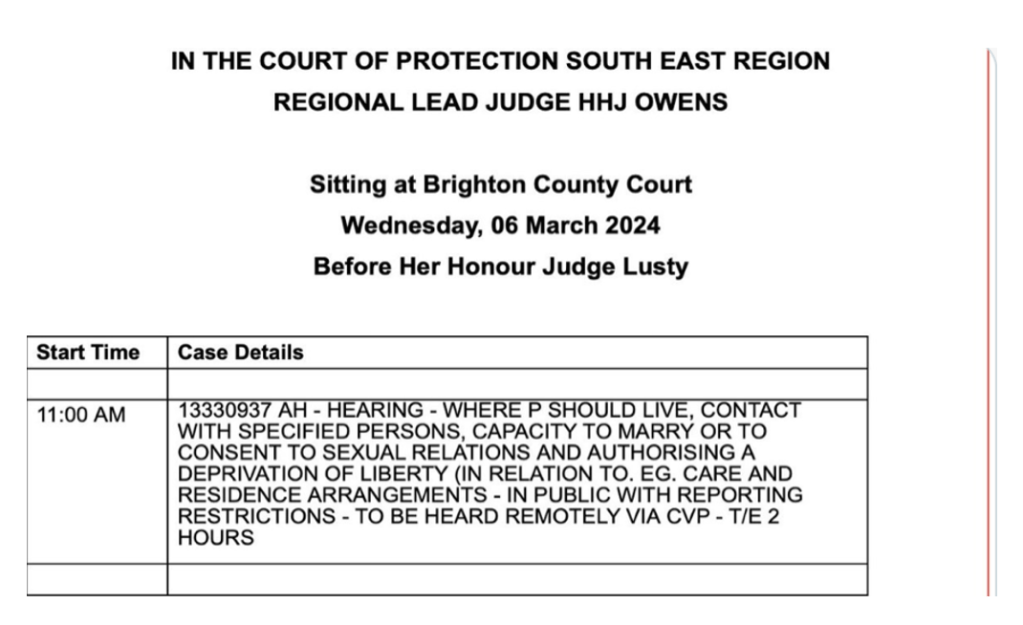
Thirteen months later, I watched the final hearing in this case (COP 1399280T) – which, as before, was heard by DDJ Reeder, sitting remotely at First Avenue House (listed as below) 

The outcome, as the judge acknowledged, is not what GNK had said she wanted. 

Background (from 2022)

Thirteen months ago, there had seemed a (remote) possibility that GNK might be able to return home. Although the judge was concerned that there was “a refusal by GNK to acknowledge her Huntington’s disease and a refusal to acknowledge the need for care”, he wanted the possibility of GNK  moving back home to be properly explored.  There were problems. Her home was apparently “significantly hoarded” and “not safe to get into”, and nobody appeared to know the financial arrangements for the tenancy.  

Meanwhile the hospital trust wanted to discharge her to an interim placement, while the move home was investigated. The draft order asked for authorisation for physical and chemical restraint if required to make that possible, but without sufficient detail on what would trigger the use of restraint, or lead to escalation in restraint. This was something that concerned the judge greatly. It also troubled the observer/blogger, who had used restraint in her previous role as a support worker. The judge asked for the order to be amended.  

That was pretty much all we knew.

The hearing on 29th February 2024

It was a short hearing because the parties had already reached agreement on a draft order but at an earlier hearing the judge had directed them to go away and just check that some additions to the standard authorisation would work on the ground, in practical terms (e.g. that there would be funding).  This hearing was really only to approve that agreed order, with those additions now confirmed. As the judge put it, it was about “making sure the ‘t’s were crossed and the ‘i’s dotted”.

I learnt that about a week after the hearing Catalia Griffiths observed back in 2022, GNK moved to a care home (I don’t know whether restraint was needed to accomplish this) and she’s been there ever since.  It provides 24-hour nursing case. 

This hearing was to make final declarations: 

1. that GNK lacks capacity to litigate, to make decisions in respect of her care and residence, to manage her finances, property and affairs and to terminate a tenancy and sign a tenancy agreement.

2. that it’s in GNK’s best interests to stay in her current care home, and to receive care and treatment there.

However, the Deprivation of Liberty Order is subject to a variation of the standard authorisation conditions, and those are what the judge wanted to go through.

One condition was that arrangements should be made for GNK to attend the church of her choice.  This is a Revivalist church which is said to “place their members in a trance” and I understand that  staff did not want to attend with her, so arrangements were to be put in place using agency staff if needed.

There were to be offers to go out into the community (e.g. to shops) without making this contingent on GNK having had a shower that morning (something she’s been refusing lately) as long as she is not malodorous and unkempt, and care home staff are to keep detailed and accurate records of all the times a trip in the community is offered and clearly record the reasons that this does not take place. 

Arrangements are to made for care home staff to work closely with the expert clinicians from [Hospital] in order better to understand the care needs of a person with Huntington’s – and I think it had been agreed that the local authority would fund specialist training from the Huntington’s Disease Association.

The standard authorisation expires on 17 January 2025 and the applicant will be asked to undertake a new assessment prior to its expiry.

Reflections

Given the extent of the nursing care that GNK is said to need, it’s hard to see what else could have been done under the circumstances.  The ‘additional conditions’ to the standard authorisation go some way towards creating positive benefits for GNK, given that she’s going to be living somewhere she said originally she didn’t want to be.

Finally, in terms of transparency, the judge was extremely helpful – ensuring that a summary was provided at the beginning of the hearing, and pointing out, when he asked counsel to go through the order, that they should do so “bearing in mind the observers haven’t seen it”.  I’m grateful to Monika Kreel of TV Edwards Solicitors (GNK’s solicitor) and Sophie Caseley of Garden Court Chambers (GNK’s counsel) – both via the Official Solicitor – for the anonymised version of their position statement, which assisted my understanding.

Celia Kitzinger is co-director of the Open Justice Court of Protection Project. She has observed more than 500 hearings since May 2020 and written more than 100 blog posts. She is on LinkedIn (here), and tweets @KitzingerCelia. She can be contacted via openjustice@yahoo.com

When P stops eating and drinking

By Ian Brownhill, 26th March 2024

This is not a blog about anorexia, withdrawal of artificial/clinically assisted feeding, nor is it a blog post about the ethics of voluntarily stopping eating and drinking (VSED). Rather, it is an attempt to explain the circumstances in which the Court of Protection might become involved in a case where a person has stopped eating and drinking. This post sets out broad principles and should not be relied upon as legal advice. From the outset, it is worth noting that for many people, stopping eating and drinking is simply part of their dying process.

The call

Most of the cases involving fluid or food refusal which resulted in published judgments relate to patients with anorexia nervosa. However, there is a variety of different circumstances in which food/fluid refusal occurs. Calls to Court of Protection lawyers tend to occur in these three scenarios:

  • P has stopped eating and/or drinking and expressed a reason for doing so. That reason might be political (a ‘hunger strike’), or, might be an attempted means to cause a change in their wider care and support arrangements;
  • P has stopped eating and/or drinking with a view to ending their own life (this is often referred to as VSED);
  • P has stopped eating and/or drinking but has not given any reason and care/health staff are unclear what, if anything, to do in the circumstances.

In respect of which call is most common, it is, in my experience that P has stopped eating to either change their situation or in some form of protest. That protest is not always what we would consider to be ‘political’ –  in fact that is relatively rare. 

A right to stop eating and drinking?

You will not find an explicit right in a statute which says that a person is permitted, or entitled, to stop eating and drinking. However, it is recognised by the law that an adult cannot be compelled to eat or drink if they have capacitously decided not to do so.

A helpful starting point is what Lord Goff said in Bland [1993] AC 789 at page 864:

“…the principle of self-determination requires that respect must be given to the wishes of the patient, so that if an adult patient of sound mind refuses, however unreasonably, to consent to treatment or care by which his life would or might be prolonged, the doctors responsible for his care must give effect to his wishes, even though they do not consider it to be in his best interests to do so.”

A person cannot therefore be forcibly fed  (be it by enteral or parenteral fluids or nutrition), when they capacitously refuse. Baker J (as he then was) put it simply in Dr A [2013] EWCOP 2442 at paragraph 30: 

“… if Dr. A. has the capacity to make decisions as to whether to take food and drink, he is entitled to starve himself to death if he so chooses. The question is: does he have the capacity?”

Trying the door handle

I recently heard Professor Paul Menzel, Dr Hope Wechkin and Dr Peter Reagan talk about the development of the Clinical Guidelines for Voluntarily Stopping Eating and Drinking in the United States. During their presentation, Peter Reagan spoke about one terminally ill woman who had commenced VSED and then stopped. He used the analogy of her trying the door handle: he said it gave her great comfort to know that she could end her life in that way if she chose. That analogy struck a chord with me as Ps who seemingly voluntarily stop eating and drinking, then start again, have been an issue of concern in some cases before the Court of Protection.

Often the court is concerned with whether the person is making a capacitous choice not to eat and drink. In those cases, the capacity assessment will be focused on whether the person is able to make a decision as to their hydration and nutrition. In the assessment, the relevant information is focused on whether, functionally, the person is able to understand, retain, use or weigh, the consequences of not taking fluid or food. If there is a functional deficit identified, the assessor then has to determine whether that is caused by a disorder of the functioning of the mind or brain. That can be a difficult assessment. One such difficult case was PH

The PH case was blogged about frequently when it was before the court[1] and ultimately a judgment was given by Hayden J (PH v Betsi Cadwaladr University Health Board [2022] EWCOP 16) that PH had the mental capacity to refuse hydration and nutrition. 

In this case, PH had a clear ongoing relationship with his treating clinicians, his lawyers and even the judge. Reading the blogs and the judgment, you will see how carefully his capacity was considered by the court. The court had a wealth of evidence in PH but that is not always the case.

In other cases, the issue of capacity has been more difficult or contentious:

In QJ a 87 year old man with vascular dementia stopped eating. In that case, P [QJ] did not answer certain questions put to him by his treating clinicians. Hayden J was keen to emphasise that the mere fact that someone has stopped eating does not mean that it should be concluded that they lack capacity to make that particular decision. 

In this blog , there is a report of where Williams J heard evidence and argument of 3 days in respect of a woman who was admitted to hospital having fractured her femur and then refused to eat. The reasons for her refusal were not articulated, at least in the blog.

In Nottingham University Hospitals NHS Trust & Anor v RL & Ors [2023] EWCOP 22, Sir Jonathan Cohen was faced with the scenario where nobody could engage P at all. The protected party, RL, a life sentenced prisoner, was in hospital having stopped feeding himself. His treating consultant psychiatrist assessed that he was “suffering from depression, and described him as virtually stuporous and mute. When she last saw him, he did not even flicker his eyes when she put papers in front of him and was not willing to communicate his wishes in any way at all. She described him as presenting as ‘quite shutdown.’” When the Official Solicitor’s representative tried to engage with him,  “he literally was not able to do so because RL would not come out from under the bedclothes; he remained completely invisible and would not engage in any way whatsoever.

The other complicating feature that needs to be recognised when P stops eating and drinking is, that at some point, every P will lose the capacity to make decisions about their nutrition and hydration. Put simply, P will become unconscious or experience confusion or delirium with changes in the body’s chemistry and as organs shut down. At this stage, unless there is a valid and applicable advance decision to refuse treatment (ss. 24-26 MCA 2005), a best interests decision will need to be made. One of the matters to be considered in making that best interests decision will be  a person’s previous wishes and feelings as well as their values and beliefs. 

How the cases arrive in the Court of Protection

Just as in any other kind of case, matters involving a P who steps eating and drinking come to court when there is a dispute as to their capacity to make decisions as to hydration and nutrition, or, when there is a disagreement as to their best interests in this regard.

Whilst assessments in respect of P’s capacity to make decisions about to eating and drinking may be unusual, or practically difficult, the relevant law is relatively settled. This is reflected in the decisions above. The more challenging disputes will relate to P’s best interests.

The following issues need to be highlighted:

  1. Unlike in the United States, there is no clinical guideline in respect of people who chose to voluntarily stop eating and drinking. Clinicians who are choosing to support this decision (they cannot be compelled to provide treatment) will likely want reassurance that the steps they are taking are lawful and comply with P’s capacitous (and uncoerced) wishes or that they are in P’s best interests;
  2. Some cases have an abundance of evidence in respect of P’s wishes and feelings both before and after losing capacity to make a decision as to their hydration and nutrition. Not all cases do. In some cases, P simply stops eating and drinking and the explanation is unknown. It ought not be forgotten that P stopping eating and drinking can be simply a reflection of an untreated dental issue or the fact that they are approaching the end of their life in any event;
  3. Section 24 of the Mental Capacity Act 2005 allows a person to make an advance decision in respect of specific treatment to be carried out or provided by someone providing, “health care”.  It is untested as to whether that could include spoon feeding someone or providing them with nutritional supplements.  There is at least an argument, considering the Court of Appeal’s decision in JJthat it might. In that case, giving a quadriplegic person a boiled sweet equated to medical treatment;
  4. Section 5 of the Mental Capacity Act 2005 does allow decision makers to conclude that a certain course of action is not in P’s best interests, even if that course (perhaps not to treat a particular injury, or not to escalate treatment for a disease)  would lead to their death: An NHS Trust & Ors v Y & Anor (Rev 1) [2018] UKSC 46;
  5. In any situation where a person is indicating that they want food and this is denied, it is likely to be very problematic for clinicians or carers following the decision of the Court of Appeal in Burke.  

The wider context and the future

Later this year, on 31 May 2024, I will be speaking at the Medical Law and Ethics Discussion Group, Oxford University about how English and Welsh law handles people who stop eating and drinking as a form of protest. Earlier this year, I spoke at the 4th International Conference on End of Life and the Law “Ethics, Policy, and Practice” (ICEL4) at the S.J. Quinney College of Law at the University of Utah in Salt Lake City, Utah, U.S.A as to how our laws differentiate between patients and protestors in these circumstances. It is (I hope) a fascinating subject and one which is steeped in British legal history, going back to the Prisoners (Temporary Discharge for Ill-Health) Act 1913 (designed to deal with suffragettes on hunger strike) and beyond. But, in reality, it is representative of a very small cohort of cases that come before the court.

Much more challenging is how VSED fits into the wider public (and legal) discourse around assisted dying/suicide and whether it is seen as an adjunct to that argument or an integral part of it. Equally, there is alarm that the concept of mental capacity has been used in a way to deny treatment to suicidal patients and that some patients, simply due to issues with their communication or cognition, have not been able to access medical care for physical health issues.

Whatever the broader issues are in society, if P stops eating and drinking, careful thought needs to be given to their capacity and then (if appropriate) to their best interests. 

Ian Brownhill is a barrister at 39 Essex Chambers who specialises in mental capacity, medical treatment disputes and wider public law, regulatory and safeguarding issues. Ian has acted in a number of food refusal cases in the Court of Protection and in a number of inquest/regulatory/safeguarding matters where a person has stopped eating and drinking. 


[1] Hunger Striking for his Identity: Autonomy, Capacity, and Justice ; Capacity for Litigation, Residence and Care: Hunger-Striker (WA) back in court“What is he saying to us?” The ‘voice’ of a hunger-striking man in a best interests decision about his medical treatmentA ‘secret’ hearing on life-sustaining treatment

Committal hearing: Struck out and dismissed for procedural defects

By Celia Kitzinger, 25th March 2024

It was listed as a committal hearing – an application by Barnsley Metropolitan Borough Council to send “DB” to prison.  

It caught my eye because it wasn’t listed the way committal hearings are normally supposed to be.

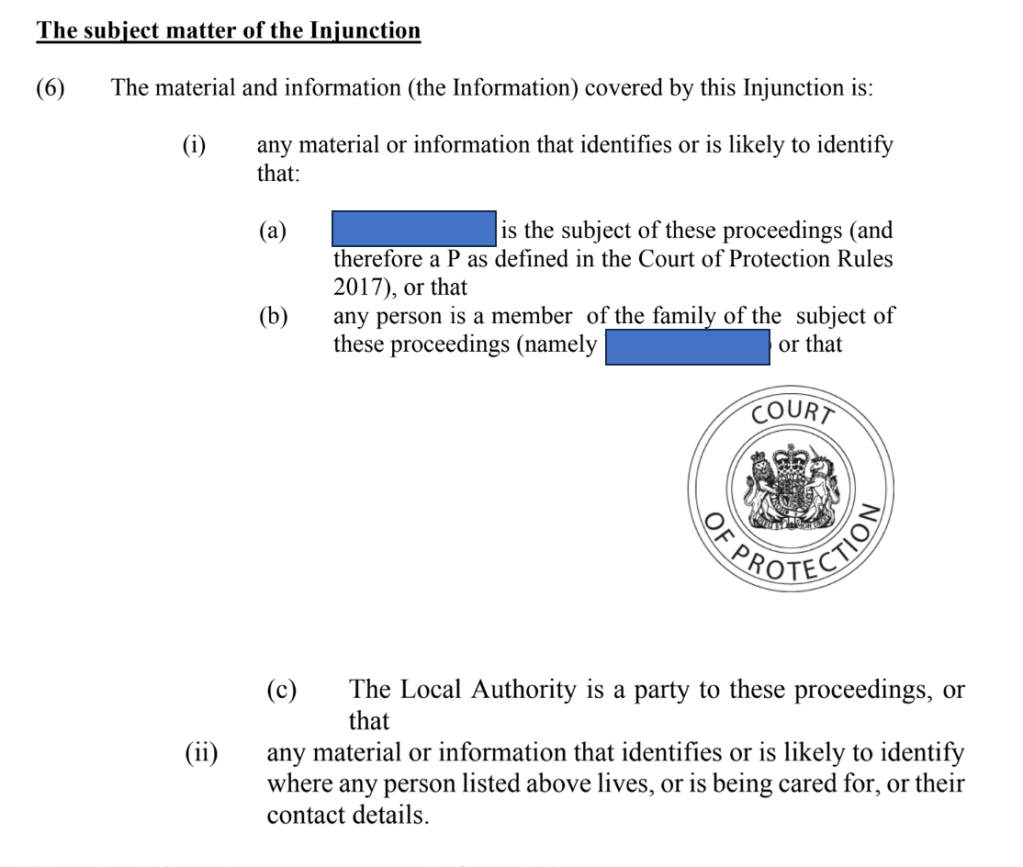
The Practice Direction for Committal for Contempt of Court specifies that the name of the person alleged to be in contempt of court should be given in full.  But it referred to this person only by the initials “DB”.  And it says that, although the hearing is “public” there are “reporting restrictions”. 

Who is “DB”?  What has he done that the local authority is applying to send him to prison?  And why is he at risk of being sent to prison effectively in secret, without the public knowing – or being allowed to tell anyone – who he is?

I was sufficiently alarmed by this listing that I wrote to the judge (care of the Leeds Court of Protection hub) in advance of the hearing, raising my concern about the discrepancies between this listing and the guidance in the Practice Direction (albeit that it permits of exceptions).  I also asked for the link to observe the hearing.

The hearing

It was apparent from the outset that this case (COP 1406388T) has run into problems. 

Counsel for the local authority, Rebecca Titus Cobb (St John’s Buildings) introduced herself and counsel for the protected party (Richard Borrett, Kings Chambers).  She said that DB, the alleged contemnor, was not present, and was not represented.

At this point, I wondered if the court would actually proceed with the committal hearing and risk sending DB to prison in his absence.

The judge, Her Honour Judge Marson, didn’t seem surprised that DB wasn’t in court.  I subsequently learnt that he had a track record of not attending hearings.  

She did address at the first opportunity “the way this case is listed on Courtel” – i.e. my concern about the fact that DB had not been named in the listing.  My understanding is that, initially, the intention had been to name him, but the judge had: “… become aware that the defendant can apply to court for non-disclosure of their name and I’m not able to identify that opportunity to have been communicated to DB […] I don’t know if he would wish to make such an application.  That I hope explains why the entry on Courtel was changed to initials, in the event that such an application was going to be made and needed to be determined. Otherwise, it would be otiose, because the information would already be out there”.  The judge then checked with Rebecca Titus-Cobb, “Am I right that he hasn’t been notified?”.  “I suspect that is right”, she replied.  “I don’t know”.

It seems that DB has breached the transparency order designed to protect the privacy of the vulnerable person at the centre of this case EB, whose deprivation of liberty is before the court.  For reasons that weren’t clear to me, DB is parking his car near EB’s previous placement with Court of Protection documents visible through its windows.  He’s been doing this since mid-September 2023: one court order that he must remove this material had been apparently complied with (in October) but by November 2023 he had resumed displaying the material – and the local authority filed an application to commit DB for contempt of court.  

There was then a hearing on 13th December 2023, which DB was aware of but chose not to attend.  That hearing was adjourned until 9th January 2024 to allow time for him to apply for legal aid and get legal representation.  Again, though he chose not to attend.  This hearing, on 22nd February 2024 was yet another attempt to hold an effective committal hearing.

It failed – due to multiple procedural defects identified by the judge – defects which, she said, “have troubled me a great deal”.   

The following is taken from the oral judgment

I assume that if DB continues to display confidential material relating to the case in public, the local authority is likely to make a new application, and so we may see the committal case back in the listings in future.

Celia Kitzinger is co-director of the Open Justice Court of Protection Project. She has observed more than 500 hearings since May 2020 and written more than 100 blog posts. She is on LinkedIn (here), and tweets @KitzingerCelia

A newly addicted observer’s reflections

By ‘Jean Louise’ (daughter of a current P), 24th March 2024 (with new postscript dded 14th April 2025)

I found the Open Justice Court of Protection Project’s website a few weeks ago due to an issue in my own family, the details of which I hope to share in due course, transparency orders allowing. 

Jury experience in my twenties had piqued my interest in the workings (and failings) of our justice system sufficiently that over the years I observed several hearings from the public gallery of criminal and civil courts. 

Despite pursuing a corporate career, my interest in the law didn’t fade, such that post early-retirement I studied a master’s in law and an LPC (acquiring a distinction along with heightened doubts of the efficacy of our legal system). 

I was therefore not daunted by the formality of the court process itself, though I had never observed a virtual hearing before and law school had provided only a perfunctory nod to the functions and workings of the Court of Protection. 

So, underprepared and imbued with the zeal of an absolute beginner (having only skim-read a few pages of the Open Justice Court of Protection Project’s fascinating content), I followed the instructions and sent off my first public observer request. 

I discovered that getting to join a hearing was a cumbersome, time-consuming process with ‘hit and miss’ results, rendering it accessible only to people with the luxury of time. In the first few weeks of enjoying my new ‘hobby’ I dedicated time to it, though in reality I spent as many hours attempting to get a ‘Golden Ticket’ to observe hearings as I did in hearings themselves. Several of my observer requests were ignored by the court, other hearings were ‘vacated’ at last moment. At one point I suspected the court had decided my new hobby was verging on an unhealthy interest and that I had perhaps now had ‘enough-open-access-to-justice-thank-you-very-much’. I asked the Project’s view of my experience and was reassured to learn that in their experience approximately one in every three hearings gets vacated, sometimes because the parties reached agreement outside of court, other times due to the unavailability of required reports. 

My observer attempts varied dramatically across the different regional courts, and even between staff within a single court, with responses on a wide spectrum. At one court, a staff member bent over backwards to help me understand the court’s mechanics and actively encouraged my interest in observing. At another court, a staff member (equipped with a tenuous grasp on the principles of open justice) seemed to interpret my phone call (to enquire whether my earlier emailed observer request had been actioned) as highly suspicious to the extent she hung up on me, leaving me with the distinct feeling she was about to ‘report’ my request (to join a hearing involving total strangers, discussing an issue I was not aware of) to someone more senior. 

I observed my first hearing on Monday 29th January (COP 13868207 Re TW heard by Mrs Justice Theis). I didn’t capture notes at that hearing (or any of the six I attended subsequently), as I was too preoccupied with understanding the mechanics and etiquette of the hearing to feel equipped to offer any useful insight or observation about the substantive hearing.

I was surprised by the ‘last-minute’ nature of the organisation. The hearing was scheduled to start at 2pm but, after acknowledging my observer request at 9am, I had heard nothing more from the court. At 2.07pm, about to give up, I received the link for the hearing and was relieved to find everyone was late, not just me. At that first hearing I got to wield the observer’s power in relation to the Transparency Order (which luckily) I’d briefly read about on the Project’s website. Sounding more confident than I felt, I explained I hadn’t received the TO but could read and confirm my understanding of it quickly once I received it (which I finally did when it arrived at 2.22pm). 

Based on my (admittedly very limited) observer experience, I was fascinated and appalled in equal measure by the execution and content of the hearings I observed. After most I was left with an unshakeable discomfort that significant decisions and outcomes were severely hampered by the incompetency and inadequacy of the social workers involved in the case (itself a symptom, in my opinion, of crumbling social care systems and the effects of austerity), and of the LA’s representing solicitors and counsel (I suspect due to an equally crumbling legal system). 

In most of the hearings I watched,  a significant amount of judicial time was dedicated to the rebuking of the LA and their legal representatives (or, less commonly, P’s representatives). These criticisms seemed justified, given almost all parties and their representatives revealed a disconcerting lack of understanding of the contemporaneous facts of the case, or status of the proceedings. As an unprepared observer it seemed my own confusion was often dwarfed by that of the multiple professionals involved (assumedly most if not all of them having acquired, and now painstakingly justifying, their lack of knowledge at the taxpayers’ expense). 

A further concern I had after some hearings was the extent to which the voice of P (purportedly, ‘at the heart of the proceedings’) and P’s family, was absent, diluted or ignored during the hearing. This seemed to be so even when P was present. After one hearing I was left doubting why P was the subject of proceedings at all given she spoke to the court more knowledgeably, lucidly, and eloquently than many of the ‘professionals’. 

At some hearings I was a sole observer, at others alongside co-observers. At each hearing I felt the observation was potentially having a material impact on the hearing or outcomes (which I found reassuring and uncomfortable in equal measure). Whether this feeling was justified, and if so to what extent it had a positive or negative effect from the perspective of the involved parties, is something I’m less sure of. 

I wondered how I could practically (and legally) observe an unobserved hearing to test my ‘observer-effect’ theory. Last week an opportunity to do that presented itself in the form of a hearing in which my dad is the ‘P’ and I am a respondent. In time, I hope to learn from the Open Justice COP Project’s experience  in seeking to lift the TO, enabling me to tell Dad’s story.

My notes of the hearings I’ve observed so far have all been too incomplete and inadequate to offer for public consumption. I’m hoping writing a good blog as an observer is a skill I can develop, allowing me in future to contribute a blog as a small token of my gratitude to the Open Justice COP  Project for their enlightening work. 

Having wondered after my first hearing whether I was the only person who would be interested in sharing perspectives of hearings observed with co-observers, a sort of real-life ‘book group’ equivalent for Court of Protection observers, I was delighted to discover that the COP Project have effectively just that, in the form of an observers’ WhatsApp Group and the arrangement of special group observations for high-profile hearings where 5-10 observers will discuss the hearing in real-time and later produce a group blog. Some great examples of these group blogs are: “Hunger striking for his identity”Family witnesses in court: Four reflections on Re AH (A Rehearing),  and Tampering with equipment.

Alongside these, I will continue to feed my new-found addiction by reading the material on the Project’s website and a selection of the full judgments of the Court of Protection in its first twenty years, and (where I am able to acquire a ‘Golden Ticket’), attend as many hearings as possible. Perhaps I’ll ‘see you in court’.

Postscript by Kim Dodd (the real name of “Jean Louise”), 14th April 2025

During the currency of my dad’s Court of Protection proceedings I experienced the Transparency Order (surely a misnomer?) almost as a weapon of war deployed against Dad and our family by the applicant LA. I was scared even to tell family members about the proceedings – leaving me and my sister in a situation that was almost impossible to manage and adding a layer of emotional complexity to an already dreadful situation.

Compared to many distraught families who want to talk about their experience of Court of Protection proceedings (both for their own benefit and that of others), I was more fortunate, in that the ‘duration’ on Dad’s TO was drafted such that it was discharged automatically on his death:

I believe many (most?) TOs state that they ‘have effect until further order of the court’. I don’t know how, or if, I would have found the strength to seek to vary that TO (via a COP9 request to the court and potentially another hearing to vary it assuming the LA opposed – which they I am sure would have done) while suffering indescribable grief after Dad’s death. Now I am free to tell Dad’s story, which he desperately wanted to be shared during the proceedings and which, I believe, is worth telling. 

“Jean Louise” – whose real name is Kim Dodd – blogged under this pseudonym when she was involved in Court of Protection proceedings and subject to a Transparency Order preventing her from identifying herself as a family member of a protected party. Having retired early from her own corporate career,  she has developed her interest in the law in general (particularly the law surrounding coercive control) and the Court of Protection.

The story of TW and her amazing friend and attorney – two years on

By Amanda Hill, formerly known as ‘Anna’ 22nd March 2024

The first hearing I ever observed in the Court of Protection (COP 13744224) was on 3rd May 2022, nearly 2 years ago now[1]. It concerned a woman in her nineties (TW), in a care home following discharge from hospital after a fall.  She wanted to return home and the judge authorized a “trial” of living at home. 

Because  it was the first case I had observed, TW’s story stuck in my mind and I often wondered what had happened to her.  Celia Kitzinger observed a couple of later hearings in 2022, from which it seemed that the return home was working out well.  But then this month, another member of the Open Justice Court of Protection Project core team spotted this listing (thank you Daniel Clark!). 

Luckily I was free that morning, so now I was about to find out what had happened in TW’s life. 

Before writing about this latest hearing, I will provide a brief summary of that first hearing and what happened in the two subsequent hearings blogged by Celia Kitzinger. I will then reflect on what this case shows about the COP and the importance of a strong advocate.  

Background (from 2022)

Back in May 2022, TW was a woman in her early nineties, who had dementia and diabetes.  She had no contact with remaining family members, but was supported by a long-term friend (M) who – like TW– was not a first-language English speaker.  M also held Lasting Power of Attorney for both Health and Welfare and for Property and Finance for TW. TW had lived in her own flat until May 2020, when she had a fall and was firstly admitted to hospital, and then subsequently to a care home. But she desperately wanted to return home. Her attorney (M) approached the local authority on 8th December 2020 to explain that T would like to return home. At the hearing I observed in May 2022, she was still at the care home she didn’t want to be in and the hearing was to discuss arrangements for her to have a trial living at home. TW’s counsel, Christine Cooper, called the situation a “Kafkaesque nightmare”. M made an impassioned plea for her friend: “I am appalling the long time it’s taking [the local authority] to decide T can go home, since she decided in her second week at [the care home]. It’s her will to be at home.  She understands that, in later days, she probably won’t be there, but at the moment she’s distressed to be in that place where she’s not happy at all.  I can’t describe how she’s feeling. Please allow her to trial home for her own peace of mind in the latest years of life.”

In the following hearing on the 3rd June 2022, there were still ongoing discussions about the arrangements for TW to return home and whether it was in her best interests to do so. The blog Celia wrote stated that “The judge recognised that a return home “will carry with it some risks” but considered these manageable and acceptable when weighed against T’s consistent wish to return home.” He ruled that TW would go back to her flat on 17th June 2022 and at the next hearing he would “consider everyone’s views on how successful that’s been”. 

At the hearing on the 9th July 2022, TW had finally returned home and none of the parties were disputing that it was in TW’s best interests for the trial of living at home to continue, even though there were still issues around funding and managing her care. At the time of the hearing, TW was actually back in hospital but the plan was that she would soon be discharged back home.  A final hearing was listed for 31st August 2022. 

Yet, here we were with another hearing in March 2024, with the same case number. What had happened to TW in the meantime and why was her case back in court? 

The hearing on 11th March 2024

I received the link to the hearing very soon after requesting it first thing Monday 11th March. I was able to gain an understanding of the latest situation because His Honour Judge Beckley asked TW’s counsel Jamie Mathieson to provide a summary for my benefit (as a public observer, and in line with best practice in accordance with guidance from the former Vice-President of the Court of Protection, Mr Justice Hayden). I also received the position statement from Jamie Mathieson that same day, after I requested it following the hearing, which complemented what I had heard in court. 

There were a number of people in court apart from the judge and TW’s counsel. There were solicitors representing TW and the local authority (LA) , although not counsel for the LA, and TW’s social worker. M was also present, and unlike the first hearing I had observed, this time she had her camera on. She had clearly become used to participating in COP virtual hearings and didn’t mind her face being shown. 

The situation since the last hearing is as follows: TW is now nearly in her mid-nineties and has been assessed as needing 24 hour care. She had lived in her flat for a year until mid-2023 and it had worked well until various problems became too difficult, including using the stairs. So she moved to a care home in August 2023. She was living there, and COP proceedings had nearly concluded, when concerns were raised by her Accredited Legal Representative (ALR) and by M that her care was not as it should have been. For example, the home was not using bedrails to protect her from falls and they were not facilitating enough access to the community. Her best interests were being investigated when she had a serious fall on the 29th December 2023, resulting in her being hospitalised with several fractures. We also heard during the hearing that she had contracted Covid while in hospital. 

Despite being assessed as fit for discharge since mid-January 2024, as of 11th March, she is still there. Her counsel said that, “to use the colloquial term”, it is now a case of “bed-blocking”. The issue is that TW’s ALR and M have both ‘lost confidence’ in the care home. In fact the LA has subsequently conducted a safeguarding investigation and found that TW’s fall was caused by neglect. As the position statement sets out, the home did not have enough protections in place to prevent TW from falling. So the LA also does not feel it would be in TW’s best interests to return there. 

Jamie Mathieson’s summary for me turned into his oral submission to the court. He explained that following weeks of delays resulting in TW spending longer in hospital than she should have done, things had moved very quickly in the week before the hearing and a new placement at a different care home had been found.  They had assessed her and said that they could offer her a place. TW wants to leave hospital but does not want to return to the original care home so a new placement would be broadly in accordance with her wishes and feelings. A new order was being sought to approve the new placement. An outstanding issue was that there needed to be an updated transition plan and an interim care plan, which included how to manage the risk of falls. The social worker had agreed for this to be prepared in 24 hours and the plan was for TW to be discharged to the new home by Thursday 14th March. 

Once TW had moved to the new care home, there would have to be a new s.21A appeal (to authorise her deprivation of liberty.) There would be risks around social isolation. Although TW had lived in the UK for many years, she was an EU national and English was her second language. As her Alzheimers has advanced, she has largely reverted back to using her birth language. Her flat is in the process of being sold and M is hoping to use some of the funds for one to one care with a carer who speaks her language. The s.21A appeal would be at a final hearing. So, in summary, all of the parties were agreed about the next steps. 

The judge spoke next. He said that the suggestions in the draft order were “sensible and straightforward”.  He said that he was disturbed to hear about her fall at the care home and the safeguarding issues. He was pleased that a new place had been found for TW. He then asked M to speak. 

M started by saying that TW was upset that she was still in hospital. She asks why she is still there and that she is a “prisoner” there. M said that she was working but had made time for the hearing. She said that she could go and get TW’s belongings and prepare her room at the new home. She wanted to reassure her that she will have company and someone she knows when she arrives. 

The judge thanked M for her help and asked if TW’s belongings were still at the previous care home. M replied that they were, and that she would go and fetch them. She also raised the point that one issue to be resolved was the risk of falls. In hospital TW had not had any falls. But in her time at the care home she had fallen three times. She said “I don’t blame anyone, accidents happen but something was wrong”. The judge replied that the bed rail was an issue. She also fell when unsupervised, getting up from a chair. So the new care home has to minimise the risks of falls. He agreed that it would be good if the sale of TW’s property could provide funds for a birth-language speaker to help care for her. 

M then stated that she hoped the sale of the property did go through, to cover outstanding debt for the “taxman” and the solicitors. But there would be enough funds left over to cover her care. 

The judge then asked the LA’s legal representative to speak. He stated that he agreed with the submission of TW’s Counsel and also thanked M for her support. 

The judge then outlined his conclusions. He stated that it was clearly in TW’s best interests to leave hospital and move to a new care home, although the risk of falls needed to be minimised. He thanked the LA for their commitment to preparing a transition plan and new care plan within 24 hours (to enable the discharge from hospital). The judge approved the draft order and hoped that TW would be able to leave hospital and move to a new care home on Thursday. 

There then had to be agreement on the next hearing, which would be to approve the s.21A appeal, and after some discussion it was agreed that this would be a one hour virtual hearing at 3pm on the 7th May 2024. After about 30 minutes, the hearing was over. 

Reflections

TW and M 

It was interesting for me to re-read the first blog that I had written in light of this new hearing. There were echoes. Once again, TW had been admitted to hospital after a fall, once again she was somewhere that she did not want to be and once again M was fighting for her friend. But in the meantime, TW had spent 12 months living back in her home, as she had wished. Reflecting on what M had said in the quote above from that first hearing, that TW “understands that, in later days, she probably won’t be there”, that point had clearly been reached in mid 2023. At least the COP had facilitated her chance to live in her home once again. I hope that she finds peace of mind in her new care home and is cared for well. 

One aspect of this hearing that stood out for me compared to the first hearing I observed was that apart from Judge Beckley, none of the participants were the same – except for M. The legal representatives had all changed and there had been no social worker at that first hearing. But M was still there, fighting her friend’s corner. She had clearly been involved throughout the intervening years. From the things that were said during the hearing, she had been involved every step of the way, including at round table meetings. It seemed as though she had been an integral part of every discussion and had raised concerns about her friend’s care at the care home. Each of the legal representatives, for TW, for the LA and the judge, thanked her for her time and effort. It brings home the fact that whilst professionals can cross paths with a P at various times, their attorneys, usually friends or family members, are a constant in that person’s life. I reflected on what Celia had written after that first hearing we had observed together: 

“…..we should appoint as attorneys people who not only know and love us, and know our wishes well, but people who also have the stamina, strength and skills to stand up to challenging behaviour from public authorities (and/or – as I’ve seen in other cases – from professionals).” 

And also what Judge Beckley too had said during that first hearing: 

 “The role that people who agree to be attorney for people who lose capacity is a very significant one”, he said. “My thanks to you for undertaking that.  There is recognition from the judges of the Court of Protection for the work undertaken by attorneys”.  

The choice of who we ask to act as our Lasting Power of Attorney is very significant. And it is not a role to be undertaken lightly. Clearly TW had made an excellent choice. 

The tone of the hearing 

The tone of this hearing was very different to the first hearing I had observed back in May 2022. That had been quite combatative, as P’s counsel and the LA had not been in agreement as to next steps for TW. In that first blog, Celia Kitzinger had described the “occasionally clearly critical (or even acerbic) nature of the exchanges”.This had delayed TW’s trial of living at home. In stark contrast, this hearing was conducted in a spirit of agreement, as is more usual for a COP hearing. The COP proceedings were positive in trying to esure the best outcome for TW and had indeed been called upon to intervene both by her ALR and M, her LPA.

Changes in COP listings 

Back in 2022, Celia had written this about s.21A (deprivation of liberty appeals) hearings being listed on Courtserve:  “….there are lots of s.21A hearings to choose from in the Court of Protection, although only First Avenue House London and the Newcastle hub routinely include this descriptor in the listings.”

Since becoming a core team member of the OJCOPP in June 2023, I am now routinely involved in listing COP hearings on X (Twitter), on the website and now on Facebook too. I would say from my experience that the majority of COP cases listed include either the terms “s.21A” or “deprivation of liberty”. So that is a major change in how cases are listed in two years. 

That previous hearing listing had also said: “PRIVATE HEARING NOT OPEN TO THE PUBLIC”.  Today, the wording used is mostly along the lines of: “Public Hearing – With Reporting Restrictions” (although a blog was recently published about hearings still wrongly being listed as private here.)

All listings tend to carry a notice along the lines of “Open justice is a fundamental principle in our courts and tribunals system, and will continue to be so as we increase the use of audio and video technology.”

Remote hearings are very common, making it easier for members of the public and professionals to observe the COP in action. The OJCOPP now run monthly webinars supporting people who want to observe. Whilst initially COP hearings went online because of the pandemic, many hearings are still online, and in my opinion it has had a real benefit for open justice. 

Conclusion

Much has changed for TW since that first hearing I observed in May 2022. The COP has had a positive impact on her life, enabling her to spend 12 months living at home and now ensuring that she can hopefully be discharged from hospital to a care home that will care for her well. The tone of this hearing was very different to that first one, everyone agreeing and working together to ensure that TW’s best interests are acted upon. It was a very positive example of the COP in action. It was also a positive example of open justice. And it allowed me to observe what a good friend and attorney M has been to TW. 

Anna was the pseudonym of a woman whose mother was a P in a Court of Protection s.21A application.  Since March 2025, Amanda Hill is allowed to reveal that she is Anna, because the Transparency Order covering her Mum’s case has been varied (changed). Amanda Hill is a PhD student at the School of Journalism, Media and Culture at Cardiff University. Her research focuses on the Court of Protection, exploring family experiences, media representations and social media activism. She is a core team member of OJCOP. She is also a daughter of a P in a Court of Protection case and has been a Litigant in Person. She is on LinkedIn (here), and also on X as (@AmandaAPHill) and on Bluesky (@AmandaAPHill.bsky.social). 


[1]  I wrote a blog about my first experience of observing: 3rd May 2022 A section 21A hearing: Impressions from a veteran observer and the daughter of (a different) P in a s.21A case. Celia also wrote two further blogs about the case when it returned to court a couple of times shortly afterwards: 3rd June 2022 “What good is it making someone safer if it merely makes them miserable?” A contested hearing and delayed trial of living at home; and 9th July 2022 Trial of living at home, successful so far

Depriving a young person of his liberty: Law or parental responsibility

By Tim Sugden, 21st March 2024

On 13th March I observed a remote hearing (COP 14200743) before HHJ Beckley, which concerned the deprivation of a 16-year-old’s liberty. 

In the Introductory Notes I was sent prior to the hearing (NB : receiving this document was extremely helpful – if only we could be sent something similar every time!) it was stated that the protected party, P. “…  has been diagnosed with 2 genetic conditions that cause brain malformations. Those malformations mean that (P) is developmentally delayed across all areas and requires significant levels of support to ensure that his needs are met. On occasion, (P) can display challenging behaviour.” 

P  is a looked after young person, the subject of a Care Order, and has been placed since 2020 in a small residential unit.  

The Notes stated that P’’s social worker believes that he cannot make meaningful decisions about where he should live and what care he should receive there, and that remaining in his current placement is in his best interests. They also stated:- 

“Because of his developmental delays, [P] would likely struggle to meet his own needs (personal hygiene, eating & drinking, taking medication) without the help of staff in the placement. He would be vulnerable if he went out into the community unaccompanied because he would not appreciate potential hazards (eg, traffic). He might also be targeted/exploited by others. [P] is therefore not allowed to go into the community unless accompanied by staff.” 

The local authority, the applicant, were therefore applying for an order under the Deprivation of Liberty Safeguards to authorise them, and the staff at the placement, to restrict P’s liberty there, in terms of the continual monitoring of his behaviour and movements, and their possible interventions. 

Evidently the local authority had initially asked the court to deal with the application without a hearing.  However, having reviewed the papers, HHJ Beckley decided that a hearing was necessary because:  

a.          [P] would shortly be transitioning to adult social care.  

b.         [P]’s care plan envisaged the use of restraint as a last resort.  

c.         [P] should be independently represented.  

The hearing itself was very brief and it appeared that representatives for the local authority (Graeme Harrison) and the Official Solicitor (Arianna Kelly) had liaised closely beforehand to come to an agreement on these issues.  The judge requested that the final versions of the Orders, with some additional information, be filed, and set a date in early June for a further hearing. 

Reflections

It was interesting to me to witness such unanimity and such overall acceptance (without it being overtly stated) that this was a matter that needed to be dealt with in a legal arena, as the last occasion in which I had to deal directly with a DoLS matter myself the landscape had been quite different. 

This was a few years ago when I was employed by a local authority (not the one in P’’s case) as an Independent Reviewing Officer (IRO), tasked with monitoring and reviewing the care plans of looked after children and young people. One of these young people (T), who was aged 16-17 and had Down syndrome, had lived with long-term foster parents for many years. 

Due to his assessed vulnerability – very similar to that described in relation to P, above – they routinely restricted his liberty.  For example he was only allowed to go out on his own for the very short walk to the local shop and back when the family were staying at their caravan near the coast, and never at all when they were at home in London. This was entirely appropriate and correct, and indicated the carers’ loving concern for T’s welfare. No-one – including T himself whose views I and an independent advocate would always separately seek before and during his review meetings – disputed this course of action. But it had no basis in law, only in good practice!  And so, in my professional role I started to query this.  

Since the Adoption & Children Act 2002, amended by the Children & Young Persons Act 2008, IROs have had the right (nay, the obligation) to challenge the local authority on behalf of or in respect of the children / young people they review. Local authorities have had to put in place a Dispute Resolution Protocol to enable IROs to move up the management line with their concerns if they are not satisfactorily addressed. My professional opinion, having read up all I could on DoLS, was that the local authority who having a Care Order for T were his corporate parents, were acting unlawfully in formulating or agreeing practices restricting his liberty (compared to those enjoyed by non-disabled young people of his age) without it being considered through due legal process. Questions about ‘best interests’ were only relevant up to a point, as they did not override the fundamental principle that T had rights as an individual that needed to be respected and upheld. 

At every stage of the Dispute Resolution Protocol, right up to involving the Director of Children’s Services, I was told that a DoLS assessment and referral were unnecessary, as there was (as I have said) no disagreement from anyone as to the need for such measures to protect T. The Legal Department of the local authority were consulted and gave the same response, that the local authority had Parental Responsibility for T and so had the authority to make these decisions. 

Fortunately, the final stage of the Dispute Resolution Protocol, as required under the 2002 and 2008 Acts, stipulated that an IRO could, if all earlier stages had been exhausted, refer the case directly to the Legal Team at the Children and Family Court Advisory & Support Service (CAFCASS) and through them to consideration by their specialist lawyers. So I did – and they came back to support my view and to flatly contradict the local authority lawyers. 

In the end, the impasse was resolved by I and CAFCASS giving the local authority a deadline to complete the various parts of the DoLS assessment, or otherwise a formal S118 referral would be made to the family court for final resolution of the dispute … and they finally relented and did as required with minutes to spare. 

So, being reminded in P’s hearing of all these hurdles that I’d faced previously, and seeing the evident unanimity about the applicable principle and the correct procedure in the consideration of P’s case, was an interesting contrast – although, upon reflection, I would have liked the opportunity to ask P’s IRO how far they might have been involved in the process to get to this stage, and whether they too had had interminable arguments along the way with Children’s Services managers who couldn’t seem to grasp that a disabled young person might actually have an inherent right to age-appropriate levels of personal liberty that could only be curtailed by careful, sensitive, due legal process. 

Tim Sugden retired in 2022, after a career in children’s services, to devote his time to providing accommodation and support to refugees from Ukraine.

When two legal teams turn up in court to represent P: Disputed capacity to conduct proceedings

By Celia Kitzinger, 18 March 2024

The first thing I need to decide,” says the judge, “is who is acting for Mrs P”.  

It turns out there’s a difficulty.  Two legal team have turned up in court, both purporting to represent the protected party.

Mrs P (who has a – disputed – dementia diagnosis) considers that she has capacity to conduct proceedings. She’s instructed a solicitor and there’s a barrister (Matthew Wyard) who plans to  represent her in court today.

A different judge (DJ Russell), had made an order declaring that there was reason to believe that Mrs P lacks capacity to conduct proceedings. The Official Solicitor has accepted the invitation to act as a litigation friend for Mrs P, and Yogi Amin is in court to act on her behalf. 

The case (COP 14187074) was heard remotely before HHJ Beckley, sitting at First Avenue House on 17thJanuary 2024.

The applicant local authority (represented by Oliver Lewis) has applied to court to establish whether or not there has been coercive control exerted over Mrs P by her daughter and two other family members (Mrs P’s daughter’s partner and P’s ex-husband).  In the interim, they want the Lasting Powers of Attorney (held by the daughter) to be suspended, and all contact between Mrs P and these three family members to be supervised. 

Mrs P– an elegantly dressed woman in her late 70s – was present in court throughout. So were Mrs P’s daughter (a litigant in person) and her partner, and P’s ex-husband.

Mrs P has prepared a witness statement, with the help of a firm of solicitors, which says that she does not lack capacity, that her daughter and her daughter’s partner “have done everything possible to help me in my old age” and that she wants her daughter to continue to act as her attorney.  She disputes claims of coercive control and says an assault her daughter is said to have made on her is a “false allegation”.  

The judge said he proposed to hear first from Yogi Amin “as to why I should continue to invite the Official Solicitor to act on Mrs P’s behalf” and then hear from Matthew Wyard “on why he should be able to act on the direct instruction of Mrs P”. 

Does anyone object to that?”, the judge asked.  “No?  I’m not seeing any looks of horror”. 

Proposed representative for Mrs P via the Official Solicitor (Yogi Amin)

Yogi Amin outlined the process that had led to the involvement of the Official Solicitor.  

There had been two separate sets of reports as to Mrs P’s capacity: one commissioned by the local authority and carried out by social workers;  and the other commissioned by Mrs P’s daughter and carried out by the treating psychiatrist, Professor F.   Only the report commissioned by the daughter expressly purported to assess Mrs P’s “legal capacity”.

Mr Amin raised concerns about the way the latter report came about, and what information was made available to Professor F when determining the question of Mrs P’s capacity.  He expressed concern that Professor F’s assessments were carried out without the permission of the court or the agreement of the parties.  

The Official Solicitor’s view is that interim orders should be made under s.48 to record that there is reason to believe that Mrs P may lack capacity to make decisions on all relevant issues before the court, including litigation capacity.  This would mean that the Official Solicitor would then act for her in court as her litigation friend.

Proposed counsel for Mrs P with direct instruction (Matthew Wyard)

Mr Wyard pointed out that capacity must be presumed. The local authority, he said, “has not provided any evidence to rebut that presumption whatsoever”. 

He pointed to four capacity assessments in the court bundle, none of which relates to litigation.  He said that the social worker responsible for carrying out the capacity assessments was “relatively junior”.  The local authority’s position “appears to be that because they’ve assessed Mrs P as lacking capacity in other domains, it follows that she must lack litigation capacity.  But the tests for litigation capacity and other types of capacity are not synonymous, and litigation capacity is a separate matter”.  

The capacity report commissioned by the daughter is by a Consultant Psychiatrist of 21 years standing who is recognised under the Mental Health Act 1983.  He found Mrs P to have capacity in all subject matter domains and also found that she had litigation capacity.

The  instructing solicitor, Mr Fielding of Fosters Solicitors, had also assessed Mrs P as having litigation capacity.

Local authority (Oliver Lewis)

The position of the local authority, said Oliver Lewis, was that they wanted to “protect Mrs P and uphold her autonomy and health and safety”.  They were not motivated by a wish to take over control of her life. This was an issue because the assessor appointed by the daughter had concluded that Mrs P had “legal capacity” based on the following analysis:

Legal Capacity

We talked about the role of the solicitor, and she said if she had to have a solicitor, she would accept this. She just wants to be given a chance to present her side of the situation with regards to care. She does not want to move out of her home, and she does not feel her family should be removed from her.

We talked about the fact that there is an application for the state to take over control of her life and she did not want this, and she was happy with the current arrangement.  There appeared to be no fear or coercion that I have been able to elicit in her. (quoted from Professor F’s report in the position statement from the local authority)

Oliver Lewis saw this as mischaracterising the application of the local authority.  He argued that the appointment of the Official Solicitor was “a protective measure” in the context of “very strong evidence spanning three years of coercion and control primarily by her daughter”.  

Mrs P (who lives in her own home with live-in care, separately from her daughter) has said she sometimes feels scared and that her daughter is a “bully”.  A social worker has documented various distressing instances including the daughter… 

  • denying her mother prescribed pain relief
  • shouting at her mother 
  • refusing to leave her mother’s home when asked
  • Installing a camera system in her mother’s home against her wishes (now removed by police)
  • threatening to put her mother in a care home and have her dog put down
  • throwing food over her mother. A carer took a photograph of Mrs P immediately after this incident, the police were called and arrested the daughter, bailing her on condition that she does not contact her mother by any means. (This bail condition has now expired.)

It was shortly after the (alleged) food-throwing incident (in late September 2023),  that the local authority made an application to revoke the Lasting Powers of Attorney held by the daughter (both Health and Welfare, and Property and Finance) and also to ask the court to consider the question of contact between Mrs P and the other two family members. 

The daughter’s partner and ex-husband have since visited Mrs P and allegedly pressured Mrs P to get rid of her care team, and to tell the police she wants her daughter to come back.  According to the local authority, there is  “a coordinated campaign by the three family members to undermine the carers, and persuade Mrs P to forget or discount the emotional and physical abuse that she has suffered at the hands of [her daughter].”

The local authority is concerned that the assessor appointed by the daughter “doesn’t seem to have considered what this case is actually about…. There is no evidence that he discussed the actual substance of the hearing with Mrs P at all”.  Moreover, there’s lots of evidence that what Mrs P says to medical professionals and to the police when she’s on her own with them, is quite different to what she says when her daughter is present.  The position statement from Oliver Lewis documents a string of comments from Mrs P such as: “I just want my daughter to stay away from the house”; “I don’t want her coming round screaming and shouting, but I do miss her. The trouble with [Daughter] is she has no patience with people who are not 100%” and “If [the live-in carer] leaves, [Daughter] will come here again and bully me”. 

The local authority considers that the capacity assessment arranged by the daughter, and the subsequent appointment of a legal team for Mrs P independently of the appointment of the Official Solicitor, are “examples of [the daughter] coercively controlling and manipulating her mother”. The local authority disputes the finding of “legal capacity”. They say that where there are well-documented examples of coercive control and where P has a diagnosis of dementia, there is sufficient evidence to give the court reason to believe on an interim basis that P lacks capacity in all the disputed domains.  

Daughter

The daughter said she believes “100% that Mum has capacity”.  She explained that her mother had been very ill a few years ago (“she had multiple organ failure and nearly died”) and that the dementia diagnosis had been made in that context when she was “very frail”. Since then, her levels of cognition have improved.  

She said, “Obviously I love her very much, and I believe in her”. 

Mrs P

After hearing from the other parties, the judge turned to Mrs P in person. 

Judge to Mrs P:  Being in a hearing with people you’ve not met is very difficult. There’s two very different accounts being put forward to me, which I’ll have to decide between.  [The local authority] have given me two witness statements prepared by your social worker, plus comments made by medical staff when you were in hospital, and from the police force, and from your live-in carer.  And if those statements are right, you’ve been subject to very bad behaviour on the part of your family.

Mrs P: No!

Judge:  On the other hand, Mrs P, I’m told you have capacity to make decisions, that the Alzheimer’s diagnosis from just over two years ago – that thankfully your mental ability has improved. You have minor cognitive difficulties but can decide where you live, what care you receive, who you have contact with and that you have capacity to appoint people as Power of Attorney and tell solicitors how you want your case to be put. 

Mrs P:  I do have capacity to make up my own mind. I live in my own home. My daughter helps.  She doesn’t control me. If I ask her opinion about anything it’s between mother and daughter. I don’t know what else to say to you.  She’s been very good to me. I go to church and am very positive in my outlook.

The judge then said he thought there was reason to believe that Mrs P lacks capacity to conduct the proceedings.

Mrs P: That makes me so angry, because I do have capacity.  What I listen to, I take in. And I can respond coherently to other people.

Judgment on capacity to conduct proceedings

Here’s what the judge said, as accurately as I could get it down at the time.

I’m going to set out how I’ve made the decision I’ve made…. What I’m being asked to decide at this stage is effectively whether I have reason to believe that Mrs P lacks capacity to litigate – to tell solicitors what they should be doing on her behalf in these proceedings.  

I remind myself of s.1 of the Mental Capacity Act 2005 – the most important part of the Mental Capacity Act, the principles I have to apply as a judge of this court.  (The judge read out the following text.)

Then I turn so s.48 of the Mental Capacity Act 2005. (The judge read out the following text.)

The test of me having “reason to believe” that P lacks capacity has been considered by more senior judges than me, and I need to follow what they say in relation to that.

Mr Justice Mostyn in An NHS Trust v P [2021] EWCOP 27 said, in a nutshell, that if someone lacks capacity to make decisions about a particular subject, for example where to live or what care to receive, then – Mostyn said – it is virtually impossible to conceive of circumstances … [where they would have] capacity to make decisions about the manifold steps or stances needed to be addressed in litigation about that very same subject matter”. 

Mr Justice Hayden, the (then) Vice-President in Lancashire and South Cumbria NHS Foundation Trust v Q [2022] EWCOP 6 says he doesn’t think Mostyn would want his words to be afforded as much weight as they have.  He says:

It is necessary to reiterate that the test remains that in Masterman-Lister v Brutton & Co [2002] EWCA Civ 1889[2003] 1 WLR 1511, endorsed in Dunhill v Burgin [2014] UKSC 18[2014] 1 WLR 933. The essence of those judgments is to confirm, unambiguously, that capacity to litigate is addressed by asking whether a party to proceedings is capable of instructing a legal advisor “with sufficient clarity to enable P to understand the problem and to advise her appropriately” and can “understand and make decisions based upon, or otherwise give effect to, such advice as she may receive”. It follows that the issue of litigation will always fall to be determined in the context of the particular proceedings…. (§24 Lancashire and South Cumbria NHS Foundation Trust v Q [2022] EWCOP 6)

In this case, not unusually (as people have said) the assessment carried out on behalf of the local authority on Mrs P did concern subject matter – where she should live, what care she should receive, whether to revoke to LPAs, and contact – but it didn’t assess Mrs P in relation to her capacity to litigate.  It was on the basis of those assessments that DJ Russell found, on the basis of s.48, Mrs P also to lack capacity in respect of litigation.

Mr Lewis for the local authority says I shouldn’t overturn that decision.

I disagree, to the extent I think I should reconsider for three reasons – with no disrespect to DJ Russell.  First, I have now been provided with Professor F’s capacity assessment. Second, Mr Fielding of Fosters Solicitors, who is an experienced solicitor, considers, having spoken to Mrs P, that she has capacity to litigate. Third, I’ve heard from the parties in this hearing.  DJ Russell didn’t have the benefit of any of those things.

I have to walk a very fine line between two contesting accounts that have been put to me.  

On the one hand I have the account by Mrs N, Mrs P’s social worker, which sets out (I emphasise that I’ve not made any findings but which sets out) very bad behaviour that Mrs P has faced, and set out both in the witness statements and in the accounts given by Mrs P to her live-in carer and to hospital staff, that Mrs P at times has felt controlled by her daughter, and has suffered harm – serious harm – from her daughter.  I have seen the photograph exhibited in Mrs N’s witness statement of Mrs P covered in food and read the account given that food was poured over her by her daughter.  That is bound to be impactful on anyone making decisions such as the one I’m making now.  I bear in mind the point made by Mr Wyard about the social worker’s lack of experience, but I find her reports to have carefully considered what information needs to be understood, weighed and communicated in relation to each subject matter.

On the opposite side, if Mrs P has the capacity to make decisions, then I have no right at all to be making decisions on Mrs P’s behalf.  And I understand absolutely the concern – indeed the anger – Mrs P expressed to me about the fact that she has to sit here on a Wednesday morning with her life being discussed by various people she doesn’t know.  I have read the report by Professor F, which I have to say I don’t find very compelling.  It does not clearly and systematically go through the tests that s.2 and s.3 of the Mental Capacity Act require. I give more weight to the statement prepared by Mr Fielding, and a great deal of weight to Mrs P’s daughter and to Mrs P herself.

Having taken all those factors into account, and in particular that what Mrs P has said to me contrasts with what she has said to her social worker and to medical professionals on other occasions, I have come to the conclusion that I do have reason to believe that she lacks capacity to make decisions in relation to this litigation.

It is likely to be complex litigation.  There are allegations against her daughter that are denied. The fact that Mrs P’s own account has varied over time makes it more complex.  So, for the purposes of s.48 of the Mental Capacity Act 2005 I do think I have reason to believe that she lacks capacity to litigate, so the Official Solicitor should continue to act as her litigation friend. But what is absolutely clear is that the first step is to ensure that further capacity assessments are carried out by an independent expert.  Also, the cost of instructing that expert must be borne by the local authority as Mrs P isn’t getting legal aid, and it would be wrong that the daughter should contribute to the cost of that independent expert.”

Next steps

There was some concern about the appropriate way forward from here.  The local authority argued for a fact-finding hearing in advance of a capacity assessment – because if it were to be found as a “fact” that her daughter is exerting coercive control over Mrs P, that needs to be amongst the “relevant information” that Mrs P would need to be able to understand, retain and weigh in making (capacitous) decisions about contact, care and residence.  

Until the “factual” basis (or otherwise) of this allegation is established, capacity assessment is challenging because, said Oliver Lewis, “the capacity assessor will have to put to Mrs P two different accounts, and would have to conclude speculatively e.g. ‘if there was coercive control, then Mrs P has capacity to decide on X, but if there was no coercive control she lacks capacity’”. 

The judge did not accept this argument.  “The converse is a fact-finding hearing with Mrs P represented by the Official Solicitor and evidence given by [the social worker], and then if after that there were to be a finding that Mrs P has capacity to litigate, she would then have wanted a very different position put on her behalf.  She’s telling me today that she doesn’t accept the allegations against her family members. It can’t be right to proceed in that way”. 

The judge ordered a one-day capacity hearing as swiftly as possible – which turns out to be 25th April 2024.  This will address Mrs P’s capacity to make decisions across all the relevant domains. 

The judge asked Mrs P’s daughter, and the two male family members, to give an undertaking that they would only have contact with Mrs P with a carer present.  After some discussion about which carer (not the one who’s made allegations of abuse), they reluctantly agreed to this. The daughter said:  “I am scared to death – I’ve never harmed a hair on my mum’s body. It’s wicked. It’s brutal”.   They were also asked to undertake not to use threatening or intimidating words or behaviour with the carer or with Mrs P. 

Daughter: (sounding shocked) I never have!

Judge:  Let me say very clearly that I’ve made no findings of fact, so I’ve not decided whether what is said in those statements is true or completely false.  Your response is to tell me you never have, and never would.  It would be helpful if you told me though that you wouldn’t.

Daughter:  I would not, and I wouldn’t dream of it. […]. Mum’s human rights have been taken away.  Is there anything we can do to protect Mum’s human rights?  She’s 79 – there isn’t that much time left. Why is this happening to our family?

Judge:  I am being asked to decide whether Mrs P is being treated terribly badly by her family or whether – as your position is – that you are a loving family.

The daughter was also asked to agree not to use the LPA for Health and Welfare pending the next hearing about capacity in about twelve-weeks’ time.  She reluctantly acceded to this, but was concerned about what would happen “if Mum became ill, delirious between now and then” (the judge said a collective decision would be made and if people couldn’t agree it would come back to court).  She was worried about the length of time this was all taking, given that she has a report in hand from a “respected geriatric expert”. 

Mrs P intervened at this point.

Mrs P:  I just need to say something.  I’ve known Professor F for three years.  He’s looked after me.  I’m sure he knows about my mind and how things are going.  I need someone to be on my side in this. 

Daughter: Well done Mum!  (All three family members clap their hands.)

Judge:  (to family) This is not a theatre performance.  Applauding is not appropriate and is disrespectful to this court.  (to Mrs P).  I’m sure he’s doing a good job as your clinician, but I have two different views about your capacity.  Although I’ve made a decision contrary to what you’ve told me you want, that doesn’t mean I discount what you say.  But what you’ve said to me today is very different from what you’ve said to your social worker and care providers in the past.

Mrs P: Right, but that’s been when I’ve been poorly.  And health care workers misinterpret what I say.

After confirming the date for the next hearing, the judge ended with a final exchange with Mrs P.

Judge: Thank you for talking to me and making your views clear.  I hope you do recognise why I’ve made the decisions I’ve made today – even though you’re not happy with them.

Mrs P: I will mull it all over. Thank you very much indeed.

Reflections 

So, for now, Mrs P, who believes she has the capacity to instruct a lawyer, has been denied the right to do so – despite the fact that the solicitor she instructed also believes she has capacity to do so, as does her daughter, and as was found to be the case in a capacity assessment recently conducted by a consultant psychiatrist.

Instead, the legal team appointed to represent her best interests is instructed by the Official Solicitor. It will take account of her “wishes and feelings” but no more than that – and can act lawfully advance a position that runs directly counter to her wishes and feelings.

On the face of it, this would seem to be in violation of Article 12 of the UN Convention on the Rights of Persons with Disabilities (CRPD) which – somewhat controversially –  guarantees for disabled people “equal recognition before the law” and affirms that states “shall recognize that persons with disabilities enjoy legal capacity on an equal basis with others in all aspects of life”.

Mrs P is being treated (at least on an interim basis) as lacking capacity to instruct a lawyer on the grounds that her social workers have found her to lack capacity to make decisions about where to live and receive care, and what contact to have with others, which in turn has led a district judge to decide that there is reason to believe she lacks capacity to litigate in relation to these matters.  HHJ Beckley has looked at the question again in the light of new information, but arrived at the same decision – most especially in view of the complex nature of the proceedings involving disputed allegations of coercive control and abuse, and Mrs P’s own apparently inconsistent communications about her daughter’s behaviour.  

One of the problems for Mrs P, according to her social workers, is that she is unable to remember instances of abuse.  If reminded of them she says she does not think her daughter would behave like that now – notwithstanding that the last instance of abuse when she said that was only 10 days earlier.

Perhaps more could be done to support Mrs P in exercising her legal capacity (Article 12(3) CRPD) – maybe talking with a solicitor with the support of an independent advocate to help her to remember the difficulties she’s experienced with her daughter in the past, and to think through the implications for the future and what safeguards she might like to put in place.  Perhaps this will be done between now and the next hearing.  Perhaps at the next hearing she will be found to have the capacity to instruct her own legal team.

The problem here is that a vulnerable older woman with dementia (or, at least, cognitive deficits) is potentially being controlled and manipulated by family members. In finding her (provisionally at least) to lack capacity to make her own decisions about contact and about litigation, the court is seeking to protect her from what she now says she wants, which seems to be unrestricted contact with the very people accused of abusing her.

Of course, there are people who apparently have capacity to make their own decisions who repeatedly return to people who abuse them – sometimes hoping the person will change, sometimes believing that, despite the abuse, the benefits of the ongoing relationship outweigh the costs.  A finding of “lack of capacity” protects Mrs P from the right to make that kind of unwise choice.

In fact, the local authority has made clear that even if Mrs P is found to have subject-matter capacity, they will continue to try to protect her from her family members. They will apply to do so under the “inherent jurisdiction” of the High Court.  In Re SA (2005) EWHC 2942 (Fam), Munby J held that, even if a person does not have an impairment of mind or brain, the inherent jurisdiction can be used in relation to an adult who is unable to protect themselves from harm because (for example) they are subject to coercion or undue influence and therefore disabled by another person from making a free choice. That decision affirmed the existence of the “great safety net” of the inherent jurisdiction (a term coined by Lord Donaldson in In re F (Mental Patient: Sterilisation) [1990] 2 AC 1) in relation to all vulnerable adults

There is a delicate and challenging balance between protecting those at risk and respecting their autonomy, but it’s hard to believe that Mrs P’s autonomy is maximised, or her human rights as a disabled person are best protected,  by leaving her in the coercive control of her daughter (if that is factually the case).  If it isn’t, then there is serious interference with her right to make her own decisions and her right to family life.  

The problem at the moment is that the court simply doesn’t know.

Celia Kitzinger is co-director of the Open Justice Court of Protection Project. She has observed more than 500 hearings since May 2020 and written more than 100 blog posts. She is on LinkedIn (here), and tweets @KitzingerCelia

Note: As always, this blog post is based on contemporaneous touch-typed notes, but as we are not allowed to audio-record hearings, I doubt it is 100% verbatim. It’s as accurate as I could make it under the circumstances.

‘The point is this – she is scared and vulnerable’: Judge about Laura Wareham

By Claire Martin, 17 March 2024 

There has been a series of hearings concerning Laura Wareham.  I observed a previous hearing in June 2023, and blogged about it here. At that hearing, the Health Board was seeking a 12-week cessation of all contact between Laura and her parents.  

In this blog, I have chosen to write about relationships between patients, families and systems of care.  What I witnessed in the hearings that I observed I found very alarming.  What I have written is based on what I have learned about the relationships between Laura Wareham and the teams who look after her (as well as her parents who are central to her life). It Is also based on what I have learned in my own professional role as a psychologist about relationships between care teams and those they are caring for.  

I observed  most of the final hearing concerning Laura’s capacity  on 19th and 21st February 2024. I was sad to miss Laura speaking for herself when she addressed the court on 20th February and I understand that her concerns were clearly and articulately expressed, leading at least one observer to believe that she clearly demonstrated capacity in all domains – a view that she subsequently  revised when she considered the law underpinning capacity assessments (see “An articulate and intelligent P is found to lack capacity: Laura Wareham in court”).

In his judgment at the end of the hearing, Deputy High Court Judge McKendrick KC found that Laura lacks litigation capacity, capacity to decide her care and support, where she lives and with whom she has contact. There is to be a further assessment of capacity to decide on use of social media. 

I have not met Laura or seen the capacity assessments and cannot know whether they are correct.  Laura and her parents oppose these conclusions, arguing that Laura has capacity for all these decisions. Dr Camden-Smith, expert witness psychiatrist, was adamant in her conclusions regarding lack of capacity for Laura on all these matters, citing Laura’s autism as the “impairment of the mind or brain” underpinning the current lack of capacity. She also, however, said that Laura might regain capacity for such decisions in future. The expert chosen by the parents, Dr Eccles, was also – after cross-examination – unable to state that Laura had capacity to make any of the relevant decisions for herself.

Whether the declarations on capacity are correct or not (as public observers we do not have access to all court documents and evidence, so are not in a position of full knowledge about any case), the restrictions and removal of agency for Laura are extensive. 

Because there’s a determination that she lacks litigation capacity, she cannot instruct a legal team herself – instead being represented by the Official Solicitor, who is instructed by a solicitor who Laura  has apparently fallen out with and won’t communicate with. Key lines of communication with Laura are, seemingly, beset with difficulty: the health care system and legal representatives have found themselves unable successfully to navigate relationships with Laura and her family. 

Laura remains in a care setting that she does not like and has no choice about and objected to moving to, and she opposes any ongoing involvement in her care from the current Health Board. She is restricted in terms of her contact with her parents, with whom she lived for 33 years before being admitted into hospital in 2021. She is judged to lack capacity in relation to most aspects of health care decisions (except I believe for decisions about catheterisation).

In relation to her medical needs in particular, Laura is said to have developed ‘erroneous beliefs’, shared and ‘reinforced’ by her parents, which have led to harm (in the form of unnecessary treatments). Dr Camden-Smith’s evidence (quoted from the Position Statement for the Health Board) stated: “The extraordinary and harmful care previously provided to Ms Wareham cannot be underestimated; I cannot comprehend how a situation arose in which Ms Wareham was receiving the medical interventions that she was without any clear medical evidence of need or benefit; however it did arise and the risk remains that this pattern will be repeated, particularly if the Warehams move to a new area.

I don’t know how Laura came to receive such ‘extraordinary and harmful care’ from previous medical teams. I do know that patients and their families  cannot compel medical teams to offer treatment that they do not think is clinically appropriate, and I am interested in where the responsibility is located, in relation to Laura having received ‘medical interventions … without … need or benefit’. I found the statement above curious – it seems to be suggesting that Laura and her parents are solely responsible for the ‘harmful’ medical treatment that Laura has received. As if the treating team(s) are not able to make autonomous clinical decisions. One could argue that another potential source (albeit not current) reinforcing beliefs about medical needs (whatever those may be) could be that previous medical practitioners have given treatment for conditions that are now rebranded under the heading of ‘erroneous beliefs’. Perhaps it is not easy for Laura to understand why she is expected to trust some medical practitioners (her current team) and not others (her previous team(s)).

In McKendrick J’s judgment of 5th March 2024, he states (at §20): “Whilst challenged in these proceedings, it is important to record the views of treating clinicians is as follows (taken from the October 2023 evidence):  “Dr and Mrs Wareham’s …[…] behaviours are potentially causing Laura to be confused or very anxious about her state of health to the extent that she appears to have developed a false self-view of being sick and this is now driving her own erroneous beliefs of her own sickness along with the role of unhelpful own peer groups on social media which can potentially encourage each other to remain ill.” […] There is a complete agreement on the continuing need for de-medicalization including reducing /stopping unnecessary medication (which has already been done with full oversight of the MDT) and offering graded physical rehabilitation.””

So the need for de-medicalization is a ‘fact’, established in a previous judgment (with which Laura’s parents strongly disagree). 

It was clear from the hearings I observed that relationships between Laura and her parents on the one hand, and clinical teams and the Official Solicitor on the other, are strained and fractious. Fractured relationships can lead to attrition and blame. Of course, this can be both ways – though power is not on a level playing field when it comes to capacity assessment, health and social care systems. Listening to this statement (above, by Dr Camden-Smith) read out in court alerted me to listen for other suggestions that errors and blame might solely be located in Laura and/or her parents, rather than anywhere else within the system of care, or in the relationships between them all. 

Where is responsibility located?

Rigid and Agitated

Dr Camden-Smith referred, in her oral evidence to the court, to Laura being ‘highly focused’ on matters that others do not consider relevant to the court’s decision. Dr Camden-Smith said:

“The primary difficulty is [that]  Laura focuses on details and matters that are not germane to the matters at hand … she’s highly focused on small areas such as the Human Rights Act, genocide and the Montreal convention …. She remains as rigid and agitated by that as she has been all along.” 

In cross-examination from Abid Mahmood (counsel acting for Laura’s parents) Dr Camden-Smith confirmed “I recognise her human rights might be being impinged, but that’s not the remit of this court. We are dealing solely with capacity …  human rights [might be] breached, but they are qualified rights”. 

It feels as if Laura’s concern with her human rights is being seen as a ‘small area’ and she is cast as ‘rigid’ for determinedly referring to these concerns, even though there is confirmation that her Human Rights are being breached. I understand that the expert witness is not saying that Laura should be less ‘rigid’ and is stating a fact as she has assessed it. However, I wonder why Laura repeatedly brings these issues up? What is happening that she persists in the face of opposition to consider them? 

Abid Mahmood later addressed this issue in his submissions to the court: 

This is a factually complicated case. May I touch on contact briefly. The context is that Laura was living at home for 33 years with her parents, now the situation is extremely limited for options for face-to-face contact and remote [contact] 2-3 times a week. The undisputed evidence is it breaks down due to tech issues. […] Laura sees her parents before extensively, because she lives with them. Then very very difficult limited contact. It is frustrating for Laura and her parents. She can’t access social media, she can’t engage with the staff. So that’s the context and then ‘well she keeps going on about human rights’.  […]. Laura’s ‘fixation’ in respect of Human Rights. Dr Camden-Smith was not providing her expert evidence in respect of this – Laura was correct when she has said that her Article 8 right to family life and Article 3 right to live free from degrading treatment and Article 5 right to liberty are correct. This is a vivid example where [the] court can see that Laura is seeking to inform and educate the court – and others – saying to care workers ‘I have Article 3 rights’ is not going to be listened to”. [Counsel’s emphasis] 

Judge: I am empathetic to that condition… Dr Camden-Smith said that the Human Rights Act doesn’t fall within this jurisdiction, she’s probably wrong in law […]” 

My understanding of these exchanges is that Dr Camden-Smith was assessing and reporting on capacity for specific decisions and did not think that Laura’s Human Rights were pertinent to her task. Laura, on the other hand, prioritises these concerns. That fact, I think, is seen as Laura’s problem by the Health Board and expert witness Dr Camden-Smith. 

Erroneous Beliefs and Alienating Staff

McKendrick J was asked to consider restricting contact with people said to reinforce Laura’s ‘erroneous beliefs’ about her medical needs, with the aim of facilitating her cooperation with rehabilitation and ‘demedicalisation’. All three counsel addressed this issue: who is said to be harmful and how extensive should be the restrictions. 

Eloise Power (Health Board): I am being instructed to put forward that declarations should be made about contact with others, not merely the parents. […] One possibility is to make declarations to restrict contact with the parents and others who reinforce the erroneous beliefs.

The Health Board was asking the judge to declare that the care team could restrict Laura’s contact with anyone (including internet groups ‘that may reinforce the damaging thinking’) that they deemed to be ‘reinforcing erroneous beliefs’. I was heartened to hear the following: 

Judge: Who is policing this idea of others who are reinforcing these erroneous beliefs? Imagine Aunty S arriving and staff being told ‘Aunty S reinforces erroneous beliefs.’ I might be persuaded that an application is needed to be made. 

The judge here was saying ‘No’ to the blanket authorisation, seemingly requested by the Health Board, to restrict contact with people other than Laura’s parents. He had earlier also said “I am not going to be signing a blank cheque” in relation to restricting Laura contacting bodies such as the Food Standards Agency, or the Health Service Ombudsman or even 999. 

Ian Brownhill, for the Official Solicitor, said: “The OS would oppose a general and broad declaration that Laura lacks capacity to decide contact with others. [There is] not the evidence. It seems the Health Board already has potential categories in mind. They should say [what these are] and … [they] should be tested. […] Turning finally to the broader issue of Laura’s ability to contact external agencies – I have two submissions – firstly we would submit that there’s a difference between Laura contacting a super-specialist in a particular area, to contacting 999 or the Food Standards Agency or the ombudsman. [There is] no authority, as far as I am aware, where the court has been asked to make declarations regarding the Food Standards Agency, the Human Rights Commission etc. There have been previous attempts to encourage the court to make declarations that someone does not have capacity to contact 999 – but no reported judgments. The OS has felt concern that someone should be prevented from calling 999 and where P has had a wish to contact people who have a statutory responsibility for safeguarding, for example the ombudsman, FSA etc. [The OS has] significant discomfort if the court is being asked about that”. [counsel’s emphasis]

Judge: “My preliminary view is to agree with this counsel”

Eloise Power said that the Health Board had not sought further restriction on contact with others or on social media (this seemed to be contrary to the previous statement from Ms Power that ‘I am being instructed to put forward that declarations should be made about contact with others, not merely the parents’) – however, there was clear concern on the part of the Health Board about these issues and a suggestion from Eloise Power that there would be a Health Board ‘assessment and best interests decision’ in relation to these concerns. 

Rather unusually for a barrister (they are often poker-faced) Ian Brownhill had what he described as a “visceral reaction” to this as Ms Power was speaking  (a sharp intake of breath) and raised a concern about this: “My submission regarding Ms Power …. the Health Board ought not to be holding Best Interests meetings when My Lord is making Best Interests decisions.”

Judge: Laura is a P in the Court of Protection, so if Best Interests decisions are being made they ought to be made by a judge. 

Judge McKendrick made it clear to the Health Board that ‘between now and the next hearing’: “Laura needs something to do. […] if she wants to while away the hours on Pinterest, that can be subject to light touch supervision”. 

Could it be that, in the context of fractured relationships, an over-reach of power and control is sought in the name of ‘protection’? Munby J famously said, “What good is making someone safer if it merely makes them miserable?”. The longer quote from that judgment suggests that ‘Physical health and safety can sometimes be bought at too high a price in happiness and emotional welfare’. As far as I know, the ‘harm’ that Laura’s parents are said to pose to her is from seeking, widely and repeatedly,  specialist treatment for Laura, which is said (later, by different treating teams) to have led to treatment that has been deemed ‘harmful’ and of ‘no benefit’. There isn’t evidence or established fact that Laura’s parents are aiming to harm her health, but that they have different views to current treating clinicians about her medical diagnoses and needs. And that those differing beliefs influence Laura’s thinking about her needs.

The judgment states that: “Dr Camden-Smith carefully considers whether Laura’s presentation meets the diagnosis of Factitious Disorder Imposed On Another (ICD-11 6D51) but does not find “clear and unequivocal” evidence to support this although she is of the opinion that the parents “contribute materially and substantially to Ms Wareham’s illness behaviour and help-seeking behaviour…..[and] often obsessively seek out medical professionals who reinforce their own (erroneous) illness beliefs.” 

I don’t think the potential impact of losing their other daughter, quite recently – a daughter who also had Ehlos Danlos (though she died from cancer) –  can be underestimated. As parents, they must be terrified of losing Laura too. Often, people’s behaviour is cast as extreme. Another perspective could be that – faced with life and death situations – people’s behaviour can be normal in abnormal circumstances. 

judgment in 2021 by Mr Justice Hayden is relevant here. In this judgment, Hayden J reflects on the ‘regular’ situations in the Family Court and the Court of Protection, where parents have  “become drawn into high octane conflict with the raft of professionals who seek to support their child’s care”. He later refers to parents of adult children similarly (“I would add that a similar dynamic and frequently for the same reasons identified here, arises in the Court of Protection when dealing with incapacitated adults.”). Hayden J commented on the expert witness (Dr Hellin) evidence in that case,  in relation to the parents’ response to their child’s conditions and care (‘M’ in the quote is the mother):

“As Dr Hellin points out in clear and unambiguous terms, this anxiety is “rational” and based in the “cumulative reality of life-threatening medical events in [W’s] life and the uncertainty of his condition and prognosis”. M’s response to the very challenging circumstances she faces are said to be “normal” and Dr Hellin would expect “a similar response in even the most psychologically robust person”.

The judgment in that case stepped back and took a systemic view in order to understand the ‘dynamic processes’ that were at play: “Already it is clear to me, before any work is undertaken, that this exposition of the dynamic has helped both the care workers and the parents better to understand the challenges that each face. […] Perspectives had become polarised and difficult to placate. Dr Hellin’s proposals are predicated on promoting mutual understanding and diminishing mutual blame.”

I do wonder whether an intervention of this kind is needed for the whole system of care around Laura. It is clear that relationships between Laura and her parents, and those looking after her on a day-to-day basis, are very polarised indeed. The Health Board has reached a position where it seems to want to police almost every interaction that Laura has, whether in-person, online or via email or letter. The Official Solicitor expressed ‘significant discomfort’ at that suggestion. 

On the one hand, the health and care system seems to feel attacked and beleaguered in their dealings with Laura and her parents, to the extent that previous health teams  have (according to Dr Camden-Smith) acceded to providing ‘harmful’ medical treatments. On the other hand, Laura and her parents are claiming that Laura’s health and care needs are not appropriately met and that her human rights are being breached. One word in Dr Camden-Smith’s evidence (from the Health Board Position Statement, kindly provided by Eloise Power) jumped out at me: 

“She fails to realise that her rigid insistence on her chosen issues alienates those caring for her and makes it impossible for her solicitor to elicit any coherent instructions regarding the matter at hand. Ms Wareham remains convinced that her viewpoint and interpretation of the law is the only correct one and that those who aren’t able to convince her otherwise are wrong.” [my emphasis]

Alienation

The statement above about Laura’s “rigid insistence on her chosen issues” is, basically, saying that because Laura won’t stop talking about things that her carers don’t want to hear about, she ‘alienates’ them. Locus of responsibility, I would suggest, is placed in Laura here. Looked at another way, perhaps Laura’s care team won’t stop talking about things that Laura doesn’t want to hear about, and they ‘alienate’ her! Or perhaps, this is a shared dynamic that needs stepping back from, “better to understand the challenges that each face” (Hayden J. above). 

Learning about Laura’s situation and the responses of the health system around her has caused me to reflect on how systems of care can, often unwittingly, develop unhealthy and even harmful relationships with those they are there to care for. Hayden J’s judgment above is referring to this dynamic. Anyone on the receiving end of care is (by the very nature of the ‘caring-to-cared for’ relationship) in a less powerful position than those in the ‘caring’ role (although that might not always feel the case to those in the system). Iatrogenic harm is defined as “any injury or illness that occurs as a result of medical care”.  This can be thought of more widely than ‘medical’ care and physical illness in their narrowest sense. In physical and mental health care this has been written about extensively [for example herehere and here; and in relation to specific types of Ehlers-Danlos syndrome here and here]. 

There is a concept in mental health care called Malignant Alienation., although it doesn’t solely apply to mental health. It has been used broadly to understand organisational dynamics of care.

It is hard for professionals working with patients and their relatives and supporters when there is dispute and acrimony. It is (perhaps) harder for patients and relatives, in the less powerful ‘cared-for’ role, to work with professionals when there is dispute and acrimony. It can be common for both sides to blame each other. Whatever the rights and wrongs and who did what when, Laura is a person who is not, actually, in a powerful position. She has significant care needs and she is assessed (by the expert witnesses) as having “a likely significant mismatch between her verbal proficiency and her processing skills”. She has been prevented from returning to her home with her parents, partly due to the harm they are said to pose by fuelling her ‘erroneous beliefs’ but also because (if this were an option the court would consider) the Local Authority says this is not an option due to the excessive cost of a home-based care package. 

These are difficult circumstances and I have no doubt that carers find it difficult looking after Laura. I heard though, at times, these relational problems being firmly located in Laura (and her parents). I give two examples below, one from the expert witness Dr Camden-Smith and one from Eloise Power, counsel for the Health Board. 

Dr Camden-Smith (from Position Statement): “… it remains my opinion that she is unable to consider all the information holistically and in the round, choosing what to prioritise and how to ‘pick her battles. She remains convinced of the superiority of her understanding of the law and frustrated at the perceived refusal of her solicitor to advance the arguments she would like to have advanced, despite these often not being relevant to the current proceedings. Attempts to discuss matters with her are generally overwhelmed by her detailed complaints about how her rights are being breached and the ways in which she is subject to torture and genocide. She may well have claims under the Equality Act and Human Rights Act, however this is not the forum to address those claims. Ms Wareham is incapable of holding more than one option in her mind so as to be able to compare them and project forwards hypothetically.”

The expert witness report from Dr Camden-Smith states “This is due to her autism, exacerbated by her pathological beliefs about her illness“.

Surely, it would be even more incumbent on services, then, to find ways of improving communication and acknowledging distress. I am sure that the services around Laura have tried their best to do this: however, whatever care plans, communication and strategies have been put in place, they don’t seem to have worked. 

Eloise Power: “In relation to matters of concern fed to your Lordship by Laura herself….”. The phrase ‘fed to’ – in place of a more neutral rendition such as “reported to” or “raised with”  is interesting. It implies doubt on the legitimacy of  Laura’s concerns (which were about not having access to a Bible, to her iPad, to personal care from female carers, not having her bed changed often enough, being prevented from contacting the Office for the Public Guardian and an issue with lighting and noise in the care setting). It has resonances with the phrase “fed me a line” (which Merriam- Webster defines  as: to tell (someone) a story or an explanation that is not true).  It’s likely the Health Board’s experience of these issues is different to Laura’s, but I wonder whether that phrase “fed to” would be used, for example, in relation to an expert witness’s evidence. 

Eloise Power made it clear that the Health Board’s position is very different to that of Laura: 

Judge: She is extremely close to her parents. I have already authorised a relaxation of these to include face-to-face with her parents – I am not aware of particular issues  …… 

Eloise Power: Alas it goes beyond that My Lord.

I found it interesting that the judge is relaxing the restrictions on contact with Laura’s parents – yet the Health Board continues to paint a different relational picture. It did make me wonder whether, organisationally, the Health Board is also finding itself unable to be flexible in how it views and relates to Laura and her parents. If there is evidence that restrictions should not be relaxed, I assume the Health Board would have submitted it. 

Groves (1978) talks about the following: 

There is a long tradition, in psychoanalytic and psychological thinking, of exploring our own feelings and responses towards those we care for. Analysts call it ‘countertransference’. This can be uncomfortable and difficult for clinicians and carers, and so it can feel much more attractive to avoid this area and locate any difficulties in patients. It can be much more bearable and acceptable, in cultures of care, to ‘project’ our bad feelings into the ‘difficult’ (less powerful) patient. However, that is much more likely to lead to attrition and entrenched positions. Is this a possibility in Laura’s case?

In a book called Using Time Not Doing Time, Hamilton suggested a model to describe ‘a continuum of professional behaviour’ (this model was developed in forensic settings and has been used much more widely across health and social care):  

The ‘controller’ end of the seesaw is often described as the ‘security guard’, a role that is concerned with rules and tasks and where, if a patient challenges those boundaries, the immediate response is often to tighten the boundaries. The patient on the receiving end often feels controlled, judged, emotionally neglected and vulnerable. And they then can become (in the eyes of the professionals) ‘challenging’. But it is a reciprocal relationship – both parties contribute and (usually) one party has a lot more power and potential support to step back and find another way. 

At the end of the hearing,  communicating his judgment, McKendrick J said:  “I told Laura the decision – my observation was that she accepted the decision. It seems to me clear from my judicial visit that Laura remains, notwithstanding the hard work that has taken place – a vulnerable and scared woman. She told me ‘I am scared’ … ‘I really need a legal team with which I feel safe and secure’. She does not have access to the amount and type of food she wants, her bed is not changed with enough frequency, she can’t speak to her aunt, she can’t contact external safeguarding agencies to help her feel safe. […] She had a download of the Bible but that has been deleted. She wants […] to have food delivered and wants to use Pinterest and hasn’t [been allowed to]. I would like the parties to address those issues Laura has raised.  [They are] small matters to professionals, but small matters that can have a significant ability to reduce the anxiety and fear Laura feels in her situation. If [there is] meaningful discussion between parties now, Laura’s feeling of being scared may be ameliorated. I want the order to be given to Laura tomorrow so she has some agency. I can’t understand why she can’t have Deliveroo – she has money. I am not putting forward a position. The point is this: she is in a vulnerable position, she is scared and vulnerable. My job is to protect her – I don’t want to get into a ding-dong about this is wrong that’s wrong. I understand that there is a dispute […] but if it’s Laura’s misconceptions, if that’s what they are, [they] are making her distressed”. [My emphasis]

The Position Statement of the Official Solicitor (kindly shared by Ian Brownhill) reinforces this view, as well as advocating for fewer restrictions: 

“Laura Wareham’s access to the internet and other restrictive practices must be considered with a view to reducing those restrictions.

Importantly, work needs to start now to build Laura Wareham’s relationship with her treating clinicians and to support her parents who are undoubtedly an important part of her life.”

I thought that Judge McKendrick articulated the key relational point: Laura is ‘scared and vulnerable’, no matter the intricacies of the ‘ding dong’. As the judge said, some issues might be “small matters to professionals, but small matters that can have a significant ability to reduce the anxiety and fear Laura feels in her situation”. I would add to that: perhaps these small matters might improve Laura’s chances of being deemed capacitous to make certain decisions, or at the very least to improve relationships with the system around her. Importantly, Ian Brownhill’s position statement submitted, “work needs to start now … build[ing] relationship[s]”. And this is the responsibility of those caring for Laura to take the lead, despite feeling alienated.

I really hope that by the next hearing in April 2024 some progress will have been made towards some agreed best interests’ decisions, for all concerned. 

Claire Martin is a Consultant Clinical Psychologist, Cumbria, Northumberland, Tyne and Wear NHS Foundation Trust, Older People’s Clinical Psychology Department, Gateshead. She is a member of the core group of the Open Justice Court of Protection Project and has published several blog posts for the Project about hearings she’s observed (e.g. here and here). She tweets @DocCMartin

Forewarned is forearmed


By “Rose”
, 15 March 2024

I am a potential future ‘P’ – a disabled woman who has a history of making unwise decisions about my physical health. 

From the moment a potential application to the Court of Protection was mentioned to me a few years ago I felt panic. My logical head understood why my professionals needed to be sure I had the capacity to make decisions that put my life at risk, but the larger part of me (in that very moment) felt almost threatened. I’ve never had my capacity questioned. I’ve always been able to make my own choices about my life and never saw that changing.  Who does? That day I learnt anyone could become ‘P’.

I knew nothing about the Court of Protection, and I went on a fast learning curve whilst seriously unwell. I don’t think I fully understood it at the time. The idea of others making choices on my behalf in my best interests terrified me. Who can know what I require more than I? My life with disability means I have more insight into having my life run by others as I am unable to complete physical tasks myself. It frightened me.

Thankfully, I didn’t end up in court, but it’s left its mark on me and I’ve wanted to understand the process ever since.

I reached out to the Open Justice Court of Protection Project to find out about  observing a hearing. I explained how uncomfortable I felt at the idea of witnessing such a stressful time in a family’s life. I learnt that opening up the process to public scrutiny can improve the court process, including exposing shortfalls in the system, and  hopefully that would lead to changes (see: “How being watched changes how justice is done).  I also learnt that observers can be excluded if the person at the centre of the case objects to their presence sufficiently to interfere with the justice process. This comforted me.

 I’ve read a lot of the blogs and not seen any cases that came close to my situation. There are plenty of eating disorders, mental health issues, learning difficulties and a plethora of elderly cases.  Then I read about Laura Wareham, and decided to observe her hearing.  

The blog post about the previous hearing gave me insight into the case so far, which aided my ability to follow the hearing. I’d recommend a nervous first timer choosing their first hearing to observe to pick a case which has been blogged before, if possible, so that they understand the background.  

My disability impacts on my ability to schedule so potentially I wouldn’t be able to utilise the link the court sent me for some or all of the hearing. My level of disability also meant I might have to leave the hearing without notice. Celia Kitzinger explained the courts may pause proceedings while attempting to reconnect me (this has occasionally happened to her) and suggested I make them aware in advance that if I drop out, they should continue without me. This I did in an email the night before. 

I had gone to the ‘test page’ in advance too, to check my mike and camera worked fine. This made me feel less pressured when it was time to enter the waiting room 15 minutes before the start time. I connected with Celia separately via WhatsApp which settled my nerves as she kindly confirmed that what I could see on screen was correct. The various black boxes I could see each had a name underneath of the participants & a large box which suddenly showed the courtroom. Confirming I could see and hear everything was only thing I had to say throughout the hearing.

There was very little opening summary of the case for us observers. If you just wanted to watch a case to get a feel for things, this isn’t an issue, but I was pleased I had read up a little first.

Before we got very far into the hearing, Celia interrupted the proceedings by turning on her camera and speaking in court to alert the judge to Laura’s plea in the chat box that nobody else appeared to have noticed. Laura had joined the platform but was not able to hear anything – so she had no access to her own hearing.   Of course, observers are not supposed to interrupt court hearings in this way and Celia told me she was embarrassed to do this, and it’s probably against the court rules – but of course the court did want Laura to be able to take part in the hearing about her, and the judge did not rebuke Celia. The chat box is usually (though not always) available for raising tech issues (and tech issues only!). 

We spent more than twenty minutes waiting for alternative tech options to be sourced for Laura. Celia explained that since Laura had declined to see her solicitor that day, she might not have access to the laptop she would otherwise have used. 

I asked what would happen if Laura ‘s issue tech issues was not solved? I felt frustrated at the idea Laura’s hearing might go ahead without her. Celia suspected this judge would pause things, but I would have assumed that P would always be involved in the hearings. It doesn’t sit well with me that it wouldn’t be automatic, but Celia told me that many Ps don’t want to come to court at all, and many prefer to meet with the judge and tell the judge their views privately in a meeting outside court. Laura is unusual in wanting to be present at every hearing and to have her say.

The long delay this case experienced – almost an hour in the end – because of the tech problems was unusual, so I’m informed.  When we were up and running again I was surprised how relaxed the process was. The judge wore no wig or gown for example. I can imagine it might make the process a little more comfortable for P. Celia requested (via the chat box) that the camera should be moved to focus on whoever is speaking at the time  – the judge, or the witnesses –  rather than just where the lawyers were sitting. This was done, and it made it easier to pinpoint who was speaking.

Having Celia available via WhatApp to ask questions helped me to follow who everyone was, and which party they represented and (in the case of witnesses) their expertise. I also learnt that Laura isn’t allowed to instruct her own solicitor (because she’s been found to lack capacity to litigate) meaning she has no representation of her own: as is usual in such cases, her ‘best interests’ are represented by the Official Solicitor. I’d have thought she would have some say over both who her solicitor was, and what arguments were raised in court by “her” (i.e. the Official Solicitor’s) barrister.  Celia told me “her wishes and feelings must be taken into account but are not determinative”.  In relation to requesting treatments, she added that Laura’s wishes wouldn’t be determinative if they agreed that Laura did have capacity to make her own medical decisions either – because requesting treatment doesn’t necessarily mean that the doctors will give it.. This too left me uneasy, as I couldn’t help but imagine how I would feel if I were in Laura’s shoes.

It was difficult to hear that some of the reasonable adjustments that had been previously agreed and that might assist Laura in this hearing had not yet been put in place, for example a word processor. I was angry on her behalf that no professional knew why this had not happened weeks ago. I had assumed these would have to be in place well in advance.

Bureaucracy is bad enough at the best of times but I can see how every little delay like this must gripe for Laura and could reduce the level of trust in the team tasked with representing her, let alone the process itself.

A real low point for me was when one of the experts stated “I recognise her human rights may be infringed but that is not the remit of this court”. A stark reminder of the power the Court of Protection holds and its limitations.

I was finding it hard to concentrate at this point. This is common for me later in the day.

Before I knew it the first day of the three day hearing was over. Unfortunately, I was unable to attend the other two days, but I found myself a silent cheerleader for Laura both days. I wasn’t there to hear the judgment, but was sad to hear the judge’s decision was that she was deemed not to have capacity to make any of the decisions she wanted to make for herself.  

Laura has found herself caught up in a system duty bound to protect her. It has taken over eighteen months to get to this point. I had hoped any application to the court would be dealt with swiftly, considering the restrictions that P has to live with in-between times. While cases like Laura’s should not be rushed, it’s imperative they don’t drag on any longer than necessary. Sadly, like any court cases there are delays.

I was left with many questions from the day, a few being: Why does Laura not having litigation capacity mean she is deprived of choosing a solicitor herself? How is it acceptable that reasonable adjustments previously agreed aren’t put in place in a timely manner? Why is this not monitored better? Is there nothing more that could be done to support not just P, but the family who are a part of this too? I have no doubt that the court acts with P’s best interests at heart, but I can see how P and the rest of their family might feel differently at times.

I hope I never end up before the Court of Protection. But should the worst happen, I now know a lot more about my rights. I have a better idea of what it feels like to attend a virtual hearing. I’m reassured that ‘P’ really is front and centre of the process.

Losing one’s decision-making abilities and liberty to live where you choose is something society imagines only happens when you commit a crime. Not when you become unwell or make a decision an expert disagrees with. Our government needs to publicise the Court of Protection and the power it has over the most vulnerable. Only then can there be true trust in the system and more proactive attempts by society to safeguard our own futures by making our wishes clear.

I’d recommend everyone takes steps to record their future wishes so what they want is clear to everyone.  You can appoint someone you trust to make decisions for you (a Lasting Power of Attorney) or write down your wishes in an Advance Statement.  If there are treatments you know you would want to refuse, you can make an Advance Decision to Refuse Treatment. None of these will guarantee that you get what you want, but they will help.  

If you can, I’d recommend observing a hearing in the Court of Protection, with support from the Project if required. You never know when a loved one or even yourself might find yourself the subject of it. While the process might be daunting, and the professional language taxing for some, it would still give you insight into the process that you cannot gain from reading a blog.

To be forewarned is to be forearmed.              

“Rose” is the pseudonym of a disabled woman concerned about the possibility of becoming a “P” in the Court of Protection.

An articulate and intelligent P is found to lack capacity: Laura Wareham in court

By Amanda Hill, formerly “Anna” 14 March 2024

I observed all three days of the public hearing concerning Laura Wareham (COP 1397774T) from 19th to 21st February 2024. But the part of the hearing that will particularly stay in my memory was Laura’s statement to the court, lasting for about 30 minutes. She spoke eloquently, articulately, knowledgably and passionately. 

Laura Wareham has Ehlers Danlos Syndrome and autism spectrum disorder.  She and her parents say that she has capacity to conduct proceedings and to make her own decisions about residence, care and contact. Both the Health Board and the Official Solicitor (representing Laura) submit that she does not.  The question of Laura’s capacity in these domains was what the court had to decide at this hearing.

Two experts were instructed: Dr Camden-Smith (jointly) who found that Laura lacks capacity in all these domains; and Dr Eccles (instructed by Laura’s parents) who accepted, in cross-examination, that she could not assert that Laura had capacity in any of them. 

At the end of the hearing, the judge decided that Laura lacked capacity to conduct proceedings and make decisions about residence, care and support, and contact with her parents. The judgement is published here: Laura Wareham v Betsi Cadwaladar University Health Board & Ors [2024] EWCOP 17l

Both Laura’s parents were in court, and her father gave evidence (discussed below). It’s quite common to see members of P’s family in court – in my mum’s hearing, both my sister and I, as P’s family members, attended – and I was a party to the case as a litigant in person and my sister was a witness. 

But it is much less common to hear from P themselves in court – as we did from Laura in this case. The judge in my mum’s case made it clear that she could meet with my mum – although my mum declined this.  It’s called a “judicial visit” and there’s official guidance here, which states: “A decision to visit P, either remotely or in person, will always be a matter for the individual Judge to determine”.

In this case, Laura wanted to appear in court so that her voice could be heard. The judge also made it clear that he wanted to pay a remote (via MS Teams) judicial visit to Laura to tell her in private about his decision after the closing statements and before giving his oral judgment in open court. 

Before Laura spoke in open court, her father, Dr Conrad Wareham, gave evidence, and this helped me to build a picture of Laura. He described Laura for the court.

He said she is a very kind, empathic and thoughtful young woman. She loves animals and pets. In terms of hobbies, she enjoys doing different crafts and photography. He also said that she really enjoys church activities.  In terms of her decision-making capabilities, he stated how she was very evidence-driven and does not just accept what somebody says because of their qualifications or title: she wants to verify and look things up and discuss the ramifications. Once she’s made up her mind, she doesn’t change her mind easily, but she will re-evaluate, seek out evidence and test it. 

When the judge asked if she had always been like that, Dr Wareham replied that she had, even as a child. She could always tell the difference between Wikipedia and a peer reviewed journal article. When asked by his solicitor whether he believed Laura had capacity to make the relevant decisions, he replied “I strongly believe Laura has capacity. I recognise the fact that the way Laura processes information may perhaps be different from a non-neuro-diverse person, but it’s still valid.  She’s able to comprehend a balanced view of an argumentI agree with the expert witnesses that not getting the information, when she’s as evidence-driven as Laura is, makes this extremely difficult for her. And she doesn’t take someone’s opinion as fact just because of their title. Experienced people have made mistakes in her care. Doctors can be fallible and can be wrong.” [1]

He described recent contact he’d had with Laura via Teams which included in-depth discussions about a multitude of topics such as about Genesis and Revelations in the Bible, and about politics in the Middle East. He used these as examples that Laura was abreast of “these sorts things and that she can see different points of view”. He said that she “can at points play devil’s advocate”. 

Listening to Dr Wareham speak, I found myself thinking ‘Laura does not sound like a person who does not have capacity’. His description of Laura undoubtedly influenced the view I had formed of her, before I heard her speak. 

I had also heard agreement in court that the diagnosis causing Laura to lack capacity was her autism. I don’t know a lot about autism, but the term that I’d heard Dr Camden-Smith, the jointly-instructed expert witness, use stuck in my mind: “rigid”. This also influenced the picture I had painted in my mind of Laura.

Laura’s statement 

Here are some observations from watching Laura speak in court.

Laura showed understanding of and consideration for others, despite the situation she finds herself in. For example, after the judge explained to Laura why he was asking her to make a statement to the court, rather than give evidence as a witness, so that she would not be subject to cross-examination, Laura stated “I do understand your logic, Your Honour. I believe my words would be held in more value if I were to speak on same basis as every other witness in these proceedings, but if you’re not comfortable with that I will respect that.” Another example was when the judge asked her to slow down as he was trying to take notes, she said: “Sorry, my brain runs very fast”. Finally, she knew that, because of the transparency order she was subject to, she should not name clinicians. At one point she corrected herself when she had accidently said a name. She later added: “I don’t like referring to people without their names, I’m sorry Your Honour, it’s discourteous”. To me this shows that she is able to take into account the perspectives of others. 

I thought Laura was knowledgeable about the application of the Mental Capacity Act 2005. She said “Starting with paragraph 1.2 in the Code of Practice. My view is that the assumption should at present be that I do have capacity until such time as experts in autism can be assured that all appropriate steps have been taken to maximise my capacity. If we’re going to assume I lack capacity, we should be considering the least restrictive option to protect me from any perceived physical or emotional harm. That’s not happening.”

Laura believes that she does have capacity but seemed to be acknowledging that she might be found not to have capacity by the judge and was then considering the next steps, showing an ability to consider the situation from the judge’s point of view. She said, “I believe I should be allowed to return home with an appropriate care package in place – and if necessary if you still believe despite §1.2 of the Code of Practice of the MCA, that I lack capacity, I believe you could put an order in place that my parents should not enter my room without the presence of a member of staff.  And given I should be having a 2:1 care package that would work.”  

In her speech, Laura showed that she was aware of some of the information that Dr Eccles was concerned she’d not been told: including a possible diagnosis of ‘Functional Induced Illness’. She said that she wanted to be clear that she had not been provided with a document of what her diagnoses are, “or rather what people say they are”.  

She seemed to know about the criteria for assessing capacity, weighing up relevant information, better than I did when I observed the hearing. She stated “It’s very hard for me to weigh up the evidence if all I ever have is what would be considered hearsay.  I’m considered to lack capacity when nothing about the information has been provided to me. I cannot weigh up evidence based upon hearsay to make a capacitous decision because hearsay is not valid evidence”.

She also seemed to know that the clinicians believed her parents were interfering in her care. She stated that her parents were her “advocates of choice”. “I drafted an LPA wishing for them to make decisions.  I made contingencies for two additional parties – one of whom has not been approached as to my views and beliefs. I have gone through my views with my parents. I believe my parents were acting in accordance with the role I have appointed them to. I believe they were acting in my best interests according to my wishes and beliefs”. 

She was also passionate and knowledgeable about human rights, quoting extensively from the Human Rights Act. “In my current placement – the assertion was that moving me here was in my best interests. I attempted to raise concerns about that, including asking for my application to be faxed to the European Court of Human Rights […] under an Article 34 appeal […] Rule 39 to prevent the risk of imminent and irreversible breaches of Articles 2 and 3 […] This was hampered and I don’t think received. I also requested clarification from parties of my rights.”

I had heard Dr Camden-Smith give evidence, often referring to Laura’s ‘rigidity’ with respect to certain topics, because of her autism. Dr Camden-Smith said that Laura’s inability to make decisions about the matters under consideration in this case was caused by her autism.  This led me to believe that Laura would speak in a certain way. I was therefore surprised when I heard her speak, as she didn’t sound rigid in various ways. For example, she adapted to not being able to name people like her clinicians; she accepted she needed to slow down when the judge asked (even if in practice she still spoke very fast);  and she understood that the judge had a different view to her, especially about whether her parents could cause her harm. She also covered a variety of subjects during the time she spoke. It was not just a monologue on human rights, which Dr Camden-Smith had said she tended to be “fixated” on. 

Laura highlighted the impact of her physical environment and how it was causing her discomfort and the reasonable adjustments she needed.  For example, there was reference to light, and a particular ceiling light causing her problems. Laura’s autism was referred to a lot in this hearing and problems with light is one aspect that can lead to discomfort. Noise was another aspect that was raised during the hearing as being uncomfortable for Laura, particularly the music being played by another resident at her accommodation.

She also raised other concerns about her care. She stated that she had strong religious views and wanted female staff, especially for intimate personal care but this wasn’t always happening. At one point she said, “On numerous occasions, my food was not of a consistency I can swallow without inhaling it and choking. I asked to speak to Safeguarding. I’ve been told the Safeguarding head is fully aware but they haven’t made time to discuss with me”. Laura feels that she isn’t being listened to and that her concerns are being ignored. I would be extremely frustrated, to say the least, if that was me. She wants to be able to order food from local supermarkets –  but she is not allowed access to the internet to do that, although the judge did order that this be looked at further, as he gave his judgment. There had been some confusion about what Laura was asking for in terms of food delivery later in the hearing. Somehow, the legal team thought that Laura wanted food delivered from people like Just Eat and Deliveroo. But then Laura used the chat box function to write that she meant food home delivery from supermarkets. She was clearly engaging in the discussion and knew (and accepted) the protocol of not just turning her camera on and speaking.  

Laura spoke eloquently for 30 minutes. At one point I realised that in trying to take notes, I was not focussing on her. So, I put my pen down and spent a few minutes just watching Laura speak, without taking any notes. She was in bed, lying down. The screen was dominated by Laura’s face.  She seemed to me to be speaking without notes, and I could see her eyes moving to the ceiling as if she was visualising what she was saying. I felt very moved watching her, as I just could not imagine what it must be like for her. 

Towards the end of her statement Laura said, “I’m dismayed, frankly at this dystopian society we appear to be living in” and “I honestly don’t understand why my concerns are not being taken seriously”.

A lay person’s perspective 

I am a lay person with some knowledge of the Court of Protection, having been a litigant in person myself, in a case about my mother’s  capacity and best interests in relation to  residence and care. In addition to my own personal involvement, I have observed a few hearings now, and read various blogs published by the Open Justice Court of Protection Project. I thought I understood what it means to have or to lack “capacity” and I really believed that after hearing Laura’s statement, the judge would decide that she did have capacity to make the relevant decisions about litigation, residence, care, and contact with her parents. She had spoken so eloquently and articulately and with a great deal of knowledge about her rights. 

It is easy to have a certain image in one’s head of what a person who lacks capacity to make a decision is like. Many people imagine an elderly relative living with dementia for example, like my mother. Laura did not fit that image. 

However, I have since learned of other cases where P has appeared in court and has also been eloquent and articulate. Here are some examples from the Open Justice Court of Protection Project website: 

 Articulate, Eloquent and Passionate – but does P have the Mental Capacity to Make Decisions about Four Areas of her own Life?

This blog describes a ‘P’ who had been diagnosed with delusional disorder and hoarding disorder. P did not accept either of those diagnoses. The observer was “impressed by the fact that P spoke for most of the 60 minutes of the hearing”. He also stated “P displayed an impressive understanding of various pieces of legislation – for example, she said repeatedly that she doesn’t have to prove her own mental capacity!”. The judge ruled that P did not have capacity to make the necessary decisions under consideration. The judge said that “she was satisfied that P had an impairment or disturbance in the functioning of her mind or brain (delusional disorder and hoarding disorder) and that her inability to make each decision was caused by this impairment or disturbance”.

 Influencing ‘best interests’ decisions: An eloquent incapacitious P

‘P’ in this case, Mr G, wanted to leave his care home and go back to living in the community. The observer sums up how he came across in court “rather like a well-respected retired colleague at a reunion in a barristers’ chambers. The relationship cultivated between him and Judge Jim Tindal also seems mutually respectful, almost collegial”. Mr G seemed to grasp and understand the matters at hand and “his sense of the indignity at being judged incapable of making his own decisions about important areas of his life was painfully obvious”.  

 Improving P’s quality of life pending a s.21A change in residence

P’ was challenging his deprivation of liberty in a care home. He attended the hearing and the observer wrote that he was very unhappy and “conveyed his distress and frustration very articulately”. 

It can be easy to observe a hearing, as I did, and hear a P speak so eloquently, and not understand how a judge can determine that the person does not have capacity to make a particular decision. We hear everyday words like ‘relevant information’ and ‘weigh up’, and take them at face value. I know I did. I didn’t realise how extremely important they are legally and how they underpin the legal concept of capacity, as set out in the Mental Capacity Act 2005, and how important they are for assessing someone’s capacity.  I am learning that capacity is a very complex area which is why experts in capacity do assessments in cases such as this one.

Capacity Assessments

Fundamental to this hearing was understanding the concept of capacity and how it is assessed. To understand more, I returned to the Mental Capacity Act (MCA) 2005, which is available here and also read the resources I have listed at the end of this blog, which I found very useful and which I refer to heavily in what follows: 

Section 2 of the MCA 2005 states that “a person lacks capacity in relation to a matter if at the material time he is unable to make a decision for himself in relation to the matter because of an impairment of, or a disturbance in the functioning of, the mind or brain”. 

So somebody lacks capacity if they are unable to make a decision, about a particular matter, at a particular time, because something is preventing their brain or mind functioning properly.

But how does an expert determine that somebody is unable to make a particular decision? They gather evidence by conducting an assessment. 

Section 3 of the MCA 2005 states: 

3.1: For the purposes of section 2, a person is unable to make a decision for himself if he is unable:

(a) to understand the information relevant to the decision,

or[2]

(b) to retain that information,

or

(c) to use or weigh that information as part of the process of making the decision

But what is ‘relevant information’? This term is not simply an ordinary phrase, but refers to something that needs to be defined at the outset of every capacity assessment. 

I found the resources provided here by 39 Essex Chambers very useful to help me understand better what ‘relevant information for different categories of decision’ are.[3] I now realise that ‘relevant information’ for various decisions is influenced by precedent (i.e. previous legal decisions) but as Alex Ruck Keene of 39 Essex Chambers spells out, that is only a starting point. Relevant information must be tailored to an individual’s situation. It must also be agreed between all the people involved in the process of assessment what the relevant information is. Here’s what it says in his introduction to the latest guidance note on relevant information for different categories of decision:   

“We emphasise that:

a. Starting with the information set out here means that is not necessary to reinvent the wheel each time they come to consider whether a person can make one of the types of decision covered. If professionals start with the information as potentially relevant (or irrelevant) they will be doing so on the basis that they will be following a path adopted as appropriate by the courts;

b. However, because each situation is specific, the information set out must always be tailored to the person’s actual situation;

c. As emphasised in the guidance note (which can be found here) on carrying out and recording capacity assessments, it is crucial to be clear before starting the process of considering the person’s capacity that all those who might be involved in the assessment process agree on what the information is that the person needs to be able to understand, retain, use and weigh. Not being clear about this is one of the single greatest causes of unnecessary complexity, difficulty and challenge.”

I’ve quoted that in full as I believe it is crucial to help lay people reading this blog understand how important relevant information is in understanding capacity decisions. 

I found some particular examples in the guidance note.  For example, concerning decisions about contact with family, “what a family relationship is and that it is in a different category to other categories of contact” is relevant information. What is not considered relevant is “The nature of friendship and the importance of family ties”. 

Relevant information includes an assessment of the consequences, as set out in the following section of the Act:

3.4 The information relevant to a decision includes information about the reasonably foreseeable consequences of—

(a) deciding one way or another, or

(b) failing to make the decision.

Weighing up the relevant information involves assessing the advantages and disadvantages of that specific information related to that specific decision. It goes much further than being able to weigh up different arguments to do with politics or religion.

Essentially, after gathering evidence as to whether a person is able to make a decision using the criteria outlined in section 3 of the MCA 2005, it then needs to be determined if this is caused by an impairment or disturbance of the brain or mind. And if it is, then the person is deemed to lack capacity. Dr Camden-Smith determined that the disturbance of the mind or brain in Laura’s case which caused her to be unable to retain, use or weigh the relevant information was her autism. 

Best practice in evidence-gathering includes not just talking to an individual but also “triangulation”: talking to other people who know the person, for example, those who care for them, medical practitioners, family and friends etc. Once all the evidence has been gathered, then a decision about whether or not the person has capacity can be made. 

Having learned how capacity is supposed to be assessed, I had a much better understanding of the questions being put to Dr Eccles, the expert instructed by the family with the court’s permission. For example, counsel for Laura via the Official Solicitor (Ian Brownhill) asked her if she had identified the relevant information (she said yes but had not put it in her report).  And another barrister asked Dr Eccles if she had gathered evidence from people other than Laura (not sufficiently). Although Dr Eccles is an expert on autism and Ehlers–Danlos syndrome (EDS) she is not an expert in capacity assessments, as she herself stated.

Laura herself acknowledged that she could not weigh up the relevant information, in her eyes because it had not been presented and explained to her in a way that she could understand. She argued that she was not provided with the relevant information in an appropriate format to support her in being able to make a decision, as section 2 of the MCA 2005 states that a person should be.

After learning more, I understand better why there was such an emphasis in this hearing on ‘relevant information’ and ‘weighing up’ that information as part of the decision-making process. From my perspective, I’ve learned that the concept of capacity has a very precise interpretation and meaning according to the Mental Capacity Act 2005, and it is not the same as lay people assume they understand. I’ve made that mistake myself. 

The outcome of the hearing was that, after considering all the evidence, the judge accepted the evidence from Dr Camden-Smith, that Laura lacked capacity to conduct litigation, to decide where to live, to consent to a care and support regime and to decide whether to have contact with her parents. Dr Eccles also conceded that Laura did not currently have capacity, although took Laura’s point of view that this was because of the way the relevant information had been presented to her. 

Irrespective of the key issue of capacity, I observed and listened to a person who was suffering, who felt that she had been treated badly. She cannot instruct her own legal team (and at times she said she couldn’t even contact them).  She is separated from her family. She has no access to the internet, so cannot currently look at websites such as Pinterest, which she wishes to spend time on. The judge acknowleged that Laura was distressed, although he considered it was due to the proceedings. I wondered whether it was also due to her situation. As the judge himself said “None of us can imagine what it would be like to be found to not have capacity to make our own decisions” and “Laura is very intelligent”. 

Towards the end of her statement, Laura said “I want to be removed from this situation to a place I feel safe and secure so that I can demonstrate my capacity to the court”. In response, the judge said: “You have said something very powerful and important at the end”. 

I must admit, I found her whole statement powerful and important and I hope that a solution can be found to reduce Laura’s distress very soon. 

I have described in this blog what I heard and saw while Laura gave her statement. I did this as somebody with various perspectives: as a public observer, a lay person, a litigant in person, and a family member to a P in the Court of Protection. To me, this shows the value of open justice, allowing different lights to be shone on Court of Protection proceedings. I’m glad that I can shine a light on Laura. 

Epilogue: The Judgment 

I mostly wrote this blog in the few days after the hearing, while it was still fresh in my mind. In the past few days, the judgment has been published.  Rather than edit what I originally wrote, I have decided to highlight some key paragraphs from the judgment which I feel shed further light on some of the points I have made. 

First, one important observersation is that in the judgment the judge draws attention to his role in the capacity assessment. I had thought that in effect a judge is assessing capacity because they make the final decision as to whether a P has capacity to make a particular decision or not –  but the judge made his role clear:

Nor am I carrying out an assessment, formally or informally, of Laura’s capacity. Instead, I am required to read and hear the written and oral evidence on these issues and then apply the law to the evidence to reach determinations.” (§8)

The judge relies on the evidence of those conducting the assessments – not on his own interaction with Laura. This seems to be reinforced by the reasons he gives for not conducting a judicial visit with Laura before the hearing: he did not want to be influenced by his own impression of Laura in coming to a decision about the evidence from the professionals:

I was concerned a judicial visit with Laura may influence my decision making one way or another, based upon my own observations which could not necessarily be fully communicated in her solicitor’s written note of the meeting. The non-verbal communication and observation undertaken may have provided additional information that would be incapable of being communicated in a written note. Not only is there a risk of unconscious bias; a visit may cause an unfairness to the parties who are deprived of the context and non-verbal communication. Whilst judges are used to hearing evidence and then excluding it, my experience is that a judicial visit can leave a lasting impression.” (§9)

The judge explains that Laura’s statement, whilst allowing her voice to be heard in court, was not used to determine whether she had capacity, but rather would influence decisions he would make about best interests: 

I consider the qualified duty on the court to ensure Laura’s participation in these proceedings is principally directed at best interests decision making. Sections 2 and 3 (of the MCA 2005) which deal with capacity do not provide for a similar qualified duty. Whilst I accept that the court’s determination of the capacity issues is a “decision affecting [Laura]” the common sense reading of this duty is that it relates to best interests.” (§10)

“For the avoidance of doubt, I did not meet Laura (or hear from her in open court) for the purposes of my need to meet her to consider her capacity, or otherwise.” (§11)

Secondly, in §81 to §86 of the judgment, the judge sets out all the ‘relevant information’ that the parties considered relevant in assessing whether Laura had capacity to make certain decisions. It is extremely detailed and can be found here.

 It has become clear to me that ‘open justice’ means a lot more than simply admitting the public to the court to observe proceedings.  In order to understand what’s going on we need to be willing to learn some law – especially around the Mental Capacity Act.  Knowledge and understanding should not be assumed, and we should wary of assuming that we understand what sound like ordinary everyday terms (e.g. “relevant information’). And professionals should not assume that lay people understand all the legal points too, even when they seem to be obvious. I know from experience that it isn’t easy.  Open justice means not only exposing us to the Court of Protection and how it works, but helping everybody understand it too.

Anna was the pseudonym of a woman whose mother was a P in a Court of Protection s.21A application.  Since March 2025, Amanda Hill is allowed to reveal that she is Anna, because the Transparency Order covering her Mum’s case has been varied (changed). Amanda Hill is a PhD student at the School of Journalism, Media and Culture at Cardiff University. Her research focuses on the Court of Protection, exploring family experiences, media representations and social media activism. She is a core team member of OJCOP. She is also a daughter of a P in a Court of Protection case and has been a Litigant in Person. She is on LinkedIn (here), and also on X as (@AmandaAPHill) and on Bluesky (@AmandaAPHill.bsky.social). 

Appendix: Useful resources for understanding Capacity and Capacity Assessments

Capacity: The Key Points Webinar by Alex Ruck Keene

Carrying out and recording capacity assessments: 35 Essex Chambers, March 2023

Relevant information: Guidance note from 35 Essex Chambers updated 1st March 2024


[1] I made notes during the hearing but as I don’t touch type and we aren’t allowed to record, it’s highly likely that my quotes will not be 100% correct.

[2] If only one of these is found to be the case, the person is deemed to lack capacity.

[3] By chance, this has been updated a few days ago in early March 2024 as I have been finalising this blog, so it is very up to date